Tag Archives: learning

Understanding the Infinite Scroll

One year there was a drought and the price for food rose exorbitantly. In Frankfurt, some Jews literally could not put bread on their table. Rav Avraham Avish, the Av Beis Din of Frankfurt, zt”l, literally gave every penny he owned to help the destitute during that year. One student wondered how this could be halachically permitted. “Didn’t we learn that it is forbidden to give over twenty percent of one’s property to charity?” he asked.

Rav Avraham Avish rejected this claim out of hand. “Although you have learned you still do not grasp how to understand a sugya in depth. It is true that in general one who gives over a fifth of his property to tzedakah violates a rabbinic prohibition, but that is irrelevant in a year where there is no food and people are endangered. To save a life, we even desecrate Shabbos which is much more stringent than any rabbinic decree!”

Daf Yomi Digest
Stories Off the Daf
“Not more than a Fifth”
Arachin 28

For the Christians reading this, and perhaps for some Jews, the meaning of my quote “off the Daf” today may not seem very relevant, but I posted it above for a single, important reason. There’s a sentence that teaches us something we need to constantly keep in the forefront of our thoughts:

Although you have learned you still do not grasp how to understand a sugya in depth.

It means that you can be smart and even well educated, and still not be able to look at something in the way that’s necessary or in sufficient depth to be able to understand it. We see this all the time in the various sciences, especially as we examine the history of scientific discoveries and knowledge. First the Earth is flat and now it’s round. First the Earth is the center of the universe, and all heavenly bodies revolve around us, now Earth revolves around a mediocre star off to one side of our huge galaxy. First you cure a fever by applying leeches to drain bodily fluids, now you give the person antibiotics to cure their infection.

As we investigate our world, we learn, but at each point in our journey of discovery across the long stretch of history, we thought we knew exactly what we were doing and what was going on. We couldn’t have possibly imagined that the world wasn’t flat or that applying blood-sucking parasites to our bodies really wouldn’t cure a fever or other types of ailments.

And although a student of Rav Avraham Avish understood that the general principle is to give only up to one-fifth of your income to charity to avoid bankrupting yourself and failing to support the needs of your own family, he still didn’t understand the underlying foundation behind the principle that would allow the Rav to contribute his very last dime to starving people, and still not violate halacha.

But what’s all that got to do with us?

Has it ever occurred to you that you could be wrong?

It probably has, especially on those occasions when you were sure you were correct in some matter of judgment, or thought you could spell the word “Mediterranean” without looking it up. OK, we’re human and we can make mistakes. It happens to the best of us and most people have learned to admit it.

Almost.

The conversation in my extra meditation from yesterday turned into a mini-debate on the letter to the Hebrews found in the New Testament. Since this letter has always been a bit of a puzzle to me, I’ve found that I’ve been at sort of a loss as to how to respond to the traditional supersessionist interpretation of it. Fortunately, many people have responded to me, both in blog comments and via email, to suggest different references, and even have sent me information to help illuminate my path in this particular direction. One such piece of illumination is as follows:

Unique among all the scholars I consulted, Charles P. Anderson sees Hebrews in a Jewish communal context. It is as if all the other commentators have been wearing sunglasses, and only he is wearing clear lenses. All the others see the recipients of Hebrews as Christian individuals of Jewish background rather than as a group of Jews who see themselves in the context of their community with each other, with the wider Jewish world, and with their people throughout time. His perspective is in my view the right one, his argument convincing and illuminating. Throughout my research on Hebrews I was longing to find someone who saw things this way. Finally, toward the end of my research, I found Anderson’s brief chapter.

Charles P. Anderson is Associate Professor of Religious Studies, University of British Columbia, Vancouver, British Columbia, Canada. I am reproducing here a large body of quotations from his article ” Who are the Heirs of the New Age in the Epistle to the Hebrews?” Especially when read against the background of common assumptions concerning the Letter to the Hebrews, his perspective stands out as something fresh, and to me, thrilling. I would hope that all who read his article and these quotations from it would be moved to say, “Why didn’t I see this before?” The answer to that question is “Because of the Christian exegetical tradition.”

-from a paper presented by Stuart Dauermann
commenting on Charles P. Anderson’s article
“Who are the Heirs of the New Age in the Epistle to the Hebrews?”
Carl Kinbar was kind enough to send me a PDF of the appendix to Dauerman’s paper which includes the above-quoted statement. This is the point I’m trying to drive home, both about understanding Hebrews and understanding the broader Biblical context.

It’s not that easy.

We may think it is easy because we’ve got hundreds and hundreds of years of traditional Christian interpretations to fall back on, and we’ve concluded that the correct way of understanding Hebrews is to say (gasp) that the Law of Moses was replaced by the Grace of Christ.

Period.

But like anyone who gets into a particular habit that may once have been helpful, we have to ask ourselves if the “habit” of our traditional way of understanding Hebrews (or any part of the Bible) really the best way we’ve got right now?

That’s a tough one. It’s difficult for me to say there is one and only one correct way for to understand the Biblical text. True, from God’s point of view, there probably is one correct, objective understanding, but we are mere humans and don’t enjoy God’s infinite wisdom and vision. It’s also possible that at least some parts of the Bible were never intended to mean the same things to all populations across all generations. After all, the Jews don’t keep slaves any more, so are the laws in the Torah about slavery still “eternal truths?”

This is what bothers me a little about blog posts that are titled Reading Acts 15:21 Correctly. While Derek Leman no doubt believes how he interprets this passage in the New Testament is the correct interpretation (and I don’t necessarily disagree with him), it’s obvious from reading the different comments in response to his blog post, that not everyone sees the same thing in that single verse of the Bible. If we can disagree about a the meaning of a single sentence in the Bible, how much more do we all disagree on the letters of Paul and the product of our dear letter writer to the Hebrews? How can any one person say, “this is what such-and-thus means in the Bible, forever and ever?”

Adding to this puzzle is the concept in Judaism that the Bible can only be interpreted correctly using accepted tradition. Sure, as the Daf above explains, there are endless ways to “dig deeper” into the text, but you don’t just “shoot from the hip” as far as understanding Biblical or Rabbinic halacha is concerned. I suppose Christians could say the same thing about their (our) standard interpretive traditions, but we have a problem (technically, so does traditional Judaism, but I’ll set that part aside for another time). Our problem is that our entire perspective on interpreting the Bible completely ignores the viewpoint and mindset of the original writers, who were first century Jews, steeped in “the hashkafah of the Tanakh.” Without said-viewpoint based on a first century Jewish worldview, it is likely we may have missed a step or two over the past 2,000 years in terms of New Testament scholarship.

The deal is, we who call ourselves Christians might need to stop and consider for a moment what we believe about the Jews and why. If our perspective on Jews and Judaism includes the necessity to declare Jews, Judaism, and the Torah of Sinai obsolete, and results in us believing that Jews who continue to worship and live within a classical Jewish framework are being rebellious and sinful, we should think about the possibility of a reasonable alternate explanation. The explanation should be one that would make sense to our first century writers and scholars and should not require that God abrogate His promise that the Hebrews would be a “peculiar people” before Him forever.

I say “reasonable” because there are just billions of “pop” theologies out there on the web that “tickle the ears” but have little substance or validity (although they can weave a multi-layered tapestry of mashed up Biblical cross-connections confused enough to “cross a Rabbi’s eyes”). They’re like cotton candy for the brain; tastes really sweet and initially invigorating, but containing zero nutritional value. However, as my little snippet from the paper written by Stuart Dauermann shows, solid Biblical research, although unconventional from a traditional Christian viewpoint, exists and provides a valid and compelling alternate interpretation to understanding the New Testament text, including the Book of Hebrews.

Obviously, I’m in no position to present that alternate interpretation of Hebrews in any detail at the moment, but I just wanted to show that it exists and should be seriously considered by any Christian who has an honest desire to place truth and a correct understanding of the intent of God and the Apostolic writers ahead of our old, comfortable, Gentile-friendly theologies. I’ll be writing on this topic again in the months that follow.

Oh, in case you were curious how our “Story Off the Daf” ends up, here’s the rest. It’s also an interesting “test” in terms of determining the identity of the Messiah.

In Yemen nine centuries ago, life was especially hard due to harsh decrees. In the middle of these challenges to the community one man secretly claimed to be Moshiach, soon to bring the longawaited redemption. Although many Jews were convinced, others were unsure and put the matter to the Rambam, zt”l. The Rambam sent students to test this man and discern if he could possibly be Moshiach. When they returned they began to tell the Rambam everything that they had observed. “This man disburses every cent he has on charity.”

The moment the Rambam heard this he immediately interjected that this man cannot be Moshiach. “It is clear that a person who violates our sages’ command not to give more than a fifth to charity is not our redeemer. Although it is permitted to give more to redeem one’s sins, Moshiach should not have any sins to redeem!”

I’ll wrap this up by quoting from Rabbi Tzvi Freeman’s interpretation of the Lubavitcher Rebbe, which illustrates an additional challenge we encounter in understanding the Word of God.

This Torah we were given is not of the world, nor is it something extraneous to it. Rather, it is the hidden essence, the primal thought from which all the cosmos and each thing within it extends. It is not about the world, it is the world—the world as its Creator sees it and knows it to be.

The sages of the Talmud told us that the Torah is the blueprint G-d used to design His creation. There is not a thing that cannot be found there. Even more, they told us, G-d and His Torah are one, for His thoughts are not outside of Him as our thoughts are.

But He took that infinite wisdom and condensed it a thousandfold, a billionfold, and more, into finite, earthly terms that we could grasp—yet without losing a drop of its purity, its intimate bond with Him. Then He put it into our hands to learn, to explore and to extend.

So now, when our mind grasps a thought of Torah, thoroughly, with utter clarity, we grasp that inner wisdom. And at the time we are completely absorbed in the process of thought, comprehension and application, our self and being is absorbed in that infinite wisdom which is the essence of all things. We have grasped it, and it grasps us. In truth, we become that essence.
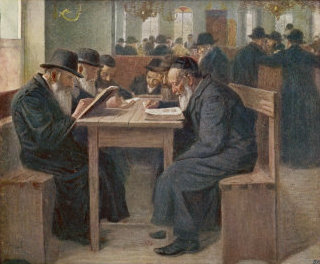
studying-talmudThis is a very mystical understanding of the “life” of the Torah and how in Chasidic Judaism, it transcends the physical scroll and exists as both the blueprint of the Universe and the means of its creation. Since we in Christianity understand that “the Word became flesh” (John 1:14) and that through the living Word, “things were made through him, and without him was not any thing made that was made,” (John 1:3) we also have a mystical understanding of the Bible, the Messiah, and creation, so perhaps the simple text on paper we see when we read our Bible and try to interpret it is not so simple after all. More than that, perhaps we cannot allow ourselves to limit that Word or that Messiah to what our Christian tradition says it all means, even if it makes us uncomfortable and stretches our understanding.

To drink “new wine,” we must prepare “new wine skins.”

Good Shabbos.

Gateway to Eden

Gateway to EdenNow the serpent was more crafty than any of the wild animals the LORD God had made. He said to the woman, “Did God really say, ‘You must not eat from any tree in the garden’?”

The woman said to the serpent, “We may eat fruit from the trees in the garden, but God did say, ‘You must not eat fruit from the tree that is in the middle of the garden, and you must not touch it, or you will die.’”

“You will not certainly die,” the serpent said to the woman. “For God knows that when you eat from it your eyes will be opened, and you will be like God, knowing good and evil.”Genesis 3:1-4

We are all familiar with the story of Adam and Eve and their sin with the fruit of the Tree of Knowledge (Genesis 3). As the story goes, the Serpent, most “cunning” of all the animals, comes along and tempts Eve to taste of the fruit, promising that it would open the eyes of man, making her and Adam “as gods knowing good and evil” (v. 5). Eve decides that the Tree is tempting to behold and both eats of the fruit and gives her husband to eat.

This, however, presents a difficultly. If Adam and Eve themselves had no evil inclination, how could they have *wanted* to sin? How could they — entirely spiritual beings — desire anything other than goodness and closeness to G-d? Where could a desire to rebel against G-d stem from?

-Rabbi Dovid Rosenfeld
The Primordial Sin, Part I (2006)
Torah.org

Christianity and Judaism see “the Fall of Man” event in Genesis very differently, but there are obvious parallels. “In the beginning”, Adam and Eve are sinless beings, created by God and knowing an incredible intimacy with the Source as completely spiritual yet physical beings. In Judaism, people originally had no internal inclination toward evil but upon disobeying the one commandment given by God, the external temptation, represented by the Serpent, became internalized. Man separated himself from God and the nature of the world became broken.

Rabbi Rosenfeld goes on in Part III of the series to ask some difficult questions:

To this we explained that man sinned in order to make life more challenging. Before the Sin, man had only a single mitzvah (commandment) — not to partake of the fruit of the Tree. There was, it seemed, very little for him to accomplish. Now, as a physical being desiring evil, life would be so much more challenging. There would be so much more potential growth in store for man. Eventually mankind would require the rigorous and demanding 613 Commandments to curb the animal within and redirect him G-dward. Thus, man — *spiritual* man — *desired* the greater challenge that would now be in store for mankind.

This, however, still does not suffice. Why would man desire a greater challenge? So that he would have more opportunities for spiritual growth? But isn’t he basically just backing up in order to reach the same goal? The ultimate goal of life — self-evident to the spiritual person — is closeness to G-d. If man was created close to G-d, why not *stay* there — perform his single mitzvah and perfect himself? What was so enticing about making life more difficult?

From Christianity’s point of view, there was no justifiable reason for Adam and Eve to sin; to disobey God. It was a terrible, ghastly mistake that sent both humanity and the nature of Creation down a dark and dismal path, away from God and into the arms of darkness, requiring that God give “His one and only Son, that whoever believes in him shall not perish but have eternal life” (John 3:16).

Judaism says that, amidst what Christians can only view as a total spiritual disaster, there is something salvageable and even perhaps desirable to be gleaned:

The deepest, most profound desire a human soul has is to feel it exists — to feel it is not just a passive entity, acted upon and taken care of by others. A person needs to feel he is an independent being — what the Serpent called a “god” (and our mishna calls a “king”) — who can accomplish, grow and make a difference in the world. There is nothing more painful — *spiritually* painful — than feeling that one’s life makes no difference to anyone or anything, that he exists only as a person acted upon by others or by natural forces, and that he has done nothing to express his own existence.

This was man’s dilemma in the Garden of Eden. Man at first, as lofty as he was, was an almost entirely passive, “created” being. He was given existence by G-d. He was placed in the Garden of Eden with all his wants and needs satisfied and with only a single mitzvah to perform. Man wanted to feel he truly existed — that he was not just a plaything of the Almighty. He wanted to be a god himself. How could he do it? By forcing upon himself greater challenges. Adam and Eve would no longer be passive beings, practically created in G-d’s presence. They would now have to earn it. Spirituality would come only through the greatest of efforts — *their* efforts. It would be the challenge they would have to face to achieve their purpose — and in order to exist.

From what Rabbi Rosenfeld presents, man faced two options: live life close to God, obeying the single commandment provided by the Almighty, but never having the opportunity to truly carve out his own path and the ability to rise spiritually, or deliberately distancing himself from God, lowering his spiritual status, and then struggling back up the ladder, rung by rung, to drive himself ever closer to God and Eden.

I suppose a challenge like that would tempt the spiritual Sir Edmund Hillarys of the world, but for the rest of us, we see the “downside” to such a decision in terms of the pain, suffering, and anguished death of billions upon billions of human beings across the long march of millennia between the dawn of man and the current age.

And yet, here we are. “Our physical flesh (is) now a confused mixture of good and evil. We know the passing of the seasons as we age, and we know decay and death. We are separated from the infinite Spirit. The struggle against evil and the abyss is no longer an external enemy, but rather, it is part of who we are inside. Judaism longs for the coming of the Messiah and Tikkun Olam. Christianity looks to the day when Jesus will return and mankind will be redeemed from a fallen world.

But what if we don’t have to wait? Rabbi Yitzchak Ginsburgh says that we don’t:

After the primordial sin, Adam and Eve heard “the voice of God” walking through the garden. They heard God, He spoke to them, and they answered. This is the consciousness of “hearing,” the height of our consciousness of Godliness (God and His Divine Providence) is our lives subsequent to the primordial sin, the consciousness of the weekdays, the workdays (“By the sweat of your brow…”).

But on Shabbat we return to the pristine state of consciousness of God as it was prior to the primordial sin (and as it will be universally in the future). In the terminology of Kabbalah, during the weekdays our consciousness is at the level of understanding (“hearing” in Hebrew means also “understanding”) whereas on Shabbat our consciousness rises to the level of wisdom (direct insight into the mysteries of creation hidden within reality, and into the “mystery of mysteries,” the Creator of reality, the true and absolute Reality).

Throughout the week everything that happens around us, all that we see and hear, “tells” us about God and His Providence. On Shabbat we don’t have to be told about God, we experience Him directly.

ShabbatOne of the mistakes of the early (non-Jewish) Christian church was to casually discard the commandment, “Remember the Sabbath day by keeping it holy” (Exodus 20:8). The church alternately says that Jesus did away with Sabbath observance with the rest of the Law or that the “Sabbath” was mysteriously moved over one day, to coincide with the “Day of the Lord” and the resurrection of the Master. I personally think that the 2nd and 3rd century church found it necessary to separate themselves from anything “too Jewish” and simply shifted the “Holy Day” over by 24 hours to achieve this, and then used specific points of Scripture to justify the decision.

Today, Christians miss out on an opportunity, however limited, to return to Eden. For contained in the Shabbat isn’t just a day to go to church or synagogue, but in fact, we discover an opportunity to remove oneself from the other six days of the week, of the toil, of the work, of the worries, of the laboring, and to totally devote ourselves as spiritual and physical beings to the God of the Universe and the King of Righteousness, as in days of old.

Six days you shall labor and do all your work, but the seventh day is a sabbath to the LORD your God. On it you shall not do any work, neither you, nor your son or daughter, nor your male or female servant, nor your animals, nor any foreigner residing in your towns. For in six days the LORD made the heavens and the earth, the sea, and all that is in them, but he rested on the seventh day. Therefore the LORD blessed the Sabbath day and made it holy. –Exodus 20:9-11

Both Christians and Jews are going to disagree with me here, particularly since this mitzvot was directed at the Children of Israel, but I believe we Christians cheat ourselves terribly out of the experience to turn one-seventh of our lives into a time to walk personally with God. I think Rabbi Ginsburgh has a point to make, not only to Jews, but to Christians as well. But more gateways to Eden exist:

There are two exceptions to the above distinction between Shabbat and the weekdays, two times that we rise to the consciousness of Shabbat during the otherwise mundane time of the week. The Arizal teaches that our consciousness in the times of prayer, every day of the week three times a day, is at the level of Shabbat. The times of prayer, when we turn to God and address Him directly, are the Shabbat as its light shines into and permeates the week.

Also, a true Torah scholar is referred to in the Zohar as Shabbat. Continuously in communion with God through the means of His Torah (which ultimately in one with Himself) he experiences Shabbat-consciousness the entire week.

Whenever we immerse ourselves in the things of God, we are drawing closer. It happens when we pray, when we give to charity, when we help our neighbor with his yard work, when we hold a small child’s hand to cross the street, when we study the Bible, when we turn away from sin and turn, in obedience, to God.

While the mystic aspects of this process may be confusing or even a little frightening, it is clear that we are separated from God by the nature of humanity and the nature of the world, but we don’t have to be that way always. While waiting for the King of Kings to come to us, we do not have to wait helplessly. We can choose, whether commanded to or not, to observe a Shabbat where we are completely devoted to God. We can take one day of our week and separate it from the rest, separate it from the office, from phone calls, from the Internet, from worry, from work, from care. We can pray, study, speak of God and the Bible with others as we break bread together.

We can create isolated pockets of Eden in the Sabbath and even during the week when we pray and beg to come close to the Throne of Heaven. We can be like “little Messiahs”, helping to fix a broken world one dent and crack at a time by performing even one single act of kindness and humility.

Sin happened. Humanity fell. The world is a broken top spinning hopelessly off the table of existence. We can’t go back to fix it but we can choose to go forward toward God. We can choose to visit Eden on Shabbat. We can cross the threshold of the gates of Paradise every day, every time we pray. We can walk with God in the Garden every time we love our neighbor more than we love ourselves.

However you want to interpret these words, observe Shabbat, return to Eden, walk with God. You can never be lost as long as you are seeking God. You can never be lost as long as God wants you to find Him.

“Do not seek greatness for yourself and do not crave honor. Do more than you have studied and do not desire the ‘table’ of kings. For your table is greater than their table, and your crown is greater than their crown. And your Employer can be trusted to pay you the reward for your efforts.”
Pirkei Avot
Chapter 6, Mishna 5(a)

Finding Freedom

CaptureTell me, you who want to be under the law, are you not aware of what the law says? For it is written that Abraham had two sons, one by the slave woman and the other by the free woman. His son by the slave woman was born according to the flesh, but his son by the free woman was born as the result of a divine promise.

These things are being taken figuratively: The women represent two covenants. One covenant is from Mount Sinai and bears children who are to be slaves: This is Hagar. Now Hagar stands for Mount Sinai in Arabia and corresponds to the present city of Jerusalem, because she is in slavery with her children. But the Jerusalem that is above is free, and she is our mother.Galatians 4:21-26

Speak and act as those who are going to be judged by the law that gives freedom, because judgment without mercy will be shown to anyone who has not been merciful. Mercy triumphs over judgment.James 2:12-13

So what is it? Does the Law take away freedom or does the law give freedom? Are we even talking about the same Law; the Torah?

I’ve often suspected that Paul and James didn’t see eye-to-eye on many issues. Paul was operating for years at a time in the diaspora, bringing the Gentiles to faith in the Jewish Messiah and teaching them his ways and how to trust in God. There wasn’t a lot of oversight going on from the Jerusalem Counsel, so Paul could have gotten away with re-writing the Gospel message in his own image, diluting or even eliminating the law and replacing it a type of “grace” that is the antithesis of the law (though in reality, they are not mutually exclusive). It’s clear that James wouldn’t have agreed with that message.

However, if you read D. Thomas Lancaster’s new book The Holy Epistle to the Galatians, you’ll see that Paul and James were more alike than unalike (though I still suspect that they had their individual perspectives). For one thing, despite the common Christian tradition of interpreting Galatians 4:21-26 as “anti-Law” (and in the plain English text, it certainly seems that’s what Paul’s saying), the issues are more complex. Lancaster interprets them this way:

The passage contrasts two types of proselytes: the legal proselyte and the spiritual proselyte. The one becomes part of Abraham’s family by conventional conversion, the other through faith in Messiah, the promised seed of Abraham, in whom all nations find blessing. The passage does not contrast the Old Testament against the New Testament or the Old Covenant with the New Covenant. It does not equate Judaism and Torah with slavery, nor does it pit Christians against Jews.

It means that if you are a Jewish believer , you should be proud of being Jewish because you are a child of Abraham, legally, physically, and spiritually. It means that if you are a Gentile believer, you, too, are part of the people, a spiritual son of Abraham, and that is remarkable – miraculous even. You are a child of the promise that God made to Abraham so long ago.

I’ve already written a review of Lancaster’s book and I’m not going to “reinvent the wheel”, so to speak, but I’m presenting this “extra meditation” this afternoon, in response to the following:

No one can say he is free today because yesterday he was granted freedom.

Freedom is a source of endless energy.
Freedom is the power behind this entire universe.
Freedom is the force that brings existence out of the void.

You are free when you take part in that endlessness. When you never stand still. When you are forever escaping the confines of today to create a freer tomorrow.

Rabbi Tzvi Freeman
“Perpetual Freedom”
Chabad.org

As an Orthodox Jew, Rabbi Freeman isn’t considering that the Torah is somehow slavery or bondage, even for a single moment. So how are Christians to interpret his words of freedom as well as the apparent conflict between Paul and James, both observant and devout Jews, on how they view the Torah?

It is said that the world was created for the sake of Torah and that, without the Torah, the world could not have been made. The analogous teaching we have in Christianity is this:

In the beginning was the Word, and the Word was with God, and the Word was God. He was with God in the beginning. Through him all things were made; without him nothing was made that has been made. –John 1:1-3

TeshuvahHere, we see a sort of “fusion” or co-identity, in some mystic sense, between the Torah and the Messiah, Son of the living God. Christians know that Jesus gives us freedom from the slavery of sin and Jews know that the Torah is the gateway to God’s endless energy, the power behind the universe, and the limitless, eternal source that creates existence out of nothingness. Through Torah, God does not enslave, but provides the means by which men may know God and understand our relationship to Him. If the same can be said of Jesus, then we can all understand from where our freedom comes.

While non-Jewish disciples of the Jewish Messiah are not obligated to the same “yoke of Torah” as the Jewish people (see Acts 15), we nonetheless are grafted into the root of the Tree of Life and like branches on the vine, we draw our nourishment and the ability to live a life of holiness from an identical source; God.

To do so requires more than just believing and more than just learning; we must do, we must behave, we must live out the values we understand from the Torah and how they were taught to us by the “living Torah”, the Moshiach, Jesus Christ. Part of that living is understanding where we came from, who we are, and our need to separate from sin and embrace holiness and peace. To gain freedom from sin, we must recognize the depth and despair of sin, which is what the Torah aptly defines, and only upon achieving that understanding, can we truly turn away from that sin and turn toward the God of Abraham, Isaac, and Jacob:

The Ohr Hachaim HaKadosh, zt”l, writes that one can only do teshuvah if he first recognizes the gravity of his sin.

A certain person committed a sin. When Rav Mordechai Aryeh Halevi Horowitz, zt”l, gently nudged him to repent the sinner displayed his relaxed attitude towards teshuvah. “Why repent now? Soon enough it will be Elul, the season when the shofar is sounded to remind us to do teshuvah. Can’t my teshuvah wait until then?”

Rav Horowitz rejected this attitude out of hand. “As is well known, the main element in teshuvah is havdalah, separating between what is proper and what is not. It is only by determining which actions lead to darkness and which generate light that we act as is fitting. Even if a person with understanding falls to sin chas v’shalom, he knows to repent and change his ways. But many people wait until Elul to do teshuvah. After all, isn’t that when we are aroused to repentance by the shofar as the Rambam writes?

“We find in the Mishnah in Chulin 26 that whenever the Shofar is sounded we do not say havdalah. Conversely, whenever we say havdalah we do not sound the shofar. Although on a simple level this is a sign for when they would blow the shofar to signify the onset of Shabbos or Yom Tov, this statement also teaches a lesson about teshuvah. When one feels justified waiting to do teshuvah until the shofar is sounded during Elul, this shows he lacks understanding. He does not comprehend the gravity of sins since this leads to havdalah, healthy separation between what is right and what is wrong. One who has fitting discrimination between good and bad doesn’t wait to hear the shofar to repent!”

Dam Yomi Digest
Stories off the Daf
“Time for Repentance”
Chullin 26

If we claim to be without sin, we deceive ourselves and the truth is not in us. If we confess our sins, he is faithful and just and will forgive us our sins and purify us from all unrighteousness. –1 John 1:8-9

Good Shabbos

As If Considering Angels

Broken AngelFor this very reason, make every effort to add to your faith, goodness; and to goodness, knowledge; and to knowledge, self-control; and to self-control, perseverance; and to perseverance, godliness; and to godliness, mutual affection; and to mutual affection, love. For if you possess these qualities in increasing measure, they will keep you from being ineffective and unproductive in your knowledge of our Lord Jesus Christ.2 Peter 1:5-8

Said Rabbi Joshua the son of Levi: Every day, an echo resounds from Mount Horeb, proclaiming and saying: “Woe is to the creatures who insult the Torah.” For one who does not occupy himself in Torah is considered an outcast, as is stated “A golden nose-ring in the snout of a swine, a beautiful woman bereft of reason.” And it says: “And the tablets are the work of G-d, and the writing is G-d’s writing, engraved on the tablets” ; read not “engraved” (charut) but “liberty” (chairut)—for there is no free individual, except for he who occupies himself with the study of Torah. And whoever occupies himself with the study of Torah is elevated, as is stated, “And from the gift to Nahaliel, and from Nahaliel to The Heights.”Ethics of the Fathers 6:2

I know these two quotes may not seem to go together, but consider this. Peter says that we should add faith to goodness and then add goodness to knowledge. What knowledge? Where does this knowledge come from? Rabbi Joshua ben Levi implies that knowledge comes from Torah by expressing the inverse that one who does not occupy himself with Torah “is considered an outcast” and is like a “golden nose-ring in the snout of a swine, a beautiful woman bereft of reason”.

Sounds pretty harsh, but then, so does Peter:

This is especially true of those who follow the corrupt desire of the flesh and despise authority. Bold and arrogant, they are not afraid to heap abuse on celestial beings; yet even angels, although they are stronger and more powerful, do not heap abuse on such beings when bringing judgment on them from the Lord. But these people blaspheme in matters they do not understand. They are like unreasoning animals, creatures of instinct, born only to be caught and destroyed, and like animals they too will perish. –2 Peter 2:10-12

I’ve been involved in a series of online discussions lately that have been critical of Talmud study among Christians. Specifically, the allegation is that the sages who documented the Oral law and established a system of rulings for the Jewish people, were the inheritors of the tradition of the Pharisees and that Jesus had nothing good to say about the Pharisees, citing examples such as this:

Then Jesus said to the crowds and to his disciples: “The teachers of the law and the Pharisees sit in Moses’ seat. So you must be careful to do everything they tell you. But do not do what they do, for they do not practice what they preach. They tie up heavy, cumbersome loads and put them on other people’s shoulders, but they themselves are not willing to lift a finger to move them. “Everything they do is done for people to see: They make their phylacteries wide and the tassels on their garments long; they love the place of honor at banquets and the most important seats in the synagogues; they love to be greeted with respect in the marketplaces and to be called ‘Rabbi’ by others. –Matthew 23:1-7

This is just one of the examples in the Gospels which cast all Pharisees everywhere in a particularly bad light, but as I commented recently, Jesus is upset with this group of Pharisees, not because they taught bad things, but because they didn’t practice what they taught! Keep that in mind. If the Pharisees had behaved consistently with their teachings, Jesus wouldn’t have had a problem with them at all. His only beef with the Pharisees is that they were hypocrites, not false teachers.

Think about it. If, as some have stated, the Talmudic scholars and sages have inherited the mantle of the Pharisees and they behaved consistently with their own teachings, then it is quite possible that the “Rebbe of Nazaret” wouldn’t have any problem with them either.

I know there are a lot of variables to consider and we won’t know for sure until Jesus returns to us, but based on this small bit of simple logic, we cannot reasonably discard or disdain anything in the Talmud based on the behavior of a collection of hypocritical religious authorities that operated in Roman-Judea in the time of Jesus. We can’t also reasonably apply the following to the Rabbis of the Talmud:

The Lord says: “These people come near to me with their mouth and honor me with their lips, but their hearts are far from me. Their worship of me is based on merely human rules they have been taught. Therefore once more I will astound these people with wonder upon wonder; the wisdom of the wise will perish, the intelligence of the intelligent will vanish.” –Isaiah 29:13-14

I know it’s enormously tempting to apply the words of the Prophet not only to the Pharisees but to the Talmudic sages as well. Certainly, if we think of the Talmudic writings as only the rules of men with no Biblical source, then we might be justified in doing so, but taken out of context, we don’t know if Isaiah is even considering the Oral Law (which he would have seen as Torah) or the Rabbinic commentaries and rulings on said-Oral Law (and Written Law), which are recorded in the Talmud. The rulings of the Rabbis don’t overwrite and contradict Torah, but rather, are intended to interpret and make sense of the Written and Oral Law for each generation of Jews as they met new challenges in applying a Torah lifestyle in an ever-changing world.

Here’s something else to consider:

At that time Jesus said, “I praise you, Father, Lord of heaven and earth, because you have hidden these things from the wise and learned, and revealed them to little children. Yes, Father, for this is what you were pleased to do. –Matthew 11:25-26

Taken together with some portions of the quote from Isaiah 29:13-14, these words of the Master might suggest that it’s bad to be intelligent, well-read, and educated. Why bother to learn how to read at all if intelligence is not to be trusted and if it’s better to be ignorant and untaught? I don’t think this is what the Master means here, but rather, he’s saying you don’t have to be a scholar to have access to the grace of God. Of course, he’s not saying grace is denied the learned sage, either.

It’s been suggested that Rabbinic judgments and rulings are not to be trusted and that the wisdom of the average individual, as guided by the Spirit, reading the Bible in English and outside of its history, culture, and other contexts, is far preferable to trusting and learning from people who have spent all of their lives pouring over Scripture and striving to master the teachings of God.

And yet Peter was critical “of those who follow the corrupt desire of the flesh and despise authority”. Further, he said that “First of all, understand this; no prophecy of Scripture is to be interpreted by an individual on his own, for never has prophecy come as a result of human willing – on the contrary, people moved by the Ruach HaKodesh (the Holy Spirit) spoke the message from God”. (2 Peter 1:20-21 [CJB]).

Cutting BranchesWe could be tempted to say Peter is confirming that all a person; any person, needs is the Holy Spirit to interpret the Bible, but he’s also speaking of Prophets like Isaiah, not the average guy on the street. We read the prophecies of Isaiah because he was a prophet of God and we’re not. We read the teachings of Jesus because he’s the Messiah and we’re not. Also, lest we forget, Paul, the Apostle to the Gentiles, and the key to bringing the Gospel of Jesus Christ to the nations of the world, was a very well-educated man…in fact, far more educated than many of Christ’s inner circle who were what we would consider today as blue-collar workers and laborers.

There’s no problem with who Jesus chose to be close to him as being, relatively speaking, uneducated, because, as I’ve already mentioned, the love of Christ isn’t primarily accessed through “book-learning”. But on the other hand, the fact that Paul was chosen by Jesus says that education and authority isn’t a problem either. Certainly, being learned and possessing authority requires that such a position be used with justice, honor, and humility. The Ethics of the Fathers 6:5 speaks to this:

Do not seek greatness for yourself, and do not lust for honor. More than you study, do. Desire not the table of kings, for your table is greater than theirs, and your crown is greater than theirs, and faithful is your Employer to pay you the rewards of your work.

In fact, from the same chapter (Chapter 6:6), we find that study of Torah (which includes Talmud in this context) yields people who have qualities such as:

love of G-d, love of humanity, love of charity, love of justice, love of rebuke, fleeing from honor, lack of arrogance in learning, reluctance to hand down rulings, participating in the burden of one’s fellow, judging him to the side of merit, correcting him, bringing him to a peaceful resolution [of his disputes], deliberation in study, asking and answering, listening and illuminating, learning in order to teach, learning in order to observe, wising one’s teacher, exactness in conveying a teaching, and saying something in the name of its speaker.

As long as the teacher behaves consistently with these, and the other teachings in the Torah and Talmud, what problem could this present? What problem could it present for any person of faith and good will who wishes to devote time to pondering this wisdom?

We see that taking Scripture out of context and applying an overly simple interpretation to what may turn out to be very complex matters of principle actually results in a disservice to the Prophets and Apostles, as well as to the later sages, and finally to Jesus and to God the Father.

We should all be very, very careful how we interpret and apply Scripture, especially if we use it to malign our teachers and scholars and, by inference, every religious Jew who has ever lived or will live, for they too revere the sages and attempt to live their lives by the principles of Torah, which have been established and interpreted across the ages.

I will bless those who bless you, and whoever curses you I will curse; and all peoples on earth will be blessed through you.” –Genesis 12:3

I do not want you to be ignorant of this mystery, brothers and sisters, so that you may not be conceited: Israel has experienced a hardening in part until the full number of the Gentiles has come in, and in this way all Israel will be saved. As it is written: “The deliverer will come from Zion; he will turn godlessness away from Jacob. And this is my covenant with them when I take away their sins.” –Romans 11:25-27

All Israel has a share in the World to Come, as is stated: “And your people are all righteous; they shall inherit the land forever. They are the shoot of My planting, the work of My hands, in which I take pride.” –Sanhedrin 11:1

for there is no free individual, except for he who occupies himself with the study of Torah. –Ethics of the Fathers 6:2

Do not denigrate the root, lest your branch be cut off from it.

What the Talmud Says About Gentiles, Revisited

Talmud StudyI originally wrote this article in October of 2009 for the Congregation Shema Yisrael blog. While I no longer am affiliated with that congregation (for many reasons previously stated), I wanted to “import” the article here, since there have been some recent conversations on the blogosphere issuing a “warning” that overly studying the Talmud or other Jewish writings could result in a Christian apostatizing from the church and abandoning faith in Jesus. Speaking for just myself, I find a great deal of value and wisdom in reading the Jewish writings and don’t find myself being drawn away from my faith. In fact, quite the opposite. I find many parallels between how the sages taught and the teachings of my own “Rebbe”.

The Talmudic sages are often depicted as being very much against non-Jews in general and Christians in specific. While I believe, given the long history of Christian persecution of Jews, that the tzadikim had good reasons to feel leery of the church, if we actually look at what the Talmud has to say about non-Jews, we see a more evenly balanced perspective. I wanted to inject the content from my almost three-year old article into my current blog to provide a reminder that Jews and Christians don’t have to be at odds with each other and particularly, that Christians don’t have to be at odds with the Talmud or avoid Jewish study. Here, for your illumination, is the content of my original article What Does the Talmud Say About Gentiles? in its entirety.

The Talmud contains many references to righteous gentiles whose behaviour is held up as a model for all people. The example of Dama ben Netina is known to all Jewish children (Kidushin 31a): ‘They asked R. Eliezer how far one should go in honoring parents. He said to them: Go and see how one idol worshipper in Ashdod honored his father, and Dama ben Netina was his name. The sages wished to purchase gems from him for the Ephod [for a tremendous profit] … but the key [to the box containing the gems] was under his father’s pillow [while his father was sleeping] and he did not trouble his father [by waking him even though he gave up a tremendous profit].’ Dama was rewarded for his virtue the next year when a red heifer [required for the Temple service] was born in his flock. When he sold it to the sages he told them that he knew that they would pay any price he asked for it, but he asked only for the amount he had not earned the previous year when he refrained from waking his father.

-quoted from a now defunct website

Messianics and many traditional Christian churches support Israel and the Jewish people as chosen and established by God. We seek to “honor the root” of our faith in Yeshua (Jesus) by honoring Jews; the only people who worshipped the one true God, and kept His Shabbat and Holy Torah for thousands of years, while the rest of the world was immersed in idolatry.

While many Messianics particularly, feel a close connection to the Jewish people though the keeping of the Shabbat, the prayers, and many other Hebraic practices, we sometimes we don’t realize that the door swings both ways. What does the Talmud and other writings teach Jews about Gentiles?

I’ve been interested in this topic for quite some time, but what made me dig a little deeper into the subject was a thread in a discussion forum at Arutz Sheva, an Israeli news service, started by a former Christian living in Israel, who had recently converted to Judaism (the non-Messianic kind). You can read her reasoning in the thread and the many responses her post elicited, but one of the main reasons she felt led to embrace Judaism and reject Yeshua as the Messiah, is that Judaism and Torah doesn’t teach that God can be a man. In that view, Yeshua as the earthly incarnation of the God of Heaven is impossible.

I’m not going to explore the view of the Christian Trinity through Jewish eyes, but I do want to take a more general look of how Gentiles are viewed in classic Judaism. Interestingly enough, some of the best sources I found on the topic are no longer available on the web or may soon become unavailable.

For instance, one of the best collections of Talmud quotes relevant to Gentiles was housed at The Talmud Exposed, formerly maintained by M. Gruda. Unfortunately, the site hadn’t been updated in almost a decade, and even worse, it was hosted at GeoCities. I came across it only days before Yahoo! permanently closed down all GeoCities sites. Fortunately, I copied the text content off of the page and will present it later in this blog for your review.

Another extremely helpful site is The real truth about the Talmud, hosted at angelfire.com. The angelfire hosted site is maintained by Gil Student and hasn’t been updated since 2000 (as far as I can tell). Since Angelfire is also a free web hosting service, it could also, in theory, disappear at any time, and so the content may not be as durable as if it resided at a more reliable (paid) host.

Before continuing, I want to emphasize why the Talmud is such an important information source in Judaism. For those of us without a classic Jewish education, we tend to look at the extra-Biblical Jewish writings as “mere commentary”, that we can either take or leave. The following from Daf Digest may help illuminate the Jewish perspective somewhat:

On today’s daf we find the unerring honesty of Rav Huna who explains why the halacha is like Rav Nachman, not himself.

Rav Wolbe, zt”l, once explained why absolute honesty must be attributed to the true chachamim of each generation. “Every Torah Jew must have absolute confidence in the great achronim of every generation. We must never suspect the Chofetz Chaim, zt”l, or the Chazon Ish, zt”l, of falsehood even in worldly matters and certainly not in the all-important area of halacha.

“When the Chofetz Chaim rules in a certain way it is as if he says this in the name of his teacher and his teacher’s teacher all the way back to Moshe (Moses) at Sinai. Someone who doubts this, doubts the veracity of Hillel and Rabi Akiva as well since what is the real difference? Even this confused person must concede that if the halachic process of our greatest authorities is based on falsehood, perhaps the same is true regarding the earlier authorities, chas v’shalom!

“When Hashem sent prophets to warn powerful kings that they would fall and their kingdoms would be destroyed, they did so fearlessly despite the terrible dangers involved. The word of Hashem burned in their hearts and they foretold these events without the slightest change. Even though some suffered blows or even imprisonment for telling people what they did not wish to hear, they would not falsify or even hold back their prophecy. “Like the prophets, the sages valiantly taught Torah whatever the consequences, since their only interest was to promulgate the truth. There can be no doubt that regardless of pressure or political considerations, the great sages of each generation remained true to the halacha which burned in their hearts. It is not for nothing that Chazal teach in Shabbos 138b, that ‘devar Hashem’ refers to both prophecy and halacha!”

From the Daf Digest
Bava Basra 65
Stories off the Daf
“The Halachic Process”

As you can see, Talmud commentary is considered in the same light as the writings and sayings of the ancient Prophets of God. To question Talmud, in some sense, is like questioning all of the Prophets, going all the way back to Moses. A Christian wouldn’t question something said by Jesus or Paul in the Apostolic Scriptures, nor of the Prophets in the Tanakh. Think of how Judaism sees the commentaries of the wise Sages. With that under our belts so to speak, let’s continue with how Judaism and Talmud speaks of Gentiles.

Talmud Study by LamplightAccording to the Judaism 101 site, “Judaism maintains that the righteous of all nations have a place in the world to come”, however, Jews are seen as especially chosen by God and the Jewish people possess a favored position, and very specific responsibilities to God. Only Jews are responsible for keeping of the entire Torah, while Gentiles, in order to merit a place in the World to Come, must only keep the Seven Laws of Noah.

Many Christians have the idea that Jews disdain or otherwise dislike Gentiles. I recall having an extended email conversation with one fellow who was actually angry at Jews for denying Gentiles access to God and Heaven, by not evangelizing Gentiles and attempting to convert them (us) to Judaism. From a Jewish perspective, it’s not necessary for the rest of the world to convert to Judaism, and Jews do not believe that God rejects the rest of the non-Jewish world. Being Jewish or non-Jewish is a matter of roles and responsibilities to God, not the presence or absence of God’s ultimate love and compassion.

This actually goes a long way to explaining the sudden shift in theology of the Messianic educational group First Fruits of Zion (FFOZ), who now state that only Jews are obligated to comply with the Torah commandments, while Gentiles are “divinely invited” to keep as many as they are called. This isn’t quite what Judaism teaches, as illustrated in my article up to this point, but it is a solid move in that direction.

As a Messianic or a traditional Christian, you might be asking yourself right now why any of this should be important to you. If you are a person who has visited, or is intending to visit a traditional synagogue to share Yeshua with your Jewish brothers and sisters, it might help to understand something of the Jewish perspective. It’s also important for us as Messianics to see where our worship and faith practice aligns with Judaism and where it deviates. Much of the theology of “Messianic Judaism”, at its core, is Christian rather than Jewish. Many in the Messianic movement haven’t explored the real “Judaism” part of “Messianic Judaism”, and I think it behooves us to become more knowledgeable in this area.

What does the Talmud say about Gentiles? From M. Gruda’s now non-existent site, here are the available quotes. This list is somewhat long and the text is verbatim:

“They said of Rabbi Yochanan ben Zakai that no man ever greeted him first, even idol worshippers in the market” [i.e., Rabbi Yochanan ben Zakai was the first to greet every person, even idol worshippers] (Berachot 17). At the same location the sage Abaye advocated soft speech and words of peace to everyone, especially including idol worshippers.

“[it is proper to] support the idol worshippers during the sabbatical year… and to inquire after their welfare [commentators: even on the days of the holidays of their idols, even if they do not keep the seven Noahide commandments] because of the ways of peace.” (Shevi’it 4,3)

The rabbis taught: ‘We support poor Gentiles with the poor people of Israel, and we visit sick Gentiles as well as the sick of Israel and we bury the dead of the Gentiles as well as the dead of Israel, because of the ways of peace.” (Gitin 61a)

The Talmud contains many references to righteous gentiles whose behaviour is held up as a model for all people. The example of Dama ben Netina is known to all Jewish children (Kidushin 31a): ‘They asked R. Eliezer how far one should go in honoring parents. He said to them: Go and see how one idol worshipper in Ashdod honored his father, and Dama ben Netina was his name. The sages wished to purchase gems from him for the Ephod [for a tremendous profit] … but the key [to the box containing the gems] was under his father’s pillow [while his father was sleeping] and he did not trouble his father [by waking him even though he gave up a tremendous profit].’ Dama was rewarded for his virtue the next year when a red heifer [required for the Temple service] was born in his flock. When he sold it to the sages he told them that he knew that they would pay any price he asked for it, but he asked only for the amount he had not earned the previous year when he refrained from waking his father.

Another example of righteous gentiles whose behaviour is held up as a model is to be found in the story of the King of Katsia and his subjects. One of his subjects purchased a ruin from his neighbor and found a treasure in it. He insisted on giving it back to his neighbor, claiming he had purchased only the ruin, and not a treasure. His neighbor refused to take it, insisting that he had sold the ruin and everything in it. The two litigants came to the King to decide the issue. When the King discovered that one neighbor had a son and the other one had a daughter he ruled that the children should marry and share the treasure. It is related that Alexander of Macedonia saw this judgement and was amazed by it. He told the King of Katsia that in his country the two neighbors would be executed (since in his land found treasure had to be delivered to the King at the pain of death). The King of Katsia is reported to have asked Alexander if the rain fell and the sun shone and if there were animals in the land of Alexander. When Alexander answered affirmatively the King of Katsia told him that the sun shone and the rain fell in the merit of the animals, not the people of his land. (Gen R 33 – further sources are referenced at this location).

Baba Kama 38a: “But we learned: R. Meir says – whence do we learn that a gentile who is occupied in the Torah [the reference is to those commandments which apply to gentiles] is like the High Priest? As it says [a proof text is given]…”

Kidushin 32 contains descriptions of the manner in which our sages honored and respected the elderly. The passage specifically refers to elderly gentiles who were honored in various fashions by the sages.

In TY Baba Metzia there are a number of descriptions of sages going out of their way to return lost objects to gentiles (Elu Metziot).

Avot 3,14: “He [Rabbi Akiva] was accustomed to say: Beloved is man [commentators: the reference is to all mankind], for he was created in G-d’s image ..”

Tosefta BK 10,8: “.. it is more grievous to steal from a gentile because of the desecration of G-d’s name ..”

Tosefta BM 2,11: “.. one who sees a lost donkey of an idol worshipper must take care of it exactly the way he takes care of the lost donkey of an Israelite ..”

At Avoda Zara 18a the Talmud relates the remarkable story of how a Roman guard of one of the sages who was brutally murdered by the Romans repented. It was made known to the sages that the guard and the sage were welcomed to the World to Come together.

At Hullin 7a there is a report of how the sage Pinchas ben Yair miraculously split a river in order to speed his way to carry out the commandment to redeem captives. He went out of his way to split the river again in order to allow a gentile who was accompanying his group to also cross the river to speed his way.

The TalmudFrom M. Gruda: This approach characterized sages throughout all generations. Some examples have been quoted in the earlier parts of this article. Two further examples of interest follow. Many more appear in the literature.

Maimonides (over 800 years ago) in Laws of the Sabbatical Year and Jubilee, Chapter 13, Halacha 13, writes .. “and not only the Tribe of Levy [merits special closeness to G-d] but every single person of those who walk the earth who … walks straight in the manner G-d created him … behold this person is sanctified as the Holy of Holies and [he will receive his reward in the World to Come] as the Priests and Levites.”

Tiferet Yisrael (Boaz) (approximately 150 years ago) on Avot 3,14 writes, ” … even if our sages had not explicitly taught [that righteous Gentiles have a place in the World to Come as we learn in Sanhedrin 105 and Maimonides Chapter 8 of the Laws of Kings] we would have understood this ourselves since G-d is righteous in all His ways … and we see many of the righteous Gentiles who not only recognize the Creator and believe in the divine origin of the Torah and also act charitably … we will say something which is a commandment to publicize … for behold, some of the them have done tremendous good for all mankind, such as Yenner who invented the … which saves tens of thousands of people from disease and death and deformities … and Draka (?) who brought the potato to Europe thus saving [people] from hunger … and Gutenberg who invented the printing press, and some who never received any reward in this world such as the righteous Reuchlin who risked his life [to prevent the burning of the Talmud] … Can anyone imagine that these great deeds are not repaid in the World to Come? ..”

As I mentioned earlier, another good source of information that remains available on the Internet is Gil Student’s The real truth about the Talmud:

In the Jewish worldview all gentiles who are ethical monotheists will achieve salvation. Judaism does not denigrate gentiles and does not see them as condemned to eternal damnation. Rather we see them as fellow human beings, from other nations, searching for G-d and for meaning in life. Judaism wishes them well with their search and celebrates those who succeed in becoming ethical monotheists. Jews are obligated in many rituals and ceremonies and those Jews who fail to fulfill these rituals are considered sinners. Gentiles, however, are not obligated in these commandments and are only obligated to be ethical monotheists. Those who fulfill this obligation receive their full reward in the world-to-come.

This article wasn’t written as a denial of faith in Yeshua, but as an attempt to offer some insight to Messianics/Christians on how traditional Judaism, using the Talmud, views the “ethical monotheistic” Gentiles. While our message about the Messiahship of Yeshua isn’t readily accepted in the Jewish world view, we are accepted as fellow creations of the God of Abraham. May we all find our home and our salvation in the arms of the God of Heaven, Jew and Gentile alike.

Blessings.

Beyond Reason

Out of the darknessA mind directed entirely by its own reasoning will never be sure of anything.

As good as the mind is at finding solutions and answers, it is even better at finding questions and doubts.

The path of Torah is to ponder its truths, so that your mind and heart will resonate with those truths, until all your deeds are guided by a voice that has no second thoughts.

-Rabbi Tzvi Freeman
“Certainty”
Chabad.org

How many of us ever take the time to stop and think about our theology, our deeply cherished and hard fought over arguments? Recently a popular blogger I know expressed a concern about even entertaining opposing arguments lest one lose one’s faith as a result of sown doubts – to him it wasn’t a good idea to engage the opposition in a non-polemic way, that is in a way that actually allows that other peoples arguments may, by some odd chance, hold water. And then I came across the following poignant remark that puts all this into better focus.

Gene Shlomovich
Ever thought you may be wrong about your cherished theology?
Daily Minyan blog

Questioning your own faith is a horrible thing. I know. I’ve been there. I spent an entire year, actually two, questioning the assumptions of my faith in virtually every detail. Eventually, I came to a crisis and fortunately passed through it with my faith in God intact. I recall the day I discovered what this person has just mentioned at Christian Forums:

wow, I never considered that 2 Peter was not written by Peter. Some say it was, some say it wasn’t. Hmff. Is there like a guarunteed listing of who wrote what or who didn’t write what?

Actually, most New Testament scholars acknowledge that not all of the Gospels and Epistles were written by the people to whom they are attributed. I discovered this reading Bart D. Ehrman’s Jesus, Interrupted (a challenging book which I highly recommend). Once I got past this, and the fact that there actually are inconsistencies in the Bible (compare the different Gospel versions of the day Jesus died and then try to figure out which day it was…the accounts conflict), I recovered my balance a bit. Then I realized that I didn’t have to depend on the Bible reading like a history book or a court deposition in order to gain wisdom and understanding from the stories the Bible tells us.

Questioning our assumptions isn’t a disaster and in my case, it resulted not only in a “course correction”, but in a greater zeal in returning to the Bible and seeing God in the writings of the Jewish prophets, apostles, and sages. However, in Judaism, the Torah isn’t simply a document or a way to try to grasp the essence of God through study. It is so much more and to understand this, we must step outside of what we consider a “rational reality”, for God doesn’t manifest in only the material world:

The answer depends on insight into the nature of the Torah. The Torah is one with G-d, an expression of His essential will. Therefore, just as His will is above intellectual comprehension, so too is the Torah. Nevertheless, G-d gave the Torah to mortals, not because He desires their obedience, but because He is concerned for their welfare. He wants man to develop a connection with Him, and for that connection to be internalized within man’s understanding, so that G-dly wisdom becomes part of his makeup. And with that intent, He enclothed the Torah in an intellectual framework.

This intellectual dimension is, however, merely an extension of the Torah. The Torah’s essence remains transcendent G-dliness, and cannot be contained within any limits even the limits of intellect. To relate to this essence, man must approach the Torah with a commitment that transcends wisdom or logic.

-Rabbi Eli Touger
“Beyond the Ken of Knowledge”
Parshas Chukas; Numbers 19:1-25:9
Adapted from
Likkutei Sichos, Vol. XVIII, p. 229ff

Christianity doesn’t even imagine the Bible being more than the Bible; a book written under the Divine inspiration of the Holy Spirit and recorded by many different people across thousands of years. It’s hard for me to imagine that the church misses this, since it’s stated quite plainly here:

In the beginning was the Word, and the Word was with God, and the Word was God. He was with God in the beginning. Through him all things were made; without him nothing was made that has been made. In him was life, and that life was the light of all mankind. The light shines in the darkness, and the darkness has not overcome it. –John 1:1-5

Path of TorahCertainly “the Word” is not just “the word” printed on a page in a book and in fact, this particular Word “became flesh and made his dwelling among us” (John 1:14). Of the four Gospels, John’s is considered the most “mystic” and it reads more like a chasidic story, which was a large part of what attracted a young Chasidic Jew named Feivel Levertoff at the end of the 19th century, to become a Chasid (a “devoted disciple”) of the “Maggid of Nazeret”, Jesus of Nazareth.

There’s a special depth in how Jews look at the Torah and find not only information about God but actually find God inhabiting the pages that are not just pages. There, they also find devotion and longing for the coming of the Moshiach (Messiah):

Yad HaChazakah is a book of laws, not a history book. What difference does it make from the perspective of Jewish law how many Parah Adumos were offered in previous generations? Moreover, why does the Rambam go on to add a prayer for the coming of Moshiach?

With regard to the obligation to believe in the coming of Moshiach, the Rambam states: “Whoever does not believe in him, or does not await his coming, denies not only [the statements of] the other prophets, but also [those of] the Torah and of Moshe, our teacher.” In other words, mere belief in Moshiach’s coming does not suffice, we are also obligated to hope for and await his arrival.

Moreover, this anticipation is to be in accordance with our thrice-daily recitation of the Amidah prayers: “Speedily cause the scion of David Your servant to flourish. for we hope for Your salvation all day.”

-Based on the teachings of the Lubavitcher Rebbe, Rabbi Menachem M. Schneerson
A Commentary on Torah Portion Chukas

For those of us who have faith and trust in Jesus as the Moshiach, who came once and will come again, we should take even greater comfort and meaning in the insights the Rambam and Rabbi Schneerson share with us. If we depend on “knowing God” through a Bible that must be completely internally consistent and absolutely a record of historical fact, we will become confused and disappointed or we will be forced to “bend reality” and make the text to fit our needs and preconceptions. As Rabbi Freeman says, the purpose of Torah (and the Bible as a whole) is so that we can “ponder truths” (not facts), not the least of which is the truth of the Messiah in our lives, allowing God’s Word to become intertwined into the fabric of who we are and letting all our deeds become “guided by a voice that has no second thoughts”

Good Shabbos.