Tag Archives: love

Doing Love

unworthyAaron was ashamed [and was reluctant to assume the position of High Priest] because of his role in the Golden Calf episode, and Moses said, “This is why you were selected.”

-Rashi, Leviticus 9:7

I was once asked to see a student nurse who was beside herself because she had made an error in medication. While this particular error was harmless, she felt that she lacked the competency to be a nurse, because she saw that she was capable of making even more serious errors.

I told the young woman that I did not know of anyone who can go through life without making any errors. Perfection belongs to God alone. If all nurses who became so upset because of a medication error would leave the field, the only ones who would remain would be those indifferent to making errors, and that would be the worst disservice to mankind.

We must try to do our very best at everything we do, particularly when it concerns others’ welfare. We must not be lax, negligent, nor reckless. We should of course be reasonably upset upon making a mistake and learn from such experiences how we might avoid repeating them. However, if in spite of our best efforts we commit errors as a result of our human fallibility, we should not give up. Allowing a mistake to totally shatter us would result in our not doing anything in order to avoid mistakes. This non-action would constitute the greatest mistake of all.

Today I shall…

…try to realize that the distress I feel upon making a mistake is a constructive feeling that can help me improve myself.

-Rabbi Abraham J Twerski
“Growing Each Day, Shevat 12”
Aish.com

No one wants to make a mistake. Certainly we all want to “get it right” the first time, whatever “it” happens to be. And when you are a person of faith, you particularly want to get moral and ethical stuff right all of the time.

It’s rather humbling when we do not. More than that, the rest of the world, both religious and non-religious people, seems to be just waiting for us to slip up so they can criticize us.

I suppose religious people are used to being put down by atheists because we’re “superstitious” or “irrational” or we’re “non-inclusive bigots” or something. However, some people of faith are no better, and tend to jump on other believers who have opinions and convictions that don’t line up with their own. You see this most often within Christianity from “Evangelical Fundamentalists” or whatever label is appropriate to use here…people who are uncompromising on matters of abortion or gay marriage (for example) and who only see the black-and-white of the issues and not the human beings involved. Christians say “love the sinner but hate the sin,” but truth be told, some Christian human beings often don’t know how to tell the difference so they hate them both.

If only we realized that we are just as capable of making mistakes as anyone else. It’s worse for us though, since we know that we are accountable to God for every word and deed we commit in our lives. One day, we’ll have to make an accounting. One day, we’ll have to face God! What the heck is wrong with us? Don’t we get it?

Rabbi Eliezer said: “Repent one day before your death.” His disciples asked him, “Does then one know on what day he will die?” “All the more reason he should repent today, lest he die tomorrow.”

-Shabbat 153a

But what is it to repent?

“It is told that once there was a wicked man who committed all kinds of sins. One day he asked a wise man to teach him an easy way to repent, and the latter said to him: ‘Refrain from telling lies.’ He went forth happily, thinking that he could follow the wise man’s advice, and still go on as before. When he decided to steal, as had been his custom, he reflected: ‘What will I do in case somebody asks me, “Where are you going?” If I tell the truth, “To steal,” I shall be arrested. If I tell a lie, I shall be violating the command of this wise man.’ In the same manner he reflected on all other sins, until he repented with a perfect repentance.”

-Rabbi Judah ben Asher, fourteenth century

love-in-lightsIs making a mistake the same as sinning? Sometimes I suppose, but as we saw in the example of the student nurse above, sometimes we just make mistakes. Even when someone gets hurt, it’s still a mistake and not a sin. But mistakes and sins have a few things in common. If we are morally adequate people, they both make us feel guilty and they both show us that we need to improve and change our ways.

Sin and repentance have been written about endlessly by people far wiser and more worthy than I, so what’s the point of me putting in my two cents? Nothing, I suppose, except for timing. There are times when we need to say such things and times when we need to hear them as well. We may not realize that it’s time and we may not seek out the information which would then inspire us to be convicted and (hopefully) to then transform. So I offer this to you just in case it’s your time. And if we are, as Rabbi Eliezer suggests, to repent today (lest we die tomorrow), then every day is our time.

There are parallel guidelines which are set to direct us in our life goals. On the one hand, we are encouraged and even obligated to state, “When will my actions be as those of our patriarchs?” In this regard we should feel that we can achieve the same levels as our ancestors. On the other hand, we must recognize that we are worlds apart from the lofty levels of our forefathers. In fact, it would be highly presumptuous to even think that we have the ability to match their accomplishments, as our Gemara reports. Even the greatest among us must acknowledge that compared to the personalities of the Torah, who were giants in character and sainted servants of Hashem, we are as mere humans as compared to angels. How are we to balance the approach we are to take in setting our goals and aspirations?

Daf Yomi Digest
Gemara Gem
“Great Asperations”
from the Commentary on Shabbos 112

We may never achieve a state of spirituality and holiness like those people we see in the Bible or those people of faith who we admire, but we can continue to seek God, and to seek His will, and to live the life he created us to live. At a very basic level, it’s really quite simple.

To love is to sigh at another’s sorrow, to rejoice at another’s good fortune. To love is the deepest of all pleasures.

-Rabbi Tzvi Freeman
“To Love”
Based on letters and talks of the Rebbe
Rabbi M. M. Schneerson
Chabad.org

Sometimes after a mistake or failure, the first person we need to learn to love is ourselves. That isn’t easy but we do have someone who can teach us. He’s the lover of our souls, and if anyone can see something inside of each of us that is worthy of love, it’s Him.

Go do like He does. Love who you are, then go love others for who they are.

Bo: I Will Betroth You to Me Forever

Laying Tefillin “And so it shall be as a sign upon your hand and as a symbol on your forehead that with a mighty hand the Lord freed us from Egypt.”

Exodus 13:16 (JPS Tanakh)

The Children of Israel are commanded to consecrate all firstborn, and to observe the anniversary of the Exodus each year by removing all leaven from their possession for seven days, eating matzah, and telling the story of their redemption to their children. They are also commanded to wear tefillin on the arm and head as a reminder of the Exodus and their resultant commitment to G‑d.

“Bo in a Nutshell”
Summary of Torah Portion Bo
Chabad.org

It isn’t easy for most Christians to understand many aspects of Jewish religious and ritual life. We can comprehend the need to pray, to gather together in worship, and to acknowledge God as King over all, but the way that Jews express their faith is often alien to Christians, especially Protestants, since we don’t have a strong ritual component (relative to Judaism) in our private and corporate worship lives.

Take Tefillin (phylacteries) for example. Why should a man have to wrap straps around one arm and the forehead with little boxes attached in order to pray to God? In this case, modern Jews are obeying a very ancient commandment from God as quoted above.

Here’s the commandment again as expressed in scripture that is also a part of the Shema:

“Hear, O Israel: The Lord our God, the Lord is one. You shall love the Lord your God with all your heart and with all your soul and with all your might. And these words that I command you today shall be on your heart. You shall teach them diligently to your children, and shall talk of them when you sit in your house, and when you walk by the way, and when you lie down, and when you rise. You shall bind them as a sign on your hand, and they shall be as frontlets between your eyes. You shall write them on the doorposts of your house and on your gates.

Deuteronomy 6:4-9 (ESV)

I don’t believe it’s a coincidence that this is also part of what Jesus referenced when asked about the two greatest commandments.

And one of the scribes came up and heard them disputing with one another, and seeing that he answered them well, asked him, “Which commandment is the most important of all?” Jesus answered, “The most important is, ‘Hear, O Israel: The Lord our God, the Lord is one. And you shall love the Lord your God with all your heart and with all your soul and with all your mind and with all your strength.’ The second is this: ‘You shall love your neighbor as yourself.’ There is no other commandment greater than these.”

Mark 12:28-31 (ESV)

If you put the commandment of tefillin within the context of loving God and loving your neighbor, then obeying this mitzvot is a sign of that love and adoration, not only of the Creator above, but of your fellow human being, because you cannot say you are performing the former if you do not perform the latter.

daven-tefillin-siddurOne of the First Fruits of Zion (FFOZ) commentaries for Torah Portion Vaetchanan (Deuteronomy 3:23-7:11) specifically addresses the commandment of tefillin.

There is some argument over whether the commandment of tefillin was meant to be taken literally, or if it is just a figurative language. In the Near East, it was once common for blood covenant partners to exchange amulet-like pouches which contained tokens, or even full copies, of their covenant obligations to one another. These were worn as bracelets or necklaces. The commandment of tefillin is consistent with that ancient ritual, especially when one considers the rabbinic tradition that God Himself wears tefillin with Israel’s name on them. In that sense, the tefillin are similar to wedding rings. In fact, while a Jew winds the black leather straps for tefillin of the hand about his middle finger like a ring, he recites the betrothal passage from the book of Hosea:

“I will betroth you to Me forever; Yes, I will betroth you to Me in righteousness and in justice, in lovingkindness and in compassion, I will betroth you to Me in faithfulness. Then you will know the LORD.” (Hosea 2:19–20)

The binding on of tefillin is a tangible, ritual reminder of our obligation to bind God’s commandments on our very lives. God’s Word is to be between our eyes, filtering all that we see and think. It is to be bound on our hands, weighing all that we set our hands to do.

As you can see, the love and marital symbolism is unmistakable and in reciting the blessings for donning tefillin, the Jewish heart is drawn in affection and adoration toward God…

…and toward each other.

As we were saying goodbye, I said to the man who had been asking the questions: “I suppose that you have a special interest in tefillin; is that was why you were asking those questions about them?”

“I haven’t put on tefillin for over 20 years!” was his reply.

“But you should!” I responded.

He then said: “Everyone here is now going home to sleep, but I am going to work. I own a bakery, and we work all through the night. If you want me to put on tefillin, you can come to my bakery at about 6:30 AM. At that time we are between bakes, and I’ll put on tefillin.”

I must admit that this was not my style, but I could not refuse, so at 6:30 Wednesday morning I arrived at his bakery with tefillin, prayerbook and skullcap, and amongst the sacks of flour he put on tefillin. What surprised me was that he needed no help—he knew exactly what to do and what to say.

After he finished, I said to him: “You obviously know how to put on tefillin, and you know the blessings and the prayers. Why don’t you do it regularly?” He told me that he didn’t own a pair of tefillin, and it was not one of his priorities to buy a pair—but if someone gave him a pair of tefillin, he would put them on regularly. I answered that I was returning to England via New York, but I expected to be back in Detroit in about six weeks, and that I would bring him a pair of tefillin.

-Benzion Rader
“Another Day Without Tefillin?”
Chabad.org

This is part of a rather lengthy story about one Jew going well out of his way (much more than the segment above indicates) to make sure another Jew could fulfill the commandment of tefillin. You might ask yourself if it was so important to the baker to daven with tefillin, why didn’t he just purchase some for himself?

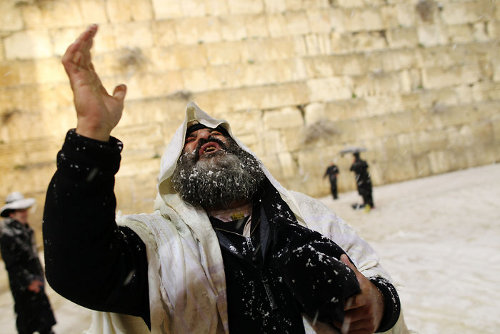
jews-praying-in-the-snowI don’t know. Regardless of his reasons or circumstances, once the other man became aware of the situation, he became obligated to help his fellow Jew. You can click the link I provided to read the entire article, but in short, here’s the rest of the story. The transaction between the businessman and the baker happened in Detroit. The businessman stopped in New York on his way back home to London to consult with the Rebbe in Crown Heights (Brooklyn), and the Rebbe convinced the businessman to make sure the baker had acquired tefillin immediately, before going back home rather than waiting six weeks. With great difficulty due to limited time and finances, the businessman was finally able to purchase tefillin and had them shipped to Detroit so that the baker would not go one more day without being able to pray with tefillin.

I left for London only after advising the Rebbe what had been arranged, and after waiting to hear that they had been collected and delivered in Detroit.

A few months later, I met this person again in Detroit, and asked him how he was doing with the tefillin. He told me that he had not missed a day—even walking home in the snow one day when his car broke down so that he put on the tefillin before sundown. He said: “Because of the trouble you went to in order that I should receive the tefillin the very next day, they are especially important to me.”

Again, this might seem rather a strange thing to a Christian since we do not experience any circumstance or situation that would inhibit or diminish our prayers, and certainly nothing like a physical object or device used in prayer.

Nevertheless, from a Jewish point of view, everything that happened was the performance of a single act of love in order to help one Jewish man perform another act of love…by davening with tefillin.

The results are obvious.

Good Shabbos.

Where Do We Find God?

Torah at SinaiWhere is the Torah?

-Shabbos 89a

It seems incredulous that Satan was unaware that Moshe had received the Torah and had taken it down to earth. Tosafos answers that at that moment, Hashem caused the Satan to become confused and confounded in order to avoid the risk of having Satan interfere with the giving of the Torah.

Maharsha notes that the Gemara had earlier reported that when Moshe came to the heavens, all the celestial angels presented Moshe with various gifts, and among those who gave Moshe a tribute was Satan himself. (This interpretation is based upon the fact that Satan and the Angel of Death are one and the same. It was the Angel of Death that divulged the secret of the incense to Moshe, and that it had the power to interrupt a raging plague.) Satan, we see, clearly was aware of the events surrounding Moshe’s mission and that his coming to the heavens was specifically in order to receive the Torah and to bring it back for the Jewish people. Why, then, asks Maharsha, was Satan surprised when Moshe took the Torah back to earth?

Daf Yomi Digest
Gemara Gem
“To where did the Torah go?”
Commentary on Shabbos 89a

This is midrash and as such, it’s not a good idea to try to take it literally, but perhaps there is something we can learn here. If we indeed have an Adversary who seeks to divert us from a life of holiness and an awareness of God and if this Adversary has the ability to succeed in his task, then how is a life of holiness possible at all?

Maharsha responds that…

Satan realized that the Torah was going to be given to Moshe. However, due to its extreme holiness and spiritual nature, Satan was certain that this was valid only as long as Moshe remained in the heavens. It did not seem possible that the Torah had any purpose in being taken to earth, to be shared with men who are made up of physical elements. When Moshe took the Torah to the Jews, Satan was shocked, and he asked, “What happened to the Torah? How could it be fitting for man to have?”

The truth is, though, that the purpose of Torah is indeed for man to have.

There are certain voices in Judaism who believe the Torah is far more than a document; a scroll with words that communicate information. They see the Torah as having a life of its own, it is wisdom and it is also part of God and thus it is the embodiment of God. Interestingly enough, Christianity’s perception of “the Word” is not far from this.

In the beginning was the word, and the word was with God, and the word was God. He was in the beginning with God. Everything was made to exist through him, and nothing that was made to exist was made to exist except by him.

John 1:1-3 (DHE Gospels)

But of course, there’s more.

The word was made flesh and dwelled in our midst. We have beheld his glory, like the glory of a father’s only son, great in kindness and truth.

John 1:14 (DHE Gospels)

The Bible exists between two “bookends,” between two instances wherein we see God dwelling among His people. In Genesis, we see that He walked in the Garden with man and in Revelation, we see God once more among those who love Him. And in between, the Torah was brought to earth by an emissary of God and given to men, both as the Torah from Sinai and the Word made flesh in Israel.

While midrash may ponder how the Adversary could allow the Torah to be brought down from Heaven to become accessible to man, the Bible tells us that he challenged such an action in the days of the second temple.

Then the spirit carried Yeshua into the wilderness so that the satan could test him.

Matthew 4:1 (DHE Gospels .. see Matthew 4:1-11 for more)

everlastingBut testing isn’t the same thing as stopping or preventing or defeating. As the midrash says…

The goal of the Torah is that it be studied and applied by man, in order for him to incorporate it into his unique blend of being made up of both physical and spiritual aspects.

And as told to us by John…

And from his fullness we all have received kindness upon kindness. For the Torah was given by Mosheh and the kindness and truth came through Yeshua the Mashiach. No one has ever seen God; the only son who is in the Father’s lap has made him known.

John 1:16-18 (DHE Gospels)

God has always desired to dwell among His special creation; among humanity. He has done so before, however briefly, and He will do so again in eternity. He has sent His messengers and His emissaries to us to give us gifts of Himself, the Torah of Moses and the Mashiach, the Christ. The means to know God and to be with God are within our grasp. As the sages say, the Torah is not in Heaven. As the Apostles of the Messiah say, the Spirit of God is with us in our hearts.

Blessings to you and all who are yours, and blessed be God who so loved the whole world that he gave us His only son.

Amen.

8 Days: Critical Mass

Critical_Mass_by_sam2993How much better than fine gold is the acquisition of wisdom, and the acquisition of understanding is choicer than silver! The paved road of the upright is turning from evil; one who keeps his way guards his soul. Pride precedes destruction and arrogance comes before failure. Better [to be] lowly of spirit with the humble than [to be] sharing the spoils with the proud. One who undertakes a matter intelligently will find good [success]; and praiseworthy is he who trusts in Hashem. The wise of heart will be called an understanding person, and one whose speech is sweet will gain learning.

Proverbs 16:16-21 (Stone Edition Tanakh)

Anyone who does not love does not know God, because God is love.

1 John 4:8

James/haSatan: First of all I made sure to use the words of Messiah particularly because you don’t know them or understand them. The teaching I put in the comments here were all backed up by scripture and were HIS WORDS and there is NO GREATER LOVE THAN TO LAY DOWN ONES LIFE FOR HIS FRIENDS. What are you accusing Yeshua of…..hatred?

IF I don’t sit in a pity party with you guys reviewing all the past evils done to the Jewish people while at the same time “Bashing Christians” and attempting to lay all the responsibility at THEIR feet……you call my words hateful?

A critic

I know. Taking verses out of context can sometimes create a false impression of what is really being said, but in my current reading from Proverbs, there seems to be an emphasis on controlling your speech, humility, understanding, and wisdom. No, I’m not trying to blow my own horn, but I am trying to understand why someone who feels they have a valid theological point to make must do so while spewing vitriol and hate. Certainly comparing me to the adversary is a little over the top, no matter how angry my fellow Christian brother may be with me.

But what started this mess, anyway?

What follows is a confession of faith for Jewish converts to Christianity, from the Church of Constantinople. While it seems extreme to us today and many Christians have regained their appreciation for Israel and Jewishness of Jesus, how many Christians truly disagree with a basic premise expressed in this swearing of allegiance to faith in Christ when it comes to their own attitudes toward Jews and especially their view of Judaism?

My friend Gene Shlomovich wrote a blog post called Confession of faith for Jewish converts to Christianity, from the Church of Constantinople. He wanted to draw attention to how Jews, during the early Christian period, were put in the position of having to renounce their entire Jewish identity, the Torah of Moses, all of the mitzvot, in order to be allowed to enter the community of faith in the Jewish Messiah…uh, that is Jesus Christ, our Lord. Here is the “confession of faith” a Jew was expected to make as quoted from Gene’s blog.

As a preliminary to his acceptance as a catechumen, a Jew ‘ must confess and denounce verbally the whole Hebrew people, and forthwith declare that with a whole heart and sincere faith he desires to be received among the Christians. Then he must renounce openly in the church all Jewish superstition, the priest saying, and he, or his sponsor if he is a child, replying in these words:

‘I renounce all customs, rites, legalisms, unleavened breads and sacrifices of lambs of the Hebrews, and all the other feasts of the Hebrews, sacrifices, prayers, aspersions, purifications, sanctifications and propitiations and fasts, and new moons, and Sabbaths, and superstitions, and hymns and chants and observances and synagogues, and the food and drink of the Hebrews; in one word, I renounce absolutely everything Jewish, every law, rite and custom, and above all I renounce Antichrist, whom all the Jews await in the figure and form of Christ; and I join myself to the true Christ and God. And I believe in the Father, the Son and the Holy Spirit, the Holy, Consubstantial and Indivisible Trinity, and the dispensation in the flesh and the descent to men of the Word of God, of the one person of the Holy Trinity, and I confess that he was truly made man, and I believe and proclaim that after the flesh in very truth the Blessed Virgin Mary bore him the son of God. and I believe in, receive, venerate and embrace the adorable Cross of Grist, and the holy images; and thus, with my whole heart, and soul, and with a true faith I come to the Christian Faith. But if it be with deceit and with hypocrisy, and not with a sincere and perfect faith and a genuine love of Christ, but with a pretence to a be Christian that I come, and if afterwards I shall wish to deny and return to Jewish superstition, or shall be found eating with Jews, or feasting with them, or secretly conversing and condemning the Christian religion instead of openly confuting them and condemning their vain faith, then let the trembling of Cain and the leprosy of Gehazi cleave to me, as well as the legal punishments to which I acknowledge myself liable. And may I be anathema in the world to come, and may my soul be set down with Satan and the devils.’ (From Assemani, Cod. Lit., 1, p. 105.)

That sounds very hateful and even kind of crazy, but it did reflect the reality of how Christians were thinking of Jews at that point in time. Unfortunately, something of an “echo” can still be heard among at least a few Christians these days.

With the merciful thou wilt show thyself merciful; With the perfect man thou wilt show thyself perfect; With the pure thou wilt show thyself pure; And with the perverse thou wilt show thyself froward. And the afflicted people thou wilt save; But thine eyes are upon the haughty, that thou mayest bring them down.”

Both the abusers of the Jewish people and those of the Jewish people who hate G-d, his son, and their neighbor will stand in judgment together. “I tell you, Nay: but, except ye repent, ye shall all in like manner perish.”

No repentance……no mercy!

No-MercyNo mercy. No mercy from God?

Doesn’t God have mercy upon us even before we repent? If He didn’t, He would never allow us the opportunity to do so…no matter how long it may take some of us.

Or how about this?

This post is not about anti-semitism. It is Christian bashing by way of blaming men who were never really followers of Yeshua for Israel’s lack of belief, faith, and transgressing the law and departing through disobedience. Israel needs to take some responsibility and stop blaming others. If you have unforgiveness in your heart and need to go through history to find someone to blame other than yourselves you missed the entire point of the Torah. Repentance begins by taking responsibility.

But how could the Jews historically accept a Messiah who was re-cast as the “Goyishe King” and was unrecognizable to his Jewish brothers?

Unfortunately, that point isn’t always understood in the church or at least by some of those in the church. But what really bothers me isn’t that some Christians have an idea that the Jews are to blame for their own hardships because “they rejected Jesus.” What really bothers me is the level of rage and hate that such individuals express in trying to “explain” their point of view. Even if they believe they can back up their position with scripture, doesn’t scripture also encourage us to love, to use measured and wise words, to feel compassion?

The really sad part of the conversation I’m referencing is just that day, I had written a memorial to the victims of the Sandy Hook school shootings. Among the victims was a 6 year old Jewish boy named Noah Pozner. It’s one thing to take “pot shots” at Jewish people in general as a Christian if you believe Judaism is thumbing its nose at Jesus Christ, so to speak. It’s another thing entirely to completely forget a national tragedy that occurred hardly a week ago and to disdain (though indirectly) a specific Jewish victim. No, my adversary never mentioned his name or referenced Noah in any way, but when you condemn all Jews who don’t renounce being Jewish for the cause of the Gentile Christ, you condemn each individual Jew, including a young Jewish boy who did no harm to anyone at all.

You can go to Gene’s blog and read everything there including all of the comments and judge for yourself whether or not I’m being unfair. I typically don’t like calling people out personally on their behavior, but it really bothers me that a Christian can not only condemn all Jewish people everywhere unless they renounce being Jewish, but I find it offensive that it is done in so callous and harsh a manner. Does God hate the Jewish people He calls His own? Did the Messiah hate us before we came to him?

Are we supposed to hate those who disagree with us, who don’t accept our faith, who believe bad things about us? This goes way beyond what one “loose cannon” Christian thinks about the Jewish people and considers how the church views the “unsaved,” i.e. the rest of the world. Are we only supposed to love people once they’re “saved?” Until then, is everyone who isn’t a Christian just “secular scum?”

I hope I’m only referencing a few random, infrequently occurring believers among a more compassionate and caring church, but it’s hard for me to tell. I guess the only way to find out is to keep going to church and to see how people treat not only me, but those who aren’t like “us.”

I wonder what I’ll discover?

First Seek Peace

There are three ways to bring unity between two opposites:

The first is by introducing a power that transcends both of them and to which they both utterly surrender their entire being. They are then at peace with each other because they are both under the influence of the same force.

But their being is not at peace—their being is simply ignored.

The second way is by finding a middle ground where the two beings meet. The two are at peace where they meet on that middle ground—but the rest of their territory remains apart and distant.

The third way is to reveal that the essence of every aspect of the two beings is one and the same.

-Rabbi Tzvi Freeman
“Essential Peace”
Based on letters and talks of the Rebbe
Rabbi M. M. Schneerson
Chabad.org

All the possessions and pleasures of the world are only valuable to the extent they are accompanied by peace of mind. A person who has tremendous riches and can gratify all of his desires, will nevertheless suffer if he lacks peace of mind.

As a rule, the power-hungry and the status-seekers lack this obvious realization. Why work on obtaining power and status when you have the ability to work on something that is much more precious? A peaceful mental attitude and serenity of the soul are the most important factors for happiness.

It is related that when an ancient emperor was about to sail for Italy, an advisor asked him what his ultimate plans were. “To conquer Rome,” he replied. “What will be after that?” “To conquer Carthage, Macedonia, and Greece.” “And after you have conquered all that, what are your plans?” Then I will be able to spend my life in peace and comfort.” “But,” queried the wise advisor, “why not be in peace and comfort right now?”

-Rabbi Zelig Pliskin
“Daily Lift #620”
Aish.com

What is it to be at peace? What is it to be at peace with others, especially those who seem to be the opposite as you? In Rabbi Freeman’s commentary, who or what is he talking about? Could it be reconciling between a man and a woman. Plenty of married people feel they are joined with an “opposite” who doesn’t understand the first thing about them? Then again, he could have been talking about man and God, but then, how could he suggest that a third and larger force be able to bring peace between them, when there is nothing larger than God? How about Christian and Jew, but certainly they are not the only “opposites,” for there are many different religious traditions that seemingly contradict each other.

God only knows
God makes his plan
The information’s unavailable
To the mortal man
We work our jobs
Collect our pay
Believe we’re gliding down the highway
When in fact we’re slip slidin’ away

-Paul Simon
from the song “Slip Slidin’ Away” (1977)

Like the ancient emperor in Rabbi Pliskin’s story, we too make all kinds of plans that, in the end, are designed to bring us pleasure and peace. Who knows if they’ll ever work, but we’ve got to try. Of course, that often means putting off pleasure and peace for a long time, maybe many years, until our “retirement,” if it ever comes. In the meantime, what do we do? Do we ever have peace? What is peace?

It seems like we are in a life that is constantly in conflict. The world is in conflict, people in different nations and within our own nation contend with each other. We ruin each other’s peace. Sometimes I think it would be better to be alone. Then at least, there would be peace and quiet. But is that what God intended when he said “be fruitful and multiply,” first to Adam and then to Noah? Probably not. We seem to be expected to make peace with our “opposite,” who in one sense is the mate God chose to correspond to us. But how is this done? Must we just plan and scheme and wait for peace to come like Rabbi Pliskin’s mythical emperor?

“The land of a rich man produced plentifully, and he thought to himself, ‘What shall I do, for I have nowhere to store my crops?’ And he said, ‘I will do this: I will tear down my barns and build larger ones, and there I will store all my grain and my goods. And I will say to my soul, “Soul, you have ample goods laid up for many years; relax, eat, drink, be merry.”’ But God said to him, ‘Fool! This night your soul is required of you, and the things you have prepared, whose will they be?’ So is the one who lays up treasure for himself and is not rich toward God.”

Luke 12:16-21 (ESV)

That didn’t work, either.

What’s the secret? What must we do? Some believe that we must understand what God wants us to do; how God wants us to obey Him, right down to the slightest detail, in order to find peace. Peace is not a state of mind then, nor is it a relationship with an opposite, neither with a spouse, nor with another person such as Christian or Jew, nor with God. Peace is the perfect “doing” of things, like the mitzvot, not due to a desire to please, or as a means to express compassion, grace, or love, but for the sake of simply doing and simply knowing how to do. Is that what God intended, actions and things to be placed above people and particularly loved ones? Does that being peace within and peace with others?

Rabbi Yaakov Ruderman, zt”l, the former Rosh Yeshiva of Ner Yisroel, reported a story which the Chofetz Chaim had told him.

The Chofetz Chaim used to visit the saintly Rabbi Nachum from Grodna. The Chofetz Chaim considered him to be his teacher and Rebbe, as he studied and learned from his holy actions and customs in all areas of Torah. Once, on one of the nights of Chanukah, the Chofetz Chaim was at his Rebbe’s home, and nightfall came and went. The hours passed, the street traffic thinned out, and still the candles of the menorah remained unlit. Much later, the wife of Rabbi Nachum returned home, and only then did his Rebbe kindle the Chanukah lights.

The Chofetz Chaim asked his Rebbe for an explanation of what had happened, for the halachah seems to say that the lighting should be done in an expedient fashion, and his Rebbe’s wife’s obligation could have been fulfilled with her husband’s lighting, even without her being home at the time.

Rabbi Nachum explained. The halachah tells us that if a person has only enough money for either Shabbos candles or Chanukah candles, the candles of Shabbos have priority, for the glow of the Shabbos candles ensures and guarantees tranquility in the house – Sh’lom Bayis. “My wife,” continued Rabbi Nachum, “is selfless and dedicated. It is to her credit that I am able to learn Torah and to be involved in the many Mitzvah activities which I handle. She enjoys being present when I light the Chanukah candles. It is for this reason that I decided that the consideration of “Sh’lom Bayis” takes priority, and I waited for her, rather than light earlier during the prime hour.”

Daf Yomi Digest
Stories Off the Daf
“Sh’lom Bayis comes first”
Shabbos 23b

Obviously, study, learning, and understanding the mitzvot of God is not irrelevant, nor would I ever suggest such a thing, but as we see in this example, it’s not the doing of things that is the most important of the mitzvot, it’s the caring for others, including one’s beloved spouse.

“Do not lay up for yourselves treasures on earth, where moth and rust destroy and where thieves break in and steal, but lay up for yourselves treasures in heaven, where neither moth nor rust destroys and where thieves do not break in and steal. For where your treasure is, there your heart will be also.”

Matthew 6:19-21 (ESV)

Peace is not the absence of conflict, noise, strife, or struggle, but the presence of the heart. Our “treasure;” our peace, both within ourselves and with others including with God, is where ever we place our heart and our love.

If I speak in the tongues of men and of angels, but have not love, I am a noisy gong or a clanging cymbal. And if I have prophetic powers, and understand all mysteries and all knowledge, and if I have all faith, so as to remove mountains, but have not love, I am nothing. If I give away all I have, and if I deliver up my body to be burned, but have not love, I gain nothing.

1 Corinthians 13:1-3 (ESV)

How often is this simple lesson completely ignored or worse, reviled and ridiculed, in favor of “debate” and “argument” and “discussion” in order for people to jockey for position in the hopes of gaining some sort of superiority over their fellow disciples in Christ. Better that we just smile at and return our peace to those who continually seek to give us the gifts of strife and discord.

A caring person is an elevated person. It is a great act of kindness to express your caring for people who might not realize that you care about them.

Today, think of three people who would greatly appreciate your sincere caring. Be resolved to let them know that you care about them as soon as possible.

-Rabbi Zelig Pliskin
“Daily Lift #619”
Aish.com

We see in examples from the Master, the Jewish Messiah King, from his emissary to the Gentiles, the Jewish “sage” Paul, and down to the Rabbis of the modern era, that love, peace, and caring are not something that we consider only after knowledge, study, and scholarship. They are the very goal for which we study. The Bible exists so that we may know God, not as a Professor knows history or as a Scientist knows chemistry or physics, but as a man knows a woman in total intimacy and love. It is from that love and intimacy with God that we can represent His Name and His grace to our fellow human beings, to our spouse, our children, our neighbors, and to even strangers. We are commanded to love. We are made to love, first God and then the world, just as God so loved the world (John 3:16).

And one of the scribes came up and heard them disputing with one another, and seeing that he answered them well, asked him, “Which commandment is the most important of all?” Jesus answered, “The most important is, ‘Hear, O Israel: The Lord our God, the Lord is one. And you shall love the Lord your God with all your heart and with all your soul and with all your mind and with all your strength.’ The second is this: ‘You shall love your neighbor as yourself.’ There is no other commandment greater than these.” And the scribe said to him, “You are right, Teacher. You have truly said that he is one, and there is no other besides him. And to love him with all the heart and with all the understanding and with all the strength, and to love one’s neighbor as oneself, is much more than all whole burnt offerings and sacrifices.” And when Jesus saw that he answered wisely, he said to him, “You are not far from the kingdom of God.” And after that no one dared to ask him any more questions.

Mark 12:28-34 (ESV)

To those of you who have responded to me (for whatever reason) with anger and upset, I’ll have to take my lesson from Gandhi and refuse your “gift.” In seeking my peace, I desire to seek your peace as well. However, that is only available when we love God, for in loving Him and in loving our neighbor, can we be at peace with each other and within ourselves.

Shalom to you all.

Doing Joy

Rejoice always, pray without ceasing, give thanks in all circumstances; for this is the will of God in Christ Jesus for you.

1 Thessalonians 5:16-18 (ESV)

Therefore, first of all, man ought to be happy and joyous at all times, and truly live by his faith in the Lord who animates him and is benignant with him every moment. But he who is grieved and laments makes himself appear as if he has it somewhat bad, and is suffering, and lacking some goodness; he is like a heretic, Heaven forbid.

Igeret HaKodesh 11 (Kehot)

Apparently, I struggle with joy. I suppose it’s part of my nature or my personality to do so, just like I struggle with everything else, including God. I don’t have an easy relationship with joy. It’s like my relationship with all those religious and spiritual people who seem to be so happy and carefree all the time. I just don’t see how they can be perpetually “warm and fuzzy” (kittens, puppies, John Lennon quotes) and still manage to relate to those of us who seem to need to keep a toe or a foot in the real world.

Was that cynical?

While I have recently acknowledged joy, I have even more recently mourned its lack in my life. But I have still managed to say something hopeful about joy.

I can only conclude that joy, like love, is a verb; it’s something you do, not something you feel. We can love by performing acts of love, such as feeding the hungry, hugging a crying child who just skinned his knee, helping an elderly, infirm person across the street, or visiting a sick person in who is in the hospital. But how to you do joy?

This morning (as I write this), I realized that last night I actually did joy. I just didn’t know that’s what I was doing at the time. That means I actually do joy more often, much more often than I thought I did.

Here’s what happened.

On Tuesday evenings, my son and daughter-in-law take a class and they ask my wife and I to watch our grandson Landon while they’re out. Last Tuesday night, my wife had to work late, so when I dropped off my son at his place after work (we commute to and from work together), I took Landon home with me (oh, he’s three-and-a-half years old, just so you know). My daughter was home and cutting up lots and lots of organic and recently picked apples on the back patio as part of her latest culinary masterpiece project (cider, I believe). The sukkah was still up, which should help set the scene for you.

Oh, one more thing. Rabbit and Alley. We have two hand puppets that we acquired (I don’t remember the details) when our own children were small. One is a rabbit and the other is an alligator (hence, “Rabbit and Alley”). Landon adores Rabbit and Alley (or “Raddit and Alley” as he calls them). They are his very close friends, almost as close as “Baby” which is his favorite stuffed toy (a giraffe).

When we got to my place, he saw that his aunt was out back and he wanted us all (Grandpa, Rabbit, and Alley) to play outside so we could be with her. My grandson is a picky eater, so he didn’t want to have dinner with me. He did sit beside me and we chatted while I ate. After my hunger was sufficiently assuaged, we proceeded out back.

Landon consumed a lot of (Auntie provided) fresh apples between periods of playing in the sandbox. Rabbit and Alley (and I) watched him as he transferred sand almost endlessly from one container to another. He put sand in a small bucket and pretended that he was planting (alternately) “pretty flowers” and tomatoes. Rabbit received the honor of watering the “plants” (pouring more sand in the bucket). He gave Rabbit and Alley “flowers” to put in their “pockets” and fed them imaginary tomatoes, since Rabbit and Alley like their vegetables (Landon, not so much).

When the sun went down sufficiently, I turned the lights on that are mounted on the sukkah, and we went inside. Landon ate more apples and asked me to read the Hebrew that is on two walls of the sukkah. I can’t read Hebrew, but was able to point out the names of Abraham, Isaac, Jacob, Moses, Aaron, Joseph, and David. Landon was a little confused when I mentioned that David played a harp because his Dad (also David) plays the drums. I had to explain that one is a King and the other is his Daddy.

We ran around the outside of the sukkah “hiding” from each other. He hid behind bushes. He picked up a “pretty rock” and carried it around for a while. I’m pretty sure I was wearing Rabbit and Alley on my hands the whole time. I tend to forget they’re actually on my hands when I’m playing with him, unless I need to take them off to turn the pages of a book I’m reading to him, or some similar activity.

In fact, when the sun went down, we did go in and I read him two books, one about an adventurous young penguin, and the other about a duck who likes to make soup.

His parents came to pick him up and, as is true with most children who are in the middle of having a good time, he didn’t want to go. So, to encourage Landon to go to the car, Rabbit, Alley, and Grandpa went out to the front to see him off. After he and his parents left, I went back inside and only then remembered to take off Rabbit and Alley and place him in their seat of honor near the fireplace.

I woke up this morning and realized that playing with my grandson was “doing joy”. It’s not that I had been emotionally ecstatic and overwhelmed with mind-bending happiness, but I recalled, looking back on the evening, that I had been quietly, pleasantly happy. I’ve mentioned before that one of the acts of love we are able to perform is to hug a crying child who has just skinned his knee. If that’s love, then joy must be playing “Rabbit and Alley” with a small child who on some level (even though he sees me put the puppets on and take them off) believes that Grandpa, Rabbit, and Alley are his best friends.

Love and joy are playing with your grandson. The next time you can’t find the Spirit of God within you and you feel lost, abandoned, and arid inside, play with someone you love. There, you’ll find joy and every other gift that God provides.

When man has moved away from the Divine, the only rectification is for man to move back toward God. Therefore the Zohar concludes that repentance is the key to heal the rift, which caused the destruction of the second Temple. This would also explain the Midrash cited at the outset — Moses knew that the absence of the Temple necessitated man’s movement toward God; therefore, Moses instituted thrice daily prayer, in order to remind man constantly, in all his experiences, that he must not forget God, rather he should take every opportunity to stand in front of God.

Furthermore, prayer is described as “service of the heart.” Evidently the heart, the emotions are crucial for this return.

But the Zohar insists that repentance coming from the heart full of love is needed to return the Jews to the level which should have been reached via the first fruits offerings. When this happens, joy will become a reality — everlasting and complete joy.

-Rabbi Ari Kahn
“Joy: Commentary on Torah Portion Ki Tavo”
(Deuteronomy 26:1-29:8)
Aish.com

I’m beginning to think that Moses should have instituted thrice daily play times with small children to remind us constantly that we must not forget God.

Turn away from feeling lost and lonely by cherishing whoever God gives you to play with, and your heart will return to Him. Go do love and joy.