

It is a sad fact that our knowledge of the Judaism of the first century CE is rather limited. It is true that we know quite a lot about the ideology of different Jewish groups. The pioneering works of C.G. Montefiore, G.F. Moore, R.T. Herford, J. Parkes, and W.D. Davies, for instance, culminating in that of E.P. Sanders, have been of tremendous importance in showing that ancient Judaism was not a legalistic religion in which salvation was earned by merit, but a living religion of grace and forgiveness.
-Magnus Zetterholm
Chapter 3: “The Cultural and Religious Differentiation,” pg 53
The Formation of Christianity in Antioch: A Social-Scientific Approach to the Separation between Judaism and Christianity
I wish Pastors preached sermons based on the latest research performed by New Testament theologians and historians. What we hear from the pulpit, more often than not, is doctrine that is decades if not centuries (or longer) old, the same standard preaching that declares Judaism of ancient and modern times as a “religion of dead works.” Even in the church I attend, which has a very pro-Jewish perspective, Jewish people and national Israel are loved, but the Christians are very happy that the old Law is dead and replaced by grace. Jews are loved but Judaism is not, even the (Pharisaic) Judaism practiced by Paul and by Jesus and by all the apostles.
Zetterholm’s book seeks to understand and explain the early schism between the Judaism once called “the Way” and the emergent religious form adopted by Gentile believers known as “Christianity” from a sociological rather than a theological point of view. Of course, it’s impossible to keep theology completely at bay, but Zetterholm, who doubts the accuracy of certain sections of Luke’s Book of Acts and any part of the Bible that speaks of miracles, does his best.
That said, I find his research compelling because he doesn’t have a doctrinal ax to grind and he does establish and confirm certain things about Judaism as practiced by the believing Jews in first century CE Syrian Antioch.
It is generally accepted that the Judaism of the first century CE was not homogeneous but a complex, diversified phenomenon. At the same time these somewhat different realizations of Jewish life had something in common. E.P. Sanders has referred to what he calls “common Judaism” as “what the priest and the people agreed on.”
-ibid, pp 55-6
This isn’t the first time I’ve heard of this concept. Nearly a year ago, Rabbi Dr. Carl Kinbar had this to say in different comments on one of my blog posts:
The situation today is very different. There is no common Judaism or commitment to Torah that is shared by the streams of Judaism and, especially, by individual Jews. Second Temple Judaism varied from one form of Torah observance to another. Today’s diversity is from ultra-orthodoxy to atheism.
To avoid misunderstanding, let me put it this way: common Judaism had a core of practices that all communities of any size considered mandatory while also having a diversity of practice in other matters. Diversity does not mean that some Jews ate pork and did not daven.
That is, unless the Jerusalem leadership objected to the common Judaism of their time. If they did object, they may have engaged in the project of bringing about uniformity. Again, there’s no direct evidence one way or the other. However, there’s some indirect support that they did not teach or enforce uniformity — there is no record that they directed Paul (or anyone, for that matter) to teach or enforce uniformity of practice. There is also nothing in the apostolic letters to indicate that the Jerusalem leadership or other apostles mandated uniformity. If they practiced uniformly in Jerusalem, why would they be indifferent to the lack of uniformity elsewhere?
The Jewish people (in the Land of Israel in particular – I’m not as familiar with the rest) actually did quite well during the time of common Judaism (from late Second Temple times to at least 400 CE). (emph. mine)
In another portion of his book, Zetterholm explains that while each synagogue adhered to a core of common Judaism, they also diverged in meeting the various needs of their differing populations, as R. Kinbar described above.
Antioch was religiously a highly pluralistic milieu. Even though the “zeal for the law” also influenced the Jewish communities in the Diaspora, Judaism was but one of many religions practiced contemporaneously at Antioch.
-ibid, pg 65
.
The various Jewish communities in Antioch had to exist perhaps in some sort of “tension” between each other, depending of their differences, but they also had to exist in a wider environment of many other religious entities, many or most of which would have opposed monotheistic Judaism, which I can only believe was one of the core beliefs of the common Judaism these synagogues shared.
This speaks to me somewhat of the struggle of Messianic Judaism today. Messianic Judaism isn’t a single, monolithic unit that has a definition easily applied to all Messianic Jewish groups (and I define the different streams of Messianic Judaism as an overarching entity distinct from any of the expressions of Hebrew Roots, even though some [many…most] Hebrew Roots congregations define themselves as “Messianic Judaism”) and there is some variability between the different synagogues (in the U.S.) of which I am aware.
Messianic Judaism is trying to relate within it’s various groups as a Judaism as well as relating to the larger Jewish community (and the rest of the world) as a Judaism, all within a diaspora (again, I’m speaking of U.S. congregations) that is poly-religious and areligious.

I say all this acknowledging Rabbi Kinbar’s statement above that the modern Judaisms of today cannot be directly compared to the Judaisms of the first century because they lack a commonly held core set of convictions related to Torah . Nevertheless, I can see connecting threads, especially between modern, western Messianic Judaism and the Judaisms in first century Antioch.
A number of critics of modern Messianic Judaism emphasizing itself as a Judaism, complain that this emphasis bumps Messiah Yeshua (Christ Jesus) to the back of the bus if not off the bus altogether. Normative Christianity stresses that Judaism was indeed (they claim) replaced by a more generalized and generic faith in Jesus without tradition or ritual, and modern Hebrew Roots proposes that modern Rabbinic Judaism is adopted by Messianic Judaism in place of “Biblical Judaism” which was (they claim) practiced by both Gentiles and Jews in the first century Messianic community.
Their sons will, furthermore, be subject to compulsive epispasm since they will be “cut by physicians to bring forward their foreskins.” In 1 Corinthians 7:18, Paul admonishes the circumcised Jesus-believing Jews against having this operation performed.
-ibid, pg 72
Zetterholm goes on in pages 76 through 79 to provide numerous examples of what we may not get from just reading the Bible…the fact that Jews in the diaspora, perhaps many, many Jews, struggled with or just plain left the Jewish community, attempted to cover up the signs of their Judaism (males), and assimilated socially and religiously into Greek culture.
Do we have that today?
How many Jews have converted to Christianity and exist and worship as “Hebrew Christians” within the Church, having abandoned any and all practices of Judaism and Jewish identity and adopted living as “Goyishe Christians?” Even the observant Jews within Messianic Judaism are considered by most other Jewish communities (i.e. not Messianic) as “Jews for Jesus,” as converts to Christianity who have abandoned their own people and left Israel. To resist this impression as well as to resist the draw from the Church that says if you believe in Jesus, even as a Jewish disciple of the Jewish Messiah, you are a Christian and are “free from the Law,” the Messianic Jew must strictly adhere to a Jewish lifestyle, including observance of the mitzvot and the traditions.
…that most Jews, in Palestine as well as in the Diaspora, worshiped daily and weekly, kept the Sabbath, circumcised their sons, observed certain purity regulations and supported the temple. Despite mixed opinions on how this obedience would be realized, we can safely assume that the majority of the Antiochean Jews intended to live their lives obeying the torah.
-ibid pg 80
The Jewish communities in the diaspora including Antioch were at risk of assimilation and absorption into the wider Greek culture and religious milieu. The barrier to stave off this threat for Jewish communities was Jewish observance and adherence to Jewish identity as distinct and unique among the myriad people groups and religions existing in the galut.

Zetterholm cited (pp 83-4) the practice of Jews in Antioch refusing to use Greek-produced oil, but believes that it was more an indication of Jewish identity rather than outright devotion to the Jerusalem Temple. Nevertheless, this still indicates that these diaspora Jews were highly aware of the necessity to keep separate from the surrounding culture, even to the point of being selective about which source of oil they used.
Further, Zetterholm citing Sanders says:
Antioch was thus located in an area almost regarded as part of the Land of Israel, and there is evidence of a particularly strong connection between some Antiochean Jews at least and the temple in Jerusalem.
-ibid, pg 85
Zetterholm’s opinion isn’t quite in line with Sanders’, though.
I would therefore conclude that we may cautiously assume the existence of a group more strongly committed to Jewish life than the main body of Antiochean Jews…
-ibid, pg 86
While Zetterholm doesn’t give much credence to the Book of Acts as an accurate model for Jewish/Gentile interactions of the first century Jewish history in Antioch, he nevertheless states:
…we may assume that there was no intermarriage between Jesus-believing Jews and Jesus-believing Gentiles, because the Jesus movement was a completely Jewish one with an unusual openness towards Gentiles.
-ibid, pg 89
And…
While Antiochus had clearly left Judaism, most Jews who were interested in Hellenism and wanted to create a Hellenistic Judaism were at the same time concerned with the preservation of a Jewish identity and had no intention of ceasing to be Jewish.
-ibid, pg 90
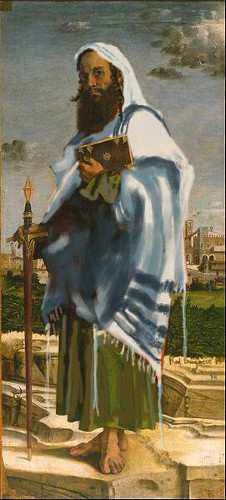 If, as Zetterholm says, the first century “Church” was a wholly Jewish movement, albeit with a high tolerance for Gentiles in the community, then even if this represented a Judaism that was “open,” to some degree, to Hellenistic influences (though this is very dicey material to seriously consider), the “Jesus-movement” had no interest in abandoning Judaism and Jewish practice for something foreign to them or more in line with the religious practices of the Greeks. Paul, as we saw above, was not convincing Jews to give up Judaism. Quite the opposite. Zetterholm’s research and the sources he cites do not support at all the creation of an alien Gentile religion out of the teachings of a rural Jewish Rav who was known by his Jewish followers to be Moshiach.
Zetterholm covers the diversity of Antioch’s synagogues (pp 90-91), including (as I stated above) how they served diverse Jewish populations, and it seems likely that the synagogue Paul and his companions used as their “home church” throughout Paul’s three “missionary journeys” was one of the (perhaps) thirteen synagogues in Antioch. In fact, he says of the Jewish Jesus-believers:
…it is highly unlikely that the Jesus-believing Jews in Antioch were organized in any other way than the synagogue.
-ibid, pg 93
Zetterholm cites Mark Nanos (The Mystery of Romans: The Jewish Context of Paul’s Letters, pp 289-336) as well as a wide selection of scriptures from the Book of Acts, to support this position. This includes the most likely common usage of “ekklesia” to mean “synagogue.” Additionally, Zetterholm references James 2:2 and James 5:14 as evidence that James the Just, brother of the Master, considered the “assembly” and “community” of Jesus-believers to be the synagogue:
We can thus conclude that the terminology does not speak against the view that the Jesus movement in Antioch was originally a synagogue consisting of Jesus-believing Jews, and that the Jesus-believing Gentiles related to this synagogue as any Gentiles related to any Jewish community. (emph. mine)
-ibid, pg 94
What might we conclude from all of this?
Judaism in the first century CE (and in my opinion, much of Judaism today) was not a “works-based religion” but rather a vibrant, faith-based practice of devotion to God. While there were many variations of Judaism practiced in that day, there was a core or common Judaism that served to define and identify all communities of Jews as Jewish and those who worshiped the God of Israel. This would have included the Judaism then known as “the Way.”
Jewish identity, performance of the Torah mitzvot, and devotion to the Temple services were among the common qualities of the Jewish community, both in Roman-occupied Judah and in the diaspora. Jews in the diaspora were at risk of assimilation and absorption into Greek culture, even to the point of attempting to cover the marks of circumcision. There was likely little to no intermarriage between Jewish and Gentile believers and if intermarriage occurred, Jewish identity would be staunchly adhered to by the Jewish spouse. If not, it was more likely that the Jew would undergo apostasy and assimilate into Greek religious and social culture.
Paul was very much opposed to Jews in the community of believers undergoing the medical procedure to restore their foreskin (males) and continued to encourage and support the Torah observance of the Jewish believers. There is no evidence, based on Zetterholm’s research, that the combined community of Jewish and Gentile believers left the synagogue or that they left Jewish practice and formed a new religion that was opposed to the other Judaisms and core Jewish practice. The Way remained a Judaism that was distinguished only by its unusual acceptance of large numbers of Gentiles who were identified neither as proselytes or God-fearers but had a different legal status allowing them to remain Gentiles and equal co-participants in the community (It should be noted that the Way wasn’t the only Jewish community that has ever claimed to follow the Messiah, so Messianic claims are not all that distinguishing).
Many of these conclusions can be applied to Messianic Judaism (and to a degree, larger Judaism) today. My experience with Messianic Judaism is within the confines of the United States, so I’ll restrict my opinions to that population. Messianic Judaism, existing in the diaspora amid a nation of religious plurality including a strong emphasis of no religion at all, faces some of the same risks as its ancient counterpart in Antioch. There is a strong pull, especially for Jews who are believers in Jesus as the Messiah, to apostate from a Jewish faith in Moshiach and “convert” to Christianity, effectively becoming Gentile believers with Jewish DNA.
 Intermarriage, although exceptionally common within Messianic Judaism and relatively rampant within all of the other Judaisms (with the likely exception of Orthodox Judaism) presents a risk or at least a challenge to the Messianic Jewish spouse to remain Messianic and Jewish in his/her observance of Torah and overall lifestyle. If this isn’t supported by the non-Jewish spouse, it could spell trouble for the marriage and/or the Jewish identity of the Jewish spouse. How the children are to be raised and their identity as Jewish vs. Gentile is also a serious consideration.
For these reasons, I reaffirm my previous assertion that a strong Messianic Jewish community be available, both for Jewish and for intermarried families who identify as Messianic. Furthermore, the Jewish Messianics should be allowed and encouraged to maintain and embrace a Jewish identity, and to consider themselves and the Messianic synagogues as part of larger Jewry. The continued effort by Messianic Gentiles and Hebrew Roots Gentiles (and some Hebrew Roots Jews), as well as the overall normative Christian community to demean any Jew in Messiah who continues to live a halachically Jewish life, and who further demands that Messianic Jews abandon Judaism as a practice, or observe some unobservable entity as “Biblical Judaism” vs “Rabbinic Judaism” must cease. Don’t argue.
It’s not our place as Gentiles within or outside the Messianic Jewish movement to dictate terms relative to how a Jew should or shouldn’t live as a Jew. A Jew’s relationship is and always has been with God.
No, I’m not throwing Jesus off the back of the bus and in fact, he’s at the center of all of this. Who lived a perfectly Jewish, halachically correct, completely Torah observant life as evidenced by the Gospels and the rest of the Biblical narrative? Only Yeshua Ben Yosef of Nazareth. Only he was born a Jew, of observant Jewish parents, within the borders of the Land of Promise, faithfully studying the scriptures and performing the mitzvot, and yet he was without sin and totally obedient to God.
What a role model for the apostles, all of the Jewish disciples, and for Messianic Jews today. Could anybody be more Jewish and live a more Jewish life than Messiah, Son of David? Will anyone live a more Jewish life in the Messianic Kingdom than the King of the Jews upon his return?
Zetterholm’s book has certainly confirmed a few things for me and opened up other doors. When next I revisit the pages of his book on this blog, I’ll further examine the relationship between Jews and Gentiles in the Messianic community in Syrian Antioch as Zetterholm’s research reveals it to us.
This series continues in my blog post Zetterholm, Ancient Antioch, and the Problem of the Gentiles.

 Morning Meditations