Tag Archives: Messiah

Paul the Christian Pharisee

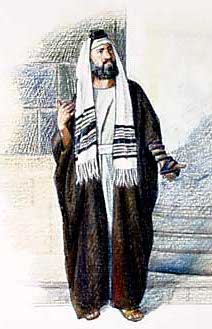
paul-the-phariseeNow when Paul perceived that one part were Sadducees and the other Pharisees, he cried out in the council, “Brothers, I am a Pharisee, a son of Pharisees.

Acts 23:6

Paul used the present tense, “I am a Pharisee,” not “I was a Pharisee.” Christian commentaries are uncomfortable with the statement, and they usually try to dodge the implications by explaining that he used to be a Pharisee prior to becoming a Christian.

Did Paul perjure himself before the Sanhedrin (a grave sin) by saying, “I am a Pharisee” instead of saying, “I was a Pharisee”? If so, none of his accusers had the wherewithal to challenge him on it. If he was no longer a Pharisee at the time of the trial, his testimony would be easy enough to discredit.

-D. Thomas Lancaster
Torah Club, Volume 6: Chronicles of the Apostles
from First Fruits of Zion (FFOZ)
Torah Portion Tazria (pg 711), Commentary on Acts 23:1-24:27

I suppose you could say this is a continuation of my previous “meditation,” Paul the Apostle, Liar, and Hypocrite and earlier commentaries. As I continue to read through Lancaster’s “Chronicles of the Apostles” Torah Club study, I continue to follow Paul through his various “legal problems” and his journey that will eventually lead to Rome, Caesar, and death. I also continue to watch as Paul repeatedly defends himself against the charges brought against him by the Jewish authorities of the Sanhedrin. From Paul’s point of view, he did nothing wrong to the Jewish people, to the Torah, to the Temple, or even to Rome.

Paul argued in his defense, “Neither against the law of the Jews, nor against the temple, nor against Caesar have I committed any offense.”

Acts 25:8

In verse 7 of the same chapter, Luke records that “…the Jews who had come down from Jerusalem stood around him, bringing many serious charges against him that they could not prove.”

As we’ve seen in earlier chapters of Acts and in my earlier commentaries on those chapters (thanks to Lancaster and the Torah Club), there simply was no evidence to support the wild accusations that had been made against Paul. He should have been set free, and except for various political reasons, finally including Paul’s appeal to Caesar and Rome, he never was.

Not only do I want to pursue the scriptures and commentaries that support Paul’s innocence, but I want to continue to illustrate how Paul never imagined that being an apostle of Jesus required in any sense, surrendering observance of the Torah mitzvot and the lifestyle of a Jewish Pharisee, nor did he expect this of other believing Jews.

All believers could claim to adhere to Pharisaic doctrine, but not all of them could claim to actually be Pharisees. Paul concluded his testimony with the declaration, “Brethren, I am a Pharisee, a son of Pharisees; I am on trial for the hope and resurrection of the dead!” (Acts 23:6).

-Lancaster, ibid

That statement might come as a shock to you if you’ve been taught that all Pharisees were horrible, legalistic monsters and hypocrites. After all, Jesus had some pretty rough things to say to the Pharisees.

“Woe to you, scribes and Pharisees, hypocrites! For you are like whitewashed tombs, which outwardly appear beautiful, but within are full of dead people’s bones and all uncleanness. So you also outwardly appear righteous to others, but within you are full of hypocrisy and lawlessness.

Matthew 23:27-28

On the other hand, Jesus also said this:

The scribes and the Pharisees sit on Moses’ seat, so do and observe whatever they tell you, but not the works they do.

Matthew 23:2-3

Do what they say but not what they do. What do they say?

And when he had said this, a dissension arose between the Pharisees and the Sadducees, and the assembly was divided. For the Sadducees say that there is no resurrection, nor angel, nor spirit, but the Pharisees acknowledge them all.

Acts 23:7-8

For Paul, the Pharisaic belief in the resurrection of the dead and a life in the world to come was lived out by his faith in Yeshua (Jesus) as the risen Messiah King.

That is why his faith was “counted to him as righteousness.” But the words “it was counted to him” were not written for his sake alone, but for ours also. It will be counted to us who believe in him who raised from the dead Jesus our Lord, who was delivered up for our trespasses and raised for our justification.

Romans 4:22-25

The doctrine of “the Way” was generally Pharisaic and in believing in the resurrection, so is modern Christianity.

I know, that’s probably a stretch for most of you, but if you follow the logic of Paul’s defense as recorded by Luke, it is very compelling. Lancaster comments further on this point.

The teaching and beliefs of Yeshua, Paul, and all the apostles echo the theology of the Pharisees. A Pharisee could become a disciple of Yeshua and still be a Pharisee…

-Lancaster, pg 713

Not so the Sadducees or any other branch of Judaism that did not believe in resurrection.

Even though the Master sometimes disagreed with the specific priorities of the oral law, He and the apostles practiced and transmitted Pharisaic, rabbinic tradition and interpretation. Their teachings and methods of biblical exegesis mirror those of the Pharisees. The Sadducees, on the other hand, were the first-century equivalents of Karaite Jews and sola-scriptura Protestants. They rejected most Jewish tradition, oral law, and rabbinic exegesis.

-ibid
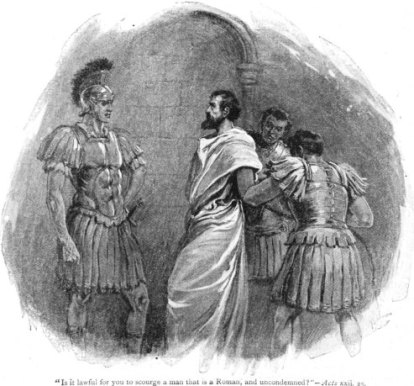
paul-in-chainsFrom a modern Christian’s point of view, we almost want to make the Sadducees the heroes of the story because they rejected Jewish oral law and traditions, and Jesus heavily criticized the Pharisees for some of their traditions. But while many of the Pharisees far exceeded the Torah’s intent by creating enormous burdens from their rulings that weighed heavily on the Jewish people, Jesus did not criticize their core teachings. Being a Pharisee wasn’t the problem. Being a hypocrite and a liar was. Paul was the former but never the latter.

But Paul had a “confession” to make.

But this I confess to you, that according to the Way, which they call a sect, I worship the God of our fathers, believing everything laid down by the Law and written in the Prophets, having a hope in God, which these men themselves accept, that there will be a resurrection of both the just and the unjust. So I always take pains to have a clear conscience toward both God and man.

Acts 24:14-16

Paul admitted to the charge of belonging “to the sect of the Nazarenes,” but he rejected any implication that the teachings of the Way deviated from normative Jewish expression. To Paul, faith in Yeshua was not simply one more sect of Judaism, it was “the Way of the LORD,” a spiritual restoration and redemption of all Israel that transcended sectarian divides. He admitted to “believing everything that is in accordance with the Torah and that is written in the Prophets.” He declared his hope in God, a hope which his accusers also cherished.

-Lancaster, pg 723

There’s one sentence in my last quote from Lancaster that I hope you caught. Here is is again:

To Paul, faith in Yeshua was not simply one more sect of Judaism, it was “the Way of the LORD,” a spiritual restoration and redemption of all Israel that transcended sectarian divides.

This is as true today as it was the moment Paul said it. Faith in Yeshua the Messianic King is not just a way for the world to be saved (which, of course, is no small thing) but it is the way to spiritual restoration and redemption of all Israel. That is the critical piece of knowledge both Jews and Christians must understand. Jesus doesn’t stand in opposition to the Jewish people, he stands for their redemption as a people and their restoration as a nation.

The good news of forgiveness from sins, salvation, and a life in the world to come is what we focus on as Christians, but most of the time, we miss why Jesus is uniquely special to the Jewish people. He doesn’t just save the individual Jewish soul as he does the individual Gentile soul, he saves Israel, he restores their nation to the head of all nations, he gathers his people back to him and to their Land, and he is their King, the King of the Jews, even as he is also the King of the World.

Paul, the “Christian” Pharisee knew all that, and the evidence of his innocence is also a shining lamp for every Jew and Gentile who turns away from darkness and to the light. To turn toward the light, we Gentiles must surrender a life of disobedience and learn to love, listen, and obey God. For a Jew to turn toward the light of the world in Messiah, they also must learn to obey, but Torah observance for the Jew is part of that obedience. We in the church are obedient, not only when we refrain from sin, but when we act to encourage our Jewish brothers and sisters in the faith to continue to live wholly Jewish lives in accordance with the commandments.

Paul lived his life enthusiastically as a disciple of Jesus Christ…and as a Pharisee.

162 days.
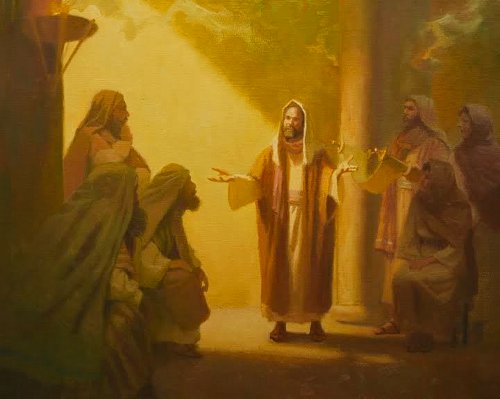
Paul the Apostle, Liar, and Hypocrite

Apostle-Paul-PreachesFor though I am free from all, I have made myself a servant to all, that I might win more of them. To the Jews I became as a Jew, in order to win Jews. To those under the law I became as one under the law (though not being myself under the law) that I might win those under the law. To those outside the law I became as one outside the law (not being outside the law of God but under the law of Christ) that I might win those outside the law. To the weak I became weak, that I might win the weak. I have become all things to all people, that by all means I might save some. I do it all for the sake of the gospel, that I may share with them in its blessings.

1 Corinthians 9:19-23

What then is to be done? They will certainly hear that you have come. Do therefore what we tell you. We have four men who are under a vow; take these men and purify yourself along with them and pay their expenses, so that they may shave their heads. Thus all will know that there is nothing in what they have been told about you, but that you yourself also live in observance of the law.

Acts 21:22-24

In one of the conversations I’ve had with Pastor Randy at my church, we discussed the activities of Paul as recorded by Luke in Acts 21. Included in some of the questions Pastor brought up was whether or not Paul was being disingenuous by offering to pay the vow price for four men at the Temple to avoid criticism from other Jews (see the quote from Acts 21 above) and that Paul had replaced this devotion for the Torah and for the Temple with faith in Jesus Christ. Interestingly enough, according to D. Thomas Lancaster in his commentary on Acts 21:15-22:30 (see First Fruits of Zion’s Torah Club Volume 6 Chronicles of the Apostles reading for Torah Portion Shemini [“Eighth”] for details), this is exactly what most Christian commentators believe.

Paul’s participation in the sacrificial services proved to the Jerusalem believers that he was not an apostate. Ironically, many Christian interpreters would consider participation in the Temple sacrifice as apostasy from Christ. They excuse Paul’s backsliding into Judaism on the basis that he was pressured into the ceremony by James and the elders. Moreover, Paul himself said, “I have become all things to all men so that I may by all means save some” (1 Corinthians 9:22).

-Lancaster, pg 684

The quote above from 1 Corinthians 9 seems particularly damning, but I want to mention something else first. In order to believe the traditional Christian interpretation of Paul’s participation in the Temple sacrifice, we have to believe that Paul is a terrible liar and hypocrite and we have to believe that James and the Council of Apostles of Christ not only condoned his dishonesty, but actively encouraged him in it.

If these are the sorts of people responsible for writing much of our New Testament, what does that say about the foundations of the Christian faith? Did God really entrust the establishment and dissemination of the Gospel of Jesus to not only flawed human beings (and all the writers of the Bible were imperfect), but deliberately dishonest, hypocritical liars? Do the ends justify the means? Should we emulate the apostles by also lying in order to win a few souls for Christ?

Assuming he’s not also lying in the following quotes, Paul defends himself before his Jewish accusers and the Romans:

Paul argued in his defense, “Neither against the law of the Jews, nor against the temple, nor against Caesar have I committed any offense.”

Acts 25:8

After three days he called together the local leaders of the Jews, and when they had gathered, he said to them, “Brothers, though I had done nothing against our people or the customs of our fathers, yet I was delivered as a prisoner from Jerusalem into the hands of the Romans.

Acts 28:17

But then what are we to make of Paul’s own words to the church in Corinth in his first letter to them? What is Paul saying?

whispererAccording to Lancaster’s commentary (pp 684-6), Paul was saying that he was merely crafting his message for different audiences, not that he was changing his overall behavior, especially in relation to Torah observance. When Paul said “to the Jews I became as a Jew,” it could hardly mean he “became a Jew” since he was already Jewish by birth (although some modern Jews believe Paul was born a Gentile and converted to Judaism). Lancaster states that in Paul saying this, he “only means that, when among Jewish people, he employed that common ground to his advantage” since he “shared with them a common cultural and historical heritage.”

I don’t have a problem believing this. My wife sometimes tells me that Jews today have a particular way of thinking and conceptualizing their world and that communication between Jews takes on a different “flavor” than between a Jew and a Gentile. It is likely that Paul would have presented his language and message within a heavily Jewish ethnic, cultural, national, and religious framework when sharing the good news of Messiah to an exclusively Jewish audience.

But what about when Paul said, “To those under the law I became as one under the law (though not being myself under the law) that I might win those under the law”? First of all, he already said he “became a Jew” so why add the redundancy (supposedly) of saying that he “became as one under the law?” Isn’t he saying the same thing twice and worse, isn’t he saying that he acted like someone under the law but actually wasn’t under the law? Isn’t that clearly being a hypocrite?

Lancaster answers those questions by saying that those “under the law” were not born-Jews but Gentile converts to Judaism or proselytes. That answers the question of why he wasn’t “under the law” if it means he’s not a convert to Judaism (a Gentile proselyte who chose place himself under Torah observance by converting). That seems a little weak, even to me, and I wish Lancaster had cited some sources to back up his claim. Apparently, this is his personal opinion but it does tend to solve why Paul engaged in “redundant language.”

On the other hand, he could have been referring to God-fearing Gentiles who were not proselytes (or who were considering conversion but had not yet made a commitment) but who voluntarily chose Torah observance. We see an example of such a person in Izates bar Monobaz who was a disciple of a Jewish merchant named Ananias and who, because of his royal position, was discouraged by Ananias from converting to Judaism. Izates vowed to observe all of the Torah mitzvot as the Jews do and later on, converted to Judaism, as did his mother Helena of Adiabene.

I also have to wonder about Cornelius, the Roman Centurion, who Peter encountered in Acts 10. In verses 3 and 30, Cornelius is seen or relates that he was praying at the ninth hour, or about 3 p.m. which is the set time for the mincha prayers in Judaism. Although the text doesn’t make it explicit, Peter and his Jewish companions stayed a number of days in the Roman’s household (see verse 48) and so they all must have eaten meals together. Unless you believe (and I don’t) that Peter’s vision (see verses 9-33) convinced him and his Jewish companions to permanently forego kosher foods, then, since there was a synagogue and thus a Jewish population in the largely Gentile community of Caesarea, it is likely that kosher food was available.

Just how many of the laws of Torah did Cornelius adhere to in his life as a God-fearer? We can’t possibly know, but it’s at least compelling to consider the idea that he may have kept a good many of them, as his position in the Roman military allowed.

under-law-torahI’m not saying any of my suggestions are fact, but it’s another way to look at Paul’s statement about “those under the law.”

Returning to Paul’s “those under the law” statement, Paul says he is not like them “under the law” but becomes like them. If Lancaster is right and they are converts, then of course, Paul doesn’t become a convert to Judaism and thus his statement is accurate. He can communicate to them in a way that they would understand in crafting his message specifically for converts (or Torah keeping God-fearers), though.

And what of “those outside the law” (1 Corinthians 9:21)? Lancaster defines them as Gentile God-fearers who do not live by the standards of Torah. If Paul becomes like them though, doesn’t that mean he puts away his Torah observance and eats ham sandwiches and shrimp scampi right alongside them at the lunch counter? Again, Lancaster refutes this and says that, “is not to say he ate forbidden foods or unclean meats, but wherever he had room to budge, he did so.” Lancaster goes on to say (pg 685):

Paul explained that he himself is not “outside of the law,” that is to say that he was not a Gentile God-fearer. Instead, he was under the “Torah of Messiah.” He remained legally Jewish in Messiah, but he bent where he could bend and flexed what he could flex in order to win those who were not Jewish.

Again, that seems a little thin, and again, Lancaster appears to be relying on his own interpretation and does not cite other authorities to back up his claim.

Traditional Christianity would probably jump all over these verses to illustrate that Paul was a behavioral chameleon and that Torah observance meant absolutely nothing to him unless he was talking to fellow Jews. Otherwise, he was under the “law of Christ,” which is to say “grace,” rather than the “Torah of Moses” or the traditional observances of the non-believing Jews.

Is there any other way to understand all this, particularly Paul’s behavior with Gentiles?

The only other way I can think of, and I’m no expert, is to say that Paul, like any good communicator, was able to craft the same message differently for different audiences. I’m a professional writer and that’s exactly what I do when constructing technical information about a software product for technical vs. lay audiences. The Gospels are largely thought to relate more or less the same information to different audiences, with Matthew written to Jews and Luke written to Greeks.

Even in ancient days, Jewish and Greek thought and conceptualization of ideas and actions was fundamentally different, and information about the same events and thoughts had to be constructed in different ways.

That’s how I would read Paul’s “chameleon” statements.

But that’s just me.

However, I also know this about Paul:

But I have made no use of any of these rights, nor am I writing these things to secure any such provision. For I would rather die than have anyone deprive me of my ground for boasting. For if I preach the gospel, that gives me no ground for boasting. For necessity is laid upon me. Woe to me if I do not preach the gospel!

1 Corinthians 9:15-16

I believe Paul. I believe he’d rather die than compromise his principles. I believe that he was devoted to the Messiah and to the truth of the Gospel. In fact, Paul ultimately did die for his faith, as did Peter, and the other apostles except arguably John. Like the other apostles, Jesus hand-picked Paul for his task and added to that, he did so as a supernatural event, well after Christ’s ascension to glory at the right hand of the Father. If God knows all things, it would be unlikely that such a man as Paul would have been selected if it was known that he was going to fail spectacularly as a liar and a hypocrite.

AbrahamYes, all men of God have failed. Abraham failed. Jacob failed. Moses failed. David failed. But not one of them failed in their mission for God. They failed in many human ways, but each successfully carried out the work that God gave them to do. Abraham failed when he lied about calling Sarah is sister (although arguably as his cousin, she could be called his “sister”), but he succeeded in having overwhelming faith in God and in the binding of Isaac. Jacob failed in his many acts of deceit, but he succeeded in fathering and raising the beginnings of the twelve tribes. Moses failed by desecrating God in front of the people when he struck the rock twice, which cost him his entry into Israel, but he succeeded in leading the Jewish nation in the wilderness for forty years as a shepherd leads and protects his flock. David failed with Bathsheba, but succeeded in conquering the Land and vanquishing Israel’s foes as her King.

Paul no doubt failed in many human ways too, but he succeeded in integrity, honesty, and courage, even in the face of death, many times defying opponents for the sake of his gospel and promoting Gentile inclusion in the Way of the Messiah.

If Paul was a liar and a hypocrite, then he only claimed to be serving Jesus. He couldn’t have been a real apostle and disciple. No one behaves so badly and yet serves a God of truth and justice.

“Not everyone who says to me, ‘Lord, Lord,’ will enter the kingdom of heaven, but the one who does the will of my Father who is in heaven. On that day many will say to me, ‘Lord, Lord, did we not prophesy in your name, and cast out demons in your name, and do many mighty works in your name?’ And then will I declare to them, ‘I never knew you; depart from me, you workers of lawlessness.’

Matthew 7:21-23

If Paul is the man who most Christian commentators (and most Jewish ones as well) believe him to be, then he was a “worker of lawlessness” literally, and a liar, and a hypocrite. If he was all of those things, then his epistles are a sham and we cannot trust them or their writer. If we can’t trust Paul, then most of the New Testament is unreliable. If that’s true, we Christians are in a horrible bind and we have to believe the modern Jews in saying that Paul took the basic teachings of Jesus and perverted them into an anti-Judaic religion, preaching hate of Jews, of the Temple, of the Torah, and of Israel.

That’s not the Paul I know. I’m sorry if you believe otherwise.

Shemini: Chesed to the Stranger

acts-of-kindnessThe following you shall abominate among the birds — they shall not be eaten, they are an abomination: the eagle, the vulture, and the black vulture; the stork; herons of every variety; the hoopoe, and the bat.

Leviticus 11:13,19 (JPS Tanakh)

The Talmud (Chulin 63a) states that the Hebrew name for the white stork is chasida, because it acts with kindness, chesed, towards its friends.

The Ramban, Moshe Nachmanides, a great Torah scholar, writes that the birds enumerated in this portion are forbidden for consumption because of their cruelty. Why, then, should the stork be considered “detestable” and an “abomination”? It should be permissible since it does kindness!

The Chidushai Ha-Rim answers: The stork does favors only for its friends. Since it doesn’t do chesed for strangers, it is considered not kosher. Chesed, kindness, must be done for everyone, not only one’s friends!

-Rabbi Kalman Packouz
“Shabbat Shalom Weekly”
Commentary on Torah Portion Shemini
Aish.com

It seems strange that we could learn lessons about treating others with charity and lovingkindness from the Laws of Kashrut, but the esteemed sages have illustrated this passage thus. Perhaps you would like something more familiar.

Love your fellow as yourself: I am the Lord.

Leviticus 19:18 (JPS Tanakh)

And a second is like it: You shall love your neighbor as yourself.

Matthew 22:39

But as the famous question goes, who is our neighbor?

The Torah teaches us, “Love your fellow human being as yourself” (Leviticus 19:18). It is often translated as “Love your neighbor as yourself.” However, Rabbi Mordechai Gifter taught that while the words “neighbor” and “fellow human being” are often used synonymously, in everyday speech the word “neighbor” is used to denote someone living or located nearby, while the obligation of this commandment includes a complete stranger who lives far away.

The general rule for this commandment is that anything you would want others to do for you, you should do for others (Rambam, Hilchos Aivel 14:1). The great Hillel once taught a convert, “That which is hateful to you, do not do unto others. That is the basis of the Torah.” (Shabbos 31a). The Baal Shem Tov used to say, “Love your fellow man as yourself — though you have many faults, nevertheless, you still love yourself. That is how you should feel toward your friend. Despite his faults, love him.”

-Rabbi Packouz

Not just your neighbor who is close to you, and not just your fellow who is like you, but even people who are far away and who you do not know…even people you may not like.

“You have heard that it was said, ‘You shall love your neighbor and hate your enemy.’ But I say to you, Love your enemies and pray for those who persecute you, so that you may be sons of your Father who is in heaven. For he makes his sun rise on the evil and on the good, and sends rain on the just and on the unjust. For if you love those who love you, what reward do you have? Do not even the tax collectors do the same? And if you greet only your brothers, what more are you doing than others? Do not even the Gentiles do the same? You therefore must be perfect, as your heavenly Father is perfect.

Matthew 5:43-48

What is Chesed? What is truly giving kindness if not showing love and concern for another human being, even when they’re a stranger, or even when there has been bitterness and enmity between you?

One thing I can attest for is his integrity. He was one of the few who called me after my last surgery to find how I am despite our bitter feud. None of you did. Give the guy a break, we must not take love out of the equation.

Chesed is calling up a sick person and showing compassion, even though at all other times you bitterly argue with that person. Chesed is a love note placed in a bottle and tossed into the sea for anyone who may need love to find, no matter how far away they may be. Chesed is a can of soup donated to a food bank for any hungry person to eat. Chesed is smiling at a stranger you pass on the street.

More about chesed on The Transcendent Path.

Good Shabbos.

He Will Come

LionIn that day, the stock of Jesse that has remained standing shall become a standard to peoples — Nations shall seek his counsel and his abode shall be honored.

In that day, My Lord will apply His hand again to redeeming the other part of His people from Assyria — as also from Egypt, Pathros, Nubia, Elam, Shinar, Hamath, and the coastlands.

He will hold up a signal to the nations and assemble the banished of Israel, and gather the dispersed of Judah from the four corners of the earth.

Isaiah 11:10-12 (JPS Tanakh)

This passage from Isaiah is part of the readings for the last day of Pesach (Passover) which ends at sundown today (Tuesday). For any Christian, the imagery is immediately recognizable as describing Christ, and for a religious Jew, the Messiah is surely appearing here. We see part of the Messianic prophesy and what the King will do upon his return, such as bringing the scattered of Israel back to their nation from the four corners of the earth. He will also be a standard and a banner attracting we from the nations to seek his counsel and to honor his abode, which is the rebuilt Temple in Holy Jerusalem.

The last day of Pesach sends a message of hope to both the Jewish people and all human beings on earth that the Messiah will gather us all to him and he will be our King. Revelation 2:27 speaks of Messiah “ruling with a rod of iron,” which doesn’t sound pleasant, but it shows that King Messiah will have dominion and authority over everything and everyone. The Bible speaks at length about the Messiah and his rule.

It shall come to pass in the latter days
that the mountain of the house of the Lord
shall be established as the highest of the mountains,
and it shall be lifted up above the hills;
and peoples shall flow to it,
and many nations shall come, and say:
“Come, let us go up to the mountain of the Lord,
to the house of the God of Jacob,
that he may teach us his ways
and that we may walk in his paths.”
For out of Zion shall go forth the law,
and the word of the Lord from Jerusalem.

Micah 4:1-2

For the children of Israel shall dwell many days without king or prince, without sacrifice or pillar, without ephod or household gods. Afterward the children of Israel shall return and seek the Lord their God, and David their king, and they shall come in fear to the Lord and to his goodness in the latter days.

Hosea 3:4-5

While we in the church firmly understand and believe in the Christ, the Moshiach, in the person of Jesus; that he walked the earth once before and will dwell among us again, this has yet to be discovered by many, both Gentile and Jewish. But is can be discovered, just by watching Jesus and listening to him. Even a simple fisherman saw this.

When Jesus came to the region of Caesarea Philippi, he asked his disciples, “Who do people say the Son of Man is?”

They replied, “Some say John the Baptist; others say Elijah; and still others, Jeremiah or one of the prophets.”

“But what about you?” he asked. “Who do you say I am?”

Simon Peter answered, “You are the Messiah, the Son of the living God.”

Matthew 16:13-16

Who is Moshiach?Religious Jews all over the world desperately await Messiah, crying out to him, “How long?” In case you haven’t noticed, the world is a mess and particularly for the Jewish people, and particularly for the Jewish nation Israel, these are very hazardous times. Of course, times are always hazardous for the Jews and for Israel. It seems to be built into the very fabric of their existence that the world will always be against them. That is why it is so important for we Christians to support and uplift them. Many promises have been made about what Messiah will do for his people Israel and if the church isn’t standing for Messiah and for his nation and people Israel, then we stand against them; against Christ, very much at our own peril.

In writing about Moshiach (Messiah), the Rambam states in his Code of Law, Yad HaChazakah : “Whoever does not believe in him or does not await his coming, denies not only [the statements of] the other prophets, but also [those of] the Torah and of Moshe, our teacher, for the Torah attests to his coming, stating: ‘And the L-rd your G-d will bring back your captivity and have compassion upon you.’

-Based on the teachings of the Lubavitcher Rebbe
Rabbi Menachem M. Schneerson for Torah Portion Balak
“The Prophecies of Bilam”
Chabad.org

In honoring the week of Unleavened Bread by eating only matzoh and reading the daily readings for this season, we temporarily draw closer to Messiah and draw him closer to us. The church also celebrates Resurrection Day bringing glory to the risen King and looking to the hope of his return, even as the Jewish people look to his coming.

Our only hope is in continuing to believe that he will come, even as it says in the twelfth of Rambam’s Thirteen Principles of Faith:

I believe with complete faith in the coming of the Messiah. And even though he may delay, nevertheless, every day I anticipate that he will come.

A couple of years ago at this season, I wrote a blog post called Why Don’t Christians Count the Omer? It’s a serious question, since Jews and Christians both share Shavuot, though we in the church call it Pentecost. There’s another reason I ask the question, though. Jews and Christians also share the same desire and the same hope for Messiah, though we understand his specific identity differently. The person is the same person (most Jews will disagree with me, of course) and the hope is the same hope. Given that, why don’t we bind our anticipation together?

Could the Messiah return on Shavuot/Pentecost? There’s no way to know for sure. If he does, then counting the Omer is sort of like a “countdown” for Messiah’s appearance as we anticipate his “coming with the clouds of heaven” (Mark 14:62).

waiting-for-mannaA blogger who has asked to remain anonymous speaks of the Christian appropriation of Judaism and particularly the co-opting of the Seder for the Communion story, but while I share her desire to protect Judaism from Christian misuse, I can’t help but see the parallels. I can’t help but see my Christ and my King in the classic Jewish and Christian texts. The Messiah is there, and for those who believe, we are all waiting for him.

His “face” has been very visible and clear to me this week and I wonder, shouldn’t all Christians be celebrating Pesach, not to steal from the Jews, but to come along side them, joining our hope with theirs? Shouldn’t we also be counting the Omer, not to appear more “Jewish” but to long for the Messiah we see in the ancient Holy texts of Israel?

A bottom line requisite to bring about redemption is to eagerly “await” the Messiah with a genuine burning desire. Whether he comes in our time or, God forbid, not, we are both held accountable and credited for the quest. Nothing stands in the path of willing. We must will, long, yearn, desire, quest, beseech and pray. But as to the actualization of that long awaited promise, we must defer to the unfathomable wisdom of the Almighty.

-Rebbetzin Feige Twerski
“Bringing the Messiah”
Aish.com

Rebbetzin Twerski concludes her article by inspiring her readers to be mindful of their actions, always behaving in a manner that pursues Messiah rather than material things, to pray for others, for an end to misery in the world, and an end to the pain of God, who some Jews believe suffers right along with His Creation. And she tells us to hope, yearn, anticipate and have faith.

As it is said, “I believe with complete faith in the coming of the Messiah. And even though he may delay, nevertheless, every day I anticipate that he will come.”

Being Filled

jewish-temple-messiahWe celebrated Easter this year with our community of Christian and Jewish interfaith families. Our minister started off by pointing out that Easter is not in the Bible, and that our holiday traditions make reference to ancient goddesses, and the fertility rites of spring. She then gathered the children together and talked to them about the Buddhist metaphor of a cup of tea representing the comforting memories of life after the tea bag (or body) is gone. She’s not your typical minister.

Next, our rabbi gave an adult sermon about the themes of intimacy, transcendence and unity in the story of the resurrection of Jesus. Somehow, the idea of life beyond death, of renewal and regeneration, seemed completely universal to me as he spoke. As a Jew, I do not feel I need to believe in a messiah or a personal savior in order to celebrate these Easter messages. Our rabbi spent his career at Georgetown, knows his gospels, and has been called a “closet Catholic” by Catholic friends. And yet, he’s an erudite, dedicated and deeply spiritual Jew. He’s not your typical rabbi.

After our Easter morning with Christians and Jews, I made a quick change out of my pastel dress and Easter bonnet and into a bold print Senegalese outfit, in order to join a community of Catholics and Muslims for our second Easter event of the day, a gathering of the local Catholic Senegalese association. We had the great fortune to be invited to this event by two Senegalese-American friends, one Catholic and one Muslim, who are cousins from an interfaith family, and who know that my husband and I crave Senegalese food and company ever since our years in Dakar. Intermarriage between Muslims and Catholics is not uncommon in Senegal. In fact, both of the Muslim Presidents of Senegal I interviewed as a journalist (Abdou Diouf and Abdoulaye Wade) had Catholic wives.

-Susan Katz Miller
from “My Easter with Christians, Jews and Muslims”
On Being Both

There is even a Chassidic custom, instituted by the Baal Shem Tov and further developed by the Rebbes of Chabad, to conduct a “mirror-seder” in the closing hours of the last day of Passover, complete with matzah and four cups of wine. These are hours, say the Chassidic masters, when time relinquishes its last hold upon our lives; when the future, too, can be remembered, and the Era of Moshiach tasted and digested as the Exodus is on the seder night.

-Rabbi Yanki Tauber
“The Third Seder”
Chabad.org

Ever since Easter Sunday services and particularly this morning, I’ve been feeling a profound sense of disconnection or maybe it’s just disappointment. I don’t know what it is, but I don’t like it.

I don’t know what I expected out of Easter or Resurrection Day, but whatever it was, I didn’t get it. Then I read Susan Katz Miller’s article, which I partially quoted from above, and I was captivated by the variety and “differentness” of her intermarriage, multicultural celebration of the resurrection. I’m sure a staunch Christian would be set back on his/her heels by even reading of, let alone participating in, such a “mash-up” of different religious practices and calling it “Easter,” but then I can see the meaning infused in this series of events, meant to speak to people from different religious backgrounds and to bring them all together in the service of the King.

I’m not setting aside the idea that God is an objective God and that His understanding of Himself is the understanding of God, but human beings are highly variable. Even within this thing we call “Christianity,” there are hundreds or perhaps even thousands of different and distinct expressions, theologies, doctrines, and dogmas. That’s why we have such a tough time getting along with each other.

meal-of-moshiachAnd yet, Katz Miller deftly merges these different traditions together within the span of a short blog post, and makes them live together, if not seamlessly, then at least in a complementary manner. I mean, how many different ways and different cultural and religious contexts can be applied to the resurrection and still have a proper celebration? Easter is a tradition, not a mitzvah (at least not one explicitly expressed in scripture), so how far can it be extended beyond Christian choirs, ham dinners, cries of “He has risen,” and still remain “kosher?”

In the seventeenth century the founder of the Chassidic movement, Rabbi Israel ben Eliezer (the Baal Shem Tov) instituted a new custom for the last day of Passover. He called it the Meal of Messiah (Seudat Mashiach,סעודת משיח ). It consisted of a special, additional meal on the afternoon of the last day of Passover, paralleling the traditional third meal of Shabbat. The Baal Shem Tov emphasized that the main component of the meal was matzah. After all, it was the last meal on the last day of Chag HaMatzot, the feast of Unleavened Bread. A few generations later, the Rebbe Rashab (1860-1920) added the custom of four cups of wine, mirroring the seder of the first night. Some Chassidic Jews still celebrate this special Messiah seder on the last day of the festival. They gather together to end the festival with matzah, four cups of wine, and a special focus on the Messiah.

The entire theme of the meal focuses on the coming of Messiah and the final redemption. The meal is festive in spirit. Everyone wishes one another “L’chayim! (to life!)” while discussing their insights into Messiah and their dreams and hopes for the Messianic Era. The meal concludes with fervent singing and dancing in joyous elation over the promise of the Messianic redemption.

What is the connection between the last day of Passover and the coming of Messiah? The Tzemach Tzedek writes:

The last day of Pesach is the conclusion of that which began on the first night of Pesach. The first night of Pesach is our festival commemorating our redemption from Egypt by the Holy One, Blessed be He. It was the first redemption, carried out through Moshe Rabbeinu, who was the first redeemer; it was the beginning. The last day of Pesach is our festival commemorating the final redemption, when the Holy One, Blessed be He, will redeem us from the last exile through our righteous Moshiach, who is the final redeemer. The first day of Pesach is Moshe Rabbeinu’s festival; the last day of Pesach is Moshiach’s festival.

One is incomplete without the other: the first redemption is connected to the last. The sages say, “In Nisan they were redeemed and in Nisan they will be redeemed in the time to come.” In fact the prophet Jeremiah tells us that the second exodus will be so great that it will overshadow the first.

-Boaz Michael
“What is the Meal of Messiah? Part 2 of 3”
First Fruits of Zion (FFOZ)

I suppose there is a limit to how much diversity we can cram into Easter, and certainly the Baal Shem Tov’s creation of this meal probably exceeds the comfort zone of even the most liberal church, but if we consider the themes being introduced and recall that the Messiah is irrefutably, irreducibly Jewish, then we must allow the celebration of the resurrection of King Messiah to also be cast in a Jewish mold and produced as a Jewish rite and tradition.

And yet, as I said above, the Messiah also transcends Judaism and extends himself to all of the people groups and nations of the world.

“Thus it is written, that the Christ should suffer and on the third day rise from the dead, and that repentance and forgiveness of sins should be proclaimed in his name to all nations, beginning from Jerusalem.”

Luke 24:46-47

multicultural-celebrationWhat is Easter like for the Christians in Egypt, for the Christians in China, for the Christians in Norway, for the Christians in New Zealand? How many different peoples have how many different traditions to commemorate the risen King and the resurrected Jesus? What do they look like? What foods are eaten? What prayers are said? What songs are sung?

I imagine if you could gather representatives of the faith from each nation and province from the four corners of the earth, and have them join together to celebrate Resurrection Day, you’d get a set of observances something like what we see on Susan Katz Miller’s blog. Add the Meal of the Messiah on the last day of Matzot and it would be complete.

The Messiah is the hope of the Jewish nation and the King of the House of David, but although he first and foremost came for the lost sheep of Israel, we also see that he came for humanity. God so loved the world that He gave His only and unique son so that none should be lost but all who choose to come to faith should be saved.

What am I looking for? In my small corner of the world, perhaps it cannot be found. But if I can transcend my world, what I want to discover is this:

Some Chassidic sources say that participation in the Meal of Messiah causes the person to carry the light of Messiah within him throughout the rest of the year and thus it infuses every action of his day. It foreshadows the Messianic Era when all mankind will be saturated with Godliness. Through this feast, the Chassid hopes that he has connected with the very soul of Messiah.

Boaz Michael’s words express my desire for what I think we are all looking for…hope. Hope in the future, hope that there is a future, hope that our lives have meaning beyond the day-to-day routine and rut of existence, hope that there is a God and that He loves us, hope that we are more than we think we are, and that we can do more than the world around thinks we’re capable of.

Rabbi Tauber says of Passover:

The “first days” with its seders and its reliving of history, and the “final days” with its messianic themes — days that herald the divine goodness and perfection which, the prophets promise us, is the end-goal of creation and the fulfillment of our present-day lives.

What I was looking for, and what I’m still looking for is the encounter with the infinite, and to be filled full of the promises of the prophets, and the final promise, the Messiah, the end-goal of creation.

Someday, we are told that we will sit at the banquet table of Abraham, Isaac, and Jacob, each of us from the north, south, east, and west who proclaims Messiah, and we will eat of that meal

Jesus said to them, “I am the bread of life; whoever comes to me shall not hunger, and whoever believes in me shall never thirst.

John 6:35

…and be filled.

The Interwoven Passover Seder

hagadaLeader: God is my strength and my song, and God has become my triumph.

Group: And we will praise our God forever.

Leader: The stone which the builders rejected has become the chief cornerstone.

A Passover Haggadah

The stone that the builders rejected has become the cornerstone.

Psalm 118:22

Jesus said to them, “Have you never read in the Scriptures: ‘The stone that the builders rejected has become the cornerstone…'”

Matthew 21:42

That kind of caught me by surprise Monday night.

But let me start at the beginning.

I went through the Haggadah several times to make sure I was familiar with the reading, using little sticky arrows to point to places I needed to skip or pay close attention to (especially where to break for the meal). Last year, I tried reading the Haggadah cold with no preparation at all and became quickly lost (where’s the part I’m supposed to read when it’s not Shabbat?). There are all kinds of songs in the Haggadah I’m not familiar with so where do I read and where do I skip and when I skip, what page do I skip to?

My son, who I commute to and from work with, had an appointment after work on Monday he forgot about, so we had to detour from the plan of getting home in plenty of time to help prepare the meal to getting home with not a lot of time to spare.

Fortunately, my other son has the week off and had spent most of the day with my wife helping her out, so when I got home, everything was under control. All I had to do was cook the chicken and pick up my daughter from work. The only hiccup I introduced was I had taken a copy of the Haggadah to work to go over it one more time before the Seder. When I showed up with it at home that evening, the missus got that “Ah ha! That’s where the other one went” look on her face, but after that, all was well.

By 7:20 that night, everything was in order. Tons and tons of food had been prepared. The formal dining room table was set. Everyone was present. We were ready.

My four-year old grandson was very patient with us. I was wondering how he’d tolerate sitting at the table for long periods of time while we were reciting from the Haggadah. Fortunately, long road trips in the van have helped him to know when and how to sit still.

And he likes matzah.

We praise You, God, Sovereign of Existence! You have called us for service from among the peoples, and have hallowed our lives with commandments. In love You have given us [Sabbaths for rest,] festivals for rejoicing, seasons for celebration,, this Festival of Matzot, the time of our freedom, a commemoration of the Exodus from Egypt. Praised are You, Lord our God, Who have us this joyful heritage and Who sanctifies [the Sabbath,] Israel, and the festivals.

-from the Haggadah

“You have called us for service from among the peoples…hallowed our lives with commandments…You have given us…the time of our freedom…Who gave us this joyful heritage and Who sanctifies [the Sabbath,] Israel…”

Remember, the family Goy is the leader of the Seder in my home and I’m the one reading all of this. I couldn’t figure out any way to read from the Haggadah and not imply that somehow I thought all this applied to me and that I was claiming to be Israel (though I’ve been acquainted with just a few Christians who call themselves “Israelites” and claim pretty much everything that’s Jewish without so much as a by your leave).

But it was more my issue than anyone else’s. I don’t think my wife or children expected me to change the text just to accommodate my “Gentile-ness.” It was really the only thing left that was bugging me about our intermarried Seder.

I decided to let it slide.

(I should say that I was feeling kind of guilty in blogging and even visiting the Internet on Tuesday morning, but I saw a significant number of Jewish believers already posting blogs and comments on Facebook, so apparently, I’m not a horrible person…in their eyes at least…for doing what I’m doing now…I guess it’s up to God to decide how He wants to respond to our online “work.”)

Then I read the quote in the Haggadah from Psalm 118 that is echoed in Matthew 21, Ephesians 2:20, and 1 Peter 2:7. I know the Haggadah wasn’t referencing any of the New Testament quotes, but remember, I said that I intended to allow the Seder to have a double meaning for me, not just addressing the traditional Passover for the Israelites, but the Messianic application as well:

And when the hour came, he reclined at table, and the apostles with him. And he said to them, “I have earnestly desired to eat this Passover with you before I suffer. For I tell you I will not eat it until it is fulfilled in the kingdom of God.” And he took a cup, and when he had given thanks he said, “Take this, and divide it among yourselves. For I tell you that from now on I will not drink of the fruit of the vine until the kingdom of God comes.” And he took bread, and when he had given thanks, he broke it and gave it to them, saying, “This is my body, which is given for you. Do this in remembrance of me.” And likewise the cup after they had eaten, saying, “This cup that is poured out for you is the new covenant in my blood.”

Luke 22:14-20

candleI admit, I didn’t have a spiritual power surge during the Seder but I had fun. I had fun in the sense of satisfaction at watching my family gather and celebrate the Seder together. I had fun watching my grandson trying to understand why Bubbe was taking him to the front door to see if someone named “Elijah” was there. I had fun watching him really, really, enjoy matzoh ball soup.

I had a feeling of warmth, like the lighting of the candles at the beginning of the reading.

I was glad to be there and participating in the “reminder” to my wife, my sons, and my daughter, that they are Jewish and that who they are and where they come from has a meaning that is unlike any other people and meaning that has ever existed or will ever exist. Even in Christianity, we are not born into a covenant. We cannot consider ourselves as having stood at the foot of Mt. Sinai to receive the Torah (although it wouldn’t hurt for us to picture ourselves standing at the foot of the cross and watching Jesus slowly die for our sins).

I did have a “light to the world” moment earlier on Monday morning at work, though. The person who sits right behind me is a very kind and gentle Catholic man. Another of the people who arrives as early to work as the two of us is a Christian woman. The subject of our conversation turned to Passover and within a few minutes, I realized that I had a captive audience, and I was explaining not only the traditional meaning of the Passover, but how I see it as a Christian, juxtaposing it against Easter.

As I’m writing this, I’m watching the “patterns” of Passover, at least in my life, weave in and out of my family, my friends, my understanding of God, taking on different colors and textures as Passover crosses from one of my worlds to the next. Passover is what it means to me as a tradition for my family. Passover is what it means to me as a Christian who acknowledges that my Lord and Savior is the Jewish Messiah King. Passover is what it means to me when, as a Christian, I share my understanding of its observance with others around me.

And in some way that is highly untraditional in the Christian and Jewish worlds, Passover is one of the bridges that crosses the gap between me and God.

So when packing my lunch this morning, among other food items, I inserted the obligatory pieces of matzah. They act, not only as nourishment, but as conversation pieces with my co-workers. They also act as reminders of the body of Christ, which was broken for me and which symbolize the Covenant that attaches me to God; a Covenant that extends directly back to Abraham.

My faith in celebrating Passover as a Christian in a Jewish family has been restored, blissfully and peacefully. Would that the upcoming Easter Sunday observance of the resurrected Messiah be as meaningful.

But that is yet to come.