Tag Archives: Messiah

Jesus the Traditionalist Jew

However, the Jewish background of the ideas of the Jesus movement is only one piece of the new picture I’m sketching here. Much of the most compelling evidence for the Jewishness of the early Jesus communities comes from the Gospels themselves. The Gospels, of course, are almost always understood as a marker for a very great break from Judaism. Over and over, we find within the interpretations of them (whether pious or scholarly) statements of what a radical break is constituted by Jesus’ teaching with respect to the “Judaism” of his day.

Even among those who recognize that Jesus himself may very well have been a pious Jew – a special teacher, to be sure, but not one instituting a consequential break with Judaism – the Gospels, and especially Mark, are taken as the sign of the rupture of Christianity, of its near-total overturn, of the forms of traditional (Jewish) piety.

-Daniel Boyarin
Chapter 3: “Jesus Kept Kosher”
The Jewish Gospels

I’ve been slowly, very slowly reading Daniel Boyarin’s excellent book The Jewish Gospels and have written regarding my responses to his text in two previous blog posts: The Unmixing Bowl and The Son of Man – The Son of God. Daniel Boyarin is a noteworthy Talmudic scholar and Professor of Talmudic Culture in the Departments of Near Eastern Studies and Rhetoric at the University of California, Berkeley, so I’d have to say that, at least from my point of view, he knows his stuff. The book I’m reading contains an examination of the “stuff” about the ancient perceptions of Jesus and how it may not have been unusual at all for many Jews in the late Second Temple period to see Jesus as Rabbi, Messiah, Prophet, and indeed, Divine Son of God.

In the third chapter of his book, Boyarin examines the “Jewishness of Jesus”.

For anyone involved in the Messianic or Hebrew Roots movements, the fact that Jesus was (and is) Jewish and that he led a completely normative Jewish lifestyle as recorded in the Gospels is no surprise, but it may have been to Boyarin when he first encountered the “good news” of the Master. I still think that Boyarin isn’t personally convinced that Jesus is Messiah King or Son of God, but he does seem to be strongly suggesting that it is no mystery why Jews in the Holy Land 2,000 years ago (and even more recently in many parts of the world?) would believe that he was.

The portion of Boyarin I quoted above aptly defines how most modern Jews and Christians see the role of the Gospels: as defining a sharp break from Jews and Judaism in the teachings of Jesus and the establishment of the very “unJewish” Christian religion. But as we already know, this was hardly the case.

Counter to most views of the matter, according to the Gospel of Mark, Jesus kept kosher, which is to say that he saw himself not as abrogating the Torah but as defining it. There was controversy with some other Jewish leaders as to how best to observe the Law, but none, I will argue, about whether to observe it. According to Mark (and Matthew even more so), far from abandoning the laws and practices of the Torah, Jesus was a staunch defender of the Torah against what he perceived to be threats to it from the Pharisees.

Boyarin characterises the Pharisees as “a kind of reform movement…that was centered on Jerusalem and Judaea (and who) sought to convert other Jews to their way of thinking about God and the Torah.” It’s interesting (since I’ve never heard this interpretation before) that Boyarin characterizes the tension between Jesus and the Pharisees as one of interpretation of halakah. According to Boyarin, the Pharisees may have represented the establishment of religious practices that were formed during the Babylonian exile “while the Jews who remained in the land continued their ancient practices.” Jesus, Boyarin asserts, supported the more ancient Jewish practices and was actually a Torah conservative and traditionalist compared to the “radical innovations in the Law stemming from the Pharisees and Scribes of Jerusalem.”

We usually see Jesus (at least those of us to perceive him as a wholly Jewish man and teacher living a life consistent with the covenant of Sinai) as interpreting the “true” Torah in opposition to the “leaven of the Pharisees” who made up all kinds of stuff and were totally hypocritical. Boyarin suggests that the struggle between the two “Judaisms” may have been one of traditional halakah (Jesus) vs. reform interpretation (Pharisees and Scribes).

Far from being a marginal Jew, Jesus was a leader of one type of Judaism that was being marginalized by another group, the Pharisees, and he was fighting against them as dangerous innovators. This view of Christianity as but a variation within Judaism, and even a highly conservative and traditionalist one, goes to the heart of our description of the relations in the second, third, and fourth centuries between so-called Jewish Christianity and its early rival, the so-called Gentile Christianity that was eventually (after some centuries) to win the day.
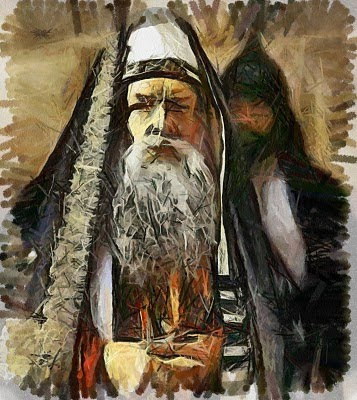
I realize that Boyarin’s opinion is a minority view among both Jews and Christians, but it is compelling to consider that the “original” Jesus Christ was not only a Jew who never broke the Laws of Moses or taught others to break them, but was a teacher who was strongly advocating for a return to a very conservative and traditionalist interpretation of Torah relative to the normative Judaism of those times.

Wow.

Imagine what that might mean to 21st century Christianity and Judaism. Imagine what that might mean to the movement we call “Messianic Judaism,” which is struggling tremendously to establish its own Jewish identity and connection to the other Judaisms of our modern era. Jesus the Jewish traditionalist. Jesus the teacher of conservative halakah.

Like I said. Wow.

Apparently, Boyarin isn’t the only Talmud scholar who holds this opinion of the relationship between Jesus and the Pharisees.

Yair Furstenberg, a young Talmud scholar at the Hebrew University, has recently provided a convincing explanation of the basic controversy between Jesus and those Pharisees. Furstenberg writes that Jesus’ statement (see Mark 7:14-23) needs to be read literally that the body is made impure not through ingesting impure foods but only through various substances that come out of the body…

…This is a debate between Jews about the correct way to keep Torah, not an attack on the Torah. Furstenberg has brilliantly argued that in its original sense, Jesus’ attack on the Pharisees here is literal; they have changed the rules of the Torah…

Really. Consider this. The argument that most Christians interpret about whether or not Jesus made all foods clean had nothing to do with abrogating the kosher laws. It was an argument between different factions of Jews on what made a person impure, which was not eating food but coming into contact with certain objects and substances such as a dead body or certain bodily fluids (you’ll have to read the whole chapter to get the details since Boyarin’s analysis is lengthy). He even presents a different view of Pharisees as “hypocrites” which doesn’t quite fit with what most Christians believe:

We should remember, however, that “in general, in ancient Jewish and Christian contexts a ‘hypocrite’ is a person whose interpretation of the Law differs from one’s own,” as Joel Marcus has so sharply put it.

That statement recasts the Pharisees in the role, not as liars and frauds, but as Jews who had a (sometimes) radically different perspective on halakah from the more conservative interpretation of Jesus.

Of course, the vast, vast majority of people in the church and probably in the Christian colleges and seminaries won’t agree with this. Boyarin suggests a corrective solution, but I don’t know how many believers, scholarly or otherwise, would be willing to try it out:

When put into its historic context, the chapter is perfectly clear. Mark was a Jew and his Jesus kept kosher. At least in its attitude toward the embodied practices of the Torah, Mark’s Gospel does not in any way constitute even a baby step in the direction of the invention of Christianity as a new religion or as a departure from Judaism at all.

Mark is best read as a Jewish text, even in its most radical Christological moments. Nothing that Mark’s Jesus proposes or argues for or enacts would have been inappropriate for a thoroughly Jewish Messiah, the Son of Man, and what would later be called Christianity is a brilliantly successful – the most brilliantly successful – Jewish apocalyptic and messianic movement.

Those of you who have read more than a few of my blog posts know I’m no Biblical scholar. I don’t have the “chops” to adequately evaluate Boyarin’s perspectives relative to other learned texts and teachers and to determine how much evidence there is to support his assertions. However, in general, what he presents to his readers is quite consistent with what is believed by modern “Messianic Jews” and those Gentiles who are called to follow that path of faith.

Jesus was and is a Jew. This “Jewishness” is written all over the Gospels. Jesus never attempted to depart from normative Jewish practice in even the slightest manner and as we see, he may very well have been advocating for a return to the more conservative and traditional understanding and practice of ancient halakah.

Imagine what this will mean for Christians and Jews everywhere when the Son of Man returns in glory. Imagine what it will mean, and what it should mean, to all of us right now.

Worshiping the God of Israel and giving great and very high honor to the Jewish Messiah King within a completely normative Jewish context is not dead. In fact, when he comes back to us and establishes his throne, it’ll all just be getting started.

Standing Insecurely at the Threshold

Hashem, God, Master of Legions, hear my prayer; listen, O God of Jacob, Selah. Look upon our shield, O God, and gaze at Your anointed one’s face. For one day in Your courtyards is better than a thousand [elsewhere]; I prefer to stand exposed at the threshold of my God’s house than to dwell securely in the tents of wickedness.

Psalm 84:9-11 (Stone Edition Tanakh)

Almost a year ago, I wrote a “meditation” called A Christian at the Gates of the Temple of God. Not much has changed since I composed that last part of my “meaningful life” series. I always imagine that I’ve progressed in my life of faith more than I really have. Reviewing year old (and even older) blog posts shows me that I’m asking the same questions now that I’ve been asking for a long time.

The classic question is, “Where do I go from here?”

The generic answer is always “forward” but I sometimes wonder if instead of actually moving along the trail, I’m simply standing still, or to use a water-based metaphor, am I just treading water?

If so, then I don’t think I’m alone. I could state the obvious and say that many people in churches and synagogues are probably making no more spiritual progress than I am, but they have plenty of company to do it with, so I guess that means it’s “OK.” When you are a “free agent” or “unaffiliated,” the dynamic feels a bit different. When you’re alone, it gives the impression that lack of progress is somehow tied to lack of fellowship.

I suppose fingers could be wagged at me for the choices that I’ve made, but so be it.

I had coffee with a fellow the other day who reminded me a lot of myself. He too seems to be spinning his wheels in his life of faith. He too is unaffiliated. I realize that there are a number of people I’ve been acquainted with over the years who, for one reason or another, do not attend a congregation or faith group. Many have been “burned” by organized religion or some aspect of it and feel that they are safer when worshiping alone or just with their families.

I realize that a significant portion of this population is classified as “fringe,” “oddball,” or worse, and many of them really are rather “unusual” in their theological conceptualizations.

I don’t think I’m one of that crowd, but I’m sure a lot of Christians and Jews would disagree with me. I don’t think my coffee companion belongs to that group either, but again, when you don’t follow some denomination’s pre-programmed doctrine and dogma, it’s bound to look a little odd to an outside observer.

What spawned this particular “meditation” was my reading of Psalm 84 and particularly verse 11:

I prefer to stand exposed at the threshold of my God’s house than to dwell securely in the tents of wickedness.

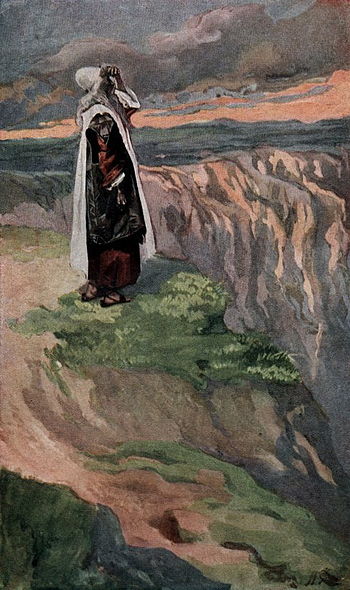
According to the psalmist, his options were standing exposed at the threshold of God’s house or dwelling securely in the tents of wickedness. I don’t see my two choices as exactly those, but they come close. In writing A Christian at the Gates of the Temple of God, I envisioned myself at the threshold of the Temple of God; the actual Temple as it stood in Holy Jerusalem thousands of years ago. It might surprise you to hear that I sometimes imagine myself praying silently in the court of the Gentiles, off to one corner, in the back, in the shadows, beseeching Hashem, God of Jacob, “have mercy on an unworthy Gentile.”

OK, I’m a Christian, which means I have a relationship with Hashem under the Messianic covenant, but nothing about that removes the necessity for humility and submission when standing in the House of God. I read verse 11 and the image I just described came rushing back to me, along with my “Christian at the Gates” blog post. Then, I remembered this:

It will happen in the end of days: The mountain of the Temple of Hashem will be firmly established as the head of the mountains, and it will be exalted above the hills, and all the nations will stream to it. Many peoples will go and say, “Come, let us go up to the Mountain of Hashem, to the Temple of the God of Jacob, and He will teach us of His ways and we will walk in His paths.” –Isaiah 2:2-3 (Stone Edition Tanakh)

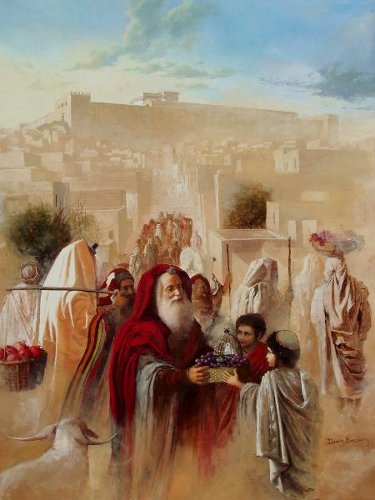
Actually, I find that vision rather intimidating. It’s one thing to imagine being a first century God-fearer standing alone and isolated in the court of the Gentiles in Herod’s Temple, and another thing entirely to be among a crowd of tens or even hundreds of thousands, making the pilgrimage to Jerusalem, climbing up to the restored Temple, actually anticipating the presence, no matter how distant, of the King of Kings, physically, majestically, in glory, standing before his people.

Who am I to stand in the presence of the Messiah King?

And imagining all that, I feel very small.

Only yesterday, I posted yet another illustration of Jesus as the Jewish King rather than the “warm and fuzzy,” blue-eyed, Christian “goy” Savior. Not that he isn’t the Savior, he just isn’t that cute and cuddly guy of uncertain European lineage (such as the image I’ve provided below) who we often see in the photos and paintings reproduced in some of our Bibles.

I’m writing this on Sunday morning and so it’s easy to picture the hundreds, the thousands, the millions of people, in my own little corner of the world and all over the world, sitting in church pews, listening to the sermon, listening to the “praise and worship team,” getting coffee, eating donuts, going to adult Sunday school, listening to a pre-programmed Bible study, everybody agreeing with everybody else.

OK, I’m being cynical. I’m also remembering my former church experience. Among many other states, it produced a state of security. Everybody (as long as they agreed with the program) belonged. But do I belong there or am I the guy standing at the threshold of some place where he probably doesn’t belong (at least not yet)? Am I the Christian standing exposed at the gates of the Jewish Temple, when I could be dwelling securely in the “tents” of the church?

No, I’m not comparing the church to the “tents of wickedness” but I am drawing a comparison of sorts. I really would rather stand, a mass of insecurity, isolated and alone, trembling with fear at the threshold of the Temple of God than seated comfortably in a pew or a folding chair at my neighborhood Christian church.

I’m not much of an adventurer or risk taker. I like adventure stories, but living out that kind of life would actually scare the daylights out of me.

On the other hand, that’s what I’m doing in my walk of faith, and that’s why I’m scared to death every day that I walk the path. I can’t dwell in the secure and safe and rather boring and unchallenging churches. Many, many true disciples of the Master find God within those walls, in the sermons, in the songs, in the Bible studies. But not me.

But for me, I find him within the Temple in Jerusalem, though it has yet to be restored, and I stand every morning, in the world of my imagination, in the court of the Gentiles, pleading before the God of Abraham, to look upon me and not turn away, invoking the name of my Master as his disciple.

Standing exposed at the threshold. May God grant me the courage to one day take the next step and to enter His House of Prayer.

The Son of Man – The Son of God

I was watching in the night visions and behold! with the clouds of heaven one like a man came; he came up to the One of Ancient Days, and they brought him before Him. He was given dominion, honor and kingship, so that all peoples, nations and languages would serve him; his dominion would be an everlasting dominion that would never pass, and his kingship would never be destroyed.

Daniel 7:13-14 (Stone Edition Tanakh)

And immediately after the distress of those days,
the sun will turn dark,
and the moon will not shine its light;
the stars will fall from heaven,
and the armies of heaven will be shaken.
Then the sign of the son of man will appear in heaven,
and all families of the earth will mourn,
and they will see the son of man coming
with the clouds of heaven in power and great glory.

Matthew 24:29-30 (DHE Gospels)

The theology of the Gospels, far from being a radical innovation within Israelite religious tradition, is a highly conservative return to the very most ancient moments within that tradition, moments that had been largely suppressed in the meantime – but not entirely. The identification of the rider on the clouds, with the one like a son of man in Daniel provides that name and image of the Son of Man in the Gospels as well. It follows that the ideas about God that we identify as Christian are not innovations but may be deeply connected with some of the most ancient Israelite ideas about God. These ideas at the very least, go back to an entirely plausible (and attested) reading of Daniel 7 and thus to the second century B.C. at the latest. They may even be a whole lot older than that.

-Daniel Boyarin
From Chapter 1: From Son of God to Son of Man
in his book The Jewish Gospels

I previously mentioned when discussing Boyarin’s book, that “I would love to see Boyarin’s research from exclusively Jewish sources that supports his understanding of these different factions of Jews, some of whom held beliefs that so mirrored a Christian’s vision…” In Chapter 1, he provides a compelling connection between the visions of Daniel as the basis how some first century Jews could indeed anticipate God as the “One of Ancient Days” who gave one like the son of man” power and dominion over all the peoples and nations of the earth. I’ve always been concerned about the apparent “disconnect” between the Old Testament and Jewish vision of the Messiah and the New Testament and Christian Jesus. Now I have hope that such a disconnect does not, in fact, exist.

Without providing too many direct quotes from the chapter, Boyarin says it would have been necessary to link the “son of man” vision to the Messiah, since it was not necessarily presupposed that one would be the other. He also effectively describes how “Son of Man” could directly refer to the divine-like being standing before the throne of the Ancient One, while “Son of God” referred to this being’s humanity. Indeed, we’ve already seen in Daniel 7:13-14 how the phrase “son of man” directly applies to the divine-like being in human form who stood before the throne of the Ancient One and was given eternal authority over the earth.

But who is the “Son of God?”

The kings of the earth take their stand and the princes conspire secretly, against Hashem and against His anointed… “I Myself have anointed My King, over Zion, My holy mountain!” I am obliged to proclaim that Hashem said to me, “You are My son, I have begotten you this day.” –Psalm 2:2,6-7 (Stone Edition Tanakh)

The “anointed one” is understood as the Messiah, the Christ. Boyarin explains this passage thus:

The anointed, earthly king of Israel is adopted by God as his son; the son of God is thus the reigning, living king of Israel. “This day I have begotten you” means this day you have been enthroned. Militating against any literal sense in which the king was taken as son of God and divine is the “this day” which, it seems, may only mean on this the day of your accession to the throne.

This is the traditional, modern Jewish understanding of the Messiah, a completely human being who will rise up from the ranks of his people to become King of Israel and by divine appointment (if not by divine nature), King over all the nations of the earth.

But…

But if you put these pieces together, if you join the “Son of God” with the “Son of Man,” you come up with an entirely new being relative to how Jews today understand Messiah; you create an image that is not unlike how Christians see the Christ, the Messiah…Jesus.

You also, according to Boyarin’s argument, come up with an explanation as to how late second Temple Jewish men like Peter, Philip, and Matthew could believe that Jesus was not only the Messiah but indeed, a divine being who is “exalted at the right hand of God.” (Acts 2:33 ESV) In fact, reading the first chapter of Boyarin’s book is so riveting, I found myself asking why the Jewish author of this book isn’t convinced of what he’s actually saying here.

Here’s a clue:

Taking the two-throne vision out of context of Daniel 7 as a whole, we find several crucial elements…

What Boyarin seems to be saying is that, while he does not necessarily believe Jesus is the Messiah or the mysterious “son of man” figure we see in Daniel’s vision (and I’m reading between the lines here), he can fully understand why some Jews in the time of Jesus would totally embrace this belief. He is saying that the conception of the Messiah as divine or divine-like was a completely acceptable understanding to some Jews (but not others, since claims of Christ’s divinity resulted in other Jews trying to stone him).

If all the Jews – or even a substantial number – expected that the Messiah would be divine as well as human, then the belief in Jesus as God is not the point of departure on which some new religion came into being but simply another variant (and not a deviant one) of Judaism. As controversial a statement as this may seem, it must be first be understood in the context of a broader debate about the origins of the divinity of Jesus. The theological idea that Jesus actually was God, however refined by later niceties of trinitarian theology, is referred to as “high Christology,” in opposition to “low Christologies” according to which Jesus was essentially an inspired human being, a prophet or teacher, and not God.

My basic understanding of what Boyarin is saying in this chapter is that while the viewpoint of the nature and identity of Jesus as high Christology is perfectly reasonable within an ancient Jewish context as connected to Daniel 7, it was only one Jewish perspective that existed at the time about Jesus and may well have been, as far as Boyarin is concerned, quite wrong.

However, Boyarin doesn’t go out of his way to express his personal beliefs in this chapter and his beliefs are not the point. The point is whether or not it is reasonable to believe that many, many first century Jews (as many as “tens of thousands” according to Bible Scholar David Bivin) could have seen Jesus as both Messiah King and divine being within the normative Judaism of their day.

I would argue that this divine figure to whom authority has been delegated is a Redeemer king, as the Daniel passage clearly states. Thus he stands ripe for identification with the Davidic Messiah, as he is in the Gospel and also in non-Christian contemporary Jewish literature such as Enoch and Fourth Ezra. The usage of “Son of Man” in the Gospels joins up with the evidence of such usage from these other ancient Jewish texts to lead us to consider this term used in this way (and, more important, the concept of a second divinity implied by it) as the common coin – which I emphasize does not mean universal or uncontested – of Judaism already before Jesus.

Although it is extremely likely that Boyarin isn’t convinced of the Messianic or divine identity of Jesus, the fact that it was an accepted way for first century normative Judaism to view the Christ brings up the obvious question. What if the “Messianic Jews” of the first century were right? What if Jesus was and is the Messiah King and Daniel’s “Son of Man?”

It would mean that not only are the core Christian beliefs about Jesus correct but that they are wholly and completely Jewish in nature and origin, not fabrications of later Gentile Christianity in early church history.

It also could mean, startlingly enough, that there’s a totally and completely Jewish way to understand Jesus that exists apart from the “whitewashed,” “Gentilized,” version we are used to seeing in church, on television, in the movies, in paintings, and in many popular New Testament translations.

One of the reasons I deliberately quoted from the Stone Edition Tanakh and Vine of David’s Delitzsch Hebrew Gospels is to try to peek behind the curtain, so to speak, at this Jewish perception of the Jewish Messiah King.

I know I’ve written about this before, but I think it’s important for both Christians and Jews to have a better understanding of Jesus and his once and future role as Savior and King and to try to grasp the realization that not only is Jesus completely Jewish, both as he once lived among men and as he will return in glory, but that accepting him as such, is not an “unJewish” thing to do.

According to Boyarin, such an acceptance of Jesus as Messiah King was in fact, a completely Jewish thing to do in the first century.

The unique quality of Mashiach is that he will be humble. Though he will be the ultimate in greatness, for he will teach Torah to the Patriarchs and to Moshe Rabeinu (alav hashalom), still he will be the ultimate in humility and self-nullification, for he will also teach simple folk.

“Today’s Day”
Monday, Menachem Av 1, Rosh Chodesh, 5703
Compiled by the Lubavitcher RebbeTranslated by Yitschak Meir Kagan
Chabad.org

What if it’s equally acceptable for a Jew to accept Jesus as Messiah in the 21st century?

Mattot-Massei: Free At Last

The Torah portion of Masei informs us of G-d’s directive that 48 cities be given to the Levites as dwellings places. Among these cities were three Cities of Refuge located on the other side of the Jordan River.

In the previous section of Matos, we read how Moshe was extremely displeased when the tribes of Gad and Reuven asked to receive their portion of the land on the other side of the Jordan. His displeasure stemmed from the fact that it was inappropriate to desire a permanent place of residence outside Eretz Yisrael proper. (Bamidbar 31:6-15.)

This being so, why did G-d command that the Levites be given the three Cities of Refuge on the other side of the Jordan? And while it’s true that it was vital that Cities of Refuge be established on both sides of the Jordan, (See Sifri, Bamidbar 35:14; Makkos 9b.) this in itself is not sufficient reason to make these “extra-territorial” cities permanent dwelling places for the Levites.

Yes, we could point out that the verse states: (Bamidbar 35:2.) “Command the Children of Israel that they give the Levites residential cities from their hereditary holdings.” Thus, these cities were not given as an inheritance from G-d, but because of an obligation placed upon the Jewish people to give a portion of their inheritance to the priestly tribe.

But this answer is not entirely satisfactory. Knowing as they did that the main dwelling place of the Jewish people was in Eretz Yisrael proper, why should any Levites want to live on the other side of the Jordan?

In the…Torah portion of Matos, we find that Moshe gave half the tribe of Menashe a portion on the other side of the Jordan. (Bamidbar 32:33.) Our Sages point out (Yerushalmi, Bikkurim.) that they did not ask for this land; Moshe presented it to them on his own.

“Levitical Cities”
Based on Likkutei Sichos Vol. XXVIII, pp. 213-218
and the teachings of the Lubavitcher Rebbe
Rabbi Menachem M. Schneerson
from the Chassidic Dimension series
Commentary on Torah Portion MattotMassei
Chabad.org

What I’m about to say isn’t going to be terribly popular with some people. Israel is never a very popular topic with some folks, especially those who hold to a particular social and political viewpoint. Of course, basing any opinion of current events upon what is written in the Bible is never acceptable to more “rational” human beings who believe that public opinion always trumps the will of (from their point of view) a non-existent God.

But look at what has been written and where we find it in this week’s double Torah portion. Not only did Moses agree to let the tribes of Gad, Reuben, and the half-tribe of Manasseh settle east of the Jordan, outside the boundaries of Canaan, but it was commanded that three of the Levitical cities would also be outside “the Land.”

But these events occurred in ancient times, so what possible impact could they have on the boundaries and borders of the modern state of Israel in the 21st century, especially if you believe the “original” boundaries were fictional or at best, part of an act fo conquest committed by the Israelites of old?

Maybe nothing. But then again, maybe everything. Continuing with the commentary:

He did so because the first entry of the Jewish people into Israel is connected to their final entry through Moshiach, and Moshe is considered “both the first and the final redeemer.” (See Shmos Rabbah 2:6; Devarim Rabbah conclusion of ch. 9; Zohar, Vol. I, p. 253a; Torah Or, Mishpatim, p. 75b.) This being so, his giving this portion to Menashe served to foreshadow the future redemption, at which time the boundaries of Eretz Yisrael will be broadened to include the other side of the Jordan as well.

We thus see that taking a portion on the other side of the Jordan can be an entirely positive act, since it hinted at the borders of Eretz Yisrael in times to come.

OK, this is midrash and mysticism thrown in with what we read in the Torah, but if it’s true; if all this occurs upon the Messiah’s return, then Israel, a very “problem nation” for much of the world, will be a great deal larger in Messianic days then it is right now (and most of the world would prefer it if Israel were a good deal smaller, even to the point of non-existence and extinction).

If you don’t believe in God, the Messiah, religious Judaism, and (arguably) Christianity, you have nothing to worry about. All this is just smoke and mirrors. Even many religious and secular Jews today argue about what the borders of modern Israel should be like or even if Israel should currently exist.

And yet, the world seems to be fighting extra hard against Israel, more than it fights against any other nation. Why?

The wounded victims of Wednesday’s suicide terrorist attack at a Bulgarian airport have arrived home in Israel, with 32 of the wounded victims touching down in an IAF Hercules military transport aircraft at Ben-Gurion International Airport. Among them was Israeli Nurit Harush, photographed by Reuters as she was pushed in a stretcher by medics after her arrival.

Three others who were critically injured have remained in a hospital in Sofia, but will later be flown to Israel.

-Chana Ya’ar
“Israeli Terror Victims Arrive Home from Bulgaria”
First published 7/19/2012 – 1:12 p.m.
IsraelNationalNews.com

The latest act of terrorism against Israel and against Jews.

This is hardly an isolated incident, but because it was so public and so dramatic, the non-Israeli news agencies have been giving it a great deal of space on their webpages and on their airwaves along with Israeli news sources.

One explanation for why Jews are regularly attacked, injured, and murdered, and why Israel as a nation is somehow blamed for this just because it exists in the world, is the historic enmity between the Arab and Jewish people, or between the Muslim and Jewish people. Popular public opinion cites the “fact” that Israel is an “apartheid state” (in spite of the fact that there are Arab Palestinian MKs in the Israeli Knesset) and is “occupying” lands that are “Palestinian” as the root to the actions of these oppressed “freedom fighters” as the reason for these acts of violence (and many of Israel’s critics refuse to call this “terrorism”). And don’t forget that historically, people all over the world have fought against and even murdered Jews just because they were Jews.

But imagine.

Imagine that God is real and the national redemption of Israel in an absolute physical sense is going to occur. It’s just a matter of time. Imagine you are a Jew and you live in Israel and this is what you believe. And it’s no secret that you believe this. It’s no secret that you know God will accomplish this when Moshiach comes.

If you don’t believe in God or at least, you don’t believe in the God of the Jews, that probably sounds pretty arrogant. Even if you think it’s total fantasy, you might be concerned that the Jewish nation will try to expand its borders to ultimately match what they think they should be according to God. That would eat up all of so-called “Palestine” and a significant chunk of the modern nation of Jordan (which modern Jewish Israel does not claim as far as I know).

If you have enough of a social, political, national, or racial interest in all of this, you might get pretty angry. So angry that you light up the Internet with your rage. And a few folks out there might be a good deal more angry.

Angry enough to blow themselves up and to take as many Jews with them as they can.

Even if you believe in the prophesies in the Jewish Bible, we could still argue all day long about whether or not Israel should pursue national expansion now or wait until the coming of the Messiah. It would be a useless argument because, like so many other debates on the web, it would go exactly nowhere. A lot of people would get worked up and nothing; absolutely nothing would be accomplished.

So where do we go from here? People are dying. I call it “terrorism.” I’m sure you’ll be glad to tell me what you call it.

I don’t believe it’s a coincidence that this act of terror happened during what is called Bein Hametzarim, the three weeks between the fast of the Seventeenth of Tammuz and the fast of Tishah B’Av, which commemorates the occurrence of many Jewish tragedies, not the least of which are the destruction of the first and second Temples in Holy Jerusalem.

Parshas Matos is always read during Bein HaMetzarim the three weeks between the fast of the Seventeenth of Tammuz and the fast of Tishah BeAv (the Ninth of Av), which are associated with the destruction of Jerusalem and the Beis HaMikdash. This recalls the negative qualities of a staff’s firmness, the severed connection to the source of vitality.

On the other hand, this period is also connected with our people’s hopes of Redemption. Indeed, Tishah BeAv, the anniversary of the destruction of the Beis HaMikdash is described as “the birthday of Mashiach” a day which generates a new impetus for the coming of the Redemption. Herein lies a connection to a staff’s positive quality of firmness, because: a) in the Era of the Redemption, our people will reap the fruit of their determined resolution to carry out G-d’s will despite the challenges of Exile; and b) it is in the Era of the Redemption that G-d’s essence, the ultimate source of strength, will become manifest in our world, His dwelling.

-Rabbi Eli Touger
“True Strength”
from the “In the Garden of Torah” series
Commentary on Torah Portion Mattot
Chabad.org

Perhaps even during this time of double mourning, there is a ray of hope.

In every hardship, search for the spark of good and cling to it. The greater the hardship, the more wondrous the good it bears.

If you cannot find that spark, rejoice that wonder beyond your comprehension has befallen you.

Once you have unveiled and liberated the spark of good, it will rise to overcome its guise of darkness. It may perhaps even transform the darkness fully to light.

-Rabbi Tzvi Freeman
“Unveiling the Spark”
Based on letters and talks of the Rebbe
Rabbi M. M. Schneerson
Chabad.org

I know that there’s a lot of sadness and anger going on and redeeming “hidden sparks” is probably far from most people’s minds at the moment. All they can do is live inside the pain and sorrow and grief. It’s not yet time to start looking for the sparks, gathering them, and sending them back to their source in Heaven.

But the day will come when the sparks will fly free. The day will come when he will come; Messiah, Son of David, and he will liberate his people Israel and place his nation as the head of nations. And his people will be safe. And grief will be only in the past at last…at long last.

…but they shall sit every man under his vine and under his fig tree,
and no one shall make them afraid,
for the mouth of the Lord of hosts has spoken.

Micah 4:4 (ESV)

He will wipe away every tear from their eyes, and death shall be no more, neither shall there be mourning, nor crying, nor pain anymore, for the former things have passed away.

Revelation 21:4 (ESV)

When we let freedom ring, when we let it ring from every tenement and every hamlet, from every state and every city, we will be able to speed up that day when all of God’s children, black men and white men, Jews and Gentiles, Protestants and Catholics, will be able to join hands and sing in the words of the old spiritual, “Free at last, free at last. Thank God Almighty, we are free at last.”

-Dr. Martin Luther King, Jr.
“I Have a Dream” speech, August 28, 1963

Good Shabbos.


Where Will The King Lead Me?

In this week’s reading, G-d explains to Moshe how his successors will be chosen. Hashem Himself will choose the leader, “who will go out in front of them, and who will come in before them, and they will go out and come in, and the congregation of G-d will not be like sheep without a shepherd.”

If you ask most people what they think is the ideal form of government, they will probably choose democracy. When compared to communism, dictatorships, monarchies and oligarchies, we see their point. But is it really such a great choice? In the United States, tens of millions of dollars will be wasted this year to convince millions of people, most of them woefully ignorant of the candidates, issues, and policy choices, to pull one lever versus another — based entirely upon advertisements which willfully distort the opponent’s record and glorify the candidate’s own, and “news” reports whose partiality is obvious. If that is insufficient to give you second thoughts, one word: Egypt. That’s the country that just selected the Muslim Brotherhood, a “suspected” supporter of terrorism according to the US, to lead it. Gaza similarly elected Hamas, a murderous gang unquestionably in the same category. And for that matter, Hitler ysv”z was elected democratically as well.

-Rabbi Yaakov Menken
“Sign of a True Leader”
Commentary on Torah Portion Pinchas
ProjectGenesis.org

In spite of the quote above, this “morning meditation” isn’t particularly about politics. In fact, it’s related to a question I asked just yesterday about just how “Jewish” the Jewish King will be upon his return?

In the U.S., we’re not that fond of kings. In fact, our nation started when we rejected a King and “taxation without representation” in favor of a Republic (technically, our nation didn’t begin as a Democracy). While some kings can be benign leaders and have the best interests of the citizens at heart, most royalty, when they wield real power (as opposed to say, the Monarchy in the U.K.), have a tendency to become despots and to virtually enslave the populace of the Kingdom.

That’s why it’s so interesting that we tend to be eager to rely on human leaders, since invariably and even under the best of circumstances, most  of them will fail us (but, of course, what choice do we have?).

Rabbi Menken’s commentary on Pinchas illustrates this very well and provides a compelling metaphor.

Interestingly enough, the Mishnah [Sotah 9:15] says that one of the signs of the “footsteps of the Messiah” is that “the face of the generation will be like the face of a dog.” There are many explanations as to what this means, but one of them is that the leadership will lead in the manner that a dog leads its owner. The dog bounds ahead, but is limited, leashed by the owner. When they come to a street corner, the dog may choose to go in one direction, only to find the owner choosing a different one. Moments later, where is the dog? Out in front of its owner once again, “leading” in the new direction. That’s what democracy looks like!

The Avnei Azel explains that in order to be a true leader one must lead, rather than being driven by polls. The Jewish Nation must be a meritocracy, with a leader capable of uplifting the people, rather than being dragged down by them. He must “go before them” and lead the congregation, rather than looking over his shoulder to see which way people want to go, and then fulfilling their desires. Look how much abuse Moshe had to put up with because he wouldn’t do whatever the congregation wanted! And that’s what made him, although he was “the most humble of men,” also an unparalleled leader.

The one thing Rabbi Menken didn’t mention was that, in the ancient past, Israel was the only fully functioning Theocracy that ever existed on Earth; a nation whose only King was God. But when Israel demanded a human King so that they could be like all the other nations, Saul was anointed first and then David. Both were human and, for all their greatness, both were flawed.

Now it’s the inheritor of David’s throne we of the nations are all waiting for, not just Israel, for he is the only just King, the one from God, the Messiah. He is the King who not only leads and who we will all follow, but the only King who leads with fairness, justice, and mercy, not favoring some party’s or organization’s political or social imperatives, but the just rule and law of the One who made us, the Author of existence, the lover of our souls, and the Creator of all life and light.

That Author even signed His creation.

When He had finished His world, complete and whole, each thing in its place, the earth below and the heavens beyond,

…it was then that the Artist signed His holy name, with a stillness within the busy movement, a vacuum in time, so that the Infinite Light could kiss the finite world and enter within. And He called it Shabbat.

In each thing there is a Shabbat, an opening that allows life to enter, a desire to receive from Beyond. In each being there is a sense of wonder, of knowing that there is something greater. Of knowing something it will never truly know. And with that perception it receives life, as it opens itself for the Infinite to enter.

-Rabbi Tzvi Freeman
“The Autograph”
Based on letters and talks of the Rebbe
Rabbi M. M. Schneerson
Chabad.org

Here’s where I struggle in following the Jewish King. The Shabbat is supposed to be only for the Jews, and yet observing the Shabbat is also an acknowledgement that God is Creator, and a foretaste of the Messianic Age. Both the acknowledgement and the foretaste affect not only the Jews, but all mankind. Should not all humanity recognize that God created the Universe? So how can the Shabbat be only for the Jews? What of the Gentiles who also cling to Messiah?

It’s another mystery. In Messianic days, will the Jews truly rest while the non-Jews continue to labor and suffer in order to maintain absolute distinctiveness between Israel and the nations? That hardly sounds like God’s justice and mercy, but what do I know?

Blessed is the man who does this,
and the son of man who holds it fast,
who keeps the Sabbath, not profaning it,
and keeps his hand from doing any evil.”

Let not the foreigner who has joined himself to the Lord say,
“The Lord will surely separate me from his people”;
and let not the eunuch say,
“Behold, I am a dry tree.”
For thus says the Lord:
“To the eunuchs who keep my Sabbaths,
who choose the things that please me
and hold fast my covenant,
I will give in my house and within my walls
a monument and a name
better than sons and daughters;
I will give them an everlasting name
that shall not be cut off.

“And the foreigners who join themselves to the Lord,
to minister to him, to love the name of the Lord,
and to be his servants,
everyone who keeps the Sabbath and does not profane it,
and holds fast my covenant—
these I will bring to my holy mountain,
and make them joyful in my house of prayer;
their burnt offerings and their sacrifices
will be accepted on my altar;
for my house shall be called a house of prayer
for all peoples.”
The Lord God,
who gathers the outcasts of Israel, declares,
“I will gather yet others to him
besides those already gathered.” –Isaiah 56:2-8 (ESV)

But if I’m not to keep the Shabbat (and don’t worry, I haven’t been), even in future days, I must be less than a foreigner and a eunuch. If so, what does the King want with me and why does he say that I am to pick up my cross and follow him? Follow him where? (Luke 9:23) If the Messianic covenant and the writings of the Apostles mean anything, I suppose I’ll find out someday.

Pondering the Puzzle

“I have to confess, I don’t really get it. If you believe in Jesus, you believe he is the King. The Lord. The Boss. Your Boss. There is no other option. It’s an integral part of his identity. The fact that some people have lost sight of that fact is evidence, to me, of how far we have come from a really Biblical idea of who Jesus is. We have forgotten that there is no such thing as a Jesus who is not our King, a Jesus we don’t have to obey.”

-Boaz Michael
President and Founder of
First Fruits of Zion (FFOZ)

I’ve mentioned most of this recently, but this is what’s available in my mind and in my blog for today’s “morning meditation.”

I keep trying to turn my rather unusual conceptualization of my Christian faith over and over in my mind, as if examining a rare piece of pottery crafted in ancient times. I’m pondering the runes and arcane markings on this archaeological object trying to tease one more clue to its nature and origin out of it; trying to discover one more secret. No, I’m not a latter-day Indiana Jones, but I am curious.

I’m curious about things I really don’t have the educational background to explore. That doesn’t stop me from wanting to explore them, but it’s like wanting to explore the deepest parts of an ocean but not knowing how to swim. The best I can do is rely on people who are expert oceanographers (who know so much more than just how to swim), their books, their findings, and the occasional special on PBS, to provide glimpses of what I want to know.

I’ll never be able to do the exploring first hand, anymore than I’ll ever be able to read and understand the runes and markings of the “faith object” I’m holding in my hands. I have to depend on someone else’s translation and hope they aren’t selling me a bill of goods, so to speak.

Now that I’ve tossed out sufficient qualifiers, here’s a few of the things I’m curious about. As I said, I may have mentioned them before.

Is the New Testament as “authoritative” as the Old Testament? That is, can we rely on the New Testament writings, including the Gospels, the Epistles, and the Apocalyptic writings to have the same authority of law as do the Torah, the Prophets, and the Writings in the Tanakh?

That’s a tough one, but here’s my opinion, for what it’s worth (and not being a theologian, I guess it’s not worth all that much).

I would say that since the Gospels relate the direct teachings of the Jewish Messiah, then they would have an impact equal to and perhaps greater than the Torah. No, they don’t particularly override Torah (although traditional Christianity will disagree with me here) but they represent the correct presentation and interpretation of God’s intent and will for the Jewish people and ultimately, for the world. If a Christian wants to take something as “law” in the New Testament, it should be teachings of the Messiah in the Gospels.

But what about the Epistles? Is literally every word of every letter Paul, Peter, and James wrote to be considered undying and unchangeable law, applicable in exactly the same manner now as they were in the lives of the different churches they were addressed to in the first century diaspora?

Another tough one. Shooting from the hip, I’d tend to say, “no.” This is where a degree in New Testament scholarship would be handy because I suspect that digging into the different layers of these letters and asking questions like, which ones are considered authentic, who actually wrote them, to whom, under what conditions, and so forth, would yield fascinating results.

What if, for instance, the majority of the material in these letters are meant not to establish new laws and traditions for the church, but to interpret and apply pre-existing Bible law to people and situations for which the law of God was not originally intended? After all, Paul only had a Jewish template by which he could comprehend service to his Creator as a Jew. How does all that work when you’re trying to build a practical worship community for a bunch of non-Jews that is centered around the Jewish Messiah?

No wonder Paul’s letters are so difficult to understand, even today, and why there is so much debate around them among New Testament scholars.

And the Apocalyptic writings? What about John’s Revelation or for that matter, portions of the Gospel of John? Mystic visions are a vast mystery that I’m not even sure how to classify. It’s not a direct teaching of the Master and it isn’t a commentary by the Apostle to the Gentiles. It’s a look behind the veil between Heaven and Earth but I’m uncertain what to make of it all.

What else do I ponder?

When the Messiah returns, what will he teach? I’ll narrow this down a bit. There’s some debate about what sort of “Judaism” Jesus will practice and promote upon his return and as he establishes his reign in Jerusalem. Most Christians probably don’t consider that he’ll practice a Judaism at all but rather a perfect form of Christianity. At best, Gentile believers would probably accept that he’d reset the Jewish calendar back to what was being practiced during his first incarnation among humanity, that is, what many folks out there would call “Biblical Judaism.”

This is opposed to what we refer to as “Rabbinic Judaism” which is generally frowned upon my most Christians as being full of man-made rules and exists as the modern inheritors of the “leaven of the Pharisees,” which is not a complement.

But wait a minute.

A careful examination of the teachings of Jesus and his interactions with the Jewish authorities and common people of his day seems to reveal that, for the most part, he was “OK” with first century normative Judaism, including all of its Halacha and traditions. While the church tends to view first century Jewish tradition as wholly inconsistent with the Bible and a harsh punishment the corrupt Jewish religious authorities set upon the shoulders of the ordinary Jewish population, it was neither invented by those authorities, nor considered bizarre or unusual by Jews.

The topic of rabbinic authority, opinions, and rulings in the time of Jesus and before is enormously complicated and beyond my meager skills to investigate, but I highly recommend Rabbi Joseph Telushkin’s book Hillel: If Not Now, When? which provides an insight into Hillel, a great Jewish teacher and leader who lived a generation before Jesus.

Let’s just say, for the sake of argument, that Jesus was perfectly fine with normative Judaism of the late second temple period, which would have differed from the Judaism of previous eras. What if…just what if when Jesus returns, he’ll be OK with normative Judaism as it exists on that day?

I have no way to back any of this up, but the assumption in Christianity and in some parts of Messianic Judaism is that Jesus will make radical changes to Jewish practice, probably tossing out most or all of what has been established in the past 2,000 years in favor of a more Bible-based model. All of the rulings, opinions, discussions and arguments of the sages would have been in vain. The scholarly teachings of the Rambam and Rashi would be dust. The Baal Shem Tov, the Chassidim, and the modern Chabad would be swept out of existence. Something more acceptable to the members of your local church would be installed in their place.

But is that necessarily true? If indeed, Jesus returns as the Jewish King, establishes his rule in Jerusalem, raises Israel as the head of all the nations of the earth, is it not also conceivable that his practice as a religious Jew might be accepting of at least some, if not most of Rabbinic Judaism?

Something to consider.

Last point. Re-read my quote of Boaz Michael from above before continuing.

One of the criticisms of Messianic Judaism is that it tends to focus more on the Torah and on Judaism than anything Messianic. That is, Jesus seems to take a backseat to Moses. Judaism is more important than Messianic.

Ironically, there are many non-Jewish practitioners in Messianic Judaism who are guilty of this, people who all but turn their back on Jesus but who will focus with great intent on how to tie their tzitzit and the correct pronunciation of their Hebrew prayers.

But what about the Messiah? Where does he fit in? Why have his teachings been subordinated to the Torah of Moses? Isn’t the Jewish King even greater than Moshe?

I think this has been a real problem in Messianic Judaism traditionally and it’s about time to start correcting it. I don’t doubt it will cause a great shake up in many congregations and reintegrating the Jewish Messiah as the center of Messianic Judaism will be quite a chore.

I have no idea how to make it work.

But figuring all this stuff out isn’t the point of today’s “meditation.” The point is just to open the box all this stuff has been stored in for so long, brush off the dust, and give them some air.

Fair wiser heads than mine are going to have to find a way to answer these questions. All I know how to do is ask them.

“If both Judaism and Christianity are correct in their definitions of redemption, then Jesus must do both what Judaism is expecting the Messiah to do, and what Christians expect him to do. This means that Jesus will do more than come back and save those who believe in him from sin and death. He will also re-gather his people Israel from exile and restore them to their land in a state of blessing and peace (Isaiah 35, 48:12-22, 52:1-12; Jeremiah 31).”

-Boaz Michael