Tag Archives: messianic judaism

Intersection

Due to the sin of murder the Beis HaMikdash was destroyed.

Shabbos 33a

Maharal points out that man is distinct and loftier than all other creations. Only man is infused with a heavenly spirit from above. Similarly, the Beis HaMikdash is on a separate plateau in function and purpose above all other places on Earth.

Furthermore, man himself functions as a type of Beis HaMikdash, in that he carries the shechinah with him, and he serves as a vehicle from which kedushah emanates and spreads throughout the world.

This is the underlying principle which our Gemara is presenting. The taking of human life, aside from the tragic aspect of the personal loss, also represents a destruction of a human Beis HaMikdash. A person, while he lives, has the ability to accomplish worlds of achievement in the realm of kedushah and in the service of Hashem. With the loss of this life, this person’s contribution to the world in this regard has been ended.

Daf Yomi Digest
Gemara Gem
“The holy human”
Commentary on Shabbos 33a

This is a rather remarkable Jewish commentary from a Christian point of view. We Christians tend to believe that only we possess the “indwelling of the Holy Spirit” as a consequence of our faith in Jesus Christ. We tend to believe that no other people group or religious tradition, especially Judaism, has this concept, let alone possesses this reality.

But what if we’re wrong?

Here we see that the Jewish sage writing this believes that “only man is infused with a heavenly spirit from above.” And just as Christians believe that each of us is a Temple housing the Spirit of God, (see 1 Corinthians 6:19 and 1 Peter 2:5) the Rabbinic commentator states, “man himself functions as a type of Beis HaMikdash, in that he carries the shechinah with him, and he serves as a vehicle.”

For those among you who may not know, the Beis HaMikdash can refer to the Temple in Jerusalem (which currently doesn’t exist) or the Heavenly Temple.  In the days of Solomon,  the Temple housed the shechinah or the Divine Presence, which Christian Bibles call “the glory of God” (this is also true of the Tabernacle in the days of Moses). While we can’t make a direct comparison between the shechinah and the Holy Spirit, we see that both Christian and Jewish concepts of how God “indwells” the faithful are all but identical.

Imagine that.

But why do I say such a thing and why should you care?

Shmuel only crossed a river on a bridge together with a gentile. He said that misfortune would not occur to two nations simultaneously.

Shabbos 32a

Shmuel crossed the river only on a ferry boat upon which gentiles were riding with him. He determined that the Destroyer cannot punish Jew and gentile together, so he would be safe and secure that the boat would not capsize.

-Daf Yomi Digest commentary

This is a less than complimentary Jewish commentary about we Gentiles, since it implies God will not visit a tragedy upon the Jew that is going to occur to the non-Jew for the sake of the holiness of the Jewish people. It elevates the Jewish people above the other peoples of the earth in a spiritual way due to the perception of a Jew’s higher awareness of God. Actually, the commentary may well be true of many non-Jewish nations and people who neither fear Hashem nor honor the God of Israel.

But what about Christians? Can’t we be said to have an awareness of God through our devotion to Jesus, the Jewish Messiah? I would say “yes,” but we must remember that said-awareness and devotion originated with the Jewish people, and did not spring forth fully grown among the Gentiles, independent of Israel.

Many Christians reading this may get the wrong idea about what I’m trying to say. Some may even feel threatened, as if I’m subordinating Christianity to Judaism in a manner that makes we non-Jewish believers into “second-class citizens” in the Kingdom of God.

I’m not saying that at all.

But I do want to say that the church has a tendency to reverse causality. We often view Jesus as wholly owned and operated by Gentile Christianity and completely divorced from (if he was ever “married” to) Judaism in any way or form. That’s pretty tough to do since Jesus was born to a Jewish mother, was circumcised on the eighth day, was raised as a Jew, was granted the power of the Spirit as the Jewish Messiah, walked like a Jew, talked like a Jew, only had Jewish disciples, ordered his Jewish disciples to only minister to the “lost sheep of Israel” in only Jewish communities, barely spoke to a Gentile, and after death and resurrection, promised to return to establish Jewish self-rule of Israel and over the nations.

Tsvi Sadan, who authored what I consider a landmark book, The Concealed Light: Names of Messiah in Jewish Sources, wrote an article recently published in Messiah Journal, issue 111 called “You Have Not Obeyed Me in Proclaiming Liberty.” It’s a unique article in that it takes to task the missionary efforts of the church to convert Jews to Christianity. But Sadan is a “Jewish believer.” More accurately, he’s a “Messianic Jew” living in Israel, and that makes all the difference in the world.

What I have described up to this point means that much of what calls itself Messianic Judaism is in fact an exotic Christian sect. One can argue until blue in the face that the Israeli Supreme Court was wrong when in 1989 it ruled that Messianic Jews are people who belong to “another religion.”

I imagine that there are more than a few Christians reading this who are quite puzzled. After all, isn’t Messianic Judaism just another form of Christianity? What’s wrong with Jews converting to Christianity? Jesus is “Jewish,” isn’t he?

Of course, when most Christians say that “Jesus is Jewish,” it’s like how they view the occasional Jewish Christian in their church…someone who is Jewish in name only and who, in terms of any identity markers, has surrendered cultural, ethnic, experiential, and halalaic Judaism for a completely Gentile Christian identity and lifestyle. This is what I mean by reversing causality. In the early days of the ministries of Peter and Paul, masses of non-Jewish people came to be reconciled with the God of Israel through the Jewish Messiah, embracing religious practices and concepts that were completely Jewish and totally foreign to them. Today, we in the church expect Jews to abandon all of their Judaism and to worship a Lord and Savior who, from our point of view, is totally foreign to Jews.

But Sadan has more to say:

Yet the judges were no fools. Long ago the Jewish people reached a firm decision to reject the kind of good news described above. The refused the gospel which in the name of Jesus called them to convert to another religion. They refused the gospel which in the name of Jesus called them to break their unique covenant with God. They refused the gospel which forced them to identify with the culture of their oppressors. They refused the gospel which called them to compromise Jewish monotheism and reject the Talmud, their tradition, and their cherished customs.

That’s got to be a tough paragraph for most Christians to read and accept, but remember that I’m pulling it out of the context of the entire article. Sadan is criticising what I call “reversing causality.” Why should Jews have to stop being Jewish and join “another religion” (other than Judaism) in order to become disciples of the Jewish Messiah and to worship the God of Israel; a God they have been worshiping since the days of Abraham, Isaac, Jacob, and Moses?

You’ll have to pick up a copy of Messiah Journal (and I highly encourage you to do so) and read Sadan’s entire write-up in order to fully comprehend where he’s coming from, but he does have a “happy ending” for how Jews can be authentically approached in order to be brought near to Moshiach and to return to the Torah.

For the sake of we Christian readers, he does quote from New Testament scholar Scot McKnight’s little-known book A New Vision for Israel (1999) in order to substantiate Sadan’s viewpoint from a Christian perspective.

The most important context in which modern interpreters should situate Jesus is that of ancient Jewish nationalism and Jesus’ conviction that Israel had to repent to avoid national disaster. Jesus’ hope was not so much the “Church” as the restoration of the twelve tribes…the fulfillment of the promises of Moses to national Israel, and the hope of God’s kingdom. (pg 10)

Definitely a book I need to read.

I don’t blame you if you think I’ve gone off the deep end or have lost my mind as a Christian. It’s taken me a very long time to see from this particular vantage point and it may take “the church” just as long or longer to reach the same spot. But I believe we’re all getting there. I know several Christian pastors who share my vision about the relationship between Jews and Christians. I believe that God is involved and guiding us along a series of paths on journeys that will finally intersect.

Jews and Christians have interactive purposes in relation to each other whereby, as children of God, we are interdependent. The Jewish role is to return to the Torah and to embrace the holiness of God and we in the church are responsible for standing alongside the Jew and supporting that…not “mission” but “keruv,” bringing Jews near “to God and to one another, first and foremost through familiarity with their own religion and tradition…the Jewish people, as taught be Jesus, cannot comprehend his message apart from Moses (John 5:46)…Keruv is all about reassuring the Jewish people that Jesus came to reinforce the hope for Jews as a people under a unique covenant.”

For hundreds of years, perhaps since the beginning of Creation, a piece of the world has been waiting for your soul to purify and repair it.

And your soul, from the time it was first emanated and conceived, waited above to descend to this world and carry out that mission.

And your footsteps were guided to reach that place.

And you are there now.

-Rabbi Tzvi Freeman
“Now”
Based on letters and talks of the Rebbe
Rabbi M. M. Schneerson
Chabad.org

The Christian “mission” isn’t just to “get saved” and then wait for the “bus to Heaven.” Although vitally important, it isn’t just spreading the Gospel of Jesus Christ to an unbelieving world, to give everyone, everywhere hope that God loves them and will never forsake them, even in the darkest nights of our souls. The Christian mission is also one of “keruv,” of bringing Jews to the Messiah in a way that is Jewish and in a way that would be completely recognizable to the apostles as they began their message to the Jewish people after the events recorded in Acts 2.

Keruv is probably not a task for all Christians. It’s probably not a task for me, at least not in a direct sense. But we can all participate by recognizing our role and the role of Israel and by welcoming and espousing the unique purpose, identity, and lives of Jewish Israel under their King and ours, Yeshua HaMashiach..Jesus the Christ.

For nearly twenty centuries, the people who Jesus drew to him, either directly or through the apostles, the Jewish people and the people of the nations, were first torn apart through much strife, and then continued to drift away from each other, one treating the other as strangers and aliens. While we may not experience it overtly today, the church and the synagogue in relation to each other are so wounded and isolated. Only by each one finding our true and unique purposes and roles in the kingdom of God can we both be healed, can we both be granted the gift of transmuting grief into joy, can we both have our loneliness be turned into joy and fellowship.

64 Days and 41,000 Paths to Follow

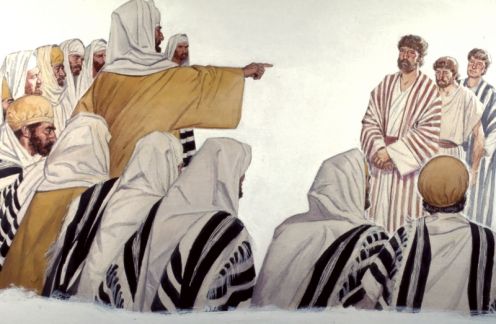
Now when they saw the boldness of Peter and John, and perceived that they were uneducated, common men, they were astonished. And they recognized that they had been with Jesus. But seeing the man who was healed standing beside them, they had nothing to say in opposition. But when they had commanded them to leave the council, they conferred with one another, saying, “What shall we do with these men? For that a notable sign has been performed through them is evident to all the inhabitants of Jerusalem, and we cannot deny it. But in order that it may spread no further among the people, let us warn them to speak no more to anyone in this name.” So they called them and charged them not to speak or teach at all in the name of Jesus. But Peter and John answered them, “Whether it is right in the sight of God to listen to you rather than to God, you must judge, for we cannot but speak of what we have seen and heard.”

Acts 4:13-20 (ESV)

Solemnly charged not to speak in Yeshua’s (Jesus’s) name, the apostles replied, “Whether it is right in the sight of God to give heed to you rather than to God, you be the judge; for we cannot stop speaking about what we have seen and heard.”

The Sanhedrin could argue that they were God’s ordained authority on earth, therefore disobedience to them was disobedience to God. It was a difficult contradiction, and one faced by others in Jewish history. Decisions the legislators adopted by majority consensus were also adopted as the ruling in heaven. (see b.Bava Meitza 59a-b)

What does one do when God-ordained institutional authority rules in contradiction with the will of God? The Master had already prepared his disciples for just such a circumstance. He had foreseen the way things would go and had assured His disciples that they would possess “the keys to the kingdom of heaven” and the right to make legal determinations of binding and loosing. (Matthew 16:19) As apostles of Yeshua, the twelve disciples represented the authority of the throne of David. That important legal power gave Simon Peter and the Twelve the right to overrule the Sanhedrin if necessary.

-from Torah Club, , Volume 6: Chronicles of the Apostles
Torah Portion Lech Lecha (“Go Forth”) (pg 78)
Commentary on Acts 2:42-4:31
Produced by First Fruits of Zion (FFOZ)

It’s all fine and well for Jesus to assure “His disciples that they would possess ‘the keys to the kingdom of heaven’ and the right to make legal determinations of binding and loosing,” but what about us? The apostles represented a direct link to the Messiah, since they had been taught by him and the giving of the Holy Spirit to them, in a very public visible and physical demonstration, was only days or weeks old. While the Sanhedrin could attempt to refute and even defy their “Messianic authority,” a good many witnesses in Jerusalem were more than convinced, and correctly so. Not only that, but there could have been no doubt in the minds of Peter, John, and the rest of the apostles, that they were in the right. Thus they had not only the authority, but the confidence and certainty of mind to be able to stand up in defiance of an order of Israel’s authentic and authoritative legal court system.

But how does D. Thomas Lancaster’s commentary on the legal authority of the apostles to defy the legal authority of the Sanhedrin affect us? That is, who holds “the keys to the kingdom of heaven” today?

You might say, “the church,” but which one? How many denominations of the Christian church currently exist?

According to the Center for the Study of Global Christianity (CSGC) at Gordon-Conwell Theological Seminary, there are approximately 41,000 Christian denominations and organizations in the world. This statistic takes into consideration cultural distinctions of denominations in different countries, so there is overlapping of many denominations.

-quoted from “Christianity Today – General Statistics and Facts of Christianity”
christianity.about.com

Oh my!

That’s a lot of denominations, and they don’t take into account a lot of the more fringy or cult-like groups who also claim some sort of authority to interpret scripture over their flocks in a legal manner.

And then there’s the Internet. As we’ve seen in a seemingly endless stream of religious blogs and their associated comments, there is a plethora of groups and individuals who claim to collectively or personally possess “the keys to the kingdom of heaven” and the right to defy the more established Christian authorities.

I suppose we could split the difference 41,000 (legitimate) ways within the body of Christianity and say that each church possesses a set of keys as applied to their own communities, and that their authority, as it were, is limited to the confines of said-communities, but that’s not really satisfactory. There are not 41,000 Gods and there are not 41,000 Christs, and there are not 41,000 Holy Spirits. God is One. While I believe, to a certain degree, that how the Bible principles are applied may vary and even evolve over the centuries in order to serve the needs of each generation, there is still an objective God; a God unto Himself, the One God with One Mind, and One Spirit, who cannot be subdivided in any manner, even though we may want and even need Him to do so for the sake of our own priorities.

So who inherited the “keys of the kingdom of heaven” or were they simply lost over the course of time?

That’s the problem we are having today. Look at the struggles the “early church” had in Jerusalem. They never became a major power in the Jewish hierarchy. They remained a small Jewish sect operating within the larger collection of valid Judaisms of the late Second Temple period and to some small degree, beyond the destruction of the Temple (but not very much farther). If there was one authentic Messianic (Christian) Jewish authority with the living apostles of Christ among the many Judaisms, when the Jews either surrendered Christianity to the nations or were “kicked out” of the assembly of the Messiah by the Gentiles, what happened to that authentic authority? Was it divided and subdivided, and subdivided again, endlessly across history, like a single-celled organism replicating, evolving, developing to form some vast living mass that is associated but not particularly unified? Is that authority shared among 41,000 living “cells” in what is (loosely) collective Christianity today?

Who currently has the right to make legal decisions that are binding both on earth and in Heaven and to defy all of the others who claim authority over the “Christian church?”

Oh, it gets worse.

It has been taught: On that day R. Eliezer brought forward every imaginable argument, (Lit., ‘all the arguments in the world’) but they did not accept them. Said he to them: ‘If the halachah agrees with me, let this carob-tree prove it!’ Thereupon the carob-tree was torn a hundred cubits out of its place — others affirm, four hundred cubits. ‘No proof can be brought from a carob-tree,’ they retorted. Again he said to them: ‘If the halachah agrees with me, let the stream of water prove it!’ Whereupon the stream of water flowed backwards — ‘No proof can be brought from a stream of water,’ they rejoined. Again he urged: ‘If the halachah agrees with me, let the walls of the schoolhouse prove it,’ whereupon the walls inclined to fall. But R. Joshua rebuked them, saying: ‘When scholars are engaged in a halachic dispute, what have ye to interfere?’ Hence they did not fall, in honour of R. Joshua, nor did they resume the upright, in honour of R. Eliezer; and they are still standing thus inclined. Again he said to them: ‘If the halachah agrees with me, let it be proved from Heaven!’ Whereupon a Heavenly Voice cried out: ‘Why do ye dispute with R. Eliezer, seeing that in all matters the halachah agrees with him!’ But R. Joshua arose and exclaimed: ‘It is not in heaven.’ (Deut. 30:12) What did he mean by this? — Said R. Jeremiah: That the Torah had already been given at Mount Sinai; we pay no attention to a Heavenly Voice, because Thou hast long since written in the Torah at Mount Sinai, After the majority must one incline. (Ex. 23:2 though the story is told in a legendary form, this is a remarkable assertion of the independence of human reasoning)

R. Nathan met Elijah (It was believed that Elijah, who had never died, often appeared to the Rabbis) and asked him: What did the Holy One, Blessed be He, do in that hour? — He laughed [with joy], he replied, saying, ‘My sons have defeated Me, My sons have defeated Me.’

Baba Mezi’a 59b

The Torah Club commentary, from which I quoted above, refers to this Talmudic story, and it is believed in observant Judaism, that the right of the Rabbis to interpret and apply halakhah in an authoritative manner derives from this passage as attached to Deuteronomy 30:12 (Stone Edition Chumash):

It is not in heaven, [for you] to say, “Who can ascend to the heaven for us and take it for us, so that we can listen to it and perform it?”

My Christian reading audience is probably asking why any of this matters, since the Jews do not have authority to interpret scriptures for Christians, and especially not to establish halakhah for us. That’s a good question and you’re right. We don’t expect any of the Talmudic rulings to have any sort of impact, let alone authority, over any of the 41,000 Christian denominations (and their variants, spin-offs, or edge case adaptations) today.

But what about Jews who profess Jesus Christ as the Jewish Messiah King, not as members of a Christian church, but as disciples of Yeshuah HaMashiach (Jesus the Christ) within a wholly Jewish ethnic, cultural, and halakhic religious and lifestyle context? What about Messianic Judaism?

When G-d intrusted Israel with the Torah, He commanded them to appoint leaders to interpret the Torah and to judge whether or not the people had broken the Torah. Inherent in this process is the development of case law, history, tradition of the Jewish people which establishes the precedence that fleshes out the full meaning and implications of each of the commandments. This body of tradition was created by the Jewish people at the commandment of G-d…The Torah invests the divine authority in the spiritual leaders of the Jewish people (this is in the Deuteronomy ch. 17), where their rulings are called…”a word of Torah”. Any Israelite presumptuous enough to reject the rulings of the judges of Israel was cut off from his people, the same punishment as for someone who rejected the written Torah. How much more presumptuous is it for a gentile to cast off entire body of Jewish tradition and claim the right to act as the judge and definer of the Torah?

-Boaz Michael
President and Founder of First Fruits of Zion (FFOZ)
Speaking at the Union of Messianic Jewish Congregations (UMJC) July 2012 conference in Baltimore, Maryland
as quoted by Gene Shlomovich on his blog
Daily Minyan

We see that in some corners of Messianic Judaism (as I define it), there is a serious devotion to the authority of the Jewish people to define themselves as Jews and to determine halakhah for themselves based on the authority of the sages. This rather flies in the face of we non-Jewish Christians but is a particular “thorn in the side” of some of those non-Jews who have either directly (by attending authentic Messianic Jewish congregations) or tangentially (through an affiliation with some form of the Hebrew Roots movement) attached themselves to a (more or less) “Jewish” viewpoint on the New Testament scriptures, Jesus as the Jewish Messiah, and God as the God of Israel.

I’ll tell you right now that I don’t know what all this means and that I don’t have the answers to the questions I’m asking. Because of this, some people accuse me of not knowing if I’m coming or going, and I suppose that is a valid concern from an outside observer’s point of view. On the other hand, there are others who feel exactly the same way about the impact and the consequences of a real, authentic, and transparent life of faith and trust in God as we attempt to grasp the meaning of the Bible across the history of the Jewish people and the world.

The Messianic Jewish Rabbinical Council (UJRC) has established a written Standards of Observance (PDF) document that is intended to guide its member synagogues in the appropriate halakhic rulings as adapted for Messianic Jews, but it is only one body and cannot possibly represent all Jews who profess Yeshua as Messiah everywhere. It also, by necessity, defines a varying level of halakhic response for the non-Jewish disciples who come under the MJRC’s authority, but again, the scope if such authority is limited. These standards do not solve the problem or answer the questions I’ve been posing in today’s meditation however, but only because, like the multitude of Christian churches that exist today, it can’t, at least not outside its own community. We don’t have a universal legal and theological interpretation of scripture where “one size fits all.”

We long for the coming of Messiah. Christians desperately await the return of the King in all his glory. We have many reasons for doing so but one of the reasons I seek him and his presence is to help me understand who indeed on earth holds the “keys to the kingdom,” if anyone. Many claim to hold them or at least know the path on which to travel to find them. Many would-be “Messiahs,” religious leaders, pundits, and self-taught scholars of one stripe or another, profess to know “the truth.” But who are we to believe except God Himself, but how we understand God through the Bible and even through the Spirit, is split at least 41,000 ways, from a Christian perspective.

How am I to choose among 41,000 paths, and probably more if I factor in my own fascination with Judaism, as applied to my Christian faith? I can’t. I can only choose one of the myriad ways as they stand before me and start walking, trusting that God will not allow me to travel the wrong path, nor select a guide made out of my ego, my biases (at least not too severely), or my weaknesses, but only His Son, and the lamp of the throne of David.

May he and I walk together discovering the truth of his existence and my own. May God grant you this gift as well, for this may be all we can do until Messiah returns to rule in Jerusalem, and reveals clearly the One God and the One Way from His Temple.

Blessed is Hashem from Zion, He Who dwells in Jerusalem. Halleluyah!

Psalm 135:21 (Stone Edition Tanakh)

For from Zion shall go forth the Torah, and the word of Hashem from Jerusalem.

Micah 4:2 (Stone Edition Tanakh)

64 days from now, on my path, chosen from among 41,000 paths, (and probably more) where will I find myself?


Do Christians Practice Judaism?

You probably think I’m crazy even asking if Christians practice any form of Judaism. The vast, vast majority of both Christians and Jews would answer a resounding “no.” Only a tiny population of Jews and non-Jews in what is referred to as the Messianic Jewish and Hebrew Roots movements (they overlap somewhat but are hardly the same thing) even ask such a question. Moreover, only some of the people inside of those movements are considering or confused by the answer.

But why even ask such a ridiculous question? First of all, I recently read such a question as it was floating by in the blogoverse and was intrigued by its audacity. One such church-going (non-Jewish) Christian says he regularly tells other people in his church that he practices “Messianic Judaism”. This is just a hair off from his possibly telling other Christians that he’s a “Messianic Jew”. I don’t want to be unfair or inaccurate, and this person did not refer to himself as a Jew, Messianic or any other kind.

But as you know if you’ve been reading my blog for very long, I have a very definite perspective on What is Messianic Judaism. If you click that link, you’ll see that I don’t think it’s possible for a non-Jew and particularly for a Christian to actually “practice Judaism,” but apparently the question requires more attention.

There’s a conversation going on in Facebook currently (you may need to be logged into Facebook to see it) that was started by Boaz Michael, President and Founder of the educational ministry First Fruits of Zion (FFOZ). He asks:

A good benchmark for the Nations? The seven laws of Noach are all things that can be derived from one place or another in the Bible, if not directly from Genesis 9. They form a sort of minimalist approach to ethical monotheism: believe in God, be a decent person, be kind to animals, and settle your disputes in court.

Now to be fair, when I queried Boaz on the differences between how Noahides are viewed in Judaism and the blessings of being a Christian, he replied:

Yes, I think that for believers there are additional standards and expectations. After all, the God-fearing Gentile believers were not just “sons of Noah.” Through Paul’s gospel, they considered themselves co-heirs to the messianic promises and spiritual members of the people of Israel. They fellowshipped with the Jewish believers, shared meals with them, and worshipped in their synagogues. They considered themselves spiritual sons of Abraham.

Which brings us to a relevant point: Did Gentiles ever practice Judaism?

The complete answer would probably turn into a book or at least a doctoral thesis on the subject, neither of which I have time for. The short answer is a kind of “maybe” as I see it (well, not really, but I’ll get to that). It all hinges on whether or not you believe that Gentles imitated literally every behavior of their Jewish mentors when learning to become disciples of the Jewish Messiah, and even if they did, what that behavior meant to both the Jews and non-Jewish believers involved.

We see in Acts 10 that the Roman God-fearer Cornelius (who didn’t become a “Christian” as far as receiving the Spirit and water baptism until the end of the chapter) most likely prayed the daily prayers in the same pattern as the Jew.

…Four days ago, about this hour, I was praying in my house at the ninth hour…

Acts 10:30 (ESV)

The ninth hour is about 3 p.m. which would be the proper time to pray the mincha or afternoon prayers. As Boaz said, the early non-Jewish disciples also very likely shared meals with their Jewish counterparts, which would have required that they keep a kosher diet, at least during those shared meals, and if, as Boaz said, they also worshipped in Jewish synagogues, then they would have prayed the same prayers (which were said from memory rather than through use of a siddur) and gone through the same “order of service” as the Jews. In fact, it’s likely that significant portions of the lifestyle of an “early Christian” would have been substantially similar to that of a Jewish person (disciples of the Jewish Messiah, or otherwise).

This may have contributed to some of the confusion we see among a number of the Gentles, as recorded both in Galatians, where Paul admonishes the Galatian church goers, saying they do not have to convert to Judaism and keep the full yoke of Torah (see Galatians 5:3) in order to be justified, and in Romans where Paul goes to great lengths (see Romans 11) to explain to the Gentile disciples that their entry into covenant with God did not cause them to supersede the Jewish “branches.”

No wonder now that Jews are rediscovering Jesus as the Jewish Messiah and Christians are rediscovering their “Jewish roots,” that we are also reviving something of that confusion in the present day (I’m speaking with some poetic license, since I don’t know if or to what extent Gentiles in the early church experienced any sort of “identity crisis” the way we see it in certain corners of the modern Hebrew Roots movement). I want to make it clear that many Gentiles in Hebrew Roots do not think they are Jews, nor do they intend on practicing any form of Judaism, so those who are “confused” represent a very small minority in Hebrew Roots.

So, I’ll ask it point-blank. Did early Christians practice Judaism? In terms of actual worship and significant lifestyle behaviors, it probably looked that way to an objective observer (though we lack a lot of information about how early Christianity really worked relative to Judaism). They might have been mistaken by some for people undergoing the process of converting to Judaism. The Roman empire recognized Judaism as a valid religion and would allow Jews to cease work during the Shabbat and so forth, but “the Way” as it was practiced among the non-Jewish disciples, was not a legal religion in the empire, and it would have been extremely difficult for diaspora Gentiles to keep Shabbat as did the Jews, and probably observe many of the other obviously Jewish mitzvot as well, such as eating kosher and praying shacharit and mincha, if it meant ceasing work during the morning and afternoon prayers.

Of course, after the destruction of the Temple and the exile of the vast majority of the Jewish population from Israel (renamed “Palestine” by the Romans), the first non-Jewish “bishop of the church” (certainly those exact words weren’t used to define the “office” of the head of the “Jerusalem Council” in those days) had to be elected. That, and many more events, resulted in the non-Jews taking administrative control over “the church of Jesus Christ” and within a few centuries (exactly how many centuries is up for grabs), the schism between what became Christianity and any form of Judaism was complete. At that point, no Christian was practicing any form of Judaism and any Jews who may have still, even secretly, acknowledged Yeshua as Messiah, would have done so as part of a completely Jewish religious life, isolated in the extreme from the Gentile Christian.

As part of the research (such as it is) I did for writing this “extra meditation,” I read articles such as Who is a Jew and Definition of a Jew, but they don’t really respond to the question I’m asking. First of all, there may be a difference between being Jewish and practicing Judaism, though I’m sure the distinction is very fine and difficult to identify. Then there’s the idea that we have post-modern Jews defining themselves without the “benefit” of the New Testament, thus they do not take into account any Apostolic material that might modify such definitions (and please keep in mind that Jews have every right to define who is a Jew and what is Judaism).

I tried to see if there was any way of answering the question, “Do Noahides Practice Judaism,” but other than finding a rather interesting article written by Rabbi Shraga Simmons about his brief interview with Noahide Jim Long, I came up dry. Certainly a Noahide would have no other place to go to worship and find community except a synagogue, thus he would be singing, praying, and worshiping alongside Jews on every Shabbat and holiday, but does that mean gentlemen like Mr. Long, a Gentile Noahide, are “practicing Judaism?”

The Gentiles in Hebrew Roots or worshiping in authentic Messianic Jewish communities seem to think they are the only non-Jews who have been attracted to and captivated by the Torah, but reading some of the comments in Rabbi Simmons’ article, I see that there is a significant number of us who have chosen the Noahide route and set aside Christianity/Hebrew Roots and Messianic Judaism as viable options.

What is Judaism? Since Judaism is a people, a nation, and a religion, it’s difficult to say that just “behaving” like a Jew means you’re practicing Judaism. You, as a non-Jewish Christian or Noahide, may be worshiping alongside Jews in a synagogue setting, sharing their fellowship, and breaking bread with them, but it might be a bit of a stretch to say you are practicing Judaism in precisely the same sense as the Jew davening next to you. If a Jew, for example, were to visit a Christian church (say he was married to a Christian wife but maintained a Jewish cultural, ethnic, and religious identity), and prayed and worshiped God within that context, we wouldn’t say he was “practicing Christianity.” Of course, he wouldn’t be acknowledging Jesus as Messiah and Savior, either.

What about the “Messianic Jew” who maintains a Jewish cultural, ethnic, and religious identity but acknowledges Jesus as Messiah? Does he practice Christianity? Some “Jewish Christians” do, but they have voluntarily left a Jewish religious and (to some degree) cultural context to worship and identify primarily as a Christian, but one of Jewish heritage. If you are a Jew who is Messianic and maintains that Jewish cultural, ethnic, and religious identity, it’s easier and clearer to say that you are “practicing (Messianic) Judaism.” A Messianic Jew in a church isn’t practicing Christianity, but worshiping alongside their Christian brothers and sisters. (Dr. Michael Schhiffman commented about this significantly on his own blog recently)

I suppose on that basis, regardless of how we see those early, ancient Christians and what they were practicing in the synagogue, today, we Christians, even those of us who daven in the presence of our Jewish fellows in a (Messianic) Jewish synagogue, are not practicing Judaism, but worshiping God with the Jewish people who, in this case, have the same God as we do, and know the same Messiah as we do.

I realize my little missive is not perfect, but I think I have made a reasonably good case for my point of view. Last spring during Shavuot, I worshiped in a completely Jewish synagogue context at Beth Immanuel Sabbath Fellowship. But even though the prayers were in Hebrew, even though we davened using a siddur, even though the Torah was read, and even through we all ate kosher meals prepared in a kosher kitchen, that doesn’t mean I was “practicing Judaism.” I was a Christian worshiping with other Christians and a good many Jews in a place where we were all welcome to share fellowship in love and peace, each of us just as who we were created to be by God.

Who Let The Dogs Out?

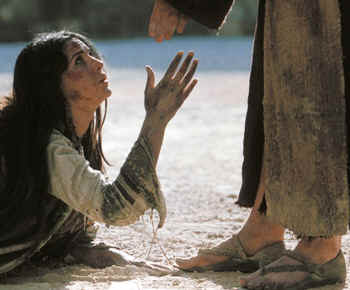
And from there he arose and went away to the region of Tyre and Sidon. And he entered a house and did not want anyone to know, yet he could not be hidden. But immediately a woman whose little daughter had an unclean spirit heard of him and came and fell down at his feet. Now the woman was a Gentile, a Syrophoenician by birth. And she begged him to cast the demon out of her daughter. And he said to her, “Let the children be fed first, for it is not right to take the children’s bread and throw it to the dogs.” But she answered him, “Yes, Lord; yet even the dogs under the table eat the children’s crumbs.” And he said to her, “For this statement you may go your way; the demon has left your daughter.” And she went home and found the child lying in bed and the demon gone.

Mark 7:24-30 (ESV)

Since the assigned lection a few Sundays ago on Jesus and the Syro-Phoenician woman (Mark 7:24-30), I’ve intended to comment on what appears to me a surprisingly widespread mis-reading of the passage. Essentially, the “dogs” (who Jesus says here must wait till after the “children” have eaten before they can be fed) are taken with an extremely pejorative connotation as feral mongrels, and the scene is read as if Jesus is pictured insulting the woman and treating her with contempt. I am embarrassed to find this basic take on the passage even in the learned commentary on Mark by a scholar I deeply admire: Adela Yarbro Collins, Mark: Hermeneia (Fortress Press, 2007), 366-67. But for several reasons, among them prominently the specifics of the Greek term used (unusually) in this passage, I think it pretty clear that this take is wrong.

Dr. Larry W. Hurtado
“Dogs, Doggies, and Exegesis”
Lary Hurtado’s Blog

Disclaimer: In using the title of the song Who Let the Dogs Out? written by Anselem Douglas and originally covered by the Baha Men, I am in no way attempting to be insulting to any individual or group of people, either those addressed within the context of this blog post or otherwise. Given the core statement made by Jesus in the Mark 7 quote, it just seemed like a “clever” title for my missive. That is the complete extent of my intention for using the song title.

Note: I’m taking an interpretation written by well-known New Testament scholar Larry Hurtado and using it as a springboard to make a suggestion of my own. I certainly don’t expect Hurtado (should he ever read this) to agree with me and frankly, what I’m doing in today’s blog post is something of an “experiment.” Just so you know.

Was Jesus a racist? This question doesn’t come out of thin air. There have been several recent conversations in the blogosphere in relation to Messianic Judaism (click the link to see my rather specific definition for the term) and whether or not proponents of Messianic Judaism as a form of Judaism, rather than an all-inclusive “Christianity,” is racist. (See Judah Himango’s blog post Two Church: Defining Bilateral Ecclesiology in Simple Terms for the latest discussion) The suggestion is that, by insisting that the modern Jewish disciples of the ancient Jewish Messiah are a Judaism and, like all other Jews, are the sole inheritors of the Mosaic covenant because they are the physical descendants of Abraham, Isaac, and Jacob, that Messianic Judaism and Messianic Jews are being racist. That is, Messianic Jews, by overtly excluding non-Jewish Christians from the conditions of the Mosaic covenant (the Torah), are denying people access to being obligated to the full weight of the Torah mitzvot based on race.

The topic is extremely rich and can be taken in a lot of different directions, but since I had recently read Dr. Hurtado’s above-quoted blog post and it’s companion article, I thought I’d use them as the focus of my investigation. They really are quite fitting since they directly address Christ’s interaction with the (non-Jewish) Syro-Phoenician woman in Mark 7 and he appears to treat her rather badly because she’s not Jewish. But is that really the case?

This sense of a domestic scene ought to be obvious simply in reading the passage. Jesus is pictured as responding to the woman’s request by saying, “Let the children be fed first, for it isn’t right to give the childrens’ food to the dogs.” The point of the statement is the temporal priority of the “children”, of course in this case, referring to Jesus directing his ministry to fellow Jews. The metaphor presumes a setting in which the household dogs are fed the leftovers after the family has eaten (not custom-produced dog-food). (I know the practice well, having grown up in a rural setting in which the household dogs ate what we ate, only after we had eaten.)

The woman’s clever reply confirms this, respectfully pointing out that “the dogs under the table eat from the portions of the children.” “Wild” dogs and “scavenger dogs of the street” aren’t typically allowed “under the table” and around the children! And anyone with both children and household dogs will know how it goes at mealtime: If allowed, the dogs hang about the children’s chairs, knowing that children love to “drop” morsels to their pets.

Finally, we also have to ask ourselves how likely it is that the authors of Mark (writing for a Christian readership at least largely made up of converted gentiles) would have inserted a scene in which supposedly Jesus insults a gentile woman in the harsh terms imputed by some modern readers. She is “put in her place” as a gentile, but it’s a temporal place. The scene functions to explain that, although Jesus’ own ministry was confined to his Jewish people (apparently, a tradition that Mark couldn’t deny/ignore), the subsequent mission to gentiles was (Mark wants to imply) on the agenda, only it had to wait its time, and Jesus is pictured as anticipating that gentile-mission in responding positively to the woman’s respectful but clever response.

Was Jesus racist? Seemingly not, according to Dr. Hurtado, at least not in a way where he was being “cruel” to the non-Jewish woman. What Hurtado describes is a situation whereby Jesus seems to order his overall ministry, with the Jews (“the children”) “served” first, and only afterwards are the domesticated “dogs” under the table (non-Jews) fed. According to Hurtado, Jesus wasn’t being insulting or racist and in fact, he was certainly “inclusive” (using a modern term appropriate for such discussions) of non-Jews, but he did not see them on the same lateral plane at that point in time. They (we) wouldn’t be served until after his death, resurrection, and ascension. During his first coming, Gentiles didn’t occupy the same “space” or the same roles relative to his mission to the Jews as the Jewish redeeming Messiah and Savior. Nevertheless, he did take the time to “feed the dog under the table” so to speak.

This is made a bit more clear by Dr. Hurtado’s subsequent blog post:

One further observation about the little scene between Jesus and the Syro-Phoenician woman in Mark 7:24-30 is that the initial response ascribed to Jesus is not a derogatory reference to the woman, or a simple misogynist or racial put-down, but is instead a parable-like saying specifically appropriate to the woman.

The part about the “parable-like saying specifically appropriate to the woman” could stand some examination. If I say that the sequence of events we see in Mark 7:24-30 represents how Jesus saw the prioritization of his ministry in relation to Jews and Gentiles, and if I say that, based on these verses, it was Christ’s intent to “feed” both the “lost sheep of Israel” and the non-Jews living among Israel, but giving a later temporal priority to the non-Jews, then can I generalize this as Christ’s intent to maintain some sort of distinction for the disciples among the nations that he would later (after the resurrection) command his Jewish disciples to make? (see Matthew 28:18-20).

Hurtado doesn’t directly address this issue and he would probably disagree with how I’m using his material. He seems to say that the only difference between Jewish disciples and Gentile disciples is that the Jews would be brought in first. The Gentiles would enter discipleship later on. But is the only distinction temporal?

Based on the Last Supper narratives (Matthew 26:17-30, Mark 14:12-26, Luke 22:7-39 and John 13:1-17:26), Jesus intended on bringing all of his followers, Jewish and Gentile alike, into covenant relationship with God via the New Covenant (see Jeremiah 31 and Ezekiel 36), a covenant which confirmed and expanded upon the previous covenants God made with Israel. Prior to this point, the non-Jewish nations did not have direct access to God through covenant (unless they converted to Judaism). Only through the blood and bodily death of Jesus and his subsequent resurrection could we be brought in and placed on a level plane in the Kingdom relative to access to God and experiencing God’s love for us. This fits quite well with what Hurtado wrote.

But would that make a difference in how Jesus saw the Gentile disciples made after his ascension to how he saw the Syro-Phoenician woman? Was it his intention to elevate the “dogs sitting under the table” to the status of “children sitting around the table?” Given that Mark was writing his Gospel primarily to non-Jewish disciples, I believe I can make a case for the answer “no.” Otherwise, Mark’s description of this transaction becomes wholly anachronistic to the disciples from the nations (i.e. non-Jewish Christians).

I’d like to suggest that the distinction between the Jewish and Gentile disciples wasn’t necessarily temporal, but sequential and derivative. In fact, the way I understand how Gentiles manage to be injected into a relationship with God through the covenants (specifically Abrahamic and New) made with Israel, it would have to be.

Paul appears to echo Mark’s theme and suggest one that mirrors my suggestion in his famous letter to the church in Rome:

There will be tribulation and distress for every human being who does evil, the Jew first and also the Greek, but glory and honor and peace for everyone who does good, the Jew first and also the Greek. For God shows no partiality.

Romans 2:9-11 (ESV)

PaulThis short verse tells us several things. First, Paul, in speaking to a “mixed congregation” of Jews and non-Jews, continues to draw a distinction between them (he calls them “Jews” and “Greeks,” not “Christians” or some other all-inclusive term designed to negate any distinction between the two groups). He also says two things that seem to be contradictory. He says that God shows no partiality” between Jews and Greeks, but he also says “the Jew first and also the Greek,” which dovetails very nicely into Hurtado’s analysis of the Mark 7 passage where he describes a “temporal” prioritization, but also a sequential prioritization, where the Jews would always be considered before the non-Jews regardless of circumstances, good or bad.

Since Paul at this point, is addressing Jews and Gentiles who are all covenant members under the Messiah, it is reasonable to say, in my opinion, that the relationship between Jews and non-Jews remains distinctive. The non-Jews are not considered before the Jewish disciples, and their (our) relationship with God derives from the Jews after the non-Jews have entered into covenant relationship with God through Jesus Christ. We are equal, because God shows no partiality, but the distinction between Jew and Gentile is maintained as is the rather (on the surface) unflattering relationship between the Jewish “children” and the non-Jewish “domesticated dogs,” though a kinder metaphor such as parent to child (no, it’s not a perfect metaphor) might be more fitting.

There’s a strong tendency to try to understand the relationship between believing Jews and believing non-Jews in terms of 21st century western cultural, social, and legal definitions. America and the other nations of the west, are based on a strong imperative to treat all people of differing races, cultures, ethnic groups, languages, and nationalities as equal in terms of law and access to resources. Our system of equality is flawed, but the principle exists and it’s a good one.

But we can’t seem to get around the fact that first Jesus (as described by Mark) and later Paul both differentiated between the Jewish and non-Jewish followers and disciples of the Messiah. The Jews were brought in first but they continued to be first, even after the Gentiles were brought into covenant. The Jews were directly descended from Abraham, Isaac, and Jacob and as such, were the beneficiaries of all of the covenants God made with Israel. The people of the other nations would not be able to enter into covenant with God except through Jesus and the New Covenant (the original blessings can be traced back to the Abrahamic covenant) and thus, Jesus and later Paul, order their priorities differently depending on…yes, on race. They order them differently based on whether or not a person is physically a descendent of Abraham and Isaac and Jacob or not. Everybody except for the Jewish people, are not.

Was Jesus a racist? Not in the sense we understand the term today. He did however, differentiate based on racially associated covenant relationships. Being Jewish was one thing. Being non-Jewish was something else. Through Jesus, we Christians enter into a relationship with God, think of it as going from wild, scavenging dogs, to domesticated dogs. Not very flattering, as I said before, especially if we (to extend Mark’s metaphor) continue to consider the Jews as “children” by comparison. On the other hand, maybe we’re much newer additions to the family and must continue (as in many families) to pay deferential respect and have differing privileges than the older members of the family.

But setting aside the uncomfortable literal interpretation of this language, the difference between the Jewish believers and the Gentile believers is not one of God’s love or access to our Creator, but of older vs. younger or, who we are as non-Jews in the family is directly derived from the older Jewish members. Jews are “served first.” The dogs eat what the children eat but the children will always come first. Or the younger family members eat what the older members eat, but the younger eat later, waiting first for the older members to be served. Perhaps we even eat only because the older members of the family, the root, provides the nourishment.

I don’t think I’ve “solved” the “are Messianic Jews racist” debate. I admit that I’ve taken liberties with the text and explored alleyways Hurtado would likely not approve of. I’ve also probably raised more questions than I’ve answered,  but I wasn’t actually trying to answer questions. I’ve been trying to introduce the possibility that Jesus never intended to eliminate any of the “specialness” of the “Children” of Israel when he, through God’s grace and mercy, made a way possible for the people of the nations to also enter God’s Kingdom. I think our connection will always be through Israel and we will always be dependent on Israel (and Israel’s firstborn son Jesus) for our access to God.

Something to think about anyway.

Returning the Torah

“I didn’t know what to say, but I certainly appreciated his incredible gift. I realized that this was a Torah that had been basically homeless for the past 50 years. There was no one to read it, hold it or keep it properly, and now God gave the Torah a home, and would hopefully bring this lonely Jew back in the near future as well.

“Now, what about an ark? That’s a story of its own. I found an online ad for an old Jewish artifact, a Jewish chest. The sellers weren’t Jewish, but they had bought it from a priest who told them it was of Jewish origin.

“When I opened the online pictures of the chest, I saw before me what seemed to be a beautifully crafted ark. It was small, so it wouldn’t be able to hold a regular sized Torah, but would be perfect for the Torah we had. But when I viewed a picture of the top of the ark, I almost fainted. There was a large cross attached to it. All of a sudden, I was not at all sure that this was an item of Jewish origin.

Suddenly I noticed a small plaque at the bottom of it. I asked the sellers to send me a photo of the plaque which appeared to have Hebrew writing on it. They sent me a picture where there was a clear inscription in Hebrew that said “Behold, the guardian of Israel neither sleeps nor slumbers Psalms 121), which proved that the item must be Jewish.

-Rabbi Binyomin Pruzansky
“The Lost Torah Scroll”
Commentary on Shmini Atzeret and Simchat Torah
Aish.com

Rabbi Pruzansky tells a story about regularly hosting 30 or 40 young Jews in his home for Shabbos meals. These are young people who are Jewish but who have never experienced a Shabbat in their own homes. They would be uncomfortable in a traditional synagogue setting, but feel comfortable as guests of Rabbi Pruzansky. So he set out on a quest to acquire a Torah scroll and ark for his home to give these young Jews an opportunity to make aliyah in a Jewish environment where they could feel more at ease.

While the scroll he eventually acquired was purchased from a Jew, although one who had fallen away from practicing Judaism for many years, the ark was another story.

The cross upon closer examination, they said, was a separate piece that had been attached. I realized that the priest who bought this ark must have made that addition. I was deeply moved, and was certain that the hand of God was clearly guiding me.

“I bought the ark and had it delivered to my home. The cross was removed and I marveled at the verse that was inscribed. I have never seen this particular verse inscribed on an ark before. And I realized that there was a message here. It was as if God were saying that although this ark was lost for many years, He would never forget about it. He didn’t rest until it finally was brought home to Jewish hands.

“My dear friends, look at what we have here. A Torah that was neglected for so many years was finally given a home in an ark that had been used by a priest. Yet the message was clear that God would never give up on them. He had not forgotten about this lost ark and Torah scroll, and finally the two of them were brought together and can now be used to bring young men and woman back to their Father in Heaven as well.

In reading Rabbi Pruznasky’s “adventure,” I couldn’t help but be reminded of another tale of the struggle to return Torah scrolls to Jewish hands:

Another thing happened as a result of Saddam’s demise. Iraqi mobs looted his crown jewel of culture, the national museum. The majestic Iraq Museum is still on Nasir Street but it’s under new management – the elected Iraqi government. A museum director, Dr. Donny George, was appointed to restore the museum in 2005.

Soon after, Canon White was invited for a private tour.

Dr. George and Canon White strolled through the grand halls. Eventually the priest was led down to the basement level. Dr. George opened the heavy doors of a vault.

Canon White couldn’t believe what he was looking it – rows and rows of Torah scrolls.

“There are 365 of them,” declared Dr. George.

Canon White’s surprise turned into horror. “The Torah scrolls were all at risk. Rats were eating some of the parchment. They were not properly preserved or displayed, just stacked up on the dirty floors,” he says.

Canon White wanted to rescue them, but he decided to try to obtain just one. He had a destination in mind.

-by Ari Werth
“Struggle for the Scrolls”
Aish.com

As I wrote in my blog post Hope and Love, “Andrew White is an Anglican priest risking his life helping Christians in Iraq. Even more dangerous, however, is what he volunteers to do – protecting the last few Iraqi Jews.”

He is also a Christian who is dedicated not just to protecting the Jews and Christians in Iraq, but to returning to the Jews that which rightfully belongs to them: the Torah scrolls held in Iraqi possession.

But there’s another way of looking at this. Although supersessionism is slowly declining in the Christian world, there is a very small subset of Christianity where a rather odd form of replacement theology is apparently on the rise. A group of non-Jewish believers holds to the theory that all of the contents and conditions of all of the covenants God made with the Children of Israel also belong to them. That means, except for a small strand of Jewish DNA, these Christians believe they are just as “Jewish” as Jewish people.

That’s an oversimplification of their beliefs, generally referred to as “One Law,” but I’m rather struck by the odd parallel (or “anti-parallel”) between their stance and the stories of Rabbi Pruzansky and Canon White. Both of these men, within their differing contexts, have worked very hard to return to the Jews something of the Torah, whether it’s hundreds of scrolls in danger of being destroyed in a sub-basement of a museum in Baghdad, or a Torah ark that had once belonged to a priest.

Traditional Christian supersessionism effectively recast the Jewish Torah into a dying or dead Law that had been replaced with Christ’s grace and “nailed to the cross”. Subsequent generations of Christians have been guilty of incinerating Torah scrolls, siddurim (Jewish prayer books), volumes of Talmud, and actual synagogue buildings.

While thankfully, the church has abandoned such heinous acts against God’s covenant people, a very tiny group of them (us) have taken on a different tactic. The tactic is subtle and for the vast majority of “One Law believers,” it is completely unconscious and innocent, as their leaders insist to them that God wants and even requires that they possess the full yoke of the Torah mitzvot as their very own. It’s not a matter of stealing it from the Jews and saying that the Torah is now “Christian.” Rather, it’s a matter of saying (in effect) that Judaism and everything that is distinctly Jewish is completely irrelevant, because Jesus made us all exactly the same. It’s the ultimate expression of equality and political correctness as applied to this minority Christian viewpoint.

(At this point, I want to say that for many years, I was a One Law believer and in my heart of hearts, I honestly believed I was doing God’s will by (poorly, in my case) imitating Jewish religious and identity practices. I still have many “One Law” friends, both locally and on the web, and they are doing what they believe they must in obedience to God. I pray that God will show them one day that while their desire to obey God is very sincere, a course correction is required. For some One Law Christians though, in spite of being presented with evidence and arguments to the contrary, they insist, as a matter of pride, that the Torah belongs to them. More’s the pity.)

In my blog posts Redeeming the Heart of Israel, Part 1 and Part 2, I tried to describe that a large part of our duty as Christians to the Jewish people is to help them return to the Torah. To bend that last sentence to fit the theme of this “meditation,” we Christians should be returning the Torah to the Jews, not claiming it for our own.

If Jesus had intended to include the rest of the world in covenant relationship with God using all of the conditions of all of the covenants God had made with Israel, in Matthew 28:18-20, he would have just commanded his Jewish disciples to make converts of the nations, not disciples. While one possible interpretation of this command would be for the non-Jewish disciples to directly imitate their Jewish mentors in all of their behaviors, including those that uniquely identify Jewish people as Jews, we don’t actually ever see that happening.

We do see, as in the example of Cornelius in Acts 10, how we non-Jews receive the Spirit the same as the Jews, and we’re baptized in water, the same as the Jews, but while many of the “God-fearers” of Peter’s and Paul’s day did pray three times daily, keep some or all of the dietary laws, and perhaps even keep a weekly Shabbos, they likely did not see becoming carbon copies of their Jewish teachers or (at that point in history) view becoming greater than the Jewish inheritors of Sinai as the desired result of their reconciliation to God.

Jesus and his Jewish Apostles lead and the Gentile disciples followed.

Now, we have a greater purpose. Rabbi Pruzansky’s story is just one small example of how modernity, moral relativism, intermarriage (and I say that as an intermarried Christian husband), and assimilation have grievously depleted the ranks of Jews who are culturally and religiously Jewish. There are so many people (my wife was once one of them), who are halachically Jewish but estranged from the synagogue, the siddur, and the Torah. We Christians who find ourselves drawn, often inexplicably, to Judaism have a great opportunity to, after our own fashion, do what Rabbi Pruzansky and Canon White are doing. We can return the Torah to the Jews or more accurately, we can encourage Jews to return to the Torah.

There is an idea in some corners of Judaism that says the Messiah will only come (or from a Christian point of view, “return”) when all Jews everywhere observe a single Shabbat. I don’t know if that’s true or not, but I believe that God will find favor in His Jewish people, as increasing numbers of them return to Him in obedience to the mitzvot. For a Jew, this means returning to the Torah. For a Jew, it means the Torah is returned to him. It does not mean, “the Torah is now for we Christians but we’re willing to share it with the Jew.” It does not mean, “the Torah is now for everyone and, strictly speaking, it isn’t Jewish anymore.”

Speaking to my Christian brothers and sisters who are not Jewish, whether you or I observe the Torah commandments that specifically identify Jewish people as Jews won’t make much of a difference to God, in my opinion. After all, the vast majority of the Torah speaks of those things that we Christians already do, such as feeding the hungry, visiting the sick, and comforting the grieving. We already do everything that our Master and Savior Jesus commanded his disciples to do.

But in a world that has always been opposed to the Jewish people, we can do something for them and for God. We can give them back what we have taken from them. We can allow them, without resisting any further, to be Jewish and to do Jewish. At Sinai, God created a unique and treasured nation that was never intended to be “xeroxed,” diluted, or deleted.  But through repeated acts of disobedience by the Israelites, God (temporarily) dispersed that nation to the four corners of the earth.

Rolling the Torah ScrollNow He is bringing them back to their peoplehood, to their Land, and God is bringing the Jewish people back to Himself. The mission of the Christian church is to serve God and to obey our Lord, and part of that service is to return the Torah to the Jews and to recognize that Israel will one day (I pray soon) be restored as the head of all nations.

Boaz Michael, the President and Founder of the educational ministry First Fruits of Zion (FFOZ) has written a soon-to-be published book called Tent of David (available January 2013) which outlines this mission for us from a Messianic Jewish perspective. These are exciting times for the church and we all have vital roles to play in the plan of God.

We just need to remember our roles. We just need to remember that our job is not to take, but to restore.

May the Messiah come soon and in our day.

Amen.

What is Messianic Judaism?

Every society has that which bonds it: A common ancestry and a system of patriarchal lineage. Or a common language or common borders or governing body. Usually, it is a combination of several factors that mold a mass of people into a single whole.

The Jewish people are unique in that they have only a single nucleus—and it is none of the above.

All that bonds us is Torah. Nothing else has proven capable of holding us together for more than a generation or two. Nothing else, other than the same Torah that first forged us as a nation.

-Rabbi Tzvi Freeman
“Jewish Nucleus”
Based on letters and talks of the Rebbe
Rabbi M. M. Schneerson
Chabad.org

When I became a follower of Yeshua, it was not a rejection of the God of Israel, but, on the contrary, a belief that Yeshua was a fulfillment of God’s promise to Israel. I did not stop being a Jew, and did not stop living as a Jew. On the contrary, believing Yeshua to be the Messiah made me want to be more observant of the Torah than before. Believing in Yeshua enhanced my Jewishness rather than lessen it.

Whatever my experience is, it is not a conversion to Christianity. I do not criticize Christian practice, but simply state the fact, that their practices are not my practices, their form of worship is not mine. Whenever I have visited a church, I have felt out of place, like I was in someone else’s living room. Their culture was not my culture, their practices were not my practices. Their understanding of Scripture is not mine. The only conclusion is that their religion is not my religion.

I feel at home in the synagogue, any synagogue. Their practices and beliefs are familiar to me. Their understanding of God and of His love for our people resonate with mine. While traditional synagogues don’t acknowledge Yeshua, nevertheless, He is there. For me, He is the Messiah of Israel.

-Rabbi Dr. Michael Schiffman
“Messianic Judaism and Christianity: Two Religions With The Same Messiah”
Drschiffman’s Blog

What is Messianic Judaism? Who is a Messianic Jew? These are questions I’m probably not qualified to ask let alone answer, but I have a special interest in the topic for a number of reasons. One important reason is that I’m a Christian husband married to a Jewish wife, so I am keenly aware of the intersection between our two outlooks on faith, the Messiah, and God as it expresses itself in our family life (I also have three Jewish children to add to the mix).

On top of that, most of my “Christian” religious life has been spent worshiping within the context of a One Law congregation (which isn’t really “Messianic Judaism” but I’ll explain that by the by). Within that venue, I gained an appreciation of (if not an actual proficiency in) Jewish religious thought and practice. I find not only many of the mitzvot quite beautiful and meaningful, but the symbolism and conceptualization behind the mitzvot, as the Rabbinic sages have expressed it, to be illuminating of God and oddly enough, my own Christianity.

Additionally, I have enough friends and acquaintances who are Jewish and Messianic and I desire to understand them and their unique experience better. That understanding I believe, will be critical for the Christian church as a whole (if the church can be said to represent a whole) to grasp as the days of the Messiah draw near and he calls His people Israel to return to him along with the nations of the world (“first to the Jew,” however). Without a firm foundation in the “Jewishness of Jesus” and how our world will one day be ruled by a Jewish King descended from the Throne of David, the traditional Christian will become lost and unable to connect to who and what Jesus truly is and what it actually means to be a Gentile disciple of the Messiah.

In addition to the Rabbis I’ve quoted from above, this “meditation” was inspired by a series my friend Judah Gabriel Himango has just started on his own blog called The State of the Messianic Movement. He intends to examine the three overarching groups that exist under the “Messianic” umbrella: Jewish Christianity, Messianic Judaism, and Hebrew Roots. This should require a definition of each of these terms and what (and who) they represent.

For myself, I’ve found that my understanding of what “Messianic Judaism” is has morphed over time. I used to think the term was a big “bucket” that contained what I thought of as Messianic Judaism proper, or groups of primarily Jewish people who worship Jesus as Messiah, One Law, which are groups of primarily non-Jews who believe that the Sinai covenant and its conditional statements, the Torah, are applied with perfect equality between Gentile and Jewish believers, and Two-House, which is made up of groups of primarily non-Jews who believe that their attraction to Torah and Judaism means they are “hidden” Jews who are descended from the “Lost Tribes of Israel.” (By necessity, these definitions are brief and do not contain all of the details and nuances to completely describe each group)

It would take too long to explain how and why I changed my paradigm for understanding Messianism, but a large part of the process was watching my wife rediscover her own Jewish identity during the last several years, moving from atheism, to traditional Christianity, to One Law, and then entering the community of Jews locally, first in our combined Reform-Conservative shul, and then finally becoming involved with the Chabad. I can say all that in a single sentence, but the reality of the experience is extremely complex and involved and having lived through my wife’s journey as her Christian husband (often observing but not significantly able to participate), it has been a remarkable and life-changing progression.

The missus and I were sitting at the kitchen table taking about subjects related to this and we landed on the “hot topic” of whether or not she thought Messianic Jews were Jews. Her answer surprised me just a little. She said that non-Jews who converted to Judaism but who did not renounce other religions (including or perhaps especially Christianity) were not Jews. During the last part of the conversion process, the almost-convert is asked if they voluntarily surrender any and all affiliations to any other religions or faith traditions. If they expect to complete the conversion and enter the mikvah, they always answer “yes”. If they answered “yes” but retained a faith in Yeshua (Jesus), then they lied and their conversion is null, as far as she’s concerned. If, for some reason (and I’ve heard unsubstantiated rumors of this occurring occasionally), the officiating Rabbi fails to ask the question and the convert continues to silently harbor a faith in Yeshua, then again, as far as my wife is concerned, the conversion isn’t valid. A non-valid conversion means the person entered and exited the mikvah as a Christian. End of story.

On the other hand, if a halalaic Jew in any way shape or form, came to faith in Jesus and worshiped him as Messiah, as mistaken as my wife thinks that person is, they are still a Jew. It would be like a Jew who practiced Buddhism or some other religious tradition. They’d still be Jewish. Her brother, for instance, is a born-again Christian and as far as I know, he continues to deny that his mother (and my wife’s mother) was Jewish (my mother-in-law passed away many years ago). To look at him, his wife, and his children, they are the perfect picture of a traditional Christian family. The idea of being Jewish just doesn’t compute within him and I’m sure he doesn’t understand why my wife and children consider themselves Jews. Nevertheless, if he should walk into our local Chabad synagogue on any given morning, and the Rabbi was aware of his status, he could still join the minyan for Shacharit prayers.

I’ve said everything above by way of introducing my humble definition of Messianic Judaism.

First of all, as Dr. Schiffman said on his blog, Messianic Judaism isn’t Christianity. Oh, it shares a number of common elements, not the least of which is the same Messiah. Jesus the Christ is the same guy (forgive me if that seems irreverent) as Yeshua HaMashiach. He is the Lord, the Savior, the Jewish Messiah King, who came once to redeem the world and who will come again, in power to redeem and restore Israel and to rule all of humanity.

However, who we are as disciples of the Messiah makes a huge difference. Regardless of how the movement of “Jesus worshipers” was started, first among the Jews and then among the Gentiles, 2,000 years later, Jews and Christians represent two wildly differing cultures and practices. As Dr. Schiffman said, he doesn’t feel comfortable in a church. He doesn’t belong there. His “spiritual home,” if you will, is the synagogue, any synagogue, Messianic or otherwise. I know of at least one other Jewish person who is Messianic and yet attends an Orthodox synagogue. I suspect there are others who quietly worship in their Jewish communities and yet who nurture a deep faith in Yeshua.

What is Messianic Judaism given all of this? In my opinion, it is a Judaism in the same manner as Orthodox Judaism, Conservative Judaism, Reform Judaism, and so on. It is an expression of religious and halalaic faith and devotion of Jewish people as they relate to the Torah and God. It is the lifestyle, cultural, ethnic, religious, and halalaic context within which each Jew is Jewish. Most, if not all of the other modern Judaisms will certainly disagree with my opinion as will most Christians and the vast majority of non-Jews who are attached to the Hebrew Roots movement in some manner or fashion. So they’ll disagree.

My definition of a Messianic Jew is a person who is halachically Jewish and who practices a form of religious Judaism which includes acknowledging the person of Jesus (Yeshua) as the Jewish Messiah King, and who acknowledges the legitimacy of the Gospels, the Letters, and the Apocrypha in what most people call “the New Testament” as valid for “teaching, for reproof, for correction, and for training in righteousness, that the man of God may be complete, equipped for every good work.” (2 Timothy 3:16-17 ESV) This person’s ethnic, cultural, religious, and lifestyle practice should be virtually indistinguishable from any other religious Jew (it would be interesting to find out if various Messianic Jews pattern their halakhah after different sects, such as Orthodox or Reform, but I lack information here). As Dr. Schiffman said, a Messianic Jew practicing Messianic Judaism (sorry if this sounds redundant, but it’s important to be clear on this point) should look and act the same as any other religious Jew from the viewpoint of an outside observer.

The twist is that there aren’t (probably) that many Messianic Jews practicing Messianic Judaism as I’ve just defined those terms. Even in synagogues that are strictly Messianic Jewish, that is, shuls that are governed by a halachically, ethnically, religiously, and culturally Jewish board, Rabbi, Cantor, and so on, the majority of attendees will still be non-Jewish. The type of synagogue practice should again, be indistinguishable from any other synagogue apart from portions of prayers and services that acknowledge Yeshua as the Messiah and the heir to the Davidic throne. Synagogues like this are most likely very rare in the western world. I’ve only attended one in over ten years of being aware of Messianic Judaism, and I only visited there last spring.

So, while it’s understood, from my perspective, that Messianic Jews practice Messianic Judaism, do the non-Jewish attendees also practice Messianic Judaism alongside the attending Jews? The answer to that question is probably the same as asking if I practiced Judaism when (this was years ago) I attended our local Reform-Conservative synagogue with my Jewish wife and our children.

In other words, “no”. I certainly worshiped the God of Abraham, Isaac, and Jacob, and privately in my own heart, acknowledged my Lord and the King of the Jews during the prayers, but I was a Gentile among Jews in a completely Jewish context. From their point of view, the best they probably thought of me was as a righteous Gentile, and it’s not unusual for Noahides to worship alongside Jews (where else would they go?). In fact, I know of many Christians who periodically or (for a few) regularly worship in one of the local synagogues, either because they’re intermarried like me, or they have some other affinity for the Jewish people and for Judaism.

In a sense, whether you worship in a church or a synagogue (assuming you are a believer in Jesus as the Jewish Messiah) depends largely on your sense of personal identity and in which culture you feel more comfortable. This isn’t really unusual. Some Jews feel more comfortable in an Orthodox synagogue than those of the other Jewish sects, and some Christians feel more comfortable in a Lutheran or Baptist church than in a Methodist or Episcopal church. Some of that is theological, but a lot of it is cultural and believe me, different Christian denominations have their own cultures. So why not different Judaisms?

I’m sure my descriptions and definitions are far from complete, but trying to define Judaism in any sense, let alone Messianic Judaism, is a very difficult and involved task. This is really more of an introduction than anything, but as I said, some of the material I’ve been reading lately has been tugging at me and I needed to respond. As always, many people will disagree and many people will become upset, troubled, and even incensed and outraged. I’ve talked recently about how poorly some people tend to respond when another person disagrees with them online.

It’s OK if we don’t agree. Please try not to take it personally. As I live with Jewish people every day, I’m kind of in tune with how they are like me and how they are not like me. I’m just extending that personal awareness into a public arena. Your mileage may vary.