Tag Archives: mishnah

Struggling to Touch the Essence

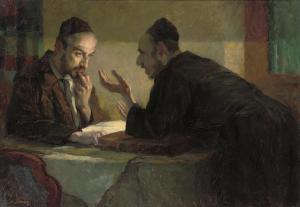
Talmud StudyDuring the centuries following the completion of the Mishnah, the chain of transmission of the Oral law was further weakened by a number of factors: Economic hardship and increased persecution of the Jewish community in Israel caused many Jews, including many rabbis, to flee the country. Many of these rabbis emigrated to Babylon in the Persian Empire. The role of the rabbis of Israel as the sole central authority of the Jewish people was coming to an end.

This decentralization of Torah authority and lack of consensus among the rabbis led to further weakening of the transmission process. It became clear to the sages of this period that the Mishnah alone was no longer clear enough to fully explain the Oral Law. It was written in shorthand fashion and in places was cryptic. This is because it was very concise, written on the assumption that the person reading it was already well-acquainted with the subject matter.

So they began to have discussions about it and to write down the substance of these discussions…

…When you look at the page of the Babylonian Talmud today, you will find the Hebrew text of the Mishnah is featured in the middle of the page. Interspersed between the Hebrew of the Mishnah are explanations in both Hebrew and Aramaic which are called the Gemara.

The Aramaic word Gemara means “tradition.” In Hebrew, the word Gemara means “completion.” Indeed, the Gemara is a compilation of the various rabbinic discussions on the Mishnah, and as such completes the understanding of the Mishnah.

The texts of the Mishnah and Gemara are then surrounded by other layers of text and commentaries from a later period.

-Rabbi Ken Spiro
“History Crash Course #39: The Talmud”
Aish.com

My conversations with Pastor Randy are always very rewarding. We’ve taken to meeting somewhat regularly to discuss matters of mutual interest and specifically the world of believing Jews called “Messianic Judaism.” He lived in Israel for fifteen years and has many Israeli Jewish friends. He is well-versed in Biblical Hebrew and Greek, and his mind and heart are very open to Israel and the Jewish people.

But in our talks, it’s difficult to address how or if modern Messianic Jews are obligated to Torah, what exactly is meant by “Torah,” and the role of Talmud (Mishnah and Gemara) in the life of an observant Messianic Jew. For a Jew, including one in Messiah, is it even possible to comprehend a passage in Torah without Talmud?

I admit, I have few answers.

But since we both have questions, I thought this was the perfect topic to expose to the blogosphere and to present to my readership (and anyone else my readership wants to share a link to this blog post with minus a few “nudniks”). If the bottom line is the Word of God and the revealed Messiah, how can we say that the word of the Sages go beyond them? I disagree that history was frozen after the destruction of Herod’s Temple and I know that Judaism and Christianity continued to move forward and develop. If I may be allowed a conceit, I believe errors entered both Judaism and Christianity in the past 2,000 years that caused both (although Christianity began as a wholly Jewish sect known as “the Way”) religious traditions to “stray” from the intent of God and the footsteps of the Messiah to some degree (probably a really large degree).

And yet, we cannot recapture first century Christianity as Paul understood it and how it was expressed and lived within both Jewish and Gentile cultural contexts. We can only look at where we’re at now and attempt to return to the scriptures to “observe, interpret, and then apply” what we discover there (to quote Pastor Randy).

ruins
But if the Bible is the final word, what do we do with 2,000 years of Jewish history, law, discussion, and interpretation…just wad it up and toss it in the nearest (very large) trash can?  Do we have a right to take everything that it means to be a Jew and to lay it to waste, leaving behind only ruins?

Absolutely not! I don’t believe Messiah will do this upon his return (although, of course, this is just my opinion). Do we say that Jesus will wholeheartedly accept each and every judgement and ruling made by the sages without question? I don’t know if that’s true either, if for no other reason than because the discussion between the ancient sages that spans the centuries, does not come to a final agreement on many practical and legal matters.

And not all Jews and not all Jewish traditions follow the same interpretations. Which one do you choose, and having made a choice, do you realize that it is a human decision and not God’s decision? How can we reconcile this?

My wife told me something interesting just the other day. She told me that the local Chabad Rabbi and the local Reform Rabbi study Talmud together. That’s kind of surprising, and in a community with a large Jewish population, that wouldn’t happen. Chabad (Orthodox) and Reform Rabbis view the traditions and Talmud from very different perspectives. But in this little corner of Idaho, there just aren’t that many Jews and there are even fewer Jewish Rabbis. That fact acts as a bridge for these two gentlemen to meet and share what they have in common as well as their differences.

However, a much greater bridge is required to link a Messianic Jew to any other observant Jew, particularly an Orthodox scholar, although this too has recently occurred. But what is the relationship between a Messianic Jew “keeping Torah,” a state of righteousness before God, and faith in Yeshua (Jesus) as the Jewish Messiah King? Can a Messianic Jew choose how to keep Torah within a particular traditional framework of halachah? Upon making such a choice, whose choice is it, the person’s or God’s?

Torah is not to be regarded, however, as an academic field of study. It is meant to be applied to all aspects of our everyday life – speech, food, prayer, etc. Over the centuries great rabbis have compiled summaries of practical law from the Talmud. Landmark works include: “Mishneh Torah” by Maimonides (12th century Egypt); “Shulchan Aruch” by Rabbi Yosef Karo (16th century Israel); “Mishnah Berurah” by the Chafetz Chaim (20th century Poland).

“Torah versus Talmud?”
-from “Ask the Rabbi”
Aish.com

Torah is meant to be applied, but how it is applied in the life of an observant Jew is very much dependent on that person’s tradition and the branch of Judaism to which they are attached. I heard a story of a Reform Rabbi who made aliyah. According to the storyteller, when a religious Jew makes aliyah and enters the Land, they either become more religious or become secular. In this case, the Rabbi began studying to become an Orthodox Rabbi.

The differences in halachah between a Reform and Orthodox lifestyle must be enormous. I say this because the Rabbi once had a conversation with the storyteller expressing his frustration at attempting to live out the Torah according to Orthodox halachah. He cried out that he sometimes gets so confused that he doesn’t know which foot to step out of bed with in the morning as a proper way of getting up.

I don’t have a lived Jewish experience to which to compare that statement, especially within the Orthodox, so I don’t know how to respond. I don’t know how to respond when applying all that to the words of James, the brother of the Master:

For whoever keeps the whole law but fails in one point has become accountable for all of it.

James 2:10 (ESV)

Granted, breaking one of the mitzvot does not invalidate the entire Torah nor does it make a Torah lifestyle futile and meaningless, but then what does it mean? A traditional Christian interpretation won’t be revealing here. Is the Jewish person guilty? If he or she is Messianic, what is the role of grace? For that matter, if he or she isn’t Messianic, what is the role of grace?

I know of no Messianic Jew who believes they are made righteous and “saved by the Law.” Messiah is the “way, the truth, and the life” (John 14:6). It isn’t enough for Messianic Jews to say “we have the Torah and the Gentile believers don’t” (and that is a gross oversimplification to be sure). Messiah is the bridge that not only links the Messianic Jew to his Jewish brothers and sisters but to the Gentile believers as well. As Boaz Michael once said, “Yeshua is the boss.” If Messiah isn’t the center of all things, the focal point, the goal of Torah and of the will of God for the redemption of the world, then what do we have?

These are the questions that my conversation with my Pastor brought into view last night. We spoke until there was no one left in the church but us. All the lights were out except for those in the Pastor’s office. All the doors were locked. If we had allowed it, our talk could easily have taken us into the middle of the night as we explored not only these questions, but everything else.

touch-the-essenceI don’t know what the answers are. I don’t know that there is any one answer. There really isn’t any one “Messianic Judaism” even as there isn’t any one “Christianity,” where a single set of interpretations and applications defines the entire group. But I believe the questions are important. I believe that discussion between all of the relevant parties is important, not because Christian Gentiles should have anything to do with defining Judaism, but for the sake of our mutual faith in Messiah.

Who is the Christian and the Messianic Jew when they each stand apart and who are we when we stand side-by-side? How are we to understand one another and in the light of scripture, how are we to understand ourselves?

The Master once said, “for where two or three are gathered in my name, there am I among them.” (Matthew 18:20) Granted, his audience at that moment was a Jewish audience, but I don’t discount the possibility that he will also be among two or three Gentile Christians when we gather in our Bible studies and in prayer. I long for the day when two or three (or more…many more) Jewish and Gentile believers in Messiah gather together (Matthew 8:11) and we can talk about all these things. I long for the presence of Messiah among us, that he may teach wisdom and reveal understanding.

The angels are jealous of the one who struggles in darkness. They have light, but we touch the Essence.

-Rabbi Tzvi Freeman
“Jealous Angels”
Based on letters and talks of the Rebbe
Rabbi M. M. Schneerson
Chabad.org

I struggle in darkness to touch the Essence of Light.
Jesus, Halakhah, and the Evolution of Judaism, Part 5

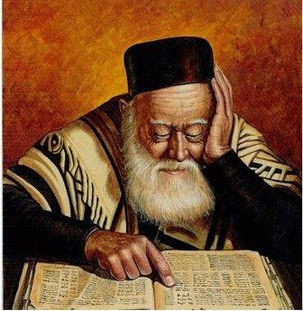
The RabbiIn addition to Tanakh, we as Messianic Jews have another authoritative source for the making of halakhic decisions: the Apostolic Writings. Yeshua himself did not act primarily as a Posek (Jewish legal authority) issuing halakhic rulings, but rather as a prophetic teacher who illumined the purpose of the Torah and the inner orientation we should have in fulfilling it. Nevertheless, his teaching about the Torah has a direct bearing on how we address particular halakhic questions. As followers of Messiah Yeshua, we look to him as the greatest Rabbi of all, and his example and his instruction are definitive for us in matters of Halakhah as in every other sphere.

In addition, the Book of Acts and the Apostolic Letters provide crucial halakhic
guidance for us in our lives as Messianic Jews. They are especially important in
showing us how the early Jewish believers in Yeshua combined a concern for
Israel’s distinctive calling according to the Torah with a recognition of the new
relationship with God and Israel available to Gentiles in the Messiah. They also
provide guidelines relevant to other areas of Messianic Jewish Halakhah, including
(but not restricted to) areas such as distinctive Messianic rites, household relationships,
and dealing with secular authorities.

-from “Standards of Observance”
Messianic Jewish Rabbinical Council (MJRC)
Section One: Halakhah and Messianic Judaism
1.1 Halakhah: Our Approach (pg. 2)
OurRabbis.org (PDF)

This series isn’t taking the direction that I thought it would. At the end of Part 4, I really thought I’d return to a high-level view of the evolution of Judaism, perhaps lightly going over the development of the Talmud. This would mean doing a bit of reading and probably delaying Part 5 (this part) of the series for a while.

Then, on a whim, I decided to read “Standards of Observance,” which is the MJRC’s treatment of “Messianic Jewish halakhah;” certainly a controversial subject given the responses I’ve been fielding in Part 3 and Part 4. Thus, another “meditation” was born.

As I’m writing this, I haven’t gotten past page 2 of the 39 page MJRC document, but when I read the portion that I quoted above, I got to thinking. I generally consider halakhah to be a matter of how Jewish people operationalize their observance of the 613 mitzvot, which is how contemporary Judaism codifies the commandments to Israel in the Torah. But if “the Book of Acts and the Apostolic Letters provide crucial halakhic guidance for…Messianic Jews,” by definition, it must also provide relevant halakhah for the non-Jewish believing community as well.

This is complicated by two potentially competing positions: the halakhah as it is presented in the New Testament (NT) Gospels, book of Acts, and Epistles, and how the MJRC chooses to conceptualize, organize, and apply that halakhah. Actually, even within the context of the New Testament, how we view the relative authority of this halakhah upon the daily lives of non-Jewish Christians depends on whether or not we see this NT halakhah as fixed, static, pronouncements that were intended to be inflexibly binding on all Christians everywhere across time, or whether at least some of this halakhah was specific to individual congregations, situations, and other contextual factors, and was meant to be adaptive across time, to the point in some cases, of not applying significantly or at all to Christianity in the 21st Century.

I’ll give you an example.

Every man who prays or prophesies with his head covered dishonors his head, but every wife who prays or prophesies with her head uncovered dishonors her head, since it is the same as if her head were shaven. For if a wife will not cover her head, then she should cut her hair short. But since it is disgraceful for a wife to cut off her hair or shave her head, let her cover her head. For a man ought not to cover his head, since he is the image and glory of God, but woman is the glory of man. –1 Corinthians 11:4-7 (ESV)

Taken literally and in its simplest form, Paul would seem to be saying that when men pray, our heads should not be covered, but when a woman prays, her head must be covered (presumably in a public setting such as communal worship). According to the notes for vv 5-13 at BibleGateway.com, “the Greek word gunē is translated wife in verses that deal with wearing a veil, a sign of being married in first-century culture.” This adds some context to what Paul is saying that we would miss by reading it in English. The head covering that is to be applied to women is specific to their marital status in specific cultures as they existed nearly 2,000  years ago. There are no immediately available notes for why a man’s head must be uncovered, but this would seem to go against the later tradition that men wear kippot when in the synagogue, although, of course, Paul is addressing non-Jewish believers in this case (keep in mind that any blanket declaration of halakhah forbidding men to cover their heads in prayer directly contradicts the modern practice of Gentile men in Messianic, One Law, and Two-House congregations to wear kippot).

My example seems to show us that it is certainly possible and likely that not every single pronouncement of halakhah that flowed from Paul’s pen was supposed to apply generally across all churches everywhere and “everywhen.” That is, we can believe that some “Messianic halakhah” as it applies to non-Jewish believers was never originally intended to be permanent, fixed, static standards of practice religious practice.

Which means we’re going to have an interesting time trying to figure out which portions of the halakhah in the NT continues to have force today and how we are to observe said-halakhah in our local communities in the present age.

I want to make certain that I communicate the following clearly. Whatever definitions that the MJRC has produced relative to “Messianic halakhah” can only apply to Messianic Jews who are members of congregations affiliated with the MJRC. This is certainly in keeping with halakhah in any other Jewish community, regardless of scope, since, for example, how halakhah is applied within the context of Chabad is most likely different from its application within Conservative or Reform Judaism. For all I know, there may be variations within specific local synagogues that are “contained” within the same sect of Judaism.

That means that not only does the MJRC understanding of halakhah not apply to wider Christianity (and you wouldn’t expect it to, since it seems to be written specifically for its Jewish members), but it doesn’t apply to any other organizations of Messianic Judaism and clearly not to any of the groups contained within “Hebrew Roots.”

(Arguably, and I haven’t read the entire MJRC document yet, any halakhah developed by the MJRC would have some sort of impact on the non-Jewish membership of each affiliated congregation, but I don’t know yet what the scope of that impact might be. However, if you are a non-Jewish believer and you choose to attend an MJRC affiliated congregation, you agree to become subject to their authority. Keep in mind that even in the most “Jewish” of Messianic Jewish congregations, the majority of members and perhaps a few folks in leadership, are non-Jews).

The next question is whether or not it is appropriate and desirable for groups of non-Jewish believers to also attempt to organize a sort of “Christian halakhah” from the NT that would apply to churches and Hebrew Roots groups.

I suppose Christians have been doing that ever since the invention of movable type and the first mass printing of the King James Version of the Bible (probably well before, but availability of the Bible prior to that time was severely limited, and the common man had no ready access to the written Word). In other words, developing “Christian halakhah” is an old story for Christianity, they (we) just don’t call it “halakhah.”

Of course, the result is what we see before us…about a billion (I’m grossly exaggerating) different Christian denominations covering the face of the earth, each with their own special take on what the Bible is trying to tell us, at least at the level of fine details of practice. Hebrew Roots organizations are no different, they just re-introduce the word “halakhah” into the mix. Viewed at in this light, it is understandable that the various Gentile expressions of Hebrew Roots including One Law/One Torah and Two-House, either formally or informally establish a set of accepted religious and lifestyle practices based on various parts of the Bible including the New Testament “halakhah.”

However, where it might get a little strange is when/if such Gentile organizations access the larger body of Jewish halakhah that extends well beyond the pages of the NT and into the writings of the Mishnaic Rabbis. While I can understand why organizations that are formed by Messianic Jews as a resource for Messianic Jews and Messianic Jewish congregations would want to delve into the accepted body of Talmudic thought, it’s puzzling why a Gentile would choose to do so. And yet, we see Gentile groups forming “Beit Dins,” wearing tzitzit and laying tefillin in accordance with traditionally accepted Jewish halakhah, and performing other Jewish religious practices that cannot be found in the NT and indeed, practices that weren’t codified (such as wearing kippot) until many centuries after the writers of the NT books and letters had died and their bones had turned to dust.

I made an observation in the previous part of this series that was never answered by any of the relevant parties:

My final note for this missive is one of irony. If written Torah, the Christian Bible, and Jesus are the only valid authorities for religious practice and lifestyle in the Hebrew Roots movement (including One Law/One Torah, and so on), then why do all of their groups and congregations follow a modern Jewish synagogue model when they worship? Why do all the men where kippot? Why do all the men wear tallit gadolim with tzitzit that are halalically correct? Why do they daven with modern Jewish siddurim? Why, in less than a week, will they construct their sukkot according to Rabbinically prescribed specifications?

It is completely understandable why any Christian church or congregation of Gentile believers in Jesus, regardless of their emphasis, should want to carefully study the NT documents and to derive whatever practical knowledge it contains for Christian religious practice in the modern era. On the other hand, it’s rather mysterious what some Hebrew Roots groups believe they will get out of studying the extra-Biblical Rabbinic texts and applying practices and concepts related to a Beit Din, Farbrengen, Ritual purity, Shmita, and so on.

If halakhah has the ability to evolve over time within the Jewish context, we can expect Jewish communities to practice one of the current forms within their local boundaries. The same can be said for Christian religious and lifestyle practice relative to the various Christian churches and denominations. I would never expect a Christian church to borrow significantly or at all from any Jewish halachic source in establishing accepted Christian religious behaviors. Why then, as I’ve asked before, should Gentile Hebrew Roots organizations desire to borrow heavily or almost exclusively from post-Biblical Jewish halachic practices, especially if said-groups only recognize the “written Torah” and New Testament as their only legitimate authoritative documents?

I know all this sounds like I’m trying to pick a fight, but given all of the “resistence” to the Talmud registered by Hebrew Roots people and how they say they don’t consider Talmud as an authoritative guide, the fact that virtually all such groups model their worship practices on modern Jewish synagogue services is truly baffling.

This series continues in the blog post: Messiah in the Jewish Writings, Part 1

Jesus, Halakhah, and the Evolution of Judaism, Part 3

The title I have chosen for this study is a “tongue-in-cheek” attempt to highlight something that seems to be missed by many, namely, that the Mishnah did not exist as a written document in the pre-destruction era, so it is quite obvious that no one, including Paul, could have possibly read what is known in our day as the Mishanh (sic). In fact, as we shall see, the Mishnah was not widely read by Jewish communities in the centuries immediately following the destruction of the Temple (70 CE) either, for the Mishnah was not “published” as a written document until much later.

Along the same lines, it is a methodological error to speak of “1st Century Judaism,” for no such monolithic Judaism existed. We must rather speak of “Judaisms” (plural) in the pre-destruction era. Granted that a variety of Judaisms extant in the 1st Century surely had some things in common (Shabbat, circumcision, Tanach, etc.), it was nonetheless their clear and (in some cases) radical differences that produced the variegated Judaisms of that era.

Unfortunately, the presupposition of some in the Messianic movement is that the later corpus of rabbinic literature presents a monolithic, historically accurate description of “the Judaism” practiced by Yeshua and His disciples.

-Tim Hegg
from the Introduction (pg. 1) of
“What Version of the Mishnah did Paul Read?” (2012)
TorahResource.com

Since writing Part 2 of this series, I’ve been pondering how to proceed, since, as I’m sure you’ve gathered if you read the questions I’ve been posing, the scope of my inquiry is rather ambitious. Then the answer landed firmly in my lap. I’m indebted to Peter at Orthodox Messianic Judaism (something of a misnomer given the theological nature of his blog) for providing a link to Tim Hegg’s article. I read it through once, meaning to go over it again and eventually write something about it, but as I was getting into the shower, I had an “epiphany” and quickly rushed to my computer (I put a robe on first) to compose the paragraphs that are the heart of this missive (we’ll get to those by the by).

I should say at this point that I like Tim Hegg. He has been very gracious to me. I’ve spent Erev Shabbat in his home, I’ve been treated well by his family and his congregation, and I admire and respect him as a leader and a scholar. All of which added to my surprise when I realized in reading the Introduction to the above-quoted paper, that he had made some glaring and erroneous assumptions.

I can’t think of anyone in Messianic Judaism who believes that the Mishnah we have today is a direct reflection of how Judaism (or “Judaisms”) functioned back in the late Second Temple period, when Jesus walked among his people Israel. I have no idea, even after reading Tim’s paper in full, where he got that idea. Certainly my drive to investigate the evolution of Judaism as it relates, both to the ongoing authority of Judaism to define itself across time, and whether or not First Century halakhah and modern halakhah can be considered equally valid for the Judaism of their times, doesn’t assume a fixed, static, and non-adaptive set of applications of Torah over a 2,000 year span.

Also, his point that in the day of Jesus, that there were multiple “Judaisms” (Pharisees, Essenes, Sadducees, and so on) is hardly a revelation. Again, I don’t know anyone in the Messianic Jewish movement who would deny the “multi-sect” nature of First Century Judaism. On the other hand, if we look at modern Judaism or modern Christianity, we could say the same thing. If there was no, one unified “Judaism” in the day of Jesus, there must certainly be no one, monolithic, unified modern Christianity either. The fact that the Christian church exists as perhaps hundreds of denominational models and their variants, (including One Law or, if you will, “One Torah”) establishes this firmly. Nevertheless, no one balks at talking about “Christianity” or “Judaism” in the 21st Century as if they were specific, unified entities, since at their cores within each individual religion, they contain a basic, common set of theologies, doctrines, dogma, and the like that identify them as either “Christian” or “Jewish.”

It’s as if Tim constructed a very well written and organized paper based on faulty assumptions about Messianic Judaism. It’s never been about the Judaism of late Second Temple times being one unified entity, and it certainly has nothing to do with the belief that the Talmud, (which is comprised of Mishnah, Baraita, Gemara, Halakhah, and Aggadah) as we understand it, having existed as the same body of information in the days of Jesus and the Apostles as it does today.

(The evolution of the Oral Torah and halakhah of Christ’s day into what eventually became known as the Talmud is well beyond the scope of this article, but the seeds of what became Talmud certainly must have existed in some form in the Second Temple period and before. What we know of Hillel and Shammai is recorded in Pirkei Avot, which is the “ethical teachings and maxims of the Rabbis of the Mishnaic period,” and yet both Hillel and Shammai pre-dated Jesus by a generation, and the formalization of Mishnah by centuries.)

In the Conclusions section of Tim’s paper (pg. 23, point 5), he states:

We see, then, that there is no historical nor biblical case for accepting oral Torah as divinely sanctioned. Even the suggestion itself is ill-founded, for it both presumes a monolithic “oral Torah” and that the rabbinic authorities who formulated and compiled the current corpus of rabbinic literature did so by the leading of God.

Point 7 of his Conclusions (pp 23-4) states:

As we avail ourselves of the wealth of rabbinic literature and gain value from the study of it, we must also keep in mind that it is the product of men and not that of divine revelation. It does not come to us with any sense of divine imprimatur nor should the rabbinic literature be considered as having sacred value greater than the works of non-rabbinic authors or sources. All the writings of men must be equally scrutinized in the light of the eternal word of God, the Bible.

There’s a certain irony in Tim’s statements if you fix your gaze, not on the Rabbinic writings that are encapsulated in Talmud, but on another “Rabbi’s” writings, which we find in “the light of the eternal word of God, the Bible.”

We take it on faith that the Bible, the Holy Scriptures of God, are Divinely inspired and not merely the writings of human beings, but even then, most of us don’t believe that God simply dictated the Bible to myriads of human beings over several thousand years of history, and that the authors involved were only human word processors. In fact, how much of the personalities and viewpoints of all of these authors made their way into our Holy Scriptures is a hotly debated point among religious scholars and worshipers.

Add to that the suggestion that the New Testament Epistles, which make up the majority of the Christian texts, were actually letters written mostly by Paul, with smaller contributions by a handful of others, to various early Christian churches, and you begin to wonder about the nature of “Divine inspiration.” More than one source has said that the New Testament letters could be of a “lesser authority” than the Torah, for example, and may indeed be Paul’s midrashim or commentaries on Torah, the Messiah, and on the Abrahamic, Mosaic, and New Covenants. If this is true, then the barrier between “Divine authority” and “human agency” in many of our holy writings is a lot thinner than most Christians (perhaps including Tim Hegg) would be comfortable with.

What if there’s merit to the idea that the Talmudic writings and subsequent commentaries, judgments, and rulings have a “Divine authority” involved, at least to a degree? If we can say that Paul’s letters are “Divine” in some manner or fashion, and yet were written by Paul with his mind and emotions fully engaged, (and who knows how “Divine inspiration” does and doesn’t work) then in Galatians, Ephesians, or Colossians, where does Paul leave off and God begin? There’s no way to know. Maybe God just “wired” Paul’s brain to write letters in a way that reflected His will and intent within the context of Paul’s personality, the place and time in which Paul was writing, who he was writing to, and the issues at hand that prompted the letter in the first place.

How is that different from the acknowledged and legitimate Rabbinic authorities issuing rulings, based on and extrapolating from Torah ideals and principles, and then applying them to their local populations?

Who can say if the Mishnaic Rabbis were Divinely inspired or not. How do you measure “Divine inspiration?” I suppose you can, as Tim says at one point, compare the Rabbinic rulings to the canon of Scripture and where they agree, you can say the Rabbis have produced value. Where they disagree, you can say they produced error. Detractors of the Talmud, as applied to Messianic Judaism, say that since “Rabbinic Judaism” does not recognize Yeshua (Jesus) as the Jewish Messiah, it invalidates everything produced by that “Judaism” including the Talmud as a whole (as far as Messianic Jews are concerned, anyway). On the other hand, as my friend Gene Shlomovich said recently in this blog comment:

If you want to believe, as much of Christianity and Islam does, that G-d has virtually abandoned the Jewish people by leaving them to fend for themselves without authoritative leaders and teachers because “they rejected Jesus”, that the Jewish people corrupted the interpretation of scriptures and have lost their right to interpret them, that G-d has removed his Spirit from my people, it’s your prerogative. You would not be the first or the last.

Traditional supersessionism states that God withdrew His Spirit from the Jewish people and transferred it to “the Church” because Judaism rejected the Messianic claims of Jesus. Not only do I believe that theology represents a tremendous error in thinking, but it is a gross simplification of a very complex set of events that occurred over decades and even centuries.

The paper Matthew 23:2-4: Does Jesus Recognize the Authority of the Pharisees and Does He Endorse their Halakhah? written by Noel Rabbinowitz, which I introduced in Part 1 of this series, suggests that not only did Jesus acknowledge the legitimate authority of the Pharisees, but also of the scribes, who, as Carl Kinbar explains, were:

…an independent group affiliated not only with the Pharisees, but also with the Sadducees, Chief Priests, and elders. In fact, in Matthew, a quick check shows that 10 references to the scribes relate them to the Pharisees and 10 to other groups!

As soon as we grant the scribes the same place that Yeshua does in Mt. 23:2, it seems that Yeshua was not promoting the idea that one group should be in control of the halakhic process. Rather, he acknowledges the vital role of Torah teachers but criticizes them as part of his teaching on humility (read to verse 12).

In essence, it seems Jesus, to some degree, acknowledged the legitimate authority of the religious leaders in the various “Judaisms” of his day to have the right to establish halakhah for their communities. Of course the Mishnah as we have it today didn’t exist when the events in Matthew 23 were happening and later recorded, but if Jesus could recognize (and still criticize) Jewish religious leaders as having the right to establish religious practice for the First Century Judaisms, and if that authority was maintained across time as granted by God (I know…a big “if) and perhaps even as a function of an evolutionary process occurring within global Judaism and the local “Judaisms,” then maybe we can say that Jewish authority to legitimately define itself and it’s practice didn’t come to an abrupt end when it was “nailed to the cross with Jesus.”

No one is saying that the Mishnah existed in the days of Jesus, Peter, and Paul. But even Tim Hegg must acknowledge that some sort of halakhah did exist as established by the Pharisees and scribes. Factor in Rabbinowitz, and you have established that Jesus agreed in principle, that the Jewish religious authorities were legitimate and he acknowledged much of their halakhah. We can build on this to explore the possibility that God did not turn His back on all of His people Israel across the last twenty centuries, and that He maintained His presence among them. If God abandoned Judaism totally, and completely “threw in” with Christianity, then whatever the Rabbis came up with was inspired by human imagination alone. But if God is with all of His people, those of the Covenant of Abraham and Sinai, as well as those of us who benefit from some of the blessings of the New Covenant, then both Christianity and Judaism have a place in God’s heart and in God’s plan.

Have God’s blessings continued to be with the Jews as well as the Christians? Considering the fact that Jews even exist today, let alone retain the faith, practices, and traditions of their Fathers, with some teachings stretching back over 3,300 years, it would seem the answer is “yes.” Has He let them spin out of control, creating laws, rules, and statutes that are made up of wishful thinking and pipe dreams, while only showering His “Divine inspiration” on the laws, rules, and statutes of the unified Christian church (I hope you’re picking up on my attempt to be ironic)? I seriously doubt it.

Tim Hegg, in point 6 of his Conclusions (pg. 23) states:

Our conclusion is that, while rabbinic literature does have much value, it is not to be received as having divine authority in matters of our faith and halachah.

Tim may esteem Rabbinic literature in terms of its historic value, as well as for its insights into “the perspectives, beliefs, and worldview of modern Judaisms,” which “aids Messianic believers in appreciating and understanding the religious perspectives of observant Jews in our own day,” but for those “observant Jews,” Messianic and otherwise, the meaning of Mishnah is a great deal more. It doesn’t have to mean the same thing to us, including me or Tim, as it does to observant Jews, since the vast majority halakhah does not apply to Christianity.

Will Jesus Christ, upon his return and when he establishes his reign over the earth and his throne in Holy Jerusalem, recognize the authority of the Jews of that day as he recognized the authority of the Jews of 2,000 years ago? I don’t know for sure. But as we’ve seen, Jesus didn’t reject the Jewish authorities of ancient days out of hand, though he didn’t completely agree with them, either. Perhaps we shouldn’t dismiss the possibility of Jesus seeing modern Judaism in the same light, particularly because God doesn’t seem to have dismissed His Jewish people…ever.

Part 4 in this series will examine another aspect of the authority of the Talmudic sages and of modern Judaism. Does Judaism have the right to define itself, including Messianic Judaism? Find out in tomorrow’s “morning meditation.”

Defining Judaism: A Simple Commentary

Talmud StudyWe find on today’s amud that one who is called up to the Torah has to have heard at least three verses—two if three is impractical—for his aliyah to count.

Someone once presented Rav Moshe Feinstein with a very common concern. He asked, “What if someone failed to hear some words of the Torah reading? Did he discharge his obligation if he missed a few? Many great scholars and tzaddikim were very careful and would make up any word missed by joining another minyan during their reading. But perhaps such stories are not because of any halachic obligation. Maybe they are merely a stringency?”

Rav Moshe ruled decisively, “It is obvious that one should not skip even one word of the reading if it is at all possible. Post facto, if one skipped and it was a day where we lain three verses, on the surface it would appear as though one does discharge his obligation. It is not permitted to read less than three verses. Since the person in question did not hear the minimum, he did not discharge his obligation. This is no different than the case of one who was called up to the Torah and they did not lain three verses—he also did not discharge his obligation if he did not hear the minimum number of verses.

Rav Moshe concluded, “If the reading contains more than three verses and he heard three he discharges his obligation with this aliyah, and if he heard another two aliyos he has fulfilled his obligation. Of course, on Shabbos and Yom Tov one has the problem that if he missed a part of the reading he will not merit to finish the public reading of the Torah for that year. However, in such a case one often has no recourse since he cannot have them repeat the reading only for him!”

Mishna Berura Yomi Digest
Stories to Share
“The Minimum”
Siman 137, Seif 5-6

Recently Dan Benzvi on his blog Fellow Heirs challenged me to discuss the relationship between the Torah, Oral Law, and the Talmud in his blog post The oral Torah. Authority of God or man. I’m not sure we “solved” anything, but at least we got the opportunity to (again) air our different perspectives on the matter.

Dan really does bring up some good questions, though. Can we believe that everything in the Mishnah and all of the rulings in the Talmud are indeed directly tied to the oral Laws God gave Moses at Sinai (assuming you believe that event actually took place) and that a Jew must obey all of the relevant Rabbinic rulings?

Take a look at the example I posted above from Mishna Berura Yomi Digest. There’s nothing in our written Bible that lends itself to describing the traditional Jewish Torah readings in anywhere near this level of detail. Can we believe that God gave these specific details to Moses? If so, why is there a question here? If not, then where did these questions and answers come from and why are they considered binding in Judaism?

If you’re a (non-Jewish) Christian, this entire discussion is moot. People who aren’t Jewish aren’t considered bound by any of the Rabbinic judgments under any circumstances, so we don’t have to give all this a second thought. But what about if you’re Jewish, and especially if you’re a believer (i.e. a “Christian” or a “Messianic Jew”)? If it’s not in the written Bible we have with us today but rather, in the extended Jewish documented wisdom, does it really matter?

Indeed, the Mishnah contains not a hint about what its authors conceive their work to be. Is it a law code? Is it a schoolbook? Since it makes statements describing what people should and should not do, or rather, do and do not do, we might suppose it is a law code. Since, as we shall see in a moment, it covers topics of both practical and theoretical interest, we might suppose it is a schoolbook. But the Mishnah never expresses a hint about the authors’ intent. The reason is that the authors do what they must to efface all traces not only of individuality but also of their own participation in the formation of the document. So it is not only a letter from utopia to whom it may concern. It also is a letter written by no one person – nor by a committee, either. Nor should we fail to notice, even at the outset, that while the Mishnah clearly addresses Israel, the Jewish people, it is remarkably indifferent to the Hebrew Scriptures.

The Mishnah makes no effort at imitating the Hebrew of the Hebrew Bible, as do the writers of the Dead Sea Scrolls. The Mishnah does not attribute its sayings to biblical heroes, prophets or holymen, as do the writings of the pseudepigraphs of the Hebrew Scriptures. The Mishnah does not claim to emerge from a fresh encounter with God through revelation, as is not uncommon in Israelite writings of the preceding four hundred years; the Holy Spirit is not alleged to speak here. So all the devices by which other Israelite writers gain credence for their messages are ignored. Perhaps the authority of the Mishnah was self-evident to its authors. But, self-evident or not, the authors in no way take the trouble to explain their document’s audience why people should conform to the descriptive statements contained in their holy book.

from the introduction to
The Mishnah: A New Translation
by Jacob Neusner

Talmud Study by LamplightThat description of the Mishnah is fairly similar to others I’ve read from various sources such as The Cambridge Companion to the Talmud and Rabbinic Literature, edited by Charlotte Fonrobert and Martin Jaffee. But given all of that, what can we say about Mishnah, Talmud, and Gemara?

I’m not particularly qualified to respond, not being a scholar in Jewish studies or anything related, but from what I gather, it’s extremely important to Judaism that these texts, opinions, commentaries, and judgments do exist. Here’s why.

After the destruction of the Second Temple in 70 C.E. and the subsequent eviction of most of the Jews from the Holy Land, what existed to define Judaism? Prior to this point, it was always the Holy Temple in Jerusalem. Even in the times between the Temples of Solomon and Herod, it was the ideal of the Temple and the Torah that, more than anything else, defined Jewish identity in exile. The longing for the Jewish people was always the return to Israel, both as nation and paradigm, and to worship again “as in days of old and as in previous years” (Malachi 3:4).

With the Second Temple reduced to scorched and shattered rubble, and the vast majority of the Jewish people exiled to the diaspora, what was to prevent the eventual assimilation of the Jews into the nations surrounding them and outnumbering them?

Judaism was always about being distinctive, as the scripture says, “and you shall be to me a kingdom of priests and a holy nation” (Exodus 19:8 [ESV]). All of the laws we see given to the Israelites in the Torah were designed to impact every area of their lives, serving as national constitution, penal and civil law, business ethics, social mores, and even personal and behavioral guides. In virtually every way, the nation of Israel was to stand out and stand apart from the nations of the world, primarily to lead its inhabitants to a holy life with God, but also to be a “light to the nations” (Isaiah 49:6, Isaiah 51:4), leading the world to God by example.

But a huge amount of the Torah laws apply only if you have a Temple, a functional priesthood, a system of courts including the Sanhedrin, and live within the geographic boundaries of the Land God gave in perpetuity to the Jewish people.

The Romans took all of that away, and then subsequent conquerors kept the Land and national self-rule from the Jews for the next 2,000 years.

Why didn’t the Jewish people assimilate and disappear into the pages of history? Many, many other people groups and religious traditions from that time have utterly vanished from our view. Why did the Jews, though extremely small in number, remain a people vitally alive with purpose and function; with faith and identity?

What do you think of when you think of a religious Jew?

The stereotypes some people have are guys in black hats and coats, wearing some sort of string off of their waistline, having large, bushy beards, and bowing over and over again when they pray. Some people think of “Jewish prayer shawls and prayer books” while others think of events such as Passover or Chanukah. Whatever religious stereotypes seem to identify the Jews, the activities are almost always different than any other people group in the world. Jews worship in different places than anyone else, pray differently, pray in a different language than anyone else, wear different clothes (at least sometimes), have different holidays, eat differently, sing differently and…well, you get the idea.

I can hardly say that the Mishnah and Talmud are direct representations of the “Oral Law” that goes back over 3,500 years to Moses and God on Sinai, especially given the description (or lack thereof) of the origins of the Mishnah. What I can say, is that what the Jews have as “people of the book”, are a set of laws and rulings that set them apart from any other nation and group on earth, and that has defined them and kept them and preserved them when everyone else was doing their best to completely annihilate the Jewish people.

No, I’m not denying God’s involvement in the preservation of Judaism and in fact, I’m counting on it. As God went down into Egypt with Jacob (Genesis 46:3-4), so too did He go into the death camps with the Jews during the Holocaust. So too did he go with the Jews into the newly created state of Israel and He is there with them now.

But in a very great way, one of the primary mechanisms that has maintained Judaism as Judaism for the past twenty centuries has been the Talmud. It has now taken on the status of “Holy” among the Jews, especially the Orthodox, and it has many critics, including within more liberal religious and secular Judaism. But without it, would there be a man or woman alive today that we could point to and know he or she is a Jew?

You can love the Talmud or you can hate it, but if you are a Jew, no matter who you are, you cannot dismiss its existence or its role in preserving your existence.

As an afterword, I want to apologize to all of the Jewish people reading this. I’m not trying to pass myself off as some sort of expert (I’m anything but an expert on Judaism) or to co-opt anything belonging to Judaism. I am just presenting the perspective of one Christian writer on why I think the Talmud is not just important, but historically vital for the existence of the Jewish people. Please keep that in mind when or if you decide to comment.

The Many Paths of God

It is very difficult to fathom how two opposing opinions can both be correct. The Ritva explains this in a wondrous manner: “When Moshe received the Torah at Sinai, God provided him with forty-nine perspectives to declare a matter pure, and forty-nine to declare it impure. Moshe Rabbeinu asked, ‘Master of the universe, why are these necessary?’ God answered, ‘So that they should be transmitted to the sages of every generation, that the law will be determined by them in accordance with the needs of their time.'”

This teaches that there are many valid paths to genuine Torah observance, all of which were received by Moshe on Sinai. But of course not all statements made are the words of the living God. As we find on today’s daf, sometimes a statement thought to be a mishnah is no mishnah at all. This means that sometimes what appears to be part of the chain of tradition is actually not and needs to be clarified as such.

Rav Menachem Mendel of Rimanov, zt”l, explains how the baalei mishnah reached a state in which they could draw down an authentic mishnah. “The baalei ha’mishnah explain how the oral Torah emerges from the written Torah. They could only draw down a genuine mishnah by completely nullifying all of their physical senses and immersing themselves absolutely in learning Torah. Once they reached this state they touched the inner essence of Torah and could determine the halachah and set down various mishnayos. When the sages perceived that a certain statement was not reached through this arduous process they declared it incorrect.

Daf Yomi Digest
Stories Off the Daf
“This is Not a Mishnah!”
Bechoros 56

Ohmygosh! What did I just say?

This teaches that there are many valid paths to genuine Torah observance, all of which were received by Moshe on Sinai.

That statement is bound to cause something of a stir in various religious circles. It is doubtful that Christianity will accept that there are many valid paths to genuine obedience to God since we have the Master’s own words saying that there is only one way to the Father, and that is through the Son (John 14:6). Of course this is midrash we’re talking about, so it’s not as if we have to believe the “conversation” between Moses and God actually took place as recorded in our “story off the daf”. I seriously doubt that many people participating in the “Messianic” movement will be enthusiastic about this midrash either, since most of the arguments I see in the blogosphere are about obeying the Torah in only one possible way.

That, of course, doesn’t make a lot of sense from a Jewish perspective, because there really is more than one way to perform a mitzvah, depending on various circumstances. For instance, how Askenazi Jews perform some of the mitzvot and how Sephardic Jews perform those mitzvot may vary drastically. And while there may be some debate between those two groups, no one is suggesting that the Ashkenazi are the only ones who “do it right” and that the Sephardic Jews “do it wrong”…or vice versa. And frankly, even if that suggestion exists, it’s not enough to compel one group or the other to change their traditions. How a Jew performs the mitzvot and understands his or her duty to God is largely based on tradition.

But how can the midrash dare to quote a conversation between Moses and God that, in all likelihood, never took place? Remember what I said in The Rabbinization of Abraham. In order to carry the Torah forward with Judaism in the centuries after the destruction of the Second Temple, Talmudic Judaism found it necessary to “refactor” the past, projecting the view of the Rabbis of the Common Era back onto Abraham and Moses. You and I may not find this “refactoring” to be accurate or factual, but if you understand the function and purpose of Chasidic Tales, you’ll understand that many great and important truths can and must be transmitted without necessarily being based totally on fact. Christians have a tough time understanding this, but it is also likely that not everything (hold on to your hats) in the Gospel accounts of the days of Jesus is literal fact.

Did that surprise you? If you think about it for a few minutes, it probably won’t.

(I should say that this point that when I realized this, I went into a crisis of faith and struggled a great deal with the idea that my faith was based on a book that was neither a legal document in full, or a newspaper reporter’s account of the “facts”).

If you don’t believe me, pop over to Derek Leman’s blog and read this write up, Passover, Last Supper, Crucifixion: 2011 Notes, Part 2. Leman illustrates in no-nonsense terms how the different Gospel versions of the Master’s death cannot be reconciled with each other, no matter how much literary and scriptural “slight of hand” you choose to employ.

So why shouldn’t we use midrash to understand mishnah and scripture? Perhaps they are useful tools after all.

This brings us back to the idea that there may be more than one way to obey God. This brings us back to the idea that there may be one way for a Jew to obey God relative to the Messiah and Torah, and a different but still correct way for a Gentile disciple of the Master to obey God. Are these two covenants? That suggestion is usually viewed with horror, especially if taken to the extreme and seen as “the Jews have Moses and the Gentiles have Jesus.” I’m not suggesting that (although the dynamics involving religious Jews who are not “Messianic” is certainly complex). I’m suggesting that for Jews who are disciples of Jesus and for Gentiles who are disciples of Jesus, there may be two paths to obedience based on identity and “covenant connection” (Jews were at Sinai and any Gentiles who were also present were absorbed into the Children of Israel, probably within three generations). The Jews have the Mosaic covenant connection which was not designed to accommodate non-Jews except for those Gentiles who were on the “multi-generational conversion track”. The Messianic covenant is unique in that it accommodates Jewish identity, allowing “Messianic Jews” to remain Jews (this is all heavily flavored by my opinions here) and also it allows Gentiles to enter into a covenant relationship with God, being “grafted in” as “wild branches” onto the “civilized tree” (note that the grafted in wild branches remain wild for the lifetime of the tree and don’t “morph” into civilized branches) and they can still remain Gentiles…forever.

Now we come back to the key phrase in today’s midrash.

This teaches that there are many valid paths to genuine Torah observance, all of which were received by Moshe on Sinai.

If you’re a non-Jew and you’re upset with how someone else is interpreting Gentile “Torah obedience”, figuring your way is right and their way is wrong, hold up a minute. First off, you Gentiles may not have any sort of “Torah obedience” based on the Mosaic covenant, so you may be traveling on the wrong path all together. Second, even within Judaism, as I previously mentioned, there is more than one accepted halacha to performing the mitzvot.

Hopefully, this will shake up someone’s moral certitude the next time they get into an Internet argument about how the Torah is supposed to be obeyed. If you continue to do your studying and are honest about it, you may find your assumptions challenged. The great Hillel was the master of teaching this lesson to potential converts, as recorded at SaratogaChabad.org.

Let us use the famous story of Shammai, Hillel and the three converts (Shabbos 31) to demonstrate the fusion of Halacha and Aggadah,: A gentile once came to Shammai, and wanted to convert to Judaism. But he insisted on learning the whole Torah while standing on one foot. Shammai rejected him, so he went to Hillel, who taught him: “What you dislike, do not do to your friend. That is the basis of the Torah. The rest is commentary; go and learn!” Another gentile who accepted only the Written Torah, came to convert. Shammai refused, so he went to Hillel. The first day, Hillel taught him the correct order of the Hebrew Alphabet. The next day he reversed the letters. The convert was confused:”But yesterday you said the opposite!?” Said Hillel: “You now see that the Written Word alone is insufficient. We need the Oral Tradition to explain G-d’s Word.” A third gentile wanted to convert so he could become the High Priest, and wear the Priestly garments. Shammai said no, but Hillel accepted him. After studying, he realized that even David, the King of Israel, did not qualify as a cohen, not being a descendant of Aaron

The convert was not just acting silly by standing on one foot; he was actually symbolizing his quest for true unity. This gentile had left behind a confusing plethora of pagan gods and multiple deities. He searched and finally found Monotheism, One Torah and One G-d, wanting to live by a single unifying principle, the ‘one foot’ on which all else stands. Hillel taught him that the underlying principle that unites all is Jewish Love. The second convert, had rejected the other man-made religions as human concoctions, was attracted to the Divine Torah, which consisted solely of G-d’s word. He was shocked to find that we follow a Rabbinical tradition. He wasn’t being rebellious, but sincerely asking a valid question; “I wish to observe G-d’s word alone, not any human additions.” Hillel creatively showed him that the two Torahs are not two separate systems, but are one and the same. The written word and the oral traditions complement each other. It is as basic as the Aleph Bais, where you can’t have one without the other. Indeed, the Torah itself bids us to follow the enactments of the sages. The third convert, disillusioned with pagan shallowness, aimed for a higher meaning to life. He yearned to reach the highest level, assuming that being a High Priest is the ultimate spiritual fulfillment.

Hillel didn’t just chase these would-be converts away, he (seemingly) accepted them on their own terms but allowed them to study and discover their own errors. Once they did so, they put aside their original assumptions and realized that in order to convert, they had to accept the Torah as it was within the Jewish framework of their day.

May God grant us the ability, wisdom, and will do to the same.