Tag Archives: Moses

Arguing with God

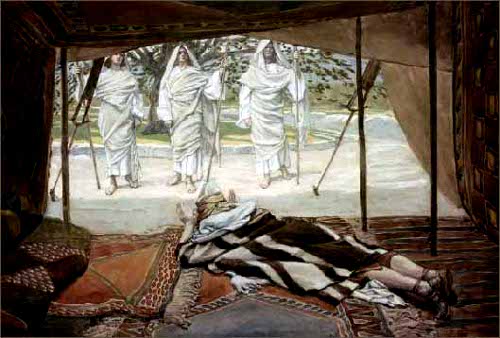
abrahams visitorsWhen G-d told Noah to build an ark before the world would be destroyed, Noah built an ark.

But when G-d told Abraham He was about to destroy the cities of Sodom and Gomorrah—cities corrupt and evil to the core—Abraham argued. He said, “Perhaps there are righteous people there! Will the Judge of All the Earth not do justice?”

Abraham felt a sense of ownership for the world in which he lived. If there was something wrong, it needed to be changed. Even if it had been decreed by the will of G-d.

-Rabbi Tzvi Freeman
“Noah and Abraham”
Based on letters and talks of the Rebbe
Rabbi M. M. Schneerson
Chabad.org

I have to admit, I was a little disturbed by how Rabbi Freeman illustrates the difference between Noah and Abraham. It makes it seem like Abraham cared more for the world he lived in than Noah. Of course both Jewish and Christian commenators generally agree that it took Noah about 120 years to build the ark and that, during that period of time, Noah was trying to convince the people around him to repent of their wickedness (he wasn’t successful). So it’s not as if God told Noah that he was going to drown everyone and Noah immediately blew off humanity, only caring that he and his family would be saved.

Still, we have a tendency, no matter how much we are otherwise instructed (Matthew 7:1-6), to judge others. Once we become aware that a person has sinned, especially a type of sin we are personally offended by (maybe because it’s a type of sin we are particularly tempted by), we cut them loose from our “this person can be saved” list and let them sail away into the spiritual darkness.

No wonder the church is called the only army that shoots its own wounded.

OK, I’m probably being unfair to the church and I’m sure that there are many, many forgiving and compassionate Christians who have great love for even the most immoral of human beings. Apparently, the Rabbis teach the lesson of compassion and love for the sinner as well.

It is human nature to believe in one’s potential to destroy, but not his ability to repair. This is especially true regarding a person who transgressed a sin which is punishable by kareis (being cut off from his people). Naturally, the sinner figures that it no longer matters what he does since he has completely severed his soul from its source. The Ohr HaChaim, zt”l, explains that the error of this attitude from a verse brought on today’s daf. “Even a person who transgressed a sin punishable by kareis must never give up. This is the deeper meaning of the verse regarding leaving pe’ah in the corner of one’s field. ‘— When you reap the harvest of your land.’ This can also be understood to refer to one who violated a sin for which the punishment is kareis. Although he has uprooted his soul from its source, this does not mean that he has uprooted his soul completely. The verse continues: ‘— you shall not reap the entire corner of your field.’ Do not continue ripping out your neshama’s connection to God by transgressing further. Even one who has violated a sin punishable by kareis has only uprooted the connection forged by acting—or refraining to act—in a certain manner which caused the cut off. But his soul is definitely still connected.

“This is clear from the Arizal’s teaching about holiness. He explains that the nature of holiness is to leave an eternal trace wherever it was. We see that every mitzvah acts to strengthen one’s bond to God, regardless of his negative behavior. The Gemara explicitly writes that teshuvah helps even for kareis—or worse. This is why teshuvha reaches the throne of glory. One who does teshuvah renews the connection of his neshmaha which was hewn out from beneath the throne of glory.”

Daf Yomi Digest
Stories Off the Daf
“Not Excised Completely”
Chullin 131

PleadExcept for the sentence of death, there was no worse consequence for a sin than to be cut off from your people (“kareis,” see examples in Genesis 17:14, Exodus 12:15, and Leviticus 23:29). There is debate on exactly what was supposed to happen if someone were worthy of kareis, but it is often thought to be some form of exile of the person from the community of Israel. It’s easy to read into this consequence a state of complete hopelessness and despair. If you are cut off from your people and from your God, what else is there? You have no place to go and there is no way back. Why continue living?

But the commentary on Chullin 131 doesn’t say there’s no hope. It does say that the person involved is in an extremely difficult and dire situation, but the “Gemara explicitly writes that teshuvah helps even for kareis—or worse. This is why teshuva reaches the throne of glory.” Even in the aftermath of the worst of all possible sins and failures, you are uprooted, but never completely cut off from God. Forgiveness is still possible. You can still turn back to Him.

The people in Noah’s time were given 120 years, as Noah built the ark, to become aware of the fatal judgment that was heading their way. They had time. They could have repented. They still chose not to. Abraham saw that God was going to destroy Sodom very soon and pleaded for whoever remained in there and who might repent and be saved (Genesis 18:16-33). In the following chapter of Genesis, you see the level of sin and depravity the inhabitants of Sodom exercised and it’s easy to imagine that the “outcry against Sodom and Gomorrah is so great and their sin so grievous” (Genesis 18:20) that they deserved complete and absolute destruction. Yet, Abraham still argued with God.

That’s a rather novel concept for a Christian. We’re generally told that God is always right and we should never argue. This has gotten us through plenty of moral puzzles in the Bible, such as those times when God has ordered the Children of Israel to completely destroy an entire people group, down to the last man, woman, child, and farm animal, because their sin was so great. But not only does Abraham question God’s judgment (very politely, though), but so does Moses, when God wants to destroy the Israelites (Exodus 32:9-10). When Jacob wrestled with the angel and won (Genesis 32:22-32), an interpretation of the event is that he was having a “moral struggle” with God. These are pictures that support humanity interacting with God on the plane of righteousness, questioning God and thereby struggling, not with God’s perfect righteous judgement, but with our own understanding of right and wrong.

Notice that in none of these examples is Abraham, Jacob, or Moses chastised or punished by God for their “effrontery” toward Him. I don’t think this means we can be casual in our relationship with God, but I do think we’re expected to be more than passive spectators in history and in life. If we can be considered “junior partners” with God in repairing the world, can we also not be involved, to some small degree, in the struggle to determine right and wrong and how justice shall be acted out in the world around us?

As people of faith, our sense of right and wrong is shaped by the Bible and how we understand its message. If some part of the Bible seems to be immoral by modern Christian or Jewish standards (or modern societal standards), what are we to do? Are we to blindly accept that the Bible is a static document with only one, static interpretation across time? Maybe we are expected to do what Jacob did and to “wrestle” with God and the text, struggling to take the underlying principles of what we are being taught and somehow apply them to a world that is far, far apart from the world in which the Bible was written.

ForgivenessThe more we develop as religious people, the more we must realize that we don’t have all the answers. The Bible doesn’t provide canned and complete responses for every possible moral and practical question. Like Abraham, we sometimes have to stand up and ask God if He really means something the way it’s written in the Bible or if there is some other alternate available. This is a very uncomfortable thing to do because we have to question matters of right and wrong in the world around us and in ourselves, rather than be satisfied that we’re right and “the other guy” is a hopeless sinner.

The next time you think the Bible is telling you to judge someone and that they deserve to be cut off from all civilized humanity or even to die for something they’ve done, or because of the person they are, it might be one of those times when you should be arguing with God (or perhaps yourself). That soul you are so willing to cut off may not be entirely uprooted from God and instead of casting it away, you may want to consider trying to replant it in more fertile soil.

For God loved the world with an abundant love, to the extent that he gave his only son so that all who believe in him will not perish, but will rather live eternal life. –John 3:16 (DHE Gospels)

The Gift of the Postdiluvian King

This week’s reading tells the story of Noah, the father of all humanity. We learn that G-d spoke to him and his children, directing them to follow seven laws for just and moral lives. Most religions say that they offer an exclusive path, but our Talmud teaches that “the righteous of all nations have a share in the World to Come.” Maimonides says that this applies to anyone who accepts upon him or herself to observe the Seven Commandments given to Noah.

-Rabbi Yaakov Menken
Director, Project Genesis – Torah.org

“But flesh, when its soul is with its blood, you shall not eat it… He who spills the blood of man, by man shall his blood be spilled, for in the Image of G-d did He create man.”Genesis 8:4,6

Where was God when the descendants of Noah needed salvation? Christians believe we are saved through the blood of Jesus Christ and Jews believe they merit a place in the world to come by obeying the 613 mitzvot (OK, it’s more complicated than that, but that’s “salvation” in a nutshell). But what about the time before the birth of Christ and before Moses at Sinai? We know that people were aware of God. Certainly Noah was a “righteous man; he was blameless in his age” and he “walked with God” (Genesis 6:9) and certainly God spoke to Abraham when He said, “Go forth from your native land and from your father’s house to the land that I will show you” (Genesis 12:1), but what allowed a person to have a relationship with God, particularly in Postdiluvial times?

We see hints that the people in those days were aware of “Torah” requirements. Even Noah was commanded of “every clean animal you shall take seven pairs, males and their mates, and of every animal that is not clean, two, a male and its mate”, telling us that well before Sinai, clean and unclean animals were an understood concept. We don’t see God going through an extensive set of explanations telling Noah the difference between these two general types of creatures, so he must have already known about this. We even know that when Abel offered his sacrifice to God (Genesis 4:3-4), it was a clean animal appropriate for sacrifice.

The commentaries in the Stone Edition of the Chumash make significant reference to the kosher vs. non-kosher animals such as in this example:

Genesis 6:19 “Two of each.” As the following verse explains, these animals were to be one male and one female, so that the species could be replenished after the Flood. In the case of the kosher species that could be used for offerings, Noah was later commanded to bring seven pairs (7:2), so that he could bring offerings of gratitude and commitment after returning to dry land.

The Chumash commentary for Genesis 8:20-21 even refers the reader to Leviticus for details on the sacrificial offerings, their names, and terminology, again suggesting that Noah would have had to possess some of this information in order to give a proper sacrifice to God after the Flood. Yet man, at that time, was not to divide animals into kosher and non-kosher for eating, as illustrated in Genesis 9:3:

Every creature that lives shall be yours to eat; as with the green grasses, I give you all these.

We see that certain parts of the “Torah knowledge” available to both the antediluvian and postdiluvian peoples was later applied specifically to the Children of Israel as part of the Torah, but what about the rest of humanity? Ten generations followed Noah before the birth of Abram (Abraham). The Bible glosses over the details of the lives of these people, but we presume at least some of them continued their worship of and devotion to Hashem. Also, during the lives of Abraham, Isaac, and Jacob, there were members of their households who were not Hebrews yet who learned of the God of Noah and turned their hearts to Him. What about the Egyptian members of Joseph’s house when he was a viceroy of Pharaoh, King of Egypt (see Torah Portions Miketz and Vayiggash)? Perhaps Joseph taught some of them about the God of his father Jacob. Most assuredly, he taught his Egyptian wife and sons.

Unlike most other religions, Judaism does not declare that they are the only path to righteousness, well not exactly anyway. Rabbi Yaakov Menken has this to say.

Unlike the other religions of the world, Judaism does not believe that everyone must become a Jew in order to approach G-d or earn a place in the World to Come. When King Solomon built the Holy Temple in Jerusalem, he asked of G-d that He hear the prayers of all who pray towards that Temple: “Also a gentile who is not of your people Israel, but will come from a distant land for Your Name’s sake… and will come and pray toward this Temple, may You hear in Heaven Your dwelling-place, and do according to all that gentile calls out to You…” [I Kings 8:41-43]

MosesIt is the subject of much debate as to whether or not there were “Noahides” or Ger Toshav among the Hebrew people between the days of Noah and Moses, but it is more than possible that they existed. Abraham sent his most trusted (non-Hebrew) servant to find a wife for his son Isaac (Genesis 24:1-9) and Rabbinic commentary identifies this man as a Noahide. If this servant had not been righteous before God, how could he have risen to such a high position in Abraham’s household and why would Abraham have trusted him to find a suitable wife for Isaac? We even see the Bible’s first recorded personal prayer uttered by this man.

He made the camels kneel down by the well outside the city, at evening time, the time when women come out to draw water. And he said, “O Lord, God of my master Abraham, grant me good fortune this day, and deal graciously with my master Abraham: Here I stand by the spring as the daughters of the townsmen come out to draw water; let the maiden to whom I say, ‘Please, lower your jar that I may drink,’ and who replies, ‘Drink, and I will also water your camels’-let her be the one whom You have decreed for Your servant Isaac. Thereby shall I know that You have dealt graciously with my master.” –Genesis 24:11-14

From a Christian point of view, there are apparent “gaps” in God’s plan of salvation for mankind. Discussions of hypothetical situations occasionally occur in Bible studies, such as what would have happened to a person before the birth of Christ who otherwise was “good” but had no way to confess Jesus as Lord and Savior? Perhaps God answered that question when He spoke to Moses in Genesis 9:1-17, which is the basis for today’s Noahide Laws.

I recently investigated the concept of the Ger Toshav as a possible “interface” between Christians and Jews but only hit a brick wall. Observant Jews do not consider Christians to be “righteous Gentiles” if, for no other reason, than they believe we worship a man as a God and indeed, worship three Gods rather than the One. However, the Ger Toshav may have enjoyed a life of righteousness that included a relationship with the God of Adam and Noah, perhaps into the time of Jesus, Peter, and Paul.

The centurion replied, “Lord, I do not deserve to have you come under my roof. But just say the word, and my servant will be healed. For I myself am a man under authority, with soldiers under me. I tell this one, ‘Go,’ and he goes; and that one, ‘Come,’ and he comes. I say to my servant, ‘Do this,’ and he does it.”

When Jesus heard this, he was amazed and said to those following him, “Truly I tell you, I have not found anyone in Israel with such great faith. I say to you that many will come from the east and the west, and will take their places at the feast with Abraham, Isaac and Jacob in the kingdom of heaven. –Matthew 8:8-11

At Caesarea there was a man named Cornelius, a centurion in what was known as the Italian Regiment. He and all his family were devout and God-fearing; he gave generously to those in need and prayed to God regularly. –Acts 10:1-2

As soon as it was night, the believers sent Paul and Silas away to Berea. On arriving there, they went to the Jewish synagogue. Now the Berean Jews were of more noble character than those in Thessalonica, for they received the message with great eagerness and examined the Scriptures every day to see if what Paul said was true. As a result, many of them believed, as did also a number of prominent Greek women and many Greek men. –Acts 17:10-12

The covenant of Christ allows we who are not Jewish to enter into a deep and abiding relationship with the God of all Creation that, in its holiness, is on par with the people of the Mosaic covenant (Galatians 3:26-29) so we non-Jews can go beyond the boundaries of the Noahide. Yet, the Acts 15 letter issued by the Jerusalem council, in some ways, mirrors the laws of Noah. Becoming disciples of the Master does not remove the obligation of a Christian to shun worship of idols, murder, theft, blasphemy, and sexual immorality. The Noahide prohibition to not eat the limb of a living animal may seem strange, but we also would find such as act abhorrent. Creating a court system is an act of establishing justice and as Christians, being just and merciful should not seem odd.

Shofar as sunriseIf the Messianic covenant has not removed or replaced the Noahide covenant but instead, has enhanced it and greatly expanded our access to God, how can we say that the covenant of the Messiah has replaced the Mosaic covenant for the Jews? The Noahide covenant paints a rainbow-colored portrait of God’s love of and provision for all of humanity from the days of the Flood up until the current age. He never abandoned the vast throng of mankind from Noah to Jesus but gave them a gift of Himself, even into the times of Abraham, Moses, and David. For the past 2,000 years, we have had Jesus to turn to for an even greater relationship with God.

But as I just said, if we can learn one lesson for the Gentiles in the story of Noah, including that there is no conflict between Noahide and Messianic covenants, then perhaps we can also learn that no conflict exists between the Mosaic laws and the teachings of the Messiah. Moses and Jesus are not enemies and in fact, for a Jew, what they illuminate goes hand in hand, just as the teachings of Noah and Jesus do for the Gentile.

Journey of the Ger Toshav: First Step

JourneyTosafos discusses how to understand how Eliezer, the trusted and faithful servant of Avraham Avinu, conducted himself in a questionable manner by letting an omen determine such a critical matter. The Gemara seems to say that he was in violation of the Torah’s law not to rely upon omens (Vayikra 19:26). Tosafos answers that according to one opinion, Eliezer was a Noachide, who was not commanded to avoid this type of conduct. And, according to the view that he was commanded to abide by it, we must say that he actually asked Rivka about her family before making any decisions.

Daf Yomi Digest
Distinctive Insight
“Relying on omens and signs which portend the future”
Chullin 95

And the 126th prohibition is that we are forbidden from feed­ing meat from the Pesach offering to [any non-Jew, even] a ger toshav.

Translated by Rabbi Berel Bell
Sefer Hamitzvot
“A Gentile Eating of the Paschal Offering”
Negative Commandment 126
Chabad.org

I’ve been trying to understand the relationship between Jews and Gentiles and how we are connected to God (and perhaps even to each other). This has been a recurring theme in my blogs for well over a year and I suspect I’ll never come to a final conclusion, but something in me refuses to let it go.

Between Christianity and Judaism, we like to think we have our roles all figured out. The Jews have Moses and the Christians have Jesus. Everybody else, well…they’re everybody else. The Jews believe that any non-Jew who adheres to the Seven Laws of Noah (see Genesis 9 for the source) is a “righteous Gentile” or Ger Toshav and merits a place in the world to come. This may well be true of the Gentile, regardless of what other traditions or religious practices the Ger Toshav follows. Christianity believes that a person must become a Christian in order to be saved and that there are no other alternatives (John 14:6).

While the Jewish perspective does not discount a Christian being a righteous Gentile (although worship of Jesus as God may rule that out, since it amounts to idol worship and polytheism), a Christian will absolutely not believe that anyone can come to God the Father except by accepting the Lordship of Jesus Christ. Period.

What surprises me is that, if the Old Testament record clearly points to Jesus as the Messiah, why does Judaism just “miss it?” Israel was the keeper of the Holy Scriptures and the only nation on Earth to worship the One and Unique God thousands of years before the concept of Christianity came into being. While Moses and the Children of Israel were standing before God at Sinai and accepting Him as their God, the ancestors of every Christian on Earth were worshiping pagan idols of wood and stone, and some were passing their own children through the flames of their false gods in (supposed) exchange for a good harvest.

There’s another wrinkle.

While traditional Christianity and Judaism have a more or less clear idea of who they are and what their roles are in relation to God and the Bible, there is a third group, rather small by comparison, but growing, which is called Messianic Judaism (MJ). Even within this group, there are a number of factions which have different and sometimes contradictory beliefs. I won’t go into a lot of detail, but the two primary groups are (for lack of better terms) One Law (OL) and Bilateral Ecclesiology (BE).

(Please keep in mind that these aren’t particularly formal groups, but in order to understand the concepts and positions, I need to assign some sort of labels to said-positions).

One Law is a movement within MJ that is made up primarily of non-Jewish Christians and Jews who come from a Christian background. This group states that Jesus never did away with the Law and that, when Gentiles are grafted into the root of Israel (Romans 11), they too become obligated to the exact same 613 commandments (as opposed to the 7 Noahide Laws) as the Jewish people. A major caveat in OL, is that this “Jewish” lifestyle is minus any directives from the Talmud, which they see as without authority and merely the opinions of men.

Bilateral Ecclesiology, a term coined in Mark Kinzer’s book Postmissionary Messianic Judaism: Redefining Christian Engagement with the Jewish People, posits that there are clear boundaries between the obligations and responsibilities of Christian Gentiles and Jews, even those Jews who have come to faith in Jesus (“Yeshua” is used as the preferred Hebrew name of Christ by both groups). BE supporters consider that a non-Jew insisting upon being “obligated” to all of the Torah commandments is blurring if not disintegrating the line between Jews and Gentiles and making meaningless what it is to be a Jew. From their perspective. OL effectively makes Messianic Jews and Christians one indistinct “blob”, where you can’t tell where a Jew leaves off and where a Christian begins.

The debate between the two groups can get rather heated on occasion, as you can see in the comments at Judah Himango’s blog, for example (please note that I’m just using this as an example. I like Judah and this is not a criticism of him or his blog). Here’s a sample of one of the comment’s in question (I like the commenter, too and am quoting him just to illustrate the point, not to be critical):

Where Scriptures makes distinction between men and women, priests, etc. There is no mentions whatsoever for Jew and Gentile distinctions as far as keeping Torah is concerned. Even your beloved “scholars at FFOZ only come up with one, only one verse where they have to twist it in order to sustain their agenda, and you drink the kool-aid….

One Law bases its assumption upon the following:

The same law applies to the native-born and to the alien living among you. –Exodus 12:49

You are to have the same law for the alien and the native-born. I am the LORD your God. –Leviticus 24:22

One and the same law applies to everyone who sins unintentionally, whether he is a native-born Israelite or an alien. –Numbers 15:29

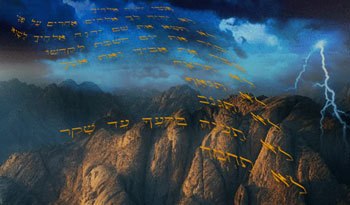
Mount SinaiMy opinion is that these scriptures are completely irrelevant to the One Law position since the “aliens” being referred to in these verses are non-Jews who attached themselves to the God of Israel, joined with the Israelites as a people, and eventually were absorbed into that population. They started out as Ger Toshav and their ancestors did not retain their non-Jewish identity but essentially “converted” to Judaism. It would be impossible to apply this set of examples to a group of non-Jewish “Messianic” believers today who want to be as equally obligated to the Torah as the Jewish people but all the while, retaining their Gentile identity and only living a partial Jewish lifestyle (one that disregards Talmudic interpretation of the written Torah).

Groups that hold to a “Bilateral Ecclesiology” framework (I don’t think Kinzer ever intended to make a theology out of BE), while maintaining a rather large Gentile Christian following, are led by a core group of Jewish Rabbis (Rabbi as defined within their own context) who support Messianic Judaism for Jews, including a completely Jewish religious lifestyle (Talmud included). They see the Acts 15 letter as the defining pronouncement by James and the Jerusalem Council, those Jews who held the mantle of authority over the “Messianic” movement after the ascension of Christ. The letter clearly defines limits upon the obligation of the Gentile believers in relation to the Torah of Moses. The letter doesn’t completely illustrate those limits, since Jesus taught outside their scope, but nothing in the teachings of Christ specifically commands that Gentiles become wholly absorbed into the Jewish nation.

Further, Paul, in the book of Galatians, goes to great efforts to discourage the Gentile Christians from converting to Judaism, for in converting, the Gentile Christian would then become fully obligated to obey all of the Torah (Galatians 5:3). That would be a crazy statement to make if the Gentile Christians were already fully obligated, as OL suggests. (D. Thomas Lancaster recently wrote The Holy Epistle to the Galatians, in which he illustrates how to understand Paul’s letter as teaching this distinction.)

To recap, traditional Judaism and Christianity both see their roles as very clear within their own groups and in relation to each other. Jews believe the Torah is only for the Jews and Gentiles, including Christians, are not obligated to it and are, in many cases, forbidden to adhere to its instructions. Non-Jews may only come before God when accepting the obligation of the Seven Noahide Laws and becoming Ger Toshav, and there is no need to convert to Judaism. Christians believe that the Law was wholly replaced by the Grace of Christ (for Jews and Gentiles) and that anyone, even a Jew, must convert to Christianity to have right standing before God. The Christian covenant completely replaces the Abrahamic and Mosaic covenants in their eyes.

In other words, Jews aren’t trying to co-opt Christians and Christians aren’t trying to co-opt Jews. They are separate communities with few if any bridges across the gap.

Messianic Judaism muddies the waters of that gap considerably and is still trying to define who they are and who Jews and Gentile Christians are in relation to each other, to the Torah, and to God.

But what about the Ger Toshav? I previously addressed the differences between the Noahide and the Christian in a pair of blog posts: The Sons of Noah and Children of God. Nevertheless, I believe that the clues to how Messianic Jews and Gentile Christians are supposed to relate to each other, to the Torah, and to God may be found in the more traditional understanding by Judaism of the Ger Toshav (and I’m deliberately sacrificing sure footing for the sake to my journey in pursuing the Ger Toshav).

What started this line of thinking for me was Rabbi Bell’s translated statement, “…is that we are forbidden from feeding meat from the Pesach offering to [any non-Jew, even] a ger toshav“. It never occurred to me that a Noahide would have had a special status in relation to Passover and the other festivals in the ancient community of Israel, but that was a logical outcome of the “one law for the native and the alien” statements during the forty years of wandering.

Going to GodIn Messianic Judaism, One Law accuses Bilateral Ecclesiology of denying Gentile Messianics (Christians) access to the same benefits of Torah living as the Jews and, by inference, treating Christians as if they/we were any other Gentile group. BE states that Gentile faith in the Jewish Messiah does make a difference, but that difference is largely in the areas of moral and spiritual behavior and does not include Jewish identity markers (wearing tzitzit, laying tefillin, keeping Kosher, observing the Shabbat). Traditional Judaism, while not recognizing a special status among Christian Gentiles relative to other non-Jews, does believe there is a difference in expectation between the general population of the world and those Gentiles who accept the mantle of Ger Toshav.

(Just to be clear, traditional Judaism sees all factions of Messianic Judaism as Christians; “Jews for Jesus”. Traditional Christianity sees Messianic Judaism as a group of Judaizers who are “under the law”. Like I said, the waters are muddy)

Eliezer was considered a Noahide, a righteous Gentile, a Ger Toshav and the most trusted of the household of Abraham. He was empowered to select a bride for Isaac, the son of the promise, who would father Jacob and continue a line that would lead to the patriarchs, the twelve tribes of Israel, and ultimately, the Messiah himself. Yet Maimonides considered even a Ger Toshav as forbidden from eating of the Passover sacrifice. Who is the Ger Toshav and can we take any understanding away from who he is and who we are in Christ, especially as we attempt to relate to our Messianic Jewish brothers?

What does it all mean and can any conclusions be drawn from this rather confused mess? That’s what I’m going to try to find out in my next blog.

For now, I remain a Christian at the gates of the Temple of God.

Part two of this series is The Ger Toshav at Worship.

The Death of the Tzaddik

Torah at SinaiRav Zalman Sorotzkin, zt”l, taught the extent of the oneness of the actions of all Jews from the prohibition of slaughtering a mother animal and her calf on the same day. “The verse states, ‘It and its progeny you shall not slaughter on the same day.’ The word for ‘slaughter’ is plural to teach that if one Jew slaughters the mother and a second Jew slaughters the child, this violates the prohibition. He explained, “We can learn a very important lesson from this.

We see that there is a very special connection between the actions of one Jew and the actions of his fellow. Our mission as a nation is to be a light unto the nations and we can only do this if we are united. Whether we know it or not, every Jew is part of one collective Jewish soul. This explains the unreasonable tendency of the non-Jewish nations to blame all Jews for heinous acts done by unworthy individuals. It is surely strange that they do not judge other nations this way. But when we consider that every Jew is part of a single whole, this begins to make a strange kind of sense, at least on a cosmic level…”

When Rav Chaim Vital, zt”l, noticed the Arizal saying a tearful heartfelt vidui during davening he wondered about this. “Why are you saying vidui? Surely you have never violated any of the heinous sins mentioned.”

The Arizal admitted that he had not violated the sins listed. He said, “Nevertheless, I must at least repent for all of them. Although I have never transgressed, what about my fellow Jews who have?

Daf Yomi Digest
Stories Off the Daf
“Parts of a Whole”
Chullin 81

I sometimes despair over the lack of unity in the body of Christ or in the larger collection of people of faith. We seem so fragmented and disorganized for a group of human beings who supposedly all worship the same God and who all long for the coming of the Messiah (for Christians that’s “second coming”). Despite the lesson we see off the Daf, it seems as if even the Jewish people are not unified in their approach to and understanding of God, the Torah, and even whether or not a Jew must believe in God to be a Jew.

Yet if we look at the Sinai event, the Torah wasn’t given to each Israelite individually but to Israel as a single body.

Moses went and repeated to the people all the commands of the Lord and all the rules; and all the people answered as one man with one heart, saying, “All the things that the Lord has commanded we will do!” –Exodus 24:3

Rashi comments that the Egyptians were pursuing the Jews “With one heart, like one person.” This comment is interesting because Rashi makes almost the same exact comment in next week’s parsha, when the Torah describes the Jewish people camping at the foot of Mt Sinai. There too, the Torah used the singular tense to describe the Jewish people, “and Israel encamped there opposite the mountain” (Exodus 19:2). On that verse, Rashi describes the powerful unity the Jews felt as they were about to receive the Torah, that they were “Like one person with one heart.”

-Rabbi Leiby Burnham
Parasha Perspectives
Torah Portion Beshalach – 5769
Partners in Torah

While modern Judaism may not function “like one person with one heart”, at least on the surface, we see that when the nation of Israel was formed and the Torah was given at Sinai, Israel accepted the Law of God “with one heart”. That was God’s intent and I believe that the Jewish people will return to complete unity under God in the days of the Messiah.

But what about Christians? We are sometimes called “the body of Christ”, implying that we are a unified group or collective, but is that really true and was it true from the beginning? Particularly in Western culture, the value of the individual is considered paramount and we tend not to respond well to being treated as a group under the authority of a Pastor, Rabbi, or other governing body. We each demand the right to determine what the Bible says for ourselves, which often results in the Bible saying many different things to many different people.

I won’t quote the various New Testament examples because there are far too many, but Paul’s mission to the Gentiles to preach the Good News of Christ was carried, by necessity, to individual Gentiles, families, or small groups. It would have been impossible to deliver the Gospel message to “the nations” as a unified whole, if only because the world is so big and Gentiles, even in the Second Temple era, were so numerous. There could be no “Sinai event” for us the way there was for the Children of Israel, and maybe that represents a fundamental difference between Jews and Christians.

Even though the various branches of religious Judaism (as well as secular Jews) don’t see eye to eye, when you take away the differences and distill the Jewish people down to their very essence, there is a very basic “Jewishness” that cannot be removed, erased, or diminished beyond a certain point. A Jew will always be a Jew. When push comes to shove, the Jews are a people as established by the will of God.

Not so a Christian.

We are not born, we are made. More accurately, we make a decision; becoming a Christian is a choice. Becoming not a Christian is also a choice. There really is no such thing as an “ex-Jew”. Even for Jews who convert to Christianity, the Jewishness is still there. That isn’t true for Gentile believers. There is a point where you can reduce the Jews down to a common denominator where they are all one (as God is One), but Christians are not “one”, we are many.

I wonder if that’s our problem?

Mount SinaiI can only imagine that, in the end, God will gather the faithful together and we will all be “one new man” (Ephesians 2:15) as, in theory, we are supposed to be right now, but we’re not there yet. In my own little corner of the world, exploring a path rarely traveled by any other Christian, I feel very much alone most of the time. That’s probably by choice as well, although I feel like there’s a bit of wiring and programming inside of me that will not let me seek a different road and will not let me blend in with the masses of the Messiah’s sheep in their Christian sheepfold.

I wonder if that’s my problem?

(Actually, I don’t feel that odd anymore. I just read an article about how Koreans, both in their native country and in the U.S., are fascinated with Talmud and its wisdom. Korean translations of Talmud and books about Talmud are common in Korean bookstores.)

Can we be one? Is Christian unity an illusion? How are we to gather together under the One God and be a unique body, set apart in holiness?

…so Christ also, having been offered once to bear the sins of many, will appear a second time for salvation without reference to sin, to those who eagerly await Him. –Hebrews 9:28

The murder of Rabbi Elazar Abuhatzeira, the “Baba Elazar,” on Thursday night saved the people of Israel from other tragedies, leading rabbis said Friday.

“Harsh punishments were decreed on the people of Israel, and he wanted to nullify them,” said the slain rabbi’s brother, Rabbi Baruch Abuhatzeira, also known as the Baba Baruch, speaking at Rabbi Abuhatzeira’s funeral.

by Maayana Miskin
“Rabbi Abuhatzeira Bore the Burden of Evil Decrees”
IsraelNationalNews.com

God is One and His Name is One. As Christians, we believe that the Son of Man came to die for the sins of many. Although Judaism traditionally does not believe that one person can die for the sins of another, the Kabbalistic perspective states otherwise:

The Bible is clear, and it is consistent. One person cannot die for the sins of another. This means that the guilt from the sins committed by one person cannot be wiped out by the punishment given to another person. First, in Exodus 32:30-35, Moses asks God to punish him for the sin of the Golden Calf, committed by the people. God tells Moses that the person who committed the sin is the person who must receive the punishment. Then, in Deuteronomy 24:16, God simply states this as a basic principle, “Every man shall be put to death for his own sins.” This concept is repeated in the Prophets, in Ezekiel 18 “The soul that sinneth, it shall die… the righteousness of the righteous shall be upon him, and the wickedness of the wicked shall be upon him.”

-Rabbi Stuart Federow
“Jews believe that one person cannot die for the sins of another person”
What Jews Believe

“… suffering and pain may be imposed on a tzaddik as an atonement for his entire generation. This tzaddik must then accept this suffering with love for the benefit of his generation, just as he accepts the suffering imposed upon him for his own sake. In doing so, he benefits his generation by atoning for it, and at the same time is himself elevated to a very great degree … In addition, there is a special, higher type of suffering that comes to a tzaddik who is even greater and more highly perfected than the ones discussed above. This suffering comes to provide the help necessary to bring about the chain of events leading to the ultimate perfection of mankind as a whole.”

Derech Hashem (The Way of God)
Rabbi Moshe Chaim Luzzatto
As translated and annotated by Aryeh Kaplan
Feldheim Publishers
Jerusalem, 1997, p. 122.
Quoted from Yashanet.com

It’s with a certain amount of irony that I find the only “reasonable” explanation for how a person, a tzaddik, can give his life to avert the “evil decrees” of an entire people (without admitting that God accepts human sacrifice), is within the confines of Jewish mysticism (you’ll find Judah Himango struggling with the issue of Leviticus 27 and human sacrifice at Kineti L’Tziyon).

If Christianity can be said to have a “Sinai event” it is the crucifixion (or can we also include the resurrection?). Not that we were all there. In fact, the vast majority of people who were in the general vicinity were Jews, who came from every corner of Israel and the diaspora for the festival of Passover.

On the other hand, every Jew, even today, is to consider himself or herself as having stood personally at the foot of Sinai to receive the Torah. Why not (and this is just my imagination speaking) consider every Christian and every disciple of the “great Rebbe of Nazaret”, the most righteous tzaddik of all generations; why not consider us all as having stood at the foot of his execution stake personally, each of us as a witness to his bloody, sacrificial death on our behalf?

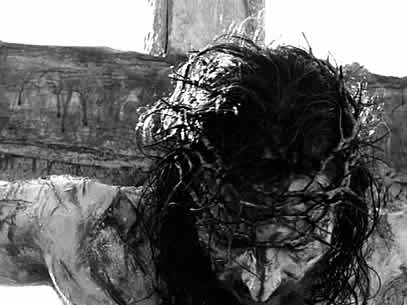
The Death of the MasterWe sometimes call Jesus our “living Torah” since he embodied the lifestyle of one who was fully human yet fully obedient to God and without sin. If the giving of the Torah at Sinai to the Jewish people unites them as one, does not the giving of the blood of the living Torah at Golgotha, the place of the skull, unite the disciples of Christ?

There’s a problem of two separate people groups under God and two separate events. Do the Jews have Moses and the Gentiles have Jesus? Are there two “Messiahs”? Not ultimately, for we all spring from a single root (Romans 11) and we are all branches on the same tree. More than that, Jesus came for the lost sheep of Israel and Paul went first to the Jew and then to the Gentile. The Jewish Moshiach came for the Jews and also came to unite all of humanity under God.

But every year, when they sound the shofar at Rosh HaShana it is revealed, a new revelation of infinite life is drawn to the world, beginning with the Land of Israel (see Tanya, pg. 239).

That is why the Torah says G-d’s eyes are on the Land of Israel from the beginning of the year to the end; it is referring to this new flow of life begun each Rosh HaShana.

And why will the Patriarchs be revived in Israel? Because as the ultimate Jews they will link and reveal the holiness of the people of Israel to the Land of Israel.

But this will only happen through our efforts to transform the entire world into holiness NOW — that is, to make Israel everywhere and prepare the world for Moshiach.

Because ONLY Moshiach will bring the Jews to Israel when the Great Shofar will be sounded by HaShem Himself.

We just have to do all we can in thought, speech, and action to bring . . .

Moshiach NOW!

-Rabbi Tuvia Bolton
Commentary on Parashat Eikev (5766)
Ohr Tmimim

Then the angel showed me the river of the water of life, as clear as crystal, flowing from the throne of God and of the Lamb down the middle of the great street of the city. On each side of the river stood the tree of life, bearing twelve crops of fruit, yielding its fruit every month. And the leaves of the tree are for the healing of the nations. No longer will there be any curse. The throne of God and of the Lamb will be in the city, and his servants will serve him. They will see his face, and his name will be on their foreheads. There will be no more night. They will not need the light of a lamp or the light of the sun, for the Lord God will give them light. And they will reign for ever and ever. –Revelation 22:1-5

For God So Loved

HumbleWhen this question reached the Alter of Kelm, zt”l, he explained quite decisively. “Two nations were forever distanced from Hashem due to their lack of hakoras hatov for the kindness of Avraham towards Lot, as the Ramban explains. Consider this, my brothers. Is there anyone in this generation who acts kindly to the grandchildren of a person who helped them? Surely so many years have passed, and most will surely have forgotten such an old obligation? We would be surprised to find even one such person in a city!”

Rav Yechezkel Levenstein, zt”l, recounted that the Alter’s rebuke did indeed bear fruit. “Boruch Hashem, I knew people in Kelm who truly knew how to express their appreciation towards those who had shown them—or their parents—kindness. I even knew people who bestowed kindness on the grandchildren of those who helped them. They did their utmost to do whatever good possible to those who had been kind to them and even their descendants. This is the level of truly pious and upright people who know their obligation in the world.”

The obligation for hakoras hatov itself is clearly explained in the Mishnas Rabbi Eliezer, “There is nothing more serious in God’s eyes than one who lacks proper appreciation. Adam HaRishon was banished from Gan Eden only because he lacked proper appreciation. God got angry at our forefathers in the desert only because they lacked hakoras hatov.”

Yomi Daf Digest
Stories Off the Daf
“The Need for Gratitude”
Chullin 62

“I gratefully thank You, living and existing King
for restoring my soul to me with compassion.
Abundant is your faithfulness.”

Modeh Ani

Gratitude is a quality that isn’t always well demonstrated in the modern world of the west. In many other cultures, including the middle east, hospitality and the expression of gratitude is still highly prized (at least among the older generation). What about those of us who are attached to the God of Israel and who are disciples of Jesus?

Every morning, before getting out of bed, I silently bless God with the Modeh Ani for preserving my life for another day. I’m not telling you this because I think it makes me a better person or anything, but to illustrate the point that we depend on God for literally everything in our lives, regardless of what it is or how we think we’ve acquired it. If God is so gracious to us that he “opens His hand and satisfies the desires of every living thing” (Psalm 145:16), how can we fail to acknowledge that before Him or not proceed to pass that graciousness on to others.

Despite the terrible shortages, the Imrei Emes always put the needs of the poor first. A certain chassid once brought him a little challah for Shabbos. This challah was made of the finest flour—a danger for the baker since this flour was set aside for soldiers—so the rebbe could avoid using coarse bread for hamotzi on Shabbos. This challah was considered very valuable since it was of much better quality.

To the surprise of all, the rebbe gave out this precious bread to his chassidim who came for shiyarim. The rebbe explained his generosity with a statement on today’s daf. “In Chullin 63 we find that the chasidah bird is called this since it does kindness exclusively with its own kind—they only share food with each other. Interestingly, we find in the Yerushalmi that mice are called wicked because when they see a lot of fruit they call their friends to join them. We may well wonder the exact difference between the two. After all, aren’t both kind to their own species exclusively?”

“The answer is that mice only call their friends when there is a lot. A chasidah shares even when there is not so much to be shared…”

Daf Yomi Digest
Stories Off the Daf
“The Rebbe’s Chessed”
Chullin 63

It’s not that we don’t do this, but we all need a reminder that we have a duty to share what God has provided with others, not just when we have plenty, but when we are in want. That’s why I recite Modeh Ani in the morning…as a reminder that I am grateful to God for my life and what I have and that what I have should be shared. But what we share shouldn’t be just what we have, but who we are. Ultimately, they should all be the same thing.

The Rebbe wept profoundly as he spoke these words:

The entire being of Moses was the Torah he brought to his people. The Torah was more than something he taught. It was what he was. It was his G-d within him.

Yet when it came to a choice between the Torah or his people, he chose his people. He said, “And if you do not forgive them, then wipe me out from Your book that You have written!”

His whole being was the Torah,
but deep into his essence, at the very core,
was his oneness with his people.

Rabbi Tzvi Freeman
Bringing Heaven Down to Earth
Based on letters and talks of the Rebbe
Rabbi M. M. Schneerson
“The Ultimate Sacrifice”
Chabad.org

For God so loved the world that he gave his one and only Son, that whoever believes in him shall not perish but have eternal life. –John 3:16

Eikev: Blessing God

EikevIn this week’s reading (Eikev), the Torah warns us that after the people enter Israel, they may be prone to think only about their own accomplishments, and forget the source of all blessings: “and you become haughty, and forget HaShem your G-d who brought you out from Egypt, from the house of slavery… and you say in your heart, my own might and the strength of my hand have made me all of this wealth.” [Dev. 8:14, 17]

This is something that can affect all of us. Maimonides says that we should look for the middle ground, that even bad traits have their place (meaning, sometimes it is right to appear angry, for example), but that haughtiness is the exception. There is never a time to be “full of ourselves.”

This does not mean we should fail to appreciate our gifts. Moshe was the leader and teacher of the Jewish people, he spoke directly with G-d, and received the Torah and taught it to us. But the Torah also testifies that he was more humble than anyone — and the Torah doesn’t exaggerate!

Rabbi Yaakov Menken
Director, Project Genesis / Torah.org
Note from the Director
“Talent on Loan from G-d”
Project Genesis

It seems almost an impossibility to be able to lead millions of people on a journey across great distances for forty years and even be able to talk to God “face-to-face” and yet be considered “more humble than anyone else on the face of the earth” (Numbers 12:3). How is this possible, especially given some of our common dictionary definitions for this word?

  1. not proud or arrogant; modest: “to be humble although successful”.
  2. having a feeling of insignificance, inferiority, subservience, etc.: “In the presence of so many world-famous writers I felt very humble”.
  3. low in rank, importance, status, quality, etc.; “lowly: of humble origin; a humble home”.
  4. courteously respectful: “In my humble opinion you are wrong”.
  5. low in height, level, etc.; small in size: “a humble member of the galaxy”.

Yet, we don’t really think of Moses as arrogant, either. According to Rabbi Menken, he couldn’t have been:

Rav Shamshon Rephael Hirsch writes that arrogance is the first step towards forgetting G-d. Moshe never ignored his gifts, but he also recognized where they came from. What prevents us from becoming arrogant or haughty is the appreciation that everything we have is a gift.

How does that work for the rest of us, particularly when we’re not the leader of millions (most of us) and don’t talk to God the way Moses talked to God (I don’t know anyone who does that, although a few people claim to have this ability)? It seems like a lot of people either take no credit at all for what they do well or they take all the credit for everything that happens good in their lives and in the lives of others. Should we give total credit to God for everything at our expense or take credit for everything, leaving no room for God? Where is the balance? How does this “partnership” between people and God work?

We were all created in the image of God (Genesis 1:27). Think of this as meaning that God created us with a certain configuration of wiring and programming. We “naturally” have certain personality traits, talents, and characteristics that are unique to us. Some give us the ability to easily accomplish particular tasks, like a person who just “naturally” draws well, sings well, or is a gifted carpenter. Other characteristics we find we must master and bring under our control, such as a quick temper or a tendency to like alcohol too much.

HamazonWhen things go well, sometimes because of our talents, we tend to credit ourselves and feel that we’re really great. When things go badly, sometimes because of our “evil inclination” or the character traits that we need to control, we tend to either blame God for how He made us, or to suddenly remember God and beg for His forgiveness and help. We see this in Rabbi Menken’s commentary about how Moses warned the Children of Israel against haughtiness. Ironically, the answer is in a very simple but unusual (from a Christian point of view) commandment:

And you shall eat and be satisfied, and you shall thank the Lord your God for the good land which he has given you. –Deuteronomy 8:10

In Judaism, this is one of the 613 commandments that define a Jew’s obligations to God and to other people. This has resulted in the blessing of Birkat Hamazon or “Grace After Meals” being said after eating, as opposed to the Christian tradition of blessing God (sometimes at length) before a meal.

There’s a reason for this as stated by Rabbi Menken:

The Ohr Gedalyahu, Rabbi Gedalyah Schorr zt”l, tells us that the holy Kabbalistic work, the Zohar, says that the Torah frequently relates the positive and the negative. Our reading, he says, is one example of this concept. The Torah goes on to warn us that after we are sated, we can make a tragic mistake.

“Guard yourselves lest you forget HaShem your G-d… lest you eat and be satisfied, and build good houses and dwell therein… and you instill pride in your hearts and forget HaShem your G-d who took you out from Egypt, from the house of slavery… and you say in your hearts, ‘my strength and the might of my hand made me all of this great wealth!'” [8:11-17] Say a blessing recognizing that it all comes from G-d, to avoid the false claim that your own abilities brought you wealth.

It’s when we are successful and satisfied that we most need to connect to God. It’s not a sin to ask for His help when we are hurt or scared or desperate, but He must be a part of everything in our lives, to good and the bad alike, or we will forget Him. We might also forget ourselves and who He made us to be.

There is a portion of the morning prayers called Birkat HaShachar that observant Jews say every day where the person thanks God for various attributes and circumstances (the full text in English and Hebrew is found on this site as a PDF). This includes thanking God for giving us (in this context, “us” are the Jews reciting these blessings) discernment, for making us free, for making us in His Image, and so on. This, like the Birkat Hamazon, is also a good model for Christians to consider because it illustrates the partnership between people and God.

Yes, God made us and all things come from God, but He made us to possess certain “innate” talents and abilities. How we choose to use those abilities is up to us, but that they are there is both a testament to God’s mastery over Creation and the fact that we have control of what we possess as human attributes. We are not puppets on God’s string. We can take pride in our achievements and thank God for having made us the way He did at the same time.

I think that’s how Moses approached his own life and in whatever circumstances we may find ourselves, I think that’s how we can approach life, too. We can do what Moses did, by never forgetting the God who created us.

Whoever possesses the following three traits is of the disciples of our father Abraham; the disciples of our father Abraham have a good eye, a meek spirit and a humble soul. The disciples of our father Abraham benefit in this world and inherit the World To Come, and is stated, “To bequeath to those who love Me there is, and their treasures I shall fill.” –Pirkei Avot 5:19

Good Shabbos.