Tag Archives: mourning

Walking East of Eden

walkingA person who has trust in G-d will be free from bothersome thoughts. He will not worry about what will be tomorrow if he has enough for today. He does not cause himself needless pain and discomfort by worrying that perhaps he will be lacking something in the future. A person who has trust in G-d feels no need to flatter other people. He will not veer from his principles for the hope of financial gain. Questions of how he will make a living do not bother him since he knows with clarity that it is impossible for him to have more or less than what the Almighty has decreed for him.

Even if there is a world crisis, he will not worry about his personal situation. He has trust that any misfortune which was not decreed upon him will not affect him. He walks in this world completely free from worries and sadness. He takes pleasure in what he has and feels no lack of possessions.

In short, if a person has trust in G-d, he has everything.

-Rabbi Zelig Pliskin
“Today’s Daily Lift, #875”
Aish.com

In 1942, the first trainload of Jews in Holland were sent to concentration camps. A few years earlier, tens of thousands of Jews had fled from Germany to Holland, which maintained an open-door immigration policy. But soon after, the Nazis occupied Holland and proceeded to make it Judenrein (clean of Jews). Perhaps the most famous Dutch Jew was Anne Frank, a teenage girl whose diary has become the most widely-read account of life during the Holocaust. In 2005, Holland’s prime minister apologized for his country’s collaboration with the Nazis.

Day in Jewish History for Av 2
Aish.com

Does it seem odd that I post two such contradictory quotes side-by-side so to speak? That’s how they came to me yesterday (today, as I write this) by email from Aish. Thousands of Jews trusted in God. Thousands of Jews trusted in the Dutch to help them escape the Nazis. Things didn’t work out so well.

Yesterday, I wrote about how God provides everything we need including sufficient answers to our difficult questions. That isn’t to say He provides all the answers and we continue to struggle all our lives to draw closer to our Creator and to understand our place in the universe.

I’ve been a life-long “fan” of the NASA space program. I remember growing up hearing about the Mercury and Gemini projects. I used to long for the days when we’d have orbiting space stations, Moon bases, and manned rockets going to Mars. None of that really happened but I still follow the adventure. I’ve been recently following the news about Voyager 1 and whether or not it has left the solar system. My childhood fascination with space contributed to my early interest in science fiction and today, I’m reliving some of that by re-reading Arthur C. Clarke’s classic Rendezvous with Rama.

Exploring the universe tends to make one feel very small. But I never feel smaller than when I am confronted with human anger, hostility, and cruelty.

starry_night_7daysWe are still in the three weeks of mourning which started on Tammuz 17 and Tisha B’Av (Av 9) is rapidly approaching.

While I strive to maintain faith and trust in God, there are days when I get worn down. It’s not that God isn’t trustworthy and it’s not that He won’t fulfill all His promises, it’s just whether or not I’ll be able to hang on to that faith and trust long enough to see it through.

Peter said to Him, “Lord, if it is You, command me to come to You on the water.” And He said, “Come!” And Peter got out of the boat, and walked on the water and came toward Jesus. But seeing the wind, he became frightened, and beginning to sink, he cried out, “Lord, save me!” Immediately Jesus stretched out His hand and took hold of him, and said to him, “You of little faith, why did you doubt?”

Matthew 14:28-31 (NASB)

I suppose Jesus has the right to criticize Peter and the rest of us for our lack of faith, for even when Messiah’s own faith was tested, he endured.

And He came out and proceeded as was His custom to the Mount of Olives; and the disciples also followed Him. When He arrived at the place, He said to them, “Pray that you may not enter into temptation.” And He withdrew from them about a stone’s throw, and He knelt down and began to pray, saying, “Father, if You are willing, remove this cup from Me; yet not My will, but Yours be done.” Now an angel from heaven appeared to Him, strengthening Him. And being in agony He was praying very fervently; and His sweat became like drops of blood, falling down upon the ground.

Luke 22:39-44 (NASB)

I know that Jesus lived a human life and he suffered more than most. And yet, none of us are like Jesus, least of all me.

About a week ago, I posted another blog bringing into question the traditional Christian belief in the rapture. What will happen to the faithful should they suffer and not be rescued when they expect it?

It’s not my faith in God that’s being tested, it’s my faith in human beings. I know that God wants us to love one another even as we love Him (and even as He loves us), but He can never be faithless, cruel, mean, moody, disagreeable, hostile, frustrated, annoying, annoyed, and so on. Only we are like that and we are like that toward each other all the time.

No, this isn’t about being criticized on the Internet again. In fact, my little corner of the blogsophere has been pretty quiet these days. Not a lot of religious posturing is going on and it’s fairly easy to ignore what little is occurring.

And yet, the world of human beings keeps going on the same way it has since there have been human beings. It’s not just the petty slights of day-to-day living, but the whole panorama of human history that shows me human beings don’t change. In spite of the illusion of progressivism, the idea that we keep getting better and better as long as we keep becoming more and more socially and politically liberal, people die every day. There are wars every day. Women are assaulted, beaten, and raped every day. Human beings do cruel things every day, just like we always have.

No matter what I do, I’m not perfect even for one minute of any day, and no matter what I do, what mistakes I’ve made, how much I’ve tried to make amends, I’ll make another mistake, tomorrow, an hour from now, a minute from now.

alone-on-marsSometimes, looking back, I wonder if part of my interest in space exploration and science fiction is the desire to get away from it all. I think of the Mars One project actually working. What would it be like to stand on another planet, staring out into the distance, gazing into the vast desert of another world, one with very, very few human beings on it? What would it be like to be truly alone, where it’s quiet and peaceful and empty?

But all that is a fantasy, at least for me. I’m on Earth, where God has put all of us. I live in a broken world, and it spins and spins in a broken universe. And besides God, all we have is each other.

The souls are all one.
Only the bodies divide us.
Therefore, one who places the body before the spirit
can never experience true love or friendship.

-Rabbi Tzvi Freeman
“True Love”
Based on letters and talks of the Rebbe, Rabbi M. M. Schneerson
Chabad.org

I don’t know if I buy that part about all souls being one but I do agree that we are divided. There’s a difference between studying, reading, and writing religion and the actual doing of religion. In my opinion, there’s a difference between wearing tzitzit or laying tefillin or lighting the Shabbos candles because they’re written down in a book and doing the same things because you are responding to God with devotion and love. There’s probably even a difference between giving to charity or donating to a food bank because you think you should do it and because you are acting out of compassion.

The one thing that shows everyone your true motivation is if you can take insults or abuse or worse and still remain loving toward other people and toward God in every word and deed.

We are divided. We are separated from God and from each other. We have been since before Adam and Eve walked east out of Eden. We’ve been walking away from paradise ever since, even as we keep trying to walk toward it.

Pessimism is a luxury that a Jew can never allow himself.

-Golda Meir

Healing the Gaps in the Wall

destruction_of_the_templeThe next Sabbath nearly the whole city assembled to hear the word of the Lord. But when the Jews saw the crowds, they were filled with jealousy and began contradicting the things spoken by Paul, and were blaspheming. Paul and Barnabas spoke out boldly and said, “It was necessary that the word of God be spoken to you first; since you repudiate it and judge yourselves unworthy of eternal life, behold, we are turning to the Gentiles.

But the Jews incited the devout women of prominence and the leading men of the city, and instigated a persecution against Paul and Barnabas, and drove them out of their district. But they shook off the dust of their feet in protest against them and went to Iconium.

Acts 13:44-46, 50-51

Are believers who live under the law generally joyful people?

Instead of God’s truth, with what did Satan fill the hearts of those who believed that justification before God could only come through keeping the law of Moses? Do you think that they were sensing a loss of influence and control?

-Questions in the Bible Study Class notes from last Sunday

Last Sunday at church, Pastor Randy preached from Acts 13:42-52. I was impressed that Pastor was able to give a sermon on such a potentially inflammatory set of verses in a way that expressed great sensitivity for the Jewish people, and correctly identified (in my opinion) the source of the “irritation” expressed by some of the Jewish leadership in the Pisidian Antioch synagogue upon witnessing vast crowds of pagan, idol-worshiping Gentiles flood into shul to hear Paul speak.

My Sunday School class discusses Pastor’s sermon after services (the church offers multiple classes on Sunday on a variety of subjects, but I chose this one since for me, the highlight of going to church is the sermon), and in going over my study notes the day before, I knew there could potentially be some problems. I wasn’t looking forward to class and once it started, I didn’t know exactly what I was going to say.

Fortunately, although the notes could have been worded a bit better, the attitudes expressed didn’t reflect any negative attitudes toward “the Jews” …

… exactly

No, no one spoke against the Jewish people, but the language of Christians talking about “the Jews” has been crafted over many centuries and there seemed to be an echo of that language in my study notes. If I hadn’t known better, I probably would have been concerned a time or two in class.

Actually, I did become concerned, since the teacher inserted the assumption that part of the reason “the Jews” in Antioch became upset, was because Paul was teaching that the grace of Christ replaces a life “under the Law” for Jewish believers.

As the time to go to class approached, I was still uncertain how or if I was going to respond to this assumption, but when the moment arrived and I heard “the Law” being (apparently) dissed, I asked to read from Psalm 19. I had the ESV Bible with me, but below, I’m quoting from the Stone Edition Tanakh (note that the verse numbers are slightly different between the Christian and the Jewish Bible):

The Torah of Hashem is perfect, restoring the soul; the testimony of Hashem is trustworthy, making the simple one wise, the orders of Hashem are upright, gladdening the heart; the command of Hashem is clear, enlightening the eyes.

Psalm 19:8-9 (Stone Edition Tanakh)

Does that sound like the Psalmist thought the Torah was a burden? That’s the question I asked the class. Pastor, in his sermon, bent over backwards to illustrate that saying “the Jews” in this context, would be highly insulting and would not accurately reflect what was happening in the Antioch synagogue. Not literally every Jewish person turned against Paul and Barnabas and no, Paul did not permanently turn away from bringing the good news of Messiah to Jewish people and take it only to the Gentiles from that moment on. And there’s nothing in the text of Acts 13 that tells us Paul spoke against the Torah.

It’s sections of scripture like this one that have been used by the church to berate, denigrate, harass, and persecute the Jewish people for centuries. Although I didn’t get any push back at all in class as I made my points, I had to be sure that the people I’ve been studying with for over half a year weren’t misunderstanding this portion of Acts 13 based on long-standing Christian tradition (yes, Christians can interpret scripture based on tradition, too).

I don’t believe they were, but it was one of those moments in church that helps me realize we have a long way to go in healing the rift between traditional Christianity and the Jewish people.

I probably wouldn’t have written about this at all except when I got home from church, I went online and read the following:

We are now entering the Three Weeks, the time between the 17th of Tamuz (observed Tuesday, June 25th) and the 9th of Av (starting Monday day night, July 15th). This is a period when many tragedies happened to the Jewish people. Why do we mourn the loss of the Temple after so many years? What did and does it mean to us?

The 17th of Tamuz is a fast day. The fast begins approximately an hour before sunrise and continuing until about an hour after sunset. The purpose of the fast is to awaken our hearts to repentance through recalling our forefathers’ misdeeds which led to tragedies and our repetition of those mistakes. The fasting is a preparation for repentance — to break the body’s dominance over a person’s spiritual side. One should engage in self-examination and undertake to correct mistakes in his relationship with God, his fellow man and with himself.

-Rabbi Kalman Packouz
“Shabbat Shalom Weekly”
Commentary for Torah Portion Pinchas (Numbers 25:10-30:1)
Aish.com

yom-kippur-kotelYou might think I’m being overly sensitive about all this. I suppose some of the people in Sunday School class might think that of me. I couldn’t see all the faces around the room as I was speaking, so I can’t gauge how each person was responding. I can only tell you that no one disagreed with me out loud, and in fact, a few people spoke up in support of my statements.

Rabbi Packouz, while reminding me of the terrible tragedies and losses that have befallen the Jewish people and how Israel is once again entering a time of national mourning, also helped me realize that for every descent, there is an ascent, and every wound offers an opportunity for healing.

The story is told of Napoleon walking through the streets of Paris one Tisha B’av (the 9th day of the Hebrew month of Av, a day of fasting and mourning for the destruction of the two Temples). As his entourage passed a synagogue he heard wailing and crying coming from within; he sent an aide to inquire as to what had happened. The aide returned and told Napoleon that the Jews were in mourning over the loss of their Temple. Napoleon was indignant! “Why wasn’t I informed? When did this happen? Which Temple?” The aide responded, “They lost their Temple in Jerusalem on this date 1700 years ago.” Napoleon stood in silence and then said, “Certainly a people which has mourned the loss of their Temple for so long will survive to see it rebuilt!”

If we know our history and understand it, then we can put our life in perspective. We can understand ourselves, our people, our goals, our values. We will know the direction of our lives, what we want to accomplish with our lives and what we are willing to bear in order to fulfill our destiny. Friedrich Nietzsche put it well, “If you have a ‘why’ to live for, you can bear with any ‘how’.”

Sara Debbie Gutfreund also wrote about the 17th of Tammuz but from a much more personal perspective.

A few years ago my grandfather passed away right before the 17th of Tammuz. On the fast day I was helping my mother as she sat shiva and an old family friend offered me a drink.

“No thanks, I’m fasting.” I said.

“What are you fasting for?” he asked. So I explained that it was the 17th of Tammuz, and we were mourning the day that the walls of Jerusalem were breached before the Second Temple was destroyed.

“I never heard of this fast day. But you know what’s even sadder? Last year my wife and I visited Israel for the first time. We went on a tour of the Old City and the tour guide points out the Temple Mount. And all we could see was this huge mosque and then the tour guide points out the Western Wall. And I couldn’t believe it. That’s it? That’s all that’s left of the Temple? One wall? So I think I know why there’s a fast. There’s so little we have left.”

-from “Filling the Crevices of the Wall”
Aish.com

So where is the uplifting part of the story. I promise you that there is one.

Last night, my son, who is named after my grandfather, was standing with me on the deck.

“Why is the world so big?” he asked me as we gazed up at the towering trees and the endless stretch of star-studded sky.

“I don’t know,” I answered. “Maybe because we need room to grow.”

And as the fireflies began to light up the dark corners of the yard, I thought that it must be true. The darkness is here for us to create light. The brokenness is here for us to learn how to make ourselves whole. And the Western Wall – all that’s left – is so much more than just a remnant of our past. It’s there to remind us to rebuild. It’s there to hold our crumpled notes and dreams. It’s a gift. Like the gap between the waves that pulled me in and brought me back to shore. Like the saltwater that poured down my face and the sand that blurred my eyes. Like the silence that gives us a chance to find our own words. Like the hugeness of the world that makes room for us to grow. Like the man who put down his drink and said. “I think I know why there’s a fast.” There’s a gap. In our hearts. In the crevices of the Wall.

But the gap is the gift. And all that’s left is the extraordinary opportunity to fill it.

I amazes me that a people and a nation who have suffered so much can continue to bounce back and not only to survive, but to live, and grow, and embrace the God of Jacob wholeheartedly. As Napoleon was supposed to have said, “Certainly a people which has mourned the loss of their Temple for so long will survive to see it rebuilt!” Nietzsche’s statement “If you have a ‘why’ to live for, you can bear with any ‘how'” is well and appropriately applied to the history of the Jewish people. The Kotel or what some people refer to as “the Wailing Wall,” is all that there is left of the Temple at present and in the crevices, people insert written prayers to God. The Jewish people fill the gaps in their existence with their faith that one day, God will answer their prayers and send His Messiah to restore them as a people in their Land, to redeem Israel, to raise her up, to give her a King who will bring peace to all the world.

temple-prayersThe gap between Christianity and Judaism gives me the opportunity to help fill it with who I am as a believer and what the Jewish Messiah King means to me. I can fill the gap as a Christian man who has been married to a Jewish wife for over three decades, who has raised three Jewish children, and who is sensitive to what Christians have traditionally said and believed about the Jewish people based on some misunderstood portions of the scriptures.

Not something to dread, but an opportunity to help educate and to introduce a balance (though it probably wasn’t needed much in this case).

But like many Jewish people are doing right now, part of me grieves the losses, even as I know there are gains. It’s going to get worse for our world before it gets better. There will be battles. There will be heartache. There will be a need for courage.

We will need to fill the gaps that God has left us because that is helping to repair the world, tikkun olam. That is part of bringing the return of the Messiah. Part of the gospel message is the promise of personal salvation for anyone who believes. But the especially good news for the Jewish people is that when Messiah returns, he will redeem and restore national Israel, rebuild the walls of David’s fallen sukkah, and bring peace between the Jewish people and the people of the nations who are called by his name.

And beyond what Rabbi Packouz and Ms. Gutfreund reminded me of, I remembered Boaz Michael’s message in his book Tent of David. It is true that, as my friend Tom once said, I’m ultimately seeking not Christianity or Judaism, but an encounter with God by returning to church, but I am also seeking the vision of Boaz Michael in healing the “crevices in the wall” between what Christianity has largely become, and what Messiah truly wants us to be.

Nobody Ought to be Alone on Christmas

aloneThings are different since you’ve been here last, Childhood dreaming is a thing of the past

Maybe you can bring us some hope this year, Visions of sugar plums have disappeared

I’m all grown up but I’m the same you’ll see, I’m writing you this letter ’cause I still believe

Dear Santa, I’ve been good this year, Can’t you stay alittle while, with me right here?

Nobody ought to be alone on Christmas

-from the song All Alone on Christmas (1992)
Written and arranged by Steve Van Zandt
Recorded by Darlene Love with members of
the E Street Band and the Miami Horns

This song is one of my guilty pleasures. I love it. I didn’t particularly like the film Home Alone 2 (1992) in which the song is featured, but it has a killer sax solo. No, I don’t celebrate Christmas, but I still like the song.

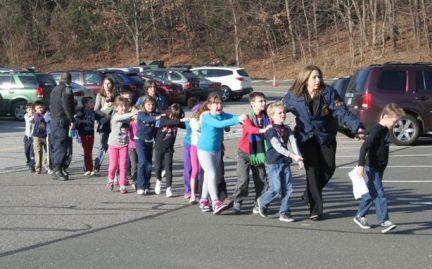
But I can’t listen to the song this year without tears welling up in my eyes (particularly embarrassing, since I’m at work as I write this). I can’t remember which news story I read it in, but I keep remembering something a reporter wrote about how some children’s Christmas presents will never be opened this year in Newtown, Connecticut because the light of those children’s lives was removed from the world last week. Because someone found it necessary to kill 26 children in Newtown, there will be parents, grandparents, brothers, sisters, and friends who will feel all alone this Christmas.

Imagine anticipating the “thumping” sound of little feet coming down the stairs before dawn on December 25th to see if Santa had brought the presents and then never hearing that sound. Imagine having wrapped each gift for your little boy or girl with care, decorating the package, and writing something loving and special on the Christmas card…but now there’s no one to rip open the wrapping paper and scatter it all over the living room in glee. As a parent, could you bear to unwrap the new toys and donate them to Toys for Tots? What would you do with them?

What would you do with “Christmas?” As a parent and a grandparent, the deaths of these 26 children tears me apart. In my imagination, I’d pull down the Christmas tree and burn it, rip all of the lights from my home and shatter them, eliminate any trace of this “festive season” from my environment, and perform the modern, moral equivalent of putting on sackcloth and ashes (whatever that might be).

But what if your small missing child has brothers and sisters? What do you say to them? How can you “celebrate” with them, or can you? Do you destroy their Christmas because of your grief? What about their grief? How can you comfort your other little ones and your spouse when pain and anguish crowd out everything else in your heart?

I’m normally pretty neutral about Christmas these days but this year, I hate it. I hate all of the expectations people have for “the season to be jolly.” In retrospect, I probably should always have hated it. Who is happy and cheerful now? Doesn’t every home know death? Don’t thousands of children die all over the world every day? Aren’t their tens of thousands, hundreds of thousands of hearts in the world right now who feel alone and empty for so many reasons? This “season” tells you that you must be happy and joyful and festive.

Eat heaping plates of turkey or ham on Christmas this year if you so choose. I’ll be dining on ashes.

No, that’s too cruel.

I don’t celebrate Christmas but maybe you do. Maybe you have many reasons to be happy and grateful (I’m grateful that my family is alive and safe this year). I have no right to take that away from you. I have no right to believe that the victims and mourners in Newtown haven’t come together to comfort and console each other. I have no right to believe that anyone will be alone this Christmas in Newtown, though I know without a single doubt that there will be an emptiness in each of those homes.

Today, we observed a moment of silence for the victims. Also, bells tolled 26 times, once for each child who died. On Christmas, if you celebrate Christmas, I don’t want to take away from your joy, but in the midst of your joy, take a moment, or two, or twenty-six, or twenty-eight.

And remember them.

Charlotte Bacon, age 6, Daniel Barden, age 7, Rachel D’Avino, age 29, Olivia Engel, age 6, Josephine Gay, age 7, Dylan Hockley, age 6, Dawn Lafferty Hochsprung, age 47, Madeleine Hsu, age 6, Catherine Hubbard, age 6, Chase Kowalski, age 7, Jesse Lewis, age 6, Ana Marquez-Greene, age 6, James Mattioli, age 6, Grace McDonnell, age 7, Anne Marie Murphy, age 52, Emilie Parker, age 6, Jack Pinto, age 6, Noah Pozner, age 6, Caroline Previdi, age 6, Jessica Rekos, age 6, Lauren Rousseau, age 30, Mary Sherlach, age 56, Victoria Soto, age 27, Benjamin Wheeler, age 6, Allison Wyatt, age 6.

You can find out more about each of them at wptv.com.

Not everyone on that list celebrated Christmas but that’s not really the point. The point is that each of them had the right to live. The point is that each of them was someone’s son or daughter and that each one of them was loved. The point is that there are people left behind to grieve and to mourn and to cry. And the point is that, in spite of all the multi-colored lights that sparkle on homes and businesses and trees right now, the little more darkness has entered our world and a little more light has been taken away from each of us.

sandy-hook-victims

And nobody ought to be alone.

A Prayer for Newtown

school_shooting_in_connFor those who suffer, and those who cry this night, give them repose, Lord; a pause in their burdens.

Let there be minutes where they experience peace, not of man but of angels.

Love them, Lord, when others cannot.

Hold them, Lord, when we fail with human arms.

Hear their prayers and give them the ability to hear You back in whatever language they best understand.

Margaret A. Davidson

I can’t think of a worse nightmare for a parent than the death of a child. My children are all adults and I continue to pray daily that God will watch over their lives. I can’t imagine what the parents of the child victims of the Sandy Hook Elementary School shootings in Newtown, Connecticut are going through right now and, coward that I am, I don’t want to know.

This isn’t the first time I’ve talked about a child’s death and sadly, I’m sure it won’t be the last. 8-year old Leiby Kletzky was murdered over a year ago in Brooklyn, and several Jewish children were killed at their school in Toulouse, France by a heartless terrorist.

I’m reminded of the final words of John Donne’s very old, very famous poem No Man is an Island:

Therefore, do not send to know
For whom the bell tolls
It tolls for thee

In truth, no matter where a child dies in the world or how he or she is taken, the child is taken from all of us. They are all our children. When someone’s precious son or daughter is killed, they’re taken from all of us and we all grieve.

I know I grieve.

Glorified and sanctified be God’s great name throughout the world which He has created according to His will. May He establish His kingdom in your lifetime and during your days, and within the life of the entire House of Israel, speedily and soon; and say, Amen.

May His great name be blessed forever and to all eternity.

Blessed and praised, glorified and exalted, extolled and honored, adored and lauded be the name of the Holy One, blessed be He, beyond all the blessings and hymns, praises and consolations that are ever spoken in the world; and say, Amen.

May there be abundant peace from heaven, and life, for us
and for all Israel; and say, Amen.

He who creates peace in His celestial heights, may He create peace for us and for all Israel; and say, Amen.

-Mourner’s Kaddish

Mourning on Black Friday

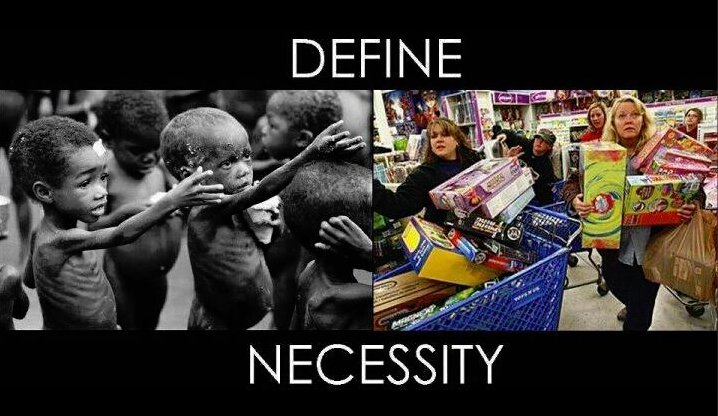
Yesterday in the U.S., we celebrated a day when we are supposed to be reminded of all of our blessings and to give thanks. For most of us, that meant conspicuous consumption of a lot of high calorie foods and if we’re fortunate, spending time in the company of friends and family we truly love, as opposed to those people we only tolerate an association with because we’re related. Today is called “Black Friday” and it is supposed to be the busiest shopping day of the year. It’s called “Black Friday” because it’s the day of the fiscal year for retail outlets that they will sell enough goods and services to put their fiancial books “in the black…” to become profitable. It’s the day untold millions of Americians will spend themselves into mindless debt buying goods that most people don’t really need for people they may not even like. This is all because in a month from now, we’re supposed to celebrate the birthday of the Prince of Peace and Savior of the world.

But as the image above is supposed to remind us, what do we truly need and who is truly in need? For me, today is “Black Friday” because I mourn the loss of sanity, generosity, and compassion, all of which has been replaced by bald greed, consumerism, and the drive to be constantly pursue mind-numbing entertainment in a complete narcissistic orgy of self-obsession.

Good Shabbos and “happy shopping.”

Difficult Ascent

AscentAs impossible as it sounds, as absurd as it may seem: The mandate of darkness is to become light; the mandate of a busy, messy world is to find oneness. We have proof: for the greater the darkness becomes, the greater the confusion of life, the deeper our souls reach inward to discover their own light.

How could it be that darkness leads us to find a deeper light? That confusion leads us to find a deeper truth?

Only because the very act of existence is set to know its own author. That is the cosmic drama, its theme and its plot: That otherness should come to know oneness.

And we are the players in that drama.

-Rabbi Tzvi Freeman
Based on letters and talks of the Rebbe, Rabbi M. M. Schneerson
“The Mandate of Darkness”
Chabad.org

All the world’s a stage,
And all the men and women merely players;
They have their exits and their entrances,
And one man in his time plays many parts,
His acts being seven ages.

-William Shakespeare
“As You Like It”
Act 2, scene 7

I’m still trying to drag my thoughts and feelings out of Tisha b’Av and the time of mourning. I don’t know why I can’t shake this off. After all, life moves on. Tisha b’Av comes every year and it goes every year. Yom Kippur, the Day of Atonement, is going to arrive in less than two months and there will be ample opportunity to fast, pray, reflect on my short comings, make amends to those I have hurt, and attempt to pull myself up out of the mud and up to the heavens.

What am I waiting for?

Why do things sometimes seem like this?

If a man fathers a hundred children and lives many years, however many they be, but his soul is not satisfied with good things and he does not even have a proper burial, then I say, “Better the miscarriage than he, for it comes in futility and goes into obscurity; and its name is covered in obscurity. It never sees the sun and it never knows anything; it is better off than he. Even if the other man lives a thousand years twice and does not enjoy good things – do not all go to one place?” –Ecclesiastes 6:3-6 (NASB)

Rabbi Freeman says that the purpose of living in a deep darkness is to find a deeper light and the verses from Ecclesiastes say that a soul should be satisfied with the good things. If not, life itself is futile. Yet I continue to feel somewhat like this fellow:

How long, O LORD?
Will You hide Yourself forever?
Will Your wrath burn like fire?
Remember what my span of life is;
For what vanity You have created all the sons of men!
What man can live and not see death?
Can he deliver his soul from the power of Sheol? –Psalm 89:46-48 (NASB)

Christians cry out to Jesus to return and Jews bare their souls in anguish to God and ask how long until the Moshiach comes? As people of faith, we know that life is not lived in vain, but how long until the King reigns in full, O’ God, how long? How many people have been born, lived, and died waiting for you?

I quoted the following parable about two weeks ago in another of my blog posts:

A father answers the questions of his child and they are happy together, in joyful dialogue.

Then the child asks a question, and the father must think deeply—not just for the answer, but to reach to the essence of this answer so he may bring it to the world of his child. For a long while, the father is quiet.

And so, the child becomes anxious and begins to cry. “Father, where are you? Why do you no longer talk to me? Why have you deserted me for your own thoughts?”

And then the father begins to speak, but this time it is the deepest core of his mind that flows into the mind and heart of the child. Such a flow that with this the child, too, may become a father.

The child is us. The time of silence is now.

When the spirit of Man is dark, when the flow gates of Above seem all but sealed, prepare for liberation.

Rabbi Tzvi Freeman
From the wisdom of the Lubavitcher Rebbe, of righteous memory
“A Time of Silence”
Chabad.org

As difficult as it can be sometimes, a good portion of the nature of faith is to wait. I believe that while we are waiting, we aren’t supposed to be passive and inactive. We still have a life. The very first prayer an observant Jew says upon awakening is:

“I gratefully thank You, living and existing King
for restoring my soul to me with compassion.
Abundant is your faithfulness.”
Modeh Ani

Even if life doesn’t make any sense, and even if life seems cruel, unjust, and merciless, we are here by the will of God. If we believe He guides our steps, then even our existence isn’t a random event. Our purpose then, is not to surrender to futility, but to discover the reason we were created and then to live that reason out every day that we draw breath.

However, some days are better than others. We ask for mercy, God, when we seem only shallow characters reciting our lines in a badly written play. We know our lives must mean more than that. Struggling to ascend from the dark abyss, when will we find the deeper light?

The road

The road is long and often, we travel in the dark.