Tag Archives: Noahide

The Gift of the Postdiluvian King

This week’s reading tells the story of Noah, the father of all humanity. We learn that G-d spoke to him and his children, directing them to follow seven laws for just and moral lives. Most religions say that they offer an exclusive path, but our Talmud teaches that “the righteous of all nations have a share in the World to Come.” Maimonides says that this applies to anyone who accepts upon him or herself to observe the Seven Commandments given to Noah.

-Rabbi Yaakov Menken
Director, Project Genesis – Torah.org

“But flesh, when its soul is with its blood, you shall not eat it… He who spills the blood of man, by man shall his blood be spilled, for in the Image of G-d did He create man.”Genesis 8:4,6

Where was God when the descendants of Noah needed salvation? Christians believe we are saved through the blood of Jesus Christ and Jews believe they merit a place in the world to come by obeying the 613 mitzvot (OK, it’s more complicated than that, but that’s “salvation” in a nutshell). But what about the time before the birth of Christ and before Moses at Sinai? We know that people were aware of God. Certainly Noah was a “righteous man; he was blameless in his age” and he “walked with God” (Genesis 6:9) and certainly God spoke to Abraham when He said, “Go forth from your native land and from your father’s house to the land that I will show you” (Genesis 12:1), but what allowed a person to have a relationship with God, particularly in Postdiluvial times?

We see hints that the people in those days were aware of “Torah” requirements. Even Noah was commanded of “every clean animal you shall take seven pairs, males and their mates, and of every animal that is not clean, two, a male and its mate”, telling us that well before Sinai, clean and unclean animals were an understood concept. We don’t see God going through an extensive set of explanations telling Noah the difference between these two general types of creatures, so he must have already known about this. We even know that when Abel offered his sacrifice to God (Genesis 4:3-4), it was a clean animal appropriate for sacrifice.

The commentaries in the Stone Edition of the Chumash make significant reference to the kosher vs. non-kosher animals such as in this example:

Genesis 6:19 “Two of each.” As the following verse explains, these animals were to be one male and one female, so that the species could be replenished after the Flood. In the case of the kosher species that could be used for offerings, Noah was later commanded to bring seven pairs (7:2), so that he could bring offerings of gratitude and commitment after returning to dry land.

The Chumash commentary for Genesis 8:20-21 even refers the reader to Leviticus for details on the sacrificial offerings, their names, and terminology, again suggesting that Noah would have had to possess some of this information in order to give a proper sacrifice to God after the Flood. Yet man, at that time, was not to divide animals into kosher and non-kosher for eating, as illustrated in Genesis 9:3:

Every creature that lives shall be yours to eat; as with the green grasses, I give you all these.

We see that certain parts of the “Torah knowledge” available to both the antediluvian and postdiluvian peoples was later applied specifically to the Children of Israel as part of the Torah, but what about the rest of humanity? Ten generations followed Noah before the birth of Abram (Abraham). The Bible glosses over the details of the lives of these people, but we presume at least some of them continued their worship of and devotion to Hashem. Also, during the lives of Abraham, Isaac, and Jacob, there were members of their households who were not Hebrews yet who learned of the God of Noah and turned their hearts to Him. What about the Egyptian members of Joseph’s house when he was a viceroy of Pharaoh, King of Egypt (see Torah Portions Miketz and Vayiggash)? Perhaps Joseph taught some of them about the God of his father Jacob. Most assuredly, he taught his Egyptian wife and sons.

Unlike most other religions, Judaism does not declare that they are the only path to righteousness, well not exactly anyway. Rabbi Yaakov Menken has this to say.

Unlike the other religions of the world, Judaism does not believe that everyone must become a Jew in order to approach G-d or earn a place in the World to Come. When King Solomon built the Holy Temple in Jerusalem, he asked of G-d that He hear the prayers of all who pray towards that Temple: “Also a gentile who is not of your people Israel, but will come from a distant land for Your Name’s sake… and will come and pray toward this Temple, may You hear in Heaven Your dwelling-place, and do according to all that gentile calls out to You…” [I Kings 8:41-43]
MosesIt is the subject of much debate as to whether or not there were “Noahides” or Ger Toshav among the Hebrew people between the days of Noah and Moses, but it is more than possible that they existed. Abraham sent his most trusted (non-Hebrew) servant to find a wife for his son Isaac (Genesis 24:1-9) and Rabbinic commentary identifies this man as a Noahide. If this servant had not been righteous before God, how could he have risen to such a high position in Abraham’s household and why would Abraham have trusted him to find a suitable wife for Isaac? We even see the Bible’s first recorded personal prayer uttered by this man.

He made the camels kneel down by the well outside the city, at evening time, the time when women come out to draw water. And he said, “O Lord, God of my master Abraham, grant me good fortune this day, and deal graciously with my master Abraham: Here I stand by the spring as the daughters of the townsmen come out to draw water; let the maiden to whom I say, ‘Please, lower your jar that I may drink,’ and who replies, ‘Drink, and I will also water your camels’-let her be the one whom You have decreed for Your servant Isaac. Thereby shall I know that You have dealt graciously with my master.” –Genesis 24:11-14

From a Christian point of view, there are apparent “gaps” in God’s plan of salvation for mankind. Discussions of hypothetical situations occasionally occur in Bible studies, such as what would have happened to a person before the birth of Christ who otherwise was “good” but had no way to confess Jesus as Lord and Savior? Perhaps God answered that question when He spoke to Moses in Genesis 9:1-17, which is the basis for today’s Noahide Laws.

I recently investigated the concept of the Ger Toshav as a possible “interface” between Christians and Jews but only hit a brick wall. Observant Jews do not consider Christians to be “righteous Gentiles” if, for no other reason, than they believe we worship a man as a God and indeed, worship three Gods rather than the One. However, the Ger Toshav may have enjoyed a life of righteousness that included a relationship with the God of Adam and Noah, perhaps into the time of Jesus, Peter, and Paul.

The centurion replied, “Lord, I do not deserve to have you come under my roof. But just say the word, and my servant will be healed. For I myself am a man under authority, with soldiers under me. I tell this one, ‘Go,’ and he goes; and that one, ‘Come,’ and he comes. I say to my servant, ‘Do this,’ and he does it.”

When Jesus heard this, he was amazed and said to those following him, “Truly I tell you, I have not found anyone in Israel with such great faith. I say to you that many will come from the east and the west, and will take their places at the feast with Abraham, Isaac and Jacob in the kingdom of heaven. –Matthew 8:8-11

At Caesarea there was a man named Cornelius, a centurion in what was known as the Italian Regiment. He and all his family were devout and God-fearing; he gave generously to those in need and prayed to God regularly. –Acts 10:1-2

As soon as it was night, the believers sent Paul and Silas away to Berea. On arriving there, they went to the Jewish synagogue. Now the Berean Jews were of more noble character than those in Thessalonica, for they received the message with great eagerness and examined the Scriptures every day to see if what Paul said was true. As a result, many of them believed, as did also a number of prominent Greek women and many Greek men. –Acts 17:10-12

The covenant of Christ allows we who are not Jewish to enter into a deep and abiding relationship with the God of all Creation that, in its holiness, is on par with the people of the Mosaic covenant (Galatians 3:26-29) so we non-Jews can go beyond the boundaries of the Noahide. Yet, the Acts 15 letter issued by the Jerusalem council, in some ways, mirrors the laws of Noah. Becoming disciples of the Master does not remove the obligation of a Christian to shun worship of idols, murder, theft, blasphemy, and sexual immorality. The Noahide prohibition to not eat the limb of a living animal may seem strange, but we also would find such as act abhorrent. Creating a court system is an act of establishing justice and as Christians, being just and merciful should not seem odd.

Shofar as sunriseIf the Messianic covenant has not removed or replaced the Noahide covenant but instead, has enhanced it and greatly expanded our access to God, how can we say that the covenant of the Messiah has replaced the Mosaic covenant for the Jews? The Noahide covenant paints a rainbow-colored portrait of God’s love of and provision for all of humanity from the days of the Flood up until the current age. He never abandoned the vast throng of mankind from Noah to Jesus but gave them a gift of Himself, even into the times of Abraham, Moses, and David. For the past 2,000 years, we have had Jesus to turn to for an even greater relationship with God.

But as I just said, if we can learn one lesson for the Gentiles in the story of Noah, including that there is no conflict between Noahide and Messianic covenants, then perhaps we can also learn that no conflict exists between the Mosaic laws and the teachings of the Messiah. Moses and Jesus are not enemies and in fact, for a Jew, what they illuminate goes hand in hand, just as the teachings of Noah and Jesus do for the Gentile.

Noach: What We Allow in Heaven

Noah's ArkThe Maggid of Mezritch interpreted our Sages’ statement: “Know what is above you,” as: “Know that everything ‘above’ all that transpires in the spiritual realms is ‘from you,’ dependent on your conduct. Each of us has the potential to influence even the most elevated spiritual realms.”

The Torah alludes to this potential in the opening verse of our reading: “These are the chronicles of Noach. Noach was a righteous man.” The word noach refers to satisfaction and repose. By repeating the word, the Torah implies that Noach and by extension, every one of his descendants can sow these qualities in two different fields, both among his fellow men, and in the spiritual worlds above.

Every person affects his environment. Our thoughts, words and deeds can inspire peace and tranquility in our fellow men, helping create meaningful pleasure. And by establishing such conditions in our world, we accentuate similar qualities in the worlds above. To highlight our obligation to spread these virtues, this week’s Torah portion is called Noach.

-Rabbi Yanki Tauber
“Genuine Satisfaction: Noach’s Legacy”
Adapted from
Likkutei Sichos, Vol. XX, p. 285ff;
Vol. XXV, p. 23ff
Chabad.org

This is the line of Noah. — Noah was a righteous man; he was blameless in his age; Noah walked with God.Genesis 6:9 (JPS Tanakh)

It’s difficult and sometimes even a little dangerous to go beyond the plain meaning of what we read in the Bible and enter hidden or even mystic interpretations. First off, even though Christianity also has its mystic tradition, looking at the Bible through a Chassidic lens can tend to be disorienting, and most people will immediately reject the view rather than attempt to explore the value that might be gained from a radical change in perspective. And yet, this is what “jumped out at me” when studying the Torah Portion Noah (some Jewish sources spell the name “Noach”) this week.

Yesterday, I posted two “meditations” on this blog about how we can have an influence on others. Both messages were, for the most part, grounded in traditional methods of doing good and improving the world, but a Chasid believes that anything that is done on earth is reflected in Heaven. To punctuate this, I previously quoted Rabbi Tzvi Freeman as saying:

For all that is, physical or spiritual or Divine, was only created to be part of the repair of this world of action. And once that repair is done, all that will be true are those things that made it happen.

Even the Master said:

“I tell you the truth, whatever you bind on earth will be bound in heaven, and whatever you loose on earth will be loosed in heaven. –Matthew 18:18

But what does this mean and what does it have to do, not only with Noah, but with us?

One rather awesome conclusion, as stated above, is that what we do here doesn’t just matter here or to the people around us, but it actually has effects beyond the physical realm.

It has been noted by our Sages that “Torah preceded the world,” i.e., although Torah as studied in this physical world is to be understood in its plain context, it preceded the world. For every letter of Torah also possesses inner and esoteric meaning. Such meaning emanates from the study of Torah in the higher spiritual realms – worlds that transcend physicality.

Understandably, this applies not only to the Torah’s commandments, but to its stories; although all the stories recounted actually transpired in all their detail, still, since Torah preceded the world, we must perforce say that these tales also contain meanings found in the higher, spiritual worlds.

This gives rise to the following inescapable conclusion: Since “No evil sojourns with You,” we must say that even though the Torah contains things that in their simple context seem undesirable – such as misdeeds, punishments, and the like – in the world above, where it is impossible for evil to reside, these selfsame events are understood as being entirely desirable, holy and good.

The Chassidic Dimension: Noach
Based on the teachings of the Lubavitcher Rebbe
Rabbi Menachem M. Schneerson and
Likkutei Sichos , Noach 5747
Chabad.org

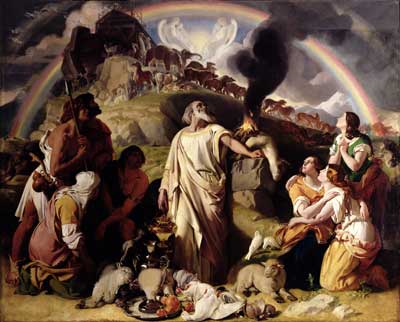
noah-rainbowThat probably doesn’t clear things up much, but consider this. For any event that you read about in the Torah, there is a corresponding event or meaning that has occurred in Heaven. There’s a mysterious, mystic, connection between the ordinary document that we study and what God used to create the universe. Extending the metaphor, we might be able to say that whenever we obey one of the Torah mitzvah, there is an impact, not only on earth, but in Heaven. Jesus said as much in Matthew 18.

Going back to this week’s Torah portion, we can apply this metaphor to say that the names, words, and events depicted in this reading is not just a report of what happened to Noah and his family and to the earth during and after the flood, but that there are much larger ramifications. Those ramifications are particularly meaningful to those people who aren’t Jewish. Remember, Rabbi Tauber said that all of Noah’s descendents can affect both the world of men and the spiritual realms. We are all Noah’s descendents.

God blessed Noah and his sons, and said to them, “Be fertile and increase, and fill the earth. The fear and the dread of you shall be upon all the beasts of the earth and upon all the birds of the sky — everything with which the earth is astir — and upon all the fish of the sea; they are given into your hand. Every creature that lives shall be yours to eat; as with the green grasses, I give you all these. You must not, however, eat flesh with its life-blood in it. But for your own life-blood I will require a reckoning: I will require it of every beast; of man, too, will I require a reckoning for human life, of every man for that of his fellow man!

Whoever sheds the blood of man,
By man shall his blood be shed;
For in His image
Did God make man.

Be fertile, then, and increase; abound on the earth and increase on it.”

And God said to Noah and to his sons with him, “I now establish My covenant with you and your offspring to come, and with every living thing that is with you — birds, cattle, and every wild beast as well — all that have come out of the ark, every living thing on earth. I will maintain My covenant with you: never again shall all flesh be cut off by the waters of a flood, and never again shall there be a flood to destroy the earth.” –Genesis 9:1-11

The covenant God made with Noah and his sons is the basis for what Judaism calls The Seven Noahide Laws. While Judaism doesn’t consider the full 613 Commandments of the Torah to be binding on a non-Jew, the Noahide Laws are applicable to everyone. In Judaism, any non-Jew who lives a life as a Noahide merits a place in the world to come (in “Christianese” that would mean he’s “saved”).

This doesn’t make much sense to a Christian because we believe that there is only one way to the Father and that’s through the Son (John 14:6). In traditional Christianity, it doesn’t matter if you’re Jewish or not Jewish, you must come to faith in the Messiah to be fully reconciled with God. How the Messianic covenant addresses the Mosaic I’ll address another time, but did the Messianic covenant wipe out the Noahide covenant completely?

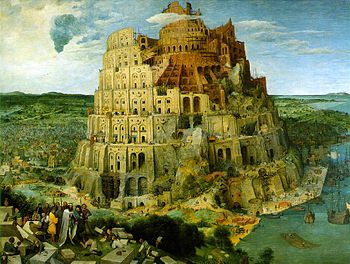
In the days of Noah and for ten generations afterward, there was only one people, one language, and one standard by which a man could have a covenant with God. It was the standard God gave to Noah. At the tenth generation, this people united to build an affront to God at Babel and we are told that God “confused their languages” and made the seventy nations (Genesis 11:1-9). At the end of this reading, we see Abram enter the narrative for the first time, but even after Abraham, Isaac, and Jacob, what was the standard of righteous living for all of mankind until the coming of Jesus?

We can look at the story of Noah and see the story of mankind’s influence, not only upon the world around us but, according to mystic interpretation, the world above. When man defied God and built a tower, God could have ignored them. After all, it wasn’t as if building a structure, no matter how high, really could have reached Heaven, could it? But if not, then why did God react and do what He did?

the-towerNo, I don’t believe you can make a tower to reach up to Heaven, but I do believe that somehow, what we do on earth, for good or for bad, does affect Heaven and it does affect God. Certainly we can’t do anything to adversely affect God but we also have a unique relationship with our Creator that no other creature has, not even the angelic beings. We are special. We matter personally to God. Our actions are not our own and they are not limited to the “nuts and bolts” of life in our own little world.

If even the name “Noach” has meaning, if the stories in the Torah somehow reach beyond the words on a page and resonate in Heaven itself, if what we loose on earth is loosed in God’s realm, then the story of Noah teaches us that we dare not be careless with what we say and do. Noah’s planting a vineyard, making wine, and becoming intoxicated resulted in a permanent curse on Ham, but we don’t know why. The descendents of Noah built a great tower to symbolize their invincibility over God, defying God as man did in Eden, and defying God as the generation before the flood, and God reacted by confusing their language and splitting the one people into the seventy nations of the earth, and we don’t really know why. We say and do things in our lives, sometimes in the service of God and sometimes in the service of ourselves, and yet they have an impact in the Heavenly courts, and we don’t know how or why.

But if what we do matters that much, or even if it just might be possible that it matters that much, do we dare say a careless word or perform a careless act? Are not only our lives, but each thing we say or do that important to God? What are we loosing on earth…and in heaven?

Good Shabbos.

Journey of the Ger Toshav: Failed Connection

Broken connectionThe Gemara rejects this suggestion, because it is Rav himself who said that establishing an omen is only prohibited when it is done as we find with Eliezer, the servant of Avraham. When Eliezer went to find a wife for Yitzchak, he announced that the woman who would offer him and his camels water would be the one who would be the wife for Yitzchak.

Tosafos answers that according to one opinion, Eliezer was a Noachide, who was not commanded to avoid this type of conduct. And, according to the view that he was commanded to abide by it, we must say that he actually asked Rivka about her
family before making any decisions.

Daf Yomi Digest
Distinctive Insight
“Relying on omens and signs which portend the future”
Chillun 95

The non-Jewish cook is called a “kefeilah.” Rashi explains that he is a baker, while the Aruch translates this word to refer to a cook. Toras Chaim explains that according to Rashi, the reason we trust the non-Jew is that we present the question to him innocently, in a general conversation, without his realizing that we are going to be relying on his word for halachic purposes. In this case, we do not think that the non-Jew will intentionally lie, as he is not aware that we are listening to his statement for any practical purpose.

Daf Yomi Digest
Distinctive Insight
“Asking a non-Jew to taste the questionable food”
Chullin 97

(Continuing from yesterday’s Part 2 of the series: The Ger Toshav at Worship)

I read these two Dafs last week while pondering the Ger Toshav question and the relationship between Jews and Gentiles and was struck by the contrasting examples of trusted and non-trusted Gentiles from the Jewish perspective. On the one hand, we have the example of Eliezer’s relationship with Abraham. While we cannot say that Abraham was a “Jew” in the modern sense nor an “Israelite” since Jacob was not yet born and had not fathered the 12 patriarchs, he is considered the Father of Judaism and the first ethical monotheist in the line of the Jewish people.

Eliezer, though not a member of Abraham’s family, was a servant who was so trusted, that Abraham sent him back to Haran, the land of Abraham’s ancestors, to find and bring a wife back for Abraham’s son Isaac (see Genesis 24).

On the other hand, as we see in the Daf for Chullin 97, a Jew may trust a Gentile to advise him on an important manner, in this case the taste of a food item that may or may not be forbidden to the Jew, only as long as the non-Jew does not know that he is helping to decide an issue of halachah. The implication is that if the non-Jew knew how important his opinion was to the Jew, he might deliberately lie to him in order to induce him (and other Jews) to eat something forbidden.

Given the long history of enmity between Jews and Gentiles, I guess I can’t blame the Rabbis for this ruling, but it still stings a little. I would like to think there is a way to bridge the gap between Christians and Jews (Messianic and otherwise), but I can see that a rather long and bloody history is standing in my way. Could this also be the problem between Jews and Gentiles in the Messianic Jewish (MJ) community or more specifically, between the One Law (OL) faction of MJ, which is largely Gentile/Christian directed, and the Bilateral Ecclesiology (BE) faction, which is largely directed by a Jewish leadership? Is it a matter of trust, at least in part?

That could very well be. I’ve previously said that OL’s efforts to establish Gentile equality with Jews relative to being obligated to the 613 commandments is interpreted by BE as an incursion into Jewish identity and an attempt (even unintentionally) to obliterate the identity distinctions between Gentile and Jew, effectively rendering Judaism non-existent.

That could be a trust issue (I say that as an understatement).

Frankly, my investigation isn’t taking an encouraging direction. I recently discovered that it is not possible to be a Noahide and a Christian from a traditionally Jewish point of view. I’ve exchanged private communications with a Jewish gentleman (and since they are private, I won’t publish any identifying details) who is well versed about Noahides and he assures me that for many reasons, including the “polytheistic” nature of Christianity and the Jewish belief that Jesus (or at least Paul) was a “false prophet”, anyone self-identifying as a Christian could not be considered as a “righteous Gentile”.

It seems my investigation is stalled. How can I take and adapt any elements or cues regarding the relationship between Gentiles and Jews in the Messianic world from the Noahide/Jew relationship in traditional Judaism when any status of “righteousness” as a Christian is cancelled by my Christianity? That means, from a traditional Jewish point of view, I am viewed as a pagan, polytheistic, idol worshiper. I was rather hoping for more.

SeparatedIf the BE contingent in MJ is drawing its identity largely from mainstream Judaism, then how much of that sentiment is carried over into Jewish/Gentile relationships? It can’t quite be the same because both Jews and Gentiles in MJ confess Jesus (Yeshua, within this context) as the Jewish Messiah and that salvation comes through the “living Word.” The question of monotheism is still a thorny one, but I won’t address it as part of this series. Since “righteousness” of all members of the Messianic world must come from the Messiah, then its Gentile members cannot be faulted for having the same faith in Jesus as the Jewish members.

Extending that into the world in which I live, those Jewish members of MJ/BE must also, at least at a very basic level, accept my faith since we both recognize Jesus as the Jewish Messiah and we both are brought before the throne of God through the sacrifice of Christ.

But saying that, I’m no closer to an answer to this puzzling set of queries now than I was when I first conceived this series. I’m also at a loss as to how to proceed and must admit that the series, barring any further developments, is closed.

With the days of teshuvah almost elapsed and the approach of Yom Kippur coming rapidly upon us, I can only throw myself before the mercy of God and let Him deal with His creations. How disappointed in us He must be.

I wonder when I’ll learn that the barriers are firmly in place, humanity in its different groups, including Jew and Gentile, are established as we are, and divided we will be until God unites us all again at the end of all things.

It’s not all bad. At least I learned that BS”D is the Aramaic phrase “B’Sayata Di’shamaya,” which means “With the help of Heaven.”

The Ger Toshav at Worship

Yom Kippur prayersHere’s a brief but significant addendum to my first blog post on the Journey of the Ger Toshav. I’ve been surfing the Ask Noah forums which are specifically for Noahides to ask questions regarding their status relative to Judaism. I found the following in the thread Rosh HaShanah and Yom Kippur as posted by one of the Rabbis moderating the forums:

As a Noahide, here are some guidelines for the Jewish Biblical festivals:

  1. In general, do not specifically intend to be observing any of the Jewish restrictions on activities during the festivals. You can continue your normal types of activities that would be forbidden for Jews (using electricity, driving, writing, etc.)
  2. Do not say a benediction of sanctifying the festival day (i.e. saying “kiddush” at a meal).
  3. Do not actively perform any of the special Jewish festival commandments with the intention that you are observing a Divine commandment (e.g. blowing a ram’s horn on Rosh HaShanah, fasting on Yom Kippur).
  4. In the synagogue, do not get called up to the Torah scroll during the public reading.
  5. A Gentile can’t be counted in the minimum of 10 Jewish men who are needed for a communal prayer-service quorum (a minyan).
  6. You can follow along in the Orthodox Jewish prayer book during the services, but don’t recite those parts that apply exclusively to Jews. Gentiles may bow down to the floor in prayer while the congregation does so during the Rosh HaShanah and Yom Kippur services.
  7. Don’t forget to turn off your cell phone or pager during the synagogue prayer services.
  8. If attending a synagogue service, a Gentile women should dress modestly. And for respect of the congregation, a man should wear a hat or a yarmulke (Jewish skull cap).

It makes perfect sense for a Noahide and a Christian attending a synagogue service to comply with all of these restrictions, but in the Messianic Jewish (MJ) world, it becomes a little confusing. As I mentioned in the previous blog post of this series, how One Law (OL) proponents in MJ and those that support Bilateral Ecclesiology (BE) see this issue is the difference between day and night. BE, of course, would be in complete agreement with the Ask Noah forums perspective, which is the traditional Jewish point of view, and OL would state that Gentile “Messianics” should have every right to participate in the same activities as the Jewish attendees in the synagogue.

Frankly, I can’t see myself as a Christian married to a Jewish wife trying to put on a tallit and expecting an Aliyah, nor would I attempt to join a minyan during the High Holidays or at any other time. In a traditional synagogue, a Gentile performing these behaviors would be considered deeply offensive.

The reason I’m bringing this up is that this series of blogs is an attempt to see if Christians can define their roles in relation to Jews (including Jews in the Messianic community) through how Jews view the status of Noahides. I know that a Noahide would be considered equivalent to the God-fearers in the day of Peter and Paul (see the example of Cornelius in Acts 10) and this group of Gentiles did not have a covenant status with God that allowed them equal access to the Most High. Confessing Jesus as Lord and Messiah and accepting the Messianic covenant does give Gentiles this access, but I still don’t see how it makes a Christian different from a Noahide (can you be a Noahide and a Christian from a traditional Jewish viewpoint?) as far as the eight points I quoted above are concerned.

Obviously, I’m aiming this blog post at the MJ community and all of its factions for a response. So far, my wee investigation does seem to indicate that Christians can learn from the Ger Toshav, at least a little.

Next and possibly last in this series: Failed Connection.

Journey of the Ger Toshav: First Step

JourneyTosafos discusses how to understand how Eliezer, the trusted and faithful servant of Avraham Avinu, conducted himself in a questionable manner by letting an omen determine such a critical matter. The Gemara seems to say that he was in violation of the Torah’s law not to rely upon omens (Vayikra 19:26). Tosafos answers that according to one opinion, Eliezer was a Noachide, who was not commanded to avoid this type of conduct. And, according to the view that he was commanded to abide by it, we must say that he actually asked Rivka about her family before making any decisions.

Daf Yomi Digest
Distinctive Insight
“Relying on omens and signs which portend the future”
Chullin 95

And the 126th prohibition is that we are forbidden from feed­ing meat from the Pesach offering to [any non-Jew, even] a ger toshav.

Translated by Rabbi Berel Bell
Sefer Hamitzvot
“A Gentile Eating of the Paschal Offering”
Negative Commandment 126
Chabad.org

I’ve been trying to understand the relationship between Jews and Gentiles and how we are connected to God (and perhaps even to each other). This has been a recurring theme in my blogs for well over a year and I suspect I’ll never come to a final conclusion, but something in me refuses to let it go.

Between Christianity and Judaism, we like to think we have our roles all figured out. The Jews have Moses and the Christians have Jesus. Everybody else, well…they’re everybody else. The Jews believe that any non-Jew who adheres to the Seven Laws of Noah (see Genesis 9 for the source) is a “righteous Gentile” or Ger Toshav and merits a place in the world to come. This may well be true of the Gentile, regardless of what other traditions or religious practices the Ger Toshav follows. Christianity believes that a person must become a Christian in order to be saved and that there are no other alternatives (John 14:6).

While the Jewish perspective does not discount a Christian being a righteous Gentile (although worship of Jesus as God may rule that out, since it amounts to idol worship and polytheism), a Christian will absolutely not believe that anyone can come to God the Father except by accepting the Lordship of Jesus Christ. Period.

What surprises me is that, if the Old Testament record clearly points to Jesus as the Messiah, why does Judaism just “miss it?” Israel was the keeper of the Holy Scriptures and the only nation on Earth to worship the One and Unique God thousands of years before the concept of Christianity came into being. While Moses and the Children of Israel were standing before God at Sinai and accepting Him as their God, the ancestors of every Christian on Earth were worshiping pagan idols of wood and stone, and some were passing their own children through the flames of their false gods in (supposed) exchange for a good harvest.

There’s another wrinkle.

While traditional Christianity and Judaism have a more or less clear idea of who they are and what their roles are in relation to God and the Bible, there is a third group, rather small by comparison, but growing, which is called Messianic Judaism (MJ). Even within this group, there are a number of factions which have different and sometimes contradictory beliefs. I won’t go into a lot of detail, but the two primary groups are (for lack of better terms) One Law (OL) and Bilateral Ecclesiology (BE).

(Please keep in mind that these aren’t particularly formal groups, but in order to understand the concepts and positions, I need to assign some sort of labels to said-positions).

One Law is a movement within MJ that is made up primarily of non-Jewish Christians and Jews who come from a Christian background. This group states that Jesus never did away with the Law and that, when Gentiles are grafted into the root of Israel (Romans 11), they too become obligated to the exact same 613 commandments (as opposed to the 7 Noahide Laws) as the Jewish people. A major caveat in OL, is that this “Jewish” lifestyle is minus any directives from the Talmud, which they see as without authority and merely the opinions of men.

Bilateral Ecclesiology, a term coined in Mark Kinzer’s book Postmissionary Messianic Judaism: Redefining Christian Engagement with the Jewish People, posits that there are clear boundaries between the obligations and responsibilities of Christian Gentiles and Jews, even those Jews who have come to faith in Jesus (“Yeshua” is used as the preferred Hebrew name of Christ by both groups). BE supporters consider that a non-Jew insisting upon being “obligated” to all of the Torah commandments is blurring if not disintegrating the line between Jews and Gentiles and making meaningless what it is to be a Jew. From their perspective. OL effectively makes Messianic Jews and Christians one indistinct “blob”, where you can’t tell where a Jew leaves off and where a Christian begins.

The debate between the two groups can get rather heated on occasion, as you can see in the comments at Judah Himango’s blog, for example (please note that I’m just using this as an example. I like Judah and this is not a criticism of him or his blog). Here’s a sample of one of the comment’s in question (I like the commenter, too and am quoting him just to illustrate the point, not to be critical):

Where Scriptures makes distinction between men and women, priests, etc. There is no mentions whatsoever for Jew and Gentile distinctions as far as keeping Torah is concerned. Even your beloved “scholars at FFOZ only come up with one, only one verse where they have to twist it in order to sustain their agenda, and you drink the kool-aid….

One Law bases its assumption upon the following:

The same law applies to the native-born and to the alien living among you. –Exodus 12:49

You are to have the same law for the alien and the native-born. I am the LORD your God. –Leviticus 24:22

One and the same law applies to everyone who sins unintentionally, whether he is a native-born Israelite or an alien. –Numbers 15:29

Mount SinaiMy opinion is that these scriptures are completely irrelevant to the One Law position since the “aliens” being referred to in these verses are non-Jews who attached themselves to the God of Israel, joined with the Israelites as a people, and eventually were absorbed into that population. They started out as Ger Toshav and their ancestors did not retain their non-Jewish identity but essentially “converted” to Judaism. It would be impossible to apply this set of examples to a group of non-Jewish “Messianic” believers today who want to be as equally obligated to the Torah as the Jewish people but all the while, retaining their Gentile identity and only living a partial Jewish lifestyle (one that disregards Talmudic interpretation of the written Torah).

Groups that hold to a “Bilateral Ecclesiology” framework (I don’t think Kinzer ever intended to make a theology out of BE), while maintaining a rather large Gentile Christian following, are led by a core group of Jewish Rabbis (Rabbi as defined within their own context) who support Messianic Judaism for Jews, including a completely Jewish religious lifestyle (Talmud included). They see the Acts 15 letter as the defining pronouncement by James and the Jerusalem Council, those Jews who held the mantle of authority over the “Messianic” movement after the ascension of Christ. The letter clearly defines limits upon the obligation of the Gentile believers in relation to the Torah of Moses. The letter doesn’t completely illustrate those limits, since Jesus taught outside their scope, but nothing in the teachings of Christ specifically commands that Gentiles become wholly absorbed into the Jewish nation.

Further, Paul, in the book of Galatians, goes to great efforts to discourage the Gentile Christians from converting to Judaism, for in converting, the Gentile Christian would then become fully obligated to obey all of the Torah (Galatians 5:3). That would be a crazy statement to make if the Gentile Christians were already fully obligated, as OL suggests. (D. Thomas Lancaster recently wrote The Holy Epistle to the Galatians, in which he illustrates how to understand Paul’s letter as teaching this distinction.)

To recap, traditional Judaism and Christianity both see their roles as very clear within their own groups and in relation to each other. Jews believe the Torah is only for the Jews and Gentiles, including Christians, are not obligated to it and are, in many cases, forbidden to adhere to its instructions. Non-Jews may only come before God when accepting the obligation of the Seven Noahide Laws and becoming Ger Toshav, and there is no need to convert to Judaism. Christians believe that the Law was wholly replaced by the Grace of Christ (for Jews and Gentiles) and that anyone, even a Jew, must convert to Christianity to have right standing before God. The Christian covenant completely replaces the Abrahamic and Mosaic covenants in their eyes.

In other words, Jews aren’t trying to co-opt Christians and Christians aren’t trying to co-opt Jews. They are separate communities with few if any bridges across the gap.

Messianic Judaism muddies the waters of that gap considerably and is still trying to define who they are and who Jews and Gentile Christians are in relation to each other, to the Torah, and to God.

But what about the Ger Toshav? I previously addressed the differences between the Noahide and the Christian in a pair of blog posts: The Sons of Noah and Children of God. Nevertheless, I believe that the clues to how Messianic Jews and Gentile Christians are supposed to relate to each other, to the Torah, and to God may be found in the more traditional understanding by Judaism of the Ger Toshav (and I’m deliberately sacrificing sure footing for the sake to my journey in pursuing the Ger Toshav).

What started this line of thinking for me was Rabbi Bell’s translated statement, “…is that we are forbidden from feeding meat from the Pesach offering to [any non-Jew, even] a ger toshav“. It never occurred to me that a Noahide would have had a special status in relation to Passover and the other festivals in the ancient community of Israel, but that was a logical outcome of the “one law for the native and the alien” statements during the forty years of wandering.

Going to GodIn Messianic Judaism, One Law accuses Bilateral Ecclesiology of denying Gentile Messianics (Christians) access to the same benefits of Torah living as the Jews and, by inference, treating Christians as if they/we were any other Gentile group. BE states that Gentile faith in the Jewish Messiah does make a difference, but that difference is largely in the areas of moral and spiritual behavior and does not include Jewish identity markers (wearing tzitzit, laying tefillin, keeping Kosher, observing the Shabbat). Traditional Judaism, while not recognizing a special status among Christian Gentiles relative to other non-Jews, does believe there is a difference in expectation between the general population of the world and those Gentiles who accept the mantle of Ger Toshav.

(Just to be clear, traditional Judaism sees all factions of Messianic Judaism as Christians; “Jews for Jesus”. Traditional Christianity sees Messianic Judaism as a group of Judaizers who are “under the law”. Like I said, the waters are muddy)

Eliezer was considered a Noahide, a righteous Gentile, a Ger Toshav and the most trusted of the household of Abraham. He was empowered to select a bride for Isaac, the son of the promise, who would father Jacob and continue a line that would lead to the patriarchs, the twelve tribes of Israel, and ultimately, the Messiah himself. Yet Maimonides considered even a Ger Toshav as forbidden from eating of the Passover sacrifice. Who is the Ger Toshav and can we take any understanding away from who he is and who we are in Christ, especially as we attempt to relate to our Messianic Jewish brothers?

What does it all mean and can any conclusions be drawn from this rather confused mess? That’s what I’m going to try to find out in my next blog.

For now, I remain a Christian at the gates of the Temple of God.

Part two of this series is The Ger Toshav at Worship.

Children of God

Children of GodYou foolish Galatians! Who has bewitched you? Before your very eyes Jesus Christ was clearly portrayed as crucified. I would like to learn just one thing from you: Did you receive the Spirit by the works of the law, or by believing what you heard? Are you so foolish? After beginning by means of the Spirit, are you now trying to finish by means of the flesh? Have you experienced so much in vain – if it really was in vain? So again I ask, does God give you his Spirit and work miracles among you by the works of the law, or by your believing what you heard? So also Abraham “believed God, and it was credited to him as righteousness.”Galatians 3:1-6

Lancaster identifies the influencers in Galatia (called by most Christian commentators “judaizers”, though “judaize” is derived from an intransitive Greek verb – that is, you can judaize [yourself], but you can’t judaize someone else, cf. Nanos, The Irony of Galatians [Minneapolis, Fortress, 2002], 116) as Gentile proselytes to Judaism who are anxious to secure their status in the Jewish community by influencing believing Gentiles to also become proselytes. His thesis makes more sense than Nanos’s (in which unbelieving Jews are the influencers) due to Nanos’s difficulty with Galatians 6:12.

Lancaster writes that the “different gospel that is not really a gospel” being peddled by these influencers is the message that Jewish identity and full Torah observance were necessary conditions for entrance into the believing community and access to the World to Come. This message was attractive for the Galatian Gentile believers because as liminals, they existed between two worlds.

from the review of
D. Thomas Lancaster’s book
The Holy Epistle to the Galatians
from the Hope Abbey blog.

This is the second part of a blog I wrote on Gentiles, Christians, and Noahides. Please read yesterday’s “morning meditation” called The Sons of Noah before continuing here. Things will probably make more sense if you do.

I wrote my own review of Lancaster’s Galatians book about a month ago, but once picked up, it’s hardly a book or a subject that can be casually laid down again. As much as any of his other letters, Paul’s words to the Galatian non-Jewish disciples of Jesus have a great deal to say to those of us who are Christians today.

In yesterday’s “morning meditation”, I introduced the concept of Gentiles and the Noahide Laws. In Judaism, it is understood that all Jews will be “saved” (to put it in the Christian vernacular), however, non-Jews are not expected to convert to Judaism in order to also attain a “saved” status. Jews are obligated to a very high standard of conduct toward God and other people, but the “nations” (i.e. everybody else)  are not expected to comply with these obligations (and in many cases, Gentiles are forbidden to obey the mitzvot as a matter of halachah). According to Judaism, the obligations of the Gentiles are outlined in Genesis 9 as the Divine code God gave to Noah which today are called Noahide Laws.

But who is a Noahide?

At Caesarea there was a man named Cornelius, a centurion in what was known as the Italian Regiment. He and all his family were devout and God-fearing; he gave generously to those in need and prayed to God regularly. –Acts 10:1-2

When Paul and his companions had passed through Amphipolis and Apollonia, they came to Thessalonica, where there was a Jewish synagogue. As was his custom, Paul went into the synagogue, and on three Sabbath days he reasoned with them from the Scriptures, explaining and proving that the Messiah had to suffer and rise from the dead. “This Jesus I am proclaiming to you is the Messiah,” he said. Some of the Jews were persuaded and joined Paul and Silas, as did a large number of God-fearing Greeks and quite a few prominent women. –Acts 17:1-4

No, I can’t draw a direct connection between the God-fearing Gentiles of the Second Temple period and the later Gentile Noahides, but I can make a suggestion that they are related and then explore that possibility. Both groups are considered “righteous Gentiles” in the sense that they have abandoned pagan idol worship and polytheism and have attached themselves to the One God; the God of Abraham, Isaac, and Jacob, without abandoning their Gentile ethnic and cultural identity (that is, by not attempting to convert to Judaism).

That said, the God-fearers in the day of Peter and Paul, though not attempting to become Jewish, did have only one model on which to draw to describe and practice a life of faith in the God of Israel:

Cornelius answered: “Three days ago I was in my house praying at this hour, at three in the afternoon. Suddenly a man in shining clothes stood before me… –Acts 10:30

Cornelius is describing performing the Minchah prayers or the afternoon prayers that are required in Judaism. Observant Jews pray three times a day: morning (Shacharit), afternoon (Minchah), and evening (Maariv). We can infer from this brief passage in Acts 10 that as a God-fearer, Cornelius did the same, though probably not in a manner identical to his Jewish mentors.

But Peter, in his encounter with Cornelius, saw something amazing take place:

While Peter was still speaking these words, the Holy Spirit came on all who heard the message. The circumcised believers who had come with Peter were astonished that the gift of the Holy Spirit had been poured out even on Gentiles. For they heard them speaking in tongues and praising God.

Then Peter said, “Surely no one can stand in the way of their being baptized with water. They have received the Holy Spirit just as we have.” So he ordered that they be baptized in the name of Jesus Christ. Then they asked Peter to stay with them for a few days. –Acts 10:44-48

Receiving the SpiritThis certainly recalls the events of Acts 2:1-4 when the core group of Christ’s Jewish disciples received the Spirit on Shavuot (Pentecost) and definitively establishes that both non-Jews and Jews have equal access to God through the Covenant of the Messiah.

Now let’s explore a few ideas. Let’s say that Cornelius and his fellow God-fearing Gentiles were the First Century equivalents of today’s Noahides, that is, they were righteous Gentiles who had a relationship with God but not on the same level as the Jewish people (Noahide Covenant vs. Mosaic Covenant). Now we see these God-fearing “Noahides” undergo a startling transformation by receiving the Holy Spirit in just the same manner as the Jewish disciples of Jesus. The status of the God-fearers changes to become more alike with the status of the Jewish disciples.

So in Christ Jesus you are all children of God through faith, for all of you who were baptized into Christ have clothed yourselves with Christ. There is neither Jew nor Gentile, neither slave nor free, nor is there male and female, for you are all one in Christ Jesus. If you belong to Christ, then you are Abraham’s seed, and heirs according to the promise. –Galatians 3:26-29

Paul is saying that in relation to access to God and the love of Jesus Christ, all people of faith are equal. Men are no greater than women in God’s eyes and Jews are no greater than Gentiles in God’s grace and compassion. Does this mean that Jews and Gentiles are absolutely equal in terms of role and function? Of course not, no more than men and women existing in unity as non-gendered, androgynous beings. The Jerusalem Council ruled on this when they issued their now famous edict to the Gentile believers (Acts 15:22-35).

Jewish and non-Jewish equal access does not mean we have identical responsibilities nor identical identities.

It also means that God-fearers or “Noahides” are not equivalent to Gentile Christians. The Covenant of Noah and the Covenant of Christ are not the same, otherwise why would God-fearing Gentiles need to be brought to faith in Jesus by Paul? The non-Jewish people of the world, even those who choose to comply with the Noahide obligations, do not possess the same status as those who take on the greater responsibility of the Messianic Covenant.

2,000 years later, we’re still trying to understand what this all means since, depending on who you listen to, both Noahides and Christians serve God and merit a place in the world to come. I suppose that’s why we have books such as Lancaster’s Galatians and a plethora of blogs on the web such as mine (and of course, in Jewish thought, a Noahide is “saved” by what he does and in Christian thought, a believer is “saved” by what he believes).

So as Christians, if we are no longer simply “Sons of Noah”, who are we?

Yet to all who did receive him, to those who believed in his name, he gave the right to become children of God – children born not of natural descent, nor of human decision or a husband’s will, but born of God. –John 1:12-13

See what great love the Father has lavished on us, that we should be called children of God! And that is what we are! The reason the world does not know us is that it did not know him. Dear friends, now we are children of God, and what we will be has not yet been made known. But we know that when Christ appears, we shall be like him, for we shall see him as he is. All who have this hope in him purify themselves, just as he is pure. –1 John 3:1-3

Paul said that “Therefore, be sure that it is those who are of faith who are sons of Abraham” (Galatians 3:7 [NASB]), which does not undo the status of the Jews as Sons of Abraham, but allows the Gentiles who come to faith to attain equal status in terms of access (though not of Legal obligation and ethnic status). Christians are not Noahides and we are not Jews. Christians are both alike and unlike their Jewish counterparts who have come to faith in Jesus as Moshiach. The Hope Abbey blog provided the following quote illustrating this:

What [Paul’s opponents] evidently failed to appreciate is that Paul made a distinction between Jewish Christians and Gentile Christians… while he saw it as perfectly legitimate for Jewish Christians to express their faith in Jesus through traditional Jewish practices, he strenuously opposed the imposition of these practices on Gentile Christians either for full acceptance by God or as a normative way of life. (Galatians, WBC 41 [Dallas: Word, 1990], xcviii)

While it may be compelling for Christians who are specifically attracted to Judaism and Jewish studies to pursue the status of Noahide (or in some extreme instances, to convert to Judaism) so that they can better associate with the Jewish synagogue and cultural community, in terms of our relationship to God, it’s a step backward. We have a clear record in the Apostolic Scriptures of God-fearers drawing closer to the Almighty by accepting the Messianic Covenant and placing their trust in Jesus Christ as Lord, Savior, and Jewish Messiah. We have been given the right to call ourselves children of the Most High God.

Raising HandsI don’t think that it’s inconsistent for a Christian to pray the three times daily or to observe a Shabbat rest in a manner similar to the Jewish model. We see these practices in the early (non-Jewish) church. I don’t believe Cornelius gave up the “Jewish” pattern of his prayers after he received the Spirit and perhaps becoming a “Christian” enhanced the meaning of coming into the Presence of God. But keep in mind that as a non-Jew, taking up faith in Jesus, becoming “Messianic”, becoming Christian, enables us to be true children of God and not merely servants. We have a greater duty and intimacy to the Father as sons and daughters. We must not lose that. We must not discard that. Like the prodigal son (Luke 15:11-32), if we desert our Father, we are throwing away “sonship” but perhaps “servanthood” as well”.

Cling to your faith. He’s coming.