Tag Archives: passover

Next Year in Jerusalem

With Pesach beginning this Friday, April 3rd at sundown, I thought I’d interrupt my reviews of Pastor Chris Jackson‘s book Loving God When You Don’t Love the Church, and say something about how I’m experiencing the approach of Passover and Easter this year.

Last year, I called the association of Easter and Passover a collision, although I did urge Hebrew Roots and Messianic people not to throw Christianity under a bus for celebrating Easter as their most Holy day.

However, this year, I’m getting nervous. No, I’m not feeling anxiety about Passover or even Easter, but about how the status of the state of Israel is changing. A few days ago, The Jewish Press published an op-ed piece called “Obama Declares War on Israel”. Unfortunately, they’re not wrong. American President Barack Obama’s negative attitude toward Benjamin Netanyahu and his recent victory in winning the election in Israel, coupled with Obama’s disastrous policies toward a near-nuclear Iran, indicate that the relationship between the U.S. and Israel is at its weakest point ever.

We are about to join the ranks of those nations who are enemies of Israel, and we know from scripture that all the nations that will go up against Israel in war will be defeated by God, and their survivors will be compelled to pay homage to Israel and her King.

On a much smaller scale, I read a story about some comedian named Trevor Noah, who is taking over Jon Stewart’s job as host of “The Daily Show”, making a number of anti-Semitic and anti-Israel “tweets” on twitter.

Here’s two of his more vitriolic tweets:

Almost bumped a Jewish kid crossing the road. He didn’t look b4 crossing but I still would hav felt so bad in my german car!

South Africans know how to recycle like Israel knows how to be peaceful.

Fortunately, according to the story, he suffered a strong and immediate backlash for his comments. However, his tweet in response was hardly repentant:

To reduce my views to a handful of jokes that didn’t land is not a true reflection of my character, nor my evolution as a comedian.

So far, I don’t find him particularly funny.

I’m just listing two examples of a much wider body of information indicating how the world is continually turning away from the nation of Israel and is being willing to victimize Jewish people up to and including murder. Even American Vice President Joe Biden publicly admitted that Jews in this country can only rely on Israel and not on the U.S. As anti-Semitism continues to rise in our nation, are we going to start looking like Europe in how we treat our Jewish citizens?

It may not be too soon for American and European Jews to start making Aliyah. That gives the statement “Next Year in Jerusalem,” which we say at the conclusion of every Seder, a new and poignant meaning.

burning star of davidIt’s not just President Obama who has declared war on Israel and the Jewish people, it’s the entire world.

Yesterday, Derek Leman posted (or re-posted) a blog called Passover, Resurrection, Constantine which is a fabulous history of how Easter came to be in the Christian religious calendar.

In the second century, the congregations of Yeshua-believers were dissociating themselves from Jewish origins. Ignatius of Antioch famously said, “It is monstrous to talk of Christ and practice Judaism” (Letter to the Magnesians 10:3). The Jews had been in two wars with Rome (66-70 and 130-132 CE). Yeshua-believers, who had originally been seen as a sect of Judaism, had originally been protected under Roman law — free from obligation to show devotions to Roman gods and Caesars under the Jewish exemption — by being regarded as Jews and proselytes to Judaism. Now being Jewish carried with it the worst social stigma possible in Roman society.

But a controversy arose between the main congregations and some Asian bishops (the Roman province of Asia, in modern Turkey). Specifically Polycrates, claiming to be keeping up the practice handed down to him from Polycarp, kept a fast (vigil) until the 14th day of the month (apparently the Jewish month, Nisan) and then held a feast (likely a Passover Seder). But the other congregations at this point held a vigil on Saturday followed by a feast on Easter Sunday. The people in this dispute like Polycrates, who kept their feast on the 14th day, were called Quartodecimanists (http://en.wikipedia.org/wiki/Quartodecimanism).

They were some of the last hold-outs, Yeshua-followers who kept some of the Jewish customs of the early believers. There would be philo-Semitic (Jewish friendly) Christians well into the fifth century (as Chrysostom preached sermons against them). But in the second century such friendliness with Judaism was already well on its way to being considered a departure from true faith.

I think we still suffer under the legacy of those days and, even in the secular world, Jews and Judaism have historically endured the disfavor and displeasure of the people of the nations (to put it mildly).

Recently, the Sojourning with Jews blog posted a missive called One New Man-ity challenging the traditional Christian belief that God’s “Old Testament” particularity toward Israel was replaced by a “New Testament” universalism that exchanged the Jewish people for the Church. As a non-Jewish wife married to a Jewish husband, she defines the Gentile role in relation to the Jewish people thus:

God also says He will discipline His people and that they will be scattered out of the land and suffer terribly from the nations for a very long time. They will “dwell many days without king or prince, without sacrifice or pillar….” But “Afterward the children of Israel shall return and seek the Lord their God, and David their king, and they shall come in fear to the Lord and to his goodness in the latter days.” Hosea 3:4-5. Other places say He will rescue Jacob from “hands that were too strong for him.” I juxtapose that with Jesus saying his followers are to love and care for even the least of his brothers and so, I see that I have a calling of my own and the overarching purpose is to love God, and my neighbor as myself.

According to the historical record, if all Christians had understood this, there would have been more to stand in-between the Jews, and the nations that repeatedly sought their blood.

As far as I’m concerned, she is definitely “preaching to the choir.”

Passover and the Week of Unleavened Bread commemorates the liberation of the Israelites from under the harsh slavery of Egypt and God, through Moses, leading His nation to Sinai to establish them as the head of the nations, giving them His Torah.

In his commentary on Passover this year, Rabbi Kalman Packouz says:

People think they are free when they throw off the yoke of the Torah. However, unless one has the revealed wisdom of the Torah, he is at risk at becoming a “slave” to the fads and fashion of his society. Slavery is non-thinking action, rote behavior, following the impulse desires of the body. Our job on Pesach is to come out of slavery into true freedom and to develop a closer relationship with the Almighty!

passoverWhat has kept the Jewish people free and united them as a people for over 3,500 years when an entire world continually tries to destroy them, is cleaving to God’s Torah and maintaining their Covenant distinctiveness from the nations around them.

Passover, for the Jewish people, is a time to celebrate freedom, not just from slavery and tyranny, but from the spectre of annihilation, assimilation, and dissolution.

Several days ago, my wife and I were discussing the sad state of America and how our President seems all too willing to throw Israel to Iranian wolves. In a fit of pique, she said she’d consider giving up on the U.S. and making Aliyah.

A momentary surge of joy welled up in me at the thought, but I realize she wasn’t making a serious suggestion. According to my spouse, Israel is looking for younger families to make Aliyah, not a couple approaching retirement.

But this made me realize that while I would hate leaving my children, my grandchildren, and my parents behind, it’s more important to me to support the Jewish nation and the Land of Promise than to tolerate my own country, which seems to be in a moral and ethical nosedive destined to crash and burn at the conscience of the King.

The weight of anti-Israeli and anti-Semitic hate weighs heavily upon my shoulders as I contemplate this year’s seder, just a day away as you read this (and as I consider Easter as well). But if I have faith in God at all, then I know what He has promised Israel, to be the head of all the nations, to be a Land of everlasting peace and prosperity, will come to pass. And not all the Barack Obamas, Trevor Noahs, or anyone else can stop Him from ushering in the Messianic Era and blessing the Jewish nation of Israel.

At my family Seder tomorrow night, when we all declare “Next Year in Jerusalem,” may that “next year” come soon. May it come soon for all Jews living in the diaspora and for all those who love them.

Freedom is the responsibility to fill our lives with meaning.

-Rabbi Shimon Apisdorf

Review of Loving God When You Don’t Love the Church, Part Five

“They didn’t want to talk about it.”

“They said there’s really no point in meeting to discuss it.”

“I guess it’s best if we just move on.”

-Pastor Chris Jackson
from Chapter 9: Your Pastor
Loving God When You Don’t Love the Church: Opening the Door to Healing (Kindle Edition)

Continued from Part Four of this review.

Pastor Jackson attributes the above quoted statements to “hurting church members who failed in their attempts to discuss their grievances with the church’s leadership.” Jackson further states that people typically don’t experience conflict with other church members but “with the leadership of the church.”

I suppose that’s what happened to me. My relationship with the church’s head Pastor reached a tipping point when, in a sermon, he discounted the foundations of my understanding of the Bible, calling it a “misuse of the Law.” He also laid that at the feet of more normative Judaism as well as Seventh Day Adventists, so it wasn’t solely aimed at me.

As far as airing my grievances, I did that. I made the mistake of doing so on my blog instead of phoning or meeting with the Pastor, and that just made a difficult situation even worse. I left the church not because I had been kicked out, and not because I was so offended, I left in a huff, but because I was incompatible with church and particularly with the church leadership. I don’t think anyone was sorry to see me go.

The next highlight I have in this chapter is Jackson citing the film adaptation of C.S. Lewis’s The Lion, the Witch and the Wardrobe in which the fox says of Aslan:

“He’s everything we hoped he would be.”

Jackson continues:

Unfortunately, the opposite of this sentiment is sometimes true in church.

We all have expectations of those around us. If people were truly unpredictable, our lives would be chaos. We couldn’t make plans with anyone. We have to have some sort of grasp of how our families and friends and the leaders and people in our houses of worship will react under certain circumstances.

I think a Pastor and church leadership have a certain expectation of what a person believes and stands for if they voluntarily attend their church week after week. If we choose a church or other sort of congregation, we probably do so because we expect that the leaders and members of the church think, believe, teach, and act in a certain way. It would be tough to drop a Messianic Gentile like me in the midst of a Fundamentalist Baptist church in Southwestern Idaho.

Oops.

But since this is a chapter on Pastors, let me be quick to say that none of my leaving church was the leadership’s fault. They were behaving and teaching as was expected by the vast majority of the people attending that church. I was the square peg vainly attempting to fit into a round hole, or conversely, trying to convince the round pegs to at least consider the benefits of thinking and studying like square pegs.

Ah, this next point is important:

What do good spiritual leaders look like? Spiritual leaders are very important for our spiritual growth and maturity so it’s important for us to know what to look for in one. I’m very selective and protective about the people I let speak to my wife…

wolf in sheep's clothingWhat I’m about to say wasn’t exactly Jackson’s point, but it relates. One of a Pastor’s jobs is to protect the flock from wolves. In spite of the fact that Randy spent nearly two years meeting with me individually and attempting to convince me of the correctness of his “sound doctrine,” in the end, I was a rogue wolf in the fold.

After a number of discussions with a young man in the Sunday school class we attended, I suggested he borrow my audio CDs of D. Thomas Lancaster’s sermon series What About the New Covenant. He did. He listened to them. He seemed at least confused if not shocked. He asked to keep them a while longer so he could listen to the lessons again.

And when the Pastor found out about it, he was pretty unhappy with me. Based on our reading and discussing Lancaster’s book The Holy Epistle to the Galatians together, Pastor came to the realization that he disagreed with Lancaster on just about everything. So my lending one of his flock CDs containing Lancaster’s teachings (even though Pastor had never listened to those sermons) exposed that particular “sheep” to “danger.”

As much as I disagree with his opinions on Lancaster, Pastor’s doing his job. He’s protecting the flock.

Jackson, in describing the ideal Pastor says, “First of all, he loves you.” Yes, the Pastor loves his flock and out of that love (just as Jackson loves his wife), he’s protective and will defend them.

Jackson’s point in mentioning this love is that it’s healing. A hurting believer having the Pastor notice and love them will help heal that hurt. But going back to what I said earlier, the basic theology and doctrine of Pastor and church goer must be what the other expects and desires.

Jackson also describes the ideal Pastor as transparent. He must be approachable and human rather than someone who dwells on high in an ivory tower dispensing holy decrees. Yes, Pastor was approachable and probably as transparent as a human being can be and still have healthy boundaries. I wouldn’t say he was nonjudgmental, as Jackson would have us believe of ideal Pastors. Not that he beat people over the head with his Bible, but he definitely had a firm sense of right and wrong doctrine, and he stuck to his guns.

An ideal Pastor, according to Jackson, “sees the greatness in you.” I think Pastor saw potential in me, but doing anything about it was contingent upon being convinced of his “sound doctrine” so that I’d be safe within the fold. So although Jackson says the ideal Pastor is not controlling, it’s tough to exercise your role as protective shepherd without maintaining control of who has access to them and under what conditions.

This next statement I thought was a bit over the top:

When he speaks, it is as if God Himself was speaking to you.

I think Jackson means the ideal Pastor is “Christ-like” in his love, compassion, and understanding of the people in his flock, not that he’s all-seeing, all-knowing, and commands one hundred percent of everyone’s respect and obedience.

That said:

…there is no human leader who can fully provide all that we need as growing disciples of Jesus. We need Him.

“Him,” in this context, is God.

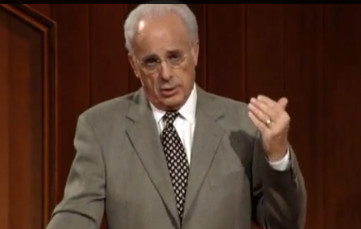
John MacArthur
Rev. John MacArthur

And so Jackson urges his readers to realize that Pastors are also human, what he calls “tools of destiny,” and he wants us to know that someday, some of us may be in church leadership, which will further help us understand the responsibilities faced by our Pastors. Jackson also said that, given this, he urges reconciliation with church leaders when there’s a problem, and outlines the steps for his readers. Ultimately, it’s a call to forgive leaders who may have hurt us. Just for giggles, I included a photo of John MacArthur because to me, he exemplifies the sort of Pastor who generates a lot of “hurt” among people. But that’s just my opinion. What do you do when a well-known and influential Pastor has the ability to potentially hurt thousands?

The only end of chapter question I have highlighted is:

Are you looking for them (church leaders) to provide something that can only come from Jesus?

At this stage in the game, I don’t think I’m looking for a church Pastor to provide anything at all. How can they when my presence in almost any church (at least if I opened my mouth) would be a monkey wrench in the machinery?

In Chapter 11: The Cup of Misunderstanding (sounds like a little-known additional cup at a Passover seder), Jackson speaks of this metaphorical cup containing something that tastes bitter, tastes like injustice, and “those who drink it must do so alone.” He also says that this cup is usually received by “innocent people,” and is particularly harsh when “delivered to you by a brother or sister in Christ.”

Jackson compares being misunderstood and judged by someone in the church to the pain of betrayal suffered by Christ at the crucifixion.

I felt the comparison was a bit much. After all, human misunderstandings aren’t confined to the church, they happen in every human corporate venue, from the family to the workplace.

Jackson says this pain is intensified if the person you are trying to reconcile with makes it abundantly clear they have no intention of mending fences.

Someone once said, “You must embrace the cross if you would carry it with dignity.” The same is true of this cup.

I think what Jackson is saying is that being misunderstood, judged, and cut loose requires the Christian to be “Christ-like,” to bear the burden and the pain as Jesus did on the cross. Sounds pretty dramatic, but then, human conflict can elicit a lot of drama.

One of the end of chapter questions is:

Do you have a friend who can stand with you in your struggle?

In spite of my friend’s concerns about me and the issues Jackson addresses in his book, I don’t know that I’m really struggling, at least in relation to community or my lack thereof.

Jackson asks: “Are you passing the test? As you do, you’ll begin to look more like Him.” If the test is forgiving the Pastor, first of all, I doubt he thinks he needs my forgiveness. Nevertheless, I have forgiven him. After all, he’s only doing what he believes is right, and within his church’s context, it is the right thing to do.

In Chapter 12: Death by Religion, Jackson discusses watching an infomercial for Chuck Norris’s Total Gym product. The bottom line is that in spite of the seemingly fantastic claims made in the marketing of this all-in-one piece of exercise equipment, Jackson says if used as indicated, and if you eat a proper diet, the claims are all true.

Please forgive this sacrilegious comment, but I’ve noticed that in some ways, the Church is a lot like that infomercial–we’re touting a product that really works.

And by that he means:

A life devoted to His service is the only way to ensure our eternal salvation and to experience the life we were created to live.

norris and brinkleyBut while a very fit Chuck Norris and Christie Brinkley sell their product on TV, Jackson says, by comparison, those Christians promoting a better life through Jesus are more like “a flabby, middle-aged guy who thinks he looks good in spandex.”

In other words, many believers promoting a better life through Christ don’t look or act like they’re participating in that life. They look like they’re participating in a marathon dining session at McDonald’s.

We’re selling relationship, but what they see is religion…and religion is killing our sales pitch.

I’ve mentioned this artificial split between these concepts in a previous blog post. It’s really the traditional Christian rant against their misconception of Judaism:

Religion breeds death because it is limited to man’s ability to comply with its codes and regulations.

If Jackson had my understanding of the New Covenant, he’d (hopefully) understand why his opinion is completely out of the ball park.

But I don’t have time or space to go into all that again in this rather lengthy series of book reviews.

Religion is easier to control than a relationship.

You may have noticed that Jackson has shifted his emphasis from the individual’s relationship with other Christians in church or their relationship with the Pastor and church leadership, and is now focusing on the person’s relationship with Christ.

…after all, we’re all under grace and God doesn’t get ticked if we skip a day of devotions.

I’m not sure what God does or doesn’t think about an individual being hit and miss on living a life of holiness, not that any one of us is perfect at it.

Jackson then proceeds to bash the Pharisees, even though (he probably doesn’t see this) Jesus lived a life consistent with the basic tenets of Pharisaism, and as a matter of fact, so did Paul.

In describing “religious systems,” he says they operate like “spiritual frat houses”. They have their secret handshakes, inside jokes, matching jackets, and the like. Yes, I’ve experienced cliques in church. People who were ‘in’ and people who were ‘out’, though to be fair, I didn’t experience them at the last church I attended (at least for the most part).

However, Jackson could have been describing how some people experience certain individuals and congregations involved in the Hebrew Roots and the Messianic Jewish movements.

I’ve mentioned before Derek Leman’s blog post Gentiles Who Feel Left Out which addresses this matter. If you feel you are “in”, then being in contributes to your sense of identity, according to Jackson. You may, again, as Jackson says, experience a sense of being among the elite by being in.

This next point is important:

Spiritual fraternities do not welcome different opinions or viewpoints.

I’ve experienced that in spades, but I think that a lot of religious communities are like this, based on a mutually accepted sense of “rightness” of their doctrine. Anything that contradicts their doctrine is automatically wrong. These congregations state, using Jackson’s words:

We want your input and opinions–as long as they agree with ours.

This goes back to what I said before about expectations within the group. Jackson also says such “frat houses” are full of cliques, difficult to fit into (again, I know what that’s like), and Jackson says the only way to combat this is to “make sure that our hearts are free from religion.”

And yet, I could probably speak to Jackson for less than an hour and elicit a very protective and “religious” (as he defines it) response from him, just by disagreeing with how he interprets the Bible’s message of the good news. Actually, all he’d have to do is read my reviews of his book.

Only two of the end of chapter questions seemed relevant:

Are you managing a religion or living in a relationship?

Has your religious experience become a duty or a delight?

passover-artConvincing Jackson of the beauty of the mitzvot, particularly with Passover and the family seder coming up in a few days, all the preparations, all of the ceremony, and the retelling of the Exodus, would be a lost cause if I were to make the attempt. I suspect all he’d see is “religion,” missing how the seder brings a Jewish family closer to God.

Of course, I wonder how he’s managing the “relationship” of the upcoming Easter Sunday service at his church, which usually involves a multi-media presentation and tons and tons of preparation and ceremony?

So far, having reviewed about half of Jackson’s book in a fair amount detail, I have two preliminary conclusions. The first is that I don’t think he’s speaking to my situation. The second is that my opinion of my being incompatible with “church” is being re-enforced. I find it impossible to review his book as related to my current status of being apart from “community” without being critical of his theology and doctrine.

I just can’t seem to put our obvious differences aside and simply listen to what he has to say on a human level. This is my fault. I have a friend who tells me I need to be more patient and to speak out less.

Probably true.

One last story.

I had coffee with my friend last Sunday. On the drive home, he mentioned that his congregation had a guest speaker from Africa on the previous Shabbat. Among other things, this speaker talked about lions and how they hunt only the sick, the weak, the old, and those who wander off and are alone.

Not-so-subtle point received, my friend. *grin*

Repentance and Regret

The Torah teaches us that it is never too late to change.

Changing for the better is called doing teshuva. The Hebrew word teshuva, which is often translated as repentance, actually means to “return.” Return to God. Return to our pure self.

How do people become interested in self-improvement?

People have faults. The faults they have cause them to suffer in some way or another. This suffering limits an individual’s freedom and is often painful. Hence, people want to change… to improve. To be free once again.

How does one change for the better? How does one do teshuva?

There are four steps of teshuva.

-Rabbi Mordechai Rottman
“Four Steps to Change”
Aish.com

I know an exploration of teshuva, which is commonly translated as “repentance,” seems more appropriate to Yom Kippur than Passover, but part of the inspiration to invest more in myself along this path and at this time comes from here:

The Midrash tells us that the Jewish people had the same problem in Egypt. Only 1/5 of the Jewish people were on a high enough spiritual level to leave Egypt — and they were on the 49th level of Tuma, spiritual degradation — and were within a hair’s breadth of being destroyed.

Yet, what is amazing is that in the next 49 days they raised themselves to the spiritual level to receive the Torah at Mt. Sinai! Each day we climbed one step higher in spirituality and holiness. Many people study one of the “48 Ways to Wisdom” (Ethics of the Fathers, 6:6 — found in the back of most siddurim, Jewish prayer books) each day in the Sephirat HaOmer period between Pesach and Shavuot — which will be explained below — as a means to personal and spiritual growth. This is a propitious time for perfecting one’s character!

Rabbi Kalman Packouz
Commentary on Passover (Shabbat Chol Hamo’ed) (Exodus 13:17-15:26)
Aish.com

I know this is midrash and for most people, especially Christians, the above statement cannot be reasonably derived from scripture. Roll with it, OK? The midrash teaches an important spiritual lesson.

Rabbi Packouz suggests Rabbi Noah Weinberg’s 48 Ways to Wisdom (there are actually 50 of them) series as the perfect companion to accompany the days between Pesach and Shavuot for those seeking to elevate themselves spiritually.

But the first step, at least in my way of thinking, is teshuva, turning away from sin, especially habitual sin, and turning back toward God.

In Judaism, repenting of sins is more than just praying “I’m sorry” to God and maybe saying “I’m sorry” to anyone you’ve hurt. It’s a four-step process:

  1. Regret. To regret what we have done wrong.
  2. Leaving the negativity behind. To stop dwelling on the transgression in thought and action.
  3. Verbalization. To verbally state the transgression.
  4. Resolution for the future. To be determined not to let the transgression happen again.

guiltyThat might seem like only a little bit more effort than what we’ve come to expect in the Church, but that short list can be unpackaged to represent a lot of depth. I plan to take each step and explore it as fully as I can, both for my edification and yours.

Regret

What is regret and how is it different from guilt?

Well , we all know what guilt is. That uneasy queasy feeling that we have done something terribly wrong that can never be fixed…

But how is regret different?

Here is an example of regret:

An eccentric but wealthy, elderly acquaintance tells you to meet him at 2:30 pm on Sunday afternoon at Starbucks for coffee.

At 2:00 pm you are busy watching a great movie and decide not to show up to the 2:30 meeting.

That evening you find out that this elderly gentleman made the 2:30 appointment with 10 people, you being one of the 10.

Only five out of 10 arrived at the meeting. To each of the five who showed up, your eccentric acquaintance gave a bank check for $50,000 dollars.

Now you know what regret is. The feeling of missed opportunity.

When you find out that you missed out on 50 grand for a stupid movie, you feel regret, not guilt.

When we go against the will of God, the feeling we are supposed to have is regret. What a lost opportunity! We lost a piece of eternity!

When we have done wrong, whether an impulsive and momentary act of unintentional sin or repeated acts of intentional sin, it is normal and expected to feel guilty. Some people only feel guilty when they are caught or confronted about their sin, while others wear guilt around their shoulders like a bitter shroud, clinging to its fabric day and night. Rabbi Rottman describes guilt as that ”uneasy queasy feeling that we have done something terribly wrong that can never be fixed,” but the first step in repentance isn’t guilt, it’s regret.

In the example above, we see the difference between the two, but of these two experiences, guilt is much easier because, unless our soul is completely unfeeling, experiencing guilt is almost automatic.

I blame myselfGuilt is a response to doing wrong and to thinking thoughts like, “I’m a no good filthy scumbag. I can’t do anything right. God must hate me because I keep sinning. What’s the use of trying to be better when it always boomerangs on me?”

As you can see, feeling guilty doesn’t lead one to initiate change, it does just the opposite. Feeling profound guilt can be paralyzing and actually perpetuate the cycle of sin rather than change it.

We regret, as in the example above, a golden opportunity to reap great rewards. Making teshuva yields great rewards. It’s an opportunity to reconcile with the Creator of the Universe. He holds wonderful gifts for us but we have to show up at the appointment He makes with Him. Guilt keeps us hiding inside our houses, under our beds, quivering in the shadows. Regret is the feeling we have when we’ve stupidly thrown away the chance to receive free money (citing the above example) and to otherwise enrich our lives. God is a wealthy benefactor who only wants to do good for us, not to punish us for every sin we commit.

God knows we’re imperfect. God is waiting to help us. But we have to regret our sins as events that have prevented us from receiving His kindness and generosity and see that if we continue to commit those sins, we continue throwing away all of those gifts.

God is a personal God. He is aware of us. We are in His presence. He is paying attention. God is communicating to us through His world of beauty and design. He is here and available. The Almighty Creator of this whole universe is saying: My child, I love you. I created you to give you pleasure. Come, let’s explore the world together.

The Creator of the universe loves you? Wake up! That’s exciting news!

-Rabbi Noah Weinberg
“The Power of Awe”
Step Four in 48 Ways to Wisdom

Look at your life as you’ve lead it up to this point. There are such a variety of people who may read this blog that I’m sure you represent all kinds of different experiences. Some of you may be very spiritually elevated, very close to the Creator through faith in the Master. Others may be barely hanging on to faith at all because of the seeming hopelessness of your lives, because of your apparent inability to shake off sin and guilt.

Feeling guilty is the lazy way of reacting. A guilty person resigns himself to keeping his faults and does not try to take actions to improve.

Don’t use guilt feelings to justify laziness and procrastination. If a person tends to think in terms of guilt, when he hears an idea he will say to himself, “How awful it is that I’m not following that idea.”

It is more productive to keep focus on what you can do to implement the principle or concept.

-Rabbi Zelig Pliskin
“Avoid Using Guilt to Justify Inaction”
from Today’s Daily Lift #358
Aish.com

jewish-repentanceWe have free will to choose obedience or disobedience to God. Even when we disobey, we have free will to allow our sin to inspire guilt or regret. We have free will to select inaction or action that will lead to change. You may have sinned for years in secret or in public and feel incapable of managing giving up that sin. You may have advanced in many other areas but still fail in one or two that hold you back from a closer relationship with God. You may say to yourself that if you’ve failed in the same way for so very long, that breaking the sin habit is impossible and you are a slave to it forever.

But guilt over missing previous opportunities, if turned to regret, doesn’t have to stop you from keeping future appointments and grasping the next opportunity offered to you by God:

In each one of us there is an Egypt and a Pharaoh and a Moses and Freedom in a Promised Land. And every point in time is an opportunity for another Exodus.

Egypt is a place that chains you to who you are, constraining you from growth and change. And Pharaoh is that voice inside that mocks your gambit to escape, saying, “How could you attempt being today something you were not yesterday? Aren’t you good enough just as you are? Don’t you know who you are?”

Moses is the liberator, the infinite force deep within, an impetuous and all-powerful drive to break out from any bondage, to always transcend, to connect with that which has no bounds.

But Freedom and the Promised Land are not static elements that lie in wait. They are your own achievements which you may create at any moment, in any thing that you do, simply by breaking free from whoever you were the day before.

Last Passover you may not have yet begun to light a candle. Or some other mitzvah still waits for you to fulfill its full potential. This year, defy Pharaoh and light up your world. With unbounded light.

-Rabbi Tzvi Freeman
“The Inside Story on Passover”
Chabad.org

Are you beginning to see why this is a good season to begin to make positive spiritual changes in your life?

You aren’t an innocent bystander in your own life, waiting on a street corner for God to drive up in a bus and offer you a ride. You don’t have to wait for God, God is waiting for you. Every time you are tempted to sin is an opportunity to keep an appointment with Him. Who knows what He has in store for you? You’ll never find out if you keep missing appointments, if you keep hiding from opportunities.

If you think I find all this easy, you’re wrong. I’m writing this in part to process my own experience and grasp the meaning of regret as a motivating force. This is only the first of four steps in the process of repenting to God. A single “I’m sorry for my sins” prayer just isn’t going to do it. Cheap grace is not sold in God’s storehouse. Salvation may be a free gift of God through grace, but you still have to show up to accept it and you need to be in a state of purity to get in the door.

purityThat state of purity, the mikvah process if you will, begins with teshuva and teshuva begins with experiencing authentic regret at having missed out on God’s blessings up until now. Seeing sin as a missed opportunity to draw nearer to God takes a lot of effort. Setting mind numbing guilt aside and allowing regret to enter your life is no easy task. If you stumble, that’s not really unexpected. But regret stumbling rather than letting it tell you some sad and sorry story about how lousy you are. Regret helps you get back up again. Guilt keeps you on the ground eating dust and ashes.

I hope to write about the second step in making teshuva soon.

The next step is Leaving Negativity Behind.

Chol HaMo’ed Pesach: Writing on Flesh

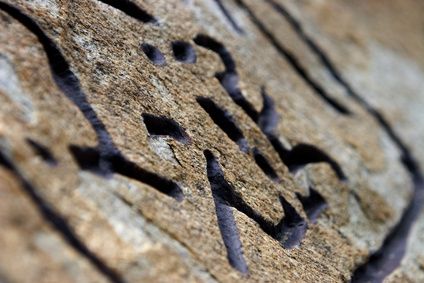
When Moses descended, he carried the Word of God—not the Word made flesh, but the word made stone upon the two tablets of the covenant.

“The Word from Heaven Was Broken”
Commentary on Chol HaMo’ed Pesach
First Fruits of Zion (FFOZ)

The obvious image those words should invoke is this:

And the Word became flesh, and dwelt among us, and we saw His glory, glory as of the only begotten from the Father, full of grace and truth.

John1:14 (NASB)

The Old Covenant was established with the Children of Israel at Mount Sinai and the conditions of that covenant, the Torah, were given on stone tablets.

The mediator of the New Covenant entered our world as “the Word made flesh” and the conditions of that covenant were in every spoken word and action of that “Word,” in the person of Yeshua (Jesus) of Nazareth, HaMaschiach (the Messiah). But of course, the conditions previously established didn’t change, and everything taught by the Rav from Nazareth was Torah.

“Do not think that I came to abolish the Law or the Prophets; I did not come to abolish but to fulfill. For truly I say to you, until heaven and earth pass away, not the smallest letter or stroke shall pass from the Law until all is accomplished.”

Matthew 5:17-18 (NASB)

The conditions of the Old Covenant were written on stone tablets. Exodus 32:16 says the finger of God wrote on the first set of tablets before the sin of the Golden Calf, before Moses broke them.

The FFOZ commentary tells us that according to midrash, the tablets that descended from Mount Sinai can be compared to a human body, and when Moses broke that “body,” because of the sin of Israel, the letters on the tablets flew off the stone and returned to their Source in Heaven.

When Messiah Yeshua’s body was broken due to the sin of Israel, his spirit left him and returned to its Source.

letters-on-stoneAfter the sin of the Golden Calf, Moses returned to the mountain and to God to plead for Israel and to renew the covenant (Exodus 34). This began a long and cyclical pattern of sin and repentance for Israel.

After the death of the Master, he was resurrected three days later and thus was completed the inauguration or the very starting of the New Covenant, a process that will not reach fruition until the Master’s return, for he ascended to Heaven and sits on the right hand of the Father, our High Priest in the Heavenly Court, who makes final atonement for the sins of humanity, who is the mediator of better promises. But get this:

“Moreover, I will give you a new heart and put a new spirit within you; and I will remove the heart of stone from your flesh and give you a heart of flesh. I will put My Spirit within you and cause you to walk in My statutes, and you will be careful to observe My ordinances.” (emph. mine)

Ezekiel 36:26-27 (NASB)

“But this is the covenant which I will make with the house of Israel after those days,” declares the Lord, “I will put My law within them and on their heart I will write it; and I will be their God, and they shall be My people. They will not teach again, each man his neighbor and each man his brother, saying, ‘Know the Lord,’ for they will all know Me, from the least of them to the greatest of them,” declares the Lord, “for I will forgive their iniquity, and their sin I will remember no more.” (emph. mine)

Jeremiah 31:33-34 (NASB)

The conditions of the Old Covenant were written on stone tablets and on scrolls, objects that are inanimate and external to human beings. If we want to know about God and if we want to “know God,” we must study and practice, and yet Biblical and human history is all too clear that even the best of us fail, no matter how great our desire to serve God.

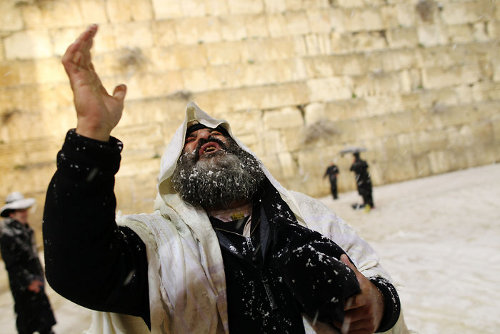
praying_at_masadaYeshua came as the “Word made flesh,” the living embodiment of the Torah, the walking, talking, flesh and blood, human expression of the will and wonder of God, all contained within a human body. He was the perfect image of what we strive for, the Word written on flesh.

There’s a difference. John’s Gospel says that Yeshua was the Word made flesh, while we get from Ezekiel and Jeremiah that the Word will be written on our fleshy hearts. We don’t literally become the Word as a human being, we “merely” have it wholly integrated into our being.

But here’s the result.

Amen, I say to you, none among those born of a woman has arisen greater than Yochanan the Immerser; yet the smallest in the kingdom of Heaven will be greater than he.

Matthew 11:11 (DHE Gospels)

I mentioned above the concepts of knowing about God vs. knowing God. I don’t doubt that there are people today, great tzaddikim or saints who know God, at least to the current extent of human ability, but the Bible records that Moses spoke with God “face to face” (Exodus 33:11). That’s pretty hard for me to imagine, especially since God is considered Spirit and without physical form (the third of the Rambam’s Thirteen Principles of Faith).

But the Master prophesied that when the New Covenant is fully enacted, then the finger of God will have finished writing His Word on our hearts of flesh and, like Moses and the Prophets of Old, including John the Baptizer, we will all know God, God’s Spirit will be poured out on all flesh (Joel 2:28, Acts 2:17), and everyone, from the least to the greatest, will have a full knowledge and intimate relationship with God. We won’t just know about Him, we will know Him.

Jesus, when the Spirit was poured out on him at his immersion (Matthew 3:16) became the forerunner, the first fruits of New Covenant human beings. He was still fully human, but with the Spirit poured out on him as it will be someday in the Messianic Era, a human being who could be tempted but still not sin. He’s the living promise that we will be perfected even as he was perfected.

It’s exciting to watch God’s plan open up in the pages of the Bible. The progression from the tablets and scrolls to the first fruits of the New Covenant, Messiah, coming as the “Word made flesh,” and then anticipating the day when that Word will be written on our flesh as well.

Right now, we experience just the leading edge of that New Covenant as we continue to live in the Old Covenant era, the Spirit was given as a pledge and a promise of what is yet to come (2 Corinthians 1:22). We aren’t there yet, but God has given His Spirit to us as His bond that what He has promised will indeed occur.

But there’s a catch.

For I am already being poured out as a drink offering, and the time of my departure has come. I have fought the good fight, I have finished the course, I have kept the faith; in the future there is laid up for me the crown of righteousness, which the Lord, the righteous Judge, will award to me on that day; and not only to me, but also to all who have loved His appearing.

2 Timothy 4:6-8 (NASB)

PrayingThis doesn’t just happen.

Yes, God promised it and it will happen, but it won’t just happen to us without an effort on our part. It isn’t just an intellectual and emotional acceptance we make that Jesus is Lord and then suddenly we’re in. As we see from Paul’s example, we only get to the finish line after running the race, after exerting ourselves, after keeping the faith and holding fast to our confession (Hebrews 4:11, 14).

Recently, I wrote of some of this as applied to me personally in For Redemption is Not Yet Complete and next week’s review of D. Thomas Lancaster’s Epistle to the Hebrews sermon The Source of Eternal Salvation will speak strongly to who we are in Messiah and our role in the process of repentance and salvation.

Each day, we struggle to reaffirm our faith. Each day we must repent anew, plead for the forgiveness of our sins, and turn to Yeshua as our atonement. The finger of God is moving and writing, but only if we are willing participants in allowing our stony heart to be transformed, only if we surrender ourselves as the material upon which (upon whom) God may write His Torah.

And we do that only by recognizing the one who came from God and who returned to God and who will come again. The one who arrived as a flesh and blood man and who was (and is) also the Word. For only through him can we find the Word within us as we are within Him.

No “Christian Seders,” Please!

I don’t think I’ve ever reblogged another’s material before, but after seeing this reblogged at the Rosh Pina Project, I was compelled to read the original. Having read the original, I found myself greatly impressed by this thoughtful woman’s insights and sensitivity and thought it important to share.

Addendum: I think this news story is the flip side to the plea for “no Christian seders:” Passover: The Jewish Holiday for Gentiles.

sicutlocutusest's avatarSicut Locutus Est

155 NOTE: In March 2013, I posted a series of Facebook Notes about so-called “Christian Seders” and the special obligation Christians have in Lent and Holy Week especially to be vigilant about the way our observances may have an impact on Jews, Christian understandings of Judaism, and related matters. I have been asked by several colleagues to re-post these reflections this year. I am happy to do so. I need to make it clear, however, that I am not an expert on these matters. What I say below is my take on controverted questions, born mostly of my own reading and of my interfaith relationships. Please take them as such.

No “Christian Seders,” Please!

With Holy Week on the horizon,  many Christian congregations have started announcing Seder dinners to observe Maundy Thursday. People of good will recognize this as a devout and well-intentioned attempt to honor the Jewishness of Jesus, and…

View original post 3,002 more words

For Redemption is Not Yet Complete

But I have been persuaded by Professor Edward Greenstein to read this story existentially rather than critically. The death of Aaron’s sons was not the result of a miscue in the prescribed choreography of the Tabernacle. Their fate conveys the far deeper and more unsettling truth that no amount of elaborate, awesome, and precisely executed ritual should ever leave us with the illusion that we have brought God under human control. The very moment the Tabernacle comes into service, Israel is taught the sober lesson that God’s will remains free and inscrutable, God’s wisdom unfathomable. The religion of the Torah is not a set of magical techniques to get God to do our bidding, but rather a quest to invest our lives with meaning. To rein in the erratic and destructive passions of the earth’s most intelligent animal, that is the Torah’s desperate mission.

-Ismar Schorsch
“Enduring Life’s Setbacks,” pg 411
Commentary on Torah Commentary Aharei Mot
Canon Without Closure: Torah Commentaries

So it came about in the course of time that Cain brought an offering to the Lord of the fruit of the ground. Abel, on his part also brought of the firstlings of his flock and of their fat portions. And the Lord had regard for Abel and for his offering; but for Cain and for his offering He had no regard.

Genesis 4:3-5 (NASB)

I’ve read a couple of different commentaries on the death of Aaron’s sons Nadab and Abihu (Leviticus 10:1-3) recently. Both said that the “strange” or “alien fire” they offered was fire of their own making. These commentaries said that when God first ignited the fire upon the altar, only that fire was to be used in making offerings to God. A rather simple explanation for a question that has stumped scholars for thousands of years.

No, we can’t make a sacrifice to God of any sort that somehow brings Him under our control or provides Him with something He lacks. Nothing we make, say, or do will manipulate God into behaving or performing in a manner differently than is His intention.

Like prayer, we don’t turn to God with anything that will change Him. The purpose of the sacrifices, the mitzvot, and prayer is to change us.

Likewise the cup that was given to the world’s greatest tzaddik.

And He withdrew from them about a stone’s throw, and He knelt down and began to pray, saying, “Father, if You are willing, remove this cup from Me; yet not My will, but Yours be done.”

Luke 22:41-42 (NASB)

It was now about the sixth hour, and darkness fell over the whole land until the ninth hour, because the sun was obscured; and the veil of the temple was torn in two. And Jesus, crying out with a loud voice, said, “Father, into Your hands I commit My spirit.” Having said this, He breathed His last.

Luke 23:44-46 (NASB)

As I write this, I just read a commentary about Passover and atonement which said in part:

“Suffering and pain may be imposed on a tzaddik (righteous person) as an atonement for his entire generation. This tzaddik must then accept this suffering with love for the benefit of his generation, just as he accepts the suffering imposed upon him for his own sake. In doing so, he benefits his generation by atoning for it, and at the same time is himself elevated to a very great degree. Such suffering also includes cases where a tzaddik suffers because his entire generation deserves great punishments, bordering on annihilation, but is spared via the tzaddik’s suffering. In atoning for his generation through his suffering, this tzaddik saves these people in this world and also greatly benefits them in the World-to-Come. In addition, there is a special higher type of suffering that comes to a tzaddik who is even greater and more highly perfected than the ones discussed above. This suffering comes to provide the help necessary to bring about the chain of events leading to the ultimate perfection of mankind as a whole. … Beyond that, the merit and power of these tzaddikim is also increased because of such suffering, and this gives them even greater ability to rectify the damage of others. They can therefore not only rectify their own generation, but can also correct all the spiritual damage done FROM THE BEGINNING, FROM THE TIME OF THE VERY FIRST SINNERS.” (emphasis mine) .. (Derech Hashem, Rabbi Moshe Chaim Luzzatto, translation by Aryeh Kaplan Feldheim Publishers, Jerusalem, 1977, pp 123-125)

If you are a Christian and unfamiliar with Jewish texts, this may seem strange or even startling to you. If you are Jewish and not a believer, this will seem like a gross misappropriation of the writings of the sages, bent in an unintended direction for a mistaken purpose.

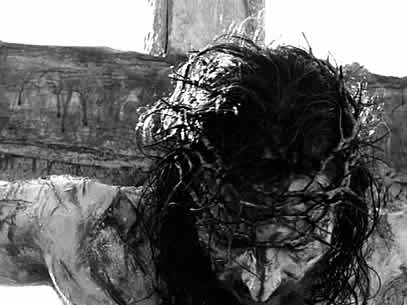
The Death of the MasterI’ve written about just such an interpretation before, both in The Death of the Tzaddik and The Sacrifice at Golgotha. God is not pleased by unauthorized offerings, strange fires, and certainly not by human sacrifice, which we Christians sometimes are mistakenly accused of condoning.

And yet, sometimes God does ask that we put our soul on the altar so to speak, not because human struggle and suffering is His desire, but because we need to learn that as servants of the Most High God, our lives are subject to Him, not to what we want. By offering sacrifices, whether it be a lamb, a prayer, or our time and energy in performing deeds of kindness and charity, we aren’t giving to God something that changes Him, but we are doing what changes us in the manner God desires us to change.

And even that desire of God’s is not for His sake but for our own.

At the last second, God terminated the Akedah or the Binding of Isaac (Genesis 22) to spare the life of Isaac and to spare Abraham the death of his only son, the son of inheritance, the son who would carry forward all of the promises God made to Abraham, so they might be sent into the future with Isaac’s son Jacob, with Jacob’s twelve sons, with the tribes they would found, and with all of Israel, today’s Jewish people.

And because God wasn’t asking Abraham for a human sacrifice on the altar by killing his son, He was changing Abraham and changing Isaac, and the result of those changes reverberate down through history in both Judaism and Christianity.

To rein in the erratic and destructive passions of the earth’s most intelligent animal, that is the Torah’s desperate mission.

-Ismar Schorsch

I might have worded that sentence a little differently, but it’s a sound statement. The Word of God exists to change us, mold us, refine us (like a precious metal in fire if necessary) so that we might become a more spiritually pure product over time.

Rabbi Kalman Packouz in his Passover commentary said the following:

The Midrash tells us that the Jewish people had the same problem in Egypt. Only 1/5 of the Jewish people were on a high enough spiritual level to leave Egypt — and they were on the 49th level of Tuma, spiritual degradation — and were within a hair’s breadth of being destroyed.

Yet, what is amazing is that in the next 49 days they raised themselves to the spiritual level to receive the Torah at Mt. Sinai! Each day we climbed one step higher in spirituality and holiness. Many people study one of the “48 Ways to Wisdom” (Ethics of the Fathers, 6:6 — found in the back of most siddurim, Jewish prayer books) each day in the Sephirat HaOmer period between Pesach and Shavuot — which will be explained below — as a means to personal and spiritual growth. This is a propitious time for perfecting one’s character!

PrayerSome of those terms may seem a little odd to some of you but the principle behind them should be clear. We want to change. We want to be a little better tomorrow than we were yesterday. But even as believers and devout disciples of the Master, that’s easier said than done, at least for me (especially for me). Rabbi Packouz suggests Rabbi Noah Weinberg’s series 48 Ways to Wisdom, working through one “way” each day between the start of Passover and the arrival of Shavuot.

Jesus didn’t die just to be a human sacrifice since God abhors the desecration of human life. But if a great tzaddik can atone for the sins of his generation, how much more does the death of the greatest of all tzaddikim atone for the sins of the world, across the vast panorama of human existence?

But there’s nothing we can offer God that changes God. Every sacrifice, every lamb, every bull, every prayer, every mitzvah, and the death of the tzaddik, the Master, exists to change each of us and to bring us a little closer to God. Empty sacrifices are less than useless however. What we do is important but why we do it is crucial. Simply giving a can of soup to a hungry person feeds that hungry person, which is good, and it may temporarily elevate ourselves, at least in our own eyes, which may not be bad either. But if the act doesn’t reveal a little bit more about God to us, and if we don’t become just a little more dedicated and compassionate as God’s servants because of it, then all we’ve done was given one small meal to one single person.

And they’ll be hungry again in a few hours. So much for our “sacrifice.”

It only really, really matters on a vast and even cosmic scale, if it brings us to a greater realization of who is above us:

“Consider three things and you will not come to sin: Know what is above you: an eye that sees and an ear that hears, and all your deeds are recorded in the Book.”

-Pirkei Avot 2:1

Jesus will have died for nothing if we don’t follow him as a result, if we aren’t changed by the crucifixion and resurrection, if his act of inaugurating the era of the New Covenant did not begin to turn our heart of stone into a heart of flesh.

Run to do good. Shun evil. Pray for God to soften you, to change you, to refine you.

Examine me, O Lord, and try me; test my mind and my heart.
For Your lovingkindness is before my eyes, And I have walked in Your truth.

Psalm 26:2-3 (NASB)

Be on guard for yourselves and for all the flock, among which the Holy Spirit has made you overseers, to shepherd the church of God which He purchased with His own blood.

Acts 20:28 (NASB)

Looking upPlease don’t think me vain if I start by praying for myself. It has been all too easy for me to rest for an extended period of time on a spiritual plateau and it’s all too difficult for me to overcome inertia and begin moving again. Going up means I have to overcome gravity, but going down is not the direction I want to take. Like a boat without oars in a river, standing still is just another way of going backward.

Our love of God is not to collapse even when our soul is shattered.

-Ismar Schorsch, pg 412

For redemption is not yet complete.

A Passover Haggadah, Ed. Herbert Bronstein, pg 34

The King is coming, but there’s still time for each of us, you and me.

“Life gets mighty precious when there’s less of it to waste.”

-Bonne Raitt