Tag Archives: Paul

The Loving Nazirite

john-the-naziriteAfter this, Paul stayed many days longer and then took leave of the brothers and set sail for Syria, and with him Priscilla and Aquila. At Cenchreae he had cut his hair, for he was under a vow.

Acts 18:18-19 (ESV)

In the days of the Temple, if a man or woman desired to take a special vow of separation to the LORD, he or she could take a Nazirite vow. The Torah lays out the specifications in Numbers 6. People undertook Nazirite vows for a variety of reasons, including healing, safe return, prayer for another, and simply to observe a time of sanctification. Rabbinic literature attests to the popularity of the vow in the late Second Temple period. The Mishnah dedicates an entire tractate to the subject. Nazirites were not uncommon among the disciples of Yeshua. John the Immerser and James the brother of the Master were lifelong Nazirites. Later in the book of Acts, Paul completes a second Nazirite vow along with four other disciples.

-D. Thomas Lancaster
Ki Tisa (“When you take”)
Commentary on Acts 18:11-23, pg 539
Torah Club Volume 6
First Fruits of Zion (FFOZ)

I know that over the years, there have been many commentaries written about the meaning of Paul’s vow and whether or not it was a Nazirite vow. Lancaster seems to think so and he has plenty of company. But why should you care and why am I writing about this now?

A lot of Christians are invested in de-coupling Paul and the early Jewish apostles from Judaism and Jewish practices. I think it’s important to “re-couple” the first century Jews in the Messiah with their Judaism and Jewish practices and then ask ourselves why would the next generation of “Messianic Jews” give up being Jews? The answer is, they wouldn’t. Why should they? Although Paul was accused of preaching against the Torah of Moses (Acts 21:28), it was a total lie. Paul never did such a thing (contrary to some theologies running around out there) and he certainly never admitted to doing so. We also don’t find Paul saying that his Jewish contemporaries were to keep Torah but their children and grandchildren would give it up.

But then again, we have this:

In speaking of a new covenant, he makes the first one obsolete. And what is becoming obsolete and growing old is ready to vanish away.

Hebrews 8:13 (ESV)

You could certainly spin that into saying the Jews were in the process of giving up their “obsolete” practices and replacing them with ones based on the New Covenant. The problem is, the New Covenant primarily reaffirms and expands upon all of the previous covenants God made with the Jews, including the Sinai covenant. If anything, the New Covenant should have strengthened Torah observance among the Jews, not deleted it.

So why does Christianity fight that interpretation and fight the idea that Paul could have possibly taken a Nazirite vow?

Many writers argue against Paul taking a Nazirite vow on the basis that the vow required the Nazirite to make animal sacrifices. These teachers are reluctant to think about Paul bringing a lamb, a ewe, and a ram as burnt offerings, sin offerings, and peace offerings. Contrary to that objection, James the brother of the Master later encourages Paul to complete his own Nazirite vow and pay the expenses of four other disciples in order to demonstrate that he walked “orderly, keeping the Torah” (Acts 21:24).

-Lancaster, pp 539-40

Sounds pretty Jewish to me.

Of course, post-Temple, there is no way to take a Nazirite vow or to perform the sacrifices, so many of the Torah mitzvot are unable to be observed by Jews today. We know that the Torah was originally given as a sort of “national constitution” of ancient Israel, defining all of the laws, social mores, and traditions of the Israelites in the Land. We know that when Messiah returns and builds the next Temple, that at least some of the Torah commandments related to the Temple sacrifices will be restored.

But what is the purpose of the Torah in Judaism in the meantime?

That’s like asking, what’s the purpose of a marriage license between a couple when the couple have to endure a lengthy physical separation say because of military service. Just because they can’t be together for a period of months or even years doesn’t mean they aren’t still married. It doesn’t mean that their marital obligations are completely done away with, even though some aspects of the relationship cannot be performed while they’re apart. The relationship endures between one period of togetherness and the next. Both husband and wife continue to wear their wedding rings. They both still refer to the other as “husband” and “wife.” They both stay faithful and do not enter into intimate relationships with other people.

Yes, I’m describing a pretty ideal situation relative to a separated married couple, but let’s look at the analogy. If a married couple who are forced to be apart, even for an extended period of time, are expected to remain faithful to one another and to practice specific behaviors based on their marital faithfulness, how much more should the Jewish people continue to remain faithful to God and to practice specific behaviors, the Torah mitzvot that can be performed in this day and age, based on their faithfulness to God?

The surest way to lose a skill or a relationship is to not practice it. The surest way for a Jew to lose faithfulness to God is to not practice the mitzvot, even though they can only practice a limited set of mitzvot due to “temporary separation.”

one-of-ten-virgins-oilBut the “couple” are getting closer again. Since 1948, there has been a Jewish homeland, Israel, in existence. Jews can make aliyah. They can return home. Yes, the Temple isn’t there yet. The Priesthood isn’t there yet. But then again, the bridegroom hasn’t returned home yet. When he does, he’ll rebuild the house, and the couple will move back in. But under certain provisions of the Abrahamic covenant that have been enhanced by the New Covenant, the “bride” won’t be only the Jewish people.

The analogy gets pretty hard to maintain at this point, but there’s a reason that the body of unified believers is called “the bride of Christ.” There’s a reason why the Gospels are full of “Jesus as bridegroom” imagery. Some of the details are still a little fuzzy, but we know that the bride and groom, who have been apart for so very long, are coming back together again.

The Jewish bride and the Jewish bridegroom will once again take up housekeeping. They have been faithful in their vows and faithful in performing all of the acts related to their marriage that were possible to keep while the house has lain in ruins. When the house is rebuilt, when David’s fallen sukkah, the Temple, is reconstructed by Messiah on the Holy Temple Mount in Jerusalem, the world will see just how vital the Torah of Moses is in the lives of the Jewish people, and the Torah will be perfect as taught and practiced by the perfect Messiah.

But until then, the Jewish bride does what she can to faithfully keep the mitzvot and to show her Jewish husband that she loves him with all her heart.

Imploring Unity

jewish-davening-by-waterAnd on the Sabbath day we went outside the gate to the riverside, where we supposed there was a place of prayer, and we sat down and spoke to the women who had come together.

Acts 16:13 (ESV)

They did not find any Jews. On that particular Sabbath only a small group of God-fearing Gentile women gathered to worship the God of Israel in the open air. The handful of God-fearers seems to be all that remained of the Jewish community in Philippi. The decree against the Jews had overlooked God-fearers. Even in the absence of the Jewish community, the women continued on with Sabbath observance and prayers.

-D. Thomas Lancaster
Torah Club, Volume 6: Chronicles of the Apostles
from First Fruits of Zion (FFOZ)
Torah Portion Terumah (“Heave Offering”) pg 488
Commentary on Acts 15:36-17:14

Yesterday’s extra meditation addressed the “Jewish oral traditions” as applied to the early Gentile disciples in the days of James, Paul, and the Council of Apostles. We saw, based on Lancaster’s commentary, that it is very likely Paul taught a sort of oral law or “halachah” to the Gentiles regarding the teachings of Jesus and how to implement those teachings using a basic understanding of Torah as a foundation.

I wrote that meditation because for the past week or so, I’ve been focused on Jewish halachah and the right of the Jews in the modern Messianic communities to establish and maintain a halachah for themselves that is substantially similar to halachot utilized by other streams of Judaism. But in defining Jewish identity through halachah, Gentile identity definitions have been neglected relative to the Bible. Based on that neglect, some Christians have opposed the maintenance of a unique Jewishness among the Jewish disciples of Messiah, defining it as “exclusivist” and even “racist.” There’s also a suggestion that “things of the flesh” and “things of the spirit” are mutually exclusive, and that God has ceased to apply a special spiritual identity and purpose to the Jewish people, the living inheritors of Sinai, particularly now that the Messiah has come and will (hopefully soon) come again.

Christianity and Judaism stand in stark contrast to each other, even within the context of Messianic Judaism where Jews and Gentiles share the same God and the same Messiah. However, as we saw in Lancaster’s commentary on Acts 16:13 above, in the days of Paul, the Gentile disciples and God-fearers probably looked more “Jewish” than we ever would look today, up to and including observing Shabbos. Lancaster quotes Ben Witherington’s The Acts of the Apostles : A Socio-Rhetorical Commentary (pg 491) to provide us with a bit more detail.

Presumably these women had assembled to recite the Shema, to pray the Shemoneh Esreh, and to read from the Law and the Prophets and perhaps to discuss its meaning, to hear from a teacher, and to receive a final blessing. In this case, Paul was the guest teacher.

This short paragraph provides us with a rich picture of a group of non-Jewish women, not yet disciples of the Messiah Yeshua, who came together in the absence of their exiled Jewish mentors and teachers, to continue to worship the God of Israel in the only way they knew how. If it had been the custom to light Shabbos candles in that day just before the arrival of Erev Shabbat, I can imagine these devout women doing so with humility and even a sense of awe and wonder, welcoming God’s rest into their homes as best they could.

LydiaMariaElkinsSome Christians, primarily those associated with the Hebrew Roots movement, have come under the mistaken belief that supporting Jewish identity uniqueness means abandoning what the women in Acts 16 were practicing and scurrying off to a Christian church, learning to be a “good goyishe” believer, and forgetting the rich history and imagery of worshiping God within the beauty of many of the mitzvot. Nothing could be further from the truth. Here we have a wonderful example of a small group of women who had devoted themselves to God within the Jewish traditions, but who were isolated from exploring and extending their faith until they met Paul and his small group by the water.

The women gladly welcomed the visitors. Paul, Silas, Timothy, and Luke sat down with the women and explained their errand to Philippi. They presented the women with the good news of the kingdom.

-Lancaster, ibid

There’s a certain simplicity in picturing such a scene and it makes me long for that sort of encounter with holy men of God and indeed with the good news of the Messiah. I can only imagine what it must have been like to sit by the river and listen to Paul and the others teach. One day, may we all be privileged to hear such words of integrity and holiness.

“Religion” has gotten so complicated and so divisive (not that religious divisiveness didn’t exist during the days of Paul). Even in my own little corner of Christianity/Hebrew Roots/Messianic Judaism, sparks fly, tempers flare, and opinions are bandied about as if they were the sacred texts themselves (well, in the blogosphere anyway…my face-to-face encounters are always very civil and friendly, even when some of my brothers and I don’t see eye-to-eye).

Derek Leman shared a link on Facebook, and I found the article written by Rabbi Dr. Nathan Lopes Cardozo called I am Taking Off My Kippah quite compelling.

Don’t be shocked. But I need to be honest. I am contemplating taking off my kippah. No, do not worry. I have no intention of becoming irreligious, or even less religious. Far from it. In fact, I want to become more religious and have come to the conclusion that my kippah prevents me from doing so.

All my life I am trying to become religious, i.e. genuinely religious, but so far I have bitterly failed. Oh yes, I am observant, even “very observant.” I try to live by every possible halacha. It’s far from easy and boy, do I fail!

But that is not my problem. My problem is that I don’t want to be observant. I want to be religious, and that is an entirely different story.

Please pause and read all of Rabbi Cardozo’s missive and capture the full flavor of his message and intent before proceeding here. You see, he makes a very good point. As I read his words, I am aware of a thought and a direction that has become my “traveling companion” for the past few years now. When I was involved in Hebrew Roots (and I still maintain friendships with my former colleagues), I originally fell into the “trap” of mistaking being “observant” for encountering God. It’s not that you can’t do both. It’s not that you can’t wear a kippah, don a tallit, lay tefillin, daven from a siddur and not still encounter God, it’s just that doing a bunch of “stuff” and wearing a bunch of “stuff” doesn’t guarantee the experience, nor does it make you better or more holy than the Christian who doesn’t do all that.

They do all their deeds to be seen by others. For they make their phylacteries broad and their fringes long…

Matthew 23:5 (ESV)

Don’t misunderstand me. I’m not saying that davening while wearing tzitzit and tefillin is a bad thing (particularly for a Jewish person), but it is a pit that some have fallen into, like the scribes and Pharisees Jesus was addressing. When the “stuff” becomes more important than what you’re trying to accomplish with the “stuff,” then it’s time to put it all in a box, put the box on a high shelf in your closet, and proceed to encounter God unfettered and exposed. Then maybe if you choose to pick some of that “stuff” back up in the future, it will actually mean something to you by then. If Rabbi Cardozo, who is Jewish and who is a child of the commandments can see this for himself, how much more should we who are not Jewish and who are “grafted in” only by faith and mercy see it for ourselves?Jewish_men_praying2

But even in acquiring this view, and returning to Paul and the Gentile God-fearers who have become disciples of the Master, there is a problem. While I do indeed support Jewish identity distinction within the body of Messiah, I’m not going to pretend that it doesn’t present a barrier to unity.

As Paul spoke about repentance, the Messiah, and the kingdom, “the Lord opened her heart to respond.” She declared her desire to become a disciple. She and her household (children, slaves, and husband if she had one) received immersion into Messiah.

After her immersion, Lydia implored the apostles to consider staying in her home. As a God-fearer, Lydia was aware that Jews did not ordinarily lodge in the homes of Gentiles. She attempted to persuade them, “If you have judged me to be faithful to the Lord, come into my house and stay.” Her request implies an appeal to judge her favorably on the basis of her observance to the Torah. The apostles expressed some reluctance, perhaps because of uncertainty about the Gentile home or perhaps because their lodging in the home of an unmarried woman (if she was) might appear unseemly. Luke says, “She urged us…and she prevailed upon us.” At last, the apostles agreed to accept her hospitality.

-Lancaster, pg 489

Some folks will jump on the phrase, “judge her favorably on the basis of her observance to the Torah” as an indication that Lancaster believes Lydia and her household were Torah observant in an identical manner to the Jews, and certainly in order for Paul and his party to stay in her household, a number of the mitzvot involving food and wine would have to be followed. We don’t have very many details regarding Lydia’s “Torah observance,” but putting everything together, we can see that she and the other devout God-fearing women in Philippi appeared to follow a number of the mitzvot, and from an outsider’s point of view, much of the behavior of these Gentile women may have been indistinguishable from Jewish women.

But there was a dynamic tension involved when Lydia asked Paul and his group to stay in her home because she wasn’t Jewish and because Paul and his party were Jewish (I believe Timothy was considered halalachally Jewish because Paul had him circumcised…Luke was arguably not Jewish but obviously was accepted as an appropriate traveling companion by his Jewish associates nonetheless). That dynamic tension has resurfaced in the Messianic realm today and for similar reasons…but not identical reasons.

In Paul’s day, being a disciple of Jesus and being Jewish was not at odds at all. While other Jewish sects may have disagreed with the identity of Jesus as Messiah, the Master’s Jewish disciples were unequivocably considered Jews. It was a no-brainer. No one gave it a second thought. But as we’ve seen in some of my previous blog posts, just who and what a Gentile disciple in the Messiah was presented quite a problem. The Apostolic Decree James issued in Acts 15 provided a basic starting point for Gentile disciples, but how far their observance and worship could be taken may have still been up for grabs.

Today, like it or not, the tradition of the church says that a person is only a Christian if they believe Jesus is Lord and died for your sins…and for Jews, they are only Christians if they give up “the Law” and rely on grace alone. No Jewish mitzvot are welcomed along on the journey of Christian faith. Yes, those attitudes are changing, but it’s completely understandable that Jewish Messianics are sensitive to any suggestion that they’ve “converted to Christianity” and are no longer observant Jews. Just as Paul was nearly lynched when it was even suggested that he took a Gentile into the Temple (Acts 21:28-29), a Messianic Jew associating with non-Jews who, for all intents and purposes, are also taking on board Jewish identity markers with apparent impunity, brings forth a lot of questions about just “who is a Jew?” Sometimes the answer to that question prompts “circling the wagons.”

Dr. David Stern in his book Restoring the Jewishness of the Gospel: A Message for Christians insists that Messianic Jews continue to observe the mitzvot and follow halachah as long as it doesn’t hinder unity with the Gentile believers. Paul, Silas, and the others were caught in a similar bind, desiring to observe halachah but also recognizing the need to be accepting of their fellow Gentile disciples.

Shechinah-Above-The-TownI don’t have an absolute answer for this puzzle, but we do see that Paul was able, in some manner or fashion, to overcome the struggle he was facing and allow his party to stay in Lydia’s home. The Bible text is silent about the specific arrangements involved so we don’t have a concrete map to use for our present situation. We also see that “Christian” women were acting a whole lot more “Jewish” than is typical in most churches today. That suggests it may be possible for completely Gentile churches or congregations to “recite the Shema, to pray the Shemoneh Esreh, and to read from the Law and the Prophets and perhaps to discuss its meaning.” That’s not “normal” in most churches today, but according to the Bible, it’s not exactly forbidden, either. I think this type of worship is at the heart of what the Hebrew/Jewish Roots movement is supposed to be all about.

But the goal isn’t for Gentile Christians to become “Jewish” or even to go out of their way to “act Jewish.” For that matter, the goal isn’t really for Jews to “act Jewish,” recalling the intent and purpose of Rabbi Cardozo’s blog post. The goal is to be who we are in our relationship with God and to seek His face always.

If your “stuff” is getting in the way of that or in the way of your relationships with the wider body of believers, including the church, then it’s time to reconsider what your goals are and who your Master is. It’s time to restore bonds between the different little “bodies” of Messiah that have been running around on this world, all proclaiming that they hold exclusive truth. Efforts are being made. Barriers are being lowered. Books like Tent of David are being written which embrace this vision of healing the shredded and fragmented body of Messiah. And amazingly, Boaz Michael and Toby Janicki from the Messianic Jewish educational ministry First Fruits of Zion (FFOZ) are being interviewed on Christian television (two-hour long video).

The world is changing. God is bringing us together. But that will only happen if the different parts of Messiah body know who we are and what we’re supposed to be doing, each of us with our special gifts and unique identities. Bring peace and unity. The barriers will fall. The fallen sukkah will be restored.

According to the Traditions: A Primer for Christians

paul-edited

In his letters to the Thessalonians, Paul frequently referred back to the teaching he passed on to them. For example, he wrote, “Now we command you, brethren, in the name of our Lord Yeshua the Messiah, that you keep away from every brother who leads an unruly life and not according to the traditions (paradosis) which you received from us.” (2 Thessalonians 3:6). In the New Testament, the Greek word “paradosis” refers to Jewish oral tradition. The gospels of Matthew and Mark use the same word to describe Jewish traditions such as washing hands before eating bread and so forth. Paul also used the word in the context of Pharisaic traditions.
Nevertheless, the “paradosis” Paul and Silas imparted to the Thessalonians did not consist of the type of halachic teachings that characterize the legal wrangling of Mishnaic law. Paul and Silas delivered to the community specific commandments in the name of the Master:

We request and exhort you in the Master Yeshua, that as you received from us instruction as to how you ought to walk and please God (just as you actually do walk), that you excel still more. For you know what commandments we gave you by the authority of the Master Yeshua.

1 Thessalonians 4:1-2

What commandments did they transmit in the name and authority of the Master Yeshua?

-D. Thomas Lancaster
Torah Club, Volume 6: Chronicles of the Apostles
from First Fruits of Zion (FFOZ)
Torah Portion Terumah (“Heave Offering”) pg 496
Commentary on Acts 15:36-17:14

I’ve been spending a lot of time this week (and previously) discussing the important role halachah plays in Jewish religious observance, including in the practice of Messianic Judaism. I thought it only fair to give some time to the other side of the coin. What was halachah like for the non-Jewish believers in the Jewish Messiah?

In my Return to Jerusalem series, I spent some time going over Lancaster’s Torah Club commentary on Acts 15 and particularly on the halachah James and the Council of Apostles issued on behalf of the new Gentile disciples. James started with the “four prohibitions” (Acts 15:19-20) and added what some consider a rather cryptic comment that “from ancient generations Moses has had in every city those who proclaim him, for he is read every Sabbath in the synagogues” (v.21), likely indicating that the details or foundations of what the Gentile disciples needed to know would be learned in a more lengthy manner by hearing and studying the Torah as it applied to them (and applies to us today).

Just as a refresher, let’s recall the moment when Jesus gave the apostles the authority to issue binding legal rulings on earth for the community of Jewish and non-Jewish believers:

Truly, I say to you, whatever you bind on earth shall be bound in heaven, and whatever you loose on earth shall be loosed in heaven. Again I say to you, if two of you agree on earth about anything they ask, it will be done for them by my Father in heaven.

Matthew 18:18-19 (ESV)

Thus, just as other Rabbis did for their disciples, allowing them to issue and adapt halachah in order to “operationalize” Torah observance, Jesus issued such authority to his apostles, the difference being that the Messiah’s authority extends infinitely beyond any earthly teacher.

rabbinBut then we are left with the question about just exactly what was the halachah for the Gentile disciples relative to obedience to God? Often, the “four prohibitions” are criticized for being rather anemic about details and obviously lacking in addressing the “obvious” commandments, such as those involving murder, theft, coveting, and so on. Some Christians have suggested that, because of the lack of detail, the intent was for the Gentile disciples to observe the Torah and halachah in an identical manner to the Jewish disciples. On the other hand, we see in the words of Paul to the Thessalonians and in Lancaster’s take on them, that Paul (and presumably the other apostles who were ministering to the non-Jewish disciples) where issuing instructions to the Gentiles both in terms of general teachings and as particular situations came up.

I borrowed a quickie explanation of the role of halachah that should help us from someone on Facebook:

In every branch of Judaism you have set guidelines that those who are under that group agree to, at least on the face, but how and where they are applied varies. As to the rabbis giving rulings here are a few things to remember; 1) halakah is always being reviewed as times change to see the best way to apply the basics, 2) those who establish the halakah are usually well versed in the issues so they can make wise decisions. Think of it this way. Its like a Jewish supreme court. The principles remain the same. The rulings affect the community at large, and just like any court system, there will be times when we need to ‘ go back to the books” In this case Torah and rabbinic writings. For example; the basic halakah for observing Shabbat is to do no normal work that day. However, if your job is being a firefighter, policeman, etc. then what? The answer is that since saving a life outweighs all else working is not only ok but actually a mitzva.

So halachah isn’t necessarily supposed to be “timeless truth” that is immutable across all of history. It’s supposed to be a method of living out the commandments of Torah that are specific to a time, place, culture, and so on. Halachah can’t contradict the words of Torah but it can shape the nature of how to apply a commandment given some specific detail (should one drive their car to Shabbat services, for instance).

As Lancaster points out in his commentary, the Gospels hadn’t yet been written, so the teachings of the Master as we have them today did not exist in a documented form. If some missionaries were “planting a church” in a foreign land today and they were about to depart, the missionaries could leave copies of the Bible behind, including the Gospels, but that wasn’t possible in the days of Paul and Silas. Thus, from Paul’s perspective, the teachings of Jesus were considered paradosis, the operationalization of how to obey God and applied to a local community’s situation or circumstances.

In 1 Thessalonians 4:3-12, Paul mentioned the prohibition on sexual immorality, and he contrasted the standards of “the Gentiles who do not know God” against the sexual purity he expected from believers. He cited prohibitions on defrauding a brother and warned against moral impurity. He reminded the disciples about the commandment to love one’s neighbor as oneself.

Paul boasted, “You also became imitators of us and of the Master” (1 Thessalonians 1:6). In his second epistle to Thessalonica, he encouraged the disciples to “stand firm and hold to the paradosis which you were taught, whether by word of mouth or by letter from us” (2 Thessalonians 2:15).

-Lancaster, pg 497

ancient-rabbi-teachingSo according to Lancaster, we can reasonably believe that Paul was issuing rulings of halachah to the newly minted Gentile disciples (both those who had been former God-fearers and those who had only recently been worshiping in pagan temples) based on the teachings of Jesus and adapted to the local communities he was addressing. I say “adapted” not to say that the teachings were changed, just “contextualized” for those receiving his message. For instance, Paul might take a specific teaching such as the prohibition against looking at a woman with lust (Matthew 5:27-28) and applied it to a community where a problem with extramarital affairs was apparent, citing circumstances that were specific to that community. That “halachah” may not necessarily apply in the same way to other communities or even to the same community in the future, assuming circumstances change.

It’s kind of a difficult thing to get your brain around if you are not used to thinking in these terms, but Paul had quite a job to do in educating the various non-Jewish “churches” on ethical monotheism, the teachings of the Master, their basis in Torah, and the Apostolic decree from Jerusalem.

And in looking back across history at all of this, we have a problem.

While reading the narrative in the Acts of the Apostles or the content of Paul’s epistles to his congregations, readers should keep in mind that we are without the vast body of the paradosis that Paul passed on to his communities. In general, his writings express concern only with issues which had arisen as problems within the communities or his perspectives that contradicted those other teachers. That narrow expression sometimes creates the false impression that Paul was at odds with Judaism in general and with the rest of the apostles specifically. The reader should remember that the larger body of unrecorded paradosis taught by Paul was consistent with the teaching of Yeshua, the twelve, the rest of the apostles, and the Jewish community.

-Lancaster, ibid

If someone could have pinned Paul down and had him write a book compiling all of the paradosis he taught and then we inserted that book into our Bibles, we might have a far different impression of what it is to be a Christian than we do today, and history between the Jewish and non-Jewish disciples might have charted a different course (well, probably not, but I can dream). But it didn’t happen that way, so it looks like we must exist with gaps in our knowledge, and experience an uncomfortable tension between who we are today in the church and how the first Gentile Christians in Paul’s communities understood who they were.

Originally, the Jewish Council of Apostles and their emissaries, which included Paul, were charged with guiding the Gentile disciples in the teachings of the Messiah including issuing halachah that had general scope across the entire body of believers, and sometimes a more specific scope within a particular community. But only Acts and Paul’s letters stand as witnesses to what that was and what it all meant. But if we have faith not only in God but in the Word that He left for us, then we must believe that the Bible is sufficient for our needs. I’ve heard some people weave this sort of “conspiracy theory” or that about how the Bible’s canon was manipulated to drive Gentile Christianity away from its “Hebrew roots,” but we can’t rewrite nearly 2,000 years of history.

two-roads-joinWe can however, chart a course into the future. I continue to maintain that relationships between believing Jews and believing Gentiles are slowly improving. Part of what contributes to that effort is the struggle to understand where we came from and what that means for us today. Christianity must look beyond its traditional doctrine and dogma and try to see the looming shadow of the Jewish Messiah King as he dons his sword, readies his steed, and prepares to return to the world we all live in. If we ever hope to truly understand the Messiah and King we call “Savior” and “Lord,” then we must try to understand not only the “Jewish Jesus,” but the apostles and emissaries he left to guide the first Gentile disciples into “Christianity.”

I’m not writing all this to answer questions but to pose possibilities. If there is halachot that applies to Jewish practice today, then there is something corresponding that applies to the church as well. We can’t fully recover everything Paul taught but we can acknowledge that the traditions regarding how the Jewish disciples understood the process of teaching and applying commandments aren’t so different after all, from what was taught to the non-Jewish disciples. I don’t intend to delete distinctions between Jewish and Gentile disciples, either historically or as they exist today. I only want to say that we may also have a few things in common. We share the same God. We share the same Messiah. And back in the day, we shared the same teachers who all taught application of commandments in terms of paradosis, according to the traditions.

Sunday School Homework: Acts 9:1-31

paul-on-the-road-to-damascusBut Saul, still breathing threats and murder against the disciples of the Lord, went to the high priest and asked him for letters to the synagogues at Damascus, so that if he found any belonging to the Way, men or women, he might bring them bound to Jerusalem. Now as he went on his way, he approached Damascus, and suddenly a light from heaven shone around him. And falling to the ground he heard a voice saying to him, “Saul, Saul, why are you persecuting me?” And he said, “Who are you, Lord?” And he said, “I am Jesus, whom you are persecuting. But rise and enter the city, and you will be told what you are to do.” The men who were traveling with him stood speechless, hearing the voice but seeing no one. Saul rose from the ground, and although his eyes were opened, he saw nothing. So they led him by the hand and brought him into Damascus. And for three days he was without sight, and neither ate nor drank.

Acts 9:1-9 (ESV)

This is part of the book of Acts generally referred to as “the Conversion of Saul,” and from a traditional Christian point of view, records the event of the Jewish Pharisee Saul, hater of all Christians and followers of Jesus, converting and becoming Paul the Christian, and Apostle to the Gentiles in the diaspora.

If you’ve been reading my blog for very long, you know that I’m not likely to accept the exact understanding most Christians have of this event, but I must say things have been illuminating. A new teacher is taking over the Sunday school class I’m attending and he’s coming in with a different style. It’s not particularly unusual, though. He assigns “homework” for the upcoming Sunday school class, in this case on the aforementioned Acts 9, and presents a series of questions that we students are supposed to research (he provides the relevant scriptures) and answer, and then bring our answers to the next class, which for me, is later today.

I debated within myself (and with God) whether or not I should even write about my Sunday school assignment. After all, my first impression upon receiving my assignment by mail several days ago and taking a look at it, was that it’s rather traditional Christian fare in terms of its content and perspective. I was wondering if there was anything I could learn from it (I know that sounds arrogant on my part, but I’m pretty familiar with how Christian tradition views Saul/Paul). I was also wondering what the rest of the class could learn, since the lesson seems relatively elementary, and I recently discovered that several members of the class are on the church’s board of elders, and thus are likely long-term Christians, well established in their faith and knowledge of the Bible.

I can’t speak for them of course, but I learned a few things.

I tend to think and write thematically, and while I am detail oriented, some of the finer points of scripture escape me at times, or at least don’t make it from short-term to long-term memory. According to Galatians 1:16-19, after Paul’s “conversion,” having his sight restored, and his escape from Damascus (Acts 9:23-25), Paul spent three years in Arabia (presumably it was Arabia) before going to Jerusalem. According to Galatians 1:18-19, once Paul returned from Arabia and journeyed to Jerusalem, he spent fifteen days in the Holy City (Acts 9:26-30) before leaving again (apparently in haste to escape the “Greek-speaking Jews” who were trying to kill him).

paul-damascus-basketI’m not sure those details are important, but they were recorded by Luke and Paul so I suppose I should acknowledge them.

I did find it ironic that Paul most likely discovered that the shoe was on the other foot as he found himself being lowered in a basket, through an opening in the exterior wall of Damascus to escape those trying to kill him.

For some days he was with the disciples at Damascus. And immediately he proclaimed Jesus in the synagogues, saying, “He is the Son of God.” And all who heard him were amazed and said, “Is not this the man who made havoc in Jerusalem of those who called upon this name? And has he not come here for this purpose, to bring them bound before the chief priests?” But Saul increased all the more in strength, and confounded the Jews who lived in Damascus by proving that Jesus was the Christ.

When many days had passed, the Jews plotted to kill him, but their plot became known to Saul. They were watching the gates day and night in order to kill him, but his disciples took him by night and let him down through an opening in the wall, lowering him in a basket.

Acts 9:19-25 (ESV)

Compare that to what we read here:

But Saul, still breathing threats and murder against the disciples of the Lord, went to the high priest and asked him for letters to the synagogues at Damascus, so that if he found any belonging to the Way, men or women, he might bring them bound to Jerusalem.

Acts 1:1-2 (ESV)

In Acts 9:23, when it says the Jews plotted to kill him, the word translated into English as “Jews” is the Greek word “Ioudaioi,” which specifically refers to the Jewish religious leaders and their supporters, not all Jewish people in general. Paul was a representative of the Jewish authorities in Jerusalem, and only a short time before, he was the one who was seeking to imprison and kill the Jewish believers belonging to “the Way.” Now, he was in the exact position of those he formerly sought to harm, and his opponents were the ones who only a tiny march of days before, would have been his allies. It must have been like facing a reflection of his former self as he was before encountering the Master on the road to Damascus. His “Damascus experience” had changed and completely reversed itself from what he thought it was to be when he originally left Jerusalem.

Jesus, it seems, is not without a sense of irony.

And when he had come to Jerusalem, he attempted to join the disciples. And they were all afraid of him, for they did not believe that he was a disciple. But Barnabas took him and brought him to the apostles and declared to them how on the road he had seen the Lord, who spoke to him, and how at Damascus he had preached boldly in the name of Jesus. So he went in and out among them at Jerusalem, preaching boldly in the name of the Lord. And he spoke and disputed against the Hellenists. But they were seeking to kill him. And when the brothers learned this, they brought him down to Caesarea and sent him off to Tarsus.

Acts 9:26-30

OK, let me get this straight. After an absence “off the grid” of three years, Paul returns to Jerusalem and attempts to make contact with the Apostles. They are naturally dubious, since the last time they heard about Paul, he was an enemy of the Way and had made it his “mission” to persecute the movement and eradicate its followers. Now he’s claiming to be one of them, to have had a vision of the Master himself, and that Jesus had given Paul a completely different mission, one of announcing the good news of Messiah to the Gentiles of the nations. It sounds like a bad joke.

PaulFortunately, Barnabas was there to back Paul up and to verify everything Paul was saying. Scripture doesn’t record how the Apostles reacted, but I guess it was favorably enough to allow Paul to go “in and out among them at Jerusalem” and to preach “boldly in the name of the Lord.” However, for whatever reason, Paul found it necessary to speak and dispute against the Hellenists (Greek-speaking Jews) in Jerusalem, which resulted in said-Hellenists wanting to kill him. Again, we don’t have the details, but commentary suggests that these Hellenistic Jews were not believers (as were the “Hellenists” we find in Acts 6:1), however, they may have been some of these guys.

And Stephen, full of grace and power, was doing great wonders and signs among the people. Then some of those who belonged to the synagogue of the Freedmen (as it was called), and of the Cyrenians, and of the Alexandrians, and of those from Cilicia and Asia, rose up and disputed with Stephen. But they could not withstand the wisdom and the Spirit with which he was speaking. Then they secretly instigated men who said, “We have heard him speak blasphemous words against Moses and God.” And they stirred up the people and the elders and the scribes, and they came upon him and seized him and brought him before the council, and they set up false witnesses who said, “This man never ceases to speak words against this holy place and the law, for we have heard him say that this Jesus of Nazareth will destroy this place and will change the customs that Moses delivered to us.”

Acts 6:8-14 (ESV)

That’s just speculation and the interpretation I found in my ESV Bible, but it’s as good as anything, lacking further information. All this does suggest something though.

The main understanding I’ve gained here is that not all Jews were against Paul, against following Jesus as the Messiah, or against the Way. There were obviously believers in Damascus, and Ananias, who was directed by Jesus to restore Paul’s sight (Acts 9:10-16) is thought by Christian tradition to have been the leader of the Jewish believers in that city. It is in the same city after his sight was restored, that Paul (amazingly, given who he was just a few days before) began to proclaim the Master in the local synagogues (Acts 9:19-22) and he did so for “many days” (v 23), and only when the non-believing Jewish religious leaders (as opposed to the Damascus Jews in general) tried to kill Paul (presumably for reasons similar to why Stephen was stoned in Acts 6), that he had to leave in secret.

Similarly, after his three-year absence, Paul returned to Jerusalem to find Jews who were Apostles and followers of Jesus and Jews who were not. The believing Jewish Apostles cautiously supported him (small wonder, given his former reputation) while other Jews, because he spoke against them (the reasons aren’t clear), opposed him and wanted to kill him (a recurring theme in Paul’s life).

prince-of-peaceThe upshot is that “the Jews” as a people and a nation, did not “reject Jesus.” Opinions between Jewish sects varied widely on theological grounds, but the most likely reason why the “official” (that is, established and supported by Rome) Jewish religious leaders wanted to kill Paul (and other members of the Way) was because they were rocking the political boat and upsetting the status quo of a corrupt and invalid leadership that was firmly in Rome’s back pocket.

Even studying for Sunday school, using a traditional Christian Bible and only consulting accepted Christian commentary, I still find that many, many Jews, including one of the (former) chief opponents of the Way, firmly accepted the Gospel message and were loyal and devoted disciples and Apostles of Jesus Christ of Nazareth. Yes, other Jewish sects had reasons not only to disbelieve Jesus was Messiah but to passionately oppose the Jewish sect of the Way, but they didn’t represent all Jews everywhere. Paul spent “many days” in Damascus preaching the message of Messiah among all of the local synagogues (not just those belonging to Christ’s Jewish followers), so obviously he had a Jewish audience who wanted to repeatedly hear what he had to say (we see this again in the latter part of Acts 13 which I’ll introduce tomorrow).

Paul only spent fifteen days in Jerusalem before some of the Jewish believers heard of the plot to kill Paul and helped him escape (Acts 9:30), but he continued to speak boldly in the Master’s name. And even after leaving Jerusalem, we can see the effect of his subsequent journey.

So the church throughout all Judea and Galilee and Samaria had peace and was being built up. And walking in the fear of the Lord and in the comfort of the Holy Spirit, it multiplied.

Acts 9:31 (ESV)

While this translation of the Bible speaks of “the church” throughout all Judea and the Galilee and Samaria, who were the believers living in those regions? Jews and Samaritans. Probably lots of Jews and Samaritans. The first Gentile we know who became a disciple of Jesus was Cornelius, and Peter had yet to encounter him (see Acts 10). The Jews and Samaritans were not Christ’s enemies, at least not all of them. Many desired to hear the message of hope and they believed. Luke’s chronicle in the early chapters of Acts records this clearly. Those Christians who doubt this because of our own traditions may want to re-examine the scriptures with open eyes and see what is actually there.

christian-coffee-cultureJesus said, “salvation is from the Jews.” (John 4:22 ESV). Paul said, “first for the Jew, then for the Gentile.” (Romans 1:16, 2:10 ESV). If we in the church ignore or worse, cut off our root, we separate ourselves from the only source of our faith, our hope, and our salvation.

Oh, one more thing.

And falling to the ground he heard a voice saying to him, “Saul, Saul, why are you persecuting me?” And he said, “Who are you, Lord?” And he said, “I am Jesus, whom you are persecuting.

Acts 9:4-5 (ESV)

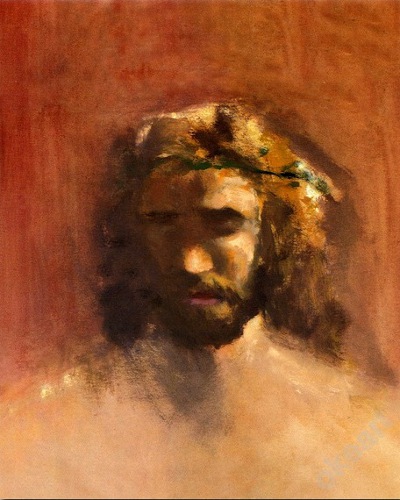
I knew of the extremely close association between Jesus and his people Israel and particularly his Jewish disciples, but I didn’t know it was also revealed here. Jesus didn’t ask, “Why are you persecuting my people” or “my disciples” but “Why are you persecuting me.” The better part of a year ago, I painted similar portraits of the Master as the Son of Israel in Minister of Peace and Gift of the Firstborn of Israel. Jesus revealed this part of his nature to Paul as well, and I hadn’t even realized it.

Now I wonder how much of this I should share in Sunday school?

Articulating an Encounter with God

saul-on-the-roadNow there was a disciple at Damascus named Ananias. The Lord said to him in a vision, “Ananias.” And he said, “Here I am, Lord.” And the Lord said to him, “Rise and go to the street called Straight, and at the house of Judas look for a man of Tarsus named Saul, for behold, he is praying, and he has seen in a vision a man named Ananias come in and lay his hands on him so that he might regain his sight.” But Ananias answered, “Lord, I have heard from many about this man, how much evil he has done to your saints at Jerusalem. And here he has authority from the chief priests to bind all who call on your name.” But the Lord said to him, “Go, for he is a chosen instrument of mine to carry my name before the Gentiles and kings and the children of Israel.

Acts 9:10-15 (ESV)

This is part of the section of Acts 9 Christians typically call “the Conversion of Saul” (Acts 9:1-19). It is what Pastor Randy’s message was about during last Sunday’s sermon, and it is what Charlie taught to the Sunday school class I attended after the worship service.

There’s just tons and tons and tons I could comment on, especially regarding the material and discussion in Charlie’s class, but I’m going to address almost none of it in this week’s “church report.” If I did, I’d probably start more of a messy debate than I really want to deal with. But rather than talk about the things I don’t always agree with the church about, I want to talk about something that actually “clicked” for me.

In fact, when I heard some of the folks in class mention this, I practically wanted to jump for joy. I’d never heard Christians talk like this before. It was as if they were reading my mind.

Let me explain.

Have you ever heard any Christian say something like, “And then the Lord told me to do such-and-thus?” How about this one: “I felt that it was a calling from the Lord for me to do such-and-thus?”

I’ve heard those phrases from time to time and I’ve always wondered about how those Christians could know that what they were experiencing was from God vs. a “message” they were telling themselves based on what they wanted to hear from God. When I’ve made such a statement before, I’ve usually been criticized for not understanding how the Holy Spirit moves in people’s lives. But get this…the members of my class who were vocal about it agreed with my assessment. One gentleman even said it gives him goosebumps in a “creepy” way when people talk like that.

Wow!

I even felt comfortable enough to weigh in with my own opinion.

Now just to be clear, no one was saying that God doesn’t work in our lives, direct us in our actions, and require that we serve Him.

It’s just not based on a “calling” such as we see in Paul’s encounter with Jesus in Acts 9. An interesting opinion that’s been coming out of the church I attend for the past several weeks is that Acts is a “transitional” book and doesn’t describe what we can typically expect in a Christian life. We can’t expect to have a “Paul on the road to Damascus” encounter with Christ. We aren’t going to (probably) see a blinding white light or hear a Bat Kol from Heaven. And we aren’t going to receive an amazingly clear-cut calling to perform a specific set of actions from Jesus the way Paul received it.

Or for that matter, we won’t have an experience like this one, either.

Now there was a disciple at Damascus named Ananias. The Lord said to him in a vision, “Ananias.” And he said, “Here I am, Lord.” And the Lord said to him, “Rise and go to the street called Straight, and at the house of Judas look for a man of Tarsus named Saul, for behold, he is praying, and he has seen in a vision a man named Ananias come in and lay his hands on him so that he might regain his sight.” But Ananias answered, “Lord, I have heard from many about this man, how much evil he has done to your saints at Jerusalem. And here he has authority from the chief priests to bind all who call on your name.” But the Lord said to him, “Go, for he is a chosen instrument of mine to carry my name before the Gentiles and kings and the children of Israel. For I will show him how much he must suffer for the sake of my name.” So Ananias departed and entered the house. And laying his hands on him he said, “Brother Saul, the Lord Jesus who appeared to you on the road by which you came has sent me so that you may regain your sight and be filled with the Holy Spirit.” And immediately something like scales fell from his eyes, and he regained his sight. Then he rose and was baptized; and taking food, he was strengthened.

Acts 9:10-19 (ESV)

covering-eyesDon’t get me wrong. It would be great for Christ to talk to us and we could talk back, just like the conversation Ananias had with the Master, but such is not to be (to the best of my knowledge). It would be great if we could receive such specific information and even better if, like Ananias in verses 13 and 14, we could respond back, even questioning our instructions. Of course, that sort of communication presupposes that, again like Ananias, we would then respond in obedience, even if it was against our better (human) judgment, and do what we were told to do, That sort of communication presupposes that we would even act in obedience to restore the sight of someone who, up until a few days ago, had been a bitter enemy bent on imprisoning us and even killing us. It would mean we would have to obey the Lord and learn to address our enemy sincerely and with compassion as “brother.”

That doesn’t happen too often.

It must have been a difficult thing for Ananias to do, but he did it because he was a Jew and a disciple of the Master who was obedient to God.

But that doesn’t particularly mean what Paul and Ananias experienced transfers in any way to what we experience. Paul heard a voice from Heaven. When a modern-day Christian says, “the Lord spoke to me,” what do they “hear” if anything at all? We are not Paul. We are not Ananias. There’s no real evidence in New Testament scripture of Christians receiving a “calling” as many believers use the expression. I think the best we can hope for is this.

Now there are varieties of gifts, but the same Spirit; and there are varieties of service, but the same Lord; and there are varieties of activities, but it is the same God who empowers them all in everyone. To each is given the manifestation of the Spirit for the common good. For to one is given through the Spirit the utterance of wisdom, and to another the utterance of knowledge according to the same Spirit, to another faith by the same Spirit, to another gifts of healing by the one Spirit, to another the working of miracles, to another prophecy, to another the ability to distinguish between spirits, to another various kinds of tongues, to another the interpretation of tongues. All these are empowered by one and the same Spirit, who apportions to each one individually as he wills.

1 Corinthians 12:1-11 (ESV)

The entire chapter of 1 Corinthians 12 describes how we are all different and all possess varying skill sets within the body of believers, but our gifts originate from a single Spirit and we serve One God.

I’m sure you have noticed what you’re good at and what you’re not so good at. I’m sure you have been in situations where what you’re good at can (and hopefully has) been applied to serving other people and serving God. Beyond specific skills, anyone can donate a can of food to their local foodbank. Anyone can visit a sick friend in the hospital. Anyone can listen to a friend who is going through a tough time tell you their troubles for an hour or so just because you don’t want them to feel alone.

But it doesn’t mean that God has “called” you to do this or that or such or thus.

So the question came up, how do you know you are where you are and doing what God wants you to do?

That’s a tough one. It really is. We tossed that one around in class for a bit. Some folks think that if they’re in a situation and there’s no adversity, then that’s where God wants them to be. Problem is, sometimes God puts you in a spot where you’re going to experience adversity, such as what Christian missionaries face in certain African countries. Just because there are problems doesn’t mean you’re in the wrong place to serve God.

My own litmus test (and this is just me) is that when I find myself doing something I never would have chosen for myself in a million years and it is something that is helping other people and serving God, then that’s where God wants me to be.

walking-side-by-sideNo, it’s not like God always puts me in uncomfortable and even miserable situations. In fact, on Saturday, I had a meeting with Pastor Randy to discuss some work I wanted to do for the congregation (yes, I met with him on Shabbos…if that bothers you, then you’re going to have to get past it). We ended up talking about a great many topics near and dear to my heart. I discovered that we have many attitudes and opinions in common and I even managed to bring up subjects with him that I thought might be premature, given how little time we’ve had to get to know one another.

I’ve had my doubts in the recent past that this church was where God wanted me to be. No, I haven’t heard even a single audible word from God for or against my being at this church, but the way things seem to be presenting themselves, I can see that there’s a fit between this church and me (no one was more surprised than I was).

Am I being “called?” Nah, probably not. But God does work in our lives in ways we can’t always explain or even understand. Beyond what I’m saying in today’s “church report,” I can’t really articulate the experience. I just know that like my bi-monthly coffee companion said not to long ago, I have encountered God in church.

Imagine that.

The Jesus Covenant, Part 6: Tracking the Elusive Covenant

Then he began with Mosheh and all of the Prophets and explained to them all of the Scriptures that spoke about him. They came near the village to which they were going, and he set his face as if he were continuing on his way. They urged him, saying, “Stay with us, for the time of evening has arrived, and the day has stretched on.”

So he entered the house to stay with them. When he reclined with them, he took the bread, made a barchah, broke it, and gave it to them. Then their eyes were opened and they recognized him, but he turned aside and passed from their eyes! They said to one another, “Were our hearts not burning within us as he spoke to us on the road and interpreted the Scriptures?”

Luke 24:27-32 (DHE Gospels)

Oh, I get by with a little help from my friends
Mm, gonna try with a little help from my friends
Mm, I get high with a little help from my friends
Yes I get by with a little help from my friends
With a little help from my friends

-Lennon and McCartney
from the song, With a Little Help from My Friends (1967)

I wish that the Master would speak to me and cause my heart to burn by starting “with Mosheh and all of the Prophets and explaining…all of the Scriptures that speak about him.”

As you know, particularly from Part 4 and Part 5 of this series, I’m having trouble matching up the New Covenant as described in Jeremiah 31 and Ezekiel 36 with the words of the Master we find in Mark 14:22-24 and Luke 22:19-20. If, as I learned from Derek Leman, the New Covenant is directed specifically at the Jewish people but possesses blessings for non-Jews, where can I find the blessings for the nations? Where can I find the connection?

As it turns out, the connection not only eludes me but, perhaps generations of people who are far more learned than I am:

I would not claim to be in any of the categories you mention, but we have history of nearly two thousand years of scholars who have traveled the same terrain – some of the most profound issues of our faith – and other who are doing the same right now. You really would benefit from some familiarity with their work. –Carl Kinbar

I feel better knowing that I’m not alone. I’m encouraged that I’m pursuing something that is as mysterious to others as it is to me. But then, what hope do I have in discovering answers to questions that scholars and saints have been wrestling with for the better part of 2,000 years? On the other hand, if I don’t attempt to also wrestle with these questions, how can I ever come to terms with my faith or have confidence that I, as a Christian, am also in covenant relationship with the God of Abraham, Isaac, and Jacob?

So many Christians take their faith for granted; they simply assume that the covenants and promises they’ve heard about from the pulpit are all explained and settled. Almost magically, the church leaps from “I will make a new covenant with the house of Israel and the house of Judah,” which we see in Jeremiah 31:31 (ESV) to this interpretation, taken from the The World Alliance of Reformed Churches website (added emphasis mine):

First, it is a community of God’s Torah: “I will put my torah in their midst” (31.33). The word torah means “law” and the teaching of the law and points to a way of ordering all of life under the covenant God. Specifically, torah provides a way of seeing reality through the lens of God’s passion and grief. Thus, the new covenant community (church) with torah in its midst will be transformed from self, indifference, and trivial moralisms to neighbour, witness, and costly love.

…Second, the new community (church) will be in covenantal solidarity about the knowledge of God: “They shall all know me, from the least of these to the greatest” (Jer 31.34).

Third, the new covenant community (the church) will know, experience and practice forgiveness: “I will forgive their iniquity and I will remember their sin no more” (Jer 31.34).

broken-crossNot to be too harsh toward my brothers and sisters in the church or the many Christian scholars who support these conclusions, but I can find no method of transferring the New Covenant which God has and will make with “the house of Israel and the house of Judah” to the Christian church of non-Jewish believers in Jesus Christ. It’s just not there in Jeremiah 31, nor in Ezekiel 36. So then, where do I look? As I alluded to above, “I’ll get by with a little help from my friends.” Here’s what one of them had to say.

I also don’t see how the Jeremiah and Ezekiel passages relate to Gentiles (at least not directly) and no exegetical commentary will claim that they do. That’s the stuff of homiletical commentaries. The only passages I know that implicitly make the connection are 1 Cor 11 and 2 Cor 3, both of which clearly have Gentile settings. While we see plenty of prophetic mention of light to the Gentiles and New Testament expansion of the gospel to Gentiles, the connection with the New Covenant seems to be a Pauline revelation/midrash. Exegetical commentaries should be helpful there, too, although many of them are supersessionist.

That’s a start, but before pursuing those scriptures in earnest, I want to outline the rest of the search.

I’ve already mentioned Mark 14:22-24 and Luke 22:19-20, where Jesus connects the shedding of his blood with the inauguration (but not completion) of the New Covenant. We see the same scene displayed before us in Matthew 26:26-29 (ESV):

Now as they were eating, Jesus took bread, and after blessing it broke it and gave it to the disciples, and said, “Take, eat; this is my body.” And he took a cup, and when he had given thanks he gave it to them, saying, “Drink of it, all of you, for this is my blood of the (Some manuscripts insert “new”) covenant, which is poured out for many for the forgiveness of sins. I tell you I will not drink again of this fruit of the vine until that day when I drink it new with you in my Father’s kingdom.”

Also, as I previously mentioned, Hebrews 8:6-7 addresses the New Covenant, however, a significant mention of the New Covenant is present in the following chapter of Hebrews, especially 9:15-22. We do see Paul talking about a covenant in Galatians 3:15-18, but it is specifically the Abrahamic covenant, so I’ll bypass Galatians until another day. Hebrews 6 also discusses God’s promise to Abraham.

Before going on, we need an anchor in the language of the New Covenant as recorded in the Tanakh (Old Testament). All of the “connectedness” we see in the New Testament that ties back to the original New Covenant language is through Christ who the church recognizes as the Jewish Messiah. He must be our anchor, or there is no connection at all.

“Behold, the days are coming, declares the Lord, when I will fulfill the promise I made to the house of Israel and the house of Judah. In those days and at that time I will cause a righteous Branch to spring up for David, and he shall execute justice and righteousness in the land. In those days Judah will be saved, and Jerusalem will dwell securely. And this is the name by which it will be called: ‘The Lord is our righteousness.’ –Jeremiah 33:14-16 (ESV)

With our anchor, the Messiah, the “righteous Branch”, now firmly in place, our next stop in following the trail of the elusive New Covenant connection is in Paul’s first letter to the church at Corinth.

For I received from the Lord what I also delivered to you, that the Lord Jesus on the night when he was betrayed took bread, and when he had given thanks, he broke it, and said, “This is my body which is for (or “broken for”) you. Do this in remembrance of me.” In the same way also he took the cup, after supper, saying, “This cup is the new covenant in my blood. Do this, as often as you drink it, in remembrance of me.” For as often as you eat this bread and drink the cup, you proclaim the Lord’s death until he comes.

Whoever, therefore, eats the bread or drinks the cup of the Lord in an unworthy manner will be guilty concerning the body and blood of the Lord. Let a person examine himself, then, and so eat of the bread and drink of the cup. For anyone who eats and drinks without discerning the body eats and drinks judgment on himself. That is why many of you are weak and ill, and some have died. But if we judged ourselves truly, we would not be judged. But when we are judged by the Lord, we are disciplined so that we may not be condemned along with the world. –1 Corinthians 11:27-32 (ESV)

One thing the plain meaning of the text does for me is to more solidly connect the term “New Covenant” with that we call “the Lord’s Supper.” However, Paul seems to be employing the imagery we find in that event (Mark 14:22-24, Luke 22:19-20, Matthew 26:26-29 ESV) as a commentary or perhaps as midrash, using the people and activities associated with the Last Supper to describe the implications of the New Covenant upon the non-Jewish Corinthian church as those implications link back to the covenant’s core values and ideas.

Thus, if Paul believed it was through the blessings in the New Covenant (which primarily solidified and expanded the Abrahamic and Mosaic covenants with the Jewish nation) that the Gentile Christians were also allowed to have a covenant relationship with God, he is saying that, by his audience behaving in a reprehensible and disrespectful manner when gathering together to break bread, they were also desecrating their New Covenant relationship, and thus bringing shame, rather than honor, to the Messiah. The result was that the Gentile Christians brought judgment upon themselves so that, through that discipline, they would not be condemned as will be those who are not in covenant relationship with God.

While Paul is using the Lord’s Supper/New Covenant language as metaphor and midrash to drive his point home to the Corinthians, from our point of view, we see a stronger link between the New Covenant, the “New Covenant” language used by Jesus during his last meal with his closest disciples, and how it can be applied, both positively and negatively, depending on the behavior of those people who are subject to specific covenant blessings; to the non-Jewish disciples who are called by the Messiah’s name.

To me, this is very encouraging. Although the route isn’t exactly straightforward, I can follow my “trail of breadcrumbs” from Jeremiah, to the Last Supper, and then to Paul’s “Corinthian midrash” on the New Covenant. It’s as if I’m trying to watch a television set from my youth, persistently adjusting the fine tuning knob to slowly produce a sharper image. But can we find even more clarification by progressing further along the path? What about 2 Corinthians 3? We’ll get to that particular milestone in Part 7 of this series.