Tag Archives: religion

Love Loses: The Aftermath of Terrorism and Humanity

starfish“You must not lose faith in humanity. Humanity is like an ocean; if a few drops of the ocean are dirty, the ocean does not become dirty.”

―Mahatma Gandhi

Two bombs exploded near the crowded finish line of the Boston Marathon on Monday, killing three people and injuring more than 140 others in a terrifying scene of broken glass, smoke and severed limbs, authorities said.

CBS Boston station WBZ-TV reports one of the three who died from the attack was an 8-year-old boy.

“Deadly bombs rock Boston marathon”
CBSNews.com

Normally I can bounce back from the impact of events like this one but not this time. I wrote about the Sandy Hook Elementary School shootings more than once, and managed to recover my balance, my relationship with God and humanity, and keep on going, but somehow, this time is different. I don’t think that the specifics of the Boston Marathon horror are different, I just think all these events are cumulative. They’re piling up inside of me and crowding out my soul.

In every human being there is only so large a supply of love. It’s like the limbs of a starfish, to some extent: if you chew off a chunk, it will grow back. But if you chew off too much, the starfish dies. Valerie B. chewed off a chunk of love from my dwindling reserve … a reserve already nibbled by Charlotte and Lory and Sherri and Cindy and others down through the years. There’s still enough there to make the saleable appearance of a whole creature, but nobody gets gnawed on that way without becoming a little dead. So, if Cupid (that perverted little motherf**ker) decides his lightning ought to strike this gnarly tree trunk again, whoever or whatever gets me is going to get a handy second, damaged goods, something a little dead and a little crippled.

-Harlan Ellison
from “Valerie: A True Memoir” (1972)

Ellison doesn’t leave his commentary on personal tragedy and untimely death like that and continues by saying, “Don’t close yourself off, but jeezus, be careful of monsters with teeth.”

Harlan Ellison used to be one of my favorite authors about thirty to thirty-five years ago or so, but eventually, the anger, abrasiveness, and lawsuits that characterized his life began to take their toll on mine and I had to move on. However in moving on, I failed to take into consideration that Ellison just writes as a reflection of our human environment, and the cynicism, dissatisfaction, and out-and-out rage at life he expresses is merely the sea we’re all swimming in. That sea is full of hungry sharks and they smell blood.

Oh, these thoughts and feelings aren’t new to me and in fact, I wrote my own starfish story not too long ago.

Since this latest act of terror, two predictable messages have dominated the news and the social media outlets: encouragement and blame. Gandhi is only one example of the encouragement type message that you can find on Facebook lately. In fact, after Newtown, I based one of my meditations on something attributed to Fred Rogers:

When I was a boy and I would see scary things in the news, my mother would say to me, “Look for the helpers. You will always find people who are helping.”

I’m sure that’s true, but there seems to be only a few helpers left. The rest of us are just “helping ourselves,” usually to things that don’t belong to us.

defeated-boxerI actually wrote on this theme, disappointment in the human race, days ago, and that “meditation” will appear on Friday morning as my commentary on this week’s Torah Portion. But the sinking feeling that we are all sinking won’t leave me and I’m not going to wait until Friday to complain about it. I slept pretty well last night, but the night before was consumed with dreams of death, blood, kidnapping, and violence. I finally woke up at 3 a.m. and was glad to do so. Sometimes sleep is the only escape I can find from the battering life dishes out, but not always.

Sometimes living is a battle and the only thing you can do is fight back, maybe hoping to win, or maybe hoping just to survive the defeat.

In the clearing stands a boxer
And a fighter by his trade
And he carries the reminders
Of ev’ry glove that layed him down
Or cut him till he cried out
In his anger and his shame
“I am leaving, I am leaving”
But the fighter still remains

-Paul Simon (recorded by Paul Simon and Art Garfunkel)
from the song “The Boxer” (1968)

In answering a question about “why bad things happen to good people” related to natural disasters, the Aish Rabbi replied:

Thank you for your thoughtful question. It is really a formulation of the classic: “Why do bad things happen to good people?” Let me try to explain:

The story is told of the king who commissioned a tapestry to be woven. In the middle of the work, someone came upon the weaver and saw a mish-mash of different colored threads, loose threads and, in general, a very messy piece of work. A complaint was issued to the king who then confronted the artist. The artist pleaded with the king for a few days to prepare his defense. After those few days he came before the king with a wrapped package and told the king, “Here is my defense.” Inside the package was the completed tapestry.

The moral is that we cannot judge the work until it is completed. Moses asked to see God’s face. That request was denied, but he was allowed to “see” God’s “back.” It is explained that Moses wanted to understand how God runs the world. The response was that it is beyond human comprehension until you see the “back.” That is, until we can see the whole picture; then in hindsight it will all make sense.

While this answer may seem a “cop-out,” it prevents us from trying to understand God’s actions from our very limited perspective. In order for us to be able to “judge God,” we need to consider God’s “ground rules” for existence. Using this premise, it becomes very difficult to judge God. Why? Because we are stuck in a finite perspective of time and space, and we can therefore never be sure which rules God is employing at any given moment.

In order to begin to make sense of this, one thing we must understand is that God is in control, and there are no accidents. There has to be intrinsic meaning in our lives; otherwise we are just a random collection of molecules whizzing through space, with no real direction or purpose.

We are living in a very complex world, and in such a world, God doesn’t only deal with individuals, he also deals with nations.
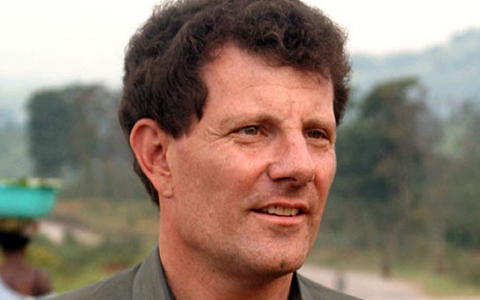
nicholas-kristofOK, I get it. God is a “big picture” kind of guy and I can’t see the forest for the trees, if you’ll forgive the mixed metaphor.

But when is enough enough? When do the encouraging messages and the happy platitudes become tiresome and ineffective? Is that why New York Times columnist Nicholas Kristof blamed the GOP for the Boston Marathon explosions or why the Westboro Baptist (so called) Church is threatening to picket the funerals of the three people killed as a protest against the LGBT community?

That isn’t fighting back against injustice, that’s insane cruelty. It’s insane to hope that the bomber turns out to be an Arab Muslim or an ultra-conservative white American. The only person to blame for the explosions is the person to planted the bombs, just like the only person to blame for the Newtown School shootings is the person who pulled the trigger.

But if I truly believed that, then I could be like Gandhi, seeing these horrific acts as aberrations among a much larger humanity I can be proud to be a part of, and I could dismiss a few drops of dirty moisture as insignificant amid a sea of refreshing, life-giving water.

But it’s not just a few drops, it’s an endless flood, not of water but of gushing blood, ripped and torn flesh, and the screams and cries of the wounded and dying.

Reddit hosts specialty pages including one on Atheism which is used to make fun of religion and religious people. I guess that sort of thing floats their boat.

Anyway, I saw a photo a “redditer” posted the day after the Boston Marathon explosions of a person donating blood. The story that went along with the image said that the blood donor had been reading a lot of messages (presumably on Facebook and twitter) from Christians saying how they were praying for the victims of the explosions. He decided to do something a little more helpful by donating blood.

I couldn’t help but agree with him, not that I believe prayer ineffective, but the answer to prayer is to actually do something about it, like giving blood. Those type of people, Christians, Atheists, or otherwise, are the “helpers” Fred Rogers’ mother was talking about.

But, to recall Gandhi, are the helpers the ocean or the few drops of “clean” water that are left amid a sea of blood, mud, and fecal matter?

Jesus once lamented, “However, when the Son of Man comes, will He find faith on the earth?” (Luke 18:8 NASB). Rabbi Tzvi Freeman wrote, “One who does good brings in more light. One who fails, feeds the darkness.” I am more than aware that I am currently feeding the darkness but I’m hardly alone. For every ten people who are willing to donate blood for people who need it, the world summons ten-thousand who will be glad to shed more blood. If a hundred people hold candles in the night to defy the darkness, a million will extinguish the light, and then rape and murder the terrified victims trying to hide in the shadows.

drowningThere’s no one left to blame except ourselves, so we might as well stop pointing fingers at everyone else besides us. Our group, our political party, our religion, our gender identity, our race, our ethnic type is no more pure than anyone else’s and the one equalizing factor is that we are part of the grubby, trashy, filthy ocean of the human race. We all planted the bombs. We all pulled the trigger. We all spilled blood. We are all drowning in the pain and the death, submerged, begging for air, begging for mercy, begging for life.

Encouraging messages such those uttered by Mahatma Gandhi and Fred Rogers are meant to lift us up out of that ocean so that we can, by resisting discouragement and depression, rise above and lead others to be agents of change and optimism.

But Gandhi and Mr. Rogers are both dead. All of the heroes are dead. The world we live in now looks up to people like Honey Boo Boo, Snooki, and Kim Kardashian. Welcome to the “progressive” age of humanity. The Prophet Isaiah was correct when he said that in the last days good would be called evil and evil would be called good. The apostle Paul expanded on this:

But understand this, that in the last days there will come times of difficulty. For people will be lovers of self, lovers of money, proud, arrogant, abusive, disobedient to their parents, ungrateful, unholy, heartless, unappeasable, slanderous, without self-control, brutal, not loving good, treacherous, reckless, swollen with conceit, lovers of pleasure rather than lovers of God, having the appearance of godliness, but denying its power.

2 Timothy 3:1-5 (ESV)

Paul wisely advised those reading his letter to avoid such people, but how is that possible when they are the only people in the world (or so it seems)? In Arkansas, groups are suing the state for the “right” to abort babies up until birth rather than banning abortions after twelve weeks gestation (as if killing a baby at any time could be considered a “good” thing to do). People are obsessed with American Idol and couldn’t care less about any suffering that CNN and the New York Times doesn’t deem worthy of attention. We greave now for the eight-year old boy who was killed in the Boston explosions, but next week, he’ll be replaced by the latest “reality TV show.” And this piece of obvious bigotry didn’t help.

The Joker, played by Heath Ledger is the film The Dark Knight (2008) was right: “When the chips are down, these… these civilized people, they’ll eat each other.”

And we will. Rob Bell (infamously) wrote a book called Love Wins. He was wrong.

161 days.

The Divine Arsonist: A Book Review

divine-a“Thank God for David and for the creek. They said the cold water probably saved your life. David called in a Lifeflight helicopter and covered you with a blanket. He stayed with you the whole time. They got you down here to St. Luke’s but you were in a coma by then. That was four months ago. Four months. The doctors are shocked that you made it at all. You were a mess. The whole left side of your body was shattered, ribs, arm, pelvis. The burns were bad but they were more worried about the skull fracture. They kept testing you for brain wave activity and every time they were amazed by the results. Even though you were deep in a coma, they said it was like you were living a parallel life somewhere else.”

-Jacob Nordby from the Epilogue of his book
The Divine Arsonist: A Tale of Awakening

This isn’t the sort of book I normally read but somehow Jacob Nordby ended up being my “friend” on Facebook, and his book “Divine Arsonist” keeps coming up in my Facebook updates. I don’t really know how we got to be “friends” on Facebook (I’ve never met him) except that we both live near Boise and we’re both published authors.

I’m generally skeptical of self-help books or texts that purport to show some sort of inner truth or secret meaning to life, but in the back of my brain, every time “Divine Arsonist” appeared in my web browser, I couldn’t shake a twinge of curiosity. Also, I remember part of a transaction I had with Nordby on Facebook. I don’t remember the conversation specifically, but I do remember him gently chiding me about the “path” I’m on, referring to my faith. So I was curious about his particular path.

And I review books.

I normally receive complementary copies of the books I review from the publisher but this time I purchased a kindle edition, which was very inexpensive. I thought I’d shoot through the text rather effortlessly, but I had to really make myself read his book, and I found myself fighting the temptation to abandon it about halfway through.

I don’t want to be unfair. If this book is the result of Nordby being the victim of a hit-and-run car accident in which he was terribly hurt, and if he has suffered all of the misfortunes the Epilogue of his book records, then I have nothing but compassion for him and his family, and I do not want to make light of his experiences. And yet, so much of his book of spiritual allegory is presented as part of his lived experience, I don’t know where his actual life stops and all the fiction begins.

So what did I think of his book?

The Divine Arsonist is the story of a businessman who worked hard to climb the ladder of success only to have something whisper to him that perhaps there was something more to discover. This is his journey of discovery told in a blend of the personal story and fiction. It immediately spoke to me of the question: When do we start dreaming a new dream for ourselves and our world? The old ways are burning us out. That’s where Jacob is at the beginning of his journey. There are so many elements of a shamanic journey, vision quest or hero’s journey from old mythology: meeting spiritual guides, being challenged to endure rites of passage, time in the wilderness, facing the shadow and opening to all the levels of reality beyond our day-to-day “get it done” consciousness. The writing is luscious, descriptive and an easy read. I could have easily read it in one sitting but I forced myself to turn off the light at night and savor it over the course of several bedtime reading sessions. There are beautiful teachings that you want to grab the highlighter to remember.

Jacob’s journey toward finding his light is an invitation or challenge to go on your own journey, to claim your own light. It is a tale that reminds us that life is short and that we are choosing the world we live in right now with each thought and each action we take. It is a story that reminds us that sometimes we have to let go of everything that we think we know to become the person we came to earth to be. Even though I’ve had my own awakening moments, Jacob’s writing made me want to commit to living them on an even deeper level. Isn’t that what we want a spiritual book to do?

Amazon review by Carol Woodliff

I don’t normally look at the other reviews of a book I intend on reviewing, but after finishing Nordby’s book, I thought I must be missing something. Woodliff’s review is typical of the overwhelming amount of praise “Divine Arsonist” has received, at least on Amazon. So why aren’t I “wowed” too?

“So, back to your book. Emerson said ‘make your own Bible. Select and collect all the words and sentences that in all your reading have been to you like the blast of triumph out of Shakespeare, Seneca, Moses, John and Paul.'”

-Nordby, Chapter Ten

Those few sentences really tell you everything you need to know about the philosophy that Nordby relates in “Divine Arsonist.” The essence is to not rely on any single truth such as, for example, Christianity or Taoism, but to derive truths from whatever seems to touch you as a truth. While Nordby’s story relies on external “guides” such as Lucius and Jack to assist the author on his spiritual journey, the truths that seem to come out in the end are truths that matter most to Nordby…or presumably anyone on a similar path. It’s what you would expect of a person taking different elements from a wide variety of world religions and philosophies and weaving them into what looks, sounds, and feels right to that individual…a completely, subjectively constructed set of truths.

CASTANEDA_kraftensgjerningerAlthough Nordby only mentions the works of Carlos Castaneda in passing, the experiences he relates reminds me of how Castaneda’s “Don Juan” series has been described to me (I’ve been meaning to read Castaneda for years but never got around to it). I guess that’s what impresses me the most, or fails to impress me, about “Divine Arsonist.” It seems all too derivative, all too “borrowed” from other religions to be truly insightful, let alone remarkable.

I swam through a field of unconditional love to explore the Great All-Nothing. Without effort, I was there, face to face with what could only be the Mystery of Mysteries, Yahweh, Baha, Wakan, Tanakh, Allah, Krishna, God the Father-Mother, Rah.

I have to assume that some parts of the book accurately describe Nordby’s past, and if so, then Christianity, or the part he experienced, was extremely…extreme, and restrictive, and joyless. Nordby did manage to salvage some portions of the Christian writings, but a much larger part of his philosophy is founded on nature-based religions such as different Native American beliefs. There was also a fair amount of mysticism involved and I’ve spent enough time reading Kabbalah and Chassidic Tales to recognize some symbols from those sources (I should say that I doubt Nordby has actually read from Jewish mystic texts, but many mystic themes seem to travel across different disciplines).

Here’s a short sample:

Masters and ancient ones have appeared to bring the light. In earlier days men were more simple, natural. They lived with the Earth and were guided by the Great Mother’s voice.

A dual male/female god isn’t unusual, even in Judaism. In mystic thought, the Ein Sof is the powerful, creative, male force God while the Divine Presence, which descended upon the Tabernacle in the desert (see the end of the Book of Exodus) is considered feminine and nurturing.

There also seemed to be some of the eastern philosophies influencing Nordby, “surrendering the ego” and such, and though I doubt it was intentional, I caught a few references that could have been from The Matrix (1999) and even the cave scene from The Empire Strikes Back (1980), though the connections were only superficial.

“Divine Arsonist” seems to be the sort of book that would appeal to someone who is on a spiritual journey (and aren’t we all) but who doesn’t want to choose one of the pre-conceived paths. Well, not exactly, anyway. If a person isn’t attracted to a pre-existing religion or philosophical discipline, then “Divine Arsonist” offers the alternative of borrowing as much or as little from any or all of the traditions human beings have created for themselves over time. It’s actually quite appealing when seen from that light.

I don’t want to minimize the impact of all this, particular in Nordby’s life, since it is obviously quite significant.

However, as you know if you’ve been reading this blog for any length of time, I travel a somewhat different path, and while it isn’t entirely traditional, it is truthful to say that I rely on what I consider to be an objective and external God, the God of Abraham, Isaac, and Jacob, and a book or repository of truth and wisdom that has existed in one form or another for thousands of years. The difference for me in writing my own Bible vs. exploring the one I believe was given to us by God, is that in the former, I’m investigating merely myself and my own symbols in relation to my environment and how I perceive it, even in the spiritual realms. In the latter, I’m delving into not only my relationship with my environment but my relationship with the One, Radical, Creative, Unified, God and how He desires to relate to me.

seeking_the_sunTruth isn’t just what I decide it will be, even below the conscious level (although most humans sometimes attempt to manipulate “truth” to their own advantage), but it’s what God has decided it will be. My task is to search for truth where ever it may be found, uncover it, and let the sparks fly upward back to their source (and you’ll forgive me if I momentarily borrow from the imagery of Chassidic mysticism).

God has created a trail for each of us and in partnership with Him, we walk the trail together, not because God needs us as a companion, but because God wants unity with human beings and He desires to teach us about a relationship with Him. The problem with internally generated symbolism and meaning is that ultimately, you can never surprise yourself or learn something new. Oh I don’t doubt that it can be very beneficial in many ways.

But it’s not God.

However, Nordby did remind me that I always did intend to read Carlos Castaneda, so after I finish the next book in my pipeline, I’ll finally get to The Teachings of Don Juan.

After everything I just said about Nordby’s book, why would I read another book (or book series) that promises to reveal yet another “alternative” spirituality? Curiosity? Yes. But I also want to pursue the history and the mythos that Castaneda’s work contains. After all, Castaneda’s books are considered classics in their genre and not derivatives of previous works (as far as I know).

There is value in unfolding another’s symbolism and following the thread woven into their tapestry…just as long as you remain grounded upon a firmer foundation.

The Problem with Religious People

rob-bellThe former pastor and founder of Mars Hill Bible Church in Grandville, Mich., made the comment during a guest appearance this past Sunday at The Forum at Grace Cathedral in San Francisco to discuss his new book, What We Talk About When We Talk About God.

Grace Cathedral is the Episcopal Cathedral of the Diocese of California and describes itself as “an iconic house of prayer for all” and is home to an “inclusive congregation.” The congregation’s dean, the Very Rev. Dr. Jane Shaw, moderated The Forum discussion before a live audience.

When asked by Shaw if he was in favor of “marriage equality,” the politically-charged term used by some who want “marriage” redefined, Bell said:

“Yes, I am for marriage. I am for fidelity. I am for love, whether it’s a man and a woman, a woman and a woman, a man and a man. I think the ship has sailed and I think that the church needs to just … this is the world that we are living in and we need to affirm people wherever they are.”

-Nichola Menzie
“Rob Bell Supports Same-Sex Marriage, Says He Is for ‘Fidelity and Love'”
March 18, 2013 | 2:42 pm
ChristianPost.com

As for Acts 15, this is not a set of different instructions for Gentiles. But salvation is by faith, for Jew and Gentile alike. We believe they will be saved the same way we will be saved. The Torah is not the yoke that we nor our fathers have been able to bear, but rather, specifically, the Torah “according the custom of Moshe.” So it is that Paul recalls his words to Peter in Galatians, that Peter did not live “like a Jew.” The followers of Messiah Yeshua inherently cannot submit to all of the traditions of Judaism. To do so would be to disobey the Master and the Commandment of God. In separating himself from the Gentiles, Peter was submitting to Jewish halachic rulings that are not in step with the gospel, and requiring Gentiles to do likewise. Gentiles should start with the four prohibitions in Acts 15—which people are cut off from Israel for breaking—so that they can join the assembly and learn the Commandment of God, which is read in every city every Sabbath. They do not need to become Jewish and submit to the Oral Torah, they simply need to have faith in God and His Mashiach and let obedience to the Commandment working through love be the expression of that faith.

-Charles commenting on my blog post
Moshiach Rabbeinu

Why is everyone trying to change my mind?

I saw the news item about Rob Bell a few days ago. The link was posted by a Facebook “friend” (I put “friend” in quotes since I’ve never met the individual and know him solely through Facebook). It wasn’t directed specifically at me, though I did comment about it a few times on Facebook and then dropped the issue.

But Charles came to me or more accurately, to my blog to comment on his views and to disagree with mine. He seems like a nice guy. I don’t doubt that he’s sincere. But in reading my blog, he should have known from the start that we were coming from two different points of view.

Don’t get me wrong, I don’t expect to be universally accepted, agreed with, or liked. Especially in the world of religion, it’s almost a given that if you’re outspoken at all, people are going to “hunt you down like a duck” (to quote Buford Tanner from the third Back to the Future movie) from the four corners of the earth just to tell you that you’re not only wrong, but a total blockhead (with apologies to Charlie Brown, who’s been called a blockhead more times than I can count).

But it occurred to me to ask, and especially in the context of Charles and people like him, people who don’t know me or have any particular reason to read, let alone comment on my blog, why do they care what I think, say, and believe?

I mean, the Internet is full of bloggers. According to dazeinfo.com, by the end of 2011, there were 181 million blogs on the Internet. That was well over a year ago, and I’m sure there must be even more by now (jeffbullas.com has some interesting info on the nature of the blogosphere in 2012, but nothing relevant to the religious blog space).

So why me? Do I comment on your blogs? No, and in fact, I’ve deliberately stopped commenting on blogs where I know my opinions will cause a small and virtual riot just because I’m sick and tired of all the arguments. Discussions? OK. But why charge down my throat just because you know you can?

And it’s not just the blogosphere anymore.

a-j-jacobsMy Pastor recently loaned me a copy of A.J. Jacobs’ book The Year of Living Biblically. I’ve just started reading it and so far, find it entertaining and humorous. Jacobs is Jewish and not religious in the slightest, but he was determined, for the sake of writing a book, to live as close to a literally Biblical life as possible for an entire year.

I might have taken some sort of offense to his approach, but apparently this is the type of book Jacobs writes. He immerses himself in a subject for a significant period of time in order to learn, often with amusing results, records his experiences, and then turns all that into a book.

But then I had a thought. Is it possible that Pastor gave me this book to read for a specific reason, one particularly related to whether or not the Torah is possible to observe by Jews in today’s world? I’ll have to ask him, but I don’t see him until tonight.

I can understand why Pastor would want to instruct me, enlighten me, edify me, since we have a one-on-one, face-to-face relationship and I attend his church, but why does the Internet care?

Even the people I agree with theologically have some sort of interest in maintaining my current belief system which dovetails into their’s. I’ve made a paradigm shift before. What if I do so again? Who will be affected? How will they react? How much of other people’s emotions and interests are tied to what should be a single individual’s personal understanding of God and faith?

And then there’s political correctness to consider. Atheists and the socially and politically liberal religious individuals and movements are interested in convincing me (well, maybe not me personally, but everyone like me) that not only “gay is good” but that being gay is biblical and that I should not only adopt that belief as a matter of religion but as a matter of politics, carrying it all the way to the ballot box.

Does my personal opinion about how “marriage equality” factors into my understanding of the Bible have anything to do with anybody else? It’s not like I’m protesting at gay weddings or writing letters to the editor. I’m not even vocal about the issue except when my hand is forced. I live in a nation of laws and when (I don’t doubt that it will happen, it’s just a matter of time) marriage between same-sex couples becomes legal nationally, I won’t say “boo” about it. Actually, it’s not a law I could break, even if I wanted to, since I’m in no position to affect such a law one way or another.

But some people want or need me to agree with them anyway. Go figure.

After finishing Jacobs’ book, I plan to start reading Carlos Castaneda’s The Teachings of Don Juan: A Yaqui Way of Knowledge. No, I don’t plan to adopt it as my model for a personal spiritual journey, but Castaneda’s books are considered classics in their genre and I’ve been meaning to read at least a few of them for the past thirty years or so. I just never got around to it before.

I’m beginning to get disgusted again with all the little games that people play in the religious blogosphere. I’m really getting tired of all of the “I’m right and you’re wrong” pettiness that is going on out there. If it stayed “out there” it would be easy to ignore, but it’s invading my space. I’m not here to be a target. I want to be free of your chains. But it seems the only way to do that is to abandon contact with religious people and pursue God independently. Yes, that’s full of pitfalls and I returned to church just because of those pitfalls.

But I’m having second thoughts. If God wants me, He’s got me, but that doesn’t mean I have to join your particular club just because it makes you feel better to drag in more members, be ye “One Law,” Two House,” “Hebrew Roots” or any other “label” that comes with a dogma on a leash.

burning-the-sacredI can sort of see why Jacob Nordby wrote his book (which I’ll review shortly) The Divine Arsonist, since it’s the latest in a long line of attempts by people to reinvent God and religion in our own personal image. I can understand why concepts such as free range humans are coming to the surface. People want control of their lives and they’re tired of the environment defining the parameters by which we must live. That includes the parameters by which we must believe and have faith.

Christians like to say “God is in control” but when it comes to faith, it’s more like the religions and the people occupying their favorite religions that want to take control…of me.

OK, I’m exaggerating. I’m not that important to anyone, at least to anyone on the web. I could disappear tomorrow and probably not inspire so much as a raised eyebrow. Which makes it all the more mysterious to me why people want to control what I say, think, and believe.

If I don’t believe the same things as you and through my beliefs, I’m not harming you (I don’t visit you, yell at you, try to change your life, picket your weddings and funerals, pollute your holy water, or otherwise interfere in your life and the practice of whatever faith to which you’re attached), then why do you care about my religious convictions? Honestly, if I believe that God really doesn’t expect me to wear a tallit gadol when praying, doesn’t expect me to not mow the lawn on Saturday morning, doesn’t expect me to not eat a cheeseburger, how does that impact you even slightly?

Yes, I’m ranting. It’s my blogspot and I’m entitled to rant here. Tomorrow, I may wake up and feel better but right now, I’m a little tired of “religion” (and please, don’t drop by and tell me that Christianity “is a relationship, not a religion,” trust me, it’s a religion).

If you want to ask me a question, fine. If you want to deliver a polite and civil comment, fine. Even if you disagree with me and want to tell me why you do what you do, fine. Just don’t feel like you can tell me what I can, should, must do just because you’ve made those decisions for you.

When I refrain from eating bacon or sausage for breakfast, I’m not doing it because I think God will fry me in pork fat if I do. I’m making a personal decision based on my own convictions. Please feel free to enjoy a good pork chop or a steaming hot bowl of shrimp scampi. I won’t mind. If you’re a gay guy and want to marry your partner, fine. If you’re a through and through Gentile without a drop of Jewish blood in your veins and you feel you must pray in Hebrew facing toward Jerusalem and calling Abraham, Isaac, and Jacob your “fathers,” go for it.

But I’m not going to pretend they’re my fathers just because you want me to. My relationship with God is my relationship with God. I blog about it. So what? Deal with it. If you don’t like what I say, don’t come to my blog. I promise, I’ll never come to your blogs and I absolutely promise I’ll never comment on any of them.

I write because that’s what I do. I’m a writer. I write for my job. I write to process information. I write for fun. Maybe someday you’ll succeed in chasing me out of the blogosphere, but I don’t know what would compel me to shut up. On the other hand, there are days like today when I could happily pull the plug and just read and study by myself, no other human beings required.

Got it?

Lancaster’s Galatians: Introduction, Audience, and What Happened to the Torah?

Apostle-Paul-PreachesThe Apostle Peter said that the writings of “our beloved brother Paul” contain “some things hard to understand.” If that was true in Peter’s day, how much more so today. Paul was a prodigy educated in the most elite schools in Pharisaism. He wrote and thought from that Jewish background.

-D. Thomas Lancaster
from the Introduction (pg 1) of his book
The Holy Epistle to the Galatians: Sermons on a Messianic Jewish Approach

I know I’m going to regret this, but if I wait until tomorrow or later in the week to write this, I’m going to forget something about my conversation with Pastor Randy. I have to get up at an insanely early hour tomorrow, but I need to make a record of what we discussed tonight.

As I write this it’s Wednesday night. I left Pastor’s office just about fifteen or twenty minutes ago after discussing the Introduction and first chapter of Lancaster’s Galatians book with him. You’ll recall I mentioned a few days ago our intention to make a study of Lancaster’s Galatians chapter-by-chapter, week-by-week as the subject of our Wednesday night discussions. I wasn’t sure what to expect when I agreed to focus our weekly talks on this book, but I never thought I’d be involved in such a densely packed conversation. Actually, I was afraid that we would run out of material, since Chapter One (really, Sermon One) is very introductory. However, we barely made it out of the Introduction section and into the first chapter before time ran out.

I finally confessed to Pastor Randy tonight that I’m more than a little in awe that we’re having these conversations. Debating theological topics with him, given his intellect, education, and his fluency in languages, makes me feel like a five-year old trying to discuss the Grand Unified Theory with Albert Einstein. OK, maybe it’s not quite that extreme, but I’m definitely out of my depth. To his credit, Pastor Randy said the benefit he receives is that I am well versed in the New Testament from a Messianic Jewish point of view.

I’m sure there are a few people out there who would disagree with that assessment or me, but such is life.

Did Paul convert to Christianity? That question came up rather abruptly.

No, not from my point of view and Pastor Randy agreed but he believes that Paul changed direction 180 degrees from his former life as a Pharisee, not just in turning from persecuting believing Jews to supporting them and evangelizing the Gentiles, but in his entire conceptualization and attitude about Judaism (as opposed to “Jewishness” which is the quality of a person being a Jew without the religious and halalaic implications) and the Torah.

Acts 15 came into the conversation very quickly and I realized that Pastor Randy believes that not only did James and the Council absolve the Gentiles from having to observe Torah, but the Jewish believers as well. As I’ve said before when addressing Acts 15, I don’t believe James made a decision that extended beyond the Gentile disciples of Messiah.

This all goes back to our previous conversations about the purpose of the Torah, which we’ve been having for many weeks. While Pastor Randy doesn’t believe Jews and their “Jewishness” ended with Jesus, ultimately, he believes the Torah pointed to Jesus as a sort of culmination and that it’s not Judaism but the message of the Gospel that saves. He believes that if Jews had continued in the “Messianic faith” (i.e. Christianity) beyond the first century or two after the ascension, the observance of Torah would have largely fallen away. Certainly the vast majority of what we think of as Rabbinic Judaism wouldn’t have gained traction and evolved and expanded to what we see today, particularly in Orthodox Judaism.

I know more than a few Jews reading my blog post probably just winced or gasped a bit. when reading the last few sentences.

On the other hand, looking at the opposite end of history, we both agree that the Jewish Messiah King will return and sit on the Throne of David in Jerusalem. There will be a Third Temple. The festivals will be reinstated. Gentiles as well as Jews will observe the festivals but, according to Pastor Randy, the Messiah will be the focus, not simply observance for its own sake.

But will “Judaism” disappear? Should “Judaism” (as opposed to “Jews” and “Jewishness”) disappear?

I didn’t hear Pastor say that Jews should disappear, quite the opposite, but we did discuss, and discuss, and discuss what is a Jew, what is Jewishness, and what is Judaism. My argument is that, whether you agree with everything that the Rabbis said, did, and wrote over the past twenty centuries, for right or for wrong, it was the necessary element and organizational structure for the preservation of Jews as a people and without that ethnic, traditional, legal, corporate structure, with only a string of DNA identifying the Jewish people as Jewish , they would ceased to exist as an identifiable people group in the world a very long time ago.

Both Pastor Randy and I agree that God will not allow the Jewish people to perish.

But what then are the distinctions between Jewish believers and Gentile believers in Messiah, both in ancient times and now? That was a hotly debated discussion. No, we didn’t get “hot under the collar,” but we did go around and around the point, orbiting it like two comets chasing each other’s dust trails.

judaismIf the Torah is to be observed in Messianic Days during the time of the Third Temple and if God meant for the Torah to be obeyed by the Jewish people prior to the first coming of Messiah and even during his lifetime, what was supposed to happen to it between the ascension and the return? Granted, we have no Temple today, but does that mean the entire Torah is in cold storage awaiting a spring thaw? And what about the sages? Are none of their interpretations, rulings, and judgments valid? Even in Yeshua’s day, he agreed with some of the halachah of the Jewish authorities (PDF) and indeed, he agreed they had authority to make such rulings.

At one point in the conversation, Pastor Randy said that he believes both Jews and Gentiles in Messiah in today’s world should look and behave in substantially similar ways, if not identically based on his understanding of the New Testament. His issue is that Torah was always impossible to keep and was put in place primarily to point to that impossibility and why we all need the Messiah. My point is that such an act looks like God just set the Jews up to try to obey an impossible set of rules for the sake of eventually pointing to Jesus. Those hundreds of generations of Jews who lived and died struggling to obey Torah would have led lost lives if the only reason for Torah’s existence was to make a point. What saved those ancient, devout Israelites?

“Grace,” says Pastor Randy.

My point exactly. Torah never, ever was intended to save. It was always faith and grace.

I think he can agree with the value of the Jewish traditions if they’re viewed as traditions and not behaviors one must do in order to please God. “But what about feeding the hungry and visiting the prisoner,” says I? The Torah didn’t stop, particularly the parts that clearly are a responsibility for Christians and Jews today. And if “Rabbinic Judaism” was God’s mechanism for preserving the Jewish people as a people since the fall of Jerusalem in 70 C.E., then who is to say that it’s wrong? After all, what systems have been put into place to implement and sustain Christianity over the long course of history?

One of the big stumbling blocks in the discussion was “Rabbinic Judaism” which could be defined as relying on a “system” instead of what the Bible says. I countered that a Christian denomination is a system and that Pastor Randy operates within one. He countered that he can and has existed outside a denomination before and that what the Bible says is ultimately more important than a denomination or any other system of religious practice.

But do we have unfiltered access to the Bible and to God? Don’t we use “systems” as the means by which we implement what the Bible tells us to do in our daily lives? Yes, if we take all of the incredible detail involved in living life as an Orthodox Jew, for example, those “implementations” are vast, multi-layered, and frankly, there are many that seem to go too far (I know I’m going to catch heck for that), but it’s still fits my definition of what humans do to “operationalize” a life of faith. Christian denominations do this to a lesser or greater degree, but without the same level of formalization (after all, what is Christmas, what is Easter, and what is Lent?).

Can we live a life of just the Bible without a system (be careful how you answer that)? Are there portions of both the modern Christian and the modern Jewish “systems” that are valid interpretations of a Biblical life, even if Messiah would (and will) have “issues” with other portions?

Jesus made distinctions between halachah he supported and did not support (is it lawful to heal on the Shabbat?) when he was first here and I suspect that he’ll “straighten out” both Jews and Gentiles when he returns. Some Jewish authorities write that one of the things Messiah will do when he comes (returns) is teach Torah properly and I believe it, too.

Shofar as sunrisePastor Randy says he believes that Gentiles should and will observe Pesach, Shavuot, and Sukkot along with the Jews but you can’t do that without the Torah not only being intact, but valid, and able to be applied in our world.

You can see why we almost didn’t make it out of page 1, let alone the Introduction of the book, and this is where we spent most of our discussion time. Sermon One runs from page 9 to page 19. It’s where we’ll have to pick up next week, but we did encounter an interesting question in the Sermon One material, and one I thought I knew the answer to. To whom did Paul write the Galatians letter? Yes, the churches in Galatia, but who in those churches? On page 19, Lancaster says it’s to the “God-fearing Gentile believers in Galatia” specifically.

But get this:

For I would have you know, brothers, that the gospel that was preached by me is not man’s gospel.

Galatians 1:11 (ESV)

Would Paul have called Gentles “brothers?” Wouldn’t it have made more sense for him to call his fellow Jews by that name?

We ourselves are Jews by birth…

Galatians 2:15 (ESV)

Paul is obviously talking to Jewish people at this point.

To give a human example, brothers…

Galatians 3:15 (ESV)

Brothers, I entreat you…

Galatians 4:12 (ESV)

I could go on. There’s 4:28, 4:31, 5:11, 5:13, and 6:1 to consider, but according to these references, there’s every reason to believe that Paul was addressing both a Jewish and a Gentile audience in this letter. That being the case, Pastor Randy suggests that Paul is explaining to both Jewish and Gentile believers that obedience to the Law is not necessary if one is in Christ. Is obedience to the Law unnecessary for either the Jew or the Gentile if Messiah is your Master?

Salvation is through Jesus but does that obliterate the Sinai covenant for the Jews? Pastor Randy and I agree that it is through Abraham and the New Covenant that we Gentiles are “grafted in.” We know that the Hebrew for the word “New” in “New Covenant” really means “new” and not “renewed,” even though the wording of the New Covenant (see Jeremiah 31 and Ezekiel 36) largely confirms and expands all of the covenants that God previously made with Israel.

Something I didn’t remember to bring up during my conversation with Pastor Randy is the question of whether or not the New Covenant is already completely written on our hearts or if God is in the process of doing the writing? If the latter, then God may be rather slowly (from a human perspective) doing away with the old (yes, the Torah will go away when heaven and earth go away) and replacing it with the new, but that such a thing has not been accomplished yet (Hebrews 8:13). As I alluded to a moment ago, Jesus also said that “until heaven and earth pass away, not an iota, not a dot, will pass from the Law until all is accomplished,” (Matthew 5:18) and I don’t think that “all is accomplished” yet. After all, the Messiah hasn’t returned, we don’t have universal peace on earth, the Temple hasn’t been rebuilt, and Israel is not yet the head of the nations.

You can see why I didn’t want to wait until later to get this all down. I’m tired but energized at the same time. I’m fighting well out of my weight class, so to speak, but I have to keep going. I agreed to have these conversations in order to learn and I know that Pastor Randy is both teaching and learning as well.

There’s nothing better to show you what you truly know and believe than to have your belief’s challenged and be asked to give a “ready defense.”

western-wall-jerusalem-dayThe funny thing is, after the conversation was over and Pastor Randy was walking me to the door of the church (by the time we’re done talking, just about everyone is gone and he wants to make sure all the doors are securely locked for the night), he continued to share with me his love for the Jewish people and his fascination with Judaism. Listening to him talk about his life in Israel and his relationship with his Jewish friends, it is abundantly apparent that he adores the texture, fabric, and essence of living among Jews. But at that moment, his words and emotions seemed so inconsistent with his beliefs on the Law and Judaism relative to our conversation. And yet in every other way, he confirms my own belief in the exceptional “specialness” of what it is to be Jewish and to live a fully realized Jewish life. The Jewish Jerusalem is where we feel the beat of God’s heart.

If ten thousand religious Jewish people came to faith in Yeshua as Messiah tomorrow, should we really ask them to give up everything in their lives that defines them as Jewish and that allows them to worship God as Jews? It sure didn’t sound like Pastor Randy was saying that in those last seconds we had together before I walked out into the night. I know he agrees that we Christians haven’t gotten it all right and we’ve built up our “systems” that help us understand how to obey God. Someday, Messiah will show us what we did right and what we didn’t do right, what we should have included, and what we should have let go.

In examining the vast body of Jewish practice, particularly the complexities of Orthodox Judaism, can we say that much of it is right and necessary now but that when Messiah returns, he will also say what is proper and what is not? Will there be a distinction in Torah for Jews that will be Jewish and will be a Judaism but will not look quite the same as Judaism looks right now?

Incredibly tough questions. I don’t have the answers. Messiah does but he’s not here yet.

This series of conversations and my blogs about them are controversial by design and I don’t expect all of my readers to accept everything I’m documenting here. I have no idea what kind or how much “blowback” I’m going to receive, but I expect there will be some.

Please be patient and exercise kindness and even some restraint in your responses, should you choose to respond. This is a journey of exploration into what for me is an undiscovered country. If you know the territory and would like to share some details about the road ahead, you are welcome to participate.

The journey continues next week.

Addendum, March 15: After reading all of the comments and continuing to struggle with the conversation and the issues involved, I have produced another reflection of my thoughts in an “extra meditation,” Broad Strokes.

Healing the Enemy

healingIt is not incumbent upon you to complete the work.

Ethics of the Fathers 2:21

In economics, the bottom line measures success and failure. Someone who goes into a business venture with complete recklessness, yet makes a great deal of money, is considered a successful entrepreneur. Another person who was extremely cautious and applied sound business principles, yet went bankrupt, is considered a failure.

Unfortunately, we tend to apply these values to our personal, non-business lives. If things do not turn out the way we wish, we may think that we have performed badly. This is not true. If parents abuse and neglect their children, yet one child wins the Nobel Prize, or discovers the cure for cancer, they do not suddenly become good parents. On the other hand, if they did their utmost to raise their children well, yet one becomes a criminal, they are not necessarily bad parents.

We must understand that we have no control over outcome. All we can control is process, i.e. what we do. If we act with sincerity and with the best guidance available, then what we are doing is right.

Parents whose children turn out to be anti-social invariably fault themselves and may be consumed by guilt. Their pain is unavoidable, but their guilt is unjustified.

Humans do not have the gift of prophecy, nor do we always have the most accurate knowledge. We should hold ourselves responsible for that which we can control, but we should not hold ourselves responsible for that which is beyond our control.

Today I shall…

…try to realize that I must judge the correctness of my actions by how I arrive at them, and not by what results from them.

-Rabbi Abraham J. Twerski
“Growing Each Day, Adar 16”
Aish.com

There’s a lot going on here including the struggle to define what is good and what is bad, not only in our own actions, but in the actions of others. We all know our own intent when we say or do something, but even when that intent is good, especially on the Internet, our words can be taken in the wrong way and people can respond with offense and even hurt and anger, as if we had gone out of our way to try to injure them. On the web, that’s usually how we define an “enemy.”

“You have heard that it was said, ‘You shall love your neighbor and hate your enemy.’ But I say to you, Love your enemies and pray for those who persecute you, so that you may be sons of your Father who is in heaven. –Matthew 5:43-45 (ESV)

Bless those who persecute you; bless and do not curse them. Rejoice with those who rejoice, weep with those who weep. Live in harmony with one another. Do not be haughty, but associate with the lowly. Never be wise in your own sight. Repay no one evil for evil, but give thought to do what is honorable in the sight of all. If possible, so far as it depends on you, live peaceably with all. Beloved, never avenge yourselves, but leave it to the wrath of God, for it is written, “Vengeance is mine, I will repay, says the Lord.” To the contrary, “if your enemy is hungry, feed him; if he is thirsty, give him something to drink; for by so doing you will heap burning coals on his head.” Do not be overcome by evil, but overcome evil with good. –Romans 12:14-21 (ESV)

None of this is suggesting that Jesus or Paul wanted us to give a kiss on the cheek to someone who’s holding the barrel of a loaded handgun to our head. It’s not as if we are forbidden from defending ourselves in war or must allow ourselves to be beaten during a robbery attempt. We see Christ’s intent in his juxtaposing the words “neighbor” and “enemy.” Someone can be our “enemy” if they are our next door neighbor. Maybe we’re upset with them because they borrowed our favorite power tool six months ago and never gave it back, or they have a dog that barks half the night but refuses to quiet the animal. For whatever reason, our “neighbor” can become our bitter enemy and they can even say bad things about us and malign our character unjustly.

WrongThis happens a lot on the web and often in blogs and blog comments (and I’ve written about this many times before). While I haven’t been “stung” in a little while, in my readings this morning (as I write this), it occurred to me that misunderstanding and misinformation are rampant on the Internet, and disagreements or differences of opinion on a good many things, but particularly in the world of religion, have created many enemies from the body of our neighbors. Against my better judgment, I’m going to refer to a blog post by Judah Himango, his commentary on a sermon delivered at his wife’s church (Judah attends church with his wife on Sunday but considers his Hebrew Roots congregation, which meets on Saturday, to be his primary place of worship) which Judah calls My experience at church today, a friendly criticism of Pastor Troy Dobbs’ sermon on Jesus and the Sabbath.

In reading Judah’s commentary, I must say that I agree with him that the Pastor in question was not accurate, (in my humble opinion) and that his message from the pulpit reflected a very traditional supersessionist stance which we have often observed in the church historically. I have been fortunate to find a church and a Pastor who sees beyond the rhetoric and back into the Scriptures in a way that reflects what I believe to be the true intent of Jesus and the Apostles relative to Jews, Judaism, and the Torah (although we don’t agree on everything), but many other churches still have a long way to go. Does that make the particular Pastor at Judah’s church my “enemy” or any sort of enemy to those of us to disagree that “the Law was nailed to the cross and replaced by grace?”

Absolutely not. In fact, at one point in the comments section, Judah even defends this Pastor by saying, “Pastor Dobbs has much great teaching.” It’s only on certain points that Judah and Pastor Dobbs disagree; it’s not (I hope) a more general drawing of battle lines between Hebrew Roots and Christianity, as if they were mutually exclusive entities (although I’m disappointed to find out that Judah “posted [a] friendly criticism on the Church’s website, underneath their post for this particular sermon, and on the Church’s Facebook page, but they deleted both..”) I think we in the church should be big enough to take a few criticisms rather than assuming what we say will always be taken as “Gospel” by literally everyone hearing the message without question.

I don’t believe it Judah’s intent to say that only his perspective is correct and everything produced by any Christian Pastor is wrong (unfortunately, a number of people have commented on his blog who seem to have a more “adversarial” relationship with Christianity and the church), but it is all too easy for most of us to start making enemies between different factions of Christianity by pointing out where they (we) disagree and ignoring how much alike both sides actually are. It’s inevitable that we are going to disagree, particularly in the religious blogosphere, but then, what are we supposed to do about it? What did Jesus and Paul say to do in their words as I quoted them above? What did Rabbi Twerski say?

Today I shall try to realize that I must judge the correctness of my actions by how I arrive at them, and not by what results from them.

Said another way, perhaps we should try to realize that we must judge the correctness of the actions of others by how they arrive at them, not by what results from them. If we understand that our good intentions can be misunderstood, then we must certainly grant that same “grace” to others. No, it’s not like we have to agree with everything that everyone else says and we can certainly recognize and challenge error, but the fact that we disagree with someone and think they’re wrong about something doesn’t make them bad or evil, nor does it make them our enemy, unless we choose to decide that they are. churches

Pastor Dobbs isn’t Judah’s enemy and frankly, he isn’t mine, either. Extending that out from individuals to systems, it also doesn’t mean that the church is the enemy of Hebrew Roots or even Messianic Judaism (or any Judaism). Yes, there has been great enmity between Christians and Jews historically, and yes, sermons like those delivered by Pastor Dobbs have often been used to maintain the distance and to some degree, the hostility we sometimes experience between Christians and Jews. To deny the validity of Jews and Judaism within the confines of what once was a sect of Judaism is kind of crazy-making, especially if you think the scriptures support such a position.

But the answer to this problem isn’t to make enemies, to revile “the church,” or to believe that some other movement that exists outside of Christianity is the only valid expression of the worship of Messiah. The answer, or at least part of it, is communication, fellowship, and patience. This is why I thought it was rather poor form of whoever manages the church’s website and Facebook page to remove Judah’s commentary (assuming it was worded in a respectful manner). Of course, depending on the church’s policy on public communications, it might be a conversation that would better be conducted (initially) in private, but even that might not have yielded Judah a friendly and receptive audience.

What to do? There’s probably no one right answer for all people and all churches, but I think part of the answer is what Boaz Michael suggests in his book Tent of David. We need to persist in the church. We need to be present in the church. We need to be the change we want to see in the church, not by forcing our thoughts, feelings, and opinions down the church’s collective throat, but by living the sort of life we believe is right in relation to Jews, Judaism, and Israel. But this doesn’t mean we should act like Jews, Judaism, and Israel (and I said just yesterday, that the best way to preserve the safety and continuance of Judaism and the Jewish people is for we Christians to protect Jewish identity, especially from ourselves).

Paul says we must do our best, as far as it depends on our own behavior, to “live peaceably with all,” which includes those with whom we disagree. And when we disagree, our response is not to beat our “enemy” about the head and shoulders with a blunt instrument (such as a handy Torah scroll), but to “heap burning coals” on their heads by offering them acts of kindness, meeting their needs, and providing for their requirements. Part of that, for some of us anyway, is to show up at church every week, to attend Sunday School, to take a weekday evening class offered at church, to smile and be friendly, to make relationships.

No one is going to listen to us, especially in a disagreement, unless we’ve first established a relationship with them and we’ve demonstrated that we are committed to being part of the church community. Even if we go on a more or less regular basis, if we are going as if we’re just guests and not part of the church, who will want to listen to us? Why will anybody care? They don’t think we care, so why should they?

If you want to inspire change, you have to demonstrate love. This isn’t just one group trying to convince another group to change their minds or to acknowledge that our group may have a valid point. The ability to commit and to show love has much wider and deeper implications.

The purpose of every human being is to serve his Creator, and that is a service of great joy: “I, puny mortal and decidedly finite being, serve with my deeds the Infinite Creator of All Worlds! I am bound to the Source of Life from birth, and all the many raging waters of this world cannot tear me away from that bond. Even if I sometimes fail, I may always return and in a single moment reconnect all my soul.”

-Rabbi Tzvi Freeman
“The Infinite Connection”
Based on letters and talks of the Rebbe
Rabbi M. M. Schneerson
Chabad.org

communityI disagree with Judah that it will always be a mistake to ask anyone who supports Jews, Judaism, the Jewishness of Messiah, and the centrality of Israel to become part of a traditional church (though I admit, it isn’t for everybody). After all, Judah and his wife are part of a church and yet that doesn’t seem to have inhibited his ability to express a differing opinion. I’m a part of my church, and the content of my blog posts should provide ample evidence that I haven’t been “brainwashed” or otherwise inhibited from holding and expressing my individual perspectives. Boaz Michael, who wrote Tent of David, and his wife Amber regularly attend a small Baptist church in their community and yet, he is not only able to write such a book, but his Pastor actually wrote the book’s introduction, endorsing Michael’s views.

The church isn’t a building or a denomination or even a theology. The church is people. The church is the body of Messiah, all of us, each and every individual who acknowledges that Jesus Christ is Lord and Yeshua HaMoshiach is ani or ha-olam (light of the world). Yes, the body of the Messiah seems hopelessly shredded, fragmented, scattered, and dismembered, with the bloody parts strewn to the four corners of the globe. But God has promised to gather the Jews who are called by His Name back to Israel (Zechariah 10:6-8, Micah 2:12) and He has also promised to gather the Gentiles from the nations who are also called by His Name (Zechariah 14:16-19, Amos 9:11-12).

One day the body of the Messiah will be One just as God’s Name is One. The body will still have “parts” even as an individual human body has many parts, but all of those parts must work together in harmony if the body is to live and to maintain good health. So to it will be for the body of Messiah. Yet, we in that body will only wither and die if we say that we reject another body part or that our own part is the only thing the body needs. Can a person live without a heart or a liver? Can the lungs say that they are the only body part the person needs and all of the other parts are “wrong?”

Even when Israel has behaved in total disobedience, God called her back to Him like a groom calls his virgin bride. How can we do any less when we perceive disagreement between ourselves and some other part of the church? I know the analogy is far from perfect, but to believe otherwise is to deny that Christ has a body of those who are called by his name or worse, it’s to say that in our own opinion, we have judged only ourselves to be the “true church” and that all congregations who don’t agree with us right down to the finest theological detail, are not part of the larger Messianic community.

Seize the vision of hope, healing, unity, and community. The beginning of restoration of the body of Christ starts with one person reaching out a friendly hand to another, even when they’ve disagreed, and calling him “brother.”

Early in the Morning – Late in Life

Running out of timeMoshe ascended early in the morning and descended early in the morning.

-Shabbos 86a

Rabbi Menachem Bentzion Sacks used to expound upon this theme. The climb to God, the spiritual drive to perfection, must begin early in one’s life. In reference to Moshe’s receiving the second tablets (34:2), the Torah similarly emphasizes: “Be ready in the morning, and go up in the morning to Mount Sinai, and be placed there before Me at the top of the mountain.” Within these words is contained a message for all generations. Namely, one must prepare in the “early morning” of one’s life and begin an ascent in order to stand before Hashem when one reaches the peak of one’s maturity.

Our sages have praised those who partake of a hearty morning meal. We are told (Bava Kama 92b): “I will remove illness from amongst you.” (Shemos 23:25). This refers to the removal of eighty-three maladies associated with the disease called “marah”. Also among the benefits gained by eating a morning meal is that one is granted the ability to study Torah and to teach.

Finally, “Sixty men may pursue one who has early meals in the morning, but they will not overtake him.” All of these advantages can be applied as well to one who partakes of spiritual food. “Torah is compared to water, as in Yeshayahu 55:1.” – Bava Kama 17. The more a young person is nourished early in the morning by studying in the dawn of his life, the stronger and more solid are the fibers of his spiritual foundation. By means of this reinforced and vitalized internal charge, our youth can merit to study Torah, to teach Torah, and to have the knowledge of Torah permeate their beings. Shlomo HaMelech has written (Mishlei 22:6): “Educate a child in the way he should go, and when he is old he will not depart from it.” This system serves to immunize children from illnesses of the soul which otherwise infect them with ‫ .מרה‬Only when our youth are equipped with Torah ideals can they withstand the difficult and corrupting challenges which the world will present to them later.

Daf Yomi Digest
Gemara Gem
“Early in the Morning – Early in Life”
Commentary on Shabbos 86a

Fortunate are we that our youth has not caused us embarrassment in later life.

-Succah 53a

Many people gain wisdom in their later years. When they look back on their youth, they regret having squandered so much time. Some people’s “golden years” are unfortunately marred with regret over the time they lost.

Young people can learn from their elders. People who reflect on the past during their last days often say, “My greatest regret is that I did not spend more time with my family.” Has anyone ever said, “My greatest regret is that I did not spend more time at the office”?

While experience teaches most efficiently, some things are simply too costly to be learned by experience, because the opportunity to apply these lessons may never arise. Our learning too late that we have spent time foolishly is a prime example.

Ask your father and he will tell you; your elders and they will say it to you (Deuteronomy 32:7). In his last words, Moses gives us this most important teaching: “Why learn the hard way when you can benefit from the experience of others who have been there?” We should regularly ask: “How pleased will I be in the future about what I am doing now?”

Today I shall…

try to examine my actions with the consideration of how I will look back at them in the future.

-Rabbi Abraham J. Twerski
“Growing Each Day, Tevet 15”
Aish.com

None of the above is at all comforting to those of us who came to faith later in life. Worse, since my initial coming to faith was not within a Jewish context and there were a lot of “mixed messages” between Christianity and Judaism traveling in my household when my children were young, I was unable to communicate a distinct Jewish “intent” for my children who now, as young adults, operate only marginally within the Jewish lifestyle and not at all within one of religious observance and faith.

interfaithMore’s the pity and certainly as the Father, it is my fault.

Not that my children blame me, I suppose, but given the dangers we hear about intermarriage and assimilation as delivered by the Jewish community and by Jewish history, I feel the weight of responsibility rests upon my shoulders.

Patrick Stewart (in the role of Captain Jean-Luc Picard on Star Trek: The Next Generation) once delivered the line…

Remembrance and regrets, they, too, are a part of friendship…And understanding that has brought you a step closer to understanding humanity.

Being human and given my particular background, I may understand humanity, but I am no less vulnerable to human foibles and failures as the next man. I suppose, from the Jewish point of view, at least if I use the above quoted commentaries as my guide, I’ve arrived at the party far too late and wearing the wrong suit for the occasion. Only the Master suggests that it may be otherwise.

“For the kingdom of heaven is like a master of a house who went out early in the morning to hire laborers for his vineyard. After agreeing with the laborers for a denarius a day, he sent them into his vineyard. And going out about the third hour he saw others standing idle in the marketplace, and to them he said, ‘You go into the vineyard too, and whatever is right I will give you.’ So they went. Going out again about the sixth hour and the ninth hour, he did the same. And about the eleventh hour he went out and found others standing. And he said to them, ‘Why do you stand here idle all day?’ They said to him, ‘Because no one has hired us.’ He said to them, ‘You go into the vineyard too.’ And when evening came, the owner of the vineyard said to his foreman, ‘Call the laborers and pay them their wages, beginning with the last, up to the first.’ And when those hired about the eleventh hour came, each of them received a denarius. Now when those hired first came, they thought they would receive more, but each of them also received a denarius. And on receiving it they grumbled at the master of the house, saying, ‘These last worked only one hour, and you have made them equal to us who have borne the burden of the day and the scorching heat.’ But he replied to one of them, ‘Friend, I am doing you no wrong. Did you not agree with me for a denarius? Take what belongs to you and go. I choose to give to this last worker as I give to you. Am I not allowed to do what I choose with what belongs to me? Or do you begrudge my generosity?’ So the last will be first, and the first last.”

Matthew 20:1-16 (ESV)

That helps me but it doesn’t help my family, particularly my children who, as young adults, are now responsible for making their own decisions without any sort of “parental influence” from me, at least the unwanted kind.

But if I didn’t arrive early enough, perhaps it’s still not too late.

Hearken and hear Israel, (Devarim 27:9) this is the time marked for the redemption by Mashiach. The sufferings befalling us are the birth-pangs of Mashiach. Israel will be redeemed only through teshuva. (Jerusalem Talmud, Taanit I:1) Have no faith in the false prophets who assure you of glories and salvation after the War. Remember the word of G-d, “Cursed is the man who puts his trust in man, who places his reliance for help in mortals, and turns his heart from G-d” (Yirmiyahu 17:5). Return Israel unto the Eternal your G-d; (Hoshei’a 14:2) prepare yourself and your family to go forth and receive Mashiach, whose coming is imminent.

“Today’s Day”
Wednesday, Tevet 15, 5703
Compiled by the Lubavitcher Rebbe
Translated by Yitschak Meir Kagan
Chabad.org

early_morning_skyI wish I could prepare my family to go forth and receive Mashiach, but the best I’m able to do at the moment is attempt to prepare myself. On the other hand, my wife recently confided in me that she feels I blog more about my feelings of going back to church than I ever discuss with her. I was rather shocked at hearing this, since I had no idea she had any interest in my church activities at all. Maybe what I do to prepare myself to go forth and receive Mashiach is more noticeable than I thought.

On the one hand, God and faith seem to be happening too late to do much good in my life and in the lives of those I love the most. On the other hand, Rabbi Tzvi Freeman had this to say about the Rebbe’s lessons, which may also apply to me.

There is a recurring theme in the volumes of stories told of the Rebbe: The tale of the man who was in the right place at the right time.

There are the stories of someone embarking on a trip to some distant place, and the Rebbe gave him a book to take along, or asked him to do a certain thing there, or to meet a certain person. Or the Rebbe simply asked someone to go to a place, with little direction of what to do there.

And then, in these stories, it always works out that just at the right time the right person turns up in the right place and all the story unfolds. It’s all a matter of making connections: Every soul has certain sparks of light scattered throughout the world that relate to it in particular. The Rebbe sees the soul and senses, like a geiger counter, the sparks that await this soul. All that was needed is to bring the two within a reasonable proximity and the rest takes care of itself.

The stories are meant as a teaching as well. The Rebbe was revealing to us the wonder of our own lives, that there is purpose latent in whatever you are doing.

To extend the metaphor and express it as a question, is God still writing my story with purpose and intent in what I am doing today? Is it still possible for my life to draw others to God?

“A wise man changes his mind, a fool never”

-Spanish Proverb