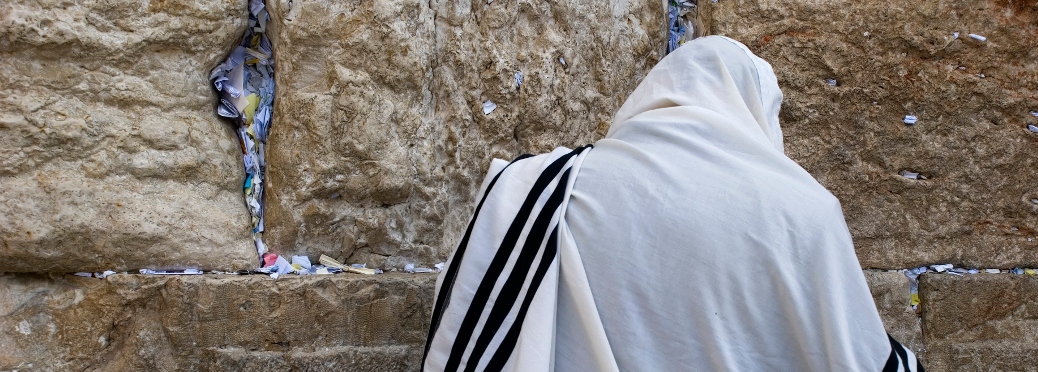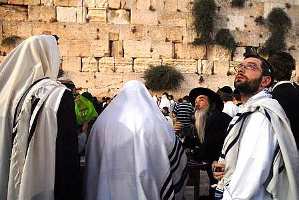
Tag Archives: repentance

Apologies and Farewell to Church

If the Shofar is sounded in the city, will the populace not tremble?

Amos 3:6

The blow of a Shofar is a call to arouse us from the lethargy of routine in which we have been immersed and to stimulate us to teshuvah. But what if someone hears the Shofar and is not moved by it?

A village blacksmith’s assistant once visited a large city and sought out the local smithy. He observed that the workers there used a bellows to fan the flames in the forge. The bellows were much more efficient than the exhausting manual fanning which he did back in his master’s shop. He promptly bought a bellows, returned with great enthusiasm to his master, and informed him that there was no longer any need for them to exhaust themselves fanning the flames. He then set out to demonstrate the magic of the bellows, but alas, regardless of how vigorously he pumped, no flame appeared.

“I can’t understand it,” he said. “In the city, I saw with my own eyes the huge flame produced by the bellows.”

“Did you first light a small fire?” the master asked.

“No,” the assistant replied. “I just pumped the bellows.”

“You fool!” the blacksmith said. “The bellows can only increase the size of the flame when you begin it with a spark. When you have no spark or fire, all the pumping of the bellows is of no use.”

Like the bellows, the Shofar can only arouse us if we have in us a spark of teshuvah, just a rudiment of desire. If we feel ourselves unmoved by the Shofar, we had better try to light a spark of teshuvah within ourselves.

Today I shall…

…try to begin teshuvah, so that the service of the approaching High Holidays will have the desired effect on me.

-Rabbi Abraham J. Twerski
from “Growing Each Day” for Elul 26
Aish.com

I’m writing this on Sunday instead of going to church, though you won’t be reading this until Tuesday morning. Given what I wrote in last week’s “What I Learned in Church” blog and subsequent commentaries, I’ve come to the realization that I owe Randy and everyone who reads this blog an apology. Regardless of my reasons, I took my criticism of Randy’s sermon way too far and I probably shouldn’t have written anything public about it at all.

But that’s water under the bridge and the damage is done.

I emailed Randy on Shabbat after much consideration and prayer with my personal apology and asked him for forgiveness. As I write this, I haven’t heard back, and perhaps I shouldn’t expect to. In addition to writing him though, as I said, I need to make my apology public just as I made my criticism.

preachingAlthough I don’t think religious leaders should be “criticism-proof,” so to speak, they also should command a certain amount of respect, and just because we have a difference of opinion, even about the important matters of Biblical interpretation, the fact that we disagree doesn’t mean he did anything wrong. His sermon was well within the norms of Christian Fundamentalism and it is backed up by a great deal of research on his part. He has the right and responsibility to “feed his flock” with the “spiritual food” he believes is beneficial for them, and I have no right to stand in his way, not that I could really affect anyone’s viewpoint at church about his sermons.

But realizing what I’ve done and how often I’ve risked collapsing the Tent of David (with apologies to Boaz Michael), I feel that my time at Pastor Randy’s church has come to an end. It had been my hope that I would provide added value to discussions in Sunday school, my personal discussions with Randy, and anyone else who wanted to interact with me. Two years ago as I was approaching this path back to church, I had high hopes that I could live out Boaz’s vision as chronicled in his book, but I see now that instead of being a light in the church, all I’ve done (for the most part) was act as an irritant.

Even those few people who were interested in what I had to say, particularly about the New Covenant, once they fully realized what I was communicating, acted confused and hesitant. I guess I was asking far too much of the people around me and my basic theological foundation, which makes a great deal of sense to me, is a strange and alien land for most Christians, particularly Fundamentalists.

It’s my place to be an opportunity of sorts, an option, a door to another perspective, not a hammer hitting people over the head. Over the past two years, although I tried to make a niche for myself in the humble walls of that little Baptist church in Meridian, Idaho, I never truly found a place where I fit in. I look like everyone else and I go through the motions of singing the hymns and shaking hands during services, but what I understand about the Bible might as well be light years away from the people I’ve “fellowshipped” with.

Please understand, I bear no ill will toward Randy, the other Pastors, the board members, and the people I’ve worshiped and studied with. I regard them all with the warmest of feelings. That we disagree doesn’t mean I think they are bad or even wrong. We’re just very different and I have no desire to hurt anyone or get in the way.

I suppose I could still attend the church and just keep silent, but that wouldn’t work for two reasons. The first is that my very presence is likely to continue to irritate or annoy Randy because of the aforementioned offending blog post and my general disagreement with him. The second is I seriously doubt I could rein in my verbal and written responses to the sermons and Sunday school lessons, at least for very long. I’d be unhappy at my self-imposed censorship and when I finally opened my mouth, I could possibly say something unkind or at least unwanted.

I want it to be known that the only person responsible for these events and their outcome is me. It’s my responsibility to conduct myself as a true disciple of the Master both in church and everywhere else, both in my spoken word and in what I write.

Erev Rosh Hashanah is tomorrow at sundown (as you read this) and in the spirit of repentance and renewal, I must offer my sincere public apology to Randy, his church, and you readers, and also I believe it is the best choice now to end my sojourn at church.

The Results

It may sound strange, but in being inspired to return to church, in part by Boaz Michael’s aforementioned book, I’ve thought of my return to Christian worship as something of an “experiment,” and I don’t mean that unkindly or clinically. As I said before, I had hoped to be a light and to represent a particular viewpoint as illumination. Did I fail completely? Did I just waste the last two years of my life in church?

I would say not, although I think I gained more from the experience than the people at church gained from me. What I know about “formal Christianity” including the history of the Church as been quite lacking, and Randy opened all that up to me. He has an excellent command of Christian history and for a year or more, he guided me on a personal journey on what it means to be a believer, particularly from a Fundamentalist point of view. I also learned how friendly, kind, and generous the people around me were, and how patient and tolerant they could be to an “oddball” like me, especially Randy.

No, it was hardly a waste of time. I only regret that they could have as much of a benefit from my presence as I did being among them.

I can only hope that others like me in other churches have better outcomes in terms of the impact they have on their fellow congregants.

The Future

Once again, I’ll be without a congregation. What will this mean for my faith? I may not be going to church, but I haven’t left faith in God or discipleship under the Master behind.

HaYesod ResourcesWill I try to find another church to attend? Not at present. I don’t see it working out any better in another Christian venue than it did in the one I just left, and I have no intention of adding insult to injury, so to speak. Inflicting myself on another Pastor and another congregation will just make matters worse. I’ve heard stories about how well some Messianic Gentiles find it in some churches. They are invited to teach HaYesod and other related classes and, according to reports, the information is well received.

But that requires two things: the right kind of environment and the right kind of presenter. I know that the church I’ve attended just wasn’t ever going to be receptive of such a view of the Bible and certainly the perspective was not requested nor required. I was wrong to force it on anyone without being asked.

Also, since I know Randy’s views on what he wants taught at his church, the fact that I was speaking to anyone at all about my opinions was risking the integrity of the doctrine being taught and I can only guess from Randy’s point of view, represented “wrongheadedness” and even a potential threat to anyone who listened to me and took my words seriously.

So no, I’m not going to seek out another church. Even if an appropriate Messianic congregation was available in my area, as I’ve said numerous times before, I wouldn’t attend, at least regularly, out of consideration for my wife, who is Jewish and not in the least Messianic.

I’ve been talking with a friend about starting up a Torah study between the two of us. The only thing in the way is working out the timing in our schedules. Even he and I don’t see precisely eye-to-eye, but we have more in common than I have with most Christians.

I’ll keep blogging as usual, but this will be the last time I intend to mention Pastor Randy or anything about the church he shepherds. I wish them all success, peace, and the presence and blessings of God.

Since the New Year is upon us, I suppose this is the perfect time to retool my studies and rededicate myself to my understanding of what it is to be a Messianic Gentile.

Someone said in a comment on one of my recent blog posts that if “a Christian is truly repentant then he will extricate himself from an anti-Judaic religious system (i.e. Christianity) and cease to identify as a Christian.” I disagree. There are many fine Christians and many fine churches, including the one I used to attend, and they perform many kind and generous acts of “Torah” (though they don’t call it that), such as feeding the hungry, visiting the sick, and loving each other. I’m not ending my relationship with them because they are not good and kind people, but only because I’m not a good fit for them (nor sadly, they for me) and I have no desire to continue to be an irritant in their presence.

walking outI know that some people like me there and maybe would even be surprised if they read this blog post, but most of them don’t really know me. If they did, I’m not sure what they’d think. It’s better that they don’t find out. God doesn’t love them or me any less because of our divergent perspectives. In the resurrection, if not before, He will guide us all to a better understanding of all truth in Him through Messiah.

May he come speedily and in our day.

May you all be inscribed and sealed in the book of life for a good year.

To Randy and his church, I again offer my sincere apologies, beg for forgiveness though I don’t deserve it, and offer my fondest farewell to you all.

The High Holy Days for the Rest of Us

Some years ago, a prominent Protestant clergyman offered the suggestion that Rosh Hashanah and Yom Kippur could very well be adopted as religious occasions for people of all faiths. He was intrigued by the predominance of the theme of universalism in the Days of Awe. Passover, Shavuot, and Sukkot convey their respective messages of human freedom, of man’s duty as a moral being, and of the thanksgiving man owes to God, in the context of the historic vicissitudes and experiences of the ancient Israelites. Rosh Hashanah and Yom Kippur, however, are not related to any particular event in Israel’s past. They are, as Yehezkel Kaufmann characterizes them, “cosmic holidays” linked with the hopes and the destiny of mankind. The liturgy of Rosh Hashanah and Yon Kippur is indeed suffused with the spirit of universalism.

-Max Arzt
“The Liturgy: An Introduction,” p. 13
Justice and Mercy: Commentary on the Liturgy of the New Year and the Day of Atonement

I suppose I’m crazy to post this, since most Christians wouldn’t even begin to “resonate” with the High Holy Days that are rapidly approaching. And yet, as Arzt notes, an anonymous Protestant clergyman of some prominence in a past era undeniably saw a more universal application to God’s judgment and mercy.

Isn’t that because God will indeed judge all the earth? Aren’t we all under His authority. Does He not have the right to elevate or to condemn? Did He not love Jacob, heir to the covenant promises, but hate Esau who was a descendent of Abraham and Isaac but not in line to receive favor as a Patriarch?

And yet at the end of days, God will judge the descendants of Jacob and Esau both.

The persecution to which R. Yehudai Gaon alluded is the injunction issued by Justinian in 553 C.E. against teaching the deuterosis, the oral interpretation of the Torah. Scholars had therefore assumed that when Judaism “went underground,” certain piyyutim replaced the prescribed liturgy and that other piyyutim of a more legalistic content served as a means of circumventing Justinian’s prohibition against teaching the Oral Law.

-ibid, p. 19

burning talmud
Burning volumes of Talmud

While many Christians today boast a love of the Jewish people and the nation of Israel, we still bristle at the thought of the Oral Law, since it has long been a tradition in our own religious stream to love the Bible (and our own traditions) but disdain the traditions of other faiths, particularly Judaism. We may not physically burn volumes of Talmud anymore, but we continue to do so in our minds and hearts.

In America, Jews are free to practice their religious faith which includes Talmud study and worshiping according to the customs, but historically Judaism has survived, in part, by periodically going “underground” or at least maintaining a low profile. Some of the other Judaisms object to the behavior of the Chabad because they can be so “in your face” about being Jewish, and are very definitely “above ground”.

We like to remind people that America is a Christian nation (actually, it isn’t and never has been) but imagine how insecure that could make a Jew feel? Anti-Semitism isn’t extinct in America or any place else, it’s just waiting for the right environment in which to once again flourish.

It is generally agreed among scholars that the synagogue arose during the Babylonian exile and that it co-existed with the Temple in Jerusalem during the period of the Second Temple…

…Thus the Synagogue was well prepared to assume its post-exilic role as the center of Jewish education, worship, and communal welfare. That the people recovered so quickly from the traumatic effects of the destruction of the Temple was due to the fact that for some centuries before 70 C.E., the Synagogue had been a functioning institution with a reasonably well-established liturgy. The Rabbis tell us that God prepares the healing before the hurt (Song of Songs Rabbah, 4:5).

-ibid, “The New Year (Rosh Hashanah),” p. 43

I’ve maintained over the years that it was indeed the synagogue, the liturgy, and the Talmud that preserved the Jewish people in the centuries after the destruction of the Temple and the initiation of the longest exile they would ever endure, particularly after two failed rebellions against the Romans and the non-Jewish disciples of Yeshua (Jesus) betrayal of their Jewish counterparts. Apparently a Gentile sub-population could not be sustained within a Judaism in exile and under siege by the powerful nations around her scattered people.

I recently discovered that a medieval French philosopher and theologian named Peter Abelard was considered the “only pre-Holocaust Christian who related to Jews as to fellow humans.”

Martin Luther
Martin Luther

That’s quite a statement and an indictment against collective Christianity, but it might not be entirely unearned. While I’m not the student of history I wish I were, I do know that as much as modern Christianity depends on the work of the men of the Reformation, its chief architect, Martin Luther, toward the end of his life, was no friend to the Jews.

According to Jewish Virtual Library, an excerpt from Luther’s work “The Jews and Their Lies” states:

What shall we Christians do with this rejected and condemned people, the Jews? Since they live among us, we dare not tolerate their conduct, now that we are aware of their lying and reviling and blaspheming. If we do, we become sharers in their lies, cursing and blasphemy. Thus we cannot extinguish the unquenchable fire of divine wrath, of which the prophets speak, nor can we convert the Jews. With prayer and the fear of God we must practice a sharp mercy to see whether we might save at least a few from the glowing flames. We dare not avenge ourselves. Vengeance a thousand times worse than we could wish them already has them by the throat. I shall give you my sincere advice:

First to set fire to their synagogues or schools and to bury and cover with dirt whatever will not burn, so that no man will ever again see a stone or cinder of them. This is to be done in honor of our Lord and of Christendom, so that God might see that we are Christians, and do not condone or knowingly tolerate such public lying, cursing, and blaspheming of his Son and of his Christians. For whatever we tolerated in the past unknowingly ­ and I myself was unaware of it will be pardoned by God. But if we, now that we are informed, were to protect and shield such a house for the Jews, existing right before our very nose, in which they lie about, blaspheme, curse, vilify, and defame Christ and us (as was heard above), it would be the same as if we were doing all this and even worse ourselves, as we very well know.

If I had lived in those days and had been a devotee of Luther, how could I have possibly imagined that God loved the Jewish people, had plans to restore them to their Land, and was continuing to uphold His covenant relationship with them? How could I even believe the words of Jesus when he said “Salvation comes from the Jews” (John 4:22)?

Rabbi Nachum Braverman writes, “On Rosh Hashana we make an accounting of our year and we pray repeatedly for life. How do we justify another year of life? What did we do with the last year? Has it been a time of growth, of insight and of caring for others? Did we make use of our time, or did we squander it? Has it truly been a year of life, or merely one of mindless activity? This is the time for evaluation and rededication. The Jewish process is called “teshuva,” coming home — recognizing our mistakes between ourselves and God as well as between ourselves and our fellow man and then correcting them.”

-Rabbi Kalman Packouz
from his commentary on Nitzavim (Deuteronomy 29:9-30:20)
Aish.com

This leads us back to the “universalism” of Rosh Hashanah and Yom Kippur.

Contrary to popular belief, Yom Kippur or the Day of Atonement is not an exceptionally depressing for fearful day for most religious Jews. My wife explained to me one year that it’s actually an opportunity to hit the reset button of our lives, to repair faults and faulty relationships, and to take advantage of an opportunity laid at our feet to become better people and build a better future.

Yom Kippur prayers
Yom Kippur Prayers

While there’s been a great deal of improvement in the relationship between Jews and Christians since the Holocaust, there is still a lot of underlying tension. There’s still a lot of “unexamined baggage” both Jews and Christians are carrying around about each other. To be fair and given recent events, there’s also a lot of baggage I’m carrying around about other Christians that needs to be examined and cleaned up one way or another. I suppose the fact that Rosh Hashanah begins This coming Wednesday the 24th at sundown with Yom Kippur following at sundown on Friday, October 3rd could provide all of us the opportunity to do better and be better than we have been so far.

I know I need something like this. Sure, we can repent and draw nearer to God and to other people any time of year, but when do we have an engraved invitation from God to do so?

I’ve heard D. Thomas Lancaster call Yom Kippur a “dressed rehearsal” for the final judgment. Even if, as a Christian, you feel assured of your salvation, that doesn’t mean you are perfect. I know it doesn’t mean I’m perfect, not even close. Rehearsals are opportunities to practice an important event to make sure you get it right before the real thing happens. That’s a pretty good reason for all faiths, and truth be told, all human beings to observe the universalism of the Days of Awe, for indeed awesome days are coming and when they arrive, if we are not prepared, we never will be.

Christianity still has much to repent for about how we think, feel, and sometimes treat the Jewish people, particularly religious Jews. What have you done that you need to repent of?

May you be inscribed and sealed for a good year.

Elul, All, Nothing, or Something

Question: I have been testing the waters, trying to get involved in Judaism. But I feel like I’m swimming in a vast ocean of unfamiliar concepts: Hebrew texts, legal nuances, culture, etc. I’m not sure any of this is for me!

The Aish Rabbi Replies: There is a misconception that many people have about Judaism, what I call “the all or nothing” syndrome. With 613 mitzvot in the Torah, things can seem a bit overwhelming. People take a look at traditional Judaism with all these different commandments and say to themselves, there’s no way that I can be successful at living that type of lifestyle, so what’s the point of looking into it or getting involved? Where to start? What to focus on? How to make sense of it all?!

That’s not the Jewish way!

“Judaism: All Or Nothing?”
-from the “Ask the Rabbi” column
Aish.com

Really? Not the Jewish way? Most Christians would disagree based on this:

If, however, you are fulfilling the royal law according to the Scripture, “You shall love your neighbor as yourself,” you are doing well. But if you show partiality, you are committing sin and are convicted by the law as transgressors. For whoever keeps the whole law and yet stumbles in one point, he has become guilty of all. For He who said, “Do not commit adultery,” also said, “Do not commit murder.” Now if you do not commit adultery, but do commit murder, you have become a transgressor of the law. So speak and so act as those who are to be judged by the law of liberty. For judgment will be merciless to one who has shown no mercy; mercy triumphs over judgment.

James 2:8-13 (NASB)

I suspect we’ve traditionally misunderstood what James is trying to say to his readers, since he doesn’t seem to be saying that you have to keep the Torah perfectly. He seems to be saying that if you expect your observance to justify you before God, only then would you have to keep the Torah perfectly. However, if you observe the “royal law”, that is “You shall love your neighbor as yourself” (Lev. 19:18, Mark 12:30-31), and do not show partiality, you are not sinning and not counted among transgressors if you are not perfectly observant. Even if you are not perfect but you show mercy, then God will show mercy to you (see Matthew 5:21-22, Matthew 6:12).

So it would seem the Aish Rabbi is correct in that being an observant Jew doesn’t mean being a perfectly observant Jew:

Imagine you bump into an old friend and he tells you how miserable he is. You ask him, what’s the matter? He says, I’m in the precious metals industry. My company just found a vein of gold in Brazil that’s going to be worth hundreds of millions of dollars.

You say, that’s fantastic. Your financial problems are solved. What’s the problem?

He says, you just don’t get it. Do you realize that this is just one vein of gold? It represents such a tiny fraction of all of the unmined gold in the world. What do I really have, compared with what’s out there?

You say, are you nuts? Who the heck cares about what you haven’t found yet? What you’ve got now is a gold mine!

That’s the Jewish approach. Any aspect that you learn about, or can incorporate into your life, is a gold mine. What does it matter what aspect of Judaism you’re not ready to take on? In Judaism, every mitzvah is of infinite value. Every mitzvah is more than any gold mine. Don’t worry about what you can’t do. Even if you never take on another mitzvah, you’ve still struck eternal gold.

The best advice: Relax.

Christian Bible StudyWhat if when you first became a Christian (if you are a Christian), you believed you had to live a perfect Christian life (however you define such a life)? What if you believed you had to go to church every Sunday, had to attend every Sunday school class, had to be at church every Wednesday for whatever class or event was being offered? What if you thought you had to instantly understand terms like “justification” or “propitiation” or “agape” and if you didn’t know and do all you believed was expected of you, it would be the same for you as a Jewish person who didn’t literally observe the 613 commandments of the Torah?

Sounds pretty horrible, huh? Instant perfection or instant failure.

I know what you’re thinking. You’re thinking, “But we’re under grace, not the Law. We Christians don’t have to be perfect.” Ironically, that’s pretty much what the Aish Rabbi is saying, too. Except in Judaism God’s grace and His behavioral expectations for Covenant members aren’t mutually exclusive. It’s all part of the same package. It’s all God’s providence and love.

The love between God and Israel is unconditional. Even when Israel behaves in a manner that results in estrangement, that love is not diminished. Israel does not have to restore God’s love, because it is eternal, and His longing for Israel to return to Him is so intense that at the first sign that Israel is ready to abandon its errant ways that led to the estrangement, God will promptly embrace it.

-Rabbi Abraham J. Twerski
“Growing Each Day, Elul 1”
Aish.com

In Judaism (as I understand it and I realize I’m making an overly generalized statement), God loves not because a Jew is perfect but simply because God loves and because He chose the Jewish people and the nation of Israel to be His own.

One of the things the Aish Rabbi says is:

The misconception that Judaism is all-or-nothing includes the false idea that a person is either “observant,” or “non-observant.” But that’s not true. In fact, here’s a secret:

Nobody is observing all the mitzvot.

Pretty shocking, huh? But that’s not all.

That’s because certain mitzvot only women usually do – like lighting Shabbat candles or going to the mikveh. Other mitzvot only men can fulfill – like Brit Milah. Others only apply to first-born children, such as the “fast of the first born” on the day before Passover. And only a Kohen can fulfill the mitzvah of reciting the Priestly Blessing.

So when we talk about the totality of mitzvot, we’ll never do them all anyway! So rather than get overwhelmed with the vastness of it all, better to be realistic about what we can do, and move forward in a positive way.

But that just means some people don’t do all of the mitzvot because not all of the mitzvot are intended for everyone, like the laws for the Kohen or the laws pertaining only to women (and as you probably already know, there are laws that apply only to Jews and not to Gentiles, Christian or not).

But that could still mean a Jew is supposed to be perfect in all the laws that do apply to him or her.

Let’s say, for example, that a person wants to try the mitzvah of prayer. We may go to synagogue and see someone immersed in intensive prayer for one hour. We cannot conceive of how we could possibly get to that point ourselves. That’s understandable, especially for one who is not fluent in Hebrew. So it’s a matter of knowing which prayer gets top priority – for example, the Amidah prayer.

The Amidah has 19 blessings, and it’s very difficult to concentrate for that entire time without being distracted, or one’s mind wandering to other things like shopping and checking your email. So the key is to take on a small goal: “I am committing that for the first prayer of the 19, I will not rush nor allow anything to interfere between me and these few words.” That goal is realistic and attainable, and one can begin to approach a high degree of intensity and concentration on that one prayer.

What this does is give a taste of the higher goal. All that’s needed is to extrapolate to all 19. This is much more effective than starting off by saying, “Today I’m going to pray the entire 19 with great concentration!” – and then after three words, you’re thinking about what’s for breakfast.

If it’s too lofty a goal, then at least taste it once. Break down a huge goal into bite-size steps that are realistic to achieve, and will give a taste of the full goal.

That’s a lot of text to say something simple. Start with just one, small mitzvah and work up from there.

But what does this have to do with Christians?

One point of relevancy, and I alluded to this above, is that we Christians need to have a better understanding of how Torah observance relates to Jewish life, since we tend to give observant Jews a hard time for not being perfectly observant. We also tend to view “grace” and “the Law” as polar opposites (like “Christianity” and “Judaism”) which, as I also mentioned, is not true.

But if, as most Christians believe, the Law has nothing to do with us, why do we care beyond those straightforward statements?

Dr. Michael Brown
Dr. Michael Brown

If you’ve been reading my blog posts for the past couple of weeks, you know there is an ongoing debate about whether or not God requires all Jesus-believers, both Jewish and Gentile, to observe the same Torah commandments in the same way.

If you listened to the rather uncomfortable debate between Dr. Michael Brown and Tim Hegg on this topic, you discovered that Mr. Hegg believes the answer is an unequivocal “yes” for everyone, while Dr. Brown thinks that no believer, Jewish or Gentile, has to observe any of the commandments (grace replaced the Law).

Frankly, I disagree with them both, but then the question is, what should Gentile Christians do?

Now that I have addressed the notion of “Torah on the heart” as a covenantal anticipation and partial fulfillment as promised to Jews, how may we envision it having an impact also on non-Jews who attach themselves to the Jewish Messiah? They do not become members of Israel or participants in the covenant per se, and they are not legally obligated by the Torah covenant. Therefore, something must become available to them because of their increasingly close proximity to the knowledge of Torah and its impact on those who actually are members of the covenant. In one other recent post, I invoked the analogy of gentiles entering the Temple’s “court of the gentiles” in order to offer sacrifices in accordance with Torah stipulations for gentiles doing so. I compared the symbolic sacrifice of Rav Yeshua to such sacrifices, but offered in the heavenly sanctuary by Rav Yeshua as a mediating Melchitzedekian priest. Such symbolism reflects the ratification of continual repentance, after which the forgiven offerer learns to walk in newness of life in accordance with HaShem’s guidance (e.g., the aspects of Torah that apply to him or her). In another recent post I addressed the notion of a gentile ‘Hasid and the appropriate reflections of Torah that may be applicable — in which a gentile might become thoroughly immersed in order to experience the same sort of spiritual intimacy with HaShem, and enter into the perceptive environment of the kingdom of heaven in its metaphorical sense in anticipation of its future physical realization. Thus non-Jews would experience spirituality from outside and alongside the covenant in the same manner as intended for Jews inside the covenant.

In such an environment the Shema may take on additional meaning, as a gentile reply and response to its pronouncement by Jews. As Jews say: “Shm’a Yisrael Adonai Eloheinu Adonai Echad” (“Hear, O Israel, HaShem is our G-d, solely the One-and-Only HaShem”), followed by “Baruch shem k’vod, malchuto l’olam va’ed” (“Blessed is His glorious purpose — an eternal kingdom”), then gentile disciples of Rav Yeshua may reply: “Hear, O Israel, HaShem your G-d has become our G-d also, the One-and-Only HaShem” (“Shm’a Israel, v’hayah Adonai Eloheichem gam Hu ‘aleinu, Adonai Echad”), perhaps followed by Zech.14:9 “V-hayah Adonai l-melech ‘al col ha-aretz — ba-yom ha-hu, yihiyei Adonai Echad u’shmo echad” (HaShem shall be King over all the earth — in that day HaShem shall be [recognized as] One, and His purpose [as] unified).

But maybe I’m already looking a little too far ahead ….

-comment made by ProclaimLiberty
on one of my blog posts

praying_at_masadaThat’s probably a lot to absorb and it’s likely not all of you will relate let alone agree.

Coming at the question from another direction, a friend of mine pointed me to an article by John C. Wright called Christians in the Pantheon called Life.

A reader with the name Metzengerstein, which sounds like it might actually be a real name for once, writes and comments:

“It is an interesting fix we Christians find ourselves in. On the one hand we should like to argue that Capitalism is a better system than any other by virtue of its results and its preference towards voluntary action and organization over government coercion for arranging society.

“On the other hand, we are anti-materialists who would like to proclaim there are more important things in life than money, and that wealth can lead you astray. Even technological improvement and scientific advancement can lead us into a mindset of creating a heaven on Earth, rather than passing through a transitory phase in a strange land.”

I confess I do not see the paradox.

Click the link I provided above to read the rest, which outlines why there isn’t a contradiction between the Biblical expectations for Christian behavior and living in the world.

Learning what God expects of us is simple enough to grasp in a few moments and yet complex enough to take an entire lifetime to comprehend.

He has told you, O man, what is good; And what does the LORD require of you But to do justice, to love kindness, And to walk humbly with your God?

Micah 6:8 (NASB)

“Teacher, which is the great commandment in the Law?” And He said to him, “‘You shall love the Lord your God with all your heart, and with all your soul, and with all your mind.’ This is the great and foremost commandment. The second is like it, ‘You shall love your neighbor as yourself.’ On these two commandments depend the whole Law and the Prophets.”

Matthew 22:36-40 (NASB)

Seems pretty straightforward but within those simple statements is a world of meaning and learning.

In Christianity, we tend to expect that we are to understand everything in the Bible perfectly and live it out unerringly (which sounds very “legalistic,” the way most Christians see Jewish people). There are no mysteries or contradictions and that with the right interpretation (and solid doctrine), the meaning of God’s Word just unfolds right in front of you with little or not effort at all.

Except that’s not how most Christians experience the Bible if they’re at all honest in admitting it.

The reason I study the Bible through a somewhat Jewish lens is not to learn how to practice Judaism, but to learn to live with a certain amount of dynamic tension involving those little things that don’t seem to add up or that even contradict each other in the Bible.

I recently heard (read) a joke about Jewish people (I think it was in one of ProclaimLiberty’s comments) about “him being right, and the other guy being right, and you’re right, too.” From a Christian point of view, that all seems impossible. How can three different people hold three different opinions and yet all of them are right?

“When you come to a fork in the road, take it.”

-attributed to Yogi Berra

Rav Yosef Cologne, the Maharik, wrote against a group of Rabbis who imposed their authority on their students and claimed that once someone studied under the authority of a rebbi he must behave submissively to that rebbi forever and may not disagree with his ruling. Maharik responded that even if one wants to claim that the former student remains submissive to his rebbi forever, that would only apply to halachos related to honoring a rebbi, e.g., to stand when the rebbi enters the room or to tear kriah if the rebbi passed away. If, however, the former rebbi is making a mistake in halacha the former students must raise the issue rather than silently accept the rebbi’s position.

-from Halachah Highlights
“Disagreeing with one’s Rebbi”
Commentary on Moed Katan 16
Daf Yomi Digest for Wednesday, August 27, 2014

Most Christians and even some Jews tend to see observant Judaism and particularly Orthodox Judaism as a straight jacket made out of lead. Once you’re in, you can never escape and there’s no such thing as “wiggle room”. Here we see (again) that Christian presumptions about Judaism don’t always hold water.

The lived experience of a Christian is actually more complicated and nuanced than one would imagine. Just reading John Wright’s brief essay reveals details that aren’t obvious to either the secular or Christian Gentile. The same can be said for observant Jewish life. Neither lifestyle exists as a single package that one acquires immediately like a birthday present, but rather represents a lifetime of experience, painstakingly gained bit by bit with each passing day.

TeshuvahWe’ve just entered the month of Elul in the Jewish religious calendar, which is the month immediately preceding Rosh Hashanah and Yom Kippur. Derek Leman made some suggestions that could apply to both the Gentile and Jewish believer, but while there seems to be some overlap here for those of us to consider ourselves “Messianic,” it’s critical for us to grasp that we also have very individual duties and responsibilities to God that we are constantly seeking to master.

Frankly, my plate is full just in keeping up with all I need to learn on my journey of spiritual growth. I don’t have a lot of time to worry about what other Christians or what Jews are or aren’t doing.

If I’m to borrow anything useful from Elul, let me adopt a discipline of repentance, increased prayer, introspection, and seeking to draw nearer to God.

For more on the month of Elul, read Elul: The Secret to Change.

“May you be inscribed and sealed for a good year.”

Judgment and Guilt

Rabbi Chayim of Tzanz once said to an evildoer, “Don’t think that because you give in to your evil inclination in some areas you therefore must be evil in all areas. Rather, in whatever ways you can, do good and overcome evil.” (Maigdolai Hachasidus: Hoadmor Maitzanz)

-Rabbi Zelig Pliskin
“No matter how far away you are from the Almighty you can always come close when you make an effort,” p. 417
Commentary on Torah Portion Re’eh
Growth Through Torah

As a flawed and imperfect human being, I find this enormously comforting but it isn’t what Christianity always teaches. It’s also a lesson that if misused, could be employed in the service of laziness or hypocrisy. As servants of God we could be tempted to believe that it is acceptable to be obedient to God in certain areas while disobedient in others. This would certainly be in error, but there’s the opposite to consider.

How often does a “religious” person bemoan their state in never being “good enough” either for God’s acceptance or more likely for the acceptance of their faith community? All churches and synagogues (and other religious traditions) have standards, both formal and informal, and violation of said-standards can elicit responses, from the casual “tongue-clicking” of gossips and judgmental people to more formal criticisms and reprimands (and sometimes there is no more legalistic and judgmental institution than the Christian Church).

Although other streams of Orthodox Judaism may not be so open, the Chabad tends to run on the belief that encouraging a Jew to observe even one mitzvah may ultimately lead to another and then another and so on. Thus, Chabad, at least in theory, accepts Jews from all walks of life and backgrounds within their synagogues, even if they have to (or choose to) drive to services on Shabbat.

The Rebbe himself (Rabbi Menachem Mendel Schneerson), although strict and demanding in issues of halachah, nevertheless embraced a certain “flexibility” (I apologize if that’s not quite the right word) in his expectation of even Orthodox Jewish practice.

In 1977 after his heart attack, the Rebbe started seeing cardiologist Dr. Ira Weiss who was an Orthodox Jew. As with most physicians, Dr. Weiss labored under the heavy demands on his time and admitted to the Rebbe that he was often late in reciting Mincha (the afternoon prayers) which caused him great guilt and distress. The Rebbe responded:

“In a case like this, where your obligations are first to your patients, and where making them wait can cause them physical or emotional harm…you are not entitled to delay them any further. You have to finish your work with them first, and God will understand the delay in your Mincha. You don’t have to make any apologies for a late Mincha.”

-Joseph Telushkin
Chapter 8: “I’m Also Tired, So What?” p. 127
Rebbe: The Life and Teachings of Menachem M. Schneerson, the Most Influential Rabbi in Modern History

Lubavitcher Rebbe, Rabbi Menachem Mendel Schneerson

The Rebbe went on to caution Dr. Weiss that when time is available and he is not in the service of his patients to not become lax or indifferent and that indeed he had a duty to pray at the appointed times, but he wanted to relieve Dr. Weiss not only of any guilt he experienced but even the idea that he had done anything wrong. The Rebbe went so far as to tell the doctor of the serious demands on his own time and circumstances that resulted in the Rebbe sometimes starting Mincha late.

I realize that for a Christian, this doesn’t seem like anything we would worry about. After all, we don’t have set times of prayer and compared to Orthodox Judaism, very light requirements from our religious calendar and traditions. However, as I said above, there are times when the Church can be quite legalistic in its own expectations, they simply do not codify their requirements in as open a manner as Orthodox Judaism. And the fact remains that regardless of our religious preferences, it is a human trait to judge others.

I recently read another Rabbinic commentary whose source escapes me (I thought it was Rabbi Pliskin’s but I can’t find it now). It tells of a poor man who was invited to a wedding. The family who invited him were quite well off and the man was embarrassed that he couldn’t afford a good suit to wear to the occasion. He finally asked a neighbor if he could borrow a suit and his neighbor generously lent the man a $1000 suit.

The day of the wedding, the man discovered that many of the people at the wedding were wearing suits not as fine as his and he began to look down upon them. This, of course, is the improper response, since this poor man could not have dressed as well as even the most casually attired wedding guest of his own resources.

And yet, as faulty as we all are in our obedience of and service to God, we can almost always find someone who is more (apparently) faulty than we are and at least within our own thoughts (though sometimes with our facial expressions and even our words) judge them.

J.K McKee in his book One Law for All: From the Mosaic Texts to the Work of the Holy Spirit opposes a Gentile (Christian) from adhering to the Torah mitzvot in the manner of the Jews as a matter of covenant obligation. Although McKee has other reasons for believing in the “One Law” for Jews and Gentiles, he states that relating to the commandments as an obligation can lead to a form of legalism and judgmentalism within One Law Christian communities.

I think McKee is simply describing human nature. I think the “cure” if there is one, is for each of us to focus on our own lives, consider where we are called to serve God, and to attend to our own “observance,” however we choose to define it.

God is the righteous judge of the world. We, as the people we are now, are to judge no one but ourselves and even then, it would be good if we didn’t judge ourselves too harshly or in too lenient a manner. Since striking the proper balance in assessing our own service to the Almighty will take a lifetime to master (regardless of how young or old you are when you take up the task), there should be little time in your life to be concerned about how well someone else is doing.

Dr. Ira Weiss wasn’t worried about any other Jew being late in reciting Mincha, only about himself. As an Orthodox Jew, he knew the standards by which his service to God was measured. The Rebbe reminded him of the higher duty the doctor had to his patients and that God was a lot more understanding of human frailty and limitations than we are as human beings.

jewish-repentanceThe Rebbe was a great believer that it was never too late to make teshuvah (repent) and to return to God. When we fail, we must remind ourselves that we too can repent and return, and that the struggle between our humanity and God’s perfection is one we will live with every day of our lives. It’s not perfection we seek in this lifetime, it’s persistence, endurance, striving to climb higher, and forgiveness when we fall. Don’t worry about the other guy. He’s got enough worries of his own without you adding to his list. God will help him even as he does you…and me.

Tisha B’Av, Lamentations, and Hope

How did Judaism manage to survive the destruction of its central sanctuary? According to the Book of Deuteronomy, which we always begin to read on the Shabbat before Tishah B’Av, it was to be the only link between heaven and earth. All sacrifices were to be offered there and no place else. The exclusive cult restricted to a single Temple seemed to reinforce the fragile belief in a single, omnipotent God…

…The destruction of his Temple in 586 B.C.E. could have ruptured the ties between God and Israel…

…I should like to suggest that the answer to this historical conundrum lies in the etymology of a single Hebrew word.

-Ismar Schorsch
“Transformation of Devir from Shrine to Book,” pg 583, August 1, 1998
Commentary on Torah Portion Devarim
Canon Without Closure: Torah Commentaries

Schorsch goes on to explain that the Hebrew word for the Holy of Holies in the Tabernacle and later the Temple is “devir”. He then traced a path from “devir” (Shrine) to “davar” (word), and across the ages to third century C.E. Babylonia and the founding of the rabbinic academy in Sura where the Persians used the proper noun “devir” for “book” (safra). For Judaism then, as Schorsch sees it, the survival mechanism employed once the Temple had been leveled by the Romans in 70 C.E. and the Jewish people were forcibly dispersed, was the investment in Talmud and Mishnah as the embodiment of the Holiness of the Temple; the conversion of the direct link between Jews and God from Shrine to Book.

This idea was also explored by the late Dr. Alan F. Segal in his book Rebecca’s Children: Judaism and Christianity in the Roman World. Dr. Segal suggested that with the destruction of the Temple and the elimination of a Judaism centered around the sacrifices and the Aaronic priesthood, two new religions emerged: Gentile Christianity and Rabbinic Judaism.

In a way, it’s not as farfetched an idea as it might seem but fails to take into account God’s planning for the continuation of His people Israel as well as the people of the nations who are called by His Name. While Judaism and Christianity both have “morphed” considerably over the past nearly two-thousand years and have traced divergent trajectories across history, we must remember that our course through space and time are always in the control of God and a single destination awaits us both: Messiah and the Kingdom.

As we rapidly approach the fast of Tisha B’Av, sorrow piles upon sorrow at the severe losses suffered by the Jewish people and the nation of Israel which, even now, is in a state of war and viciously maligned by the worldwide news media, multiple world leaders and celebrities, and people in general simply for defending themselves against the thousands of missiles and other attacks the terrorist group Hamas has launched against them.

And how do these events color Tisha B’Av this year? Like any other year, as Schorsch says elsewhere in his commentary:

No other religion is quite so self-critical. The Bible goes out of its way to record the flaws and errors of our people’s loftiest leaders. (pg 589)

As most of us should be doing whenever something goes wrong in our lives, the first place Israel looks for a cause when tragedy strikes is in the mirror and their relationship with God.

If a person sees that suffering befalls him, let him examine his deeds.

-Berachos 5a

Yes, one day the Messiah will rebuild the Temple, but it’s been so long and who knows when he will suddenly return? Yet in spite of all the tragedies that have befallen the Jewish people across the long centuries, God has always preserved them in many and varied ways, including, I believe, through what we refer to as Rabbinic Judaism and a devotion to studying Torah and Mishnah.

Most Christians believe that any legitimate connection between the Jewish people and God crumbled with the Temple and that their only hope is conversion to Christianity and worship of Jesus Christ. For most people in the Church, Rabbinic Judaism in all its expressions is a dry and vain effort, bereft of any presence of God; an invention of men who “missed the boat” of Messiah, so to speak, and now are continually bailing water out of a slowly sinking ship.

Tisha b'Av at the Kotel 2007But let us suppose, on the eve of one of the most grief-stricken observances on the Jewish religious calendar, that God didn’t abandon His people Israel after the advent of Messiah and the destruction of Jerusalem. Let us suppose that God chose to go into exile with His people, even as He maintained His presence among the devout ones of the Gentile disciples of Messiah. Is that so unreasonable an assumption? Does God have to abandon Sinai in order to occupy Calvary?

Hence when our sages read the story of Jacob and Esau as the tale of Israel and Rome in the time of the Christian emperors, as they did, they did not conceive that theirs was a reading distinct from the author’s original intention. And how could such a conception have taken root, when, after all, they knew that Torah, oral and written, came from God to Moses, or was the work of the Holy Spirit, or otherwise transcended the particularities of time, space, and circumstance?

-Jacob Neusner
from the Series Forward of (pg xii)
Israel After Calamity: The Book of Lamentations

Professor Neusner is attempting to explain to an audience with little knowledge of Mishnah how it is possible and even reasonable for the Sages to create interpretations of books of scripture that (apparently) couldn’t have been the author’s original intent, and yet have those interpretations be correct for the generation in which they were made (and later).

That requires believing that the inspiration of the Holy Spirit both encodes the Bible with messages that continually unfold with the passage of human history and believing that God really did infuse the Jewish sages with the authority, wisdom, and Spirit to create valid interpretations of the Bible after formal canonization was considered closed.

That’s a lot for most Christians to take in, since our general conceptual platform is founded on Greek thought and philosophy which is sort of a “connect the dots” way of thinking coupled with being “binary.” That is, things are either this way or that, left or right, up or down, and we continually move forward in time, leaving the past permanently preserved in amber, forever unchangeable, including by interpretation, as we progress step by step toward the return of Jesus. There is no room in our thinking for a God who can take both forks in a road simultaneously (with apologies to Yogi Berra).

If we accept that God is infinite, that God is Spirit, and believe all of the other supernatural and metaphysical things we’re supposed to believe, then it behooves us not to put God in a box (Schrödinger’s or any other kind), and make Him obey the rules we’ve created for the Bible and ourselves. If God is transcendent, then so is His Word and, for that matter, so is His relationship with His people Israel. God’s relationship with Israel survived the destruction of Solomon’s Temple. It can survive the destruction of Herod’s as well, plus such and thus many thousands of years hence.

Neusner’s book takes us through an analysis of Lamentations Rabbah, and in Parashah II Lamentations 2:3 (pp 95-6), we read:

But when the Israelites repent, the Holy One, blessed be he, will put the horns back in place: “All the horns of the wicked I will also cut off, but the horns of the righteous shall be lifted up” (Ps. 75:11).

The horns which the Righteous One of the world had cut off [will be restored].

When will he restore them to their place?

When the Holy One, blessed be he, exalts the horn of his messiah: “And he will give strength to his king and exalt the horn of his anointed” (1 Sam. 2:10).

grafted olivesEven in sorrow and mourning, Israel always has hope in the Promises of God for return and restoration, the promises of King Messiah and the New Covenant age.

This is purely poetic interpretation on my part, but when I read of the wicked horns being cut off and the righteous horns being restored by Messiah the Righteous One, I couldn’t help but think of this:

But if some of the branches were broken off, and you, being a wild olive, were grafted in among them and became partaker with them of the rich root of the olive tree, do not be arrogant toward the branches; but if you are arrogant, remember that it is not you who supports the root, but the root supports you. You will say then, “Branches were broken off so that I might be grafted in.” Quite right, they were broken off for their unbelief, but you stand by your faith. Do not be conceited, but fear; for if God did not spare the natural branches, He will not spare you, either. Behold then the kindness and severity of God; to those who fell, severity, but to you, God’s kindness, if you continue in His kindness; otherwise you also will be cut off. And they also, if they do not continue in their unbelief, will be grafted in, for God is able to graft them in again. For if you were cut off from what is by nature a wild olive tree, and were grafted contrary to nature into a cultivated olive tree, how much more will these who are the natural branches be grafted into their own olive tree?

Romans 11:17-24 (NASB)

As it says in Tsvi Sadan’s book The Concealed Light (pg 212):

To call Messiah Horn (keren) is supported by “There I will make a horn to sprout for David; I have prepared a lamp for My anointed” (Psalm 132:17 ESV).

But as it also says in Sadan’s book (pg 156):

Using the name Branch (netzer) for Messiah comes from a clear messianic prophecy that says: “There shall come forth a Rod (choter) from the stem of Jesse, and a Branch (netzer) shall grow out of his roots” (Isaiah 11:1 ESV).

Played back over Lamentations Rabbah and Neusner’s commentary, we can see some obvious parallels to Yeshua (Jesus), but as I said, the connections are poetic and shouldn’t be taken for more than that. Still, we are pointed back to a hope for the Jewish people and the rest of the world, that out of the ashes of the Temple will rise a King, and lifted from the lakes and oceans of Jewish tears shed over hundreds and thousands of years is lifted up the Moshiach.

…and He will wipe away every tear from their eyes; and there will no longer be any death; there will no longer be any mourning, or crying, or pain; the first things have passed away.

Revelation 21:4 (NASB)

But Israel has a part to play:

Israel is responsible for its own condition but also can so act to atone for what it has done and so regain God’s favor. A covenant governs Israel’s relationship to God, and therefore the condition of the holy people. When the covenant is broken, the result is God’s punishment; but then, when Israel atones, the covenant makes clear, Israel will repair its disastrous condition.

-Neusner, pg 104

But while the focus of disaster, repentance, and atonement is upon Israel, this also has applications on individual lives:

Rabbi Yisroel Salanter would utilize every opportunity to gain mussar insights and to motivate himself to further self-improvement. There were many occurrences when most people would think nothing of them, but Rav Yisroel would gain some lesson for growth. Rav Yisroel once was in the home of a shoemaker late at night and observed how he was doing his work by the light of the candle that was almost going out. “Why are you still working?” Rav Yisroel asked him. “It is very late and soon the candle will be extinguished.”

The shoemaker replied, “As long as the candle is still burning it is still possible to accomplish and to mend.”

Rabbi Salanter was very moved by this, and said, “If for our physical needs as long as the candle is burning one keeps mending, all the more so for our souls, as long as the light of the soul is still going we must make every effort to accomplish and mend.”

After this he would frequently repeat to himself, “As long as the candle is lit, accomplish and mend.” (Tnuas Hamussar, vol.1, p.315-6)

-Rabbi Zelig Pliskin
“Utilize the hints of others for self-improvement,” pg 379
Commentary on Torah Portion Devarim
Growth Through Torah

From Tsvi Sadan’s book (pg 10) we learn:

Light (or) to describe Messiah comes from the well-known verse, “And God saw the light, that it was good” (Genesis 1:4). Puzzled by this good light that was created before the sun and moon, the sages were drawn to another unique light, which David talks about when he says, “In Your light we see light” (Psalm 36:9).

This light within a light, says one midrash, is the light created on the first day, which David recognizes as King Messiah.

Yeshua also made this plain about himself:

Then Jesus again spoke to them, saying, “I am the Light of the world; he who follows Me will not walk in the darkness, but will have the Light of life.”

John 8:12 (NASB)

light-ohrThis year, Tisha B’Av begins the evening of Monday, August 4th and ends some forty minutes after sundown the following day. We enter our own darkness when we face Jewish grief, for although the sin of baseless hatred caused the destruction of the Temple and the exile of the Jewish people, those acts of destruction were brought about by Gentiles. For the past twenty centuries, the Goyim, including the Christian Church, has been piling sorrow upon sorrow on the Jewish people and are at it to this very day.

The Jewish people fast, pray, and repent on Tisha B’Av but as the instruments of their suffering, we should fast, repent, and pray as well, entering our own darkness so we can recognize, through faith, the light of our hope.

The redemption of Israel and, through it, all the world, depends on how well man perceives and acts upon that faith.

-Rabbi Meir Zlotowitz

Sermon Review of the Holy Epistle to the Hebrews: The Eternal Judgment

Therefore leaving the elementary teaching about the Christ, let us press on to maturity, not laying again a foundation of repentance from dead works and of faith toward God, of instruction about washings and laying on of hands, and the resurrection of the dead and eternal judgment.

Hebrews 6:1-2 (NASB)

As I mentioned in last week’s review of D. Thomas Lancaster’s sermon The Resurrection of the Dead from his Holy Epistle to the Hebrews lectures, the following message “The Eternal Judgment” wasn’t recorded, thus I cannot listen to it and write my review.

However, that material was included in Lancaster’s book Elementary Principles: Six Foundational Principles of Ancient Jewish Christianity, so I’ll review the chapter (Chapter 10) instead.

But some days later Felix arrived with Drusilla, his wife who was a Jewess, and sent for Paul and heard him speak about faith in Christ Jesus. But as he was discussing righteousness, self-control and the judgment to come, Felix became frightened and said, “Go away for the present, and when I find time I will summon you.”

Acts 24:24-25 (NASB)

Lancaster introduces his chapter by describing the marriage of Felix, the Roman governor over Judea, to the Jewish princess Drusilla, youngest daughter of King Herod Agrippa the first. Supposedly, Felix hired a sorcerer to use occult means to get Drusilla to abandon her husband and marry him. Felix wasn’t a very nice man.

In today’s world, intermarriage between a Jew and a Gentile, at least in Orthodox Judaism, is highly discouraged. How much more embarrassing was it for a Jewish princess to marry, not just any Roman, but the occupying governor over Judea?

But then, although it was (according to Lancaster) Drusilla’s idea to have a private discussion with Paul, it was Felix’s response that was the point of this story. And while resurrection of the dead might seem like a great deal, what about “the judgment to come?”

It is appointed for man to die once, and after that comes judgment.

Hebrews 9:27

Associating concepts like “righteousness” and “resurrection” with “self-control” and “judgment” would probably not be comfortable to hear, assuming Felix took Paul seriously, since Felix could hardly be considered a pious individual, even by Roman standards. In fact, if we really gave it some thought and realized that the resurrection and final judgment are in our future as well, how comfortable would we feel about who we are and what we’ve done (or are doing)?

Throw out the worthless slave into the outer darkness; in that place there will be weeping and gnashing of teeth. But when the Son of Man comes in His glory, and all the angels with Him, then He will sit on His glorious throne. All the nations will be gathered before Him; and He will separate them from one another, as the shepherd separates the sheep from the goats; and He will put the sheep on His right, and the goats on the left.

Matthew 25:30-33 (NASB)

Judge NotI won’t quote all of the scriptures Lancaster lists to illustrate Jesus and the final judgment, but he does make a convincing case that if God does not exact justice for human wrongdoing in this life, He most certainly will in the next.

In Messianic Judaism, we rehearse for the final judgment every year in the high holiday of Rosh HaShanah and Yom Kippur (Festival of Trumpets and Day of Atonement). Judaism treats high holidays as an annual dress rehearsal for the final eternal judgment. In anticipation of the holidays, we repent, confess sins, mend relationships, apologize, and try to make peace with both men and God.

-Lancaster, pg 127

This may sound somewhat familiar since I associated the topic of forgiveness with the high holidays in a recent blog post reviewing a chapter in Brad H. Young’s book The Parables: Jewish Tradition and Christian Interpretation. In my review Young’s book, I said that most Christians wouldn’t (but should) automatically associate making amends with another person with how we will be forgiven (or not) by God at the final judgment.

Now Lancaster seems to be saying that the period between Rosh Hashanah and Yom Kippur on the Jewish religious calendar has applications for Christians as well, since it is in the apostolic scriptures where we see a final judgment staring at us square in the face.

Except that since we’re “saved by the blood of Jesus,” we (that is, Christians) aren’t particularly worried about being judged. Jesus paid the price for our sins so we’ve got our “fire insurance” covered. No need to “rehearse” anything since we’ve already won, God is on our side, and everything is hunky dory.

Boy, that sounds arrogant.

While Rosh Hashanah, when the books are opened before the Heavenly court, and Yom Kippur, when the final verdicts are issued and the books are closed again, are not the actual final judgment, they prefigure this awesome and august event, and perhaps we shouldn’t play fast and loose with a living and infinite God. God can indeed issue decrees in the present age and in our lives in response to your actions and mine, but there will come that final day, even if we push it off into the back of our minds, when we will all be expected to stand in judgment.

As I looked, thrones were placed, and the Ancient of Days took his seat; his clothing was white as snow, and the hair on his head like pure wool; his throne was fiery flames; its wheels were burning fire. A stream of fire issued and came out from before him; a thousand thousands served him, and ten thousand times ten thousand stood before him; the court sat in judgment, and the books were opened.

Daniel 7:9-10

yom kippurLancaster goes on to describe “one like a son of man” stepping forward in this vision of the final judgment, to deliver the sentencing. He quoted from the apocryphal book Enoch (1 Enoch 69:27-29) and the following to illustrate the judgment seat of Messiah:

For we must all appear before the judgment seat of Christ, so that each one may receive what is due for what he has done in the body, whether good or evil. Therefore, knowing the fear of the Lord, we persuade others.

2 Corinthians 5:10-11

In these words, Paul expressed his motive for evangelism…Paul knew the fear of the LORD. To fear God is to believe that he exists, rewards, and punishes. Paul knew that eventually God will judge the wicked and reward the righteous. He taught that we must all stand before Messiah in the final judgment.

-Lancaster, pg 131

All of us? Won’t Christians just be there to pick up our rewards? We won’t have to give account for everything we’ve done wrong in our lives after becoming believers, will we?

What if we do?

We think that final judgment just means going to Heaven or Hell, but what if it also means we have to have our human lives stripped naked before us and relive everything we’ve done, both good and bad?

Yuck. Kind of makes you want to be more careful about all of those casual thoughts, words, and gestures you’re sure God is going to forgive because you’ve been saved and go to church every Sunday.

But it gets worse.

Generally speaking, the doctrine of the eternal judgment has fallen into disfavor. Perhaps this shift in emphasis from everlasting punishment to a blissful afterlife occurred as a natural swing of the theological pendulum. The medieval and Reformation-era church had an unhealthy fascination with the torments of hell. Evangelicals later demonstrated the same fixation, predicating their appeal for the gospel on the basis of avoiding damnation. The church framed Christianity primarily as an avenue of escape from everlasting fiery tortures and the pitchfork of Satan. We substituted the foundational doctrine of eternal judgment for the doctrine of eternal damnation.

-ibid, pg 132

justiceIt seems to be a mistake to trust in any extreme, either a fascination with damnation or an obsession with bliss. The former focuses on God’s judgment as if it were a terrible trap and the later on His mercy as if it is all-encompassing…no matter what we’ve actually done.

The eternal judgment is so basic and fundamental to our faith that the writer of the book of Hebrews considers it to be the milk. It is pretty simple. We believe that every human life has eternal significance — so much so that the deeds committed in this body will have ramifications that completely transcend time. That makes every moment of this life precious. It makes every opportunity to perform a good work (mitzvah) precious. It makes every sin utterly abhorrent. Every righteous deed merits eternal reward, and every sin earns eternal punishment. Ironically, the doctrine of the eternal judgment makes life in this temporary world all the more significant.

-ibid, pg 133

We can only imagine that what terrified (according to Lancaster) Felix so much was being resurrected into a world where an absolutely just God would judge him for all the acts of his life…and condemn him. Not a pleasant thought to be sure. We all want our pleasures and want to skip out (as much as we can get away with) on our responsibilities. Anyone who struggles with the “battle of the bulge” and against all reason and logic still can’t give up their Big Macs and Whoppers knows that self-disciple isn’t easy…even in the face of dire consequences.

What Did I Learn?

Are our names already written in the Book of Life or the Book of Death? Did God makes these decisions, who was to be commended and who was to be damned, before He ever manufactured our universe?

From God’s point of view, His timeless experience, things like “before,” “during,” and “after” most likely have no meaning. The creation of Adam from dust and opening the Book of Life at the final judgment exist in the same micro-second to Him. Who is and isn’t in the Book has been there for all time and won’t be written until the pages are opened at the very end of time. I hope you like paradox, because that’s all I have to offer as far as the mystic visions of final judgment are concerned.

DespairBut one thing seems clear. Paul taught that there is a final judgment. So did Jesus. And all humanity stands within it for life or for death.

It isn’t just that one “decision for Christ” that you made once upon a time by answering an altar call or raising your hand at a camp meeting. It’s everything you’ve done since then.

No, you can’t buy your way into Heaven but you can throw it all away. Even the best of the best of us is utterly corrupt when compared to a completely and absolutely Holy God. Who are we to compare?

Rabbi Eleazer taught his disciples to repent every day (See b. Shabb. 153a). The later rabbinic teachings regarding the ten days of awe and the day of Atonement mention three categories of people,the completely righteous, the completely wicked, and the “in-betweens” (See b. Rosh Hash. 16b). The rabbis obviously believed that most people fall into the “in-between” category and need to repent. The house of Shammai taught, “There will be three groups at the Day of Judgment — one thoroughly righteous, and one thoroughly wicked, and of the intermediate” (See b. ibid 16b-17a). Therefore Bailey may be correct when he notes, “Christ’s subtle humor shows through in this verse. The ‘righteous’ who ‘need no repentance’ do not exist” (Kenneth E. Bailey, The Cross and the Prodigal). Most people need to repent and maintain a living relationship with God in their cultivation of personal spirituality.

-Brad H. Young
“Chapter 10: The Search: The Parables of the Lost Sheep and Lost Coin,” pg 195
The Parables: Jewish Tradition and Christian Interpretation

If we believe Christ died for us then we should live like it. We should all live like people who’ve been given a second chance, living on borrowed time or rather time purchased for us when we didn’t deserve it.

If you think you are saved, don’t expect that you can sit on your laurels and gather your rewards before judgment. You, I, and everyone else will be judged on what we have done, what we are doing, and what we haven’t even thought of doing yet.

Since all these things are to be destroyed in this way, what sort of people ought you to be in holy conduct and godliness, looking for and hastening the coming of the day of God, because of which the heavens will be destroyed by burning, and the elements will melt with intense heat! But according to His promise we are looking for new heavens and a new earth, in which righteousness dwells. Therefore, beloved, since you look for these things, be diligent to be found by Him in peace, spotless and blameless, and regard the patience of our Lord as salvation…

2 Peter 3:11-15 (NASB)

Yom Kippur prayersMaybe observing the high holidays wouldn’t be such a bad idea for Christians. Many of us are so unused to facing the idea of judgment let alone responding to it with fasting, with prayer, with repentance, with fear and trembling, with begging for the forgiveness of those we have harmed, of begging God for mercy, though we are all like grass. At least if you’re an observant Jew, you know you are accountable and that God expects you to take that seriously with your intention and your behavior.

If you see something that is broken, fix it.

If you cannot fix all of it, fix some of it.

But do not say there is nothing you can do. Because, if that were true, why would this broken thing have come into your world?

-Rabbi Tzvi Freeman
“If It’s Broken”
Based on letters and talks of the Rebbe, Rabbi M. M. Schneerson
Chabad.org

Addendum: I found out (thanks, Alfredo) after I wrote this review that Lancaster re-recorded the content for this topic on audio available on the web: The Final Judgment.