Tag Archives: repentance

Sermon Review of the Holy Epistle to the Hebrews: The Source of Eternal Salvation

Follow the apostolic logic and discover the relationship between Psalm 2 and Psalm 110 and how the writer of the book of Hebrews derived the priesthood of Messiah. This teaching comes with a stern call to discipleship.

-D. Thomas Lancaster
Sermon Fourteen: The Source of Eternal Salvation
Originally presented on April 20, 2013
from the Holy Epistle to the Hebrews sermon series

So also Christ did not glorify Himself so as to become a high priest, but He who said to Him,

“You are My Son,
Today I have begotten You”;
just as He says also in another passage,

“You are a priest forever
According to the order of Melchizedek.”

In the days of His flesh, He offered up both prayers and supplications with loud crying and tears to the One able to save Him from death, and He was heard because of His piety. Although He was a Son, He learned obedience from the things which He suffered. And having been made perfect, He became to all those who obey Him the source of eternal salvation, being designated by God as a high priest according to the order of Melchizedek.

Hebrews 5:5-10 (NASB)

In today’s sermon, Lancaster starts out with a bit of review of earlier in this chapter of Hebrews and ends it by “getting Evangelical.”

We return to the concept of the High Priest, who Lancaster called “the Holiest man in the world.”

Now when these things have been so prepared, the priests are continually entering the outer tabernacle performing the divine worship, but into the second, only the high priest enters once a year, not without taking blood, which he offers for himself and for the sins of the people committed in ignorance.

Hebrews 9:6-7 (NASB)

The High Priest was the hope of the nation. Only he could enter the Holy of Holies on Yom Kippur and offer atonement for all of Israel. Every Jewish heart turned in repentance toward the Temple, the Most Holy Place, and the High Priest that their sins would be forgiven and atoned for, and they might be justified before God.

But as you might recall from previous reviews in this series, Lancaster believes the readers of the letter to the Hebrews were Hellenistic Messianic Jews who had been denied access to the Temple, the Priesthood, and the sacrifices, by the Sadducees who administered the Temple in those days. How heartbroken and anguished must these Jewish disciples of the Master have been, believing the High Priest on Yom Kippur was not atoning for their sins among the people of Israel.

James the Just and other apostolic figures had been martyred. The Messianic disciples were cut off from the Temple, their faith in the Master was wavering. And this epistle was sent to them as consolation and exhortation, and even as prophesy of a life when the Temple would be no more and all the Jewish people would suffer exile.

They needed a priest. But where did the writer of Hebrews get the idea that Yeshua (Jesus) of the tribe of Judah and the house of David was a High Priest? Wasn’t that only for the sons of Aaron?

And no one takes the honor to himself, but receives it when he is called by God, even as Aaron was.

Hebrews 5:4 (NASB)

In Judaism, no one chooses to be High Priest. Not even King David himself could perform the duties of the High Priest. Only the son’s of Aaron.
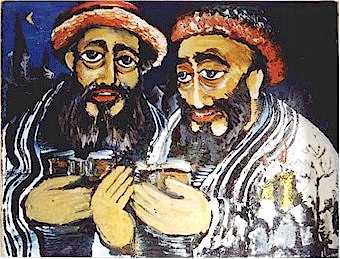
Hillel and ShammaiLancaster recalled a story from the Talmud, specifically Shabbos 31, about three converts, three pagan Gentiles who wanted to become proselytes, one on the condition that he could become the High Priest. I found a summary at the Saratoga Chabad website if you’d like to review the material.

The point is, no one, not even the anointed one of God, King Messiah, can demand to become High Priest.

However, in another priestly line, we find another High Priest of a different order, Melchizedek, King of Salem, who Abraham encounters in Genesis 14:18-20

But what does he have to do with Jesus?

Lancaster reads Psalm 2 and Psalm 110 and says that they are both Psalms about Messiah, depict God establishing Messiah as ruler in Zion, show God speaking directly to Messiah, declaring Messiah as both Son and Priest:

I will tell of the decree: Hashem said to me, “You are my Son; today I have begotten you.

Psalm 2:7

Hashem has sworn and will not change his mind, “You are a priest forever after the order of Melchizedek.”

Psalm 110:4

If you go to the web page for this lesson, you’ll find a PDF with the translations Lancaster uses for these two Psalms.

In short, it’s Lancaster’s opinion that the writer of the Book of Hebrews uses Psalm 2 as the foundation for Psalm 110 and that these are his proof texts establishing Yeshua as a High Priest who is able to make atonement for us.

But when did this happen?

In the days of His flesh, He offered up both prayers and supplications with loud crying and tears to the One able to save Him from death, and He was heard because of His piety. Although He was a Son, He learned obedience from the things which He suffered. And having been made perfect, He became to all those who obey Him the source of eternal salvation, being designated by God as a high priest according to the order of Melchizedek.

Hebrews 5:7-10 (NASB)

Messiah”In the days of His flesh.” In other words, in Christ’s earthly ministry he was established as a High Priest. How? Why?

Lancaster cites these verses as a wonderful, apostolic eyewitness about how the Master prayed. He prayed very loudly, with great supplications, with crying and tears, to God, the one able to save from death. Lancaster believes this tells of the night Jesus prayed at Gethsemane (Matthew 26:36-56, Luke 22:39-46).

And even though Jesus was a Son, he obeyed God, even as Isaac obeyed Abraham at the Akedah by allowing himself to be bound as the sacrifice, but in this case, no angel saved the son of promise from becoming the Lamb of God on the altar.

He suffered and was made perfect. Wasn’t he perfect before? What perfected him? The refiner’s fire? He was perfected as we shall be, by the resurrection. And having been made perfect, Jesus then became the one who is the source of eternal salvation for all who obey him.”

This is the part where Lancaster “gets Evangelical.” This is the part when he reminded me of the Head Pastor at the church I attend.

For the most part, we learn in the church that if we believe in Jesus, we will be saved from our sins, but the writer of Hebrews says Jesus is ”the source of eternal salvation for all who obey him.”

Obey Jesus by doing what?

“Repent, for the kingdom of heaven is at hand.”

Matthew 4:17 (NASB)

First Fruits of Zion’s television series A Promise of What is to Come has a number of episodes describing what “the Kingdom of Heaven” or “the Kingdom of God” means and you can take a look at those for the details. But Jesus is calling all who hear him to repentance.

“If anyone wishes to come after Me, he must deny himself, and take up his cross daily and follow Me. (emph. mine)

Luke 9:34 (NASB)

Nevertheless, the firm foundation of God stands, having this seal, “The Lord knows those who are His,” and, “Everyone who names the name of the Lord is to abstain from wickedness.” (emph. mine)

2 Timothy 2:19 (NASB)

Repentance isn’t a one time event and it’s not mere intellectual or even emotional ascension that “Jesus is Lord”. It’s one thing to call Jesus “Master” and quite another thing entirely for him to be your Master (or my Master) by a conscious act of our (my) will, allowing him to truly rule your (my) life.

Lancaster pleaded with his audience to examine themselves and to determine if they have truly repented, if they repent daily, if they really, continually do subjugate themselves to the Master’s will, if he really is King of their (our) lives. Lancaster isn’t selling cheap grace. Lives hang in the balance. Like the writer of the Epistle to the Hebrews, Lancaster is exhorting his flock to keep to the faith, not unsaved sinners somewhere outside the body, but living human beings and devotees of the Master within the ekklesia, the body of Messiah.

What Did I Learn?

I listened to this sermon the same day I wrote For Redemption is Not Yet Complete, a dedication to repentance, turning away from sin,  and back to God.

According to Aish.com, there are four steps to repentance or teshuvah:

  1. Regret. To regret what we have done wrong.
  2. Leaving the negativity behind. To stop dwelling on the transgression in thought and action.
  3. Verbalization. To verbally state the transgression.
  4. Resolution for the future. To be determined not to let the transgression happen again.

waitRepentance, true repentance must be humanly possible, otherwise, why would God call for repentance so much in the Bible? In my studies of the New Covenant, thanks to Lancaster’s What About the New Covenant lectures, I know that we are currently in the Old Covenant times, which means we don’t yet have the ability to automatically, naturally, easily obey the voice of our Master. And yet, as believers, we are also called to listen to the voice of our shepherd as if we were already in New Covenant times.

The Master gives us all a sober warning (Matthew 25:31-46) that we can be counted as sheep or goats, and many believe they truly have turned to our shepherd but in fact, they never really repented. And in their sins, even while calling Jesus “Master,” they were rejected (or will be rejected) and sent away.

Take care, brethren, that there not be in any one of you an evil, unbelieving heart that falls away from the living God. But encourage one another day after day, as long as it is still called “Today,” so that none of you will be hardened by the deceitfulness of sin. For we have become partakers of Christ, if we hold fast the beginning of our assurance firm until the end…

Hebrews 3:12-14 (NASB)

All shepherds cry out to their sheep, not to wander away, not to be foolish, not to fool ourselves that we are somehow “once saved, always saved,” that our “fire insurance” is all paid up.

The Bible is replete with warnings against human failure and exhortations and encouragement to maintain our faith, even in severe adversity, as did Paul, as did James, even to the death, for the sake of our lives, for the sake of the Master, for the sake of the Kingdom.

If we can do nothing else, cling to him, cleave to the shepherd, grasp the holy garments of the High Priest, repent with tears and anguish, and beg for him to provide your atonement, that you might be reconciled to God and enter His Kingdom.

Repentance and Regret

The Torah teaches us that it is never too late to change.

Changing for the better is called doing teshuva. The Hebrew word teshuva, which is often translated as repentance, actually means to “return.” Return to God. Return to our pure self.

How do people become interested in self-improvement?

People have faults. The faults they have cause them to suffer in some way or another. This suffering limits an individual’s freedom and is often painful. Hence, people want to change… to improve. To be free once again.

How does one change for the better? How does one do teshuva?

There are four steps of teshuva.

-Rabbi Mordechai Rottman
“Four Steps to Change”
Aish.com

I know an exploration of teshuva, which is commonly translated as “repentance,” seems more appropriate to Yom Kippur than Passover, but part of the inspiration to invest more in myself along this path and at this time comes from here:

The Midrash tells us that the Jewish people had the same problem in Egypt. Only 1/5 of the Jewish people were on a high enough spiritual level to leave Egypt — and they were on the 49th level of Tuma, spiritual degradation — and were within a hair’s breadth of being destroyed.

Yet, what is amazing is that in the next 49 days they raised themselves to the spiritual level to receive the Torah at Mt. Sinai! Each day we climbed one step higher in spirituality and holiness. Many people study one of the “48 Ways to Wisdom” (Ethics of the Fathers, 6:6 — found in the back of most siddurim, Jewish prayer books) each day in the Sephirat HaOmer period between Pesach and Shavuot — which will be explained below — as a means to personal and spiritual growth. This is a propitious time for perfecting one’s character!

Rabbi Kalman Packouz
Commentary on Passover (Shabbat Chol Hamo’ed) (Exodus 13:17-15:26)
Aish.com

I know this is midrash and for most people, especially Christians, the above statement cannot be reasonably derived from scripture. Roll with it, OK? The midrash teaches an important spiritual lesson.

Rabbi Packouz suggests Rabbi Noah Weinberg’s 48 Ways to Wisdom (there are actually 50 of them) series as the perfect companion to accompany the days between Pesach and Shavuot for those seeking to elevate themselves spiritually.

But the first step, at least in my way of thinking, is teshuva, turning away from sin, especially habitual sin, and turning back toward God.

In Judaism, repenting of sins is more than just praying “I’m sorry” to God and maybe saying “I’m sorry” to anyone you’ve hurt. It’s a four-step process:

  1. Regret. To regret what we have done wrong.
  2. Leaving the negativity behind. To stop dwelling on the transgression in thought and action.
  3. Verbalization. To verbally state the transgression.
  4. Resolution for the future. To be determined not to let the transgression happen again.

guiltyThat might seem like only a little bit more effort than what we’ve come to expect in the Church, but that short list can be unpackaged to represent a lot of depth. I plan to take each step and explore it as fully as I can, both for my edification and yours.

Regret

What is regret and how is it different from guilt?

Well , we all know what guilt is. That uneasy queasy feeling that we have done something terribly wrong that can never be fixed…

But how is regret different?

Here is an example of regret:

An eccentric but wealthy, elderly acquaintance tells you to meet him at 2:30 pm on Sunday afternoon at Starbucks for coffee.

At 2:00 pm you are busy watching a great movie and decide not to show up to the 2:30 meeting.

That evening you find out that this elderly gentleman made the 2:30 appointment with 10 people, you being one of the 10.

Only five out of 10 arrived at the meeting. To each of the five who showed up, your eccentric acquaintance gave a bank check for $50,000 dollars.

Now you know what regret is. The feeling of missed opportunity.

When you find out that you missed out on 50 grand for a stupid movie, you feel regret, not guilt.

When we go against the will of God, the feeling we are supposed to have is regret. What a lost opportunity! We lost a piece of eternity!

When we have done wrong, whether an impulsive and momentary act of unintentional sin or repeated acts of intentional sin, it is normal and expected to feel guilty. Some people only feel guilty when they are caught or confronted about their sin, while others wear guilt around their shoulders like a bitter shroud, clinging to its fabric day and night. Rabbi Rottman describes guilt as that ”uneasy queasy feeling that we have done something terribly wrong that can never be fixed,” but the first step in repentance isn’t guilt, it’s regret.

In the example above, we see the difference between the two, but of these two experiences, guilt is much easier because, unless our soul is completely unfeeling, experiencing guilt is almost automatic.

I blame myselfGuilt is a response to doing wrong and to thinking thoughts like, “I’m a no good filthy scumbag. I can’t do anything right. God must hate me because I keep sinning. What’s the use of trying to be better when it always boomerangs on me?”

As you can see, feeling guilty doesn’t lead one to initiate change, it does just the opposite. Feeling profound guilt can be paralyzing and actually perpetuate the cycle of sin rather than change it.

We regret, as in the example above, a golden opportunity to reap great rewards. Making teshuva yields great rewards. It’s an opportunity to reconcile with the Creator of the Universe. He holds wonderful gifts for us but we have to show up at the appointment He makes with Him. Guilt keeps us hiding inside our houses, under our beds, quivering in the shadows. Regret is the feeling we have when we’ve stupidly thrown away the chance to receive free money (citing the above example) and to otherwise enrich our lives. God is a wealthy benefactor who only wants to do good for us, not to punish us for every sin we commit.

God knows we’re imperfect. God is waiting to help us. But we have to regret our sins as events that have prevented us from receiving His kindness and generosity and see that if we continue to commit those sins, we continue throwing away all of those gifts.

God is a personal God. He is aware of us. We are in His presence. He is paying attention. God is communicating to us through His world of beauty and design. He is here and available. The Almighty Creator of this whole universe is saying: My child, I love you. I created you to give you pleasure. Come, let’s explore the world together.

The Creator of the universe loves you? Wake up! That’s exciting news!

-Rabbi Noah Weinberg
“The Power of Awe”
Step Four in 48 Ways to Wisdom

Look at your life as you’ve lead it up to this point. There are such a variety of people who may read this blog that I’m sure you represent all kinds of different experiences. Some of you may be very spiritually elevated, very close to the Creator through faith in the Master. Others may be barely hanging on to faith at all because of the seeming hopelessness of your lives, because of your apparent inability to shake off sin and guilt.

Feeling guilty is the lazy way of reacting. A guilty person resigns himself to keeping his faults and does not try to take actions to improve.

Don’t use guilt feelings to justify laziness and procrastination. If a person tends to think in terms of guilt, when he hears an idea he will say to himself, “How awful it is that I’m not following that idea.”

It is more productive to keep focus on what you can do to implement the principle or concept.

-Rabbi Zelig Pliskin
“Avoid Using Guilt to Justify Inaction”
from Today’s Daily Lift #358
Aish.com

jewish-repentanceWe have free will to choose obedience or disobedience to God. Even when we disobey, we have free will to allow our sin to inspire guilt or regret. We have free will to select inaction or action that will lead to change. You may have sinned for years in secret or in public and feel incapable of managing giving up that sin. You may have advanced in many other areas but still fail in one or two that hold you back from a closer relationship with God. You may say to yourself that if you’ve failed in the same way for so very long, that breaking the sin habit is impossible and you are a slave to it forever.

But guilt over missing previous opportunities, if turned to regret, doesn’t have to stop you from keeping future appointments and grasping the next opportunity offered to you by God:

In each one of us there is an Egypt and a Pharaoh and a Moses and Freedom in a Promised Land. And every point in time is an opportunity for another Exodus.

Egypt is a place that chains you to who you are, constraining you from growth and change. And Pharaoh is that voice inside that mocks your gambit to escape, saying, “How could you attempt being today something you were not yesterday? Aren’t you good enough just as you are? Don’t you know who you are?”

Moses is the liberator, the infinite force deep within, an impetuous and all-powerful drive to break out from any bondage, to always transcend, to connect with that which has no bounds.

But Freedom and the Promised Land are not static elements that lie in wait. They are your own achievements which you may create at any moment, in any thing that you do, simply by breaking free from whoever you were the day before.

Last Passover you may not have yet begun to light a candle. Or some other mitzvah still waits for you to fulfill its full potential. This year, defy Pharaoh and light up your world. With unbounded light.

-Rabbi Tzvi Freeman
“The Inside Story on Passover”
Chabad.org

Are you beginning to see why this is a good season to begin to make positive spiritual changes in your life?

You aren’t an innocent bystander in your own life, waiting on a street corner for God to drive up in a bus and offer you a ride. You don’t have to wait for God, God is waiting for you. Every time you are tempted to sin is an opportunity to keep an appointment with Him. Who knows what He has in store for you? You’ll never find out if you keep missing appointments, if you keep hiding from opportunities.

If you think I find all this easy, you’re wrong. I’m writing this in part to process my own experience and grasp the meaning of regret as a motivating force. This is only the first of four steps in the process of repenting to God. A single “I’m sorry for my sins” prayer just isn’t going to do it. Cheap grace is not sold in God’s storehouse. Salvation may be a free gift of God through grace, but you still have to show up to accept it and you need to be in a state of purity to get in the door.

purityThat state of purity, the mikvah process if you will, begins with teshuva and teshuva begins with experiencing authentic regret at having missed out on God’s blessings up until now. Seeing sin as a missed opportunity to draw nearer to God takes a lot of effort. Setting mind numbing guilt aside and allowing regret to enter your life is no easy task. If you stumble, that’s not really unexpected. But regret stumbling rather than letting it tell you some sad and sorry story about how lousy you are. Regret helps you get back up again. Guilt keeps you on the ground eating dust and ashes.

I hope to write about the second step in making teshuva soon.

The next step is Leaving Negativity Behind.

For Redemption is Not Yet Complete

But I have been persuaded by Professor Edward Greenstein to read this story existentially rather than critically. The death of Aaron’s sons was not the result of a miscue in the prescribed choreography of the Tabernacle. Their fate conveys the far deeper and more unsettling truth that no amount of elaborate, awesome, and precisely executed ritual should ever leave us with the illusion that we have brought God under human control. The very moment the Tabernacle comes into service, Israel is taught the sober lesson that God’s will remains free and inscrutable, God’s wisdom unfathomable. The religion of the Torah is not a set of magical techniques to get God to do our bidding, but rather a quest to invest our lives with meaning. To rein in the erratic and destructive passions of the earth’s most intelligent animal, that is the Torah’s desperate mission.

-Ismar Schorsch
“Enduring Life’s Setbacks,” pg 411
Commentary on Torah Commentary Aharei Mot
Canon Without Closure: Torah Commentaries

So it came about in the course of time that Cain brought an offering to the Lord of the fruit of the ground. Abel, on his part also brought of the firstlings of his flock and of their fat portions. And the Lord had regard for Abel and for his offering; but for Cain and for his offering He had no regard.

Genesis 4:3-5 (NASB)

I’ve read a couple of different commentaries on the death of Aaron’s sons Nadab and Abihu (Leviticus 10:1-3) recently. Both said that the “strange” or “alien fire” they offered was fire of their own making. These commentaries said that when God first ignited the fire upon the altar, only that fire was to be used in making offerings to God. A rather simple explanation for a question that has stumped scholars for thousands of years.

No, we can’t make a sacrifice to God of any sort that somehow brings Him under our control or provides Him with something He lacks. Nothing we make, say, or do will manipulate God into behaving or performing in a manner differently than is His intention.

Like prayer, we don’t turn to God with anything that will change Him. The purpose of the sacrifices, the mitzvot, and prayer is to change us.

Likewise the cup that was given to the world’s greatest tzaddik.

And He withdrew from them about a stone’s throw, and He knelt down and began to pray, saying, “Father, if You are willing, remove this cup from Me; yet not My will, but Yours be done.”

Luke 22:41-42 (NASB)

It was now about the sixth hour, and darkness fell over the whole land until the ninth hour, because the sun was obscured; and the veil of the temple was torn in two. And Jesus, crying out with a loud voice, said, “Father, into Your hands I commit My spirit.” Having said this, He breathed His last.

Luke 23:44-46 (NASB)

As I write this, I just read a commentary about Passover and atonement which said in part:

“Suffering and pain may be imposed on a tzaddik (righteous person) as an atonement for his entire generation. This tzaddik must then accept this suffering with love for the benefit of his generation, just as he accepts the suffering imposed upon him for his own sake. In doing so, he benefits his generation by atoning for it, and at the same time is himself elevated to a very great degree. Such suffering also includes cases where a tzaddik suffers because his entire generation deserves great punishments, bordering on annihilation, but is spared via the tzaddik’s suffering. In atoning for his generation through his suffering, this tzaddik saves these people in this world and also greatly benefits them in the World-to-Come. In addition, there is a special higher type of suffering that comes to a tzaddik who is even greater and more highly perfected than the ones discussed above. This suffering comes to provide the help necessary to bring about the chain of events leading to the ultimate perfection of mankind as a whole. … Beyond that, the merit and power of these tzaddikim is also increased because of such suffering, and this gives them even greater ability to rectify the damage of others. They can therefore not only rectify their own generation, but can also correct all the spiritual damage done FROM THE BEGINNING, FROM THE TIME OF THE VERY FIRST SINNERS.” (emphasis mine) .. (Derech Hashem, Rabbi Moshe Chaim Luzzatto, translation by Aryeh Kaplan Feldheim Publishers, Jerusalem, 1977, pp 123-125)

If you are a Christian and unfamiliar with Jewish texts, this may seem strange or even startling to you. If you are Jewish and not a believer, this will seem like a gross misappropriation of the writings of the sages, bent in an unintended direction for a mistaken purpose.

The Death of the MasterI’ve written about just such an interpretation before, both in The Death of the Tzaddik and The Sacrifice at Golgotha. God is not pleased by unauthorized offerings, strange fires, and certainly not by human sacrifice, which we Christians sometimes are mistakenly accused of condoning.

And yet, sometimes God does ask that we put our soul on the altar so to speak, not because human struggle and suffering is His desire, but because we need to learn that as servants of the Most High God, our lives are subject to Him, not to what we want. By offering sacrifices, whether it be a lamb, a prayer, or our time and energy in performing deeds of kindness and charity, we aren’t giving to God something that changes Him, but we are doing what changes us in the manner God desires us to change.

And even that desire of God’s is not for His sake but for our own.

At the last second, God terminated the Akedah or the Binding of Isaac (Genesis 22) to spare the life of Isaac and to spare Abraham the death of his only son, the son of inheritance, the son who would carry forward all of the promises God made to Abraham, so they might be sent into the future with Isaac’s son Jacob, with Jacob’s twelve sons, with the tribes they would found, and with all of Israel, today’s Jewish people.

And because God wasn’t asking Abraham for a human sacrifice on the altar by killing his son, He was changing Abraham and changing Isaac, and the result of those changes reverberate down through history in both Judaism and Christianity.

To rein in the erratic and destructive passions of the earth’s most intelligent animal, that is the Torah’s desperate mission.

-Ismar Schorsch

I might have worded that sentence a little differently, but it’s a sound statement. The Word of God exists to change us, mold us, refine us (like a precious metal in fire if necessary) so that we might become a more spiritually pure product over time.

Rabbi Kalman Packouz in his Passover commentary said the following:

The Midrash tells us that the Jewish people had the same problem in Egypt. Only 1/5 of the Jewish people were on a high enough spiritual level to leave Egypt — and they were on the 49th level of Tuma, spiritual degradation — and were within a hair’s breadth of being destroyed.

Yet, what is amazing is that in the next 49 days they raised themselves to the spiritual level to receive the Torah at Mt. Sinai! Each day we climbed one step higher in spirituality and holiness. Many people study one of the “48 Ways to Wisdom” (Ethics of the Fathers, 6:6 — found in the back of most siddurim, Jewish prayer books) each day in the Sephirat HaOmer period between Pesach and Shavuot — which will be explained below — as a means to personal and spiritual growth. This is a propitious time for perfecting one’s character!

PrayerSome of those terms may seem a little odd to some of you but the principle behind them should be clear. We want to change. We want to be a little better tomorrow than we were yesterday. But even as believers and devout disciples of the Master, that’s easier said than done, at least for me (especially for me). Rabbi Packouz suggests Rabbi Noah Weinberg’s series 48 Ways to Wisdom, working through one “way” each day between the start of Passover and the arrival of Shavuot.

Jesus didn’t die just to be a human sacrifice since God abhors the desecration of human life. But if a great tzaddik can atone for the sins of his generation, how much more does the death of the greatest of all tzaddikim atone for the sins of the world, across the vast panorama of human existence?

But there’s nothing we can offer God that changes God. Every sacrifice, every lamb, every bull, every prayer, every mitzvah, and the death of the tzaddik, the Master, exists to change each of us and to bring us a little closer to God. Empty sacrifices are less than useless however. What we do is important but why we do it is crucial. Simply giving a can of soup to a hungry person feeds that hungry person, which is good, and it may temporarily elevate ourselves, at least in our own eyes, which may not be bad either. But if the act doesn’t reveal a little bit more about God to us, and if we don’t become just a little more dedicated and compassionate as God’s servants because of it, then all we’ve done was given one small meal to one single person.

And they’ll be hungry again in a few hours. So much for our “sacrifice.”

It only really, really matters on a vast and even cosmic scale, if it brings us to a greater realization of who is above us:

“Consider three things and you will not come to sin: Know what is above you: an eye that sees and an ear that hears, and all your deeds are recorded in the Book.”

-Pirkei Avot 2:1

Jesus will have died for nothing if we don’t follow him as a result, if we aren’t changed by the crucifixion and resurrection, if his act of inaugurating the era of the New Covenant did not begin to turn our heart of stone into a heart of flesh.

Run to do good. Shun evil. Pray for God to soften you, to change you, to refine you.

Examine me, O Lord, and try me; test my mind and my heart.
For Your lovingkindness is before my eyes, And I have walked in Your truth.

Psalm 26:2-3 (NASB)

Be on guard for yourselves and for all the flock, among which the Holy Spirit has made you overseers, to shepherd the church of God which He purchased with His own blood.

Acts 20:28 (NASB)

Looking upPlease don’t think me vain if I start by praying for myself. It has been all too easy for me to rest for an extended period of time on a spiritual plateau and it’s all too difficult for me to overcome inertia and begin moving again. Going up means I have to overcome gravity, but going down is not the direction I want to take. Like a boat without oars in a river, standing still is just another way of going backward.

Our love of God is not to collapse even when our soul is shattered.

-Ismar Schorsch, pg 412

For redemption is not yet complete.

A Passover Haggadah, Ed. Herbert Bronstein, pg 34

The King is coming, but there’s still time for each of us, you and me.

“Life gets mighty precious when there’s less of it to waste.”

-Bonne Raitt

Without Faith and Grace

leaving_edenJudaism and Christianity parted company over how to read these few spare chapters in universal history. For the Church, the Garden of Eden became the soil for the doctrine of original sin. In their waywardness, Adam and Eve, and all their descendants, fell hostage to the domain of the devil. The narrative bespoke the immutably depraved condition of human nature. To know the Torah was not sufficient to do it. In the words of Paul, “In my inmost self I delight in the law of God, but I perceive that there is in my bodily members a different law, fighting against the law that my reason approves and making me a prisoner under the law that is in my members, the law of sin.” (Romans 7:22-23) Not human willpower then but divine grace alone in the person of God’s own Son who had died on the cross could hope to break this vicious cycle of human malice.

-Ismar Schorsch
“Teshuvah in Place of Original Sin,” pp 34-35 (October 16, 1999)
Commentary on Torah Portion Noah
from the book Canon Without Closure: Torah Commentaries

I know we’ve already read Torah portion Noah this year, but as I’ve been working through the commentaries in Schorsch’s book each week, I’ve been taking notes of the more compelling articles. For each Torah Portion, there is a small but powerful collection of Schorsch’s writings which he composed over a number of different years. Going over this collection is like opening his mind and listening to Schorsch musing on how he encountered each Parashat across each annual reading cycle over time.

I’m also grateful that this book includes his thoughts on Christianity and comparisons to Judaism, not because I’m trying to “shoot down” Christianity (or necessarily Judaism), but it’s helpful to have an intelligent mind discuss my faith from the “outside.” Like my conversations with my Pastor, it hones my ability to look at my own beliefs, especially when they’re challenged, and discover if I truly know and can explain why I have the faith I possess in Jesus as Messiah.

It’s a steep learning curve sometimes and I can hardly claim to have all of my ducks in a row, so to speak. However, I can say that the ducks are lining up in a somewhat more orderly fashion than they have in past years.

Original sin vs. the Jewish understanding of “the Fall” makes for interesting reading. Judaism in all its different modern streams, is not going to consider the need for a spiritual savior (though Moshiach is considered the redeemer of national Israel in Jewish thought, generally speaking). The Torah is accepted as sufficient, and always has been, to negotiate the Jewish relationship with a perfect God.

That’s hard for me to believe since no man can obey the commandments perfectly, and the Tanakh is a blatant record of that fact. The New Covenant promised in Jeremiah 31 starting in verse 27 promises that the covenant once written on stone tablets and scrolls made of animal skin will, in future times, be written on the heart, thus the “disconnect” between the desire for Holiness in man and the imperfection of living out that Holiness will cease to exist. Man and God will have a far more intimate relationship in those days than we enjoy in the present, or at any point in the past.

Gateway to EdenBut for Christianity, Jesus is the arbiter of that covenant, the gatekeeper, the doorway, and only by a profession of faith in him and the resultant transformed life, can man access the New Covenant of God. After that perfect writing of the Torah on a circumcised and human heart of flesh, can man perform the mitzvot with complete fidelity and with true justice and righteousness. Prior to that event, Christian or Jew, no man obeys God in the manner God desires, or for that manner, even in the manner we ourselves would wish.

In my own approach to a closer walk with God, I find myself slowly moving in a direction, but then, the tether that binds me to the habits of the past snaps me back like a rubber band that has been stretched just a little too far…and it stings.

It is not until we come to the late and marginal Book of Jonah that we first confront in full view the idea of teshuvah, repentance, as efficacious. Nor is it an accident that we read all of it in the synagogue on Yom Kippur afternoon, for Jonah encapsulates the essence of the day: that atonement, resolve, and initiative can get us beyond the impediments of our past and ourselves.

-Schorsch, pg 35

For all of the prophets of Israel we see in the Tanakh (Old Testament) who implored that nation of God to abandon her sin (which she regularly failed to do), only the Gentile city of Nineveh heeded a reluctant prophet and turned away God’s “evil decree.” It wasn’t permanent, of course, and later down history’s road, Nineveh sinned and fell, but consider how many times (if you can) that Israel too listened to the words of the prophets and averted disaster.

“Jerusalem, Jerusalem, who kills the prophets and stones those who are sent to her! How often I wanted to gather your children together, the way a hen gathers her chicks under her wings, and you were unwilling. Behold, your house is being left to you desolate! For I say to you, from now on you will not see Me until you say, ‘Blessed is He who comes in the name of the Lord!’”

Matthew 23:37-39 (NASB)

The Master’s commentary on the matter is plain and dismaying. And yet, I heard one person tell me that if Israel had turned away from their sins and returned to Torah and God in the days that Jesus walked the earth, the Messianic Age would have come and flourished even in that very instant.

The world is waiting for Israel’s national repentance, without it, Messiah will not come and both Israel and the nations continue to suffer from our own folly.

Schorsch would say that the story of Jonah and Nineveh tells us that human beings can, in and of ourselves, hear the warnings of God, repent in sincerity, and the result is that God’s promise of destruction will be averted. But without Messiah, how were Nineveh’s sins forgiven? They certainly weren’t Israelites. History doesn’t record that they sent representatives to Jerusalem to offer the appropriate sacrifices for guilt and sin (and we know that the sacrifices of Gentiles were accepted in the Temple, even in the days of Jesus).

Jonah's KikayonOnly God’s grace can explain why Nineveh survived when they repented. God is an “either-or” engine or sorts. “Either you repent and I will spare you, or you keep sinning and I will destroy you.”

This may also explain why, when they were faithful, when they did obey God, when they did perform the mitzvot, however imperfectly, and offered the required sacrifices, that is required by God, in the Temple in atonement for that imperfection, God chose to respond to sacrifices and the blood of goats and bulls, by sparing Israel, forgiving the apple of His eye, cherishing His often wayward bride.

On the basis of this small book, the Rabbis softened their understanding of the divine-human relationship with a large dose of compassion. God stood ready to forgive and humans had the capacity to grow. Thus Rabbi Eliezer ben Hyrcanus in the early second century proclaimed:

“Repent one day before your death.” When his students asked him how one might know that day, he replied: “Then repent today for you might die tomorrow.” (Avot DeRabbi Natan, ed. Schechter, page 62)

In other words, each and every day, and not just Yom Kippur, was suitable for repairing one’s ties to God.

-Schorsch, pp 35-36

Such is true of the Christian as well, and more so, since we do not have a traditional day in our religious calendar set aside specifically for repentance and “repairing one’s ties to God.” If anything, we are rather casual about the whole affair, for we are taught that once we were saved at some altar call or camp meeting, our place in Heaven is assured. We can never again fall from God’s hand.

My sheep hear My voice, and I know them, and they follow Me; and I give eternal life to them, and they will never perish; and no one will snatch them out of My hand. My Father, who has given them to Me, is greater than all; and no one is able to snatch them out of the Father’s hand. I and the Father are one.”

John 10:27-30 (NASB)

That’s quite a promise, but I still say we should not rest on our laurels so comfortably, for the Master also said this:

“Then they will deliver you to tribulation, and will kill you, and you will be hated by all nations because of My name. At that time many will fall away and will betray one another and hate one another. Many false prophets will arise and will mislead many. Because lawlessness is increased, most people’s love will grow cold. But the one who endures to the end, he will be saved.

Matthew 24:9-13 (NASB)

FallingTo “fall away” means we must have some place to fall from, in this case, from our faith in God (and I didn’t fail to notice that those “falling away” did so during the great tribulation). This does not seem to be the illusion of faith or describing those people who are not among the elect (for the Calvinists among you), but those who were in the Father’s hand at one point, who will fall away because lawlessness increased, their love grew cold, and they listened to false prophets.

We must always be alert and cautious. Like Nineveh, when we see the warning signs and hear the voice of God calling to us to beware lest we perish, we should respond immediately and “don sackcloth and ashes,” so to speak, declare a time of fasting and mourning, even if it is only with our own individual soul, and turn back to God, rather than risk falling from His hand down to the depths of despair.

In short, the rabbinic concept of teshuvah rested on deeds rather than on faith, on the discipline of Torah rather than on divine grace. Its implicit optimism about the correctability of human nature tempered the near fatalism that darkened the original meaning of Genesis.

-Schorsch, pg 36

I couldn’t disagree more.

First of all, Nineveh was redeemed for a specific time, but we have no indication whatsoever that it never returned to sin (and knowing the nature of human beings, I believe it must have returned to that dark place) and was forever redeemed as a city before God. Repentance, teshuvah, is not a single act that once accomplished, is accomplished forever. We have Christ’s warning that we can fall away. True, no one can snatch us out of the Father’s hands, but that doesn’t mean we can’t “bail out” on our own accord. We cannot be dragged unwillingly from the presence of God, but we can wantonly walk out of our own free will, thumbing our nose at the Divine in a suicidal gesture right before our final exit.

Schorsch says that human beings have pull themselves up by their own bootstraps and effectively refrain from sin, but again, the Tanakh is the witness against him (and against us all). Also, if the Covenant of Moses was sufficient forever in an unratified form, why does God promise a New Covenant, with the Torah not written externally, but inscribed internally across the fabric of our hearts (and please keep in mind that the content of the previous covenant remains unchanged, only the “material” upon which it is written does)?

I don’t know if I completely buy the classic Christian interpretation of the events in Eden, but I do believe that no amount of human effort, all by itself, will ever pay the debt we owe to God for our willful rebellion. From Adam in the beginning and down across each generation, we have failed God, and laughed at God, and denied God again and again. Even the best among us falls short, as Paul said (referencing Psalms 14 and 53), there is no one righteous, not even one of us…ever (Romans 3:10-12), apart from the Master himself.

dust-and-ashesWith much respect to Schorsch and his commentaries, which I enjoy very much, we cannot possibly walk the walk without both faith of the heart, and the grace of a most merciful God. Without both faith and grace, our repentance would be a faint and temporary glimmer in the dark, and we would all meet the ultimate fate of historical Nineveh well passed Jonah’s intervention, and the fate of all the “great cities” that have risen and crumbled to dust across the vast corridors of time.

Divine grace is certainly necessary, and no human being can even come close to “meeting God halfway,” so to speak. But we are still required to change directions, to face away from our sin and to turn toward God. Once that’s accomplished, often with God’s insistent “prodding,” then and only then do we have life, and the will to live it in obedience.

Noah: Reminder of the Rainbow

rainbow-israelThe story of one righteous man in an evil generation. The Almighty commands Noah to build the ark on a hill far from the water. He built it over a period of 120 years. People deride Noah and ask him, “Why are you building a boat on a hill?” Noah explains that there will be a flood if people do not correct their ways (according to the comedian Bill Cosby, Noah would ask “How long can you tread water?”). We see from this the patience of the Almighty for people to correct their ways and the genius of arousing people’s curiosity so that they will ask a question and, hopefully, hear the answer.

The generation does not do Teshuva, returning from their evil ways, and God brings a flood for 40 days. ah leave the ark 365 days later when the earth has once again become habitable. The Almighty makes a covenant and makes the rainbow the sign of the covenant that He will never destroy all of life again by water (hence, James Baldwin’s book, The Fire Next Time). When one sees a rainbow it is an omen to do Teshuva — to recognize the mistakes you are making in life, regret them, correct them/make restitution, and ask for forgiveness from anyone you have wronged as well as from the Almighty.

-Rabbi Kalman Packouz
Torah Portion of the Week
Noah, Genesis 6:9-11:32
Aish.com

The rainbow is a sign to do teshuvah. I’d never heard of that before or, if I had, it leaked out of my memory somewhere along the way.

The Jewish world has just completed the period of the High Holidays including Yom Kippur, the Day of Atonement, the most Holy and solemn day on the Jewish religious calendar, a day when every observant Jew seeks to repent and to beg God’s forgiveness and the forgiveness of others. The rest of the world, including most Christians, don’t have much regard for Jewish holidays, but for Christians, you’d think we might take a cue from the rainbow.

Of course, since we have the blood of Jesus covering our sins and we’ve been washed white as snow, most Christians don’t give a great deal of thought to ongoing repentance, forgiveness, and atonement. More’s the pity.

But this is about me, not you. No, I’m not writing this as an exercise in narcissism, but rather as my effort to continue to turn toward God and to seek His face.

The heart of those that seek God shall rejoice. Seek God and His might, constantly seek His countenance

Psalms 105:3-4

As I write this, I didn’t sleep well last night. I thought about seeking God, about recounting His wonders, about remembering His marvels and judgments, but my mind was too clouded and distracted. Reading the Bible while fighting fatigue was unproductive. All I could do was to try to cling to God and pray that He would grant me at least a little bit of rest.

I’ve resolved to meditate on and even to memorize His Word (some of it, anyway) as a way to keep Him and His teachings close to my heart. Last night wasn’t a good time to do that and it reminded me of just how far a journey I must yet travel.

sandy-little-ferry-flooding-hmed-4a_photoblog500If I had known last night what I know this morning, I might have meditated on a rainbow.

Rabbi Yirmiyahu Ullman says that the rainbow is both a curse and a blessing. It’s a curse because it is a reminder that the world deserves to be destroyed for its sins, but that God has promised by covenant not to do so by flooding. Such a grim reminder of destruction that, in slightly smaller ways, we still suffer from today. But then, what else can we say about the rainbow? Rabbi Ullman states this:

The generation of the flood indulged in this worldliness to the point of perversion. Their wanton obsession with variety and variation resulted in their abusing the full gamut of their G-d given powers for the purpose of impurity. The flood purged the world of this impurity and the rainbow was given as a sign and reminder of what results from inundating the world with indulgence. However, the same rainbow simultaneously reminds us to repent from the relentless pursuit of multiplicity drawing us away from G-d. It urges us to direct the full spectrum of our powers and interests over the rainbow to the One on High.

In this way the rainbow is at once both curse and blessing; transgression and repentance; seductively appealing and pristinely beautiful. It depends on what you’re looking for in life. And perhaps that’s why, although it’s forbidden to indulge in the rainbow’s beauty, one may gaze at it – for the purpose of doing teshuva and directing one’s pluralities to G-d — in order to make the blessing.

I think the rainbow is visually appealing so that it will draw our gaze and having done that, remind us that we must continually seek to repent, to do teshuvah, to be reminded that we have a purpose in this world that goes beyond pursuing our individual desires.

I’ll never look at a rainbow the same way again.

One of the fundamental differences in Jewish Law and Noahide Law is that, Jews do not actively pursue Jewish converts, among non-Jewish nations.

The B’nai Noah are already under the Seven Laws, and have been permanently warned concerning their observance, so it is not a matter of trying to “convert” someone, from one religion to another; for the Noahide Code is not a “religion;” and all organized “religions,” are prohibited for the Noahide.

For the Noahide, it is a matter of Teshuva (return to G-d), not proselytization. Similarly a Jew who grew up atheist or agnostic, or who had strayed from the Torah and converted to an idolatrous religion; when he realizes his mistake and returns to Judaism, he does not “convert” back to Judaism; it is a matter of Teshuva, or returning.

It is the same for a Noahide. Others proselytize, Noahides return.

-Shlomo
“The Noahide Teshuva”
Gateway to Heaven

I include this quote because it suggests a very interesting idea. Jewish people are born into a covenant relationship with God whether they want to be or not. When a Jew leads a wholly secular life and later wants to return to God, as “Shlomo” says, that person doesn’t have to “convert” to Judaism, since they’re already Jewish and in relation to God. However, they do have to return to God, to do teshuvah, to repair the damage done in that relationship (I’ll argue that a Messianic Jewish person has not converted to Christianity but rather, made an even more complete return to God by becoming a disciple of Moshiach).

Blessed by GodMost Jewish people don’t recognize the Christian connection to God or that we are the beneficiaries of the blessings of the covenant God made with Abraham. However, they are quite willing to say, as “Shlomo” did above, that all non-Jews already have a covenant relationship with God through Noah. So, from that perspective, a Gentile does not have to “convert” to Judaism or anything else. The Gentile, like the Jew, is born already having a covenant relationship with God and on that basis, must return to God.

And in you all the families of the earth will be blessed.

Genesis 12:3 (NASB)

Now the promises were spoken to Abraham and to his seed. He does not say, “And to seeds,” as referring to many, but rather to one, “And to your seed,” that is, Christ.

Galatians 3:16 (NASB)

Christianity is something else. No one is born a Christian. Even if you are born to parents who are believers, you are not automatically a believer. Each person negotiates their own relationship with God. On the other hand, the covenant God made with Abraham is very old and spans across human history just waiting for any and all of us to grasp it and experience the blessings of the seed, of Messiah. In that sense, are we converting to Christianity or returning to something God intended for us all along?

The Lord is not slow about His promise, as some count slowness, but is patient toward you, not wishing for any to perish but for all to come to repentance.

2 Peter 3:9 (NASB)

Not that all of us will, of course. But we each have a responsibility to turn…to return to Him. It is not a casual act and it’s not something you do once and then it’s done forever. I neglect my relationship with God at my own peril. God created each of us in His own image, and endowed us with free will and a desire to seek Him. Many of us twist or distort those gifts and either go our own merry way in chasing our pleasures, or in seeking “something” we can’t define, become lost in the maze of religions and philosophies, imagining we are wise by worshiping what isn’t alive or even real.

Another Shabbos approaches. Another opportunity to welcome the Lord of the Sabbath (Matthew 12:1-8) beckons. Will the glow of the candles symbolize the warmth of God in my home and my heart? Will I fill in the “missing rainbow colors” in that glow and see the reminder to repent and return?

“A different world cannot be built by indifferent people.”

-Peter Marshall

Good Shabbos.

Encounter with Now

Moses at SinaiNow Moses went up from the plains of Moab to Mount Nebo, to the top of Pisgah, which is opposite Jericho. And the Lord showed him all the land, Gilead as far as Dan, and all Naphtali and the land of Ephraim and Manasseh, and all the land of Judah as far as the western sea, and the Negev and the plain in the valley of Jericho, the city of palm trees, as far as Zoar. Then the Lord said to him, “This is the land which I swore to Abraham, Isaac, and Jacob, saying, ‘I will give it to your descendants’; I have let you see it with your eyes, but you shall not go over there.” So Moses the servant of the Lord died there in the land of Moab, according to the word of the Lord. And He buried him in the valley in the land of Moab, opposite Beth-peor; but no man knows his burial place to this day. Although Moses was one hundred and twenty years old when he died, his eye was not dim, nor his vigor abated. So the sons of Israel wept for Moses in the plains of Moab thirty days; then the days of weeping and mourning for Moses came to an end.

Deuteronomy 34:1-8 (NASB)

The final verse of the final portion of the Torah refers to “the strong hand and all the great awe, which Moses performed before the eyes of all Israel.” According to the Talmud, the phrase “before the eyes of all Israel” alludes to the incident when Moses smashed the Tablets of the Covenant when he found the Jewish people worshiping the Golden Calf.

An odd conclusion for the Five Books of Moses! The whole Torah ends by recalling the destruction of the Ten Commandments by Moses! Another interesting point to consider is that after completing the reading of this portion in the Synagogue, we immediately begin reading from the first portion of the Torah (Gen. 1:1): “In the beginning, G-d created…”

The reason that the Torah ends as it does – by alluding to the breaking of the Tablets of the Covenant – is the same reason that we start over again once we’ve finished. Both ideas are rooted in the same principle; we never just finish up and move on. Just when we think we’ve reached the end – when we get to the very last line of the very last portion – we are reminded that the Tablets of the Covenant were once destroyed and had to be remade.

Rabbi Ben A.
“Starting Over”
Chabad.org

In many ways, the start of a new Torah cycle is about starting over. But like the Children of Israel at the death of Moses and being poised to cross the Jordan with Joshua as their leader and prophet, it’s also a continuation and even a radical change…or it can be. It probably should be, otherwise, you’re just recycling the Torah and spiritual learning year by year and as a result, not actually learning anything new.

As the Children of Israel discovered when Moses died (and Aaron and Miriam and an entire generation of Israelites before him), change inevitably means loss, sorrow, and grief, even as change can mean growth, progression, and fulfillment.

broken-tabletsWe know that after Moses destroyed the first set of tablets as a result of the sin of the Golden Calf, at the command of God, he made a second set. But it was God who made the first set and it was God who wrote on it. The second set was created by Moses and Moses wrote on it at the command of God. God gave the Israelites a “second chance” but it wasn’t the same situation as the “first chance.” Even if God grants you “do-overs,” you lose something, even if you don’t lose it all.

Rabbi Ben A. is the most famous anonymous rabbi. Using his pen name, Ben A. draws from his personal experience in recovery to incorporate unique Chassidic philosophy into the practice of the 12 Steps. He tells us that our spiritual journey is never complete and we are always starting over, but not quite with fresh start. There is not perfect “reset” button for our lives.

As newcomers looking at the Steps for the first time, many of us wondered what we were supposed to do once they were completed. The answer is that our recovery is never finished; it continues by beginning again. We remember that the life we now have was once in a state of apparent destruction, just as the Tablets containing the Word of G-d had been smashed. In our despair, we agreed to let go, and let G-d give us a new life. We learned to trust G-d. We cleaned house; and we repaired our relationships with others.

We remember that it is He who takes away our pain and gives us joy. It is He who takes away our sickness and gives us health. It is He who instills renewed energy into our desolate lives…it reminds us how the spiritual lives we now have began out of darkness, chaos and void. It is now our job to once again transform our lives with light, order and fulfillment.

Spiritual growth is like a 12-step program? A Spiritual recovery program? It seemed a strange thought when I first encountered it, but actually, it makes perfect sense. Who are we without God but human beings on a path to destruction. We repent, but repentance, forgiveness, and atonement are not accomplished in a single act. It takes time, perhaps a great deal of time…perhaps all of our lives, over and over, year by year, like the Torah cycle.

It is now as it was now a moment before. It grew no older. It was not touched, not moved nor darkened by the events that flickered upon its stage. They have vanished; it has remained. It perpetually transcends.

And it is immanently here. Tangible, experienced, real and known. For what can be more known than the moment in which you stand right now?

Yet, what can be so utterly unknown?

-Rabbi Tzvi Freeman
“Now”
Chabad.org

Rolling the Torah ScrollLike the continual Torah reading cycle, we are constantly moving forward, continually experiencing and re-experiencing what we need and what God understands we need. But also, we only live inside of one instant in eternity at a time. It is always “Now.” We look to the future and remember the past, but it is always now. When you read Beresheet last Shabbos (if you follow the traditional Torah readings), it was “Now” and when you read Noah next Shabbos, it will also be “Now.”

It’s what we do inside of each instant of life that creates or inhibits the progression, the growth, the journey toward drawing closer to God. We may have done terrible damage to ourselves and to others in the past, but the past is just that. It’s gone, though the consequences can still be with us. It is now. It is always now. You are always in now. Living inside of now is like guiding a ship by working the tiller to move the rudder. Now you move it one way. Now you move it another. Now the tiller moves the rudder and now the ship moves in response. Moment by moment, every action you take in an endless progression of “now events” creates the sequence of our lives and results in consequences for us, for our loved ones, and in our relationship with God.

Rabbi Freeman concludes:

If you are here only now, what is the purpose?
And if all is transient, why be here now?

Grasp the now by both ends and every moment is divine,
every experience is precious.
For you have grasped G‑d Himself.

I will tell you a secret that can be told, and within it a secret that cannot be known: Take the Hebrew present tense of the verb to be, and prefix it with the letter yud to indicate a perpetual state of now-being—and you will have the name of G‑d.

G‑d is now.

Over two weeks ago, a friend of mine challenged me to experience God more fully. I felt backed into a corner knowing that I should want such an experience but dreading it as well. I didn’t want to change and I knew God would require it if I turned to Him. Now…yes, right now, God is also backing me into a corner. The choice of whether or not to turn to Him is still mine but God is limiting my options. The consequences for not accepting His challenge are becoming more dire, and I see that He has been allowing me enough rope and may yet let me swing if I continue in that direction.

ancient-sail-boatSo what do I do? I do what God wants, I do what God requires, not because I have no choice, but because God has made it abundantly plain what the result of my choices will be.

I know there is a future, a wonderful and terrible future. Where I’ll be standing when that future becomes “Now” depends on which direction I move the tiller, which direction I choose to turn the ship. The wood is in my hands, I can move right or left, the ship is traveling forward into the storm. Moving one way leads to disaster, with my ship and everyone on it being broken apart on jagged rocks, and moving the other way leads to safe haven. I may have seen this before but I chose to ignore it, believing I had time before I had to make the final decision. Now, what I once saw vaguely and disregarded has become a present reality viewed with absolute and crystal clarity.

Now I grasp the ship’s tiller, I apply pressure. I feel resistance. The tiller moves and with it, the rudder. Now the ship begins to change course and…

…and Moses dies. And the Children of Israel mourn. And the Ark goes ahead of the Assembly into the Jordan. And Joshua leads. And we read the last few lines in Deuteronomy. And we hastily re-roll the scroll. And we read, “When God began to create heaven and earth…”

O Hashem, You have scrutinized me and You know. You know my sitting down and my rising up; You understand my thought from afar. You encompass my path and my repose, You are familiar with all my ways. For the word is not yet on my tongue, behold, Hashem, You knew it all. Back and front You have restricted me, and You have laid Your hand upon me.

Psalm 139:1-5 (Stone Edition Tanakh)

And now…