Tag Archives: sukkot

A Christian Brings a Tanakh to Sunday School

jerusalem_templeSome people believe the 4 spring holidays (Passover, Unleavened Bread, Firstfruits, and Feast of Weeks/Pentacost) were fulfilled in Messiah’s 1st coming and that the 3 autumn holidays (Feast of Trumpets, Day of Atonement, and Feast of Booths/Tabernacles) will be fulfilled at his 2nd coming.

-from Sunday School study notes
for August 4th, “Leviticus 23, Feasts of Israel: God’s Picture of Things to Come”

Help.

I knew Pastor Randy was going to start giving a series of sermons on the Festivals to better educate folks about their past and future (and hopefully their present) meaning. I forgot that meant my Sunday School class would be teaching on them too, since my class “mirrors” the Pastor’s sermons.

I like my Sunday School teacher but in many ways he has a very “basic” approach to the Bible, that is to say, very basically Christian. I’ve had to bite my tongue on a few occasions during a study rather than open a can of worms that would not easily be closed again.

To his credit, the teacher came up to me before the start of class today and said he expected I’d have a lot to say about next week’s lesson. That’s something of an understatement. I plan to really do my homework this weekend, come prepared with a lot of notes, and bring my Stone Edition Tanakh for good measure.

What’s kind of scary is that the Festivals won’t be approached based on their own merit, but on their “symbolic meaning” relative to Jesus and all that “fulfilling” stuff.

Really, Passover has been “fulfilled?” I’m not sure what that’s even supposed to mean. Does that mean it’s over. No more Pesach seders? Then why did Jesus say “do this in remembrance of Me” (Luke 22:19)? Oh. Am I supposed to believe that the sacrament of communion replaced Passover? What happens when the Temple is rebuilt? Will there be no Pesach sacrifices because Jesus “fulfilled” Passover?

Actually, I told my teacher that I do sometimes keep my mouth shut and my opinions to myself in his class on various occasions. Our conversation was light-hearted but I know I’m going to have concerns over the next two months. I won’t be as quiet as I have been in the past. I can’t be.

Actually, in preaching on Acts 14:21-28, I encountered my Pastor’s opinion on Shabbat as applied to Christians. This section of Acts addresses the end of Paul’s “first missionary trip” and his return to Syrian Antioch. Although the text doesn’t actually say Paul and his team rested, it’s assumed that once they returned to their “home church,” they may have taken it easy for a bit.

Both Pastor and my Sunday School teacher emphasized the importance of taking a break from our duties to recharge our “spiritual batteries,” so to speak. Pastor went so far as to mention the Shabbat, “but not in a legalistic sense” (Oy). He did say that he felt it was important to take one day out of the week as a day of total rest. That day can’t be Sunday for him since it’s his busiest day, but every Monday, he and his wife spend the day at their cabin. No phone and no Internet. Just taking it easy and pursuing some personal activities and projects.

From the way he’s described it to me, it doesn’t sound like a “Jewish” Shabbat as such, but it is a day of rest. However, Pastor says we can choose whatever day we want. I don’t see that in the Bible, but then, he’s not going to be preaching a Saturday Shabbat to his congregation, either.
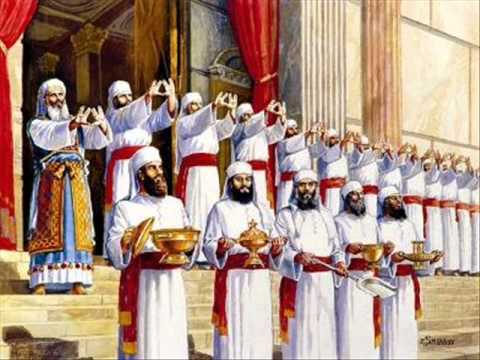
levites-aaronic-blessingAs an aside, in ancient times, the Kohenim (Levitical Priesthood) also worked on Shabbat and yet were held blameless (Matthew 12:5). I wonder when they rested? Of course, in the days of Jesus, the Priests worked on a rotational basis, so maybe it wasn’t as bad as all that. However, what about Rabbis working on Shabbat? But I digress.

I wonder if Pastor or anyone else at church would consider actually observing a Saturday Shabbat as “legalistic,” particularly if observed from sunset Friday to sunset Saturday and abstaining from some form of the Melachot or the thirty-nine types of work traditionally forbidden on Shabbos? Would it be legalistic to observe Shabbat because it honors God as the Creator rather than just because we need a rest?

Christianity didn’t switch Shabbat from Saturday to Sunday, they eliminated it altogether. Few Christians treat Sunday the way a religious Jew observes Shabbat, not even close. I think the church surrendering the Sabbath and its traditional observance was like Christianity shooting itself in the foot. Could you imagine the enormous relief and freedom we could experience if we didn’t choose to treat Sunday pretty much like any other day of the week?

That’s pretty much what I’m going to be addressing at church for the next two months. I’m actually kind of excited to hear what Pastor is going to say about the Festivals, but I’m also kind of dreading how it’s going to play in Sunday School. I’m going to go. In some ways, I really want to go. And I’m going to give input. People have become aware of my basic leanings and seem to be OK with it, but this will be the real test.

People are going to find out that in my own small way, I do observe the Festivals. My wife and kids being Jewish, we have a family seder each spring and I build a sukkah in our backyard each fall. I eat matzah instead of leavened products for the eight days of unleavened bread. And although I don’t always fast on Yom Kippur, I have done so periodically in solidarity with the Jewish people.

Too bad this didn’t come up before Tisha B’Av.

I’m sure I’ll have more to say after next Sunday’s message and Bible school study. This is where my real life experience and the mission illustrated in Boaz Michael’s book Tent of David intersect, hopefully not to forcefully, though.


Life Under Repair

Question: I’ve been enjoying the philosophy articles on Aish.com. The approach to life resonates with me much more than the Western style of consumerism and media hype. Regarding the obligatory nature of mitzvot, however, I think sometimes humans have to disregard the boundary and be disobedient against the command. It might be painful, but I believe you come away with a higher appreciation that God and His commands are ultimately correct. Do you agree with this thinking?

The Aish Rabbi Replies: You have touched on a deep truth, but ultimately your principle is mistaken. The Talmud states: “In a place where a reformed sinner stands, even a righteous tzaddik does not stand.” The idea is that after having erred, you can analyze your negative acts, learn from them, and use that knowledge as a foundation to motivate you further.

While all this seems to imply that it is better to make mistakes and then correct them, rather than never have made the mistake in the first place, that is not true.

Let’s take the mundane example of the rule: “Always look both ways before crossing the street.” There are two ways to learn this lesson: 1) Listen to the advice of teachers and parents to look both ways before crossing, or 2) cross recklessly, get hit by a car, and then while lying in the hospital acknowledge a lesson well-learned.

The problem in choosing the second path is that there is always a residual effect from our mistakes. A teenager who experiments with drugs may grow up to realize the dangers, but a lot of brain cells have been killed in the meantime.

“Intentional Mistakes”
from the “Ask the Rabbi” series
Aish.com

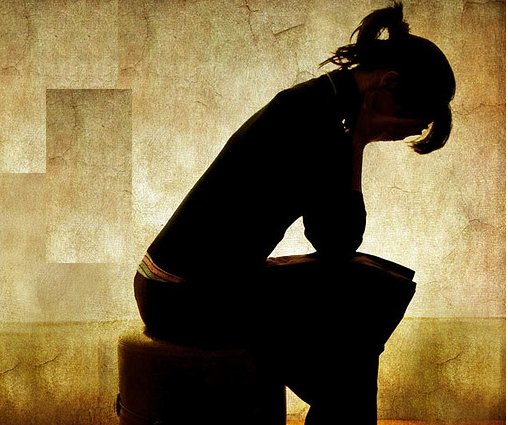
(I almost didn’t post the first picture that appears in today’s “meditation” because of its provocative elements, but of all the similar images I found, this one came closest to communicating what I wanted to say.)

In a comment on Gene Shlomovich’s recent blog post How Jesus may have viewed conversion to Judaism, I mentioned how I corrected one of my mistakes:

To be fair, many non-Jewish “Messianics” were taught for years or even decades that there was “One Law for the native-born and the alien” and that information is well ingrained into their psyche and identity. Now that “the movement” has evolved and more accurate information is available relative to how the Bible defines the roles of “Messianic” Gentiles and Jews, it is very hard for some to surrender a status or role that they’ve become quite used to.

I remember when FFOZ (First Fruits of Zion) first announced that they had been wrong in supporting the One Law position and that they were correcting their teachings and organizational stance. I felt angry and betrayed and shot off a very pointed comment or two on Facebook in response. It was like being given an important and valuable gift and becoming comfortable with it, then having it suddenly ripped away.

I suppose I could have become one of those angry “deniers” and continued to “demand my right” to “Torah obligation,” but I started to think. FFOZ had financially just shot themselves in the foot. A large number of their constituents simply abandoned them, abruptly and significantly reducing their income. Why would they do that when in any practical sense, even if privately they’d come to the conclusion that One Law was unsustainable Biblically and theologically, they should have publicly maintained their OL position in order to make sure they survived as a ministry? Their decision only made sense if moral and spiritual honesty were more important to them than an income.

I became curious and started investigating. At about the same time, I started looking at my wife’s pursuit of her Jewish identity as an individual and as a member of the Jewish community through different eyes. Long story short, I realized that I had been wrong in my One Law assumptions and shifted my perceptual and theological paradigm accordingly.

But to say that it was difficult is a gross understatement. A lot of people aren’t capable of that kind of change. I even recently wrote about how difficult it is to “share Abraham” so to speak, and accept that only certain blessings are passed down to the nations (Christians) through Israel. Exchanging self-entitlement for a more mature reality is very hard and not everyone is going to accept it.

Frankly, and not to necessarily contradict the Aish rabbi from whom I quoted above, I don’t see how some mistakes can be avoided. I mean, we all make mistakes. Some are actually part of the human developmental learning process. Take walking for example. When a small child is first learning how to stand and walk, the child falls a lot. Falling isn’t a mistake at this stage of development, it’s a requirement and it’s perfectly normal and expected. No small child has ever (to the best of my knowledge) spontaneously stood and walked with absolute precision on the very first try, and never fell back to the floor. Everybody falls the first time, or the first dozen times, or the first few hundred times.

I think trying to understand God and trying to understand who we are in God is like learning how to stand and walk. We get a lot of things wrong at first, but that’s to be expected. Just conceptualizing the existence of God is tremendously difficult, and integrating faith, trust, hope, and spirituality into a daily lifestyle can escape even some of the best of us. I would hardly expect anyone to become “good at it” right off the bat. In fact, most of us never get really “good at it.” We continue to struggle, to learn, and we periodically fall flat on our faces.

That’s how I’d characterize my own spiritual development, anyway. I suspect that if we were all honest with ourselves and everyone else, every person of faith would admit to the same thing. Only pride keeps us from doing so. We’re afraid of looking foolish. We’re afraid of what other people will say. We’re afraid of just letting go of all that and, like a little child, accepting what God has given us from His abundant store of gifts.

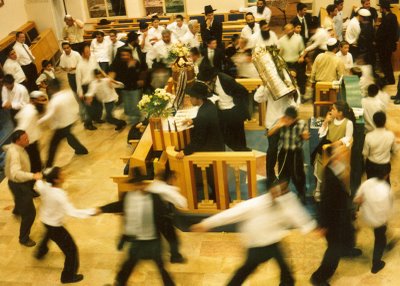
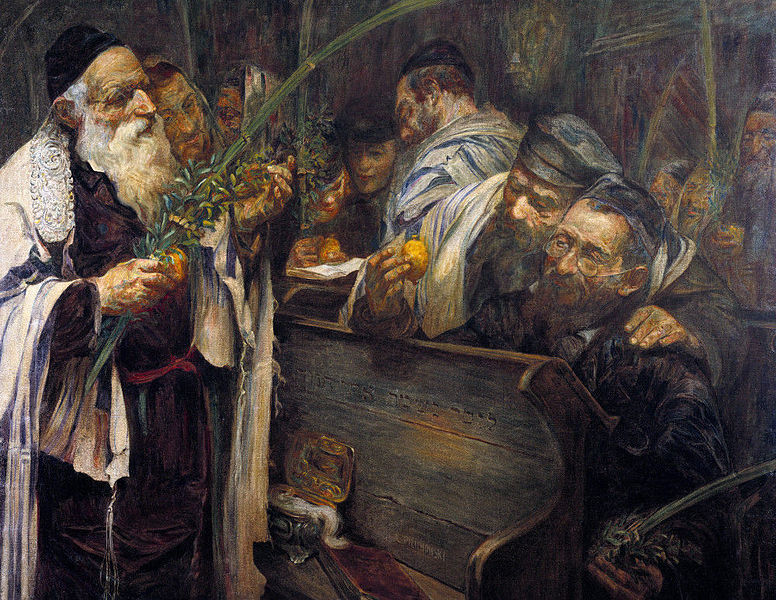
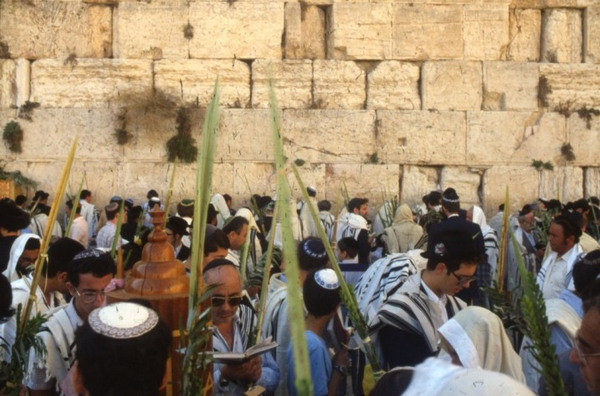
For seven days of Sukkot, Jews walk around in circles, carrying an assortment of green and yellow flora. Then, on Simchat Torah, they dance in circles carrying Hebrew scrolls, working up to a frenzy.

Did I say dance? Well, it’s more like marching, your hands over the next guy’s shoulders, singing and stomping as you march to . . . the same place you started from. Repeat until you plotz. (Yiddish: collapse)

Now for my confession…

When I was first invited, cajoled and nudniked to join the circular festivities, I was more than hesitant. I attempted to explain that I didn’t see the point of walking in such a way that you don’t get any further than where you started. Needless to say, the argument was ignored, and I was swept into the circle whether I liked it or not.

And I felt stupid. For about the first 40,000 circuits. After that, I forgot about myself and how I felt and what I was doing and why I was doing it and whether I was stupid and that I was there at all. And that’s when the circle became good. Very good.

It was good exactly due to that which I had subliminally feared. Because as I stand here, I am I. In the circle, that I dissolves into we. And in that very act of transcendence, that loss of self, there is unbounded joy.

-Rabbi Tzvi Freeman
“Why Jews Dance in Circles”
Commentary on Sukkot and Simchat Torah
Chabad.org

While being embarrassed and feeling foolish (and avoiding joy) aren’t exactly mistakes, these are experiences that, if we allow them to, will prevent us from correcting mistakes and lead us into a lifestyle based on error and fear. In fact, many people try so hard to avoid embarrassment, foolishness, and the tremendous effort that change requires once it’s discovered, that they live in self-denial, never even permitting themselves to realize that what they are living is a mistake. That is why so many people (and I know atheists must think this about religious people) can “stand their ground” and “stand up for their rights” with total conviction of purpose, and still be dead wrong.

But remember, even in the lesson we learned from the Aish Rabbi, it’s only a mitzvah if we realize we made a mistake and corrected it. And, remember as well that it would have been better to never have made the mistake in the first place.

We can’t avoid making a mistake. We fall so that we can learn to pick ourselves up. Although mistakes are regrettable, they are also part and parcel of the human experience. Falling down is an obvious mistake when our intention was to walk. Many human mistakes are far more subtle and even when we want to be honest, it can be difficult to see past our own assumptions, prejudices, and pride.

To conquer even our unintentional and unconscious errors, we must learn to question everything about ourselves. Why do I believe in such-and-thus? Is it because I grew up believing this? Did someone teach me this belief when I was cognitively or spiritually immature? Examining the same information now that I am more educated, more mature, and more stable, will I reach the same conclusions that I did before?

These are all very dangerous questions and they can make us feel extremely insecure in areas that are absolutely the foundation of our existence. You don’t have to question your faith in God, but you do have to question what that faith means and how it is to be expressed. While people can change, most people don’t once they arrive at a certain comfortable plateau. The trick is never to completely rest on that plateau. It’s not your destination. Keep climbing, even if you feel uncomfortable, even if you feel nervous or foolish. The truth is always one level higher than you’ve ascended so far.

Or like Rabbi Freeman, after dancing in pointless circles the first 40,000 times or so, eventually, you’ll see that pursuing the joy of God is more important than how you feel or what you look like to others. Fixing mistakes and repairing your life is a mitzvah. So is longing for God. The two go hand in hand.

Climb. Dance.


God is in Jerusalem

It shall be on that day that God comes against the soil of Israel – the word of the Lord Hashem/Elohim – My raging anger will flare up; for in My vengefulness, in the fire of My fury, I have spoken: [I swear] that on that day a great earthquake will take place upon the soil of Israel. They will quake before Me – the fish of the sea, the bird of the heavens, the beast of the field, every creeping thing that creeps on the ground and every human being that is on the face of the earth; the mountains will be broken apart and the cliffs will topple, and every wall will topple to the ground. I will summon the sword against him to all My mountains – the Word of Lord Hashem/Elohim – each man’s sword will be against his brother. I will punish him with pestilence and with blood; torrential rain and hailstones, fire and sulfur will I rain down upon him and upon his cohorts and upon the many peoples who are with him. I will be exalted and I will be sanctified, and I will make Myself known before the eyes of many nations; then they will know that I am Hashem.

I will make My holy Name known among My people Israel, and I will not desecrate My holy Name any longer; then the nations will know that I am Hashem, the Holy One in Israel.

Ezekiel 38:18-23, 39:7 (The Kestenbaun Edition Tikkun)

This is part of the Haftarah reading for Sukkot Shabbat Chol Hamoed which was read yesterday in synagogues all over the world. Although I attend no synagogue or other congregation where the Torah is read on Shabbat, I privately read and study each week’s Torah portion, including the Prophets, Psalms, and if applicable, the writings of the Apostles.

Although I rarely (if ever) write or teach from the Haftarah portion, I was rather struck by the words of the prophet Ezekiel and by the choice of this passage for the Shabbat that occurs during Sukkot. The words of the prophet seem rather harsh for this season of joy, relating the events of the war of Gog and Magog at the end of time, according to the commentary I found in the Tikkun. And yet there is an important reminder to attend to in this lesson.

God speaks of making His holy Name known, both among the nations and in Israel, and that His holy Name will not be desecrated any longer. In fact, He says, through the prophet, two rather interesting things:

I will not desecrate My holy Name any longer.

Then the nations will know that I am Hashem, the Holy One in Israel.

I quoted from the passage above generally to illustrate that both in most of modern Israel and in most of the rest of the world, the holy Name of God is not recognized, acknowledged, esteemed, or given any honor at all. Most of humanity does not know that “God is Hashem” (Heb. literally, “the Name”). I even mentioned recently that among many religious people, the Name of God is desecrated and not sanctified due to their (our) rude and hostile attitudes when we’re communicating with each other online. Relative to the population of our planet, only a tiny fraction of humanity currently cares about God and His Name at all.

But what peculiar things did God say in the passage from Ezekiel? He said that He will no longer desecrate His own Name. Really? I thought that we human beings were doing the desecrating, not God. The commentary for Ezekiel 39:7 in the Stone Edition Tanakh says that God will no longer desecrate His own Name by “allowing” His “people to be subjugated and humiliated.” That is very interesting because it points to the thought that by subjugating and humiliating the Jewish people (and within the context of this verse, there can be no other people group being addressed), we among the nations (including Christians) are desecrating the holy Name of God.

That’s a rather interesting thought. It goes along with this:

I will bless those who bless you, and him who curses you I will curse; and all the families of the earth shall bless themselves by you.

Genesis 12:3 (Stone Edition Chumash)

To bless Israel is to be blessed and to curse Israel is to be cursed. Furthermore, all of the families, the nations of the earth will bless themselves by you, by Israel.

This tells us something I’ve said on numerous occasions in other blog posts, that we Christians are only connected to God and we only receive the blessings of God through Israel, and specifically through Israel’s “firstborn son,” the Messiah, the King, Jesus Christ.

Every time we throw a Jew under a bus, so to speak, or insult, denigrate, or attack Israel in any way, we are causing God to curse us and canceling our ability to bless ourselves by Israel.

How could we be so blind?

It has been said that during the festival of Sukkot, during the days of the Holy Temple in Jerusalem, that the priests would sacrifice seventy bulls, representing the nations of the earth, in order to atone for our sins. It is also said that if the Romans, representing the nations of the earth, had realized the importance of the Temple in atoning for them, for us, they (we) would never have leveled the Temple (which to this day, has not been rebuilt) and sent the vast majority of the Jews out from their land for nearly 2,000 years.

That leads us to the second rather compelling thing God said through Ezekiel: “Then the nations will know that I am Hashem, the Holy One in Israel.”

Read that last part again. “…the Holy One in Israel,” not the Holy One of Israel. This paints a picture not of possession but of belonging and of unity. God is not just the God of the Jewish people, but He resides in Israel. He has belonging in Israel. He is united with Israel.

Particularly during this time of year, the statement of God in Israel is punctuated by the following:

It shall be that all who are left over from all the nations who had invaded Jerusalem will come up every year to worship the King Hashem, Master of Legions, and to celebrate the festival of Succos. And it shall be that whichever of the families of the land does not go up to Jerusalem to bow down before the King, Hashem, Master of Legions, there will be no rain upon them. But if it is the family of Egypt that does not go up and does not come [to Jerusalem], there will be no [water] for them; the same plague will come to pass with which Hashem will strike the nations that do not go up to celebrate the festival of Succos. This will be the punishment of the Egyptians and the punishment of all the nations that will not go up to celebrate the festival of Succos.

Zechariah 14:16-19 (Stone Edition Tanakh)

In other words, after the end of all things, when God once more establishes His rule over all the world from Israel and in Holy Jerusalem, if the rest of us, all of us, want to go and properly worship the God of Israel, we will need to go and worship our God in Israel.

Really everyone, I’m not making this stuff up. It’s not some arcane and esoteric commentary from the medieval Jewish sages. It’s right there in your Bibles. Look it up if you don’t believe me. As Christians, we may not be commanded to celebrate Sukkot or any of the other festivals, either in our own lands or in Jerusalem, but the day is coming when we will be compelled to send representatives from every nation, people, and tongue, to go up to Jerusalem and pay homage to the King, and to celebrate the festival of booths with our brothers and our mentors, the Jewish people.

But after all, that’s rather appropriate I think, given what was said by James, the brother of the Master:

After they finished speaking, James replied, “Brothers, listen to me. Simeon has related how God first visited the Gentiles, to take from them a people for his name. And with this the words of the prophets agree, just as it is written,

“‘After this I will return,
and I will rebuild the tent of David that has fallen;
I will rebuild its ruins,
and I will restore it,
that the remnant of mankind may seek the Lord,
and all the Gentiles who are called by my name,
says the Lord, who makes these things known from of old.’”

Acts 15:13-18 (ESV)

James is quoting the prophet Amos (Amos 9:11-12) in regards to “David’s fallen booth,” which we might render as “sukkah,” when describing how the Gentiles will also come to worship the God of Israel. Boaz Michael, President and Founder of the educational ministry First Fruits of Zion (FFOZ) referred specifically to this teaching in the Introduction of an early manuscript of his forthcoming book (of which I’ve read an advanced copy), Tent of David: Healing the Vision of the Messianic Gentile:

The Tent of David is a reference to the Davidic kingdom, which Amos envisions will encompass even the Gentiles, non-Jews who attach themselves to Israel and to Israel’s Messiah. James reckoned that the believing Gentiles of his day were the first fruits of the fulfillment of Amos’ prophecy.

The concept of the Tent of David, central as it is to the identity of the church and the Messianic Gentile, is seriously underappreciated. The prophets envisioned a kingdom that brought myriads of Gentiles to the knowledge of the Messiah and submission to his rule. Isaiah (2:2) prophesied that people from all nations—Gentiles—would flow to Jerusalem and worship there. Later in Isaiah (11:10–12), Messiah is said to inspire Gentiles to come to him as well as regather the scattered Jewish people. Isaiah 49:6; Micah 4:2; and Zechariah 8:22–23 contain similar prophecies.

The Lord’s brother saw the potential and the prophetic necessity for Yeshua-believing Gentiles and Jews to partner in making the prophets’ vision a reality. The Messiah had come and Gentiles were coming to him in droves. Paul’s ministry was devoted to making the “obedience of faith” a reality in the Gentile community, connecting his Gentile believers to Israel and teaching them how to properly submit to the rule of King Messiah. (Mark Nanos, The Mystery of Romans (Minneapolis: Fortress, 1996), 166–238.)

Not only must we cease to desecrate God’s holy Name by desecrating His holy people, the Jewish people, we must bless them in order to receive the blessings that God has reserved for us. Part of those blessings is a commandment to worship God in Jerusalem once the Messianic reign of Jesus is fully established. Part of our role as recipients of those blessings is to support Israel so that David’s “fallen booth” can once more be built up. Boaz Michael says it this way:

Gentile believers had a unique and vital role, using their numbers and resources to empower and bless the Jewish community and spread the message of the kingdom in their own culture.

I believe that remains our role in the world and in relation to the Jewish community. We must bless them and build them up, support them in returning to Torah and in re-claiming the Messiah as their own. This is what it is to rebuild the fallen sukkah of David, so that one day, Jews, Christians, and all of the world will gather together in Jerusalem and worship under the shelter of God.

Sukkot and Simchat Torah: Abundant Life

Without Torah it is impossible for an individual to say that his life is full of things that cause him to offer G-d thanks; even if he enjoys mostly good times, he still cannot consider himself to be vitally alive, as most of a person’s time is occupied with food, drink and sleep, earning a living, etc.

A Jew, however, is inextricably bound to the “Torah of life,” and is therefore able to imbue all that he does with life; even while engaged in mundane affairs he cleaves to G-d by remembering that “All your actions should be for the sake of Heaven,” and “In all your ways shall you know Him.” (Mishlei 3:6; Tur and Shulchan Aruch , Orach Chayim 231.)

The result? “And you who cleave to the L-rd your G-d are entirely alive ,” (Devarim 4:4.) every moment of every day. Thus a person can and must thank G-d for granting him life and enabling him to reach this occasion.

“Shehecheyanu for Torah”
from “The Chassidic Dimension” series
Lesson for Berachah and Simchas Torah
Based on the teachings of the Lubavitcher Rebbe
Rabbi Menachem M. Schneerson
Chabad.org

I periodically encounter some Jewish teachings and commentaries that apparently elevate the Jewish people at the expense of everyone else in the world. That is, it seems as if, at least in some corners of Judaism, that Jews see themselves as more spiritually elevated than Gentiles, regardless of any particular Gentile’s religious tradition, including Christianity. At first blush, this seems to smack of elitism if not downright bigotry, but we should remember that through the vast majority of Jewish history, at one time or another, most of the non-Jewish nations have tried to evict, enslave, or exterminate the Jews, in part, because of their “choseness” by God as a people.

It is a fact that God did give the Torah to the Children of Israel and it has been passed down, generation by generation to their modern descendents, the Jewish people. Yes, there was a “mixed multitude” of Gentiles standing with the Israelites at Sinai who also agreed to the full conditions of the covenant, but within a few short generations, not one distinctly Gentile person remained among Israel according to the Biblical record. They had all been completely assimilated into larger Israel, and their descendants became indistinguishable from Israelites who were fully, genetically descended from Abraham, Isaac, and Jacob.

So if we choose to believe that without the Torah, the full yoke of the 613 mitzvot, (or those two hundred and some that can be performed today, especially outside the Land of Israel) that life cannot be lived to the fullest, then are the Jews saying that we Gentiles do not truly live our lives full of all good things?

Perhaps, at least according to the Chassidic Dimension reading I quoted above. But that’s not the end of the story, particularly for Christians.

In the beginning was the Word, and the Word was with God, and the Word was God. He was in the beginning with God. All things were made through him, and without him was not any thing made that was made. In him was life, and the life was the light of men. The light shines in the darkness, and the darkness has not overcome it.

And the Word became flesh and dwelt among us, and we have seen his glory, glory as of the only Son from the Father, full of grace and truth.

John 1:1-5, 14 (ESV)

Truly, truly, I say to you, whoever hears my word and believes him who sent me has eternal life. He does not come into judgment, but has passed from death to life.

“Truly, truly, I say to you, an hour is coming, and is now here, when the dead will hear the voice of the Son of God, and those who hear will live. For as the Father has life in himself, so he has granted the Son also to have life in himself. And he has given him authority to execute judgment, because he is the Son of Man. Do not marvel at this, for an hour is coming when all who are in the tombs will hear his voice and come out, those who have done good to the resurrection of life, and those who have done evil to the resurrection of judgment.

John 5:24-29 (ESV)

So Jesus again said to them, “Truly, truly, I say to you, I am the door of the sheep. All who came before me are thieves and robbers, but the sheep did not listen to them. I am the door. If anyone enters by me, he will be saved and will go in and out and find pasture. The thief comes only to steal and kill and destroy. I came that they may have life and have it abundantly.

John 10:7-10 (ESV)

It appears that the Gospel of John, the most “mystic” of the Gospels, at least according to Paul Philip Levertoff, has a lot to say about the life we have in Jesus Christ. And if indeed the Master is “the Word made flesh” who lived among his people, and he thus commanded his Jewish disciples to pass on that Word and make disciples of the nations of the world, then although we do not possess the Torah as the Jews do; as the set of conditions they must fulfill as part of the Sinai covenant, we possess the essence; the life of “Torah” in our faith and our salvation. We possess life to the fullest and have it abundantly.

Can we not also consider ourselves now “vitally alive” as the Jewish people do? Does that life not cause us to cry out in thanks and joy to God for all of His love, gifts, and provisions, even at those moments when we may be suffering?

Yahrtzeit of Rebbe Nachman of Breslov (1772-1810), founder of the Breslov chasidic movement. Rebbe Nachman lived in Poland and the Ukraine, where he inspired thousands of Jews to greater love of God. Though he suffered the loss of his son and wife, Rebbe Nachman said: “You may fall to the lowest depths, heaven forbid, but no matter how low you have fallen, it is still forbidden to give up hope.” A few of his most famous teachings are: “It’s a great mitzvah to always be happy,” and “All the world is a narrow bridge — but the main thing is not to be afraid” (now a popular Hebrew song, Kol Ha-Olam Kulo). Every year on Rosh Hashana, tens of thousands of Jews travel to Uman (Ukraine) to pray at the gravesite of Rebbe Nachman.

Day in Jewish History, Tishei 18
Aish.com

A chassid once traveled to one of the Chabad rebbes. He related to the rebbe that his deceased teacher had appeared to him in a dream with a frightening message: it had been decreed in heaven that one of this chassid’s children would pass away that year.

The rebbe heard his words, sighed, and remained silent. A reaction that certainly did not bode well.

As it was shortly before the holiday of Sukkot, the chassid remained till after the holiday. When it was time for him to return home, he approached the rebbe for his blessing. The rebbe happily assured him that his family would be well.

“Besides,” the rebbe asked, “what special deed did you do on Simchat Torah?”

The chassid recounted how during the hakafot he was standing on the side crying when he remembered that, after all, it was Simchat Torah! He washed his face and joined the dancing, ignoring his dread.

“You should know,” the rebbe said, “this is what caused the change in your situation.”

-Rabbi Yossy Gordon
“The Power of Joy”
Commentary on Sukkot and Simchat Torah
Chabad.org

He will wipe away every tear from their eyes, and death shall be no more, neither shall there be mourning, nor crying, nor pain anymore, for the former things have passed away.”

Revelation 21:4 (ESV)

But that the dead are raised, even Moses showed, in the passage about the bush, where he calls the Lord the God of Abraham and the God of Isaac and the God of Jacob. Now he is not God of the dead, but of the living, for all live to him.”

Luke 20:37-38 (ESV)

We are called not just to abundant life but to joy through our salvation in Christ. The Jewish Messiah allows us to partake in the blessings of such a completely full life that even in our tears, when we allow ourselves to be completely aware of God and His Presence among us, within pain and grief, there is still the light of joy. We are alive, and even those who have passed on to the “long sleep” remain alive in Him.

the-joy-of-torahIt’s difficult to communicate to most Christians the sheer happiness and celebration that is attached to Sukkot and Simchat Torah unless they’ve actually participated in those events and let themselves be immersed in such joy. And yet, even if we don’t “get” these or any of the other Jewish festivals, we should get why they are celebrating. The reason they’re celebrating is the same reason we should be celebrating. God is with us. How can we not feel completely, intensely alive?

Before we came to God through Christ, we were dead in our sins, completely separated from our Creator and so numb spiritually, that we lacked the ability to even be aware of God. (see Ephesians 2:1, Colossians 2:13) Now we are not only alive, but abundantly and exceedingly alive. We have life to the fullest. We have life that extends beyond the mere beating of our hearts. We are alive in God.

This is the day that the LORD has made; let us rejoice and be glad in it.

Psalm 118:24 (ESV)

Good Shabbos and Chag Sameach.

Freedom

Seven days shall you dwell in boothsLeviticus 23:42

… and you shall only be rejoicingDeuteronomy 16:15

Succos is the festival designated as the season of our gladness. Yet the commentaries state that one of the symbolisms of the succah, a temporary hut, is that we dwell in it for seven days to symbolize man’s temporary sojourn on earth for his average life span of seven decades (Psalms 90:10).

Human mortality is a rather sobering thought; it is hardly conducive to rejoicing. Most often we do not think about our mortality, and when circumstances force us to face it, we quickly dismiss it from our minds and go on acting as though we will live forever.

How different Torah values are from secular values! The Torah teaches us that there is an eternal life, a wholly spiritual life, whose bliss is far greater than the human mind can imagine. We are placed on this planet for our ephemeral earthly existence only to give us an opportunity to prepare for the eternal life.

The Torah teaches us to enjoy life, and if it restricts some pleasures, it is because we should enjoy life in a manner that befits a human being. Furthermore, our joy of living should not be diminished by the awareness of our mortality, nor need we deny it. The succah – the symbol of our temporary stay on earth – is beautifully decorated, and we enjoy our festive meals therein. Even our temporary existence can be beautiful and happy, and our faith in the eternal life should enhance that happiness.

Today I shall…

try to enjoy life as befits a spiritual person, knowing that the true life of man is not the fleeting one, but that of eternity.

-Rabbi Abraham J. Twerski
“Growing Each Day, Tishrei 15”
Aish.com

Throughout life people will make you mad, disrespect you and treat you bad. Let God deal with the things they do, cause hate in your heart will consume you too.

-Will Smith, American actor

I probably take myself too seriously. Sometimes my wife tells me that. I know it’s certainly true of me in my “online persona.” I guess that comes from being a professional writer. Writing is what I do, so it’s important to me. It’s pretty much my first, best expression of who I am. Not that I’m perfect at it of course. But I don’t paint, and I don’t play music, and I’m not that good a public speaker, and I don’t dance worth anything, so I’ve got to have one way of expressing myself that’s better than all the others.

For me, that is writing. I’ve said before that writing this blog has a therapeutic aspect to it. It helps for me to pound out my thoughts and feelings, to “wear my heart on my sleeve,” so to speak. I can better describe how I feel and think about God, Jesus, Christianity, Judaism, and lots of other things when I write. Not that everyone will agree with me, but then, not everybody has to agree with me.

In this season of joy, during Sukkot, I need to be reminded about the difference between what’s real and important and what’s more or less beside the point. A lot of what happens online is beside the point. No, it’s not that I don’t take my writing seriously, and it’s not that I don’t take the people who I interact with online seriously, but beyond a certain point, I have to let things go.

Some people steal joy, as if joy were something you have and they don’t. As if joy were something they’ll never have and they can’t stand that you have some. They steal it, even if they can’t use it themselves, just so you can’t use it, either.

No one can do that to you unless you let them. In real life, it’s harder to combat, especially if the person stealing your joy is important to you, especially if it’s someone you love. While I get hurt by people I love sometimes, no one I love steals my joy. I’d probably let them if they wanted to, because I love them, but they don’t do it because they love me and they know that stealing joy is wrong.

Online, there are no end of people who steal joy. They may not think of it in those terms, but that’s the net result of their interaction with others. It’s easier to try to steal someone else’s joy online because you can’t see them and they can’t see you. You are depersonalized. They can’t see that they’re hurting you, and so, if they have no empathy, compassion, or grace, they don’t have to care if they’re hurting you. They can verbally harangue you, insult you, make fun of you, and feel well justified in doing so, because you aren’t even human to them. You’re just an anonymous “thing” that they can attack and defeat. I guess that’s what it takes to make themselves feel better.

You’d think that it would be easy to let go of someone like that online. All you have to do is pull the plug on whatever communication conduit they use to connect to you. Stop visiting their blog. Ignore or delete their comments on your blog or even block their IP address. But it’s not that easy. It’s like slamming the door in someone’s face. Even when they’re hostile, and even when they’re abusive, if you’re a decent human being, it still feels rude to (metaphorically) slam the door in their face.

Most hostile and abusive people are usually victims of some kind. Most bullies and trolls online have a history of being bullied themselves. I guess that’s why I put up with some folks as long as I do. I realize that even when they’re in your face, making demands of you, telling you what to do, that it’s really their defense against how hurt they are inside. They’ve never dealt with their pain and never resolved their conflicts. The only way they know how to live inside their own skin is to project all of their “stuff” onto others.

So I was dumb, and I was foolish. I (mentally) cut someone loose but let them back in because I thought maybe there was hope that, though we’d always disagree, we could disagree with a sense of mutual respect. I was taking a risk, but you have to do that sometimes. Sometimes it’s worth it. This time it wasn’t.

You can’t really hate a victim because in many ways, they just can’t help themselves. In order to feel powerful, they have to be hostile. These sorts of people, especially guys, mistake anger and aggressiveness for power, not realizing that true power isn’t hostile or aggressive at all. True power is love, compassion, forgiveness, mercy, graciousness, and tenderness. Some people think the only power is intelligence, education, superiority, winning the argument, devastating twists of irrefutable logic, how well they halalachally perform a mitzvot. That’s the stuff they push in your face to show you that they’re not a victim, that they’re “winning,” that they’re better than you. Then they can feel better about themselves.

But they’ve missed the point. Paul was extremely clear about which gifts are more important. In fact, there’s one gift, one attribute that we can all possess and exercise if we choose to, that trumps all the rest.

If I speak in the tongues of men and of angels, but have not love, I am a noisy gong or a clanging cymbal. And if I have prophetic powers, and understand all mysteries and all knowledge, and if I have all faith, so as to remove mountains, but have not love, I am nothing. If I give away all I have, and if I deliver up my body to be burned, but have not love, I gain nothing.

Love is patient and kind; love does not envy or boast; it is not arrogant or rude. It does not insist on its own way; it is not irritable or resentful; it does not rejoice at wrongdoing, but rejoices with the truth. Love bears all things, believes all things, hopes all things, endures all things.

Love never ends. As for prophecies, they will pass away; as for tongues, they will cease; as for knowledge, it will pass away. For we know in part and we prophesy in part, but when the perfect comes, the partial will pass away. When I was a child, I spoke like a child, I thought like a child, I reasoned like a child. When I became a man, I gave up childish ways. For now we see in a mirror dimly, but then face to face. Now I know in part; then I shall know fully, even as I have been fully known.

So now faith, hope, and love abide, these three; but the greatest of these is love.

1 Corinthians 13:1-13 (ESV)

Really. Read that again. What is Paul saying? He’s not saying that “winning” in some Charlie Sheen fashion is the whole point. He’s saying that, even if you’re fabulous in speaking tongues, are an amazing prophet, even if you have faith that literally can move mountains, but you don’t have love, you have nothing.

GardeningLove is like a small, fragile, budding plant you nurture inside of you. If you don’t take care of it, the love will wither, and you will wither along with it. Love takes a lot of special attention but if you don’t care for the love inside of you, you’ll never be able to show it to others, especially those who really need to be loved. It almost seems paradoxical to say that in order to preserve your love, there are some people you have to let go. But those are the people who suck joy directly from your soul, murdering your love, blackening your heart, and damaging, not only you, but everyone around you who needs and depends on you.

Author C. JoyBell C. said, “You will find that it is necessary to let things go; simply for the reason that they are heavy. So let them go, let go of them. I tie no weights to my ankles.” Sometimes toxic people are the weights that hold us down. And even if it feels like giving up on another human being, it’s better to let go of the weight so that you can rebound and fly, than to keep hanging onto it and letting it; letting that person drag you down into hostility, hopelessness, and despair along with them.

I hope and pray that my “toxic person” finds his way and learns to let go of his own unneeded weights, but he’ll have to learn love, the kind of love Paul was talking about, first. That’s something you can’t teach someone, especially against their will and especially if they equate humility, compassion, forgiveness, and love with being humiliated and being weak.

This is the season of joy. This is the time to rediscover love, love of your fellow person and love of God. To soar up to the source of our flame, we have to unburden ourselves sometimes. In order to fly, you have to break free from the people and things that hold you down.

“Woe to him who does not feel that this life and the next are but one!”

-Nikos Kazantzakis from his novel
“Zorba the Greek”

Sukkot: The Man Who Had No Coat

There was once a man, whom we will call Andy, who was diagnosed with a rare and severe illness. Unique conditions often call for unconventional treatments, and he was advised to try psycho-physical therapy: he was told to find someone who lives in complete joy with no worries, ask him for his coat, and wear that man’s coat for seven days. Hopeful that he would soon feel healthy again, Andy embarked on his mission to find such a person. He searched everywhere, asking everyone he met if they or someone they knew was completely happy without worries. Unfortunately, after many months he still hadn’t found anyone who fit the description.

Finally, with the debilitating illness still progressing, Andy was referred to a man named Sam who, he was told, was happy and had no worries at all. It was winter, yet Andy anxiously trudged through the snow to a park bench where he was told Sam could be found. Andy sat down next to Sam and began his inquiry.

“Are you Sam, the man they say is filled with joy, who has no worries?” Andy asked.

“Yes, indeed I am,” Sam replied with a smile.

“Wonderful! May I borrow your coat for seven days? It would really mean a lot to me.”

“Of course! I would love to lend you my coat, but there’s just one problem.”

“What’s that, Sam?”

“I have no coat.”

-Rabbi Mordechai Dixler
Program Director, Project Genesis/Torah.org
“The Party That Never Ends”
ProjectGenesis.org

This lesson from Rabbi Dixler somewhat reminds me of something that the Master taught:

“Do not lay up for yourselves treasures on earth, where moth and rust destroy and where thieves break in and steal, but lay up for yourselves treasures in heaven, where neither moth nor rust destroys and where thieves do not break in and steal. For where your treasure is, there your heart will be also. –Matthew 6:19-21 (ESV)

But what does all this have to do with Sukkot? Plenty.

As Rabbi Dixler points out in his commentary, during Yom Kippur, observant Jews immerse themselves in prayer and supplication before God, turning aside from physical pleasures and imploring their Creator to help them build a new future. Immediately after such a time of plunging into the intense personal and spiritual depths, emerging after the fast and knowing that Sukkot is immediately upon them, the soul rebounds and rises into great joy.

Interestingly enough, Jews are to leave their regular dwellings and reside in “simple huts with deliberately poor roofing” for this week-long holiday, entertaining their guests including, traditionally, Abraham, Isaac, Jacob, Joseph, Moses, Aaron, and David…a different guest each night. It would be like welcoming a different king on each successive night, and entertaining them in a makeshift lean-to. After the personal deprivation of Yom Kippur, why eat and drink and sleep in, what for some of us, might be a small, damp, cold, flimsy shelter?

I think the secret is in what we read from Matthew’s account of the teachings of Jesus. With the roof of the tent purposefully incomplete, allowing in rain and letting us see the stars above us at night, we are trading our physical, secular home for one which Rabbi Dixler calls a “new spiritual home” which “serves to inject the spiritual, genuine, joy experienced on Yom Kippur into common daily activities.”

But what about Andy and Sam?

One does not need a coat to be the happiest man alive. In fact, if we rely on non-spiritual pursuits for our joy, we’ll never be satisfied. As the Sages say, “a person does not leave this world with even half of what he wanted” (Koheles Raba, 1:34). Nothing in this world can live up to our dreams, and a non-spiritual focus ultimately ends in disappointment.

The answer is not asceticism. As one of my teachers, Rabbi Berel Wein, used to say in this context, “this is not a plea for poverty, my friends!” We do learn, however, that for any material pursuit or attainment to last, it must at least be rooted in spirituality. If we buy delicious food to share with others, buy a house to raise a family and welcome guests, or pursue a lucrative career to have money to help those in need, we’ll experience the spiritual joy along with the physical joy, and then it is guaranteed to last. (Based on Nesivos Shalom)

Under the sukkahI suspect that Andy was relieved of his disorder, not by wearing Sam’s non-existent coat for the next seven days, but by understanding why he didn’t have one. Although you and I might consider spending seven days and nights living, eating, and sleeping under the clouds and the sky as a bit uncomfortable (one or two nights might seem like a camp out), there is joy in relying on God. Our immediate surroundings may seem poor, but we are inundated by the boundless treasures of Heaven. By living in a flimsy structure and yet decorating it elaborately, often with lights, trinkets, pictures and such, and then, inviting guests, from the poorest to the richest, into our hovel, and feeding them abundant food and drink, we are experiencing the reality of our existence. We live on earth and are able to enjoy all that it has to offer, but we are also dependent on the blessings of Heaven above us to shelter our heads from the harsh elements of this life.

One can take pleasure in what the world has to offer and this, God approves of. But the world will not be our lasting joy. Only God can give that.

Sukkot begins tonight, September 30th, at sundown. Here’s an infographic that will tell you everything you ever wanted to know about Sukkot.

Chag Sameach and Good Sukkos.