
 To die while committed to a belief system that is idolatrous, false and contrary to what G-d has revealed to us AND has resulted in the persecution of the Jewish people for the last two thousand years, even if it doesn’t affect our eternity through the ever burning hell fires that Christianity reserves for those who didn’t believe in Jesus, is still not something I would desire for myself or anyone.
-from a private conversation
The simple believes everything, but the prudent gives thought to his steps.
–Proverbs 14:15
Faith and belief are both defined as accepting as true something which transcends logic and which may not be subject to proof by rational argument. Yet, belief in God is not the “blind faith” of a simpleton.
A simpleton does not think, either because he lacks the capacity or does not wish to make the effort. Therefore, he is gullible and can be easily swayed in any direction. Being credulous is not the same as having faith.
When we reflect on the concept of a Supreme Being, Who is in every way infinite, we are likely to feel bewilderment, because our finite minds cannot grasp the infinite. Since all of our experiences involve finite objects, we lack a point of reference for dealing with the infinite.
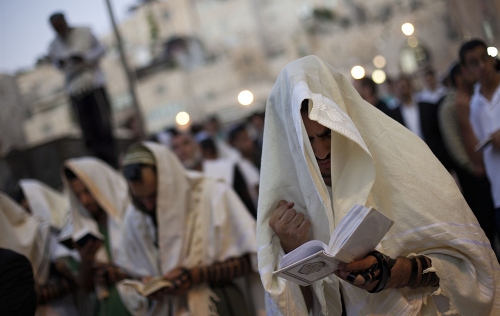
When this reflection brings us to realize that the question of the existence of an infinite Supreme Being cannot be logically resolved, we then turn to the unbroken mesorah, the teachings which have been transmitted from generation to generation, from the time when more than two million people witnessed the Revelation at Sinai. When we accept our faith on this basis, we do so as the culmination of a process of profound thought which is no way similar to the credulousness of a simpleton.
This process also helps us with other questions that we have about God. For instance, the fact that we cannot possibly logically understand God does not preclude our coming to a knowledge of His Presence.
Today I shall…
…strengthen my faith by reflecting on the unbroken chain of tradition since Sinai.
-Rabbi Abraham J. Twersky
“Growing Each Day, Elul 3”
Aish.com
I’d like to think I’m not a simpleton. I hope I’m thoughtfully considering my steps. I have faith. I believe. The faith and belief of the Jewish people ultimately rests at Sinai, at the giving of the Torah. It is said that each Jewish person is to consider himself or herself as having personally stood at Sinai and having received the Torah directly. This communicates a sense of direct “ownership” of the commandments of God, rather than just the tradition of having them passed down from one generation to the next.
For a Christian, faith and belief ultimately rests at the foot of the cross, in a pool of blood shed for our sins. Christians aren’t “commanded” to consider ourselves as having personally stood at the foot of the cross of Christ, watching him die for our sake and for the sake of the world. Maybe we should.
But even so, people like me have a difficult thing to face. In my case, I have a Jewish wife, two Jewish sons, and a Jewish daughter. My children don’t speak to me one way or the other about my attending church and professing my Christian faith, but occasionally my wife does. Occasionally a few (non-believing) Jewish friends do (although in strictest confidence) as well.
If I love my Jewish family and friends, how can I be a part of a faith that historically has been guilty of “the persecution of the Jewish people for the last two thousand years”? I thought I knew, but when someone you deeply care about asks that question, it’s not so easy to answer. The answer is long and involved, and when someone is responding to your Christianity on a really emotional level, they don’t always want to hear long, involved explanations that they’ll probably do their level best to shoot out of the water in any case.
I don’t really want to argue. If someone wants to hear about my faith, I’ll do my best to explain it to them. If they don’t, I’m not invested in beating people over the head with a copy of the New Testament.
 It doesn’t help (ironically enough) that my wife used to be a believer. My limited experience with Jewish people who were once believers and then returned or adopted a more traditional Jewish practice and worship, is that they are more highly resistant to any idea that there could be validity in Christianity or Messianic Judaism. I can only imagine it’s like being a person who is an ex-smoker (I used to smoke a number of decades ago) and a smoker is trying to convince the non-smoker to light up again.
“Yuck,” is the predictable reaction, followed by a series of reasons from the non-smoker why lighting up is an incredibly bad idea, and harmful not only to the smoker, but to everyone around the smoker, particularly the smoker’s loved ones.
As a Christian among Jews, I feel like a smoker among long-term non-smokers. If I want to “light up,” I sure better take it outside, down the alley, and around back behind a shed where no one can see me or smell me. As a Christian among Jews, I feel as if they see me like this:
In 1391, the Jews of Barcelona, Spain were victims of a massacre. This was part of three months of deadly riots throughout Spain, which left the Jewish community crushed and impoverished. Incredibly, on this same date 70 years later, a bishop named Alfonso de Espina urged the establishment of the Spanish Inquisition. The Inquisition was designed to uncover those Jews who continued to practice Judaism in secret (called Conversos or Marranos). During the years of brutal Inquisition, an estimated 32,000 Jews were burned at the stake and another 200,000 were expelled from Spain.
-from “Day in Jewish History” for Elul 4
Aish.com
You may consider that example a little extreme, but I’m not sure it’s that far out. I think it’s one thing to be Jewish and to be aware of Christians in your general environment, at the grocery store, at work, at the park, driving the streets of your city, and another thing entirely to be close to and even to live with a Christian. While my wife will occasionally give voice to her concerns, my children haven’t. My daughter, who is the only child left at home, has become more distant from me in recent months. She says everything’s OK, but everything else she says and does communicates otherwise. I can’t absolutely say it’s because of my continued church attendance and my reading from the Christian Bible, but it wouldn’t be much of a stretch, either.
Authentic Jewish life is characterized by the study of Torah, the observance of Shabbat and Kashrut, and the thrice-daily worship of God. Not Shabbes leichter as museum pieces, but a generation of Jewish women who light their candles to usher in the holy Shabbat. Not klezmer concerts to evoke nostalgia for the shtetl, but Jewish bands playing Jewish music at Jewish weddings where Jewish communities are celebrating the beginning of a new generation of a Jewish family.
I wish my niece Jodi had had such a wedding.
-Sara Yoheved Rigler
“The Dead End of Jewish Culture”
Aish.com
 Rigler wrote this article as a description of how Jewish people identifying themselves as Jewish entirely on the basis of Jewish culture (as opposed to Jewish faith, observance of the mitzvot, and study of Torah) are reaching a dead-end to their Jewish identity. The painful result, from Rigler’s perspective, is her Jewish niece Jodi’s (not her real name) wedding to a Catholic husband in a Catholic church.
Rigler writes:
One December afternoon, my precious four-year-old niece Jodi walked into my mother’s suburban New Jersey kitchen and asked, “Bubbie, are you Jewish?”
“Yes, I am,” my mother answered proudly.
“So am I,” Jodi confided, “but don’t tell Santa Claus.”
I laughed when my mother told me this story, and I chuckled every time I thought of it – for 22 years. Last week, Jodi got married, in a Catholic church, kneeling in front of a huge gilded cross. I stopped laughing.
Apparently, Jodi’s perception of Judaism as a liability grew with the years. At the age of four, being Jewish made her a persona non grata to Santa Claus. At the age of 16, growing up in a town whose century-old bylaws stipulated, “No Jews or Negroes,” Jewish identity must have been a social non-starter. At the age of twenty, as a sophomore at Boston University, being Jewish must have threatened her budding romance with a handsome Catholic senior.
I’m sure Jodi’s Catholic husband doesn’t imagine that he might be considered guilty of any wrongdoing to Jodi or Jodi’s Jewish family, but, based on my experience, eventually he’ll have to confront those feelings. At least I don’t have Jewish in-laws who are upset with me, just the nuclear family and a few other Jewish people.
He who loves father or mother more than Me is not worthy of Me; and he who loves son or daughter more than Me is not worthy of Me.
–Matthew 10:37 (NASB)
That’s a tough one to take. How am I supposed to respond to that, God? And what about this?
For whoever is ashamed of Me and My words, the Son of Man will be ashamed of him when He comes in His glory, and the glory of the Father and of the holy angels.
–Luke 9:26 (NASB)
This next one is even worse.
For in the case of those who have once been enlightened and have tasted of the heavenly gift and have been made partakers of the Holy Spirit, and have tasted the good word of God and the powers of the age to come, and then have fallen away, it is impossible to renew them again to repentance, since they again crucify to themselves the Son of God and put Him to open shame. For ground that drinks the rain which often falls on it and brings forth vegetation useful to those for whose sake it is also tilled, receives a blessing from God; but if it yields thorns and thistles, it is worthless and close to being cursed, and it ends up being burned.
–Hebrews 6:4-8 (NASB)
It would be worse to come to faith in Messiah and to fall away than never to have come to faith in the first place. Ouch.
So how am I supposed to choose, or if a choice is impossible, what am I supposed to do? At least in terms of marriage, Paul (and not God) had this to say:
But to the rest I say, not the Lord, that if any brother has a wife who is an unbeliever, and she consents to live with him, he must not divorce her. And a woman who has an unbelieving husband, and he consents to live with her, she must not send her husband away. For the unbelieving husband is sanctified through his wife, and the unbelieving wife is sanctified through her believing husband; for otherwise your children are unclean, but now they are holy. Yet if the unbelieving one leaves, let him leave; the brother or the sister is not under bondage in such cases, but God has called us to peace. For how do you know, O wife, whether you will save your husband? Or how do you know, O husband, whether you will save your wife?
–1 Corinthians 7:12-16 (NASB)
 “But God has called us to peace.” Really? Not until Messiah comes/returns (depending on who you are).
I don’t want to give the impression that I’m fighting with the missus (or anyone else) tooth and nail, and that I’m constantly engaged in some sort of “battle” of faith with the Jewish people in my life, but I can hardly ignore the steady undercurrent in these relationships as well as the occasional flare ups, either.
“Do not think that I came to bring peace on the earth; I did not come to bring peace, but a sword. For I came to set a man against his father, and a daughter against her mother, and a daughter-in-law against her mother-in-law; and a man’s enemies will be the members of his household.
–Matthew 10:34-36 (NASB)
“Not peace, but a sword.”
Whoever has faith in individual Divine Providence knows that “Man’s steps are established by G-d,” (Tehillim 37:23) that this particular soul must purify and improve something specific in a particular place. For centuries, or even since the world’s creation, that which needs purification or improvement waits for this soul to come and purify or improve it. The soul too, has been waiting – ever since it came into being – for its time to descend, so that it can discharge the tasks of purification and improvement assigned to it.
“Today’s Day”
Friday, Elul 3, 5703
Compiled by the Lubavitcher Rebbe; Translated by Yitschak Meir Kagan
Chabad.org
Assuming God is establishing my steps too, I have to believe that I have come to this place, this time, this circumstance, for a reason. What that reason is, I cannot say. May it be right that I am here for a good purpose, and that God intends my existence and my presence in order to correct and purify some part of the world around me. I have no desire to hurt anyone, least of all those people I love who are Jewish.










 Morning Meditations