Tag Archives: supersessionism

Is It Better to Rule?

This week’s reading describes the miracle of the Mahn (Manna), the miraculous bread which G-d gave to our ancestors to eat in the desert. The people said they were hungry, they complained, and they were given an open miracle in return — along with instructions. They were told to gather only what they needed for the day, except on the sixth day, when they were told to gather a double portion for the Sabbath. So almost everybody did exactly what they were told to do. But the Torah tells us that “they didn’t listen to Moses, and men left it over until morning, and it became wormy” [Ex. 16:25]. Who didn’t listen? The Medrash tells us: Dasan and Aviram.

You just have to ask, who were these guys? In modern language, what was their problem?

We first meet Dasan and Aviram much earlier. Moses goes out and sees an Egyptian beating a Jew, and in order to protect his brother from death, he kills the Egyptian. The next day, he finds Dasan and Aviram fighting with each other, and he says to the attacker, why are you hitting your friend?

He answers back, “who made you ruler and judge over us? Are you saying you’re going to kill me like you killed the Egyptian?” The Medrash says that what Moses found so frightening about this exchange is that there were wicked people, informers among the Jews.

-Rabbi Yaakov Menken
Director, Project Genesis – Torah.org
Challenging Authority “for its own sake”
Commentary on Torah Portion Beshalach
ProjectGenesis.org

Some people just aren’t satisfied with what they’ve got. That seems to be the premise of the midrash for Dasan and Aviram, according to Rabbi Menken. I have a tendency to give the newly freed slaves of the Egyptians a break because after centuries of servitude to a corrupt and idolatrous kingdom, they are suddenly thrust into a world they could hardly have imagined and after all, learning to wait for God’s provision isn’t something they really understood. But Dasan and Aviram are a different case. Midrash states that they questioned authority, not because they didn’t understand and desired to comprehend the will of God, but just because they could.

But they weren’t simply informers, they were troublemakers at every opportunity. They finally met their end during the rebellion of Korach, which they joined. Korach was jealous of Moses and Aharon for the honor they received. But if Korach had become the leader instead, Dasan and Aviram would still have been simply members of the tribe of Reuven. What did they stand to gain from getting involved in the argument?

They were obviously sincere to a certain degree, because they merited to be part of the Exodus. But they could not get over their desire to challenge authority, apparently simply for its own sake. Even on something so trivial as gathering extra Mahn, they couldn’t resist seeing if they could find a flaw in the orders Moses gave them. And that was the same trait that eventually led to their deaths in Korach’s rebellion.

But that’s not really relevant to us today, is it? I mean after all, we don’t find people today, apparently well-meaning in some way, but acting out, against authority, just “because,” do we? Or perhaps it is more common than ever.

Rabbi Menken’s last paragraph obviously communicates more than a little irony, and he points to last time we see such rebellion against authority from these two Reubenites, just because they were jealous and had a desire to rebel.

Now Korah, son of Izhar son of Kohath son of Levi, betook himself, along with Dathan and Abiram sons of Eliab, and On son of Peleth — descendants of Reuben — to rise up against Moses, together with two hundred and fifty Israelites, chieftains of the community, chosen in the assembly, men of repute. They combined against Moses and Aaron and said to them, “You have gone too far! For all the community are holy, all of them, and the Lord is in their midst. Why then do you raise yourselves above the Lord’s congregation?” –Numbers 16:1-3 (JPS Tanakh)

The two same malcontents who insisted on disobeying Moses in regards to the manna are also backing up Korah in his opposition against Moses and Aaron. They are nothing if not persistent, but as the subsequent verses in this chapter and Rabbi Menken’s commentary tells us, they finally came to a bad end.

Unfortunately, as Rabbi Menken suggests, discontent within the community of faith isn’t exactly a rare occurrence. In fact, it seems to happen all the time. Jewish blogger Shmarya Rosenberg even suggests (incorrectly) that Jesus broke from the traditional sects of Judaism in the late Second Temple period, and formed his own branch because he too was rebelling against religious authority which, in that place and time, had become corrupt and laden with many superfluous, man-made rulings.

A student of one of Hillel’s students attacked these rabbis’ extremism: “You blind guides!” he said, “You strain out a gnat and swallow a camel!”

That student, fed up with the growing halakhic extremism that dominated Israel from the last few years of Hillel’s life until the Destruction, did what many other disgruntled Jews did with regard to the rabbis or to the Temple cult – they walked away and formed their own version of Judaism or joined one of the many sects that began at that time.

His sect, known in history as the Jerusalem Church, grew. An offshoot from it – one the student’s brother, who was then the sect’s leader, opposed – is Christianity.

This is a completely distorted view of Jesus and the early formation of Christianity, but it does illustrate that when the Messiah walked among his people as a man, there were many branches of Judaism in existence which often zealously disagreed with each other on many basic tenants of Jewish belief and practice.

Progressing only slightly forward into history, we are keenly aware that the Gentile disciples of the Jewish Messiah would eventually turn against their Jewish mentors and by the second and third centuries of the Common Era, would create a religion that was completely distinct from and excised of any traces of its Jewish origins. This could be viewed as a historical extension of a “Dasan and Aviram” type of rebellion against the Jewish authority which was established by God through the Messiah.

Why do we have people like this among us? As Rabbi Menken previously pointed out, it wasn’t as if Dasan and Aviram were completely evil and beyond redemption. After all, they merited leaving the “enthrallment” of Egypt along with the rest of the Israelites, so they couldn’t be “that bad,” could they? This example may tell us that the “rebels” in the community of faith today aren’t necessarily “all that bad” but then again they aren’t necessarily all that good, and can still be really annoying nudniks. Maybe they’re just people who will never be satisfied with anything that even slightly disagrees with their own personal desires.

In the past couple of days, the Messianic blogosphere has been alive with passionate discourse about one such “extremist nudnik.” In an opinion piece at the Huff Post called Eddie Long Is Not a King, Rev. Wil Gafney, Ph.D, an Associate Professor of Biblical Hebrew and Jewish and Christian Scripture, posts a commentary on the extremely controversial YouTube video of “troubled pastor” Eddie Long, of the New Birth Missionary Baptist Church in Atlanta GA, being “apparently crowned king with the ritual use of a Jewish Torah scroll.” The real “nudnik” of this sad and sorry tale though, is a fellow named Ralph Messer, as Rev. Gafney states:

The unidentified man who, (in the YouTube video to which I had access he is identified subsequently as Ralph Messer), represents himself as a Jew. He may well be some sort of Messianic Jew, a person who claims Jewish heritage and recognizes Jesus as the Son of God, but who is not part of one of the major Jewish movements: Orthodox, Reform, Conservative, Reconstructionist, Reform, Renewal. He does not, however, represent recognizable Jewish thought or practice in his (mis-) representations of the Torah and other Jewish sancta — or for that matter, New Testament and Christian biblical interpretation and theology.
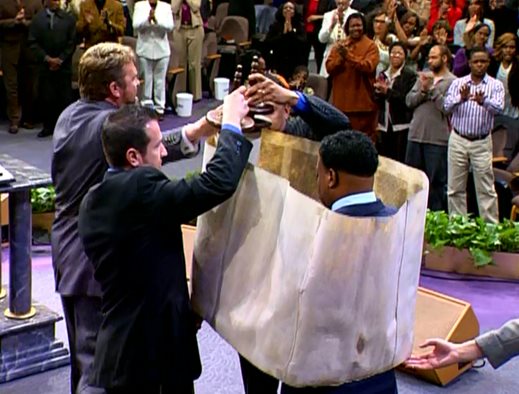
I won’t present any more details about this story since I would end up just duplicating what’s been thoroughly covered in much more worthy blogs, such as the one maintained by Dr. Rabbi Michael Schiffman, however, I would like to suggest that one of the motivations for such bizarre and unBiblical behavior on the part of men like Long and Messer is the same motivation Dasan and Aviram had in rebelling against the authority of Moses, Aaron, and ultimately God. This desire lead them, like Nadab and Abihu, to offer, “unauthorized fire” or in this case, to misuse a holy sefer Torah for unholy purposes.

Some people just have a problem with legitimate authority and having such a problem, do what Korah did and rebel by attempting to recreate that authority within themselves. This is at the heart of the theological arguments that have supported supersessionism in the ancient and modern church. I can’t truly say that the Christian church stands in total opposition and rebellion against the authority of God, since it is abundantly obvious that God has been using His Christian church to perform His will for centuries. I can say that the seeds that were planted 2,000 years ago which resulted in the weed that opposed the Jerusalem Council and denied the Jewish foundations of the church, were born of rebellion, but it was perhaps a “necessary” rebellion (Romans 11) so that the Gentiles could find a place within their Messianic covenant relationship to God.

That doesn’t make it any less painful or harmful and I believe the time for that “rebellion” is coming to a close.

People like Long and Messer seem to be establishing themselves as “authorities” simply because they can draw a following and they can magnify themselves by creating the illusion that they are “anointed” by God. But what do the people who follow these “rebels” want? Perhaps they are looking for whatever the rest of us are searching for, too.

Where was the knowledgeable one who wove his spell to bring his familiarity with the Atman out of the sleep into the state of being awake, into the life, into every step of the way, into word and deed? Siddhartha knew many venerable Brahmans, chiefly his father, the pure one, the scholar, the most venerable one. His father was to be admired, quiet and noble were his manners, pure his life, wise his words, delicate and noble thoughts lived behind its brow – but even he, who knew so much, did he live in blissfulness, did he have peace, was he not also just a searching man, a thirsty man? Did he not, again and again, have to drink from holy sources, as a thirsty man, from the offerings, from the books, from the disputes of the Brahmans? Why did he, the irreproachable one, have to wash off sins every day, strive for a cleansing every day, over and over every day?

from the novel Siddhartha (1951 U.S. publication)
by Hermann Hesse

This may seem like an odd source to quote within a Christian (and tangentially Jewish) context, but take one giant step backward from your religion and consider what human beings are looking for in general. What does the praying Christian have in common with the Jewish man davening in a minyan or a Muslim kneeling on his prayer mat? What do they have in common with the Buddhist, the Wiccan, and the New Age mystic? Aren’t we all, in our many and diverse ways, seeking God, in whatever way we may conceive of Him (or “Her”)?

I’m not saying that each and every one of these religious paths is equal in its validity or potential to arrive at the true “destination” of God, but the need to strive for that destination is the same in each of us. Some of our paths are legitimate and worthy, and many, many other paths lead to dead ends, darkness, and many ghastly conclusions in the spiritual travels of such seekers.

There are paths that lead people who desire a sincere and simple relationship with God to people like Ralph Messer, more’s the pity. Messer took the true message found in our Bibles and twisted it into a horrible distortion of God, misusing and desecrating the holy Torah of the Jewish people in order to glorify a misguided and selfish man. There is a legitimate path that allows man to understand God through the revelation of Torah, but Messer chose not to take it, perhaps because he would have to become a humble student and not an exalted “teacher.”

Milton, in his classic Paradise Lost, allows the “character” Satan to utter the famous line, “It is better to rule in hell than to serve in Heaven.” That seems to sum up anyone who would usurp the authority of God and the Bible (and Torah) for their own purposes rather than submit to the legitimate authorities God has established and to humbly serve under them. Jesus taught the exact opposite (John 13:1-17)  of Milton’s “adversary” when he washed the feet of his disciples and explained that “a servant is not greater than his master, nor is a messenger greater than the one who sent him” (v. 16). It is terrible to forget the words of the Master and to seek to rule over yourself and others, thinking you are better than those who came before you.

It is better to serve in Heaven than to rule in hell. Seek out those who are truly appointed by God and repudiate those who aren’t, so that the others who seek God just as you do, will be saved. Do not take such actions out of the desire to glorify yourself or whatever group or religion you serve but to glorify God only, lest you become like Dasan and Aviram and surrender to the temptation to serve only yourself. Should you feel that temptation within you, as if being who God made you to be isn’t good enough to satisfy you or Him, consider the parable of the Stonecutter by R’ Abraham Twerski MD. Perhaps it will add some perspective and even a hint of wisdom.
Debating Fulfillment Theology

This “logic” is plainly presented in Galatians 3. God had a very good reason to institute the Law of Moses and it has nothing to with “bait and switch.” It had to do with point and lead until the fulfillment of its goal. The emphasis of the salvation that was to come for all of mankind goes back to the promise made to Abraham.

-Eugene Adkins
in his January 27 comment on my blog post
The Lord’s Sabbath

This understanding of the function of a paidagogos clears up Galatians 3:23, where Paul says, “Now before faith came, we were held captive under the law, imprisoned until the coming faith would be revealed” (Galatians 3:23). The paidagogos was the child’s guardian, not his jailer. When we understand that the paidagogos was responsible for protecting, supervising, and directing a child, then we have a better understanding of how the Greek text of Galatians 3:23 should be rendered in English. The Greek word which the English Standard Version translates as “held captive” has a different connotation. It can also be rendered as “protected,” “kept safe,” or “guarded.” The word should be understood as speaking about how a pedagogue kept a child safe and out of trouble. Similarly, the Greek word which the ESV translates as “imprisoned” (the same word appears in 3:22) can be rendered as “kept in” or “enclosed” in a positive sense. The word should be understood as speaking about how a pedagogue kept a child inside for his school lessons. He did not allow the child to run off and follow his friends into trouble. He kept him shut up inside for the purpose of education and protection.

-D. Thomas Lancaster
“Sermon Eighteen: The Pedagogue (Galatians 3:19-26), pg 182
The Holy Epistle to the Galatians
First Fruits of Zion
August 2011

Ziesler, “Role of the Tenth Commandment,” p. 50, makes the important observation in Rom. 8:4 of the use of the singular…(“requirement”) in Paul’s conclusion: “having talked in 7.1-6 about dying to the Law, Paul now in a notably bald statement appears to bring us back to life again in relation to the Law, if not under it. We died to the Law in order to keep it better.” He further suggests that this singular reference keeps the singular sin of covetousness in perspective (pp.50-51).

Snodgrass, “Spheres of Influence,” p. 107 states: “If the law is not involved in salvation, then sin is a victor because it defeated God’s law which was for life (7.12.10). But now the law is placed within the sphere of the Spirit (cf. 8.4), where it belongs (7.14). The law in the right sphere frees us from the tyranny of the law in the sphere of sin. I do not think we can ignore a reference to the OT law. It is through the law that Paul died to the law.”

Footnotes 55 and 56
from “Summary and Appendix I,” pp 365-66
in the Mark D. Nanos book
The Mystery of the Romans
Fortress Press (1996)

Important Note! Please read the first comment made by Eugene Adkins below, as he corrects some mistakes I made about his background and role. I apologize to Eugene and to everyone reading this for my errors.

I’ve been debating with Pastor Eugene Adkins in the comments section of my blog post The Lord’s Sabbath regarding what he refers to as “fulfillment theology” and what I consider supersessionism or “replacement theology” (see our series of comments on the aforementioned blog post for full details of this discussion and specifically Pastor Adkins’ comments submitted on Jan 27, 2012 @ 17:31 hours).

In response to some of Pastor Atkins’ points, I’ve quoted from both Lancaster’s recent Galatians book and the classic Nanos tome on Romans (or rather, some footnotes contained within the Nanos book). I’m doing this for several reasons. The first is that, unlike Pastor Adkins, I do not have a post-graduate degree in any form of religious studies (I assume as a Pastor that Adkins is so educated) and thus do not have skill sets equal to his own as far as debating the scriptures. In order to support my arguments, I must rely on the scholarship of external sources, namely the previously mentioned Lancaster and Nanos books.

Secondly, I want to introduce valid and scholarly sources that refute or at least bring into question the traditional Christian view that the Torah was only temporary for the Jewish people (and I have never said that the Law was intended to apply equally to the Jewish and Gentile disciples of Jesus in any equal fashion) and that once Christ lived, died, was resurrected, and ascended, that the Law became null and void (or “fulfilled” in the sense that its temporary purpose as completely satisfied and then ended), and wholly replaced by what Pastor Adkins refers to as Christ’s “international covenant” that applies uniformly to Jewish and non-Jewish disciples of Jesus. I’m trying to point out here that perhaps Pastor Adkins’ interpretation of scripture (which seems to be the interpretation of the church in general) is not the only possible way to understand what Paul was saying to the congregations of Rome and Galatia.

Finally, I want to be fair. There is a tremendous tendency for me to simply dig in my heels, say “you’re wrong,” and base my subsequent responses on my emotional states, particularly those that have to do with Christian supersessionism and its terrible (and often fatal) effect upon the Jewish people across 2,000 years of church history. But that’s not the right thing to do. I want to respond based not only on my spiritual “understanding” of God’s relationship with both Jews and Gentiles (which is completely subjective and therefore, unable to be objectively demonstrated) but on Biblical scholarship as well. The problem here is that I’m like Woody Allen trying to go a few rounds in the ring with Mike Tyson as far as our relative educational backgrounds go (well, probably not that bad).

I have two undergraduate degrees and a post-grad degree, but none of them are in subjects relevant to this conversation. Given my job, my book writing, and my family commitments, I don’t have the time or other resources to go back to school and take another degree, or to perform the necessary research to adequately respond to all of the specific points being brought up in this discussion in order to sufficiently represent my point of view. I believe I’m right based on everything I’ve learned thus far, but belief isn’t enough. I must have proof beyond what I have already demonstrated, both online and in print. Also, assuming that I can be wrong (and I know I can be), I need to either confirm or refute my current belief system using concrete evidence (or as “concrete” as anything gets in theological debates).

That’s where you, dear readers, come in. I’m calling for backup. Or I’m willing to be presented with irrefutable proof that the New Testament writings can be interpreted in one and only one, single manner, and that the one and only interpretation is held under lock and key by the 21st century evangelical Christian church. I personally don’t think it is, but like I said, I want to be fair.

I want to say to you personally Eugene, that I’m not writing this to try and be mean or unfeeling or offensive in any way. I know you are sincere and are representing the truth based on everything you’ve been taught and everything you believe, both intellectually and through your faith. I don’t have a problem with any of that. None of this is motivated by any dislike of or anger toward you. I respect your service to God and thank you for continuing to participate in our dialog rather than summarily “writing me off” as some sort of “religious nut.”

My problem with the traditional Christian position on supersessionism is that, even clothed in a pleasing and benign exterior, this “fulfillment theology” is a nearly 2,000 year old artifact that was first created when the schism between Jewish and non-Jewish believers began to develop and then exploded across the early history of the church, in order to artificially justify the ascension of the Gentiles over the Jews in Messiah, and to literally re-write the nature and character of Christian vs. Jewish “Messianism,” as we see in part here:

The destruction of the Second Temple in 70 CE and the subsequent expulsion of the majority of Jews from what would be called Palestine marked a disastrous shift in the Jewish authority over the Messianic community. Up until that time, the head of the Jerusalem leadership of the Messianic community, otherwise referred to as “the bishop of the church”, had always been Jewish. Once the Jews were expelled from Jerusalem by Hadrian, for the first time a Gentile had to be elected into the role. As events moved forward from that point in time, the Gentile presence in the Messianic community grew dramatically while the Jewish leaders and worshipers of Yeshua struggled under the heartbreak of the loss of the Temple and the ejection from their land. Scant decades later, the failure of the Gentile “church” to support the Jewish revolt of Bar Koshba drove another significant wedge between the Jewish Messianic community and the body of Gentile believers.

With the Jewish population now scattered, humiliated, and fearing destruction at the hands of the Romans, the Gentile Messianics continued to secure their dominance and control of the worship of Yeshua. The self-identity of the Gentile Christians shifted from grafted-in to the root of Judaism through Abrahamic faith to the new inheritors of the Messiah, replacing Israel on a spiritual level. Origin of Alexandria and Justin Martyr were the earliest authors of this tradition and among the first to declare that the church had superseded Israel. Attached to this belief was the rise of Christian blame against the Jews for the murder of Jesus. The Jews became unworthy of their own Messiah and were pushed out of the worship of Yeshua by the Gentile disciples they had once taught and nurtured.

-James Pyles
Excerpt from “Origins of Supersessionism in the Church” (pp. 33-34)
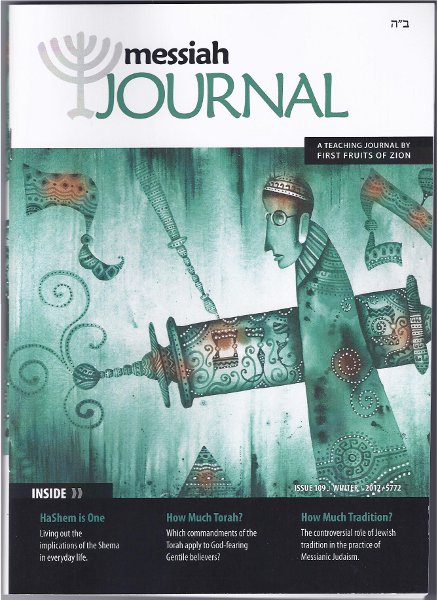
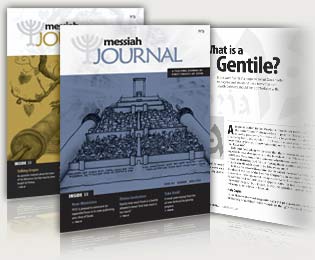
Messiah Journal
Issue 109/Winter 2012

I previously said that I don’t have an advanced degree in religious studies, but as a published author, I do know how to do research, including delving into the history of how “the Way,” which started as a sect of Judaism inclusive of non-Jews but administered and guided by Jewish mentors who understood God and Messiah in a completely Jewish religious framework, into a newly created non-Jewish religion which found it necessary to eliminate any aspects of Judaism from its background.  In my review of the early church, I could see the early “church fathers” virtually reframe the letters of the early Jewish disciples, principally written by Paul, into words that would ultimately be used to discount and eventually all but exterminate the Jewish people.

I’m opening this blog post up for debate on the pros and cons of “fulfillment theology” and asking for those who are far wiser and much better educated and I in religious subjects to enter into the conversation. I do insist however, that this conversation remain polite and respectful. Disagreement is absolutely no excuse for undue emotionalism or any personalizing of conflict. Any apparent “attacks” on someone who differs from your point of view will not be tolerated and I, as the blog owner, reserve the right to edit or delete any offensive comments at my discretion.

This debate is specifically focused on the pros and cons of “supersessionism,” “replacement theology,” “fulfillment theology,” or whatever else you want to call it. It is NOT about One Law or Two House perspectives, so I am not inviting statements on those viewpoints to be presented here. If you find it necessary to disregard my wishes in this, your comments will be removed. Thank you.

With those disclaimers out of the way, please feel free to refer back to the full stream of comments on the “Sabbath” blog post, then return here and discuss how you support or refute my statements and Pastor Adkins’s statements. Please cite specific Biblical or other sources to support your arguments. I am asking for information, not unbridled passion.

One last thing before we begin. Eugene, you previously said:

How is lighting candles a confirmation of Jesus’ grace if that person doesn’t believe in Jesus to begin with?

Shabbat candlesI do have faith in Jesus, as you do Eugene. Watching the lighting the Shabbos candles is a beautiful and unique way of inviting him into my home and to experience something of a preview of his return to us, may it be soon and in our days. If perhaps, your comment were meant as a remark toward my wife who is Jewish but not a believer, I can only ask that you try to consider her with the same compassion and love that God has toward His am segulah; His “wondrous and treasured people” (Exodus 19:5). I can’t tell your attitude toward Jews and thus toward my wife and children through our “text-only” conversation, but if you cannot see them with the same compassion as God does, and believe God has discounted if not completely destroyed them, then I suppose my argument has already been made for me.

With that, I look forward to everyone’s contribution now and in the days ahead. I hope to learn a lot.

Messiah Journal: Excerpt from “Origins of Supersessionism in the Church”

Yeshua not only defined himself as the gateway to salvation, but commanded his Jewish disciples to do something that had never been done before. Yeshua commanded his Jewish disciples to make non-Jewish people disciples in a Jewish sect that followed the Messiah and worshiped the God of Israel. Yeshua identifies his Jewish disciple Peter as the rock upon which he will build the Messianic community (Matthew 16:18). Acts 4 shows us that thousands of Jews came to faith in the Messiah well before the time when Paul began to actively seek non-Jewish disciples. We also see in Acts 15 that the Jewish Jerusalem council exercised authority over the Gentile assembly of the Messiah. With the foundation of the early Messianic community being so thoroughly Jewish, how did a concept like supersessionism even come into being? Actually, the seeds of this rather ugly plant began to sprout early.

Excerpt from the article
“Origins of Supersessionism in the Church”
by James Pyles
Messiah Journal
Issue 109/Winter 2012

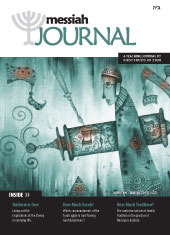
I just received my advance copy of the latest edition of Messiah Journal (MJ) and of course, as it contains my first article published in religious literature, I’m more than thrilled. I showed my wife and she said that she will have to read it, which is even more intriguing (as surprising as it may sound, she doesn’t often read my material). I hate to admit this, but like many authors, I really enjoy seeing my work in print. I suppose it is the same feeling a painter has when he or she sees their work on display in an art gallery.

But I shouldn’t forget everything else this issue of MJ has to offer. I haven’t had the opportunity to read it yet (so I can’t review its contents), but I’ve looked through this issue and there are definitely some submissions I’m anxious to dig into.

There’s an article written by Tsvi Sadan called “Halachic Authority in the Life of the Messianic Community”. Apparently, it was delivered as a lecture to Messianic leaders in Israel in September of 2008 as the “final chord of a debate between those Messianic Jews who teach to live according to Jewish tradition and those who view this tradition as ‘the leaven of the Pharisees and Sadducees.'” This discussion has taken place in the Messianic blogosphere fairly recently, such as in Judah Himango’s blog post Kosher Jell-O, and whether Messiah’s disciples need our own ruling body, as well as on my own blog in the write up Tradition! (and as always, some of the most interesting parts are in the comments sections).

I must admit, I will probably dive into Sadan’s article first, but I also want to read Russ Resnik’s “Shema: Living the Great Commmandment” (Part 1). I’m also very interested in Toby Janicki’s article “The Gentile Believer’s Obligation to the Torah of Moses”, which is also a topic of great interest among non-Jews who are attracted to Jewish religious lifestyle and worship. I believe MJ has had similar articles in the past and want to find out if this is just a reworking of material with which I’m already familiar or something entirely new. I know I’ve been challenged on this topic by comments made on my own blog very recently, both in Defining Judaism: A Simple Commentary and The Focus and the Lens, so I’m hoping for some “re-enforcement” to augment my own knowledge in this area.

For tomorrow’s “morning meditation,” I’m posting a blog on Gentiles and the Shabbat, and Aaron Eby has an article in the current issue of MJ called “Fire by Night: Lighting the Shabbat Candles” which (you should pardon the pun) should prove illuminating. That’s not all of the contents of issue 109 of MJ but those are the highlights. Of course, if you find all of that tantalizing, don’t forget my own article on the origins of supersessionism in the church, how the seeds were first planted, who the major players were, and how the history points to modern times.

If you don’t already regularly receive issues of Messiah Journal, go to the First Fruits of Zion (FFOZ) website and order issue 109 today. I’m really looking forward to reading it myself.

Origins of Supersessionism: My Upcoming Article for Messiah Journal

Occasionally I receive a few complements from folks who think well of my blog and who suggest that I should do more formal kinds of writing in religious publications. While it’s very flattering to receive such attention, since I don’t have a formal education in theology, I thought such a contribution to be beyond my current skill sets. However, that has changed.

Several months ago, Boaz Michael, the Founder and President of First Fruits of Zion (FFOZ), asked me to write a four-part series on Replacement Theology or Supersessionism for their quarterly publication Messiah Journal (MJ). The series will touch upon the historic origins of Supersessionism, its placement in Christian doctrines, how Supersessionism affects the Church and Jewish people today, and how the Church can leave Supersessionism behind. One article in the series will be published in each of 2012’s quarterly releases of MJ. According to Toby Janicki at FFOZ, the issue of Messiah Journal containing my article should be available by the end of January. Look for “Origins of Supersessionism in the Church” in the January 2012 (#109) issue of Messiah Journal.

I want to take this opportunity to say that I am deeply honored Boaz and the fine folks at FFOZ considered me for this project and am gratified that I can offer my small talents in the service of their ministry and in service to God.

Blessings.

Dayenu

When Ephraim spoke piety, He was exalted in Israel; But he incurred guilt through Baal, And so he died. And now they go on sinning; They have made them molten images, Idols, by their skill, from their silver, Wholly the work of craftsmen. Yet for these they appoint men to sacrifice; They are wont to kiss calves!

Assuredly, They shall be like morning clouds, Like dew so early gone; Like chaff whirled away from the threshing floor. And like smoke from a lattice. Only I the Lord have been your God Ever since the land of Egypt; You have never known a [true] God but Me, You have never had a helper other than Me. I looked after you in the desert, In a thirsty land. When they grazed, they were sated; When they were sated, they grew haughty; And so they forgot Me. So I am become like a lion to them, Like a leopard I lurk on the way; Like a bear robbed of her young I attack them And rip open the casing of their hearts; I will devour them there like a lion, The beasts of the field shall mangle them.

You are undone, O Israel! You had no help but Me.Hosea 13:1-9 (JPS Tanakh)

I was reading the haftarah portion for Vayeitzei on Shabbat and realized something about the Jewish people and the rest of us. I think many Christians but particularly those who have attached themselves to some portions of the “Messianic” movement, feel a little bit envious of all the blessings God has bestowed upon Israel. I think this is one of the reasons why the early Church chose to apply a supersessionist theology, stating that Gentile Christianity has replaced the Jews in all of God’s covenant promises. We just can’t stand the idea that “salvation comes from the Jews” (John 4:22) so we must find a way to steal what the Jews have and pretend it belongs only to us.

I’ve probably always known this, but when reading the above-quoted passages from Hosea 13, it came into absolute clarity within me that as much as God has blessed the Jewish people, He has also designed ghastly curses for them in times of disobediance and rebellion, much more than we can see for people who are not Jewish, including Christians. I’m not saying that Christians haven’t been persecuted for their faith over the course of the past 2,000 years, but as we see in many of the exclamations of the ancient prophets, God is exceedingly determined to hold Israel accountable for any failure to the covenant they have with Him.

Christianity sometimes mistakes the level of accountability to which God holds the Jews as an eternal curse upon Israel, but even as God curses, so in the next moment, He blesses them abundantly.

Return, O Israel, to the Lord your God, For you have fallen because of your sin. Take words with you And return to the Lord. Say to Him: “Forgive all guilt And accept what is good; Instead of bulls we will pay [The offering of] our lips. Assyria shall not save us, No more will we ride on steeds; Nor ever again will we call Our handiwork our god, Since in You alone orphans find pity!”

I will heal their affliction, Generously will I take them back in love; For My anger has turned away from them. I will be to Israel like dew; He shall blossom like the lily, He shall strike root like a Lebanon tree. His boughs shall spread out far, His beauty shall be like the olive tree’s, His fragrance like that of Lebanon. They who sit in his shade shall be revived: They shall bring to life new grain, They shall blossom like the vine; His scent shall be like the wine of Lebanon. Ephraim [shall say]: “What more have I to do with idols? When I respond and look to Him, I become like a verdant cypress.” Your fruit is provided by Me. –Hosea 14:2-9 (JPS Tanakh)

Dancing with GodIsrael’s special place in the heart of God is undeniable, but our God is a jealous God. As much as He loves, He also chastises. As much as He has compassion, He also gives discipline. It is a terrible thing to fall into the hands of the living God (Hebrews 10:31).

I realized with great certainty when reading the words of the prophet Hosea that in many ways, we non-Jews are “blessed” that we don’t carry the responsibilities of our Jewish brothers. Some of us would be more than willing to bear the full burden of the mitzvot but many, many of us do not realize the dread consequences of that desire. This is one of the reasons that Judaism is reluctant to allow Gentiles to convert; out of the fear that once faced with everything it is to be a Jew, for good and for ill, that some of the converts would abandon the God of Abraham, Isaac, and Jacob as well as the people of the Book.

There isn’t always a consistent interpretation of the meaning of the “Jerusalem letter” issued by the Council of Apostles and Elders as recorded in Acts 15. Some say it limits the “Torah responsibility” of Gentile Christians to just those restrictions literally recorded, while others say it is merely a starting point for non-Jews who have come to the faith to begin learning the full ways of the Torah. Yet we see that upon receipt of the letter, the non-Jewish disciples were “strengthened in the faith, and were increasing in number daily” (Acts 16:5 – NASB), indicating that there was some expression of relief and even joy that the non-Jews would not be expected to take on the full yoke of Torah. Paul’s letter to the Galatians also makes it quite clear not only that the non-Jewish disciples weren’t expected to take on all of the Torah mitzvot unless they converted to Judaism, but that the duties expected of them if they converted would be far and above what was (and is) required of a Gentile follower of the Messiah.

While Christians and Jews continue to debate the exact blessings and responsibilities assigned by God to each covenant group, it is readily apparent that Christians are not simply “Jews without the Talmud”. We are attached to God by the Messianic covenant and not only are we not obligated to the Mosaic covenant, we probably should be glad we do not carry upon ourselves the Torah of Moses. For with all the special attention and devotion God lavishes upon the descendents of the Children of Israel, they also embrace a tremendous responsibility with consequences to freeze the blood. Like Peter when he swore to follow the Master, even unto death, we should not be so quick to make oaths that we are not be able to keep, and as the Master urges us, we should let our “yes” to him be just “yes” and our “no” to him (if such be the case) be just “no”. We have been given a extraordinarily special gift as the result of the death and subsequent life of the Messiah. This must be sufficient for us without coveting what belongs to our Jewish neighbors (Exodus 20:17). Is not the love of God through Jesus Christ enough for any of us? Do we tempt God and throw the blood of Christ back in the Master’s face by wanting more?

And He has said to me, “My grace is sufficient for you, for power is perfected in weakness.” Most gladly, therefore, I will rather boast about my weaknesses, so that the power of Christ may dwell in me. –2 Corinthians 12:9 (NASB)

One of my favorite Passover songs is Dayenu, which seems an appropriate title given the theme of this wee missive.

Dayenu is a song that is part of the Jewish holiday of Passover. The word “Dayenu” means approximately, “it would have been enough for us”, “it would have been sufficient”, or “it would have sufficed.” –Wikipedia

Of the various lyrics to this song, the following stands out as particularly relevant here.

If He had brought us before Mount Sinai, and had not given us the Torah – Dayenu, it would have sufficed us!

Adapted for we Christians, I think it should go more like this:

If He had given us His only begotten Son so that the world might be saved, and had not given us the Torah – Dayenu, it would have sufficed us!

It has sufficed us. By Christ, we are “more than conquerors” (Romans 8:37) of the sins in our hearts. We don’t need to be more than this. As Christians, we are sufficient in His love. We are good enough.

Injustice and the Promises

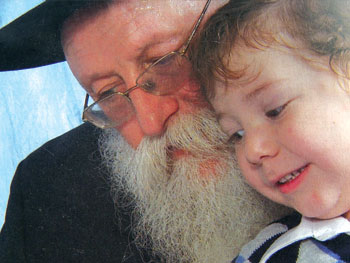
Three years ago, Baby Moshe, one of the unforgettable faces of the Mumbai attacks, escaped the carnage clinging to his nanny not knowing that his parents- Rabbi Gavriel Holtzberg and his pregnant wife Rivika – were killed. Now a four-year-old, Moshe knows they had fallen victim to terrorists. Orphaned by the terrorists, Moshe is now a carefree child, though he remembers his parents whenever he sees their photographs, saying good morning or goodnight to ‘eema’ (mother) and ‘abba’ (father) each day.

from the news story “Moshe still says goodnight to parents”
The Times of India

As Jacob flees from the promised land, he stops at Bethel where God gives him the dream of the ladder and confirms the covenant promises to him. Though the oracle at Bethel is essentially a repetition of the covenant promises bestowed upon Abraham and Isaac, there is an important variation on the wording in 28:14. The seed of Jacob will not only multiply to be as numerous and uncountable as the dust of the earth, it will also “spread abroad to the west, and to the east, and to the north, and to the south.” Not only will his seed inherit the land of Canaan, they will also be spread in every direction. This dispersion alludes again to the theme of exile. As Jacob descends into exile, he is warned that his seed will be spread in every direction as the result of such exile.

from “The Dispersion and Return”
Commentary on Torah Portion Vayetze
FFOZ.org

I don’t know what to write about but I do know that I’m angry. Three years ago this month, little Moshe Holtzberg lost his parents in the most horrible way possible. Now four years old, it’s doubtful he fully comprehends what has happened to him or why. But I know what has happened and I’m furious about it. As much as I’m supposed to forgive others for their “transgressions”, remembering the details of the attack that took Moshe’s parents away does not bring thoughts and feelings of forgiveness to me. I’m not alone.

Have you forgiven the terrorists? “No, of course not,” replies Moshe’s grandmother Yudith. His nanny says, “It makes me angry because they could have escaped but they did not do it and I could have done something, which in my cowardness I did not do.”

I have a grandson who’s not quite three years old. If my son and his wife had been killed by monsters and I was raising my grandson under those conditions, I would probably feel just like Moshe’s grandmother. I know that doesn’t say anything good about me, but I cannot get past this kind of murderous injustice.

Welcome to the history of the Jewish people.

I hope you all remember these events from CNN three years ago. I hope you were all shocked and appalled, just as I was, and angry that innocent blood could be shed in such a ghastly manner. Moshe’s parents weren’t just killed, they were tortured and mutilated by their attackers. Now with all that in mind, apply those same images to what has been happening to the Jewish people throughout history, not just the past 2,000 years of inquisitions, persecutions, and pogroms, but during every trial and exile that has befallen the Jewish people since the days of Jacob.

Although the Jewish people have a modern state of Israel, in many ways, they are still in exile. The very legitimacy of Israel is constantly being brought into question by nations from around the world including the U.S. and there is a continual struggle over what is “Israel” and what (if anything) is “Palestine”.

Faith and composure are very difficult for me when considering such manners (I’m making an understatement). And yet there are promises.

Remember, I am with you: I will protect you wherever you go and will bring you back to this land. I will not leave you until I have done what I have promised you.” –Genesis 28:15 (JPS Tanakh)

It is true that the plain meaning of the text suggests that God is speaking just to Jacob’s sojourn in Haran but, as the FFOZ commentary states, we can also apply this scripture both as prophesy and promise, that God will be with Jacob and his children in whatever exile they might find themselves and will remain with them until they return to their Land, to Israel.

This is not the only such promise to the Jewish people from God.

Do not be afraid, for I am with you;
I will bring your children from the east
and gather you from the west.
I will say to the north, ‘Give them up!’
and to the south, ‘Do not hold them back.’
Bring my sons from afar
and my daughters from the ends of the earth—
everyone who is called by my name,
whom I created for my glory,
whom I formed and made.” –Isaiah 43:5-7

And He will send forth His angels with a great trumpet and they will gather together His elect from the four winds, from one end of the sky to the other. –Matthew 24:31 (ESV)

The quote from the Book of Matthew is probably interpreted by Christianity as applying exclusively to the church, but put back into the larger panorama of the entire Bible and refactored into its original context (Matthew was writing to a primarily Jewish audience), we can see it has more specific implications.

I periodically rant on the topic of Christian supersessionism and how it has been used as a platform to justify crimes by the church against the Jewish people. I hope that recalling God’s promises to the Jews will serve as a reminder that they have been and always will be God’s chosen people. That God was gracious enough to give “his only Son, that whoever believes in him should not perish but have eternal life” (John 3:16), does not mean that we Christian Gentiles have “bumped” the Jews from their seats on the flight, so to speak, in order to make room for us (read Romans 11:17-20 again if you don’t believe me).

In our nice, peaceful, reasonably safe American homes, we like to think that the persecution and murder of Jews are a thing of the past and that an ugly chapter in the history of the church has now been closed, but if you are tempted to be comforted by those thoughts, remember four-year old Moshe Holtzberg as he kisses the photos of his parents every morning and night. True, this isn’t a crime that can be laid at the feet of the church, but it’s a delusion to believe that men and women of the past who also called themselves “Christian” didn’t perform the same, horrible terrorist acts and worse. How many Jewish children have we orphaned in the name of Christ?

George Santayana made the often misquoted comment, “Those who cannot remember the past are condemned to repeat it.” I could change that slightly to say, “Those who are not outraged by the atrocities of the past will continue to commit them in the present.” That includes committing atrocities by apathy, lack of concern, and the unwillingness to act.

We should mourn the loss of Rabbi Gavriel Holtzberg and his wife Rivika along with Moshe and his grandparents. It’s tragic that Christianity doesn’t understand the significance of yahrzeit for we should all kindle of the yahrzeit candle for Gavriel and Rivika Holtzberg in solemn memory. By inference, we can also mourn all the Jewish victims of terrorism who came before them, particularly those who were murdered by the church, for in remembering and grieving, we can assure the Jewish people and ourselves that we will never participate in such a nightmare again. We cry out against the injustice of the Nazi Holocaust and the murder of six million but we must never forget that countless Jews have their blood spilled across the pages of thousands of years of history.

Jews believe that tikkun olam, acts of repairing the world, will hasten the coming of the Messiah. However, even in Jewish tradition it is understood that anyone, Jew or Gentile, can perform tikkun olam. Gandhi was once supposed to have said, “Be the change you want to see in the world.” If the fact that Moshe Holtzberg will never again see his parents this side of Heaven makes you sad and angry, you can stand up and do something about it. You can make sure that through action or inaction, you are never a part of such an injustice. You don’t have to change the whole world. You only have to change yourself. Remember God’s promises to the Jewish people and to all people. If you are devoted to the God of Israel, perform one act of justice and mercy today. Perform another one tomorrow. Let your voice be heard. Light a candle in remembrance. Never let the light of mercy go dark in your heart.

The bridegroom is coming. The Prince is returning to his throne. Be ready every day and every night. Tremble at the thought that he will come and you will not be prepared.

Tremble, and sin not; reflect in your hearts while on your beds and be utterly silent. –Psalm 4:5

He who testifies to these things says, “Surely I am coming soon.” Amen. Come, Lord Jesus! –Revelation 22:20 (ESV)