Tag Archives: Talmud

For the Sake of God

Jewish in JerusalemThe law, stiff with formality, is a cry for creativity; a call for nobility concealed in the form of commandments. It is not designed to be a yoke, a curb, a strait jacket for human action. Above all, the Torah asks for love: “thou shalt love thy God; thou shalt love they neighbor” (Deut. 6:5; Lev. 19:18). All observance is training in the art of love. To forget that love is the purpose of all mitsvot is to vitiate their meaning. “Those who think that the performance is the main thing are mistaken. The main thing is the heart; what we do and what we say has only one purpose: to evoke the devotion of the heart. This is the essence and purpose of all mitsvot: to love Him wholeheartedly.” (Hachayim, ms. Munich, in Otsar Hasafrut, vol. III, p. 66.)

-Abraham Joshua Heschel
God in Search of Man : A Philosophy of Judaism (p.307)

Hearing that Jesus had silenced the Sadducees, the Pharisees got together. One of them, an expert in the law, tested him with this question: “Teacher, which is the greatest commandment in the Law?”

Jesus replied: “‘Love the Lord your God with all your heart and with all your soul and with all your mind.’ This is the first and greatest commandment. And the second is like it: ‘Love your neighbor as yourself.’ All the Law and the Prophets hang on these two commandments.”Matthew 22:34-40

It seems as if Rabbi Heschel and Jesus have something in common: their understanding about what is most important about the Torah, which is love of God and love of human beings. A few days ago, I quoted some of Heschel’s criticisms of Christianity as compared to Judaism, but then Rabbi Heschel was focused on the teachings of Paul and not Jesus himself. I’ve heard more than one Jewish person say they have nothing against Jesus, but Paul and what Paul did to the teachings of Christ is another matter.

Unfortunately, both Judaism and Christianity for the most part, misunderstand Paul the same way, believing he taught against “the Law” and replaced the Torah with a religion of grace, and no behavioral components.

To be fair, there is a general misunderstanding, even among many Jews, as to the nature of the Torah and the mitzvot. Fortunately, Heschel clarifies this.

The translators of the Septuagint committed a fatal and momentous error when, for lack of a Greek equivalent, they rendered Torah with “nomos”, which means “law”, giving rise to a huge and chronic misconception of Judaism and supplying an effective weapon to those who sought to attack the teachings of Judaism. That the Jews considered Scripture as teaching is evidenced by the fact that in the Aramaic translations Torah is rendered with “oraita” which can only mean teaching, never law. (p. 325)

The error Heschel describes was transmitted to the Greek used in our earliest texts of the New Testament, so whenever the Torah is referenced, the word “nomos” is used and thus in English is read as “law” (the next time you are reading one of Paul’s letters and come across the word “law”, mentally substitute the word “teaching” and see how the meaning changes for you).

When Heschel says “an effective weapon to those who sought to attack the teachings of Judaism”, I can only imagine he’s referring to Christianity, and I’m sure he’s right. Christians tend to see Judaism as a religion of acts and behaviors but no faith and spirit. Heschel tries to correct this misconception.

It is a distortion to say that Judaism consists exclusively of performing ritual or moral deeds, and to forget that the goal of all performing is in transforming the soul. Even before Israel was told in the Ten Commandments what to do, it was told what to be: a holy people. (p. 310)

Jesus said something very similar:

Therefore you are to be perfect, as your heavenly Father is perfect. –Matthew 5:48 (NASB)

Praying with tefillinObeying God is simply the means by which we act out who we are as people of faith. This is just as true for the Jew as for the Christian. In another recent blog, I quoted Heschel when he says, a “mitsvah is an act which God and man have in common”, and my response was “I realize that the mitzvot belong to Him and well as us and that when we obey God, we are also working with God.”

When a Christian observes a Jew praying with tefillin, observing the Shabbat by not driving, separating meat and dairy dishes, the Christian could easily conclude that following Judaism is a matter of performing the mechanics without feeling, without heart, and probably without God. This is a terrible mistake, for only God can see inside the individual’s heart of intent. What if the Jews is thinking and feeling this?

The main function of observance is not in imposing discipline but in keeping us spiritually perceptive. Judaism is not interested in automations. In its essence obedience is a form of imitating God. That we observe is obedience; what we observe is imitation of God (see Sotah 22b). (p. 310)

Halacha must not be observed for its own sake but for the sake of God. The law must not be idolized. It is a part, not all, of the Torah. We live and die for the sake of God rather than for the sake of the law. (p. 326)

I criticize Christians for misunderstanding the intent of the observant Jew and seeing only a people who obey halacha for its own sake, but Torah obedience has been devoid of life at times in Israel. A lack of kavanah has been one of the greatest mistakes within Judaism and it has resulted in terrible consequences.

Why was Jerusalem destroyed? Because her people acted according to the law, and did not act beyond the requirements of the law (see Baba Metsia 30b.). (p. 327)

They failed to fulfill it (Torah) “for its own sake”, for the sake of God. The land was destroyed because there was no kavanah, no inner intention. It was in the spirit of such a radical demand for inner purity that the word of the Psalmist (119:113), “I hate those who are of a divided mind”, was applied to those who serve the Lord out of fear rather than out of love. We must always remember the words of Isaiah 29:13. “This people draw near with their mouth and honor Me with their lips, while their hearts are far from Me, and their fear of Me is a commandment of men learned by rote.” (p. 328)

I find the last quote to be especially illuminating, since Isaiah 29:13 is also quoted by Jesus (Matthew 15:8-9) and his words are used by the church (and some Messianics) to condemn observance not only written Torah, but particularly halacha. Reading Heschel shows me (and hopefully others) that Christ was criticizing neither Torah nor halacha, but rather rote obedience of commands.

Heschel goes on (p. 329) to say that we can call Judaism a religion without faith only if we intend to forget Abraham’s willingness to sacrifice Isaac at the Akedah (Genesis 22:1-24) and “Job’s avowal, “though He slay me, yet will I trust Him” (Job 13:15). Both Paul (Romans 4) and the writer of Hebrews (Hebrews 11:8-9) cite Abraham as the author of faith for the Jewish people and for the rest of us, and Abraham is Heschel’s example and prototype for Jewish faith as well.

PaulIt seems as if, after a little digging, that Heschel’s understanding of the intent and meaning of Torah, halacha, and observance is more like what Jesus, Paul, and the Hebrews writer understood than we previously would have imagined. Said a different way, how Heschel, a modern Jewish Rabbi, understands the complex interweaving of a Jew with Torah, halacha observance, and God, is very much like how Second Temple period Jews such as Jesus, Paul, and the writer of Hebrews understood those same concepts, behaviors, and intentions.

The part that we as Christians should take from all this, is that our understanding of the Christ, our Savior and Lord, needs to adjust to take on this more accurate perception of Jesus as an observant Jew. We cannot claim love for the Jewish Messiah and at the same time disregard the modern Jew as lost, and his faith and observance dead and irrelevant. Perhaps some individual Jews do simply go through the motions but so do some individual Christians. We cannot condemn Jewish observance of halacha, Talmud study, and the very faith of Judaism as dead and at the same time believe that the grace and love of Jesus Christ is alive. Jesus and grace were and are perfectly consistent and harmonious with the Torah and halacha.

If you see a Jew, especially a Jew who professes faith in Jesus (probably calling him “Yeshua”) as the Jewish Messiah, and who continues to observe the traditions of his fathers; this Jew is not confused, lost, or “under the Law”. I believe he is doing what Jesus advocated, living out his faith by imitating God. This Jew is joining God as a partner in building a sukkah, lighting candles on Shabbos, and laying tefillin with Him, not just in response to the Torah, but for the sake of God. A Jew living by the Torah is living a life doing not only what God wants him to do, but is also doing what God is doing. Jesus did this, too.

Jesus gave them this answer: “Very truly I tell you, the Son can do nothing by himself; he can do only what he sees his Father doing, because whatever the Father does the Son also does.” –John 5:19

New Genesis

New WorldOn Rosh Hashanah, G-d takes Himself to court. He looks down from above at this world and, as I’m sure you may realize, it doesn’t always look so good.

G-d is within this world as well. He is found in every atom of this world. It may sound strange, but this is what is happening: He as He is above takes Himself, as He is present within this world, to trial.

Only the soul of Man can argue on His behalf. So we do that, as lawyers for the defense. All that is required is to awaken the G-dliness within our own souls.

The spark of G-d within us below connects with the Infinite Light of G-d above. The circuit is complete and the universe is rebooted with a fresh flow of energy for an entire year.

-Rabbi Tzvi Freeman
“G-d’s Lawyers”
Based on letters and talks of the Rebbe
Rabbi M. M. Schneerson
Chabad.org

This is a very strange Rosh Hashanah meditation but then, Rosh Hashanah is a very strange time. I suppose you can look upon the quote from Rabbi Freeman as midrash, mysticism, or metaphor, depending on which one best fits your personality, but just how can God judge Himself? Isn’t He supposed to judge us?

Then I saw a great white throne and him who was seated on it. The earth and the heavens fled from his presence, and there was no place for them. And I saw the dead, great and small, standing before the throne, and books were opened. Another book was opened, which is the book of life. The dead were judged according to what they had done as recorded in the books. –Revelation 20:11-12

This image is very reminiscent of how Judaism pictures God during the High Holidays. According to the Talmud, the Book of Life is opened on Rosh Hashanah and closed again at the end of Yom Kippur. This event repeats on an annual basis. According to Christianity, the Book of Life is opened only once, as we see in the above-quoted passage from Revelation. While it may be difficult to imagine, I think that Christianity’s and Judaism’s different visions can be reconciled. I’ll get to that part in a minute. Back to my previous question.

How can God judge Himself? Isn’t He supposed to judge us?

When it was the sixth hour, there was darkness over all the land until the ninth hour. And during the ninth hour, Yeshua (Jesus) cried out with a loud voice, “Elahi, elahi, lemah shevaktani?” which is interpreted, “My God, my God, why have you abandoned me?”

Some of the men standing there heard and said, “Look! He is calling to Eliyahu!”

One of them ran and filled a sponge with vinegar. He placed it on a cane, gave it to him to drink and said, “Leave him alone, and let us see if Eliyahu will come to take him down!”

But Yeshua gave a loud cry and breathed out his life. –Mark 15:33-37 (DHE Gospels)

Here, perhaps we see God judging both Himself and us. If Jesus was meant to bear the sins of all mankind and to take the punishment that was upon us, this then is our judgment. That the judgment falls upon the King of Kings, the Son of God, he who is mortal and sent by the Divine, then in this, we can say that God judges “Himself”. That we are all created in God’s image and that the Divine spark resides in each of us can also be thought of as God “judging Himself”.

But didn’t all this happen only once? If so, why bother (at least from a Christian perspective) observing an annual Rosh Hashanah and Yom Kippur?

Time is not a train of cars hitched one to another, one year dragged along by the year preceding, the present hitched tightly to the past, the future enslaved to the present. Rather, every year arrives fresh from its Creator, a year that never was before and could never have been known before its arrival.

That is why we call Rosh Hashanah “the birthday of the world” in our prayers. The past has returned to its place, never to return. With the blowing of the shofar, the entirety of Creation is renewed. From this point on, even the past exists only by virtue of the present.

-Rabbi Tzvi Freeman
“Reboot”
Based on letters and talks of the Rebbe
Rabbi M. M. Schneerson
Chabad.org

Midrash, mysticism, or metaphor…take your pick. From the Lubavitcher Rebbe’s point of view, the Universe is recreated every year at Rosh Hashanah. The “reboot” opportunity for our lives isn’t just poetic imagery, it’s a metaphysical reality. Are you having trouble believing that? Then what about this?

For as high as the heavens are above the earth,
so great is his love for those who fear him;
as far as the east is from the west,
so far has he removed our transgressions from us. –Psalm 103:11-12

Then he adds:

“Their sins and lawless acts
I will remember no more.”

And where these have been forgiven, sacrifice for sin is no longer necessary. –Hebrews 10:17-18

Reboot t-shirtOnce redeemed, God not only forgives our sins, it’s as if our sins never existed in the first place. It’s as if our very lives have been “rebooted”, as if the person we were had died and in our redemption, we have become brand new (2 Corinthians 5:17). The Bible allows for a metaphysical reboot in the lives of human beings. Why not in the “life” of the Universe as well? Does the Universe have a “soul”? Rabbi Freeman seems to think so, along with an existence in space and time.

The universe has a soul. All that exists in the soul exists in space and in time.

In the cosmic soul there is a mind, a consciousness from which all conscious life extends.

In space, there is the Land of Israel, a space from where all space is nurtured.

In time, there is Rosh Hashanah, a time from which all time is renewed.

Rosh Hashanah, meaning Head of the Year. Not just a starting point, but a head. For whatever will transpire in the coming year is first conceived in these two days.

Midrash, mysticism, or metaphor…take your pick. From the Lubavitcher Rebbe’s point of view, Creation itself has a distinct and unique existence, not only as a physical reality, but as a mystic and metaphysical presence, expressed as a soul within a specific time and place. Existence is reset and a new life is begun at Rosh Hashanah and given a new heartbeat emanating from Israel and circulating its “blood” throughout the rest of the world. It’s as if Creation were a pool of water. Each year at Rosh Hashanah, God drops a pebble into the pool. The water is so disturbed that the ripples completely wipe away what had existed upon and within the water and everything becomes brand new again. A new universe, a new chance, a new life for each of us. A new relationship with God is offered if we want it. It’s as if salvation were given to us on Rosh Hashanah. For a Christian, it’s like being “saved” all over again.

Do we need to be saved each year? Maybe. I’m not saying salvation expires every year, but consider this, Christian. At some point in your life, you accepted the Lordship of Jesus over your entire being. Chances are, you had no idea what was going to happen next and how much you would have to change who you were and what you were doing. It was exciting at the time but, like your wedding day and the days afterward, what was once exciting and new can become an old, tired routine.

Rosh Hashanah is an opening of the door to the moment of salvation again. We can make a decision not to live within apathy or to settle for a second-best relationship with our Creator. We don’t even have to settle for a renewal of what once was. We can have it brand new, shining and perfect again.

God suspending the worldRosh Hashanah can be many things. When you are in a relationship with the One, Unique, Creative God, that relationship is not limited by physical and temporal boundaries. It exists on levels beyond which any human can experience. Nevertheless, those levels exist. We may not be acutely aware of them, but we can still take advantage of those places in time and space that man has not touched. God is there and God can do wonders. We can be His partner in those wonders and participate in recreating the Universe and recreating us. We can be new again, and the voices of God and man can echo back and forth between the Heavens and God’s footstool, upon which we dwell, as if reverberating between mirrors.

The words we say are spoken in the heavens. And yet higher. For they are His words, bouncing back to Him.

On Rosh Hashanah, we say His words from His Torah recalling His affection for our world; He speaks them too, turning His attention back towards our earthly plane.

We cry out with all our essence in the sound of the shofar; He echos back, throwing all His essence inward towards His creation.

Together, man and G-d rebuild creation.

Judgment is rendered and suspended. God and man together speak the Word in a shofar’s blast, and the Universe is again is new.

Rosh Hashanah begins at sundown on Wednesday, September 28th.

L’shanah tovah tikatev v’taihatem. May you be inscribed and sealed for a good year.

Who is the King?

Lion of JudahMoshe received the Torah at Sinai and transmitted it to Joshua; Joshua to the Elders; the Elders to the Prophets; and the Prophets transmitted it to the Members of the Great Assembly (Avot 1:1). The entire body of Judaic Law, written and oral, came through Moshe, who received it directly from God. God did not give it directly to the Jews. Why not?

The Talmud relates: The Emperor told Rabbi Yehoshua ben Chananya that he wanted to see God. Rabbi Yehoshua took him outside and told him to look at the sun. “This is not possible!” exclaimed the Emperor, to which Rabbi Yehoshua answered: “If you cannot even look upon the servant of God, how can you expect to look at God Himself?!” (Chullin 59b).

-Rabbi Chaim Kramer
“Tzaddik: Leader, Teacher, Intermediary?”
Breslov.org

He who is to be a good ruler must have first been ruled. -Aristotle

Several days ago, I compared the crucifixion of Jesus at the hands of the Romans to the murder of Rabbi Abuhatzeira in the morning meditation, The Death of the Tzaddik. I was trying to re-cast Jesus in the role of tzaddik and thus into a proper Jewish context, as well as communicating that, through the lens of Jewish mysticism, how both of these deaths can be considered to atone for “evil burdens”. After reading Rabbi Kramer’s commentary on tzaddikim, this “extra” meditation pretty much created itself.

But that’s not all:

Every time you people talk about the messianic era, and “the Moshiach” (which I assume equates with “messiah”), you insist on talking about him as a king. Well, we started guillotining kings over two hundred years ago, and they haven’t really been in fashion since then. We have found liberal democracies much more adept at protecting the rights of the individuals, and working for the maximum benefit of the maximum number of people. Kings, as a whole, were pretty lousy at all that.

So how about we just call him (or her) an “enlightened spiritual leader”? The “king” title seems such an anachronism.

Question written to Rabbi Tzvi Freeman
quoted in “Who Needs a King?”
Moshiach 101
Chabad.org

The different roles that Jesus plays can be really confusing. Servant, King, Tzaddik, Savior, Messiah. Just who is Jesus and what is the relationship between who he was, who he is, and who he will become? Also, since Judaism en masse rejects the possibility of Jesus actually fulfilling the role of the Moshiach (Messiah), is there any way we can look to Jewish sources (as opposed to Christian scholarship and commentary which, after all, is biased in a certain direction) and possibly see where Jesus might actually fit in?

I believe there is.

No, my case won’t be iron clad and I can’t present it all in a simple blog. Also, I lack the educational and scholarly “chops” to be able to prove anything to anyone. Still, I see patterns in some of what I read. I saw a pattern and wrote about it in my previous blog post and I see one today.

To continue reading from Rabbi Kramer:

With this in mind, we can attempt to examine the role of the Tzaddik. In Judaism, the Tzaddik is a leader, a guiding light to his followers. In general, people have a need for leadership. The average person is for the most part unsure of his responsibility in life and how to go about fulfilling it. He must learn this from the Tzaddik. Therefore, what is needed is true leadership; truly knowledgeable people with an understanding of what someone else’s capabilities are and what is demanded and required of that individual.

Let’s compare this to what Rabbi Freeman has to say about the role of the Moshiach in the Messianic age:

If so, in such a state, who needs a king? Who needs any government at all? Let the people, so fully enlightened and aware of their Creator and their responsibility to His creation, self-organize and work things out between one another. I mean, do you really expect enlightened beings to hurt, steal, extort, or otherwise cause bodily or monetary harm to one another? So who needs government in such a world, never mind a king?

Okay, to get to that point, we may well need an outstanding individual, a great leader who could deal with the oppressors and dictators and other powerful shmendriks of the world. As Maimonides puts it, someone who will strengthen the Torah and “fight the wars of G-d” (Mishneh Torah, Laws of Kings 11:4..) — not necessarily military wars, but actions that have very powerful political and social ramifications.

But once that mission is complete and the world is at peace, buzzing with wisdom until even the leopards and wolves are behaving and the very earth itself is full of knowledge, then everything changes. What would be crucial at such a point would be not a king, but a teacher. Yes, the world is enlightened, but it is still a world emerging into enlightenment. The Moshiach, as a teacher, would guide people to see and to understand this new world into which they had entered.

Now remember the quote from Aristotle?

He who is to be a good ruler must have first been ruled.

OK, I’m probably not playing fair bringing Aristotle into the argument, so I’ll let the Master speak for himself:

An argument started among the disciples as to which of them would be the greatest. Jesus, knowing their thoughts, took a little child and had him stand beside him. Then he said to them, “Whoever welcomes this little child in my name welcomes me; and whoever welcomes me welcomes the one who sent me. For it is the one who is least among you all who is the greatest.” –Luke 9:46-48

When he had finished washing their feet, he put on his clothes and returned to his place. “Do you understand what I have done for you?” he asked them. “You call me ‘Teacher’ and ‘Lord,’ and rightly so, for that is what I am. Now that I, your Lord and Teacher, have washed your feet, you also should wash one another’s feet. I have set you an example that you should do as I have done for you. Very truly I tell you, no servant is greater than his master, nor is a messenger greater than the one who sent him. Now that you know these things, you will be blessed if you do them. –John 13:12-17

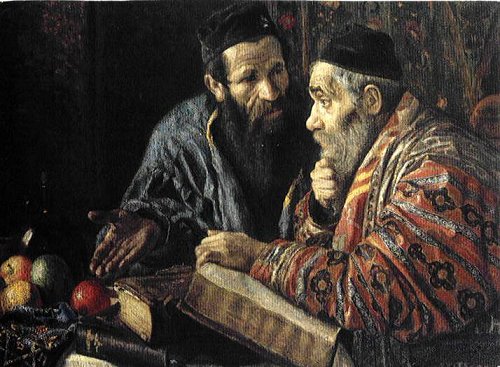
Talmudic RabbisThe Master himself set the prerequisite for being a leader and a tzaddik as being first a servant to others. Rabbi Kramer teaches that a tzaddik must be a leader and Rabbi Kramer and Rabbi Freeman tell us that a tzaddik and the Moshiach (respectively) must also be a teacher:

Torah is the instrument which conveys God’s Infinite Wisdom to man. Who among us can honestly say that he is wise enough to look at that medium and grasp what is required of him? The Talmud, Midrash and Shulchan Arukh stress the importance of receiving from a teacher, so that one’s understanding of Torah be clear. Thus, a teacher or rabbi has to have received from his teacher, and so on, back to Moshe Rabeinu. To look directly into the Torah and say “I know and understand,” is to say “I don’t know and never will, because I consider myself capable enough to glance at God by myself.” As the Talmud teaches: Even one who has studied, as long as he has not received from a Talmid Chakham, a qualified teacher, is still considered an ignoramus (Berakhot 47a). And: How foolish are those who stand up for the Torah Scroll, but do not stand up for the Sage (Makot 22b). The Torah can actually mislead a person who follows it, without the benefits of true guidance and leadership.

Using Moshe (Moses) as an example and a starting point, Rabbi Kramer shows us that one of the main functions of a tzaddik is to present the correct and proper interpretation of the Bible to his disciples (for Christians, substitute “Bible” for “Torah”). Jesus did this continually in the Gospels, with one noteworthy example being the Sermon on the Mount (see Matthew 5). This also goes back to a point I have been trying to make in various blog posts. We cannot simply read the Bible in English with our own understanding, without any training or scholarly background, and expect to always understand what God is trying to say to us. Rabbi Kramer makes this clear when he says, “Even one who has studied, as long as he has not received from a..qualified teacher, is still considered an ignoramus” (quoting Berakhot 47a). Christianity dispenses with the roles of Rebbi and tzaddik as authoritative teachers at our own peril. This model of learning is one of the reasons I am attached to Judaism as a teaching platform.

But why will King Moshiach also need to be a teacher? Here’s Rabbi Freeman’s response:

This will also be the character of the Moshiach. Yes, he will be a teacher—because that’s what those times will be all about: learning, knowing, gaining divine wisdom. But a teacher—a good teacher—limits his lesson to that for which the student is ready and can handle. The Moshiach will be a teacher, but one with a kingly character: as enlightened as they may be, he will see far beyond. And yet, as a teacher-king, he will be capable of transmitting that transcendental knowledge to all of us as well. Perhaps not cognitively, but in some form in which it can be shared.

This teacher, then, is the ultimate of teachers. For he will show us the very core essence of our souls, and how they are rooted in the Core Essence of All Being.

So from Christianity’s point of view, we see that Jesus was required to teach the “lost sheep of Israel” and, through the Gospels, teach all of the subsequent generations of Jewish and Gentile disciples throughout the ages up to the current day, and then beyond. We also see that in the Messianic Age, he will still continue to teach and be the authority for our understanding of the Word of God and how that lamp will completely illuminate our souls.

Even in the beginning, the way Christ taught was considered astonishing:

When Jesus had finished saying these things, the crowds were amazed at his teaching, because he taught as one who had authority, and not as their teachers of the law. –Matthew 7:28-29

Typically, no Rabbi taught in his own name. He taught in the name of his Master; his Rebbe, who also taught in the name of his Master, and so on. Not that there couldn’t be exceptions:

This does not mean that there are no exceptions to the rule. The Talmud speaks of those unique individuals who did succeed in Torah study, though they did not follow the prescribed approach to study outlined by our Sages (see Avodah Zarah 19a). But these singular human beings are very few and far between. One must receive at least the basics of learning from a rabbi, whose task it is to see that the material taught conveys its true meaning (Bava Batra 21a,b).

With apologies to Rabbi Kramer, Jesus would have been even more unique in having “learned” the Torah from his Father, the One God of Heaven. On the other hand, when Rabbi Kramer says, “One must receive at least the basics of learning from a rabbi”, is it such a stretch to consider Christ’s teacher and Rabbi to also be his Father?

The Tzaddik is also an intermediary. He is an agent between God and ourselves. Yet, he is not an intermediary at all. God forbid that anyone should think he needs a medium between the Almighty and himself; not from his side, and certainly not from God’s. Rather, because the Tzaddik is one who has conquered the physicality of this world and entered the spiritual realm, he serves as an agent and a catalyst for bringing spirituality to this world. Having attained the wisdom and understanding necessary for serving God in a true and proper manner, the Tzaddik serves Him by bringing His will to mankind and by getting people to recognize God in all aspects of their lives. The average person cannot perceive God’s will, and therefore has to turn to someone who can. Thus, in this sense, the Tzaddik is an intermediary.

Who is Moshiach?And so, though Rabbi Kramer wouldn’t present it this way, Jesus is an intermediary between us and God as our great High Priest in the Heavenly Court (Hebrews 4:14-16). He “serves as an agent and a catalyst for bringing spirituality to this world”. We are not alone nor are we, even though not Jews and recipients of the gift of Sinai, without one to petition the Father with our needs.

Rabbi Freeman tells us the role our teacher plays out for us today and where it will lead tomorrow:

An interesting idea, because it fits so well into the idea of what the messianic era is all about and how it fulfills the purpose of creation—as Rabbi Schneur Zalman writes, “everything depends on our work throughout the time of exile.”

Meaning that through the toil of our hard work, our struggle and persistence in the most trying times right up until that glorious era, we will draw into the world a deep light, an essence-light, such as could never have been revealed without that labor. It is that essence-light that the Moshiach will have the job of revealing to us. Something entirely transcendental, and yet, something that each of us touches; something from which each of us draws strength every time we defy the confusion and darkness of our present world to do what we know is right and beautiful.

I cannot help but see Jesus as the Messiah through the teachings of the Rabbis. In fact, I see him more clearly as I read the words of Rabbis Kramer and Freeman than I do in the books written by traditional and modern Christian scholars. I see Jesus in the words of Talmud, as interpreted by such Rabbis (again, I emphasize that these Rabbis would never have intended that I take such a meaning. This is due to Jesus being completely “re-painted” in the image of a Gentile Christian “god” by the church). How can I not? I must seek him where he is to be found.

The Moshiach is found among his people; among his Father’s chosen ones; His Am Segulah, God’s treasured, splendorous children. As servant and teacher, whose death atoned for an evil decree upon mankind, as Intermediary, Priest (Hebrews 6:20), and Messiah King, he first came for Israel but is the redeemer of all the world. We seek him and God sent him to us so that we, in seeking God, could be found by Him and return home.

Ki Tavo: Blessings of the Soul

BikkurimOne of the major thrusts in Judaism is hakaras hatov, appreciation of the good which G-d constantly bestows upon us. And as with appreciation of our fellow man, the emphasis is on appreciating not only the material dimension of G-d’s kindness, but also the love and care which He showers on every person.

In this vein, we can understand the sequence of our Torah reading, Parshas Ki Savo. The reading begins by describing the mitzvah of bikkurim (Deuteronomy 26:1-11), the first fruits which the Jews would bring to the Beis HaMikdash, and shortly afterwards speaks of a covenant concerning the entire Torah (Deuteronomy 26:16)

What is the connection between these subjects?

The mitzvah of bikkurim was instituted to show that our gratitude for the good G-d has granted us (Rashi, gloss to Deuteronomy 26:3), and to display our appreciation to Him for “granting us all the blessings of this world.” (Sefer HaChinuch, mitzvah 606) And this appreciation is not expressed merely by words of thanks, but through deed.

-Rabbi Eli Touger
Ki Savo commentary: “Entering Deeper and Deeper”
In the Garden of Torah
Chabad.org

There’s a tendency among people of faith to separate their lives into the holy and the mundane. It is holy to pray in the morning before work, and it is mundane to commute to work. It is holy to worship in church or synagogue, but it is mundane and ordinary to have a meeting at work, have dinner with your family, volunteer at the food bank, and to give to charity. Yet we see in the example set in this week’s Torah Portion Ki Tavo that in the process of the bikkurim, there is an intimate connection between appreciating the gifts of the physical world and the loving providence of God.

The bikkurim is an illustration of the Jewish expression of appreciation to God for the gift of the Land of Israel and its bounty, but how else can such appreciation be expressed and experienced?

Our Sages teach (Bava Basra 9b): “A person who gives a coin to a poor person is granted six blessings; one who gratifies him is blessed elevenfold.” Now, gratifying does not necessarily mean giving more money. It means giving a positive feeling, showing the recipient that you care about him, and that he means something to you. When one so invests himself in another person, putting enough of himself into the stranger that the person feels appreciated, he has given something far greater than money. And so he receives a more ample blessing from G-d.

Our own sage, the “Maggid of Nazaret” teaches a similar lesson:

Jesus sat down opposite the place where the offerings were put and watched the crowd putting their money into the temple treasury. Many rich people threw in large amounts. But a poor widow came and put in two very small copper coins, worth only a few cents.

Calling his disciples to him, Jesus said, “Truly I tell you, this poor widow has put more into the treasury than all the others. They all gave out of their wealth; but she, out of her poverty, put in everything—all she had to live on.” –Mark 12:41-44

What is “value” in the eyes of God and “worth” in the economy of Heaven? It isn’t our ability to pay or to provide for others or even to God, but our intent, willingness, and expression in helping the unfortunate. A poor widow can donate a a very small amount (although it is great to her since it is all she has to live on) and have it be worth more than all of the gifts of the wealthy, even though what they give can feed multitudes of the impoverished.

To continue quoting from Rabbi Touger:

This leads to a deeper concept: Appreciation stems from involvement; the deeper the relationship between people, the more one appreciates the uniqueness of the other. When a person appreciates a colleague, he is motivated to do whatever he can for that other person.

These concepts apply, not only to our relationships with our fellow man, but also to our relationship with G-d.

What we do for others relates directly back to how we express our appreciation for all God has done for us. In fact, there is probably a closer connection between acts of charity to others and our appreciation of God than we might imagine:

“Then the righteous will answer him, ‘Lord, when did we see you hungry and feed you, or thirsty and give you something to drink? When did we see you a stranger and invite you in, or needing clothes and clothe you? When did we see you sick or in prison and go to visit you?’

“The King will reply, ‘Truly I tell you, whatever you did for one of the least of these brothers and sisters of mine, you did for me.’ –Matthew 25:37-40

HomelessIn Judaism, the first blessing offered to God, the Modeh Ani, is given before the person even gets out of bed, but it is performed while the person is not quite awake. Later in the day, observant Jews recite the Modim blessing of the Shemoneh Esreh, and offer a more complete expression of thanks, yet this is only part of offering our hearts to God. The physical acts of kindness to others and the illustration of the bikkurim are both tangible and concrete, yet representative of traveling into the greater depths of spiritual dimensions where prayers and blessings alone cannot take us. So even in giving to others as an expression of appreciating the life God gives to us, we also get something back; the opportunity to serve the table of the King.

Once the Chasam Sofer, zt”l, was riding in the same carriage as his rebbe, Rav Nosson Adler, zt”l. It was a very cold day and the Eastern European roads were filled with snow and slush. One wrong turn could land a person into a sticky quagmire from which he would not easily get out. During the first leg of the trip, the wagon driver managed to extricate them each time
the horses got stuck. Eventually, however, the horses enter a muddy pit from which they could not budge. Although they tried, they lacked the physical strength to get that wagon out of the mud.

After coaxing the team for an extended time, the wagon driver understood that his efforts were futile and that he needed help. He unhitched one of the horses and rode to a nearby town. After some time the wagon driver returned with reinforcements to remove the wagon. When Rav Nosson Adler saw them coming he left the wagon. He rushed out so quickly that he didn’t even put on his boots. In his silk socks he jumped down from the wagon and then—to the surprise of the Chasam Sofer—he began to dance. His face shone with a holy fire and he was obviously overjoyed.

The Chasam Sofer wondered what it was that had made his rebbe so happy that he spontaneously began to dance. “You know I spend most of my day in the beis midrash. I do as many mitzvos as I can, but there are many mitzvos which are virtually impossible for me to fulfill. One of these unusual mitzvos is to avoid kil’ayim.

“But now don’t you see? The wagon driver brought a team of oxen to help pull his wagon out of the mud. As a non-Jew, this is his right, but we are forbidden from sitting in the wagon while it is being towed out by a mixed team. If we would have sat in the wagon we would have violated the prohibition of kil’ayim. Now that I have finally merited to fulfill this rare mitzvah I feel filled with joy and cannot stop myself from dancing!”

Daf Yomi Digest
Stories Off the Daf
“A Mixed Team”
Chullin 79

While this example of gratitude and appreciation may seem obscure and even nonsensical to someone without the benefit of a traditional Jewish religious education, if you take a moment to think about it, this is a story of a rare opportunity. Bringing the illustration back to the present, those opportunities that God gives us to serve others, even when they significantly interrupt our otherwise orderly and scheduled lives, are really opportunities for our benefit. Helping someone else not only benefits the other person, and it not only lets us bless God for all He has done for us, it is also the act of God blessing us by letting us be of further service to Him. In committing even the smallest act of repairing the world, God is giving us His loving compassion by repairing us, for there is no difference between helping another person, honoring God, and receiving God’s blessings on our soul.

In every person, there lie all souls that ever were and will be.

After all, humanShabbat candles consciousness began in a single being, with a single breath of G‑d within that being.

And so, just as every cell of the human being contains the blueprint of every other cell and of the entire person from the synapses of his brain to the swirls of his fingerprints, so every single person contains the entire humankind.

In this way, our Creator has rendered each of us the master of human destiny. In the liberation of any one of us lies the liberation of us all.

-Rabbi Tzvi Freeman
“Any Soul”
Based on letters and talks of the Rebbe
Rabbi M. M. Schneerson
Chabad.org

Good Shabbos.

Searching by Ineffable Light

Light at nightGod is not a scientific problem, and scientific methods are not capable of solving it. The reason why scientific methods are often thought to be capable of solving it is the success of their application in positive sciences. The fallacy involved in this analogy is that of treating God as if He were a phenomenon within the order of nature. The truth, however, is that the problem of God is not only related to phenomena within nature but to nature itself; not only to concepts within thinking but to thinking itself. It is a problem that refers to what surpasses nature, so what lies beyond all things and all concepts. (page 102)

The object of science is to explain the processes of nature. (page 104)

-Abraham Joshua Heschel
God in Search of Man: A Philosophy of Judaism

He made His world of contradictions, opposites that combine as one.

Being and not being,
infinity and finitude,
light and darkness,
form and matter,
quantity and quality,
giving and withholding.

At their nexus, a world is formed: Neither can exist without the other, all function together as a single whole.

They are mere modalities—He Himself is none of them. He mixes them and matches them at whim.

Paradox is our window to the Unknowable.

-Rabbi Tzvi Freeman
“Being and Not Being”
Based on letters and talks of the Rebbe
Rabbi M. M. Schneerson
Chabad.org

The “mystery” of God is both that He is unknowable and that the attempt to “know” Him is irresistibly compelling. This is probably why I write on the topic so much (my most recent entry being Mystery Story). Yet the mere act of prayer is an attempt to interface the ordinary with the fantastic; the finite with the infinite; the temporal and the immortal. As Rabbi Freeman says, God “made His world of contradictions, opposites that combine as one.” But while God can exist without us, we can’t exist without Him.

In the beginning you laid the foundations of the earth,
and the heavens are the work of your hands.
They will perish, but you remain;
they will all wear out like a garment.
Like clothing you will change them
and they will be discarded.
But you remain the same,
and your years will never end. –Psalm 102:25-27

The life of mortals is like grass,
they flourish like a flower of the field;
the wind blows over it and it is gone,
and its place remembers it no more. –Psalm 103:15-16

In touching the hem of God’s garment, we cannot truly know Him; in approaching the throne, we cannot truly comprehend Him. We are like ancient men trying to understand how an airplane flies or how a submarine descends to tremendous depths. In truth, we are much more ignorant than they. But we still have the need to draw nearer to God, and even the secular person searches for Him without realizing it. To again quote from Heschel’s book:

No one is without a sense of awe, a need to adore, an urge to worship. The question is only what to adore, or more specifically, what object is worthy of supreme worship. (page 88)

We are all in search of the One God but people, in our confusion and incomprehension, turn to other objects, stars, trees, and even people, and devote all our adoration to them, rather than to our Creator and in doing so, declare ourselves “free” of the confines of “religion” and accountability to a standard of holiness we do not understand nor desire to emulate.

More’s the pity.

Indeed, secular man considers Biblical man to be the one who is ignorant and even superstitious, and who can blame him?

The prophet is a fool. The man of spirit is mad. –Hosea 9:7

There is a certain madness to this idea of talking to G-d, of saying “You” to the Ground of Reality–as though this is a person. Like the madness of love or of unbounded joy. Not the madness of a derelict mind, but the madness that rides upon the shoulders of reason, with all its qualities, but beyond.

-Rabbi Tzvi Freeman
“Divine Madness”
Chabad.org

OceanYet what we seek and the faith we grasp so tightly is not without logic but beyond logic. It is not irrational, but super-rational.

I recently attempted to delve into a comparison between Jesus, the Oral Law, and the Talmud, which is a subject far too complex for a single blog post. While there is a tradition in Judaism that says Moses was given both a written and an oral Torah, Kabbalistic adherents believe there is a third, “hidden” Torah as revealed in the Zohar or other mystic writings.

This is certainly controversial and is not accepted among all Jewish authorities. And although Christianity enjoys its own rich, mystic tradition, the vast majority of believers in the church disdain not only the Zohar and any of the Chassidic writings, but even the more rational and grounded Talmud.

And yet, the mystic, in both Judaism and Christianity, exists because of the ineffable nature of the unknowable God, as Rabbi Heschel writes:

By ineffable we do not mean the unknown as such; things unknown today may be known a thousand years from now. By the ineffable we mean that aspect of reality which by its very nature lies beyond our comprehension, and is acknowledged by the mind to be beyond the scope of the mind. Nor does the ineffable refer to the realm detached from the perceptible and the known. It refers to the correlation of the known and the unknown, of the knowable and the unknowable, upon which the mind comes in all its acts of thinking and feeling.

The sense of the ineffable is a sense for transcendence, a sense for the allusiveness of reality to the super-rational meaning. The ineffable, then, is a synonym for hidden meaning rather than for absence of meaning. It stands for a dimension which in the Bible is called glory, a dimension so real and sublime that it stuns our ability to adore it, and fills us with awe rather than curiosity.

No wonder David wrote this:

..what is a human being that you are mindful of him, a son of man that you care for him? –Psalm 8:4

What are we indeed, but the handiwork of the Creator and the clay vessels which contain transformative infinite light. And what Shakespeare said with irony, we can say with conviction:

What a piece of work is a man, how noble in reason, how
infinite in faculties, in form and moving how express and
admirable, in action how like an angel, in apprehension how like
a god!

-Hamlet Act 2, scene 2, 303–312

Light under the doorWhile not “angel” nor “god”, we do tread on the edge or madness and the abyss at each encounter with the Creator, attempting to touch what is beyond our reach and to know what knowledge cannot imagine. Yet it was for this purpose that God created each of us, and that we even have such a word as “ineffable” in our vocabulary speaks to the need to cross the boundary between the tangible and the mystic and to walk the corridors of a Temple not made by the hand of man.

Reason stands on the threshold, trembling to open the door to her own womb, although a blinding light bursts from between the cracks. For in that place, she knows, there is no reason. She has shown the way, but now she must step aside for madness to break in.

-Rabbi Tzvi Freeman
Divine Madness

Transforming Darkness with Light

Inner lightHusbands, love your wives, just as Christ loved the church and gave himself up for her to make her holy, cleansing her by the washing with water through the word, and to present her to himself as a radiant church, without stain or wrinkle or any other blemish, but holy and blameless. In this same way, husbands ought to love their wives as their own bodies. He who loves his wife loves himself. After all, no one ever hated their own body, but they feed and care for their body, just as Christ does the church – for we are members of his body. “For this reason a man will leave his father and mother and be united to his wife, and the two will become one flesh.” This is a profound mystery – but I am talking about Christ and the church. However, each one of you also must love his wife as he loves himself, and the wife must respect her husband.Ephesians 5:25-33 (NIV)

The relation of husband and wife is the way our world reflects the relationship of the Creator with His Creation. There is nothing more pivotal to the world’s ultimate fulfillment than this.

Therefore, as the world nears closer and closer to its fulfillment, the resistance grows stronger and stronger. By now, absolutely everything appears to be undermining the most crucial key of peace between man and woman.

-Rabbi Tzvi Freeman
“Peace at Home”
Based on letters and talks of the Rebbe
Rabbi M. M. Schneerson
Chabad.org

Anyone who’s ever been married knows that, even in the best of relationships, there can be strife and disagreement at times. It isn’t always easy to maintain peace in the home at every moment. The world around you may never know that you and your spouse aren’t getting along, but you know, your spouse knows…and God knows.

How much more does God know about the state of our relationship with Him, if we are on good terms or are feeling estranged. As Rabbi Freeman states, our relationship with our spouse is a reflection of our relationship with God. As the world progresses to a condition of ever greater darkness, it becomes increasingly difficult to maintain peace in the home and peace as we attempt to enter the Temple of Hashem.

In the presence of God and of Christ Jesus, who will judge the living and the dead, and in view of his appearing and his kingdom, I give you this charge: Preach the word; be prepared in season and out of season; correct, rebuke and encourage – with great patience and careful instruction. For the time will come when people will not put up with sound doctrine. Instead, to suit their own desires, they will gather around them a great number of teachers to say what their itching ears want to hear. They will turn their ears away from the truth and turn aside to myths. But you, keep your head in all situations, endure hardship, do the work of an evangelist, discharge all the duties of your ministry. –2 Timothy 4:1-5 (NIV)

Even in the community of faith, “peace is the home” is getting harder to secure. As Paul predicted, we are living in an age when “people will not put up with sound doctrine”, although it is ironic that some very shallow viewpoints on the Word of God are considered to have “deep meaning”. We also see values that once were great in the hearts of believers, visiting the sick, feeding the hungry, giving to the poor, are now considered passe’ and have been replaced by the latest fads in church “feel-good-about-yourself” programs. And yet, in any relationship, no matter the circumstances, we can still overcome the barriers as long as we keep our focus on the object of our love and faith:

Just as He clothes the naked, as it is written [in Genesis 3:21], “The LORD God made garments of skin for Adam and his wife, and clothed them,” so too should you also clothe the naked. The Holy One, blessed be He, visited the sick, as it is written [in Genesis 18:1], ‘Now the LORD appeared to him by the oaks of Mamre,’ [while he was still recovering from circumcision,] so too should you also visit the sick. The Holy One, blessed be He, comforted mourners, as it is written [in Genesis 25:11], “After the death of Abraham, that God blessed his son Isaac,” so too should you also comfort mourners. The Holy one, blessed be He, buried the dead, as it is written [in Deuteronomy 34:6], “And He buried [Moses] in the valley in the land of Moab,” so too should you also bury the dead. –b.Sotah 14a

Here we see God’s love for us and His example in how we should show love to others. We also see this in the life of the Master:

Yochanan heard in prison about the deeds of the Mashiach and sent two of his disciples. They said to him, “Are you the one who comes, or should we wait for another?” Yeshua answered and said to them,

“Go tell Yochanan what you have heard and what you have seen. The blind are seeing, the lame are walking, metzora’im are becoming pure, the deaf are hearing, the dead are rising, and the poor are receiving good news. And O, the gladness of th eman who does not stumble because of me!” –Matthew 11:2-6 (DHE Gospels)

Holding onto lightAs the time of darkness approaches, we can push it back and indeed, by our acts of trust and faithfulness to Jesus, we can actually transform the darkness into light, at least in part, and when he returns to us, he will  make everything complete and restore the world to light.

When light pushes away the darkness, eventually another darkness shall come. When the darkness itself is transformed into light, it is a light that no darkness can oppose.

-Rabbi Tzvi Freeman
“Transformation”
Based on letters and talks of the Rebbe
Rabbi M. M. Schneerson
Chabad.org

Is it any wonder we have this comparison?

Yeshua spoke to them once more saying, “I am the light of the world. Anyone who follows me will not walk in darkness, for he will have the light of life.” –John 8:12 (DHE Gospels)

You are the light of the world. A city that sits on the mountain will not be hidden, nor do people kindle a lamp just to put it under the bushel measure, but on the menorah, to illuminate all who are in the house. So also, shine your light before sons of men, so that they may see your good deeds and praise your father who is in heaven. –Matthew 5:14-16 (DHE Gospels)

Just as we see the light of our Master and strive to imitate him by also becoming light, our Master did nothing on his own:

Then Yeshua said to them, “At the time you lift up the son of man you will know that I am he and that I do not do anything of myself. But as my Father has taught me, so I speak. The one who sent me is with me; the Father has not abandoned me to be alone. For I always do what is good in his eyes.” –John 8:28-29 (DHE Gospels)

Just as he was sent in the Name of the Father, now we are sent in the name of the Son. So we should do all that is good in His eyes, that we might become one with our Father in Heaven, that there might be peace in our homes and in “the Home”, and that the darkness may be dispelled by our light, and His light.

Note: Quotes from the Gospels were taken from the Delitzsch Hebrew Gospels, Hebrew/English translation adapted and published by Vine of David from the original 1890 text, produced by Franz Delitzch and supervised of Gustav Dalman.

Quotes from Sotah 14a and John 8:28-29 were adapted from the First Fruits of Zion (FFOZ) commentary on Torah Portion Ki Tavo, Imitating God.

Dawn