Tag Archives: Talmud

Days of Mourning

MourningDuring the 3 weeks from 17 Tammuz leading up to Tisha B’Av, the 9th of Av, the Jewish people mourn the loss of the Holy Temple. The Talmud attributes this loss to the prevalence of Sinas Chinam, baseless hatred, among the Jewish people. While hatred towards others is a serious offense, how does it explain the loss of the Temple, and sending the Jewish people into a bitter, arduous exile for nearly 2000 years? Surely there are much greater crimes!

Recall that our relationship with the Al-mighty is not simply servant to master — it’s much deeper. He’s not only Malkeinu, our King, but Avinu Malkeinu, our Father, our King. A mere servant follows orders, but a child does what he knows his father wants most. While G-d did not record baseless hatred in His Torah as a punishable crime, we know that the deep pain it causes the Al-mighty, as it were, far exceeds even the most cardinal of sins. (Nesivos Shalom, Bamidbar 146)

I encourage you to read the words offered in eulogy (pgs 1 & 16) by Rabbi Binyomin Eisenberg , spiritual leader of the synagogue attended by Leiby Kletzky’s family, and one who had a close personal relationship with the pure, innocent Neshama (soul) summoned back to heaven last week. While one can only speculate what G-d’s message is to us, and undoubtedly there are many amidst such a profound tragedy, Rabbi Eisenberg noted the outpouring of assistance, thousands of volunteers, who helped in the search for Leiby and eventually helped lay his body to its final rest. He then asked a painful question: “Why do we need a tragedy to provide water in the streets for strangers?” “Let’s help each other – always,” he said. “If you pick up the phone, it stops ringing. If we Daven (pray) and help each other, we hopefully won’t need tragedies.”

Rabbi Mordechai Dixler
Program Director, Project Genesis – Torah.org

The three weeks of mourning, which started on Tammuz 17, began on July 19th this year, and will culminate on August 9th; Tisha b’av. The 9th day of the month of Av observes a series of tragic events that have befallen the Jewish people throughout history. It is said that both the First and Second Temples were destroyed on the 9th of Av. The Bar Kochba revolt (133 CE) was ended with the slaughter of the Jewish rebels by the Romans on the 9th of Av. On this same date in 1290 CE, the Jews were expelled from England and Spain banished Jews from their land in 1492 on the 9th of Av. Chabad.org has more facts on this day, which holds so many harsh events for the Jewish people.

Why continue to mourn? What purpose could continuing to commemorate the three weeks serve except as a depressing reminder of so much suffering, pain, and death? Why would the Jewish people want to make this a permanent part of their religious calendar and to relive such terrible times?

What did Rabbi Dixler say?

The reminder isn’t what the world has done to the Jews. The reminder is how they failed God, defining the failure as “the prevalence of Sinas Chinam, baseless hatred, among the Jewish people”.

I don’t say this to insult or denigrate the Jewish people. In fact, we all fail God, each and every one of us, and on a rather frequent basis. What lessons can Christians take from the three weeks of mourning and the fast days of 17 Tammuz and 9 Av? Christianity often focuses on how we are saved from sin and death, which isn’t necessarily a bad thing, but we have a tendency to gloss over our own faults, mistakes, and errors, all because we are “saved”. In fact, our salvation seems to make some Christians a little cocky and even arrogant. For them, being “saved” means if you mess up, all you have to do is shoot a quick prayer of “I’m sorry, God” up to heaven and you’re good to go.

Really?

MourningI think not, but sadly, I do think a lot of Christians proceed on this rather self-satisfied and self-serving assumption. If Christians would take their failures a little more seriously, consider displaying a more contrite attitude toward God and other people they have failed, and humble themselves (ourselves) before God and those people, wouldn’t we be better servants of God and better disciples of Jesus? Jesus emptied himself of all glory and honor and humbly accepted an unjust and undeserved death on a stake as a criminal. Where is our fasting, our mourning, our prayers of sorrow for the failures of our lives?

Rabbi Yehudah Prero offers a description of what observant Jews practice during these three weeks:

We are now in the final days of the Three Weeks, the period of time between the fasts of the 17th of Tamuz and the 9th of Av. These three weeks are spent in a state of mourning. We do not conduct weddings, we do not cut our hair, and we refrain from enjoying music. During the last nine days, we do not eat meat, drink wine, nor do we bathe. The sorrow of our exile surrounds us at every moment during this time of the year. While we are to mourn the loss of the Holy Temple, the Bais HaMikdosh and the destruction of Jerusalem, and pray for the end of this lengthy exile, we must remember that Hashem is with us, watching us, ready to lift the burden of exile from upon us at the proper time.

Granted, this type of observance is more common among Orthodox Jews, but it does set a standard of behavior that includes solumn reflection and prayer among the Jewish people as well as the reassurance that God is with them and, at the right time, that He will rescue them. It commemorates the “incompleteness” of the redemption of the Jewish people from exile and the desire for the coming of the Messiah to accomplish the final return of the Jews to Israel and to God:

We have been in exile for a long time. Our families have been subject to spiritual and physical persecution. During the Three Weeks, our behavior reflects the sadness of this time period, the recognition of the great suffering which we still endure. Although we mourn and lament, we must still keep in mind that Hashem is watching over us. He has already put in place the mechanisms for our redemption. We cannot allow that spark of hope within us to be extinguished. We must recognize that the exile will end. That end has been planned for and provided for by G-d. With our striving to be better people, with our repenting, our studying of the Torah, the redemption, our light at the end of the tunnel, is clearly within sight.

Christians don’t consider themselves in exile, but perhaps we should. Although Christianity doesn’t have the same relationship to Land of Israel as the Jewish people, there is definitely something we are missing. We still live in a broken world. We still live in a world where sin and immorality reign and where the values of God and truth are treated with contempt. When will we be “returned” to our “homeland”, where we will live in peace and be ruled by our just and merciful King? When will Jesus come?

As long as we are waiting for him, we are also in exile. While we celebrate our salvation, let us mourn the fact that it was for our sins that Jesus suffered terribly and died. We share some measure of grief and sorrow for the destruction of the Temple and the exile of the Jews from Israel, because these are all events that are inexorably tied to the death of the Messiah and the spreading of the Gospel of Christ. The Prophet Micah said that someday, all people from the nations will stream to the mountain of God. For that reason, we too must long for the day of its return and for the restoration of the Jews to Israel, as we do for the return of Christ. Let us fast and mourn as for an only son who we have lost and pray for the day when he will come into the world again, in glory and honor and joy. One day, we will all be restored in the courts of our Father and our King.

In the last days
the mountain of the LORD’s temple will be established
as the highest of the mountains;
it will be exalted above the hills,
and peoples will stream to it.

Many nations will come and say,

“Come, let us go up to the mountain of the LORD,
to the temple of the God of Jacob.
He will teach us his ways,
so that we may walk in his paths.”
The law will go out from Zion,
the word of the LORD from Jerusalem.
He will judge between many peoples
and will settle disputes for strong nations far and wide.
They will beat their swords into plowshares
and their spears into pruning hooks.
Nation will not take up sword against nation,
nor will they train for war anymore.
Everyone will sit under their own vine
and under their own fig tree,
and no one will make them afraid,
for the LORD Almighty has spoken.
Micah 4:1-4

Finding Freedom

CaptureTell me, you who want to be under the law, are you not aware of what the law says? For it is written that Abraham had two sons, one by the slave woman and the other by the free woman. His son by the slave woman was born according to the flesh, but his son by the free woman was born as the result of a divine promise.

These things are being taken figuratively: The women represent two covenants. One covenant is from Mount Sinai and bears children who are to be slaves: This is Hagar. Now Hagar stands for Mount Sinai in Arabia and corresponds to the present city of Jerusalem, because she is in slavery with her children. But the Jerusalem that is above is free, and she is our mother.Galatians 4:21-26

Speak and act as those who are going to be judged by the law that gives freedom, because judgment without mercy will be shown to anyone who has not been merciful. Mercy triumphs over judgment.James 2:12-13

So what is it? Does the Law take away freedom or does the law give freedom? Are we even talking about the same Law; the Torah?

I’ve often suspected that Paul and James didn’t see eye-to-eye on many issues. Paul was operating for years at a time in the diaspora, bringing the Gentiles to faith in the Jewish Messiah and teaching them his ways and how to trust in God. There wasn’t a lot of oversight going on from the Jerusalem Counsel, so Paul could have gotten away with re-writing the Gospel message in his own image, diluting or even eliminating the law and replacing it a type of “grace” that is the antithesis of the law (though in reality, they are not mutually exclusive). It’s clear that James wouldn’t have agreed with that message.

However, if you read D. Thomas Lancaster’s new book The Holy Epistle to the Galatians, you’ll see that Paul and James were more alike than unalike (though I still suspect that they had their individual perspectives). For one thing, despite the common Christian tradition of interpreting Galatians 4:21-26 as “anti-Law” (and in the plain English text, it certainly seems that’s what Paul’s saying), the issues are more complex. Lancaster interprets them this way:

The passage contrasts two types of proselytes: the legal proselyte and the spiritual proselyte. The one becomes part of Abraham’s family by conventional conversion, the other through faith in Messiah, the promised seed of Abraham, in whom all nations find blessing. The passage does not contrast the Old Testament against the New Testament or the Old Covenant with the New Covenant. It does not equate Judaism and Torah with slavery, nor does it pit Christians against Jews.

It means that if you are a Jewish believer , you should be proud of being Jewish because you are a child of Abraham, legally, physically, and spiritually. It means that if you are a Gentile believer, you, too, are part of the people, a spiritual son of Abraham, and that is remarkable – miraculous even. You are a child of the promise that God made to Abraham so long ago.

I’ve already written a review of Lancaster’s book and I’m not going to “reinvent the wheel”, so to speak, but I’m presenting this “extra meditation” this afternoon, in response to the following:

No one can say he is free today because yesterday he was granted freedom.

Freedom is a source of endless energy.
Freedom is the power behind this entire universe.
Freedom is the force that brings existence out of the void.

You are free when you take part in that endlessness. When you never stand still. When you are forever escaping the confines of today to create a freer tomorrow.

Rabbi Tzvi Freeman
“Perpetual Freedom”
Chabad.org

As an Orthodox Jew, Rabbi Freeman isn’t considering that the Torah is somehow slavery or bondage, even for a single moment. So how are Christians to interpret his words of freedom as well as the apparent conflict between Paul and James, both observant and devout Jews, on how they view the Torah?

It is said that the world was created for the sake of Torah and that, without the Torah, the world could not have been made. The analogous teaching we have in Christianity is this:

In the beginning was the Word, and the Word was with God, and the Word was God. He was with God in the beginning. Through him all things were made; without him nothing was made that has been made. –John 1:1-3

TeshuvahHere, we see a sort of “fusion” or co-identity, in some mystic sense, between the Torah and the Messiah, Son of the living God. Christians know that Jesus gives us freedom from the slavery of sin and Jews know that the Torah is the gateway to God’s endless energy, the power behind the universe, and the limitless, eternal source that creates existence out of nothingness. Through Torah, God does not enslave, but provides the means by which men may know God and understand our relationship to Him. If the same can be said of Jesus, then we can all understand from where our freedom comes.

While non-Jewish disciples of the Jewish Messiah are not obligated to the same “yoke of Torah” as the Jewish people (see Acts 15), we nonetheless are grafted into the root of the Tree of Life and like branches on the vine, we draw our nourishment and the ability to live a life of holiness from an identical source; God.

To do so requires more than just believing and more than just learning; we must do, we must behave, we must live out the values we understand from the Torah and how they were taught to us by the “living Torah”, the Moshiach, Jesus Christ. Part of that living is understanding where we came from, who we are, and our need to separate from sin and embrace holiness and peace. To gain freedom from sin, we must recognize the depth and despair of sin, which is what the Torah aptly defines, and only upon achieving that understanding, can we truly turn away from that sin and turn toward the God of Abraham, Isaac, and Jacob:

The Ohr Hachaim HaKadosh, zt”l, writes that one can only do teshuvah if he first recognizes the gravity of his sin.

A certain person committed a sin. When Rav Mordechai Aryeh Halevi Horowitz, zt”l, gently nudged him to repent the sinner displayed his relaxed attitude towards teshuvah. “Why repent now? Soon enough it will be Elul, the season when the shofar is sounded to remind us to do teshuvah. Can’t my teshuvah wait until then?”

Rav Horowitz rejected this attitude out of hand. “As is well known, the main element in teshuvah is havdalah, separating between what is proper and what is not. It is only by determining which actions lead to darkness and which generate light that we act as is fitting. Even if a person with understanding falls to sin chas v’shalom, he knows to repent and change his ways. But many people wait until Elul to do teshuvah. After all, isn’t that when we are aroused to repentance by the shofar as the Rambam writes?

“We find in the Mishnah in Chulin 26 that whenever the Shofar is sounded we do not say havdalah. Conversely, whenever we say havdalah we do not sound the shofar. Although on a simple level this is a sign for when they would blow the shofar to signify the onset of Shabbos or Yom Tov, this statement also teaches a lesson about teshuvah. When one feels justified waiting to do teshuvah until the shofar is sounded during Elul, this shows he lacks understanding. He does not comprehend the gravity of sins since this leads to havdalah, healthy separation between what is right and what is wrong. One who has fitting discrimination between good and bad doesn’t wait to hear the shofar to repent!”

Dam Yomi Digest
Stories off the Daf
“Time for Repentance”
Chullin 26

If we claim to be without sin, we deceive ourselves and the truth is not in us. If we confess our sins, he is faithful and just and will forgive us our sins and purify us from all unrighteousness. –1 John 1:8-9

Good Shabbos

The Side of Merit

Judge NotJudge every man to the side of merit.

Ethics of our Fathers 1:6

On the most elementary level, this means that if you discern a negative trait in your fellow or you see him commit a negative act, do not judge him guilty in your heart. “Do not judge your fellow until you are in his place,” warns another of the Ethics’ sayings, and his place is one place where you will never be. You have no way of truly appreciating the manner in which his inborn nature, his background or the circumstances that hold sway over his life have influenced his character and behavior.

However, this only explains why you should not judge your fellow guilty. Yet our Mishnah goes further than this, enjoining us to “judge every man to the side of merit.” This implies that we should see our fellow’s deficiencies in a positive light. But what positive element is implied by a person’s shortcomings and misdeeds?

Commentary on Ethics of Our Fathers
“Double Standard”
Tammuz 18, 5771 * July 20, 2011
Chabad.org

The character traits of strength and firmness evoke mixed responses. On one hand, everyone admires personal fortitude, and respects an individual who has the courage to persevere in his convictions despite challenges. And yet a strong person can also be thought of as rigid and insensitive, clinging stubbornly to his own views without bending in consideration of others. Counseling against this tendency, our Sages commented, (Taanis 20a) “A person should always be pliant like a reed, and not hard like a cedar.”

Commentary on Torah Portion Matot
“True Strength”
-Rabbi Eli Touger

The world of religion is terribly judgmental. To be fair, this is a human trait and not just one seen among people of faith. While secular people tend to blame religion for all the world’s ills (war, racism, poverty, and so forth) is it rather our human nature and our tendency toward selfishness and evil that lets us corrupt the values of God into something that harms people.

In Christianity we are taught, “Judge not, that ye be not judged” (Matthew 7:1 [KJV]), but that certainly hasn’t stopped many in the church from judging others, both within the congregation and in the non-believing world. Is this any way to show the world the love of Jesus Christ?

Despite what I’ve quoted above, Judaism is also populated by human beings and thus, Jewish people aren’t perfect. They have a capacity equal to any Christian to judge others and to assign unfair blame and ridicule. Asher at the Lev Echad blog is on something of a mission to try and turn the hearts of Jews toward each other and to heal the differences between them. Recently, he published a plea asking Jews to not judge each other for their differences in religious practices and lifestyle but rather to guide “others into a life of serving God and His children in a way that best matches their individual personality”.

Asher’s words can easily be applied to the rest of us, both in their practicality and in their need.

Returning to the example of the Ethics of Our Fathers from which I quoted above, we see in the commentary that we must not only treat our fellows fairly and as we want to be treated, but we should extend ourselves to give others the benefit of the doubt, while at the same time, looking at our own deeds without compromise:

So judge every man to the side of merit—every man, that is, except yourself. For the attitude detailed above, while appropriate to adopt towards other human beings, would be nothing less than disastrous if applied to oneself.

“True, I have done nothing with my life,” the potential-looking individual will argue. “But look at what I am capable of! Look at the quality of my mind, the sensitivity of my feelings, the tremendous talents I possess. It’s all there within me, regardless of the fact that I have never bothered to realize any of it. This is the real me. The extent to which I actualize it is only of secondary importance.”

In our judgement of human life and achievement, we must adapt a double standard. Our assessment of a fellow human being must always look beyond the actual to the potential reality within. On the other hand, we must measure our own worth in terms of our real and concrete achievements, and view the potential in ourselves as merely the means to this end.

FriendsChristianity has parallel teachings to these Talmudic gems:

“Why do you look at the speck of sawdust in your brother’s eye and pay no attention to the plank in your own eye? How can you say to your brother, ‘Let me take the speck out of your eye,’ when all the time there is a plank in your own eye? You hypocrite, first take the plank out of your own eye, and then you will see clearly to remove the speck from your brother’s eye. –Matthew 7:3-5

Then Peter came to Jesus and asked, “Lord, how many times shall I forgive my brother or sister who sins against me? Up to seven times?” Jesus answered, “I tell you, not seven times, but seventy-seven times. –Matthew 18:21-22

At the core of all these lessons is the Torah itself and the Master’s commentary on the “Torah” that both Jews and Christians can embrace:

One of the teachers of the law came and heard them debating. Noticing that Jesus had given them a good answer, he asked him, “Of all the commandments, which is the most important?”

“The most important one,” answered Jesus, “is this: ‘Hear, O Israel: The Lord our God, the Lord is one. Love the Lord your God with all your heart and with all your soul and with all your mind and with all your strength.’ The second is this: ‘Love your neighbor as yourself.’ There is no commandment greater than these.” –Mark 12:28-31

I specifically say this is a “Torah”, because Jesus is quoting from both Deuteronomy 6:4-5 and Leviticus 19:18, so the heart of Christianity was born in Judaism and if we are wise, we will not separate the branches from the vine (see John 15:5 and Romans 11:11-24).

Rabbi Touger’s commentary on Matos describes two symbols of leadership over the twelve tribes of Israel. The authority of a tribal head is symbolized by both a staff and a rod. They sound the same but are wholly different from one another:

What is the difference between these two terms? A rod is supple, able to be bent, while a staff is firm and unyielding. For a rod is freshly cut or still connected to the tree from which it grew and is therefore pliant. A staff, by contrast, has been detached from its tree long ago, and over time has become dry, hard, and firm.

Both terms serve as analogies for different levels in the expression of our souls’ potential. (See Sefer Maamarei Admur HaZakein 5562, Vol. I, p. 237ff.) The term “rod” refers to the soul as it exists in the spiritual realms, where its connection to G-dliness is palpably appreciated. It shares an active bond with the lifegiving, spiritual nurture it receives. “Staff,” by contrast, refers to the soul as it exists in our material world, enclothed in a physical body. On the conscious level, it has been severed from its spiritual source, and its connection to G-dliness is no longer felt.

In this setting, there is the possibility for both the positive and the negative types of strength and hardness. There is a tendency towards spiritual insensitivity, a brittle lack of responsiveness to the G-dliness invested within creation.

Tree of LifeTying this back to the analysis of Pirkei Avot 1:6, we see that we should be a “rod” when dealing with others but a “staff” when judging ourselves.

A rod and a staff have a common source and the difference is how long each one has been separated from the tree. It is said that the Torah is a “tree of life for those who hold fast to her” (Ethics of Our Fathers 6:7). Given the Torah source of both Jewish and Christian commentaries on compassion toward others, not the least of which is the teaching of the Master, how can we not take hold of that tree and cling fast to her in our relationships with others and with God?

Rabbi Chananiah the son of Akashiah would say: G-d desired to merit the people of Israel; therefore, He gave them Torah and mitzvot in abundance. As is stated, “G-d desired, for sake of his righteousness, that Torah be magnified and made glorious.” –Makot, 3:16

As If Considering Angels

Broken AngelFor this very reason, make every effort to add to your faith, goodness; and to goodness, knowledge; and to knowledge, self-control; and to self-control, perseverance; and to perseverance, godliness; and to godliness, mutual affection; and to mutual affection, love. For if you possess these qualities in increasing measure, they will keep you from being ineffective and unproductive in your knowledge of our Lord Jesus Christ.2 Peter 1:5-8

Said Rabbi Joshua the son of Levi: Every day, an echo resounds from Mount Horeb, proclaiming and saying: “Woe is to the creatures who insult the Torah.” For one who does not occupy himself in Torah is considered an outcast, as is stated “A golden nose-ring in the snout of a swine, a beautiful woman bereft of reason.” And it says: “And the tablets are the work of G-d, and the writing is G-d’s writing, engraved on the tablets” ; read not “engraved” (charut) but “liberty” (chairut)—for there is no free individual, except for he who occupies himself with the study of Torah. And whoever occupies himself with the study of Torah is elevated, as is stated, “And from the gift to Nahaliel, and from Nahaliel to The Heights.”Ethics of the Fathers 6:2

I know these two quotes may not seem to go together, but consider this. Peter says that we should add faith to goodness and then add goodness to knowledge. What knowledge? Where does this knowledge come from? Rabbi Joshua ben Levi implies that knowledge comes from Torah by expressing the inverse that one who does not occupy himself with Torah “is considered an outcast” and is like a “golden nose-ring in the snout of a swine, a beautiful woman bereft of reason”.

Sounds pretty harsh, but then, so does Peter:

This is especially true of those who follow the corrupt desire of the flesh and despise authority. Bold and arrogant, they are not afraid to heap abuse on celestial beings; yet even angels, although they are stronger and more powerful, do not heap abuse on such beings when bringing judgment on them from the Lord. But these people blaspheme in matters they do not understand. They are like unreasoning animals, creatures of instinct, born only to be caught and destroyed, and like animals they too will perish. –2 Peter 2:10-12

I’ve been involved in a series of online discussions lately that have been critical of Talmud study among Christians. Specifically, the allegation is that the sages who documented the Oral law and established a system of rulings for the Jewish people, were the inheritors of the tradition of the Pharisees and that Jesus had nothing good to say about the Pharisees, citing examples such as this:

Then Jesus said to the crowds and to his disciples: “The teachers of the law and the Pharisees sit in Moses’ seat. So you must be careful to do everything they tell you. But do not do what they do, for they do not practice what they preach. They tie up heavy, cumbersome loads and put them on other people’s shoulders, but they themselves are not willing to lift a finger to move them. “Everything they do is done for people to see: They make their phylacteries wide and the tassels on their garments long; they love the place of honor at banquets and the most important seats in the synagogues; they love to be greeted with respect in the marketplaces and to be called ‘Rabbi’ by others. –Matthew 23:1-7

This is just one of the examples in the Gospels which cast all Pharisees everywhere in a particularly bad light, but as I commented recently, Jesus is upset with this group of Pharisees, not because they taught bad things, but because they didn’t practice what they taught! Keep that in mind. If the Pharisees had behaved consistently with their teachings, Jesus wouldn’t have had a problem with them at all. His only beef with the Pharisees is that they were hypocrites, not false teachers.

Think about it. If, as some have stated, the Talmudic scholars and sages have inherited the mantle of the Pharisees and they behaved consistently with their own teachings, then it is quite possible that the “Rebbe of Nazaret” wouldn’t have any problem with them either.

I know there are a lot of variables to consider and we won’t know for sure until Jesus returns to us, but based on this small bit of simple logic, we cannot reasonably discard or disdain anything in the Talmud based on the behavior of a collection of hypocritical religious authorities that operated in Roman-Judea in the time of Jesus. We can’t also reasonably apply the following to the Rabbis of the Talmud:

The Lord says: “These people come near to me with their mouth and honor me with their lips, but their hearts are far from me. Their worship of me is based on merely human rules they have been taught. Therefore once more I will astound these people with wonder upon wonder; the wisdom of the wise will perish, the intelligence of the intelligent will vanish.” –Isaiah 29:13-14

I know it’s enormously tempting to apply the words of the Prophet not only to the Pharisees but to the Talmudic sages as well. Certainly, if we think of the Talmudic writings as only the rules of men with no Biblical source, then we might be justified in doing so, but taken out of context, we don’t know if Isaiah is even considering the Oral Law (which he would have seen as Torah) or the Rabbinic commentaries and rulings on said-Oral Law (and Written Law), which are recorded in the Talmud. The rulings of the Rabbis don’t overwrite and contradict Torah, but rather, are intended to interpret and make sense of the Written and Oral Law for each generation of Jews as they met new challenges in applying a Torah lifestyle in an ever-changing world.

Here’s something else to consider:

At that time Jesus said, “I praise you, Father, Lord of heaven and earth, because you have hidden these things from the wise and learned, and revealed them to little children. Yes, Father, for this is what you were pleased to do. –Matthew 11:25-26

Taken together with some portions of the quote from Isaiah 29:13-14, these words of the Master might suggest that it’s bad to be intelligent, well-read, and educated. Why bother to learn how to read at all if intelligence is not to be trusted and if it’s better to be ignorant and untaught? I don’t think this is what the Master means here, but rather, he’s saying you don’t have to be a scholar to have access to the grace of God. Of course, he’s not saying grace is denied the learned sage, either.

It’s been suggested that Rabbinic judgments and rulings are not to be trusted and that the wisdom of the average individual, as guided by the Spirit, reading the Bible in English and outside of its history, culture, and other contexts, is far preferable to trusting and learning from people who have spent all of their lives pouring over Scripture and striving to master the teachings of God.

And yet Peter was critical “of those who follow the corrupt desire of the flesh and despise authority”. Further, he said that “First of all, understand this; no prophecy of Scripture is to be interpreted by an individual on his own, for never has prophecy come as a result of human willing – on the contrary, people moved by the Ruach HaKodesh (the Holy Spirit) spoke the message from God”. (2 Peter 1:20-21 [CJB]).

Cutting BranchesWe could be tempted to say Peter is confirming that all a person; any person, needs is the Holy Spirit to interpret the Bible, but he’s also speaking of Prophets like Isaiah, not the average guy on the street. We read the prophecies of Isaiah because he was a prophet of God and we’re not. We read the teachings of Jesus because he’s the Messiah and we’re not. Also, lest we forget, Paul, the Apostle to the Gentiles, and the key to bringing the Gospel of Jesus Christ to the nations of the world, was a very well-educated man…in fact, far more educated than many of Christ’s inner circle who were what we would consider today as blue-collar workers and laborers.

There’s no problem with who Jesus chose to be close to him as being, relatively speaking, uneducated, because, as I’ve already mentioned, the love of Christ isn’t primarily accessed through “book-learning”. But on the other hand, the fact that Paul was chosen by Jesus says that education and authority isn’t a problem either. Certainly, being learned and possessing authority requires that such a position be used with justice, honor, and humility. The Ethics of the Fathers 6:5 speaks to this:

Do not seek greatness for yourself, and do not lust for honor. More than you study, do. Desire not the table of kings, for your table is greater than theirs, and your crown is greater than theirs, and faithful is your Employer to pay you the rewards of your work.

In fact, from the same chapter (Chapter 6:6), we find that study of Torah (which includes Talmud in this context) yields people who have qualities such as:

love of G-d, love of humanity, love of charity, love of justice, love of rebuke, fleeing from honor, lack of arrogance in learning, reluctance to hand down rulings, participating in the burden of one’s fellow, judging him to the side of merit, correcting him, bringing him to a peaceful resolution [of his disputes], deliberation in study, asking and answering, listening and illuminating, learning in order to teach, learning in order to observe, wising one’s teacher, exactness in conveying a teaching, and saying something in the name of its speaker.

As long as the teacher behaves consistently with these, and the other teachings in the Torah and Talmud, what problem could this present? What problem could it present for any person of faith and good will who wishes to devote time to pondering this wisdom?

We see that taking Scripture out of context and applying an overly simple interpretation to what may turn out to be very complex matters of principle actually results in a disservice to the Prophets and Apostles, as well as to the later sages, and finally to Jesus and to God the Father.

We should all be very, very careful how we interpret and apply Scripture, especially if we use it to malign our teachers and scholars and, by inference, every religious Jew who has ever lived or will live, for they too revere the sages and attempt to live their lives by the principles of Torah, which have been established and interpreted across the ages.

I will bless those who bless you, and whoever curses you I will curse; and all peoples on earth will be blessed through you.” –Genesis 12:3

I do not want you to be ignorant of this mystery, brothers and sisters, so that you may not be conceited: Israel has experienced a hardening in part until the full number of the Gentiles has come in, and in this way all Israel will be saved. As it is written: “The deliverer will come from Zion; he will turn godlessness away from Jacob. And this is my covenant with them when I take away their sins.” –Romans 11:25-27

All Israel has a share in the World to Come, as is stated: “And your people are all righteous; they shall inherit the land forever. They are the shoot of My planting, the work of My hands, in which I take pride.” –Sanhedrin 11:1

for there is no free individual, except for he who occupies himself with the study of Torah. –Ethics of the Fathers 6:2

Do not denigrate the root, lest your branch be cut off from it.

The Irrelevant Drunkard

PogromOn today’s daf we find the laws of when we follow the majority.

It is difficult to imagine the precarious state of our fellow just a few centuries ago. Even in places where they were relatively safe and prospered, the status quo could change at any time. Virtually all clergy were antisemites, always trying to trip up the Jews who were generally no more than tenuous second-class citizens in their host countries. If a Jewish rabbi could not give a satisfactory reply to a prominent priest’s questions or accusations, the entire community could be exiled from their homes with hardly any notice and no time or even right to sell their possessions, most of which were often confiscated. And if the king himself asked a question which could not be answered, things were at least as bad.

Daf Yomi Digest
Stories Off the Daf
“Majority Rules?”
Chullin 19

It’s difficult for Christians (and everybody else who’s not Jewish) to imagine what living this way must have been like. Probably the closest we get to comprehending a Jewish life of eternal uncertainty in a hostile world is when we watch the film Fiddler on the Roof (1971) or see the stage musical. Even then, we are unlikely to register the true horror of the pogroms, the inquisitions, and the general hatred of the Jews in most parts of the world.

As much as we’d like to believe that all of the Jew-hatred is behind us, there is still a significant presence of these feelings among people, including Christians, today. Even among those (non-Jewish) Christians who are aligned with the “Messianic” movement, while they make a public declaration of love for the Jewish people, love of Judaism, and love of Israel, there is also an underlying current of distrust and frustration, particularly when religious Jews insist upon maintaining a lifestyle and set of traditions that chafe at Christian “goyishe” sensibilities. I once heard a Christian fellow exclaim, “Why can’t the Jews just accept Jesus?”. He was operating out of a sense of historical, social, and theological ignorance that has held the church in thrall for nearly twenty centuries and still exists in many churches and “Messianic” communities to this very day.

To illustrate the point I’m about to make, I will continue to quote from the aforementioned commentary on the daf:

Once, a priest primed his sovereign to ask Rav Yonasan Eybeschuetz, zt”l, what he thought was a genuine stumper. The king was delighted at this trick, since if Rav Yonasan could not answer the question he would fill the coffers of his treasury with Jewish property – an excellent way to improve the economy.

He asked, “The Talmudic rule is that one should follow the majority. Since the non-Jews are the majority of the world’s population, why don’t you join our religion? According to your own law you must follow the custom of the majority!” But Rav Yonasan could not be bested. “We only follow the majority when we are in doubt. When we know the truth, the practice of the majority is irrelevant.”

This could sound pretty harsh to Christian ears. Here we have Rav Yonasan telling a priest and a King that Christianity is irrelevant to a Jew. That’s pretty much a slap in the face, but you have to look at the larger context and what was at stake. If the Rav answered poorly or not at all, his entire community could be evicted from all the lands where the King ruled with not so much as a “by your leave”. The Jews weren’t being “witnessed” to by concerned and well-meaning Christians about the love of Jesus; they were being given an ultimatum that could even be escalated to a death sentence. Rav Yonasan had not only the right to be a little “snippy” toward the priest and the King based on this, but he was also following a path of Godliness and truth that the Jewish people have traveled for untold centuries, going all the way back to Moses at Sinai.

I suppose all this begs the question of how (or if) Christians should witness to Jews and a detailed answer goes beyond the scope of this small article. In short, the answer is “yes” with the caveat that you don’t just go into a synagogue, start “preaching Jesus”, denigrate everything there is about being Jewish, and expect your audience to cry out joyously “Give us an ‘Amen’, brother!” Instead, you’ll be politely asked to leave. If and when God requires that a Gentile Christian share his or her faith with a Jew, that door will become very apparently open. Don’t presume ignorance for “missionary zeal”.

PrayingThe other question this brings up is, when a Jew does accept Jesus, does he or she accept the stereotypical white-Christian Jesus, or are we talking about the Moshiach; the Messiah? Opinions vary, even among believing Jews. Some Jews who have come to faith in Christ lead lives that are little different than any other Christian, including setting aside all of the Torah laws related to the Sabbath, kosher eating, the traditional prayers, and so forth. A very small (but perhaps growing) minority can’t be said to be followers of the Jesus one sees in most traditional paintings of Christ, who bears no resemblance to a first-century Jewish man living in Roman-Judea. Instead, they are disciples of the “Moshiach, the Son of the living God.” (Matthew 16:16).

For this latter group of Jews, there is no inconsistency between living a lifestyle completely consistent with religious Judaism, including Talmud study and adherence to accepted halachah and the logical and ultimately expected discipleship of the “Rebbe of Nazaret”, the “Jewish Jesus of Nazareth”. Although Rav Yonasan Eybeschuetz wasn’t necessarily referencing the Moshiach as opposed to Jesus in the responses we’ve read thus far, the Messiah is always anticipated. Why do a few Jews see him in the person of Jesus while most currently do not? I’ve heard it taught more than once that Jesus, the brother of all Jewish people, is currently concealed, just as Joseph in Egypt, though he spoke to and interacted with his brothers, was temporarily concealed behind an Egyptian “mask” (see Genesis chapters 41-45 for the details).

I’ve also recently read that “prominent sages such as Rabbi Abraham Isaac Kook and the Chazon Ish have ruled that we live in a time of God’s concealment” (quoted from the Lev Echad blog), and although those noteworthy Rabbis are not likely referring to the concealment of Jesus as the Messiah, perhaps we Christians can take such a meaning when considering the Jewish people from our perspective.

The conclusion of our “Story Off the Daf” contains an even more difficult lesson for Christians to learn:

Rav Elchonon Wasserman, Hy”d, offered a different explanation, however. “A sober person would never follow the opinion of even a hundred drunks since they are not thinking straight. The Jewish sages are likened to a sober minority since they purify themselves from ulterior motives and personal agenda. How can we expect people who have not purified themselves from impure agenda to find the truth?”

Thus Christianity goes from being “irrelevant” to in the possession of “drunks” and “people who have not purified themselves from impure agenda”. That does not, in fact, describe the majority of Christians who truly are disciples of the Master and live out his holy teachings, but in the era being described in today’s story, it was most certainly true of the corrupt church authorities who spared no effort to harass, malign, and abuse the Jews just because they could.

However, we don’t have to repeat the mistakes we see laced throughout Christian history. We don’t have to demand that Jews stop being Jews just because we don’t understand them. We don’t even have to demand that Jews who have come to faith in the Moshiach, who we call “the Christ”, stop being Jews just because we’ve been taught that “the law is dead” and that “Pharisees are all hypocrites”. We can however adopt the lesson I found at the Lev Echad blog, from which I previously quoted:

One of the unique aspects of Judaism is learning about all the different roads people take that lead them to God and a life of goodness. While this is certainly a fascinating phenomenon, it can also be a great impediment to how we treat one another. Therefore, our goal in life should not be to turn all our fellow Jews into ideological and/or religious replicas of ourselves. Rather, it should be to guide – not force – others into a life of serving God and His children in a way that best matches their individual personality.

Extending this lesson beyond Judaism, we can realize that it’s not our job to judge. There is only one righteous Judge, and He is God. As there are many different churches and many different congregations of God, so there may be many different ways to offer worship and glory to the King of Kings, and the Lord of Lords. Can you, as a Christian, say that only your church is the true and righteous church and that no other churches, even within your own denomination, worship God in a way that is accepted by Him? Without seeing the world as God sees it, can you dare pronounce judgment on your fellow human being and companion along the path of faith?

If you can be so daring, then perhaps the words of Rav Elchonon are true for you. More’s the pity.

“If your heart is bitter, sugar in your mouth will not help.” -Jewish Proverb

“It was Judaism that brought the concept of a God-given universal moral law into the world…the Jew carries the burden of God in history [and] for this has never been forgiven.” -Reverend Edward H. Flannery

“A Jew never gives up. We’re here to bring Mashiach, we will settle for nothing less.” -Rabbi Yitzchak Ginsburgh

Good Shabbos.

Who Are Our Teachers?

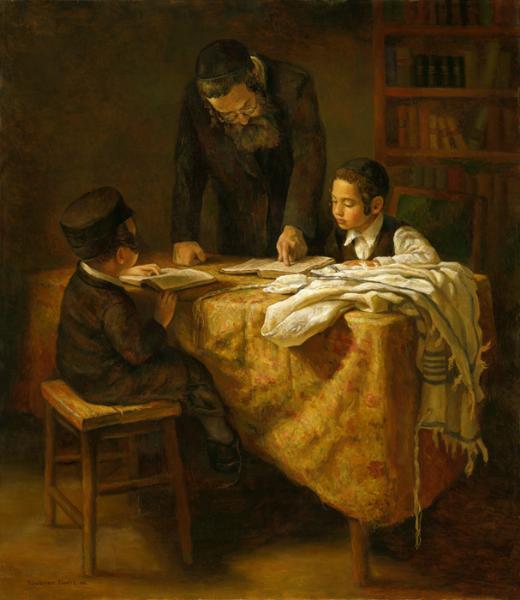
A Rabbi TeachingIf King David, who learned nothing from Achitofel except for two things alone, nevertheless referred to him as his “master,” “guide,” and “intimate,” it certainly goes without saying that one who learns from his fellow a single chapter, a law, a verse, a saying, or even a single letter of Torah, is obligated to revere him.

-Ethics Of The Fathers, 6:3

Our sages tell us, “There are three partners to the creation of man: G-d, his father, and his mother.” The capacity to procreate is, in essence, a distinctly Divine nature…The same is true regarding the “regenerative power” contained in a teaching: when G-d is a partner to their endeavor, the teacher-student relationship yields an infinite progeny.

Commentary on Ethics of Our Fathers: Chapter 6
Tammuz 11, 5771 * July 13, 2011
“Fertile Wisdom”
Chabad.org

I’ve mentioned before that the student-teacher relationship can yield enormous benefits, assuming an honest, knowledgeable, and inspired teacher and a student willing to be open. However, as we see from the quotes above, the teacher isn’t necessarily the most important partner in the transaction, which is good, since human beings are fallible. God is always present when Torah is taught and learned, which makes the act of study not only educational but holy. The Creator is the indispensable element in the room whenever people come together to learn the Word of God.

Rabbi Chalafta the son of Dosa of the village of Chanania would say: Ten who sit together and occupy themselves with Torah, the Divine Presence rests amongst them, as is stated: “The Almighty stands in the community of G-d.” And from where do we know that such is also the case with five? From the verse, “He established his band on earth.” And three? From the verse, “He renders judgment in the midst of judges.” And two? From the verse, “Then the G-d-fearing conversed with one another, and G-d listened and heard.” And from where do we know that such is the case even with a single individual? From the verse, “Every place where I have My name mentioned, I shall come to you and bless you.” –Ethics of The Fathers 3:6

“For where two or three have gathered together in My name, I am there in their midst.” –Matthew 18:20 (NASB)

But from who can we learn? It’s desirable to find a worthy teacher; one we can call our “Rebbe”, but there are problems with this. There are many unworthy teachers out there who are anxious to gather a following out of their own ambition, men and women who believe they have a special insight and who are entitled to share their particular “theological axe” which they desire to “grind”. From these “teachers” we learn there are those who are not to be trusted. Also, Christian tradition, unlike Judaism, doesn’t have a history of “Rebbes” or exalted teachers who pass their knowledge, wisdom, and compassion from one generation of disciples to the next. We are (often rightly) suspicious of gurus, cult leaders, and false teachers who ultimately lead people away from God. Christians even distrust the study of Torah and Talmud from valid and worthy Jewish Rabbis for fear this will lead the Christian away from Jesus.

And yet we are commanded to obey our leaders and teachers in the community of faith:

Have confidence in your leaders and submit to their authority, because they keep watch over you as those who must give an account. Do this so that their work will be a joy, not a burden, for that would be of no benefit to you. –Hebrews 13:17

We also see from David’s example with Achitofel that we are to honor a person who teaches us “a single chapter, a law, a verse, a saying, or even a single letter of Torah.” While we can seek to learn the teachings of an honored Rebbe such as Rabbi Menachem M. Schneerson, of blessed memory (and I’m learning much from his teachings as related by Rabbi Tzvi Freemen in the book Bringing Heaven Down to Earth), we see from the following that a good teaching can come from even a bad source:

It is possible to utilize for G-d’s service, [in a manner] according to Torah, all behavior-traits. This includes those traits that are unwholesome, and even those that are evil, as their names and descriptions indicate. For example, the tzadik Rabbi Meshulam Zushya of Anipoli, of blessed memory, learned [from his Rebbe, the Maggid of Mezritch] a number of ways of serving G-d from [the ways of] a thief:

  1. He works quietly without others knowing.
  2. He is ready to place himself in danger.
  3. The smallest detail is of great importance to him.
  4. He labors with great toil
  5. [and] Enthusiasm.
  6. He is confident and optimistic.
  7. If he did not succeed the first time, he tries again and again.

-[From HaYom Yom by the Lubavitcher Rebbe, translated by Uri Kaploun (Kehot)].
found at Chabad.org

This shouldn’t be so surprising, since the Master, our own great Rebbe in Christianity told us this:

Then Jesus said to the crowds and to his disciples: “The teachers of the law and the Pharisees sit in Moses’ seat. So you must be careful to do everything they tell you. But do not do what they do, for they do not practice what they preach. They tie up heavy, cumbersome loads and put them on other people’s shoulders, but they themselves are not willing to lift a finger to move them. –Matthew 23:1-4

Look at what Jesus is saying. He’s not telling his audience to ignore or disregard the teachings of the Pharisees. He’s saying “you must be careful to do everything they tell you”. What? Aren’t Pharisees hypocrites, liars, untrustworthy, and “under the Law”? Don’t they deny the true teachings of God and the grace of Jesus Christ? Why did Jesus tell his disciples to obey everything the Pharisees told them to do?

It’s because what the Pharisees taught was correct and consistent with the Torah, however the Pharisees of that day were corrupt and indeed, they were hypocrites who, under the Roman occupation, exalted themselves and did not “practice what they preached”, so to speak.

But what they actually taught was worthy of being learned and obeyed.

It’s also important to realize that not every single Pharisee was corrupt and no good. After all, Nicodemus was a Pharisee and he ended up becoming a disciple of Jesus. After the crucifixion of the Master, Nicodemus and Joseph of Arimathea, a wealthy member of the Sanhedrin, approached Pilate and asked permission to bury the Master’s body before the Sabbath began (we aren’t quite clear as to whether this was the eve of Passover or the weekly Sabbath). Not all Pharisees and members of the Sanhedrin were evil and corrupt, so we shouldn’t paint them all with the same broad brush.

KindergartenLook at the teaching of the Rebbe about how to learn from a thief. He doesn’t say the thief is a good and worthy teacher and that we must devote our lives to learning at the feet of a criminal. He says that, by simply observing the thief, there are habits we can learn and adapt to a life of holiness. The same is true of learning from anyone, even if they are unworthy, a hypocrite, or a thief, simply by watching them and listening to them, we can learn much, as long as we continue to use our powers of discernment and to view everything through the lens of the Bible and the Spirit of God.

Remember, in any transaction between two people, one being a teacher and the other being the student, God is there as the indispensable partner in the exchange. Being a student and disciple does not mean being a mindless sponge with no will of your own. In fact, your will, your judgment, and your questioning nature is as necessary to being a student as your attention, openness, and eagerness to learn. You cannot be taught corruption if you are paying attention and you do not have to take anything at face value without asking questions. Even the Bereans didn’t take Paul at his word and checked everything he taught against scripture (Acts 17:10-12). If you feel you have been lead astray by a teacher, look to yourself when asking the question, “how did this happen?”.

I’m sure you’ve heard or read the list compiled by Robert Fulghum, All I Really Need to Know I Learned in Kindergarten. From this, we learn that small children can teach us something. Even the Prophet Isaiah said “and a little child will lead them.” (Isaiah 11:6).

The Maggid also taught Rabbi Zushya, his disciple that we can learn three things from a child:

  • Never for a moment is he idle.
  • When he needs something, he demands it vigorously.
  • He is merry for no particular reason.

-[From The House of Rizhin by Rabbi Menachem Brayer [Mesorah].]

The Pirkei Avot; The Ethics of the Fathers teaches us that a life of learning and performing Torah yields many rewards:

The sages expounded in the language of the Mishnah (blessed is He who chose them and their learning):
Rabbi Meir would say: Whoever studies Torah for Torah’s sake alone, merits many things; not only that, but [the creation of] the entire world is worthwhile for him alone. He is called friend, beloved, lover of G-d, lover of humanity, rejoicer of G-d, rejoicer of humanity. The Torah enclothes him with humility and awe; makes him fit to be righteous, a chassid, correct and faithful; distances him from sin and brings him close to merit. From him, people enjoy counsel and wisdom, understanding and power, as is stated, “Mine are counsel and wisdom, I am understanding, mine is power.” The Torah grants him sovereignty, dominion, and jurisprudence. The Torah’s secrets are revealed to him, and he becomes as an ever-increasing wellspring and as an unceasing river. He becomes modest, patient and forgiving of insults. The Torah uplifts him and makes him greater than all creations. –The Ethics of the Fathers 6:1

Being a student, a disciple, and a person of faith is not a passive activity. Learning isn’t something you only do sitting at someone’s feet or taking notes in a classroom. It’s not always accomplished by reading a book or by visiting inspirational websites. A disciple is always moving, always asking questions, always observing, always sharing their insights with others and asking for feedback. Most importantly, in any learning situation (which is to say, in every waking moment of our lives), we are always turning to the “silent” voice in the room, the indispensable partner in the teaching of Torah. God is with us and He sent us a counselor who will teach us all things (John 14:26). Even when reading the Bible by ourselves at night, we are never alone.

Our teachers can be anyone. Our teachers can be anywhere. We just have to be paying attention to where we are and what we’re doing.

“A brilliant mind without faith is like a beautiful face without eyes.” -Shalom Cohen

Good Shabbos