We’ve explained why midrash and aggadah are so vital to our Torah diet. We’ve explained that these stories speak to us from a higher plane of reality. And we’ve also demonstrated that even if you don’t get it, you still do get it—meaning that you’ve still got truth even if you’re clueless to the meaning inside.
We’ve also provided some guidelines to determine whether a story is an anecdote or a parable. Now, let’s take a test case. Let’s look at a story of the Talmud and see what’s meant literally, what’s meant to point to something deeper, and how it could be true for everyone on their level.
-Tzvi Freeman and Yehuda Shurpin
Death by Secrets
Part 5 of “Is Midrash For Real?” Chabad.org
That’s a really nice summary of the past four articles compressed into just a couple of paragraphs. Now’s the test. Run an actual story through the matrix and see if it makes sense. This last commentary by R. Freeman and R. Shurpin is quite a bit shorter than their previous missives. I could probably copy and paste the whole thing here and then comment on it, but I don’t think I’ll do that. You have the link above to see all of the contents.
So what’s the story they want to test?
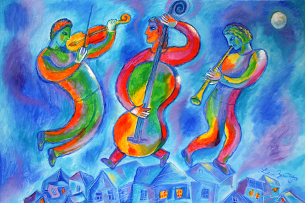
Rabbah taught, “A man is obligated to get drunk on Purim until he cannot distinguish between ‘cursed is Haman’ and ‘blessed is Mordechai.’”
Rabbah and Rabbi Zeira held their Purim feast together. They became drunk. Rabbah got up and slaughtered Rabbi Zeira. The next day, Rabbah pleaded for divine mercy, and brought Rabbi Zeira back to life. A year passed, and Rabbah said to Rabbi Zeira, “Come, let us hold the Purim feast together!” Rabbi Zeira replied, “Miracles don’t happen every day.”
I’ve heard this one before. This story circulates every Purim (and as I write this, it is still before Purim). The commentary from Chabad tells us something useful right away.
In this case, I guarantee this is not meant to be taken at face value.
In other words, even if these two esteemed Ravs got drunk on Purim, it wasn’t to the degree that Rabbah murdered and then resurrected Rabbi Zeira. But then what does it mean and more importantly, how does this story ”speak to us from a higher plane of reality?”
Here’s where the title “Death by Secrets” comes in.
What we appear to be dealing with in this case is a real-life anecdote told in figurative terms. Rabbah and Rabbi Zeira were drunk, but not from the wine; and Rabbah slaughtered Rabbi Zeira, but not with a slaughtering knife. Everything was good, very good—to the point that Rabbah was ready to go it again. Just not something that us amateurs should attempt without clinical supervision.
What? OK, I was fine with ”a real-life anecdote told in figurative terms,” but what does it mean that Rabbi Zeira was “slaughtered but not with a knife” and “everything was very good and Rabbah was ready to go again?” Go at what?
”When wine enters,” the Talmud tells us, “secrets come out.” Rabbi Isaiah Horowitz, in his classic Shnei Luchot ha-Brit, describes how great sages and holy men would consume much wine and celebrate—and the channels of their mind would open so that the deepest secrets of the Torah would flow out of their mouths.
Interrupting the narrative for a moment. Sounds like something Carlos Castaneda was trying to do; apprehend Yaqui Indian sorcery through the use of mind-altering drugs. But to continue…
He cites stories of the Talmud to this effect. Rabbi Chaim ibn Attar, in his commentary to the Torah, Ohr ha-Chaim, describes how it was these secrets that emerged through the drinking of wine that carried Nadav and Avihu, the two sons of Aaron, to death as their souls departed from their bodies in ecstatic divine love.
Now, Rabbah was able to imbibe these secrets and remain alive, as his name implies: rab means “great.” But Rabbi Zeira could not contain such intense light: ze’ir means “small.” So Rabbah’s sharing of mystical secrets created such a great thirst for divine union in Rabbi Zeira’s soul that it departed, and his body was left dead. The next day is no longer Purim—no longer a day for escaping all bounds and limitations, but a day for fulfilling your purpose down here on earth inside a physical body—so Rabbah dutifully resurrects his colleague.
The next year, Rabbah had no regrets, and was ready to perform the same clinical procedure on Rabbi Zeira once again—take him for a ride up to heaven and back again the next morning. Or perhaps he figured Rabbi Zeira had enough time to also attain a higher level, and would be able to hang in there.
So we aren’t to believe that Rabbah literally murdered Rabbi Zeira but we are expected to believe that under the influence of alcohol, Rabbah’s “secrets” were spilled out, and he took Rabbi Zeira on an unexpected ride to heaven and then back to earth the next day.
Uh-huh.
Rabbi Zeira decided he didn’t want a second trip to heaven the following year, not because it would drive him to the point of insanity and even kill him, but because of his great humility.
Uh-huh.
But then Freeman and Shurpin give a more down-to-earth answer:
Whatever the case, the lesson remains the same: Don’t get carried away with your wine, no matter its substance. Keep your feet on the ground. If you know you’re the type to be easily carried away when drinking, avoid it altogether.
So it all depends on what kind of person you become when you get drunk. That’s the moral of the story and it seems to be the most useful lesson being taught, especially when imbibing at a celebration where others are present.
To be honest, I’m a little disappointed. That’s quite a build up to a conclusion that seems so pedestrian. I mentioned in last week’s review that based on Yann Martel’s novel Life of Pi, it’s not the more believable story that’s “real” but the most interesting tale.
Here we have three selections:
The literal meaning: Rabbah and Rabbi Zeira got drunk on Purim to the degree that Rabbah murdered Rabbi Zeira and, when he sobered up the next day, begged for divine mercy and resurrected Rabbi Zeira. The next year, Rabbi Zeira turned down Rabbah’s invitation to celebrate again because he couldn’t count on a second miracle should he die again.
The higher or mystic meaning: Rabbah and Rabbi Zeira got drunk on Purim, and Rabbah’s mystic secrets poured forth to the degree that he escorted Rabbi Zeira on an “unscheduled” trip to the heavenly realms (which rendered such ecstatic joy it killed him) and returned him to earth the next day (bringing him back to life). The following year, Rabbi Zeira turned down Rabbah’s invitation to a second trip because of his great humility.
The underlying truth: Rabbah and Rabbi Zeira probably did get drunk together on one Purim but because of his host’s behavior or perhaps his own (some people are less pleasant or controlled when drunk), Rabbi Zeira declined a subsequent invitation, being concerned about a repeat of previous events.
The moral of all three stories is, if you know you get too excited or carried away while drunk, avoid social situations that require alcohol consumption.
As far as which story you want to apply to the moral, I guess it depends on which one you find the most interesting or, if “interesting” isn’t what you want from your morality tales, which one seems the most plausible.
What Did I Learn?
I learned what I already knew, to take mystic and midrashic tales with a grain of salt. Don’t get me wrong. I love a good metaphor and a fantastic saga. I believe they can contain great truths about the reality of our lives. I just don’t think that contained within these stories are a higher mystic reality and must be objectively real. I don’t believe Rabbi killed Rabbi Zeirg with a knife because they were exceedingly drunk and then resurrected him the next day. Nor do I believe that under the influence of wine, the two of them took a trip to heaven in massive, mind-blowing joy and then returns the next day, anymore than I believe that any of Carlos Castenada’s adventures under the influence of hallucinogens were anymore than what a person experiences in a chemically induced, mind-altering state.
I’m sorry, I just don’t. I believe that, however these tales came about, they result in lessons of ethical and moral behavior that are designed to illuminate the communities in which the revered Talmudic sages resided. I wish I could say they were more than that. I really do like reading them and I do learn from each one. I guess I make a pretty lousy Jewish mystic. However, if you’re interested in reading more examples of Chasidic Tales, go to the Chabad webpage Stories from the Midrash.
Heaven forbid we should tell a child an untruth! It is a Jewish custom, and a Jewish custom is also Torah—the Torah of truth. Everything the child is told is true: Those who throw the candies are doing it on behalf of the archangel Michael, the angel who seeks out the merits of the Jewish people. The sweetness of the candies is the sweetness of Torah as it descends and clothes itself in a physical object.
An adult won’t accept this, because he sees that he, and not an angel, is the one throwing the candies. When a child is older, we can explain to him that this is only a garb for something much higher. But when he is a three-year-old child just beginning his education, we tell him these things clothed in a story, and he has no problems with any of it. Nevertheless, when he grasps the outer clothing, the child grasps the archangel Michael, and the sweetness of Torah, and all the truth that is within that clothing!
-Rabbi Menachem M. Schneerson
from talks of Shabbat Parshat Pinchas 5734 and 8th day of Chanukah 5739
(translated, combined and abridged)
If you’ve been following this series, by now you should know that when you come across a fabulous story from the Midrash, you need to peel back the covers to discover what it’s trying to tell you. The stories are all true stories—just not necessarily the way things were able to unfold in our physically limited realm. This reality is not the ultimate expression of truth.
-Tzvi Freeman and Yehuda Shurpin
Limitless Truth for the Limited Mind
Part 4 of “Is Midrash For Real?” Chabad.org
In the first quote above, the Rebbe is describing the traditional custom of celebrating a small child’s first day attending cheder (A Jewish schoolroom) by throwing candies at him from behind and then telling him it was the archangel Michael who had thrown them.
I suppose from an outsider’s point of view, it seems as innocent as the stories we tell our children about Santa Claus and the Tooth Fairy, which of course they believe at the time, but realize are mere fictions as they grow older.
But the Rebbe declares, “Heaven forbid we should tell a child an untruth!” Anyone who has pretended with their child that there really is a Santa Claus or Tooth Fairy doesn’t think they’re lying. They think they’re upholding a family and cultural tradition, just as the Rebbe states that attributing thrown candy to the archangel Michael is a Jewish custom.
OK, so far, so good. But then he says, “It is a Jewish custom, and a Jewish custom is also Torah—the Torah of truth. Everything the child is told is true…” Most parents outside of Orthodox Judaism aren’t going to extend their customs and say they operate as truths on some other level, and yet the Rebbe calls this custom (and many other Jewish customs) “Torah…the Torah of truth.”
This is a continuation of last week’s article and review and so far, I am no more illuminated now than I was then. Although I know there is a difference between the truth and a fact, I can’t see saying that Michael threw the candies represents an actual intent operating in the angelic realm that Michael expects this sort of action to occur. Does the tradition compel a change in angelic reality or do the Sages imagine that every tradition generated by the great Rabbis must originate from on high?
It is considered inappropriate to relate the midrashim to those who are unable to tell the difference between literal facts and an underlying or supernal truth, but here we have an example of doing so with a three-year old child who absolutely takes his elders’ word about candies and the archangel Michael as both truth and fact.
Historically, that just hasn’t been the case. Many, if not most of these midrashim are collections from sermons of popular rabbis of past generations. To whom were they sermonizing? To whoever came and listened: men, women and children—most of them simple folk.
So historically, most of the Rabbis most of the time compounded this problem by speaking the midrashim in sermons to simple folk who also, like small children, may not have been able to differentiate between the literalness of an event and an underlying truth, even on the level of metaphor. Why isn’t this a problem?
Truth doesn’t grow where falseness is planted. We must say that even as they are understood on their most basic level, each of these stories is absolute truth.
But how is that so? Either fine clothes will be growing on trees when Moshiach comes, or they will not. Can we say that for the small child they will do so literally, while for the sophisticated adult they will do so only figuratively?
Good question.
The question is not on midrashic aggadah alone. The Hebrew Bible is filled with anthropomorphism—G‑d’s eyes and hands, His wrath, His disappointment and His love, G‑d as king, G‑d as father—all understood by innocent and simple people exactly as stated.
Oh no you don’t. There’s a world of difference in describing certain attributes of God by metaphor, for after all, God doesn’t really have physical qualities like a human being, and juxtaposing that with some of the fantastic tales we find in midrash. I have to cry “foul” on this example.
Nevertheless, the question remains: How could the Torah—a Torah of truth—mislead the innocent reader of simple faith?
Again, good question.
Indeed, Rabbi Abraham ben David (known as Raavad) criticized Maimonides for making this ruling. He himself agreed that G‑d has no form, physical or otherwise. What he could not bear is the condemnation, as he writes, of “many who were better than him [meaning Maimonides (!)] who believed such things due to their innocent reading of the text.”
This is something of a side topic, but as I read the two paragraphs above, I couldn’t help but think of the struggles we have in Christianity with Biblical interpretation, especially when it collides headlong with some of the alternate interpretations I find in different corners of Messianic Judaism and what has been called the new perspective on Paul.
From my point of view, many in the church have “believed” Christian interpretive traditions “due to their innocent reading of the text,” while from my (and other’s) point of view, that tradition and innocent reading of the text is based on a two-thousand year old mistake that does not reflect the true Gospel message of the Bible.
But this speaks of differences in how to interpret the Biblical text. Midrash is something else and is understood differently, even as it is addressed to the written Torah.
“Better than him,” writes Rabbi Abraham. Even though they believe something about G‑d that he himself agrees is utterly false! What is so wonderful about people who cannot fathom a formless G‑d?
To answer that question, we need to readjust our thinking about several issues: about Torah, about reality, and about human language.
OK, buckle up and get ready for the ride.
R. Menachem Azariah was concerned with a statement of the Talmud, that the Torah sometimes exaggerates.
R. Menachem Azariah writes, “Heaven forbid that the Torah should exaggerate! Everything in the Torah is truth—even the lies the characters of the Torah tell are truth. For in a Torah of truth, there is no room for inaccuracies, never mind exaggeration.
One of the supposed exaggerations in Talmud has to do with the report of the spies who were sent into Canaan to scope out the land (Deuteronomy 1:28) stating that the cities were “fortified up to the heavens” (Talmud, Chullin 90b and Tamid 29a).
Like last week’s example explaining why it is true in midrash that Moses was fifteen feet tall and yet in the written record we have in Torah, there’s no indication that Moses was seen as unusually tall, the description of impossibly high boundaries around the great cities is rationalized as a way of saying how the external ministering angels could not enter the boundaries of the land (Rabbi Menachem Azariah of Fano, Asarah Maamarot, Maamar Chikur Din, part 3, chapter 22).
In other words, Talmud does not exaggerate (Heaven forbid), it simply reveals greater truths about the observations of the spies in Canaan than are revealed in a plain reading the written Torah text (don’t forget the four “departments” or PARDES).
Ramban
I feel like I’m running around in the same circle I was while I was writing last week’s review. Nothing new to see here. Really. I’m sorry. I’m just not convinced. I’ll buy that Talmud doesn’t exaggerate, at least for the sake of exaggeration, but it can employ metaphor to describe just how daunting and impenetrable the great cities of Canaan seemed to be to the Israelite spies. That’s not an untruth, it’s a poetic description to communicate an important point to the audience. This is a perfectly legitimate literary device to use, even when describing actual events.
Unfortunately, the Rabbinic commentary completely flips things around.
To R. Menachem Azariah, that itself is the meaning of exaggeration in Torah—not an inflation of the facts, but a statement of a higher truth that cannot be expressed in our physical world. Torah, however, speaks only secondarily about our physical world—and in a world higher than our own, there is certainly some very real manifestation of this truth.
The “higher truth” of which the Torah primarily speaks is also the “higher reality,” and actual, observable, factual events are relegated to playing second fiddle in the mystic Jewish tapestry of God’s interactions with Israel, at least as understood by some of the sages.
I think I like Ramban better than Azariah.
Ramban (Nachmanides) had written that the Torah speaks about earthly matters and alludes to spiritual ones.
The great Kabbalist Rabbi Moshe Cordovero presented a unique understanding…
This is a radically original way of thinking of metaphor in Torah: all that exists in our reality is nothing more than an analogy derived from the true reality to which it points. As the Rebbe, Rabbi Menachem M. Schneerson, explained this view, G‑d gave us a hand and eyes and ears so that we could understand the true hand and eyes and ears as they are above. And the same with all that we find in our world. The whole world is one big parable, a crystallized analogue of the real thing.
So it is our physical, observable reality that is the parable, and the parables of midrash that represent true and higher reality. Rather than saying God has arms or eyes by way of analogy, describing and indescribable God in terms mere mortals can comprehend, the “arms” and “eyes” of God represent “divine verbs,” so to speak, indications of His activity, while we are given physical equivalent body parts as a way to “understand” something about God.
Freeman and Shurpin are right. This is “a radically original way of thinking of metaphor in Torah.” One that my western, Gentile mind doesn’t want to accept. I feel like Neo (Keanu Reeves) in the film The Matrix (1999) where everything I ever thought was real turned out to be a complex illusion and “reality” exists almost completely outside my experience.
Morpheus (Laurence Fishburne): Unfortunately, no one can be told what the Matrix is. You have to see it for yourself.
However in the case of midrash, everyone can be told what “the Matrix” is, the chore is understanding and accepting without seeing it for ourselves, that is, experiencing the “reality” that the midrashic Sages expect us to comprehend beyond the simple meaning of metaphor.
Can a metaphor be a truth, not just in telling of some moral or ethical principle, but can it have a life of its own, so to speak, an independent heavenly meaning that transcends the mere symbolic representation between metaphor describing an event and the event itself? How can metaphor come from “above” and why should we not understand midrash as a product of a Rabbi’s fertile imagination in attempting to communicate a complex topic in simple, easy to digest terms?
Except we have an equation that I cannot resolve. Jewish tradition is Torah and Torah is always truth.
In my past conversations with Pastor Randy at the church I attend, he has asked me repeatedly “what is Torah” and the answer has always seemed elusive. Perhaps, if anything labeled “Torah,” no matter how outrageous, must always be truth, and many, many things beyond the written text are labeled, “Torah,” then I can see the source of his confusion, and admittedly, mine.
All of this will become clearer if we examine this metaphor of the metaphor: clothing. Why do ideas need clothing?
An author wishes to communicate an idea, an ethic or a perspective on life. If he would spell it out in the raw, the point won’t come across. He needs something that will carry his audience from their perspective to his, so that they will see that which is currently imperceptible to them. He can’t pick them up and take them there, and he can’t plop his mind into their brains.
I think the Rabbis are clothing the midrash and the definition of metaphor in an unnecessarily complicated way. Something can be “truth” and “not fiction” and still not have to be fact on any plane of existence and still function as a teaching tool and a guide. I know mystics are defining a lot of these concepts and I make a lousy mystic, but in order to assign mysticism a validity, you must subscribe not only to the existence of a supernatural world, which we do as religious Christians and Jews, but that Rabbinic Sages can peel back the covering over the written word in the Bible and uncover an objective, mystical reality underneath, much as one might remove the clothing from one’s beloved to reveal her greater beauty.
It’s all very poetic and even compelling, but I recently read a commentary by an Aish Rabbi saying that Christianity is a religion of (blind) faith, while Judaism is a religion of word, documentation, and truth. I’d like to get the Aish Rabbi and Rabbis Freeman and Shurpin together and listen to them engage in a frank discussion of their viewpoints.
Actually, my metaphor of unclothing a beautiful lover to reveal even greater beauty may not be correct.
But what he can do is find clothing that fits the subject and makes it presentable, that hides whatever is distracting them and brings out the highlights he wants to point out. As good clothing brings out the natural beauty of the subject, so a good parable brings out a depth otherwise ineffable. Paradoxically, both do so through concealment—concealment for the sake of revealing a deeper beauty.
Are we removing clothing, the outer material world, to reveal a greater beauty beneath, or is the metaphor, the midrash, clothing in which we dress the material world in order to show a more majestic appearance?
Bruno Bettelheim is best known for his classic work of child psychology, “The Uses of Enchantment: The Meaning and Importance of Fairy Tales.” He criticizes the “narrow-minded rationalists” who object to telling children fantasies, pointing out the value children receive from these stories in dealing with the emotions and turmoil of life. As for the unrealism, he writes that this is “an important device, because it makes obvious that the fairy tales’ concern is not useful information about the external world, but the inner process taking place in an individual.” In short, “The child intuitively comprehends that although these stories are unreal, they are not untrue . . .”
The Rebbe, Rabbi Menachem M. Schneerson, seems to be going beyond this. When a small child is told that the archangel Michael threw candies at him, that is very real to him. He imagines the angel there in the room, and the candies become very precious candies. And yet it is not a lie.
Most cultures have some sort of tradition of fables or folk tales that serve important purposes in educating their population, both children and adults. Usually the more industrially and technologically advanced a culture, the less room there is for folk tales that have any semblance of seeming “true” (Do kids even learn about “Paul Bunyan” or “Pecos Bill” in grade school anymore?). In the western world right now, many of our folk heroes are characters from 1960s comic books who are being brought to life in films such as The Avengers (2012) and Man of Steel (2013) (with Captain America: The Winter Soldier being released to theaters in less than a month).
But no one is suggesting that Superman or Captain America have a “reality” of their own that not only operates as a metaphor for our real world but that represents the best and truest form of our world. No one really believes that we are only a shadow of that higher existence of heroes, superpowers, and fantastic worlds that we see in film and television.
Midrash, even though we encounter it outside of its original, aged and ancient places of origin, meeting it here in the modern world, nevertheless demands that we accept it on its own terms.
I think the central message I’m getting here is that the very manner in which Freeman and Shurpin (and Orthodox Judaism) describe Midrash and metaphor is by way of metaphor. They rewrite how we understand the words “midrash, “Torah,” “reality,” and “language” in order to support a mystic vision of metaphor that lies in neither this world nor the next, but somewhere in-between.
In his introduction to the 1963 episodes of the Twilight Zone television series, Rod Serling said in part, “You’re moving into a land of both shadow and substance, of things and ideas…” (the text of Serling’s now-classic introduction to this series changed a bit over time). This seems to be not only where we cross over into the Twilight Zone but where we meet the realm of midrash as well.
I don’t mean to sound unkind or disrespectful in my descriptions. I’m only illustrating how I understand what is being presented in this article as I encounter it. I really do feel I’m being asked to enter into a space that sits on a fence between my world and someplace else, evaluating a “fairy tale” as fanciful metaphor and ethical principle wrapped up in the gossamer fabric of Jewish lived experience.
Some are stuck with a very pedestrian view of the Talmud and Midrash as nothing more than a repository of teachings from various teachers—teachers they imagine to be much like themselves, prone to exaggeration for the sake of making a point. Such a view is sorely insufficient at explaining Jewish practice and belief.
Unfortunately, that describes me to a “T”. I’m willing to admit that I may be at fault here and that it is my human, Goyishe limitations that prevent me from seeing midrash as it’s being presented to me, but as inadequate as the Rabbis would believe me to be, I find it difficult to cast off my tethers to the world around me and enter their’s without so much as a safety net or even a soft pillow to cushion my eventual fall.
Next week’s article is called “Death by Secrets” and the title alone is worth the price of admission. It’s the last article in the series. Will Freeman and Shurpin be able to pull off an eleventh hour save and convince me that midrash actually does exist beyond just imagination?
Or should I, like last week, believe that midrash is the Chabad’s answer to Yann Martel’s novel Life of Pi and accept that the better story is also the more “real” story?
We’re used to considering the precise measurements of our world as the final arbiter of all truth. It might help to jump to an event in Mezhibuzh, Ukraine, a century or two after Maharal:
…One of the homeowners of Mezhibuzh was involved in a nasty dispute with another resident of the town. It happened that while in the Baal Shem Tov’s presence, in his shul, he yelled that he was going to rip the other guy apart like a fish.
The Baal Shem Tov told his pupils to hold one another’s hand, and to stand near him with their eyes tightly closed.
He then placed his holy hands on the shoulders of the two disciples next to him. Suddenly the disciples began shouting in great terror: They had seen how that fellow had actually ripped his disputant apart like a fish…
Now, what if I ask you, “Did a resident of Mezhibuzh tear apart his disputant like a fish?”
You might answer, “Well, not really.” Problem is, I have witnesses. Very reliable ones. And they all saw exactly the same thing.
But can the perpetrator be charged in court for bodily harm? Problem is, his disputant is still walking around without a scratch.
So, which world is real?
-Tzvi Freeman and Yehuda Shurpin
“Midrash and Reality:
Part 3 of ‘Is Midrash For Real?'” Chabad.org
This one made my head hurt. In this article, the authors and their sources tell me that I’m not supposed to take midrash, even those telling fantastic and impossible tales, as if they are mere metaphors. They are also true and while fiction can contain truths, they are also real in a mystical sense.
Rabbi Yehuda Loewe of Prague (known as the “Maharal of Prague”) was adamant: Torah is not fiction. Jews consider the words of their sages that have been recorded in the Talmud and Midrash to be Torah, no less divine than the Five Books of Moses. Once they were accepted by the general community of observant Jews as works to be studied and revered as Torah, they attain a status of G‑d’s own thoughts, arguments He has with Himself and stories He tells Himself. And if the Creator of the universe is telling it, it’s real.
And further:
On the one hand, you have to know that every story told and recorded by the rabbis of the Talmud is true. They are Torah, just as much as a verse from scripture or a halachah kept by all Jews is Torah.
This is the part that makes my head hurt. Titus destroys the Temple and God assigns a gnat to eat his brain so that seven years later, upon the death of Titus, it is discovered that the gnat with metal claws reduced the size of the man’s brain to that of a year-old pigeon’s brain.
Moses is ten cubits tall (about fifteen feet) but no where in the Torah, which I mean as the five books of Moses, is this noted nor does anyone, Pharaoh, Moshe’s wife, his father-in-law, his brother, seem to notice.
And yet these things are not only “Torah” but they are real?
Now, reading the chronicles of Roman historians, you won’t find anything about this gnat. Titus, they tell you, died of a fever. At any rate, metal claws on a big bug is a tad outrageous.
So, one scholarly Italian Jew named Azariah dei Rossi explained, “This is just aggadah.” It didn’t really happen. It’s just that the sages wanted to impress on people that G‑d can always find a way to punish the wicked, so they told this story.
So this really is a metaphorical tale to illustrate a moral point. It contains a truth but it is not objectively real.
So, Maharal tells us that the real Moses truly was fifteen feet tall. Not the one that Pharaoh saw, or that the fleeing shepherds saw. They saw only the physical shell of Moses, as he is invested in a body within our physical world—a world that for several reasons can’t manage a ten-cubit human form. But Moses is a complete person, and ten is the number of completeness. He should have been ten cubits tall—would the physical world be capable of such a thing. Certainly, writes Maharal, whatever could be reflected in the physical world was reflected, and Moses was likely taller than the average human being. But not as tall as he really was.
Am I supposed to believe that in some supernal realm, the person of Moses is really fifteen feet tall, but that he only appeared to be of a normal human height in our world because that was not the “real” Moses, and our physical world could not contain all the Moses was and is?
That’s a lot to swallow. As I keep saying, I can accept the metaphorical nature of the midrashic stories, but I have a tough time making the conceptual leap into the world the Rabbi’s suggest I accept. Maybe, harkening back to last week’s review, I am a “bigger fool.” It’s not that I don’t “get” what Freeman and Shurpin are saying, I just don’t believe in the literal reality of these “deeper meanings” as having a truth and a life of their own in an objective sense.
Maharal takes the same approach to the gnat in Titus’ brain. The sages are not concerned with telling us a story for the medical annals. Their concern is to present to us the real Titus and his true destiny. Did a physical gnat enter his brain? Perhaps not, writes the Maharal. But the story is still true, because the gnat got in there anyways. Every living creature has its essential quality that makes it uniquely what it is—and the essential quality of the gnat made its way in. This essential quality, if it could be seen, would appear in its most intense state with a mouth of bronze and iron claws.
Unless evidence to the contrary appears, I’m not inclined to believe on any level, essential or otherwise, that a gnat with bronze or iron claws was involved in the death of Titus. I can believe that God metes out justice upon the wicked, though not always in this life.
But the view of midrash I’m asked to accept isn’t one in which the Rabbis parse out words of wisdom in mythical or fanciful form to illustrate a “truth” alluded to by the plain text of a story, either in the Bible our outside of it.
Maharal sums up his approach in one simple line: “The sages do not speak of the physical at all; they speak of a world stripped of physicality.” Every midrashic teaching is a peek behind the veil, dressing deep truths in language that is meant to reveal an inner world. If that language seems foolish to us, it is only because we have not yet cracked the code. We are grabbing the clothes, the words, as though they themselves were their own meaning.
This is an attractive way to think about the universe, with hidden corners, metaphysical alleyways, mystical portals through which the sages are able to peer and then relate what they’ve seen to the rest of us. I wish I could believe it. I know in some manner the sages were granted the ability to issue rulings equal to what we have in the inspired Bible. I know that in Judaism, canon is never quite closed and there is always another revelation concealed in the Bible’s “code.”
But I’m not going for it. I’m not jumping headlong into believing that the sages, wise and learned though they may be, actually see into a non-physical reality beyond our mortal plane and what they relate in their teachings and writings represents a divine truth equal to the Word of God.
It is true that Ezekiel, the apostle John, and even Paul, the letter writer, each had their own mystic experiences, either physically or through visions, where they literally saw and heard things that do not exist in our own universe, but to attribute this same ability, or some shadowy version of it, to each and every sage to has told a midrashic tale ultimately recorded in Talmud is too far for me to go.
Now a systematic approach to midrash had been laid out clearly by Maimonides and Maharal. But that raises a new question, perhaps a more difficult one: If the point of midrash is not the story itself, but that which it contains, not the foreground but the background, and if anyone who understands these stories literally is a fool—then how is it that we tell these stories to children and simple folk, who certainly take them at face value? Are we to hide all of these tales from them? Have we been doing things wrong all these centuries?
I still believe it’s important for Christians to have at least a slightly passing knowledge of midrash considering that this interpretative method may well have been in use during the Apostolic era. This understanding may help us pierce the veil traditional Christian exegesis has cast over the Bible for the past nearly two-thousand years, blinding ourselves to the way the New Testament scriptures were written and intended to be read.
But that’s still a far cry from the “reality” of Midrash as opposed to the metaphorical truths midrashic tales can contain. I guess I wouldn’t make a very good mystic or even a very good Jewish person.
I did take way something quite positive from this week’s article however:
Adult Pi Patel (Irrfan Khan): So which story do you prefer? Writer (Rafe Spall): The one with the tiger. That’s the better story. Adult Pi Patel: Thank you. And so it goes with God. Writer: [smiles] It’s an amazing story.
I’ve never seen the film but I have read the book (which I highly recommend, by the way), and this bit of dialog is the key to understanding the author’s message. The book and the film speak of a fantastic tale of survival at sea of both a boy named Pi and an adult Bengal tiger named Richard Parker who share a small lifeboat together.
Toward the end of the story, after many adventures, Pi and Richard Parker, the only survivors of a shipwreck seven months before, land on the shores of Mexico. The tiger disappears into the jungle forever, and Pi is rescued and eventually tells his story. Although the story of Pi and the tiger commands most of the book, he does tell a much more believable if horrible story of murder, starvation, cannibalism, and near-insanity that could also account for Pi’s survival.
But Pi asks the writer who is chronicling his early life, “So which story do you prefer?” It’s as if the sages are asking the same question about midrash. We accept “truth” if not “fact” from the more interesting story. That’s what midrash means, at least to me.
Or maybe midrash is God telling “the better story.” And so it goes.
Torah, like any wisdom, has departments. That’s important to know. You can’t study literature the same way you study biology, and you can’t critique poetry as you would journalism. So too, you can’t study one department of Torah the same as you study another.
There’s more than one way of dividing up those departments. One way is to talk about approaches to the text.
Rabbi Yitzchak Luria, the Ari, constructs an acronym from these four departments, disciplines, or levels of peshat, remez, derush and sod: pardes, meaning “an orchard.” He taught that every soul must delve into all four layers of the Torah, and must continue to return to this world until having done so.
-Tzvi Freeman and Yehuda Shurpin
Is Midrash for Real?
Part 1 in a series on the truth behind Talmudic tales Chabad.org
I have been promising to write a review on this series for a few weeks now, but as I read part one, I already feel like I’ve bitten off more than I can chew. I’m not Jewish and certainly not an Orthodox Jew, nor am I a mystic, which is what seems to be required to understand what Freeman and Shurpin are saying.
True, I’ve been critical of Christian devotion to Sola Scriptura more than once, but investigating Midrash on the road to Kabbalah could be a bit much for me.
I’m not throwing in the towel. I just want you to know how different this is.
First things first. How does this article define Midrash?
Finding deeper meaning and lessons in life is yet another department, which we call derush or midrash—and our basic commentators will again be found in these halls as well. Midrash often includes stories, called aggadah, some allegorical, some anecdotal, some reaching far beyond what we understand to be possible in our world. Midrash can be found strewn throughout the Talmud, and in many anthologies compiled contemporaneously with the Talmud or later. The largest, best-known collection is called Midrash Rabbah.
Many of the juiciest midrashim are collected in the classic commentary of Rashi. This despite Rashi’s repeated insistence that “I come only to explain the simple meaning of the text.” Because the text bubbles with meaning, frequently defying the steamroller of the strict literalist, demanding deeper interpretation at every turn.
What I’m taking from this is that Midrash isn’t necessarily intended to be literal fact. Certainly Christianity has its own rich tradition of religious allegory, so how can we criticize Judaism for employing the same tools. Midrash is in the “Derush” department, that which reveals the deeper meanings of the Torah.
But are these “deeper meanings” actually encoded in the Torah or are they what various authorities including the esteemed Rashi have taken out of Torah and formed into morality tales, fables, or colorful metaphors to communicate principles that can be derived from scripture? How many Christian Pastors take a verse or two of scripture and develop a homily to be delivered from the pulpit on Sunday? I can accept Midrash at that level of understanding and meaning, even though in Orthodox Jewish thought, it may be intended to represent so much more.
But according to the article and the sages it cites, a steady diet of all four “departments” of Torah understanding is necessary for the “spiritual health” of every Jewish person.
The Ari’s message is not as esoteric as it may seem: Just as our bodies do not live by carbs alone, so our souls require a mixed diet. To be a complete Jew embracing a complete, wholesome Torah, you can’t satisfy your requirements studying in one department alone. You need a well-rounded curriculum at all four levels.
But the focus on this series as well as my review is of only one of the four “departments” or “food groups” in this diet.
And the midrashic tales and the secrets of the Torah are just as vital. Why? Because as much as Torah is about what you know and what you do, it’s also about how you think and what you feel. As magnificent a structure as you may have built for yourself, without light and warmth nobody is going to live there too long. That’s the way life goes: without the sparks firing, the engine just stops turning.
Midrash is your gateway to connect with the Author of the Torah. “If you want to know the One who formed the universe,” the Talmudic sages advise, “learn aggadah.” Aggadah, the midrashic tales scattered throughout Torah literature, are said to contain “most of the secrets of the Torah.”
That’s probably a lot farther than most Christians would be willing to go, and understandably so. Outside of Orthodox Judaism and especially the mystic context of the Chabad, it’s also much farther than many Jewish people would want to go. Let’s not kid ourselves. What I’m investigating is a relatively narrow perspective within the panoramic landscape of overarching Judaism. Nevertheless, for those of us who “intersect” with religious Judaism at some level, encountering Midrash is inevitable. So why fight it? Let’s have a look.
But the secrets are veiled, as Maimonides writes (we’ll get to that soon), so that only those who are fit to receive them will discover them there. The Zohar provides a parable to explain why the Torah must speak in parables…
I’m pausing here to remind everyone that Jesus spoke in parables. Christians tend to take the parables of Jesus for granted, largely because those parables have all been explained in the text of the Gospels, and even if we don’t always understand the explanations, we usually receive some satisfactory interpretation from our Pastors or some Christian book writer.
FFOZ Teachers and Toby Janicki and Aaron Eby are the hosts for these episodes and present each one as a “mystery” that requires three “clues” to solve. In these clues and their solutions, they use the Bible and Jewish literature to teach their audience that “Parables were a common teaching device used to simplify complex concepts.” The question then is whether or not Midrashim also take complex concepts and simplify them for their audience. Most Christians encountering a Midrash would probably say “no.” Sometimes a midrashic tale can make what we think of as the plain meaning of the text seem all too mysterious.
Apparently, the stories and mysterious words are more than packaging. After all, as the parable of the Zohar tells, from within the cloak of these parables the inner soul of the Torah speaks. Perhaps we should think of these stories as haute couture for G‑d’s wisdom. They are the fine clothing and jewelry that allow expression for Torah’s most inner wisdom, as a tasteful wardrobe betrays beauty that would otherwise elude the senses.
I invite you to read Part 1 in a series on the truth behind Talmudic tales (I also put the link at the top) for the full article, including the various parables it contains, to gain the full context of what I’m discussing. The sense I get from this text, and I’ve read similar material before, is that the Torah almost has a life of its own and is deeply encoded with meaning that extends well beyond what we can perceive, even if we could read the oldest available Torah documents in their original ancient Hebrew.
So fitting, so magnificent is this wardrobe that it carries the secrets of Torah even to the small child. In a way, it transmits to the simple child much more than to the sophisticated adult. To the adult, the clothing is distinct from the meaning it contains; the analogy and its analogue live in two different worlds. The child, when he grasps the clothing, grasps the warm body and soul breathing within. They are all one and the same. In his simple understanding of the tale, he touches G‑d.
To better understand how that is so, we’ll have to examine midrash a little deeper. We need to ask, are the stories of the Midrash truth or fiction? If they are truth, how is it that they so often conflict with one another? And how do we know when the Talmud is telling us a historical anecdote and when it is speaking in parables?
Just a reminder. There’s a difference between facts and truth. Or as Indiana Jones once said, “Archaeology is the search for fact… not truth. If it’s truth you’re looking for, Dr. Tyree’s philosophy class is right down the hall.”
Midrash, like any metaphor or morality tale, can contain truth and still be fiction. We’ll see what more Freeman and Shurpin have to say in next week’s review.
Our fourth teaching on the book of Hebrews considers the first two verses of the epistle:
“God, who at sundry times and in divers manners spake in time past unto the fathers by the prophets, hath in these last days spoken unto us by his Son.” (Hebrews 1:1-2)
How does Yeshua and the message of Messiah stack up against the patriarchs and the prophets?
The thesis statement behind the book of Hebrews with reference to Yalkut Shimoni and Midrash Tanchuma on Isaiah 52:13.
After my significant goof up in my review of last week’s session, I’m a little hesitant to write another review, but hopefully, I’ll be more mindful of my notes if not my memory.
Today’s the day. It’s the day Lancaster actually starts delving into the book of Hebrews, well the first couple of verses in the first chapter, anyway. However, there’s a lot to cover in this thirty-five minute sermon. Let’s get going.
The first thing a traditional Christian Bible student should know is that Lancaster thinks the Book of Hebrews reads like Midrash Rabbah, other Talmudic portions, and even the Zohar. That’s because the sermon/letter seems so Jewish. That isn’t going to make a lot of Christians happy because they (we) have been taught some pretty negative things about Talmud and especially about Zohar (most Christians have probably heard of the Talmud but how many teachers and Pastors even breathe the word “Zohar”?).
Lancaster says he feels pretty comfortable with Talmudic literature, at least in English, but he rather feels sorry for the innocent and unsuspecting Christian Bible student who stumbles into Hebrews without that background. The implication is that without familiarity with Rabbinic commentary, most Christians are going to come away from Hebrews with an inaccurate interpretation of what the anonymous author was trying to say.
Lancaster says the experience of an uninitiated Christian facing Talmudic writings encounters the intellectual and perhaps spiritual equivalent of stepping on a rake. I assume he means the “business end” of the rake and not the handle.
God, after He spoke long ago to the fathers in the prophets in many portions and in many ways, in these last days has spoken to us in His Son, whom He appointed heir of all things, through whom also He made the world.
–Hebrews 1:1-2 (NASB)
What does this mean?
It’s actually pretty straightforward. In ancient days, God spoke to “the fathers in the prophets”. Who are they? Prophets include Abraham, Isaac, Jacob, and especially Moses. They also include anyone of the Judges as well as prophets like Samuel, Isaiah, Ezekiel, Jeremiah, and any of the so-called “minor prophets” who, in Hebrew Bibles, are called the “later prophets.” No prophet of God is “minor.”
We also see prophetic words from God in the writings such as the Psalms and Proverbs, so God spoke to all of the writers of all of the books of what Christians refer to as the “Old Testament” and what Jews call the Tanakh (Torah or Law, Nevu’im or Prophets, and Ketuvim or Writings).
We call all of this put together the “Old Testament,” but for Jews in the Apostolic Era, it was just The Testament or The Scriptures.
Verse one testifies that God inspired all of the writers of all of those writings speaking through them and to them. These were the men of God of the past and God spoke to ALL of them. Thus, what they wrote is ALL the Word of God. God spoke in many diverse ways to the prophets:
He said, “Hear now My words: If there is a prophet among you, I, the Lord, shall make Myself known to him in a vision. I shall speak with him in a dream.
“Not so, with My servant Moses, He is faithful in all My household; With him I speak mouth to mouth…”
–Numbers 12:6-8 (NASB)
God spoke through the other prophets in many and different ways but only with Moses did God speak “face-to-face” (lit. mouth-to-mouth). The message of the prophets was to all of Israel and ultimately, to all the world.
However in the last days, God spoke through His Son.
What last days? While the apostles and early disciples may have thought they were living in the last days, they must have been wrong, because almost two-thousand years have passed and the “days” haven’t ended yet.
But were they wrong? They were living in the last days of the Apostolic Era. They were living in the last days of the Holy Temple. They were living in the last days of Jerusalem, the last days before the Jewish people would be exiled from their Land to wander the diaspora for nearly twenty desperate centuries.
Lancaster characterized the imminent coming of the Kingdom as a clock that is stuck at one minute to midnight, sort of how the Doomsday Clock is used to show the imminence of Nuclear War.
The men and women of the Apostolic Era were living in the “end times” no more or less than we. The stage has been set, the actors have taken their places, now all that is left is for the curtain to go up, the house lights to go down, and for the play to begin. However, the audience and the actors haven’t been told exactly when the curtain will rise and to a large degree it is they who will determine the moment, not the director.
Truly I say to you, this generation will not pass away until all things take place.
–Luke 21:32 (NASB)
But this interpretation makes me consider that “this generation” isn’t meant to be taken literally.
…in these last days has spoken to us in His Son.
–Hebrews 1:2 (NASB)
This speaks more than I could have possibly known before hearing this sermon.
Lancaster invoked my English 101 class which I took the first time I attended university. In an English Composition class, you’re taught to begin a paper with a thesis statement, a declaration of the topic and purpose of the paper, then you spend the rest of the time writing documentation supporting your thesis.
That’s how Hebrews begins.
Lancaster took a moment to explain that the New Testament is NOT just commentary on the Torah, which may come as a surprise to some Messianic Jewish and Hebrew Roots people who have been taught to focus on the Torah and almost nothing else.
The thesis of the writer of Hebrews is that in ancient days, God spoke through and to the Prophets of old and what they spoke and wrote was and is the Word of God. But in the End Times, God spoke through his Son, Moshiach, and what Moshiach spoke is recorded in the Gospels.
We take all this for granted as Christians in the twenty-first century. After all, we have our Bibles, they include the Old Testament and the New Testament, and the New Testament includes the Gospels, so of course what Jesus said was and is the Word of God, but that was a revolutionary concept in the early 60s CE. The Jewish believers as well as all other Jewish people understood that the Hebrew Scriptures were the Word of God, but could Jesus of Nazareth also speak God’s Word (not to mention his apostles, but we won’t address that today)?
Was/is Jesus greater than the Prophets? The answer is of course, “yes,” but what did the original readers of Hebrews believe? Was Jesus greater and better than angels (see Hebrews 1:4)?
The writer of Hebrews had to establish this as his thesis and then spend the rest of the sermon/letter defending and supporting that thesis.
Behold, My servant will prosper, He will be high and lifted up and greatly exalted.
–Isaiah 52:13 (NASB)
This is the beginning of the Song of the Exalted Servant. Traditional, normative Judaism considers the Exalted or Suffering Servant to be the people and nation of Israel, while Christians believe it is Messiah, it’s Jesus.
Lancaster began to establish that the Servant must be Messiah based on a variety of Jewish sources, such as Targum Jonathan and too many others for me to write down and thus record here. He mentioned again that the Zohar is one of those sources, but it should be noted that most if not all of the supportive Jewish writings were authored well after the Apostolic Era.
Lancaster wants to show his audience that his interpretation is correct but that it must be understood and supported by Jewish sources. The question, and it’s an important one, is if the audience of the sermon/letter to the Hebrews would have understood this document through the Jewish documentation and commentary they had access to in or around the year 62 CE.
The most reliable estimates regarding the Zohar say it was written in about the 12th century and the Talmud wasn’t authored for centuries after the apostles died. We can accept some of Lancaster’s argument if we believe the information later recorded in Rabbinic writings already existed, probably in oral form, during Apostolic days. But for many Christians, that’s quite a leap.
What Lancaster is trying to establish is that the writer of Hebrews was declaring, and again, this would be controversial and even revolutionary in the mid-first century, that Yeshua of Nazareth was not only equal to the Prophets and Judges and even Angels, but that he was superior to them all as Messiah and as the Son of God. The audience of Hebrews was to understand that the words of Jesus were indeed also the Word of God, which Christians accept today without question but the original readers of Hebrews still needed to comprehend.
And He is the radiance of His glory and the exact representation of His nature, and upholds all things by the word of His power. When He had made purification of sins, He sat down at the right hand of the Majesty on high…
–Hebrews 1:3 (NASB)
For He has been counted worthy of more glory than Moses, by just so much as the builder of the house has more honor than the house.
–Hebrews 3:3 (NASB)
Jesus is worthy. He sits at the right hand of the Father. He is the radiance of God’s glory, an exact representation of God’s nature. Messiah upholds all things by his word, which is the Word of God because Messiah is greater, more glorious, more worthy than any of the prophets, including Moses and even more so than the Angels.
Now here’s the important part for today.
For this reason we must pay much closer attention to what we have heard, so that we do not drift away from it.
–Hebrews 2:1 (NASB)
Read the entire first chapter of Hebrews and then read the first verse of the second chapter. What were the readers of this sermon/letter (and what are we) supposed to pay much closer attention to?” The Word of God as spoken by Messiah. Why? So they wouldn’t drift away.
Remember, that according to previous sermons, the writer of the Book of Hebrews was deeply concerned that his audience, because they were denied access to the Temple in Jerusalem, were tempted to “drift away” from their faith in Messiah, all for love of and devotion to Temple worship.
Christians believe that Hebrews was a warning to Jews not to abandon Jesus and “backslide” into Jewish practices including the Temple sacrifices, but according to Lancaster, it was a warning to not forget priorities.
Lancaster used a number of metaphors to get his point across but I’ll choose just one. How many couples do you know have gotten a divorce? Maybe you are divorced. Maybe you have friends who are, or maybe your parents are.
Sometimes, when describing the process that lead up to divorcing, men and women will say that they drifted away from each other over time. This rather contradicts a sudden trauma such as being abruptly denied access to Temple worship and suggests a gradual cooling of faith.
Faith and devotion to the Master are there, but for a variety of reasons, they can begin to become less important over weeks, months, and even years. Christians are taught in Church that only one thing matters: Jesus. It’s pretty easy to lock onto Jesus and not let go because he is all anyone ever talks about.
But the Messianic Jewish and Hebrew Roots movement are sometimes so devoted to Torah, to Talmud, to Shabbat, to a thousand other things, that Jesus gets lost in the shuffle. I think that’s why some Gentile Messianic believers convert to normative Judaism, usually Orthodox, because the things of Judaism become more attractive and they slowly drift away from Yeshua.
Hebrew Roots people accuse Messianic Jewish adherents of promoting this kind of apostasy all the time, but here we have D. Thomas Lancaster, no small voice in the realm of Messianic Jewish teachings and writings, offering the same cautionary tale based on the warning of whoever wrote the Book of Hebrews.
What Did I Learn?
I’ve been bending my brain around what Lancaster has been teaching and filtering it through some of the comments of people who have been reading my reviews.
Could the Book of Hebrews been written after the Temple’s destruction and the writer was trying to encourage his Jewish readers that the quintessential Temple continued to exist in Heaven with Messiah as its Kohen Gadol?
Regardless of differences in interpretation, the main point of Lancaster’s sermon was what hit home the most, especially in the face of recent failures and my continued struggle with the rigidity of certain Christians and their commentaries.
For this reason we must pay much closer attention to what we have heard, so that we do not drift away from it. For if the word spoken through angels proved unalterable, and every transgression and disobedience received a just penalty, how will we escape if we neglect so great a salvation?
–Hebrews 2:1-3 (NASB)
We must…I must pay attention to what I have heard so that I do not drift way from it, for if the Word spoken by angels at Sinai to Moses, the Torah, proved unalterable, how can I escape if I neglect so great a salvation as the Word uttered by the Master?
The Torah, or Jewish Written Law, consists of the five books of the Hebrew Bible – known more commonly to non-Jews as the “Old Testament” – that were given by G-d to Moses on Mount Sinai and include within them all of the biblical laws of Judaism. The Torah is also known as the Chumash, Pentateuch or Five Books of Moses. The word “Torah” has multiple meanings including: A scroll made from kosher animal parchment, with the entire text of the Five Books of Moses written on it; the text of the Five Books of Moses, written in any format; and, the term “Torah” can mean the entire corpus of Jewish law. This includes the Written and the Oral Law.
Tonight, I’m having my usual Wednesday evening meeting with Pastor Randy. Our agenda includes discussing Chapter Eight of D. Thomas Lancaster’s book The Holy Epistle to the Galatians, “The Antioch Incident: Galatians 2:11-14”.
Here’s the relevant scripture:
But when Cephas came to Antioch, I opposed him to his face, because he stood condemned. For prior to the coming of certain men from James, he used to eat with the Gentiles; but when they came, he began to withdraw and hold himself aloof, fearing the party of the circumcision. The rest of the Jews joined him in hypocrisy, with the result that even Barnabas was carried away by their hypocrisy. But when I saw that they were not straightforward about the truth of the gospel, I said to Cephas in the presence of all, “If you, being a Jew, live like the Gentiles and not like the Jews, how is it that you compel the Gentiles to live like Jews?
–Galatians 2:11-14 (NASB)
That’s going to be interesting since, on the surface, it seems as if Paul is accusing Peter of being two-faced in his observance of Torah, living “like the Gentiles” when among Gentiles (which is commonly interpreted as Peter scarfing down plates of ham and shellfish with the goyim), but pulling back from his Gentile friends when “certain men from James” (probably Jewish believers sent to Antioch by James, the leader of the Jerusalem Council and who likely didn’t approve of Gentile inclusion into “the Way”) came around to see what was going on.
However, there is an underlying issue involved in our discussion of Galatians. What is the purpose of Torah in New Testament Judaism? I’ve spent some time this past week looking into that question in three separate blog posts (so far, not including this one) and they have elicited some interesting responses. It’s those responses, more than anything I’ve written, that are helping me begin to pull together some sort of answer.
Today, I want to gather some loosely associated points or statements that point in the direction of an answer. I don’t want to say that they are the answer, but perhaps they form the container in which the answer resides. Although this should be an easy topic to address, in fact, it is enormously difficult to grasp and define.
Here’s what I’ve got so far. I’m going to mine the comments I’ve received on all three blog posts more or less in the order they were submitted.
According to Rabbi Carl Kinbar, the Christian tendency to separate the Torah into ritual/ceremonial law and moral law originated with the church fathers and was perpetuated by the reformers, but does not have a basis within the Bible itself. That is, the Bible doesn’t categorize the Torah mitzvot into those two containers. They are a convenient method of defining why the “ceremonial” laws were killed by Jesus but why Christians must still maintain the “moral” laws.
altruistico suggests that the Torah, which for him includes all of the authoritative and sacred texts in Judaism, has functionally preserved Judaism as an entity and the Jewish people as a unique and distinct people group for the last two-thousand years or so, particularly in the absence of the Jewish homeland, Temple, Priesthood, Sanhedrin court system, and Messiah King. Without Torah observance on some level and a halachic lifestyle (although many Jews today are non-observant and non-responsive to such), the Jewish people and Judaism would have gone the way of the Hittites and the Canaanites long ago.
ProclaimLiberty (PL) says that the purpose of Torah is very simply expressed and contained in Psalm 19 and that the teachings of Jesus as well as his death, resurrection, and ascension have changed none of that purpose for the Jewish people, Messianic or otherwise. Jesus himself said that until Heaven and Earth passed away, the Torah would remain, as stated in Matthew 5:17-18. In fact, PL says that verses 19 and 20 illustrate the Messiah’s encouraging better performance of the mitzvot for his Jewish listeners.
Carl Kinbar says that as a Messianic Jew who studies the Rabbinic writings every day, he finds them “illuminating and nurturing” but presents the opposite side of the coin in saying that he weeps “over the gaping absence of the Master from their pages.”
ProclaimLiberty and Carl Kinbar engage in a lengthy discussion in the comments section of this blog post regarding how the Rabbinic writings should be considered by Messianic Jewish people. PL seems to have a more traditional viewpoint about the authority and binding nature of Rabbinic rulings, and while Carl Kinbar also esteems the Rabbis, he notes that their viewpoint would discount the reality of Yeshua as Messiah, even if a Divine Voice from Heaven should declare the truth.
I know you are probably thinking at this point that I’ve strayed from my original question, but for observant Jewish people, except in rare circumstances, one does not separate Talmud from Torah and in fact, studying Talmud is studying Torah. It would be best for you to review the full text of PL’s and Kinbar’s conversation, since any attempt to condense it here would likely do them both an injustice.
At my request, Carl Kinbar gave me his understanding of how Matthew 23:2-4 can be interpreted relative to the Noel Rabinowitz paper (see the body of the blog post for the link or go to my Books page). In his series of comments, Kinbar specifically addresses the legal aspects of Torah which are not easily, if at all, enacted in the modern world due to the lack of an appropriate Sanhedrin or other court body. Except in Orthodox Jewish contexts, there are no judges to rule on matters of halachah and to issue judgments binding on the Jewish people involving such legal cases.
However, Kinbar did offer one other nugget for consideration that addresses the variability we see in both ancient and modern Jewish practice. One of the problems in defining what “Torah” is and how it is observed is the inconsistency across different Jewish communities (Reform, Conservative, Orthodox, Reconstructionist, and so on). Kinbar notes that in ancient times including during the “earthly ministry” of Jesus, Judaism had a common core (common Judaism), which was defined as the basics of Torah observance according to the prevailing customs of the time, but that different communities, synagogues, sects kept their own unique set of “specifics.” Most synagogues did not have a centralized leadership and did not recognize the authority of other sects (including the Pharisees) to impose other laws on their groups.
It is my contention that even within the Messianic Jewish sect of “the Way,” there were sub-groups that disagreed with the halachah issued by the leadership of the Jerusalem Council, principally around the mechanism of allowing Gentiles entry into their Jewish religious space.
Whether in ancient or modern times, it seems clear that there has been a long-standing pattern within the overarching entity we call “Judaism” of many individual communities operating off of a varying religious and cultural praxis, all of them considered “Jewish,” and yet with no one group having any influence on the observance or behavior of any other group. Many communities within both ancient and modern Judaism do not even have a centralized leadership, allowing for variability between the practice of different synagogues occurring within the same sect of Judaism.
Thus the “function” of Torah or rather how (or in some cases “if”) it is lived out, differs across the variety of Jewish communities in the ancient and modern worlds. This includes how Torah functions within modern Messianic Judaism. No one group has the corner market in defining what “Torah” is and how it works.
I do want to point to a few additional details.
One function of Torah from a Christian perspective, is to point to the Messiah. It has been a tutor or custodian of the Jewish people, keeping them “contained” within a certain moral/ethical boundary (Galatians 3:23-25) until such time as the Messiah arrived. However, if we do away with the Torah as custodian or pointer after the first generation of Jews is born post-ascension, what is left to point subsequent generations of Jews to Moshiach, especially those who do not have an awareness of Jesus as Messiah? I know Christians would say “the church” is the new pointer, but seeing as we have the majority of Jews defining themselves as Jewish primarily because they don’t believe in Jesus, we might want to reconsider our position. We should let the Torah be the pointer for the majority of Jews on Earth, allowing Torah to continually fulfill this purpose.
Even setting Talmud aside for the moment, nothing defines the Jewish people more than the Torah. We can indeed see that during every exile, the Jewish people have maintained their identity and distinction because of their religious and cultural observances as defined and provided by Torah. Without Torah observance, the Jewish people would long ago have assimilated into the cultures among which they were exiled. It’s always a danger and is a particular threat in the modern world where so many Jews are secular. Only a slender thread of DNA and a few ethnic leftovers prevent a person now known as a “Jew” from vanishing, if not from the sight of God, then at least from the human cultural consciousness.
So much for the entire Sinai event and the promises God made to Abraham, Isaac, Jacob, and every subsequent generation of Jews as spoken by the Prophets that a Messiah would come to restore the Jewish people, restore Israel as a nation, and inspire unprecedented zeal for the Torah.
That’s what I’ve got so far. No definitive answers, just a list of important points to consider. Most of them can’t even be said to be “the inspired word of God,” at least not as how Christianity would see it.
You need not, like withered leaves, fall away from your ancient stock, or deny parents or nationality; you need not be unfaithful to the God of your fathers, on account of reverence rendered to the Son, for only when you do him homage are you a true Jew, a genuine son of Abraham, not only after the flesh, but after the Spirit.
If you want to add anything to this summary before tonight, now would be a good time.
"When you awake in the morning, learn something to inspire you and mediate upon it, then plunge forward full of light with which to illuminate the darkness." -Rabbi Tzvi Freeman


 What? OK, I was fine with ”a real-life anecdote told in figurative terms,” but what does it mean that Rabbi Zeira was “slaughtered but not with a knife” and “everything was very good and Rabbah was ready to go again?” Go at what?
 So it all depends on what kind of person you become when you get drunk. That’s the moral of the story and it seems to be the most useful lesson being taught, especially when imbibing at a celebration where others are present.
 I’m sorry, I just don’t. I believe that, however these tales came about, they result in lessons of ethical and moral behavior that are designed to illuminate the communities in which the revered Talmudic sages resided. I wish I could say they were more than that. I really do like reading them and I do learn from each one. I guess I make a pretty lousy Jewish mystic. However, if you’re interested in reading more examples of Chasidic Tales, go to the Chabad webpage Stories from the Midrash.













 Morning Meditations