Tag Archives: Talmud

Fish Out Of Water

FishOutofWaterA true master of life never leaves this world—he transcends it, but he is still within it.

He is still there to assist those who are bonded with him with blessing and advice, just as before, and even more so.

Even those who did not know him in his corporeal lifetime can still create with him an essential bond.

The only difference is in us: Now we must work harder to connect.

-Rabbi Tzvi Freeman
“Connecting”
Based on letters and talks of the Rebbe, Rabbi M. M. Schneerson
Chabad.org

“The Son of David will not come till a fish is sought for an invalid and cannot be found.”

-Talmud, Sanhedrin 98a

The Son of David is a diminutive reference to the Messiah, who will be a descendent of the royal house of David, King of Israel. The diminutive reference is strange in itself, but even more strange is the contention that the coming of the Messiah is dependent on an invalid in search of an unfound fish. What did Rabbi Menachem Mendel see in this passage that could reflect on his present situation?

-Rabbi Eli Rubin
“Lisbon 1941: The Messiah, the Invalid, and the Fish:
The private journal of the Lubavitcher Rebbe reveals a dual vision for the future of humanity”
Chabad.org

My wife sent me the email version of Rabbi Rubin’s article about the Rebbe, the Messiah, the Invalid, and the Fish and I still can’t figure out why. Maybe she just thought I’d find it intellectually stimulating or maybe she was sending me a message about my faith in Jesus as Messiah.

I do find it stimulating, which is why I’m writing about it, but more than that, I think the Rebbe’s message about Messiah tells us something about ourselves.

But I’ll get to that in a moment. One of the things I found in the article and learned at some previous point in time is that at least within some streams of Judaism, there is no single scenario that is thought to bring the Messiah. As far as what the Rebbe was teaching he said that there were two different generations that could possibly see the Messiah come: one that was entirely worthy or one that was entirely unworthy.

Seems contradictory and unnecessarily complicated from a Christian point of view. We tend to think that the Messiah will come when he comes. It’s up to God, not us. We can’t do anything about it and we certainly can’t be “worthy” of his coming.

…as it is written:

“There is no one who is righteous, not even one; there is no one who has understanding, there is no one who seeks God.”

Romans 3:10-11 (NRSV)

But then, as my wife has told me before, Christians and Jews think in fundamentally different ways. As I previously said, in certain areas of Judaism, it is thought that people have the ability to change the timing of Messiah’s arrival based on our collective behavior. That then lends itself to multiple circumstances by which Messiah could appear (or “return” from the Christian perspective):

Rabbi Menachem Mendel offers two explanations of the earlier passage, corresponding to these alternative scenarios. In the first, the redemption is well deserved due to the lofty station at which society has arrived; in the second, redemption is bestowed because the alternative is utter deterioration.

This brings us back to our invalid: The diminutive designation “Son of David” indicates that the redeemer is worthy of his messianic status only due to his lineage. Likewise, the generation to be redeemed is also deficient, suffering from the spiritual maladies of sin and moral degeneration.

At a time when the world was ailing, and the Holocaust was already underway, Rabbi Menachem Mendel confronted the paradoxical possibility of evil in the presence of G‑d. The cause of such spiritual illness, he wrote, is human forgetfulness. We can do evil only if we forget that we are in the presence of G‑d.

lisbon-to-new-yorkThe Rebbe’s commentary didn’t come out of a vacuum. The backdrop for all this was the Holocaust, World War Two, when the Rebbe and his wife were trying to leave Lisbon for the United States to escape Nazis in 1941. The time when the world went mad or as mad as anyone thought we could get up to that point.

“We can do evil only if we forget that we are in the presence of G‑d.”

Well, yes and no.

“Yes,” in the sense that when we believe we are doing “evil” or anything wrong, we cannot simultaneously be acutely conscious of the fact that God is watching over our shoulder, so to speak. It would be like a man cheating on his wife while his wife was in the same room. If we choose to sin, we must temporarily pretend that God isn’t watching in order not to be immediately seized with horrible guilt (of course if we are wired correctly in a moral and spiritual sense, we should experience guilt anyway, even without a direct awareness of the presence of God).

But it is also “no” in the sense that we do “evil” and do not recognize what we are doing is evil. People who operate within the bounds of what you might call “self-righteousness” are quite guilty of this and also quite unaware of their guilt. In fact, they might feel completely justified and even believe that God approves of their evil acts, calling their evil “good.”

Woe to those who call evil good, and good evil; Who substitute darkness for light and light for darkness; Who substitute bitter for sweet and sweet for bitter!

Isaiah 5:20

For the time is coming when people will not put up with sound doctrine, but having itching ears, they will accumulate for themselves teachers to suit their own desires, and will turn away from listening to the truth and wander away to myths.

2 Timothy 4:3-4

The Westboro Baptist Church is the most extreme example I can think of within “Christianity,” though I don’t count them as disciples of Christ. They perform heinous acts against grieving families of American military personnel who have died in the service of our country and believe it is somehow all for the glory of Jesus.

Of course, most believers commit such “evil” in far less spectacular ways but they are no more conscious of their wrongdoing than the aforementioned Westboro folks. Confront them if you will, but they’ll turn every argument you make against you (and that’s happened to me more than once) as if you, in attempting to uphold the Biblical principles of forgiveness, kindness, and compassion are making terrible Biblical errors and their own fire-breathing doctrine is the only way to please God.

That makes the following statement all the more ironic.

This is where the Talmudic fish comes in. Fish are a metaphor for the knowledge that we are ever submerged in the presence of G‑d. Just as a fish cannot live out of water, so the spiritual health of humanity can be preserved only if we are consciously aware of G‑d’s all-encompassing presence. It is at a moment that G‑d’s presence is utterly hidden—when no fish can be found for the invalid—that the redemption must arrive.

Ironic and true.

We live in a world where no fish can be found, when it seems as if the presence of God has completely left our world. Good literally is being called evil and evil is literally being called good in terms of the various social priorities and journalistic pronouncements we find daily in the popular media.

I keep expecting Jesus to come around the corner at any second, given what the Rebbe has said.

“Just as a fish cannot live out of water, so the spiritual health of humanity can be preserved only if we are consciously aware of G‑d’s all-encompassing presence.”

We are one sick and dying fish.

Rabbi Menachem Mendel’s second interpretation lays out the flip side of this vision. So long as the hand of G‑d has not yet been forced, and the redemption has not yet arrived, the burden of responsibility still lies on the shoulders of humanity. We can repair the world, so we must repair the world, ultimately bringing it to an era that is “entirely worthy” and ripe for redemption. In an era of human perfection, man will strive to lose all sense of ego, desiring to become utterly submerged within the divine self.

But maybe not completely dead (though I wouldn’t say we can possibly be “worthy”).

feeding_the_hungryAt least from a Jewish point of view, we can do something to help. Maybe we can’t actually summon the Messiah, which is what a Christian believes, but we can still be more “Messiah-like.” Some Christians used to wear those “WWJD” or “What Would Jesus Do” bracelets, but we can go one better and just do what Jesus would do in the world. What did he teach? Is the answer going to come as a big surprise?

Feed the hungry, visit the sick, comfort the grieving, help anyone hurting in whatever way they need help. Change someone’s flat tire. Volunteer to take “meals on wheels” to the elderly and the infirm. Pick a need and fulfill it. I don’t care which one. Just quit being a “sick fish” by going out of your way to hurt other people because that is your special or only way of “serving” God.

According to the Rebbe’s metaphor, the fish is “sick” for the love of God but as immersed as the fish is, the fish and the water aren’t ever going to be the same thing:

Similarly, the worthy invalid is “sick” with love for G‑d, desiring utter submergence but unable to cross the infinite divide separating man from G‑d.

The best we can do, and that’s only by the grace of God, is to imitate our Master in how we do good to others. Maybe that will bring the Messiah back sooner and maybe it won’t but it sure couldn’t hurt. In fact, it probably will do some good, if not in a cosmic sense, then at least in a down-to-earth human sense.

Four decades later, Rabbi Menachem Mendel delivered a public talk in which he explained that at every moment we face two very different visions of the future. On the one hand, we anticipate the imminent revelation of a new era of eternal good; on the other hand, we invest long-term commitment and energy into a more gradual transformational process, changing the world from the bottom up.

I don’t believe the world and the people in it are anywhere near “the imminent revelation of a new era of eternal good.” Looking at the news headlines for five minutes will tell you that humanity is no better now than at any time in the past, and some might argue that we’re getting worse all the time. That leaves the Rebbe’s “Plan B:” investing in a long-term commitment to gradually transform the world from the bottom up, one act of kindness at a time.

Multiple sources have been attributed to the famous quote, “If you’re not part of the solution, then you’re part of the problem.” Whoever first said it knew what they were talking about. Sitting on your bottom and doing nothing isn’t actively “evil” but it does nothing to produce “good.”

“All that is necessary for the triumph of evil is that good men do nothing.”

-Edmund Burke

That’s pretty much it. How many “good men” did nothing while six-million Jews died? How many good men have done nothing while countless men, women, and children starved, or died in wars, or died in riots, or died due to political indifference to human rights?

Doing nothing won’t keep you safe and doing evil in the name of good is just as bad or worse.

If we are truly connected to God and truly love Him, then we have no choice but to also love human beings. God loves human beings…all of us, regardless of race, creed, color, nationality, language, and (gasp) religion. Like it or not, God loves the Muslim, the Taoist, the Buddhist, as well as God loves the Christian and the Jew. God loves us even though we screw up pretty much all the time, even the best of us.

If we restrict our love, then we are hardly being “Christ-like” and thus we’ve already tainted our response to God and our ability to do good in the world.

“For if you love those who love you, what reward do you have? Do not even the tax collectors do the same?”

Matthew 5:46

rocket-scienceThis isn’t rocket science. This isn’t esoteric and arcane knowledge hidden within the murky depths of some obscure part of the Bible. This is the “easy stuff.” Well, it’s easy in that it’s pretty easy to comprehend. Obviously given the state of certain areas of the religious blogosphere and various believing congregations, home groups, and families scattered across the landscape, it’s not really that easy to do, otherwise there’d be a power surge of constantly doing good in the world.

Take a look at the last time you talked to another person. Was it in kindness, indifference, or anger? If you’re a blogger (or you comment on blogs), what was the last topic you wrote or commented on? Were you encouraging and supportive? Were you insulting and accusatory? Given everything I’ve written so far, you should be able to quickly figure out if you’re doing the will of the Master in the world or the opposite.

Do not bring us into the power of error, nor the power of transgression and sin, nor into the power of challenge, nor into the power of scorn. Let not the Evil Inclination dominate us. Distance us from an evil person and an evil companion. Attach us to the Good Inclination and to good deeds and compel our Evil Inclination to be subservient to You. Grant us today and every day grace, kindness, and mercy in Your eyes and in the eyes of all who see us.

-from the Siddur

You’re either a fish in the water immersed into the reality of God or you’re a fish out of water (Marco Polo). If you’re out, then you’re dying and you don’t even know it. You think you’re in a vast ocean when in fact, your tiny little puddle is evaporating like a raindrop in the Arizona desert sun in August. You don’t have much time.

I don’t believe people will ever be “worthy” enough for the age of Messiah to come. I think our world and the people in it will continue to degrade until he either comes or we destroy ourselves, eating each other alive. But those of us who are disciples of the Master can continue to strive to be a little more like him every day. In that way, maybe he will find at least a few people who have faith when he finally returns, may it be soon and in our day.


The Bible as a Quantum Cookbook

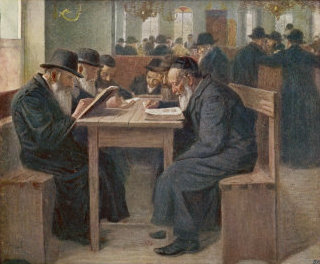
Talmud StudyWhen I was young, my father, a rabbi, would roll up his sleeves in front of an open Talmud and spend four or five hours putting different postulates and corollaries together as though he were building a road in ancient Rome. It wasn’t easy, but he was determined. He would concentrate unrelentingly on the words and sentences until he fashioned a pshat – a line of reasoning – to make things work. Lazy thinking was as far from him as Queens was from the Pacific.

He was the whole world to me, and I yearned to know what he knew, to be like him. But he and I were too different; we still are. My father is thoroughly God-centered and deeply committed to mastery of religious texts. He is a man of principles, scholarship, organization, planning, and goals. I, on the other hand, am both less scholarly and less organized along rational principles. I cannot be like my father, as much as I may have awkwardly, painfully tried.

-Dr. Simon Yisrael Feuerman
“My Father and the Talmud”
Aish.com

While Rabbi Shkop was spending his final years directing a Talmudic academy in Grodno, Belarus, a tight-knit community of theoretical physicists not so far away was discussing a strikingly similar problem. Instead of a married woman, however, the subject was a cat.

It was the summer of 1935, and Erwin Schrödinger’s thoughts were preoccupied with the fate of a small cat that had somehow been trapped in a metal box with a glass bottle of cyanide. A small hammer hung precariously over the bottle, attached to a kind of Geiger counter, on top of which sat a substance containing a single atom of some radioactive material (my guess would be nitrogen-13). The cat was certainly in danger. As soon as the atom would decay, the Geiger device would drop the hammer so as to smash the bottle, releasing the cyanide and killing the cat.

-Rabbi Tzvi Freeman
“Quantum Talmud: How Deep Can Talmud Go?”
Chabad.org

I recently suggested in Part 1, Part 2 and Part 3 of my discussion on Arminianism and Calvinism, as well as in a blog post about the potential for unknown qualities of the Bible, that the Word of God may have more to it than meets the eye.

I know “Talmud” exceeds the definition of “Torah” or “Bible” for most Christians by quite a bit, but I’ve been having a small discussion with someone named “ProclaimLiberty” on Sunday’s and Monday’s “meditations,” and they seem related to how we perceive the Jewish authority relative to the Bible (and Jewish authority as it exists after the Biblical canon closed) as well as the nature of the Bible and the supernatural itself.

While the quote from Dr. Feuerman’s article illustrates a simple desire to gain a traditional Jewish understanding of Talmud and thus Jewish thought (though like Feuerman, it may always be beyond me), Rabbi Freeman’s article (which is exceptionally lengthy) manages to compare the dynamics of Talmud study with Quantum Physics. I never thought of those two processes being related in any way, but Rabbi Freeman makes a compelling if complicated case.

But what does that have to do with anything, especially a Christian’s understanding of the Bible?

Well, the Pentacostal and Charismatic movements re-introduced the notion that revelation did not necessarily cease 19 centuries ago. Of course, that notion also has been abused terribly to justify everything from charlatanism to insanity. Re-introducing the notion of messianic Judaism also was difficult 4 decades ago, and it is still resisted in some quarters. It could be viewed also as having been already abused in some measure.

Thus I understand very well your sense of the difficulty about re-introducing a notion of the continuity (more than merely a restoration) of Jewish authority. It has been hard enough to convey the idea that Jewish believers are entitled to be something more than or different from merely some ethnic expression of Christianity. But this suggestion derived from Matt.23:3a undermines a fundamental viewpoint underlying the Nicene Council and the creeds it developed. It opens a door to a very scary world in which large segments of Christian doctrine could need to be re-invented. Furthermore, it threatens to unleash another wave of Christian guilt over its historical treatment of Jews. On the other hand, theologians love that sort of challenge; and if Christianity hasn’t learned how to request and accept forgiveness, something truly is fundamentally wrong (though there may be some need to learn a bit more about how repentance and atonement work).

-ProclaimLiberty’s comment on my blog
June 10, 2:45 am

phariseesI invite you to read the entire exchange of comments to get the full flavor of what was discussed, but PL brings to the table the compelling suggestion that Jews didn’t lose the authority provided by God to issue binding halakhic rulings after the Biblical canon was closed sometime in the early centuries of the Common Era.

Christians are almost universally going to reject that idea, but it’s at the heart of Jewish religious observance and Talmudic study within Messianic Judaism (as well as the other streams of Judaism today) and is based, interestingly enough, on a Biblical principle found in Matthew 23:3 (though I’ve yet to hear a Christian interpret that verse in such a fashion).

(PL isn’t the first Jewish commentator to bring up this interpretation of Matthew 23:3. For more details, please read Matthew 23:2-4: Does Jesus Recognize the Authority of the Pharisees and Does He Endorse Their Halakhah? (PDF) by Noel S. Rabbinowitz.)

This may mean that, for the Jewish people in general and for Jewish Messianics in particular, Rabbinic authority to make binding rulings over specific Jewish communities under God’s directives continued in some fashion after the Jewish/Gentile Christian split and continued across time and into the present. Of course, such a suggestion isn’t without problems as PL addresses in the same comment:

Of course, even if the notion of Jewish authority continuity were wholeheartedly adopted, there would still be a lot of analytical work to do examining how it might apply to non-Jews, and in what measure. Along with that analysis is one that would examine how a number of statements in Jewish literature were developed. For example, some statements were polemical responses in defense of Judaism under the pressure of Christian assault. While we don’t throw away such opinions in Judaism, we do at times limit their applicability and effectivity to specific circumstances, even when they were responsible for accepted elements of halakhah.

The “analytical work” involved to “examine how a number of statements in Jewish literature were developed” and the application of some of the more difficult Talmudic statements to Messianic Judaism (let alone non-Jews involved in the Messianic movement) has yet to be done, at least to any significant extent (to the best of my knowledge), but I believe a whole world of study would open up to Christians if we could just see the Bible from the perspective PL seems to represent.

PL was less than impressed by what he calls “esoteric mystical perception” as he commented in our conversation in my other meditation, but then, he’s had some rather unique experiences in that area as well.

However, I still maintain that the Bible is more than the sum of its parts and, as Rabbi Tzvi Freeman has remarked, (and I paraphrase) the Torah is not a book about what God thinks about so much as an illustration about how God thinks.

Reading Rabbi Freeman’s commentary on Talmud study and Quantum Physics, I’m convinced I’d never make a good student of either discipline. I must however, admire a mind that can grasp even the very basics of both.

Today’s “meditation” probably seems a little “over the top,” even for me, but since reading Rabbi Freeman’s article on Talmud and Quantum Physics last week, I’ve been periodically considering the implications if any portion of what he presents can be said to be relevant to non-Jews outside the stream of Jewish thought.

Back when I was an undergraduate for the first time in the early 1970s, I took a few astronomy classes. I might have considered making a career out of it if I could have handled the math. However, among the things I learned in my beginning astronomy class, I learned that we can consider light as both as a wave and a particle. Depending on how we consider light in terms of the math involved and under direct observation, it can behave either as one or the other. Depending on the circumstances of human investigation, we treat light either one way or the other.

In quantum physics, a particle has a potential for a number of locations in space until we observe that particle, then it appears in a single location only, and from that location, we can trace it back to where it must have been.

But why does its location only become fixed when we observe it? What is happening to the particle when we don’t observe it?

quantum-physics-catAs I asked before, what does any of this have to do with the Bible?

The Bible isn’t a particle (or a wave) of light. It exists in the “macro” world and just like Schrödinger’s hypothetical cat (no, he never put a real cat in danger…it was a thought experiment), we can’t actually apply what we know about subatomic particles to objects like cats and Bibles in our world.

Unless you consider the study of the Bible (like Talmud study) to be somewhat “transcendent” of the world we live in.

I admit that his all requires more mental gymnastics than I am capable of, just like a career in astronomy (I probably would have specialized in cosmology or the study of the origins of the universe, but I wouldn’t have ruled out planetary astronomy), but just like astronomy, I find the more esoteric aspects of the Bible to continue to be compelling in my present-day life.

All this complexity of thought (some of you may see this as unnecessarily complex) comes down to something very simple and something I’ve said before. I think it’s possible for the Word of God to contain far more than we imagine. I think that if we treat the Bible as far more than just a book full of ancient writings, it will “behave” in that manner.

Oh sure, I know this could easily lead to people projecting their (our) desires and imaginations onto the text, reading what we want to read in-between the lines, but what if God Himself put something in-between the lines for us to find? What if it takes someone with the mind and imagination of a Talmud scholar or Quantum physicist to find the place in-between the lines (and that someone would not be me)?

What if that “something” holds the answer to questions like the Calvinism-Arminianism debate or at least provides us with a perspective that throws said-debate clear out of the fifth floor window, defenestrating the very idea that human beings can turn the Bible into a “cookbook” containing Calvin’s and Arminius’s separate “recipes” for salvation?

Food for thought.

The Unsimple Truth

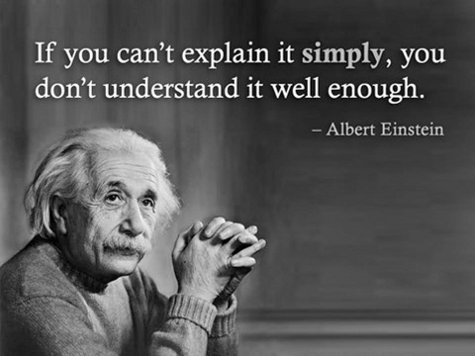
einstein_simplyIf you can’t explain it simply, you don’t understand it well enough.

-attributed to Albert Einstein

According to Rashi, the question is directed against Rav Yirmiyah who had said that the basket in the tree does not actually have to be within ten tefachim of the ground to be valid. We are dealing with a long basket where it could be tilted and emptied even without being brought below into the reshus harabim. In contrast to this, Rav bar Sh’va brings a Baraisa where an eiruv is not valid unless it is actually brought to where it must be situated. Here, we do not take into consideration the fact that the eiruv should be valid due to the potential that it could
theoretically be brought during bein hashemashos to its destination.

Daf Yomi Digest
Distinctive Insight
from “Rabbinic injunctions and Bein HaShemashos
Eruvin 33

I’m a failure. More to the point, I don’t understand God, Jesus, faith, and spirituality well enough. I can’t explain it simply. I’m not sure I can explain it at all. Certainly the fact that I have posted nearly eight-hundred articles in this “morning meditations” blog (not to mention other blogs) about these subjects and have hardly scratched the surface must mean I don’t understand all this well enough. I can’t explain what I believe simply. I certainly can’t explain it briefly.

I quoted from a commentary on an excerpt from Talmud above to illustrate the level of complexity of the halachot related to Orthodox Judaism. Although I read from the Daf Yomi Digest daily, I scarcely comprehend what I’m reading and what I understand most clearly is that the Talmud is an enormously complex set of works. I don’t know how observant Orthodox Jews manage to obey all of the minute details involved in daily living. I can only imagine that Einstein would have contended with the sages based on his above-quoted statement (though it is unsure if Einstein or Richard Feynman actually said those words).

I can hardly be said to live anything close to an Orthodox Jewish lifestyle in my “observance” as a Christian, but as I write and write and write, and then read back what I’ve written, I realize that I am no closer to truly comprehending God and faith than I was when I first accepted Jesus Christ as Lord. Sometimes I wonder if I’ve even gone that far.

For I do not understand my own actions. For I do not do what I want, but I do the very thing I hate. Now if I do what I do not want, I agree with the law, that it is good. So now it is no longer I who do it, but sin that dwells within me. For I know that nothing good dwells in me, that is, in my flesh. For I have the desire to do what is right, but not the ability to carry it out. For I do not do the good I want, but the evil I do not want is what I keep on doing.

Romans 7:15-19

If we’re honest with ourselves as Christians, then I suppose we all have to admit that this statement of Paul’s is also true of us. How can we live a life we call “holy” and yet still struggle with the mundane, the common, and even the evil within us? If God’s Word is written on our hearts, how can we defy that word and pursue what we know isn’t right? I can only imagine that atheists have moral struggles as well, though as I recall myself from before I came to faith, they didn’t seem as dire.

Is a life of faith really that hard or that hard to explain? It certainly seems that hard to live. But then again, is Einstein’s quote the litmus test we should be using against ourselves? After all, he also said this:

If I could explain it to the average person, I wouldn’t have been worth the Nobel Prize.

Einstein made that statement in response to being asked to give a brief quote on why he won the Nobel Prize. That’s the problem with taking quotes out of context. It’s easy to make a person seem completely inconsistent. How much more difficult it is to analyze “chunks” of the Bible and find consistency and comprehension?

My conversations with Pastor Randy (which are on hiatus for the month of April and for several weeks in May) about D.T. Lancaster’s book The Holy Epistle to the Galatians aren’t hugely complex, but they do get detailed…and we’ve barely covered one chapter in Galatians! How about the book of Romans?

mystery-in-midtownI know that Mark Nanos is popular in Messianic circles, but some years ago, when I tried to read his book The Mystery of Romans, I gave up, not getting very far in his book. Maybe I’d be better able to comprehend his writing now, but Paul’s letter to the Roman church is extremely dense with meaning that I wonder if I’ll ever truly understand either Paul or Nanos. I know the Nanos books on Romans and Galatians should be on my “required reading” list, but who knows if they’ll do me any good? I’m tasked to understand a scholar and author in order to understand the mystery of “letter writer.” Are these reasonable goals?

In some ways, trying to comprehend a life of faith is a fool’s errand. While the concept of Christian salvation is supposed to be simple enough for a small child to understand, the fact remains that the Bible contains depths that if plumbed, would make even explorers such as Jacques Cousteau bolt for the surface as if hotly pursued by Leviathan.

Maybe it’s not quite that bad, but I feel that way sometimes.

Of course there’s a difference between understanding a life of faith and living it. Well, maybe not for the Orthodox Jews since behavior and conceptualization are largely interwoven, but certainly for Christianity, where one can live a basic Christian life without having to know much of the Bible at all. You can feed the hungry, visit the sick, remain faithful to your spouse, give to charity, pray to God, and fellowship with other believers without having to spend even a single day in seminary. Of course studying the Bible gives such a life context and meaning, but you don’t really have to know all of the arcane debates about the doctrine of Divine Election, for example.

Don’t get me wrong. I enjoy reading. I enjoy studying. I enjoy discussing all of these little details. But at what point do you turn it all off and just spend time with God? What’s the point of all of our debates on the web? Why do you try to convince me you’re right about something and why do I try to convince you that I’m right about something? What difference does it make? OK, probably a pretty big one, depending on what we’re talking about, but we can’t all be right? Can we all be wrong? That seems far more likely.

If we believe God exists, then He must exist separately from what we believe and from the web of theology and doctrine we’ve spun for ourselves. God must be an “objective” God. If the world’s population stopped believing in God totally and completely, God would continue to exist and His plan for the universe would continue to move forward toward its ultimate conclusion. We spend all our lives examining the Bible trying to uncover the clues to that plan and what it means in our lives, but we only get bits and pieces, and much of the time, we can’t really be sure we understand what we think we’ve got in our hands.

This theologian espouses one particular theory and another theologian opposes him or her. More theories spring up, more debates occur. But God is God. Our theories and debates don’t affect him in the slightest. He exists as He exists regardless of our “religious orientation.”

We’re all seeking truth but even with the help of the Holy Spirit, who is supposed to guide us in all truth (John 16:13), we all come up with different conclusions. You’d think if there were one Spirit and He was guiding us to One truth, we’d all arrive at the same conclusion.

But we don’t.

I’m most of the way through Carlos Castaneda’s book The Teachings of Don Juan: A Yaqui Way of Knowledge. It’s not really what I expected, but I appreciate Castaneda’s honesty in saying that he didn’t quite succeed either in his field study or as a disciple of don Juan. I decided to read this book because I hadn’t read any Castaneda before and felt I owed it to myself to have the experience.

letting-goMaybe I should just let go and move away from religious and spiritual reading altogether and just read for pleasure (not that reading books on religion and spirituality aren’t pleasurable). I used to read a lot of science fiction and mystery back in the day, with a few of the classics thrown in just for giggles. Maybe that would be more satisfying. Nothing I know or don’t know affects God. I’m not sure it even affects me. I can probably explain simply Castaneda’s book, but how could I possibly explain even one letter of Paul’s? Many have tried, including Nanos and Lancaster, but what does it matter if you end up with a body of work about the Bible that is fraught with disagreement?

I guess there’s a reason people pursue truth all their lives but either never find it or find only what some people (but not all) call “truth.” Maybe we never find it at all. Maybe we just delude ourselves and say what we have is “truth” because living a life of existential uncertainty is too difficult to bear.

Maybe that’s why there are so many atheists. There are no mysteries to the universe beyond what they can see. It’s all nuts and bolts with no colors, textures, or moods. There’s only light and darkness. More’s the pity.

One who returns from the darkness must bring of it with him and convert it to light. He must exploit his experience to surge higher and higher with greater strength.

Therefore, the one who returns from a distance is greater than the one who was always close. What matters is not so much where you stand, but with what force you are moving in which direction.

-Rabbi Tzvi Freeman
“Exploiting the Darkness”
Based on letters and talks of the Rebbe
Rabbi M. M. Schneerson
Chabad.org

So which direction should I move in next in pursuing truth or God or whatever?

Moshiach Rabbeinu

rabbeinu1Believe it or not, this week’s message was not inspired by the fact that the Catholic Church has chosen a new Pope; it just offers a convenient contrast. As you probably know, there is, in their beliefs, a doctrine of papal infallibility. When the Pope teaches the rules, he is always right.

It is natural to assume that Judaism has something similar. This is especially true, given the Torah’s demand that we listen to the Rabbis and Judges, and not deviate “right or left” [Deut. 17:11] from what they say.

-Rabbi Yaakov Menken
“Everyone Makes Mistakes”
Commentary on Torah Portion Vayikra
Project Genesis

I’ve been hesitating about writing this particular “meditation” because it has the potential to be rather controversial. As part of my conversations with Pastor Randy, we’ve been discussing what is Torah? That’s an amazingly difficult question to answer. It’s not just the Five Books of Moses, and I believe that it should be at least the entire Tanakh (Old Testament). I believe a great deal of the New Testament and certainly the epistles of Paul should be considered midrash on Torah, specifically in relation to the teachings of Messiah.

As I’ve said before (and will say again when I publish “Four Questions, Part 4” tomorrow), Pastor Randy believes that the Torah is too difficult to observe perfectly and in fact, has always been too difficult to observe. This is pretty much what most of Christianity believes, and along with that, the church sees the primary purpose of Torah as always pointing to Jesus. Once Jesus came, the purpose of Torah expired and grace was substituted.

I don’t happen to believe this, and my understanding is that Jewish people, including those who are disciples of the Master, remain obligated to the Torah of Moses.

But I’m not here to talk about the Torah as such (I’ll do that tomorrow), but rather how it is applied through Rabbinic interpretation and authority. This is the really touchy part. As Rabbi Menken writes, there’s a tendency to view the sages in a manner similar to how Catholics view the Pope, as infallible and that all Rabbinic rulings are automatically correct. But is that really true? Rabbi Menken continues.

We see from this week’s reading, though, that this is definitely not the case. The Torah prescribes special atonement for when the High Priest, the King, or the Sanhedrin [Lev. 4: 13-21], the High Rabbinical Court, makes a mistake. In other words, the Torah highlights for us that it is possible for the Sanhedrin to be mistaken.

This is not about a small matter, either. The commentaries say that the mistake described here is one in which the Sanhedrin teaches that it is permitted to do something, and the Sanhedrin later realizes that the behavior is prohibited — so much so that a person committing the act deliberately would suffer the punishment of Kares, spiritual excision [the exact definition of this is disputed, but severe]. Even in matters of religious law, where the Sanhedrin’s supreme authority is undisputed — even there, they could make a mistake.

So why, then, does the Torah tell us to listen to them? They could, after all, be leading us in the wrong direction!

That is an extraordinarily good question. It’s also the question that comes to the minds of just about all Christians, including many people in the Hebrew Roots movement who believe that the Bible contains everything necessary for a Jew to observe Torah without relying on external interpretation or additional instructions.

Based upon a proof from a Baraisa, the Gemara had concluded that a lechi post is not valid if it is not recognizable from the inside, although it is visible from the outside. Yet, the Gemara proceeds to inform us that the halachah is that such a lechi is valid. Immediately, the Gemara asks, “We have disproven the validity of such a lechi, and yet the halachah rules that it is valid?!”

The Gemara continues to resolve this halachic conclusion, based upon yet another Baraisa which validates such a lechi.

This give and take, where the Gemara proves one point of view, and then immediately concludes the halachah according to the opposite opinion is relatively uncommon. A computer check reveals that it appears only five times in Shas (here, Kesuvos 41b-twice, Bava Kamma 15b-twice, Bava Metzia 22b).

Daf Yomi Digest
Distinctive Insight
“It is disproved – but yet it is the Halachah!”
Eruvin 10

That didn’t help. I admit, the complexities of Talmud escape me most of the time and yet religious Judaism in all of its variants, depends on these rulings, laws, and judgments for so very much.

My question is basic. Is literally every single ruling, judgment, halachah, and word of every sage everywhere across time valid and binding in religious Judiasm, or is it possible that at some point, the sages have gone too far?

Kapparot is a custom in which the sins of a person are symbolically transferred to a fowl. It is practiced by some Jews shortly before Yom Kippur. First, selections from Isaiah 11:9, Psalms 107:10, 14, and 17-21, and Job 33:23-24 are recited; then a rooster (for a male) or a hen (for a female) is held above the person’s head and swung in a circle three times, while the following is spoken: “This is my exchange, my substitute, my atonement; this rooster (or hen) shall go to its death, but I shall go to a good, long life, and to peace.” The hope is that the fowl, which is then donated to the poor for food, will take on any misfortune that might otherwise occur to the one who has taken part in the ritual, in punishment for his or her sins.

-Richard Schwartz, Ph.D.
“The Custom of Kapparot in the Jewish Tradition”
JewishVirtualLibrary.org

Solomons-TempleThe Torah, particularly the book of Leviticus, provides an extremely detailed description of the various sacrifices to be given at the Temple in Holy Jerusalem, and under what circumstances a Jew must present said-sacrifices. To the best of my knowledge, none of them involve the use of a chicken as described by the modern rite of kapparot. Dr. Schwartz details some of the Jewish objections to this practice.

Some Jewish leaders felt that people would misunderstand the significance of the ritual. The belief that the ceremony of kapparot can transfer a person’s sins to a bird, and that his or her sins would then be completely eradicated, is contrary to Jewish teachings. For, if the ritual could remove a person’s sins, what would be the need for Yom Kippur, the Day of Atonement?

The Mishneh Brurah, an eminent contemporary commentary on Rabbi Joseph Caro’s classical codification of Jewish law, explains the significance of the ritual. Judaism stresses that a person can’t obtain purity from sin, and thus obtain higher levels of perfection, without repenting. Through God’s mercy, we are given the Divine gift of repentance, so that we might abandon our corrupt ways, thereby being spared from the death that we deserve for our violation of the Divine law. By substituting the death of a fowl, one will (hopefully) appreciate G-d’s mercy and be stirred to repentance. By no means, however, does the ritual and the slaughter of the bird eradicate one’s misdeeds, even though the bird is donated to the poor.

If a Jewish person is a disciple of the Master and has studied and accepted the teachings in the Apostolic Scriptures, he or she understands that this particular ritual is not meaningful or necessary. The sins of anyone, Jew or Gentile, who has accepted Jesus (Hebrew: Yeshua) as Savior, Lord, and Messiah, have been forgiven. He died, paying the price for our sin as the ultimate atonement, and when we repent (and we must repent) of our own sins, turning away from them, and turning to God, we are forgiven once and for all without the need for further sacrifices.

So how are we to reconcile the rulings of the sages in relation to the kapparot involving chickens during Yom Kippur and the reality of the Messiah? The better question is, how are Messianic Jews to reconcile this along with any other Jewish practices that seem to contradict the teachings and life of the Master?

The Messianic Jewish Rabbinical Council has established official halachah for its member synagogues and individual members, but that’s hardly a universal standard. On the other hand, how halachah is applied across the rest of the religious Jewish landscape is not entirely consistent either. For example, we can point to the radically extreme differences between how the Haridim vs. Reform Judaism live out Jewish lives they believe are consistent with observing Torah.

It’s obvious that Messianic Judaism has to make a few “adjustments” to how some of the Rabbinic rulings are applied, but even given that, are we to understand that all of the remaining body of Mishnah is fully correct and fully valid? If we accept that the Torah doesn’t change (and there are those who debate even that), can we accept that Jewish interpretation is adaptive and evolutionary across time and culture? I had a recent Facebook conversation that included the following:

There are enduring realities in the Torah…the Shema is one…The pursuit of Justice is another…however there are changes in the way Torah is embraced…David recognizes that G-d wants a contrite and broken heart, not burnt offerings (Psalm 51) Micah gives the same notion (Micah 6)…so there is an evolutionary understanding of the nature and character of G-d that takes place…

David is specific…”burnt offerings you do not desire”…but a contrite broken heart….quite removed from the harsh Levitical code of bloody sacrifices…and those scriptures reflect evolving understanding of the nature and character of G-d…Jesus in the John 8 narrative lays aside the penalty that the Torah prescribes and challenges the lack of personal holiness/integrity of the woman’s accusers…

Part of the problem is that we can “interpret” the Bible to mean just about anything. If we give the Rabbinic sages (or anyone) carte blanche to establish binding interpretations and halachah for their specific streams of Judaism, are they always consistent with God’s intent for the Jewish observance of Torah?

There’s no way to know for sure. Well, there’s one.

Then Jesus said to the crowds and to his disciples, “The scribes and the Pharisees sit on Moses’ seat, so do and observe whatever they tell you, but not the works they do. For they preach, but do not practice. They tie up heavy burdens, hard to bear, and lay them on people’s shoulders, but they themselves are not willing to move them with their finger.

Matthew 23:1-4 (ESV)

phariseesEven as Jesus confirmed that the scribes and Pharisees did indeed have the authority to create binding halachah upon the Jewish people of his day (see the paper Matthew 23:2–4: Does Jesus Recognize the Authority of the Pharisses and Does He Endorse their Halakhah? (PDF) by Noel S. Rabbinowitz, JETS 46/3 (September 2003) 423-47 for details), he also criticized them for failing to follow their own rules. However, he didn’t agree with each and every one of their rulings.

Again he entered the synagogue, and a man was there with a withered hand. And they watched Jesus, to see whether he would heal him on the Sabbath, so that they might accuse him. And he said to the man with the withered hand, “Come here.” And he said to them, “Is it lawful on the Sabbath to do good or to do harm, to save life or to kill?” But they were silent. And he looked around at them with anger, grieved at their hardness of heart, and said to the man, “Stretch out your hand.” He stretched it out, and his hand was restored.

Mark 3:1-5 (ESV)

Now when the Pharisees gathered to him, with some of the scribes who had come from Jerusalem, they saw that some of his disciples ate with hands that were defiled, that is, unwashed. (For the Pharisees and all the Jews do not eat unless they wash their hands properly, holding to the tradition of the elders, and when they come from the marketplace, they do not eat unless they wash. And there are many other traditions that they observe, such as the washing of cups and pots and copper vessels and dining couches.) And the Pharisees and the scribes asked him, “Why do your disciples not walk according to the tradition of the elders, but eat with defiled hands?” And he said to them, “Well did Isaiah prophesy of you hypocrites, as it is written,

“‘This people honors me with their lips,
but their heart is far from me;
in vain do they worship me,
teaching as doctrines the commandments of men.’

You leave the commandment of God and hold to the tradition of men.”

Mark 7:1-8 (ESV)

So what does all this mean?

  • There are some modern Jewish rituals and customs that contradict the reality of the risen Messiah.
  • Jewish ritual and tradition is not applied with universal consistency across all religious Jewish communities and across time.
  • Historically, Jesus affirmed the right of the ancient Pharisees and scribes to establish binding halachah for Jews.
  • Historically, Jesus refuted some of the halakhic rulings by the Pharisees and scribes and offered correction and criticism when necessary.
  • At least one modern Messianic Jewish body has offered an adaptation to Jewish halachah that is more consistent with the reality of the risen Messiah.

Oh. We know one more thing:

The nations will send their emissaries to the King Messiah, and the King Messiah will teach the world how to live in peace, and how to want to live in peace. Then, everyone in the world will enjoy eternal peace, for as long as this world will last. The great Rabbi, Rav Shlomoh Freifeld, of blessed memory, said in a talk he once gave that I attended that the Messiah will be a great teacher.

-from “What is the Messiah Supposed to Do”
BeingJewish.com

He will restore the religious court system of Israel and establish Jewish law as the law of the land (Jeremiah 33:15).

-from “Mashiach: The Messiah”
Judaism 101

It is my understanding that one of the things many Jewish people believe the Messiah will do is to teach Torah, to teach the correct interpretation of Torah and how it is to be lived out. According to BeingJewish.com, as we saw above, he will even teach the Gentiles peace.

So what am I getting at?

This is Rabbi Menken’s solution to understanding the puzzle.

One answer has to do with the power of unity. Different customs and practices are wonderful, but there has to be underlying agreement on “the basics.” One of the problems with calling different Chassidic groups “sects” is that a sect is “a dissenting or schismatic religious body.” Chassidic groups may be led by different Rebbes, but they don’t rewrite the rules. The disagreements of today are disagreements about shapes of branches on individual trees within a massive, unified forest.

And there is another answer, which requires still more humility. It is all well and good to say that everyone is fallible — but who is more likely to be making a mistake? The Torah gives leadership to people who dedicate themselves completely to Torah study, to learning the Torah’s “way of thinking.” Such people are inherently less biased by the latest news reports and the wise opinions of the chattering class, as we are. We recognize that it is much less likely that they will make a mistake, and that is why we trust their guidance.

torah-tree-of-lifeIs there a “unified forest” of Torah? I think there must be, otherwise there is nothing for Jews to observe except traditions (the shapes of branches on the individual trees); there is no root, no foundation, no sense of an absolute God who has core standards that are as unchanging as He is. Beyond a certain point, we can’t simply re-invent the Bible to fit our modern sensibilities so that they agree with whatever “politically correct” causes that may be popular this week, this month, or this year. If we did, our faith (and our God) would be no more consistent or eternal than the shifting viewpoints of a political party or social agenda.

Rabbi Maurice Lamm says in “What is Torah” published at Aish.com:

In fact, far from being enslaved by the law, Jews were enamored of it. We cannot take our leave of the subject of Torah without expressing this most characteristic sentiment of Jewish literature – the love of Torah.

You may ask: can a people “love” a law? Yet, that is the exquisite paradox inherent in the concept of Torah – it is respected and studied and feared, while it is loved and embraced and kissed. All at once. There is no good in this world – no ideal, no blessing, no perfection, no glory – unless it is associated with the law.

To Jews, the Torah is “light”; it is the “glory of the sons of man”; it is the energizing sap of life for “the dry bones” (Ezekiel 37:4) which symbolize the “people in whom there is not the sap of the commandment.”

To Jews, the law is mayim chayim, refreshing, life-restoring, living waters to Jews; the sweetness of honey and milk, the joy and strength of wine, and the healing power of oil. It is an “elixir of life” that brings healing to all.

In Acts 15, Peter called the Law a burden but in Acts 21, Paul defended his observance of the Law. We also see in that same chapter that many of the Jews in Messiah were zealous for the Law.

And God, through Moses, said this about the Torah.

“For this commandment that I command you today is not too hard for you, neither is it far off. It is not in heaven, that you should say, ‘Who will ascend to heaven for us and bring it to us, that we may hear it and do it?’ Neither is it beyond the sea, that you should say, ‘Who will go over the sea for us and bring it to us, that we may hear it and do it?’ But the word is very near you. It is in your mouth and in your heart, so that you can do it.”

Deuteronomy 30:11-14

I think that for the Jewish people, there is an “ideal” Torah, a Torah that God intends for His people Israel. As we’ve seen in the record of the Bible, all things being equal, human beings will mess up a free lunch. We take everything God gives us and turn it on its side, we fold, spindle, or mutilate it, drag it through the mud, drag it through our biases, prejudices, and personalities, drag it through our theologies, our doctrines, our translations, and eventually on the other side, we come out with some approximation of what God wants us to say, do, and be.

How close are all of our approximations to the desires of God, how near is our fidelity to the original? Opinions vary widely. It’s not that we are dishonest and it’s not that we don’t want to do His will as opposed to our will (most of the time, anyway), but we are human beings. Everything we are as flawed, mortal beings gets in the way of everything He is as a perfect, immortal God.

That’s where Messiah comes in. Being human and divine, he can provide (and has provided) the correct “interface” for us. He is a teacher. When he comes, whatever we’ve gotten wrong, he’ll help us understand correctly.

If there’s an answer to how the Law is infinitely accessible, and a delight, and a light, and to be loved by those who have received it from Him, that answer comes on the clouds with Messiah. God is a teacher.

When the Fruit Tree is Silent

the-fruit-treeOne who humiliates another person in public … even though he may be a scholar and may have done many good deeds, nevertheless loses his portion in the eternal world.

-Ethics of the Fathers 3:15

Imagine a situation: you have a fine home, a well-paying job, a comfortable car, and a substantial retirement annuity. If you do a single thoughtless act, you will lose everything you have worked to achieve: home, job, car, and savings. What kind of precautions would you take to avoid even the remotest possibility of incurring such a disaster? Without doubt, you would develop an elaborate system of defenses to assure that this event would never occur.

The Talmud tells us that everything we have worked for during our entire lives can be forfeited in one brief moment of inconsideration: we embarrass another person in public. Perhaps we may say something insulting or make a demeaning gesture. Regardless of how it occurs, the Talmud states that if we cause another person to turn pale because of being humiliated in public, we have committed the equivalent of bloodshed.

Still, we allow our tongues to wag so easily. If we give serious thought to the words of the Talmud, we would exercise the utmost caution in public and be extremely sensitive to other people’s feelings, lest an unkind word or degrading gesture deprive us of all our spiritual merits.

Today I shall…

…try to be alert and sensitive to other people’s feelings and take utmost caution not to cause anyone to feel humiliated.

-Rabbi Abraham J. Twerski
“Growing Each Day, Adar 2”
Aish.com

I suppose this is a continuation of a previous morning meditation and yet another attempt on my part to appeal to the body of faith. I am aware of a discussion in the Hebrew Roots “blogosphere” that has cast me and a friend of mine in an unfavorable light, but up until now, I’ve said nothing about it. I certainly have no intention of visiting said-blog and attempting to refute the accusations. What would be the point? As we see from Talmudic wisdom, behaving unkindly in response to criticism is unsustainable. Of course virtually all Christians, including those in the Hebrew Roots movement, have little use for the Talmud, so I imagine Rabbi Twerski’s appeal is in vain when applied to such an audience.

Accessing the Bible, do we really get a sense that if we humiliate another person publicly, we’ll lose our salvation as the Rabbi suggests? No? So why worry about it? I guess we are free to humiliate others with impunity, right?

And since they did not see fit to acknowledge God, God gave them up to a debased mind to do what ought not to be done. They were filled with all manner of unrighteousness, evil, covetousness, malice. They are full of envy, murder, strife, deceit, maliciousness. They are gossips, slanderers, haters of God, insolent, haughty, boastful, inventors of evil, disobedient to parents, foolish, faithless, heartless, ruthless. Though they know God’s righteous decree that those who practice such things deserve to die, they not only do them but give approval to those who practice them.

Romans 1:28-32 (ESV)

OK, that’s a little harsh, even for me. Also, Paul was talking about God’s wrath upon the unrighteous, and that couldn’t possibly include anyone in the body of Christ, could it? Maybe I should look elsewhere for more appropriate scriptures.

For this is the message that you have heard from the beginning, that we should love one another. We should not be like Cain, who was of the evil one and murdered his brother. And why did he murder him? Because his own deeds were evil and his brother’s righteous. Do not be surprised, brothers that the world hates you. We know that we have passed out of death into life, because we love the brothers. Whoever does not love abides in death. Everyone who hates his brother is a murderer, and you know that no murderer has eternal life abiding in him.

1 John 3:11-15 (ESV)

That may still be a little over the top, since you don’t actually have to hate someone in order to publicly embarrass and humiliate them. I’m sure my recent critics don’t actually hate me. Given that, is it OK with Jesus then to be insulting?

“You have heard that it was said to those of old, ‘You shall not murder; and whoever murders will be liable to judgment.’ But I say to you that everyone who is angry with his brother will be liable to judgment; whoever insults his brother will be liable to the council; and whoever says, ‘You fool!’ will be liable to the hell of fire.”

Matthew 5:21-22 (ESV)

Hmmm. I don’t know about you, but that one seems to be pretty close to the mark. In fact, it is pretty much identical to the following:

He who publicly shames his neighbour is as though he shed blood.

-Talmud: Bava Mezia 58b

studying-talmudWell, so much for the Talmud having absolutely and totally no relevance to a Christian life of faith. Perhaps a certain amount of the Torah and traditional Jewish halachah applies to Christians after all, if it connects back to what we learn from our Master.

But getting back to the main point of this missive, it seems that (and I’ve mentioned this many times before) our endless series of rants, public insults toward others, and general “bad mouthing” of other Christians with whom we disagree, isn’t exactly “kosher,” so to speak. Unfortunately, when I say stuff like this, the usual response from some quarters is that I’m just an old “softie” and that I’m sacrificing “clarity” and “truth” for the sake of patience, kindness, avoiding envy or proud boasting, and attempting not to dishonor others (see 1 Corinthians 13:4-5).

Obviously, I’m not perfect at it, thus some of the language that I’ve included in this “extra meditation.”

But what are we to do under such circumstances when other believers insist on overlooking both Matthew 5:21-22 and its Talmudic corollary Bava Mezia 58b?

Bless those who persecute you; bless and do not curse them. Rejoice with those who rejoice, weep with those who weep. Live in harmony with one another. Do not be haughty, but associate with the lowly. Never be wise in your own sight. Repay no one evil for evil, but give thought to do what is honorable in the sight of all. If possible, so far as it depends on you, live peaceably with all. Beloved, never avenge yourselves, but leave it to the wrath of God, for it is written, “Vengeance is mine, I will repay, says the Lord.” To the contrary, “if your enemy is hungry, feed him; if he is thirsty, give him something to drink; for by so doing you will heap burning coals on his head.” Do not be overcome by evil, but overcome evil with good.

Romans 12:14-21 (ESV)

But in making this an issue on my blog, am I “repaying evil for evil” rather than “heaping burning coals” (by heaping kindness) upon the heads of those who are so critical of me? (As an aside, Paul’s quoting partially from Proverbs 25:22, so again, I guess more of the Torah is applicable upon us than we commonly realize.)

Do not be overcome by evil, but overcome evil with good.

Easier said than done, especially on the Internet, when people visit each other’s blogs and make sniping comments like gangbangers doing drive-by shootings. It’s one of the reasons I don’t visit and especially don’t comment on the blogs of some of my “opponents.” My minor effort at not repaying evil for evil and perpetuating the cycle of “drive-bys.”

But this still isn’t working because I’m still writing a message to people who don’t want to listen. There’s no hope of trying to get them to see why what we’re all doing is so wrong. Self-justification is a powerful lure and there’s a tendency to confuse our priorities with God’s.

But if there’s no hope, what’s left?

There is hope, and there is trust in G-d –and they are two distinct attitudes.

Hope is when there is something to latch on to, some glimmer of a chance. The drowning man, they say, will clutch at any straw to save his life.

Trust in G-d is even when there is nothing in which to hope. The decree is sealed. The sword is drawn over the neck. By all laws of nature there is no way out.

But the One who runs the show doesn’t need any props.

-Rabbi Tzvi Freeman
“Between Hope and Trust”
Based on letters and talks of the Rebbe
Rabbi M. M. Schneerson
Chabad.org

shhhhSo I should trust in God to take care of whatever (or whoever) is bothersome and move on. That’s pretty much what Rabbi Freeman said as I quoted him on a previous meditation.

Why don’t people like to remain silent when others insult them? Because they’re afraid that others might think they’re weak and unable to answer back.

The truth is, it takes much greater strength to remain silent when someone insults you. Revenge, on the other hand, is a sign of weakness. A revenger lacks the necessary strength of character to forgive.

(Rabbi Yerachmiel Shulman; Ketzais Ha’shemesh Big’vuraso, p.42; Rabbi Pliskin’s “Gateway to Happiness,” p. 302)

-Rabbi Zelig Pliskin
“Daily Lift #728: It Takes Strength to Keep Silent”
Aish.com

Yeah. I’ve got to work on that one. After all, I can hardly say I’ve advanced further spiritually than my critics if I’m just as prone to the same misbehavior as they display. We shall know a tree by its fruit. In my case, I’ve striving to be a “silent fruit tree.”

Taking a page from Rabbi Twerski’s book…

Today I shall…

…try to refrain from replying to insults that others say to me or to those people I care about and strive to return good for evil.

The Unintentional Shabbos Christian

Shabbat candlesIf a non-Jew lit a candle [for himself], a Jew may also benefit from it. If the non-Jew lit it for the Jew, this is prohibited.

-Shabbos 122a

The Mishnah discusses the case where a gentile lit a candle on Shabbos. If he lit it for himself, the Jew may sit in that illuminated area and benefit from the light. However, if the gentile lit the light for the sake of the Jew, the Jew may not benefit from the light.

There is a variance among the Rishonim in explaining the reason why it is prohibited for a Jew to benefit from labor which a gentile performed (on his own) on Shabbos for the sake of the Jew. Tosafos ( ד”ה ואם ) and Rambam (6:18) explain that if a Jew would be allowed to have this labor done for him, we are concerned that the Jew would then give outright instructions to the gentile to do the labor for him. Rashi and Ran (Beitza 24b) write that it is simply prohibited for the Jew to benefit from labor done for him on Shabbos.

Ritva writes that according to the understanding of Rambam and Tosafos, it might seem that we have arranged a rabbinic precaution (not to benefit from labor done by a gentile) to safeguard another rabbinic injunction (lest we come to give instructions to a gentile outright). This seems to be in violation of the general rule that we do not establish גזירה לגזירה . Nevertheless, the correct explanation is that this is simply a one-staged enactment. The sages set into motion protective measures to ensure that the Shabbos remain special. In order to set it aside and different from the other days of the week, it was necessary to disallow benefiting from the labor performed by a gentile, either when he does it for us by himself without being asked, or whether he does it when asked to do so. These guidelines are all part of the same approach to preserve the sanctity of Shabbos.

Daf Yomi Digest
Distinctive Insight
“Preserving the sanctity of Shabbos – through speech”
Commetary on Shabbos 122a

It’s been a particularly cold and icy winter here in Southwest Idaho. Fortunately, it’s warmed up some lately to near normal temperatures for this time of year, but in the past two weeks, lows have been in the single digits and into negative numbers while highs never got anywhere near above freezing. Ice on the roads and sidewalks has been particularly hazardous, and I know of many people, including several in my family, who have fallen and become injured.

But most winters, it’s just the typical matter of shoveling snow off the driveway and sidewalks and being cautious when driving to and from work. I was remembering a typical “snow shoveling” winter of a few years ago that was like the one I just described while reading the above-quoted commentary. It was on a Sunday morning (before I went back to church) and I had some time on my hands. I had finished shoveling the snow off of my own drive and sidewalks, but on Sunday, it can be a chore for some of my “church-going” neighbors to shovel and get ready to go to services. So I decided to just keep going and to clear the driveways and sidewalks of a couple of other houses near me. I know one neighbor in particular whose family goes to church early and generally has a full day of it. I shoveled off their drive and walk while they were gone.

One of the things about me doing such things is that I don’t like to be noticed (kind of hard when you’re standing in the middle of someone’s driveway with a big, orange snow shovel, I must admit). But I thought I’d gotten away with it. I thought no one would figure out it was me. That is, until my neighbor came over later that afternoon to say “thanks.” He was appreciative because Sunday is indeed a very busy day for him and he didn’t know when he’d be able to get around to shoveling his snow. It was a big help.

I don’t say all this to make myself sound like a big deal, though, but I do have a point. Be patient.

Now imagine my neighbor is an Orthodox Jew and all this is happening on Saturday instead of Sunday. Further imagine that my neighborhood is within walking distance of an Orthodox synagogue (it’s not, but let’s pretend). Now let’s say I know my neighbor and his family are Jewish and I know that they walk to shul on Saturday morning. They’ve probably already left for services and I know they won’t be shoveling snow on Shabbos. As a Christian, it would be a nice thing for me to help them out and shovel their driveway and sidewalk.

But will they see it that way? Sure, they didn’t ask me to do it for them (which would be forbidden), but technically, they can’t benefit from my labor if I did it to benefit them. Could they even walk on the sidewalk and the driveway I shoveled for them upon their return from shul? Frankly, I don’t know, but in my eagerness to be “a good Christian neighbor,” I may have actually caused more of a problem than a help.

Why am I saying all this?

shoveling-snowLast week, I wrote a large number of “meditations” that addressed how Jews who are Messianic may view a life of halachah in relation to their discipleship under Messiah Yeshua, Christ Jesus. It’s a controversial topic, certainly for Christians and even for a number of Jewish people, but it’s one that needs to be discussed. In reading the commentary on Shabbos 122a just a few days ago, I started to wonder how “Christian generosity” and Jewish observance of Shabbos could unexpectedly collide, producing undesirable results. Granted, the Christian in my imagination was just trying to be a good neighbor and lend a hand, but especially an Orthodox Jewish neighbor might have a fundamentally different way of looking at such “help.” This is what happens when we don’t understand each other.

Granted, in this day and age, people who live in the suburbs next to each other or across the street from each other, don’t get to be friends or acquaintances the way we did when I was a child. Often people don’t even wave “hi” to each other when they are both out in their front yard or passing each other on the street.

But if part of being a Christian is loving your neighbor as yourself, and chances are you know a little bit about yourself, how can you be sensitive to your neighbor’s needs if you don’t know what those needs they are. Snow on a driveway and a sidewalk may seem to tell you want your neighbor requires, but you can’t really go by superficial appearances. Who is your neighbor? How can you help him?

If you, as a Christian, have a Jewish neighbor, and you want to be a good neighbor, it might help if you got to know him a little bit. However, we Christians have other Jewish “neighbors” who may not live near us, but who are connected because our “salvation comes from the Jews.” (John 4:22). Whether your Jewish neighbor is someone who lives near you or, in a more expansive sense, is your “neighbor” because he is a child of God like you, how can you become aware of his needs, and of Israel’s needs, if you don’t know what those needs are?

Addressing my last question, Boaz Michael recently posted a new blog article called Three Kinds of Churches pt.2. It includes a section called “Churches that align with Israel” and the description of such churches (and Christian people) may well be part of the answer we need.

Do not judge your fellow until you have stood in his place.

-Pirkei Avot 2:5

Adapting Hillel’s famous statement, we also can’t be a good neighbor, until he have stood in his place, or perhaps just started a conversation with him.