Tag Archives: Talmud

Jesus, Halakhah, and the Evolution of Judaism, Part 3

The title I have chosen for this study is a “tongue-in-cheek” attempt to highlight something that seems to be missed by many, namely, that the Mishnah did not exist as a written document in the pre-destruction era, so it is quite obvious that no one, including Paul, could have possibly read what is known in our day as the Mishanh (sic). In fact, as we shall see, the Mishnah was not widely read by Jewish communities in the centuries immediately following the destruction of the Temple (70 CE) either, for the Mishnah was not “published” as a written document until much later.

Along the same lines, it is a methodological error to speak of “1st Century Judaism,” for no such monolithic Judaism existed. We must rather speak of “Judaisms” (plural) in the pre-destruction era. Granted that a variety of Judaisms extant in the 1st Century surely had some things in common (Shabbat, circumcision, Tanach, etc.), it was nonetheless their clear and (in some cases) radical differences that produced the variegated Judaisms of that era.

Unfortunately, the presupposition of some in the Messianic movement is that the later corpus of rabbinic literature presents a monolithic, historically accurate description of “the Judaism” practiced by Yeshua and His disciples.

-Tim Hegg
from the Introduction (pg. 1) of
“What Version of the Mishnah did Paul Read?” (2012)
TorahResource.com

Since writing Part 2 of this series, I’ve been pondering how to proceed, since, as I’m sure you’ve gathered if you read the questions I’ve been posing, the scope of my inquiry is rather ambitious. Then the answer landed firmly in my lap. I’m indebted to Peter at Orthodox Messianic Judaism (something of a misnomer given the theological nature of his blog) for providing a link to Tim Hegg’s article. I read it through once, meaning to go over it again and eventually write something about it, but as I was getting into the shower, I had an “epiphany” and quickly rushed to my computer (I put a robe on first) to compose the paragraphs that are the heart of this missive (we’ll get to those by the by).

I should say at this point that I like Tim Hegg. He has been very gracious to me. I’ve spent Erev Shabbat in his home, I’ve been treated well by his family and his congregation, and I admire and respect him as a leader and a scholar. All of which added to my surprise when I realized in reading the Introduction to the above-quoted paper, that he had made some glaring and erroneous assumptions.

I can’t think of anyone in Messianic Judaism who believes that the Mishnah we have today is a direct reflection of how Judaism (or “Judaisms”) functioned back in the late Second Temple period, when Jesus walked among his people Israel. I have no idea, even after reading Tim’s paper in full, where he got that idea. Certainly my drive to investigate the evolution of Judaism as it relates, both to the ongoing authority of Judaism to define itself across time, and whether or not First Century halakhah and modern halakhah can be considered equally valid for the Judaism of their times, doesn’t assume a fixed, static, and non-adaptive set of applications of Torah over a 2,000 year span.

Also, his point that in the day of Jesus, that there were multiple “Judaisms” (Pharisees, Essenes, Sadducees, and so on) is hardly a revelation. Again, I don’t know anyone in the Messianic Jewish movement who would deny the “multi-sect” nature of First Century Judaism. On the other hand, if we look at modern Judaism or modern Christianity, we could say the same thing. If there was no, one unified “Judaism” in the day of Jesus, there must certainly be no one, monolithic, unified modern Christianity either. The fact that the Christian church exists as perhaps hundreds of denominational models and their variants, (including One Law or, if you will, “One Torah”) establishes this firmly. Nevertheless, no one balks at talking about “Christianity” or “Judaism” in the 21st Century as if they were specific, unified entities, since at their cores within each individual religion, they contain a basic, common set of theologies, doctrines, dogma, and the like that identify them as either “Christian” or “Jewish.”
It’s as if Tim constructed a very well written and organized paper based on faulty assumptions about Messianic Judaism. It’s never been about the Judaism of late Second Temple times being one unified entity, and it certainly has nothing to do with the belief that the Talmud, (which is comprised of Mishnah, Baraita, Gemara, Halakhah, and Aggadah) as we understand it, having existed as the same body of information in the days of Jesus and the Apostles as it does today.

(The evolution of the Oral Torah and halakhah of Christ’s day into what eventually became known as the Talmud is well beyond the scope of this article, but the seeds of what became Talmud certainly must have existed in some form in the Second Temple period and before. What we know of Hillel and Shammai is recorded in Pirkei Avot, which is the “ethical teachings and maxims of the Rabbis of the Mishnaic period,” and yet both Hillel and Shammai pre-dated Jesus by a generation, and the formalization of Mishnah by centuries.)

In the Conclusions section of Tim’s paper (pg. 23, point 5), he states:

We see, then, that there is no historical nor biblical case for accepting oral Torah as divinely sanctioned. Even the suggestion itself is ill-founded, for it both presumes a monolithic “oral Torah” and that the rabbinic authorities who formulated and compiled the current corpus of rabbinic literature did so by the leading of God.

Point 7 of his Conclusions (pp 23-4) states:

As we avail ourselves of the wealth of rabbinic literature and gain value from the study of it, we must also keep in mind that it is the product of men and not that of divine revelation. It does not come to us with any sense of divine imprimatur nor should the rabbinic literature be considered as having sacred value greater than the works of non-rabbinic authors or sources. All the writings of men must be equally scrutinized in the light of the eternal word of God, the Bible.

There’s a certain irony in Tim’s statements if you fix your gaze, not on the Rabbinic writings that are encapsulated in Talmud, but on another “Rabbi’s” writings, which we find in “the light of the eternal word of God, the Bible.”

We take it on faith that the Bible, the Holy Scriptures of God, are Divinely inspired and not merely the writings of human beings, but even then, most of us don’t believe that God simply dictated the Bible to myriads of human beings over several thousand years of history, and that the authors involved were only human word processors. In fact, how much of the personalities and viewpoints of all of these authors made their way into our Holy Scriptures is a hotly debated point among religious scholars and worshipers.

Add to that the suggestion that the New Testament Epistles, which make up the majority of the Christian texts, were actually letters written mostly by Paul, with smaller contributions by a handful of others, to various early Christian churches, and you begin to wonder about the nature of “Divine inspiration.” More than one source has said that the New Testament letters could be of a “lesser authority” than the Torah, for example, and may indeed be Paul’s midrashim or commentaries on Torah, the Messiah, and on the Abrahamic, Mosaic, and New Covenants. If this is true, then the barrier between “Divine authority” and “human agency” in many of our holy writings is a lot thinner than most Christians (perhaps including Tim Hegg) would be comfortable with.

What if there’s merit to the idea that the Talmudic writings and subsequent commentaries, judgments, and rulings have a “Divine authority” involved, at least to a degree? If we can say that Paul’s letters are “Divine” in some manner or fashion, and yet were written by Paul with his mind and emotions fully engaged, (and who knows how “Divine inspiration” does and doesn’t work) then in Galatians, Ephesians, or Colossians, where does Paul leave off and God begin? There’s no way to know. Maybe God just “wired” Paul’s brain to write letters in a way that reflected His will and intent within the context of Paul’s personality, the place and time in which Paul was writing, who he was writing to, and the issues at hand that prompted the letter in the first place.
How is that different from the acknowledged and legitimate Rabbinic authorities issuing rulings, based on and extrapolating from Torah ideals and principles, and then applying them to their local populations?

Who can say if the Mishnaic Rabbis were Divinely inspired or not. How do you measure “Divine inspiration?” I suppose you can, as Tim says at one point, compare the Rabbinic rulings to the canon of Scripture and where they agree, you can say the Rabbis have produced value. Where they disagree, you can say they produced error. Detractors of the Talmud, as applied to Messianic Judaism, say that since “Rabbinic Judaism” does not recognize Yeshua (Jesus) as the Jewish Messiah, it invalidates everything produced by that “Judaism” including the Talmud as a whole (as far as Messianic Jews are concerned, anyway). On the other hand, as my friend Gene Shlomovich said recently in this blog comment:

If you want to believe, as much of Christianity and Islam does, that G-d has virtually abandoned the Jewish people by leaving them to fend for themselves without authoritative leaders and teachers because “they rejected Jesus”, that the Jewish people corrupted the interpretation of scriptures and have lost their right to interpret them, that G-d has removed his Spirit from my people, it’s your prerogative. You would not be the first or the last.

Traditional supersessionism states that God withdrew His Spirit from the Jewish people and transferred it to “the Church” because Judaism rejected the Messianic claims of Jesus. Not only do I believe that theology represents a tremendous error in thinking, but it is a gross simplification of a very complex set of events that occurred over decades and even centuries.

The paper Matthew 23:2-4: Does Jesus Recognize the Authority of the Pharisees and Does He Endorse their Halakhah? written by Noel Rabbinowitz, which I introduced in Part 1 of this series, suggests that not only did Jesus acknowledge the legitimate authority of the Pharisees, but also of the scribes, who, as Carl Kinbar explains, were:

…an independent group affiliated not only with the Pharisees, but also with the Sadducees, Chief Priests, and elders. In fact, in Matthew, a quick check shows that 10 references to the scribes relate them to the Pharisees and 10 to other groups!

As soon as we grant the scribes the same place that Yeshua does in Mt. 23:2, it seems that Yeshua was not promoting the idea that one group should be in control of the halakhic process. Rather, he acknowledges the vital role of Torah teachers but criticizes them as part of his teaching on humility (read to verse 12).

In essence, it seems Jesus, to some degree, acknowledged the legitimate authority of the religious leaders in the various “Judaisms” of his day to have the right to establish halakhah for their communities. Of course the Mishnah as we have it today didn’t exist when the events in Matthew 23 were happening and later recorded, but if Jesus could recognize (and still criticize) Jewish religious leaders as having the right to establish religious practice for the First Century Judaisms, and if that authority was maintained across time as granted by God (I know…a big “if) and perhaps even as a function of an evolutionary process occurring within global Judaism and the local “Judaisms,” then maybe we can say that Jewish authority to legitimately define itself and it’s practice didn’t come to an abrupt end when it was “nailed to the cross with Jesus.”

No one is saying that the Mishnah existed in the days of Jesus, Peter, and Paul. But even Tim Hegg must acknowledge that some sort of halakhah did exist as established by the Pharisees and scribes. Factor in Rabbinowitz, and you have established that Jesus agreed in principle, that the Jewish religious authorities were legitimate and he acknowledged much of their halakhah. We can build on this to explore the possibility that God did not turn His back on all of His people Israel across the last twenty centuries, and that He maintained His presence among them. If God abandoned Judaism totally, and completely “threw in” with Christianity, then whatever the Rabbis came up with was inspired by human imagination alone. But if God is with all of His people, those of the Covenant of Abraham and Sinai, as well as those of us who benefit from some of the blessings of the New Covenant, then both Christianity and Judaism have a place in God’s heart and in God’s plan.

Have God’s blessings continued to be with the Jews as well as the Christians? Considering the fact that Jews even exist today, let alone retain the faith, practices, and traditions of their Fathers, with some teachings stretching back over 3,300 years, it would seem the answer is “yes.” Has He let them spin out of control, creating laws, rules, and statutes that are made up of wishful thinking and pipe dreams, while only showering His “Divine inspiration” on the laws, rules, and statutes of the unified Christian church (I hope you’re picking up on my attempt to be ironic)? I seriously doubt it.

Tim Hegg, in point 6 of his Conclusions (pg. 23) states:

Our conclusion is that, while rabbinic literature does have much value, it is not to be received as having divine authority in matters of our faith and halachah.

Tim may esteem Rabbinic literature in terms of its historic value, as well as for its insights into “the perspectives, beliefs, and worldview of modern Judaisms,” which “aids Messianic believers in appreciating and understanding the religious perspectives of observant Jews in our own day,” but for those “observant Jews,” Messianic and otherwise, the meaning of Mishnah is a great deal more. It doesn’t have to mean the same thing to us, including me or Tim, as it does to observant Jews, since the vast majority halakhah does not apply to Christianity.

Will Jesus Christ, upon his return and when he establishes his reign over the earth and his throne in Holy Jerusalem, recognize the authority of the Jews of that day as he recognized the authority of the Jews of 2,000 years ago? I don’t know for sure. But as we’ve seen, Jesus didn’t reject the Jewish authorities of ancient days out of hand, though he didn’t completely agree with them, either. Perhaps we shouldn’t dismiss the possibility of Jesus seeing modern Judaism in the same light, particularly because God doesn’t seem to have dismissed His Jewish people…ever.

Part 4 in this series will examine another aspect of the authority of the Talmudic sages and of modern Judaism. Does Judaism have the right to define itself, including Messianic Judaism? Find out in tomorrow’s “morning meditation.”

Jesus, Halakhah, and the Evolution of Judaism, Part 2

Who were the Jewish followers of Jesus?

The members of the Jesus sect were clearly religious Jews who believed that Jesus was the Messiah. They could not have believed that Jesus was “god” and remained Jewish, as such a belief would have been complete idolatry in Jewish eyes and would have appeared closer to the Greco-Roman pagan beliefs where gods took on human form and had relations with humans.

At any rate, the Jesus sect, like numerous other sects in the Land of Israel, would certainly have died out even if its members had survived the revolts against Rome in the first and second centuries. (The Pharisees survived in part due to the vision of their leader, Rabbi Yochanan ben Zakkai)

So where did all the Christians comes from? Indeed, where did Christianity come from?

For the answer, we must look at another colorful personality who appeared on the scene after the death of Jesus, and who is given the credit by virtually every historian of Christianity for spreading the message of Jesus worldwide, if not fashioning Christianity for the consumption of the pagan world.

He was a Jew—originally known as Saul—who became famous in Christianity as “Saint Paul.”

Rabbi Ken Shiro
“Seeds of Christianity”
#40 in the “Crash Course in Jewish History” series
Judaism Online: SimpleToRemember.com

Do religions evolve? That is, can we believe that it is reasonable and expected for any given religious structure to evolve over time in order to adapt to changes in the environment that affect the requirements of the religion’s followers? I asked that question in Part 1 of this series and it stands before me, taunting me, and perhaps even haunting me.

Among people of faith, Christians particularly tend to believe that the truths we possess about God and who we are in Christ are fixed, immutable, unchangeable information that exists and is applied universally in the same manner as when Jesus walked the earth.

That’s not actually true, of course. Over the past 2,000 or so, the Christian faith has metamorphosed tremendously. It’s extremely unlikely that the Apostle Paul, walking into a modern Baptist church, would recognize anything as familiar, even understanding that the church was for only Gentiles and that no observant Jews would be present. What would Paul make of Constantine? How would he perceive the ancient Holy Roman Catholic church? And what about Martin Luther and the reformation? How would Paul look at a 19th century American “fire and brimstone” preacher leading a tent revival meeting somewhere just outside of Tulsa, Oklahoma?

(If you want to get a sort of “snapshot” of the changes that Christianity has undergone over the long centuries, visit Wikipedia’s History of Christianity page)

Wait a minute. Doesn’t the title of this series say “the Evolution of Judaism?” Yes, it does. However, in trying to figure out how to write Part 2 of this series, it was easier for me to approach the evolutionary progression of Judaism by way of Christianity. After all Christianity started out as a small sect of Judaism and, through an extraordinary process, spread like wildfire through the Gentile diaspora world of the First and Second Centuries C.E. Since a large part of the audience for this series are both Jews who have come to faith in Yeshua (Jesus) as the Messiah, and non-Jews who worship Jesus and yet, in some manner or fashion, are attracted to Judaism, my decision to access Judaism by accessing Christianity makes sense to me (though you may not agree).

While the changes that have occurred within Christianity and it’s somewhat fragmented nature in the early 21st century are undeniable, are these changes actual developmental or evolutionary stages that are required of this, or any religion, in order to survive? After all, like many species of plants and animals, over the long centuries many religions and faith groups have died out. They existed once, even flourished for a time, but are no more.

I can’t say that they ceased to exist because they failed to adapt, although that’s certainly an interesting thought. I can’t really find much (at least that’s readily available online) to support what I’m trying to say, but a site called TED.com (Technology, Entertainment, Design: a nonprofit devoted to Ideas Worth Spreading), presents the following questions:

Have religious belief systems evolved over time?

While many religious believers do not accept the theory of evolution in regards to the development of life, from a historical perspective it seems religious and spiritual belief systems themselves have evolved and developed over time.

From the earliest Venus figurines, cave paintings, early burial sites, naturel and ancestor spirits, polytheistic beliefs to the monotheistic, to deist and others.

Do the strongest survive? Do they adapt? Do they interbreed and influence each other? Do they go extinct? Is there some natural selection process that passes on religious ideas memes, and sees others become extinct?

What properties help a religion survive and thrive? Invisible gods perhaps. Evangelical rather than hereditary. Religions linked to economically and militarily strong cultures perhaps. Do religions have a symbiotic relationship with their host cultures – making them stronger and more united supporting development and progress and hence protecting the religion itself.

What are the greatest challenges to the survival of different religions today, and what will help them survive and thrive?

from “Do religions evolve?”
TED.com

I could probably study for years and eventually write a paper trying to answer those questions. But maybe the seeds of the answer are found in Judaism:

“I think sometimes Christians read the Bible and think, ‘Oh, this is what Judaism is,’” he says. “Judaism is a living tradition that continues to grow and adapt and change well beyond the Biblical age.”

-Greg Johnson quoting
Rabbi Mike Uram, director of Penn Hillel
“Tracing the Talmud’s journey”
upenn.edu

Rabbi Uram is describing the point that I’m trying to make: that religions, particularly Judaism, aren’t fixed and static entities with wholly unchanging rules, commandments, and practices that are frozen across history, geography, and culture. The Talmud and how it is studied and understood in Judaism helps us (well, it helps me) comprehend how religious structures can purposefully adapt and change over time and across sub-groups of the religion, in order to better serve the needs of each generation of followers.

PogromNaturally, I can’t say that all changes across Christianity and Judaism have always been beneficial and productive. Certainly the schism between the church and the synagogue that occurred in the early centuries of the common era has resulted in tremendous harm to the Jewish people. The church is guilty of a long list of crimes against the Jews, including the pogroms, the inquisitions, the burning of synagogues, the destruction of Torah scrolls and volumes of Talmud, and quite horribly, the wholesale slaughter of Jewish men, women, and children. All committed in the name of Christ.

But all of that is rapidly (relative to the speed of history) changing. There is more interfaith cooperation between many Christians and religious Jews. It is common to find Christians supporting Israel and Jewish Israeli causes. If the church is currently evolving, it definitely does seem beneficial in terms of its current viewpoint toward Judaism.

The dark side of suggesting that religions evolve is that such change may be at the cost of the enduring truths of the Bible and the will of God. Such change may be solely for the purpose of fitting in with the surrounding culture, while throwing principles, morals, and ethics under a bus.

I can’t say that hasn’t happened in either Christianity or Judaism.

But I can’t say that all change is bad, either. It seems, especially in the case of Judaism, that a fine balance must take place between adapting to environmental changes and protecting the inner core of the faith. I believe that, more than anything, that is exactly the function of the Talmud in Judaism. In spite of overwhelmingly hostile attempts to eradicate Judaism and exterminate anything that might appear distinctively Jewish (including the people), not only do Jews remain in the world today, but a significant portion of the practices established in the Torah 3,300 years ago continue to be performed in some manner.

Jewish men still wear fringes on their clothing. The Shabbat rest is still observed. Prayers are still offered while facing Jerusalem. Meats are still slaughtered in the customary fashion, and prepared in accordance to the traditions. Men still daven in minyans and their prayers are spoken in Hebrew and Aramaic.

Why am I writing this? I live in the world today, so why should I be concerned about whether or not the church has evolved? The church is what it is today and I live in today, so why does it matter? Here’s what I said in Part 1 that’s relevant to these questions.

Now that we’ve seen evidence that it is reasonable to believe Jesus could have accepted Pharisaic authority to establish ancient halakhah and that he not only upheld portions of that halakhah but practiced it as well, (see the full text of Rabbinowitz for details) Part 2 (although I’m not sure when I’ll write it) will examine the “reasonableness” of Christianity and Judaism evolving or developing from ancient to modern forms. After examining that point, we shall try to see if it is even possible for a returning Jewish Messiah King to accept the halakhah that will exist on the day of his return to Jerusalem.

I have no way to really prove that religions evolve or develop forward in time in a productive and beneficial manner. There are hints that how Talmud and tradition is applied in Judaism is both adaptive and stabilizing, and that this is what has enabled religious Judaism and Jews as a people to be preserved throughout their history.

But what does God think about it all?

I have no idea and I don’t believe anyone can know.

But we can speculate (and speculate and speculate, the blogosphere is full of speculation). In Part 1, I presented some information that seems to support how Jesus upheld the authority of the Pharisees (and the larger structure of religious Judaism) to establish and apply halakhah, and how Jesus even advised his Jewish disciples to follow the halakhah of the Pharisees.

But the Rabbinowitz paper (PDF) also said that the authority of the Pharisees was destined to pass away. Eventually, it would no longer be valid. So what would replace it, not just among the small sect of Jewish “Nazarenes” who followed Jesus, but for all of Judaism in its various divisions, both during the life of Jesus and well beyond?

If Jesus established a distinctive halakhah for his Jewish disciples, it died with the passing of ancient “Messianic Judaism”. The Gentile church moved far, far away from anything even remotely Jewish, so they wouldn’t have carried his halakhah forward, and the descendants of the Jews who were disciples of Jesus fell away in only a few centuries or less. After that, only a Judaism that did not recognize Jesus as Messiah remained to establish law, interpretation, tradition, and halakhah for the Jewish people.

the-teacher2All we have of the teachings of Jesus are what is recorded in the Gospels. The early days of the First Century church are seen mainly through the eyes of Paul and a small group of other disciples. We aren’t even sure of who really wrote most of the New Testament, but if there was a “halakhah of Jesus” that deviated from the halakhah established by Second Temple period normative Judaism, only tiny bits and pieces survived in what became canonized into our Bibles.

I’m not proposing any answers today. I just need to throw some large, sweeping concepts out into the open, because I can see them better there than inside the swirling maelstrom of my thoughts.

Ultimately, the questions are:

  • Do religions naturally evolve in productive ways, both to preserve the core faith and to adapt to external changes in history, geography, and culture?
  • Can we see and trace the evolutionary mechanisms and stages in order to differentiate between productive, expected changes and developmental dead ends?
  • Has Christianity evolved in a productive manner and can we identify the benefits (local or global) of that evolutionary process today in the church?
  • Has Judaism evolved in a productive manner and can we identify the benefits (local or global) of that evolutionary process today in the synagogue?
  • At the coming/return of the Messiah (your specific viewpoint on this depends on whether you’re a normative Jew, Messianic, or a Christian), how might the Messiah view and judge Christianity and Judaism relative to how they have changed in the past 2,000 years?

I guess I should have added one last question: “Do I have a prayer of even beginning to answer those questions in a meaningful way?

Probably not, but as I’m fond of saying, this blog is more about chronicling whatever I’m thinking about at any given point in time than actually doling out satisfying answers to complicated questions.

That said, Part 3 of this series, which will be tomorrow’s “morning meditation,” takes an extremely interesting direction, leveraging the opinions of a particular and well-known (in some circles) “One Torah” scholar who believes that Mishnah and “Divine authority” have nothing to do with each other.

Jesus, Halakhah, and the Evolution of Judaism, Part 1

The ever present studentMoses received the Torah from [G-d at] Sinai and gave it over to Joshua. Joshua gave it over to the Elders, the Elders to the Prophets, and the Prophets gave it over to the Men of the Great Assembly. They [the Men of the Great Assembly] would always say these three things: Be cautious in judgment. Establish many pupils. And make a safety fence around the Torah.

-Pirkei Avot (Ethics of Our Fathers) 1:1

Our first order of business must be to determine the meaning of the phrase “the Seat of Moses”… The precise meaning of the term remains a subject of much debate among scholars. Resolving this question is important, because it has direct bearing upon our understanding of the Pharisees authority and influence in Second Temple Judaism. If Jesus uses “the Seat of Moses” pejoratively, this weakens the argument that the Pharisees exercised any real, or at least any legitimate, authority within the religious and social life of Israel. If, however, he uses the term positively, or as a statement of fact, this strengthens our conviction that the Pharisees had become the authoritative interpreters of the Torah and that their halakhic decisions were accepted by most people within Israel.

-Noel S. Rabbinowitz
“Matthew 23:2-4: Does Jesus Recognize the Authority of the Pharisees
and Does He Endorse their Halakhah?”
Journal of the Evangelical Theological Society 46:3 (September 2003): 423-4 (PDF)

Yes, I know…another series. But this has been on my mind for awhile and during the Rosh Hashanah celebration, I decided to put it into words.

I’m hoping some of my loyal readers who are educationally equipped to examine this information will comment on this topic as it is quite complex and controvertial. Keep in mind, that’s not a promise that I’ll always accept whatever is posted as a response. Your priorities and perspectives may not agree with my own. For example, I reject the common Christian viewpoint that Jesus dismissed all Jewish oral tradition and halakhah of his day, as well as the Torah outright, and replaced it with grace. You’ll see support for my opinion in a minute.

This blog post quotes heavily from Noel Rabbinowitz’s paper “Matthew 23:2-4: Does Jesus Recognize the Authority of the Pharisees and Does He Endorse their Halakhah?” which was published in Journal of the Evangelical Theological Society 46:3 (September 2003): 423-47. I want to acknowledge that I first found this paper linked to the Rosh Pina Project blog post, “Did Jesus Recognize Halakhah?” Although I don’t frequently visit their site, Rosh Pina has a good reputation in the Messianic Jewish space and they’re considered a good and fair source of information.

Why am I writing this?

There have been numerous suggestions on the web that there is no validity in the authority of the Talmudic sages to establish halakhah that would apply to the Messianic Jewish community. By “Messianic Jewish,” I specifically mean a form of Judaism, in its ideal expression, that is wholly “owned and operated” by people who are halachically Jewish (having at least a mother who is Jewish) and (again, ideally) raised in a Jewish home, possessing of a Jewish education, and who are fully identified as ethnically, culturally, and religiously Jewish.

OK, that’s a tall order, since even in the most “Jewish” of Messianic Jewish congregations, the majority of members, and probably a good number of the leaders, are non-Jews. But the idea is that people who come from a very Jewish lived experience and who have come to faith in Yeshua (Jesus) as the Jewish Messiah King, must have a completely appropriate synagogue setting at which to worship, daven in a minyan, celebrate the holidays, and be part of a fully Jewish community that is dedicated to the Jewish Messiah.

A Rabbi TeachingThe problem is that a significant number of non-Jews who are loosely associated with the Messianic Jewish movement via Hebrew Roots, One Law, and Two-House groups, mildly to vehemently oppose any authority outside of the written Torah, as having the ability to dictate religious and ritual practice. This sort of makes sense given the fact that all of the non-Jews and most of the Jews who make up any portion of Messianic Judaism and Hebrew Roots entered the movement through the church. There’s an enormous perceptual and conceptual hold over from the church in the minds of these folks that says Jesus replaced, if not the Law, halakhah and oral tradition with a type of “grace” and pure interpretation of the Torah that doesn’t require Rabbinic judgments or rulings.

But if you’re Jewish in a fully lived and experiential sense and it is your complete identity, then one does not simply do away with the Talmud with a bit of theological slight-of-hand. My dear wife keeps trying to tell me that it’s impossible to understand and interpret the Torah apart from the traditions. For a Jew, this is obvious. For a Christian (and I include Hebrew Roots in this category), it is practically heresy.

But to delete the Talmud or even to substantially alter it such that it becomes more palatable to Christian Gentile theology and doctrine (again, I’m including Hebrew Roots here), results in the deletion of anything “Jewish” in that theology and doctrine. Jews get a little nervous when someone comes along and tries to invalidate their entire religious and cultural lifestyle.

The detractors and “enemies” of Talmudic authority say that they only recognize Jesus Christ has having authority to interpret Torah and establish a type of “Messianic halakhah” for at least Gentiles and maybe Jews in the modern Messianic movement. But doing away with Jewish “Rabbinics” to define Jewish (including Messianic) practice means that these detractors must discover or recover a complete understanding of how the First Century CE church was organized and operated…

…and we don’t have that. Right from the start, recreating the Church as it actually was in the day of Peter, Paul, and James is doomed to fail.

But maybe it doesn’t matter. Maybe it’s OK for the Judaism and Christianity of today to not be exactly the same as it was 2,000 years ago. Maybe it’s even impossible to work from a twenty century old model of these ancient religious forms.

What if we don’t have to?

One of the problems with accepting modern Jewish halakhah as authoritative, is the question of whether or not Jesus even accepted the halakhah that existed in the Second Temple era. That’s where Rabbinowitz’s paper comes in. I intend to use his work to address the question of whether or not Jesus was likely to have accepted even some of the halakhah of his day. If he was, my next question (which will be the subject of a future “meditation”) will be whether or not, at his second coming (assuming it occurs within the reasonably forseeable future) he might accept modern Jewish halakhah. I know, that requires speculation and more guesswork than I probably should consider, but it’s a compelling question.

This also addresses a larger and related topic: Do religions evolve and is that acceptable to God? Yes, we know that Christianity today isn’t the same as it was when Paul was planting his first churches. Modern Judaism as well is, by requirement, practiced in a different manner than when the sacrifices could still be offered in the Temple of God.

But is “evolution” of religion reasonable, expected, and acceptable to God? I suppose there’s no way to know this in an absolute way, but we can take a stab at it. The first step is an examination of Rabbinowitz’s paper, “Matthew 23:2-4: Does Jesus Recognize the Authority of the Pharisees and Does He Endorse their Halakhah?”

The first question we look at in the paper is whether or not Jesus accepted the scribes and the Pharisees legitimately possessing the authority to interpret the Torah for the Jewish population and to establish and enforce specific halakhah?

Rabbinowitz suggests (pp. 429-30) that “the scribes and Pharisees were the authorized and legitimate teachers of the Torah.”

But even if authorized, did Jesus endorse the Halakhah of the Pharisees? What did Jesus mean when he said, (Matthew 23:3 ESV) “…so practice and observe whatever they tell you—but not what they do.”

When Jesus said to practice what the Pharisees taught, did he say this in reference to their teachings regarding the Torah or was he referring to Pharisaic halakhah as well?

-Rabbinowitz (p. 435)

What’s really interesting, and perhaps exceptionally relevant to our conversation, is the footnote (62) for this text:

“It is unlikely that any group of early Christians ever acknowledged without further ado the authority of non-Christian teachers.” On the other hand, they insist that “the extra-canonical halakhah on tithing is neither dismissed nor belittled but affirmed” (Matthew 3.269–70, 295).

Further commentary adds illumination to whether or not it was even possible for Jesus to have separated Torah from halakhah.

Stein states that disciples were to practice what the Pharisees taught regarding the OT but not regarding their “oral traditions.” We must ask, however, is such a bifurcation possible? Can exegesis be so neatly separated from application and practice?

…Jesus’ own observance of oral tradition creates a very strong argument that “all things” includes at least some halakhic traditions. Even though Matthew is unrelenting in his criticism of the Pharisees, he nevertheless presents Jesus as adhering to the halakhah of his day. Contra Banks, Moo is most certainly correct when he states that “the verdict that there is no evidence that Jesus kept any of the oral law cannot be sustained.”

(pp. 435-6)

This is the same today in modern Judaism where one cannot properly read and interpret the Torah apart from halakhah and the traditions. Rejecting halakhah is only conceivable in religious groups existing wholly outside the ancient and modern structure of Judaism.

Rabbinowitz further nails his point home with the following:

The very fact that Jesus even engages Pharisaic halakhah implies that it possessed a certain legitimacy in contradistinction to other traditions. He acknowledges the authority of the Pharisees but rebukes them for violating the very law they claimed to protect (Matt 15:1–6). Jesus does not reject Pharisaic purity laws concerning the eating of food (Matt 15:10–11) or the washing of vessels (Matt 23:24–25), but he does excoriate the Pharisees for their moral and ethical failure to understand the Law’s true intent. Likewise, he upholds Pharisaic halakhah regarding the tithing of herbs but repudiates the Pharisees because they have stressed that point and neglected the Law’s emphasis upon justice, mercy, and faithfulness (Matt 23:23).

(p. 437)

According to Rabbiniowitz, Jesus didn’t have a problem with the fact that authority to interpret Torah was legitimately in the hands of the Pharisees, nor did he object to their halakhah, his problem was “for they do not practice what they preach.” (Matthew 23:3 NIV)

Interestingly enough, to those critics of Rabbinic Judaism who accuse the Talmudic scholars and judges of continuing to be afflicted with the “leaven of the Pharisees,” it should be noted that Rabbinic Judaism is also critical of the Pharisees.

Our final observation concerns rabbinic Judaism’s own critique of Pharisaic hypocrisy. Weinfeld demonstrates that Jesus’ accusations of Pharisaic hypocrisy are identical to charges of hypocrisy leveled against the Pharisees in the rabbinic material. To cite but one example, the rabbinic literature condemns the arrogant demonstration of piety by the Pharisees. Regarding the midrash on Eccl 4:1, we find the following condemnation of “Pharisaic pea-cockery”…

(p. 441)

The problem that most Christians (and probably some Jews) have with understanding Jesus upholding Pharisaic halakhah is encapsulated by Rabbinowitz:

To the modern reader, halakhic regulations regarding minute aspects of the Law may indeed seem legalistic and onerous. This perception, at least in part, arises out of the fact that the Torah is no longer the central structure around which we organize our daily lives. We no longer ask the all-important question, “How do I fulfill these commandments today?” But for the messianic Jews of Matthew’s Gospel, this was a very real and very practical question.

(p. 443)

Actually, in modern Judaism and especially among the Orthodox, this is a question that is very prominent, very real, and very practical today. Why shouldn’t it be a real and practical matter for some Messianic Jews as well?

Now that we’ve seen evidence that it is reasonable to believe Jesus could have accepted Pharisaic authority to establish ancient halakhah and that he not only upheld portions of that halakhah but practiced it as well, (see the full text of Rabbinowitz for details) Part 2 will examine the “reasonableness” of Christianity and Judaism evolving or developing from ancient to modern forms. After examining that point, we shall try to see if it is even possible for a returning Jewish Messiah King to accept the halakhah that will exist on the day of his return to Jerusalem.

Is the continuing authority of Talmud sustainable in 21st century Judaism? I’m not a Jew so I’m probably not qualified to respond, but maybe the following makes the most sense, given the context:

“We don’t see things as they are, we see them as we are.”

Anais Nin

The Equality Puzzle, Part 2

Part 2 in a four-part series. Go to Part 1 before continuing here.

While Christians and Jews rarely get hung up on who is obligated to what under usual circumstances, there is a “middle area” where Christians and Jews meet and sometimes enter into conflict. Of course I’m talking about Messianic Judaism which, in its ideal, is a form of normative Judaism (modern traditional Judaism and the traditional church will disagree with me here) that allows halakhic Jews who have come to faith in Jesus as the Jewish Messiah, to give him honor and to worship God in a wholly religious Jewish context and environment. It could be thought of as a Judaism like other sects of Judaism in the 21st century, but one acknowledging that the Messiah has already come and will come again.

As I said, the rest of normative Judaism in our world completely rejects any suggestion that Jesus could possibly have been (or will be) the Jewish Messiah King and thus (for the most part) rejects all Jews who “believe in Jesus.”

Christianity sometimes struggles with Messianic Judaism as well, since the phrase “under the Law” is virtually a curse word in most churches. “Jewish Christians” who continue to observe the mitzvot are considered to be a slap in the face to Jesus Christ and his bloody, sacrificial death on the cross, which, after all, was supposed to have freed all men from the Law.

OK, not all churches believe in such supersessionist ideas and many churches are slowly progressing forward, but for a large number of “average Christians,” Messianic Judaism is at least a mystery if not an actual affront to their concept of the work of Christ.

Somewhere in the midst of all this is a group of Gentiles who believe in Christ as Lord, Savior, and Messiah, but who disdain not only the church as a whole, but even the name “Christian,” preferring to refer to themselves as “One Law” or “Messianic Gentile” or some other circumlocution.

Last week in Journey to Reconciliation, Part 1 and Part 2, I said that many people who make up the Hebrew Roots/One Law movement became disillusioned with the traditional church and feel that some form of “Judaism” is the key to returning to the true intent of Christ and the “grafting in” of non-Jewish believers into the Hebraic root. However, it becomes amazingly confusing when large groups of Gentile Christians start attempting to absorb and live out Jewish religious customs and identity markers, often without a very good understanding of the underlying traditions, definitions, and methods of operationalization of a Jewish religious lifestyle.

In other words, many One Law practitioners are only “quasi-Jewish” in appearance and otherwise don’t typically conform to actual Jewish religious behaviors. In any event, a group of Christians practicing modern Jewish Halacha is not the same thing as the first pagan goyim abandoning idolatry and starting to worship in a First Century church established by the Apostle Paul.

It gets even more confusing when, confronted with hundreds of years of Jewish Rabbinic judgments, rulings, and education, some Hebrew Roots Christians either decide to toss the Talmud out altogether or reinvent it for their own purposes. However, any attempt to live out even the semblance of a Jewish lifestyle, either without the Talmud or using it in a drastically altered version, is ultimately doomed to failure.

The ability to even understand how to enact the basics of Torah doesn’t exist without some form of interpretation. Whether you choose to believe in the authority of the Rabbis to make halakhic rulings or not, they did establish a standard of Biblical interpretation and behavior that has served to safeguard the Jewish people for the past 20 centuries. Granted, the Rabbis never intended the vast majority of the Talmud to ever apply to non-Jewish people, but once you commit yourself to a Jewish lifestyle, it becomes impossible to avoid significant encounters with the Talmud.

Any Gentile who chooses to pray with a Siddur has encountered the Talmud and probably the Zohar. Any Gentile who dons a tallit gadol has encountered the Talmud. Any Gentile who attempts to “keep kosher” beyond the limits of Leviticus 11 has encountered the Talmud. The Rabbinic Sages and their rulings are so integrated into modern Judaism that for all intents and purposes, they are modern Judaism. You cannot adopt any item or element from modern Jewish religious and worship life without encountering and adopting some aspect or ruling of the Sages.

There’s no such thing as a “Bible-only” Jewish life (there’s no such thing as a “Bible-only” Christian life either, since we too have a rich history of tradition and ritual…we just pretend their is). Any understanding and implementation of the mitzvot at all is heavily interpreted and filtered through hundreds of years of Rabbinic commentary.

I mentioned in another blog post that, while Rabbis discourage non-Jews from taking on Jewish identity customs such as wearing kippot, they also recognize that we non-Jews may want to adopt the underlying intent of those markers. There are some Gentiles who refrain from wearing a kippah outside of an authentic Jewish synagogue setting, but who honor God by covering their heads with a hat or similar article when in public. There’s nothing wrong with that.

The Messianic educational and publishing ministry First Fruits of Zion has written an overwhelming number of books and articles outlining the appropriateness and desirability of Christians keeping significant portions of the Torah, including the correct Halacha involved, so it’s not as if we Gentile believers are cut off from the beauty of wonder of the traditions and prayers. However, it is one thing to be a grafted in branch being nurtured by the “civilized” root, and another thing entirely to say that we now own that root and that it is totally ours to do with as we please.

We cannot throw out the Jewish lifestyle without exterminating the historic link that connects Judaism (and thus any Jewish application to Christianity) back 2,000 years to the days of the Messiah’s earthly existence. We cannot take the Jewish lifestyle and morph it into something that pleases we Christians better without destroying the authenticity and the “Jewishness” of that link. In our ignorance or our arrogance, (or both) we are continuing to do what we did in the darkest days of the history of the church; invalidate and destroy the history of the Jewish people and claim its “first fruits” as belonging only to us.

If anyone in Christianity desires to address some form of “Torah observance,” it hardly makes sense for us to reinvent the wheel by redesigning Halacha. If we want to “keep kosher,” for example, the standards for keeping kosher are well established. We don’t need to “fix” them or rewrite them. How could we do better? Where do we get the authority to try to take Jewish life and “Gentilize it?” If some Christians want to pray with a siddur, then you will have to get used to the idea that most of the prayers were written post-Second Temple, and a significant portion of the content originated with the ancient Jewish Sages.

Actually, I don’t blame “One Law” Christians and even the more moderate “Messianic Gentiles” (a category to which I probably still belong, although I think of myself as “Christian”) for being confused as to what aspects of Torah are allowable and which are considered “forbidden” to Gentiles by the Jewish people.

(I suppose now would be a good time to mention that Judaism can’t actually walk into some Gentile’s home or congregation and say, “You can’t do that. Only we can do that.” If any non-Jews refrain from Jewish dress or practices that uniquely identify the Jewish people, it would have to be out of respect for the Jews and the desire to honor the Jewish forefathers who brought the first Gentiles into faith and discipleship under the Jewish Messiah King. If you choose not to show that type or level of honor, then I guess you’ll do as you please.)

For people who are intermarried and interfaith like me, it’s a little simpler in that, having a Jewish spouse, whatever Jewish practices the Jew in the home performs, the non-Jew is involved. Thus if my wife should choose to light the Shabbos candles and say the blessing, I, as her husband, would be able to enjoy the full flavor of the Shabbat entering our home. Of course, I’ve blogged many times in the past about the conflicts and dissonance that can also be involved in an intermarried home, so in some sense, a husband and wife who are either both Christians or both Jews (or both Messianic Jews) have certain advantages.

In the home, there is no problem for the Christian who loves welcoming in the Shabbat, praying with the Siddur, and even wearing tzitzit and tefillin in prayer since, in privacy, it is between the Christian and God. In public, it becomes more “dicey” as I’ve already mentioned, especially once the Gentile individual or group purposefully adopts Jewish practices and dress and then deliberately alters time-honored Halacha and tradition because they believe they have the “right,” and what the Jewish people have established either doesn’t fit, or isn’t “good enough” somehow.

As I said, this issue is already hopelessly confused, which is one reason why I simply put the brakes on my own “One Law” religious practice, put my tallit, my kippah, and everything else “Jewish” in a box, and hit the “Reset” button. If a Christian has to adopt Jewish practices in order to feel religiously significant, spiritually closer to God, or validated in their faith in Jesus, then something is terribly wrong.

O foolish Galatians! Who has bewitched you? It was before your eyes that Jesus Christ was publicly portrayed as crucified. Let me ask you only this: Did you receive the Spirit by works of the law or by hearing with faith? Are you so foolish? Having begun by the Spirit, are you now being perfected by the flesh? Did you suffer so many things in vain—if indeed it was in vain? Does he who supplies the Spirit to you and works miracles among you do so by works of the law, or by hearing with faith – just as Abraham “believed God, and it was counted to him as righteousness”? –Galatians 3:1-6 (ESV)

Some people get so involved in adopting or adapting the “mechanics” of modern Judaism into their lives that they effectively forget that Jesus does matter. In fact, they forget that he matters more than anything because without the Messiah, we Gentiles could never become Christians and as such, enter into a covenant relationship with the God of Abraham.

But if the Torah is not our “keys to Heaven” so to speak, and if focusing on the mitzvot or our own adaptations of Halacha are not the most significant things in our lives, then on what do we base our hope? Where does our treasure lie? Are we always, as Christians, the “little brother” tagging along behind the older and “cooler” Jewish Messianics?

Absolutely not! But if not, then who are we and, in terms of anything “Messianic,” where is our significance, our role, our purpose in God’s Kingdom. We’ll cover that in Part 3.

The Equality Puzzle, Part 1

“For all that You created to revive the soul of all that live…” Tosafos – For example, apples. – 37a

One motza’ei Shabbos, one of the chassidim of R’ Aharon Karliner came to visit him. During their conversation, the gabai brought a plate of fruit before them. The Rebbe picked up an apple, and fervently recited the appropriate brochah, thanking Hashem for the fruit of the trees, and he cut off a slice. He then proceeded to eat the apple.

The chossid sat across the table from the Rebbe, watching his every move. He had always thought of the rebbe as akin to one of the angels, and yet, here was his rebbe, eating a mundane apple just like everyone else would. For a fleeting moment, a thought flashed through the mind of the chossid, “We both eat apples, and we both recite brachos. True, the rebbe recites the brochah with a bit more concentration than I do, but we are both essentially the same.”

The rebbe was quick to notice the subtle change of demeanor from reverence to careful appraisal, and he said to his guest, “Tell me, what indeed is the difference between you and me? I eat apples, and you eat apples. I recite blessings, and you recite blessings. So how are we different?”

“I was just wondering the same thing,” the chossid admitted, somewhat startled and embarrassed.

“I’ll tell you,” the rebbe said. “When I get up in the morning, I look around and see all the beautiful things Hashem has created. I am overwhelmed with the splendor of creation, and the mastery of the universe. I am enthralled and I crave to praise Hashem, but I know that it is forbidden to say Hashem’s name in vain. So, I reach for an apple, which gives me the opportunity to praise Hashem as I say a brochah.

“But when you arise in the morning, the first thing you think is that you are hungry, and you want to eat an apple. You cannot eat it without saying a brochah, so you do so to allow yourself to eat. You say your brachos in order to eat, but I eat in order to say a brochah and to talk to Hashem.”

Daf Yomi Digest
Stories Off the Daf
“Eating to Bless”
Berachos 37

Part 1 in a four-part series.

I mentioned just the other day that we believers who grew up in the west, particularly in the United States, seem to be all about our “rights” and all about “equality.” We have a philosophy that is even built into our Declaration of Independence (although at the time this document was written, it really only applied to white landowners), so it is difficult to even conceive of essential “inequalities” between different groups of human beings unless we invoke the terms “racism” or “bigotry.”

But is inequality between peoples true in terms of the Bible’s intent and more importantly, is it true in terms of God’s intent for humanity? On the surface, it would seem the answer is “no.”

For as many of you as were baptized into Christ have put on Christ. There is neither Jew nor Greek, there is neither slave nor free, there is no male and female, for you are all one in Christ Jesus. And if you are Christ’s, then you are Abraham’s offspring, heirs according to promise. –Galatians 3:27-29 (ESV)

It would seem then, that the Christian ideal is for anyone who has been “baptized into Christ,” there is “neither Jew nor Greek, there is neither slave nor free, there is no male and female.” We indeed are all equal before the throne of our King and no one is superior or inferior in relation to each other in the eyes of God.

That doesn’t mean we don’t have differences, of course. It would be foolish to believe that men and women are completely identical right down to their physiology and biochemistry. Also, in terms of social status, duties, and responsibilities, in the day of Paul, there were still slaves and masters, equal in the love of God, but still a master held authority over the slave. The Galatians 3:28 “equality” didn’t “whitewash” humanity. There are still differences in biology and in social roles and status.

Which tends to chafe at some people, particularly those who are more politically liberal. After all, no one wants to support or commit acts of discrimination or injustice which lowers one human being in relation to another. If we’re all equal in God’s eyes, shouldn’t our identities, practices, and roles relative to the faith be identical, too?

Not necessarily.

I quoted the commentary on Berachos 37 above to illustrate that on the level of spiritual development, we can exist on very different planes of accomplishment. A tzaddik like the Rebbe obviously has a more highly developed perspective on spiritual matters than the Chassid who was observing him. Their transaction reminds me of another “Rebbe” relating to his own “Chassidim.”

An argument arose among them as to which of them was the greatest. But Jesus, knowing the reasoning of their hearts, took a child and put him by his side and said to them, “Whoever receives this child in my name receives me, and whoever receives me receives him who sent me. For he who is least among you all is the one who is great.” –Luke 9:46-48 (ESV)

Jesus knew “the reasoning of their hearts” even as the Rebbe in the story above noticed “the subtle change of demeanor from reverence to careful appraisal” of his Chassid. He was also just as quick to point out that there we indeed differences between a Rebbe and his Chassid, just as there were differences between Jesus and his disciples. We are also the disciples of Jesus and just like his students of ancient days, we have a long way to go in our learning and understanding. We are not equal to our Master.

Truly, truly, I say to you, a servant is not greater than his master, nor is a messenger greater than the one who sent him. –John 13:16 (ESV)

I don’t think any Christian, regardless of denomination, tradition, or sect, would seriously consider themselves as equal to Jesus Christ, but do we consider ourselves always equal to one another?

Given the nature of human beings, probably not. That is, people have a tendency to elevate themselves at the expense of others. But is this always unjustified? It wasn’t in terms of the Rebbe and his Chassid. But what about between different groups of believers.

In traditional Judaism, Jews do not see themselves as superior to Christians or any other group of Gentiles. They only see themselves as functionally different based on the covenant requirements that were specified at Sinai. This viewpoint is illuminated by a response to an “Ask the Rabbi” question about why Jews don’t proselytize.

It would be discriminatory for Judaism to proselytize and try to convert those not of the religion. That would imply that everybody needs to be Jewish in order to make a relationship with God, participate in the Torah’s vision of repairing the world, and “get to heaven.” Yet this is not so.

The idea of demanding that everyone to convert is probably familiar to you as a Christian ideal. For example, a Baptist group in Florida recently spent over $1 million to distribute a video entitled “Jesus” to every household in Palm Beach County. It’s no coincidence that 60 percent of these homes are Jewish.

Be that as it may, the Jewish idea is that the Torah of Moses is a truth for all humanity, whether Jewish or not. The Torah (as explained in the Talmud – Sanhedrin 58b) presents seven mitzvot for non-Jews to observe. These seven laws are the pillars of human civilization, and are named the Seven Laws of Noah, since all humans are descended from Noah.

Maimonides explains that any human being who faithfully observes these laws earns a proper place in heaven. So you see, the Torah is for all humanity, no conversion necessary.

As well, when King Solomon built the Holy Temple in Jerusalem, he specifically asked God to heed the prayer of non-Jews who come to the Temple (1-Kings 8:41-43). The Temple was the universal center of spirituality, which the prophet Isaiah referred to as a “house for all nations.” The service in the Holy Temple during the week of Sukkot featured a total of 70 bull offerings, corresponding to each of the 70 nations of the world. In fact, the Talmud says that if the Romans would have realized how much they were benefiting from the Temple, they never would have destroyed it!

Of course, anyone wanting to take on an extra level of responsibility can voluntarily convert to become Jewish. But that is not a prerequisite for having a relationship with God and enjoying eternal reward.

From “Jewish Proselytizing?”
Ask the Rabbi
Aish.com

interfaithYes, all men are equal in the sense that all men are descended from Noah, and thus the wisdom and truth of the Torah is for all humanity, but how the responsibilities of the Torah are to be expressed are a function of covenant responsibility from a Jewish point of view. Jews are obligated to the full 613 mitzvot as modern Judaism understands the Torah commandments today, while most Jews consider Gentiles obligated to a subset of the Torah as defined by the Seven Noahide Laws.

Christianity disputes this, not in terms of thinking that we believers are obligated to the full weight of the Torah, but that Jesus removed the Torah obligations for everyone, and replaced them with grace, love, and forgiveness. I don’t believe the Bible supports this particular theology and maintain that while we non-Jewish Christians are not obligated to the full yoke of Torah, the Jewish people do remain a people of the full Torah in response to God and Sinai.

Christians and Jews don’t particularly believe that one group is better than the other and equality between the two groups is less of a concern than incompatibility. They simply see each other as completely different religious entities. Jews are Jews and Christians are Christians.

But if Christians and Jews traditionally don’t struggle over issues of equality or superiority, then where is the problem? We’ll address that in Part 2 of this series.

More Than The Heart Can Bear

Rolling the Torah ScrollThey have forsaken Me, the source of life-giving waters, to dig wells that cannot give water.

Jeremiah 2:13

In a world filled with nationalistic pride, where nations, ethnic groups, and individuals are all searching for their historic roots, it is nothing less than mind-boggling that a people who has an unparalleled wealth of recorded and documented history and literature would so ignore its rich heritage. What do most Jewish children know about their people? Only a fraction receive more than a fragmentary awareness of Jewish history. All can identify Twain and Poe, but few know Maimonides or Yehudah HaLevi. They are likely to know much about Nathan Hale and even Simon Bolivar but have never heard of Rabbi Akiva and Bar Kochba. They may remember the Alamo, but not Massada.

Why do we so despise ourselves? Where is our pride? How can we expect our youth to develop a sense of self-esteem if by our own dereliction we fail to convey to them a justified sense of pride in who they are?

We do not need to drink at others’ wells. Our own is filled with sweet, life-sustaining water.

Today I shall…

do whatever I can to further Jewish education both among adults and children.

-Rabbi Abraham J. Twerski
“Growing Each Day, Av 16”
Aish.com

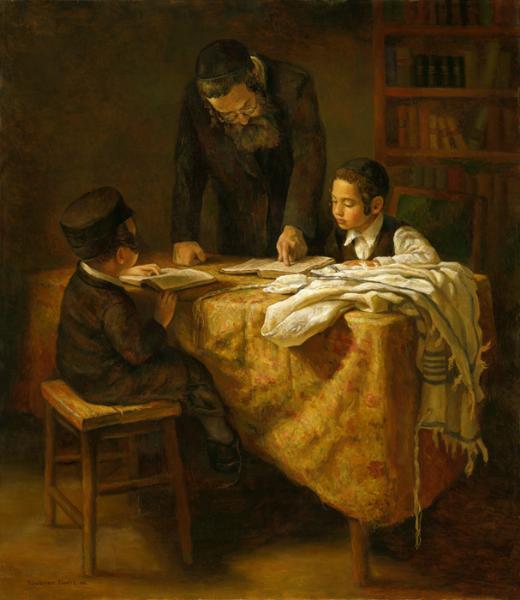
As a Christian, you may think it strange that I support Jewish education. It’s not that I don’t support Christian education, but after all, my three children are Jewish and they should know what it is to be Jewish, to know their history, to study the writings of the learned sages, and to cleave to what it is to be a Jew.

But as Rabbi Twersky points out, even many Jewish children raised by two Jewish parents today hardly know who the Rambam or Hillel were, much less are able to discuss even one single lesson they taught.

In my children’s case, that’s my fault for a number of reasons, not the least of which is that I’m not a Jewish father. Also, my wife and I came to faith rather late in life, when our children were already growing up. First we went to a church, then to a “Messianic” (One Law) congregation, then we split the difference with me taking the kids to the local Reform shul and my wife worshiping elsewhere (it’s a long story). Finally, I set my course on Christianity (albeit with an unusual expression and emphasis) and my wife on traditional Judaism.

But my kids are all adults now.

I remember that when my wife and I first started attending a church, we were not yet believers (I guess the church called us “seekers”), but we sent our kids to Sunday school and the church youth group to help them get a more focused moral center…one that we as parents did not yet share.

Horrible mistake. Grievous error. You can’t teach your children morals and values by proxy.

From what time may one recite Sh’ma at night? – 2a

In the Sh’ma, which we read every day, the verse instructs us to learn Torah ourselves and teach it to our children. In fact, a person can expect to be successful in transmitting God’s laws to his children only if he himself learns as well. If he makes no effort to acquire Torah knowledge, how will he have the ability to influence and to lead his children along the right path? Only when there are those who inherit the Torah’s teachings can these lessons in turn, be passed down to the next generation.

In a similar vein, a story is told about Rabbi Menachem Mendel of Kotzk, the Kotzker Rebbe. One of his Chasidim asked for a beracha that he merit that his sons study Torah with devotion. The Rebbe replied that the chassid himself had the key to ensure that this blessing could materialize. The Rebbe pointed out to this father that he should learn Torah with devotion, and then he could anticipate that his sons would follow his example. “For, if not,” the Rebbe warned, “your sons will come with the same request – that their sons should study with devotion while they occupy themselves with other matters.”

Torah can only be fulfilled when we are willing to exert ourselves directly and personally in its ways. We must demonstrate the importance of Torah learning by setting an example that others might follow. By merely stating ideals, these goals will not be reached. This lesson in Sh’ma is one of great importance, so much so that we must reinforce it twice each day.

Daf Yomi Digest
Stories Off the Daf
“Teach it to your children—by personal example…”
Berachos 2

I remember meeting with the Youth Pastor at the church we attended at the time and I asked him what I had to do to encourage my children in their “Christian walk.” He gave me essentially the same answer, although worded with more of a Christian “spin.” Most parents with any sort of wisdom at all realize that our children will almost never do what we tell them to do if they see we are not living examples of our lessons. They will however, always watch what we do and our behavior will become their teacher.

Derek Leman wrote a blog post the other day called WhyNotTorah4Christians? It is based on what we read in Deuteronomy 4:6:

Keep them and do them, for that will be your wisdom and your understanding in the sight of the peoples, who, when they hear all these statutes, will say, ‘Surely this great nation is a wise and understanding people.’

Leman suggests that it is not only vitally necessary for Jews to study Torah (and I agree), but for Gentiles, and particularly Christians to do so as well. I questioned him on this point, asking if that would not somehow encourage Christians to take on mitzvot intended only for Jews. He responded…

You asked: “But how do you reconcile that with opposition to a strict One Law interpretation of scriptures?”

I believe the answer is easy: it is impossible to truly STUDY the Torah and remain in the One Law position. I apologize in advance to those who will be offended. But the One Law position is based on a lack of study of Torah.

The One Law position makes the same basic interpretive error which is common in Christian readings of the Hebrew Bible. People see themselves in Israel’s scriptures by direct substitution. So God says, “And now, O Israel, listen to the statutes and rules,” (Deut 4:1) and One Lawers think, “This is speaking directly to me.” They skip entirely the question: this is what God commanded one nation at Sinai and I should study to determine what my relationship is to these commandments.

This is exactly the same as Christians reading Jeremiah 29:11 (“I know the plans I have for you…”) and making it a poster in the youth room as a promise to themselves. Never mind that it was addressed to Israel.

What we need is more study — deep engagement — context — thought.

So studying Torah…really studying Torah for a Christian, is as much about understanding the role of the Jews in relation to God as it is about understanding who we are as Christians in relation to Jews.

Although there are venues for Christians to study Torah, somewhat rarely in a traditional synagogue settings, and a bit more commonly through resources such as First Fruits of Zion’s (FFOZ’s) Torah Club series, I continue to have my doubts that we can fulfill the imperative of Deuteronomy 4:6, or that God intended us to satisfy that directive by going to classes. I think what we were supposed to do is observe the Laws of Israel in action and to derive the wisdom of God and the understanding of the Jewish people by observing their behavior.

The “behavior” of the Jewish citizens of the modern state of Israel is under constant criticism by most of the world these days, and almost no one is praising Israel as “a wise and understanding people.” It is also true that the majority of the Jews in Israel today are not religious and portions of those who are religious seem to demonstrate behaviors that seem hostile, aggressive, and even violent at times.

On top of all that, we have a subset of Christianity who feels that they are able to redefine Judaism in their own image and even insist that Jews do not have the right to define their own observance or establish their own authorities.

In that light, Christians who have little or no experience in Jewish studies will indeed struggle to understand where and how to study Torah in a way that will be meaningful for them.

As for me, I tend to “dabble” in Jewish studies. My opinion is that one cannot simply study the Torah and Talmud in isolation, however qualified teachers of Torah (so far, all of my face-to-face teachers have been Christians) are few and far between in my neck of the woods. Of course, if my sole purpose in learning Torah was to teach my Jewish children, I’m more than a few years too late. As adults, the burden of learning has been passed to my kids and my opportunities for contribution have dwindled to nothing.

And yet, as we see, I have an obligation to learn Torah as a Christian for my own sake, for the sake of the Torah itself, in response to God, and perhaps even for the sake of unknown people who may observe me (or read my blog) and somehow may benefit.

But there’s another reason:

You shall know… and take to heart (Deut. 4:39)

For many years Rabbi Sholom DovBer of Lubavitch suffered from ill health, compelling him to undertake many trips to various European healing centers to consult with medical specialists.

On one such occasion, a professor-physician who had examined and interviewed the Rebbe categorized his ailment in the following manner: the heart craves something that is beyond the capacity of the mind, and the mind understands more than the heart can bear…

-Rabbi Yanki Tauber
“Rebbe’itis”
from the “Once Upon a Chasid” series
Chabad.org

There is an insatiable drive within me, and I believe it is shared by many others like me, to learn, to reach out, to explore, to stretch the limits of knowledge and understanding beyond the five senses, and beyond what the mechanics of the human brain may know. I strive to discover the world beyond the plain, black and white qualities of the known universe and to seek the textures and colors of the infinite and unknowable God, which cannot be detected by logic alone.

This is why I believe we should all study Torah and sit at the houses of learning of the Jewish people, who have kept the Word of God for thousands of years before the first Christian ever rose from the dust of paganism to meet the God of Israel.

It’s not a perfect world and we are not perfect people. Many Christians criticize what Jews teach and believe that they deny the reality of Jesus as Messiah and Lord. Many Jews do indeed deny that knowledge, but a growing number have come to both knowledge and faith. Where do we go to meet each other? Where is there a place where Christian and Jew may intersect and share a common God? Jesus taught upon the foundation of the Torah and I believe Moses would have understood him very well.

For our own sakes, for the sake of our children and the generation of Christians who will come after us, and most of all, for the sake of God and our own sanity, we must take the next evolutionary step in our faith and rise above the static teachings of supersessionism and replacement theology. Salvation comes from the Jews (John 4:22) but for the church to study Torah; for me to be able to study Torah in a real and meaningful way…

…God will have to create a miracle.

This miracle I believe, when it is brought about, will be another stone upon which the Mashiach will step as he hastens to return to us.

…under the leadership of Mashiach, even Jews who are farthest away from God’s service will be brought back into the fold by gathering them in and rediscovering the point in their hearts with which they still cling to God. These modern worshippers of Pe’or; the spies and the congregation of present-day Korach will all be a part of Mashiach’s redemption. As we see in this week’s haftarah of consolation, “Like a shepherd [who] tends his flock, with his arm he gathers lambs, and in his bosom he carries [them], the nursing ones he leads.” (Isaiah 40:11)

-Rabbi Yitzchak Ginsburgh
“Completing Moses’ task”
from Harav Ginsburgh’s class, 11th Av 5772
Wonders From Your Torah

May the Messiah come soon and in our days.