Tag Archives: Talmud

Saving Israel

Several reasons are given why it is prohibited to record the oral Torah in written form.

Ritva (Gittin 60a) and Ra”n (14a) explain that once something is put into writing, it is subject to being interpreted or misinterpreted according to the viewpoint of the reader. Putting such developed ideas into written form necessarily restricts the concepts into rigid sentences, which is too limiting for their true meaning. When, however, concepts are transmitted orally from rebbe to talmid, they are able to be articulated and explained with emotion and clarity.

The give and take which follows allows a student to ask and pursue that which needs further elucidation. This is essential for the transmission of the mesorah, and this is why the Torah prohibits us to record the oral law in written form.

P’risha (O.C. 49:1) also notes that the written word limits the ideas it represents by the usage of particular phrases and expressions. This leads to subjective interpretation and understanding based upon the author’s choice of words, which may or may not convey the accurate intent of the writer to the reader.

Daf Yomi Digest
Distinctive Insight
“The oral law may not be written down”
Termurah 14

I have to admit, I’ve never comprehended this. It’s always been my understanding that information transmitted orally from one generation from the next was subject to distortion over time. We see this demonstrated in the children’s game where kids sit in a circle and one child whispers a short story to the next. The story is transmitted around the circle, and by the time it gets to the person who told the original story, it (in all likelihood) has significantly changed. Even an individual’s memory of a single even tends to change over time, making eyewitness testimony in court unreliable, although legally, it is still considered one of the more reliable forms of evidence.

Add to all that the fact that during different periods of exile in Jewish history, there were “breaks” in the transmission process when it is very likely that the Oral Law was not transmitted at all. Once such a break occurs, how could this information be recaptured if it has not been preserved in some documented form? Once the last of the old generation dies, if they haven’t passed on the oral law to the next generation, the oral law dies with them.

That’s why we have written information. That’s why we have books, magazines, newspapers, and other physical and virtual documents. So that information can be preserved over time, unaffected by a distortion of transmission or a distortion of memory.

And yet, the above commentary is right in that, once information is nailed down in written form, it becomes accessible to everyone’s individual and subjective interpretation. We see this commonly in Bible interpretation, particularly within the church, where any individual can tell themselves that a scripture means “such and thus” to them, even if it doesn’t carry that meaning for anyone else.

(I say “particularly within the church” because Judaism tends to interpret the Bible based on established tradition rather than an individual’s “feelings.” To be fair though, it is true that Christianity also has traditions that are applied to Bible interpretation, but the “freedom” the average Christian has seems to include the freedom to ignore scholarship, at least on occasion)

Don’t look to me for an answer to this conundrum, because I have none to give you. We know that the Oral Law was finally redacted around 200 CE because of the fear that it would be lost due to the Jewish exile from Israel, and so we have a rich body of interpretation and commentary on Jewish Law that is with us to this day.

But in studying this topic in today’s Daf and the original reasons that documenting the Oral Law was forbidden, I did come across this.

Yefei To’ar (to Shemos Rabba 47:1) explains, based upon the Midrash, that if the oral law would be written there would be a risk that the gentiles would take our law and copy it for themselves. They would implement many of the aspects of our system of life, and the clear and obvious differences between the Jews and the non-Jews would be less apparent, causing many Jews to blend into the non- Jewish society.

Most Christians reading this quote will find it rather a strange concern for the Jewish sages to have, since one of the foundations upon which Christian faith is built is on the destruction of Jewish Law and it being wholly replaced by the grace of Christ. In fact, in the long history of the Christian church, most church theologians, scholars, and clergy have gone out of their way to avoid any type of practice of anything that looks like Judaism in worship or belief. Christians are not only completely uninterested in copying Jewish law, they actively disdain it.

(OK, this is overly simplistic and there are a number of parallelisms historically between Christianity and Judaism, but for the sake of this “mediation,” let’s assume that the schism between Jewish and Christian thought, faith, and practice is absolute)

But in the here and now, we have a glaring exception. Messianic Judaism.

To be more accurate, there’s a branch of Messianic Judaism called “One Law” that states Gentiles who are “grafted in” to the root of Israel are also grafted in to the full “yoke of Torah” such that, there is no distinction between Jewish and “Christian” practice of the Law. In essence, the dire worry of the sages has come to past. The Gentiles have taken the Law and copied it for themselves. Let’s read part of the quote again that predicts the result:

They would implement many of the aspects of our system of life, and the clear and obvious differences between the Jews and the non-Jews would be less apparent, causing many Jews to blend into the non- Jewish society.

This is precisely the concern many ethnic, cultural, and religious Jews in the Messianic movement have, and it seems the concerns of the sages are well justified.

But wait.

It’s not the Oral Law that is being copied by the Gentiles, it’s the written Torah. The Gentiles in “the movement” have about as much interest in the Oral Law as their traditional Christian counterparts. So it seems that documenting the oral traditions really hasn’t yielded the feared result.

But the core of the concern remains. Gentiles are copying Jews and the distinction between Jews and Christians is eroding. Some Jews who have only a tenuous understanding of what Judaism actually is, are gravitating to One Law congregations rather than pursuing more significantly Jewish communities (Again, to be fair, many One Law Jews have been raised in Jewish homes and have a very strong Jewish identity). Many Gentiles who have become disillusioned with the church are flocking to One Law congregations in droves, believing they are embracing their “lost” Jewish roots and in practice, becoming “pseudo-Jews.” It doesn’t matter then, whether the Oral Law was written down or not, since the written portion of Torah was sufficient to produce a collection of Gentiles who, for all intents, believe they are “spiritual Jews,” and who have adopted many of the Jewish religious practices and traditions.

Praying with tefillin(It should be noted here that many non-Jewish One Law practitioners actually do adhere to some of the Oral Law without realizing it, since the traditions involving how to put on a tallit gadol, lay tefillin, perform a blessing before a meal, conduct a Torah service, and many other worship activities, are rooted in the Oral Law rather than in written Torah. Some of the prayers in the siddur originate in the Zohar, thus even small portions of Kabbalah are unknowingly included in One Law practice)

The irony is that, in utilizing the written but not Oral Law of the Jews, One Law Gentiles fulfill the concern of the sages which has lead to…

…a subjective interpretation and understanding based upon the author’s choice of words, which may or may not convey the accurate intent of the writer to the reader.

Modern Judaism believes that the written Torah, and the intent of the author’s choice of words, cannot be accurately understood unless seen through the lens of the oral Torah. In disregarding the oral traditions and rulings, the Jews and Gentiles in One Law may be falling into the trap that so concerned the ancient sages. Of course, there are branches of Judaism that historically have rejected the Oral Law, such as the Sadducees and Essenes, but unlike the Pharisaic tradition, they did not survive into modern times. The Kararites have survived and currently exist, but they are the only Jewish sect I’m aware of, that does not, in some manner or fashion, recognize the Oral Law.

(It is true that between Reform, Conservative, and Orthodox Judaism, there are differing levels of adherence to Oral Law, but none of these branches does away with the it altogether).

Usually, in discussions like this one, the primary concern presented is Gentile “misuse” or “misapplication” of Jewish Law, which I’ve certainly addressed, but the Story Off the Daf for Temurah 14 illustrates another problem.

It is tragic that so many Jews have fallen away from Torah observance in the modern period. Immigration to America—the “Goldeneh Medinah” —played a large role in a historic shift away from tradition. The vast majority of those who arrived here from “der alter heim,” the “old country,” fell away from observance. At a superficial glance, this seems a bit hard to fathom. Throughout our long past, the Jewish People faced so many obstacles, a multitude of decrees forbidding Torah, which did not deter us at all. What was it about America, and the rest of the free world, that had such a detrimental effect on Torah and mitzvos?

Perhaps we can understand the solution to this puzzle in light of how the Chofetz Chaim, zt”l, explains a statement on today’s daf. “In Temurah 14 we find that it is better for the Torah to be disrupted then forgotten. When various parties rise up and block us from learning Torah, the situation is not so spiritually dangerous as one might have thought. When they chase after people who learn, usually we find a solution. Jews learn in caves, attics and cellars, and Torah is preserved.

“A far worse situation is when Jews forget the Torah—when it is abandoned and considered unimportant. Then, learning Torah is something that Jews simply do not aspire to at all. In such circumstances, there is a vast spiritual danger.

“To understand the true state of a Jew without Torah let us consider a person who is completely paralyzed. Just as such a person is sadly unaware of what the senses of a normal person would perceive—since he is completely unfeeling—the same is true of those who have no feel for the value of Torah.”

My wife was raised in an intermarried family. Her mother was Jewish and her father, raised as a Christian Scientist, had left the faith and was non-religious. Her mother also had left religious, and for the most part, cultural Judaism to such a degree that my wife didn’t even realize that she was Jewish until early adulthood.

After my wife and I converted to Christianity some fifteen years ago or so, her first sustained exposure to “Judaism” was via the One Law congregation we started to attend. If she had stayed there, she more than likely would have continued her faith in Jesus. However, she wouldn’t actually have understood what it is to be a Jew, since the congregational leader and most of the board of elders were not Jewish. Even those Jews who participated in the congregation back then, had not been raised in cultural and religious Jewish homes.

But the drive in her to understand what it is to be a Jew would not let go, and she eventually gravitated to first the Reform, and then the Chabad synagogues. There, she established herself among other Jews and enjoyed the full measure of participation in a completely realized ethnic, cultural, and religious Jewish community.

But the cost was her faith in Jesus.

What would have made a difference? I’m not sure anything would have. I’m not some sort of dictator in the home, and I cannot simply tell my wife where to go, how to feel, and believe. I’m not going to tell her she must embrace Jesus as the Messiah. I believe each human being negotiates his or her own relationship with God and no one can act as a go-between. If, perhaps, we had a congregation available that offered a fully Jewish community and true Jewish worship of the Jewish Messiah, maybe…maybe it would have made a difference. Maybe my wife could have securely explored her Judaism while preserving her faith in Jesus. But we don’t live in a world of “what ifs”. We live in a world of completed actions and what is done, is done.

I know that my friends in the One Law movement (who will no doubt be upset at today’s “meditation”) will tell me that if she had stayed in One Law, she could have lived a completely Jewish lifestyle and a continued to be believer, but I know that congregation well. I love the people who attend and who lead, and they are sincere in their faith and wonderful disciples of the Master…but it’s not a Jewish congregation. The men may wear kippot and don tallitot in prayer, they may use siddurim, and call the Master, “Yeshua,” but the vast, vast majority of them are Gentiles, and most of the Jews weren’t raised within Judaism.

tallit-prayerSo should I raise Judaism above the Messiah? As Paul might put it, “heaven forbid.” But I can’t separate a Jew from the Jewish worship of the Jewish Messiah, either. I cannot demand that a Jew, in order to maintain faith in the Moshiach, water down or delete their Jewish identity in any aspect. 2,000 years of history have created the illusion that there must be a separation between Judaism and Jesus and sadly, that separation is being maintained, not only by traditional Judaism and traditional Christianity, but by (hold on to your hats) the One Law expression of the Messianic movement. For in removing the Oral Law and traditions, which I’ve said before have been the only things that preserved Jewish cultural and religious existence in post-Second Temple times, they have removed almost everything that comprises historic and modern Judaism, and that tells a Jew what it is to be a Jew.

(I’m not making this up. For an excellent illustration of the meaning of Oral Law, tradition, and Talmud to the Jewish lifestyle, read Rabbi Daniel Gordis’ book God Was Not in the Fire)

I know I’m going to be criticized for yet another one of my opinions, but like the proverbial baseball umpire, “I calls ’em as I sees ’em.” I continue to be grieved that my wife no longer recognizes Jesus Christ as the “hidden” Messiah who will one day be revealed to Israel, but I cannot behave toward her as have countless generations of Christians across the long march of history, and demand that she stop being Jewish, even in the smallest detail, for the sake of worshiping a Messiah most of Judaism disregards. I do however, continue to pray that this is not the end of her story or the final destination of her path, and that there is a milepost up ahead, or an unseen bend in the trail, where she will one day be reunited with the “Maggid of Natzaret.”

Lest you be wise in your own sight, I do not want you to be unaware of this mystery, brothers: a partial hardening has come upon Israel, until the fullness of the Gentiles has come in. And in this way all Israel will be saved, as it is written, “The Deliverer will come from Zion,he will banish ungodliness from Jacob”; “and this will be my covenant with them when I take away their sins.” –Romans 11:25-27 (ESV)

Another Chance

The Ishbitzer Rebbe, zt”l, explains the deeper meaning of yovel and why houses within cities walled since the time of Yehoshua bin Nun do not return during yovel. “Yovel teaches that everything has a time. God doesn’t remain angry at anyone forever. Even if someone’s sins force him to sell his portion or to be sold as a slave, this cannot be forever. Eventually he will be redeemed and his inherited field will return to him. But batei arei chomah are an exception. This alludes to the two chomos, the two barriers—teeth of bone and lips of flesh—that God gave us to rein in what we say, as discussed on Arachin 15…Indulging one’s arrogance by failing to hold back one’s anger at his friend is no simple matter. If the victim remained silent in the face of his rage, the sinner’s merits are transferred to the recipient of his anger.

“Unlike sins between man and his Creator, sins between man and his fellow do not have an automatic limit. These misdemeanors remain until his friend forgives him. One has only limited time to beg his friend’s forgiveness. Failure to do so causes his merits to remain with his friend. His inability to accept his wrongdoing and make it up to his friend causes him losses he would never have imagined.”

But the rebbe concluded with words of chizzuk. “Nevertheless, we find that kohanim and leviim can always sell and always redeem. This teaches that even if one has sinned, if he begins to serve God in earnest, he can always redeem what he has lost. Through the dynamic change he gains through his avodah he always has another chance!”

Daf Yomi Digest
Stories Off the Daf
“The Walled Cities”
Arachin 31

What is being said here? We learn from the construction or organization of the Ten Commandments brought down from Sinai that there are two general classifications of sin: sin between man and God and sin between man and man. Of the first, God will forgive by His own grace and mercy and not necessarily because of the merit of the sinner. We rely on God to give us something we could not possibly earn. However of the second, we will not be forgiven until (or unless) we ask for forgiveness from our fellow. In this, we must take a much more active role, otherwise forgiveness will never occur. We also learn that if we stubbornly refuse to admit our wrongdoing against our fellow, this affects our relationship with God as well, so we have in some sense, doubly sinned.

The commentary concludes that, “even if one has sinned, if he begins to serve God in earnest, he can always redeem what he has lost.” But how can this be? If you sin against a person, ignore your responsibility for that sin, and go on to seemingly “serve God in earnest,” are you really serving God while remaining unrepentant? The answer is in the last sentence of the teaching: “the dynamic change he gains through his avodah he always has another chance!”

I suppose this could be read as saying that by serving God, even though you have not sought forgiveness of the person you sinned against, your service to the Almighty somehow compensates. I don’t think that’s what is being said here, though, since the sin against your friend remains. I think it is much more likely that, by honestly and truly serving God, it will become necessary for your soul to turn to Him and in order to do so, you will have to see the stains on your own character. Once you do, and with your desire to serve God earnestly still intact, as part of that service, you must go back to the one you offended and beg forgiveness. Only then, can you return to God and have your response to Him gain real meaning.

So if you are offering your gift at the altar and there remember that your brother has something against you, leave your gift there before the altar and go. First be reconciled to your brother, and then come and offer your gift. –Matthew 5:23-24

We see that the Master is in agreement with the Ishbitzer Rebbe. Living a life in this world does not detract from living a life of holiness, as long as we keep our perspective.

It is not business, not money, nor career, nor human relationships that tears our souls from us and us from our G-d.

There is as much beauty in any of those as there is in any flower from the Garden of Eden. As much G-dliness as in any temple.

It is the way we lock ourselves inside each one, begging it to take us as its slave, refusing to watch from above, to preserve our dignity as human beings.

As you enter each thing, stay above it.

Rabbi Tzvi Freeman
“Unslavery”
Based on letters and talks of the Rebbe
Rabbi M. M. Schneerson
Chabad.org

As much as we fail and allow ourselves to become slaves of the world around us or even our own emotions and pride, God provides every opportunity for us to make amends and to succeed in serving God and serving our fellow. If we do not surrender to anger, frustration, and despair, and continue to seek Him, we will always have another chance.

Understanding the Infinite Scroll

One year there was a drought and the price for food rose exorbitantly. In Frankfurt, some Jews literally could not put bread on their table. Rav Avraham Avish, the Av Beis Din of Frankfurt, zt”l, literally gave every penny he owned to help the destitute during that year. One student wondered how this could be halachically permitted. “Didn’t we learn that it is forbidden to give over twenty percent of one’s property to charity?” he asked.

Rav Avraham Avish rejected this claim out of hand. “Although you have learned you still do not grasp how to understand a sugya in depth. It is true that in general one who gives over a fifth of his property to tzedakah violates a rabbinic prohibition, but that is irrelevant in a year where there is no food and people are endangered. To save a life, we even desecrate Shabbos which is much more stringent than any rabbinic decree!”

Daf Yomi Digest
Stories Off the Daf
“Not more than a Fifth”
Arachin 28

For the Christians reading this, and perhaps for some Jews, the meaning of my quote “off the Daf” today may not seem very relevant, but I posted it above for a single, important reason. There’s a sentence that teaches us something we need to constantly keep in the forefront of our thoughts:

Although you have learned you still do not grasp how to understand a sugya in depth.

It means that you can be smart and even well educated, and still not be able to look at something in the way that’s necessary or in sufficient depth to be able to understand it. We see this all the time in the various sciences, especially as we examine the history of scientific discoveries and knowledge. First the Earth is flat and now it’s round. First the Earth is the center of the universe, and all heavenly bodies revolve around us, now Earth revolves around a mediocre star off to one side of our huge galaxy. First you cure a fever by applying leeches to drain bodily fluids, now you give the person antibiotics to cure their infection.

As we investigate our world, we learn, but at each point in our journey of discovery across the long stretch of history, we thought we knew exactly what we were doing and what was going on. We couldn’t have possibly imagined that the world wasn’t flat or that applying blood-sucking parasites to our bodies really wouldn’t cure a fever or other types of ailments.

And although a student of Rav Avraham Avish understood that the general principle is to give only up to one-fifth of your income to charity to avoid bankrupting yourself and failing to support the needs of your own family, he still didn’t understand the underlying foundation behind the principle that would allow the Rav to contribute his very last dime to starving people, and still not violate halacha.

But what’s all that got to do with us?

Has it ever occurred to you that you could be wrong?

It probably has, especially on those occasions when you were sure you were correct in some matter of judgment, or thought you could spell the word “Mediterranean” without looking it up. OK, we’re human and we can make mistakes. It happens to the best of us and most people have learned to admit it.

Almost.

The conversation in my extra meditation from yesterday turned into a mini-debate on the letter to the Hebrews found in the New Testament. Since this letter has always been a bit of a puzzle to me, I’ve found that I’ve been at sort of a loss as to how to respond to the traditional supersessionist interpretation of it. Fortunately, many people have responded to me, both in blog comments and via email, to suggest different references, and even have sent me information to help illuminate my path in this particular direction. One such piece of illumination is as follows:

Unique among all the scholars I consulted, Charles P. Anderson sees Hebrews in a Jewish communal context. It is as if all the other commentators have been wearing sunglasses, and only he is wearing clear lenses. All the others see the recipients of Hebrews as Christian individuals of Jewish background rather than as a group of Jews who see themselves in the context of their community with each other, with the wider Jewish world, and with their people throughout time. His perspective is in my view the right one, his argument convincing and illuminating. Throughout my research on Hebrews I was longing to find someone who saw things this way. Finally, toward the end of my research, I found Anderson’s brief chapter.

Charles P. Anderson is Associate Professor of Religious Studies, University of British Columbia, Vancouver, British Columbia, Canada. I am reproducing here a large body of quotations from his article ” Who are the Heirs of the New Age in the Epistle to the Hebrews?” Especially when read against the background of common assumptions concerning the Letter to the Hebrews, his perspective stands out as something fresh, and to me, thrilling. I would hope that all who read his article and these quotations from it would be moved to say, “Why didn’t I see this before?” The answer to that question is “Because of the Christian exegetical tradition.”

-from a paper presented by Stuart Dauermann
commenting on Charles P. Anderson’s article
“Who are the Heirs of the New Age in the Epistle to the Hebrews?”

Carl Kinbar was kind enough to send me a PDF of the appendix to Dauerman’s paper which includes the above-quoted statement. This is the point I’m trying to drive home, both about understanding Hebrews and understanding the broader Biblical context.

It’s not that easy.

We may think it is easy because we’ve got hundreds and hundreds of years of traditional Christian interpretations to fall back on, and we’ve concluded that the correct way of understanding Hebrews is to say (gasp) that the Law of Moses was replaced by the Grace of Christ.

Period.

But like anyone who gets into a particular habit that may once have been helpful, we have to ask ourselves if the “habit” of our traditional way of understanding Hebrews (or any part of the Bible) really the best way we’ve got right now?

That’s a tough one. It’s difficult for me to say there is one and only one correct way for to understand the Biblical text. True, from God’s point of view, there probably is one correct, objective understanding, but we are mere humans and don’t enjoy God’s infinite wisdom and vision. It’s also possible that at least some parts of the Bible were never intended to mean the same things to all populations across all generations. After all, the Jews don’t keep slaves any more, so are the laws in the Torah about slavery still “eternal truths?”

This is what bothers me a little about blog posts that are titled Reading Acts 15:21 Correctly. While Derek Leman no doubt believes how he interprets this passage in the New Testament is the correct interpretation (and I don’t necessarily disagree with him), it’s obvious from reading the different comments in response to his blog post, that not everyone sees the same thing in that single verse of the Bible. If we can disagree about a the meaning of a single sentence in the Bible, how much more do we all disagree on the letters of Paul and the product of our dear letter writer to the Hebrews? How can any one person say, “this is what such-and-thus means in the Bible, forever and ever?”

Adding to this puzzle is the concept in Judaism that the Bible can only be interpreted correctly using accepted tradition. Sure, as the Daf above explains, there are endless ways to “dig deeper” into the text, but you don’t just “shoot from the hip” as far as understanding Biblical or Rabbinic halacha is concerned. I suppose Christians could say the same thing about their (our) standard interpretive traditions, but we have a problem (technically, so does traditional Judaism, but I’ll set that part aside for another time). Our problem is that our entire perspective on interpreting the Bible completely ignores the viewpoint and mindset of the original writers, who were first century Jews, steeped in “the hashkafah of the Tanakh.” Without said-viewpoint based on a first century Jewish worldview, it is likely we may have missed a step or two over the past 2,000 years in terms of New Testament scholarship.

The deal is, we who call ourselves Christians might need to stop and consider for a moment what we believe about the Jews and why. If our perspective on Jews and Judaism includes the necessity to declare Jews, Judaism, and the Torah of Sinai obsolete, and results in us believing that Jews who continue to worship and live within a classical Jewish framework are being rebellious and sinful, we should think about the possibility of a reasonable alternate explanation. The explanation should be one that would make sense to our first century writers and scholars and should not require that God abrogate His promise that the Hebrews would be a “peculiar people” before Him forever.

I say “reasonable” because there are just billions of “pop” theologies out there on the web that “tickle the ears” but have little substance or validity (although they can weave a multi-layered tapestry of mashed up Biblical cross-connections confused enough to “cross a Rabbi’s eyes”). They’re like cotton candy for the brain; tastes really sweet and initially invigorating, but containing zero nutritional value. However, as my little snippet from the paper written by Stuart Dauermann shows, solid Biblical research, although unconventional from a traditional Christian viewpoint, exists and provides a valid and compelling alternate interpretation to understanding the New Testament text, including the Book of Hebrews.

Obviously, I’m in no position to present that alternate interpretation of Hebrews in any detail at the moment, but I just wanted to show that it exists and should be seriously considered by any Christian who has an honest desire to place truth and a correct understanding of the intent of God and the Apostolic writers ahead of our old, comfortable, Gentile-friendly theologies. I’ll be writing on this topic again in the months that follow.

Oh, in case you were curious how our “Story Off the Daf” ends up, here’s the rest. It’s also an interesting “test” in terms of determining the identity of the Messiah.

In Yemen nine centuries ago, life was especially hard due to harsh decrees. In the middle of these challenges to the community one man secretly claimed to be Moshiach, soon to bring the longawaited redemption. Although many Jews were convinced, others were unsure and put the matter to the Rambam, zt”l. The Rambam sent students to test this man and discern if he could possibly be Moshiach. When they returned they began to tell the Rambam everything that they had observed. “This man disburses every cent he has on charity.”

The moment the Rambam heard this he immediately interjected that this man cannot be Moshiach. “It is clear that a person who violates our sages’ command not to give more than a fifth to charity is not our redeemer. Although it is permitted to give more to redeem one’s sins, Moshiach should not have any sins to redeem!”

I’ll wrap this up by quoting from Rabbi Tzvi Freeman’s interpretation of the Lubavitcher Rebbe, which illustrates an additional challenge we encounter in understanding the Word of God.

This Torah we were given is not of the world, nor is it something extraneous to it. Rather, it is the hidden essence, the primal thought from which all the cosmos and each thing within it extends. It is not about the world, it is the world—the world as its Creator sees it and knows it to be.

The sages of the Talmud told us that the Torah is the blueprint G-d used to design His creation. There is not a thing that cannot be found there. Even more, they told us, G-d and His Torah are one, for His thoughts are not outside of Him as our thoughts are.

But He took that infinite wisdom and condensed it a thousandfold, a billionfold, and more, into finite, earthly terms that we could grasp—yet without losing a drop of its purity, its intimate bond with Him. Then He put it into our hands to learn, to explore and to extend.

So now, when our mind grasps a thought of Torah, thoroughly, with utter clarity, we grasp that inner wisdom. And at the time we are completely absorbed in the process of thought, comprehension and application, our self and being is absorbed in that infinite wisdom which is the essence of all things. We have grasped it, and it grasps us. In truth, we become that essence.

studying-talmudThis is a very mystical understanding of the “life” of the Torah and how in Chasidic Judaism, it transcends the physical scroll and exists as both the blueprint of the Universe and the means of its creation. Since we in Christianity understand that “the Word became flesh” (John 1:14) and that through the living Word, “things were made through him, and without him was not any thing made that was made,” (John 1:3) we also have a mystical understanding of the Bible, the Messiah, and creation, so perhaps the simple text on paper we see when we read our Bible and try to interpret it is not so simple after all. More than that, perhaps we cannot allow ourselves to limit that Word or that Messiah to what our Christian tradition says it all means, even if it makes us uncomfortable and stretches our understanding.

To drink “new wine,” we must prepare “new wine skins.”

Good Shabbos.

Why Don’t the Jews Convert to Christianity?

In my neighborhood, we did not even mention his name. We said “Yoshke,” a Hebrew play on his name, or some children learned to say “cheese and crust” in place of “Jesus Christ.” In a synagogue sermon, rabbis might refer to Jesus – exceedingly rarely – by saying “the founder of Christianity.”

Fundamentally, we understood Jesus as a foreign deity, a man worshiped by people. The Torah instructs us never to mention the names of other gods, as no other god exists except God. We also understood Jesus to be as anti-Jewish as his followers. Was he not the Jew who had rebelled against his people? Was he not the one who instructed his followers to hate the Jews as he did, instigating countless cruelties against those with whom God had established an everlasting covenant? Was he not also the man who had abrogated the Law and said that the Torah was now mostly abolished?

-Rabbi Shmuley Boteach
from the Preface (pg ix) of his new book
Kosher Jesus

I’m just beginning Rabbi Boteach’s latest and most controversial book and will write a full review when I’m finished. However, in reading the Preface and Introduction sections of the book, I find myself thinking that much of what I’ve consumed so far would be good material for every Christian to read and absorb. Look at what Rabbi Boteach is saying about how he understanding Jesus when Boteach was a young Jewish boy growing up in an Orthodox Jewish neighborhood. A Jew’s understanding of Jesus from earliest childhood is as a person who hated his own Jewish people, who taught his Jewish (and later, Gentile) followers to also hate Jews, and who founded a religion based on the idea that Jews must be eradicated.

And Christians wonder why Jews aren’t standing in line waiting to convert to that form of Christianity. Gee whiz!

But there’s more:

Until the deeply anti-Semitic Augustine of Hippo (354-430 CE) directly addressed the subject centuries later, early Church leaders held that Judaism would never survive. Even the powerful Roman Empire couldn’t resist the Christian juggernaut – eventually capitulating and adopting Christianity as state religion. It wasn’t a stretch for Christians to surmise that all remaining Jews would eventually convert, wiping out the ancient religion. But against all odds, Judaism survived and flourished.

-Boteach
Introduction, pp xiii-xiv

That last sentence reminds me so much of this:

Then Joseph died, and all his brothers and all that generation. But the people of Israel were fruitful and increased greatly; they multiplied and grew exceedingly strong, so that the land was filled with them. –Exodus 1:6-7 (ESV)

Even as Pharaoh, King of Egypt enslaved the Israelites and the Egyptians treated the Hebrews with terrible cruelty, under the harshest conditions, the Children of Jacob survived, multiplied, and flourished. Of course, Pharaoh had no intention of exterminating his population of slaves. They were much too valuable to him alive, so their continued survival was no mystery to him. However, for the early church, according to Boteach, the continuation of Jews and Judaism was inexplicable.

This makes me ask a few questions.

I wonder if the continuation of the Jews and Judaism today is what frustrates some Christians? It would explain something my brother-in-law said to me many years ago. He’s my wife’s younger brother and a born-again Christian. He denies that his mother was Jewish (even though we have ample evidence that she, her siblings, and cousins, and parents, and grandparents are all buried in Jewish cemeteries). I can’t remember how we got on the topic, but at one point, in a fit of emotion, he exclaimed, “Why can’t the Jews just accept Jesus?”

Maybe I should send him a copy of Rabbi Boteach’s book.

I think that the survival and flourishing of Judaism in the modern age is frustrating to some Christians. Rabbi Boteach goes on in the Introduction of his book, to illustrate how there has been much restoration of the relationship between Judaism and both Catholicism and Evangelical Christianity, so I can’t paint a terribly grim portrait of the Jewish/Christian interaction today. But there are still plenty of Gentile believers who seem to wish that Judaism would just plain “go away” and who are at a total loss as to why God would allow the Jewish people to continue as a distinct group on the face of the Earth.

My other question has to do with “Rabbinic” or “Talmudic” Judaism. In any real sense, this is the only valid form of Judaism in the post-Second Temple world (and I’m including significant portions of Messianic Judaism in this group), since without a Temple, functioning priesthood, and functioning Sanhedrin, much of the Judaism of the Torah cannot be observed, even in Israel. I’ve said before in a few blog posts that the Talmud and the traditions of the Sages are a major reason why Judaism survived in a hostile post-Temple world and across the long centuries after 70 CE and after the majority (but not all) of the Jews were exiled from Israel by the Roman conquerors.

Throughout the history that followed the last Jewish exile, on many occasions, Christian religious authorities tried to destroy the Jews by burning their synagogues, their Torah scrolls, their siddurim (prayer books), and their Talmud. Sadly, Martin Luther, near the end of his life, reversed any good he did to bring Christ closer to the Christians by advocating the destruction of the Jews:

…set fire to their synagogues or schools and to bury and cover with dirt whatever will not burn, so that no man will ever again see a stone or cinder of them. This is to be done in honor of our Lord and of Christendom, so that God might see that we are Christians, and do not condone or knowingly tolerate such public lying, cursing, and blaspheming of his Son and of his Christians. For whatever we tolerated in the past unknowingly ­ and I myself was unaware of it ­ will be pardoned by God. But if we, now that we are informed, were to protect and shield such a house for the Jews, existing right before our very nose, in which they lie about, blaspheme, curse, vilify, and defame Christ and us (as was heard above), it would be the same as if we were doing all this and even worse ourselves, as we very well know.

…I advise that all their prayer books and Talmudic writings, in which such idolatry, lies, cursing and blasphemy are taught, be taken from them….

From “Martin Luther: The Jews and Their Lies” (1543)
as quoted by Jewish Virtual Library

If some Christians, both historically and currently, experience frustration at the continued existence of Judaism, they might also experience frustration at and hostility toward the mechanisms by which the Jews have survived: Jewish prayer, synagogue worship, Torah readings, and particularly Talmudic study. If you destroy a people’s lifestyle and culture, you destroy the people, perhaps not in body, but in spirit and identity. As an example, allow me to present the Native American peoples who were all but wiped out by European expansion across this continent over the past several centuries. There are tribes who no longer know their own written and spoken languages, who have lost many of their traditional ceremonies and history, and who are hanging on to any remaining shred of their identity as a people by their fingernails.

This is what could have happened to the Jewish people and to Judaism if the Talmud had successfully been destroyed. But is this why some Christian and Hebrew Roots groups oppose the study and authority of Talmud among Jews today? Does it somehow diminish those who say they follow the cause of Christ if the Jews continue to adhere to that which has allowed them to survive and to flourish as Jews?

I suppose you could say I’m being a little hard on Christianity and some parts of Hebrew Roots for their opposition to the Talmud of Judaism, but frankly, even if their intentions are “benign” from their own point of view, if they had gotten their way, there would be no Jews walking around today or at best, the “Jews” we’d recognize would be a shell rather than a thriving Jewish culture. Their identity would be shattered, and all that would be left of the people established by God Himself at Sinai through the Torah, would be the tiny sparks and shattered fragments that somehow survived in the whitewashed and “Gentilized” teachings of the modern, refactored “Jesus Christ,” who started out well as Jewish Rabbi and Messiah, but who was turned into a non-Jewish icon symbolizing the extinction of his own people.

Having read my wee missive now, if you’re a Christian, if you’re a Pastor, if you’re a Bible teacher, if you’re a Church Choir Leader, if you’re involved in the church in any capacity whatsoever, take a moment and look at yourself in the mirror. Now ask yourself, why don’t the Jews convert to Christianity. You may not understand it yet, but I think you have the answer.

The Embarrassing Murder

On today’s amud we find a decree was instituted to avoid publicly embarrassing a fellow Jew.

Many are unaware that Rav Chaim Kaplan, zt”l, was the son-in-law of the famous mashgiach, Rav Yeruchem Levovitz, zt”l. As can well be imagined, Rav Kaplan was a baal mussar in the full sense of the word.

One time, Rav Kaplan’s student, Rav Waxman, saw him crying his eyes out, obviously absolutely devastated. This was a very shocking sight since it was a regular day in the beis medrash and the young man had not heard that any tragedy had occurred. The student approached Rav Kaplan and asked him what was bothering him, but the latter was so heartbroken that it was a while before he could answer. When the student inquired a second time, the rav tearfully asked him to bring a gemara Bava Metzia.

When the young man brought it from the shelf, the rav opened to the sugya in Hazahav that discusses the seriousness of embarrassing a fellow Jew in public. He concluded with the statement on daf 59 that one should throw himself into fiery furnace instead of publicly embarrassing another, which we learn from Tamar.

“We see from here that embarrassing another is compared to murder,” Rav Kaplan said sadly. “Imagine you were here in this beis midrash in the middle of seder when one young man pulled out a gun in front of everyone and shot his fellow student in the heart. Surely, anyone with a drop of human feeling would be unable to hold back from crying bitter tears after witnessing such a tragedy! After I witness one young man approach a fellow student and publicly shame him, is it any wonder that I cry? It is a wonder how a person could fail to cry!?”

Mishna Berura Yomi Digest
Stories to Share
“A Tragedy in the Beis Medrash”
Siman 139, Seif 1-3

I periodically receive a little criticism for suggesting that the Talmud and various Rabbinic commentaries are appropriate lenses by which to view the teachings of Christ and my faith in Jesus. For example, we see above that for one Jew to embarrass another in public is compared with the act of murder. In this tale’s rather dramatic telling, Rav Kaplan is seen to be crying uncontrollably, as if he had witnessed a horrible act of violence, after seeing one student in the beis midrash publicly shame another. Whether this event actually took place or not, can we really say that embarrassing someone in public is the same as pulling out a gun and shooting them? Can we find anything that Jesus taught that can even approach this?

“If your brother sins against you, go and tell him his fault, between you and him alone. If he listens to you, you have gained your brother. But if he does not listen, take one or two others along with you, that every charge may be established by the evidence of two or three witnesses. If he refuses to listen to them, tell it to the congregation. And if he refuses to listen even to the congregation, let him be to you as a pagan and a tax collector. –Matthew 18:15-17

You’ve probably heard this before, but the reason you have to go through such a lengthy set of steps in confronting the brother who has sinned against you, is to avoid embarrassing him. You approach him alone first, so the nature of his sin and the confrontation is just between the two of you. If he repents, then no one else is the wiser and no one has to be embarrassed. If that’s not effective, then you next approach your brother with just two or three witnesses. Again, the information is contained and only a few people have to become aware of the incident. Only if the sinner doesn’t repent are you compelled to bring the matter before the entire congregation, thus causing your brother embarrassment which, at this point, is probably unavoidable.

While Jesus doesn’t say embarrassing your fellow is like killing him, he obviously felt that embarrassing someone was a serious matter and should not be taken lightly. Jesus also said this:

“You have heard that it was said, ‘You shall not commit adultery.’ But I say to you that everyone who looks at a woman with lustful intent has already committed adultery with her in his heart. –Matthew 5:27-29

Now is looking at a woman and having lustful thoughts about her really the exact same thing as actually having sexual relations with her? After all, the former is not a physical act, it’s just a thought and perhaps a feeling. Maybe you fantasize about what it would be like to have “relations”, but nothing actually happens. The latter requires that you arrange to enter into a relationship with her, at least enough of one to be able to get together with her alone and have actual, physical sex.

And yet Jesus said they were the same. So can’t publicly embarrassing someone be the same as actually killing the person, in the eyes of God?

I don’t have God’s point of view, so I can’t say that He equates embarrassment to death (although many human beings have felt so embarrassed that they wanted to crawl under a rock and die, euphemistically speaking), but if we take Christ’s teaching to heart and reflect back upon the tale of Rav Kaplan, perhaps we should act as if it’s that important a matter.

Could it hurt?

Defining Judaism: A Simple Commentary

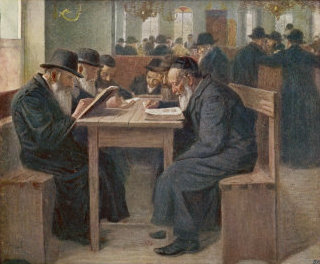
Talmud StudyWe find on today’s amud that one who is called up to the Torah has to have heard at least three verses—two if three is impractical—for his aliyah to count.

Someone once presented Rav Moshe Feinstein with a very common concern. He asked, “What if someone failed to hear some words of the Torah reading? Did he discharge his obligation if he missed a few? Many great scholars and tzaddikim were very careful and would make up any word missed by joining another minyan during their reading. But perhaps such stories are not because of any halachic obligation. Maybe they are merely a stringency?”

Rav Moshe ruled decisively, “It is obvious that one should not skip even one word of the reading if it is at all possible. Post facto, if one skipped and it was a day where we lain three verses, on the surface it would appear as though one does discharge his obligation. It is not permitted to read less than three verses. Since the person in question did not hear the minimum, he did not discharge his obligation. This is no different than the case of one who was called up to the Torah and they did not lain three verses—he also did not discharge his obligation if he did not hear the minimum number of verses.

Rav Moshe concluded, “If the reading contains more than three verses and he heard three he discharges his obligation with this aliyah, and if he heard another two aliyos he has fulfilled his obligation. Of course, on Shabbos and Yom Tov one has the problem that if he missed a part of the reading he will not merit to finish the public reading of the Torah for that year. However, in such a case one often has no recourse since he cannot have them repeat the reading only for him!”

Mishna Berura Yomi Digest
Stories to Share
“The Minimum”
Siman 137, Seif 5-6

Recently Dan Benzvi on his blog Fellow Heirs challenged me to discuss the relationship between the Torah, Oral Law, and the Talmud in his blog post The oral Torah. Authority of God or man. I’m not sure we “solved” anything, but at least we got the opportunity to (again) air our different perspectives on the matter.

Dan really does bring up some good questions, though. Can we believe that everything in the Mishnah and all of the rulings in the Talmud are indeed directly tied to the oral Laws God gave Moses at Sinai (assuming you believe that event actually took place) and that a Jew must obey all of the relevant Rabbinic rulings?

Take a look at the example I posted above from Mishna Berura Yomi Digest. There’s nothing in our written Bible that lends itself to describing the traditional Jewish Torah readings in anywhere near this level of detail. Can we believe that God gave these specific details to Moses? If so, why is there a question here? If not, then where did these questions and answers come from and why are they considered binding in Judaism?

If you’re a (non-Jewish) Christian, this entire discussion is moot. People who aren’t Jewish aren’t considered bound by any of the Rabbinic judgments under any circumstances, so we don’t have to give all this a second thought. But what about if you’re Jewish, and especially if you’re a believer (i.e. a “Christian” or a “Messianic Jew”)? If it’s not in the written Bible we have with us today but rather, in the extended Jewish documented wisdom, does it really matter?

Indeed, the Mishnah contains not a hint about what its authors conceive their work to be. Is it a law code? Is it a schoolbook? Since it makes statements describing what people should and should not do, or rather, do and do not do, we might suppose it is a law code. Since, as we shall see in a moment, it covers topics of both practical and theoretical interest, we might suppose it is a schoolbook. But the Mishnah never expresses a hint about the authors’ intent. The reason is that the authors do what they must to efface all traces not only of individuality but also of their own participation in the formation of the document. So it is not only a letter from utopia to whom it may concern. It also is a letter written by no one person – nor by a committee, either. Nor should we fail to notice, even at the outset, that while the Mishnah clearly addresses Israel, the Jewish people, it is remarkably indifferent to the Hebrew Scriptures.

The Mishnah makes no effort at imitating the Hebrew of the Hebrew Bible, as do the writers of the Dead Sea Scrolls. The Mishnah does not attribute its sayings to biblical heroes, prophets or holymen, as do the writings of the pseudepigraphs of the Hebrew Scriptures. The Mishnah does not claim to emerge from a fresh encounter with God through revelation, as is not uncommon in Israelite writings of the preceding four hundred years; the Holy Spirit is not alleged to speak here. So all the devices by which other Israelite writers gain credence for their messages are ignored. Perhaps the authority of the Mishnah was self-evident to its authors. But, self-evident or not, the authors in no way take the trouble to explain their document’s audience why people should conform to the descriptive statements contained in their holy book.

from the introduction to
The Mishnah: A New Translation
by Jacob Neusner

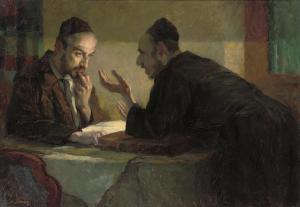
Talmud Study by LamplightThat description of the Mishnah is fairly similar to others I’ve read from various sources such as The Cambridge Companion to the Talmud and Rabbinic Literature, edited by Charlotte Fonrobert and Martin Jaffee. But given all of that, what can we say about Mishnah, Talmud, and Gemara?

I’m not particularly qualified to respond, not being a scholar in Jewish studies or anything related, but from what I gather, it’s extremely important to Judaism that these texts, opinions, commentaries, and judgments do exist. Here’s why.

After the destruction of the Second Temple in 70 C.E. and the subsequent eviction of most of the Jews from the Holy Land, what existed to define Judaism? Prior to this point, it was always the Holy Temple in Jerusalem. Even in the times between the Temples of Solomon and Herod, it was the ideal of the Temple and the Torah that, more than anything else, defined Jewish identity in exile. The longing for the Jewish people was always the return to Israel, both as nation and paradigm, and to worship again “as in days of old and as in previous years” (Malachi 3:4).

With the Second Temple reduced to scorched and shattered rubble, and the vast majority of the Jewish people exiled to the diaspora, what was to prevent the eventual assimilation of the Jews into the nations surrounding them and outnumbering them?

Judaism was always about being distinctive, as the scripture says, “and you shall be to me a kingdom of priests and a holy nation” (Exodus 19:8 [ESV]). All of the laws we see given to the Israelites in the Torah were designed to impact every area of their lives, serving as national constitution, penal and civil law, business ethics, social mores, and even personal and behavioral guides. In virtually every way, the nation of Israel was to stand out and stand apart from the nations of the world, primarily to lead its inhabitants to a holy life with God, but also to be a “light to the nations” (Isaiah 49:6, Isaiah 51:4), leading the world to God by example.

But a huge amount of the Torah laws apply only if you have a Temple, a functional priesthood, a system of courts including the Sanhedrin, and live within the geographic boundaries of the Land God gave in perpetuity to the Jewish people.

The Romans took all of that away, and then subsequent conquerors kept the Land and national self-rule from the Jews for the next 2,000 years.

Why didn’t the Jewish people assimilate and disappear into the pages of history? Many, many other people groups and religious traditions from that time have utterly vanished from our view. Why did the Jews, though extremely small in number, remain a people vitally alive with purpose and function; with faith and identity?

What do you think of when you think of a religious Jew?

The stereotypes some people have are guys in black hats and coats, wearing some sort of string off of their waistline, having large, bushy beards, and bowing over and over again when they pray. Some people think of “Jewish prayer shawls and prayer books” while others think of events such as Passover or Chanukah. Whatever religious stereotypes seem to identify the Jews, the activities are almost always different than any other people group in the world. Jews worship in different places than anyone else, pray differently, pray in a different language than anyone else, wear different clothes (at least sometimes), have different holidays, eat differently, sing differently and…well, you get the idea.

I can hardly say that the Mishnah and Talmud are direct representations of the “Oral Law” that goes back over 3,500 years to Moses and God on Sinai, especially given the description (or lack thereof) of the origins of the Mishnah. What I can say, is that what the Jews have as “people of the book”, are a set of laws and rulings that set them apart from any other nation and group on earth, and that has defined them and kept them and preserved them when everyone else was doing their best to completely annihilate the Jewish people.

No, I’m not denying God’s involvement in the preservation of Judaism and in fact, I’m counting on it. As God went down into Egypt with Jacob (Genesis 46:3-4), so too did He go into the death camps with the Jews during the Holocaust. So too did he go with the Jews into the newly created state of Israel and He is there with them now.

But in a very great way, one of the primary mechanisms that has maintained Judaism as Judaism for the past twenty centuries has been the Talmud. It has now taken on the status of “Holy” among the Jews, especially the Orthodox, and it has many critics, including within more liberal religious and secular Judaism. But without it, would there be a man or woman alive today that we could point to and know he or she is a Jew?

You can love the Talmud or you can hate it, but if you are a Jew, no matter who you are, you cannot dismiss its existence or its role in preserving your existence.

As an afterword, I want to apologize to all of the Jewish people reading this. I’m not trying to pass myself off as some sort of expert (I’m anything but an expert on Judaism) or to co-opt anything belonging to Judaism. I am just presenting the perspective of one Christian writer on why I think the Talmud is not just important, but historically vital for the existence of the Jewish people. Please keep that in mind when or if you decide to comment.