Tag Archives: Torah Portion

Vayikra: Voluntary Offering

The Torah portion Vayikra discusses various types of korbanos, sacrificial offerings, first relating the laws of voluntary offerings and then of obligatory offerings. Why does the Torah begin with free-will offerings; one would think that we should first be made aware of the laws regarding the korbanos that must be brought, and only then learn about the details of the voluntary offerings. The answer is that, by doing so, it indicates that the most crucial aspect of all offerings is that they be offered from a genuine desire to come closer to G-d – “his heart’s intent is for the sake of Heaven.”

It can thus be said that all korbanos are to be considered free-will offerings, for at the crux of all offerings are the feelings of the individual bringing them.

In fact, the intention required is found within each and every Jew, but when an individual brings a free-will offering, these latent desires are revealed for all to see.

Thus, it is not necessary for the Torah to command this intent, for it is found in any case; bringing the offering will automatically reveal the Jew’s innate intention of drawing close to G-d.

-from “Korbanos and the Heart’s Intent”
Commentary on Torah Portion Vayikra
Based on Likkutei Sichos, Vol. XVII, pp. 9-13
and the teachings of the Lubavitcher Rebbe
Rabbi Menachem M. Schneerson
Chabad.org

In Christianity, we have a tendency to view Jewish religious behavior as obligatory, works-driven acts; almost a kind of “slavery” to God. By comparison, the Christian believes that grace makes us as free as a bird in flight to enjoy the peace and understanding of a loving and forgiving God. What we do in response to the grace of God and the crucifixion of Jesus Christ is based (ideally) on sheer gratitude for all God has done for us. There are few, if any, obligations incumbent on the Christian, or at least that’s how it sounds when most Pastors deliver their message from the pulpit on Sunday.

But here we see a different side of Judaism, one that we’re not always aware of. We see that a Jew is encouraged to embrace the motivation of voluntarily drawing closer to God. It’s not a slave approaching a Master with bloody sacrifices on a hot, burning, and ash-filled altar, but a person who actually wants to approach, as a lover with a gift, desiring to enter into the presence of her paramour.

Today’s daf continues to discuss the halachos of various issurei kareis.

The evil inclination will drive a person insane if given half a chance. First it entices a person to sin. Then it riddles him with thoughts of guilt and gloomy thoughts of what will be the result of his sinful activities.

Rav Yitzchak Sher, zt”l, explained why the yetzer hara won’t even allow a person to enjoy having sinned. “The yetzer wants to kill us, as our sages teach. He therefore pushes one to sin and urges God to punish the hapless fellow. Even if he cannot kill us, he wants us to suffer. He is in essence saying, ‘You sinned, now give up all the pleasure too.’”

One of the strongest arguments the yetzer has is when a person transgresses issurei kareis, chas v’shalom. The evil inclination immediately begins harping on this stain, insisting that teshuvah doesn’t help—in direct contradiction of the Gemara itself. Yet even one who learned that kareis can be rectified cannot help being daunted by the need for Yom Kippur and yesurin to clean away such guilt. Although the Meiri there adds that a complete teshuvah also atones alone, who can say he has done a complete teshuvah?

The Chofetz Chaim, zt”l, brings that the Yesod V’Shoresh Ha’avodah, zt”l, teaches how to wipe away even the kareissins. “It is brought from the Arizal that one who did a sin punishable by kareis should stay awake the entire night and learn Torah, especially those segments where the sin he transgressed is discussed.”

The Yesod V’Shoresh Ha’avodah adds, “This practice is most frequently followed during the nights of Aseres Yemei Teshuvah. The custom is for people to stay on their feet and learn Meseches Kareisos the entire night.”

The Chofetz Chaim adds that one who learns Meseches Kareisos well attains added holiness and purity. Learning this tractate is a segulah to rectify transgressions.

Daf Yomi Digest
Stories Off the Daf
“Repairing the Damage”
Kereisos 3

That doesn’t sound very voluntary, but when we have distanced ourselves from God, it’s pretty tough to actually want to face Him again, particularly after we’ve sinned and let Him down. Guilt makes things a mess and we’ll put ourselves through all kinds of pain and sorrow as a result.

But God does not want sin to make His people distant and desires that His chosen ones draw close, even after periods of separation.

The unique love which G-d shows the Jewish people is reflected in the beginning of our Torah reading, which states: “And He called to Moshe, and G-d spoke to him.” Before G-d spoke to Moshe, He called to him, showing him a unique measure of endearment. G-d did not call Moshe to impart information; on the contrary, He called him to express the fundamental love He shares with our people. (For although it was Moshe alone who was called, this call was addressed to him as the leader of our people as a whole.)

The inner G-dly nature which we possess constantly “calls” to us, seeking to express itself. This is reflected by the subject of the Torah reading, the sacrificial offerings. The Hebrew word for sacrifice, korban, shares a root with the word kerov, meaning “close.” Sacrifices bring the Jews’ spiritual potential to the surface, carrying our people and each individual closer to G-d.

-Rabbi Eli Touger
from “The Dearness of Every Jew”
Commentary on Torah Portion Vayikra
Adapted from
Likkutei Sichos, Vol. VII, pgs. 24-26;
Vol. XVII, pgs. 12-15;
Sefer HaSichos 5750, Vol. I, p. 327ff
Chabad.org

But how does this speak to the Christian? Actually, it speaks to us especially so that me might understand how passionately God does not want His chosen ones, the Jewish people, to be distant from Him…ever. How can the joining of the nations to the God of Israel ever diminish, or God forbid, destroy the loving union between the Jews and God? How can we ever dare believe such as thing?

But if God is so close to the Jew, where does that leave the Gentile?

“For God so loved the world, that he gave his only Son, that whoever believes in him should not perish but have eternal life. –John 3:16 (ESV)

And Jesus came and said to them, “All authority in heaven and on earth has been given to me. Go therefore and make disciples of all nations, baptizing them in the name of the Father and of the Son and of the Holy Spirit, teaching them to observe all that I have commanded you. And behold, I am with you always, to the end of the age.” –Matthew 28:18-20 (ESV)

Therefore remember that at one time you Gentiles in the flesh, called “the uncircumcision” by what is called the circumcision, which is made in the flesh by hands – remember that you were at that time separated from Christ, alienated from the commonwealth of Israel and strangers to the covenants of promise, having no hope and without God in the world. But now in Christ Jesus you who once were far off have been brought near by the blood of Christ. –Ephesians 2:11-13 (ESV)

God’s grace and mercy are not limited to the Jewish people, although the Jews have been and always shall be a special people unto the Creator. God grants His grace to the nations of the world as well, but here’s the catch. We must volunteer to draw near to Him. We are not compelled to do so, nor are we born into His grace.

To one degree or another, if you are born Jewish, even though God desires the Jewish person to draw near of his or her own free will, there is an attachment of the Jew to all other Jews and to the Torah that can never be disconnected. You belong, quite frankly, whether you want to or not. This is not true for the rest of us. Although each of us was created in God’s own image, we either choose to draw near to Him or we choose to be distant. Even the atheist, who believes it is more rational to disbelieve in the existence of God, is still making a choice, since knowledge of God is abundant in the world around us.

But God desires us. He desires that we all draw near to Him and that none should be lost or perish (2 Peter 3:9). But we must desire Him. How can this be done, since all human beings desire only their own wants and needs without hardly a thought of God? It would take a miracle. Rabbi Touger’s commentary continues.

The G-dly potential within every Jew and within our people as a whole will not remain dormant. Its blossoming will lead to an age when the G-dliness latent in the world at large will become manifest, the Era of the Redemption. At that time, the Jewish people will “relate [G-d’s] praise” in a complete manner, showing our gratitude for the miracles performed on our behalf.

Herein we see a connection to the month of Nissan, during which Parshas Vayikra usually falls. Our Sages associate Nissan with miracles. Further, Nissan is the month in which the Jews were redeemed, and the month in which we will be redeemed in the future. At that time, our entire nation will proceed to our Holy Land and “relate [G-d’s] praise” in the Beis HaMikdash. May this take place in the immediate future.

The Rabbi’s words echo those of the Apostle Paul who also said that “all Israel will be saved” (Romans 11:26). We also see how the rest of us are included in God’s grace, as Rabbi Touger says that the “blossoming” of Jewish holiness, “will lead to an age when the G-dliness latent in the world at large will become manifest, the Era of the Redemption.”

This is the era of the Messiah’s return.

The Christian world is looking forward to a reminder of the return of Jesus in its celebration of his resurrection on Easter Sunday, which is on April 8th this year. For the Jew, the special time of redemption is when the Jewish people were redeemed from slavery by God, during the Passover season, which begins at sundown on Thursday, April 5th. I personally relate more to the Passover season for reasons too numerous to mention here, but regardless of which time you hold dear in your heart, realize that we are called, not to be chained to God, but to fervently desire to be near to Him, to draw close, to love His Word and His Presence in our lives.
To want to be near God, we must believe we are safe when we are with Him. We must do more than hope in Him, we must trust in God, something that is not always easy for me. I suppose this is a major reason why our relationship isn’t what it should be. I suppose it’s why God drops little reminders into my calendar; little invitations to draw near to Him. He does so every week on Shabbat. He does so every day for morning and evening prayers. He does so many times a year and, after all, as I just mentioned, Passover is drawing near. These are times when God asks me to set aside my doubts and fears, to trust Him, to believe in miracles, and to approach.

Trust transcends hope, as the sky above transcends the earth below.

The heart that clings to a thread of hope is anchored to its earthly bounds. It desires to receive, but its capacity is tightly defined. The thread snaps and your eyes look up to see nothing more than the open sky. Hope is gone. All you can do now is trust the One who has no bounds.

That is Trust: When you stop suggesting to your Maker what He should do. When you are prepared to be surprised and open to wonders and miracles.

-Rabbi Tzvi Freeman
“Trust over Hope”
Based on letters and talks of the Rebbe
Rabbi M. M. Schneerson
Chabad.org

Good Shabbos.
Building and Rebuilding the Tabernacle

Ever watch a child learning to walk? While strolling along confidently, albeit a bit wobbly, he’ll suddenly drop to the floor. With admirable persistence, he’ll usually pick himself right back up on his feet and continue on as if nothing had happened.

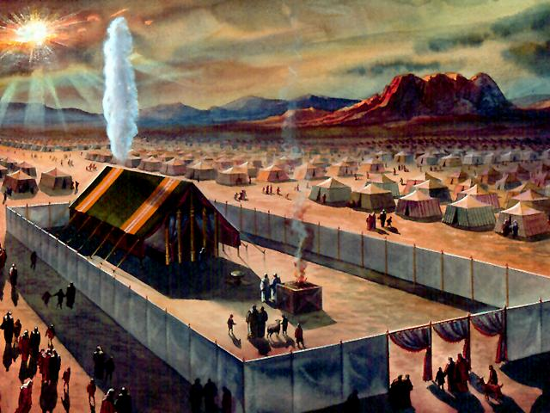
The Midrash (Tanchuma 11) says that throughout the seven inaugural days of the Holy Tabernacle, the portable dwelling place built for G-d’s Holy Presence, Moses would construct and disassemble it two or three times each day. The Tabernacle, of course, was a large and extremely heavy structure. Many of its parts were solid wood and gold, and it was tens of feet high. To build and dismantle the entire structure 14 times, or more, in one week must have been incredibly taxing to Moses! Why didn’t he just assemble it the first day, and then leave it standing until the next time G-d instructed the nation to travel?

There was a deeper meaning, however, to the construction of the Tabernacle, corresponding to the efforts of a person committed to spiritual growth. That person drafts a model of holiness, an ideal setting for rising above material and selfish pursuits, insuring the appropriate goals and safeguards are set. As he takes his first few steps of growth, he feels a sense of pride and serenity, assuring himself that he’s on the proper course. But soon, it all crumbles. The habits of the past return, and his best-laid plans for the future appear unattainable.

The continuous building and dismantling of the Tabernacle throughout the inauguration tells us that holy structures are designed to be built and rebuilt before they are completed. The nature of spiritual growth is to move forward and fall back, repeatedly, akin to the toddler’s efforts to walk. Although a toddler first falls immediately, after just a few steps, his strength, balance, and ability improve exponentially. Don’t be afraid when experiencing setbacks on the road to spiritual growth, because we are promised that the results will come — if we get right back up and keep trying!

-Rabbi Mordechai Dixler
Program Director, Project Genesis – Torah.org
“Pick Yourself Up, Brush Yourself Off”
Commentary on Torah Portion VayakhelPekudei
Based on Nesivos Shalom, Pikudei, 279
ProjectGenesis.org

In keeping with my previous blog posts based on Rabbi Tzvi Freeman’s A Multimedia Guide to Jewish Prayer series, I read the next installment in sequence, Climbing Jacob’s Ladder prior to writing this “morning meditation”. Unfortunately, the “Jacob’s Ladder” piece just didn’t inspire me as I had hoped. However, Rabbi Dixler’s commentary did.

Here I am, still sitting at the bottom of the dark, dusty abyss, looking at the ladder that has been placed before me by God, as an invitation to a dance, so to speak. As Rabbi Freeman commented in his Jacob’s Ladder article, What was that ladder? According to the Zohar, it’s the ladder of prayer. That’s what I thought when I wrote another of my morning mediations as well. But then how do I climb?

That reminds me of an old joke:

A tourist from an Iowa farm decides to visit New York City. He’s having fun seeing the sights, visiting the Statue of Liberty, stopping off at Times Square and such, but he’s bought a ticket for a Broadway play and it starts in an hour. Trouble is, he doesn’t know how to find where the play is going to be performed.

He stops a person who appears to be a local and asks, “How do I get to Broadway.”

The gruff New Yorker replies, “Practice.”

How do you climb the ladder of prayer? The answer is the same. Practice.

I know I’ve said something like this before but it can use repeating, which is also part of practicing.

Look at Rabbi Dixler’s story again. In a way, Moses needed the “practice” in putting up and taking down “holiness.” Chances are, the story isn’t literally true, but it is a metaphor that communicates something important to me. In fact, here’s the part that especially speaks to me.

There was a deeper meaning, however, to the construction of the Tabernacle, corresponding to the efforts of a person committed to spiritual growth. That person drafts a model of holiness, an ideal setting for rising above material and selfish pursuits, insuring the appropriate goals and safeguards are set. As he takes his first few steps of growth, he feels a sense of pride and serenity, assuring himself that he’s on the proper course. But soon, it all crumbles. The habits of the past return, and his best-laid plans for the future appear unattainable.

I have better days and worse days, probably just like everyone else. I have better days and worse days in relation to God, too. Sometimes reading the Bible is very uplifting and other times, the messages I read carry nothing but discouragement. The trick for me, in having fallen down again, is figuring out a way to keep discouragement from having the last word.

The nature of spiritual growth is to move forward and fall back, repeatedly, akin to the toddler’s efforts to walk. Although a toddler first falls immediately, after just a few steps, his strength, balance, and ability improve exponentially. Don’t be afraid when experiencing setbacks on the road to spiritual growth, because we are promised that the results will come — if we get right back up and keep trying!

Why does a toddler, who falls down more times than we can count, continue getting back up? Why does the child, who falls, and falls, and falls, keep trying to walk again? Why doesn’t he get to the point of saying, “I’ll never be able to walk,” and then just keep on crawling as a means of locomotion?

I don’t know.

I suppose there’s something built into every child, a sort of developmental “map,” that drives the boy or girl to keep on trying to walk, keep on building blocks, keep on learning their ABCs, keep on trying to read, to write, to count, to dress themselves, to reach a little higher, then a little higher, then a little higher…

You get the idea. If little kids gave up anytime something was difficult, they’d never develop, become bigger, more sophisticated kids, then teens, and finally adults. They’d always be stuck at being toddlers.

Somewhere along the line, we learn that it’s possible to give up. For most of us, that doesn’t prevent us from hitting all of the usual developmental milestones. Most of us keep on trying and today, we’re able to walk, talk, write, read, count, get dressed, feed ourselves, even drive, get a job, have friends, get married, and raise children of our own. But we also learn we can give up on things and sometimes we do. Some of us learn that we can have a relationship with God and other people give up without even trying, “reasoning” that God doesn’t exist.

I think we have a “developmental need” to seek out God, even as we have developmental needs to learn to walk, feed ourselves, and read. All of those developmental milestones I listed require enormous amounts of practice and the more we practice, the better we get at mastering those skills. The more you read (usually), the better reader you become. The same goes for driving a car, fixing a leaky faucet, or playing a musical instrument (it should be noted though, that some people can practice certain skills forever and still not get very good at them).

But while most of us won’t become world-famous classical guitarists, unless we have a significant disability, we will all learn how to walk, talk, read, count, eat, and get dressed, because (unlike playing a musical instrument or performing heart surgery) they are all basic human skills. But they still all take lots of practice. Is having a relationship with God a basic (rather than an advanced) human skill?

I think so. But it’s one that we are able to abandon even before we ever learn it. Even after learning the basic steps of that relationship, we can still lose skills through lack of practice or lack of confidence. We may at one point have climbed the ladder well and then later, for whatever reason, find we are even afraid of trying. Maybe we fell off the ladder and got hurt. Maybe we failed at some other related skill and we don’t have the nerve to face the ladder again.

So here I sit at the bottom of the well, looking at the first rung of the ladder. Perhaps I fell off the ladder or maybe I never started to climb in the first place. Regardless, here I am, like a toddler who tried to walk and landed on his butt. According to Rabbi Dixler, I need to stand and fall and stand and fall, like Moses building and unbuilding the Mishkan, hour after hour, day after day, until I can stand a little longer, walk a little further, and climb the first rung of the ladder.

Don’t be afraid when experiencing setbacks on the road to spiritual growth, because we are promised that the results will come.

PrayingThe mystical aspects of Jewish prayer are enormously complex and well beyond my limited comprehension and abilities. I’m still trying to climb onto the first rung of the ladder and not become discouraged when I fall back off. But just like a toddler learning how to walk, it’s not something someone else can teach me or even help me with. You can’t walk for someone else, they have to learn it on their own.

But after everything I just said about being able to pray and to forge a relationship with God being a “basic human skill” that anyone can learn, why do I still doubt that I’m ever going to be any good at it? Maybe I’ve just been “plain old me” for too long, sitting here staring at the ladder. It goes up awfully high…and you know what happened to Icarus.

Getting to where you need to be is an important step. But nothing is as important as getting out of where you’re at right now.

-Rabbi Tzvi Freeman
“Hit the Road”
Based on letters and talks of the Rebbe
Rabbi M. M. Schneerson
Chabad.org

He erected the Courtyard all around the Tabernacle and the Altar, and he emplaced the curtain of the gate of the Courtyard. So Moses completed the work.

The cloud covered the Tent of Meeting, and the glory of Hashem filled the Tabernacle. –Exodus 40:33-34 (Stone Edition Chumash)

May it ever be so for you…and for me.

Vayakhel-Pekudei: The Missing Kahal

The Hebrew language does not lack synonyms, and there are several other verbs which could have been chosen to begin the verse: “And Moshe gathered together the children of Israel.” The word employed, vayakhel, is significant, for it implies the fusion of the people into a kahal or communal entity, far more than a collection of individuals.

A group which gathers together can also move apart, and even while together, the union is not complete. A kahal, by contrast, represents an eternal entity that unites individuals in a new framework, highlighting the fundamental bond that joins them.

-Rabbi Eli Touger
“More than Gathering Together”
Commentary on Vayakhel; Exodus 35:1-38:20
Adapted from
Likkutei Sichos, Vol. XXI, p. 250ff;
Sefer HaSichos 5749, p. 292ff;
Sichos Shabbos Parshas Vayakhel, 5752
Chabad.org

This commentary should speak to those people who believe that the Jewish people no longer are a people before God. It should speak to those who believe that God divorced Israel and married the Christian church. It should speak to those who believe that God abandoned His people Israel and transferred His eternal covenants to the church as the “new Israel.” It probably won’t, but it should. Look at what Rabbi Touger is saying. He’s saying that the Jewish people are uniquely a people, a unity, a kahal. They were at Sinai and they remain so today.

But what about the church?

I’m sure I’ve written about this before (but the problem with writing so many “meditations” is that I can’t be sure when or where), but is Christianity “a people?” In the strictest sense of the term, the answer is “no.” One is only a Jew if you have a Jewish mother (though having two Jewish parents would be really great) or if you converted to Judaism using a formalized process in a recognized branch of Judaism (this last part is problematic, since Orthodox Jews don’t recognize converts who went through Conservative or Reform synagogues). On the other hand, anyone can be a Christian. All you have to do is profess faith in Jesus Christ. You can come from any language, nation, or tongue, and God will not withhold the grace of Christ from you. You will belong (actually, I’m still working on that “belong” part).

But will you be a “kahal?” Will you be an “eternal entity that unites individuals in a new framework, highlighting the fundamental bond that joins them?”

How many Christian denominations exist today? I can’t find any one statistic that is authoritative or definitive, but it seems to be in the tens of thousands. Tens of thousands of individual and unique Christian denominations.

That’s a lot. Are they all a unity together; an eternal entity together?

That’s hard to say.

I’m not just commenting on this week’s torah portion (which is a double portion that includes Vayakhel and Pekudei). I’m performing a minor comparison of Judaism and Christianity. This is extremely oversimplified and open to tons of criticism, but hear me out.

My friend Gene Shlomovich has written a couple of blog posts recently. One is 50 signs you may subscribe to Replacement Theology which, as you might imagine, highlights a series of factors that contribute to elevating the Christian church at the expense of Jews, both in society and supposedly in the eyes of God. The more recent blog that caught my attention though is Test of a true convert to Judaism. The test is an easy one. If you want to convert to Judaism but you find out that the next Holocaust is just around the corner, would you still convert?

This is one of the reasons that Jews do not evangelize and are very hesitant to accept converts. When the going gets tough, the converts may not see themselves as integrated with the Jewish kahal. If you are born a Jew, it doesn’t matter how you see yourself. Hitler’s Nazis took all Jews to the camps, religious or secular. It didn’t matter if they saw themselves as part of the kahal of Israel, they still suffered and died. A Jew is bound the the community body and soul.

But is a Christian?

I admit, the church probably has to work harder at it, since we come from such a diverse set of backgrounds, but it’s not impossible to become a unified entity under Christ. The problem is how we see the rest of the world. Unlike Judaism, Christianity has a mandate to speak to the rest of the world. We are directed by Christ to make converts of all nations (see Matthew 28:18-20). No man must be our enemy because he has the potential to be our brother in the Messiah, regardless of his former life.

I had a discussion on another Christian blog recently regarding the Coexist Bumper Sticker phenomenon. The writer of that blog (no, I won’t provide links) was generally against the bumper sticker campaign as he felt it was directing Christians to simply get along with those of different faiths or or no faith at all, denying our mandate to evangelize to those groups. He also felt the coexist bumper stickers denied this:

Jesus said to him, “I am the way, and the truth, and the life. No one comes to the Father except through me. –John 14:6 (ESV)

The blog writer separated the world into two camps…us and them. Those who are not part of us (Christianity) are against us. But if that’s true in an absolute sense, how will we ever be able to share the “good news” to people we hold in disdain? To be fair, he wasn’t really rejecting secular humanity, just resisting the “dumbing down” of Christian convictions for the sake of political correctness. But it reminded me of how many other churches erect extremely rigid barriers against the “unsaved,” and those of us who came to Christ late in life and with “a past.”

I’ve always been bothered by the arrogance and even apparent cruelty of these type of churches. This is particularly poignant for me, as I’ve mentioned, since I didn’t become a believer until my early 40s. If any of these folks had encountered me in those days, what would they have thought of me? Would they have thought I against them? Would they have thought I was their enemy? But weren’t we all enemies of Christ at one time?

For if while we were enemies we were reconciled to God by the death of his Son, much more, now that we are reconciled, shall we be saved by his life. –Romans 5:10 (ESV)

No one is born God’s “friend.” As we grow and develop and become aware of God, we each negotiate our relationship with Him. It may be different from a Jewish point of view, I don’t know. I suspect that although God has promised that all of Israel will be saved (Romans 11:26), that doesn’t give each and every individual Jew a free pass to ignore God or the Torah without certain consequences.

I don’t have all the answers, so don’t ask me to provide them.

But I do know that we, as Christians, cannot simply dismiss the Jewish people or Judaism just because it suits our “superiority” theology, and we certainly can’t spit on those who have not accepted Christ as Lord and Savior because we can only feel better about our salvation in comparison to other people’s state of being without God. There are plenty of people I don’t really like and maybe a few really bad people I’m absolutely against, but how can I be an enemy to someone who was once just like me? How can I refuse to speak to anyone who desires to hear the good news just because they aren’t already just like me?

For me, coexisting isn’t surrendering my convictions in order to get along with the political correctness of the world. It’s the willingness to walk and talk and live in the world around me in all of its diversity, to illustrate that a life lived as a disciple of the Master is not one lived in vain (no matter how many secular and religious people tell me otherwise). How can anyone come to a knowledge of the Messiah if we refuse to share that knowledge, in love and forbearance, with others?

Returning to Rabbi Touger’s commentary, we can’t forget that what God has promised His people Israel was long ago said and done, and we in the church (though I attend no church) cannot undo the will of God toward His kahal.

The most complete expression of this oneness will come in the Era of the Redemption, when “a great congregation (kahal gadol) will return there.”Jews from all over the world will stream together to Eretz Yisrael. This ingathering will be more than geographic in nature. G-d will “bring us together from the four corners of the earth.”But more importantly, there will be unity and harmony among us, and this unity will embrace all existence. “The world will be filled with the knowledge of G-d as the waters cover the ocean bed.”

These are not merely promises for the future, but potentials that can be anticipated today. The massive waves of immigration that have reached Eretz Yisrael in recent years are obvious harbingers of the ultimate ingathering of our nation. And even as the physical reality of the Redemption is coming to pass, so too we can have a foretaste of its spiritual elements. We have the potential to establish a new harmony within ourselves, and to spread that harmony among others. And by these efforts to anticipate the Redemption, we will help make it a reality.

We cannot live in arrogance, taking the place of the groom at the wedding feast (Luke 14:7-11) when we have been commanded to sit down at the lowest place. Not if we expect to be a part of the harmony of which Rabbi Touger speaks. If God wants to honor us, He will move us to a more distinguished seat. It is not up to us to automatically occupy the head of the table.

If Christianity wants to be a kahal of God, unified under our Master and Savior, we must emulate him in being loving to others, as he was to the woman at the well (John 4:7-26). He was not dishonest with her, nor did he “soft pedal” his message to her, but he did not send her summarily away, either.

AbyssI tried to explain my point of view on the aforementioned blog, but the blog owner and I continued to talk at cross purposes (forgive the small pun). Eventually, I was inspired to write today’s Torah commentary, such as it is, not speaking to the blog writer as such, but to all Christians in the hope that someone will listen with a softened heart.

Lately, I’ve been writing about my own spiritual journey, which admittedly has become interrupted “at the bottom of a well.” I’m focusing on prayer as the means by which to respond to being “stalled in traffic” so to speak. I understand that a great many things I object to today, I’ll eventually have to accept and let them be. One of them is the idea that I can always have fellowship with other Christians. I want not to be hostile or anxious or upset with those people who are different than I am. Unfortunately, if the church, or some of its members, are circling the wagons and defending themselves against anyone who is even slightly different, then what fellowship do I have with them?

I should say at this point that we are all doing our best to understand and obey God, so I can’t really be upset or angry at the blog writer I’ve been referencing. I know he’s sincere and really does want to help others, but where he may see enemies such as Stalin, Haman, Hu Jintao and Ahmedinijad, I see my next door neighbor, my co-workers, and my family.

I may have to accept that the church is not my kahal and that such a unity will never exist for me. My closeness and unity to God may be found, not within the walls of a church or synagogue, but in the slender pages of the Bible and in solitary prayer. But then, not every Christian blog has the same response to the “coexist” bumper stickers, so who knows what the future may bring?

Good Shabbos.

Ki Tisa: Pursuing Tranquility

Inner lightThe Torah portion of Sisa contains an entire section (Shmos 31:13-18.) relating to Shabbos. It begins by stating that Shabbos is “a sign between Me and you for all generations, so that you know that I, G-d, am making you holy.” The section concludes: “And the children of Israel shall observe the Shabbos … as an everlasting covenant … for in six days G-d made heaven and earth, and on the seventh day He ceased working and rested.”

Why is Shabbos and its laws discussed here at such length, when it was already covered in detail (.Ibid., 20:8-11.) as part of the Ten Commandments?

Our Sages derive (Taanis 27b; Beitza 16a.) from the words “He ceased working and rested,” that “An additional [measure of] soul is granted [the Jew] on the arrival of Shabbos.

What exactly is meant by the statement that “an additional [measure of] soul is granted [the Jew] on the arrival of Shabbos”? According to the Zohar, this literally refers to an additional measure of spirituality that is granted from above as a gift on Shabbos.

“Shabbos and the Additional Soul”
Commentary on Torah Portion Ki Tisa
Based on the teachings of the Lubavitcher Rebbe
Rabbi Menachem M. Schneerson
Chabad.org

I sometimes have difficulty with the rather esoteric teachings of the Chasidic sages, and certainly imagining that an “extra soul” comes upon a Jewish person with the arrival of the Shabbat is a bit of a stretch for me. On the other hand, part of what is being communicated is that, for the Jew, Shabbat brings a special kind of peace and tranquility that cannot be found on the other days of the week. This could be more than simply choosing to refrain from normal work and focusing more on God, and contain a supernatural or even mystical component. After all, where God is involved, anything is possible.

Starting with my “morning meditation” Learning Acceptance, I have been attempting to “pursue peace” in a different manner or fashion than I have previously, making adjustments to my behavior and even my thoughts as I attempt to approach this goal. The arcane imagery of receiving an “additional Shabbat soul” is rather appealing, but the Chasidic teachings on Ki Tisa remind me of the demarcation line that is set between the Jew and the Gentile. According to the Chasidim, this “additional soul” of peace arrives on the Shabbat for the Jew and not for the Gentile, because only the Jew is set apart as holy (Exodus 31:13).

I suppose I could complain about this not being fair, but then I’m sure someone would remind me that life, and even God (although He is always just) are not always fair. But then, the Rebbe and the Chabad Rabbis are hardly taking the teachings of Jesus into consideration. Could there be a kind of peace we Christians can access as well?

Sometimes Christians don’t realize that Jesus, when he walked among men, observed the mitzvot of first century Judaism in the same manner as the other Jews in Israel, as did their fathers and their father’s fathers. The Shabbat was no stranger to Jesus, in spite of the fact that most Christians and Jews believe that Jesus actually taught breaking the Shabbat (which is untrue). His Jewish disciples would also have observed the Shabbat with their Master, and continued to do so in the manner of the Jews after the death, resurrection, and ascension of Christ. Paul, the Apostle to the Gentiles, and James, brother of the Master and leader of the Messianic council in Jerusalem, were also devout, Shabbat keeping Jews.

Although the exact form of the teaching from which I quoted above may not have been known to them, certainly the peace of the Shabbat would be all too familiar to the Jewish followers of the Way. In what manner, if any, would this special type of peace have been transmitted to the non-Jewish disciples, both in Roman occupied Judea and in the Greek diaspora?

There’s no way to know for sure, but it is likely that the Gentile disciples would have worshiped on Shabbat, if for no other reason, than because their Jewish mentors did so. It’s in the realm of the historians and the New Testament scholars as to whether or not the Gentile disciples attempted a form of Shabbat rest along with their Jewish counterparts, but usually, when someone is trying to learn a new type of worship, they do so by imitating an original model. This may be the reason the rather mysterious words of Acts 15:21 were recorded:

For from ancient generations Moses has had in every city those who proclaim him, for he is read every Sabbath in the synagogues.”

The Gentiles were assumed to learn the intricate details of the God of the Hebrews from hearing the readings of the Torah and the Prophets during Shabbat services, but that would presuppose that even a few Gentiles were in the synagogue for worship on Shabbat. Leaping forward twenty centuries, I know from my own experience, the beauty of witnessing the lighting of the Shabbos candles, and the sublime grace of welcoming the Queen into my home. I must admit that my family doesn’t keep the Shabbat as we’d like, but it remains an ideal and a goal toward which we strive.

Tranquility is also an ideal and a goal toward which I strive, even in a troubled world and in struggling with a troubled soul. I guess that’s what makes the idea of receiving an “additional soul” so appealing. But is receiving this “Shabbat soul” something the original non-Jewish disciples would have understood let alone attempted?

I don’t know. Maybe not.

I only know as an outsider looking in, the glow and warmth of Shabbat peace is attractive to me as well.

There are two aspects of Shabbat observance: outwardly, it is a day of rest, but inwardly, it is a time of soul-union with our Maker; in the same way the additional soul has an inner and outer purpose. This outer purpose is, as Rashi explains, an expanded heart, or in other words a sharpening of our sense perceptions comparable to the effect of mind-altering drugs which heighten the ability to see colors, taste food, appreciate sound, and the like. This outer purpose helps us fulfill the commandment of delighting in Shabbat.

From Rafael Moshe Luria; translated by Simcha H. Benyosef
“The Additional Shabbat Soul”
Kabbalah Online
Chabad.org

When Rabbi Eli Touger discusses the dynamics of the sin of the Golden Calf in his Ki Tisa commentary, he says:

Similarly, all the punishments suffered by the Jewish people throughout the centuries are connected to this sin (Sanhedrin 102b; Rashi, Exodus 32:35.). What place can such an event have in a portion whose name points to the Jews’ ascent?

To answer this question, we must expand our conceptual framework, for the state to which G-d desires to bring mankind is above ordinary human conception. This is indicated by the very expression: “When you lift up the heads”; “the heads,” human intellect, must be elevated.

Rabbi Touger shifts his focus from “the Jews’ ascent” to “G-d desires to bring mankind is above ordinary human conception.” That is, the focus shifts from Jews to everyone. Of course, it could just be assumed, given his context, that everything he presents is directed to Jews and that the nations are not to be considered, but how can we reconcile this with the concept that the Jews were to be a light to the nations, and that God so loved even the nations (John 3:16), who were also created in His own image (Genesis 1:27)?

Whatever the understanding of the Chasidim may be in relation to Gentiles, God, and peace, the emissary to the Gentiles had this to say:

Rejoice in the Lord always; again I will say, rejoice. Let your reasonableness be known to everyone. The Lord is at hand; do not be anxious about anything, but in everything by prayer and supplication with thanksgiving let your requests be made known to God. And the peace of God, which surpasses all understanding, will guard your hearts and your minds in Christ Jesus. –Philippians 4:4-7 (ESV)

While this doesn’t address a Shabbat peace, it is an encouragement from our ancient Jewish mentor for the Gentile disciples to also seek peace through “prayer and supplication” and that “the peace of God, which surpasses all understanding, will guard your (our) hearts and your (our) minds in Christ Jesus.” Tranquility for the non-Jewish disciple then, is not considered unattainable nor forbidden.

But what about this “extra soul?”

So Peter opened his mouth and said: “Truly I understand that God shows no partiality, but in every nation anyone who fears him and does what is right is acceptable to him.

While Peter was still saying these things, the Holy Spirit fell on all who heard the word. And the believers from among the circumcised who had come with Peter were amazed, because the gift of the Holy Spirit was poured out even on the Gentiles. For they were hearing them speaking in tongues and extolling God. Then Peter declared, “Can anyone withhold water for baptizing these people, who have received the Holy Spirit just as we have?” –Acts 10:34, 44-47 (ESV)

I know. I’m stretching the metaphor completely out of shape, but when we among the nations accept the Spirit of God as disciples of the Jewish Messiah, do we not also inherit the ability to seek the peace Paul describes in Philippians? I mentioned previously that peace was as much a matter of practice as it is a thing of the spirit, but I think the two need to go together.

This brings up a curious discussion I had in a series of private messages on a Christian forum not too long ago. A person suggested that not all Christians possess the “indwelling of the Holy Spirit.” His evidence (or at least part of it) was that not all (and maybe not most) Christians experience speaking in tongues and the (temporary) gift of prophesy, as we see described in Acts 2 and Acts 10, when they declare Christ as Lord and Savior (that is, convert to Christianity). We also see (Matthew 7:23, Luke 13:27) that not everyone who believes they belong to Christ really have that relationship, and will be rejected by Jesus when he returns. Is it possible for me to “believe” and yet not “belong?” After all, there is a precedence illustrating that people can “confess Christ” and yet experience a delay between that confession and the actual receiving of the spirit. What if a person declares Jesus as Lord but never receives the Holy Spirit? Would there be no peace? Would there be no salvation? Is that person’s faith in vain?

On the other hand, the Ethiopian eunuch was baptized in water and rejoiced without any outward evidence of receiving the Spirit.

And the eunuch said to Philip, “About whom, I ask you, does the prophet say this, about himself or about someone else?” Then Philip opened his mouth, and beginning with this Scripture he told him the good news about Jesus. And as they were going along the road they came to some water, and the eunuch said, “See, here is water! What prevents me from being baptized?” And he commanded the chariot to stop, and they both went down into the water, Philip and the eunuch, and he baptized him. And when they came up out of the water, the Spirit of the Lord carried Philip away, and the eunuch saw him no more, and went on his way rejoicing. –Acts 8:34-39 (ESV)

Or am I making this harder than it really is?

In spite of Jewish exclusivity in relation to the Shabbat in general and a special peace with God in specific, perhaps pursuing tranquility is as simple as setting the rules and commentaries aside and simply opening up the heart and accepting God. Faith is knowing God exists. Trust is knowing that when you open the door and invite Him in, He enters. His Word is a “lamp unto my feet” (Psalm 119:105) not only on Shabbat, but always. Or it’s supposed to be.

True happiness is the highest form of self-sacrifice.
There, in that state, there is no sense of self
—not even awareness that you are happy.

True happiness is somewhere beyond “knowing.”
Beyond self.

All the more so when you bring joy to others.

-Rabbi Tzvi Freeman
“The Highest Happiness”
Based on letters and talks of the Rebbe
Rabbi M. M. Schneerson
Chabad.org

Good Shabbos.

Tetzavah: The Eternal Light Under the Throne

Leadership involves self-sacrifice. Everyone understands that to receive you have to give, but true leadership is above this type of barter. A genuine leader rises above self-concern entirely. He identifies totally with his people and their purpose, and is willing to give up everything for them.

Moshe Rabbeinu epitomized this type of leadership. When G-d told him that He would destroy the Jewish people because of the sin of the Golden Calf, Moshe responded: “If You would, forgive their sin. And if not, please obliterate me from the book You have written.”

By making this statement, Moshe offered to sacrifice more than his life; he was willing to give up even his soul. “The book You have written” refers to the entire Torah. Although Moshe is identified with the Torah, “he dedicated his soul for it,” he was, nevertheless, willing to sacrifice his connection with the Torah for the sake of Jewish people.

Why? Because Moshe is one with the Jewish people. “Moshe is Israel, and Israel is Moshe.” However deep his connection with the Torah, Moshe’s connection with the Jewish people was deeper.

-Rabbi Eli Touger
“A Paradigm Of Leadership”
Commentary on Torah Portion Tetzavah
Adapted from
Likkutei Sichos, Vol. XV, p. 34ff;
Vol. XVI p. 204ff; Vol. XXI, p. 173ff;
Sefer Maamarim Melukat, Vol. VI, p. 129ff
Chabad.org

I have heard it said that the Messiah, in being called the “Son of God,” is considered to be intimately associated with Israel. This is to the point that Messiah, for all intents and purposes, is Israel. He is the living embodiment of his people, even as Moses was, but much more so. Moses speaks about him thus:

“The Lord your God will raise up for you a prophet like me from among you, from your brothers—it is to him you shall listen— just as you desired of the Lord your God at Horeb on the day of the assembly, when you said, ‘Let me not hear again the voice of the Lord my God or see this great fire any more, lest I die.’ And the Lord said to me, ‘They are right in what they have spoken. I will raise up for them a prophet like you from among their brothers. And I will put my words in his mouth, and he shall speak to them all that I command him. –Deuteronomy 18:15-18 (ESV)

Rabbi Touger speaks of Moses and how much he identified with his people Israel and how, as their leader, he was willing to surrender his life and even his soul for the sake of the Sons of Jacob. We know that he was a “good shepherd” of his people, which was a lesson learned during the many years he was a shepherd of his father-in-law’s flocks in Midian. But “the prophet” that has been raised up from among Israel is also a good shepherd.

I am the good shepherd. I know my own and my own know me, just as the Father knows me and I know the Father; and I lay down my life for the sheep. –John 10:14-15 (ESV)

The Master’s words are more than just words. Like Moses, he was willing to lay down his life in order to save Israel. Indeed, he did lay down his life, not because of his own will, but because of the will of the Father.

And he withdrew from them about a stone’s throw, and knelt down and prayed, saying, “Father, if you are willing, remove this cup from me. Nevertheless, not my will, but yours, be done.” And there appeared to him an angel from heaven, strengthening him. And being in an agony he prayed more earnestly; and his sweat became like great drops of blood falling down to the ground. –Luke 22:41-44 (ESV)

This is a very simple “morning meditation” and Torah commentary, but for me, it says something powerful that we often take for granted. Jesus loved his people and he loves them still. He came for the “lost sheep of Israel” (Matthew 15:24)  and because “salvation comes from the Jews” (John 4:22) he also comes for us. Last night, I overheard my wife having a phone conversation with a friend from synagogue, and in the small part I understood, I heard my wife say that God chose the Jewish people and that they are to be a light to the nations. Jesus is the King of the Jews, and he is so much more. He is a light for Israel and as that light, he illuminates the rest of the world.

“The assembly of Israel said before the Holy One, blessed be he: ‘Master of the world, in the future I will be delighted in your light because of the Torah that you gave me, which is called “fountain of life” (Psalm 36:10). What is the meaning of “in your light we see light”? For what light is Israel waiting?’ This is the light of Messiah as it says, ‘And God saw the light that it was good.’ This teaches us that the Holy One, blessed be he, observed Messiah and his deeds before the creation of the world and concealed his Messiah under his throne until his generation” (Peskikta Rabbati 36).

-Tsvi Raban
from his forthcoming book (March 2012)
“The Concealed Light: Names of Messiah in Jewish Sources”

Messiah is a “concealed light” who will be revealed to his people in the last days. Blessed are those who have beheld his light in the current age and who have recognized him. Blessed is the Messiah, who will one day return for his people Israel, and by the grace of God, for we among the nations as well. As we continue to wait for him, Jew and Gentile, let us stand with each other and not against each other, for as he commanded, we are to love each other and in this, everyone will know we are his (John 13:34-35). This is how we are to show that his light is eternal.

When one speaks crushing words of rebuke, it must be with the sole purpose of enlightening, illuminating, and uplifting one’s fellow; never, G-d forbid, to humiliate and break him.

Rabbi Yechiel, Rebbe of Alexander

And from Rabbi Touger’s commentary:

This is reflected in the continuation of the charge to Moshe: “And they shall bring you clear olive oil, crushed for the lamp.” One might ask: why should the oil be brought to Moshe? It was Aharon who kindled the menorah.

The answer is found in the continuation of the verse, “to raise an eternal light.” Aharon has the potential to kindle Divine service and inspire people with light and warmth, but for the flame to burn as “an eternal light,” “from evening until morning,” Moshe’s influence is necessary. For it is Moshe that enables every Jew to tap his innermost spiritual resources and maintain a constant commitment.

If the influence of Moses kindled an eternal light by which every Jew was able to connect to his innermost spiritual resources, how much more so does the eternal light of Messiah allow every Jew and every Gentile to find the spark of the Divine within ourselves and send that light up to God.

Good Shabbos.

Terumah: Waiting for God On Earth

When dedicating the Beis HaMikdash, King Shlomo exclaimed in wonderment: “Will G-d indeed dwell on this earth? The heavens and the celestial heights cannot contain You, how much less this house!” For the Beis HaMikdash was not merely a centralized location for man’s worship of G-d, it was a place where G-d’s Presence was and is manifest. Although “the entire earth is full of His glory,” G-d’s Presence is not tangibly felt. He permeates all existence, but in a hidden way. The Beis HaMikdash, by contrast, was “the place where He chose to cause His name to dwell.” There was no concealment; His Presence was openly manifest.

Why was man’s activity necessary? Because G-d’s intent is that the revelation of His Presence be internalized within the world, becoming part of the fabric of its existence. Were the revelation to come only from above, it would merely nullify worldliness. To cite a parallel: when G-d revealed Himself on Mount Sinai, the world ground to a standstill. “No bird chirped… nor did an ox bellow, nor the sea roar.” Although G-dliness was revealed within the world, material existence did not play a contributory role.

When, by contrast, the dwelling for G-d is built by man himself part of the material world the nature of the materials used is elevated. This enables G-d’s Presence to be revealed within these entities while they continue to exist within their own context.

-Rabbi Eli Touger
“A Dwelling Among Mortals”
from the In the Garden of the Torah series
Adapted from
Likkutei Sichos, Vol. III, p. 902;
Vol. XVI, p. 286ff; Vol. XXI, p. 146ff
Chabad.org

The building of a Mishkan foreshadows the transformation of the entire world into a dwelling place for G-d. This is accomplished through Torah, Divine service, and deeds of kindness – the “three pillars” upon which the world stands. (Avos 1:2.)
-Based on Likkutei Sichos Vol. XVI, pp. 292-297.

In this week’s Torah portion, we see the Children of Israel being commanded to bring contributions that will be used as materials for building the Mishkan (Tabernacle) in the desert. Moses is provided with what me might think of as a “diagram” of the Heavenly Court and told to direct the Children of Israel to build, for all intents and purposes, a “scale model” so that God might dwell among His people. This is a strange enough request when you try to picture the “environment” where God dwells in the Heavens, and then imagine what it would be like to build a physical representation of that metaphysical “place.”

But it gets even stranger.

Thus, it is understood that although the construction of the Mishkan and the bringing of donations had to have happened in accordance with only one of these three schedules, all three opinions are true as they relate to the spiritual Mishkan within the heart of every Jew.
-Based on Likkutei Sichos Vol. VI, pp. 153-156.

The use of the term ‘them’ rather than ‘it’ has been interpreted as a message that the purpose of the Mishkan sanctuary was to facilitate the dwelling of the Divine Presence within the heart of every Jew. The role of the Mishkan in the wilderness and during the first four centuries of a Jewish presence in Eretz Yisrael was perpetuated by the first and second Beit Hamikdash Temples which spanned a period of nine centuries. All of this is today but a memory to which a visit to the Kotel (Western Wall) gives a special dimension. This does not mean, however, that a Jew cannot build a mini-sanctuary in his heart even today. The Divine Presence is waiting to dwell within the hearts of all Jews if only they will let it enter!

-Rabbi Mendel Weinbach
‘The “Holy Sites”‘
For the week ending 8 February 2003 / 6 Adar I 5763
Ohr Somayach

If it seems unusual or even incomprehensible to be able to build a “scale model” of the Heavenly Court and then expect God to take up residence, how much more incredible is it to expect God to take up residence within the “spiritual Mishkan within the heart of every Jew?”

Oh, have you heard of this before?

When the day of Pentecost arrived, they were all together in one place. And suddenly there came from heaven a sound like a mighty rushing wind, and it filled the entire house where they were sitting. And divided tongues as of fire appeared to them and rested on each one of them. And they were all filled with the Holy Spirit and began to speak in other tongues as the Spirit gave them utterance. –Acts 2:1-4 (ESV)

Perhaps this isn’t so strange, since the Jewish disciples of the Master had a precedent for the Pentecost event act at Sinai, but what came next was completely unexpected.

While Peter was still saying these things, the Holy Spirit fell on all who heard the word. And the believers from among the circumcised who had come with Peter were amazed, because the gift of the Holy Spirit was poured out even on the Gentiles. For they were hearing them speaking in tongues and extolling God. Then Peter declared, “Can anyone withhold water for baptizing these people, who have received the Holy Spirit just as we have?” And he commanded them to be baptized in the name of Jesus Christ. Then they asked him to remain for some days. –Acts 10:44-48 (ESV)

God desires to dwell among His people, which we can understand, because God once did dwell among His people in Eden before the fall. God once again, though in a somewhat different sense, arranged to dwell among His people Israel, and that dwelling was to be a light to the nations. As part of the process of God being among man, each Jew was to consider that the Divine Presence was also dwelling within each of them. This was repeated at the Pentecost event and while all of that is magnificent, the truly amazing thing in the eyes of God’s chosen ones, was (and perhaps still is for some Jewish people) that the Creator extended His splendid and compassionate grace, even to the Gentiles.

But is this the whole story and, now that Christianity boasts of the “indwelling of the Holy Spirit,” is this work finally complete?

On the ninth day of the month of Av (“Tish’ah B’Av”) we fast and mourn the destruction of the Holy Temple in Jerusalem. Both the First Temple (833-423 bce) and the Second Temple (349 bce-69 ce) were destroyed on this date. The Shabbat preceding the fast day is called the “Shabbat of Vision,” for on this Shabbat we read a chapter from the Prophets (Isaiah 1:1-27) that begins, “The vision of Isaiah…”

On the “Shabbat of Vision,” says Rabbi Levi Yitzchak, each and every one of us is granted a vision of the third and final Temple — a vision that, to paraphrase the Talmud, “though we do not see ourselves, our souls see.” This vision evokes a profound response in us, even if we are not consciously aware of the cause of our sudden inspiration.

Adapted by Yanki Tauber
“Shabbat of Vision”
Based on the teachings of the Lubavitcher Rebbe
Chabad.org

I previously mentioned that Christianity abandoned a major portion of it’s history and heritage by tossing the Jewish foundation of our faith aside, so I can understand that the church would view any Jewish “vision” of the Third Temple with skepticism if not utter disbelief. Perhaps they are right, but could there be any way to reconcile all of the imagery we have of the bodies of believers being as Temples for the Spirit of God and the coming of a Third, physical Temple where God will once again dwell among His people Israel?

Maybe.

Especially in western thought, we tend to see conditions as “either or”. Either the Spirit dwells in the Temple, or it dwells within the heart of the believer. For some reason, it can’t be both, although I’m not sure why. After all, in Judaism, the Divine Presence dwelt within the Mishkan, but it also dwelt within each Jewish heart in some mysterious, spiritual, and mystic way. God, in a metaphysical manner, dwelt within the Heavenly court, but He also made it possible for a physical replica of His “abode” to be created among His people Israel so He could also dwell among men, even though no structure could possibly contain Him.

God’s desire to be among us is fraught with problems when we actually make ourselves wonder how it is possible, and yet we see reliably, that God has indeed done so, in Eden, in the Mishkah, and in Solomon’s Temple. Jews are said to be able to have a vision, on a mystic level, of the Third Temple on the Shabbat just before the Ninth of Av. What are the Jewish people supposed to see and understand? Perhaps this.

The First Temple was built on Divine command and assistance. The Second Temple was constructed at the orders of a human being. The level of revelation associated with it, and the accompanying miracles, were far less intense. Yet, precisely because it came to be built through human efforts and on human initiative, it had a greater impact on this world. It was larger than the first Temple, taking up more of this world in terms of space, and it lasted longer, occupying this world for a greater length of time.

The Third Temple, like the Shabbat on which we are shown its image, combines the strengths of both the first and second Temples. It combines the Divine revelation, an inspiration from Above, along with human effort, an inspiration from below, to create a permanent home for G-dliness. Thus is the lesson and inspiration of this Shabbat. We are given a Divinely revealed vision which we must combine with human efforts to permanently alter the world we live in, and, even more challenging, ourselves.

-Chana Kroll
“Make It Real”
Shabbat Chazon
chabad.org

Repeatedly, we’ve seen how God must contribute to the construction of His dwelling on Earth, but so must man. While God does not need human beings to offer their efforts in the service of Divine tasks, we see in the Bible how people are continually involved in “building” with God and repairing the world. While God does not “need” our help, something about the nature of God dwelling among us requires that we be actively engaged. In this, we must take “ownership” of our desire to return the holy sparks within us to Him, not by our going up to God, but in allowing God to come down to us. Somehow, God dwelling within us and God dwelling among us in a Temple are all interconnected. We must change the world for Him but we must also change ourselves. Paradoxically, we can do neither without God’s help, but then, those tasks cannot occur without us, either. I can’t explain how it all works. I only know that God is showing all of us, not just the Jewish people, a picture of His future with His people; His human beings.

Chassidic master Rabbi Levi Yitzchak of Berdichev uses the following metaphor to explain the necessity of the Three Temples and why we must wait such a long time for Him to be truly among us again.

A father once prepared a beautiful suit of clothes for his son. But the child neglected his father’s gift and soon the suit was in tatters. The father gave the child a second suit of clothes; this one, too, was ruined by the child’s carelessness. So the father made a third suit. This time, however, he withholds it from his son. Every once in a while, on special and opportune times, he shows the suit to the child, explaining that when the child learns to appreciate and properly care for the gift, it will be given to him. This induces the child to improve his behavior, until it gradually becomes second nature to him — at which time he will be worthy of his father’s gift.

God has shown us His gift in the Messiah, but He also withholds the Messiah’s coming until we are ready. But God is gracious enough to show us what will happen once we reach this state of being worthy. Through the vision of a prophet, we can see the return of the Messiah, our later return to Eden, and finally, the placing of the Throne of God among us at a future time when the requirement for Ezekiel’s Temple is no longer necessary.

Then the angel showed me the river of the water of life, bright as crystal, flowing from the throne of God and of the Lamb through the middle of the street of the city; also, on either side of the river, the tree of life with its twelve kinds of fruit, yielding its fruit each month. The leaves of the tree were for the healing of the nations. No longer will there be anything accursed, but the throne of God and of the Lamb will be in it, and his servants will worship him. They will see his face, and his name will be on their foreheads. And night will be no more. They will need no light of lamp or sun, for the Lord God will be their light, and they will reign forever and ever. –Revelation 22:1-5 (ESV)

But before all that happens, we must come to terms with our struggle between life in this world, in the spirit and in the body, as Rabbi Tzvi Freeman relates:

The human mind despises the body that houses it, but the soul has only love.

The mind would soar to the heavens, but for a body that chains it to the earth. The mind would be consumed in divine oneness, but for the body’s delusion of otherness, as though it had made itself.

But the soul sees only G-d.

In that very delusion of otherness,
in that madness of the human ego,
even there, the soul sees only G‑d.
For she says, “This, too, is truth.
This is a distorted reflection of the Essence of all things,
of that which truly has neither beginning nor cause.”

And so she embraces the bonds of the body,
works with the body, transforms the body.
Until the body, too, sees only G-d.

—Basi LeGani 5712

Good Shabbos.