Tag Archives: Torah Portion

Mishpatim: The Boundaries of Knowing God

At the conclusion of Mishpatim – after almost an entire Torah portion that addresses matters not directly related to Mattan Torah, the giving of the Torah – Moshe is told: “Go up to G-d.” (Shmos 24:1) Rashi explains (Commentary of Rashi ibid.) that this took place on the fourth of Sivan, prior to Mattan Torah.

The Midrash notes (Shmos Rabbah 12:3; Tanchuma, Va’eira 15) that at the time of Mattan Torah , two things were accomplished: “Those Above descended below” – “G-d descended on Mt. Sinai,” (Shmos 19:20) ; and “Those below ascended Above” – “And to Moshe He said: ‘Ascend to G-d.’ ” (Ibid. 24:1) Man ascended to G-dliness.

“A Tale of Two Portions”
Commentary on Torah Portion Mishpatim
The Chassidic Dimension
Chabad.org

The Lord said to Moses, “Come up to Me on the mountain and wait there, and I will give you the stone tablets with the teachings and commandments which I have inscribed to instruct them.” So Moses and his attendant Joshua arose, and Moses ascended the mountain of God. To the elders he had said, “Wait here for us until we return to you. You have Aaron and Hur with you; let anyone who has a legal matter approach them.”

When Moses had ascended the mountain, the cloud covered the mountain. The Presence of the Lord abode on Mount Sinai, and the cloud hid it for six days. On the seventh day He called to Moses from the midst of the cloud. Now the Presence of the Lord appeared in the sight of the Israelites as a consuming fire on the top of the mountain. Moses went inside the cloud and ascended the mountain; and Moses remained on the mountain forty days and forty nights.Exodus 24:12-18 (JPS Tanakh)

Regardless of the differences between the world’s wide spectrum of religious disciplines, they share one, basic, common goal: to understand God. How we conceive of God and the mechanics and meaning behind the process of finding Him (or her, depending on your tradition) varies tremendously across different cultures and across the panorama of history, but in the end, we want and even need to connect to something that is larger than us, and to find out why we are here and where our place is in a universe.

In Judaism, this process has two parts: God descending to man and man ascending to God. Both of these parts happen at the end of Mishpatim, and the climactic moment of this week’s parashah, in some sense, mirrors the desires of every person of faith. This is why we study the actions of the Creator: to learn the nature of God. It is also why we study people who have had personal encounters with the Creator…because those people have learned something of the nature of God. I like how Rabbi Tzvi Freeman expresses the thoughts of the Rebbe in this matter:

Science is the study of those things G-d thinks about,
by one of His thoughts.

Torah is the study of G-d thinking.

We do not have the privilege of ascending Sinai as God has descended upon it, and the ability to encounter God within the smoke and the flames, but like my previous description of how Moses encountered God, we also have two parts to our own process of approaching an understanding of Him: we can study the universe and we can study the Torah. As Rabbi Freeman points out, the first is studying what God thinks about and the second is studying God as He thinks.

I’m not discounting prayer at all and prayer is a vital component in establishing and developing our relationship with the Creator, but we are not only called to experience God in a spiritual and emotional sense, we are also called to experience Him in thinking. We need to understand, at least to the limits God built into the human mind.

This is why the Torah has manifested as a document or series of documents that is tangible and lends itself to study and multiple layers of interpretation. It’s why humanity has spent countless centuries pouring over every tiny bit of text and arguing with ourselves and each other over meanings both obvious and arcane. This is why the Bible can be read in your native language, pointing the way to the Kingdom of Heaven, and still allow God to be a complete mystery in every single aspect.

God seeks to dwell among mankind, but our ability to “know God” is something we struggle with all our lives. As human beings, we often make the mistake of thinking that God is knowable in the same way his creations are knowable. We mistake how we can learn what God’s thinking about by studying His universe (which we don’t understand all that well, either) with understanding the process of God thinking by studying the Bible. And even in studying God’s “thought process,” our ability to truly comprehend more than a tiny fraction of anything at all regarding God, is extremely limited. The world is filled with commentaries (including this one), in bookstores, in libraries, in seminaries, and particularly on the Internet, with a stream of endless text purporting to explain the nature and character of God, including that which is secret and that which may only be known to a favored few “prophets”.

But what do we know?

One who is unqualified can never assume that he understands the depths of halachah like a genuine posek. It is astounding how even the most apparently obvious halachos can sometimes be much more complex than they appear on the surface.

Mishna Berura Yomi Digest
Stories to Share
“The Transfer of Holiness”
Siman 153 Seif 1

A certain man was assumed to be a kohen for many years and redeemed many bechoros. One day he was confronted with an unexpected visitor to town who claimed upon his arrival that this kohen was really no kohen at all! To the surprise of everyone in the town, the man who had been assumed to be a kohen for so many years admitted that he was not a kohen. People wondered what the halachah was in such a case. Was this man still considered a kohen? Did all the many bechoros that he had redeemed need a new pidyon? Although they figured he was now like a yisrael in every regard since presumably he had nothing to gain by accepting this man’s testimony — and this is the halachah whenever
someone believes one witness—they decided to consult with a competent posek.

Daf Yomi Digest
Stories Off the Daf
“The False Kohen”
Arachim 34
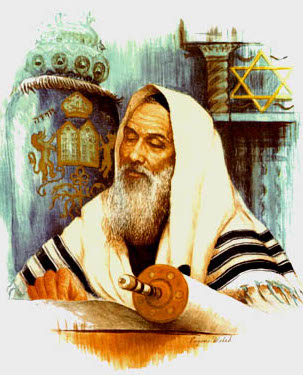
Studying TorahHere we see two things. We see that not everyone is qualified to interpret the Bible and, even more so, to plum the depths of halacha related to Jewish understanding and ritual observance, and we also learn that one may successfully misrepresent himself as a person who has a special religious or teaching authority when in fact, he does not. Beyond the fact that there are false prophets, charlatans, and religious hucksters in the world who have some sort of religious ax to grind, there are also people who are seemingly well-meaning and sincere, but who are also naive or just plain ignorant about how complicated it is to study the text and arrive at meaningful conclusions. There are people who feel they have a special calling to arrive at these “meaningful conclusions” and to teach them to others, perhaps because of some emotional need, when that special calling is only an illusion. Anyone can create a web site or a blog (even me).

I’m not trying to discourage anyone from honest study and exploration on the path that leads to holiness, (which is, after all, what I’m trying to do) but there’s a difference between being one pilgrim on the road who asks questions and reaches for the Heavens, and someone who is a true posek and tzaddik who has spent all of his or her life and resources in acquiring the knowledge to fulfill a position that only God can assign.

I am the former and not the latter, but I still need to ask the questions, record my observations and, if necessary, accept (hopefully) gentle rebukes from those who are authentically learned (as opposed to the scores of folks out there who only think they are) as to where I’ve made my mistakes.

And I’ve made mistakes.

And I will no doubt continue to make mistakes as I attempt to learn, throughout the rest of my life.

But it’s worth it if, in the end, I am allowed to even approach the tiniest thread trailing from the hem of the garment of God.

But, as I said, there are limits.

The above allows for an extended interpretation of a famous statement of our Rabbis: (Bechinos Olam, sec. 8, ch. 2; Ikarim, Discourse II, ch. 30; Shaloh 191b.) “The ultimate of knowledge is not to know You.” The simple meaning of this statement is that a person should realize the limits of his intellect, and therefore understand that knowing G-d is impossible, for He transcends all limits. There is, however, an allusion to the concept that when a person has fully developed his mind, he appreciates that even the concepts which he knows possess an inner dimension which transcends intellect. And going further, one can infer dimensions of G-d that are infinite, internalizing this knowledge to the point that it shapes our personalities.

-Rabbi Eli Touger
After Sinai; Making the Torah a Part of Ourselves
Commentary on Mishpatim
“Knowing, and Not Knowing”
Adapted from
Likkutei Sichos, Vol. III, p. 896ff; Vol. XVI, p. 242ff;
Sefer HaSichos 5749, p. 243ff.
Chabad.org

As I’ve already mentioned, our limits are built in, but that doesn’t mean there isn’t a great deal we can learn, as long as we are mindful that we do have limits and know where those limits are set. Some men are great scholars, while others will only rise to the level of a humble and seeking student. Some women have been appointed by God to be learned sages, while others may only reach the most elementary levels of Torah comprehension. This does not make one of us better than another in God’s eyes, or make the learned more loved and cherished by the Creator than the struggling disciple. It only means that we have our roles and our boundaries which have been set for us as God has set the limits to the sea and the sky.

Of course, we must make certain that the limits we acknowledge are those set by God and not by us. Just as an overly ambitious or arrogant person can elevate himself to a station higher than God intended (and eventually fall an equally great distance into a spectacular abyss of defeat), so can a person fail to rise to the level God has apportioned for them, not recognizing that they can seek and learn and understand more than they have imagined (or more than someone else told them they were allowed). Seek the level that God has set; learn to see when you still have miles to go on the trail and when you have reached the point where God has said, “no further”.

But even when you have reached that limit, realize that it’s not truly the end.

Knowledge of G-d in this manner anticipates and precipitates the coming of the Redemption, the era when “A man will no longer teach his friend…, for all will know Me, from the small to the great.” (Jeremiah 31:33)

“Knowing, and Not Knowing”
-Rabbi Touger

“When we try to pick out anything by itself, we find it hitched to everything else in the Universe.”

-John Muir, Scottish-American environmentalist and writer

Good Shabbos.
The Torah of Fellowship and Peace

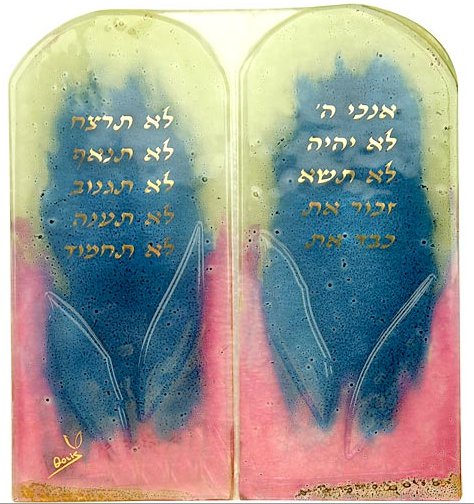
The Ten Commandments (Shemos 22:2-17, Devarim 5:6-21) as spoken by G-d to the Jewish nation at Sinai were engraved upon the Shnei Luchos Habris, Two Tablets of the Covenant. The first Five Commandments belong to the category of laws between “man and his Creator” while the remaining Five Commandments are precepts between “man and man”.

The Ten Commandments engraved upon the tablets of stone and brought down by Moshe from G-d to the Jewish people are accorded a special distinction over all the other 613 precepts.

The Ten Commandments written upon the Two Tablets are comparable to the Kesubah, “marriage contract” drawn up as the essential contractual terms under which a Jewish man and woman enter into Jewish matrimony. Herein the parties pledge their allegiance and the principle obligations to each other thereafter. (The Avos deRabbi Nosson 2:3 fascinatingly explains this is why Moshe smashed the Two Tablets, tearing up the marriage contract, when the Children of Israel were disloyal by worshipping the Golden Calf and had to provide a substitute upon their national repentance).

The Ten Commandments forge this eternal relationship.

The covenant struck between “two” parties, affirming the relationship between G-d as the “Source” and Israel as the “product”, is mirrored in the Ten Commandments inscribed upon the Shnei Luchos HaBris, “Two” Tablets of the “Covenant”. The emphasis is on how this relates to the eternal bris, “covenant” of Torah that unites man and his Creator.

How this bond is intrinsic to the national Jewish psyche is magnificently captured in the Ten Commandments engraved through the thickness of the Tablets – such that the letters and stone were inseparably one.

Herein is included the symmetrical record of the laws pertaining both to man’s relationship to “G-d” and to “man”. The first grouping, those of “man-G-d laws”, relate to G-d the “Source” while the second grouping, those of “interpersonal laws”, relates to man, the “product”.

Side-by-side, the Ten Commandments are the microcosm to all 613 Commandments (See Bamidbar Rabbah 13:15). They embrace the acceptance of G- d’s Sovereignty at Sinai as the essential platform for strict adherence to all the other 613 laws in the Torah, which serve to polish and perfect man to become more G-dly.

Through its symbolism of the “eternal covenant” between man and G-d, of two parties inextricably bound in their mutual relationship…

-Rabbi Osher Chaim Levene
from his commentary on Torah Portion Yitro
“Two Tablets: Prescription for Jewish Observance”
Torah.org

When the Prushim heard that he had shut the mouth of the Tzaddukim, they conferred together. A certain sage among them asked him a question to test him, saying, “Rabbi, which is the greatest mitzvah in the Torah?” Yeshua said to him,

“Love HaShem your God with all of your heart, with all of your soul, and with all of your knowledge.” This is the greatest and first mitzvah. But the second is similar to it: “Love your fellow as yourself.” The entire Torah and the Prophets hang on these two mitzvot.Matthew 22:34-40 (DHE Gospels)

In one of my recent morning meditations, I commented how the Torah functioned as a ketubah or “wedding contract” between God, the groom, and national Israel, the bride. For Christianity, this is a puzzle (unless you wholly substitute “the Church” for “Israel” in this event), since how can God be eternally married to the Jewish people, the inheritors of the Mosaic covenant, and at the same time, have the Christian church be “the bride of Christ? I asked this question on the aforementioned “meditation,” but no one was willing or able to respond to my query.

In studying the Torah portion for last Shabbat, I noticed an interesting parallel between the Rabbinic commentary and the teachings of the Master:

Side-by-side, the Ten Commandments are the microcosm to all 613 Commandments… -Rabbi Levene

The entire Torah and the Prophets hang on these two mitzvot. –Matthew 22:40 (DHE Gospels)

Traditional Judaism, at least as Rabbi Levene describes it, compresses the entire 613 commandments into the ten mitzvot we see on the two tablets that Moses brought down from his personal encounter with God, while Jesus tells us that they are represented, along with all of the writings of the Prophets, by the two greatest commandments, which he cites from Deuteronomy 6:5 and Leviticus 19:18. Neither source is saying that all we need are only the ten commandments or the two greatest commandments, but they are the foundation and representation upon which we formally base our obedience to God, for Jew and Christian.

Am I saying that both Jews and Christians have identical responsibilities to God relative to the Torah? Absolutely not. There have been plenty of debates, both among scholars and on the various religious blogospheres on this topic, and my personal opinion is that we non-Jewish disciples of the Master are not obligated to take upon ourselves the full yoke of Sinai. The Master himself tells us that “my yoke is easy, and my burden is light” (Matthew 11:30) while we find Peter, who walked with the Master, saying, “why are you putting God to the test by placing a yoke on the neck of the disciples that neither our fathers nor we have been able to bear? (Acts 15:10), referring to the non-Jewish disciples (and a comparison of these two verses is a study all its own).

So are we to say that God has two brides, that there are two paths to salvation, and that there are two laws? Is this the veil of separation that I’m rebuilding between Jew and Gentile that was supposedly torn down? (Ephesians 2:14)

Heaven forbid.

Yet, if I am not describing two brides separated by a veil, must I say that the only resolution to this conflict is to adopt a supersessionist viewpoint and to declare that the Church has replaced Judaism in all of the covenant promises, creating a new “spiritual Israel” out of the non-Jewish Christians? Must I say that the Jews become “one new man” with the Church only be renouncing their Judaism in totality and converting mind, body, and soul into Gentile Christians, trading in the Jewish Messiah for the “Greek” Jesus?

No, I’m not saying that, either.

According to Rabbi Dr. Stuart Dauermann in his blog post Inconvenient Truths: The One New Man:

Rather than superseding the Jewish people, the Church from among the nations joins with them as part of the Commonwealth of Israel. Only in this way can the “dividing wall of hostility” – which supersessionism maintains – be removed. Gentiles are no longer categorically outsiders to the community of God’s people, but neither do they supplant Israel. However if Gentiles were required to obey Torah and live as Jews, one would be perpetuating their categorical exclusion as Gentiles. And it is a major component of the good news as proclaimed by Paul that this former categorical exclusion is over and done with through the work of Messiah!

The balance of unity and diversity in the One New Man is further highlighted in Ephesians 3:6, where Paul says “Gentiles are fellow heirs and fellow members of the body, and fellow partakers of the promise in Christ Jesus through the gospel.” The terms “fellow heirs, fellow members, and fellow partakers” require another communal reality with whom the Gentiles are joined, and that other partner is the community of Messianic Jews living in solidarity with wider Israel. It is only as Messianic Jews embrace this calling that their communities become the communal joining point whereby the Church from among the nations is joined to the Commonwealth of Israel.

Admittedly, this is a set of points that most traditional Christians and Jews will find difficult to absorb into their current understanding of how God relates to each of our religious groups. This also gives us something new to think about in terms of how Jews and Christians are supposed to relate to each other. But in giving the Torah at Sinai and the blood of the Son at Calvary, God provided the means by which the Jews could become a special, unique and “peculiar people” to God in a way no other people or nation had ever or has ever become to Him, and has also opened the door for the rest of the world, through the Messianic covenant, to allow the larger body of humanity to draw close to God, alongside the descendants of Jacob.

This isn’t a realization that all Jews and all non-Jews have, even though this open door is available to everyone. Secular Jews are just as much a part of Sinai as their religious brothers, whether they choose to acknowledge that fact or not. Every non-Jewish person on earth is equally invited to stand before the throne of the King by the mercy of God who sent the Messiah to both Jewish and Gentile humanity, if only we will accept that gracious offer. Jesus presents the Jews with the continual and perpetual fulfillment of the prophesy of the Messiah and a life lived in obedience to Torah as God intended from the beginning, and brings close a “grafted in” humanity together with the Jews in one Kingdom as we too respond to the Torah as proceeds from Jerusalem and as it is meant for us to comprehend and obey.

There is one Torah but two intents. Torah is the ketubah of Sinai for the Jews and at the same time, it is a light unto the nations. How Jews are forever “married” to God and we Christians are the “bride” of Messiah, I do not know, but of all the different mitzvot among the 613, many are selected to identify Jews as Jews forever, and other portions are indeed universal truths applied to all, for no man made in the image of the Creator should murder his fellow, or steal from him, or covet his property, or blaspheme the name of God or worship idols of stone or wood or paper.

Jew and Gentile, where do we start? Where do we start establishing a relationship with God and an understanding of each other? We start with studying the mitzvot of the tablets and the commandments of the Messiah. Most of all, we start with this one, new commandment that I believe Moshiach gave to each and every one of us, if only we have ears to hear.

I am giving you a new mitzvah: that you love one another. As I have loved you, so you must love one another. –John 13:34 (DHE Gospels)

and many peoples shall come, and say:
“Come, let us go up to the mountain of the LORD,
to the house of the God of Jacob,
that he may teach us his ways
and that we may walk in his paths.”
For out of Zion shall go the law,
and the word of the LORD from Jerusalem. –Isaiah 2:3

The Torah has gone forth from Zion, carried on the teachings of Jesus and the Apostles, and we among the nations have heard the words of the Messiah and the “Word made flesh”. If we who are Christians can learn those lessons and the Jewish people can turn their hearts toward the Torah given by Moses and Jesus, then we will someday truly love one another in obedience to that Torah, and sit and eat together at the table of Abraham, Isaac, and Jacob (Matthew 8:11) in fellowship and peace.

The Torah of Hashem is perfect, restoring the soul; the testimony of Hashem is trustworthy, making the simple one wise; the orders of Hashem are upright, gladdening the heart; the command of Hashem is clear, enlightening the eyes; the fear of Hashem is pure, enduring forever; the judgments of Hashem are true, altogether righteous. They are more desirable than gold, than even much fine gold; and sweeter than honey, and the drippings from its combs. –Psalm 19:8-11 (Stone Edition Tanakh)

Yitro: Servants of the Lessons of Peace

And so the explanation of why the Exodus is given as the reason for G-d becoming the G-d of the Jewish people is obvious – G-d’s liberation of the Jews from slavery is what made it possible for Him to give us His Torah and mitzvos on Sinai.

Moreover, the fact that G-d took the Jews out of Egypt in order for them to serve Him was already mentioned several times in the Torah; in none of those places did Rashi find it necessary to explain that this “is sufficient reason for you to be subservient to Me.” What difficulty is there in this particular verse?

The difficulty which Rashi addresses is related to this very issue: Since the Jews were already well aware that the ultimate goal of the Exodus was the receipt of the Torah and submission to G-d, what was the need to mention yet again that G-d’s declaration: “I am G-d your L-rd” is the consequence of His being the One “who brought you out of the land of Egypt”?

Rashi therefore explains that “who brought you out of the land of Egypt” is neither a reason nor an explanation for “I am G-d your L-rd.,” Rather, it is a wholly distinct matter – “Taking you out of Egypt is sufficient reason for you to be subservient to Me.”

“I am G-d your L-rd” implies the acceptance of G-d’s reign. The Jews accepted G-d as their king and ruler, and thereby obligated themselves to obey all His commands. G-d then added an additional matter – merely accepting G-d as king does not suffice; Jews must be wholly subservient to Him.

Accepting a king’s dominion does not preclude the possibility of a private life; it only means doing what the king commands and avoiding those things which the king prohibits. However, being “subservient to Me” means a Jew has no personal freedom; all his actions and possessions are subservient to G-d.

Performing Torah and mitzvos is unlike heeding the commands of a flesh-and-blood king, since it is done in a state of complete subservience. Every moment of a Jew’s life involves some aspect of Torah and mitzvos.

Commentary on Torah Portion Yitro
Based on Likkutei Sichos Vol. XXVI pp. 124-128
and the teachings of the Lubavitcher Rebbe
Rabbi Menachem M. Schneerson
Chabad.org

On the third day, as morning dawned, there was thunder, and lightning, and a dense cloud upon the mountain, and a very loud blast of the horn; and all the people who were in the camp trembled. Moses led the people out of the camp toward God, and they took their places at the foot of the mountain.

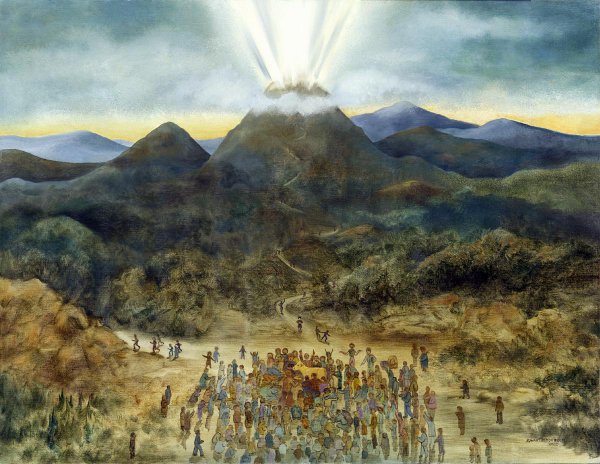
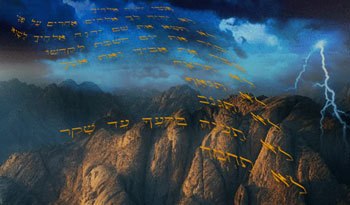
Now Mount Sinai was all in smoke, for the Lord had come down upon it in fire; the smoke rose like the smoke of a kiln, and the whole mountain trembled violently. The blare of the horn grew louder and louder. As Moses spoke, God answered him in thunder. The Lord came down upon Mount Sinai, on the top of the mountain, and the Lord called Moses to the top of the mountain and Moses went up. The Lord said to Moses, “Go down, warn the people not to break through to the Lord to gaze, lest many of them perish. The priests also, who come near the Lord, must stay pure, lest the Lord break out against them.” But Moses said to the Lord, “The people cannot come up to Mount Sinai, for You warned us saying, ‘Set bounds about the mountain and sanctify it.'” So the Lord said to him, “Go down, and come back together with Aaron; but let not the priests or the people break through to come up to the Lord, lest He break out against them.” And Moses went down to the people and spoke to them.

God spoke all these words, saying…Exodus 19:16-20:1 (JPS Tanakh)

I cannot even imagine what it must have been like to stand at the foot of Mount Sinai and to be a part of this amazing, awesome, terrifying, wonderful experience of standing in the physical presence of the manifestation of God. Just to glimpse it from afar would have been an honor beyond imagination. This was and is truly the pivotal moment in all of Jewish history: the giving of the Torah. Nothing else would so uniquely define the Jews as a people and as the chosen nation of God. No other people have any experience that could compare to this pinnacle moment in the history of Israel. Or do we? I’ll get to that.

In the Chabad commentary I quoted from above, we see that there is an interesting comparison between serving a human King and serving the King of the Universe. As the Rabbis point out, serving an earthly King entails only obeying the specific orders of your monarch. Except for rare individuals, a subject of a King would still have a private life and individual pursuits that were apart from the King’s commands and laws.

This is not so when serving the King of Kings.

The Torah defines every single aspect of a Jew’s life, how he prays, how he works, how he eats, how he is to treat his wife, his neighbors, his animals, everything…every little detail. When the Children of Israel said, “All that the Lord has spoken we will do,” (Exodus 19:8), they were pledging their very lives to God down to the tiniest action and thought. Yes, I know someone out there is going to tell me that according to the record in the Tanakh, the Hebrews were not always very successful in obeying God, but what’s important is the amazing scope of the promise, of the commandments, of having a God who so cared for you and your people that we was involved in every aspect of your existence, not just what you did in synagogue on Shabbat (or church on Sunday). You gave everything you were, are, and ever will be to God.

But when the Pharisees heard that he had silenced the Sadducees, they gathered together. And one of them, a lawyer, asked him a question to test him. “Teacher, which is the great commandment in the Law?” And he said to him, “You shall love the Lord your God with all your heart and with all your soul and with all your mind. This is the great and first commandment. And a second is like it: You shall love your neighbor as yourself. On these two commandments depend all the Law and the Prophets.” –Matthew 22:34-40 (ESV)

We see here that the Son of God, Jesus, the Messiah, God’s Lamb, demanded nothing less of his disciples as well, but that’s to be expected.

But that brings me to an interesting question. Every Jew who has ever lived can point to Sinai and say, “that’s where we began…that’s who we are as a people forever.” In fact, each Jew is to behave not just as an inheritor of the Sinai covenant, but as if he or she had personally stood at the foot of Mount Sinai and accepted the Torah!

Where do we Christians find such a moment in our lives? Do we have a “Sinai?”

When the day of the festival of Shavuot arrived, they were all together in one place. And suddenly there came from heaven a sound like a mighty rushing wind, and it filled the entire house where they were sitting. And divided tongues as of fire appeared to them and rested on each one of them. And they were all filled with the Holy Spirit and began to speak in other tongues as the Spirit gave them utterance. –Acts 2:1-4 (ESV)

Note: I substituted “day of the festival of Shavuot” for the actual text which reads “day of Pentecost” to preserve the perspective of the Jewish Apostles.

Since Pentecost and Shavuot are essentially parallel occurrences, it’s not surprising that the empowering of the Holy Spirit came upon the Jewish Apostles on the same day as the anniversary of the Sinai event.

I have to admit to being somewhat let down. Christians are not encouraged to consider the Pentecost experience as literally their own (I suppose because Christians see salvation as an individual “accomplishment” rather than becoming part of the “body of Christ” and the “commonwealth of Israel”), as if they (we) were “all together in one place” with the Apostles as the “mighty rushing wind…filled the entire house where they were sitting.” We are to consider (sort of) the moment when we accepted Jesus Christ as Lord and Savior of our lives as the moment when we have out Acts 2 experience, although no Christian I have ever met has described that moment in terms of “tongues of fire” appearing from heaven and resting upon them. Some people have described being able to suddenly “speak in tongues”, but I do know a person who, at an altar call at a local church some years ago, was encouraged by the Elder with him to “make something up” if the ability to speak in an “angelic language” didn’t manifest itself in him.

So much for majesty and awe.

For that matter, we don’t really know how Peter could tell that “the Holy Spirit fell on all who heard the word” while he was visiting the Roman God-fearer Cornelius in the Centurion’s home? (Acts 10:44)

However, this is as close to a “Sinai event” as we who are the non-Jewish disciples of the Master can achieve in the modern era. I don’t know what it means or doesn’t mean and maybe I’m reading too much into it, but I don’t think things have been explained to us very well. I don’t think we’ve been told that one of the responsibilities we have in common with our Jewish brothers and sisters is the command to surrender our entire lives, every action, every word, every thought, to God, our King.

It’s not like we should be ignorant of this responsibility, since it’s all over the New Testament.

We destroy arguments and every lofty opinion raised against the knowledge of God, and take every thought captive to obey Christ… –2 Corinthians 10:5 (ESV)

Not many of you should become teachers, my brothers, for you know that we who teach will be judged with greater strictness. For we all stumble in many ways. And if anyone does not stumble in what he says, he is a perfect man, able also to bridle his whole body. If we put bits into the mouths of horses so that they obey us, we guide their whole bodies as well. Look at the ships also: though they are so large and are driven by strong winds, they are guided by a very small rudder wherever the will of the pilot directs. So also the tongue is a small member, yet it boasts of great things. –James 3:1-5 (ESV)

If we look at the words of the Master as recorded by Matthew and add the letters from Paul and James, we see that we too must surrender all that we are to God in everything, including our words and our very thoughts. How like the covenant at Sinai in this one very important dimension in the lives of we Christians.

Christianity prizes Grace over the commandments of the Law, but we tend to miss the fact that we have serious responsibilities and that freedom from sin doesn’t mean we can literally do whatever we want with our lives, pursuing the same matters in practically the same way as the secular people around us. We must be more in our actions, which we aren’t always taught matter as much as faith and having a “warm and fuzzy” feeling inside for Jesus. We are servants. With almost no exceptions, the original Jewish Apostles suffered for a long time and eventually died terrible deaths as the commitment to the Messiah required. This is the lesson they learned, not just as disciples of the Master, but as Jews who, like all of their people, personally stood at the foot of Sinai as the fire and the thunder and the sound of the great shofar sounded, and before their King declared, “All that the Lord has spoken we will do!”

Can there be peace between the people who stood at Sinai and we who inherit the Spirit of Pentecost? We are disciples of the Master, but where is the unity? Where is peace?

Peace refers to harmony between opposites. In an ultimate sense, it refers to a resolution of the dichotomy between the physical and the spiritual, the forward movement enabling a world in which G-d’s presence is not outwardly evident to recognize and be permeated by the truth of His Being.

Moreover, true peace involves more than the mere negation of opposition. The intent is that forces which were previously at odds should recognize a common ground and join together in positive activity. Similarly, the peace which the Torah fosters does not merely involve a revelation of G-dliness so great that the material world is forced to acknowledge it. Instead, the Torah’s intent is to bring about an awareness of G-d within the context of the world itself.

There is G-dliness in every element of existence. At every moment Creation is being renewed; were G-d’s creative energy to be lacking, the world would return to absolute nothingness. The Torah allows us to appreciate this inner G-dliness, and enables us to live in harmony with it.

-Rabbi Eli Touger
In the Garden of the Torah
“Ripples of Inner Movement”
Adapted from
Likkutei Sichos, Vol. XI, p. 74ff; Vol. XV, p. 379ff;
Vol. XVI, p. 198; Sichos Shabbos Pashas Yisro, 5751
Chabad.org

The portion of the Torah event we who are grafted in may take away with us, is that there is a path to peace, not only between Christian and Jew, but for all of mankind. We aren’t there yet. There is not even peace between all Christians or between all Jews. But someday, “they shall sit every man under his vine and under his fig tree, and no one shall make them afraid, for the mouth of the LORD of hosts has spoken.” (Micah 4:4 [ESV]).

Good Shabbos.

Counting Down

Torah at SinaiOn the sixth day of the third month (Sivan), seven weeks after the Exodus, the entire nation of Israel assembles at the foot of Mount Sinai. G-d descends on the mountain amidst thunder, lightning, billows of smoke and the blast of the shofar, and summons Moses to ascend.

G-d proclaims the Ten Commandments, commanding the people of Israel to believe in G-d, not to worship idols or take G-d’s name in vain, to keep the Shabbat, honor their parents, not to murder, not to commit adultery, not to steal, and not to bear false witness or covet another’s property. The people cry out to Moses that the revelation is too intense for them to bear, begging him to receive the Torah from G-d and convey it to them.

The Parashah in a Nutshell
Yitro in Nutshell
Exodus 18:1–20:23
Chabad.org

Starting the second night of Pesach, we begin counting seven weeks, 49 days, until the holiday of Shavuos. This counting is called Sefiras Ha’Omer, The Counting of the Omer. (For more information on Sefiras Ha’Omer, see I:16, I:18)

-Rabbi Yehudah Prero
“The Counting of the Omer – A Count of Anticipation”
YomTov, Vol. IV, # 7
Torah.org

We see the events of the Torah reflected in current Jewish practice. According to the commandments (Ex. 12:16, Ex. 23:14, Lev. 23:7) the Jewish people commemorate the Passover every year in order to remember the Passover in Egypt and the great exodus of the Israelites from slavery to freedom. Then comes the Omer count, whereby Jews are commanded to count the Omer for 49 days in anticipation of the festival of Shavuot, which commemorates the giving of the Torah at Sinai. The events we see displayed with such grandeur and majesty before us when we read the Torah portions that relate these times, are part of the lived experience of every religious Jew and any Gentile who is attached to the Jewish community for various reasons.

But there’s one other event that we Christians must consider.

And when evening had come, since it was the day of Preparation, that is, the day before the Sabbath, Joseph of Arimathea, a respected member of the council, who was also himself looking for the kingdom of God, took courage and went to Pilate and asked for the body of Jesus. Pilate was surprised to hear that he should have already died. And summoning the centurion, he asked him whether he was already dead. And when he learned from the centurion that he was dead, he granted the corpse to Joseph. And Joseph bought a linen shroud, and taking him down, wrapped him in the linen shroud and laid him in a tomb that had been cut out of the rock. And he rolled a stone against the entrance of the tomb. Mary Magdalene and Mary the mother of Joses saw where he was laid. –Mark 15:42-47 (ESV)

According to the Gospel of Mark, Jesus was crucified on the same day as all of the representatives of the Jewish families in Israel were presenting their Passover lambs for sacrifice at the Temple in Jerusalem, in obedience to the commandment. He should have died right before sunset; right before the eating of the Passover lamb by each Jewish family, again, in obedience to the commandment.

But not all of the Gospel versions of the death of Jesus line up chronologically and we cannot be sure of the exact date. Was the “Last Supper” a true Passover seder or some other meal that occurred the evening before? We don’t know. We do know that Jesus died at about the time of the Passover, and we are fond of referring to Jesus as our “Passover lamb”. And three days later, Jesus rose from the tomb and he was with his people again for forty days. And then he ascended.

In the first book, O Theophilus, I have dealt with all that Jesus began to do and teach, until the day when he was taken up, after he had given commands through the Holy Spirit to the apostles whom he had chosen. He presented himself alive to them after his suffering by many proofs, appearing to them during forty days and speaking about the kingdom of God…And when he had said these things, as they were looking on, he was lifted up, and a cloud took him out of their sight. –Acts 1:1-3, 9 (ESV)

It would be nice if things lined up neatly but forty days does not equal the forty-nine day count of the Omer. Maybe this is one of the reasons why Christians don’t also “count the Omer” from the day of the crucifixion, which the church calls “Good Friday” to the day of the giving of the Holy Spirit, which Christians call “Pentecost”, but which also was the day of the festival of Shavuot commemorating the Sinai event.

So the Bible and our celebrations don’t line up into nice, neat, perfectly ordered events and holidays. I also understand that, during the schism between Gentile Christianity and Jewish Messianism, most or all of the Jewish connections to the Christian faith were summarily erased, along with the Jewishness of Jesus. Christians were not taught to count the Omer and in fact, were likely forbidden to perform any celebration of their faith that even vaguely resembled the worship of the Jews.

But wouldn’t it be great if, after the return of the Messiah, the Jews and the Gentiles counted the Omer together, in commemoration of the Passover and the gift of the Messiah to humanity? For just as death passed over the obedient Israelites in Egypt, so has eternal death passed over all who are faithful and obedient to Jesus, the lamb of God, who gave his life for the sake of the world and yet lives. And the giving of the Torah and the giving of the Holy Spirit nourishes all of the Master’s disciples, in accordance to our covenant relationship with God.

But for this tearing down of the wall of enmity to happen, we Christians must not be careless or dismissive of the things that God has created for the Jews and for the good of everyone.

As a young boy, Rabbi Yosef Yitzchak (the sixth Lubavitcher Rebbe) would go with his father on walks through the woods. One time, as they talked, the boy absent-mindedly plucked a leaf off a tree and began to shred it between his fingers. His father saw what his son was doing, but he went on talking. He spoke about the Baal Shem Tov, who taught how every leaf that blows in the wind—moving to the right and then to the left, how and when it falls and where it falls to—every motion for the duration of its existence is under the detailed supervision of the Almighty.

That concern the Creator has for each thing, his father explained, is the divine spark that sustains its existence. Everything is with Divine purpose, everything is of concern to the ultimate goal of the entire cosmos.

”Now,” the father gently chided, “look how you mistreated so absent-mindedly the Almighty’s creation.”

”He formed it with purpose and gave it a Divine spark! It has its own self and its own life! Now tell me, how is the ‘I am’ of the leaf any less than your own ‘I am’?”

-Rabbi Tzvi Freeman
“Purpose of a Leaf”
Based on letters and talks of the Rebbe
Rabbi M. M. Schneerson
Chabad.org

Do not shred a “leaf” too quickly, for you may not correctly understand why God created and sustained it. So it is with the Jewish people. So it is with counting the Omer. So it will be one day when a few, and then many, and then all of Israel sees the Divine spark, the “I am” in the Messiah; in Jesus of Nazareth.

Beshalach: Waiting for the Bread of Heaven

The purpose of the manna was to uplift those who ate it and heighten their spiritual consciousness. As a result of this spiritual boost, the Jews were able to “follow My teaching”—to receive the Torah, as it is indeed stated in the Midrash: (Mechilta ad loc) “The Torah could only have been given to those who had partaken of the manna.” (Sefer HaMa’amarim Melukat, vol. 1, pp. 238-239.)

-From the Kehot Chumash
Chassidic Insights for Parshah Beshalach
Chapter 16
Based on the works of the Lubavitcher Rebbe
Rabbi Menachem Mendel Schneerson, of righteous memory
Chabad.org

And he humbled you and let you hunger and fed you with manna, which you did not know, nor did your fathers know, that he might make you know that man does not live by bread alone, but man lives by every word that comes from the mouth of the LORD. Deuteronomy 8:3 (ESV)

And the tempter came and said to him, “If you are the Son of God, command these stones to become loaves of bread.” But he answered, “It is written,
“‘Man shall not live by bread alone,
but by every word that comes from the mouth of God.’”
Matthew 4:3-4 (ESV)

It may be strange to think of us today as waiting for our bread from Heaven, but I think that’s exactly what we do at times. Think about what it meant to the Children of Israel in the wilderness to wait on God for their bread. Although they had vast herds of livestock with them, they still have no reliable source of “daily bread,” especially enough to feed millions of people, morning, noon, and night. In this, they were completely reliant on God for their food and drink and without Him, they could do nothing.

As slaves, the Israelites depended on the Egyptians for their food and drink (and housing and everything else), and even though life was hard and often brutal, they were used to it, as a convict becomes used to a long term in prison. There was a routine. There were expectations that were fulfilled day in and day out. Breakfast would come tomorrow from the Egyptians because it came yesterday, and the day before, and last year, and in the days of their fathers and grandfathers.

But they weren’t used to waiting on God. They were together as a people, but they felt alone. They were free, but they were in a strange and unpredictable environment. The Egyptians were men and the Israelites understood how men could provide bread, but God is not a man and who can possibly understand manna?

So they were afraid, and they doubted, and they complained, and they tested God. This was a mistake, but it was a completely understandable one. But did God understand?

“You shall not put the LORD your God to the test, as you tested him at Massah. –Deuteronomy 6:16 (ESV)

Jesus said to him, “Again it is written, ‘You shall not put the Lord your God to the test.’” –Matthew 4:7 (ESV)

It certainly doesn’t sound that way, but then again, how could God possibly misunderstand His creations? How can He possibly misunderstand us, when we too are waiting for our “bread from Heaven” and we feel alone, and afraid, and uncertain?

It’s even more confusing when God sets up a schedule and then creates an exception:

Interestingly, Moses does not tell the Jews that the manna will not be in the field, but only that they will not find it there. And indeed, the manna was esoterically present on the Sabbath as well. The Sabbath is the source of all blessings, including those of material sustenance. In this sense, the manna of the other six days descended as a result of the “spiritual manna” that was produced on the Sabbath. (Zohar 2:63b, 88a.)

The physical manna gathered during the week “materialized” out of this spiritual manna. It therefore had to be acquired through physical effort: it had to be gathered, cooked, and so on. In contrast, the Sabbath manna was not manifested physically and therefore could not be “accessed” by any physical means.

Similarly, our physical livelihood is spiritually “produced” by our observance of the Sabbath. During the ensuing week, we have to gather the material blessings of the Sabbath by engaging in our weekday work. But on the Sabbath itself, we must refrain even from thinking about our livelihood. (Likutei Sichot, vol. 16, pp. 181-182.)

-Chassidic Insights commentary continued

This is certainly a very mystic interpretation, but it teaches us something beyond the literal telling of the tale of manna in the desert. Whether we believe we provide for ourselves through the work of our hands and our minds, in reality, everything we think belongs to us was produced by and belongs to God. Beyond that, it shows us that in some manner or fashion, the Shabbat rest results in producing what we need from God and ourselves for the other six days of the week. That’s why we give thanks to Him for everything.

But what about when we ask and we don’t receive, at least right away? But what about when we ask and we don’t receive, at least in the manner we expected to receive? But what about when we ask for a fish and God gives us (seemingly) a snake instead?

“Ask, and it will be given to you; seek, and you will find; knock, and it will be opened to you. For everyone who asks receives, and the one who seeks finds, and to the one who knocks it will be opened. For which one of you, if his son asks him for bread, will give him a stone? Or if he asks for a fish, will give him a serpent? If you then, who are evil, know how to give good gifts to your children, how much more will your Father who is in heaven give good things to those who ask him! –Matthew 7:7-11 (ESV)

There’s a difference between what we need and what we want. God knows what we need, even as He knew what the Israelites in the desert needed. They didn’t ask for manna, but God knew they needed it. At first, they didn’t even know what to do with the manna, but God told Moses and Moses told the people. Eventually, the people got sick and tired of eating manna every single day, but God knew they still needed it on a regular basis and the gift that God gave continued to be His gift, regardless of whether or not it was received with gratitude.

We know that our purpose in a life created by God is not to be served but to serve. Jesus illustrated this very clearly here:

When he had washed their feet and put on his outer garments and resumed his place, he said to them, “Do you understand what I have done to you? You call me Teacher and Lord, and you are right, for so I am. If I then, your Lord and Teacher, have washed your feet, you also ought to wash one another’s feet. For I have given you an example, that you also should do just as I have done to you. Truly, truly, I say to you, a servant is not greater than his master, nor is a messenger greater than the one who sent him. If you know these things, blessed are you if you do them. –John 13:12-17

And yet, we are weak, and we need so much, and we depend on God, or we try to. There are times when we must act in order to receive from God, but there are other times when we are utterly helpless, and we can do nothing but wait.

And waiting on God to deliver His bread from Heaven is very hard. Even when it arrives, we may not recognize it for what it is, since His blessings may not come in a form we will understand. Even when we realize He has delivered His blessings, because they are not as we wanted them to be, we may be ungrateful, or hurt, or even feel betrayed that God didn’t give us what we wanted, when we wanted it, in exactly the way, shape, and form we asked for. But as difficult as it is for us, we must strive to trust God and not to question our Sovereign.

But Moses said to the people, “Have no fear! Stand by, and witness the deliverance which the Lord will work for you today; for the Egyptians whom you see today you will never see again. The Lord will battle for you; you hold your peace!” –Exodus 14:13-14 (JPS Tanakh)

“Be still, and know that I am God.
I will be exalted among the nations,
I will be exalted in the earth!” –Psalm 46:10 (ESV)

We can trust in God, if only we will wait.

You open your hand; you satisfy the desire of every living thing. –Psalm 145:16 (ESV)

His hand is opening. He’s about to help you. Wait.

Good Shabbos.

Bo: When We Finally Leave Egypt

The command to confront Pharaoh and negate his influence is given to Moshe, representative of mankind, because the negation of selfishness is a fundamental dimension of man’s service. Man was given the mission of making this world a dwelling for G-d, and this is possible only when selfishness is nullified. Haughty self-interest prevents the Divine Presence from being manifest.

And yet, this nullification of self cannot be accomplished by man alone; it requires G-d’s power. For this reason, Moshe shrank at G-d’s command; he realized that the task was beyond him. That is why G-d instructed him: “Come to Pharaoh,” i.e., come with Me, and not “Go to Pharaoh.” G-d would confront Pharaoh together with Moshe.

-Rabbi Eli Touger
“Confronting Pharaoh”
Commentary on Torah Portion Bo
Adapted from
Likkutei Sichos, Vol. XXI, p. 48-49; Vol. XXXI, p. 32-33;
Sichos Shabbos Parshas Bo, 5733, 5751
Chabad.org

The primary function of the mitzvot is to enable man to permeate the world with goodness and holiness.

“Sanctifying Time”
Commentary on Torah Portion Bo
Adapted from the works of the Lubavitcher Rebbe, Rabbi Menachem M. Schneerson, of righteous memory. (Likkutei Sichos Vol. XXVI, pp. 59-65.)
Chabad.org

And all the Israelites did so; as the Lord had commanded Moses and Aaron, so they did. That very day the Lord freed the Israelites from the land of Egypt, troop by troop.Exodus 12:50-51 (JPS Tanakh)

As I wrote in last week’s Torah commentary Exodus: Challenge in Exile, one of the ways we can think of the exile of the Israelites in Egypt is as an “exile” into their own humanity and as a result, they were distanced from God. Yet, they could not release themselves from their own slavery without God’s intervention, thus God sent Moses as His agent to free the people, to lead them out of slavery, and to redeem them to Himself.

However, what did the Children of Israel have to surrender in order to be free?

I suppose that’s an odd question, since who wants to be a slave? What possible reason would a slave have for not “surrendering” their slavery in order to be free? What about all of the harmful things that enslave us? Pharaoh is a perfect example of this. After the terrible plagues that God had caused upon the land of Egypt, it was in Pharaoh’s best interest to release his slaves and allow them to leave. Even after the plague of the firstborn, when the Israelites finally looted Egypt and left, Pharaoh “strengthened” himself and sent his army to retrieve the Hebrews. As we see, even in the face of overwhelming adversity from God, Pharaoh found it impossible to surrender his “self” in order to protect his nation and his people. He reaped utter destruction as a result.

Is that how we sometimes destroy ourselves, even in the face of the living God who desires to redeem us? The Children of Israel were redeemed when they left Israel and they were saved from themselves. Pharaoh and Egypt could have been redeemed by just letting Israel go at God’s command. Rabbi Touger’s commentary concludes thus:

Penetrating and nullifying self-orientation makes possible the revelation of a positive dimension. And thus the Zohar refers to the House of Pharaoh as: “the place where all lights are revealed in an unrestrained manner.”

Carrying this concept further, the Exodus from Egypt is connected to the ultimate Redemption. Indeed, had the Jews merited, they would have entered Eretz Yisrael immediately after leaving Egypt.

As it is, the entire period from the Exodus until the final Redemption is referred to as “the days of your exodus from Egypt.” For nullifying the selfishness of Pharaoh and breaking through the limitations of Egypt began and begins for each of us as we relive the Exodus a self-reinforcing dynamic destined to take our nation beyond all natural limitations and lead to the Redemption.

And once redeemed, then what? Remember the true purpose of the mitzvot as I mentioned above:

The primary function of the mitzvot is to enable man to permeate the world with goodness and holiness.

The purpose of our redemption, our freedom, and our status as sons and daughters of the Most High is not to exalt ourselves but to “permeate the world with goodness and holiness.” The Master commanded us not to continually resist the insults of “one who is evil” but to turn the other cheek to him (Matthew 5:39). Jesus didn’t teach us to refuse to go a mile with someone by force, but instead, to go with him for two (Matthew 5:41). Yesterday, I tried to say that there are times we must stand resolute before evil as an iron wall against the storm, but there are also times we must bend and be supple like a reed before the wind.

The prophet Isaiah teaches:

a bruised reed he will not break, and a faintly burning wick he will not quench; he will faithfully bring forth justice. –Isaiah 42:3

Yet for all I’ve just said, we cannot free ourselves from ourselves alone. We must rely on God for that strength and that sense of direction which leads us out of our personal Egypt, across the desert, to the redemption promised to all who serve as disciples of the Messiah. If we refuse, even though we claim his name as Master, and continue on our own egotistical and self-destructive course, we’ll find our freedom is an illusion and discover that we never left Egypt at all.

When the time for redemption came, G-d did not keep them for even the blink of an eye

Rashi’s commentary

In the Passover haggadah we say: “Had G-d not taken our forefathers out of Egypt, we, our children, and our children’s children would still be enslaved to Pharaoh.”

After two centuries of exile and subjugation there was little to differentiate the Jewish people from their idol-worshiping masters. So deeply had they sunk into the pagan depravity of Egypt that their redemption came at the very last possible moment, when they were but a hairsbreadth from spiritual annihilation.

Nachmonides

Ironically, we don’t always find redemption when we ask or even beg for it. God waits until we are totally lost within our own worlds of self-indulgence and sin and when we’ve forgotten God completely. Then our redemption comes as Moses came for the unwilling children of Israel.

Said the Zeidehof Shpoli to the Almighty: “Master of the Universe! The sages of the Talmud pleaded before You to bring the Moshiach. You chose not to do so. The holy Ari begged You to bring Moshiach – again You were unwilling. We have reached the point where it is left to someone of my ilk to ask for the redeemer. Still You are holding out.

“Mark my words. There will come a generation who will have no interest in You or Your Moshiach. Then You will have no choice but to bring him.”

-Rabbi Yanki Tauber
“Mark My Words”
Commentary on Torah Portion Bo
Once Upon a Chasid
Chabad.org

This week, there have been many discussions on my “morning meditations” and they do not reflect well on we who claim the cause of Christ. As disciples of Jesus, we have lost our way and are like the Children of Israel in their Egyptian slavery. We say we belong to God but we act like we have completely forgotten Him. We stand up and demand our “rights” for this or that under God, and completely forget that the primary message of Jesus was not one of individual rights but rather, our responsibilities to God and to other people. Christ had the “right” to claim Kingship of the world and its people 2,000 years ago, but instead of standing up for his “rights” (and this is how the adversary tempted him), he submitted to the will of the Father, surrendering even to the horrible death on the cross. If he had “stood up for his rights”, humanity would have no hope. Only by Messiah’s humility and submission have we all been reconciled to God and saved by grace and mercy.

The message has been lost. We must take it back.

Good Shabbos.