Tag Archives: Torah Portion

Lech Lecha: Choices of the Heart

avrahamThe Torah portion of Lech Lecha relates how G-d commanded Avraham to circumcise himself and the members of his household. By doing so, Avraham became the first and primary individual to adopt the sign of the holy covenant that exists between G-d and every Jew.

This connection between circumcision and Avraham is so strong that the blessings for circumcision include the phrase: “to enter him into the covenant of Avraham, our father,” i.e., the circumcision currently taking place is directly related to our patriarch Avraham. Since Avraham is our father,he makes it possible for all of us, his children, to inherit the privilege of entering into an eternal covenant with G-d.

This kind of inheritance is not at all dependent on any preparations or qualifications on the part of the inheritor — a one-day old infant can inherit everything.

Commentary for Torah Portion Lech lecha
“The Covenant of Avraham”
Based on Likkutei Sichos, Vol. X, pp. 44-47
Chabad.org

The Brit Milah, the covenant of circumcision is something that no one can ask for and no one can reject. Jews males are circumcised on their eighth-day in accordance to the commandment and become part of Israel, and Israel becomes a part of them. But Ishmael was also a son of Abraham. Does the older son inherit along with Isaac? The commentary continues.

The following, however, must be understood: In explaining the commandment of circumcision, the Rambam states: (Commentary on Mishnayos, Chulin conclusion of ch. 7) “We do not engage in circumcision because our father Avraham, of blessed memory, circumcised himself and his household, but rather because G-d commanded us through our teacher Moshe to circumcise ourselves.”

And where are these commandments?

For the generations to come every male among you who is eight days old must be circumcised, including those born in your household or bought with money from a foreigner—those who are not your offspring. –Genesis 17:12

On the eighth day the boy is to be circumcised. –Leviticus 12:3

The Abrahamic covenant is “honed” and applied within the context of the Mosaic covenant, passing from Abraham to Isaac to Jacob to the Children of Israel. Then passing to every Jew across history and to this very day.

But what does it mean besides being a sign of a Jew’s perpetual inheritance of the land of Israel?

Significantly, Avraham was given this name in connection with the mitzvah of circumcision. Circumcision an act which affects the most basic physical aspect of our being, demonstrates that our spiritual quest is not an attempt to escape worldly reality, but is rather an attempt to refine it. Circumcision represents a “covenant in the flesh,” and endows even our physical bodies with sanctity.

-Rabbi Eli Touger
“A Journey To One’s True Self: Avraham’s Odyssey As A Lesson For His Descendants”
Commentary on Lech Lecha
Adapted from
Likkutei Sichos, Vol. V, p. 57ff; Vol. XX, p. 59ff, p. 301ff;
Vol. XXV, p. 52; Sefer HaSichos 5750, p. 96ff.
Chabad.org

We are all faced with a physical and spiritual journey in our lives that starts the day we are born and continues until our death. This journey begins and progresses whether we want it to or not. It exists regardless of our religious orientation or lack thereof. Atheists, agnostics, Muslims, Christians, Buddhists, Taoists, and Jews all walk upon the path of spirit as well as the path of life. No newborn infant can ask to proceed on a spiritual path nor can they refuse it. For a Jew it is the same with the unique sign of the covenant. An eight-day old boy cannot ask for nor refuse the Brit Milah. It is the mark of God separating him from the hoards of humanity and signaling that his spiritual journey is unique among the peoples of the earth. He is a Jew and things will be different for him than for the rest of us. It is not a matter of choice.

Abraham had a choice but in choosing, he also chose for his children, his grandchildren, for Isaac, for Jacob, for the twelve tribes, and for all Jews throughout the corridors of time. He chose for Jews today. And in spite of legal decisions made by men such as Yoram Kaniuk, a Jew can never become a “not-Jew”.

spiritual-journeyThe rest of us have a choice. People who convert to Judaism have a choice, and one of the reasons that Judaism is reluctant to convert others is that the converts, under persecution, can decide to renounce their Jewish identity. Not so the born Jew. The Christian who accepts Christ as Lord and Savior can, under duress or discouragement, choose to renounce Jesus, join another religious tradition, or enter into atheism, acknowledging no God except himself. There is no sign on our flesh marking us as set apart. The circumcision we undergo is on our hearts.

A person is not a Jew who is one only outwardly, nor is circumcision merely outward and physical. No, a person is a Jew who is one inwardly; and circumcision is circumcision of the heart, by the Spirit, not by the written code. Such a person’s praise is not from other people, but from God. –Romans 2:28-29

But this is really confusing. Who is Paul talking about here?

Moreover the LORD your God will circumcise your heart and the heart of your descendants, to love the LORD your God with all your heart and with all your soul, so that you may live. –Deuteronomy 30:6

These aren’t the only examples of “circumcision of the heart” in the Tanakh (Old Testament)  and the Apostolic Scriptures and certainly not the only illustrations of such a circumcision applied to the Jews. So who is circumcised and what does it mean? Has “circumcision of the heart” replaced the Abrahamic and Mosaic commandments for physical circumcision?

Or does one symbolize the other?

The way I see it, the physical circumcision indelibly marks a Jew as a Jew beyond all undoing. However, not all Jewish individuals dedicate themselves to the service of God and in obedience to the mitzvot. You can’t decide to be or “un-be” a Jew (except if you’re a convert), but you can decide, as a Jew or a Gentile, to serve God or not to serve God. You can make a conscious decision to allow the circumcision of the heart. You don’t get to decide to be born or to start on the journey of spirit and life, but you can decide the specific paths to take between birth and death (and beyond).

Small plantThe uniqueness of the Jewish people in the Kingdom of God is beyond question. How we decide to serve God or to fail God is entirely up to us, as a Jew, Christian, or anyone else. In that, we are like Abraham. God tells us to go somewhere and to do something. How we answer God is up to us.

The Lord said to Abram, Go forth from your native land and from your father’s house to the land that I will show you. Abram went forth as the Lord had commanded him. –Genesis 12:1,4

If the world did not need you and you did not need this world, you would never have come here. G-d does not cast His precious child into the pain of this journey without purpose.

You say you cannot see a reason. Why should it surprise you that a creature cannot fathom the plan of its Creator? Nevertheless, eventually the fruits of your labor will blossom for all to see.

-Rabbi Tzvi Freeman
“Waiting for Fruition”
Based on letters and talks of the Rebbe
Rabbi M. M. Schneerson
Chabad.org

Good Shabbos.

Noach: What We Allow in Heaven

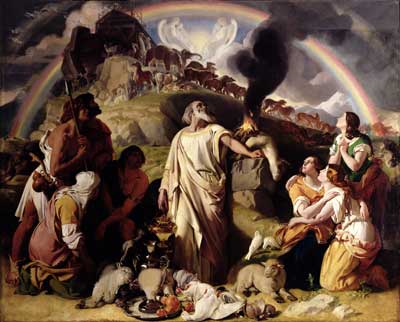
Noah's ArkThe Maggid of Mezritch interpreted our Sages’ statement: “Know what is above you,” as: “Know that everything ‘above’ all that transpires in the spiritual realms is ‘from you,’ dependent on your conduct. Each of us has the potential to influence even the most elevated spiritual realms.”

The Torah alludes to this potential in the opening verse of our reading: “These are the chronicles of Noach. Noach was a righteous man.” The word noach refers to satisfaction and repose. By repeating the word, the Torah implies that Noach and by extension, every one of his descendants can sow these qualities in two different fields, both among his fellow men, and in the spiritual worlds above.

Every person affects his environment. Our thoughts, words and deeds can inspire peace and tranquility in our fellow men, helping create meaningful pleasure. And by establishing such conditions in our world, we accentuate similar qualities in the worlds above. To highlight our obligation to spread these virtues, this week’s Torah portion is called Noach.

-Rabbi Yanki Tauber
“Genuine Satisfaction: Noach’s Legacy”
Adapted from
Likkutei Sichos, Vol. XX, p. 285ff;
Vol. XXV, p. 23ff
Chabad.org

This is the line of Noah. — Noah was a righteous man; he was blameless in his age; Noah walked with God.Genesis 6:9 (JPS Tanakh)

It’s difficult and sometimes even a little dangerous to go beyond the plain meaning of what we read in the Bible and enter hidden or even mystic interpretations. First off, even though Christianity also has its mystic tradition, looking at the Bible through a Chassidic lens can tend to be disorienting, and most people will immediately reject the view rather than attempt to explore the value that might be gained from a radical change in perspective. And yet, this is what “jumped out at me” when studying the Torah Portion Noah (some Jewish sources spell the name “Noach”) this week.

Yesterday, I posted two “meditations” on this blog about how we can have an influence on others. Both messages were, for the most part, grounded in traditional methods of doing good and improving the world, but a Chasid believes that anything that is done on earth is reflected in Heaven. To punctuate this, I previously quoted Rabbi Tzvi Freeman as saying:

For all that is, physical or spiritual or Divine, was only created to be part of the repair of this world of action. And once that repair is done, all that will be true are those things that made it happen.

Even the Master said:

“I tell you the truth, whatever you bind on earth will be bound in heaven, and whatever you loose on earth will be loosed in heaven. –Matthew 18:18

But what does this mean and what does it have to do, not only with Noah, but with us?

One rather awesome conclusion, as stated above, is that what we do here doesn’t just matter here or to the people around us, but it actually has effects beyond the physical realm.

It has been noted by our Sages that “Torah preceded the world,” i.e., although Torah as studied in this physical world is to be understood in its plain context, it preceded the world. For every letter of Torah also possesses inner and esoteric meaning. Such meaning emanates from the study of Torah in the higher spiritual realms – worlds that transcend physicality.

Understandably, this applies not only to the Torah’s commandments, but to its stories; although all the stories recounted actually transpired in all their detail, still, since Torah preceded the world, we must perforce say that these tales also contain meanings found in the higher, spiritual worlds.

This gives rise to the following inescapable conclusion: Since “No evil sojourns with You,” we must say that even though the Torah contains things that in their simple context seem undesirable – such as misdeeds, punishments, and the like – in the world above, where it is impossible for evil to reside, these selfsame events are understood as being entirely desirable, holy and good.

The Chassidic Dimension: Noach
Based on the teachings of the Lubavitcher Rebbe
Rabbi Menachem M. Schneerson and
Likkutei Sichos , Noach 5747
Chabad.org

noah-rainbowThat probably doesn’t clear things up much, but consider this. For any event that you read about in the Torah, there is a corresponding event or meaning that has occurred in Heaven. There’s a mysterious, mystic, connection between the ordinary document that we study and what God used to create the universe. Extending the metaphor, we might be able to say that whenever we obey one of the Torah mitzvah, there is an impact, not only on earth, but in Heaven. Jesus said as much in Matthew 18.

Going back to this week’s Torah portion, we can apply this metaphor to say that the names, words, and events depicted in this reading is not just a report of what happened to Noah and his family and to the earth during and after the flood, but that there are much larger ramifications. Those ramifications are particularly meaningful to those people who aren’t Jewish. Remember, Rabbi Tauber said that all of Noah’s descendents can affect both the world of men and the spiritual realms. We are all Noah’s descendents.

God blessed Noah and his sons, and said to them, “Be fertile and increase, and fill the earth. The fear and the dread of you shall be upon all the beasts of the earth and upon all the birds of the sky — everything with which the earth is astir — and upon all the fish of the sea; they are given into your hand. Every creature that lives shall be yours to eat; as with the green grasses, I give you all these. You must not, however, eat flesh with its life-blood in it. But for your own life-blood I will require a reckoning: I will require it of every beast; of man, too, will I require a reckoning for human life, of every man for that of his fellow man!

Whoever sheds the blood of man,
By man shall his blood be shed;
For in His image
Did God make man.

Be fertile, then, and increase; abound on the earth and increase on it.”

And God said to Noah and to his sons with him, “I now establish My covenant with you and your offspring to come, and with every living thing that is with you — birds, cattle, and every wild beast as well — all that have come out of the ark, every living thing on earth. I will maintain My covenant with you: never again shall all flesh be cut off by the waters of a flood, and never again shall there be a flood to destroy the earth.” –Genesis 9:1-11

The covenant God made with Noah and his sons is the basis for what Judaism calls The Seven Noahide Laws. While Judaism doesn’t consider the full 613 Commandments of the Torah to be binding on a non-Jew, the Noahide Laws are applicable to everyone. In Judaism, any non-Jew who lives a life as a Noahide merits a place in the world to come (in “Christianese” that would mean he’s “saved”).

This doesn’t make much sense to a Christian because we believe that there is only one way to the Father and that’s through the Son (John 14:6). In traditional Christianity, it doesn’t matter if you’re Jewish or not Jewish, you must come to faith in the Messiah to be fully reconciled with God. How the Messianic covenant addresses the Mosaic I’ll address another time, but did the Messianic covenant wipe out the Noahide covenant completely?

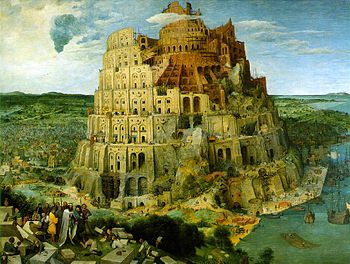
In the days of Noah and for ten generations afterward, there was only one people, one language, and one standard by which a man could have a covenant with God. It was the standard God gave to Noah. At the tenth generation, this people united to build an affront to God at Babel and we are told that God “confused their languages” and made the seventy nations (Genesis 11:1-9). At the end of this reading, we see Abram enter the narrative for the first time, but even after Abraham, Isaac, and Jacob, what was the standard of righteous living for all of mankind until the coming of Jesus?

We can look at the story of Noah and see the story of mankind’s influence, not only upon the world around us but, according to mystic interpretation, the world above. When man defied God and built a tower, God could have ignored them. After all, it wasn’t as if building a structure, no matter how high, really could have reached Heaven, could it? But if not, then why did God react and do what He did?

the-towerNo, I don’t believe you can make a tower to reach up to Heaven, but I do believe that somehow, what we do on earth, for good or for bad, does affect Heaven and it does affect God. Certainly we can’t do anything to adversely affect God but we also have a unique relationship with our Creator that no other creature has, not even the angelic beings. We are special. We matter personally to God. Our actions are not our own and they are not limited to the “nuts and bolts” of life in our own little world.

If even the name “Noach” has meaning, if the stories in the Torah somehow reach beyond the words on a page and resonate in Heaven itself, if what we loose on earth is loosed in God’s realm, then the story of Noah teaches us that we dare not be careless with what we say and do. Noah’s planting a vineyard, making wine, and becoming intoxicated resulted in a permanent curse on Ham, but we don’t know why. The descendents of Noah built a great tower to symbolize their invincibility over God, defying God as man did in Eden, and defying God as the generation before the flood, and God reacted by confusing their language and splitting the one people into the seventy nations of the earth, and we don’t really know why. We say and do things in our lives, sometimes in the service of God and sometimes in the service of ourselves, and yet they have an impact in the Heavenly courts, and we don’t know how or why.

But if what we do matters that much, or even if it just might be possible that it matters that much, do we dare say a careless word or perform a careless act? Are not only our lives, but each thing we say or do that important to God? What are we loosing on earth…and in heaven?

Good Shabbos.

Genesis: Rerolling the Torah Scroll

IRolling the Torah Scrollf G-d is “perfect,” as Judaism says, what prompted Him to create the universe? What void was He seeking to fill?

The answer provided in Jewish Mysticism is that G-d desired marriage. Marriage necessitates the existence of someone distinct from yourself with whom to share your life, a union of husband and wife. G-d chose humanity as His bride. According to the Kabbalah, the High Holiday season is the annual experience of the cosmic matrimony between G-d and humanity.

-Rabbi Yosef Y. Jacobson
“Souls in the Rain”
Commentary on Sukkot and Simchat Torah
Chabad.org

It is impossible to decide whether in Judaism supremacy belongs to halacha or to agada, to the lawgiver or to the Psalmist. The Rabbis may have sensed the problem. Rab said: The world was created for the sake of David, so that he might sing hymns and psalms to God. Samuel said: The world was created for the sake of Moses, so that he might receive the Torah (Sanhedrin 98b). (p.340)

-Abraham Joshua Heschel
God in Search of Man : A Philosophy of Judaism

Genesis. The very familiar and very confusing Biblical rendition of God’s creation of the universe, our planet, and man and woman. Why did He create all of this and us? In a previous blog post, I took a rather dim view of creation, given how things have turned out so far, and if I were standing at some sort of cosmic reset point, where God were about to create time and space all over again for the first time, I might say to Him, “Do you really want to do this? You know how it turns out.”

Indeed, we do know. God gives man and woman exactly one thing to do and they blow it. Put another way, long before God gives Moses the Torah, with its 613 mitzvot for the Children of Israel, He gave only one to Adam. If a mitzvah contained the same intrinsic meaning for man in the first days of the Garden as it does for a Jew today, then this one task, to refrain from partaking of the fruit of the tree of the knowledge of good and evil, was not simply a matter of obeying (or disobeying) God, but something that Adam and Eve actively participated in with God as part of a cooperative effort. God, speaking from a Jewish perspective, is just as “bound” to the mitzvot as man.

Heschel (p. 361) illustrates the importance of a mitzvot to a Jew this way:

Just as salvation is the central concept in Christian piety, so does mitsvah serve as a focus fo Jewish religious consciousness.

That sentence, more than any other in Heschel’s book, should send shivers down a Christian’s spine. Any believer knows just how much they value their salvation through the blood of Jesus Christ. But Christian, whether you understand it or not, a mitzvah to a Jew is every bit as important to him as your salvation is to you. The difference is that, once you accept Jesus as Lord and Savior, your job is done. Accepting salvation upon yourself is a passive act. God does it all by grace. By contrast, a Jew is always in motion with the mitzvot, acting upon the world and working with God to make it a better place. It’s not as if failing a mitzvah puts the Jew’s soul at risk or that grace isn’t in operation every single moment (to put it in Christian terms), but performing the mitzvah is the active ingredient in any Jew’s faith and life.

In fact, it is said “Without mitsvot one is naked” (Genesis Rabba 3,7). It is thought that one does not perform a mitzvah so much as one “acquires” it. A Jew might say “Adorn thyself with mitsvot before Him” (Sanhedrin 17a) as if the mitzvot were clothing. That is how Heschel (pp. 362-3) can come to this statement:

The supreme dignity of mitsvah is of such spiritual power that it gained a position of primacy over its antonym, namely, sin or averah. Even the sin of Adam was described as loss of mitsvah. After the forbidden fruit, we are told, their eyes were unclosed and “they knew that they were naked” (Genesis 3:7). “One mitsvah was entrusted to them, and they had stripped themselves of it.” (Genesis Rabba 19,17).

Knowing all of this, why did God create the world? Why did he create man? For marriage? For the supreme union between man and God? My, how we made a mess of things early on in the relationship and continue to do so. As Rabbi Yonah writes on the Jewlicious blog:

Jewish tradition teaches that God created the world to infuse it with goodness. However, this stands in contrast to the world we see. Even with the rose-colored glasses of privilege and faith in humankind, we have to admit that the world is full of misery and suffering. Finding God in this mess becomes difficult, if not impossible, for many of us.

failurePerhaps this terrible condition of the world is the only environment where humanity could exist for any length of time. We were going to fall. It was a matter of God deciding whether or not we should be given life, not whether we would fail in that life or not. Perhaps God’s boundless love would never have been understood or appreciated unless we were still loved by Him after we completely failed.

As we learned recently from Yom Kippur, God made time in such a way that it can be rolled back to the beginning. All wrongs can be made right. All hurts can be healed. We can be as we were “in the beginning”. The intensity and whirlwind of activities that mark the Days of Awe are about to collapse in on themselves and suddenly, time will be rolled back to Genesis even as Torah scrolls are rolled back to the beginning.

I haven’t experienced the joyous highs that most people have who celebrate this time of year, but my experience is unique and my situation has a limited context. Although I am a Christian, I am not a typical cog in that machine, nor do I fit into the Jewish world because of my faith. I have read through many Torah cycles, but this year, going back to the beginning is like making a fresh descent into the abyss of man’s failure without being able to see his future.

How did Abraham arrive at his certainty that there is a God who is concerned with the world? Said Rabbi Isaac: Abraham may be “compared to a man who was traveling from place to place when he saw a palace in flames. Is it possible that there is no one who cares for the palace? he wondered. Until the owner of the palace looked at him and said, ‘I am the owner of the palace.’ Similarly, Abraham our father wondered, ‘Is it conceivable that the world is without a guide?’ The Holy One, blessed be He, looked out and said, ‘I am the Guide, the Sovereign of the world.’ ” (Genesis Rabba 39) The world is in flames, consumed by evil. Is it possible that there is no one who cares? -Heschel p.367

There’s a well-known idiom in Hebrew that says, “Yeridah Letzorech Aliyah” meaning “descent for the sake of ascent”. I am descending into Genesis and will once again watch man fail God. Each day that I live, I live the life of a man who has failed God. But as the days and weeks progress and the Torah scroll is rolled further into Genesis, I pray that this will also be an ascent for the sake of my descent. Man has failed God and yet is still loved by God. However tenuous it may seem to me just now, that means there must be hope.

As a father has compassion on his children,
so the LORD has compassion on those who fear him;
for he knows how we are formed,
he remembers that we are dust. –Psalm 103:13-14

Good Shabbos.

V’zot Haberachah: When the Party Ends

Hebrew FireAnd this is the blessing that Moses, the man of God, bestowed upon the Children of Israel before his death. He said: Hashem came from Sinai – having shone forth to them from Seir, having appeared from Mount Paran, and then approached with some of the holy myriads – from His right hand He presented the fiery Torah to them. Indeed, You loved the tribes grately, all its holy ones were in Your hands; for the planted themselves at Your feet, bearing [the yoke] of Your utterances: “The Torah that Moses commanded us is the heritage of the Congregation of Jacob.”Deuteronomy 33:1-4

The Rambam writes: “Moshe ordained that on every festival, the Jews should read [a portion of the Torah which reflects] its content.” He continues by listing the passages read on different festivals, and concludes that on Simchas Torah, we read Zos HaBerachah. This implies that the reading of Zos HaBerachah on Simchas Torah shares a connection with the holiday itself; it is not read at that time merely because it is customary to conclude the yearly cycle of Torah readings on that festival.

-Rabbi Eli Touger
In the Garden of Torah
“A Fountain of Blessing”
V’zos Haberachah
Chabad.org

The final portion of Deuteronomy is always read on Simchat Torah, the “Rejoicing of the Torah”, as one Torah cycle ends and another begins. It is a reminder that all things end and yet all things are new. The gift of God’s Torah to the Jews is celebrated with much laughter and dancing. In the synagogue, all of the Torah scrolls are removed from the ark and everyone carries them and dances and sings and cheers in joyous appreciation of God’s goodness. Shemini Atzeret and Simchat Torah also formally end the Jewish holiday season and, the following Shabbat, the reset button is pushed and Parashoat B’resheet starts another cycle of reading.

Yet in the midst of tremendous victory, Rabbi Touger chooses to remind his readers of one of Israel’s greatest tragedies.

In this context, however, a difficulty arises: Rashi explains that the final phrase of the Torah, l’einei kol Yisrael, “before the eyes of the entire Jewish people,” refers to the breaking of the tablets containing the Ten Commandments. Our Sages attach great importance to conclusions, explaining that they summarize the content of all the preceding concepts. Why then does the conclusion of the entire Torah and in particular, the conclusion of the reading V’Zos HaBerachah mention a subject which seemingly reflects the disgrace of the Jewish people, for the tablets were broken because of the nation’s sin in worshipping the Golden Calf.

However, to understand why such a time of shame should be introduced into the culmination of a season of celebration, we have to go back into the symbolism for both Sukkot and for Simchat Torah:

What is the inner content of Simchas Torah? When contrasting the sacrificial offerings brought during Sukkos to those brought on Simchas Torah, our Sages explain that the 70 bulls offered on Sukkos refer to the 70 nations of the world. The one bull offered on Simchas Torah refers to the Jewish people, the “one nation.”

Simchas Torah is a day when “Israel and the King are all alone.” This is a time when the essential bond between G-d and the Jewish people is expressed in joyous celebration. This concept is reflected in the name of the Torah reading, V’Zos HaBerachah, lit. “This is the blessing,” and its content, which focuses entirely on the blessings given the Jewish people, and the praise of their uniqueness.

PrayingThat Sukkot includes the nations and not just the Jews is perfectly understandable, given Zechariah 14:16-19, when all the survivors of the war against Israel from among the Gentile nations will be commanded to send representatives to Jerusalem for Sukkot and pay homage to the King in Messianic days. For a Gentile such as myself to celebrate Sukkot now is something of a taste of things to come. But there is something else.

If Sukkot is an invitation for everyone to join God and God’s chosen people, Simchat Torah is a time when, according to Rabbi Touger, the nations are “included out”. This rather punctuates the fact that the Torah was given just to Israel and that the special holiday of honoring the giving of the Torah at Sinai is just between God and His One Nation: the Jews. While God is the Father and Creator of the people of the world, it’s as if the Father wants to have a special day with only His first born. It is also a time when, remembering the Golden Calf, God consoles His special son and brings His son back from his past shame and returns the son to God’s love.

This also explains why Moses broke the first set of tablets, out of God’s great love for Israel:

To explain: When describing the reason for the breaking of the tablets, Rashi states:

To express with an analogy: A king journeyed to a distant country, leaving his betrothed with maids. Because of the depravity of the maids, the reputation of the intended also became tarnished. The bridesman took the initiative and ripped up the wedding contract, saying: “If the king will order to kill her, I will protest, saying that she was not yet his wife.”

The king is the Holy One, blessed be He; the maids, the mixed multitude [of converts who joined the Jews after the Exodus]. The bridesman is Moshe, and the betrothed…, the Jewish people.

Rashi’s intent is to explain that Moshe broke the Tablets to protect the Jewish people from G-d’s wrath. Here we see the unique importance of the Jewish nation. The Torah is G-d’s “delight, frolicking before Him at all times.” And within the Torah, the tablets on which the Ten Commandments were engraved were “the work of G-d… and the writing of G-d,” given to Moshe by G-d Himself. And yet when the future of the Jewish people was at stake, Moshe was willing to break the tablets without hesitation.

Why did Moshe take such a step? Because there is nothing not even the Torah which G-d cherishes more than a Jew.

For a Jew, this makes perfect sense, but for a Christian it is confusing. This is especially true in light of the explanation that the Golden Calf incident is attributed largely to the Gentile “converts” to Judaism, casting Gentiles in an untrustworthy light. But if a Jew considers himself God’s first born, a Christian acknowledges the first born of the Creator as ultimately expressed in the person of Jesus Christ:

About eight days after Jesus said this, he took Peter, John and James with him and went up onto a mountain to pray. As he was praying, the appearance of his face changed, and his clothes became as bright as a flash of lightning. Two men, Moses and Elijah, appeared in glorious splendor, talking with Jesus. They spoke about his departure, which he was about to bring to fulfillment at Jerusalem. Peter and his companions were very sleepy, but when they became fully awake, they saw his glory and the two men standing with him. As the men were leaving Jesus, Peter said to him, “Master, it is good for us to be here. Let us put up three sukkot – one for you, one for Moses and one for Elijah.” (He did not know what he was saying.)

While he was speaking, a cloud appeared and covered them, and they were afraid as they entered the cloud. A voice came from the cloud, saying, “This is my Son, whom I have chosen; listen to him.” When the voice had spoken, they found that Jesus was alone. The disciples kept this to themselves and did not tell anyone at that time what they had seen. –Luke 9:28-36

Simchat TorahWhat this all means, I don’t exactly know. I do know that the Jewish people have always been special to God and they always will be special, even above all the other people of the earth and yes, even above Christianity, those of us among the nations who have chosen to be disciples of the Master.

Even Paul went first to the Jews and only afterward to the Gentiles (Romans 1:16; Romans 2:10), though he was specifically sent as an emissary to the nations. This should be a message for those Christians who tend to get a little full of themselves contemplating the idea that somehow the church has replaced Israel, while ignoring Paul’s warning in Romans 11:24. Indeed, all of Israel will be saved (Romans 11:26).

But while we continue to eat and fellowship and enjoy Shemini Atzeret, this “extra” day of Sukkot, we are about to be escorted out of the hall and politely asked to leave the party, for Simchat Torah is a private affair between the Jews and God. The last day of the great celebration is limited to a very special people who have, above all the nations, endured extreme hardship and suffering for the sake of keeping God’s Torah and His Shabbat when the rest of the world was wallowing in pools of pagan savagery.

Waiting to danceHow then can the rest of us, though we know God is right, console ourselves as we stand on the outside of God’s special and unique love, looking in? How can we watch the dancing around the synagogue with the Torah while we sit alone in the dark? Only by remembering this and knowing that we are not completely rejected because of God’s love for the Jews.

For God so loved the world that he gave his one and only Son, that whoever believes in him shall not perish but have eternal life. –John 3:16

There are many kinds of barriers: Those from within and those from without. Barriers between people. Barriers that prevent you from doing good things.

Barriers of your own mind and your own hesitations. There are the barriers that exist simply because you are a limited being.

Joy breaks through all barriers.

-Rabbi Tzvi Freeman
“Joy Unleashed”
Based on letters and talks of the Rebbe
Rabbi M. M. Schneerson
Chabad.org

Someday, we will be asked to dance as well.

Falling

FallingIt does seem frightfully unfair that one man’s single transgression should consign all humanity to death. But it is equally unfair that one man’s righteousness also offers all of humanity the reward of righteousness: “the right to the tree of life.” (Revelation 22:14)

From: “The Life-giving Spirit”
Parasha B’reisheet commentary
First Fruits of Zion (FFOZ)

After man ate from the Tree of Knowledge, however, he acquired the intimate knowledge of and desire for evil. The evil inclination was no longer an external force, represented by the Serpent. It was within. Our physical flesh was now a confused mixture of good and evil. Death was introduced into the world: human flesh, separated from the spirit, was a creature of the finite, physical realm — one which must ultimately decay and die. Man would now face a much greater challenge than before. He would no longer battle a Serpent from without. He would have to battle his own sluggish yet desirous flesh within.

Rabbi Dovid Rosenfeld
The Primordial Sin, Part II
Pirkei Avos Chapter 6, Mishna 5(b)
Torah.org

This coming Saturday, we begin a completely new Torah cycle with Parasha B’reisheet and once again, we start by reading the first chapters of Genesis. Adam is coming, and I’m a little nervous. I know this may seem strange, since we are in the middle of Sukkot, a time of great joy, but it’s as if I am sitting in my sukkah, somehow looking at Creation from several moments before God said “Let there be light” (Genesis 1:3). Yet in that point of suspended time, I know everything that is going to happen after God speaks these words. It’s as if God has not yet created the universe and some part of me wants to stop Him. How can He create the Earth, Adam, Eve, the tree of the knowledge of good and evil, even the serpent, knowing what I know; knowing about the fall? How can He create the universe knowing about all of the pain, anguish, and suffering that is going to happen as a result?

What?

Do you doubt that God knew about what would happen once He started everything in motion? Don’t you realize that to be God, He must have known that Adam would disobey, give into temptation, and lead all of humanity down a dark and sinister road to the abyss?

God must have known, but He created us anyway. Still, waiting for next Shabbat to come is like waiting for it happen all over again, from moments before God brought all into being with His powerful Word, to forming the first man out of clay, breathing life into Him, splitting the man and making woman, placing them in the Garden, and then…and then…

I often despair at the state of the world. All I have to do is go online and start reading the news. I recently read a story on CNN about a toddler in China who was the victim of a hit-and-run accident. As bad as this is, what makes the story all the more horrible is that she was hit twice by two separate vehicles and neither driver stopped. Worse, numerous pedestrians walked right past her and did nothing. Finally, a “58-year-old scavenger named Chen Xianmei” stopped and pulled her out of the street. The CNN story states that the “grainy footage of the accidents went viral on Chinese Internet within minutes of posting”, and only then did anyone express “outrage”.

According to Rabbi Rosenfeld, as a result of what Christians call “the fall”, humanity is now is a state of confusion, trying desperately to tell the difference between good and evil and to understand what we are supposed to be doing about it. The Prophet Isaiah, in warning Israel, could also have been warning us:

Woe to those who call evil good
and good evil,
who put darkness for light
and light for darkness,
who put bitter for sweet
and sweet for bitter. –Isaiah 5:20

God holds the worldIt seems as if everything that God tells us is evil and wrong is touted by the world around us as right, positive, and desirable. In that sense, I feel very much a stranger in a strange land, an alien among humanity, a pariah standing against everything the world says is the right thing to do and being called cruel and bigoted because of it.

That’s why I want to stop God from creating the world. Because it will just start all over again and we’ll end up right back here, facing the same day, the same problems, the same moral confusion where right and wrong are literally turned inside out.

Do not repay anyone evil for evil. Be careful to do what is right in the eyes of everyone. If it is possible, as far as it depends on you, live at peace with everyone. Do not take revenge, my dear friends, but leave room for God’s wrath, for it is written: “It is mine to avenge; I will repay,” says the Lord. On the contrary:

“If your enemy is hungry, feed him;
if he is thirsty, give him something to drink.
In doing this, you will heap burning coals on his head.”

Do not be overcome by evil, but overcome evil with good. –Romans 12:17-21

…so Christ also, having been offered once to bear the sins of many, will appear a second time for salvation without reference to sin, to those who eagerly await Him. –Hebrews 9:28

I know, I know…he’s coming, too. Jesus, I mean.

The world is broken but not beyond repair. The principle of Tikkun Olam tells us that we are junior partners with God in the act of repairing the world. Of course, we all await the Messiah to come back and bring the job to its finale, restoring us to who and what we were before the serpent entered the Garden and in fact, restoring the Garden itself. I know. We will once again walk with God as Adam did and “each man will sit under his vine and under his fig tree, and none will make him afraid” (Micah 4:4).

Sukkah in the rainI just wish we didn’t have to fall in the first place, because it’s so hard to get back up.

Maybe that’s why Sukkot is happening right now. In an imperfect world, where our shelters don’t have solid walls and the roof leaks, we are like people living in a sukkah depending on God to keep us fed, warm, dry, and safe.

Adam is coming and he’s about to fall. But Jesus is coming to help pick him back up. I’m trembling in fear as it’s about to happen all over again. I’m watching, I’m waiting. I’m praying.

Having discovered all your faults, you are depressed.

Imagine you have just found a doctor with a diagnosis that explains all your afflictions over the past many years. And he’s written a prescription directing you on a sure path to good health.

Shouldn’t you jump with joy and relief?

-Rabbi Tzvi Freeman
“Joyful Prognostics”
Based on letters and talks of the Rebbe
Rabbi M. M. Schneerson
Chabad.org

A few months back, I wrote a three-part series on the lessons we are about to learn once more in Genesis. This might be a good time to read them again: Part I: Overcoming Evil, Part II: The Primordial Serpent, and Part III: Healing the Wounded.

The Garden of Ha’azinu

Hands of the GardenerAt every moment, your Creator must decide, “Should I put up once again with this little creature’s imperfections and blunders, or is it time to measure things by the scale?”

Then He looks at the scale you use to measure others. And with that same measure, He measures you.

-Rabbi Tzvi Freeman
“Reciprocal Tolerance”
Based on letters and talks of the Rebbe
Rabbi M. M. Schneerson
Chabad.org

What, after all, is Apollos? And what is Paul? Only servants, through whom you came to believe—as the Lord has assigned to each his task. I planted the seed, Apollos watered it, but God has been making it grow. So neither the one who plants nor the one who waters is anything, but only God, who makes things grow. The one who plants and the one who waters have one purpose, and they will each be rewarded according to their own labor. For we are co-workers in God’s service; you are God’s field, God’s building.1 Corinthians 3:5-9

The First Fruits of Zion (FFOZ) commentary on this week’s Torah Portion Ha’azinu compares the teachings of the Torah given to the Children of Israel to the acts of the Apostles spreading the Good News of Jesus Christ to the people of Corinth. Paul was the first to bring the Gospel message to the Gentiles there, but if he “planted the seed”, then he credits Apollos with “watering” it. Yet the seed, the water, and the growing of the plants all come from God.

And look what we’ve done with what He’s provided. I don’t necessarily say that as a compliment to humanity.

Rabbi Freeman shows us that perhaps God considers our lives each day and ponders about whether or not to extend our existence into tomorrow. This is based on the measure of how we show or fail to show kindness and grace to others. What a terrible way to judge us.

Rosh Hashanah begins at sundown this coming Wednesday (1 Tishrei), and it is believed in Judaism, that at the “head of the year”, God opens the Book of Life, in which are inscribed the names of those who will be extended into the coming year. From Rosh Hashanah, it is said that we have ten days until Yom Kippur to be inscribed into the Book of Life. Perhaps God does “reconsider” our existence from time to time, or at least annually.

That may not fit your view of God or your view of your continuing life, particularly if you are a Christian. In Christ, we believe that we have been redeemed once and for all, thanks to the gift of God’s grace through the atoning death of Jesus. Nevertheless, this does not mean we cannot fail the Creator and it does not mean that we can’t be better tomorrow than we are today. It also doesn’t mean that there are no further consequences for our actions, including the consequence of death.

The FFOZ commentary on Ha’azinu includes this parable:

Consider the story of a foolish gardener. In the spring he planted some seeds and watered them. He was pleased when they began to grow, and he assumed that he could simply wait for the harvest. He did not think to water the young plants again. “After all, I have already watered them,” he said to himself. The plants shriveled up and died.

If God is our gardener, then we are indeed fortunate, for God will not neglect us or fail to water and care for us. But we are self-willed “plants” and we have some control over whether or not we allow ourselves to be “watered”. Words of Torah rain on us from heaven (Deuteronomy 32:2) but do we allow our “roots” to soak up what we need for life? Even though we’ve been “saved”, and even if you believe that salvation is difficult if not impossible to forsake, can you still not forsake living the life God has given to you? Unlike the plants in a garden, God offers care but we must willingly accept it. We can say “yes” or “no” or simply ignore the provision of rain, sunshine, careful weeding, and fertilizer. Who we are in Him depends as much on us and how we choose to live, as it does the generous hand of God.

In Judaism, a new year is coming soon. It’s an opportunity to hit the “cosmic reset button” in our lives. If we have failed Him, and we most certainly have (Romans 3:10), then we too, as Christians, can take this opportunity to turn our “no” into a “yes”. The gardener is here. Let Him sow good things in us so that we can be the good fruit of His harvest.

L’shanah tovah tikatev v’taihatem. May you be inscribed and sealed for a good year.