Tag Archives: Torah

Tazria-Metzora: Time Out

whispererTzara’at, the skin discoloration mistranslated for millennia as “leprosy,” is a curious disease. It is not contagious—it was only acquired by virtue of speaking badly of other people. It was a physical skin discoloration caused by a spiritual defect. The “metzora,” the sufferer with tzara’at, had to stay outside the city and inform all that he or she was spiritually impure.

-Rabbi Shlomo Yaffe
“Healing Hubris”
Chabad.org

Judaism does not believe in free speech.

Talking ill of your neighbor, even if it is the truth, is unequivocally banned. In fact, the Talmud (Erchin 15b.) equates gossip-mongering with idolatry, licentiousness and murder—the three cardinal sins—combined!

Moreover, the Jerusalem Talmud tells us that “King David’s soldiers would fall at war, for although they were completely righteous, tale-bearing was widespread among their ranks… Ahab’s militia, however, although they were notorious idol-worshippers, were victorious on the battlefield because of their exceptional camaraderie . . .” (Pe’ah 1:1.)

Apparently, G‑d takes greater offense at the badmouthing of His children than at the badmouthing of Himself!

In some ways, then, the gossiper is the worst sinner of all. As such, his “punishment” teaches us much about the nature of all the punishments prescribed by the Torah.

-Rabbi Mendel Kalmenson
“Spiritual Rehab”
Chabad.org

Commenting on this week’s Torah Portion TazriaMetzora is a difficult task, at least if I don’t want to seem repetitive. After all, I’ve been “bashing” lashon hara or “evil speech” for a few days now as a problem I have with religious people and in how such speech destroys God’s reputation and all our lives.

It is thought in some circles of Judaism, that the cause of tzara’at in ancient times was evil or ill speech. The consequence was that, after the condition was confirmed by a Priest (with the cry of “Unclean!”), the metzora was set outside the camp. There was a period of waiting and then re-examination. If the metzora was declared clean, then he or she undertook a certain set of rituals and then could re-enter the camp. If not, then they had to wait some more and the process would repeat itself. Presumably, anyone who was a metzora would eventually be declared clean and then re-enter the camp of God.

But what if someone was never declared clean? What if the disease wouldn’t go away? I guess that would mean not only the symptoms would remain, the skin disease, but the underlying cause would keep hanging around: talking ill of your neighbor (and your neighbor ultimately could be anyone).

“If your brother sins against you, go and tell him his fault, between you and him alone. If he listens to you, you have gained your brother. But if he does not listen, take one or two others along with you, that every charge may be established by the evidence of two or three witnesses. If he refuses to listen to them, tell it to the church. And if he refuses to listen even to the church, let him be to you as a Gentile and a tax collector.

Matthew 18:15-17

I suppose that’s the closest New Testament equivalent to the condition of the metzora who sinned against his or her neighbor by gossiping against them. Well, it’s not as if the metzora didn’t exist in the days when Jesus walked in Israel:

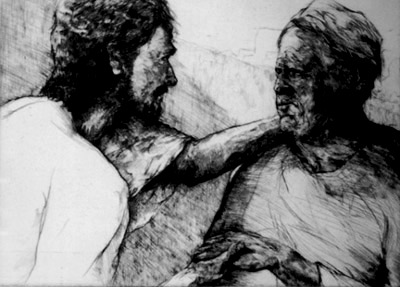
When he came down from the mountain, great crowds followed him. And behold, a leper came to him and knelt before him, saying, “Lord, if you will, you can make me clean.” And Jesus stretched out his hand and touched him, saying, “I will; be clean.” And immediately his leprosy was cleansed. And Jesus said to him, “See that you say nothing to anyone, but go, show yourself to the priest and offer the gift that Moses commanded, for a proof to them.”

Matthew 8:1-4

The word rendered as “leper” in verse two is probably a rather poor translation or there was no Greek word that captured the Hebrew “metzora.” It seems that, in one fell swoop, Jesus forgave the metzora of his sin and cured his physical and spiritual ailments.
the_leperIn some sense, it’s a shame we don’t suffer from tzara’at today. If our sins were as plain as the noses on our faces, perhaps we would be much more diligent in avoiding sin. Then again, to the degree that there was such a law that required the metzora be examined and isolated from the camp, I guess people under such a law weren’t able to avoid such a sin, even knowing the consequences.

Still, it seems cruel. Why isolate someone from the community if they’ve sinned? We see examples in both the Tanakh and in the Apostolic Scriptures. The metzora endured temporary (hopefully) exile, while the passage from Matthew 15 teaches that a person gets “three strikes” before they are “out.” Do they ever get back in? How did the metzora get back into the camp?

Rather than talk to others, he needed to talk to himself.

This wasn’t about revenge; it was about reflection.

He wasn’t being hurt because he’d hurt others in the past. He wasn’t even being isolated so that he wouldn’t come to socially isolate others in the future. He was simply being given the opportunity to get to know his present self.

People who hurt and isolate others are lonely and in pain themselves. Those who try to destroy other people’s security and happiness are themselves often sad and insecure.

The Torah—which is concerned with kindness, not power—sees the sinner as a victim, not an enemy, and therefore recognizes his need to be strengthened rather than weakened. This, the Torah perceives, cannot be done in the presence of others, but has to be done alone.

In the presence of others, he would see that which he lacked. Alone with himself, he was able to see that which he possessed.

-Rabbi Kalmenson

This isn’t hard to understand. Any parent who has put their child in “time out” understands what is happening. This is what parenting experts and educators call “logical consequences.” If you can’t get along with your community (your brother, mother, playmate), you don’t get to be with them for a certain period of time. If you sin against your brother (in Christ), and you don’t repent, you don’t get to be with your brother or any of your brothers, presumably until you are able to repent.

Then Peter came up and said to him, “Lord, how often will my brother sin against me, and I forgive him? As many as seven times?” Jesus said to him, “I do not say to you seven times, but seventy-seven times.

Matthew 18:21-22

Oh, yes. When they do repent, you take them back. That’s what happened to the recovered metzora and what was supposed to happen to the brother who sinned against you. When they repent, you take them back. Even if they sin against you later and then repent, and then sin against you later, and then repent, and then…

Gee, really? Is this like a sin and repent and forgive revolving door? I suppose there must be limits.

Or do you not know that the unrighteous will not inherit the kingdom of God? Do not be deceived: neither the sexually immoral, nor idolaters, nor adulterers, nor men who practice homosexuality, nor thieves, nor the greedy, nor drunkards, nor revilers, nor swindlers will inherit the kingdom of God.

1 Corinthians 6:9-10

That sounds pretty harsh, but then again, if someone is willfully and habitually sinning, are they really saved at all? Are they really members of Messiah’s “sheep pen?” Can we flaunt the will of God to His Face and still expect that He will write our names in His book of life?

Why are we sometimes exiled from the community of brothers?

And so, ultimately, this was a therapeutic time for the metzora, focused not on hurting him but on curing him. Rather than confine him, this procedure aimed to free him.

Could this be the reason that the Torah portion which describes the metzora’s impurity, likened in Jewish literature to spiritual death, (Talmud, Nedarim 64b.) is called Tazria, which means “conception,” or the beginning of new life? (see Likkutei Sichot, vol. 22, pp. 70ff.)

-Rabbi Kalmenson

isolationI suppose there’s a certain merit in the idea of isolating yourself when you realize that you are living a double-minded life. Why wait to be publicly humiliated when you can stop it now, take a “time out,” and turn to God to get yourself straight. How that’s implemented depends on your sins. Are you a gossip? Are you a drunk? Are you into “inappropriate adult material?”

For some of that, you might not be able to deal with it alone and in fact, being alone might make it worse. Sometimes you have to withdraw from your usual social avenues and connect with a group or individual who is there specifically to help you out with your specific problem.

The closest ancient analogy is the Priest, who was responsible for the initial and subsequent examinations of the metzora. The metzora’s counselor during isolation was God. In modern times, we continue to need God, but sometimes he sends us additional, human help.

And there’s hope for life after “tzara’at.”

Life isn’t out to get you.

It’s out to be gotten by you.

And if and when in life you are forced to punish, do it like a pro.

Imitate G‑d.

Don’t hurt out of weakness; repair out of strength.

-Rabbi Kalmenson

A life under repair might not look pretty, at least in the beginning, but if the life is truly being repaired, that means productive work is being done. Give it time. Give God time to work with you (and me). Jesus told Peter to forgive repeatedly, over and over again, so that none should perish but everyone come to repentance.

Good Shabbos.
Paul the Apostle, Liar, and Hypocrite

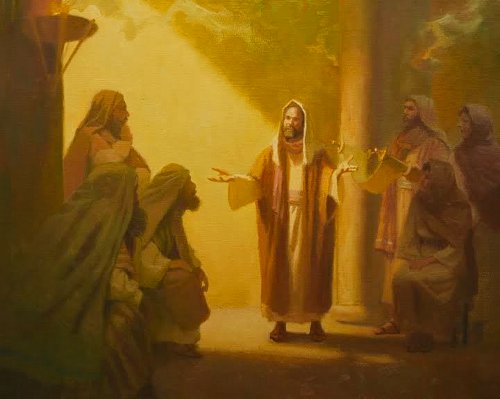
Apostle-Paul-PreachesFor though I am free from all, I have made myself a servant to all, that I might win more of them. To the Jews I became as a Jew, in order to win Jews. To those under the law I became as one under the law (though not being myself under the law) that I might win those under the law. To those outside the law I became as one outside the law (not being outside the law of God but under the law of Christ) that I might win those outside the law. To the weak I became weak, that I might win the weak. I have become all things to all people, that by all means I might save some. I do it all for the sake of the gospel, that I may share with them in its blessings.

1 Corinthians 9:19-23

What then is to be done? They will certainly hear that you have come. Do therefore what we tell you. We have four men who are under a vow; take these men and purify yourself along with them and pay their expenses, so that they may shave their heads. Thus all will know that there is nothing in what they have been told about you, but that you yourself also live in observance of the law.

Acts 21:22-24

In one of the conversations I’ve had with Pastor Randy at my church, we discussed the activities of Paul as recorded by Luke in Acts 21. Included in some of the questions Pastor brought up was whether or not Paul was being disingenuous by offering to pay the vow price for four men at the Temple to avoid criticism from other Jews (see the quote from Acts 21 above) and that Paul had replaced this devotion for the Torah and for the Temple with faith in Jesus Christ. Interestingly enough, according to D. Thomas Lancaster in his commentary on Acts 21:15-22:30 (see First Fruits of Zion’s Torah Club Volume 6 Chronicles of the Apostles reading for Torah Portion Shemini [“Eighth”] for details), this is exactly what most Christian commentators believe.

Paul’s participation in the sacrificial services proved to the Jerusalem believers that he was not an apostate. Ironically, many Christian interpreters would consider participation in the Temple sacrifice as apostasy from Christ. They excuse Paul’s backsliding into Judaism on the basis that he was pressured into the ceremony by James and the elders. Moreover, Paul himself said, “I have become all things to all men so that I may by all means save some” (1 Corinthians 9:22).

-Lancaster, pg 684

The quote above from 1 Corinthians 9 seems particularly damning, but I want to mention something else first. In order to believe the traditional Christian interpretation of Paul’s participation in the Temple sacrifice, we have to believe that Paul is a terrible liar and hypocrite and we have to believe that James and the Council of Apostles of Christ not only condoned his dishonesty, but actively encouraged him in it.

If these are the sorts of people responsible for writing much of our New Testament, what does that say about the foundations of the Christian faith? Did God really entrust the establishment and dissemination of the Gospel of Jesus to not only flawed human beings (and all the writers of the Bible were imperfect), but deliberately dishonest, hypocritical liars? Do the ends justify the means? Should we emulate the apostles by also lying in order to win a few souls for Christ?

Assuming he’s not also lying in the following quotes, Paul defends himself before his Jewish accusers and the Romans:

Paul argued in his defense, “Neither against the law of the Jews, nor against the temple, nor against Caesar have I committed any offense.”

Acts 25:8

After three days he called together the local leaders of the Jews, and when they had gathered, he said to them, “Brothers, though I had done nothing against our people or the customs of our fathers, yet I was delivered as a prisoner from Jerusalem into the hands of the Romans.

Acts 28:17

But then what are we to make of Paul’s own words to the church in Corinth in his first letter to them? What is Paul saying?

whispererAccording to Lancaster’s commentary (pp 684-6), Paul was saying that he was merely crafting his message for different audiences, not that he was changing his overall behavior, especially in relation to Torah observance. When Paul said “to the Jews I became as a Jew,” it could hardly mean he “became a Jew” since he was already Jewish by birth (although some modern Jews believe Paul was born a Gentile and converted to Judaism). Lancaster states that in Paul saying this, he “only means that, when among Jewish people, he employed that common ground to his advantage” since he “shared with them a common cultural and historical heritage.”

I don’t have a problem believing this. My wife sometimes tells me that Jews today have a particular way of thinking and conceptualizing their world and that communication between Jews takes on a different “flavor” than between a Jew and a Gentile. It is likely that Paul would have presented his language and message within a heavily Jewish ethnic, cultural, national, and religious framework when sharing the good news of Messiah to an exclusively Jewish audience.

But what about when Paul said, “To those under the law I became as one under the law (though not being myself under the law) that I might win those under the law”? First of all, he already said he “became a Jew” so why add the redundancy (supposedly) of saying that he “became as one under the law?” Isn’t he saying the same thing twice and worse, isn’t he saying that he acted like someone under the law but actually wasn’t under the law? Isn’t that clearly being a hypocrite?

Lancaster answers those questions by saying that those “under the law” were not born-Jews but Gentile converts to Judaism or proselytes. That answers the question of why he wasn’t “under the law” if it means he’s not a convert to Judaism (a Gentile proselyte who chose place himself under Torah observance by converting). That seems a little weak, even to me, and I wish Lancaster had cited some sources to back up his claim. Apparently, this is his personal opinion but it does tend to solve why Paul engaged in “redundant language.”

On the other hand, he could have been referring to God-fearing Gentiles who were not proselytes (or who were considering conversion but had not yet made a commitment) but who voluntarily chose Torah observance. We see an example of such a person in Izates bar Monobaz who was a disciple of a Jewish merchant named Ananias and who, because of his royal position, was discouraged by Ananias from converting to Judaism. Izates vowed to observe all of the Torah mitzvot as the Jews do and later on, converted to Judaism, as did his mother Helena of Adiabene.

I also have to wonder about Cornelius, the Roman Centurion, who Peter encountered in Acts 10. In verses 3 and 30, Cornelius is seen or relates that he was praying at the ninth hour, or about 3 p.m. which is the set time for the mincha prayers in Judaism. Although the text doesn’t make it explicit, Peter and his Jewish companions stayed a number of days in the Roman’s household (see verse 48) and so they all must have eaten meals together. Unless you believe (and I don’t) that Peter’s vision (see verses 9-33) convinced him and his Jewish companions to permanently forego kosher foods, then, since there was a synagogue and thus a Jewish population in the largely Gentile community of Caesarea, it is likely that kosher food was available.

Just how many of the laws of Torah did Cornelius adhere to in his life as a God-fearer? We can’t possibly know, but it’s at least compelling to consider the idea that he may have kept a good many of them, as his position in the Roman military allowed.

under-law-torahI’m not saying any of my suggestions are fact, but it’s another way to look at Paul’s statement about “those under the law.”

Returning to Paul’s “those under the law” statement, Paul says he is not like them “under the law” but becomes like them. If Lancaster is right and they are converts, then of course, Paul doesn’t become a convert to Judaism and thus his statement is accurate. He can communicate to them in a way that they would understand in crafting his message specifically for converts (or Torah keeping God-fearers), though.

And what of “those outside the law” (1 Corinthians 9:21)? Lancaster defines them as Gentile God-fearers who do not live by the standards of Torah. If Paul becomes like them though, doesn’t that mean he puts away his Torah observance and eats ham sandwiches and shrimp scampi right alongside them at the lunch counter? Again, Lancaster refutes this and says that, “is not to say he ate forbidden foods or unclean meats, but wherever he had room to budge, he did so.” Lancaster goes on to say (pg 685):

Paul explained that he himself is not “outside of the law,” that is to say that he was not a Gentile God-fearer. Instead, he was under the “Torah of Messiah.” He remained legally Jewish in Messiah, but he bent where he could bend and flexed what he could flex in order to win those who were not Jewish.

Again, that seems a little thin, and again, Lancaster appears to be relying on his own interpretation and does not cite other authorities to back up his claim.

Traditional Christianity would probably jump all over these verses to illustrate that Paul was a behavioral chameleon and that Torah observance meant absolutely nothing to him unless he was talking to fellow Jews. Otherwise, he was under the “law of Christ,” which is to say “grace,” rather than the “Torah of Moses” or the traditional observances of the non-believing Jews.

Is there any other way to understand all this, particularly Paul’s behavior with Gentiles?

The only other way I can think of, and I’m no expert, is to say that Paul, like any good communicator, was able to craft the same message differently for different audiences. I’m a professional writer and that’s exactly what I do when constructing technical information about a software product for technical vs. lay audiences. The Gospels are largely thought to relate more or less the same information to different audiences, with Matthew written to Jews and Luke written to Greeks.

Even in ancient days, Jewish and Greek thought and conceptualization of ideas and actions was fundamentally different, and information about the same events and thoughts had to be constructed in different ways.

That’s how I would read Paul’s “chameleon” statements.

But that’s just me.

However, I also know this about Paul:

But I have made no use of any of these rights, nor am I writing these things to secure any such provision. For I would rather die than have anyone deprive me of my ground for boasting. For if I preach the gospel, that gives me no ground for boasting. For necessity is laid upon me. Woe to me if I do not preach the gospel!

1 Corinthians 9:15-16

I believe Paul. I believe he’d rather die than compromise his principles. I believe that he was devoted to the Messiah and to the truth of the Gospel. In fact, Paul ultimately did die for his faith, as did Peter, and the other apostles except arguably John. Like the other apostles, Jesus hand-picked Paul for his task and added to that, he did so as a supernatural event, well after Christ’s ascension to glory at the right hand of the Father. If God knows all things, it would be unlikely that such a man as Paul would have been selected if it was known that he was going to fail spectacularly as a liar and a hypocrite.

AbrahamYes, all men of God have failed. Abraham failed. Jacob failed. Moses failed. David failed. But not one of them failed in their mission for God. They failed in many human ways, but each successfully carried out the work that God gave them to do. Abraham failed when he lied about calling Sarah is sister (although arguably as his cousin, she could be called his “sister”), but he succeeded in having overwhelming faith in God and in the binding of Isaac. Jacob failed in his many acts of deceit, but he succeeded in fathering and raising the beginnings of the twelve tribes. Moses failed by desecrating God in front of the people when he struck the rock twice, which cost him his entry into Israel, but he succeeded in leading the Jewish nation in the wilderness for forty years as a shepherd leads and protects his flock. David failed with Bathsheba, but succeeded in conquering the Land and vanquishing Israel’s foes as her King.

Paul no doubt failed in many human ways too, but he succeeded in integrity, honesty, and courage, even in the face of death, many times defying opponents for the sake of his gospel and promoting Gentile inclusion in the Way of the Messiah.

If Paul was a liar and a hypocrite, then he only claimed to be serving Jesus. He couldn’t have been a real apostle and disciple. No one behaves so badly and yet serves a God of truth and justice.

“Not everyone who says to me, ‘Lord, Lord,’ will enter the kingdom of heaven, but the one who does the will of my Father who is in heaven. On that day many will say to me, ‘Lord, Lord, did we not prophesy in your name, and cast out demons in your name, and do many mighty works in your name?’ And then will I declare to them, ‘I never knew you; depart from me, you workers of lawlessness.’

Matthew 7:21-23

If Paul is the man who most Christian commentators (and most Jewish ones as well) believe him to be, then he was a “worker of lawlessness” literally, and a liar, and a hypocrite. If he was all of those things, then his epistles are a sham and we cannot trust them or their writer. If we can’t trust Paul, then most of the New Testament is unreliable. If that’s true, we Christians are in a horrible bind and we have to believe the modern Jews in saying that Paul took the basic teachings of Jesus and perverted them into an anti-Judaic religion, preaching hate of Jews, of the Temple, of the Torah, and of Israel.

That’s not the Paul I know. I’m sorry if you believe otherwise.

Shemini: Chesed to the Stranger

acts-of-kindnessThe following you shall abominate among the birds — they shall not be eaten, they are an abomination: the eagle, the vulture, and the black vulture; the stork; herons of every variety; the hoopoe, and the bat.

Leviticus 11:13,19 (JPS Tanakh)

The Talmud (Chulin 63a) states that the Hebrew name for the white stork is chasida, because it acts with kindness, chesed, towards its friends.

The Ramban, Moshe Nachmanides, a great Torah scholar, writes that the birds enumerated in this portion are forbidden for consumption because of their cruelty. Why, then, should the stork be considered “detestable” and an “abomination”? It should be permissible since it does kindness!

The Chidushai Ha-Rim answers: The stork does favors only for its friends. Since it doesn’t do chesed for strangers, it is considered not kosher. Chesed, kindness, must be done for everyone, not only one’s friends!

-Rabbi Kalman Packouz
“Shabbat Shalom Weekly”
Commentary on Torah Portion Shemini
Aish.com

It seems strange that we could learn lessons about treating others with charity and lovingkindness from the Laws of Kashrut, but the esteemed sages have illustrated this passage thus. Perhaps you would like something more familiar.

Love your fellow as yourself: I am the Lord.

Leviticus 19:18 (JPS Tanakh)

And a second is like it: You shall love your neighbor as yourself.

Matthew 22:39

But as the famous question goes, who is our neighbor?

The Torah teaches us, “Love your fellow human being as yourself” (Leviticus 19:18). It is often translated as “Love your neighbor as yourself.” However, Rabbi Mordechai Gifter taught that while the words “neighbor” and “fellow human being” are often used synonymously, in everyday speech the word “neighbor” is used to denote someone living or located nearby, while the obligation of this commandment includes a complete stranger who lives far away.

The general rule for this commandment is that anything you would want others to do for you, you should do for others (Rambam, Hilchos Aivel 14:1). The great Hillel once taught a convert, “That which is hateful to you, do not do unto others. That is the basis of the Torah.” (Shabbos 31a). The Baal Shem Tov used to say, “Love your fellow man as yourself — though you have many faults, nevertheless, you still love yourself. That is how you should feel toward your friend. Despite his faults, love him.”

-Rabbi Packouz

Not just your neighbor who is close to you, and not just your fellow who is like you, but even people who are far away and who you do not know…even people you may not like.

“You have heard that it was said, ‘You shall love your neighbor and hate your enemy.’ But I say to you, Love your enemies and pray for those who persecute you, so that you may be sons of your Father who is in heaven. For he makes his sun rise on the evil and on the good, and sends rain on the just and on the unjust. For if you love those who love you, what reward do you have? Do not even the tax collectors do the same? And if you greet only your brothers, what more are you doing than others? Do not even the Gentiles do the same? You therefore must be perfect, as your heavenly Father is perfect.

Matthew 5:43-48

What is Chesed? What is truly giving kindness if not showing love and concern for another human being, even when they’re a stranger, or even when there has been bitterness and enmity between you?

One thing I can attest for is his integrity. He was one of the few who called me after my last surgery to find how I am despite our bitter feud. None of you did. Give the guy a break, we must not take love out of the equation.

Chesed is calling up a sick person and showing compassion, even though at all other times you bitterly argue with that person. Chesed is a love note placed in a bottle and tossed into the sea for anyone who may need love to find, no matter how far away they may be. Chesed is a can of soup donated to a food bank for any hungry person to eat. Chesed is smiling at a stranger you pass on the street.

More about chesed on The Transcendent Path.

Good Shabbos.

Shabbat Chol HaMoed Pesach: Mercy

hosea-and-gomerSo Moses cut two tablets of stone like the first. And he rose early in the morning and went up on Mount Sinai, as the Lord had commanded him, and took in his hand two tablets of stone. The Lord descended in the cloud and stood with him there, and proclaimed the name of the Lord. The Lord passed before him and proclaimed, “The Lord, the Lord, a God merciful and gracious, slow to anger, and abounding in steadfast love and faithfulness, keeping steadfast love for thousands, forgiving iniquity and transgression and sin, but who will by no means clear the guilty, visiting the iniquity of the fathers on the children and the children’s children, to the third and the fourth generation.” And Moses quickly bowed his head toward the earth and worshiped. And he said, “If now I have found favor in your sight, O Lord, please let the Lord go in the midst of us, for it is a stiff-necked people, and pardon our iniquity and our sin, and take us for your inheritance.”

Exodus 34:4-9

Moses pleads with the Almighty not to send an angel in His place, but to accompany the Jewish people Himself through the trek in the wilderness even though they had sinned with the Golden Calf. Moses asks the Almighty to reveal how He interacts with the universe (it is a mystical interchange). Then the Almighty commands Moses to carve two stone tablets and to ascend Mt. Sinai so that He can engrave the replacement tablets for the set that Moses broke at the transgression with the Golden Calf.

The Almighty reveals his Thirteen Attributes of Mercy (Exodus 34:5) which we repeat on Yom Kippur and other times of seeking the Almighty’s mercy. Moses asks the Almighty to forgive the Jewish people. The Almighty renews the Covenant with the Jewish people commanding us not to enter into a covenant with the inhabitants of the land, not make molten gods, to observe the Festival of Matzos, laws of first born issue, to keep the Shabbat, celebrate Shavuot and Sukkot and ends with assorted laws of offerings.

-Rabbi Kalman Packouz
“Shabbat Shalom Weekly”
Commentary on Shabbat Chol HaMoed Pesach
Aish.com

Based on yesterday’s extra meditation, I’m having second thoughts about God’s attribute of mercy. I realize that I’m still caught up in the dynamic interplay between the actual nature of God and what we draw from the Bible about Him. We can’t know God fully since He’s an infinite being. We can (sort of) know the Bible, since it is a finite document, though as I repeatedly discover, it’s a tough book to know.

There is so much that is beautiful in the Bible, so much mercy, so much grandeur, so much compassion from our infinite God.

And then there are some pretty difficult things to try to understand about God, at least based on how we understand the Bible.

But I should talk.

I keep trying to convince Christians that God didn’t cancel Torah observance for the Jewish people just because of Jesus. It’s an “unfortunate truth” of the Bible (well, not unfortunate for me) for many Christians, once they see it. So why am I complaining about Pastor Randy pointing to another “unfortunate truth” about the Bible that I don’t want to face. He doesn’t want to accept that Jewish believers in Jesus still wanted to keep the Torah and were still obligated to keep the Torah, even though the Gentile disciples had no such obligation. I don’t want to accept that God chooses which people are going to be saved and which ones aren’t going to be saved from before they were born.

shattered-glassYou either draw the winning lottery ticket and get saved or you don’t draw it and well…tough luck on you.

I have to write these “morning meditations” one day early so you’ll have them when you wake up each day. That means what you are reading for Friday, I’m writing on Thursday, when I’m still stinging about the whole “Divine Election” thing. I don’t really have a plan for this blog post, I just need to have something ready for Friday and I still need to let off steam. But I’m feeling a little shattered now and I need to hear something from God.

There will come a time, very soon, when we will be shown miracles so great, they will make the Ten Plagues and the splitting of the Red Sea appear as ordinary as nature itself.

So great, no mind can begin to fathom them;
so powerful, they will transform the very fabric of our world, elevating it in a way that the wonders of the Exodus never did.

For then, our eyes will be opened and granted the power to see the greatest of miracles: Those miracles that occur to us now, beneath our very noses, every day.

-Rabbi Tzvi Freeman
“Greater Miracles”
Based on letters and talks of the Rebbe
Rabbi M. M. Schneerson
Chabad.org

Before difficulties arise, think in advance about what could go wrong, and then try to work out potential solutions. By devising a variety of solutions, you will be prepared to cope in a productive manner with whatever contingency may arise.

Today, think of one potential difficulty that might arise in your life. Brainstorm with yourself and think of five possible solutions.

-Rabbi Zelig Pliskin
“Daily Lift #772, Plan for Difficulties”
Aish.com

The problem is, I never saw this one coming. I was completely blindsided. So here I sit, munching on a bit of matzoh and cream cheese (foregoing the morning bagel) and pondering God’s “mercy.”

Or man’s.

I have to remember that doctrine is what human beings come up with when they read the Bible (or any holy book, I suppose) and codify beliefs into a body of teachings or instructions that are then meant to be consumed and absorbed by the “faithful.”

Often doctrine specifically connotes a corpus of religious dogma as it is promulgated by a church, but not necessarily: doctrine is also used to refer to a principle of law, in the common law traditions, established through a history of past decisions, such as the doctrine of self-defense, or the principle of fair use, or the more narrowly applicable first-sale doctrine. In some organizations, doctrine is simply defined as “that which is taught”, in other words the basis for institutional teaching of its personnel internal ways of doing business.

Wikipedia

A little over a week ago, I said that the problem with religious people is that they all want you to believe what they believe. I guess that’s the problem with me too, since I keep sharing my point of view on both ancient and modern Jewish disciples of the Messiah, and how I believe that a Jew having faith in Jesus is not incompatible with a life of Torah observance for that Jewish person.

Yeah, I guess I can’t complain…but I’m going to, anyway.

Passover is supposed to be the commemoration of coming out of slavery and into redemption and freedom thanks to God. For a Christian, we can see a picture of our coming out of slavery to sin and into redemption and freedom by faith through the grace of Jesus Christ. I just need that to include all human beings everywhere, not that everyone will be saved, but everyone needs to have a chance. Otherwise, why did God create 99 percent of the human race?

But do not overlook this one fact, beloved, that with the Lord one day is as a thousand years, and a thousand years as one day. The Lord is not slow to fulfill his promise as some count slowness, but is patient toward you, not wishing that any should perish, but that all should reach repentance.

2 Peter 3:8-9

HopeThis gives me some small comfort. God, according to Peter, doesn’t desire that any should perish, but that all should reach repentance.

God desires that for us, but some small part of it has to be up to us. A free gift is only a gift if it is accepted. God holds a package calls “salvation” in his hand and offers it to us. The package is wrapped in pretty paper and has an attractive bow, but we can’t see inside the box. Some of us accept it and maybe more don’t. But everyone gets the opportunity to reach out, touch the hand of God, and take the gift.

If God only offers the package to those He knows will accept it and ignores the others, what does that make God?

I need to end this on a hopeful up note, not only for your sake, but for mine. Here goes.

Therefore, beloved, since you are waiting for these, be diligent to be found by him without spot or blemish, and at peace. And count the patience of our Lord as salvation, just as our beloved brother Paul also wrote to you according to the wisdom given him, as he does in all his letters when he speaks in them of these matters. There are some things in them that are hard to understand, which the ignorant and unstable twist to their own destruction, as they do the other Scriptures. You therefore, beloved, knowing this beforehand, take care that you are not carried away with the error of lawless people and lose your own stability. But grow in the grace and knowledge of our Lord and Savior Jesus Christ. To him be the glory both now and to the day of eternity. Amen.

2 Peter 3:14-18

But then, someone commented on yesterday’s “extra meditation” with this:

Does not Scripture teach that one’s final salvation depends on the state of the soul at death? As Yeshua himself tells us, “He who endures to the end will be saved” (Matt. 24:13; cf. 25:31–46). One who dies in the state of friendship with God (the state of grace) will go to heaven. The one who dies in a state of enmity and rebellion against God (the state of sin) will go to hell.

Did not Yeshua die on the cross freely for our sins….. and has He not returned to heaven to appear before God on our behalf? Has He, Himself, not provided for our salvation? (And while that does not mean there is no process by which this is applied to us as individuals, surely, we do have assurances.) And yet, while we, like Adam and Eve, can become unreconciled with God and need to come back and be reconciled again with HIM … is that not ALWAYS an option?

Maybe I’m not crazy after all for believing that God does love everyone and is not willing for anyone to be condemned without having a fair chance to get to know Him.

God please have more mercy than we think you do.

Good Shabbos.

Paul Picks Up His Cross

pick-up-your-crossAnd when they came to him, he said to them:

“You yourselves know how I lived among you the whole time from the first day that I set foot in Asia, serving the Lord with all humility and with tears and with trials that happened to me through the plots of the Jews; how I did not shrink from declaring to you anything that was profitable, and teaching you in public and from house to house, testifying both to Jews and to Greeks of repentance toward God and of faith in our Lord Jesus Christ. And now, behold, I am going to Jerusalem, constrained by the Spirit, not knowing what will happen to me there, except that the Holy Spirit testifies to me in every city that imprisonment and afflictions await me. But I do not account my life of any value nor as precious to myself, if only I may finish my course and the ministry that I received from the Lord Jesus, to testify to the gospel of the grace of God. And now, behold, I know that none of you among whom I have gone about proclaiming the kingdom will see my face again.

Acts 20:18-25 (ESV)

While we were staying for many days, a prophet named Agabus came down from Judea. And coming to us, he took Paul’s belt and bound his own feet and hands and said, “Thus says the Holy Spirit, ‘This is how the Jews at Jerusalem will bind the man who owns this belt and deliver him into the hands of the Gentiles.’” When we heard this, we and the people there urged him not to go up to Jerusalem.

Acts 21:10-12 (ESV)

Several days ago, in my blog post about my second conversation with Pastor Randy on D. Thomas Lancaster’s Galatians book, I discussed the possibility that Paul may have lied to the Jews in Jerusalem about teaching the diaspora Jews to not circumcise their sons and not follow the Torah of Moses. Was Paul afraid for his life and out of that fear, would he have lied or “bent the truth” about any portion of his mission in order to save himself?

I gave my opinion, based on my general understanding of Paul, that he would not have lied and he would have unflinchingly told the truth about his activities among the diaspora Jews and God-fearing Gentile believers, regardless of the consequences. I found the concrete proof (blame my failing middle-age memory for not recalling these verses earlier) in the passages of scripture I quoted above. Not only would he face many hardships to serve the Master, but he had a pretty good idea that once he entered Jerusalem, he might not be leaving again alive.

But he went to Jerusalem anyway, even after repeated warnings not to go. And once he was in Jerusalem and his adversaries among the Jewish people began to respond to the false rumors about him, he followed the advice of James and the elders to quickly reassure the Jewish population, including the believing Jews who were zealous for the Torah, that he had not forsaken the customs of their fathers, the Law of Moses, and was not teaching other Jews to abandon the Torah.

What then is to be done? They will certainly hear that you have come. Do therefore what we tell you. We have four men who are under a vow; take these men and purify yourself along with them and pay their expenses, so that they may shave their heads. Thus all will know that there is nothing in what they have been told about you, but that you yourself also live in observance of the law.

Acts 21:22-24 (ESV)

Later passages in Acts 21 and beyond tell us that the rumors continued and the prophesied troubles of Paul that were a consequence of his entering Jerusalem all came to pass. But Paul went to Jerusalem with high hopes:

Paul wanted to present these [God-fearing Gentile] men to the apostles and Jewish believers in Jerusalem. He hoped that the character and quality of the delegates would silence his critics and set all fears to rest about the type of disciple he raised in the Diaspora.

-D. Thomas Lancaster
Commentary on Acts 20-21:14, read with Torah Portion Tzav (“Command”), pg 651
Torah Club Volume 6: Chronicles of the Apostles

Paul-ArrestedOne of those Gentile disciples that Paul wanted to present to the apostles was probably Trophimus the Ephesian, the man some Jews from Asia thought Paul had taken into the Temple, defiling the Holy Place. Again, this wasn’t true, but as Winston Churchill once said, “a lie gets halfway around the world before the truth has a chance to get its pants on.” Apparently that was true nearly 2,000 years before Churchill was born and I don’t doubt that it’s true today. The sad outcome is that Paul stood condemned before the Jewish population of Jerusalem based on a fabric of lies that whipped the crowds into a frenzied riot.

But Paul knew he would face hard trials before they actually happened and nevertheless, went ahead into Jerusalem to accept whatever God had planned for him.

And now, behold, I am going to Jerusalem, constrained by the Spirit, not knowing what will happen to me there, except that the Holy Spirit testifies to me in every city that imprisonment and afflictions await me.

Acts 20:22-23 (ESV)

The dedication of Paul to God was remarkable, but then again, a disciple always seeks to emulate the life of his Master, even unto death.

And I have other sheep that are not of this fold. I must bring them also, and they will listen to my voice. So there will be one flock, one shepherd. For this reason the Father loves me, because I lay down my life that I may take it up again. No one takes it from me, but I lay it down of my own accord.

John 10:16-18 (ESV)

Greater love has no one than this, that someone lay down his life for his friends.

John 15:13 (ESV)

“Father, if you are willing, remove this cup from me. Nevertheless, not my will, but yours, be done.”

Luke 22:42 (ESV)

Paul also emulated his Master by being a “good shepherd” to his own flock, and as such, Paul strived to make provisions for their continuation and guidance under other “good shepherds.”

Pay careful attention to yourselves and to all the flock, in which the Holy Spirit has made you overseers, to care for the church of God, which he obtained with his own blood. I know that after my departure fierce wolves will come in among you, not sparing the flock; and from among your own selves will arise men speaking twisted things, to draw away the disciples after them. Therefore be alert, remembering that for three years I did not cease night or day to admonish every one with tears. And now I commend you to God and to the word of his grace, which is able to build you up and to give you the inheritance among all those who are sanctified. I coveted no one’s silver or gold or apparel. You yourselves know that these hands ministered to my necessities and to those who were with me. In all things I have shown you that by working hard in this way we must help the weak and remember the words of the Lord Jesus, how he himself said, ‘It is more blessed to give than to receive.’”

Acts 20:8-35 (ESV)

Paul knew the dangers that the believing Jews and Gentiles in the diaspora were facing, particularly if Paul would no longer be alive or at least not be free to continue to visit them and support them with his letters. So he, like Moses before him, gave them a warning to watch out for apostasy and for “wolves” who would come in and surely lead them astray. He also very likely knew, just as Moses did, that apostasy was inevitable.

For I know that after my death you will surely act corruptly and turn aside from the way that I have commanded you. And in the days to come evil will befall you, because you will do what is evil in the sight of the LORD, provoking him to anger through the work of your hands.”

Deuteronomy 31:29 (ESV)

In his letter to the mixed congregation of believing Jews and Gentiles in Rome, he tried exceedingly hard to give the same warning.

So I ask, did they stumble in order that they might fall? By no means! Rather through their trespass salvation has come to the Gentiles, so as to make Israel jealous. Now if their trespass means riches for the world, and if their failure means riches for the Gentiles, how much more will their full inclusion mean!

Romans 11:11-12 (ESV)

Read the entire chapter for the full argument, but it seems apparent to me that Paul was urging the Jewish and Gentile disciples to regard each other as equal before God in salvation and access, working as different parts with different functions and responsibilities, but all operating in a single body:

For as in one body we have many members, and the members do not all have the same function, so we, though many, are one body in Christ, and individually members one of another.

Romans 12:4-5 (ESV)

So, in what he knew was his final journey to Jerusalem and possibly the last journey of his life, Paul encouraged the “shepherds” placed over the Master’s flocks, to “feed the sheep.”

When they had finished breakfast, Jesus said to Simon Peter, “Simon, son of John, do you love me more than these?” He said to him, “Yes, Lord; you know that I love you.” He said to him, “Feed my lambs.” He said to him a second time, “Simon, son of John, do you love me?” He said to him, “Yes, Lord; you know that I love you.” He said to him, “Tend my sheep.” He said to him the third time, “Simon, son of John, do you love me?” Peter was grieved because he said to him the third time, “Do you love me?” and he said to him, “Lord, you know everything; you know that I love you.” Jesus said to him, “Feed my sheep.

John 21:15-17 (ESV)

the-shepherdOther passages in the letters of Paul testify to his disregard for his own safety and even his life in the service of the Master. Consider 2 Corinthians 4:7-5:10, 6:4-10, Philippians 1:19-26, 2:17, 3:8, and 2 Timothy 4:6.

No, Paul did not lie, bend the truth, or misrepresent any of his actions in order to protect himself. The Paul we see in Acts 21 is the genuine Paul, who was given a hard task by his Master and Lord, and fulfilled it with remarkable courage in the face of overwhelming hardships. He never told the diaspora Jews to not follow the Torah of Moses or the traditions. He never encouraged Jews to not circumcise their sons. He never taught anyone against the Jewish people, against the Temple, or against the Law.

Even when he knew that disaster awaited him in Jerusalem, he did not fail, he did not shirk his responsibilities, but instead, continued to follow where Jesus the Nazarene led him.

From that time Jesus began to show his disciples that he must go to Jerusalem and suffer many things from the elders and chief priests and scribes, and be killed, and on the third day be raised. And Peter took him aside and began to rebuke him, saying, “Far be it from you, Lord! This shall never happen to you.” But he turned and said to Peter, “Get behind me, Satan! You are a hindrance to me. For you are not setting your mind on the things of God, but on the things of man.”

Then Jesus told his disciples, “If anyone would come after me, let him deny himself and take up his cross and follow me. For whoever would save his life will lose it, but whoever loses his life for my sake will find it. For what will it profit a man if he gains the whole world and forfeits his soul? Or what shall a man give in return for his soul? For the Son of Man is going to come with his angels in the glory of his Father, and then he will repay each person according to what he has done. Truly, I say to you, there are some standing here who will not taste death until they see the Son of Man coming in his kingdom.”

Matthew 16:21-28 (ESV)

Should such a time come in our lives when the Master asks us to pick up our cross and follow him, to offer more of ourselves than we would like to give, even including our lives, may we remain as steadfast in our mission as Paul, the Jew from Tarsus, the good shepherd.

Tzav: Ashes at Dawn

burnt-offering-altarHe shall then take off his vestments and put on other vestments, and carry the ashes outside the camp to a clean place.

Leviticus 6:4 (JPS Tanakh)

What lesson do we learn from the ceremonious taking out the ashes from the altar each morning?

Rabbi Samson Raphael Hirsch comments that the taking out of the ashes that remained on the altar from the previous day expresses the thought that with each new day, the Torah mission must be accomplished afresh, as if nothing had yet been accomplished. Every new day calls us to our mission with new devotion and sacrifice. The thought of what has already been accomplished can be the death of that which is still to be accomplished. Woe unto him who with smug self-complacency thinks he can rest on his laurels, on what he has already achieved, and who does not meet the task of every fresh day with full devotion as if it were the first day of his life’s work!

“Carry forth the ashes out of the camp.” Every trace of yesterday’s sacrifice is to be removed from the hearth on the Altar, so that the service of the new day can be started on completely fresh ground. Given these considerations, we can understand the law that prescribes the wearing of worn-out garments when one is occupied with the achievements of the previous day. The past is not to be forgotten. However, it is to be retired to the background, and is not to invest us with pride before the fresh task to which each new day calls us. (Rabbi Hirsch’s commentary)

-Rabbi Kalman Packouz
“Shabbat Shalom Weekly”
Commentary on Torah Portion Tzav
Aish.com

I have been accused of being a very simplistic, very lyrical player, and that’s okay. That just comes from the blues, which is my background. But every day you wake up and transcend. You can’t ever rest on your laurels.

Carlos Santana

I could probably find dozens of similar quotes to illustrate this single point. But it’s a difficult point. Rabbi Packouz uses this lesson to tell us that our past successes do not transfer into the present. No matter how well you’ve done in anything, even serving God, you are only as good as you are today. Serving God well yesterday and then not serving God today just means you’re not serving God. Your “laurels” are already wilting, so to speak.

Carlos Santana says that “every day you wake up and transcend.” The Rebbe, Rabbi M. M. Schneerson said this:

When you awake in the morning, learn something to inspire you and mediate upon it, then plunge forward full of light with which to illuminate the darkness.

Each day is a new opportunity to live, to serve God, to serve other people. Each day is a new opportunity to discover something new and exciting about yourself. It is why observant Jews recite the following blessing as their very first blessing to God, even before getting out of bed in the morning.

“I gratefully thank You, living and existing King
for restoring my soul to me with compassion.
Abundant is your faithfulness.”

But the sentiment works in another direction as well.

Success isn’t permanent and failure isn’t fatal.

-Mike Ditka
US football player and coach

failureI’ve noticed a good many people working in sales have that particular quote jotted on a sticky note or written on a white board in or around their work area. Success isn’t permanent. Rabbi Packouz and Carlos Santana both agree on that. But failure isn’t fatal, either. It only feels that way sometimes.

We were told to transcend limitations — but that doesn’t mean just jumping into the air with no idea of where you’re going to land!

-Rabbi Tzvi Freeman
Based on letters and talks of the Rebbe
Rabbi M. M. Schneerson
Said to one who fell into enormous debt trying to achieve miracles
Chabad.org

Adding all this up, you might say, success isn’t permanent, serve God today as well as yesterday. Failure isn’t fatal, but don’t do anything stupid that will likely result in you failing God.

And Jesus answered him, “It is said, ‘You shall not put the Lord your God to the test.’”

Luke 4:12 (ESV)

You may be eager to serve God but good intentions aside, eagerness is not enough. In fact misdirected, eagerness can get you in a lot of trouble. One horrible modern example is the “eagerness” of the Westboro Baptist Church which results only in demonstrations of bigotry and increasing the grief of the families of our fallen military personnel who gave their lives in the service of our nation.

Here’s another example of misguided eagerness and zealousness.

And there arose on that day a great persecution against the church in Jerusalem, and they were all scattered throughout the regions of Judea and Samaria, except the apostles. Devout men buried Stephen and made great lamentation over him. But Saul was ravaging the church, and entering house after house, he dragged off men and women and committed them to prison.

But Saul, still breathing threats and murder against the disciples of the Lord, went to the high priest and asked him for letters to the synagogues at Damascus, so that if he found any belonging to the Way, men or women, he might bring them bound to Jerusalem. Now as he went on his way, he approached Damascus, and suddenly a light from heaven shone around him. And falling to the ground he heard a voice saying to him, “Saul, Saul, why are you persecuting me?” And he said, “Who are you, Lord?” And he said, “I am Jesus, whom you are persecuting.

Acts 8:1-3, 9:1-5 (ESV)

Fortunately, Paul’s zealousness took a turn for the better, but he had to encounter the Master in a dramatic and startling way and be robbed of his sight before Paul could begin to see that he needed to travel in a different direction. Before that, he jumped into the air but didn’t realize where he was going to land.

Serving God is a partnership. It’s not just what you do and it’s not just what God does. We know we have a God who neither slumbers or sleeps (Psalm 121:4) and He is at work continually in the lives of human beings. But He requires that we work each day in His service, and that our work be considered and mindful, not random and reckless. This is why we not only read the Bible but study it. This is why we seek out fellowship with sober and mindful believers. This is why we pray for guidance and direction from the Holy Spirit. This is why we strive to do His will rather than our will.

“Father, if you are willing, remove this cup from me. Nevertheless, not my will, but yours, be done.”

Luke 22:42 (ESV)

Landron Paule_Histoire Sainte_Première Alliance_Droguet Ardant_Limoges 1991We don’t often think about the Master having a choice as to being crucified. It’s an uncomfortable thought that Jesus could have just said “no,” and escaped that night as he prayed in Gethsemane rather than surrender to God’s will and death.

But he had a choice. He could have said “no.” Instead, he said, “not my will, but yours, be done.”

Jesus had served God and human beings flawlessly for three years. He was without sin, so for his entire lifetime, we have to believe he never sinned. But it wasn’t about what he did yesterday. It was always about what he was going to do next with each coming dawn. So it should be with us.

Soon, Christians and believing Jews will mourn the loss of our Lamb and rejoice in the resurrection of our King. He teaches us that there are days when we dine on ashes, but then, the ashes of the offering are removed. Then it is time for us to rise from those ashes at dawn and to serve God anew. Some days we feel as if we have failed and have been burned out. But there is a new day coming, like the resurrection from the dead. If we fail to serve God today, it is as if we are still in the tomb. If we resolve to approach the service of the King as the dawning light of a new day, then we rise with him and in some small measure, share in his glory.

Remove the ashes of yesterday’s service for it is done. The sun has set and darkness is here. Then rise from the cold and dead ash and fly up like sparks into the flaming dawn. Today is bright and clear. It is life from the dead.

Good Shabbos.