Tag Archives: Torah

Randomly Covering Territory

Do you only believe when you can see with your eyes? When your prayers are answered and miracles carry you on their wings? Or do you also believe when circumstances fly in your face?

If it touches you to the core, if it is a belief you truly own, if it is as real to you as life itself, then it does not change.

And if it does not change, then you are bound up with the true essence of the One who does not change.

-Rabbi Tzvi Freeman
“Faith in the Dark”
Based on letters and talks of the Rebbe
Rabbi M. M. Schneerson
Chabad.org

I’ve said before that I don’t consider myself the “sharpest knife in the drawer.” In the world of faith, I think I have plenty of company, though. For instance, I don’t think most Christians consider the idea that there are two basic levels of knowledge in our religion (or probably most religions): the common worshiper’s view and the scholar’s view. For instance, New Testament scholar Larry Hurtado recently posted on his blog an article called An “Early High Christology”. I mean really. What in the world is high Christology and what’s the difference between high vs. low Christology?

I’ll let you click the links I provided since my discussion today isn’t focused on those topics. I’m just including them to illustrate that most people in the church don’t have the same view of God, Jesus, and the Bible as do theologians and Bible scholars. These people talk a different language than we do and conceptualize the Word of God in ways most of us can’t even imagine. I’m not even sure most of them could communicate their ideas and perspectives to a crowd of “regular Christians” at their local neighborhood church in any successful way.

Which is kind of a shame, because the information these people work with would almost assuredly challenge and perhaps even change the viewpoint and direction of most believers in most churches if we had access to it in a comprehensible way.

Well, they do publish popular books, some of them anyway, but most Christians don’t take advantage of that material (let alone anything more scholarly, such as a Ph.D Thesis). Most people who sit in the pew on Sunday are content to believe that they are being adequately “fed” by their local Pastor, who no doubt is doing a good job, but may feel constrained to offer only the “food” he or she believes the audience will comfortably tolerate.

I occasionally get “dinged” for including non-Biblical sources in my writings since they are, after all, non-Biblical and thus cannot carry the same weight of authority as the scriptures in the Bible. But I’m no Bible scholar and I do love a good metaphor, so I include things like Rabbinic midrash, Chassidic tales, and commentary about Kabbalah, largely for their cultural, metaphorical and symbolic meaning. I certainly can’t discuss them from the perspective of a Pastor, Rabbi, or someone else with an advanced education in Theology or Divinity.

That doesn’t keep me from being curious though, and curiosity often leads me down interesting if troublesome paths.

Here’s one such path:

Numbers 22-24: While the Numbers text itself is inconclusive, both rabbinic legend and the Apostolic Scriptures clearly paint Balaam as wicked through and through.

“The Error of Balaam”
Commentary on Torah Portion Balak
First Fruits of Zion

Um, what was that? The Torah was inconclusive about the nature and character of the “wizard” Balaam, but both the New Testament and midrashim agreed that he was evil? That seems like an odd combination. Of course, it’s not that the New Testament writers and the authors of midrash expected to agree with each other, but in this case, strangely enough, they did. Here’s the New Testament commentary on Balaam.

Forsaking the right way, they have gone astray. They have followed the way of Balaam, the son of Beor, who loved gain from wrongdoing, but was rebuked for his own transgression; a speechless donkey spoke with human voice and restrained the prophet’s madness. –2 Peter 2:15-16 (ESV)

But these people blaspheme all that they do not understand, and they are destroyed by all that they, like unreasoning animals, understand instinctively. Woe to them! For they walked in the way of Cain and abandoned themselves for the sake of gain to Balaam’s error and perished in Korah’s rebellion. –Jude 1:10-11 (ESV)

Admittedly, the opinions being rendered about Balaam in the New Testament text are rather brief. But what about the midrash?

Some say Balaam of Pethor (פתור) was called a money-changer (petor, פתור) because the kings of the nations rushed to him for counsel in the same way that people rush to a money-changer to change their currency. –Numbers Rabbah 20:7

This may not be the only Rabbinic commentary on Balaam, but it’s the only one I have access to due to my limited knowledge in this area.

Am I saying that we can compare the New Testament and Talmud, for example? Probably not, or at least, only very, very carefully, with lots of caveats attached (as a side note, can the New Testament and the later Rabbinic commentaries both be considered midrash?). On the other hand, there is just so much we don’t truly understand about the Bible, and there are so many other sources of information that we have access to that may provide additional perspective. We just need to be able to clearly delineate between the Bible and other information sources. We also need to remember that we don’t have to be so binary in our thinking that we always have to say, “Bible good! Everything else, bad!”

After pursuing my personal faith issues for the past few years, I’m slowly coming to the conclusion that the Bible doesn’t always tell us the “whole story.” Both Christian and Jewish scholars and sages have spent the past several thousand years trying to understand the mind of God by delving into the Word of God. They’ve produced an untold amount of commentary that their audiences judge to be of greater or lesser value in defining the faith. The fact that gentlemen like Larry Hurtado even exist as New Testament scholars tells us there is more to be learned about the New Testament than we already know or think we know. I’m sure the same is true for the rest of the Bible.

I’ve previously mentioned last Thursday’s conversation between me, my son, and two other believers that lead to quite an interesting theological discussion. One of the things I didn’t mention was that David asked me what the minimum amount of knowledge was that would still qualify a person as a believer in God and a disciple of the Master. I don’t recall the details of my answer, but I don’t doubt it’s a good deal less than what the scholars, sages, and experts possess.

I suppose we could limit ourselves to knowing just the basics.

And one of the scribes came up and heard them disputing with one another, and seeing that he answered them well, asked him, “Which commandment is the most important of all?” Jesus answered, “The most important is, ‘Hear, O Israel: The Lord our God, the Lord is one. And you shall love the Lord your God with all your heart and with all your soul and with all your mind and with all your strength.’ The second is this: ‘You shall love your neighbor as yourself.’ There is no other commandment greater than these.” –Mark 12:28-31 (ESV)

But people are curious creatures. We very rarely hold ourselves back to the basics, well, some of us, anyway. We want to know more and we push our limits. We push the limits of religious propriety, asking questions the church doesn’t want to answer. We push our intellectual limits, asking questions that have answers we may not have the ability to understand. We push the limits of what are considered viable information sources and methods of study and what are not, at least by those folks who are “in the know,” such as Hurtado or Timothy George.

But the alternative is to shut up, don’t ask questions, and do as we’re told. For some people, that’s the entire scope of their faith. For others, for people like me, that would be the end of my faith. It would die for lack of nourishment.

So I’ll probably keep asking questions, being rebuffed, offending people, entering areas that are “off limits” to mere mortals and those of us with a limited religious education (and IQ), and generally stubbing my toe every other step.

I feel like a person who is trapped in an endless, man-sized maze looking for the cheese. Problem is, the maze is completely blacked out. I can’t see a thing. So the only way to discover my path is to bump into a lot of walls as if I were a human Roomba. My path seems completely random. Hopefully, I’ll cover the necessary territory.

What else can I do?

You don’t need to move mountains.
You just need to know where to aim.
You can transform an entire family forever with one flickering Shabbat candle of one little girl.

-Rabbi Tzvi Freeman
“A Small Candle”
Based on letters and talks of the Rebbe
Rabbi M. M. Schneerson
Chabad.org

I recently read a very interesting blog post written by Jacob Fronczak called Every man is not a theologian which seems to give me a sort of “permission” not to pretend I know what a theologian knows. You might want to have a look and see what you think.
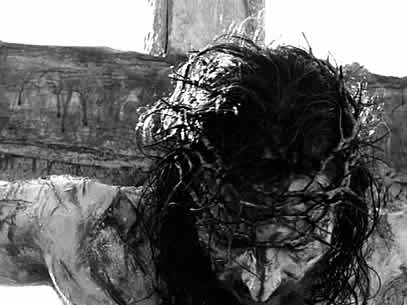
The Sacrifice at Golgotha

The Death of the MasterI am hoping you will be able to resolve a very important issue confronting the very foundation of Christianity.

God’s way of testing Abraham by calling for the sacrifice of Isaac…and then the abrupt staying of the knife…was intended to demonstrate that God abhorred human sacrifice and would not accept it (Gen 22.12). When the great central Law of Judaism (the TORAH) was revealed at Sinai, it called for animal sacrifices. The slaying of an animal and the offering of its blood according to certain prescribed rites, symbolized God’s mercy to the sinner, for this would have been his fate. Later in the Law, Moses gives warning to Israel not to worship God in the manner of the pagans (through human sacrifice) for it is an abomination unto the LORD in any way or form it is practiced (Deut 12.30-32).

Turning to the New Testament, Jesus states that he completely upholds the precepts of the Judaic Law until its complete spiritual enactment through-out the world. This great authorization of the central Law of Judaism renders it supreme (Matt 5.18). Nevertheless, here is where a trouble-some contradiction arises. According to Romans 5.6-11, Jesus’ death was a vicarious atonement. But this is a human sacrifice which is expressly forbidden by the very same Law sanctioned by Jesus.

True, Jesus is unique in being both human and Divine. But by sanctioning the Law He did not allow His uniqueness to detract from His subjection to the Law which is understandable since the Law is the perfect Word of God.

In sum, if Jesus was upholding the Law then His death cannot be sacrificial. Or, if His death is sacrificial, He has rejected the Law which He claimed to uphold. In either case, Christianity’s central doctrine of the sacrificial death of Jesus is proven to be scripturally untenable. Christianity is therefore in peril of crumbling away. The stakes are very high. If Christianity succumbs to an inner breakdown, the moral order in the world will soon follow….

This contradiction can only be satisfactorily resolved by reference to Scripture. Scripture is a single, self-consistent truth, but beginning to end. Each verse urges its own truth. When two verses appear to exhibit incompatible claims, a contradiction develops. We must then attempt to resolve this contradiction by reference to another verse(s) which will reconcile the two opposing viewpoints…

When reconciliation is not forthcoming, the contradiction remains and the verse(s) in question are not Divinely revealed facts, but have been spoken by the prophet out of his own authority…

The defensibility of Jesus’ sacrificial death has been troubling me for a long while. I am unable to resolve it according to Scripture. I would be very grateful to you if you could clear it up for me…

Quoted from christianthinktank.com

Have you ever been asked a question you were so sure you knew the answer to that you never even worried about it, and then, when you tried to answer the question, realized you didn’t really know how to respond?

That happened to me yesterday afternoon. Let me explain.

On most Thursdays after work, I meet with a couple of other guys for coffee and discussion. There’s no set agenda, but we usually talk about matters of faith and questions that come up in the Bible that sometimes drive us crazy. We are all reasonably comfortable questioning the traditional Christian assumptions and our coffee meetings give us an opportunity to ask questions we could never ask in church.

I commute to and from work with my son David. On Thursdays I usually drop him off at his place, then go to the coffee shop for my meeting. Yesterday, my daughter-in-law had an activity planned with some female friends at their place and asked if David and I could hang out together. I asked him if he wanted to join my meeting and he said, “OK.”

David was the first of my children to develop a sense of spirituality. When he was little, he went to church with my wife’s brother Steve whenever Steve was visiting from the Bay Area. After David went to church with Steve, he’d ask my wife and me why the rest of us didn’t go to church and believe in Jesus (this was years before my wife and I became religious). That was kind of awkward.

Somewhere between childhood and adulthood, David set his faith aside but it’s always been on the back burner, so to speak. Thursday allowed him to revisit old territory and to ask some of those questions that would drive most Christians nuts.

The four of us were having a fairly stimulating conversation when the question of human sacrifice came up. David sees the death of Jesus on the cross to atone for the sins of the world as a direct violation of the commandment not to sacrifice a human being.

So here we are, three guys from different backgrounds but who all have the same fundamental belief in Christ as Messiah and Savior trying to address this question.

I shot off my big mouth first.

Understand, that this is a very troubling question with no simple answer. Also understand that one of the reasons that I am attracted to Jewish mysticism and particularly the Chassidim, is because I don’t think that there is any other way to explain certain things about the Messiah, including his bloody, sacrificial death, outside of a deeply mystic framework.

Just how can a human sacrifice, even that of the Messiah, atone for the sins of the world? What’s the mechanism that makes it possible and that doesn’t violate God’s prohibition against human sacrifice?

My answer was based on the understanding of the death of a tzaddik being able to atone for the sins of a community or even of an entire generation. Of course, my answer was founded entirely on the Chassidic mystic understanding of this process; something which most Jews, particularly in modern times, do not agree with.

So where is this explained in the Bible?

My friend Russ offered David what I would consider the traditional Christian explanation for the sacrifice of Jesus Christ on the cross. As I listened to him answering David, I realized that I didn’t find the Christian viewpoint particularly satisfying. I know that I’ve had this explained to me before at some point, but my memory is a leaky container and a lot of stuff has dribbled away over time, so I don’t remember exactly what was said or when that conversation occurred.

This really bothered me.

The conversation ended with more questions than answers, which is fairly typical for our little group, but where was David now? He continues to focus on the Torah and the Prophets as the foundation of his understanding about God and the Jewish people, though I’m sure he would benefit from a review of his knowledge base, but the New Testament seems to him like so many exceptions and contradictions to his understanding of Torah. On the drive back to my place, David and I continued our conversation, and I decided to encourage David to start where he is. If the Torah and Judaism are the rock on which he now stands, then I will support him returning to and exploring the cornerstone of his faith.

But it still bothered me that not only could I not give a satisfactory answer to his questions about Jesus, but I couldn’t really answer my own questions. I can’t solely rely on the “mystic” explanation for how a tzaddik’s death provides atonement, and assuming the traditional Christian response to this query is also lacking, then what is the answer?

I don’t know.

I know that faith is sometimes the mortar that fills in the spaces in religious understanding, but I’m uncomfortable with it being the putty that replaces solid Biblical knowledge let alone logic.

OK, I know that logic is the beginning of wisdom and not its conclusion and that once we accept the existence of God, we also must accept the supernatural, but David did bring up what seems to be a huge disconnect between the Tanakh (Old Testament) and the New Testament in terms of death, atonement, and sacrifice. You’ve probably already clicked the link I provided above and read the christianthinktank.com reply to this question. I did too, but I’m not sure I’m buying it.

Do we see any example of the death of a righteous man providing atonement for the sins of other people in the Tanakh? Was any man in the Old Testament deliberately killed in order to turn away God’s wrath toward other human beings? We talk about men like Joseph, Moses, and David being “types and shadows” of the Messiah. But we don’t see that their deaths really did anything to illuminate the problem of Jesus being a human sacrifice to turn away God’s fatal judgment from all people everywhere across time who accept Christ as Lord and Savior.

I’m not that smart. Some people think I’m smart. My wife thinks I’m smart (except when she disagrees with me, then I’m not too bright at all *wink*). But it’s not really true. I suppose it’s more accurate to say that in this particular area, I’m not very well-educated. I feel ill-equipped to manage these sorts of questions. On some level, I think that it’s not very easy or maybe even not very possible to use human language and human logic to explain the mysterious, mystical way the death of the Messiah somehow atones for the sins of people.

And yet, that’s all we have to work with. Assuming extra-Biblical and particularly mystical (when my wife learned about this conversation, her response to me was to ask in an incredulous tone, “You talked to him about mysticism?”) sources are not considered valid in this discussion, then we must rely on scripture. But if the Old Testament and New Testament don’t agree that the Messiah must die to atone for sins, then what do we have?

A big, fat, furry mess, that’s what.

So I’m opening up yet another can of worms and throwing this topic out to the public via the Internet. I’m seeking out a greater imagination or at least a more scholarly believer. What’s the answer to how the death of Jesus isn’t human sacrifice? Is there an answer that doesn’t contradict the commandment to not sacrifice people?

The comments section is now open. What do you think?

Chukat: The Chutzpah of Entering Fire

This is the Torah (law): A man who dies in a tent…

Numbers 19:14

The Torah is only acquired by those who kill themselves for it in the tents of study.

-The Zohar

It happened in the winter of 1798 or 1799, when Rabbi Menachem Mendel of Lubavitch was a child of eight or nine. Every Friday night Rabbi Schneur Zalman of Liadi would deliver a discourse of chassidic teaching to a select group of disciples. Little Mendel begged to be allowed in, but his grandfather refused.

The dwelling of Rabbi Schneur Zalman consisted of two two-room buildings, joined by a connecting passageway. In one of the wings, a large wood-burning stove, used for heating and occasionally to bake bread, was set in the wall between the two rooms. The stove opened into the outer room, and also protruded into the inner room which served as Rabbi Schneur Zalman’s study.

One Friday night, the Rebbe was delivering his weekly discourse in his study. It was an exceptionally cold night, so a gentile was summoned to heat the oven. For some reason, he found it difficult to push the logs all the way in to the oven, so he built the fire near the opening of the stove. As a result, the outer room soon began to fill with smoke. Once again, he tried to push the burning logs further in, but they wouldn’t budge. The poor man had to start all over again. He put out the fire, pulled out the logs, and peered into the stove to see what was preventing the logs from going in.

His shouts and shrieks summoned the entire household. The session in Rabbi Schneur Zalman’s room was disrupted; those in the second building also came running. Inside the stove lay a young boy.

-Rabbi Yanki Tauber
“The Path of Fire”
Commentary on Torah Portion Chukat
Once Upon a Chasid series
Chabad.org

Chassidic tales are very compelling but it’s impossible to know how much some of them represent actual events. I’ve come to look at these tales as stories that have been crafted to communicate important moral and religious thoughts to a specific audience. Since I’m obviously not part of that audience, it’s rather puzzling that I should be drawn to them at all. Certainly most of my fellow Christians are at best, indifferent to the stories of the Chassidim and prefer moral commentaries from the ancient or current Christian scholars and commentators.

So what’s wrong with me?

I don’t know.

According to Rabbi Eli Touger’s commentary on this Torah Portion:

The term Chukim refers to those mitzvos whose rationale cannot be grasped by human intellect.

I find my own “rationale” for pursuing the writing of a blog focused on not only Jewish, but specifically Chassidic teachings, to be just as difficult to grasp by my intellect. As I’ve said in the past, the content that I discover in Chabad sources talks to me with my metaphors, but it doesn’t make sense that it should. This is not only because I’m not Jewish (and certainly not Orthodox), but that I am not particularly learned either. I should be just as put off by what I’m reading as most people in the church. I have no explanation for why I return to this particular pool daily to drink and seek refreshment.

But then not all of my meditations are particularly refreshing.

I mentioned just the other day that we are all seeking out a greater imagination, particularly when our own well becomes dry. I’ve also said that there are times when I feel as if I’m in a wilderness waiting for God to do something, but in truth, it is God who waits in the desert for me. Like a dunce in the corner of the classroom, I may have asked God too many stupid questions but I just can’t figure out how else to talk to Him.

But it’s not just me and God. If it were, I suppose life wouldn’t seem so complicated. Being married to the girl with the Jewish soul has taught me that Judaism isn’t really accessible to me, but then Christianity isn’t exactly an open door, either. I call myself a Christian as a matter of intellectual honesty, but I’m the weirdest Christian I know. If I ever entered a church and actually said what I really think, feel, and believe in a completely unfiltered manner, I’d most likely get thrown out on my ear.

I’ve talked about “not fitting in” before and I suppose this missive is just the latest incarnation of that personal state. Judaism is, by definition, community and in theory, so is Christianity (though “salvation” is personal and not corporate) but I’ve gotten just too “strange” to fit into anybody’s community, at least for more than a tiny march of days. Not only that, but I have to consider how my joining any particular community would affect my family. My being married to a Jewish woman, and being dedicated to ensuring the safety of her being a Jew takes an obvious toll on my being a Christian. She can tolerate my meeting with a couple of guys once a week, but church would be pushing the envelope a little too hard…for the both of us.

So I have a mystery and no answers. While I share my perspectives with the Internet, it’s a wholly impersonal environment. People respond to me, but it’s “virtual” and only on rare and brief occasions does the virtual transcend into reality.

I know what I’m writing has virtually no connection to Chukat, but this is who I am and where I am right now. How about we finish the story as told by Rabbi Tauber and see what turns up.

A small lamp was the only source of light in the smoke-filled room, so it took some time until the child was identified as the Rebbe’s grandson, little Menachem Mendel.

For some weeks now, the child had discovered that he could hear his grandfather’s words through the thin wall of the stove. Every Friday night he would clamber deep into the large stove, and listen to the profound and lofty words of the Rebbe’s teachings. And now, because of the bitter cold, his listening post had been discovered.

Rabbi Schneur Zalman’s daughter-in-law, Rebbetzin Sheina, who was present at the time, related:

“When they pulled the child out of the stove, he was paralyzed with fright. My mother-in-law, Rebbetzin Sterna, cried to my father-in-law, the Rebbe: ‘See what could of happened! A tragedy! Strangers you allow to enter, but when your own child begged you, you wouldn’t let him in!’ Father-in-law replied: ‘Sha, sha. Moses reached Mount Sinai only by beholding fire – only then did he merit that the Torah be given through him. Torah is acquired only through self-sacrifice.’ “

One way to deal with not fitting in is to have the chutzpah to fit in anyway. In little Menachem Mendel’s case, he fit himself into a stove, but unfortunately, he didn’t anticipate that on a cold night, he could end up being part of the fuel used to warm the room. Rabbi Tauber relates a childish error in judgment to the willingness to die for the sake of Torah learning, but clearly in the real world, the little boy wasn’t willing to burn nor were his elders willing to incinerate him for the Torah’s sake. The real lesson (at least according to the Rebbetzin, since the Rebbe disagreed) is that if someone wants in badly enough and they show a willingness to make sacrifices, you should let them in.

That doesn’t really work in my case since I’ll never be Jewish enough (or rather, I’ll never be a Jew at all) to learn as a Jew and I’ll never be Christian enough to fit into the church culture. I don’t know what I’d have to be to fit in with my wife religiously. I don’t think there is an answer to that one except, as I said before, to be a “low profile Christian at home.”

But what about God? I guess I can be a Christian at home in terms of behaviorally displaying my morals and ethics without being overtly “Christian” (openly praying or invoking Christ’s name, for example). In this case, chutzpah won’t get me anywhere except in hot water, so I’ve nowhere else to go except into the privacy of my own thoughts, which gets turned into very public blog posts…and to turn to God.

I’m seeking out a greater imagination, but I’m putting some pretty harsh limits on it.

Solomon couldn’t comprehend the mitzvah of the Red Heifer and I can’t comprehend my own existence. If God didn’t require that Solomon understand, I guess I don’t have to, either. I can only continue living and to see what happens next.

The irony is that I don’t know what to do, and yet I feel as if God is waiting for me to make the next move. I guess that’s what faith is…acknowledging God and proceeding forward, even when it doesn’t make sense, for what alternative do we have?

Today, if you hear his voice,
do not harden your hearts, as at Meribah,
as on the day at Massah in the wilderness,
when your fathers put me to the test
and put me to the proof, though they had seen my work.
For forty years I loathed that generation
and said, “They are a people who go astray in their heart,
and they have not known my ways.”
Therefore I swore in my wrath,
“They shall not enter my rest.” –Psalm 95:7-11 (ESV)

Good Shabbos.


Korach: Who is Speaking to Your Heart?

In the Torah portion Korach we read how Korach led a band of 250 men in a rebellion against Moshe and Aharon. Underlying their revolt against Aharon’s High Priesthood was the charge: “All the people in the community are holy and G-d is in their midst; why are you setting yourselves above G-d’s congregation?” (Bamidbar 16:3.)

From Moshe’s response, (Ibid. verse 10.) “…and you seek priesthood as well,” we readily perceive that Korach and his band desired to become priests. This being so, their argument that “All the people…are holy,” and nobody can set himself above anybody else seems to contradict their desire to be above others by obtaining priesthood.

“A Lesson in Priesthood”
Based on Likkutei Sichos Vol. VIII, pp. 116-118
Commentary on Torah Portion Korach
The Chassidic Dimension series
Chabad.org

Rav Yisrael of Ruzhin, zt”l, gives a fascinating explanation of a famous statement on today’s daf. “Our sages say that today the yetzer hara says to do one sin, tomorrow another, until one finally falls to idolatry. This statement does not mean that the yetzer hara increases the sins that one indulges in from day to day. It means that the yetzer hara pushes a person who falls to keep falling in the same manner day after day, time after time. Even this is enough to cause one to worship idolatry eventually, God forbid!

“This can be compared to a sick person whose weakened constitution does not improve. If his system does not overcome what ails it, he gets sicker and sicker and eventually he reaches the point where he is dangerously ill.” Rav Shalom Schwadron, zt”l, offers his own insight here. “It is interesting that the yetzer doesn’t demand that one stop fulfilling mitzvos; it merely pushes one to follow his instructions. He wants to bring a person to a place where he will fulfill only that which interests him. A student in yeshiva will learn Torah until very late at night, missing out on a meaningful shachris. Another person will express his zealousness at the expense of fulfilling his obligations to his fellow human beings.

“The yetzer wants to be in the driver’s seat; that one should only do what interests him in the manner that he prefers. He knows that a person who only acts when he is inclined to do so will eventually stop fulfilling the mitzvos. We need to recall that the main thing is to fulfill the mitzvos of the Torah because this is the will of the Creator. We must not be swayed by the compelling-seeming logic of the yetzer hara which causes one to forget God.”

Daf Yomi Digest
Stories Off the Daf
“In the Driver’s Seat”
Niddah 13

Here’s the key portion of the above-quoted lesson:

He wants to bring a person to a place where he will fulfill only that which interests him.

By the time I finished reading this “story off the Daf,” I found that the conclusion didn’t match up with what I thought it would be at the beginning of the story. I thought fulfilling certain of the mitzvot would be contrasted against overt sin, such as a person who fulfills the mitzvah of feeding the hungry and then turns around and cheats his business partner. I didn’t think it would be focusing on fulfilling one mitzvah, the one that fits your personal desires, at the expense of other equally worthy mitzvot.

We’ve seen this sort of thing before:

Then Pharisees and scribes came to Jesus from Jerusalem and said, “Why do your disciples break the tradition of the elders? For they do not wash their hands when they eat.” He answered them, “And why do you break the commandment of God for the sake of your tradition? For God commanded, ‘Honor your father and your mother,’ and, ‘Whoever reviles father or mother must surely die.’ But you say, ‘If anyone tells his father or his mother, “What you would have gained from me is given to God,” he need not honor his father.’ So for the sake of your tradition you have made void the word of God. –Matthew 15:1-6 (ESV)

“Woe to you, scribes and Pharisees, hypocrites! For you tithe mint and dill and cumin, and have neglected the weightier matters of the law: justice and mercy and faithfulness. These you ought to have done, without neglecting the others.” –Matthew 23:23 (ESV)

We see a couple of important points taught by the Master relative to the story off the Daf, and both are related to hypocracy and setting human priorities on what we choose to do for good.

In the example from Matthew 15 (yes, I know this passage is typically used to say Jesus did away with man-made traditions and only endorses obeying pure Torah law, but he was perfectly fine with many other aspects of the normative halachah of the Judaism of his day, so I consider his main “rant” against hypocrisy, not tradition) , Jesus turns on his critics and accuses them of neglecting the commandment to honor parents by committing the money that could have been used to support their parents to the Temple. Outwardly, the Pharisees involved may have appeared holy, but in their neglect of their parents, they were reprehensible.

The short quote from Matthew 23:23 shows us something similar. Certain Pharisees were again, outwardly appearing as holy by their tithes but in the process, they completely ignored what Jesus called, “weightier matters of the law” such as the principles of “justice and mercy and faithfulness.” I should note that Jesus did not say one was really better than the other and told his audience that they should have performed their tithes without neglecting the other mitzvot.

But what does that have to do with us? On the one hand, these arguments could support the classic One Law position in the Hebrew Roots movement which states that non-Jewish people, when we become Christians and are “grafted in” (Romans 11) to the Jewish root, are obligated to the identical set of commandments as the Jews are, and we should not pick and choose which ones to obey. It would appear as if Jesus is telling us to not pick and choose as well, but to obey all of the 613 commandments, or at least as many as can be obeyed without the existence of a Temple, a Levitical priesthood, a Sanhedrin court system, and (for most of us), while living outside the Land of Israel.

On the other hand, we could use the same texts to consider just what our (I’m speaking to Gentile Christians now) true obligations are to God and whether, in our performance of the mitzvot, we are doing what God actually wants us to do, or only obeying what we want, what makes us feel righteous, and what makes us look “cool” in the eyes of our peer group. Are we falling into the same trap as Korach, Heaven forbid?

I know that sounds a little harsh, but I’ve encountered more than one non-Jewish person in the Hebrew Roots movement who seems really pleased with his tzitzit, his Hebrew prayers, and how he laid tefillin. OK, I want to be fair and say that there are many who subscribe to the One Law position who sincerely believe this is the one and only way a Gentile can please the God of Heaven, and these folks feel really picked on when people like me say that obeying many of the Torah commandments is a choice and not an obligation (your behavior doesn’t have to change in any way just because it’s voluntary rather than obligatory). But consider this.

When you say that non-Jewish believers in the Jewish Messiah are obligated to obey the full yoke of Torah, your saying that it is a sin for any Christian to fail to observe the full range of the mitzvot. You are condemning the vast, vast majority of Christians who have lived, loved the Master, observed the “weighter matters of the Torah,” and died, based on your personal interpretation of the Bible. By saying you are obligated to the Torah and that you are fulfilling the Torah, you aren’t equalizing conditions between Christians and Messianic Jews but (whether you mean to or not) elevating yourself above your brothers and sisters in the church.

Let’s continue the Chabad commentary on Korach. I think you’ll see that he and his followers were doing something very similar.

The Kohanim , the priestly class, differed from the rest of the Jewish people in that the Kohanim were wholly dedicated to spiritual matters. This was especially true with regard to the Kohen Gadol , the High Priest, who was commanded “not to leave the Sanctuary.” (Vayikra 21:12.)

Their apartness from the general populace notwithstanding, the Kohanim in general, and the Kohen Gadol in particular, imparted their level of sanctity to all the Jews. Thus we find that Aharon’s service of lighting the Menorah in the Sanctuary imparted sanctity to all Jews, and enabled them to reach Aharon’s level of service and love of G-d. (See Likkutei Torah , beginning of portion Beha’alosecha.)

You may consider this a bit of a stretch, but I think the unique standing and “choseness” of the Jewish people and their obligation Sinai covenant also imparts a “level of sanctity” to we who are grafted in from among the nations. I think there’s a relationship to Israel being a light and to those of us who have seen and been attracted to that light.

I’ve tried talking about this before, especially in blog posts such as Redeeming the Heart of Israel, Part 1 and Part 2, where we see a partnership between the Jewish and Gentile disciples of the Master that is complementary and interwoven, and I’ve tried to show that this partnership does not require a fused or homogenous identity between Christians and Jews in the Messianic realm.

Granted, I believe this manner of thinking is still in its formative stages and requires a great deal more research, especially in Scripture, but we see a classic example in the Korach rebellion of how a group desiring to separate themselves from their fellows and assume an identity not their own results in disaster. In the end, Korach and the rebels didn’t really believe that all of Israel had the right to become priests.

Korach and his band’s complaint that “All the people…are holy,” however, did not contradict their own desire for priesthood, for they desired a manner of priesthood totally removed from the rest of the congregation.

This manner of priesthood would not cause them to feel superior to the rest of the Jewish people, a superiority that resulted from their imparting holiness to them, for in their scheme of things they would not impart holiness to other Jews — they would remain totally separate and apart.

But Korach and his band were badly mistaken: It is true that there are different categories of service — Jews who are solely occupied with spiritual matters, and other Jews whose task it is to purify and elevate the physical world through the service of “All your actions should be for the sake of heaven,” (Avos 2:12.) and “In all your ways you shall know Him.” (Mishlei 3:6.)

Putting all this together, we can paint a picture of those Gentiles who want to assume a full “Jewish” identity without having to convert to Judaism as not demonstrating equality between Jews and Gentiles in the covenant, but perhaps setting themselves above their fellow Christians by taking on Jewish identity markers. I’m sure that many One Law proponents aren’t motivated in this direction, but ask yourself if this could be describing you.

If you, as a Christian (non-Jewish disciple of the Jewish Messiah) in the Hebrew Roots movement, choose to take on additional mitzvot that could be considered specific to Jews, please study up on them first, including the relevant halachah for performing the mitzvot. Shooting from the hip probably isn’t as effective way to perform any of the Torah commandments as using the accepted standards established in normative Judaism.

From my personal perspective, a Gentile publicly appearing as a Jew, even with completely pure motives, is like walking into a room full of trapdoors and tripwires. You might be successful in your efforts, but more than likely, once you step outside your local congregations and into the larger world, you could encounter unanticipated conflicts. Be sure whatever you do is actually what God wants and not just something that makes you feel special.

I’m sure no one wants to make Korach’s mistake. Ask yourself who or what is speaking to your heart?

Addendum: This all gets more complicated when you factor in people who claim a Jewish identity without Jewish parents and exist outside of Messianic Judaism, as we see in this Huffington Post article. One person has blogged about her experiences as a “Jewish” non-Jew, and Derek Leman has offered his own commentary. True, it doesn’t have a direct relationship with this week’s Torah portion or the matter of any Christian’s perceived obligation of Torah, but it is very much relevant to the “identity wars” between Jews and non-Jews, so I include these references here.

Good Shabbos.

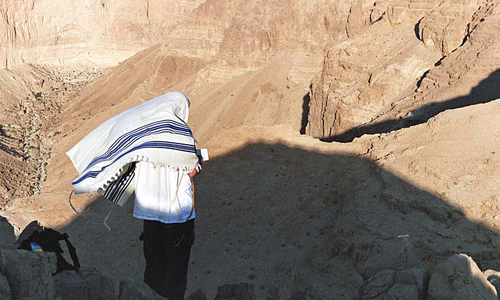
God Waits in the Desert

The Talmud also writes there that the mouth of a fetus is compared to a strand of hair. This teaches that one’s spiritual level depends on what he says. In Tehillim we find, “I believed as I speak” — words of emunah build one’s emunah and bitachon and draws him near to God. But speaking profane words distances one from the purpose of creation. How much more so do words of slander and falsehood! The verse commands, ‘‫ — מדבר שקר תרחק‬ Distance yourself from falsehood.’” Rav Zusia of Anapoli, zy”a, interpreted this phrase in a novel way: “If you speak falsehood, you will be distanced from God!”

Daf Yomi Digest
Stories Off the Daf
“The Eyes, the Nose and the Mouth”
Niddah 25

“They went down to the pit alive” (Bamidbar 16:30) – even in the grave they think they are alive. There is a blessing contained in “They went down to the pit alive,” as with “the sons of Korach did not die,” (Ibid. 26:11.) – “a place was established for them (In Gehinom “the pit,” Megilla 14a.) and they repented.” For teshuva, repentance, is effective only while one is still alive. This, then, is the blessing – that even in the pit they will live, and they will be able to effect teshuva.

“Today’s Day”
Tuesday, Sivan 26, 5703
Torah lessons: Chumash: Korach, Shlishi with Rashi
Tehillim: 119, 97 to end.
Compiled and arranged by the Lubavitcher Rebbe
Rabbi Menachem Mendel Schneerson, of righteous memory, in 5703 (1943)
from the talks and letters of the sixth Chabad Rebbe
Rabbi Yosef Yitzchak Schneersohn, of righteous memory
Translated by Yitschak Meir Kagan

I sometimes get kind of cranky about a life of faith. I sometimes forget about what I’ve already learned about faith and trust. I’ve recently been reminded of something I first read on Derek Leman’s blog, but the reminder didn’t come from Derek:

The call of faith is hard, the task seems impossible, the place we are called to seems desolate, the day of regeneration seems far in the future, but this faith is its own reward during the long delay.

I’m reminded that we’re to have faith in the desert. But while it’s easy to declare that the desert represents the faithless world we live in, in fact, the desert is inside of us each time we doubt.

Each time I doubt.

Ironically, the desert is a good place to be when I’m in doubt. There are few distractions. I imagine a sandstorm. The wind is hot. I have coverings over most of my body including around my eyes so I’m not blinded by the sand. The sun is obscured from my vision as a hazy, blurry ball of yellow and white but the power of its heat is oppressive.

And there is only me and the wind and the sand and the heat and somewhere beyond, the vast reaches of the desert, all but lifeless.

And there is God.

He’s not actually apparent. I talk to Him, though. I complain to Him. I wonder where He is. I imagine that He’s contracted Himself; He’s withdrawn from the part of the universe where I live, He’s left me to swing in the breeze or in this case, the wind and sand.

Not really, of course. The reality of His existence is that He’s always “standing at my shoulder” so to speak, never far away at all, no matter how transparent He seems to be to my failing perceptions. But it’s as if He has withdrawn, like a silent lover who has backed away in order to give me time to process some sort of quarrel between us.

Not that He’s ever argued with me. I do all the arguing. That is, until I realize He has left me and I am utterly alone and abandoned in the desert of my soul.

My God, my God, why have you forsaken me?
Why are you so far from saving me, from the words of my groaning?
O my God, I cry by day, but you do not answer,
and by night, but I find no rest. –Psalm 22:1-2 (ESV)

The wonderful thing about being alone is that you have time to think. There are no distractions, not even the presence of God (though He is still present). The desert is comforting, even the heat is welcome; the sweat, the smell of dry things. There is still rock beneath my feet so my footing is sound.

The quote from Derek’s blog says in part, “but this faith is its own reward during the long delay.” Faith is a companion in the desolation, a faint voice I can just barely hear over the banshee winds. Though I feel as if the God in whom I have faith is “far off and the road to reach him is long” and arduous, I am also reminded that my desert can be watered and flourish, but only when I’m ready to return. Only when I want to begin the journey again (or is this part of the journey?).

He leads me beside still waters.
He restores my soul.
He leads me in paths of righteousness
for his name’s sake.
Even though I walk through the valley of the shadow of death,
I will fear no evil,
for you are with me;
your rod and your staff,
they comfort me. –Psalm 23:2-3 (ESV)

But that’s only a mirage which has yet to arrive; an oasis that will only come when the Messiah does, or when my faith in the Messiah returns.

This week’s Torah portion records the failure of the Children of Israel to realize the promise and the dream. They lack faith and do not take possession of the land of Canaan. They are condemned to wander the vast wilderness for forty years, dying one by one along the way. Miriam, Aaron, and even finally Moses all perish. Only Joshua and Caleb from that generation survive and only because of steadfast faith and trust.

The very last verses of the Parashah say this:

The Lord said to Moses as follows: Speak to the Israelite people and instruct them to make for themselves fringes on the corners of their garments throughout the ages; let them attach a cord of blue to the fringe at each corner. That shall be your fringe; look at it and recall all the commandments of the Lord and observe them, so that you do not follow your heart and eyes in your lustful urge. Thus you shall be reminded to observe all My commandments and to be holy to your God. I the Lord am your God, who brought you out of the land of Egypt to be your God: I, the Lord your God. –Numbers 15:37-41 (JPS Tanakh)

The commandment of tzitzit is directly connected back to failure because man needs tangible reminders of an intangible God. Faith and trust are shadows in the mist as well, but the tzitzit are real enough. They are not faith, but for the Children of Israel, they serve as a visible reminder that God is as near as the four corners of their garments.

Christians don’t wear tzitzit since, among other things, the failure to possess the land and the subsequent possession of Israel by the Jewish people are commandments for the Jews, not for us. However, our need for faith and trust is the same. Our need to be reminded of God is the same. Where is God when we need Him? He’s standing apart, giving us time to realize we need to return to Him; letting us stew in our graves while we decide to repent and live.

A life of faith isn’t all that easy. It’s not even so much that the world around me thinks I’m a superstitious fool for believing in the providence of a God that I cannot see and touch and who allows horror and tragedy to abound on his earth while we believers declare His undying love for humanity. It’s the desert inside where the battle is fought. It’s where I fight with God. It’s where I fight with myself. It’s where I have one lover’s quarrel after another with the One who is the lover of my soul.

So He periodically leaves me alone in the desert with the wind and the sand and the heat. But he provides me with solid rock to walk on so I won’t lose my footing or my way.

The desert is a good place for me to ponder my lot and my fate. Occasionally the wind dies down a bit and I’m temporarily given a small sheep to tend, so I have something else to care for. This is God reminder that He cares for me in the same way.

And God waits at a distance, but always watching me, ready to return to my side in an instant should I but say the word.

And He waits.

Shlach: The Miraculous Messenger

The Torah portion of Shlach relates how the men sent to spy out Eretz Yisrael returned and reported that the country was unconquerable. The Jewish people, they said, would be unable to enter the land, since “The inhabitants of the land are mighty.” (Bamidbar 13:28.)

Furthermore, say our Sages, (Sotah 35a.) the spies went so far as to say that even G-d would not be able to wrest the land from its inhabitants. Their words caused great consternation among the Jews, who feared that they would be unable to enter Eretz Yisrael.

How was it possible for the spies to mislead the Jewish people and convince them that even G-d could not help them, when the Jews themselves had constantly witnessed the miracles performed on their behalf, e.g., G-d provided their daily food and drink in a miraculous manner — manna from heaven and water from Miriam’s well.

Commentary on Torah Portion Shlach
from “The Chassidic Dimension” series
Based on Likkutei Sichos Vol. XVIII, pp. 171-174
and the teachings of the Lubavitcher Rebbe
Rabbi Menachem M. Schneerson
Chabad.org

Like the logic applied in our initial conundrum, the spies argued that after God created the laws of nature, He ruled that even He Himself would not be able to change those laws. God bound His own hands, as it were, by means of the laws that He Himself instituted. Until now, God’s leadership in the wilderness had been one of supernatural miracles that defied the laws of nature again and again. It was clear though that entering thelandofIsrael, for all its holiness, meant entering the confines of nature and living by its laws. This was why the ten spies thought that the Jewish people could not overcome the giants who lived in the land. They believed that God had indeed created a rock that could not be lifted. Moses himself used this argument in his prayer asking for God’s forgiveness, saying that destroying the Jewish people, God forbid, for their sin, would be proof for the surrounding nations of the erroneous claim that “God lacked the ability to bring this nation to the land which He swore to them…” (Numbers 16:14-15).

Joshua and Caleb, the remaining two spies, also saw that conquering the land was a supernatural task, but they said, “Yes, God can create such a rock that He cannot lift, but He can still decide to pick it up if He wants to.” They realized that on entering theHoly Land, God could paradoxically empower the Jewish people themselves with supernatural powers and this would become their very nature.

-Rabbi Yitzchak Ginsburgh
“The Rock that God Can Carry”
Commentary on Torah Portion Shlach
Wonders from Your Torah

I hadn’t heard this particular perspective on the “sin of the ten spies” before and that they believed that there was “a rock that God Himself couldn’t lift,” so to speak. I did however, realize that anyone who is “sent out” for a particular purpose is called “shlach,” including us.

I know it doesn’t sound like these two things are connected, but I can explain.

Go therefore and make disciples of all nations, baptizing them in the name of the Father and of the Son and of the Holy Spirit, teaching them to observe all that I have commanded you. And behold, I am with you always, to the end of the age.” –Matthew 28:19-20 (ESV)

WalkingThat command was originally given by the Master to the “eleven disciples (who) went to Galilee, to the mountain to which Jesus had directed them.” (v16) However, it has been inherited by every disciple who is called by his name, Jew and Gentile alike, and we have carried that mission upon us for nearly 2,000 years.

How are we doing so far?

Actually, not that bad. But we could be better, especially in the present age. It’s not so much that the Good News of Jesus Christ isn’t being spread to the four corners of the earth and that the vast, vast majority of the human race hasn’t heard of God, the Bible, and Jesus. They certainly have heard the Good News, however many of those people; perhaps most of those people, don’t see it as “good news” at all. Many people experience Christianity as “bad news.” They see us as superstitious, as old fashioned, as out of touch, as bigots, sexist, racist, anti-gay, anti-political correctness, anti-progressive.

Some of that is true, whether we intend it to be or not. Where have we gone wrong?

In the days of Moses, the ten spies gave an “evil report,” not because they were dumb or evil or cowards, but because they believed that the supernatural power of God would not go with them when they entered the land of Canaan. They believed that without the power of God, in terms of mere human strength, they would have no chance at defeating the mighty giants of the land. They felt abandoned and afraid.

Every time I read the words of “the great commission” as recorded in Matthew 28:19-20, I always puzzled over Christ’s final statement:

“And behold, I am with you always, to the end of the age.”

Now I realize what he was trying to say. He was trying to say that his disciples would not be alone in the enormous mission of taking the word of the Jewish Messiah to the nations of the world. Remember, nothing like that had even been dreamed of before let alone attempted. In a world full of false gods and polytheistic idol worshipers, how would the Word of the One God of Israel and the Messiah King of the Jews be received by the Gentiles? Would they listen to the Gospel message at all, or listen and then merely incorporate God into their panthenon of other gods, worshiping the God of Heaven as if he were just another idol of stone, wood, or bronze?

The Bible didn’t record the reaction of Christ’s “great commission” but it would be another fifteen years or so before any one of them would attempt to respond. Even then, Peter needed the prompting of not only a vision on a rooftop (Acts 10:9-16), but that of a messengers sent by the God-fearing Roman Cornelius with an unusual request. (Acts 10:17-23). The rest of this chapter in Acts tells the tale of God showing just how possible it was to carry the message of the Messiah to the Gentiles and how indeed, many Gentiles were eager to hear it.

Receiving the SpiritAnd in seeing that the Gentiles could receive the Holy Spirit, even as the Jews had already done (Acts 10:44-48), it was confirmed that the supernatural power of the Spirit of Messiah was with them “always, to the end of the age.”

That age hasn’t expired yet and neither has our calling. Not all of us enter what the church calls “the mission field” in a formal sense, but in truth, we are all “missionaries” or “sent ones.” We are shlach in the way we live our lives. Every word we speak and every action we take tells the tale of our Lord and Master, for good or for ill. Every deed of honor and praise glorifies the Name of God, and every mistake and mean-spirited act we commit drags that Name through the mud.

Joshua and Caleb understood that God would enable the Israelites to take the land, not by a series of supernatural miracles, but by making the people of Israel the miracle. We see in the book of Joshua and beyond how true this was. They didn’t have to believe in the miracles. They just needed faith in God. That first generation out of Egypt couldn’t overcome their “slave mentality” and when faced with such challenges, they balked. They didn’t have faith in themselves, let alone a God they felt would cease to provide protection from Heaven (I know, I’m applying midrash here, but I think it fits).

As believers and disciples of the Jewish Messiah, our teacher, our Master, and our King, what have we learned, not only from his lessons but from the lesson of the Shlach among the Israelites? Jesus already said that he would continue to be with us for the amount of time it takes to fulfill the directive to spread the Word of hope. He asks us to have faith. Faith in our Master, faith in the One Holy God of Israel…and faith in ourselves.

We see from the Biblical record that the taking of Canaan and the forging of Israel was no easy task, even though God was with the Children of Jacob. We see from the record of Paul’s letters that even though he was personally comissioned by the Messiah to be the “shlach to the Gentiles,” his task was at times brutally difficult. Our tasks are not easy, either. Living a life of faith and swimming against the tide or a world determined to deny God never is. We are reviled, called foul names, laughed at, ridiculed, and that’s only in the western nations. In other parts of the world, Christians are raped, beaten, tortured, and murdered for the sake of Jesus Christ. Under such terrific pressure, our sin is never in doing our best and failing, but only in failing to try.

“In fact, the spies’ sin, in fact any sin, can be understood using the same principles just applied. Sin is like a rock that by nature cannot be “lifted,” that is forgiven…But we know that even after sin, God remains open to teshuvah (repentance and return to God).”

-Rabbi Yitzchak Ginsburgh

“You do not always succeed, but you always have to try.”

-Gutman Locks
“Tefillin After 72 Years”
Stories of the Holocaust series
Chabad.org

A life of faith and miracles isn’t begun by waiting for God to make the first move. He’s waiting for us. So is everyone else. You can be the answer to someone’s prayer. All you have to do is try.

Good Shabbos.