Tag Archives: Torah

Yitro: Servants of the Lessons of Peace

And so the explanation of why the Exodus is given as the reason for G-d becoming the G-d of the Jewish people is obvious – G-d’s liberation of the Jews from slavery is what made it possible for Him to give us His Torah and mitzvos on Sinai.

Moreover, the fact that G-d took the Jews out of Egypt in order for them to serve Him was already mentioned several times in the Torah; in none of those places did Rashi find it necessary to explain that this “is sufficient reason for you to be subservient to Me.” What difficulty is there in this particular verse?

The difficulty which Rashi addresses is related to this very issue: Since the Jews were already well aware that the ultimate goal of the Exodus was the receipt of the Torah and submission to G-d, what was the need to mention yet again that G-d’s declaration: “I am G-d your L-rd” is the consequence of His being the One “who brought you out of the land of Egypt”?

Rashi therefore explains that “who brought you out of the land of Egypt” is neither a reason nor an explanation for “I am G-d your L-rd.,” Rather, it is a wholly distinct matter – “Taking you out of Egypt is sufficient reason for you to be subservient to Me.”

“I am G-d your L-rd” implies the acceptance of G-d’s reign. The Jews accepted G-d as their king and ruler, and thereby obligated themselves to obey all His commands. G-d then added an additional matter – merely accepting G-d as king does not suffice; Jews must be wholly subservient to Him.

Accepting a king’s dominion does not preclude the possibility of a private life; it only means doing what the king commands and avoiding those things which the king prohibits. However, being “subservient to Me” means a Jew has no personal freedom; all his actions and possessions are subservient to G-d.

Performing Torah and mitzvos is unlike heeding the commands of a flesh-and-blood king, since it is done in a state of complete subservience. Every moment of a Jew’s life involves some aspect of Torah and mitzvos.

Commentary on Torah Portion Yitro
Based on Likkutei Sichos Vol. XXVI pp. 124-128
and the teachings of the Lubavitcher Rebbe
Rabbi Menachem M. Schneerson
Chabad.org

On the third day, as morning dawned, there was thunder, and lightning, and a dense cloud upon the mountain, and a very loud blast of the horn; and all the people who were in the camp trembled. Moses led the people out of the camp toward God, and they took their places at the foot of the mountain.

Now Mount Sinai was all in smoke, for the Lord had come down upon it in fire; the smoke rose like the smoke of a kiln, and the whole mountain trembled violently. The blare of the horn grew louder and louder. As Moses spoke, God answered him in thunder. The Lord came down upon Mount Sinai, on the top of the mountain, and the Lord called Moses to the top of the mountain and Moses went up. The Lord said to Moses, “Go down, warn the people not to break through to the Lord to gaze, lest many of them perish. The priests also, who come near the Lord, must stay pure, lest the Lord break out against them.” But Moses said to the Lord, “The people cannot come up to Mount Sinai, for You warned us saying, ‘Set bounds about the mountain and sanctify it.'” So the Lord said to him, “Go down, and come back together with Aaron; but let not the priests or the people break through to come up to the Lord, lest He break out against them.” And Moses went down to the people and spoke to them.

God spoke all these words, saying…Exodus 19:16-20:1 (JPS Tanakh)

I cannot even imagine what it must have been like to stand at the foot of Mount Sinai and to be a part of this amazing, awesome, terrifying, wonderful experience of standing in the physical presence of the manifestation of God. Just to glimpse it from afar would have been an honor beyond imagination. This was and is truly the pivotal moment in all of Jewish history: the giving of the Torah. Nothing else would so uniquely define the Jews as a people and as the chosen nation of God. No other people have any experience that could compare to this pinnacle moment in the history of Israel. Or do we? I’ll get to that.

In the Chabad commentary I quoted from above, we see that there is an interesting comparison between serving a human King and serving the King of the Universe. As the Rabbis point out, serving an earthly King entails only obeying the specific orders of your monarch. Except for rare individuals, a subject of a King would still have a private life and individual pursuits that were apart from the King’s commands and laws.

This is not so when serving the King of Kings.

The Torah defines every single aspect of a Jew’s life, how he prays, how he works, how he eats, how he is to treat his wife, his neighbors, his animals, everything…every little detail. When the Children of Israel said, “All that the Lord has spoken we will do,” (Exodus 19:8), they were pledging their very lives to God down to the tiniest action and thought. Yes, I know someone out there is going to tell me that according to the record in the Tanakh, the Hebrews were not always very successful in obeying God, but what’s important is the amazing scope of the promise, of the commandments, of having a God who so cared for you and your people that we was involved in every aspect of your existence, not just what you did in synagogue on Shabbat (or church on Sunday). You gave everything you were, are, and ever will be to God.

But when the Pharisees heard that he had silenced the Sadducees, they gathered together. And one of them, a lawyer, asked him a question to test him. “Teacher, which is the great commandment in the Law?” And he said to him, “You shall love the Lord your God with all your heart and with all your soul and with all your mind. This is the great and first commandment. And a second is like it: You shall love your neighbor as yourself. On these two commandments depend all the Law and the Prophets.” –Matthew 22:34-40 (ESV)

We see here that the Son of God, Jesus, the Messiah, God’s Lamb, demanded nothing less of his disciples as well, but that’s to be expected.

But that brings me to an interesting question. Every Jew who has ever lived can point to Sinai and say, “that’s where we began…that’s who we are as a people forever.” In fact, each Jew is to behave not just as an inheritor of the Sinai covenant, but as if he or she had personally stood at the foot of Mount Sinai and accepted the Torah!

Where do we Christians find such a moment in our lives? Do we have a “Sinai?”

When the day of the festival of Shavuot arrived, they were all together in one place. And suddenly there came from heaven a sound like a mighty rushing wind, and it filled the entire house where they were sitting. And divided tongues as of fire appeared to them and rested on each one of them. And they were all filled with the Holy Spirit and began to speak in other tongues as the Spirit gave them utterance. –Acts 2:1-4 (ESV)

Note: I substituted “day of the festival of Shavuot” for the actual text which reads “day of Pentecost” to preserve the perspective of the Jewish Apostles.

Since Pentecost and Shavuot are essentially parallel occurrences, it’s not surprising that the empowering of the Holy Spirit came upon the Jewish Apostles on the same day as the anniversary of the Sinai event.

I have to admit to being somewhat let down. Christians are not encouraged to consider the Pentecost experience as literally their own (I suppose because Christians see salvation as an individual “accomplishment” rather than becoming part of the “body of Christ” and the “commonwealth of Israel”), as if they (we) were “all together in one place” with the Apostles as the “mighty rushing wind…filled the entire house where they were sitting.” We are to consider (sort of) the moment when we accepted Jesus Christ as Lord and Savior of our lives as the moment when we have out Acts 2 experience, although no Christian I have ever met has described that moment in terms of “tongues of fire” appearing from heaven and resting upon them. Some people have described being able to suddenly “speak in tongues”, but I do know a person who, at an altar call at a local church some years ago, was encouraged by the Elder with him to “make something up” if the ability to speak in an “angelic language” didn’t manifest itself in him.

So much for majesty and awe.

For that matter, we don’t really know how Peter could tell that “the Holy Spirit fell on all who heard the word” while he was visiting the Roman God-fearer Cornelius in the Centurion’s home? (Acts 10:44)

However, this is as close to a “Sinai event” as we who are the non-Jewish disciples of the Master can achieve in the modern era. I don’t know what it means or doesn’t mean and maybe I’m reading too much into it, but I don’t think things have been explained to us very well. I don’t think we’ve been told that one of the responsibilities we have in common with our Jewish brothers and sisters is the command to surrender our entire lives, every action, every word, every thought, to God, our King.

It’s not like we should be ignorant of this responsibility, since it’s all over the New Testament.

We destroy arguments and every lofty opinion raised against the knowledge of God, and take every thought captive to obey Christ… –2 Corinthians 10:5 (ESV)

Not many of you should become teachers, my brothers, for you know that we who teach will be judged with greater strictness. For we all stumble in many ways. And if anyone does not stumble in what he says, he is a perfect man, able also to bridle his whole body. If we put bits into the mouths of horses so that they obey us, we guide their whole bodies as well. Look at the ships also: though they are so large and are driven by strong winds, they are guided by a very small rudder wherever the will of the pilot directs. So also the tongue is a small member, yet it boasts of great things. –James 3:1-5 (ESV)

If we look at the words of the Master as recorded by Matthew and add the letters from Paul and James, we see that we too must surrender all that we are to God in everything, including our words and our very thoughts. How like the covenant at Sinai in this one very important dimension in the lives of we Christians.

Christianity prizes Grace over the commandments of the Law, but we tend to miss the fact that we have serious responsibilities and that freedom from sin doesn’t mean we can literally do whatever we want with our lives, pursuing the same matters in practically the same way as the secular people around us. We must be more in our actions, which we aren’t always taught matter as much as faith and having a “warm and fuzzy” feeling inside for Jesus. We are servants. With almost no exceptions, the original Jewish Apostles suffered for a long time and eventually died terrible deaths as the commitment to the Messiah required. This is the lesson they learned, not just as disciples of the Master, but as Jews who, like all of their people, personally stood at the foot of Sinai as the fire and the thunder and the sound of the great shofar sounded, and before their King declared, “All that the Lord has spoken we will do!”

Can there be peace between the people who stood at Sinai and we who inherit the Spirit of Pentecost? We are disciples of the Master, but where is the unity? Where is peace?

Peace refers to harmony between opposites. In an ultimate sense, it refers to a resolution of the dichotomy between the physical and the spiritual, the forward movement enabling a world in which G-d’s presence is not outwardly evident to recognize and be permeated by the truth of His Being.

Moreover, true peace involves more than the mere negation of opposition. The intent is that forces which were previously at odds should recognize a common ground and join together in positive activity. Similarly, the peace which the Torah fosters does not merely involve a revelation of G-dliness so great that the material world is forced to acknowledge it. Instead, the Torah’s intent is to bring about an awareness of G-d within the context of the world itself.

There is G-dliness in every element of existence. At every moment Creation is being renewed; were G-d’s creative energy to be lacking, the world would return to absolute nothingness. The Torah allows us to appreciate this inner G-dliness, and enables us to live in harmony with it.

-Rabbi Eli Touger
In the Garden of the Torah
“Ripples of Inner Movement”
Adapted from
Likkutei Sichos, Vol. XI, p. 74ff; Vol. XV, p. 379ff;
Vol. XVI, p. 198; Sichos Shabbos Pashas Yisro, 5751
Chabad.org

The portion of the Torah event we who are grafted in may take away with us, is that there is a path to peace, not only between Christian and Jew, but for all of mankind. We aren’t there yet. There is not even peace between all Christians or between all Jews. But someday, “they shall sit every man under his vine and under his fig tree, and no one shall make them afraid, for the mouth of the LORD of hosts has spoken.” (Micah 4:4 [ESV]).

Good Shabbos.
Counting Down

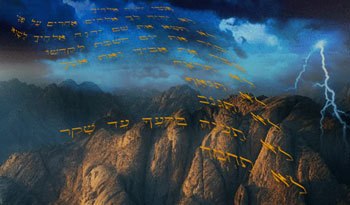
Torah at SinaiOn the sixth day of the third month (Sivan), seven weeks after the Exodus, the entire nation of Israel assembles at the foot of Mount Sinai. G-d descends on the mountain amidst thunder, lightning, billows of smoke and the blast of the shofar, and summons Moses to ascend.

G-d proclaims the Ten Commandments, commanding the people of Israel to believe in G-d, not to worship idols or take G-d’s name in vain, to keep the Shabbat, honor their parents, not to murder, not to commit adultery, not to steal, and not to bear false witness or covet another’s property. The people cry out to Moses that the revelation is too intense for them to bear, begging him to receive the Torah from G-d and convey it to them.

The Parashah in a Nutshell
Yitro in Nutshell
Exodus 18:1–20:23
Chabad.org

Starting the second night of Pesach, we begin counting seven weeks, 49 days, until the holiday of Shavuos. This counting is called Sefiras Ha’Omer, The Counting of the Omer. (For more information on Sefiras Ha’Omer, see I:16, I:18)

-Rabbi Yehudah Prero
“The Counting of the Omer – A Count of Anticipation”
YomTov, Vol. IV, # 7
Torah.org

We see the events of the Torah reflected in current Jewish practice. According to the commandments (Ex. 12:16, Ex. 23:14, Lev. 23:7) the Jewish people commemorate the Passover every year in order to remember the Passover in Egypt and the great exodus of the Israelites from slavery to freedom. Then comes the Omer count, whereby Jews are commanded to count the Omer for 49 days in anticipation of the festival of Shavuot, which commemorates the giving of the Torah at Sinai. The events we see displayed with such grandeur and majesty before us when we read the Torah portions that relate these times, are part of the lived experience of every religious Jew and any Gentile who is attached to the Jewish community for various reasons.

But there’s one other event that we Christians must consider.

And when evening had come, since it was the day of Preparation, that is, the day before the Sabbath, Joseph of Arimathea, a respected member of the council, who was also himself looking for the kingdom of God, took courage and went to Pilate and asked for the body of Jesus. Pilate was surprised to hear that he should have already died. And summoning the centurion, he asked him whether he was already dead. And when he learned from the centurion that he was dead, he granted the corpse to Joseph. And Joseph bought a linen shroud, and taking him down, wrapped him in the linen shroud and laid him in a tomb that had been cut out of the rock. And he rolled a stone against the entrance of the tomb. Mary Magdalene and Mary the mother of Joses saw where he was laid. –Mark 15:42-47 (ESV)

According to the Gospel of Mark, Jesus was crucified on the same day as all of the representatives of the Jewish families in Israel were presenting their Passover lambs for sacrifice at the Temple in Jerusalem, in obedience to the commandment. He should have died right before sunset; right before the eating of the Passover lamb by each Jewish family, again, in obedience to the commandment.

But not all of the Gospel versions of the death of Jesus line up chronologically and we cannot be sure of the exact date. Was the “Last Supper” a true Passover seder or some other meal that occurred the evening before? We don’t know. We do know that Jesus died at about the time of the Passover, and we are fond of referring to Jesus as our “Passover lamb”. And three days later, Jesus rose from the tomb and he was with his people again for forty days. And then he ascended.

In the first book, O Theophilus, I have dealt with all that Jesus began to do and teach, until the day when he was taken up, after he had given commands through the Holy Spirit to the apostles whom he had chosen. He presented himself alive to them after his suffering by many proofs, appearing to them during forty days and speaking about the kingdom of God…And when he had said these things, as they were looking on, he was lifted up, and a cloud took him out of their sight. –Acts 1:1-3, 9 (ESV)

It would be nice if things lined up neatly but forty days does not equal the forty-nine day count of the Omer. Maybe this is one of the reasons why Christians don’t also “count the Omer” from the day of the crucifixion, which the church calls “Good Friday” to the day of the giving of the Holy Spirit, which Christians call “Pentecost”, but which also was the day of the festival of Shavuot commemorating the Sinai event.

So the Bible and our celebrations don’t line up into nice, neat, perfectly ordered events and holidays. I also understand that, during the schism between Gentile Christianity and Jewish Messianism, most or all of the Jewish connections to the Christian faith were summarily erased, along with the Jewishness of Jesus. Christians were not taught to count the Omer and in fact, were likely forbidden to perform any celebration of their faith that even vaguely resembled the worship of the Jews.

But wouldn’t it be great if, after the return of the Messiah, the Jews and the Gentiles counted the Omer together, in commemoration of the Passover and the gift of the Messiah to humanity? For just as death passed over the obedient Israelites in Egypt, so has eternal death passed over all who are faithful and obedient to Jesus, the lamb of God, who gave his life for the sake of the world and yet lives. And the giving of the Torah and the giving of the Holy Spirit nourishes all of the Master’s disciples, in accordance to our covenant relationship with God.

But for this tearing down of the wall of enmity to happen, we Christians must not be careless or dismissive of the things that God has created for the Jews and for the good of everyone.

As a young boy, Rabbi Yosef Yitzchak (the sixth Lubavitcher Rebbe) would go with his father on walks through the woods. One time, as they talked, the boy absent-mindedly plucked a leaf off a tree and began to shred it between his fingers. His father saw what his son was doing, but he went on talking. He spoke about the Baal Shem Tov, who taught how every leaf that blows in the wind—moving to the right and then to the left, how and when it falls and where it falls to—every motion for the duration of its existence is under the detailed supervision of the Almighty.

That concern the Creator has for each thing, his father explained, is the divine spark that sustains its existence. Everything is with Divine purpose, everything is of concern to the ultimate goal of the entire cosmos.

”Now,” the father gently chided, “look how you mistreated so absent-mindedly the Almighty’s creation.”

”He formed it with purpose and gave it a Divine spark! It has its own self and its own life! Now tell me, how is the ‘I am’ of the leaf any less than your own ‘I am’?”

-Rabbi Tzvi Freeman
“Purpose of a Leaf”
Based on letters and talks of the Rebbe
Rabbi M. M. Schneerson
Chabad.org

Do not shred a “leaf” too quickly, for you may not correctly understand why God created and sustained it. So it is with the Jewish people. So it is with counting the Omer. So it will be one day when a few, and then many, and then all of Israel sees the Divine spark, the “I am” in the Messiah; in Jesus of Nazareth.

Is It Better to Rule?

This week’s reading describes the miracle of the Mahn (Manna), the miraculous bread which G-d gave to our ancestors to eat in the desert. The people said they were hungry, they complained, and they were given an open miracle in return — along with instructions. They were told to gather only what they needed for the day, except on the sixth day, when they were told to gather a double portion for the Sabbath. So almost everybody did exactly what they were told to do. But the Torah tells us that “they didn’t listen to Moses, and men left it over until morning, and it became wormy” [Ex. 16:25]. Who didn’t listen? The Medrash tells us: Dasan and Aviram.

You just have to ask, who were these guys? In modern language, what was their problem?

We first meet Dasan and Aviram much earlier. Moses goes out and sees an Egyptian beating a Jew, and in order to protect his brother from death, he kills the Egyptian. The next day, he finds Dasan and Aviram fighting with each other, and he says to the attacker, why are you hitting your friend?

He answers back, “who made you ruler and judge over us? Are you saying you’re going to kill me like you killed the Egyptian?” The Medrash says that what Moses found so frightening about this exchange is that there were wicked people, informers among the Jews.

-Rabbi Yaakov Menken
Director, Project Genesis – Torah.org
Challenging Authority “for its own sake”
Commentary on Torah Portion Beshalach
ProjectGenesis.org

Some people just aren’t satisfied with what they’ve got. That seems to be the premise of the midrash for Dasan and Aviram, according to Rabbi Menken. I have a tendency to give the newly freed slaves of the Egyptians a break because after centuries of servitude to a corrupt and idolatrous kingdom, they are suddenly thrust into a world they could hardly have imagined and after all, learning to wait for God’s provision isn’t something they really understood. But Dasan and Aviram are a different case. Midrash states that they questioned authority, not because they didn’t understand and desired to comprehend the will of God, but just because they could.

But they weren’t simply informers, they were troublemakers at every opportunity. They finally met their end during the rebellion of Korach, which they joined. Korach was jealous of Moses and Aharon for the honor they received. But if Korach had become the leader instead, Dasan and Aviram would still have been simply members of the tribe of Reuven. What did they stand to gain from getting involved in the argument?

They were obviously sincere to a certain degree, because they merited to be part of the Exodus. But they could not get over their desire to challenge authority, apparently simply for its own sake. Even on something so trivial as gathering extra Mahn, they couldn’t resist seeing if they could find a flaw in the orders Moses gave them. And that was the same trait that eventually led to their deaths in Korach’s rebellion.

But that’s not really relevant to us today, is it? I mean after all, we don’t find people today, apparently well-meaning in some way, but acting out, against authority, just “because,” do we? Or perhaps it is more common than ever.

Rabbi Menken’s last paragraph obviously communicates more than a little irony, and he points to last time we see such rebellion against authority from these two Reubenites, just because they were jealous and had a desire to rebel.

Now Korah, son of Izhar son of Kohath son of Levi, betook himself, along with Dathan and Abiram sons of Eliab, and On son of Peleth — descendants of Reuben — to rise up against Moses, together with two hundred and fifty Israelites, chieftains of the community, chosen in the assembly, men of repute. They combined against Moses and Aaron and said to them, “You have gone too far! For all the community are holy, all of them, and the Lord is in their midst. Why then do you raise yourselves above the Lord’s congregation?” –Numbers 16:1-3 (JPS Tanakh)

The two same malcontents who insisted on disobeying Moses in regards to the manna are also backing up Korah in his opposition against Moses and Aaron. They are nothing if not persistent, but as the subsequent verses in this chapter and Rabbi Menken’s commentary tells us, they finally came to a bad end.

Unfortunately, as Rabbi Menken suggests, discontent within the community of faith isn’t exactly a rare occurrence. In fact, it seems to happen all the time. Jewish blogger Shmarya Rosenberg even suggests (incorrectly) that Jesus broke from the traditional sects of Judaism in the late Second Temple period, and formed his own branch because he too was rebelling against religious authority which, in that place and time, had become corrupt and laden with many superfluous, man-made rulings.

A student of one of Hillel’s students attacked these rabbis’ extremism: “You blind guides!” he said, “You strain out a gnat and swallow a camel!”

That student, fed up with the growing halakhic extremism that dominated Israel from the last few years of Hillel’s life until the Destruction, did what many other disgruntled Jews did with regard to the rabbis or to the Temple cult – they walked away and formed their own version of Judaism or joined one of the many sects that began at that time.

His sect, known in history as the Jerusalem Church, grew. An offshoot from it – one the student’s brother, who was then the sect’s leader, opposed – is Christianity.

This is a completely distorted view of Jesus and the early formation of Christianity, but it does illustrate that when the Messiah walked among his people as a man, there were many branches of Judaism in existence which often zealously disagreed with each other on many basic tenants of Jewish belief and practice.

Progressing only slightly forward into history, we are keenly aware that the Gentile disciples of the Jewish Messiah would eventually turn against their Jewish mentors and by the second and third centuries of the Common Era, would create a religion that was completely distinct from and excised of any traces of its Jewish origins. This could be viewed as a historical extension of a “Dasan and Aviram” type of rebellion against the Jewish authority which was established by God through the Messiah.

Why do we have people like this among us? As Rabbi Menken previously pointed out, it wasn’t as if Dasan and Aviram were completely evil and beyond redemption. After all, they merited leaving the “enthrallment” of Egypt along with the rest of the Israelites, so they couldn’t be “that bad,” could they? This example may tell us that the “rebels” in the community of faith today aren’t necessarily “all that bad” but then again they aren’t necessarily all that good, and can still be really annoying nudniks. Maybe they’re just people who will never be satisfied with anything that even slightly disagrees with their own personal desires.

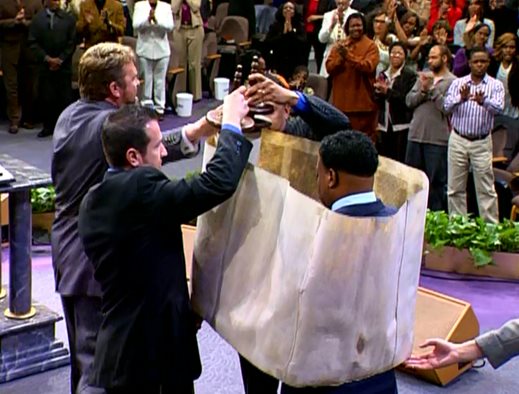
In the past couple of days, the Messianic blogosphere has been alive with passionate discourse about one such “extremist nudnik.” In an opinion piece at the Huff Post called Eddie Long Is Not a King, Rev. Wil Gafney, Ph.D, an Associate Professor of Biblical Hebrew and Jewish and Christian Scripture, posts a commentary on the extremely controversial YouTube video of “troubled pastor” Eddie Long, of the New Birth Missionary Baptist Church in Atlanta GA, being “apparently crowned king with the ritual use of a Jewish Torah scroll.” The real “nudnik” of this sad and sorry tale though, is a fellow named Ralph Messer, as Rev. Gafney states:

The unidentified man who, (in the YouTube video to which I had access he is identified subsequently as Ralph Messer), represents himself as a Jew. He may well be some sort of Messianic Jew, a person who claims Jewish heritage and recognizes Jesus as the Son of God, but who is not part of one of the major Jewish movements: Orthodox, Reform, Conservative, Reconstructionist, Reform, Renewal. He does not, however, represent recognizable Jewish thought or practice in his (mis-) representations of the Torah and other Jewish sancta — or for that matter, New Testament and Christian biblical interpretation and theology.

I won’t present any more details about this story since I would end up just duplicating what’s been thoroughly covered in much more worthy blogs, such as the one maintained by Dr. Rabbi Michael Schiffman, however, I would like to suggest that one of the motivations for such bizarre and unBiblical behavior on the part of men like Long and Messer is the same motivation Dasan and Aviram had in rebelling against the authority of Moses, Aaron, and ultimately God. This desire lead them, like Nadab and Abihu, to offer, “unauthorized fire” or in this case, to misuse a holy sefer Torah for unholy purposes.

Some people just have a problem with legitimate authority and having such a problem, do what Korah did and rebel by attempting to recreate that authority within themselves. This is at the heart of the theological arguments that have supported supersessionism in the ancient and modern church. I can’t truly say that the Christian church stands in total opposition and rebellion against the authority of God, since it is abundantly obvious that God has been using His Christian church to perform His will for centuries. I can say that the seeds that were planted 2,000 years ago which resulted in the weed that opposed the Jerusalem Council and denied the Jewish foundations of the church, were born of rebellion, but it was perhaps a “necessary” rebellion (Romans 11) so that the Gentiles could find a place within their Messianic covenant relationship to God.

That doesn’t make it any less painful or harmful and I believe the time for that “rebellion” is coming to a close.

People like Long and Messer seem to be establishing themselves as “authorities” simply because they can draw a following and they can magnify themselves by creating the illusion that they are “anointed” by God. But what do the people who follow these “rebels” want? Perhaps they are looking for whatever the rest of us are searching for, too.

Where was the knowledgeable one who wove his spell to bring his familiarity with the Atman out of the sleep into the state of being awake, into the life, into every step of the way, into word and deed? Siddhartha knew many venerable Brahmans, chiefly his father, the pure one, the scholar, the most venerable one. His father was to be admired, quiet and noble were his manners, pure his life, wise his words, delicate and noble thoughts lived behind its brow – but even he, who knew so much, did he live in blissfulness, did he have peace, was he not also just a searching man, a thirsty man? Did he not, again and again, have to drink from holy sources, as a thirsty man, from the offerings, from the books, from the disputes of the Brahmans? Why did he, the irreproachable one, have to wash off sins every day, strive for a cleansing every day, over and over every day?

from the novel Siddhartha (1951 U.S. publication)
by Hermann Hesse

This may seem like an odd source to quote within a Christian (and tangentially Jewish) context, but take one giant step backward from your religion and consider what human beings are looking for in general. What does the praying Christian have in common with the Jewish man davening in a minyan or a Muslim kneeling on his prayer mat? What do they have in common with the Buddhist, the Wiccan, and the New Age mystic? Aren’t we all, in our many and diverse ways, seeking God, in whatever way we may conceive of Him (or “Her”)?

I’m not saying that each and every one of these religious paths is equal in its validity or potential to arrive at the true “destination” of God, but the need to strive for that destination is the same in each of us. Some of our paths are legitimate and worthy, and many, many other paths lead to dead ends, darkness, and many ghastly conclusions in the spiritual travels of such seekers.

There are paths that lead people who desire a sincere and simple relationship with God to people like Ralph Messer, more’s the pity. Messer took the true message found in our Bibles and twisted it into a horrible distortion of God, misusing and desecrating the holy Torah of the Jewish people in order to glorify a misguided and selfish man. There is a legitimate path that allows man to understand God through the revelation of Torah, but Messer chose not to take it, perhaps because he would have to become a humble student and not an exalted “teacher.”

Milton, in his classic Paradise Lost, allows the “character” Satan to utter the famous line, “It is better to rule in hell than to serve in Heaven.” That seems to sum up anyone who would usurp the authority of God and the Bible (and Torah) for their own purposes rather than submit to the legitimate authorities God has established and to humbly serve under them. Jesus taught the exact opposite (John 13:1-17)  of Milton’s “adversary” when he washed the feet of his disciples and explained that “a servant is not greater than his master, nor is a messenger greater than the one who sent him” (v. 16). It is terrible to forget the words of the Master and to seek to rule over yourself and others, thinking you are better than those who came before you.

It is better to serve in Heaven than to rule in hell. Seek out those who are truly appointed by God and repudiate those who aren’t, so that the others who seek God just as you do, will be saved. Do not take such actions out of the desire to glorify yourself or whatever group or religion you serve but to glorify God only, lest you become like Dasan and Aviram and surrender to the temptation to serve only yourself. Should you feel that temptation within you, as if being who God made you to be isn’t good enough to satisfy you or Him, consider the parable of the Stonecutter by R’ Abraham Twerski MD. Perhaps it will add some perspective and even a hint of wisdom.

Beshalach: Waiting for the Bread of Heaven

The purpose of the manna was to uplift those who ate it and heighten their spiritual consciousness. As a result of this spiritual boost, the Jews were able to “follow My teaching”—to receive the Torah, as it is indeed stated in the Midrash: (Mechilta ad loc) “The Torah could only have been given to those who had partaken of the manna.” (Sefer HaMa’amarim Melukat, vol. 1, pp. 238-239.)

-From the Kehot Chumash
Chassidic Insights for Parshah Beshalach
Chapter 16
Based on the works of the Lubavitcher Rebbe
Rabbi Menachem Mendel Schneerson, of righteous memory
Chabad.org

And he humbled you and let you hunger and fed you with manna, which you did not know, nor did your fathers know, that he might make you know that man does not live by bread alone, but man lives by every word that comes from the mouth of the LORD. Deuteronomy 8:3 (ESV)

And the tempter came and said to him, “If you are the Son of God, command these stones to become loaves of bread.” But he answered, “It is written,
“‘Man shall not live by bread alone,
but by every word that comes from the mouth of God.’”
Matthew 4:3-4 (ESV)

It may be strange to think of us today as waiting for our bread from Heaven, but I think that’s exactly what we do at times. Think about what it meant to the Children of Israel in the wilderness to wait on God for their bread. Although they had vast herds of livestock with them, they still have no reliable source of “daily bread,” especially enough to feed millions of people, morning, noon, and night. In this, they were completely reliant on God for their food and drink and without Him, they could do nothing.

As slaves, the Israelites depended on the Egyptians for their food and drink (and housing and everything else), and even though life was hard and often brutal, they were used to it, as a convict becomes used to a long term in prison. There was a routine. There were expectations that were fulfilled day in and day out. Breakfast would come tomorrow from the Egyptians because it came yesterday, and the day before, and last year, and in the days of their fathers and grandfathers.

But they weren’t used to waiting on God. They were together as a people, but they felt alone. They were free, but they were in a strange and unpredictable environment. The Egyptians were men and the Israelites understood how men could provide bread, but God is not a man and who can possibly understand manna?

So they were afraid, and they doubted, and they complained, and they tested God. This was a mistake, but it was a completely understandable one. But did God understand?

“You shall not put the LORD your God to the test, as you tested him at Massah. –Deuteronomy 6:16 (ESV)

Jesus said to him, “Again it is written, ‘You shall not put the Lord your God to the test.’” –Matthew 4:7 (ESV)

It certainly doesn’t sound that way, but then again, how could God possibly misunderstand His creations? How can He possibly misunderstand us, when we too are waiting for our “bread from Heaven” and we feel alone, and afraid, and uncertain?

It’s even more confusing when God sets up a schedule and then creates an exception:

Interestingly, Moses does not tell the Jews that the manna will not be in the field, but only that they will not find it there. And indeed, the manna was esoterically present on the Sabbath as well. The Sabbath is the source of all blessings, including those of material sustenance. In this sense, the manna of the other six days descended as a result of the “spiritual manna” that was produced on the Sabbath. (Zohar 2:63b, 88a.)

The physical manna gathered during the week “materialized” out of this spiritual manna. It therefore had to be acquired through physical effort: it had to be gathered, cooked, and so on. In contrast, the Sabbath manna was not manifested physically and therefore could not be “accessed” by any physical means.

Similarly, our physical livelihood is spiritually “produced” by our observance of the Sabbath. During the ensuing week, we have to gather the material blessings of the Sabbath by engaging in our weekday work. But on the Sabbath itself, we must refrain even from thinking about our livelihood. (Likutei Sichot, vol. 16, pp. 181-182.)

-Chassidic Insights commentary continued

This is certainly a very mystic interpretation, but it teaches us something beyond the literal telling of the tale of manna in the desert. Whether we believe we provide for ourselves through the work of our hands and our minds, in reality, everything we think belongs to us was produced by and belongs to God. Beyond that, it shows us that in some manner or fashion, the Shabbat rest results in producing what we need from God and ourselves for the other six days of the week. That’s why we give thanks to Him for everything.

But what about when we ask and we don’t receive, at least right away? But what about when we ask and we don’t receive, at least in the manner we expected to receive? But what about when we ask for a fish and God gives us (seemingly) a snake instead?

“Ask, and it will be given to you; seek, and you will find; knock, and it will be opened to you. For everyone who asks receives, and the one who seeks finds, and to the one who knocks it will be opened. For which one of you, if his son asks him for bread, will give him a stone? Or if he asks for a fish, will give him a serpent? If you then, who are evil, know how to give good gifts to your children, how much more will your Father who is in heaven give good things to those who ask him! –Matthew 7:7-11 (ESV)

There’s a difference between what we need and what we want. God knows what we need, even as He knew what the Israelites in the desert needed. They didn’t ask for manna, but God knew they needed it. At first, they didn’t even know what to do with the manna, but God told Moses and Moses told the people. Eventually, the people got sick and tired of eating manna every single day, but God knew they still needed it on a regular basis and the gift that God gave continued to be His gift, regardless of whether or not it was received with gratitude.

We know that our purpose in a life created by God is not to be served but to serve. Jesus illustrated this very clearly here:

When he had washed their feet and put on his outer garments and resumed his place, he said to them, “Do you understand what I have done to you? You call me Teacher and Lord, and you are right, for so I am. If I then, your Lord and Teacher, have washed your feet, you also ought to wash one another’s feet. For I have given you an example, that you also should do just as I have done to you. Truly, truly, I say to you, a servant is not greater than his master, nor is a messenger greater than the one who sent him. If you know these things, blessed are you if you do them. –John 13:12-17

And yet, we are weak, and we need so much, and we depend on God, or we try to. There are times when we must act in order to receive from God, but there are other times when we are utterly helpless, and we can do nothing but wait.

And waiting on God to deliver His bread from Heaven is very hard. Even when it arrives, we may not recognize it for what it is, since His blessings may not come in a form we will understand. Even when we realize He has delivered His blessings, because they are not as we wanted them to be, we may be ungrateful, or hurt, or even feel betrayed that God didn’t give us what we wanted, when we wanted it, in exactly the way, shape, and form we asked for. But as difficult as it is for us, we must strive to trust God and not to question our Sovereign.

But Moses said to the people, “Have no fear! Stand by, and witness the deliverance which the Lord will work for you today; for the Egyptians whom you see today you will never see again. The Lord will battle for you; you hold your peace!” –Exodus 14:13-14 (JPS Tanakh)

“Be still, and know that I am God.
I will be exalted among the nations,
I will be exalted in the earth!” –Psalm 46:10 (ESV)

We can trust in God, if only we will wait.

You open your hand; you satisfy the desire of every living thing. –Psalm 145:16 (ESV)

His hand is opening. He’s about to help you. Wait.

Good Shabbos.

Repairing the Turbulent Suffix

A certain sofer wrote a sefer Torah and was checking it over carefully for any possible errors, when he finally found one…Although with most errors he would only have to erase the problem and rewrite, he was unsure whether he could do so in this case. As is well known, it is forbidden to erase the Name of Hashem. In this case, the problem was not the name per se, but the suffix… Since he did not want to rewrite the entire amud, he wanted to fix the error but only if this was permitted by the halachah.

When this question reached the Taz, he ruled that the sofer could not erase the suffix…It is obvious to me that it is forbidden to erase a suffix to one of the Divine Names. Here is the proof: although we find in Maseches Sofrim that if a drop of ink fell on one of the Divine Names it is permitted to erase the ink in order to correct the blot, the Mordechai explains that this may only be permitted if letter wasn’t yet formed properly. However, if ink fell on a complete Name it would be forbidden to erase the ink. Similarly, if the letter were accidentally connected this would also be forbidden and the same is true regarding a suffix.”

When the Chut Hameshulash saw this response, he presented a different view, however. “In my opinion, although the Beis Yosef brings this Mordechai and it is l’halachah, there is room for leniency regarding a suffix. The proof to this is from Menachos 48. There we find that Rav Yochanan asks if we may do a sin in order to gain something with regard to sacrifices. From the Rambam there it is clear that we hold like the opinion of Rav Yochanan.

He concluded, “Since rectifying the shem Hashem is like saving a sacrifice, it is clear that in this case we may erase to rectify, especially since erasing a suffix is only a rabbinic prohibition.”

Mishna Berura Yomi Digest
Stories to Share
“Erasing to Rectify”
Siman 143 Seif 4(a)

I know that the information imparted in the quote above won’t make a great deal of sense to most Christians and probably even to a good many non-Jews in the “Messianic” movement. However the halacha that relates to the creation of a sefer Torah or Torah scroll is extremely specific if, for no other reason, than to avoid violating the commandment not to take the Name of God lightly or in vain (Exodus 20:7). I’m not going to attempt to provide a commentary on the ruling in this Daf, but I do want to use it as a metaphor.

A few days ago, I created a blog post called Debating Fulfillment Theology for the purpose of inviting polite debate regarding the pros and cons of the Christian theology that states the grace of Christ has wholly replaced the law of Moses. Even under the best of circumstances (and the debate is continuing as I write this “mediation,” so you are free to join it if you haven’t done so already), such dialogues rarely arrive at a unified conclusion. That is, I don’t expect that those who support fulfillment or replacement theology will “repent” and agree that it is a dangerous and unsupportable position, nor to I expect that those who disagree with replacement theology will eventually agree that the Jews must surrender their dedication to Torah and God and submit to the grace of Jesus Christ in a manner that completely denies Jews and Judaism (and I’m sure you can detect my bias based on how I worded that last sentence).

My goal for the debate is to engage in and encourage open, honest discourse with the hope of not resolving this conflict, but presenting alternate points of view. I am disturbed that the church sees replacement theology or supersessionism (though sometimes more politely cloaked as “fulfillment theology”) as concrete fact and the only possible way that the New Testament scriptures can be understood. After all, New Testament scholars have been debating for centuries (and continue to debate today) over the meaning of many portions of Paul’s letters and some of the more “difficult sayings of Jesus.” If a certain amount of scholarly disagreement remains in these interpretations, how can Christianity as a whole believe that replacement theology is such a “done deal?”

In quoting part of the Daf for Siman 143 Seif 4(a), I want to introduce an idea. I’ll use myself as an example (and I’ll try to keep this as short as possible and still form a complete picture). I was an agnostic/atheist until my early 40s as was my Jewish wife. Then I came to faith in Christ in a local Nazarene church (long story). My family and I attended for some time, but we found that many of our questions about God and Jesus weren’t being answered, especially as they related to the Jewish people.

My wife came into contact with a “Messianic/One Law” group in our community and she was immediately “hooked” (it took me a little longer to warm up to this sudden change in perspective). She strongly suggested that I attend with her and eventually, my family and I shifted our worship context from the Nazarene church to the One Law congregation. Years passed and many transitions took place. Eventually, we left the One Law congregation, and then my wife went back while the children and I attended the local Reform synagogue (another long story). Then my wife left One Law and joined the Reform shul, while I eventually went back to One Law and stayed for a number of years, proceeding from attendee to board member and teacher.

I was happy there for a time but my wife continued to explore her Judaism with the Reform synagogue and later with the Chabad and for the first time in almost 20 years of being together, we became a “mixed marriage”. My wife now identifies with the traditional Jewish community and is not “Christian” or “Messianic” in any sense.

As I watched my wife explore what it was and is for her to be a Jew within a cultural, ethnic and religious Jewish context, the basic tenants of the One Law movement seemed so discordant with what I was discovering (through my wife’s eyes) is actually Judaism (most One Law groups refer to themselves corporately as “Messianic Judaism” thus identifying themselves as a “Judaism”, even if the majority of their leaders and members are not Jews). Questions about assumptions I had made years before started coming to me and I entered into a year long investigation of who I was and what I was doing in my walk of faith (if you like reading a lot, that entire year is chronicled on my now defunct blog, Searching for Light on the Path).

Finally, I did what most religious people (or even what most people in general) don’t do. I changed my perspective, my theology, and my approach to being a disciple of the Master. In essence, I repaired what I saw as a damaged “suffix” in my understanding of God. That required great sacrifices on my part and I entered into more than one serious “crisis of faith” which resulted in quite of bit of emotional distress. These crises resolved into a new framework, the one from which I am now operating on this blog. I still take “heck” occasionally from people who don’t agree with my decision, however it’s a decision I found necessary to make for me and my relationship with God.

Why am I telling you all this and why should you care?

People can change. It’s not easy and it’s not common, but it’s possible. People can make significant and even extraordinary shifts in their theological perspectives if presented with enough evidence, but evidence is not enough. It takes the ability to admit that you can be wrong (not that God can be wrong, which would amount to actually erasing the Name of Hashem) and the courage to make changes (fix the suffix) once that admission has occurred.

No one likes change which is why a couple who is planning their wedding is stressed to the max, even though getting married is what they want to do more than anything. Any change creates stress and crisis, especially if it involves making major alterations to fundamental emotional, cognitive, and spiritual structures such as how you comprehend your trust and faith in God.

That means it is possible, however unlikely, that someone might really change as a result of this conversation. OK, I’m not holding my breath, but I am making a suggestion. As we see from the Daf above, change and correction of perceived flaws is not easy and there are times when it is necessary and times when it isn’t. Changes should be made with the utmost care and only after a great deal of deliberation, prayer, and consultation with trusted advisers.

But if change weren’t possible, no one would become a Christian in the first place, since no one is born into that state, not even people who are raised in a Christian family.

Rabbi Dr. Michael Schiffman recently made a comment on the aforementioned blog post that speaks to what I’m trying to express:

Scripture is scripture, but quoting a verse in or out of context says what the scripture says, but doesn’t tell us what you think it means. If you are going to quote scripture you have not achieved your goal until you tell us what YOU think it means. What you think it means is actually what you are basing your argument upon, so just say what you think it means or you have proven nothing.

Scripture is Scripture and the Bible is the Bible. It exists. It says what it says. But what does it mean? That depends on how we interpret it and what that interpretation means in our lives. Not everyone relates to the Bible and to God in the same way based on how we interpret the scriptures and how we interpret who we are. When presented with the challenges and crises in our life of faith and understanding, we need to keep going, no matter what the obstacles and no matter what the cost, even if the cost is that we must change or be forced to admit that we will always live a life at odds with God and in conflict with His Word.

On their exodus from Egypt, towards Mount Sinai, the Jewish people arrived at an obstacle – the Red Sea.

They divided into four parties.

One advocated mass suicide.

One said to surrender and return.

One prepared to fight.

One began to pray.

G-d spoke to Moses and said, “Why are you crying out to Me? I told you to travel straight ahead. Keep going and you will see there is no obstacle!”

The Jewish people kept going
and the obstacle became a miracle.

-Rabbi Tzvi Freeman
“Keep Going”
Based on letters and talks of the Rebbe
Rabbi M. M. Schneerson
Chabad.org

Keep going. Like Nachshon, plunge into the turbulent seas. When you find them, you can fix mistakes. Miracles are possible.

My God, guard my tongue from evil, and my lips from speaking deceitfully. And to those who curse me, let my soul be silent and let my soul be like dust to everyone. Open my heart to Your Torah, then my soul will pursue Your commandments.

-from the Elohai N’tzor

Slandering the Image of God

The Sages tell us, “What is the remedy for one who has spoken leshon hara (slanderous speech)? If he is a Torah scholar, let him engage in Torah study.” (Arachin 15b). Leshon hara defaces man’s “image of God”, and Torah study restores it.

According to the Midrash (Tanchuma, Kedoshim #13, and Nedarim 32a), Avraham was punished for his reaction to God’s promise in the Bris bein Habesarim that He would grant him possession of the land of Canaan. God told him, as it were, “You want to know? Here is something you can know (Bereshis 15:13): ‘Know with certainty that your offspring will be strangers.’”

Daf Yomi Digest
Distinctive Insight
“The power of word”
Arachin 15

There is one who speaks [harshly] like piercings of a sword, but the tongue of the wise heals. True speech is established forever, but a false tongue is only for a moment. –Proverbs 12:18-19 (Stone Edition Tanakh)

I suppose I’ve been on something of a mission lately to try and emphasize that, among people of faith and disciples of the Master, we have an obligation to treat each other with the same love and respect that Jesus has for his people, both the “lost sheep of Israel” and we non-Jews sheep who are “other sheep…not of this fold” (John 10:16). I know I’ve said this before, and blogs and sermons on the topic of “lashon hara” (the evil or slanderous tongue) are plentiful, but it is a lesson that we can’t seem to get enough of. I say this because, if we were taking this teaching to heart and incorporating it into our lives (and our speech), then there wouldn’t be so much harmful speech, insults, and character assassinations in the religious blogosphere.

And I would be writing about something else this morning.

It’s interesting what the Daf has to say about the “cure” for “evil speech”. “What is the remedy for one who has spoken leshon hara (slanderous speech)? If he is a Torah scholar, let him engage in Torah study.” Is the same remedy available for those of us who are not Torah scholars? I hope so (though I can’t speak from Jewish halacha on the matter). Where else can we find a cure for the evil that resides inside us than within the Word of God?

The commentary on the Daf tells us why speech is so important and how it can be so potentially lethal:

Rav Shach once explained that the uniqueness of man in creation — the “image of God” that was bestowed upon him—lies in the fact that he is a “living soul”, which Onkelos renders as “a speaking spirit.” It is the ability to speak that sets man apart from the beasts. The power of speech is indeed a reflection of “God’s image.” Just as God’s very word is capable of accomplishing the same as an actual deed, as it says (Tehillim 33:6): “By the word of God the Heavens were created,” so too is man’s power of speech capable of “establishing the heavens and settling a foundation for the earth” (Yeshaya 51:16). We must therefore ensure that our speech is pure and exact, in order not to corrupt the “image of God” within us.

This is why Avraham was punished for his expression, “How can I know,” although this was seemingly only a minor impropriety of speech. Similarly, Moshe was taken to task for asking God (Shemos 5:22; see Rashi ibid., 6:1), “Why have You treated this people badly?” There are many other examples of improper expressions and harsh penalties for them — all because of the fact that to misuse the gift of speech is to tarnish man’s image of God.

One way I choose to read this is that the “power” of speech comes from our being made in the “image of God” and that it defiles something about our Creator when we misuse this unique gift that he has provided only to humanity. Also, when we use this unique gift to harm another, we are injuring something of that “image” in the other person. Harmful speech damages not only that aspect of God in which we were made, but the same aspect in the other human. It is as if we are using “the power of the word” to damage or destroy “the power of His Word.” So we are hurting ourselves, hurting someone else, and “hurting” God when we commit “lashon hara”. Why is it so easy (I say this, because such speech is exceptionally common in the blog comments I read in the religious blogosphere) for us to spew our insults and harsh words on other brothers and sisters in the faith?

Haven’t we read what the Master said about this?

It is not what enters the mouth that contaminates the person, but what comes out from the mouth – that contaminates the person. –Matthew 15:11 (DHE Gospel)

Even the brother of the Master teaches this lesson.

Not many of you should become teachers, my brothers, for you know that we who teach will be judged with greater strictness. For we all stumble in many ways. And if anyone does not stumble in what he says, he is a perfect man, able also to bridle his whole body. If we put bits into the mouths of horses so that they obey us, we guide their whole bodies as well. Look at the ships also: though they are so large and are driven by strong winds, they are guided by a very small rudder wherever the will of the pilot directs. So also the tongue is a small member, yet it boasts of great things.

How great a forest is set ablaze by such a small fire! And the tongue is a fire, a world of unrighteousness. The tongue is set among our members, staining the whole body, setting on fire the entire course of life, and set on fire by hell. For every kind of beast and bird, of reptile and sea creature, can be tamed and has been tamed by mankind, but no human being can tame the tongue. It is a restless evil, full of deadly poison. With it we bless our Lord and Father, and with it we curse people who are made in the likeness of God. From the same mouth come blessing and cursing. My brothers, these things ought not to be so. Does a spring pour forth from the same opening both fresh and salt water? Can a fig tree, my brothers, bear olives, or a grapevine produce figs? Neither can a salt pond yield fresh water. –James 3:1-12 (ESV)

If you’ve been a Christian for any length of time, you already know these lessons and you know what they mean. If you then continue to deliberately use your speech (or what you write in blog comments or discussion threads on the Internet) to hurt someone else, you must realize that you are also deliberately disobeying the teachings of Jesus and spitting on the will of God. Please keep that in mind.

I am sometimes questioned about how I can use Jewish teachings to help me better focus on the lessons of Jesus (and no, I am not a “mere imitator of Judaism” in my faith or practice), but I find many seemingly associated themes. I don’t know that they are directly connected in any manner, but I find them comforting nonetheless.

Today’s daf discusses the negative consequences of speaking leshon hara.

Once a certain father heard that a child of the rebbe of Toldos Aharon, zt”l, wished to make a match with his daughter. He was overjoyed…until someone told him that the young man was not in his right mind. Obviously, the father was distressed. He was also worried about how to ascertain the truth; surely a maggid shiur or other person within the Toldos Aharon system wouldn’t say anything negative about the rebbe’s grandson.

He finally decided to ask the rebbe himself, since he was certain that the tzaddik would not deceive him. When this question was put to the rebbe he denied the claim against his grandson. “I know that child since he was born. No one has ever thought there was anything wrong with him.”

The father was very glad to hear this, but also furious at the one who had slandered the innocent bochur, and immediately blurted out, “Do you know who told me? It was…”

“Just a moment,” the rebbe firmly interrupted, “It is a question of leshon hara. Perhaps you are forbidden to tell me. Working out whether this is permitted is no simple matter. I am going on a fundraising trip for two weeks in the next few days. When I return you are welcome to come back and I will tell you the halachah.” When the rebbe was away, he learned the entire Sefer Chofetz Chaim through twice with great care. When he returned, the father of the girl—now engaged to the rebbe’s grandson—came to ask whether he was permitted to tell the rebbe who had slandered the bochur.

The Rebbe of Toldos Aharon said, “I learned the sugya very carefully while I was away and I concluded that if you don’t derive any pleasure in the telling, you are permitted to tell me who slandered the young man.”

Before the man could say a word, however, the rebbe stopped him with a motion. He astounded the man with his concluding words, “It may be permitted, but nevertheless, I do not wish to hear about it!”

Daf Yomi Digest
Stories Off the Daf
“A Question of Leshon Hara”
Arachin 15

We may not be able to prevent our brother from using harmful speech or trying to “stir the pot,” but we can certainly control our own tongues (or fingers on the keyboard). And like the Rebbe of Toldos Aharon, when someone is about to speak in such a manner, even if it is “permitted,” we can refuse to listen and refuse to respond.