Tag Archives: trust

Distance

Once in a while, He seems to be peeking through the latticework of our world, filling the day with light.

But then there are times He hides His face behind a thick wall, and we are confused.

We cry out to Him, loudly, for He must be far away.

He is not far away. For the latticework is His holy hand, and the walls themselves are sustained by His word.

-Rabbi Tzvi Freeman
“Hiding Behind His Hand”
Based on letters and talks of the Rebbe
Rabbi M. M. Schneerson
Chabad.org

In Torah-study the person is devoted to the subject that he wishes to understand and comes to understand. In davening the devotion is directed to what surpasses understanding. In learning Torah the Jew feels like a pupil with his master; in davening – like a child with his father.

“Today’s Day”
Thursday, Tamuz 26, 5703
Compiled by the Lubavitcher Rebbe
Translated by Yitschak Meir Kagan
Chabad.org

I have to keep reminding myself that there is something bigger than humanity. If I ever stop, my faith in just about everything would completely collapse, especially in human beings. It seems like every time I turn about (virtually), someone else is saying that all religious people everywhere are fanatics. I have to keep reminding myself that, for some people, all they know about a life of faith is from those people and groups who only pretend to honor the God of the Bible. I have to remind myself that the only “Christians” some folks are aware of are those who use their religion as an excuse to spew out their vile, personal hate.

No wonder other religious people as well as agnostics and atheists hate Christians.

But it makes me wonder.

If all Christians everywhere are judged by the behaviors of a few, fringe fanatics, doesn’t that make the people doing the judging prejudiced and bigoted?

I know that even the best among the body of faith take heat for evangelizing to the “unsaved”. From the Christian’s point of view, he or she is fulfilling the mandate from Christ (Matthew 28:18-20) and sincerely trying to keep another living human being from “eternal damnation” (I put these terms in quotes because they are very “Christian-centric” and not easily understood outside the church).

I know that although we are not of the world, we are supposed to be in it (John 15:19, Romans 12:2), if only to live the lives we are created for, to do our part in repairing the world, and to prepare our environment for the Master’s return (“and even though he may delay, nevertheless every day I anticipate that he will come”…from the Rambam’s Thirteen Principles of Faith).

But most of the rest of the world still thinks I’m a schmuck.

Trying to convince them that not all people of faith are “the enemy” seems hopeless. The secular “haters” outnumber me by quite a bit, and as I’ve said before, I guess I should have expected this. I guess it’s especially difficult to take when people who I like and otherwise get along with continually bombard me with “religion is evil” messages day in and day out.

Judaism’s answer, according to Rabbi Freeman’s interpretation of the Rebbe is:

The first thing needed to fix this world is that Jews should love each other and be united.

And this can begin even without a planning committee and without funding.

It can begin with you.

That can work for the church too, but this strategy often involves defining yourself by who or what you oppose. How can you oppose the world and not expect it (and them) to oppose you? Doesn’t that make it difficult to have conversations? Does that mean the church becomes a self-contained box and only talks inside of itself? How do you spread the Gospel of Christ that way, or do you only “spread” it inside the church?

All that said, maybe the only way to survive with faith intact is to withdraw periodically. I think that’s what prayer is like sometimes. It’s what Shabbat would be like for Christians if Shabbat were permitted to the non-Jew.

It’s almost a shame that my primary template for understanding Christianity is traditional Judaism, because the vast majority of Jews are completely opposed to everything I stand for. Somehow, I manage to fit a square peg into a round hole, but perhaps only in my own imagination.

Alone in silenceI’ve always thought that Christian hymns like just you and me, Jesus were terribly self-centered and driven by the desire to contain the King of the World within a single, human relationship, but I also see the appeal. It’s easy, when you don’t feel as if human beings are friendly, approachable, or even trustworthy, to want to withdraw from humanity all and only trust the Divine.

Of course, that strategy presupposes you have the ability to trust God, but then, that’s one of the interesting things about people who oppose religion. Sometimes people like them and people like me have a thing or two in common.

But I learned long ago that you have to trust someone. If God can’t be trusted, then life is hopeless.

Rabbi Freeman’s solution goes something like this:

Do kindness beyond reason.

Defy terror with beauty.

Combat darkness with infinite light.

I could spread light throughout the world from today until the day I die and most people would continually refactor and redefine the light as darkness, just in order to keep fitting me into how they define religion. In the end, I have to hide some tiny spark of His infinite light  deep inside of me and somehow manage keep it kindled. The horrible alternative is to surrender to terror and a perpetual descent into the abyss, watching both people and God dwindle in the increasing distance between us.

As opposed to people, God is supposed to be the ultimate inclusionist. I certainly hope so.

God Waits in the Desert

The Talmud also writes there that the mouth of a fetus is compared to a strand of hair. This teaches that one’s spiritual level depends on what he says. In Tehillim we find, “I believed as I speak” — words of emunah build one’s emunah and bitachon and draws him near to God. But speaking profane words distances one from the purpose of creation. How much more so do words of slander and falsehood! The verse commands, ‘‫ — מדבר שקר תרחק‬ Distance yourself from falsehood.’” Rav Zusia of Anapoli, zy”a, interpreted this phrase in a novel way: “If you speak falsehood, you will be distanced from God!”

Daf Yomi Digest
Stories Off the Daf
“The Eyes, the Nose and the Mouth”
Niddah 25

“They went down to the pit alive” (Bamidbar 16:30) – even in the grave they think they are alive. There is a blessing contained in “They went down to the pit alive,” as with “the sons of Korach did not die,” (Ibid. 26:11.) – “a place was established for them (In Gehinom “the pit,” Megilla 14a.) and they repented.” For teshuva, repentance, is effective only while one is still alive. This, then, is the blessing – that even in the pit they will live, and they will be able to effect teshuva.

“Today’s Day”
Tuesday, Sivan 26, 5703
Torah lessons: Chumash: Korach, Shlishi with Rashi
Tehillim: 119, 97 to end.
Compiled and arranged by the Lubavitcher Rebbe
Rabbi Menachem Mendel Schneerson, of righteous memory, in 5703 (1943)
from the talks and letters of the sixth Chabad Rebbe
Rabbi Yosef Yitzchak Schneersohn, of righteous memory
Translated by Yitschak Meir Kagan

I sometimes get kind of cranky about a life of faith. I sometimes forget about what I’ve already learned about faith and trust. I’ve recently been reminded of something I first read on Derek Leman’s blog, but the reminder didn’t come from Derek:

The call of faith is hard, the task seems impossible, the place we are called to seems desolate, the day of regeneration seems far in the future, but this faith is its own reward during the long delay.

I’m reminded that we’re to have faith in the desert. But while it’s easy to declare that the desert represents the faithless world we live in, in fact, the desert is inside of us each time we doubt.

Each time I doubt.

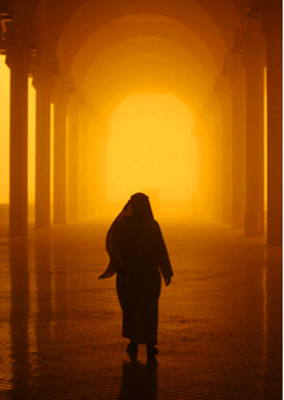
Ironically, the desert is a good place to be when I’m in doubt. There are few distractions. I imagine a sandstorm. The wind is hot. I have coverings over most of my body including around my eyes so I’m not blinded by the sand. The sun is obscured from my vision as a hazy, blurry ball of yellow and white but the power of its heat is oppressive.

And there is only me and the wind and the sand and the heat and somewhere beyond, the vast reaches of the desert, all but lifeless.

And there is God.

He’s not actually apparent. I talk to Him, though. I complain to Him. I wonder where He is. I imagine that He’s contracted Himself; He’s withdrawn from the part of the universe where I live, He’s left me to swing in the breeze or in this case, the wind and sand.

Not really, of course. The reality of His existence is that He’s always “standing at my shoulder” so to speak, never far away at all, no matter how transparent He seems to be to my failing perceptions. But it’s as if He has withdrawn, like a silent lover who has backed away in order to give me time to process some sort of quarrel between us.

Not that He’s ever argued with me. I do all the arguing. That is, until I realize He has left me and I am utterly alone and abandoned in the desert of my soul.

My God, my God, why have you forsaken me?
Why are you so far from saving me, from the words of my groaning?
O my God, I cry by day, but you do not answer,
and by night, but I find no rest. –Psalm 22:1-2 (ESV)

The wonderful thing about being alone is that you have time to think. There are no distractions, not even the presence of God (though He is still present). The desert is comforting, even the heat is welcome; the sweat, the smell of dry things. There is still rock beneath my feet so my footing is sound.

The quote from Derek’s blog says in part, “but this faith is its own reward during the long delay.” Faith is a companion in the desolation, a faint voice I can just barely hear over the banshee winds. Though I feel as if the God in whom I have faith is “far off and the road to reach him is long” and arduous, I am also reminded that my desert can be watered and flourish, but only when I’m ready to return. Only when I want to begin the journey again (or is this part of the journey?).

He leads me beside still waters.
He restores my soul.
He leads me in paths of righteousness
for his name’s sake.
Even though I walk through the valley of the shadow of death,
I will fear no evil,
for you are with me;
your rod and your staff,
they comfort me. –Psalm 23:2-3 (ESV)

But that’s only a mirage which has yet to arrive; an oasis that will only come when the Messiah does, or when my faith in the Messiah returns.

This week’s Torah portion records the failure of the Children of Israel to realize the promise and the dream. They lack faith and do not take possession of the land of Canaan. They are condemned to wander the vast wilderness for forty years, dying one by one along the way. Miriam, Aaron, and even finally Moses all perish. Only Joshua and Caleb from that generation survive and only because of steadfast faith and trust.

The very last verses of the Parashah say this:

The Lord said to Moses as follows: Speak to the Israelite people and instruct them to make for themselves fringes on the corners of their garments throughout the ages; let them attach a cord of blue to the fringe at each corner. That shall be your fringe; look at it and recall all the commandments of the Lord and observe them, so that you do not follow your heart and eyes in your lustful urge. Thus you shall be reminded to observe all My commandments and to be holy to your God. I the Lord am your God, who brought you out of the land of Egypt to be your God: I, the Lord your God. –Numbers 15:37-41 (JPS Tanakh)

The commandment of tzitzit is directly connected back to failure because man needs tangible reminders of an intangible God. Faith and trust are shadows in the mist as well, but the tzitzit are real enough. They are not faith, but for the Children of Israel, they serve as a visible reminder that God is as near as the four corners of their garments.

Christians don’t wear tzitzit since, among other things, the failure to possess the land and the subsequent possession of Israel by the Jewish people are commandments for the Jews, not for us. However, our need for faith and trust is the same. Our need to be reminded of God is the same. Where is God when we need Him? He’s standing apart, giving us time to realize we need to return to Him; letting us stew in our graves while we decide to repent and live.

A life of faith isn’t all that easy. It’s not even so much that the world around me thinks I’m a superstitious fool for believing in the providence of a God that I cannot see and touch and who allows horror and tragedy to abound on his earth while we believers declare His undying love for humanity. It’s the desert inside where the battle is fought. It’s where I fight with God. It’s where I fight with myself. It’s where I have one lover’s quarrel after another with the One who is the lover of my soul.

So He periodically leaves me alone in the desert with the wind and the sand and the heat. But he provides me with solid rock to walk on so I won’t lose my footing or my way.

The desert is a good place for me to ponder my lot and my fate. Occasionally the wind dies down a bit and I’m temporarily given a small sheep to tend, so I have something else to care for. This is God reminder that He cares for me in the same way.

And God waits at a distance, but always watching me, ready to return to my side in an instant should I but say the word.

And He waits.

When We’re Left Behind

Teresa MacBain has a secret, one she’s terrified to reveal.

“I’m currently an active pastor and I’m also an atheist,” she says. “I live a double life. I feel pretty good on Monday, but by Thursday — when Sunday’s right around the corner — I start having stomachaches, headaches, just knowing that I got to stand up and say things that I no longer believe in and portray myself in a way that’s totally false.”

MacBain glances nervously around the room. It’s a Sunday, and normally she would be preaching at her church in Tallahassee, Fla. But here she is, sneaking away to the American Atheists’ convention in Bethesda, Md.

-by Barbara Bradley Hagerty
“From Minister to Atheist: A Story of Losing Faith”
NPR.org

When I read the NPR story, my immediate reaction was one of anger. I took the actions of ordained ministers who have become atheists and yet continue to serve in the pulpit as personally insulting and hypocritical. I also felt that NPR’s publishing of this story was an attack on Christians.

Of course, I shot my big mouth off on twitter and received replies asking why I felt that the telling of one person’s story on their journey of faith (even if it’s away from faith) was an attack on Christianity.

Good question. Why do I feel this way? If someone loses faith and a news agency decides to write a story about it, why do I care? For that matter, if some people choose to walk away from the church, why should I feel that they’re invalidating everything I believe in?

I don’t mind when people disagree with me. I don’t expect everyone in the world to have the same, thoughts, ideas, and opinions as I do. In fact, the world would be a pretty boring place if everyone were just like me. I actually enjoy a frank debate on interesting topics now and then. I guess it’s just the sense of being completely devalued, considered unintelligent, superstitious, and finally, irrelevant that bothers me. It’s one thing for a person to have never had faith and to refuse the option to consider God. It’s another thing entirely to be a person who was once devout and who helped others come to faith, do a complete u-turn and say God doesn’t matter anymore.

It’s like saying I don’t matter anymore, either. Faith isn’t something that I put on like a raincoat when the forecast is for thunder showers. Faith and trust in God is the fabric of my personality and the substance of my being. If we were once alike in our faith and you walk away, it’s like you’re saying who I am is no good anymore.

Two days later, MacBain returned to Tallahassee — and to reality.

“I didn’t know how far or how explosive her coming out would be, but, then again, nobody did,” says MacBain’s husband, Ray MacBain. “The next morning, we got up, I went to work and my son Alex texted me and said it went viral.”

The local TV station, WCTV, ran a series of stories about MacBain, interviewing her boss but never MacBain herself. Hundreds of people wrote comments on the site, and MacBain says they were painful to read.

“The majority of them, to begin with, were pretty hateful,” she says, although some nonbelievers soon came to her defense. “For somebody who’s been a good guy their whole life and been a people pleaser, it’s really hard to imagine that overnight you’re the bad guy.”

This is a very tragic consequence for a person, a member of the clergy, to experience when she “comes out of the closet” and admits to losing her faith. While the NPR story is very sympathetic to MacBain and others like her, I can see why people in the church would be angry.

broken-crossThere’s a sense of being betrayed. Imagine going through your own spiritual and emotional crisis. Who do you turn to for help? Often secular counselors, though well-meaning, just don’t understand the dynamics of a crisis of faith. For many people, the first person you turn to is your Minister or Pastor. You go to them, pour out your heart, fearing some “fire and brimstone” lecture, but hoping and praying he or she will understand. Then they do, they help you, they pray with you, and they gently guide you to a place where you feel like you can trust God again.

And then you find out they were lying between their teeth.

OK, it’s probably a lot more complex than that, and I certainly don’t want to be unfair to the practicing clergy who are atheists and enduring their own spiritual conflicts and crises in the pulpit, but yes, I do understand how the people around them could get very angry, could feel ripped off, and could feel discounted and even attacked.

It’s as if the one person in this world who you depend upon to be your spiritual anchor turns out to be made out of paper mache. I guess this is why we’re supposed to have faith in God and not in people, but for most human beings, it really helps to have someone spiritually stronger than you to rely upon when times get tough.

But people lose their faith. Really good and kind and wonderful people lose their faith. They go through hard times. They watch other people who they love go through hard times. Little children die of horrible diseases. Relationships are shattered. Where is a loving and compassionate God? I can see how faith could take quite a beating. Then your Minister announces to the world that she is an atheist.

Gee. What’s the point?

I’ve mentioned Joe and Heidi Hendricks before. I’ve mentioned they both have cancer. I’ve talked about the emotional roller coaster ride they’ve gone through on a daily basis for years and years. They are the two most remarkable people I know. I don’t know what holds them together…except their faith in God and their love for each other.

Put two Christians through identical horrible circumstances and then never let up on them. Hurt, terrify, and disappoint them over and over again until they both feel like they’re going to explode. Offer them comfort and hope, and then rip it away at the last possible second. What enables one Christian to endure with their faith intact or even strengthened, while the other’s faith is torn to shreds and they crawl away defeated, abandoning God as they feel they have been abandoned by God?

I don’t know. I’m not so cruel as to say one person’s faith was stronger or that the ‘weaker’ person didn’t have a ‘real’ faith at all. I can’t judge another person’s faith. I have no idea what they’re experiencing.

So if someone loses faith and walks away, what does that do to the rest of us? Why do we let it affect us at all? After all, it’s the other person’s decision. They’re making it for themselves. Pastors and Ministers and Rabbis are human beings after all. In fact, the demands of being a religious leader can make things harder rather than easier, and who knows how many of them silently suffer week after week, pretending to their congregations that they have a faith that has long since evaporated like an ice-cube in an Arizona heat wave.

We know we’re supposed to love one another. We know it isn’t easy. But that’s the point. Love isn’t easy. We have to love when it’s hard, too. If someone like Teresa MacBain in the NPR story is our Minister and she tells us she’s lost her faith, how should we respond?

“I believe in God,” says her husband, Ray. “And to be honest, I pray for her every night, I got friends praying for her.”

But he says he adores his wife and defends her right to disbelieve. “That’s why I spent 23 years in the Army. That’s why I’m still a police officer. We have freedom of speech and freedom of thought. And God never forced anybody to believe, so who am I to step up?”

This could have torn the MacBain family apart. For all I know, someday it might do just that. But we’re supposed to love and to try to understand, even when it’s not easy, and even when we feel attacked, and even when we feel insulted and take what the other person says and does really personally.

Love isn’t a warm and fuzzy feeling or lots of hugs and kisses. Love is setting aside your (my) personal reactions and trying to understand what the other person is going through. And then, you try to offer them what they need, even when it’s not what you want to give (and sadly, a recent study indicates that very religious people aren’t particularly motivated by compassion).

Is God that hard to find? When someone walks away and leaves us behind, God says we’re supposed to love them. Sometimes, with so many atheists telling us how bad we are and how evil Christianity is in the world, it’s hard to believe in love at all. It’s not rational, but if we acted like the rest of the world around us (and some religious people do), then we’d be as bad as they say we are. Jesus said to love. It hurts when someone who used to be a believer tells us they’re and atheist and that they’re “better” or they’ve “grown up” now. If we want them to respect our choice to be a person of faith, we have to allow them the same right and not take it as a slap in the face.

Unavoidable

It was the summer of 1930, before most of these things had happened…It was several months since I had been in London, and then only in passing, so I had really hardly had seen Father at all since he had entered the hospital the autumn before.

So all of us went to the hospital. Father was in a ward. We had arrived much too early and had to wait. We were in a new wing of the big hospital. The floor was shiny and clean. Vaguely depressed by the smell of sickness and disinfectant and the general medical small that all hospitals have, we sat in a corridor downstairs for upwards of half an hour…

Finally, the clock we had been watching got around to the appropriate hour; we went up an elevator. They all knew where the ward was – it was a different ward. I think they had changed his ward two or three times. And he had had more than one operation. But none of them had been successful.

We went into the ward. Father was in bed, to the left, just as you went in the door.

And when I saw him, I knew at once there was no hope of his living much longer. His face was swollen. His eyes were not clear but, above all, the tumor had raised a tremendous swelling on his forehead.

I said: “How are you, Father?”

He looked at me and put forth his hand, in a confused and unhappy way, and I realized that he could no longer even speak. But at the same time, you could see that he knew us, and knew what was going on, and that his mind was clear, and that he understood everything.

But the sorrow of his great helplessness suddenly fell upon me like a mountain. I was crushed by it. The tears sprang to my eyes. Nobody said anything more.

I hid my face in the blanket and cried. And poor Father wept, too. The others stood by. It was excruciatingly sad. We were completely helpless. There was nothing anyone could do.

What could I make of so much suffering? There was no way for me, or for anyone else in the family, to get anything out of it. It was a raw wound for which there was no adequate relief. You had to take it, like an animal. We were in the condition of most of the world, the condition of men without faith in the presence of war, disease, pain, starvation, suffering, plague, bombardment, death. You just had to take it, like a dumb animal. Try to avoid it, if you could. But you must eventually reach the point where you can’t avoid it any more. Take it. Try to stupefy yourself, if you like, so that it won’t hurt so much. But you will always have to take some of it. And it will all devour you in the end.

-Thomas Merton
“Chapter Three: The Harrowing of Hell”
pp 90-91
The Seven Storey Mountain: An Autobiography of Faith

Reading this part of the chapter doesn’t hurt so much today as it did when I first read it a day or two ago. It doesn’t hurt so much as it did when I read it the day after writing about Joe and Heidi’s latest scene from their cancer battle. Merton was about 17 years old when he visited his dying Father in the London hospital as described above. He had gone through a few vague encounters with religion up to that point in his life, but none yet with God. So as he said, facing his father’s terrible illness and imminent death was like a “dumb animal” facing a tragedy it could not avoid and had no ability to understand.

Does faith make tragedy easier to handle? Joe and Heidi think so. I can’t imagine what that must be like, and frankly, coward that I am, I don’t want to imagine. Who actually wants to face that and have their faith tested? Peter, James, and John had their faith tested at Gethsemane (Mark 14:32:42) and it was found wanting.

My friend Leah said that having faith helps. When her husband died in a sudden accident many years ago, she went around in a fog for the first twenty-four hours, but after that, it was her faith in God and the certainty of the resurrection that sustained her. It was still “the year from hell” in which she grieved terribly, and any hint of joy was fleeting if present at all, but the presence of God was with her the entire time. She was not alone.

I suspect Merton was alone in his grief and sorrow when he visited his father in the hospital, even though he was surrounded by family. God was there too, but no one noticed. No one except Merton’s father, that is.

In fact, if he could not talk, there were other things he could do. One day I found his bed covered with little sheets of blue note-paper on which he had been drawing. And the drawings were real drawings. But they were unlike anything he had ever done before – pictures of little, irate Byzantine-looking saints with beards and great halos.

Of us all, Father was the only one who really had any kind of faith. And I do not doubt that he had very much of it, and that behind the walls of isolation, his intelligence and his will, unimpaired, and not hampered in any essential way by the partial obstruction of some of his senses, were turned to God, and communed with God Who was with him and in him, and Who gave him, as I believe, light to understand and to make use of his suffering for his own good, and to perfect his soul. It was a great soul, large, full of natural charity. He was a man of exceptional intellectual honesty and sincerity and purity of understanding. And this affliction, this terrible and frightening illness which was relentlessly pressing him down even into the jaws of the tomb, was not destroying him after all.

-Merton pp 91-92

Merton wrote his autobiography as a young Trappist monk and saw the world and his past through the newly minted lens of his Catholic faith, rather than from the perspective of later in his life as a cleric. I have no idea if, at 17, any of this would have occurred to him, and of course, he had no idea what his father was subjectively experiencing, but his father, a professional artist, was communicating that experience in the only way he knew how. And years later, it’s possible that his son finally understood.

At the time, Merton probably only understood the following, and ironically, decades removed from the event and having lived a completely different life than he, I also understand.

Indeed, the truth that many people never understand, until it is too late, is that the more you try to avoid suffering, the more you suffer, because smaller and more insignificant things begin to torture you, in proportion to your fear of being hurt. The one who does most to avoid suffering is, in the end, the one who suffers most: and his suffering comes to him from things so little and so trivial that one can say that it is no longer objective at all. It is his own existence, his own being, that is at once the subject and the source of his pain, and his very existence and consciousness is his greatest torture.

-Merton, pg 91

I don’t know if Merton captured the ineffable essence of all human suffering in that paragraph or if, by the grace of God, he managed to actually create in that brief stream of words, a completely accurate description that points to my life as it is today specifically for the sake of my soul, but these words speak to me like no other words that I’ve ever read. In virtually one literary breath, Merton describes my predicament and it’s potential cure. In trying to avoid suffering, I have become the author of my own pain. Every little event is registered as another injury, and my very life, with every beat of my heart, is my greatest agony. Each heartbeat is like another splinter inserted into my eyes, and each breath is constricted by a great hand crushing my lungs.

And the cure is to stop avoiding suffering.

Strange cure, I must admit. After all, who seeks to suffer? Who actually wants their own faith to be tested?

But Peter became a better man after he recovered from denying the Master. Merton believed that, even in terrible suffering, with death waiting for him as close as his shadow, that his father’s soul was becoming better because of his torment. Of course, this is a Catholic’s perspective on the matter, and a 17 year old Merton could not truly assess the condition of his father’s soul, but his father could not avoid suffering and so there he was; drawing “little, irate Byzantine-looking saints with beards and great halos,” and communing with God.

So I went back to school, after seeing Father for a moment on the way through London. I had been back for barely a week when I was summoned, one morning, to the Headmaster’s study, and he gave me a telegram which said that Father was dead.

-Merton, pg 93

And so the great mass of horrible agony and pain is really made up of tiny bits and pieces of frustration and annoyance and sorrow. The missed opportunity to say, “I love you,” the driver that cuts you off on the road, the harsh rebuke from your daughter, the unfriendly chiding of an online critic; these are all filtered through the self and the self-loathing of my existence and my life as I vainly attempt to avoid injury and insult. The harder I try to isolate myself from the “slings and arrows,” the more they strike and stab at me.

Is there some truth after all in letting down my defenses and praying that God stand with me in the face of my own wretched life?

Ironically, it was famed martial arts master Bruce Lee who said, “Do not pray for an easy life, pray for the strength to endure a difficult one.” On the one hand, I have no control whatsoever, of the seemingly random events of the world around me. But on the other hand, I have a great deal of control about how or if I choose to try to avoid them and, in encountering such events, how I choose to interpret their impact. Am I in pain? It feels that way. Do I have to be? I don’t know.

Rabbi Tzvi Freeman, interpreting the letters and talks of the Rebbe, Rabbi M. M. Schneerson, said:

In the morning, we make our plea as though unable to tolerate another moment. And as evening comes, we demand again as though morning never passed.

We live on the verge of eternity. May we arrive now.

We live on the verge of eternity, as if life were like dancing on the edge of a razor blade, running fast and hard, terrified that if we fall, we’ll be cut to ribbons.

But what if we…what if I chose one day, to deliberately fall off of the edge of the razor, but rather than falling headlong into the sharpened metal and being destroyed in bloody shredded flesh…

…I flew?

Flight of the Sparrow

Devastating News Today, darn it!

Heidi’s tumor markers not only went up but doubled. So this new chemotherapy failed completely, like the one they tried in December/January. We will hear what option(s) are left sometime tomorrow.

My own outpatient surgery is tomorrow morning at 8am, another unwelcome surprise.

We’re really grateful to all of you for your kindness and support.

My beloved wife has metastatic breast cancer (spread to lungs, bone, liver). I am a prostate cancer survivor and my bladder cancer is in remission. We are both treated at Seattle Cancer Care Alliance. But we love God, we love life’s adventures, we love our family & friends. And will do so until God takes us Home. We are followers of Christ.

-Joe Hendricks
Tuesday, April 2nd, 2012

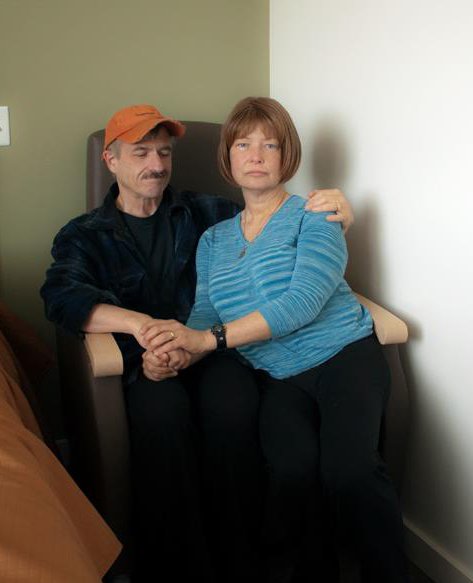
I’ve never met Joe and Heidi Hendricks face to face. I suppose I could, since we live only about a day’s drive away from each other. However, through the “magic” of Facebook, I have shared the last few years of their cancer battle together. The photo I’ve posted is number 56 in their scenes from our cancer battle.

The most startling thing for me about photo 56 is that Joe and Heidi aren’t smiling. No, I don’t expect them to smile after such terrible news, but if you go through their “photo album,” even in the most dire of circumstances, they’re always smiling and joking and pressing on through adversity. Humor is almost the last tool to fail when all other tools have long since burned out in the course of such a tremendous physical and emotional drain. I must admit, mine would have been shot through like swiss cheese in a hail storm long before this. But Joe particularly always makes me laugh.

But not today.

Besides their sense of humor, the thing I admire most about Joe and Heidi is their faith. A lot of Christians say they have faith and trust in God…that is, until something really bad happens. Then it all goes flying out the window and it’s “Why did you let this happen to me, God?” and “How could you be so cruel to me, God?” I’m sure I’d be among that group if I had to face the scenes from Joe and Heidi’s cancer battle first hand.

But no matter how grim it’s been for them, they’ve always grasped tightly onto the hand of God and never let go, just as love has bonded Joe and Heidi together and the never let go of each other.

I’m angry. No, not at God…well, not exactly. I don’t who or what I’m angry at. I think it’s that I feel really helpless and frustrated. Sounds strange, eh? There is horrible tragedy happening all over the world. Every day, someone suffers. Every day, someone dies. Every day, some act of injustice is committed, the helpless are victimized and have no defender, the innocent are made to pay for the crimes of the oppressor. It’s a broken world.

But in the face of all that, I’m angry at the news of Joe and Heidi’s cancer battle today. I know the world isn’t fair, but I’m still angry. It isn’t fair.

It’s like my feelings have mass and can be affected by gravity. It’s like the muscles that hold up my feelings are tired and my sadness is a lead weight, pulling my shoulders down and anchoring me to my seat. I feel as if I’m slowly being pulled to the floor. It’s as if my only light is losing its brightness, and I’m just getting more heavy and silent and it’s getting dark all around me.

The light of laughter is going out in the world.

And where is God?

How many people of faith have asked that question across the long stretch of centuries? How many Christians and Muslims and Jews and whoever else have asked God where He went off to when horrible news, disease, injury, and death stalked us one by one? Is this what ancient man felt like, cowering in some cave in the night, listening to the predators crying out at the moon and declaring to the grey, reflected light that they would find you and consume you?

Is that what it feels like knowing that there is a cancer inside of you and it’s taking over and it won’t be chased away?

I’ve heard the words “God is in control” said countless times in countless church services, but what do the words really mean? God is in control, but people still get sick. God is in control but people still get hurt. We’re alone, and we’re scared, and we need to be able to hang on when our strength, and our stamina, and finally our laughter is dried up like the last drop of water feeding the last wilted flower in the brilliant summer sun baking the vast and endless desert.

I realize that there are forces in the world and forces in our body that we can fight but we can’t always control. At some point, no matter how much you put into the struggle, you (I can only imagine, since I haven’t had to face this) have to let your shoulders relax, let the weight pull you down, look up, put your tiny hand in God’s immense grasp and say, “No matter what happens, please don’t go away.”

I hate crying.

God, don’t go away. Stay with Joe and Heidi, no matter what happens. We all want a miracle, but the greatest miracle is that You even care. If not even one tiny sparrow falls to the earth apart from the will of the Father, then You are mindful of Joe and Heidi, for they are worth much, much more than sparrows.

Stay with them God and, if it is Your will, don’t let them fall. Let them fly.

I Will Awake the Dawn!

My heart is steadfast, O God! I will sing and make melody with all my being! Awake, O harp and lyre! I will awake the dawn!

I will give thanks to you, O Lord, among the peoples; I will sing praises to you among the nations. For your steadfast love is great above the heavens; your faithfulness reaches to the clouds. Be exalted, O God, above the heavens! Let your glory be over all the earth! That your beloved ones may be delivered, give salvation by your right hand and answer me!

Psalm 108:1-6 (ESV)

Wake up by your own body clock, before the alarm. King David said, “I will wake the morning”—not that the morning woke him. You see, if you are only awake because it is morning, you are not really awake—you are sleepwalking. If it is morning because you are awake, however, then you are truly awake and in control.

-Rabbi Tzvi Freeman
“How to Get Out of Bed…and really mean it”
from the Multimedia Guide to Jewish Prayer series
Chabad.org

I hadn’t noticed that David said, “I will awake the dawn” before. I think most of us, when we first get up, are “sleepwalking” for some period of time, as Rabbi Freeman describes. We are waiting for morning, or our first cup of coffee, to wake us up. In his article on getting out of bed from which I’m quoting, Rabbi Freeman provides rather detailed instructions on what to do, from the first moment you realize you’re awake, through the process of entering into morning prayer. These steps are traditional for a religious Jew and so may not be particularly adaptable for the Christian.

On the other hand, there may be a thing or two we can take into our own morning routine as we prepare to greet our Creator.

As I previously mentioned, the first thing a Jew does after waking up is to recite the Modeh Ani blessing, thanking God for returning his soul to him and restoring his life. Immediately afterwards comes the Netilat Yadayim or the traditional handwashing, followed by other specific routines to prepare for prayer.

You can read Rabbi Freeman’s article in full at the links I’ve already provided, so I won’t go into a step-by-step description of the awakening process of a Jew preparing for prayer. Frankly, I don’t believe most of it specifically applies to the Christian and that these are rituals uniquely Jewish in nature.

However, there are a few things we might want to pay attention to, especially activities that a Jew should avoid prior to tefillah (prayer):

  • Don’t eat a meal.
    Eat what you need to focus your mind in tefillah. Maybe that’s just a hot drink. Maybe a light snack. But stop there. First connect your soul, then feed the body.
  • Don’t check the news.
    Sure it’s important to know what’s going on in the world. Starting from the event of the greatest, earth-shaking import. And that is that you are about to talk to the Creator of the Universe. Keep your head clear. You’ll need it.
  • Don’t visit a friend.
    This is a classic, mentioned in Talmud. You’re about to greet your Maker, so it’s not good protocol to visit someone else first. If you do see someone you haven’t seen for a while, the custom is to not say, “Shalom Aleichem” or even “Shalom”. Shalom (peace) is a name of G-d, so we don’t use it for anyone else until we’ve spoken with Him personally. “Good morning, how are you?” is fine.
  • Don’t check your email or otherwise take care of business.
    Getting tough? Consider each day to be like a mini-week, and the late night and early morning comprise the mini-Shabbat.
  • Don’t get into distracting conversations.
    You don’t have to be rude. But once those conversations start, there’s no end. When you try to put your head into meditation before tefillah, everything you heard and said that morning keeps rattling around in your head. Why add noise, when it’s already so hard to quiet down the mind?

Do you pray in the morning before launching into your day? I must admit that I don’t do so very often. I have a morning routine, but while it contains time to read from the Psalms and the Gospels, it doesn’t accommodate itself to a specific and formal prayer time. I’m not saying that I’m right in this, only that I don’t feel really good about formal prayer while I’m still in my PJs or unshowered, and by the time I take a shower, it’s time to zoom out the door to work.

Would my day go better if I read from the Bible and regularly prayed in a formal manner to God? I can only assume it would. So why don’t I?

Habit, I suppose. Here’s what a typical (actually ideal) morning looks like for me during the week.

  • Wake up and recite Modeh Ani.
  • Use the bathroom.
  • Make coffee and drink a glass of water while I’m waiting.
  • Read various comic strips on the computer which helps my brain wake up.
  • Finish one cup of coffee and one glass of water and then (if I’m very good) head off to they gym.
  • Return home after the gym, drink more water, and publish the day’s “morning mediation” blog.
  • Eat breakfast.
  • Shower, brush my teeth, and shave.
  • Read from the Bible, usually a page of Psalms and a chapter from the Gospels.
  • Pack my lunch for the day and head out the door.

Believe it or not, including the workout at the gym, that covers from 4 a.m. to 7 a.m. and I make it to work by around 7:30 a.m. depending on traffic.

Pouring waterDoesn’t sound much like how Rabbi Freeman describes a morning for a traditional religious Jew.

I hate to make this sound dry, but in many ways, holiness is a habit. Like many people, I tend to do the same things each morning when I get up as a matter of routine, not because it’s better or worse than any other way of waking up. I suppose there are some very diligent Christians and Jews who have extremely disciplined morning routines that are infused with the presence of God. There may also be a large number of Christians and Jews who have a routine that is more or less like mine.

A Christian tends to think of prayer life, like most other aspects of the Christian lifestyle, as “free,” that is, you can pray pretty much any time you’d like. This is true and it’s true in Judaism as well. However, there is also a formal aspect to Jewish prayer that dictates specific times when one is to pray (ideally with a minyan) in a ritual manner. The morning prayer service is called Shacharit and is one of the three times a day a Jew is commanded to enter into prayer.

I mentioned in my last morning meditation that God desires we voluntarily enter into a relationship with Him, and this is true. However, I also mentioned that for the Jew, there is a certain set of connections, rituals, and traditions that are part and parcel of being a Jew. There is a “belonging” and a “commandedness” to being a Jew that few Christians truly understand. I don’t know if this is a good thing or a bad thing, only that it is a Jewish thing.

A few months ago, I wrote that the Roman Centurion Cornelius (see Acts 10) seemed to have adopted the Jewish tradition of fixed prayers, probably because having come to faith in the God of Israel, it was the only available model for his prayers. This suggests that fixed times of prayer are not forbidden to the Christian, even though they are not formally commanded of us by God.

I can find all kinds of reasons why I should pray in the morning, but it is entirely up to me to choose to initiate such prayer or to disregard it. To incorporate morning prayer as a daily routine, I will need to change my habits which, as I’m sure you’re aware (assuming you have habits, too) is easier said than done.

But having admitted a need to improve certain areas of my life, which includes a more intimate relationship with God, what else can I do but either take God seriously or discard His presence?

When I imagine other Christians or anyone who shares a faith in the God of Abraham, Isaac, and Jacob, I imagine them in the morning, entering into deep and meditative periods of prayer with God. But that’s my imagination and it can be used to fuel a sense of guilt, because I don’t have such a time in my morning, admittedly by choice. On the other hand, I’ve heard numerous Christians say they “share” their first cup of coffee with Jesus, praying to him in the morning (but even Jesus said we are only to pray to God the Father) as if they were talking to a neighbor or acquaintance sitting around the kitchen table.

I apologize if this sounds offensive, but I’ve always been put off by that image. One does not approach the throne of the King with a cup of coffee in one hand and a folding chair in another, sit down next to His Throne, and then address the King of the Universe in the same way as you’d chit chat with a casual acquaintance.

I think that’s one of the reasons I hesitate to pray in the morning. When am I really prepared to enter into the presence of the King? When am I clean enough? How should my hair be combed? Should I be hungry or full? Should I be sleepy or well “caffeinated?”

Is it just my own “hang up” that I think morning prayer or any formal, regular prayer should contain a sense of formality, respect, and awe of God? Is this something that only the Jews have retained and that the church has tossed in the gutter, in favor of a casual dip into the shallow pools of grace and freedom?

But I’ll never be “good enough” to actually enter into the august and majestic Throne room of the Almighty and All-encompassing King of Everything. How do you even do that? Is that why Christians “dumb down” prayer for the most part? Should I emulate the Jewish “style” even though I’m not a Jew, for lack of any better model?

I’m tossing this question out to you readers. What do you think?

You might think that the more lowly the created being, the lower the divine spark it contains.

Just the opposite: Only the highest of sparks could descend to the lowest of places and retain their power to sustain such an existence.

That is why the deepest truths are so often found in the darkest of places.

-Rabbi Tzvi Freeman
“The Taller They Are…”
Based on letters and talks of the Rebbe
Rabbi M. M. Schneerson
Chabad.org

How can I wake up the dawn?