FFOZ Friends: Become Part of the Promise that is to Come

Boaz MichaelPerhaps at some point this month you would find it a worthy blog to talk about the FFOZ Friends program and encourage your readers to join with you, with us, by becoming an FFOZ Friend. If we are all going to make an impact we need to work together…FFOZ is a worthy cause to invest into with funds that have already been designated for giving. FFOZ as you know and noted today in your review are creating materials that are communicating a balanced and challenging message.

-Boaz Michael, President and Founder of First Fruits of Zion (FFOZ)
from a private communication

I’ve been reviewing the FFOZ educational television series A Promise of What is to Come for almost half a year now, and have covered the vast majority of the available episodes. I’ve found the teachings offered by Toby Janicki and Aaron Eby to be informative, well-balanced, and provocative. They’ve expanded my understanding of the Bible and gone a long way to helping me see that the truly inspired Word of God cannot “jump the tracks,” so to speak, between the Tanakh and the later Apostolic Writings. The scriptures can and must be interpreted rightly and in a way that does not require the ascendency of Israel and the Jewish people we see in the Messianic prophesies of old to be reversed and replaced with “the Church” as “the Church” interprets the New Testament.

Through Boaz’s graciousness, I am an FFOZ Friend. What’s that?

Basically, it’s a method of participating in a support structure that allows the “Friend” to donate a specific amount of funds on a regular basis in exchange for access to FFOZ’s printed and online educational material. It’s a “win-win” in which the participant receives a view of God, the Messiah, and the Bible that is edifying, rewarding, and summons the coming Messianic Kingdom, while also supporting and enabling this ministry to not only continue its operations, but to produce even more innovative resources, and additionally, to expand its scope in order to reach greater numbers of Gentile Christian and Jewish audiences.

The FFOZ Friends main page describes this opportunity far better than I can:

An FFOZ Friend shares our vision and mission with us, and is a co-laborer with us in this work of restoration. FFOZ Friends facilitate the development and dissemination of our shared vision, and invest into this work as we labor daily towards the kingdom of heaven, “a promise of what is to come.”

The generosity of our FFOZ Friends helps meet the core operating needs of the organization and makes outreach efforts possible. FFOZ Friends are the source of funding for the development of books, teachings, educational resources, television programming, and extensive commentaries on the Bible from its historical, linguistic, and cultural context. These resources bring together the latest scholarship, ancient Jewish sources, and extra-biblical literature to present a Messianic Jewish reading of the Bible and early Jewish-Christianity.

I described generally about what you can accomplish by joining this program, but this FFOZ Friends infographic lays it all out for you (yes, please click the link).

In short, by becoming an FFOZ Friend, you will be supporting four key missions:

  • Jesus is Jewish
  • The Kingdom of Heaven
  • The Validity of Torah
  • The Jewish People

The infographic provides the details of each of these missions, but what I’ve listed in four short bullet points contains a vast span of information, knowledge, and wisdom that expands both Christian and Jewish thinking about the identity of the Messiah, the promise of the Kingdom to come, the continuation of Torah in Jewish lives and its application to the Gentiles who are called by His Name, and the restoration of the Jewish people and of Israel.

ffoz-teaching-teamI can’t think of any other single ministry that is accomplishing so much and opening eyes in such a unique, beautiful, and illuminating manner. So what does it take to be an FFOZ Friend?

Basically, there are three different monthly support levels. Each support level provides access to a different set of resources (you can find additional details by clicking the links I’ve provided):

  • Companions: $25 (or less, or more)
  • Allies: $50 or more
  • Pillars: $100 or more

If you are a member or regularly attend a church, chances are that you tithe a specific amount on a regular basis, say, once a week. If you are a member of a synagogue, you probably pay annual membership fees. If you support a particular charity (for instance, my wife and I have supported World Vision and other such worthy causes over the years), you probably don’t just mail them a check once and then ignore them. If that charity or ministry is indeed worthy, you probably budget so that you can make regular donations for their continued support.

Becoming an FFOZ Friend is just like that. It’s supporting a cause you find worthy, a cause you believe in, a cause that not only gives to others but gives back to you.

In addition to what I’ve already mentioned, what will you be supporting? The FFOZ main website gives you access to a fund of information about who they are and what they do. There are a wide variety of online materials, books, and other resources. Sure, you can purchase all of these separately, but being an FFOZ Friend, depending on the support level, will allow you to receive many of these resources just by participating in the program.

There are also a lot of educational assets that are being planned or under development right now that are scheduled to become available in the next year or two. FFOZ is working hard to make information about the coming Kingdom, about Messiah, about the relationship of the Gentile and Jewish believer to the Sabbath, to the Torah, and to God increasingly accessible. I’m personally looking forward to Season 2 of the FFOZ TV series which is currently being filmed, as well as their book “The Apostolic Decree” (Acts 15 is a favorite topic of mine) which should be released late next year.

Other projects you can look forward to include making information that was only previously available through The Torah Club formatted in multi-volume book form, book and audio resources to support Sabbath observance among Messianic believers, commentary on the Didache, and a great deal more.

Becoming an FFOZ Friend is more than just donating regularly and receiving and consuming resources. The ultimate goal is to change the world and to pave the road upon which the Messiah will walk on his triumphant return to Jerusalem and his ascendency to the Throne of David. It’s the road upon which the exiles will return from the four corners of the earth, it’s the road that we, the disciples of Messiah, will line in droves as we exuberantly cheer the victory of the King and the restoration of Israel, his Kingdom, and the final truth of God living among His people at last.

Becoming an FFOZ Friend is joining an effort to bring all this about and to contribute to repairing the world, and preparing the world for the promise of what is to come.

Boaz appears at the end of each FFOZ TV episode to announce the topic for the following show and to encourage the viewers. He always ends his presentation with the words, “What are we waiting for? Let’s get busy.”

prophetic_return1Why wait? Join the laborers in the field which is ripe for harvest. The Master said the laborers are few but it doesn’t have to be this way. Join them, join us. Brighten the world by becoming a light, just as the Master commanded us. Illuminate the path as well as your spirit. Become part of something bigger than any one person.

Become an FFOZ Friend.

When Boaz asked if I could blog about being an FFOZ Friend, I knew that some people reading this would probably misinterpret my response and my intent, and would see all this as just some sort of marketing effort. Marketing is just a method of making information and opportunities public. It’s an offer that allows you, the reader, to become aware, to learn more, and to make a decision. If you believe in the missions FFOZ stands for and what they are doing, then being an FFOZ Friend is the perfect response. If you believe in the Messianic vision for Gentiles and Jews then don’t just stand on the sidelines and wait. Join. Participate. Help spread the word. Summon the vision.

Thank you. Peace.

Is Sola Scriptura Enough to Understand Paul?

Apostle-PaulIs the Torah to be considered as a dead husband that nobody liked anyway? This is the way many Christians interpret Romans 7:1-6: “For the woman who has a husband is bound by the law to her husband as long as he lives. But if the husband dies she is released from the law of her husband” (verse 2 of Romans 7:1-6). Paul refers to an ancient halachah (principle of the law) to illustrate his new relationship to the Torah because of his faith in Jesus. But one question is never asked when studying Romans 7:1-6. And it is only when the full impact of Paul’s Jewish heritage is understood in light of his entire teaching concerning the believer’s response to the Torah that this question can be carefully considered. Nonetheless, we must ask: Was Paul speaking about the death of the Torah or was he referring to the death of the flesh? Is the Torah, for Paul, a dead husband?

Brad H. Young
“Is Paul Against the Law?”
Biblescholars.org

Dr. Roy Blizzard promoted this article on his Facebook page, and since I’ve read both Blizzard and Young in the past, I was interested in seeing how their perspectives have developed.

What I read made me think of how I recently brought up the issue of sola scriptura in relation to a presentation given by Pastor Steve Lawson at John MacArthur’s Strange Fire conference last October.

I found myself wondering if sola scriptura as offered by Lawson would match up with how Young is interpreting Paul in Romans 7.

To interpret Paul correctly on this passage, it is first imperative to recognize that the saying, “when a person dies he is free from the law and the commandments” (kivan shemet adam naaseh chofshi men hatorah vehamitzvot), was a well-known concept in halachah, which probably was almost proverbial in ancient Jewish thought (b. Nidah 61b and parallels). When Paul says that he is writing to those who know the law (Romans 7:1), it is clear that he speaks concerning a practice of halachah with which the Jews in the congregation of Rome would be quite familiar. The marriage laws concerning a woman and her husband would also be fairly well known. Of interest to the issue is the fact that Rabban Gamaliel the Elder, who according to Luke was the teacher of Paul in his early days as a student in Jerusalem, addressed questions relating to these laws in the Mishnah. Gamaliel the Elder taught that a woman is free to remarry even if only one witness gives testimony that her husband had died (m.Yeb. 16:7). Scholars have noted that the passage in Romans 7:1-6 might well betray the influence of Paul’s teacher Gamaliel. While the similarity between Paul and Gamaliel on this point of halachah should not be denied, it is also true that such teachings were probably common knowledge to Jewish men and women who lived pious lives according to their devout faith. Paul could have been acquainted with this principle from many sources, including Gamaliel the Elder.

-Young, ibid

sola scripturaI tried to choose the most representative paragraph in Young’s brief article to illustrate that a thorough understanding of not only scripture but of Judaism (or the various Judaisms) as it (they) existed during Paul’s lifetime is absolutely essential to correctly understanding Paul. Without addressing the complete social, religious, historical, national context in which Paul was writing, plus his education and as much of his “psychology” as we can apprehend after all this time, we are quite likely to get Paul wrong and, as a result, construct completely erroneous theologies, doctrines, and dogmas based on our misunderstanding, all the while believing we are standing on the rock-solid foundation of “sola scriptura.”

But am I being unfair? After all, I do believe the Bible (correctly understood) is the basis for a life of faith. I just think it’s more complicated than reading the Bible and taking the text (especially in English) at face value.

I recalled that a gentleman named Tim Hegg, who is well-known in Hebrew Roots circles, took exception to another criticism of sola scriptura, written by First Fruits of Zion (FFOZ) author, Pastor Jacob Fronczak for Messiah Journal issue 111 (Fall 2012).

The full text of Hegg’s rebuttal can be found at TorahTalkOnline.com (PDF) but I’ll take the liberty of inserting the relevant quotes here.

According to Hegg, Fronczak asserted “it (the Bible) needs no outside help to be correctly interpreted”as a tenet of sola scriptura. Hegg responded:

Wrong!

Sola Scriptura holds that the Bible must be interpreted according to its historical, grammatical sense. This means that knowing the history, culture, and language in which the inspired word is given is necessary for receiving its divinely intended message. But Sola Scriptura also states that the Bible is self-interpreting, meaning that since it is God’s inspired word as a whole, it is never self-contradictory. Therefore, the truth of the Scriptures is found in the whole of the Bible’s message, allowing the whole to interpret the parts

The first part of Hegg’s response sounds good, but it is dependent upon how well the interpreter knows the “historical grammatical sense” and how much they’re willing to take into account the “history, culture, and language in which the inspired word” was given. In other words, would the interpreter who is an adherent of sola scriptura take into consideration ancient Jewish thought and Paul’s relationship with Rabban Gamaliel the Elder when attempting to understand Paul’s relationship with and description of the function of Torah in the community of first century Jewish believers?

Also, when Hegg says that “the Bible is self-interpreting, meaning that since it is God’s inspired word as a whole, it is never self-contradictory. Therefore, the truth of the Scriptures is found in the whole of the Bible’s message, allowing the whole to interpret the parts,” he seems to be leaving out the necessity of understanding the context to its fullest degree.

By that, I mean in order to resolve those areas of the Bible that seem internally inconsistent (how Paul in some parts of the Bible seems pro-Torah and in other parts seems anti-Torah), we have to employ a much wider net of information gathering than I think Christian interpretive tradition is willing to allow.

Here’s more about what I mean:

If Paul employs a known analogy from halachah in Romans 7:1-6, perhaps the Jewish tradition can throw light upon Paul’s message and the conclusion he desires to draw from the evidence he cites. The sage, R. Simeon ben Pazzi, taught “…and the servant is free from his master”(Job 3:19). A person, as long as he lives is a servant to two masters: the servant of his Creator and of his [evil] inclination. When he does the will of his Creator, he angers his inclination, and when he does the will of his inclination, he angers his Creator. When he dies, he is freed, ‘the servant is free from his master!’ (Ruth Rabbah 4:14, M. Lerner pp.78-80). Rabbi Simeon ben Pazzi’s saying, “When he dies, he is freed…” not only recalls Paul’s words in Romans 7:1-6, but also provides a clear parallel in thought to his discussion of the servant who either is enslaved to his evil inclination or to his Creator in the preceding chapter of Romans. In Romans chapter 6, Paul teaches that an individual is either a servant of sin to obey the flesh or a servant of righteousness to obey God.

-Young

In order to grasp the meaning of how Young is understanding Paul, not only is understanding other areas of scripture necessary, but understanding ancient, and to a certain degree, modern Judaism is required as well. If you had no idea Paul was employing “a known analogy from halachah in Romans 7:1-6,” you might not consider investigating Jewish tradition in order to “throw light upon Paul’s message.”

Rabban GamalielThe conclusion you draw about what Paul is saying can be dramatically altered by inserting or omitting the Jewishness of Paul’s thinking, education, life experience, personal history, and teachings. If Paul was a disciple of Rabban Gamaliel, we know, as a disciple, he would have memorized his Master’s teachings to the degree that he could teach from the same perspective and understanding. To the degree that Paul became a disciple of Jesus (although not in a traditional sense), Paul would also have studied and memorized all of the teachings of this Master. If we don’t understand the full impact of what that means in terms of the late Second Temple model of Jewish discipleship and look to the relevant sources that would support authentic comprehension of Paul’s letters, we’re going to miss the point of everything Paul wrote, and as a result, misunderstand the very fabric of what it means to be a Christian.

I encourage you to read the full content of Young’s commentary on Paul and Romans 7. It only takes a few minutes, but it may also open your eyes, not only to Paul as you’ve never seen him before, but to the level of complexity involved in approaching and interpreting the scriptures. Sola scriptura is a good, basic place upon which to stand, but if you aren’t employing the proper interpretive tools to correctly understand “scripture alone,” you aren’t going to have a very accurate view.

The Church created a basic set of interpretations early on in order to foster separation between Gentile Christianity and Judaism, with Judaism and the Jewish people cast in the role of the villain. We like to think we’ve come a long way in revising our understanding of the Bible, but the deep core of those original interpretations lives on, underground, unseen, and most Christians are unconscious of how much they permeate their (our) Biblical thinking. We have it within ourselves to dismantle those ancient assumptions and to take a fresh look at Paul. Interestingly enough, we’ll have to go back even before the so-called “Church fathers” to our “Jewish fathers” and their fathers, to the Jewish Paul and the Jewish Gamaliel, to see a vision of Jesus and of Paul that has been lost since the time of the apostles.

Only with such a lens can we see not only what Paul wrote, but the intent, the thought, the heart he used to pen his letters and what he wanted his original audience and us to understand.

Remembering Newtown: We Live to Love

9-11 Flag“When Jacob finished his instructions to his sons, he drew his feet into the bed and, breathing his last, he was gathered to his people.”

Genesis 49:33

“How utterly different was the cruel fate of those who perished in the Twin Towers, the Pentagon, and the hijacked planes on September 11. To its everlasting credit, The New York Times in its daily ‘Portraits of Grief’ has been compiling the fragments of eulogy for each individual whose life was so suddenly obliterated. Grief is compounded by the lack of preparation and by the absence of all remains. As I read these personal vignettes of largely young people bursting with zest, in pursuit of dreams and borne aloft by so many relationships, I must constantly remind myself that they are no longer. Nothing is left to mitigate the anguish of their loved ones but memories that need to last a lifetime.”

-Ismar Schorsch
“Portraits of Grief,” pg 180 (December 29, 2001)
Commentary on Torah Portion Vayechi
Canon Without Closure: Torah Commentaries

As I write this, it is the anniversary of the shootings at the Sandy Hook Elementary School in Newtown, Connecticut. As I write this, I recall reading earlier this morning that another school shooting has just taken place at a High School in Colorado, with the eighteen-year old shooter having killed himself and his fifteen-year old victim struggling for life in the hospital.

I have prayed for the victims in Newtown and I have grieved with their parents since I am both a parent and grandparent. The very idea of losing a child to a sudden and needless death is horrifying beyond imagination.

Schorsch’s commentary on the death of Jacob paints a portrait of a man who died with difficulty even as he lived. But he was also a man who had the time to prepare for death, to bless his children and grandchildren, and to be surrounded by a comforting family as he breathed his last and was “gathered to his people.”

In Judaism, there is a halakhic requirement to sit shiva or to mourn in solitude and withdrawal from the world for seven days following the death of a loved one. And on the anniversary of the loved one’s death, it is customary to observe yahrzeit by reciting the Kaddish, lighting a candle, and remembering the person who has died.

But these are not my loved ones nor am I Jewish, so what am I to do?

No man is an island, entire of itself; every man is a piece of the continent, a part of the main; if a clod be washed away by the sea, Europe is the less, as well as if a promontory were, as well as if a manor of thy friend’s or of thine own were; any man’s death diminishes me, because I am involved in mankind, and therefore never send to know for whom the bell tolls; it tolls for thee.

John Donne

Donne’s famous poem, which I learned forty years ago, reminds me that anyone’s death diminishes me because I am involved in humanity, because of my humanity and my mortality.

APTOPIX Connecticut School ShootingAccording to Schorsch’s commentary (pp 170-172), second century Jewish sage, Rabbi Meir’s midrash on the Creation account in Genesis was so controversial that it saw limited circulation during his lifetime. His interpretation of Genesis 1:31 where it is declared “And God saw all that he had made, and found it very good,” Rabbi Meir relates the Hebrew word “me’od” which is translated as “very” to “mot,” which is the Hebrew word for “death”.

In Christian doctrine, we believe that God introduced death into the world as a response to the fall of Adam and Eve. According to Rabbi Meir’s midrash…

…God did not inject death into the world later, as a punishment for human sin. Rather, death was part of life, for without its inescapable presence, humankind would never value or use life fully. The beauty of life flowed from its impermanence.

-Schorsch, pg 171

I’m sure this is little comfort to those who are mourning their children in this supposed season of joy. In abstract, we can philosophize that it is our mortality that defines our existence, and the shadow of death cast across our journey of life reminds us that every moment is precious.

But in reality, most people rarely consider their death until something shakes them out of apathy, such as a doctor’s dire report or the murder of a child.

There is a tremendous temptation to either sink into depressive despair or to cry out in anger and pursue the path of vengeance. We want and even need to do something, to respond in some way, either by withdrawal or violent projection, because of the senseless outrage of these deaths.

In the end, neither reaction does much good. The former honors no one and the latter is manipulated by the politicians and the media pundits to achieve their own agendas.

The only thing that makes sense to me, particularly in a universe where I acknowledge a loving, involved, and creative God, is to take the only option that remains…to love those who are left to me here and now, not just because I know they can be taken away at any moment, but because life has to be more than mere existence, pursuit of money, pleasure, and the consumable products in the latest ad campaign on television. If life isn’t the expression of love, especially to those who depend upon us for their every need (even as we all depend on God for our every need), then why were we given life in the first place?

As I write this, I mourn the loss of the young innocents, not just in Connecticut and Colorado, but everywhere, and for every person, because like God, I must be involved in humanity. It is said that when Jacob and the seventy went down into Egypt, God went with them. How He must have grieved knowing just how far down Israel’s children would descend in the following years and decades. It is said that when millions of Jews and other “undesirables” entered the Nazi camps, God entered with them and was imprisoned with them. How He must have grieved as He witnessed each individual death of the six million of His chosen little ones.

The only thing we have to keep us going in the face of death and disaster is our faith in God, that there is something more to life than what we can detect with our five senses, and that there is a greater meaning to it all. When a child dies, even great faith is shaken, for how could a loving God allow such a heinous act to occur?

But where we have faith, God has certainty of perception and knowledge. God knows. He knows the placement of each individual soul in this life and beyond. We live in a universe that is broken and under slow repair. In that universe, death occurs, injustice occurs, tragedy occurs. Tears and grief occur.

landonBut there is also hope.

I took a few days off of work last week to spend time with my grandson. We played with legos, I made him pancakes, we had “sword fights” in my snowy backyard, we went to the playground and slid down slides covered with melting ice. I dropped him off at pre-school and had the wonderful privilege of picking him up again as he ran toward me grinning and gleefully yelling, “Grandpa!”

I can’t say anything that will comfort the grieving and the dying except that if you still have someone precious in your life who needs you and who loves you, then they are the difference, the hope, and the faith that makes life more than just living day-to-day. This is what God does to open our eyes. This is what God does to open our hearts, to turn stone into beating flesh. This is why we are alive. We live to love.

Vayechi: The King’s Scepter

LionLast week I shared with you four Torah prophecies charting Jewish history: 1) that the Jewish people will be eternal though 2) we will be few in number and 3) scattered to the four corners of the earth and that 4) the host nations were ultimately inhospitable to us. This week, 2 more prophecies!

One would think, if the Jewish people were so reviled to be persecuted and killed, that we would have little impact upon those nations persecuting and killing us. Yet, the Torah prophesies that we will be…

-Rabbi Kalman Packouz
“Shabbat Shalom Weekly”
Commentary on Torah Portion Vayechi
Aish.com

You may be wondering what this has to do with this week’s Torah portion, with the blessings Jacob confers on his children and his grandchildren and his subsequent death, or with the burial of Jacob in Canaan, or with the death of Joseph and the end of the book of Genesis. Consider the following:

The scepter shall not depart from Judah, nor the ruler’s staff from between his feet; so that tribute shall come to him and the homage of peoples be his.

He tethers his ass to a vine, his ass’s foal to a choice vine; he washes his garment in wine, his robe in blood of grapes. His eyes are darker than wine; his teeth are whiter than milk.

Genesis 49:10-12 (JPS Tanakh)

These are the blessings Jacob set upon Judah before Jacob’s death. From a Christian standpoint, we see an obvious image of the Messiah, of Jesus in this blessing.

But now we have to find the connection I’m making between Rabbi Packouz’s commentary and the Torah reading:

“I will make you into a great nation. I will bless you and make your name great. You shall become a blessing. And I will bless those who bless you, and curse those who curse you. Through you all the communities of the earth shall be blessed” (Genesis 12:2-3). The prophet Isaiah (42:6) states, “I, the Lord, have called you in righteousness, and will hold your hand and keep you. And I will establish you as a covenant of the people, for a light unto the nations.”

Which, of course, reminds Christians of this:

Then Jesus again spoke to them, saying, “I am the Light of the world; he who follows Me will not walk in the darkness, but will have the Light of life.”

John 8:12 (NASB)

Immediately after the Master said these words, the Pharisees he was speaking to objected and accused him of false testimony. These men could not have failed to recall the prophecy of Isaiah that it was Israel who was the light to the nations. How could this one man claim to be such a thing, to represent all of Israel as it were, unless he were their King?

Interestingly enough, Rabbi Packouz referenced Genesis 12:2-3 which ends with, “through you all the communities of the earth shall be blessed.” All the nations of the earth are blessed through Abraham’s seed, through Messiah (Galatians 3:16), through the light to the nations, the firstborn son of Israel.

And so Jacob passed on the blessings to his sons, including the Messianic blessing onto Judah, the scepter shall not depart from Judah, nor the ruler’s staff from between his feet.” Judah’s descendant is Messiah, the ruler, the King, the light, and as he was born into humility as Yeshua ben Yosef, he will return in power and might as Yeshua ben David, and ascend the throne of David in Jerusalem, and rule with justice and with peace over his people Israel, and over the entire population of the world.

In next week’s “Shabbat Shalom Weekly,” Rabbi Packouz will finish his series with “the final prophecy — the return from Exile — and what does it all mean.”

As you might have guessed, today’s Torah commentary is an extension of the one I wrote last week, the “cautionary tale” to the Christian Church to not take the ancient Messianic Jewish prophecies too lightly, and especially not to refactor them in such a way that favors the Gentile Christians over God’s chosen people and nation.

Many peoples and strong nations shall come to seek the Lord of hosts in Jerusalem and to entreat the favor of the Lord. Thus says the Lord of hosts: In those days ten men from the nations of every tongue shall take hold of the robe of a Jew, saying, ‘Let us go with you, for we have heard that God is with you.’”

Zechariah 8:22-23 (ESV)

up_to_jerusalemFirst Fruits of Zion (FFOZ) author and teacher Toby Janicki, in the episode Fringes of the Garment of the television series The Promise of What is to Come said that the Jewish man in question is the Messiah, as he interprets this verse.

Toby further said that those ten men from the nations were not just a random group of non-believing Gentiles, but are Gentile believers from “the Church” who, in my estimation, must recognize the Savior as the Jewish Messiah King, fully the King of Israel and the Jewish people, and that grasping his tzitzit, as it were, is a recognition of that fact, a representation of the profound paradigm shift required by Christians in order to even recognize Yeshua ben David as our “Jesus,” and the desperate attempt to heal the tremendous wound that separates Christianity from the Jewish Messiah.

If Toby’s interpretation of Zechariah is correct, and my interpretation of Toby is correct, then many in the Church today are laboring under a needless burden placed upon our shoulders by a long history of misunderstanding, anti-Semitism, and supersessionism. Much was lost after the apostolic era ended and the Gentile majority of the Messianic followers took over and reformed the “Church of Christ.” We have a lot of work to do to repair the damage and prepare the road for the return of the King.

But why wait for Messiah to return to take hold of his tzitzit? Let’s do it now by humbling ourselves before the King and studying his ways as expressed through the Jewish prophets and the Jewish apostles.

For from Zion shall come forth the Torah…

Isaiah 2:3

Salvation is from the Jews.

John 4:22

For Moses from ancient generations has in every city those who preach him, since he is read in the synagogues every Sabbath.

Acts 15:21

Come, let us go up to the mountain of Hashem, and to the house of the God of Jacob.

Peace and Good Shabbos.

Why the Jews in Thessalonica Were Jealous of Paul

Apostle Paul preachingThink of Paul in a city like Pisidian Antioch or Thessalonica. He goes into the synagogue where he speaks to a mixed audience of Jews and Gentiles. What? Jews and Gentiles? You bet. The synagogues of the first century had something in common with modern Messianic Jewish congregations. (No, I don’t mean they played Paul Wilbur songs, I mean there was a significant Gentile presence in the Jewish service).

Paul spoke to the “men of Israel” (Jews) and “you who fear God” (Gentiles) and “sons of the family of Abraham” (converts to Judaism, a.k.a. proselytes, no longer counted as Gentiles). Typically the God-fearing Gentiles were so ready for a message that would bring them closer to God and Paul’s news was well-received as God hearing their prayers at last.

-Derek Leman
“Paul Was Too Jewish for the Synagogue, Part 1”
AncientBible.net

I don’t really need another blog to follow, but Derek does mention AncientBible.net on his own blog from time to time, so I peeked in. And, of course, the title of his blog post was too interesting to resist.

Then I started reading what he wrote and it reminded me of my own recent church experience:

So when the question about “the jealousy of the Jews” came up and teacher said this caused “the Jews” to reject Paul’s message about Christ, I piped up and said, “Not all the Jews.” And things went downhill from there.

Even accepting that it was the Jewish leadership of the synagogue and not every individual Jewish person in attendance, one woman in class said that the leadership represented the people, pretty much painting all “the Jews” with a broad brush. Actually, I was thinking of the synagogue in Berea but I figured that I’d missed my window of opportunity in explaining my point and wasn’t going to get another one…that is unless I wanted to start a riot.

I’m not worried that my exposure to traditional Christian doctrine at church is going to change or warp my current opinions, but it was nice to read Derek’s blog post and see that New Testament scholars are discussing these issues and coming to conclusions that are similar to my own.

The genesis of this post was an unexpected adventure at SBL (Society of Biblical Literature) in November in Baltimore. My young friend, David Matthews, and I were there catching all the papers we could in our main fields of interest (his = the Temple, mine = Isaiah). But we couldn’t resist a few “Paul and Judaism” sessions. And one of them was like a Rock Festival of Pure Pauline Goodness . . . an unbelievable chance to hear Paula Fredriksen, Mark Nanos, Magnus Zetterholm, and Pamela Eisenbaum all in one room. It was one of the larger session rooms at SBL, probably with room for 400 people, and it was standing room only.

I know you don’t have to be impressed and certainly I’d like to explore the materials of Fredriksen et al in more detail (although I am reading Nanos’ book The Mystery of Romans right now), but it’s nice to know that “little ol’ me” in Southwestern Idaho isn’t completely off base. It’s easy to get that feeling when you’re the only one in your church who has such “goofy ideas” as Paul being “too Jewish” for the diaspora synagogues.

What is the biggest difference between Paul’s approach with Gentiles and the liberal, laid-back approach of the synagogues? Paul demands that Gentiles who enter into the congregation of Messiah Yeshua should abandon all honor to the gods. These are the last days. The Name of God will be one and the Lord will be king over all the earth (Zech 14:9). The Gentiles will be called by his Name (Amos 9:12). It is time to go up to the mountain of the house of the Lord and learn his ways (Isa 2:2-4). The eschaton (next age) is about to come with Yeshua’s return as the Divine Messiah who brings it all to pass.

CohenI had actually read (I think in Cohen’s From the Maccabees to the Mishnah) that the Gentile God-fearers in the late Second Temple era synagogues may not have entirely abandoned their devotion to the other “gods” in Greek and Roman culture. It presents them in a different light and maybe not as divorced from their pagan worshipping peers as is otherwise believed.

But Paul’s gospel was a kind of conversion, not making Gentiles into Jews, but bringing Gentiles into the covenant promises of Abraham, as citizens of Greater Israel but not Israelites, branches grafted into the Israel tree. And these Gentiles did not have to have their foreskins cut off, but they had to do something much harder — reject the family and city gods and become non-Romans.

This gives new meaning to the words of the Master:

“Do not think that I came to bring peace on the earth; I did not come to bring peace, but a sword. For I came to set a man against his father, and a daughter against her mother, and a daughter-in-law against her mother-in-law; and a man’s enemies will be the members of his household.

Matthew 10:34-36 (NASB)

Since Jesus’ audience at that moment was Jewish, it’s easy to get the impression that he was only saying that believing (in Messiah) Jews would be rejected by their unbelieving (but still faithful to God) Jewish relatives, but when applied to what Derek wrote, the meaning expands to the experience of diaspora Gentile believers as well.

You see, Paul was too Jewish for the synagogue. He turned the world upside down. And he scared the be-Jesus out of the synagogues. Their liberal status-quo with Gentile adherents to the God of Israel had been working. They were good neighbors with the Greco-Roman city. But this crazy, end-times zealot who demanded that Gentiles forsake the city gods and worship one Lord other than Caesar, well, he was going to get the Jews in trouble by making them seem like bad neighbors. And Jewish blood would be spilt. Couldn’t Paul just be a little less like a Pharisee with his zeal for Torah and prophets?

Now let’s go back to the “problem text” I encountered last Sunday:

Now when they had traveled through Amphipolis and Apollonia, they came to Thessalonica, where there was a synagogue of the Jews. And according to Paul’s custom, he went to them, and for three Sabbaths reasoned with them from the Scriptures, explaining and giving evidence that the Christ had to suffer and rise again from the dead, and saying, “This Jesus whom I am proclaiming to you is the Christ.” And some of them were persuaded and joined Paul and Silas, along with a large number of the God-fearing Greeks and a number of the leading women. But the Jews, becoming jealous and taking along some wicked men from the market place, formed a mob and set the city in an uproar; and attacking the house of Jason, they were seeking to bring them out to the people.

Acts 17:1-5 (NASB)

And now, filter that through the paragraph of Derek’s I quoted just above. What were “the Jews” becoming jealous of? Could it be that they were jealous, not just out of concern that too many pagan Gentiles were invading Jewish religious space, but because Paul and his radical teaching of Messiah which included a more strict and absolute rejection of the pagan gods in the diaspora, was rattling too many cages and upsetting the status quo?

When they did not find them, they began dragging Jason and some brethren before the city authorities, shouting, “These men who have upset the world have come here also; and Jason has welcomed them, and they all act contrary to the decrees of Caesar, saying that there is another king, Jesus.” hey stirred up the crowd and the city authorities who heard these things. And when they had received a pledge from Jason and the others, they released them.

Acts 17:6-9 (NASB)

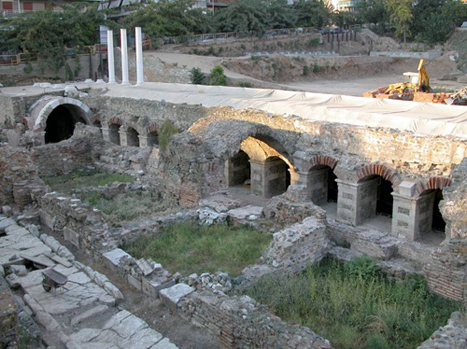
ThessalonicaViewing Acts 17 through the handy filter provided by Derek (and thanks to Paula Fredriksen, Mark Nanos, Magnus Zetterholm, Pamela Eisenbaum, and their presentation on Paul), the blurry, fuzziness of the image of the Jewish leadership of the synagogue in Thessalonica (that you see in Church teachings) and the motives for their jealousy comes into sharp focus.

Of course, this is just one short blog post and a very brief summary of what must have been a very rich and densely packed SBL conference session presented by some of the world’s most outstanding experts on Paul. How much can we read into it?

On the other hand, it’s also adding a link to an ever-strengthening chain of evidence that re-frames Paul as zealous for the Torah, zealous for the Messiah, and uncompromising in his devotion to God as a Jew. A man and a Jewish apostle who demanded no less of others what he expected from himself, especially in the rejection of any compromise with pagan gods and the lifestyle surrounding them.

No wonder Paul was always being beaten, jailed, and thrown out of town by both the Jewish and Roman establishments.

Looking forward to Part 2 of this series written by David Matthews.

FFOZ TV Review: All Foods Clean

All Foods CleanEpisode 23: Most Christians believe that when Mark 7 tells us “thus he declared all foods clean,” that the biblical dietary restrictions were abolished once and for all. In Episode twenty-three viewers will learn that in order to understand these words, it is imperative to look into the Jewish context of the Mark 7 story, and in particular that the argument surrounded not food but ritual hand washing. It will be discovered that the dietary laws are indeed still in force for the Jewish people and will be the menu for the Messianic kingdom.

-from the Introduction to FFOZ TV: The Promise of What is to Come
Episode 23: All Foods Clean (click this link to watch video, not the image above)

The Lesson: The Mystery of All Foods Clean

This episode takes on the traditional Christian doctrine that teaches Jesus abolished the Kosher food laws during his earthly ministry based on the following scripture:

And he said to them, “Then are you also without understanding? Do you not see that whatever goes into a person from outside cannot defile him, since it enters not his heart but his stomach, and is expelled?” (Thus he declared all foods clean.)

Mark 7:18-19 (ESV)

I understand something of the background of these scriptures and why they don’t actually prove that Jesus abolished the Kosher laws, but First Fruits of Zion (FFOZ) teachers Toby Janicki and Aaron Eby did an excellent job at digging deeper and making points I had never considered before. After watching this episode, I challenge any Christian to continue believing that Jesus declared all foods “Kosher” based on the above quoted verses.

But first things first.

We find the basis for the Jewish Kosher laws in Leviticus 11 and Deuteronomy 14 which outlines the foods Jews can and cannot eat according to the commandments of God. Toby didn’t mention this, but the basis for how food animals are to be slaughtered is only briefly mentioned in the Torah and thus, a significant amount of Rabbinic interpretation is involved in expanding on this important issue, adding more dimension to what makes an animal Kosher in relation to the method of execution and preparation.

However, as you’re about to discover, the discussion in Mark 7 had nothing to do with Kosher foods at all. In fact, it would have been a contradiction for Jesus to have “declared all foods clean” (Kosher) since in Matthew 5:17 Jesus said he had not come to abolish any of the Torah laws, and in Isaiah 66:17 the prophet said that in the future Messianic Kingdom, it will be an abomination to eat pork or mice (non-Kosher animals).

So if Jesus and the Pharisees weren’t even talking about “keeping Kosher,” what were they talking about?

Now when the Pharisees gathered to him, with some of the scribes who had come from Jerusalem, they saw that some of his disciples ate with hands that were defiled, that is, unwashed. (For the Pharisees and all the Jews do not eat unless they wash their hands properly, holding to the tradition of the elders, and when they come from the marketplace, they do not eat unless they wash. And there are many other traditions that they observe, such as the washing of cups and pots and copper vessels and dining couches.) And the Pharisees and the scribes asked him, “Why do your disciples not walk according to the tradition of the elders, but eat with defiled hands?”

Mark 7:1-5 (ESV)

Toby has said in at least one prior episode that “context is King,” and we see that illustrated here. The beginning verses of this chapter show us that the Pharisees weren’t accusing Jesus and his disciples of eating pork chops with a side of shrimp scampi. It had to do with eating (bread) with defiled hands, that is, unwashed hands. It had to do with a particular practice that the Pharisees had of ritually washing not only their hands, but many other objects in order to achieve a level of ritual purity. This was completely irrelevant to the issue of Kosher or non-Kosher foods and was a tradition the Pharisees took upon themselves to honor God; a tradition of the elders.

The following is Jesus’ response to the allegations that his disciples didn’t keep the same ritual washing tradition as the Pharisees:

You leave the commandment of God and hold to the tradition of men.” And he said to them, “You have a fine way of rejecting the commandment of God in order to establish your tradition!

Mark 7:8-9 (ESV)

Jesus turns the conversation completely around and accuses the Pharisees of being so concerned about non-Biblical traditions involving excessive ritual purity, that they neglected the higher moral laws of the Torah.

That brings us to Toby’s first clue:

Clue 1: The context of Mark 7 is ritual handwashing before eating, not the dietary laws of the Bible.

Toby JanickiThat’s pretty much where I thought Toby was going to go, but what happens next, I didn’t expect and in fact, Aaron’s Hebrew language lesson opened up new information for me, and went a long way to “sealing the deal” that Jesus and the Pharisees weren’t discussing the Kosher laws on any level in Mark 7.

There’s a world of difference in talking about the Kosher food laws and the concept of ritual purity. In Hebrew, the word for ritually clean is “Tahor” and the word for ritually impure is “Tamai.” This has nothing to do with sinning, but it does require a little background to understand the concepts and their relevancy to this discussion.

Aaron told a sort of story in order to illustrate his point. You have to imagine yourself as a Jewish person in the days of Jesus when the Temple was still standing. You are having the Passover meal with a family in Jerusalem. The lamb you will be eating was sacrificed at the Temple and, in order for a Jewish person to eat a Temple Sacrifice, that person has to be Tahor or ritually pure. This isn’t a requirement for having any Kosher meal, only for eating a Temple Sacrifice.

Aaron said that if one of the guests at the meal were to suddenly pass away, just the presence of a corpse at the Passover meal would render everything, including the people in attendance, as Tamai. They would no longer be able to eat the Passover lamb because they would be in a state of ritual impurity.

Again, this has nothing to do with sin. No one did anything wrong. There are many conditions listed in the Torah that could make a person Tamai. A woman who gives birth or who has her monthly period is considered Tamai. A man who has had typical marital relations with his wife is considered Tamai. That doesn’t mean they’ve done anything wrong, and it doesn’t mean they can’t eat anything, but one thing it does mean is that until they perform the rituals listed in the Bible to again become Tahor, they can not eat any Temple Sacrifice.

Aaron describes the procedure for returning to ritual purity, which you can get from the episode, but comprehending the meaning of Tahor and Tamai is critical to understanding the discussion in Mark 7.

It’s important to note that cycles of being Tahor and Tamai were a typical part of a Jewish human experience and even Jesus would have been Tamai and Tahor depending on a variety of circumstances. It has nothing to do with sin and a great deal to do with involvement in Temple ceremonies in ancient Israel for a Jewish person. Normal Kosher food can either be Tahor or Tamai, but as long as it’s not part of a Temple Sacrifice, it’s OK for a Jewish person to eat Tamai bread. There’s no sin.

Aaron EbyThis next part is the key (and I’d love to see Toby and Aaron’s source material on this matter – – bibliography, please). The Pharisees who confronted Jesus and his disciples in Mark 7 kept a particular practice where they treated every meal as if it were a Temple Sacrifice. This required them to exist in a constant state of ritual purity or be continually Tahor. They had to enter the mikvah and otherwise practice many ritual purity washings in all aspects of their day-to-day existence. This was absolutely not required by the Torah and had nothing to do with the Kosher laws, but was their way of honoring God, though God didn’t obligate them or any Jew to do so.

To maintain a constant state of ritual purity, the Pharisees (I don’t know if all Pharisees kept this practice or only some) had to avoid all contact with other Jews who did not keep the same excessive level of purity (and contact with Gentiles on any level was completely out of the question). These Pharisees led very complicated lives where even having a meal involved a great deal of preparation and would have been very difficult to maintain.

Back in the studio, Toby uses Aaron’s teaching to produce the second clue:

Clue 2: Mark 7 involves a sectarian preference of the Pharisees and not a Biblical requirement.

At this point, it should be abundantly clear that Mark 7 can’t be used as a proof text for the extinction of the Kosher laws at the hands of Jesus, but we have a problem.

…since it enters not his heart but his stomach, and is expelled?” (Thus he declared all foods clean.)

Mark 7:19 (ESV)

We have a statement in parenthesis saying that Jesus declared all foods clean. Toby read from a variety of different Bible translations but only the King James Version translates this verse literally and omits any mention of Jesus declaring all foods or meats kosher or pure.

The words in parenthesis were added by the translators and are not in any of the original Greek texts. Toby was generous and said the translators were just trying to clarify the verse, but what they actually did was to impose their theology onto the Bible by adding words to it (which I think both the Torah and New Testament take a dim view of).

I’ll omit posting all of the different translation examples used by Toby except for the following:

He said to them, “Are even you lacking discernment? Do you not comprehend that whatever comes within a person from the outside of him does not contaminate him? For it does not come into his heart, but rather into his stomach, and it goes out to the toilet, which cleanses all that is eaten.”

Mark 7:18-19 (DHE Gospels)

Here, Jesus accuses the Pharisees of being completely out of balance, giving ultimate importance to a man-made standard of excessive ritual purity while neglecting the moral implications of the Bible. The Pharisees were nearly obsessed with avoiding eating anything Tamai which, for non-Temple Sacrificed food, would not affect their relationship with God and would literally pass into the toilet, as opposed to ignoring the Torah commandments and thus becoming morally impure, those things that enter the heart and result in “evil thoughts, sexual immorality, theft, murder, adultery, coveting, wickedness, deceit, sensuality, envy, slander, pride, foolishness” (Mark 7:21-22 ESV).

Clue 3: The words “Jesus declared all foods clean” are not in the original Greek text.

This should go a long way in establishing to everyone familiar with these verses that they cannot possibly be interpreted the way the Church as typically understood them. The phrase about Jesus declaring all foods clean is a tragic example of the Christian church in all it’s denominations across much of history favoring man-made traditions (traditions of the elders) and ignoring the actual words of the Bible in their proper context.

kosher eatingThis is an excellent example of why I’m a Christian who studies Messianic Judaism. The vast majority of Christian teachers would have not understood this point at all.

Toby quickly mentions that even though the Kosher laws were not done away with, that doesn’t mean Gentile Christians have to suddenly start separating their milk and meat products. The Kosher laws are applied to the Jewish people, while the only food restrictions for Gentile Christians are found in Acts 15 (and how the “Jerusalem letter” is understood would be a worthy study for a future episode of this show).

Toby also said that in the Messianic Era, the whole world (Jews and Gentiles alike) will be eating Kosher, which probably doesn’t sound like good news to most of the Christians who read my blog. How that works would also have to be covered in another FFOZ TV show since it represents another mystery.

What Did I Learn?

Aaron’s lesson and how Toby applied it was completely new to me. I had some understanding of the concepts of Tahor and Tamai, but I had no idea of the excessive levels of ritual purity practiced by the Pharisees of Mark 7 vs. Tahor and Tamai in relation to ordinary Kosher meals. I know most Christians will try to find a way around this, but for me, it was another example of how this show presents very tight arguments that help us correctly understand the Gospels from their original, apostolic perspective.

I found myself wishing Toby had tossed in a clue or two about Acts 10, since that’s the other major part of scripture used by Christians to “prove” that God did away with the Kosher laws. But then I remembered this:

You yourselves know that it is unlawful for a Jew to associate with or to visit a Gentile; but God has shown me that I should not call anyone profane or unclean (emph. mine).

Acts 10:28 (NRSV)

If you recall, earlier I said that the excessive level of ritual purity kept by the Pharisees in Mark 7 would make it impossible to have any sort of association with Gentiles, even to the point of entering their homes. Merely being in a non-Jewish home would pose a great risk of a Jew becoming Tamai for a number of reasons. Now this represents no sin, but for the Pharisees, who could not even eat a single meal in a state of Tamai, it would be exceptionally difficult to have relations with Gentiles.

But what about Peter? We already know that Jesus didn’t require his disciples to keep a level of ritual purity matching the Pharisees.

Now when the Pharisees and some of the scribes who had come from Jerusalem gathered around him, they noticed that some of his disciples were eating with defiled hands, that is, without washing them (emph. mine).

Mark 7:1-2 (NRSV)

The text says that only some of Jesus’ disciples ate with unwashed hands, not all of them. Was Peter one of the Jewish disciples of Jesus who did keep a higher level of ritual purity, treating all meals as if he had to be Tahor to eat them? Was this excessive standard of purity considered the de facto standard among Jews until Jesus taught his disciples otherwise?

I don’t know, but since I do know the Torah does not say that it is unlawful for a Jew to “associate with or to visit a Gentile,” the fact that Peter was saying those words and his Jewish companions seemed to be aligned with this belief tells me it’s quite possible Peter kept some of these excessive purity laws (and I should mention that the tradition of washing hands, called Netilat Yadayim, is practiced by some observant Jews today).

Now the apostles and the believers who were in Judea heard that the Gentiles had also accepted the word of God. So when Peter went up to Jerusalem, the circumcised believers criticized him, saying, “Why did you go to uncircumcised men and eat with them?”

Acts 11:1-3 (NRSV)

Here we see Peter being confronted by the apostles and elders in Jerusalem, the Jerusalem Council, which could very well have included James, the brother of the Master, and they were very surprised that Peter was associating with Gentiles. This confrontation seems to support that the apostles and brothers in Jerusalem also had adopted a higher set of standards of ritual purity than Jesus and the Torah required. This is very important in understanding the following:

But when Cephas came to Antioch, I opposed him to his face, because he stood self-condemned; for until certain people came from James, he used to eat with the Gentiles. But after they came, he drew back and kept himself separate for fear of the circumcision faction. And the other Jews joined him in this hypocrisy, so that even Barnabas was led astray by their hypocrisy. But when I saw that they were not acting consistently with the truth of the gospel, I said to Cephas before them all, “If you, though a Jew, live like a Gentile and not like a Jew, how can you compel the Gentiles to live like Jews?”

Galatians 2:11-14 (NRSV)

Apparently, Peter had become accustomed to eating and associating with Gentiles, that is, until some “certain people” showed up, probably important representatives from James and the apostolic council in Jerusalem. We can’t be certain of the sequence of events, but Galatians was probably written before Acts 15. However, did Peter already have his encounter with Cornelius in Acts 10? It seems likely if he initially was OK with associating with Gentiles, but he obviously struggled with the level of ritual purity and tradition he felt he needed to keep, and how it would look to James and the brothers in Jerusalem. He was influenced by peer pressure, unlike Paul, who was a lot more comfortable with being a Jewish man in close proximity to Gentiles, and knowing that did not make him unacceptable to God as a Jew.

DHE Gospel of MarkAgain and again, in all the so-called Christian “proof texts” which seem to abolish the Kosher laws, we see that the topic isn’t about Kosher foods at all, but rather how some Jews, including possibly Peter, kept a higher than necessarily level of ritual purity, and how that specific preference could be used to discriminate against the Gentile believers by “requiring” Gentiles in the body of Messiah not to be permitted to associate with believing Jews (at least those who kept this higher standard).

Sure, some of this is supposition on my part, but given all of the solid scriptural evidence of the maintaining of the Kosher laws for the Jewish people of the apostolic era (and by inference, among modern Jews today, including modern believing Jews), I think I make a good case in explaining the “food” issues of Acts 10 and Galatians 2. Some of my conclusions are also derived from the opinions and research of New Testament scholar and author Mark Nanos, which I’ve previously recorded on this blog.

I know some Christians who express great joy at not “being under the Law” and who would be pretty dismayed at my conclusions, but as Toby said, there’s nothing in the Bible that tells us non-Jewish Christians must keep the Kosher laws. The Didache, an early document dated to the second or even first centuries and purportedly used to train new Gentile disciples of the Jewish Messiah entering the Jewish religious stream of “the Way,” offers no requirement or even mention of the Kosher laws as applied to non-Jewish believers, and only stresses that the Gentiles should avoid meats sacrificed to idols (which mirrors the Acts 15 directives to Gentile disciples). While I think any non-Jewish believer can take on board additional Torah mitzvoth, including Kosher, voluntarily (and the Didache also supports this), it’s voluntary and a matter of conviction between the person and God.

Just remember that the Pharisees also kept a standard of observance that was higher than what God required of them as well, and it resulted in them becoming so focused on those excessive standards that they ended up ignoring what actually was required of them. If you, as a Christian, feel you want to modify your eating habits to reflect some level of Kosher or Kosher-like observance, just remember that such observance by a Gentile believer will never be as important to God as what is required of us, “to do justice, and to love kindness, and to walk humbly with our God” (Micah 6:8).

Final note: this is probably a good time to mention that there are only three more episodes in the series available for me to review. Given the value I’ve found in what I’ve seen so far, I hope the folks at FFOZ consider producing more shows in this excellent television series soon.