All posts by James Pyles

James Pyles is a published Science Fiction, Fantasy, and Horror author as well as the Technical Writer for a large, diversified business in the Northwest. He currently has over 30 short stories published in various anthologies and periodicals and has just sold his first novella. He won the 2021 Helicon Short Story Award for his science fiction tale "The Three Billion Year Love" which appears in the Tuscany Bay Press Planetary Anthology "Mars."

The Challies Chronicles: John MacArthur Tests the Spirits

john-macarthurThe second day of the Strange Fire conference began with John MacArthur preaching a message titled “Testing the Spirits.” It was based on 1 John 4: “Beloved, do not believe every spirit, but test the spirits to see whether they are from God…”

-Pastor Tim Challies
“Strange Fire Conference: John MacArthur Tests the Spirits,” October 17, 2013
Challies.com

This is a continuation of my Challies Chronicles series, reviewing the live blogging of Pastor Tim Challies on John MacArthur’s Strange Fire conference. Based on a conversation I had last week with my Pastor and what I wrote in a previous blog post, I’ll try to exercise more restraint or at least be a little more even-handed in my responses to this topic.

As far as the above-quoted statement goes, I couldn’t agree more. I’ve seen more than few people in church (not necessarily the one I go to now) attribute their emotional states to an influence of the Holy Spirit. Typically, if a person is facing a tough decision and they pray about it, and then, when they consider one of their options and they experience “a peace” about it, they say that was confirmation from the Spirit that it’s the right decision.

Well, maybe.

And maybe the person just feels at peace with the decision they’d prefer to make, not whether or not it is in the will of God. After all, who says God is in the business of always making us feel good or giving us our heart’s desire constantly. From my experience, God tends to guide people into areas of challenge and difficulty, not on board the gravy train to Heaven.

But let’s see what else Pastor Challies has to say about this presentation by MacArthur.

There are many places in the New Testament where we are told to test all things and this is critical because Satan and his demons exist and because they operate a kingdom of lies that dominates the world. Satan has been allowed to run loose in this world and he and his agents are disguised as angels of light. We should not be surprised that Satan operates 99% of the time in false religion, in lies and deception. He is not the one behind the corruption in sinful society—the flesh takes care of that. He is behind the false systems of belief that pervade this world.

MacArthur said that many Christians get spiritual warfare all wrong and turned briefly to 2 Corinthians 10:3ff where we see that the weapons of our warfare are not human and that we cannot rely on anything concocted by man. Our weapons must be divinely powerful. Why? Because we must be engaged in the destruction of fortresses. The picture here is that human weapons are no match for a huge and impregnable fortress. We are assaulting formidable edifices and cannot use pea-shooters. These fortresses are speculations, ideas, psychologies, and religions. Spiritual warfare is not about running off demons, but battling for the mind.

I have to admit that I am confused about to what extent MacArthur believes the Spirit of God intervenes in our world? How much of what goes on around us can we attribute to God vs. other influences, most of all being human influences, including our personal, internal states?
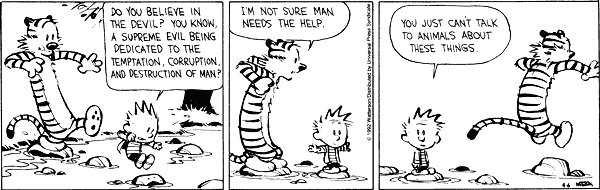
Calvin and Hobbes discuss evil

MacArthur seems to imbue evil spirits with a great deal of power on the surface, but then he says, “These fortresses are speculations, ideas, psychologies, and religions. Spiritual warfare is not about running off demons, but battling for the mind.”

So really then, “spiritual warfare” isn’t actually battling in a supernatural realm, but dealing with our own thoughts and feelings as well as the stuff that goes on around us in the world every day like cults, new age philosophies, and other institutions. OK, I get that you can’t trust politicians or Scientology. Of course, since he mentioned it, MacArthur’s track record dealing with psychology is pretty sketchy from my point of view.

He is also an advocate of Nouthetic Counseling, which stresses the Bible as a sufficient tool for counseling people with mental illnesses such as depression and anxiety. MacArthur does not reject all forms of psychological theories and techniques, though he considers some psychology and psychiatry as contrary to the Bible.

MacArthur has argued that “True psychology (i.e. “the study of the soul”) can be done only by Christians, since only Christians have the resources for understanding and transforming the soul. The secular discipline of psychology is based on godless assumptions and evolutionary foundations and is capable of dealing with people only superficially and only on the temporal level… Psychology is no more a science than the atheistic evolutionary theory upon which it is based. Like theistic evolution, Christian psychology is an attempt to harmonize two inherently contradictory systems of thought. Modern psychology and the Bible cannot be blended without serious compromise to or utter abandonment of the principle of Scripture’s sufficiency….

Wikipedia on MacArthur

By the way, that point of view of mine comes from a Bachelor’s degree in Psychology, a Master’s degree in Counseling Psychology, and fifteen years of post-graduate practice, so it’s not like I don’t have a basis for my opinion. I don’t think counseling psychological disorders absolutely requires that the therapist be a Christian or that the counseling techniques be strictly based on the Bible.

CounselingSure, MacArthur isn’t specifically referencing Nouthetic counseling but since he brought the topic up, I think the it becomes relevant to the current discussion.

But I do believe that people more often than not, create their own problems. They don’t need to look to a supernatural cause right away. When any of us have some sort of difficulty in our lives, the first person we should consider is the one we see in the bathroom mirror every morning.

The architect of it all is Satan, the arch-deceiver.

On the other hand, MacArthur is saying that all of these human caused problems have a supernatural source.

And his solution?

What is our responsibility as Christians? It is to smash these ideologies, to crush these fortifications, and to take every thought captive to the obedience of Christ. Once again, we need to remember that we are engaged in a battle for how people think. (emph. mine)

Sorry. Got caught up in the martial language there for a minute.

I’m OK with “obedience to Christ,” but I’m a little worried about “a battle for how people think.” Who is supposed to control my thinking, the Jesus of the Bible, or a particular movement in Christianity? I would prefer the former and turn myself over to God than to man, but that may not mean I’ll always agree with MacArthur or others like him on everything. If I don’t, would he think I was being influenced by Satan? I don’t know. I’ve recently called myself a Christian who studies Messianic Judaism, so I imagine he’d have an opinion on that.

When the Great Awakening broke out, there was much debate about what was and what was not a true work of the Spirit. Jonathan Edwards went to 1 John 4 and MacArthur closely followed Edwards’ The Distinguishing Marks of a Work of the Spirit of God…

We are all responsible to assess anything and everything that is claimed to be a work of the Holy Spirit. These are timeless tests for all movements, all preaching, and all preachers. What is truly of the Holy Spirit will conform to these marks.

MacArthur lost me at the Great Awakening. My primary orientation when trying to understand God is the Bible. I’ve recently been chastised by a good friend for not knowing Christian history, but how much authority should I insert into particular events in the history of Christianity vs. the Bible in trying to understand the work of the Holy Spirit?

This is one of those times when my not being a “typical Christian” doesn’t work out so well.

The context for this passage is the work of the Spirit (see 3:24). While the working of the Holy Spirit is invisible, the manifestations of his work are visible. We know Christ abides in us because the Spirit he has given is manifested in us. What is the Spirit doing in us? MacArthur provided a long list. The Spirit creates a desire for repentance, a hatred of sin, a belief in the gospel, a love for Christ, a desire to be a slave of Christ, a delight in Scripture, a longing for obedience, joy in trials, love of other believers, desire for fellowship, illumination of Scripture, a heart of praise, worship as a way of life, increasing Christ-likeness and much more besides.

I’m reassured a bit since MacArthur does believe that the Holy Spirit does have an influence and a tangible impact on our day-to-day lives, prompting us to repentance, inspiring love of Messiah, supporting us in our trials, and so forth.

His major critique of the charismatic movement is that it focuses undue attention on the Holy Spirit and does so at the expense of Christ. Any true preacher will be Christ-dominated and present him in an accurate and exalting way. It is a matter of sound theology and also a matter of preeminence. Where you see any deficiency in the nature and preeminence of Christ, this is not the work of the Holy Spirit. The Holy Spirit’s ministry is always to point you to Jesus Christ. Anyone who pollutes the gospel or distracts from the Son to the Spirit is not operating in the Spirit.

The devil would never want men to have more honorable thoughts of Christ and for that reason loves to draw attention away from Christ to a false image of the Holy Spirit. And all the while he pretends to draw attention to Jesus. A true work of the Spirit exalts the true Christ. If the charismatic movement was a movement of the Spirit, it would be Christ-dominated and everyone in the movement would be bowing the knee to the true Christ in belief of the true gospel.

According to leading charismatics, a distinctiveness of the charismatic movement is the preeminence of the Holy Spirit. They have a passion to experience the Spirit’s presence and power. But if the Spirit is the person sought, his work has been rejected. In this movement Christ is obscured, Scripture is depreciated, and a preoccupation with experience is elevated.

Off balanceSorry for the numerous and lengthy quotes, but there’s a lot going on here. I know time and again, I’ve been told to focus on Jesus, only Jesus. I can see that if, as a believer, I want the Holy Spirit to do this dramatic thing or that dramatic thing, or some other dramatic thing, that I’m probably caught up in a religion of sensation and that I’m way off-balance. I get that.

But when told to only, only, only focus on Jesus, I wonder where did God the Father run off to? I mean, MacArthur and a lot of other Christians talk about the Holy Spirit, and they talk lots and lots about Jesus, but where is God? I know. In a trinitarian view, all of them are God, but if that’s true, doesn’t focusing on any one aspect of the trinity make us unbalanced? If it’s possible to focus too much on the Spirit, is it also possible to focus too much on the Son?

I almost never, ever hear anything spoken among Christians about God the Father or, as He would be expressed in the Tanakh (older Jewish scriptures known in Christianity as the “Old Testament”), Hashem. But Jesus talked about Him all the time.

Therefore Jesus answered and was saying to them, “Truly, truly, I say to you, the Son can do nothing of Himself, unless it is something He sees the Father doing; for whatever the Father does, these things the Son also does in like manner.”

John 5:19 (NASB)

In that day you will not question Me about anything. Truly, truly, I say to you, if you ask the Father for anything in My name, He will give it to you.

John 16:23 (NASB)

Jesus spoke these things; and lifting up His eyes to heaven, He said, “Father, the hour has come; glorify Your Son, that the Son may glorify You…”

John 17:1 (NASB)

I’m saying all this not to be a theological pain in the neck, but to point out that Jesus always re-directed the attention of his disciples to the Father.

The charismatic movement fails this test of exalting Christ above all. MacArthur said, Show me a person obsessed with the Holy Spirit and I’ll show you a person not filled by the Spirit. Show me a person obsessed with Jesus Christ and I’ll show you a Spirit-filled person.

I learned in the Bible to always pray to God in the name of the Messiah. Am I wrong? Am I supposed to pray to Jesus? Am I supposed to be “obsessed” with Jesus so I can “prove” that I’m filled with the Spirit? MacArthur said to “exalt Jesus above all.” I can’t believe he means to exalt the Son over the Father, does he?

Coffee and BibleI agree we need to be mindful of anything we consider a supernatural experience or a “movement of the Spirit.” I’m not much of a spiritualist and I’m certainly not a mystic (although the writings of the mystics make wonderful metaphors). I like reading and I like studying. I think I’m “wired” to go in that direction. But I’m also wired to pay attention to what I read, which most certainly includes the Bible.

I know MacArthur is trying to make a point and the scope of his presentation, his conference, and his book probably don’t allow for answering more broad-based questions, but inadvertently, he brought this subject up so now I think he should have to deal with it.

The Bible doesn’t elevate Jesus above God the Father just as it doesn’t elevate the Spirit above the Father. MacArthur says that overindulging in the Spirit of God to the detriment of everything else God is leads to error, and I completely believe it. But how does MacArthur avoid the same problem when he demands that we should obsess on Jesus to the exclusion of God the Father?
Standing on the Jewish Foundation of the Bible

ShabbatIt shall be that at every New Moon and on every Sabbath all mankind will come to prostrate themselves before Me, says Hashem.

Isaiah 66:23 (Stone Edition Tanakh)

Therefore no one is to act as your judge in regard to food or drink or in respect to a festival or a new moon or a Sabbath day—things which are a mere shadow of what is to come; but the substance belongs to Christ.

Colossians 2:16-17 (NASB)

On the surface, these two passages of scripture seem to contradict each other, at least according to traditional Christian interpretation. I pulled them from yesterday’s review of The Promise of what is to Come series episode What Day is the Sabbath, produced by First Fruits of Zion. I published my review a day early (usually, my reviews of the show appear every Wednesday morning) because I wanted to build on a specific point and attempt to arrive at a personal conclusion.

For some time now, I’ve been trying to explore what I consider inconsistencies between the ancient Jewish scriptures, also known as the Tanakh or the Old Testament, and the later scriptural writings, also refered to commonly as the New Testament. If we’re supposed to have one, unified Bible that is all “God breathed” (2 Timothy 3:16), that is, if everything we read from the first chapter of Genesis to the last words in Revelation all originate from the same source, from God, then everything in the Bible must be internally consistent and provide a single, cohesive revelation from God to humanity.

Human beings artificially divided the Bible into “Old” and “New Testaments,” not God, and we’ve applied many more divisions, filters, interpretations, and traditions to how these texts are now understood in “the Church.” But I have to remind myself that, like Judaism, Christianity isn’t a single, monolithic entity. There are many “Christianities,” just as there are many “Judaisms,” each with its own theology, set of doctrines, and sacred interpretations. Sure, there’s significant overlap. The fundamentals of the Christian faith should be shared by all valid Christianities, in spite of other differences, but the multiple ways different Christian streams understand what the Bible is saying are dizzying.

However, the problem I’m confronting now is more basic than just different denominational biases. I am attempting to resolve a more fundamental (sorry for employing that word so much) problem. Using the above-quoted scriptures, how are we to reconcile the apparent contradiction between the prophet Isaiah, who tells us that in the Messianic Age, all human beings will worship God on every Sabbath and every New Moon, and the apostle Paul, who says (apparently) that Sabbaths and New Moons are mere shadows of what is to come (presumably in the Messianic Age), and the substance (or meaning or fulfillment) is in Christ? It seems as if Paul is undoing what Isaiah prophesied.

We have some options:

  1. Both scriptures are correct but traditional Christian interpretation of Paul is flawed, leading the Church to come to a false conclusion. A new paradigm is required to understand Paul and Isaiah (and the entire Bible) within the same Judaic context.
  2. The Christian doctrine of progressive revelation allows for Paul to provide additional meaning to Isaiah’s prophesy, expanding upon our understanding of the earlier text.
  3. In Christ, the function of the Law was fulfilled at the cross, and thus later prophesies and holy scriptures replace or supersede earlier texts, with the later texts (on the right side of the cross) always “winning” in any apparent contradiction.
  4. The Tanakh or the Jewish holy scriptures were the only revelation of God given to man through the Jewish prophets. The later apostolic writings, and especially Paul, were a distortion of the teachings of Jesus and created a new, non-Jewish religion that was ultimately called Christianity.
  5. The Bible is broken and unreliable.

Let’s handle the easy items first and then proceed to the more challenging points.

tallit-prayerItem 5 is what atheists would say. The Bible is a series of ancient tribal writings and can no more be considered as originating from a Divine supernatural being than any other “holy book” ever written in human history. Christianity and Judaism are fantasies and superstitions that have no place in the modern age.

Item 4 is what traditional observant Jews would say, including groups such as Jews for Judaism. A Jewish man named “Yeshua” or “Yeshu” may have lived in the late second Temple period and taught along with many other itinerant Rabbis, but if he thought he was the Messiah, his death proved he was not. The Tanakh is the extent of God’s revelation to mankind. The New Testament is a radical distortion of the teachings of Jesus, and Paul, in writing letters directly contradicting the Torah and the Prophets, was a liar, hypocrite, and a traitor to the Jewish people, to the Torah, and to God.

Item 3 is the most traditional, historical Christian interpretation. Jesus fulfilled the Law at the cross, and when he died, the Law died with him, along with any prophesies that contradict the later Gospels and Epistles. This is called supersessionism or replacement theology and it has been the bedrock for Christian interpretation of the Bible for nearly 2,000 years. Although the Christian Reformation may have changed a good many things, this foundational conceptualization and interpretation of scripture remained intact. Later events, and especially the Holocaust, have resulted in “the Church” softening its perception of Jews and Judaism to a much less anti-Semitic position, and many Christian denominations are now pro-Israel, but the fundamental Christian doctrine that the Law is dead continues unchanged.

Item 2 is something of a variation of item 3 but it has to be handled delicately. The idea is that, over the vast span of Biblical history, God continually revealed more and more about Himself and His plan to human beings. Abraham only knew so much about the plan of God. God revealed more to Moses. God revealed more to Isaiah. And God provided His ultimate revelation in the person of Jesus Christ, the Son of God and the second part of the Trinity. Paul, as Christ’s special emissary to the Gentiles, was able to reveal, through the Spirit, even more than the previous prophets, thus adding much more meaning and dimension to the Biblical narrative of God’s plan as a whole. In this interpretation, the scripture from Isaiah 66:23 is incomplete and Paul added more to our understanding than Isaiah ever had access to.

That would work out fine except for one thing. Christianity still understands Paul as contradicting (apparently) Isaiah. No matter how you spin it, sooner or later, progressive revelation must believe that later revelations not only add meaning and dimension, but in cases where a later revelation seems to contradict an earlier one, the later revelation is always correct. In other words, the later revelation supersedes or replaces the earlier revelation, thus making items 2 and 3 close cousins if not sibling interpretive methods.

high-trail-hiking1And that brings us to item 1.

Periodically, I have been accused of being wishy-washy. I’ve always seen a life of faith as a journey of discovery. God places us on a path and sends us in a direction. We have a “map” of the territory ahead, but we all know that the map isn’t literally the territory. What we find on the trail should always provide unique details and experiences that make the journey necessary, otherwise, we could all just sit in the comfort of our homes, read the map, and know everything there is to know. There would be no need to study, pray, worship, or “wrestle” with God. The Bible would be a simple narrative, like reading a novel or even a children’s story. One or two passes through the book, and we know everything there is to know. God is reduced to a finite number of words on the printed page.

But that obviously isn’t true, otherwise we’d all agree about what the Bible says and there would be only one interpretation of the Word of God possessed by all human beings of faith.

In traveling the road of faith as I have, I occasionally manage to annoy some people or to frustrate them. Most other “religious bloggers” or “religious” people in general don’t think that a life of asking questions is sufficient. They want definite, concrete answers, and they want to hold onto them unswervingly, not exploring, not journeying, but always possessing the destination in the palm of their hands. They always want to be “right.”

And they want me to do all that, too.

Alright. If I’m to be pushed into a corner and you want a definite answer from me, here it is.

I believe in item 1. I believe the Bible is a single, unified document that represents God’s revelation to mankind, primarily through the Jewish prophets and apostles. I believe where ever we experience a fundamental contradiction in the Bible, such a contradiction does not actually exist. Using the television episode What Day is the Sabbath as my example, I believe that Biblical contradictions between how Christians and Jews understand the Sabbath are a result of incorrect interpretation based on anti-Semitic and anti-Jewish doctrine that was originally developed in the first several centuries of Church history and that hasn’t changed very much in almost two-thousand years. Such traditions have been so ingrained in Christian thinking among nearly all streams of the Christian faith, that it never even occurs to most kind, compassionate, intelligent, well-read, devoted believers, including many Pastors and New Testament scholars, to question those extremely ancient and I believe faulty assumptions.

They can’t possibly imagine that their interpretative traditions are wrong.

I’m not trying to sound like the old T.V. show The X-Files, but I believe the truth is out there. I believe that later Christian viewpoints such as The New Perspective on Paul have merit and are enabling believers to view the apostle in a different light, one where we can read him as not contradicting the earlier prophets or abandoning Judaism.

Movements such as Hebrew Roots among Christians and Messianic Judaism among Jewish believers, are embracing this paradigm shift and taking a fresh look at the Bible, especially the apostolic scriptures, peeling away hundreds of years of stale doctrine, and learning to see Paul as a Jew, as a Pharisee, and as a zealot for Torah, the Temple, the Messiah, and the God of Israel.

People want me to make a stand, so I announce my platform. I suppose it shouldn’t come as a total shock, but I’m tired of being considered noncommittal. You don’t have to like it and you don’t have to agree with me, but I believe a pro-Jewish view of Paul and a Judaic interpretive lens is the correct way to read the later, apostolic writings and to heal the divisions we have historically carved in our Bibles, especially “between the Testaments.”

Yesterday, I partly quoted Boaz Michael when I said:

He also said, and this is very important to me, that studying the Bible, all of it, from a Jewish cultural, national, historical, ethnic, and traditional perspective “makes our Bibles consistent and upholds the Biblical truth that God doesn’t change.”

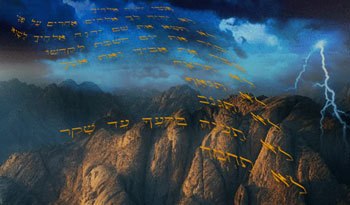
Torah at SinaiGod doesn’t change His mind. When He said the Sabbath was an eternal sign of His covenant with Israel, He wasn’t lying, and this wasn’t some sort of cosmic “bait and switch.” Refactoring our understanding of the Bible to accommodate a Judaic and pro-Jewish perspective on scripture is the only way to view the Bible as a single, unified revelation of God. There is no need to throw out “Biblical sufficiency.” The languages of the Bible still say what they say, and the Bible remains a record of God’s interaction with man and a guide to holy living. The only thing we must change is our tradition about how we interpret the Bible.

I choose not to adhere to a tradition of Biblical interpretation that, by definition and having long been established historically, must rewrite the Old Testament to fit the New Testament as understood by the Church. Christianity has found it necessary to invent man-made ways to retrofit the prophets to map to a Jesus who denies Judaism and an anti-Torah Paul. God’s “eternal covenant” can’t be “eternal” if the Church must interpret Paul as saying it’s temporary. The Church’s fundamental matrix for understanding the Bible is flawed because it denies the unchangability of God and even under the most benign and apparently pro-Israel perspective, must replace or at least significantly “spin” portions of the Messianic prophesies of the Tanakh in order to make sense of a non-Jewish Messiah who is not part of Judaism and does not uphold the primacy of his people Israel.

Nothing else makes sense. Christians can pepper me with this individual verse and that individual verse from New Testament writings, but in the end, the Bible isn’t just a list of verses we can “cherry pick” to fit an outmoded doctrine, it’s a single thing or unit made up of all of its elements, an “Echad.” If all the elements aren’t unified, then the Echad must disintegrate and collapse in upon itself. I don’t believe the Bible does that, so the problem lies elsewhere…with human beings.

It’s time to do this better before the bridegroom comes and finds our lamps are without oil.

Who am I? I’m a Gentile Christian who studies Messianic Judaism. I also go to church, and I’m trying to build bridges between the different members of the body of Messiah.

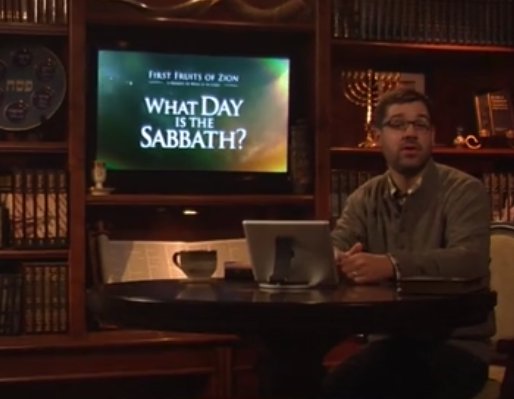
FFOZ TV Review: What Day is the Sabbath?

FFOZ TV episode 20Episode 20: It is often thought that somewhere in the New Testament the Sabbath was changed from Saturday to Sunday. But did the unchangeable God really change the day of rest? In episode twenty viewers will learn that not only has the Sabbath day not changed but Jesus himself was faithful to keep it and taught about it. The Sabbath is an eternal covenantal sign between Israel and God. Thus, while Gentiles are not required to keep it, they are welcomed to do so throughout the Scriptures.

-from the Introduction to FFOZ TV: The Promise of What is to Come
Episode 20: What Day is the Sabbath? (click this link to watch video, not the image above)

The Lesson: The Mystery of the Sabbath

I thought this episode would just be a “rehash” of material I already knew about the Sabbath. To some degree it was, but First Fruits of Zion (FFOZ) teachers Toby Janicki and Aaron Eby managed to flesh out the meaning of the Shabbat for the nation of Israel and to some degree, Christianity as well. Since this show primarily is addressed to traditional Gentile believers, no doubt some of the material came as a bit of a surprise.

Toby starts out relating his Sunday school experience as a child when he was required to memorize the Ten Commandments. This, of course, includes the fourth commandment to observe the Sabbath. Many Christians believe that the Ten Commandments are still in effect for the Church, but either disregard the Sabbath entirely, or believe it was changed from Saturday to Sunday, and that all of the Torah restrictions involving work on the (Sunday) Sabbath were eliminated by Jesus.

Toby asks the questions, “Why don’t Christians keep the Sabbath,” “Was the Sabbath changed from Saturday to Sunday,” and “Is the Sabbath even valid anymore?”

And he said to them, “Shabbat was given for the sake of man, and not man for the sake of the Shabbat. Therefore, the son of man is master even of the Shabbat.”

Mark 2:27-28 (DHE Gospels)

According to Toby, Christians typically use these verses to support the position that Jesus teaches man no longer has to keep the Sabbath since “Shabbat was given for the sake of man.” But Jesus also said that he didn’t come to abolish the Torah, which by definition, would have to include the Torah commandments related to the Sabbath:

Do not imagine that I have come to violate the Torah or the words of the prophets. I have not come to violate but to fulfill. For, amen, I say to you, until heaven and earth pass away, not one yod or one thorn will pass away from the Torah until all has been established.

Matthew 5:17-18 (DHE Gospels)

If you haven’t done so already, or you just don’t believe Jesus didn’t cancel the Torah, please view the FFOZ TV episode The Torah is Not Canceled, which I reviewed several weeks ago. It provides necessary background for what Toby and Aaron are teaching in the current episode of this series.

To understand how Jesus approached the Sabbath, we have to understand the larger context of what he means by “the Shabbat being made for man rather than man for the Shabbat.”

And it happened that He was passing through the grainfields on the Sabbath, and His disciples began to make their way along while picking the heads of grain. The Pharisees were saying to Him, “Look, why are they doing what is not lawful on the Sabbath?” And He said to them, “Have you never read what David did when he was in need and he and his companions became hungry; how he entered the house of God in the time of Abiathar the high priest, and ate the consecrated bread, which is not lawful for anyone to eat except the priests, and he also gave it to those who were with him?” Jesus said to them, “The Sabbath was made for man, and not man for the Sabbath. So the Son of Man is Lord even of the Sabbath.”

Mark 2:23-28 (NASB)

Toby JanickiToby brings up an important point that Jesus is debating with the Pharisees about what is and is not permitted to do on the Sabbath, not whether or not the Sabbath remains valid. Neither side in this argument is invalidating the Sabbath, merely dialoguing about what constitutes “work” on this holy day. Rabbis have been having similar debates for hundreds and even thousands of years. The Talmud is replete with Rabbinic discussions and disagreements over what is permitted to do on Shabbat and a wide variety of other matters related to the Torah mitzvot. The discussion recorded in Mark 2:23-28 is no different, and yet Christianity, not seeing this transaction from a Jewish perspective, universally fails to comprehend its meaning.

In the specific example above, Jesus is citing a portion of the Bible when David and his men ate bread permitted only to the Levitical priests. They did so because they were starving and had no where else to turn for food. Jesus is saying that the Shabbat is a gift, not a straitjacket, and the specifics of performing a type of work that is normally forbidden on Shabbat must not overrule the higher principle of preserving human life, well-being, and dignity.

Jesus had a number of similar debates with the Pharisees on this topic, including whether it was permitted to heal a non-life threatening disability on Shabbat (Matthew 12:9-14).

For more context on the debates Jesus had with the Pharisees on the Shabbat, see my review of D. Thomas Lancaster’s book The Sabbath Breaker: Jesus of Nazareth and The Gospels’ Sabbath Conflicts, also published by First Fruits of Zion.

At this point in his presentation, Toby said something I didn’t expect. We generally consider the phrase “Son of Man” as Jesus used it, to refer to himself, the Messiah, however, Toby applied it differently in the context of Mark 2:23-28. He suggested that “Son of Man” is an equivalent term for all humankind. Thus, he presents the words of Jesus as saying that the Sabbath was created as a gift for all people and that all people everywhere are “Lord of the Sabbath.”

For me, this creates certain problems, since, as I said before, the “Son of Man” is generally considered as a title for Messiah, and Toby’s interpretation seems to create a separate meaning for only this situation. It also may contradict what he establishes later in this episode, since if the Sabbath is created for everyone, Jew and non-Jew, and we are all “lords” of the Sabbath, what does that mean for Gentile Shabbat observance today?

More on that in a bit.

Toby drew a parallel between the Master’s words above and an ancient Jewish commentary on the book of Exodus called Mechilta, and quotes part of it which states:

Shabbat is delivered to you, not you to the Shabbat.

This echos the meaning of the Master that man is not to surrender himself to the Shabbat but quite the opposite. If the laws of the Sabbath were entirely rigid and immutable, they might require that observant people be subject to hardship and even death in obedience of such laws. Even the most stringent Jewish interpretation of the laws of Shabbat allow for lifesaving efforts to be expended on Shabbat, but what about people who are suffering but who will live for another day? What if the dilemma isn’t life and death, but life and dignity?

I’ve come the long way around to the first clue in solving our mystery, but it has finally arrived:

Clue 1: Jesus argued about what things were permissible to do on the Sabbath.

And this, as I previously pointed out, is a debate that has been taking place in Judaism for a very long time.

The scene shifts to Aaron Eby in Israel for a word study on the Hebrew word “Shabbat.”

Aaron starts by quoting Exodus 20:8-9, 11 which I render from the Stone Edition of the Tanakh:

Remember the Sabbath day to sanctify it. Six days shall you work and accomplish all your work…for in six days Hashem made the earth, the sea and all that is in them, and He rested on the seventh day. Therefore, Hashem blessed the Sabbath day and sanctified it.

Aaron EbyAaron points out that the Sabbath has a universal application and far pre-dates the giving of the commandments of the Sabbath at Sinai.

The literal meaning of the word “Shabbat” is “resting” and “stopping” and implies an “active” form of “resting” and “refraining,” not just kicking back and relaxing. To me, this speaks of a specificity of types of activity and inactivity, a mindfulness that Shabbat is not just relaxing in front of the T.V., but directing mind, spirit, and heart away from our immediate human activities and toward God.

Aaron cites something I consider very important in the following:

The Children of Israel shall observe the Sabbath, to make the Sabbath an eternal covenant for their generations. Between Me and the Children of Israel it is a sign forever that in a six-day period Hashem made heaven and earth, and on the seventh day He rested and was refreshed. (emph. mine)

Exodus 31:16-17 (Stone Edition Tanakh)

There are two exceptionally important points to get from this. When Israel or any individual Jewish person keeps the Shabbat, they:

  1. Testify to the eternal covenant between God and all Jewish people, the nation of Israel.
  2. Testify to God’s sovereignty as Creator of the Universe.

In the quote from Exodus 31:16-17, I emphasized words that testify to the eternal nature of the Shabbat as a covenant sign between God and the Jewish people. This also, by implication, testifies to the eternal nature of the Mosaic covenant with the Jewish people, and the Torah as the conditions of that covenant. When Christians say that the Shabbat no longer applies to the Jewish people (or anyone else) and especially that the Torah is now irrelevant to the Jewish people, I want to scream, “What part of eternal don’t you understand?”

But I digress.

Formally, in Judaism, a “day” lasts from sundown to sundown, not from sunrise to sunrise or midnight to midnight. That means that the seventh day Shabbat begins at sundown on Friday and ends at sundown on Saturday (in Rabbinic custom, the Shabbat actually begins slightly before sundown on Friday and ends about 45 minutes after sundown on Saturday as a “hedge,” to avoid “cutting it too close,” so to speak, in beginning and ending Shabbat observance).

Aaron also pointed out that generally, Jewish (and Christian) authorities all agree on which day is the “seventh day,” and that Biblically, it can’t be just any day at all.

I wish Aaron or Toby had addressed the following, though:

One person regards one day above another, another regards every day alike. Each person must be fully convinced in his own mind. He who observes the day, observes it for the Lord…

Romans 14:5-6 (NASB)

Therefore no one is to act as your judge in regard to food or drink or in respect to a festival or a new moon or a Sabbath day—things which are a mere shadow of what is to come; but the substance belongs to Christ. Let no one keep defrauding you of your prize by delighting in self-abasement and the worship of the angels, taking his stand on visions he has seen, inflated without cause by his fleshly mind, and not holding fast to the head, from whom the entire body, being supplied and held together by the joints and ligaments, grows with a growth which is from God.

Colossians 2:16-19 (NASB)

Mark NanosIn Paul’s letter to the Romans addressing “the weak and the strong” (which I’m about to get to in the Mark Nanos book The Mystery of Romans), most people take from these words to mean that one day is as good as another as far as observing a “Sabbath” is concerned, and that believers need not be concerned about strictly observing a Saturday Shabbat. The scripture from Colossians tells a similar tale in the eyes of the Church, and yet both of these interpretations directly contradict earlier scriptures. Since as believers, we cannot understand that the Bible is internally contradictory, we must conclude then that our interpretations are flawed. How can Jewish Shabbat observance be eternal and yet Paul say that it simply doesn’t matter because of Jesus? Jesus himself affirmed the Shabbat, not eliminated it.

Aaron’s segment of this program has him also affirming the current requirement for Israel to observe the Shabbat, but he also asks the question, “What does the Shabbat mean to Gentile believers?”

Back in the studio with Toby, we find our second clue:

Clue 2: Sabbath is from sunset Friday until sunset Saturday.

Two or three clues really don’t do it for the mystery of Shabbat in my opinion. This particular television episode brought up a dense set of meanings for me.

While earlier portions of the episode spoke of the “universality” of the Shabbat as a testimony of all mankind that God is the sovereign Creator, Toby shifts into the specifics of Shabbat and Judaism. While we see the sanctity of the Shabbat being set in place in Genesis 2, Toby points out that the specific commandments of Shabbat observance were not given in any recorded fashion to Adam and his sons or to Noah and his sons. It is only after God redeems the Children of Israel from Egypt and they are standing “as one man” at Sinai before Hashem their God, that Shabbat is formally established and its observance defined in Torah. It is also given as a specific sign of the Mosaic covenant between God and Israel, only Israel, forever. No other people group or nation has ever received this sign obligation to God.

Hashem said to Moses, saying: “Now you speak to the Children of Israel, saying: ‘However, you must observe my Sabbaths, for it is a sign between Me and you for your generations, to know that I am Hashem, Who makes you holy.'”

Exodus 31:12-13 (Stone Edition Tanakh)

Toby doesn’t mention this, but the above verses establish that not only is the Saturday Sabbath considered an eternal sign of the covenant between God and Israel, but so are all of the “Sabbaths,” that is, all of the moadim, God’s appointed times, the festivals identified and defined in Torah, such as Passover, Shavuot, Sukkot, Rosh Hashanah, and Yom Kippur. Each and every one of these Sabbaths must be observed by all of Israel for all time; for after all, that’s what “eternal” means.

I’ve heard it said in the Church that Jews should observe the moadim as “national holidays” the way Americans “observe” the Fourth of July or Thanksgiving. I consider that not only misleading and Biblically inaccurate, but potentially demeaning. It reduces the eternal covenant signs between God and Israel to how Americans “observe” barbecues, fireworks, eating turkey, and watching football. The very best you can say about American national holidays is that they represent who we are and how we relate to our history as Americans, a relationship between citizens and our country. The moadim, the weekly Sabbath, Passover, Shavuot, Sukkot, and the other special Sabbaths are far, far more than that, and indeed, define the relationship between Israel and her citizens, the Jewish people, and the God of Everything!

That’s somewhat more significant than mere American “national holidays,” wouldn’t you say?

This is another long way around to reaching the third and final clue in solving today’s mystery:

Clue 3: The Bible requires only the Jewish people to keep the Sabbath.

That’s going to make some people I know, non-Jewish people, very unhappy, but hold on there. Toby goes on to say that there’s nothing stopping any non-Jewish believer from also observing the Shabbat in some manner. We may not be commanded to do so, but we might as well “get used to it,” for someday, all of humanity will indeed observe the seventh day Shabbat.

And the foreigners who join themselves to Hashem to serve Him and to love the Name of Hashem to become servants unto Him, all who guard the Sabbath against desecration, and grasp My covenant tightly — I will bring them to My holy mountain, and I will gladden them in My house of prayer; their elevation-offerings and their feast-offerings will find favor on My Altar, for my House will be called a house of prayer for all peoples.

Isaiah 56:6-7 (Stone Edition Tanakh)

It shall be that at every New Moon and on every Sabbath all mankind will come to prostrate themselves before Me, says Hashem.

Isaiah 66:23 (Stone Edition Tanakh)

Boaz MichaelIf I’m reading this right (and I think I am), then not only will everyone observe a weekly Sabbath, the seventh day Sabbath, in the Messianic Age, but we will observe the New Moons and all of the Sabbaths and Festivals of God, all of the moadim listed in the Torah.

I don’t know how any later or subsequent revelation in the Apostolic scriptures (New Testament) can alter or undo the meaning of this text.

What Did I Learn?

I learned some things about the Sabbath, but I learned more about myself. I learned that I want to scream when I hear good, intelligent, and passionate Christians, men and women who I deeply respect, saying things about the Bible that seem completely contrary to the Bible. To my way of thinking, Toby and Aaron provided their audience with an air-tight case that Sabbath keeping is completely Jewish and remains an obligation for the Jewish people as a response to their covenant obligations to God. To deny this is (forgive me) to deny the evidence of the Bible. Toby and Aaron “quoted chapter and verse,” so to speak, illustrating the path from Genesis, to Sinai, to the present age, and into the Messianic Era, that the seventh day Sabbath is an eternal sign of the (eternal) covenant between God and Israel.

I also learned to “tighten up” the scriptures defining when all of humanity, in addition to Israel, will be obligated to observe the Shabbat, which is in the Messianic Era. There is no current obligation for Christians, or anyone else who isn’t Jewish, to observe Shabbat, but there will be in the future age when Messiah returns and establishes his Kingdom of peace over all the Earth. While Gentiles don’t have to observe Shabbat now, we can choose to, in some fashion, to honor God as Creator and to summon for ourselves a taste of the future Messianic Kingdom.

I found myself thinking of my Jewish wife and children. None of them observe the Shabbat in any real sense. For awhile, when our daughter was in Israel, my wife was lighting the Shabbos candles, but she stopped soon after our daughter returned. It breaks my heart, but I have to remind myself that some traditional Jews believe that in the age right before the coming of Messiah…

There is a tradition that people will begin to despise the values of their religion in the generations preceding the coming of the Messiah. Since in a period of such accelerated change, parents and children will grow up in literally different worlds, and traditions handed down from father to son will be among the major casualties.

Our sages thus teach us that neither parents nor the aged will be respected, the old will have to seek favors from the young, and a man’s household will be become his enemies. Insolence will increase, people will no longer have respect, and none will offer correction. Religious studies will be despised and used by non-believers to strengthen their own claims; the government will become godless, academies places of immorality, and the pious denigrated…

Perhaps it is darkest before the dawn.

At the very end of the episode, as always, FFOZ Founder and President Boaz Michael appeared on camera to summarize this episode and to mention that next week’s show will continue to discuss the Shabbat. He also said, and this is very important to me, that studying the Bible, all of it, from a Jewish cultural, national, historical, ethnic, and traditional perspective “makes our Bibles consistent and upholds the Biblical truth that God doesn’t change.”

At the beginning of some of these shows, Toby refers to himself as “a Gentile who studies Messianic Judaism.” I’m a Gentile Christian who studies Messianic Judaism but who also attends a Christian church and, as part of that experience, studies Christianity from a fundamentalist and Reformed theology perspective.

So far, after a year of being back in church, the Messianic learning framework still makes a great deal more sense to me as a Biblical guide to Biblical truth than the platform used by fundamentalists. And this should be strange, since being a fundamentalist Christian simply means adhering to the core fundamentals of faith in Jesus Christ.

ShabbatBut maybe that’s the problem. Those fundamentals are based on (please pardon me again) a “fundamental” set of assumptions and traditional interpretations of what the Bible is saying. While those fundamentals attempt to take into account, not only the meaning of the Bible in its original languages, but the cultural and historic context of the Biblical authors and their audiences, they just do not escape the filter of two-thousand years of Christian interpretive history as well as Christian/Jewish enmity, all of which, after Christianity broke from its Jewish origins, must by definition, deny the Torah and deny continuing Jewish obligation to the Torah, including the seventh day Sabbath, as an eternal sign of the covenant between Jewish Israel and God.

How long will I be able to straddle the line with each foot planted on opposite sides of the street? You’ll find out in tomorrow’s “morning meditation.”

A Sketch of Christian Fundamentalism

How Christian Fundamentalists are seenChristian fundamentalists, who belong in the center field of Biblical theology, find themselves grouped by the media in the same category as militant political extremists, fascists, snake handlers, and Islamic fundamentalists. It’s about time somebody called foul!

The term “fundamentalism,” as Bible-believing Christians use it, identifies a system of beliefs that are foundational, or fundamental, to the Christian faith. Coined at the turn of the twentieth century, in an era of emerging, aggressive theological error, the term still stands as a watershed between truth and apostasy.

-from the pamphlet
“Fundamentally Sound: Understanding Our Faith”
Regular Baptist Press: Building Lives by the Book

(Note: I just want to point out that when you do a Google image search on “Christian fundamentalism” or “Christian fundamentalists,” the results are never pretty).

A Challies Chronicles Interlude

I’ve been trying not to mention my Pastor and my church to any extent in my blog posts to avoid even the hint that I am being critical of either, but there’s no other way to write this “meditation.” Pastor brought to my attention that I might not quite understand the term “fundamentalism” and have even been using it in a pejorative manner. He also explained some differences relative to how Reformed theology is understood.

In an effort to be fair, and to cement this in my memory, I decided to construct a little summary of “what is Christian fundamentalism.” I won’t go into the history (though I took copious notes of Pastor’s discussion), however, after a series of annual conferences held by leading Christian thinkers from America and Canada starting in 1890 and extending to 1930, the “Fundamentals of the Faith” were established, recorded, and published. The first five were fully agreed upon and the sixth was debated and later added. Here’s the list as we have it today:

  1. The Inspiration and Authority of Scripture: God authored the entire Bible — every word of it and every part of it (2 Tim. 3:16). The Bible is God’s Truth (John 17:17). It is without error!
  2. The Deity of Jesus Christ: He is fully God as well as fully man. He has always existed as God, and He always will be God (John 1:1; 20:31; 1 Tim. 3:16).
  3. Christ’s Virgin Birth and Miracles: Jesus was born of the virgin Mary (Isa. 7:14; Matt. 1:18-25) and was sinless (Hebrews 4:15; 1 Peter 2:22). He performed miracles to authenticate His credentials as Israel’s Messiah (John 20:30, 31).
  4. Christ’s Blood Atonement for Sin: Jesus shed His blood as the payment for our sins. Without the shedding of His blood, there would be no remission of sin (Romans 3:24-26; Col. 1:13, 14; Heb. 9:14-28; Rev. 1:5).
  5. Christ’s Bodily Resurrection: Jesus arose bodily from the grave, triumphing over death and assuring believers of their future resurrection (Luke 24:1-12, 34-38; 1 Cor.15:1-20).
  6. Christ’s Personal Return: Jesus assured His disciples that He will come again (John 14:1-3). Angels announced His return (Acts 1:1), and the apostles taught that He will return (1 Thess. 4:13-17; Titus 2:13; 2 Peter 3:1-10; 1 John 3:2).

This describes the core beliefs of fundamentalist Christianity and as far as I can tell, these six points are generally accepted by most if not all Christians. In fact, if you dispute any one of these points, according to a fundamentalist point of view, you can’t really be called a Christian.

It’s funny how much the topic of apostasy has come up in the Christian, Hebrew Roots, and Messianic Jewish areas of the blogosphere lately.

I don’t doubt that many of you out there will have something to say about this list. I copied it word for word from the aforementioned pamphlet, so as far as it goes, I’m just transmitting information, not engaging in editorial commentary (that comes later).

christian-fundamentals-101It all sounds so simple on the surface, but even accepting those six points, there’s still room for a huge amount of variability beneath the overall Christian “umbrella.” As I mentioned to my Pastor last Wednesday, everyone who claims Yeshua-faith as well as religious Jews who deny Yeshua (Jesus) was/is the Messiah all state that scripture supports their positions. Even when considering the rules of Biblical interpretation, there is always the filter of interpretive tradition each religious stream in Christianity and Judaism utilizes to color understanding and meaning. No one has pure, unbiased access to the Bible.

We are all on a journey attempting to discover truth, attempting to achieve ever higher fidelity to the original, that is, the truth of God, and yet we all fall short. This isn’t to say we should all give up, and it isn’t to say that we can’t come closer to truth as we continue our efforts, but achieving the mind of God is like traveling at the speed of light. To do so would require the expenditure of infinite energy and would result in us laboring under infinite mass.

In other words, no matter how hard we try, and what technologies we use, pushing an object in space faster and faster and faster will get us (marginally) closer and closer to the light speed limit, but we will not only fail to ever achieve it, we will probably fall significantly short of our target.

But that doesn’t mean we will ever stop trying, and in fact, NASA continues to look into developing warp drive.

People of faith continue to strive to break the bonds of our humanity in an effort to touch the Divine. The moral equivalent of developing “warp drive.”

My Pastor suggested that it might be helpful for me to listen to some sermons and to gain some actual experience and perspective on Christian thought and Christian leaders. We discussed John MacArthur, R.C. Sproul, Steven J. Cole, and Chuck Swindoll.

I didn’t tell Pastor this (but since he reads my blog posts, he’s about to find out), but I gave up listening to sermons on Christian radio well over a decade ago. Even as a “young Christian,” I found some of the sermons too elementary, some too confusing, and most too critical of Judaism and Israel to be of much help. Sooner or later, the speaker would say something that would make my blood boil, and my commute home from work would be shot as would my mood when I got home.

I listen to the 1960s “oldies” station now and am much happier on my drives.

I’m a guy sitting on a fence. I go to a Christian church, but I think like a “Messianic” (however you want to define the term). More to the point, I think and enjoy Biblical lessons that focus on understanding scripture from the Judaic thought process, linguistic, social, ethnic, and yes, Rabbinic context of the times when those scriptures were authored, and from the viewpoint of the intended Jewish (in most cases) audience.

Hillel and ShammaiKnowing the original languages isn’t enough, because how we interpret what was actually being said has been stripped of most of its contextual meaning. From a Messianic viewpoint, you can’t read the teachings of Jesus without, in some cases, summoning up Hillel and Shammai, who taught a generation before Christ. They were Jewish teachers, Jesus was a Jewish teacher. In many ways, Jesus had a lot more in common with Hillel and Shammai than he has with MacArthur, Sproul, Cole, and Swindoll. I’m not trying to be mean or insulting. It’s a statement of fact. Jesus wouldn’t call himself a “Christian.” He wouldn’t say that the Law was “nailed to the cross.” He wouldn’t disdain the Shabbat, New Moons, or other Biblical festivals.

To understand Jesus, or Paul, or Peter, or James, it makes more sense to seek out sources closer to them, not only historically and linguistically, but culturally, ethnically, ethically, as well as in terms of what Jewish traditions and interpretative methods were in play in that place at that time.

I’m not sure how men like MacArthur or even the very user-friendly Chuck Swindoll would approach such a context. I don’t want to be unfair, but I do want to be realistic.

This all goes back to Boaz Michael’s book Tent of David and my recent review of who I am and what I mean within the cultural and theological context of Christianity as an institution.

So far, I see one of three outcomes of my “church experience:”

  1. I stay at church and “assimilate,” becoming a “regular Christian” and abandoning any mental, emotional, theological linkage with Messianic Judaism, Hebrew Roots, and any “Judaic” viewpoint on the Bible.
  2. I stay at church but maintain my current perspective, even expanding it though self-study and contact (real or virtual) with others who share my basic viewpoint, generally being a curiosity, a pain in the neck, or ideally, a refreshing conveyer of the Messianic perspective within the church environment.
  3. I give up on Christianity as an institution entirely, leave church, and pursue a life of faith as an independent “free-agent.”

As the end of my first year in church approaches (or has it arrived by now?), I feel like I’m crossing some sort of milestone or threshold. A year in church as resulted in me learning more about the history and institution of Christianity, but it hasn’t diminished the perspective I possessed when I went back to church a year ago. If anything, having to debate my perspective has driven me to do even more reading and studying, strengthening my belief in a Jewish Yeshua and the continuance of Jewish Torah observance for all Jews of faith, including Jews in the body of Messiah.

Every time I enter into such a brain bending set of debates and discussions, I have to get away for a while afterward and be alone with God. God may not be entirely knowable, but He isn’t confusing, either. He is a listener. He doesn’t have much to say most of the time when I pray, but it’s good to be able to tell Him how crazy religion makes me sometimes.

praying-aloneI’m glad He’s there. I’m glad I can remember that regardless of all the religious preachers and pastors and rabbis and sages rolling around human history and the current theological landscape, there is an eternal God who is the point of everything everyone is trying to do. In the end, it doesn’t matter who wins the arguments. In the end, God reigns supreme. In the end, God will stop listening and start talking. Then, if we are wise even to the slightest degree, we will stop talking and listen.

It’s in moments like these that I continue to pursue God, moments when it is dark and quiet, and the only sound is the passage of my voice to the Heavens. God listens. Being with Him is very peaceful and comforting. The chaos of human religion seems miles away.

I’ll return to my review of the Strange Fire conference soon.

In the meantime, tomorrow’s latest review of an episode of First Fruits of Zion’s television series and Wednesday’s follow up on that content continues the discussion of who I am as a believer. I said above that I was sitting on a fence. Wednesday, you will see me hopping off and I will show you on which side of the fence I land.

First Impressions of the Didache

Didache CodexThe Didache represents the preserved oral tradition whereby mid-first-century house churches detailed the step-by-step transformation by which gentile converts were to be prepared for full active participation in their assemblies. As an oral tradition, the Didache encapsulated the lived practice by which non-Jews were initiated into the altered habits of perceiving, judging, and acting characteristic of one branch of the Jesus movement during the mid-first century.

-Aaron Milavec
from the Introduction, pg ix of his book
The Didache: Text, Translation, Analysis, and Commentary

“Since we have heard that some of our number to whom we gave no instruction have disturbed you with their words, unsettling your souls, it seemed good to us, having become of one mind, to select men to send to you with our beloved Barnabas and Paul, men who have risked their lives for the name of our Lord Jesus Christ. “Therefore we have sent Judas and Silas, who themselves will also report the same things by word of mouth. “For it seemed good to the Holy Spirit and to us to lay upon you no greater burden than these essentials: that you abstain from things sacrificed to idols and from blood and from things strangled and from fornication; if you keep yourselves free from such things, you will do well. Farewell.”

So when they were sent away, they went down to Antioch; and having gathered the congregation together, they delivered the letter. When they had read it, they rejoiced because of its encouragement.

Acts 15:24-31 (NASB)

I’ve often wondered about the instructions imparted to the non-Jewish disciples of the Master in the so-called “Jerusalem letter.” They’ve always seemed rather anemic to me. I mean, there certainly had to have been more to the training of new disciples who had no clue about the God of Israel, the Messiah, and the role of Gentile believers in a Jewish religious stream.

When I read that the Gentile response to the letter’s delivery in Antioch was that “they rejoiced because of its encouragement,” I ponder about what they found encouraging. Certainly the fact that the men and boys didn’t have to be circumcised would have been encouraging. Also, I imagine it was encouraging that they didn’t have to convert to Judaism and learn to perform the humongous list of instructions found in the Torah and accompanying commentary and halachah.

But a mere four essentials hardly seems an adequate substitute.

Of course, there is the mysterious Acts 15:21: “For Moses from ancient generations has in every city those who preach him, since he is read in the synagogues every Sabbath.” There is a minority opinion among some modern Gentile believers that it was the Council’s intention for the ancient Gentile believers to also be required to follow the Torah mitzvot in the manner of the Jews, in spite of Peter’s testimony that the Torah was “a yoke which neither our fathers nor we have been able to bear.”

The issue at hand during the Acts 15 legal hearing was how to integrate the Gentiles into the Jewish religious stream of “The Way.” The supposition brought forth (Acts 15:1) was that Gentiles must convert to Judaism (be circumcised and obligated to the full yoke of Torah) in order to be justified before God. The Council’s ruling, after much testimony and due deliberation over scripture, was that Gentiles did not have to convert. It would have been silly to say they didn’t have to be circumcised and convert to Judaism, but in all other ways, they still had to act, relative to Torah, exactly like the Jewish disciples.

But if that is true and if the four essentials of the Jerusalem letter are far too sparse to constitute a functional set of behavioral requirements, where do we find more? How does the Acts 15:21 statement fit in?

I have a working theory (and it’s just a theory) that the Didache is the answer or part of the answer. My working theory is that a set of oral traditions accompanied the Jerusalem letter and perhaps even developed over time, evolving into a formal halachah for the Gentiles.

I can’t prove any of this of course, but I hope to present a compelling suggestion.

In the process of writing this blog post, I consulted my previous article on this topic, including the notes I took of First Fruits of Zion (FFOZ) teacher and author Toby Janicki’s article “The Didache: An Introduction,” published in Messiah Journal issue 113.

Most scholars generally agree that the Didache was written either in the location of Egypt, Syria, or Israel sometime between the late first to early second century. Some speculate it may have been written as early as 50 CE. This would mean that the Didache is actually older than the canonical Gospels and was written during the generation after the Master’s death.

-Janicki, pg 44

There is some speculation that the Didache was composed by the Apostles themselves or those close to the Council. The further back in time we place its origin, the more authoritative becomes its teachings to the Gentiles. Aaron Milavec, who wrote the commentary for my copy of the Didache, believes its origin to be sometime in the mid-first century. This would allow for the material to be initially orally transmitted, and then soon thereafter, codified and documented for “discipling” new Gentile adherents to “the Way.”

Milavec's DidacheMilavec’s opinion is that the Didache material was a sort of training guide used by mentors to bring up novice Gentile disciples. Milavec’s book presents the Greek and English versions of the text side-by-side. I can’t read the Greek, so I have to trust that the English translation is reasonably accurate. This is my first go-round with the Didache, so all I’ve got are first impressions.

For the most part, I experienced the Didache text (it’s rather brief) as a compilation of teachings gleaned from the Gospels and the Torah. This is interesting if the Didache were composed prior to the Gospels, especially the Gospel of Matthew upon which some say the Didache was founded, because it would mean that the oral traditions passing along the Master’s teachings were incorporated into the early formal training of Gentile believers.

Actually, I can only imagine that both Jewish and Gentile disciples in the Diaspora would benefit from training in the Master’s teachings, but of course, Torah would be known by the Jews and long-term Gentile God-fearers, but be a mystery for the Gentiles just coming out of paganism.

I also found this:

1:2 [A] On the one hand, then, the way of life is this:
[1] first: you will love the God who made you;
[2] second: [you will love] your neighbor as yourself.
[B] On the other hand [the way of life is this]:
as many [things] as you might wish not to happen to you, likewise, do not do to another.

-Milavec, pg 3

This section of the Didache leverages what we know as the Golden Rule as spoken by Jesus, but also the teachings of Hillel, a Jewish sage who lived a generation before the Master (I recently reviewed this material). So we see that older Rabbinic lessons were included to accompany the teachings of the Yeshua.

2:2: You will not murder,
you will not commit adultery,
you will not corrupt boys,
you will not have illicit sex,
you will not steal,
you will not practice magic,
you will not make potions,
you will not murder offspring by means of abortion,
(and) you will not kill [him/her] having been born,
you will not desire the things of [your] neighbor.

-ibid, pg 5

While not exactly direct quotes, this section seems very much taken from the Torah and thus links back to the instruction we find in Acts 15:21. This supports the verse that says the Gentile disciples were to learn the Law of Moses in the synagogue as it applies to them. Here, we see such application.

I’m not sure how to interpret the instruction not to kill children by abortion, since no direct reference to abortion appears in the Bible, and I’m unaware of such a practice in Biblical times (but then, I’m no history major). This is one time I wish I could consult the Greek to see what word is being translated as “abortion.”

I also don’t have any idea what “not corrupt boys” refers to, though it does come right before the instruction against illicit sex.

So, at first blush, the Didache’s instructions to the newly minted Gentile disciples provides a liberal dose of Gospel teachings and Torah teachings, with a smattering of other early Rabbinic lessons.

This is pretty much what I expected and the Didache doesn’t disappoint.

The text goes along presenting additional information from those sources along with what seem like quotes or adaptations from the Proverbs. Here’s an example:

3:5 My child, do not become false,
since falsehood is the path leading to theft;
nor a lover of money,
nor a seeker of glory,
for, from all these, thefts are begotten.

-ibid, pg 9

I’m not going to do a “copy and paste” of large blocks of the Didache into this “meditation,” but I found a few additional sections revealing.

6:2 For, on the one hand, if you are able to bear
the whole yoke of the Lord, you will be perfect;
but if, on the other hand, you are not able,
that which you are able, do this.

-ibid, pg 19

King Priest TorahThe term “yoke” tends to be a reference to Torah in Biblical language. Since we know the Didache is a training manual for Gentile disciples of Yeshua, it seems as if the author is permitting any Gentile disciple to observe the entire body of Torah mitzvot if he or she is able, but if that person is not able, it is acceptable to do anything that they can observe.

I’m sure most other Christians would disagree with how I’m interpreting “yoke,” but to me, it certainly sounds like the mid-first century to mid-second century Gentile disciples in the Jewish Yeshua movement were permitted but not required to keep all or some portion of the Torah commandments, though if they were able to keep all of it, they would be “perfect.”

Just a thought.

7:2 and 7:3 address baptism and 7:2 specifies that flowing water should be used, recalling the mikvah, with a pattern of immersing the head three times, once for the Father, once for the Son, and once for the Spirit. There seems to be a number of options available. It is preferable to immerse in flowing water and preferable to immerse in cold water, but still water as well as warm water may be substituted if the former are unavailable. It seems mandatory though that the person to be immersed should fast one or two days prior to immersion.

9:1-9:5 mentions the eucharist which involves a cup of wine and broken loaf, and that only someone who has been baptized into the community of the Lord may drink and eat of it (there doesn’t seem to be a direct connection to Passover here).

Many of the blessings the Gentiles are instructed to recite bear great similarity to Jewish blessings for various occasions.

Blessing over wine from the Didache:

We give you thanks, our Father,
for the holy vine of your servant David
which you revealed to us through your servant Jesus.
To you [is] the glory forever.

The traditional modern Jewish blessing over wine:

Blessed are You, Lord our God, Ruler of the universe, who creates the fruit of the vine.

The Didache blessing over bread:

We give you thanks, our Father,
for the life and knowledge
which you revealed to us through your servant Jesus.
To you [is] the glory forever.

The traditional modern Jewish blessing over bread:

Blessed are You, Lord our God, Ruler of the universe, who brings forth bread from the earth.

I just want to point out that the Gentile disciples are being taught to pray to God (the Father) in the name of God’s “servant Jesus,” not to Jesus himself. Jesus never commanded his disciples to pray to him, only to the Father in his name, so that seems consistent with scripture, though not always with modern Christian practice.

Sections 10:1-7 seem to read like an early rendition of Grace After Meals and I can only believe that common Jewish blessings utilized at various points in a person’s day, life-cycle were used or adapted for the training of Gentile disciples, and thus included in the Didache.

This also interested me:

11:3 And concerning the apostle-prophets, in accordance with the decree of the good news, act thus…

This portion of the Didache instructs the Gentile disciples to expect apostles and/or prophets and describes the manner in which the disciples should treat such people. That means, apparently, that apostles still existed when the Didache was composed, which dates it in the mid to late first century, and that there were still actual prophets in the land.

The ProphetThe flip side to this teaching is that if the Didache was composed in the second century, or even later, then we have to accept the idea that apostles, however that term would have been defined given that the original apostles were all dead by then, and prophets, actual prophets of God, continued to exist, in spite of John MacArthur and Strange Fire. Of course, this is all speculation on my part, but fascinating nonetheless.

Speaking of MacArthur and the Holy Spirit:

11:7 [A] And every prophet speaking in Spirit
you should not put on trial and not judge;
for every sin will be forgiven
but this sin will not be forgiven.

-pg 29

The section goes on to describe true and false prophets and how not everyone who speaks in Spirit is a prophet, but these early instructions to new Gentile believers certainly tells them to expect prophets and even others who speak “in Spirit.” Again, depending on the timing of the authorship of the Didache, this has interesting implications for our world of faith today.

13:3 [A] So, every first fruits of the products of the wine vat and the threshing floor, both of cattle and sheep, [1] you will give the first fruits to the prophets; for they themselves are your high priests.
13:4 [2] (But) if you should not have a prophet, give [it] to the beggars.

-pg 33

The language seems to reference the Temple service and the sacrificial system, although the specifics require the “first fruits” of the Gentile disciples to either be given to prophets, if they are available, or beggars (the poor) if they are not. Again, this is very “Jewish” in language and concept, although I suppose Gentiles who were former idol worshipers were accustomed to making offerings in pagan temples.

Here’s a few more points I thought were important.

On page 17 of Milavec’s book, 5:1 and 5:2 lists “the Way of Death,” or that which is evil and “full of accursedness.” Among these “ways” are what you’d expect from Torah: murder, adultery, lust, illicit sexual acts, theft, and so on.

On page 19, 6:3 says the following:

(And) concerning eating, [1] bear that which you are able, [2] from the food, on the other hand, sacrificed to idols, very much keep away, for it is worship of dead gods.

The only definite instruction being given to new Gentile disciples about food is to avoid food sacrificed to idols. There is no direct commentary on whether or not the Gentile is commanded to “keep kosher,” though I don’t know what “bear that which you are able” is supposed to mean.

On page 21, 8:2 is a repetition of “the Lord’s Prayer,” (Matthew 6:9-13), and 8:3 states, “Three times within the day pray thus,” suggesting that Gentiles were also to observe the fixed times of prayer.

The last part of the actual Didache text speaks of the end times, but I won’t go into any of that because Milavec offers an interesting commentary on this topic, one that doesn’t entirely match up with the modern Christian view based on Revelation, but then, if Milavec is right, the Didache as an oral tradition (but not a written document) would have been used to train Gentile disciples years or even decades before John had his vision on the island of Patmos.

I can’t tell you what to believe. At this point, I’m not sure myself what to believe about the Didache. My Pastor said it was seriously considered for canonization, that is, being made part of our Bible as the inspired Word of God, but in the end, it didn’t make the cut. However, even my Pastor quotes from it, and my understanding is that the Didache is taken seriously as an early Christian text.

Talmud StudyIf it’s early enough, it could be considered the possible basis for the oral instructions that accompanied the Jerusalem letter, or if not, then a supplement that was developed by the apostles or those in authority to augment the original Acts 15 instructions.

If my personal theory is right (and it’s just a theory), we have in our grasp something tangible from the mid-first to mid-second century of the common era that tells us the first Gentile disciples had their own “Torah” as it were, that overlapped portions of the Jewish Torah but was in fact not identical; a set of separate behavioral expectations of the Gentile disciples of Jesus that only somewhat mirrored the Torah of Moses. This may be the bridge between the Acts 15 letter and the actual, lived experience of the earliest Gentile disciples of Jesus in the original Messianic Jewish religious stream.

We also see, as I noted above, that according to the Didache (if my little theory is correct), Gentile believers were permitted to take on board as much of the yoke of the Lord (Torah) as they could handle up to and including full observance, but Gentile Torah observance was not mandatory.

Certainly something to think about and discuss. I’ll write more when I get through Milavec’s commentaries.

Vayishlach: The Good Fight

wrestlingIn this week’s parsha, our father Yaakov, fresh from his successful escape from Lavan, prepares to encounter his brother and sworn enemy, Eisav. He sends malachim to deal with Eisav before he will actually meet with him face to face. The word malachim signifies two different meanings. One is that it means agents, messengers, human beings who were sent on a particular mission to do Yaakov’s bidding. The other meaning is that the world malachim signifies angels, supernatural messengers of God who were sent to Yaakov to help him in his fateful encounter with his brother.

Rashi cites both possible interpretations in his commentary. When Rashi does so, he is teaching us that both interpretations are correct at differing levels of understanding the verse involved.

-Rabbi Berel Wein
“Human Effort and Supernatural Help”
Commentary on Torah Portion Vayishlach
Torah.org

A plain reading of the text suggests (at least to me) that Jacob sent human beings as messengers to his brother Esau rather than supernatural angels. It makes the most sense given the context. However, there is another encounter Jacob has with the supernatural that bears scrutiny.

Jacob was left alone. And a man wrestled with him until the break of dawn. When he saw that he had not prevailed against him, he wrenched Jacob’s hip at its socket, so that the socket of his hip was strained as he wrestled with him. Then he said, “Let me go, for dawn is breaking.” But he answered, “I will not let you go, unless you bless me.” Said the other, “What is your name?” He replied, “Jacob.” Said he, “Your name shall no longer be Jacob, but Israel, for you have striven with beings divine and human, and have prevailed.” Jacob asked, “Pray tell me your name.” But he said, “You must not ask my name!” And he took leave of him there. So Jacob named the place Peniel, meaning, “I have seen a divine being face to face, yet my life has been preserved.” The sun rose upon him as he passed Penuel, limping on his hip. That is why the children of Israel to this day do not eat the thigh muscle that is on the socket of the hip, since Jacob’s hip socket was wrenched at the thigh muscle.

Genesis 32:25-33 (JPS Tanakh)

A man comes out of nowhere in the middle of the night, encounters Jacob and starts wrestling with him. Amazingly, both fighters have the strength and stamina to sustain their combat for many hours until dawn nears. The intruder then pleads with Jacob to release him because the sun is coming up, but rather than demanding who the person is and why he attacked him, Jacob asks his fellow combatant to bless him.

At least from this translation, we only learn that the “person” who attacked Jacob was supernatural when we arrive at verse 31:

So Jacob named the place Peniel, meaning, “I have seen a divine being face to face, yet my life has been preserved.”

It is commonly believed that Jacob wrestled with an angel of God, but some believe is was some form of incarnate God Himself, while others believe it may have been a “pre-incarnate Jesus.”

Who knows?

But from Rabbi Wein’s commentary, we can assume, at least on the surface, that the mysterious fellow could either have been human or an angel.

Who was Jacob wrestling with? If it was an angel, why couldn’t the angel defeat a mere moral? When the attacker couldn’t defeat Jacob, why did he injure Jacob’s hip? Why did the “angel” attack Jacob in the first place?

Our problem is that if Jacob is truly alone, who can be wrestling with him? One possible answer is — no one! Jacob is actually wrestling with himself. This would explain the ambiguity in the passage. However, by solving the textual problem (if indeed we are correct), we have raised an even greater problem: Why would a sane man wrestle with himself? A careful reading of the text may give us some insight.

The “man” is referred to in Hebrew as an ish. And we find another verse — a great deal less enigmatic — in which it is apparent that the ish is clearly Jacob.

-Rabbi Ari Kahn
“Vayishlach: The Struggle of Jacob”
from M’oray Ha’Aish: Advanced-level Commentaries on the Weekly Parasha
Aish.com

OK, you’re probably not buying that, but I think the interpretation has merit, even as a metaphor. However, this isn’t the only way to look at this encounter:

Who is this man with whom Jacob wrestled? According to the Sages, he is the “angel of Esau,” and their struggle, which “raised dust up to the Supernal Throne,” is the cosmic struggle between two nations and two worlds — the spirituality of Israel and the materiality of Edom (Rome). The night through which they wrestled is the long and dark galut (“exile”), in the course of which Jacob’s descendants suffer bodily harm and spiritual anguish, but emerge victorious.

-Rabbi Yanki Tauber
“Wrestling with Angels”
Chabad.org

shoahSo, in this interpretation, the guardian angel of Esau attacks Jacob but is unable to defeat him, presumably because of the blessings of God that rest upon Jacob but not Esau.

I suppose it makes more sense, especially when considering that Jacob realized he had been wrestling with a divine being. This operates as another metaphor and even on a prophetic level. The descendants of Jacob will be attacked by the descendants of Esau and although the Children of Israel, the Jewish people, will be injured, sometimes terribly, and carry the marks of their injury forward through history, they will ultimately prevail.

But let’s get back to the immediate situation Jacob was facing:

The messengers returned to Jacob, saying, “We came to your brother Esau; he himself is coming to meet you, and there are four hundred men with him.” Jacob was greatly frightened; in his anxiety, he divided the people with him, and the flocks and herds and camels, into two camps

Genesis 32:7-8 (JPS Tanakh)

Courage is resistance to fear, mastery of fear — not absence of fear.

-Mark Twain (Samuel Clemens)

Fictional heroes may face danger and death without fear, but real men and women are afraid all the time. Jacob had a lot of good reasons to be afraid. In fact, fear was one of his primary motivations for leaving his home in Canaan and seeking refuge, such as it was, in the home of his kinsman Laban.

For twenty years, Jacob labored under extremely difficult conditions, married, raised a family, went from being in poverty to becoming very wealthy. He, his family, his servants, and his livestock had all just survived the pursuit and threat of destruction represented by Laban, but now Jacob must face his oldest foe and his greatest adversary: his brother Esau.

Jacob's-Ladder1Jacob had done everything he could think of, everything humanly possible to appease Esau and to create a circumstance between them that wouldn’t immediately result in armed conflict when they finally met, but Jacob had a bigger enemy than Esau: this own fear and perhaps even guilt.

No matter which way you look at it, Jacob not only removed Esau’s birthright and blessing from him, on both occasions, he had done so by guile and trickery, even to the point of deceiving his own father Isaac. Such a thing for the grandson of the sage and tzaddik Abraham to do. One dream about angels at his exit from Canaan, and he’s gone.

What results from Jacob’s fight with the stranger in the dark?

  • Jacob is permanently disabled, walking with a limp for the rest of his days.
  • Jacob is blessed with the name “Israel” because he combatted with the divine and was victorious.
  • Jacob not only survived the encounter with Esau, but was welcomed by his brother back into Canaan.

And [Esau] said, “Let us start on our journey, and I will proceed at your pace.” But he said to him, “My lord knows that the children are frail and that the flocks and herds, which are nursing, are a care to me; if they are driven hard a single day, all the flocks will die. Let my lord go on ahead of his servant, while I travel slowly, at the pace of the cattle before me and at the pace of the children, until I come to my lord in Seir.”

Then Esau said, “Let me assign to you some of the men who are with me.” But he said, “Oh no, my lord is too kind to me!” So Esau started back that day on his way to Seir. But Jacob journeyed on to Succoth, and built a house for himself and made stalls for his cattle; that is why the place was called Succoth.

Genesis 33:12-17 (JPS Tanakh)

Alright, Jacob also didn’t trust his brother Esau as far as he could throw him, so he lied. Instead of following Esau at a slower pace, he detoured to Succoth, avoiding any future meeting with his brother.

All night long, Jacob struggles with his success. His spiritual self and his physical self collide as he tries to determine his true identity. But Jacob is unable to resolve this conflict.

In the resolution that is finally achieved, the physical realm is forced to yield. Laws, like that of the hip tendon, Gid HaNashe, will create spiritual boundaries within physical experience, making possible the elevation of the physical world to a spiritual plane.

-Rabbi Ari Kahn

Rabbi Kahn sees the struggle as the conflict between the physical and spiritual forces within Jacob. Would he join with his brother Esau and combine wealth, denying his spiritual destiny as the inheritor of Abraham and Isaac, or would he defeat his baser self, and become the true father of Israel?

Kahn says the outcome is obvious and reflected in Jacob’s refusal to accompany Esau and rather, to pursue a higher destiny.

Rabbi Tauber sees the victory a little bit differently:

It is a long and difficult struggle till dawn. But in the end we triumph over men and prevail over the divine as well. For this is the essence of Israel.

Rabbi Tauber sees Jacob defeating both the forces of evil that Esau’s angel represents and the divine itself, illustrating that it will always be Israel’s destiny to contend, even with God. This may sound like a bad thing, but it has merits.

A relationship with God always involves struggle. The worst thing a person of faith can do, even worse than becoming an apostate, is to take faith for granted and become apathetic.

I know your deeds, that you are neither cold nor hot; I wish that you were cold or hot. So because you are lukewarm, and neither hot nor cold, I will spit you out of My mouth. Because you say, “I am rich, and have become wealthy, and have need of nothing,” and you do not know that you are wretched and miserable and poor and blind and naked, I advise you to buy from Me gold refined by fire so that you may become rich, and white garments so that you may clothe yourself, and that the shame of your nakedness will not be revealed; and eye salve to anoint your eyes so that you may see.

Revelation 3:15-18 (NASB)

coastSometimes it takes a crisis to shake us out of apathy. Like the church at Laodicea, Jacob had become rich. He was in danger of taking God’s blessings for granted. The angel of Jacob delivered the same message as the angel to the church in Laodicea (although the message of the Master may have been delivered by a human messenger rather than an angelic being). Do not be lukewarm. It would be better if you were cold than lukewarm. Do not let your material wealth fool you. You are miserable, poor, blind, and naked. Only through God can you be rich with true riches.

So what was the ultimate achievement attained by Israel’s struggle with God?

God appeared again to Jacob on his arrival from Paddan-aram, and He blessed him. God said to him, “You whose name is Jacob, you shall be called Jacob no more, but Israel shall be your name.”

Thus He named him Israel.

And God said to him, “I am El Shaddai. Be fertile and increase; a nation, yea an assembly of nations, shall descend from you. Kings shall issue from your loins. The land that I assigned to Abraham and Isaac I assign to you; and to your offspring to come will I assign the land.”

Genesis 35:9-12 (JPS Tanakh)

It may seem disrespectful and even dangerous to struggle against or contend with God, but remember, in the example we have with Jacob, God started it. Jacob was alone in the dark. He was afraid. He was uncertain. He did everything humanly possible to deal with his fears and to protect his family, but he didn’t know what was going to happen.

God knew all of this and challenged Jacob. It doesn’t look like Jacob had much of a choice. He could either fight off his attacker or surrender. Jacob chose to fight. He couldn’t afford to be “lukewarm” in this situation. He fought back and he won, not because he literally defeated God, but he defeated the challenge God set before him, the one Jacob had to defeat in order to overcome his fears; in order to become Israel, father of a nation, patriarch of an empire.

poured_outMost of us aren’t going to be the father or mother of a nation, but that doesn’t mean we don’t have challenges we must overcome in order to advance God’s plan and to grow spiritually. We can take from Jacob’s example that our challenges aren’t always easy. We can also see that God doesn’t always step in and overwhelm our challenges for us and in fact, sometimes He is the challenge, and we must contend against Him.

Even when we don’t escape such struggles unscathed, in the end, if we persevere, the injuries are worth the blessing.

For I am already being poured out as a drink offering, and the time of my departure has come. I have fought the good fight, I have finished the course, I have kept the faith; in the future there is laid up for me the crown of righteousness, which the Lord, the righteous Judge, will award to me on that day; and not only to me, but also to all who have loved His appearing.

2 Timothy 4:6-8 (NASB)

Good Shabbos.