All posts by James Pyles

James Pyles is a published Science Fiction, Fantasy, and Horror author as well as the Technical Writer for a large, diversified business in the Northwest. He currently has over 30 short stories published in various anthologies and periodicals and has just sold his first novella. He won the 2021 Helicon Short Story Award for his science fiction tale "The Three Billion Year Love" which appears in the Tuscany Bay Press Planetary Anthology "Mars."

A Quick View of Revelation Through a Christian Lens

trumpets-on-the-lords-dayI was in the Spirit on the Lord’s day, and I heard behind me a loud voice like the sound of a trumpet, saying, “Write in a book what you see, and send it to the seven churches: to Ephesus and to Smyrna and to Pergamum and to Thyatira and to Sardis and to Philadelphia and to Laodicea.”

Then I turned to see the voice that was speaking with me. And having turned I saw seven golden lampstands; and in the middle of the lampstands I saw one like a son of man, clothed in a robe reaching to the feet, and girded across His chest with a golden sash. His head and His hair were white like white wool, like snow; and His eyes were like a flame of fire. His feet were like burnished bronze, when it has been made to glow in a furnace, and His voice was like the sound of many waters. In His right hand He held seven stars, and out of His mouth came a sharp two-edged sword; and His face was like the sun shining in its strength.

Revelation 1:10-16 (NASB)

Tales of the Messianic Era series

The previous entry is Trouble Breaking into Church with Messianic Prophesy.

Last Wednesday, Pastor and I talked about (among other things) a summary of his understanding of the Book of Revelation, that really confusing, mystic experience of the apostle John, the vision he experienced during his exile on Patmos.

In one of my previous blog posts, I had tried to sketch out my understanding of Pastor’s conceptualization of Revelation but missed the mark. This is my attempt to correct my mistake, but it’s also part of my investigation into “the end times,” that part of Christian/Hebrew Roots/Messianic Jewish doctrine I’ve been avoiding for so very long.

The following (and this time, I took notes) is my summary of Pastor’s summary of Revelation. Basically, I’m just laying a little groundwork for what follows. No conclusions, just the fundamentalist Christian mapping to the return of Jesus, the rapture, the tribulation, and the Messianic Era.

Here goes.

According to Pastor, in Revelation 1, we see the resurrected Jesus. As you might imagine, he’s not quite the way John remembered him during their time together in Israel.

In Revelation chapters 2 and 3, we see the churches, but according to Pastor, after this point in the book, the Church (big C), the entire body of Jewish and Gentile believers in Jesus Christ everywhere, disappears, to be taken up to Heaven with Jesus for the seven years of tribulation. For those seven years, there are no Christians on Earth at all.

Chapters 4 and 5 show us the Church in Heaven.

Chapters 6 through 19 show us the tribulation period, God’s judgment and wrath on the unsaved of the Earth. Since there is no mention of the Church in these chapters, Pastor believes the “argument by silence” here supports the Church being absent from the Earth during this time. Those people who come to faith in Jesus during the tribulation are saved, but they are not part of the Church. Those ancient Israelites who lived and died before Jesus are resurrected (Pastor says he’s not quite sure on the timing of this event) and are saved, but they too are not part of the Church.

Chapter 19 says something important.

And the armies which are in heaven, clothed in fine linen, white and clean, were following Him on white horses.

Revelation 19:14 (NASB)

Depending on which Bible translation you use, the phrase could be rendered “armies in heaven” or “armies of heaven.” If it’s of heaven, then it’s most likely talking about angels. But according to Pastor, if it’s in heaven, then it’s likely talking about the Church, the group of Jewish and Gentile believers who were raptured up to Heaven with Jesus but who now follows Jesus back down to Earth. Their being “clothed in fine linen, white and clean” indicates their righteousness and purity. There’s a further implication that in Jesus striking “down the nations,” that as his army, the Church, will also “strike” (Pastor didn’t mention that last part, but seems to make sense, given the context).

Chapter 20 of Revelation is the Messianic reign. I mentioned to Pastor that one chapter being devoted to such an important time period seemed a little skimpy, but he reminded me that there are many prophesies in the Old Testament (Tanakh) that speak at length about the Messianic reign. I can’t wait to map them to the fundamentalist Christian interpretation of events to see how (or if) it all connects.
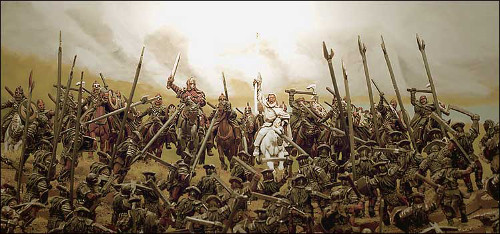
final_battleRevelation chapters 21-22 are the final battle, the new Heaven and new Earth and progressing into Eternity.

We spent some time covering a little theoretical ground on the rapture before tribulation (which is Pastor’s viewpoint), rapture after tribulation (which Pastor says most churches go with), and rapture in the middle of the tribulation. Pastor believes the following is the critical portion of scripture that supports his perspective and that all other perspectives must somehow explain it in order to be considered valid.

But we do not want you to be uninformed, brethren, about those who are asleep, so that you will not grieve as do the rest who have no hope. For if we believe that Jesus died and rose again, even so God will bring with Him those who have fallen asleep in Jesus. For this we say to you by the word of the Lord, that we who are alive and remain until the coming of the Lord, will not precede those who have fallen asleep. For the Lord Himself will descend from heaven with a shout, with the voice of the archangel and with the trumpet of God, and the dead in Christ will rise first. Then we who are alive and remain will be caught up together with them in the clouds to meet the Lord in the air, and so we shall always be with the Lord. Therefore comfort one another with these words.

1 Thessalonians 4:13-18 (NASB)

Pastor also mentioned there are differences of opinion about when the Messianic Era will occur, but my current opinion is that the wars (all but the final one) must all occur and all of Israel’s enemies must be defeated before we experience a thousand years (or a long but undefined period of time) of peace under the reign of the King.

This all leads back to who and what is the church, the fate of ethnic Israel (Romans 11:26), and what I consider the “splitting” of “saved Israel” (the righteous Israelites such as Abraham, Jacob, Moses, David, and so forth) vs. the Jewish people who believed in Jesus and are part of the Church. It still bothers me that Israel has two separate expressions in the Millennial Kingdom, one as saved Israel and one as Israel in the Church (occupying the body of Messiah with the Gentile Christians).

The prophesies in the Tanakh don’t presuppose a divided Jewish people unless you consider those that mention Israel and Judah, such as the following:

“Behold, days are coming,” declares the Lord, “when I will make a new covenant with the house of Israel and with the house of Judah, not like the covenant which I made with their fathers in the day I took them by the hand to bring them out of the land of Egypt, My covenant which they broke, although I was a husband to them,” declares the Lord.

Jeremiah 31:31-32 (NASB)

I don’t want to go too far down that road right now. Like I said, I’m just laying the groundwork for what follows, but if you have any ideas about how the Christian and Jewish points of view about the coming (or return) of Messiah are supposed to fit together, let me know.

This Can’t Be It

That-s-all-folks“Fear is the parent of cruelty.”

-James Anthony Froude

I’ve tried to be fearless in pursuit of God and chronicling my journey along the way. I can pretty much put up with name calling and people disagreeing with me. What I can’t tolerate is being the source of pain for other human beings, and yet no matter what I do or say, I end up hurting someone. I don’t think you can really blog in the religious space without stepping on toes, but we were commanded to love one another, not to step on each other’s toes.

Far from pronouncing judgment and condemnation and trying to constantly correct others, Yeshua taught his disciples to be peacemakers, merciful, meek, humble, patient, and longsuffering, even under persecution (Matthew 5:1-10). Rather than boasting about being right, we should seek to do what is right.

-Boaz Michael
“Becoming a Shaliach,” pg 95
Tent of David: Healing the Vision of the Messianic Gentile

I’ve come that close to shutting down this blog on more than one occasion over the differences between being right and doing right, but never closer than I have with today’s “meditation.” I had a email “conversation” with a friend who both (without his realizing it) triggered the desire to close up shop and then encouraged me to keep on going. I won’t go into the details, but all kinds of misunderstandings can happen when we rely on the Internet for communication. I’m thankful that God is patient and that He gave me the time to reconsider my original course of action.

The image at the top of this missive was the one I originally selected and I decided to keep it because one: I love Looney Toons, and two: as a reminder that the show must go on.

You are not required to complete the task, you are not free to withdraw from it … but be aware that the reward of the righteous will be given in the World to Come.

-Pirkei Avot 2:21

strengthSo the sages say I can’t give up, even when I want to, even when I don’t think I’m doing such a good job, even when any blog post I create can be sharply diverted from its course by someone commenting off topic. I guess like Bugs Bunny and company, as well as everyone in show business has traditionally said (and as I said above), “the show must go on.”

But as I wrote yesterday, I need to spend a lot of time at the feet of my Master, learning, studying, meditating, and pondering on his words and his teachings. If what I do isn’t about serving God and showing love, then it’s not worth it at all. I need you, my readers, to understand that. I think a lot of you do, but there’s always the potential for the more “controversial issues” in the religious blogosphere to get in the way, especially through comments and conversation.

You hypocrite, first take the log out of your own eye, and then you will see clearly to take the speck out of your brother’s eye.

Matthew 7:5 (NASB)

Even when I express frustration at what happens at church sometimes, I am absolutely not placing myself above the church or criticizing other human beings in the church. We’re all running madly along the edge of a razor blade anyway, desperate to not fall one way or the other and be sliced to ribbons on the blade of our own folly.

For man is born for trouble, As sparks fly upward.

Job 5:7 (NASB)

This much is true, but I’m reminded that in some corners of Judaism, the Divine in each of us can be seen as “sparks” and these “sparks” always desire to fly upward to rejoin their Source, the Holy One of Israel. This same train of thought states that we are all put into this life to search for very specific “sparks,” the shards of Divinity “with our name on them,” so to speak. It is our task to uncover these sparks to send them upward again. The world is in disguise, covered with mud, and blood, and worse, but that’s not how it was created and that’s not how it’s going to end up. Beneath the disguise is something beautiful. Beneath the masks of ugly, base humanity we wear, we are beautiful people made in God’s image. All we need to do is learn how to uncover the world and ourselves to see the beauty that God built into Creation and into us.

bugs-bunnyIf that is my mission, then as you can see, I have little time to focus on “negativity.” If I’m tempted to take pot shots at someone else or some organization, I should take the Master’s rather sarcastic words from Matthew 7:5 to heart.

The blog post I originally intended for today was difficult to write and I couldn’t think of a single portion of scripture that seemed to fit. After some reflection and no small amount of influence from the Holy Spirit, this “replacement” for today’s “morning meditation” is more in touch with who I believe I am in Messiah.

It’s funny how something as simple as a childhood memory can remind you of what’s really important. Thanks, Chuck Jones. You’ll never know how much of a hero you are, and through your artwork, humor, and a scrappy little “wascally wabbit,” how much you showed me that being down doesn’t mean being out. On with the show, this is it.

Overture, curtains, lights
This is it, you’ll hit the heights

Tonight what heights we’ll hit
On with the show this is it

Peace.

Returning to the Tent of David: Notes from an Emissary

notes-in-the-darkMany Christians have chosen the path of the Messianic Gentile. They have seen their lives changed for the better as a result of the strides they have taken towards an understanding of their Jewish roots. They have studied, learned, and grown. At a certain point in this process of growth, though, it is not always obvious what to do next. I am frequently contacted by Messianic Gentiles who are debating what do to with their new understanding. I have connected with many communities in which this is a serious problem.

For the most part, Messianic Gentiles want to share the Messianic renewal with other believers. Grasping hold of one’s Jewish roots is a wonderful thing. It is a beautiful feeling to learn about the biblical feasts, the Sabbath, and other Jewish practices which our Master embraced and taught. Our love for Yeshua makes these things precious to us. For disciples of Yeshua, finding our Jewish roots is like discovering a beautiful, long-lost treasure.

-Boaz Michael
“Introduction,” pg 18
Tent of David: Healing the Vision of the Messianic Gentile

Part of the Returning to the Tent of David series

Here is where I come in. I should say that I’m not really a typical “Messianic Gentile.” I think the model may have been more appropriate back in the day, but not so much anymore, primarily because I’m a believer going to a church, and the missus is Jewish and not a believer. Furthermore, as Boaz says several times in his book, a “Messianic Gentile” is indeed a “Christian.” I’ve adopted the latter “title” to clarify my vision: that there’s nothing about a Messianic perspective on Messiah and the Bible that should be considered separate or apart from Christians and the Church (big “C”).

The other reason I don’t call myself a “Messianic Gentile” is that I don’t “keep Torah” in many of the ways someone on a Messianic community might. Even at the height of my so-called “observance,” I still drove on Shabbat, cooked on Shabbat, ate what you might call “Kosher-style” rather than what my local Chabad Rabbi would consider kosher, used the Siddur poorly, had (and still have) by and large no command of Hebrew at all, and so forth. I was a lousy “Messianic Gentile” in my practice. But the study and the information flow was and is fabulous.

Among the many things our Master taught us was the command to love each other as he loved us (John 13:34).

-ibid

This is a core of the message and the vision. If we don’t do these “Tent of David” experiences out of love rather than some other motivation, we lose and the Church loses.

And that’s not easy.

What is easy is to get involved in theological and doctrinal debates trying to show who is wrong and who is right. That’s no different from the typical “dust ups” we have in the religious blogosphere, and I’ve been critical of those before.

Becoming a living and active part of the church community isn’t always easy. I go to services, attend Sunday school, visit weekly with the Pastor, but that’s about it. Oh, I’ve taken on a special project that has required I work with one of the Associate Pastors and some of the staff, but I don’t know if that qualifies me as part of the community. Maybe it just takes more time or maybe I’m holding back.

Can one live as a Messianic Gentile among Christians who don’t yet embrace his lifestyle or viewpoint?

-ibid, pg 19

boaz-michael-beth-immanuelAs Boaz says on the previous page, “Yet this is not always easy. Churches can be resistant to the message of the Messianic Gentile.” But is my mission and purpose to go into church with the idea of changing people? This is one of the most difficult parts of the “TOD” experience. The vision is vast and glorious, but living it out day by day is difficult, especially when I’m not a gifted teacher, theologian, and publisher, but rather, just a guy “on the ground,” so to speak.

I don’t really try to live my life as a “Messianic Gentile” in the church. I just try to be me, which I suppose is both my greatest strength and my staggering weakness.

And why should the church listen to the rather odd sounding message of the “Messianic Gentile?” I mean, it’s their home ground. They hold all the keys that open all of the doors in their realm. They are comfortable with what they are being taught and what they believe fundamentalist and evangelical Pastors and their books and sermons tell them. Saying something like the Torah is not canceled is not just different or new information, it’s radical and potentially “dangerous”. It flies in the face of everything the average Christian in the pew has ever been taught.

The Gentile believers, as part of the commonwealth, had a unique and vital role in the process of building the Tent of David, using their numbers and resources to empower and bless the Jewish community and spread the message of the kingdom in their own culture. In this way, the apostles envisioned the imminent restoration of the Tent of David and the establishment of Yeshua’s hegemony over the entire world…It would hardly be an overstatement to say that this apostolic vision is Christianity’s raison d’être, its reason for existing.

-ibid, pg 22

That’s only vaguely how most Christians and most Christian churches see themselves. Frankly, it took me awhile to even see this aspect of my “reason for existing” and even longer to get comfortable with it. A tremendous amount of internal struggle along with lots of prayer and studying had to take place before I was able to put together all the pieces of the puzzle and to recognize that the completed picture was “me.” I’ve spent many months trying to communicate on this blog what I see and while the people who already share that vision are enthusiastic, those who don’t are going to be just as blind to it as I was.

As disciples of the Messiah, Messianic Gentiles must live out by personal example the teachings of Yeshua…

-ibid, pg 24

I read this sentence and immediately thought about Sukkot. I happened to mention to my Sunday school teacher that I built a sukkah in my backyard, as I do every year, and a little bit about the customs around Sukkot. He seemed interested and enthusiastic, but not in the way I anticipated. It was more like a novelty item to him…something interesting and curious to look at but nothing that had to do with him and his lived experience. The idea of him building a sukkah would be seen in the same way as the idea of living in a Buddhist monastery in Tibet for a year. A fascinating thought but in no way connected to his experiential reality.

Who will show the institutional church its blind spot?

-ibid, pg 26

Who says they want to see it? The most interesting part of this experience is not the response, but the silence. I recently had a bit of a disagreement with my Sunday school teacher over the meaning of Acts 15:1-2. He says that the Jewish people who stated that Gentiles needed to be circumcised were “Satanically-inspired” and I said that they were Jewish people who had a legitimate theological question that needed to be resolved.

hereticBut we were the only two engaged on this issue. Everyone else in the room was silent. What were they thinking? Did they imagine I’d flipped out or was I just a heretic? OK, probably nothing that strong, but I really don’t think most of the Christians in that room had a clue how to deal with the idea that first century Jews requiring Gentiles to covert to Judaism as the only way to be saved were at all people expressing a valid concern, as opposed to a bunch of trouble makers and Judaizers.

“The church desperately needs creative heretics. A “creative heretic,” an independent thinker, is an example of the “unbalanced” force to which Newton refers in his first law of motion. Only the person who breaks with tradition can change the direction of an institution. A heretic is not an enemy of God but one who is more interested in truth than in tradition.”

-John Sloat, A Handbook for Heretics

Imparting the vision of the “Messianic Gentile” within a church setting requires a great deal of tact. I’ve tried as best I can to restrain myself. I almost always pick just one question (out of the many I could cite) to ask in Sunday school so as not to appear like I’m trying to argue. I can be candid with my Pastor but that’s part of our relationship, and all of those conversations only involve the two of us.

This can only happen, though, if those Christians who understand their Jewish roots choose to remain in their churches as faithful congregants.

-Boaz, pg 26

I’ve had this discussion before about whether or not the “Messianic Gentile,” that is, “me,” should join the church as an official member. My good friend with whom I have coffee every other Sunday afternoon says absolutely “yes.” I must join the church as a full member in order to be accepted and integrated into the body.

But I don’t know if I’d ever by a good Baptist when their’s so much about the theology involved with which I don’t agree. If being a good Calvinist is required, then it’s a “showstopper.”

Which brings me to the question of who changes? Boaz mentioned previously in his Introduction about the challenges of living as a Messianic Gentile in the Christian church. Part of the difficulty as I see it is that the church is exerting an effort to change the Messianic Gentile even as the Messianic Gentile is making the same effort to change the church. Boaz says that all committed Christians want to know Jesus better, and while I believe that’s true, they also anticipate that Jesus won’t look too “Jewish” as they draw nearer to him. The portrait of Moshiach I have to paint is far more semitic than any Jesus they’ve ever seen or want to see.

darkmirrorThe Tent of David book is designed to reach out to a vast population of Messianic Gentile and Hebrew Roots Gentile people in our country and either support them in the churches they already attend, or encourage some of them, like me, to return to the church as emissaries of the Messianic viewpoint on the Jewish Messiah. We’re not “secret agents” on a covert mission, we’re representatives of an idea and a perspective that isn’t common in the church. We’re part of Boaz’s vision of reaching the church with a new (or renewed) way of conceptualizing the Jewish Jesus. And we are only one stream among several they are trying to produce, another such stream being their A Promise of What is to Come television series (available for free over the Internet), which is designed to impart much of this information at a very accessible level for most Christians.

You are not required to complete the task, you are not free to withdraw from it … but be aware that the reward of the righteous will be given in the World to Come.

-Pirkei Avot 2:21

That sounds incredibly noble, but I’ve always had a tough time seeing myself as incredibly noble. I know too much about myself to see the reflection of a hero in the mirror when I shave in the morning.

So after nearly a year, who do I see when I look at my reflection? Most mornings, it’s easy to ignore the question. I’m getting ready to go to work or if it’s Saturday, I’m mulling over my “honey do” list for the day. If it’s Sunday, then I’m anticipating Pastor’s sermon and considering what I’m going to say in Sunday school, and then thinking about what the rest of the day will bring.

But this blog post series (assuming I write future entries) is about stopping and taking the time to look at the scruffy older guy in the mirror. Am I living up to my mission as an emissary to the church, as it were? Have I been successful in delivering my message and more importantly, in living it out?

I can’t say I’ve been wildly successful. A few people have expressed an interest in what I have to say, but they seem to only just get started on the trail and then stop. I have had conversations with one of the older Associate Pastors who is interested in Hebrew Roots but when I directed him to the First Fruits of Zion website to access some resources, I got the impression that he was quite overwhelmed.

I think there is a desire to learn more about the Jewish Jesus in the church, but there are two issues of concern. The first has to do with what Christians expect to learn. They expect that the Jewish Jesus will look and act just as they imagine him to be. They think the “Messianic Gentile” will teach them “more of the same” but maybe with some interesting but minor details. What they don’t expect is to learn anything different and especially anything challenging. The second issue comes out of the first: getting people to think outside the box without feeling like they’re being heretics or, heaven forbid, being brought “under the Law.”

That second part is really important, because if people aren’t willing to even consider a paradigm shift to a new perspective, they’ll never accept what the “Messianic Gentile” has to offer beyond the superficial.

thinking-inside-the-boxMy impression is that the mission of the Messianic Gentile in the church is a lengthy if not life long process. It also requires a great deal of commitment, not only to the church, but to God. My Crossing the Ford of the Jabbok blog post illustrates how I see what I need to do, not only for the sake of the mission but for the sake of my relationship with God. I do no one any good if I neglect dedication and devotion to Hashem, Master of Legions, Lord of Creation, while otherwise beating my brains out against the stucco walls of the church (or in the blogosphere).

If I am ever to be successful in showing the Christian world around me a true portrait of the Moshiach, the Jewish Messiah King who has come once and who will come again, then I must spend every possible moment at his feet studying, learning from his wise teachings, and becoming an ever more dedicated disciple of my Master.

Addendum: It has come to my attention that I need to be spending a lot more time sitting at the feet of my great Teacher than doing many other things. I’ll speak more on this in tomorrow’s “morning meditation,” but things are going to change.

Straightening the Road of the King

what-is-the-churchWhat is the “church?” Who belongs to the church? How is the church related to Judaism or is the church related to Judaism in the current age? These are the questions my Pastor and I discussed last Wednesday night. Sometimes, when we talk of these puzzling subjects, I have a difficult time conceptualizing my thoughts and feelings and articulating them while I’m with him in his office. So I ponder, and think, and occasionally, I draw (you’ll see what I mean as you scroll down while reading).

I think I’ve come up with a “vision” of Pastor’s understanding of the evolution of the church from its beginnings in Judaism as well as my own “vision.” I apologize to Pastor and to you in advance for any misunderstanding I have of his point of view. He recently pointed out to me how I didn’t have a correct understanding of his view of the “end times” (which I blogged about) and sometime soon, I’ll need to post a retraction (he told me he doesn’t find a retraction or correction necessary, but I find it necessary if I intend to be honest in my transactions with him and everyone else).

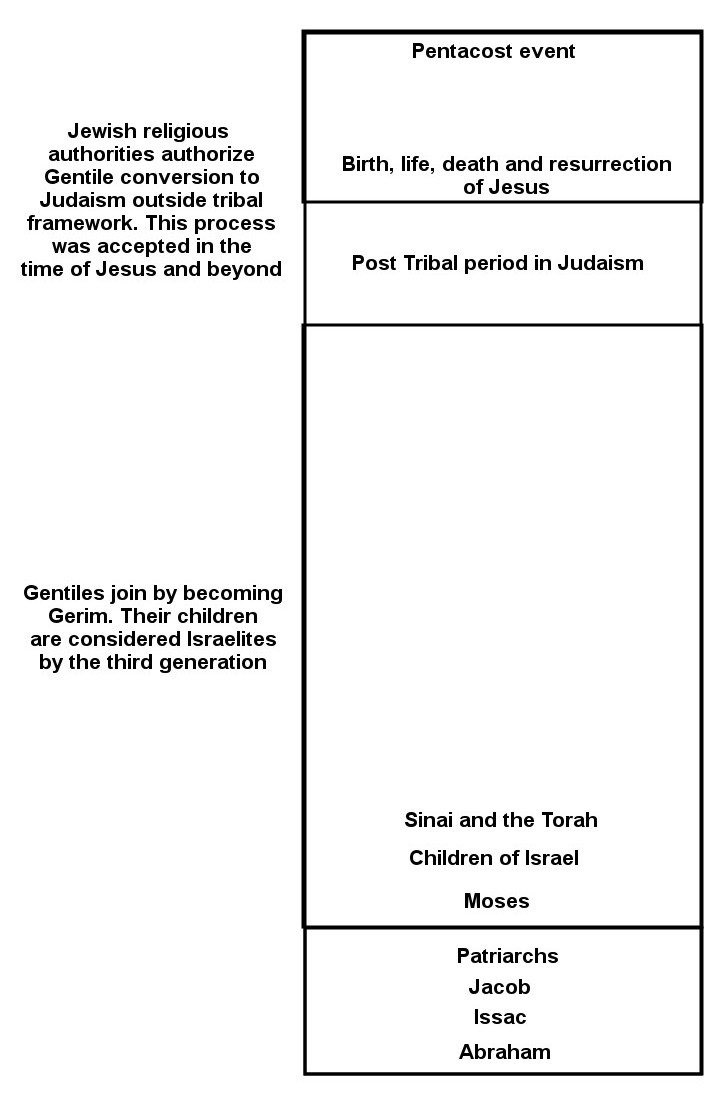
First things first. There are some areas we necessarily agree upon. God made a covenant with Abraham, with Isaac, and with Jacob involving promises relating to the Land of Israel, making their descendants very numerous, promises that they would be a blessing to all nations (through Messiah), and that circumcision would be the physical sign between God and the specific, biological descendants of Abraham and Isaac, and Jacob that their descendants would be the inheritors of these covenant promises.

The patriarchs came from Jacob and the twelve tribes of Israel came from the patriarchs. Moses led the twelve tribes out of slavery in Egypt and God redeemed them as His special people, as per the promises made to Abraham and his descendants. God then added to His promises at Sinai and gave the Torah, the teaching and instruction for righteous living to the physical descendants of Abraham, Isaac, and Jacob. This also functions as the national constitution of Israel, and has multiple other purposes.

At this point in history, Gentiles can only join Israel as gerim, which isn’t exactly conversion. The idea is that a Gentile would do what the Israelites would do in terms of the mitzvot, but the Gentiles would never become Israelites in their generation. More like resident aliens. No one can convert to a tribe or a family clan. Only after the third generation, would the ger’s children have intermarried into tribal Israel and ultimately assimilate into the Israelites. This was the only path for a Gentile to join the covenant people of God.

After the Babylonian exile and a lot of history passed by, tribal and clan affiliations were all but lost. The Jewish religious authorities instituted what we understand as the ritual of conversion. Now, if a Gentile wants to join national Israel and the Jewish people, they must undergo a process supervised by Jewish religious authorities (in modern Orthodox Judaism, it is a group of three Rabbis who form a Beit Din). The men are circumcised and both men and women are “mikvahed” as the final act of conversion. They go down into the water as a Gentile and come up as a Jew. There is no multi-generational “delay” and the individual Gentile who desires to be Jewish can become Jewish and thereafter, they and all of their descendants are considered Jews.

stream1Then Jesus comes. At this point, there are born Jews and there are Jewish converts or proselytes to Judaism. Jesus doesn’t speak against the ritual of the proselytes and does not overturn this institution, even though it is not directly found in the Torah. Remember, Jesus wasn’t adverse to opposing Jewish traditions and he did overturn or object to other halachah of the scribes and Pharisees on occasion (Matthew 15:1-14 for example). We also see that Paul encountered Jewish proselytes (Acts 13:43 for instance) and he too never said a cross word about the Jewish converts or the practice of converting Gentiles to Judaism (though in Galatians, he spoke strongly against Gentiles converting to Judaism as the only way to be justified before God). Both Jesus and Paul were very direct about expressing their thoughts and feelings and if either one had a problem with the Jewish conversion process, they would have said so…but they never did.

But something new happened after the death and resurrection of Jesus.

And Jesus came up and spoke to them, saying, “All authority has been given to Me in heaven and on earth. Go therefore and make disciples of all the nations, baptizing them in the name of the Father and the Son and the Holy Spirit, teaching them to observe all that I commanded you; and lo, I am with you always, even to the end of the age.”

Matthew 28:18-20 (NASB)

I wonder if the Jewish apostles truly understood the implications of Messiah’s words. Did they believe he wanted them to make converts of the Gentiles, “mikvahing” them into Judaism? All of the other streams of Judaism accepted Gentile converts, why should “the Way” be any different?

But it was and is.

While Peter was still speaking these words, the Holy Spirit fell upon all those who were listening to the message. All the circumcised believers who came with Peter were amazed, because the gift of the Holy Spirit had been poured out on the Gentiles also. For they were hearing them speaking with tongues and exalting God. Then Peter answered, “Surely no one can refuse the water for these to be baptized who have received the Holy Spirit just as we did, can he?” And he ordered them to be baptized in the name of Jesus Christ.

Acts 10:44-48 (NASB)

stream2Here we see our answer. Gentile believers, like the Jewish believers, received the Holy Spirit and were baptized by water without being circumcised and converting to Judaism! This was revolutionary. This was astounding. This had never, ever happened before. It was without compare. Paul perceived this vision clearly in his subsequent work with Gentiles, but it wasn’t until the matter was brought before the council of apostles and elders of the Way in Jerusalem that a formal, legal status was granted to the Gentiles entering into a wholly Jewish religious stream (see my Return to Jerusalem series for a detailed analysis of this process).

But it’s at Acts 2 that Pastor and I disagree. He believes that Pentecost is the “Birthday of the Church” and that sometime remarkable happened. Something remarkable did happen, but we don’t agree on exactly what it is. To the best of my ability to relate (and again, I apologize in advance if I mess any of this up), Pastor believes that an entirely new entity, “the Church” emerged from a Jewish religious stream and although it is made up of both Jewish and Gentile members, the members all form a single, uniform body of Messiah. At this point, the Torah is “fulfilled” and is no longer a set of commandments or obligations for the Jewish Christians. Jewish and Gentile Christians share a single set of obligations under the grace of Jesus Christ.

This effectively separates the Jewish members in the Church from larger Israel and the Jewish people. Pastor says that all Jews share in the covenant promises of God, particularly possession of the Land of Israel in perpetuity, but that only the Jewish Christians are saved.

My point of view is different.

I see the creation of the Body of Messiah (I’m not going to call it “the Church” in order to distinguish Pastor’s perspective from mine) as the natural and logical extension of everything that happened in Biblical and historical Judaism before it. The entire stream of history and prophesy for Israel pointed inevitably to the Jewish Messiah, so when Jesus came, it was the pinnacle, the focal point, the historical hinge upon which everything in Judaism was aimed at and upon which it turned.

But while it was revolutionary for Gentiles to be allowed to enter a stream of Judaism without converting to Judaism and being considered Jewish, their admittance wasn’t the end of the Jewish stream that accepted Jesus as Messiah as a Judaism, nor was it replaced by another religion or religious entity. It was a Judaism that had Gentiles admitted as equal members in relation to salvation and access to God, but it didn’t turn “the Way” or “Messianic Judaism” into “the Church.”

That happened unfortunately, after the Jewish/Gentile schism in the movement (and there’s a lot of history available to describe the details, so I won’t replicate it here) and in my opinion, the “Gentile Church” was born when the Gentile Church leadership agreed that it was no longer a Judaism and that Jews were not welcome unless they converted to Christianity!

If Pastor is right, then we have to consider the Jews in the Church as irrevocably separated from their Jewish brothers and sisters and perhaps even national Israel, since they no longer can identify with Israel, the Torah, and the connection the Torah provides a Jew with his nation and his God. If I’m right, then we have to consider the Body of Believers in Messiah as a Jewish stream, albeit a somewhat unique one because of such a large Gentile membership, that runs parallel to all other Jewish religious streams pointing toward the future and the eventual return of the King. We also have to admit that the Torah is not canceled and that Messianic Jews share an equal obligation to the mitzvot as all other Jewish people.

stream3Again, I sincerely apologize to my Pastor and to everyone reading this if I got his perspective on these matters wrong, in even the slightest detail. It is not my intention to misrepresent anyone, but it is my intention to draw a distinction between our two viewpoints.

Does it matter who is right? Is my purpose in the church, let alone the reason for my existence, simply to be right? As I’ve discovered (or re-discovered) recently, the answer is yes and no. No, it doesn’t matter if I personally am right. The world doesn’t depend on my one, small opinion. Statistics vary, but recent research indicates that there are anywhere between one and three-quarter million blogs to perhaps up to 164 million blogs in existence, and even the people compiling these numbers admit the list is incomplete. The number of individual blog posts goes into the billions and billions. Compared to all that, my one little blog can hardly matter, even in the human realm, let alone God’s. Any religious blogger who thinks they’re “all that and a bag of chips” can only make me laugh.

On the other hand, it’s vitally important to examine the question “who is the Church” and especially “what is the Church”. If “the Church” turns out to be a terribly misguided Judaism that has wildly deviated from its original course, then we require an exceptionally radical “course correction.” No, I’m not suggesting a revolution in the Church as such, where we strip away 100% of church culture as it has evolved over the past twenty centuries, but I am suggesting some form of change.

This is exactly the sort of process described by First Fruits of Zion (FFOZ) Founder and President Boaz Michael in his book Tent of David. The answer to the question of who and what “the Church” is has profound implications if we believe that the modern Messianic Jewish opinion is correct and that “the Church” was never intended to be a totally unique religious unit, disconnected forever from Israel, the Torah, and the Jewish people.

In my opinion, everything God did across human history was ultimately additive, no replacements or substitutions accepted. Abraham and God make a covenant, and as part of the conditions of that covenant, Isaac is added, then Jacob is added, then Jacob’s children are added as the patriarchs, and then their descendants, the Children of Israel are added, and they are made into a nation and the Torah is added, and possessing the Land of Israel is added, and all of the prophesies by all of the prophets pointing to the Messiah and the Kingdom of Heaven are added, and the birth of Messiah is added, and the death and resurrection of Messiah are added, and the Jewish religious stream that is identified by faith in Messiah is added, which includes the Gentiles entering this Jewish stream being recipients of the blessings of the covenant God made with Abraham…all in one, nice, neat, straight line across history as drawn on the canvas of time by God.

What we have now in the 21st century is something of a mess, but that’s what happens when God gives us a gift and then lets us play with it for 2,000 years. We’ve bent, folded, spindled, and mutilated it, but not beyond repair. Repair is what I think Messianic Judaism is all about. It’s tikkun olam or repairing the world with a Messianic twist. It’s a voice in the wilderness calling out to the synagogue and the church saying, “It’s time to take a fresh look at all this so we can clean the place up and get ready for the King’s return.”

The roadOne nice, neat, straight line from Abraham to Moshiach. Any bends in the road, any wrinkles in the asphalt, any potholes, any mudslides, any detours, have nothing to do with God and His intent. We’re the ones with the jack hammers and sledge hammers pounding away at that line, making it crooked and not straight. But we’re the ones who were charged with caring for the road, just as Adam was charged with caring for the Garden (and look how that one turned out).

I’m not in charge with being “right” but God did say that I’m supposed to take care of my little section of the road upon which the King will walk as he returns. I can’t fix it all, but I have to do something. He’s coming soon. I can’t just lie down on the job and call it good. He’s coming soon. I’ve got to do my best, with the help and by the will and grace of God, to make and keep my little piece of the road of the King straight.

For more about the relationship between Jewish and Gentile believers in the Body of Messiah, see Derek Leman’s short article, Citizens, Not Natives.

Noah: Reminder of the Rainbow

rainbow-israelThe story of one righteous man in an evil generation. The Almighty commands Noah to build the ark on a hill far from the water. He built it over a period of 120 years. People deride Noah and ask him, “Why are you building a boat on a hill?” Noah explains that there will be a flood if people do not correct their ways (according to the comedian Bill Cosby, Noah would ask “How long can you tread water?”). We see from this the patience of the Almighty for people to correct their ways and the genius of arousing people’s curiosity so that they will ask a question and, hopefully, hear the answer.

The generation does not do Teshuva, returning from their evil ways, and God brings a flood for 40 days. ah leave the ark 365 days later when the earth has once again become habitable. The Almighty makes a covenant and makes the rainbow the sign of the covenant that He will never destroy all of life again by water (hence, James Baldwin’s book, The Fire Next Time). When one sees a rainbow it is an omen to do Teshuva — to recognize the mistakes you are making in life, regret them, correct them/make restitution, and ask for forgiveness from anyone you have wronged as well as from the Almighty.

-Rabbi Kalman Packouz
Torah Portion of the Week
Noah, Genesis 6:9-11:32
Aish.com

The rainbow is a sign to do teshuvah. I’d never heard of that before or, if I had, it leaked out of my memory somewhere along the way.

The Jewish world has just completed the period of the High Holidays including Yom Kippur, the Day of Atonement, the most Holy and solemn day on the Jewish religious calendar, a day when every observant Jew seeks to repent and to beg God’s forgiveness and the forgiveness of others. The rest of the world, including most Christians, don’t have much regard for Jewish holidays, but for Christians, you’d think we might take a cue from the rainbow.

Of course, since we have the blood of Jesus covering our sins and we’ve been washed white as snow, most Christians don’t give a great deal of thought to ongoing repentance, forgiveness, and atonement. More’s the pity.

But this is about me, not you. No, I’m not writing this as an exercise in narcissism, but rather as my effort to continue to turn toward God and to seek His face.

The heart of those that seek God shall rejoice. Seek God and His might, constantly seek His countenance

Psalms 105:3-4

As I write this, I didn’t sleep well last night. I thought about seeking God, about recounting His wonders, about remembering His marvels and judgments, but my mind was too clouded and distracted. Reading the Bible while fighting fatigue was unproductive. All I could do was to try to cling to God and pray that He would grant me at least a little bit of rest.

I’ve resolved to meditate on and even to memorize His Word (some of it, anyway) as a way to keep Him and His teachings close to my heart. Last night wasn’t a good time to do that and it reminded me of just how far a journey I must yet travel.

sandy-little-ferry-flooding-hmed-4a_photoblog500If I had known last night what I know this morning, I might have meditated on a rainbow.

Rabbi Yirmiyahu Ullman says that the rainbow is both a curse and a blessing. It’s a curse because it is a reminder that the world deserves to be destroyed for its sins, but that God has promised by covenant not to do so by flooding. Such a grim reminder of destruction that, in slightly smaller ways, we still suffer from today. But then, what else can we say about the rainbow? Rabbi Ullman states this:

The generation of the flood indulged in this worldliness to the point of perversion. Their wanton obsession with variety and variation resulted in their abusing the full gamut of their G-d given powers for the purpose of impurity. The flood purged the world of this impurity and the rainbow was given as a sign and reminder of what results from inundating the world with indulgence. However, the same rainbow simultaneously reminds us to repent from the relentless pursuit of multiplicity drawing us away from G-d. It urges us to direct the full spectrum of our powers and interests over the rainbow to the One on High.

In this way the rainbow is at once both curse and blessing; transgression and repentance; seductively appealing and pristinely beautiful. It depends on what you’re looking for in life. And perhaps that’s why, although it’s forbidden to indulge in the rainbow’s beauty, one may gaze at it – for the purpose of doing teshuva and directing one’s pluralities to G-d — in order to make the blessing.

I think the rainbow is visually appealing so that it will draw our gaze and having done that, remind us that we must continually seek to repent, to do teshuvah, to be reminded that we have a purpose in this world that goes beyond pursuing our individual desires.

I’ll never look at a rainbow the same way again.

One of the fundamental differences in Jewish Law and Noahide Law is that, Jews do not actively pursue Jewish converts, among non-Jewish nations.

The B’nai Noah are already under the Seven Laws, and have been permanently warned concerning their observance, so it is not a matter of trying to “convert” someone, from one religion to another; for the Noahide Code is not a “religion;” and all organized “religions,” are prohibited for the Noahide.

For the Noahide, it is a matter of Teshuva (return to G-d), not proselytization. Similarly a Jew who grew up atheist or agnostic, or who had strayed from the Torah and converted to an idolatrous religion; when he realizes his mistake and returns to Judaism, he does not “convert” back to Judaism; it is a matter of Teshuva, or returning.

It is the same for a Noahide. Others proselytize, Noahides return.

-Shlomo
“The Noahide Teshuva”
Gateway to Heaven

I include this quote because it suggests a very interesting idea. Jewish people are born into a covenant relationship with God whether they want to be or not. When a Jew leads a wholly secular life and later wants to return to God, as “Shlomo” says, that person doesn’t have to “convert” to Judaism, since they’re already Jewish and in relation to God. However, they do have to return to God, to do teshuvah, to repair the damage done in that relationship (I’ll argue that a Messianic Jewish person has not converted to Christianity but rather, made an even more complete return to God by becoming a disciple of Moshiach).

Blessed by GodMost Jewish people don’t recognize the Christian connection to God or that we are the beneficiaries of the blessings of the covenant God made with Abraham. However, they are quite willing to say, as “Shlomo” did above, that all non-Jews already have a covenant relationship with God through Noah. So, from that perspective, a Gentile does not have to “convert” to Judaism or anything else. The Gentile, like the Jew, is born already having a covenant relationship with God and on that basis, must return to God.

And in you all the families of the earth will be blessed.

Genesis 12:3 (NASB)

Now the promises were spoken to Abraham and to his seed. He does not say, “And to seeds,” as referring to many, but rather to one, “And to your seed,” that is, Christ.

Galatians 3:16 (NASB)

Christianity is something else. No one is born a Christian. Even if you are born to parents who are believers, you are not automatically a believer. Each person negotiates their own relationship with God. On the other hand, the covenant God made with Abraham is very old and spans across human history just waiting for any and all of us to grasp it and experience the blessings of the seed, of Messiah. In that sense, are we converting to Christianity or returning to something God intended for us all along?

The Lord is not slow about His promise, as some count slowness, but is patient toward you, not wishing for any to perish but for all to come to repentance.

2 Peter 3:9 (NASB)

Not that all of us will, of course. But we each have a responsibility to turn…to return to Him. It is not a casual act and it’s not something you do once and then it’s done forever. I neglect my relationship with God at my own peril. God created each of us in His own image, and endowed us with free will and a desire to seek Him. Many of us twist or distort those gifts and either go our own merry way in chasing our pleasures, or in seeking “something” we can’t define, become lost in the maze of religions and philosophies, imagining we are wise by worshiping what isn’t alive or even real.

Another Shabbos approaches. Another opportunity to welcome the Lord of the Sabbath (Matthew 12:1-8) beckons. Will the glow of the candles symbolize the warmth of God in my home and my heart? Will I fill in the “missing rainbow colors” in that glow and see the reminder to repent and return?

“A different world cannot be built by indifferent people.”

-Peter Marshall

Good Shabbos.

Crossing the Ford of the Jabbok

PrayingHear my prayer, O Lord, Give ear to my supplications! Answer me in Your faithfulness, in Your righteousness! And do not enter into judgment with Your servant, For in Your sight no man living is righteous. For the enemy has persecuted my soul; He has crushed my life to the ground; He has made me dwell in dark places, like those who have long been dead. Therefore my spirit is overwhelmed within me; My heart is appalled within me. I remember the days of old; I meditate on all Your doings; I muse on the work of Your hands. I stretch out my hands to You; My soul longs for You, as a parched land. Selah.

Psalm 143:1-6 (NASB)

Part of the Returning to the Tent of David series

This is the “flip side” to this morning’s meditation, The Christianization of Acts 15. Every couple of weeks or so, I have coffee and conversation with a friend who is smarter and wiser than I am. Certainly, his spirit is far closer to God than mine. I often tell him of my thoughts and feelings and he is direct and forthright in his response.

This is a continuation of my Returning to the Tent of David series since it has a direct connection to my reacquaintance with the church and how I have been conducting myself within its walls.

Apparently, I haven’t been doing so well.

I spend a fair amount of time expressing my point of view on this blog. I guess that’s OK since, after all, it is my blog, my platform for talking about my experiences as they occur. But I also air out my opinions of and frustrations with the church and its members on occasion. I commented to my friend that I felt my Sunday school teacher is rather dogmatic in how he presents his lessons. And the instant the words left my lips, I knew what he was going to say.

So am I, just with a different point of view.

I’ve been spending a lot of time presenting and expressing my opinions. But what about God? That is, who is expending the effort here and whose purpose is being served, mine or God’s? In my friend’s view, it’s the former, totally.

No, he isn’t being too hard on me and in fact, I have every reason to believe he speaks not only with an honest heart, but from the heart of God. I’ve been studying and using what I’ve learned as a sword or a club to “go after” those with whom I disagree, and without the slightest concern about God’s desires. I guess I assumed that if I was doing this, it must be what God wants, but that was arrogant presumption on my part. I never even considered the possibility that I wasn’t in the right spiritual frame from which to conduct such activities.

No, it doesn’t mean I’m going to stop going to church, attending Sunday school, or meeting with my Pastor (unless none of them will have me anymore). It does mean I need to take a step backward and start “preparing” for these actions in a different way.

Yes, studying the Bible is good. Studying intelligent and informative commentaries is good. But is it the mind and will of God that makes change, not the efforts of mere men.

There’s little doubt that my Pastor and I, in meeting together, are each trying to help the other change in a particular direction. Of course, I learn a great deal from these conversations, but I’m also hoping to impart something as well. But so far, I’m the only one doing the imparting. Has God been in my voice? Am I even aware of His presence in the Pastor’s office? For that matter, am I aware of God’s presence in the chapel during services or in the classroom during Sunday school?

Man aloneThe vast majority of the time, I must say “no.”

My friend keeps suggesting I “meditate” on the Bible, but the word “meditate” seems indistinct to me. He says it’s matter of considering a portion of scripture and mulling it over. What does it mean? What does it mean to me? What can it tell me about God and about myself? What scripture should I choose?

I meditate on all Your doings;
I muse on the work of Your hands.

I read books, including the Bible, as fast as I can, as if I’m in some sort of race to cover the maximum amount of territory in the least amount of time. I’m only mortal and my span on this sphere is exceptionally limited. God is infinite and forever. He can afford to take His time. After all, it is His time; He made it. Time exists only within His will and should He desire, time would cease to exist and scurry back to the nothingness from whence it came.

“In that day I will raise up the fallen booth of David,
And wall up its breaches;
I will also raise up its ruins
And rebuild it as in the days of old;
That they may possess the remnant of Edom
And all the nations who are called by My name,”
Declares the Lord who does this.

Amos 9:11-12 (NASB)

I keep coming back to these verses because they define my purpose within a “Hebraic” and “Messianic” context. I say “my purpose” but it’s really the purpose of any non-Jewish disciple of Messiah, “the nations who are called by My Name,” says the Lord. It’s the “job description” for Gentile disciples of the Jewish Messiah who perceive that they are operating within a Jewish religious and spiritual context and not necessarily inside of “goyishe Christianity.”

I’m not trying to be insulting, but consider who our King is and from where he will reign. Can there be any doubt that Moshiach our King is and will be King of Israel, King of the Jews, and only out of all that is he King of the World?

But I’m getting ahead of myself again. Humility is something I didn’t think far from my grasp, but a guess I am farther from its sheltering arms than I imagined. This isn’t my battle. I didn’t come here to fight. I came here to serve God. What an interesting thought, since it never occurred to me to say it that way before. I always thought, harkening back to Boaz’s book, that I returned to the church to help breach the gap between the traditional fundamental and evangelical perspective on Jesus, the Bible, and everything and how it all should be seen within the Jewish context, using Jewish terms, Hebrew language, and especially removing the paint from “Joseph’s” alien face (Genesis 45:4) to reveal the son of Jacob or more to the point, the son of David…the Jewish son and firstborn of Israel. The son of God.

man-without-a-coatIf this is how you want me to serve you God, then I have to admit I haven’t been doing such a good job. If this isn’t what you’ve wanted me to do, then I’ve been doing an even worse job than I thought.

How can I promote any form of healing at all by “banging heads” with other people or by beating my head against a wall? When Jacob wrestled the Divine, in midrash, it is said that Jacob wrestled with his doubts, or his evil inclination, or his own dark angel. He had to conquer something in himself before he could take the next steps back into the Land his descendants would one day inherit, the Land of Promise. Is that my mission as well, to conquer something within myself?

That I should slow down, take time with scripture, mull and turn over the Word in my mind and heart, meditate on His wisdom day and night is all worthy and right, and I’ve been in too much of a hurry to actually do it. Where will my spirit and the Spirit of God find a common meeting ground? Jacob arose at night, crossed the ford of the Jabbok and was left alone. There he encountered God. Jacob wrestled for the rest of the night and when the sun began to dawn, the battle was still raging. Jacob’s “companion,” seeing he had not prevailed, injured Jacob, permanently disabling him (see Genesis 32:22-32). But Jacob also received a blessing, a new name, and a mission to form a dynasty; to  ultimately become the father of a mighty nation that belongs only to God.

I seriously doubt my destiny is such a great thing in God’s eyes or in man’s. And yet there must be some reason for my existence, else God would have long since extinguished me, like I might blow out a candle. Not that I’m such a great light or even a small one. Who can glory in their own light when confronted with the blazing inferno of an Everlasting God? Only a fool. I pray that I am no fool, though I know I’ve been foolish.

God will judge us not according to how much we endured, but how much we could love.

-Richard Wurmbrand

Whatever God wants me to do could easily fail if it was all up to me. Having launched myself in a particular direction for nearly a year, I haven’t looked back and I haven’t checked the map. I just figured if I went in a nice, straight line, I’d end up where I’m supposed to be. But there are no nice straight lines in my terrain, only back alleys, narrow corridors, dark tunnels, and labyrinthine passages. Getting lost if I am the only navigator is a foregone conclusion.

…but whatever your original intentions, you have become truly lost.

-Ducard (played by Liam Neeson)
Batman Begins (2005)

extinguished_candleIs that me? Maybe. Or maybe it’s what I’m on my way to becoming. But according to my friend, it’s not too late. I can slow down the horse, so to speak, take stock of my surroundings, renew my connection to God, through the Bible, through meditation on His Word, through prayer, through sincere repentance. Like a watchman on the walls of the city at night, I rely on the Presence of God as I await the dawn, considering His mighty deeds, recalling Days of Old, meditating upon Him in my heart.

My voice rises to God, and I will cry aloud;
My voice rises to God, and He will hear me.
In the day of my trouble I sought the Lord;
In the night my hand was stretched out without weariness;
My soul refused to be comforted.
When I remember God, then I am disturbed;
When I sigh, then my spirit grows faint. Selah.
You have held my eyelids open;
I am so troubled that I cannot speak.
I have considered the days of old,
The years of long ago.
I will remember my song in the night;
I will meditate with my heart,
And my spirit ponders…

Psalm 77:1-6 (NASB)

And my spirit ponders…as I cross the ford of the Jabbok and am left alone in the dark…waiting.