All posts by James Pyles

James Pyles is a published Science Fiction, Fantasy, and Horror author as well as the Technical Writer for a large, diversified business in the Northwest. He currently has over 30 short stories published in various anthologies and periodicals and has just sold his first novella. He won the 2021 Helicon Short Story Award for his science fiction tale "The Three Billion Year Love" which appears in the Tuscany Bay Press Planetary Anthology "Mars."

How to Love Your Neighbor as Yourself

love-your-neighborWhy an “extra meditation” so late in the day? Why so close to Shabbos, when many of my readers east of me have already gone offline or are preparing to do so? Because I can, I suppose. More accurately, because I read something that touched me and I want it to touch you as well.

Many of us could write up a list of rules for how we’d like to be treated by our friends. Most don’t have a physical list to hand out to people (although it might reduce some painful guesswork if we did), but this is how the list might look:

  1. Be sincere — no acting.
  2. Respect me, always.
  3. Check up on me to see how I’m doing.
  4. Be supportive when I’m in pain.
  5. Greet me warmly when I visit.
  6. Give me the benefit of the doubt.
  7. If I need some help, be ready to lend a hand.
  8. Don’t act overbearing or disdainful towards me.

In our eyes these expectations are within reason. We don’t delude ourselves to think our friends would give us full access to their bank accounts, or sign their house or car over to us, nor do we want them to.

We’re obliged to “Love your friend like yourself” (Lev. 19:18). The obvious question is: how can we be obligated to love others as we love ourselves? Even for someone who naturally loves people, there’s no way such love could equal the devotion they have to themselves!

We come back to our list of expectations. That’s all we really want from others, and it’s really all they want from us. Just treat others as you expect them to treat you — that’s the obligation. Are we able to demonstrate that level of love? We must be, for we couldn’t reasonably expect of others more than we’re capable of doing ourselves! (HaKsav VeHaKabalah, R’ Yaakov Tzvi Mecklenburg, 1785–1865)

Good Shabbos!
Rabbi Mordechai Dixler
Program Director, Project Genesis – Torah.org

I love that list but am also accused by it. I know I don’t always treat my family and friends in the way the list suggests (do I ever?). My heart also pines because I’d love to be treated that way by my family and friends as well. I am not assigning blame. If I don’t treat others this way, how can I expect the treatment to be returned?

And yet, it’s not just our friends and family who are involved.

“You have heard that it was said, ‘You shall love your neighbor and hate your enemy.’ But I say to you, Love your enemies and pray for those who persecute you, so that you may be sons of your Father who is in heaven. For he makes his sun rise on the evil and on the good, and sends rain on the just and on the unjust. For if you love those who love you, what reward do you have? Do not even the tax collectors do the same? And if you greet only your brothers, what more are you doing than others? Do not even the Gentiles do the same? You therefore must be perfect, as your heavenly Father is perfect.”

Matthew 5:43-48

I’m sure you saw that one coming from a mile away.

Hillel the Elder once said, “That which you hate, do not do to your friend [the negative picture of “love your fellow as yourself”]―that is all the Torah and all the rest is commentary. Go and study it.” Our Master Jesus said the same thing expressed positively, linking love of God and love of neighbor:

And he said to him, “You shall love the Lord your God with all your heart and with all your soul and with all your mind. This is the great and first commandment. And a second is like it: You shall love your neighbor as yourself. On these two commandments depend all the Law and the Prophets.”

Matthew 22:37-40

I’ve already written on the Torah’s greatest principle but I find that I need to repeat myself, not just for your sake, but for my own.

We can’t stop everything that’s wrong in the world. As I’m writing this, a terrorist has all but shut down the city of Boston and the surrounding area. An uncounted number of people are huddling in their homes in fear for their lives. Where will “the suspect” be found? Will he be found? Will he kill again? Who will be his next victim? Will it be me?

Hardly the sort of thoughts and feelings that usher in a peaceful Shabbos.

And we can’t do anything about it. But we can do something else. We can be sincere with our family, friends, and others we come in contact with. We can always treat them with respect. When we haven’t seen a friend for a while, we can call and see how they’re doing. We can be supportive when they’re sick or in pain. When they come to visit, we can greet them warmly and act sincerely glad to see them. When there’s a disagreement, we can strive to give them the benefit of the doubt. If they need help, we can offer them assistance. And even when we’re tempted to or we feel that we are in the right, we can deliberately avoid behaving overbearing or disdainful toward them.

And if we did all that, and if we did all that to everyone we encounter, and if we did that all of the time, we probably wouldn’t stop even a single act of terrorism, stop even one bomb from exploding, prevent even one gun from being fired at another human being, or inhibit the next natural disaster from devastating another city somewhere in the world.

But we would still make the world a better place and we would make ourselves better people.

159 days.

Acharei Mot-Kedoshim: Why We Fail to Walk with God

WalkingMy ordinances you shall do, and My statutes you shall observe, to walk with them, I am the Lord, Your G-d.

Leviticus 18:4

What does the Torah mean “to walk with them?”

The Ksav Sofer, a famous Hungarian rabbi, commented that the words “to walk with them” mean that a person needs to walk from one level to the next level. That is, a person should constantly keep on growing and elevating himself.

It is not enough to keep on the same level that you were on the previous day. Rather, each day should be a climb higher than the day before. When difficult tests come your way, you might not always appreciate them. The only way to keep on elevating yourself is to keep passing more and more difficult life-tests. View every difficulty as a means of elevating yourself by applying the appropriate Torah principles. At the end of each day, ask yourself, “What did I do today to elevate myself a little higher?” If you cannot find an answer, ask yourself, “What can I plan to do tomorrow to elevate myself?”

-Rabbi Kalman Packouz
“Shabbat Shalom Weekly”
Commentary on Torah Portion Acharei MotKedoshim
Aish.com

I’m getting a little tired of these “tests.” They don’t seem to be helping me. Worse, they don’t seem to be helping anyone else, either.

Let me explain.

In continuing to read Rudolph’s and Willitts’ book Introduction to Messianic Judaism: Its Ecclesial Context and Biblical Foundations, I arrived at “Chapter 6: Messianic Jewish Ethics,” written by Russ Resnik. It’s interesting that when we think of Jesus, we usually think of his mercy, his grace, or his compassion, but it’s a little unusual to consider his ethics. And yet, even Jews who are not believers, when they read the Gospels, find the ethics of Jesus are undeniably Jewish.

A generation later, the Orthodox Jewish scholar Pinchas Lapide commented on the Sermon on the Mount, “In all this messianic urgency toward humanization God wills for all the children of Adam and toward the humanization of this earth, in the deathless power of hope that finds in reliance on ‘the above’ the courage to go ‘forward,’ Jesus of Nazareth was ‘the central Jew,’ as Martin Buber called him, the one who spurs us all to emulation.”

-Resnik, pg 82

Resnik states that “Yeshua fully embodies the image of God, which is placed upon humankind from the beginning: ‘God created mankind in his own image’ (Gen 1:27).” He also refers to the first man and woman as “divine image bearers” and further says:

…the divine image is obviously not a physical resemblance, but neither is it an abstract spiritual resemblance. Rather, it entails representing God through active engagement in creation. This understanding of the image of God gives rise to the Jewish idea that God does ethics before we do, that our ethical behavior is not just a matter of obedience, or even pleasing God, but of reflecting God and his nature, fulfilling the assignment to bear the divine image.

-Resnik, pg 84

In other words, even before the commandments to do good and to walk with God’s ordinances and statues were recorded in the Torah, they were humanity’s built-in imperative to do good because God does good and we are made in His image. When we do good, we are a reflection of the image of our Creator. Resnik provides a quote from the Talmud to cement his point.

What does it mean, “You shall walk after the Lord your God?” Is it possible for a person to walk and follow in God’s presence? Does not the Torah say “For the Lord your God is a consuming fire”? (Deut 4:24). But it means to walk after the attributes of the Holy One, Blessed be He. Just as He clothed the naked, so you too clothe the naked, as it says “And the Lord made the man and his wife leather coverings and clothed them” (Gen 3:21). The Holy One, Blessed be He, visits the ill, as it says, “And God visited him in Elonei Mamreh” (Gen 18:1), so you shall visit the ill. The Holy One, Blessed by He, comforts the bereaved, as it says, “And it was after Abraham died that God blessed his son Isaac…” (Gen 25:11), so too shall you comfort the bereaved. The Holy One, Blessed be He, buries the dead, as it says, “And He buried him in the valley” (Deut 34:6), so you too bury the dead.

-b. Sotah 14a
quoted by Resnik, ibid

Although Resnik didn’t cite this portion of the Gospels, the following seems to fit rather well as an illustration of “walking with God.”

Then the King will say to those on his right, ‘Come, you who are blessed by my Father, inherit the kingdom prepared for you from the foundation of the world. For I was hungry and you gave me food, I was thirsty and you gave me drink, I was a stranger and you welcomed me, I was naked and you clothed me, I was sick and you visited me, I was in prison and you came to me.’ Then the righteous will answer him, saying, ‘Lord, when did we see you hungry and feed you, or thirsty and give you drink? And when did we see you a stranger and welcome you, or naked and clothe you? And when did we see you sick or in prison and visit you?’ And the King will answer them, ‘Truly, I say to you, as you did it to one of the least of these my brothers, you did it to me.’

Matthew 25:34-40

boston_marathon_terror_explosionAs I write this (most of it, anyway), it is early Tuesday morning, and yesterday, several explosions occurred at the Boston Marathon, killing three and injuring and maiming many others. To walk with God and reflect His image is to do good under all circumstances, to visit the sick and injured, and to bury the dead, but I despair for humanity. Although we certainly can find some helpers involved in response to this terrible expression of violence, how many more people exist who are capable of committing similar acts of hostility or worse? It always seems like we struggle and struggle in this unending battle of good vs. evil, and to what gain?

Batman (played by Christian Bale): Then why do you want to kill me?

The Joker (played by Heath Ledger): [giggling] I don’t, I don’t want to kill you! What would I do without you? Go back to ripping off mob dealers? No, no, NO! No. You… you… complete me.

Batman: You’re garbage who kills for money.

The Joker: Don’t talk like one of them. You’re not! Even if you’d like to be. To them, you’re just a freak, like me! They need you right now, but when they don’t, they’ll cast you out, like a leper! You see, their morals, their code, it’s a bad joke. Dropped at the first sign of trouble. They’re only as good as the world allows them to be. I’ll show you. When the chips are down, these… these civilized people, they’ll eat each other. See, I’m not a monster. I’m just ahead of the curve.

The Joker: We really should stop this fighting, otherwise we’ll miss the fireworks!

Batman: There won’t *be* any fireworks!

The Joker: And here… we… go!

[Silence. Nothing happens. Confused, Joker turns to look at the clock, which shows that it’s past midnight and neither ferry has blown the other up]

Batman: [triumphantly] What were you trying to prove? That deep down, everyone’s as ugly as you? You’re alone!

The Joker: [sighs] Can’t rely on anyone these days, you have to do everything yourself, don’t we!

-from the film The Dark Knight (2008)

In this scene, Batman and the Joker are debating the nature of humanity. Batman believes that human beings are basically good, while the Joker believes that “these civilized people, they’ll eat each other.” In the film, the situation that the Joker sets up to prove his point fails. The people involved don’t blow each other up, but risk their own lives in order to show compassion, even for people they don’t know, even for criminals.

But it’s just a movie, a work of fiction. People are good in the movie because they’re written that way.

What about people in reality?

According to Resnik, we are also “written” to do good because we are made in the image of God and should “naturally” reflect His goodness. However, the history of the human race seems to prove otherwise. We are not good, we have not been good, and in spite of what “progressives” may believe, we are not getting better. We simply shift around the types of “badness” we commit and just call it “good.”

aloneBut wait. I’ve already been down this path once before and I know where it leads. It leads to a dark, depressing dead end where no one will follow you and where no one wants to go. Do I really want to go there again? I probably will. Given the nature of my personality, I visit that place periodically. But do I want to stay this time?

When I complained previously that all the heroes were dead, I was reminded “All the more reason to be the “called out” ones and live counter to our culture.” It’s true. The fewer of us there are, the harder we’re supposed to work for what we know is good and right. It gets more lonely and more scary, but God didn’t ask us to serve Him in a world of truth and light. If everything were perfect, He wouldn’t need us to do Tikkun Olam. It’s in the face of terrorism, tragedy, and horror that we need to be especially faithful to the tasks that God has given us. No matter how discouraging things get sometimes, we still have to work and we still have to wait.

We’re all waiting for something to happen to save us. Christians and Jews are waiting for the Messiah. The inquisitions happened and the Messiah didn’t come. Pogroms beyond measure have happened and the Messiah didn’t come. Crusaders raped, pillaged, and murdered, with the blood of their victims running through the streets like water and the Messiah didn’t come. Wars have slaughtered millions and the Messiah didn’t come. The Nazis murdered six million Jews and countless other “undesirables” and the Messiah didn’t come. Someone blew up a bunch of people at the Boston Marathon, killing three and injuring hundreds and Messiah didn’t come.

What’s God waiting for? Is He waiting for us to “walk in His ordinances and His statutes?” Is He waiting for us to become the people He designed us to be? Is He waiting for us to follow Him in the footsteps of the Messiah? He’s been waiting a long time. He’s waiting for us to do what He sent us here to do. He’s waiting for us to live out His image. If the Messiah is the ultimate human image of God, we share that with him as his disciples. We must hold on. I must hold on. One little dip in the pool of despair, a couple of laps just for good measure, then out again, dry off, get dressed, and get going.

“You must not lose faith in humanity. Humanity is like an ocean; if a few drops of the ocean are dirty, the ocean does not become dirty.”

― Mahatma Gandhi

How ironic that I should hear the voice of Messiah from the mouth of Gandhi, but then I think Gandhi understood Jesus better than many of his followers, including me. This is why God created the Shabbat…to give our injured spirits a rest in Him. Someday the rest will be perfect. Until then, we must continue to carry the image of God to a suffering and disbelieving world. Without that, there is no hope.

Good Shabbos.

159 days.

The Torah’s Great Principle

love-one-anotherRabbi Akiva said, “Love your fellow as yourself” is a great principle of the Torah. A similar principle is gleaned from the famous story of a proselyte who wished to convert to Judaism on condition that someone would teach him the entire Torah while standing on one foot. Hillel the Elder accepted his conversion and told him, “That which you hate, do not do to your friend [the negative picture of “love your fellow as yourself”]―that is all the Torah and all the rest is commentary. Go and study it.”

Obviously, the entire Torah is a true, God-given Torah, but Hillel the Elder and Rabbi Akiva teach us that there is room to meditate on the principle that is the Torah’s “great principle”; the signpost that puts us on the right track.

The need for such guiding lights is most necessary when an outsider wishes to approach the infinite sea of Torah and needs an anchor to show him where to begin.

-Rabbi Yitzchak Ginsburgh
“The Torah’s greatest principle”
Wonders From Your Torah

Our Master Yeshua (Jesus) taught something similar.

And he said to him, “You shall love the Lord your God with all your heart and with all your soul and with all your mind. This is the great and first commandment. And a second is like it: You shall love your neighbor as yourself. On these two commandments depend all the Law and the Prophets.”

Matthew 22:37-40

Referencing Rabbi Ginsburgh, I periodically write about non-Jewish people (including me) who are drawn to the larger body of Torah mitzvot and who find they have a desire to live a more “Jewish” lifestyle as a means of holiness. Essentially, there’s nothing wrong with this and indeed, the Torah was created not just for the Jewish people, but for humanity, as it is said:

For out of Zion shall go forth the Torah, and the word of the LORD from Jerusalem.

Micah 4:2

I substituted the word “Torah” for “Law” in the ESV translation for effect, but both terms are correct (although I’d argue that “Torah” is the more correct word to use here).

Again, as we see from Rabbi Ginsburgh’s commentary, the “outsider” (non-Jew or secular Jew) who desires to learn Torah has to start somewhere. Although as Rabbi Ginsburgh states, the entire Torah is true, it’s easy for a beginner (Rabbi Ginsburgh is talking about potential converts to Judaism but I’m applying his statements to the rest of us) to become lost, confused, discouraged or even “seduced” by the complexities of Torah and the vast span of mitzvot. I’ve seen non-Jewish people introduced to the concept of “complete Torah observance” or “obligation” who throw themselves headlong into what they imagine it is to lead a “Torah-submissive life” only to become enamored by “the stuff.”

tzitzit1I call “stuff” all the outward devices, objects, or activities that are typically associated with observant Judaism, such as donning a tallit gadol and tefillin when davening, wearing a tallit katan under one’s shirt daily, wearing a kippah in public daily, lacing their sentences with Hebrew or even Yiddish words, growing a long, furry beard (because they believe God wants this), and so on.

But what does Rabbi Ginsburgh, citing both Hillel the Elder and Rabbi Akiva suggest is the Torah’s “great principle?” What does the Master say is the greatest commandment?

None of those things I just mentioned. What is the anchor for “beginners” in the Torah? “You shall love your neighbor as yourself.”

This concept sheds light on the Jewish conception of holiness. The Hebrew word kedosh , meaning “holy,” implies separation; (See Tanya, ch. 46.) a distinction must be made between the Jewish approach and a secular approach to any particular matter, as is stated at the conclusion of our Torah reading: (Levitcus 20:26.) “You shall be holy unto Me, for I, G-d, am holy, and I have separated you from the nations to be Mine.”

Such a distinction is unnecessary with regard to the ritual dimensions of the Torah and its mitzvos. These are clearly distinct; there is no need for man to do anything further. Instead, the focus of our Torah reading is on concerns shared by all mortals. Thus the reading relates laws involving agriculture, human relations, business, and sexual morality. For it is in these “mundane” areas that the holiness of the Jewish people is expressed.

Judaism does not understand holiness to be synonymous with ascetic abstention. Instead, it demands that a person interact with his environment, and permeate it with holiness. (See Rambam, Mishneh Torah, Hilchos De’os 3:1.)

-Rabbi Eli Touger
“What Does Being Holy Mean?”
Adapted from
Likkutei Sichos, Vol. I, p. 254ff; Vol. XII, p. 91ff;
Sichos Shabbos Parshas Acharei-Kedoshim, 5745
Chabad.org

That might be a little “intense” or at least unfamiliar to most Christians. Here’s another way of saying it.

What good is it, my brothers, if someone says he has faith but does not have works? Can that faith save him? If a brother or sister is poorly clothed and lacking in daily food, and one of you says to them, “Go in peace, be warmed and filled,” without giving them the things needed for the body, what good is that? So also faith by itself, if it does not have works, is dead.

James 2:14-17

A life of faith and holiness cannot be lived apart from actually living life. Holiness is doing not just praying, meditating, studying, and contemplating. Holiness is an action. Go and do.

An emissary is one with his sender. This concept is similar to that of an angel acting as a Divine emissary, when he is actually called by G-d’s name. If this is so with an angel it is certainly true (See Iyar 6.) of the soul; in fact with the soul the quality of this oneness is of a higher order, as explained elsewhere. (See Tamuz 10.)

“Today’s Day”
Thursday, Iyar 8, 23rd day of the omer, 5703
Compiled by the Lubavitcher Rebbe;
Translated by Yitschak Meir Kagan
Chabad.org

Again, the Master taught something similar.

For I have given you an example, that you also should do just as I have done to you. Truly, truly, I say to you, a servant is not greater than his master, nor is a messenger greater than the one who sent him. If you know these things, blessed are you if you do them.

John 13:15-17

boston_marathon_terror_explosionWe are his servants and we are not greater than he is. He gave us an example of what to do by the living of his life and his teachings. He gave us an “anchor” in the Torah as to where we should begin and where we should stay centered: to love God with all of our being, and to love our neighbor (who is really everyone) as ourselves. And just recently, we’ve been reminded that there are opportunities to fulfill the Master’s mitzvot all around us.

The Mighty Rock, Whose deeds are perfect, because all His ways are good. He is a faithful God in Whom there is no iniquity.

Deuteronomy 32:4-5

These very sobering words are often invoked at moments of great personal distress to express our faith and trust in the Divine wisdom and justice.

People who have suffered deep personal losses, such as destruction of their home by fire or the premature death of a loved one, or who have observed the widespread suffering caused by a typhoon or an earthquake, may be shaken in their relationship with God. How could a loving, caring God mete out such enormous suffering?

It is futile to search for logical explanations, and even if there were any, they would accomplish little in relieving the suffering of the victims. This is the time when the true nature of faith emerges, a faith that is beyond logic, that is not subject to understanding.

The kaddish recited by mourners makes no reference to any memorial concept or prayer for the departed. The words of kaddish, “May the name of the Almighty be exalted and sanctified,” are simply a statement of reaffirmation, that in spite of the severe distress one has experienced, one does not deny the sovereignty and absolute justice of God.

Our language may be too poor in words and our thoughts lacking in concepts that can provide comfort when severe distress occurs, but the Jew accepts Divine justice even in the face of enormous pain.

Today I shall…

…reaffirm my trust and faith in the sovereignty and justice of God, even when I see inexplicable suffering.

-Rabbi Abraham J. Twerski
“Growing Each Day, Iyar 8”
Aish.com

Without trust and faith in God, it’s easy to lose faith in humanity and we are unable (or unwilling) to be the Master’s servant in this world and to do his will by loving and helping others in need.

In a commentary on this week’s Torah portion, we learn from the midrash that one of the reasons for the death of Aaron’s sons Nadab and Abihu was that they loved God “too much.” They came too near the Holy One and were consumed. This was a warning to Aaron that no matter how great his love for God was and the desire to draw near the Divine Presence in the Holy of Holies, he must restrain himself.

G-d knew that Aharon’s love for Him was so great that he would always desire to enter the Holy of Holies. However, by doing so, it could cause his soul to leave his body, as happened with his sons. G-d therefore informed told him of the need to keep his soul within his body so that he could fulfill his mission in this world — transforming it into a dwelling place for G-d.

The lesson we can learn from the command to Aharon is that every Jew has the capacity to love G-d, and indeed is commanded to do so, as the verse states: “You shall love your G-d with all your heart, soul and might.” (Devarim 6:5)

peace-of-mind1While midrash may not appeal to you in a literal sense, when viewed metaphorically or as a moral lesson, it teaches that human beings, out of our love for God, can achieve greater heights of holiness, drawing nearer to God, though we can never be “greater than our Master.” Yet as servants, we must always strive to become better than we are.

It’s not easy. God never gets tired, He never gets scared, He never gets discouraged, He never wants to “throw in the towel,” but we poor, pathetic human beings experience all those things.

People think that if they are not well, they must sacrifice all meaning in their life in order to take care of their physical situation.

In fact, the opposite is true: You cannot separate the healing of the body from the healing of the soul. As you treat the body, you must also increase in nourishing the soul.

-Rabbi Tzvi Freeman
“Soul Healing”
Based on letters and talks of the Rebbe, Rabbi M. M. Schneerson
Chabad.org

Just as we cannot separate healing of the body from healing of the soul, we cannot separate our personal need for healing from the needs of those around us. In fact, by acting for the benefit of others and serving their needs, we may discover that our own wounds are also being healed.

I have been guilty on many occasions of wanting to withdraw from humanity and particularly from the community of faith when it has hurt too much. God has shown me (again and again and again) that I’ve been going in the wrong direction.

When in doubt, I must return to the portion of Torah that is for all of us, Jew and Gentile alike, the anchor, the center, the love of God and humanity. Without that, nothing else we do means anything.

160 days.

Love Loses: The Aftermath of Terrorism and Humanity

starfish“You must not lose faith in humanity. Humanity is like an ocean; if a few drops of the ocean are dirty, the ocean does not become dirty.”

―Mahatma Gandhi

Two bombs exploded near the crowded finish line of the Boston Marathon on Monday, killing three people and injuring more than 140 others in a terrifying scene of broken glass, smoke and severed limbs, authorities said.

CBS Boston station WBZ-TV reports one of the three who died from the attack was an 8-year-old boy.

“Deadly bombs rock Boston marathon”
CBSNews.com

Normally I can bounce back from the impact of events like this one but not this time. I wrote about the Sandy Hook Elementary School shootings more than once, and managed to recover my balance, my relationship with God and humanity, and keep on going, but somehow, this time is different. I don’t think that the specifics of the Boston Marathon horror are different, I just think all these events are cumulative. They’re piling up inside of me and crowding out my soul.

In every human being there is only so large a supply of love. It’s like the limbs of a starfish, to some extent: if you chew off a chunk, it will grow back. But if you chew off too much, the starfish dies. Valerie B. chewed off a chunk of love from my dwindling reserve … a reserve already nibbled by Charlotte and Lory and Sherri and Cindy and others down through the years. There’s still enough there to make the saleable appearance of a whole creature, but nobody gets gnawed on that way without becoming a little dead. So, if Cupid (that perverted little motherf**ker) decides his lightning ought to strike this gnarly tree trunk again, whoever or whatever gets me is going to get a handy second, damaged goods, something a little dead and a little crippled.

-Harlan Ellison
from “Valerie: A True Memoir” (1972)

Ellison doesn’t leave his commentary on personal tragedy and untimely death like that and continues by saying, “Don’t close yourself off, but jeezus, be careful of monsters with teeth.”

Harlan Ellison used to be one of my favorite authors about thirty to thirty-five years ago or so, but eventually, the anger, abrasiveness, and lawsuits that characterized his life began to take their toll on mine and I had to move on. However in moving on, I failed to take into consideration that Ellison just writes as a reflection of our human environment, and the cynicism, dissatisfaction, and out-and-out rage at life he expresses is merely the sea we’re all swimming in. That sea is full of hungry sharks and they smell blood.

Oh, these thoughts and feelings aren’t new to me and in fact, I wrote my own starfish story not too long ago.

Since this latest act of terror, two predictable messages have dominated the news and the social media outlets: encouragement and blame. Gandhi is only one example of the encouragement type message that you can find on Facebook lately. In fact, after Newtown, I based one of my meditations on something attributed to Fred Rogers:

When I was a boy and I would see scary things in the news, my mother would say to me, “Look for the helpers. You will always find people who are helping.”

I’m sure that’s true, but there seems to be only a few helpers left. The rest of us are just “helping ourselves,” usually to things that don’t belong to us.

defeated-boxerI actually wrote on this theme, disappointment in the human race, days ago, and that “meditation” will appear on Friday morning as my commentary on this week’s Torah Portion. But the sinking feeling that we are all sinking won’t leave me and I’m not going to wait until Friday to complain about it. I slept pretty well last night, but the night before was consumed with dreams of death, blood, kidnapping, and violence. I finally woke up at 3 a.m. and was glad to do so. Sometimes sleep is the only escape I can find from the battering life dishes out, but not always.

Sometimes living is a battle and the only thing you can do is fight back, maybe hoping to win, or maybe hoping just to survive the defeat.

In the clearing stands a boxer
And a fighter by his trade
And he carries the reminders
Of ev’ry glove that layed him down
Or cut him till he cried out
In his anger and his shame
“I am leaving, I am leaving”
But the fighter still remains

-Paul Simon (recorded by Paul Simon and Art Garfunkel)
from the song “The Boxer” (1968)

In answering a question about “why bad things happen to good people” related to natural disasters, the Aish Rabbi replied:

Thank you for your thoughtful question. It is really a formulation of the classic: “Why do bad things happen to good people?” Let me try to explain:

The story is told of the king who commissioned a tapestry to be woven. In the middle of the work, someone came upon the weaver and saw a mish-mash of different colored threads, loose threads and, in general, a very messy piece of work. A complaint was issued to the king who then confronted the artist. The artist pleaded with the king for a few days to prepare his defense. After those few days he came before the king with a wrapped package and told the king, “Here is my defense.” Inside the package was the completed tapestry.

The moral is that we cannot judge the work until it is completed. Moses asked to see God’s face. That request was denied, but he was allowed to “see” God’s “back.” It is explained that Moses wanted to understand how God runs the world. The response was that it is beyond human comprehension until you see the “back.” That is, until we can see the whole picture; then in hindsight it will all make sense.

While this answer may seem a “cop-out,” it prevents us from trying to understand God’s actions from our very limited perspective. In order for us to be able to “judge God,” we need to consider God’s “ground rules” for existence. Using this premise, it becomes very difficult to judge God. Why? Because we are stuck in a finite perspective of time and space, and we can therefore never be sure which rules God is employing at any given moment.

In order to begin to make sense of this, one thing we must understand is that God is in control, and there are no accidents. There has to be intrinsic meaning in our lives; otherwise we are just a random collection of molecules whizzing through space, with no real direction or purpose.

We are living in a very complex world, and in such a world, God doesn’t only deal with individuals, he also deals with nations.

nicholas-kristofOK, I get it. God is a “big picture” kind of guy and I can’t see the forest for the trees, if you’ll forgive the mixed metaphor.

But when is enough enough? When do the encouraging messages and the happy platitudes become tiresome and ineffective? Is that why New York Times columnist Nicholas Kristof blamed the GOP for the Boston Marathon explosions or why the Westboro Baptist (so called) Church is threatening to picket the funerals of the three people killed as a protest against the LGBT community?

That isn’t fighting back against injustice, that’s insane cruelty. It’s insane to hope that the bomber turns out to be an Arab Muslim or an ultra-conservative white American. The only person to blame for the explosions is the person to planted the bombs, just like the only person to blame for the Newtown School shootings is the person who pulled the trigger.

But if I truly believed that, then I could be like Gandhi, seeing these horrific acts as aberrations among a much larger humanity I can be proud to be a part of, and I could dismiss a few drops of dirty moisture as insignificant amid a sea of refreshing, life-giving water.

But it’s not just a few drops, it’s an endless flood, not of water but of gushing blood, ripped and torn flesh, and the screams and cries of the wounded and dying.

Reddit hosts specialty pages including one on Atheism which is used to make fun of religion and religious people. I guess that sort of thing floats their boat.

Anyway, I saw a photo a “redditer” posted the day after the Boston Marathon explosions of a person donating blood. The story that went along with the image said that the blood donor had been reading a lot of messages (presumably on Facebook and twitter) from Christians saying how they were praying for the victims of the explosions. He decided to do something a little more helpful by donating blood.

I couldn’t help but agree with him, not that I believe prayer ineffective, but the answer to prayer is to actually do something about it, like giving blood. Those type of people, Christians, Atheists, or otherwise, are the “helpers” Fred Rogers’ mother was talking about.

But, to recall Gandhi, are the helpers the ocean or the few drops of “clean” water that are left amid a sea of blood, mud, and fecal matter?

Jesus once lamented, “However, when the Son of Man comes, will He find faith on the earth?” (Luke 18:8 NASB). Rabbi Tzvi Freeman wrote, “One who does good brings in more light. One who fails, feeds the darkness.” I am more than aware that I am currently feeding the darkness but I’m hardly alone. For every ten people who are willing to donate blood for people who need it, the world summons ten-thousand who will be glad to shed more blood. If a hundred people hold candles in the night to defy the darkness, a million will extinguish the light, and then rape and murder the terrified victims trying to hide in the shadows.

drowningThere’s no one left to blame except ourselves, so we might as well stop pointing fingers at everyone else besides us. Our group, our political party, our religion, our gender identity, our race, our ethnic type is no more pure than anyone else’s and the one equalizing factor is that we are part of the grubby, trashy, filthy ocean of the human race. We all planted the bombs. We all pulled the trigger. We all spilled blood. We are all drowning in the pain and the death, submerged, begging for air, begging for mercy, begging for life.

Encouraging messages such those uttered by Mahatma Gandhi and Fred Rogers are meant to lift us up out of that ocean so that we can, by resisting discouragement and depression, rise above and lead others to be agents of change and optimism.

But Gandhi and Mr. Rogers are both dead. All of the heroes are dead. The world we live in now looks up to people like Honey Boo Boo, Snooki, and Kim Kardashian. Welcome to the “progressive” age of humanity. The Prophet Isaiah was correct when he said that in the last days good would be called evil and evil would be called good. The apostle Paul expanded on this:

But understand this, that in the last days there will come times of difficulty. For people will be lovers of self, lovers of money, proud, arrogant, abusive, disobedient to their parents, ungrateful, unholy, heartless, unappeasable, slanderous, without self-control, brutal, not loving good, treacherous, reckless, swollen with conceit, lovers of pleasure rather than lovers of God, having the appearance of godliness, but denying its power.

2 Timothy 3:1-5 (ESV)

Paul wisely advised those reading his letter to avoid such people, but how is that possible when they are the only people in the world (or so it seems)? In Arkansas, groups are suing the state for the “right” to abort babies up until birth rather than banning abortions after twelve weeks gestation (as if killing a baby at any time could be considered a “good” thing to do). People are obsessed with American Idol and couldn’t care less about any suffering that CNN and the New York Times doesn’t deem worthy of attention. We greave now for the eight-year old boy who was killed in the Boston explosions, but next week, he’ll be replaced by the latest “reality TV show.” And this piece of obvious bigotry didn’t help.

The Joker, played by Heath Ledger is the film The Dark Knight (2008) was right: “When the chips are down, these… these civilized people, they’ll eat each other.”

And we will. Rob Bell (infamously) wrote a book called Love Wins. He was wrong.

161 days.

Introduction to Messianic Judaism: Reading the Bible in Flux

Talmud Study by LamplightMessianic Jews accord Scripture a unique status as the inspired and authoritative Word of God. They study it, use it liturgically, and base their life and practice on it. However, Messianic Jews grapple with certain issues involved in biblical interpretation that are particularly relevant to Jewish followers of Yeshua. In the first two parts of this essay I will focus on how Messianic Jewish interpretation of Scripture is affected by interpretive traditions and how this leads to the task of shaping a post-supersessionist canonical narrative. In the third part I will focus on unique uses of Scripture in Messianic Judaism.

-Carl Kinbar
“Chapter 4: Messianic Jews and Scripture” (pg 61)
Introduction to Messianic Judaism: Its Ecclesial Context and Biblical Foundations

In my conversations with Pastor Randy at the church I attend, the core of our conversations are on interpretation of the Bible. Pastor says that the first step in any proper interpretation is understanding the literal meaning of the text in its original language and within its context. I can hardly argue against that, but there are two additional steps: “what the text means” and “what the text means to me.” The former is an application of the text in its original context and the latter is an application of the text today.

Hyper-literalists would say that the application of all Biblical text is uniform across time, being the same both the day it was written and right now in 21st century America. I don’t think I can go that far, since, for instance, many portions of scripture in Tanakh (Old Testament) and New Testament addressing slavery are not particularly applicable in today’s world, whether in Israel or the rest of the nations.

But Dr. Kinbar suggests a finer degree of application depending, in this case, on whether one is or is not a Messianic Jew. We do know that, depending on whether one is an observant Jew or a Gentile Christian, certain passages of the Tanakh, specifically those often understood as “Messianic,” are interpreted differently, with the latter population seeing Jesus in the text and the former group seeing the future Messiah or sometimes national Israel instead.

Even when both populations interpret the same text in terms of its literal meaning within its original context, the application, especially in the present age, differs radically because it is being interpreted by two different populations, each with a different “agenda.”

It’s what I keep trying to explain to Pastor Randy. Even multiple parties who are honest and who seek truth can arrive at different interpretations of the Bible depending on who the parties are and how they’ve been “programmed” to interpret the Bible, sometimes just based on who they are (the ultimate arbiter of scripture may be the Holy Spirit, but that doesn’t prevent many people of good faith and character from interpreting scripture quite differently from one another, sometimes even within the same church).

But Christians will always see Jesus in Messianic texts. Religious Jews, not so much.

Now Kinbar is factoring Messianic Jews into the equation in his article. What can we expect?

Perhaps no one specific application.

Mark Kinzer, another Messianic Jewish thinker, approaches the interpretation of Scripture from a different direction. He argues that the Bible must be interpreted in the context of interpretive traditions, which consist of “the accumulated insights of a community transmitted from one generation to the next. In a Messianic Jewish context, tradition represents the understanding of Scripture preserved through the generations among the communities – Jewish and Christian – within which Scripture itself has been preserved. If we are connected to these communities, then we are also heirs of their traditions.”

-Kinbar, pg 62

jewish-handsThat’s something of an adaptation to how Orthodox Jews see Biblical interpretation. My wife occasionally quotes our local Chabad Rabbi as saying that the Bible cannot be interpreted correctly except through tradition, which in this case, means the traditions of Orthodox Judaism. According to Kinbar, Kinzer includes Jewish and Christian traditions as part of the requirement for correct Biblical interpretation, but Jewish and Christian interpretive traditions (and make no mistake, Protestant Christianity does have traditions for interpreting the Bible) are often at odds with each other, including the rather critical element of identifying the Messiah. Establishing the particulars of which traditions to use from each religious perspective must be an enormous challenge.

But there’s more than one way Messianic Jews look at this matter.

(Daniel) Juster argues for a more cautious approach toward Jewish tradition, asserting that “only biblical teaching is fully binding, whereas other authorities might be followed because we perceive wise application or respect community practices.” In other words, Scripture is the measure of tradition, never the reverse. Juster does not address the claim of traditionalists that the cumulative weight of centuries of interpretation is necessarily of greater weight than the judgment of the individual.

The positions of Juster and Kinzer on the place of tradition in the interpretation of Scripture represent the views of two branches of Messianic Judaism and are emblematic of broader disagreements in the movement over the place of traditional practices in Messianic Jewish life.

-Kinbar, pp 62-3

How I define Messianic Judaism is fairly conservative, and possibly closer to how the contributors of the Rudolph/Willitts book see the definition as opposed to how Hebrew Roots identifies the movement. I see Messianic Judaism as a “Judaism” (most or all of the other “Judaisms” in the world will disagree), that is, a religious, cultural, and ethnic group made up primarily or exclusively of Jewish people who are desiring to establish and nurture a Jewish cultural and religious community for the purpose of worshiping the God of Israel and having “fellowship” with other Jews. The distinction of “Messianic Judaism” is the centrality of Yeshua (Jesus) as the Jewish Messiah King in accordance with his revelation in the Apostolic Scriptures.

I’ve periodically encountered Hebrew Roots congregations (including the one I once attended and taught at) that have defined themselves as “Messianic Judaism,” in spite of the fact that few halachically Jewish people made up their membership and even fewer Jews within that group were born and raised in an ethnically, culturally, and religiously Jewish family. Few of the Jewish people within a Hebrew Roots “Messianic Jewish” group have any more familiarity with Jewish halachah and worship practices than the non-Jews in attendance. I base that statement on personal experience, and since I have little to no equivalent experience in more “authentic” Messianic Jewish congregations, I cannot comment on the membership demographics of their groups. I can only say that the ideal of Messianic Judaism is to provide Jewish communities for Jewish worshipers of God and disciples of Yeshua the Messiah, with some Gentile believers attending to “come alongside” their Jewish brothers and sisters.

prayer-synagogue-riga-latviaBut as we’ve seen, relative to Biblical interpretation, even Messianic Judaism as I define the movement, isn’t a single entity. If Kinzer and Juster represent two different perspectives in this arena, then there are two different expressions of Messianic Judaism based on how scripture is interpreted and subsequently applied. I’m not saying this to throw a monkey wrench into anyone’s machine, but to point out that these issues of religious identification and affiliation aren’t as simple as they may appear on the surface. Many Christians in the church see “Messianic Judaism” as a single container, and when visiting Hebrew Roots congregations, assume that all groups are identical in composition and practice and erroneously believe that all Hebrew Roots groups are “Messianic Judaism.”

Obviously this isn’t the case.

But returning to Messianic Judaism and interpretation of scripture, there are a few important matters to address.

Kinzer remarks that Christian theology generally ignores the eschatological character of Israel’s holiness and accentuates the “discontinuity between Israel’s covenant existence before Yeshua’s coming and the eschatological newness that Yeshua brings. Messiah is thus exalted by the lowering of Moses and Israel.” To the contrary, God’s presence with Israel is an ongoing reality that always anticipates the time of consummation. Kinzer agrees with (R. Kendall) Soulen’s argument that the death and resurrection of Yeshua anticipates what will be achieved for Israel and the nations at the time of the consummation of all things…Israel’s vocation is thus not occluded but brought to a new height in Yeshua, the one-man Israel. The person and work of Yeshua may thereby be seen in the context of Israel’s ongoing life and vocation and not its replacement.

-Kinbar, pg 65

In other words, the coming of Jesus didn’t do away with Israel and the Jewish people but insured their continuation into the future Messianic age. A rather radical thought for many Christians to absorb. But it’s not just Israel’s continuation as a wholly Jewish nation and people, but their ascendency to the head of the nations and the core of Christ’s Kingship on Earth that is being presented. Israel isn’t replaced by Christianity but rather, placed at the head of the table, so to speak. The Jews not only have a future, but an exalted and glorious future.

This is a unique interpretation of the Bible, not so much for religious Jews in general, but for Jews who believe that Jesus is the Messiah and who see him in both the prophesies of the Tanakh and the words of the New Testament.

There’s just one more unique Biblical interpretation attributed to Messianic Judaism I want to point out.

Among the Scriptures, the Torah (the five books of Moses) holds a primary place in the history and affections of the Jewish people as the record of the progenitors of Israel and the formation of Israel as a community bound to God by the commandments (also called collectively “the Torah”). Mainstream Messianic Jews, especially those who adhere to Jewish tradition, depart from the classic Christian teaching that the Torah was made obsolete in Messiah. Rather, they see that Yeshua has affirmed the Torah as the basis for life of covenant faithfulness in keeping with their calling as Jews (Matt 5:17-19).

-Kinbar, pg 69

a-long-way-to-go-pathPastor Randy and I go back and forth on this particular issue, and I continue to maintain, in agreement with Kinbar, that Torah observance for Messianic Jews remains in force if, for no other reason, than such observance defines Messianic Jews as Jews. There may be a variety of other reasons for the continuation of Torah observance within the Messianic Jewish community, but if we believe that Yeshua and subsequently the Apostles, including Paul, supported such observance (and I’ve been writing a good deal lately about Paul’s life of Torah observance) as a life long pattern for Jews in the Messiah, then these are compelling reasons not only for Messianic Jews to interpret scripture in this manner, but to continue to live their lives in accordance with the commandments, as do other Jews in other branches of religious Judaism.

But this is just the beginning, and Messianic Judaism, relative to scripture and a good many others elements, has a long way to go.

The Messianic Jewish construal of the relationship between Scripture and tradition is in flux. Messianic Judaism is still in need of a canonical narrative that is clear and comprehensive, accounting for Israel’s ongoing vocation as a holy people.

-Kinbar, pg 70

The dynamic between scripture and tradition is at the heart of many arguments regarding how a Jew is supposed to relate to the Messiah. For some observers and even some practitioners of Messianic Judaism, observance of Torah is not the issue but observance of “the traditions” very much is. As Dr. Kinbar said, the debate is “in flux” and Messianic Judaism is in many ways, still a “diamond in the rough.”

Of all of the contributors to the Rudolph/Willitts book, only Carl Kinbar (as far as I know) regularly (or periodically) reads this blog and occasionally comments on it, so if I’ve gotten anything wrong in my analysis of his article, I can expect he’ll come by to correct me. While this is slightly intimidating on one hand, on the other, it is rather comforting since it is part of the expected and required dialogue between Messianic Judaism and Gentile Christianity that David Rudolph expressed earlier in the book.

If, as I believe, Gentile Christians have a major role in supporting Israel and encouraging Messianic Jews in taking up and observing the Torah mitzvot as part of the process of a returning Messiah, then conversation and cooperation between our two populations within the body of Yeshua brings us one step closer to repairing our broken world and anticipating the return of the King.

161 days.

Paul the Christian Pharisee

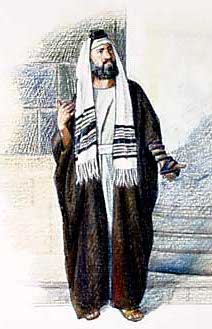
paul-the-phariseeNow when Paul perceived that one part were Sadducees and the other Pharisees, he cried out in the council, “Brothers, I am a Pharisee, a son of Pharisees.

Acts 23:6

Paul used the present tense, “I am a Pharisee,” not “I was a Pharisee.” Christian commentaries are uncomfortable with the statement, and they usually try to dodge the implications by explaining that he used to be a Pharisee prior to becoming a Christian.

Did Paul perjure himself before the Sanhedrin (a grave sin) by saying, “I am a Pharisee” instead of saying, “I was a Pharisee”? If so, none of his accusers had the wherewithal to challenge him on it. If he was no longer a Pharisee at the time of the trial, his testimony would be easy enough to discredit.

-D. Thomas Lancaster
Torah Club, Volume 6: Chronicles of the Apostles
from First Fruits of Zion (FFOZ)
Torah Portion Tazria (pg 711), Commentary on Acts 23:1-24:27

I suppose you could say this is a continuation of my previous “meditation,” Paul the Apostle, Liar, and Hypocrite and earlier commentaries. As I continue to read through Lancaster’s “Chronicles of the Apostles” Torah Club study, I continue to follow Paul through his various “legal problems” and his journey that will eventually lead to Rome, Caesar, and death. I also continue to watch as Paul repeatedly defends himself against the charges brought against him by the Jewish authorities of the Sanhedrin. From Paul’s point of view, he did nothing wrong to the Jewish people, to the Torah, to the Temple, or even to Rome.

Paul argued in his defense, “Neither against the law of the Jews, nor against the temple, nor against Caesar have I committed any offense.”

Acts 25:8

In verse 7 of the same chapter, Luke records that “…the Jews who had come down from Jerusalem stood around him, bringing many serious charges against him that they could not prove.”

As we’ve seen in earlier chapters of Acts and in my earlier commentaries on those chapters (thanks to Lancaster and the Torah Club), there simply was no evidence to support the wild accusations that had been made against Paul. He should have been set free, and except for various political reasons, finally including Paul’s appeal to Caesar and Rome, he never was.

Not only do I want to pursue the scriptures and commentaries that support Paul’s innocence, but I want to continue to illustrate how Paul never imagined that being an apostle of Jesus required in any sense, surrendering observance of the Torah mitzvot and the lifestyle of a Jewish Pharisee, nor did he expect this of other believing Jews.

All believers could claim to adhere to Pharisaic doctrine, but not all of them could claim to actually be Pharisees. Paul concluded his testimony with the declaration, “Brethren, I am a Pharisee, a son of Pharisees; I am on trial for the hope and resurrection of the dead!” (Acts 23:6).

-Lancaster, ibid

That statement might come as a shock to you if you’ve been taught that all Pharisees were horrible, legalistic monsters and hypocrites. After all, Jesus had some pretty rough things to say to the Pharisees.

“Woe to you, scribes and Pharisees, hypocrites! For you are like whitewashed tombs, which outwardly appear beautiful, but within are full of dead people’s bones and all uncleanness. So you also outwardly appear righteous to others, but within you are full of hypocrisy and lawlessness.

Matthew 23:27-28

On the other hand, Jesus also said this:

The scribes and the Pharisees sit on Moses’ seat, so do and observe whatever they tell you, but not the works they do.

Matthew 23:2-3

Do what they say but not what they do. What do they say?

And when he had said this, a dissension arose between the Pharisees and the Sadducees, and the assembly was divided. For the Sadducees say that there is no resurrection, nor angel, nor spirit, but the Pharisees acknowledge them all.

Acts 23:7-8

For Paul, the Pharisaic belief in the resurrection of the dead and a life in the world to come was lived out by his faith in Yeshua (Jesus) as the risen Messiah King.

That is why his faith was “counted to him as righteousness.” But the words “it was counted to him” were not written for his sake alone, but for ours also. It will be counted to us who believe in him who raised from the dead Jesus our Lord, who was delivered up for our trespasses and raised for our justification.

Romans 4:22-25

The doctrine of “the Way” was generally Pharisaic and in believing in the resurrection, so is modern Christianity.

I know, that’s probably a stretch for most of you, but if you follow the logic of Paul’s defense as recorded by Luke, it is very compelling. Lancaster comments further on this point.

The teaching and beliefs of Yeshua, Paul, and all the apostles echo the theology of the Pharisees. A Pharisee could become a disciple of Yeshua and still be a Pharisee…

-Lancaster, pg 713

Not so the Sadducees or any other branch of Judaism that did not believe in resurrection.

Even though the Master sometimes disagreed with the specific priorities of the oral law, He and the apostles practiced and transmitted Pharisaic, rabbinic tradition and interpretation. Their teachings and methods of biblical exegesis mirror those of the Pharisees. The Sadducees, on the other hand, were the first-century equivalents of Karaite Jews and sola-scriptura Protestants. They rejected most Jewish tradition, oral law, and rabbinic exegesis.

-ibid

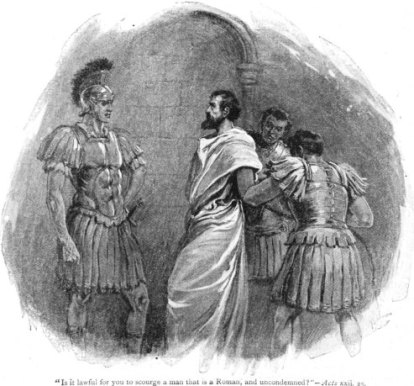
paul-in-chainsFrom a modern Christian’s point of view, we almost want to make the Sadducees the heroes of the story because they rejected Jewish oral law and traditions, and Jesus heavily criticized the Pharisees for some of their traditions. But while many of the Pharisees far exceeded the Torah’s intent by creating enormous burdens from their rulings that weighed heavily on the Jewish people, Jesus did not criticize their core teachings. Being a Pharisee wasn’t the problem. Being a hypocrite and a liar was. Paul was the former but never the latter.

But Paul had a “confession” to make.

But this I confess to you, that according to the Way, which they call a sect, I worship the God of our fathers, believing everything laid down by the Law and written in the Prophets, having a hope in God, which these men themselves accept, that there will be a resurrection of both the just and the unjust. So I always take pains to have a clear conscience toward both God and man.

Acts 24:14-16

Paul admitted to the charge of belonging “to the sect of the Nazarenes,” but he rejected any implication that the teachings of the Way deviated from normative Jewish expression. To Paul, faith in Yeshua was not simply one more sect of Judaism, it was “the Way of the LORD,” a spiritual restoration and redemption of all Israel that transcended sectarian divides. He admitted to “believing everything that is in accordance with the Torah and that is written in the Prophets.” He declared his hope in God, a hope which his accusers also cherished.

-Lancaster, pg 723

There’s one sentence in my last quote from Lancaster that I hope you caught. Here is is again:

To Paul, faith in Yeshua was not simply one more sect of Judaism, it was “the Way of the LORD,” a spiritual restoration and redemption of all Israel that transcended sectarian divides.

This is as true today as it was the moment Paul said it. Faith in Yeshua the Messianic King is not just a way for the world to be saved (which, of course, is no small thing) but it is the way to spiritual restoration and redemption of all Israel. That is the critical piece of knowledge both Jews and Christians must understand. Jesus doesn’t stand in opposition to the Jewish people, he stands for their redemption as a people and their restoration as a nation.

The good news of forgiveness from sins, salvation, and a life in the world to come is what we focus on as Christians, but most of the time, we miss why Jesus is uniquely special to the Jewish people. He doesn’t just save the individual Jewish soul as he does the individual Gentile soul, he saves Israel, he restores their nation to the head of all nations, he gathers his people back to him and to their Land, and he is their King, the King of the Jews, even as he is also the King of the World.

Paul, the “Christian” Pharisee knew all that, and the evidence of his innocence is also a shining lamp for every Jew and Gentile who turns away from darkness and to the light. To turn toward the light, we Gentiles must surrender a life of disobedience and learn to love, listen, and obey God. For a Jew to turn toward the light of the world in Messiah, they also must learn to obey, but Torah observance for the Jew is part of that obedience. We in the church are obedient, not only when we refrain from sin, but when we act to encourage our Jewish brothers and sisters in the faith to continue to live wholly Jewish lives in accordance with the commandments.

Paul lived his life enthusiastically as a disciple of Jesus Christ…and as a Pharisee.

162 days.