All posts by James Pyles

James Pyles is a published Science Fiction, Fantasy, and Horror author as well as the Technical Writer for a large, diversified business in the Northwest. He currently has over 30 short stories published in various anthologies and periodicals and has just sold his first novella. He won the 2021 Helicon Short Story Award for his science fiction tale "The Three Billion Year Love" which appears in the Tuscany Bay Press Planetary Anthology "Mars."

Tetzaveh: Our Children Are Watching

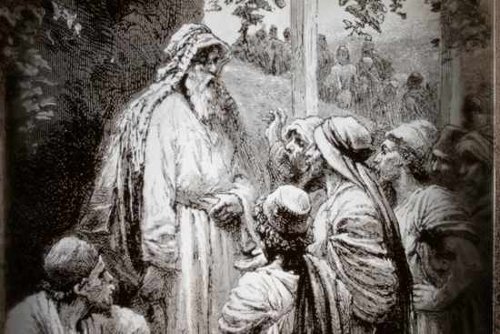
The Rebbe and the ChildA rabbi was sitting next to an atheist on an airplane. Every few minutes one of the rabbi’s children or grandchildren would inquire if they could bring him something to eat or drink or if there was anything they could do for him. The atheist commented, “It’s wonderful the respect your children and grandchildren show you; mine don’t show me that respect.” The rabbi responded, “Think about it. To my children and to my grandchildren, I am one step closer in a chain of tradition to the time when God spoke to the whole Jewish people on Mt. Sinai. To your children and grandchildren — unfortunately, you are considered to be one step closer to being an ape.”

Are children more inclined to respect their parents if they think they are one step closer to being an ape or if they believe that their parents are one step closer to being created by the Almighty who heard God speak?

-Rabbi Kalman Packouz
“Shabbat Shalom Weekly”
Commentary on Torah Portion Tetzaveh
Aish.com

No, I’m not taking a cheap shot at atheists but I would like to wake up a few religious people about the commandment to honor parents and what it all means. According to Rabbi Packouz, the original commandment regarding parents and the related scriptures (see Exodus 20:12, Deuteronomy 5:16, and Leviticus 19:13) actually describe two separate commandments:

We see from these verses that there are two mitzvot (commandments): 1) To honor your parents and 2) To revere your parents. Love motivates one to do positive things; fear keeps one from transgressing the negative.

We are to love and fear (revere) our parents. This may seem more apparent when one is a child. As an adult, we may still love our parents, but we typically don’t fear them anymore. After all, can an eighty year old father or mother send their fifty-eight year old son to “time out?”

But then again, we may be missing something about the full implications of this commandment.

And he said to him, “You shall love the Lord your God with all your heart and with all your soul and with all your mind. This is the great and first commandment. And a second is like it: You shall love your neighbor as yourself. On these two commandments depend all the Law and the Prophets.”

Matthew 22:37-40 (ESV)

We have a Father in Heaven who we are also commanded to love. In fact, in some ways, it’s by having a Father on earth that we can even begin to conceptualize the Father in Heaven. Of course, the analogy is far from perfect. A human Father can be flawed, selfish, distracted, drunk, abusive, overbearing, hostile, wishy-washy, the list goes on. God is perfect and therefore, all of His actions toward us are perfect.

In quoting Rabbi Packouz above, I immediately thought that the Rabbi’s children would only see their Father as closer to God if he acted in a manner consistent with that impression. It’s not like all kids of all Rabbis, Pastors, and other clergy people offer their Dad’s equal reverence. Sometimes it has little to do with the sort of job the Dad has or what the family’s religious tradition is, but children very much are affected by what their father’s actually do, and mold their opinions about him and about Dads in general based whether or not he acts consistently with his stated principles and ideals.

And sometimes how we relate to our earthly Father is how we relate to our Father in Heaven. If we haven’t learned to respect, love, revere, and honor our own Father and Mother, what sort of model do we have for respecting, loving, revering, and honoring our Father in Heaven?

But then, it can work in the opposite way, too. I’ve heard stories of people who have had horrible and abusive Dads, Dads who have sexually molested their children, brutalized them, neglected them, abandoned them. And yet some of those kids have learned to trust their Father who is perfect in Heaven in spite of the cruelty they had to endure from their Father on earth.

children-watchingI don’t think the Rabbi and the other airplane passenger had different relationships with their children because the children of the former saw him as one step closer to God while the children of the latter saw him as one step closer to the apes. I think the difference is who each person was as a Father and a man and how each one of them treated his children and most likely his wife, the children’s mother. Children are more likely to respond by what they see their parents doing rather than what their parents say or who their parents even are (a Rabbi vs. an Atheist). It’s a little scary to think that how we relate to our kids may strongly affect how they relate to God.

But how we behave as a parent and as a human being depends on who we are, what we believe, and then how we choose to act out of all of that.

Gather together and I will tell you what will befall you at the end of days.

Genesis 49:1

Prior to his death, the Patriarch Jacob wished to disclose to his children the future of the Jewish nation. We know only too well what those prophecies were, and Jacob knew that revealing the enormous suffering that the Jews were destined to experience would be devastating to his children. The only way they could hear these things was if they “gathered together” and, by virtue of their unity, could share their strengths.

What was true for our ancestors holds true for us. Our strength and our ability to withstand the repeated onslaughts that mark our history lie in our joining together.

Jacob knew this lesson well. The Torah tells us that “Jacob remained alone, and a man wrestled with him” (Genesis 32:25). Jacob discovered that he was vulnerable only when he remained alone.

Some people feel that they must be completely independent. They see reliance on someone else, be it others or God, as an indication of weakness. This destructive pride emanates from an unhealthy ego. [There is sometimes an] apparent paradox that a humble person is one who is actually aware of his strengths, and that feelings of inadequacy give rise to egocentricity and false pride.

Not only are we all mutually interdependent, the Torah further states that when we join together, our strengths are not only additive, but increase exponentially (Rashi, Leviticus 26:8). Together, we can overcome formidable challenges.

Today I shall…

…try to join with others in strengthening Judaism and in resisting those forces that threaten spirituality.

-Rabbi Abraham J. Twerski
“Growing Each Day, Adar 9”
Aish.com

Part of the Rabbi’s “success” as a father in the original quote was his perception of himself as a Rabbi and as a Jewish man. Without his sense of spirituality and his identity as a Jew who is connected to all other Jews, both in the present, and back across history, how he would behave as a Father and how his children would respond to him might be very different. It might also be very different how his children would choose (or if they would choose) to respond to God.

If you’re a parent, teaching your children about the commandments related to honoring and revering you as parents (which extends also to how they should respond to their grandparents) is a very good thing, but you may be having a much greater impact on your kids than you might imagine. In forging a relationship with your children, teaching them what God expects of parents and children, you are also teaching them what they should expect from God and how to respond to Him as a Father.

family-praying-picnicAs a Christian and a parent, you have a specific identity and source to draw from to define yourself and to define the relationship you have with your children based on what you know of God from His Spirit and from the Bible. While the Rabbi’s children were born Jewish (assuming they had a Jewish mother, and I think this is likely), a Christian’s children aren’t “born Christian.” A Christian doesn’t inherit his or her relationship with God the way a Jew does. Although Jewish children can, Heaven forbid, choose to reject their relationship with God and with Judaism, children born of Christian parents are one more step removed because every Christian must choose their path in life, including a path of faith. It’s even more important for us as parents and grandparents to behave in accordance with our stated beliefs and our faith because unless our children actually see that, we have no hope of transmitting Christian faith to the next generation. Even Jewish parents have a tough time transmitting Jewish faith and values to the next generation, so you can imagine what challenges there are for Christian parents.

That’s why we must make sure that God is continually with us so that our children can see that holiness is our constant companion.

When someone walks the street and thinks words of Mishna or Tanya, or sits in his store with a Chumash or Tehillim – that is more valued today than it was when the streets were bright with the light of Torah. We must not go about in the street with a vacant heart. We must have some Torah memorized, to take with us into the street.

“Today’s Day”
Sunday, 9 Adar I, 5703
Compiled by the Lubavitcher Rebbe
Translated by Yitschak Meir Kagan
Chabad.org

For a Christian, that means living, eating, reading, and breathing our faith, spending time in the Bible, associating with friends who are believers, and behaving in every aspect of our lives in complete consistency with what we know we should be doing as a Christian. This is also why it is vitally important for Jewish parents to perform the mitzvot, regularly daven, recite the Shema, and keep kosher.

No pressure, eh?

But what choice do we have? After all, our children are watching.

Good Shabbos.

According to the Traditions: A Primer for Christians

paul-edited

In his letters to the Thessalonians, Paul frequently referred back to the teaching he passed on to them. For example, he wrote, “Now we command you, brethren, in the name of our Lord Yeshua the Messiah, that you keep away from every brother who leads an unruly life and not according to the traditions (paradosis) which you received from us.” (2 Thessalonians 3:6). In the New Testament, the Greek word “paradosis” refers to Jewish oral tradition. The gospels of Matthew and Mark use the same word to describe Jewish traditions such as washing hands before eating bread and so forth. Paul also used the word in the context of Pharisaic traditions.
Nevertheless, the “paradosis” Paul and Silas imparted to the Thessalonians did not consist of the type of halachic teachings that characterize the legal wrangling of Mishnaic law. Paul and Silas delivered to the community specific commandments in the name of the Master:

We request and exhort you in the Master Yeshua, that as you received from us instruction as to how you ought to walk and please God (just as you actually do walk), that you excel still more. For you know what commandments we gave you by the authority of the Master Yeshua.

1 Thessalonians 4:1-2

What commandments did they transmit in the name and authority of the Master Yeshua?

-D. Thomas Lancaster
Torah Club, Volume 6: Chronicles of the Apostles
from First Fruits of Zion (FFOZ)
Torah Portion Terumah (“Heave Offering”) pg 496
Commentary on Acts 15:36-17:14

I’ve been spending a lot of time this week (and previously) discussing the important role halachah plays in Jewish religious observance, including in the practice of Messianic Judaism. I thought it only fair to give some time to the other side of the coin. What was halachah like for the non-Jewish believers in the Jewish Messiah?

In my Return to Jerusalem series, I spent some time going over Lancaster’s Torah Club commentary on Acts 15 and particularly on the halachah James and the Council of Apostles issued on behalf of the new Gentile disciples. James started with the “four prohibitions” (Acts 15:19-20) and added what some consider a rather cryptic comment that “from ancient generations Moses has had in every city those who proclaim him, for he is read every Sabbath in the synagogues” (v.21), likely indicating that the details or foundations of what the Gentile disciples needed to know would be learned in a more lengthy manner by hearing and studying the Torah as it applied to them (and applies to us today).

Just as a refresher, let’s recall the moment when Jesus gave the apostles the authority to issue binding legal rulings on earth for the community of Jewish and non-Jewish believers:

Truly, I say to you, whatever you bind on earth shall be bound in heaven, and whatever you loose on earth shall be loosed in heaven. Again I say to you, if two of you agree on earth about anything they ask, it will be done for them by my Father in heaven.

Matthew 18:18-19 (ESV)

Thus, just as other Rabbis did for their disciples, allowing them to issue and adapt halachah in order to “operationalize” Torah observance, Jesus issued such authority to his apostles, the difference being that the Messiah’s authority extends infinitely beyond any earthly teacher.

rabbinBut then we are left with the question about just exactly what was the halachah for the Gentile disciples relative to obedience to God? Often, the “four prohibitions” are criticized for being rather anemic about details and obviously lacking in addressing the “obvious” commandments, such as those involving murder, theft, coveting, and so on. Some Christians have suggested that, because of the lack of detail, the intent was for the Gentile disciples to observe the Torah and halachah in an identical manner to the Jewish disciples. On the other hand, we see in the words of Paul to the Thessalonians and in Lancaster’s take on them, that Paul (and presumably the other apostles who were ministering to the non-Jewish disciples) where issuing instructions to the Gentiles both in terms of general teachings and as particular situations came up.

I borrowed a quickie explanation of the role of halachah that should help us from someone on Facebook:

In every branch of Judaism you have set guidelines that those who are under that group agree to, at least on the face, but how and where they are applied varies. As to the rabbis giving rulings here are a few things to remember; 1) halakah is always being reviewed as times change to see the best way to apply the basics, 2) those who establish the halakah are usually well versed in the issues so they can make wise decisions. Think of it this way. Its like a Jewish supreme court. The principles remain the same. The rulings affect the community at large, and just like any court system, there will be times when we need to ‘ go back to the books” In this case Torah and rabbinic writings. For example; the basic halakah for observing Shabbat is to do no normal work that day. However, if your job is being a firefighter, policeman, etc. then what? The answer is that since saving a life outweighs all else working is not only ok but actually a mitzva.

So halachah isn’t necessarily supposed to be “timeless truth” that is immutable across all of history. It’s supposed to be a method of living out the commandments of Torah that are specific to a time, place, culture, and so on. Halachah can’t contradict the words of Torah but it can shape the nature of how to apply a commandment given some specific detail (should one drive their car to Shabbat services, for instance).

As Lancaster points out in his commentary, the Gospels hadn’t yet been written, so the teachings of the Master as we have them today did not exist in a documented form. If some missionaries were “planting a church” in a foreign land today and they were about to depart, the missionaries could leave copies of the Bible behind, including the Gospels, but that wasn’t possible in the days of Paul and Silas. Thus, from Paul’s perspective, the teachings of Jesus were considered paradosis, the operationalization of how to obey God and applied to a local community’s situation or circumstances.

In 1 Thessalonians 4:3-12, Paul mentioned the prohibition on sexual immorality, and he contrasted the standards of “the Gentiles who do not know God” against the sexual purity he expected from believers. He cited prohibitions on defrauding a brother and warned against moral impurity. He reminded the disciples about the commandment to love one’s neighbor as oneself.

Paul boasted, “You also became imitators of us and of the Master” (1 Thessalonians 1:6). In his second epistle to Thessalonica, he encouraged the disciples to “stand firm and hold to the paradosis which you were taught, whether by word of mouth or by letter from us” (2 Thessalonians 2:15).

-Lancaster, pg 497

ancient-rabbi-teachingSo according to Lancaster, we can reasonably believe that Paul was issuing rulings of halachah to the newly minted Gentile disciples (both those who had been former God-fearers and those who had only recently been worshiping in pagan temples) based on the teachings of Jesus and adapted to the local communities he was addressing. I say “adapted” not to say that the teachings were changed, just “contextualized” for those receiving his message. For instance, Paul might take a specific teaching such as the prohibition against looking at a woman with lust (Matthew 5:27-28) and applied it to a community where a problem with extramarital affairs was apparent, citing circumstances that were specific to that community. That “halachah” may not necessarily apply in the same way to other communities or even to the same community in the future, assuming circumstances change.

It’s kind of a difficult thing to get your brain around if you are not used to thinking in these terms, but Paul had quite a job to do in educating the various non-Jewish “churches” on ethical monotheism, the teachings of the Master, their basis in Torah, and the Apostolic decree from Jerusalem.

And in looking back across history at all of this, we have a problem.

While reading the narrative in the Acts of the Apostles or the content of Paul’s epistles to his congregations, readers should keep in mind that we are without the vast body of the paradosis that Paul passed on to his communities. In general, his writings express concern only with issues which had arisen as problems within the communities or his perspectives that contradicted those other teachers. That narrow expression sometimes creates the false impression that Paul was at odds with Judaism in general and with the rest of the apostles specifically. The reader should remember that the larger body of unrecorded paradosis taught by Paul was consistent with the teaching of Yeshua, the twelve, the rest of the apostles, and the Jewish community.

-Lancaster, ibid

If someone could have pinned Paul down and had him write a book compiling all of the paradosis he taught and then we inserted that book into our Bibles, we might have a far different impression of what it is to be a Christian than we do today, and history between the Jewish and non-Jewish disciples might have charted a different course (well, probably not, but I can dream). But it didn’t happen that way, so it looks like we must exist with gaps in our knowledge, and experience an uncomfortable tension between who we are today in the church and how the first Gentile Christians in Paul’s communities understood who they were.

Originally, the Jewish Council of Apostles and their emissaries, which included Paul, were charged with guiding the Gentile disciples in the teachings of the Messiah including issuing halachah that had general scope across the entire body of believers, and sometimes a more specific scope within a particular community. But only Acts and Paul’s letters stand as witnesses to what that was and what it all meant. But if we have faith not only in God but in the Word that He left for us, then we must believe that the Bible is sufficient for our needs. I’ve heard some people weave this sort of “conspiracy theory” or that about how the Bible’s canon was manipulated to drive Gentile Christianity away from its “Hebrew roots,” but we can’t rewrite nearly 2,000 years of history.

two-roads-joinWe can however, chart a course into the future. I continue to maintain that relationships between believing Jews and believing Gentiles are slowly improving. Part of what contributes to that effort is the struggle to understand where we came from and what that means for us today. Christianity must look beyond its traditional doctrine and dogma and try to see the looming shadow of the Jewish Messiah King as he dons his sword, readies his steed, and prepares to return to the world we all live in. If we ever hope to truly understand the Messiah and King we call “Savior” and “Lord,” then we must try to understand not only the “Jewish Jesus,” but the apostles and emissaries he left to guide the first Gentile disciples into “Christianity.”

I’m not writing all this to answer questions but to pose possibilities. If there is halachot that applies to Jewish practice today, then there is something corresponding that applies to the church as well. We can’t fully recover everything Paul taught but we can acknowledge that the traditions regarding how the Jewish disciples understood the process of teaching and applying commandments aren’t so different after all, from what was taught to the non-Jewish disciples. I don’t intend to delete distinctions between Jewish and Gentile disciples, either historically or as they exist today. I only want to say that we may also have a few things in common. We share the same God. We share the same Messiah. And back in the day, we shared the same teachers who all taught application of commandments in terms of paradosis, according to the traditions.

Throwing Stones

jacobs-wellDo not throw a stone into the well from which you drank.

-Bava Kama 92b

The Talmud states that this folk saying is related to the Torah commandment, “Do not reject an Egyptian, because you were a dweller in his land” (Deuteronomy 23:8). Since Egypt hosted the Israelites, we, their descendants, must acknowledge our gratitude.

The brief period of tranquility that our ancestors enjoyed in Egypt was followed by decades of ruthless enslavement and brutal oppression. Thousands of newborn Israelite children were murdered. This unspeakable horror more than obscured any favorable treatment they had received earlier, and our natural inclination is to despise the Egyptians with a passion.

The Torah tells us to take a different path. Although we celebrate, every Passover, our liberation from this tyrannical enslavement and commemorate the triumph over our oppressors, we have no right to deny that we did receive some benefit from them. Even though a denial of gratitude might appear well justified in this particular case, it might impact upon us in such a manner that we might also deny gratitude when it is fully deserved.

If people cast stones into the well from which they drank, the well will not be hurt in the least, because it is an inanimate and insensitive object. The act, however, might impact negatively upon those who do it: they might subsequently behave with a lack of gratitude to people as well.

Today I shall…

…try to remember to be considerate of anyone who has any time been of help to me, even though his later actions might have been hostile.

-Rabbi Abraham J. Twerski
“Growing Each Day, Adar 10”
Aish.com

Over the past week or two in my blogs, I’ve had encounters with a few people who you could consider hostile or at least ill-mannered. This, in spite of what I’ve been trying to accomplish by refraining from participating in so many other online encounters. As Rabbi Zelig Pliskin says, “Why don’t people like to remain silent when others insult them? Because they’re afraid that others might think they’re weak and unable to answer back.” But as he also says, “The truth is, it takes much greater strength to remain silent when someone insults you. Revenge, on the other hand, is a sign of weakness. A revenger lacks the necessary strength of character to forgive.”

I strive to learn how to be better at forgiving, even when others may not realize they have caused harm or offense (and it’s not like I’m blameless, either).

Then I encountered Rabbi Twerski’s commentary for yesterday and it occurred to me that many of us have been “throwing stones in the well from which we drank.”

Yesterday, both Derek Leman and I wrote about the vital importance of Jewish Torah observance, particularly for those Jews who have become followers and disciples of Jesus as the Jewish Messiah. In some manner or fashion across the long centuries after the destruction of Herod’s Temple, we in the church have been throwing pebbles, and rocks, and boulders, and monolithic asteroid-sized chunks of granite into “the well from which we have all drank.”

We’ve been making a mockery of what Paul was trying to tell us.

Therefore remember that at one time you Gentiles in the flesh, called “the uncircumcision” by what is called the circumcision, which is made in the flesh by hands—remember that you were at that time separated from Christ, alienated from the commonwealth of Israel and strangers to the covenants of promise, having no hope and without God in the world. But now in Christ Jesus you who once were far off have been brought near by the blood of Christ. For he himself is our peace, who has made us both one and has broken down in his flesh the dividing wall of hostility by abolishing the law of commandments expressed in ordinances, that he might create in himself one new man in place of the two, so making peace, and might reconcile us both to God in one body through the cross, thereby killing the hostility. And he came and preached peace to you who were far off and peace to those who were near. For through him we both have access in one Spirit to the Father. So then you are no longer strangers and aliens, but you are fellow citizens with the saints and members of the household of God, built on the foundation of the apostles and prophets, Christ Jesus himself being the cornerstone, in whom the whole structure, being joined together, grows into a holy temple in the Lord. In him you also are being built together into a dwelling place for God by the Spirit.

Ephesians 2:11-22 (ESV)

tearing-down-the-wallI know I’m going to be accused of misusing this part of scripture, which is often used to confirm the destruction of the Law and the elimination of any unique Jewish identity in the body of the Messiah, but it all hinges on what sort of “dividing wall of hostility” was brought down and what exactly was the “law of commandments expressed in ordinances” that was abolished. It makes a lot of Christians (including those in the usual variants of the Hebrew Roots movement) feel “hunky dory” to believe that it was the uniqueness of Judaism that Jesus “nailed to the cross” along with his battered, bloody body. Even those Christians who agree that the Law is intact and it was only Judaism that died, agree to the elimination of what it is to be Jewish by redefining the sign commandments of the Torah as not Jewish any longer but belonging to anyone and everyone who claims them.

(And I must say at this point that a great deal of what we also call “Torah” is perfectly accessible to Jews and Christians alike).

I’m sure that when non-Jews claim Jewish sign commandments as their very own, it must feel “hostile” to the Jewish people who would prefer to keep their identities intact.

Back in Acts 15 the problem faced by the Council of Apostles was how to establish and implement “Gentile inclusion” into the body of the Jewish Messiah. For most of the history of the church, the problem reversed itself and was considered how do we establish and implement “Jewish inclusion” into the Christian church? In the latter case, it was by requiring the Jews surrender every last vestige of what it is to be a Jew. However James and the Council made no such requirement of the Gentiles in the former situation, though to be sure, the Gentile disciples had to give something up. But it wasn’t their identity as such, otherwise there would be no “Gentiles called by the Messiah’s name,” only Jews. The Gentiles were included, and ancient “Christianity” became one of the most inclusive religious movements on the planet, because one did not have to covert to Judaism and accept the obligation of the total yoke of Torah in order to join.

But as I’ve said in many conversations recently, I don’t think the relationship between the Jewish and Gentile disciples in those early days ever reached any sort of stability. There wasn’t time. Events such as the Jewish exile from Israel and the Bar Koshba revolt came and went too quickly on the stage of time, and once played out, the result was a separation between the Jews, and the Gentiles who wrested observance and worship of the Moshiach from the Jewish people for nearly twenty centuries.

But all that is beginning to change. What stands in the way is that across all of the long years, the “dividing wall of hostility” has been rebuilt with a vengeance and it is tall and thick and wide and hard. The people on both sides of the wall have built it up and the people on both sides of the wall have been heavily invested in keeping it standing. Good fences make good neighbors as Robert Frost once wrote.

Rabbi Twerski is determined to “remember to be considerate of anyone who has any time been of help to me, even though his later actions might have been hostile.” That certainly describes what we Christians should say of Israel who gave us the Messiah but later was hostile to us because we tried to sell them a “Goyishe King.”

But I’d like to reverse that saying for us. The Master said “salvation comes from the Jews,” (John 4:22) and that statement is the crystallization of Israel’s mission to be a light to the world (Isaiah 49:6). Without Israel and without Israel’s first-born son, Yeshua HaMoshiach, Jesus the Christ, none of us could be saved. But since the time when salvation entered into the world in the body of a man and as the flesh and blood expression of the Divine, much enmity has built up between Israel and the Christianity that resulted from her light. A few Christians and a few believing Jews are finally beginning to breach the wall of hostility and extend friendship and brotherhood to one another, as it was in days of old. I can’t speak for the Jews in Messiah, but as a Christian…

unityToday I shall…

…try to remember to set aside any hostility I may have expressed to either a Jewish person or a Christian because of the struggle in which we are engaged in removing the barriers between us, and realize that though we may not always see things in the same way, we are striving toward the same goal, achieving unity in the body of Messiah so that God may once again dwell among the peoples called by His Name.

Before embarking on a journey from your place of residence, arrange a Chassidic farbrengen and receive a parting blessing from your good friends, and as the familiar expression goes: Chassidim never say farewell, for they never depart from each other. Wherever they are, they are one family.

-“Today’s Day”
Monday, 10 Adar 1, 5703
Compiled by the Lubavitcher Rebbe
Translated by Yitschak Meir Kagan
Chabad.org

Where your thoughts are, there you are, all of you.

-Rabbi Tzvi Freeman
“All of You”
Based on letters and talks of the Rebbe
Rabbi M. M. Schneerson
Chabad.org

May we all work to bring unity and peace among ourselves as believers, and with all humanity, through the Master and Savior of the world, Christ Jesus our Lord.

If I Should Ever Forget Your Torah

Rescuing_torah_scroll_Beth_IsraelRashi on the Chumash (Devarim 31:21) comments and says that this verse serves as a promise that the Torah will never be forgotten from the Jewish people totally – ‫.לגמרי‬

There is a discussion among the commentators how to interpret the meaning of this promise. When the verse says that “Torah” will not be forgotten, Rashi understands that we are assured that the song of Ha’azinu will never be forgotten. This song will remain as testimony for the Jewish people for all generations, and its lesson of the trials and tribulations of the nation and its destiny will accompany them on their trek through history. However, there never was a promise that the rest of the Torah would be remembered forever. This, then, is what Rashi alludes to when he comments that the Torah will never be forgotten “totally”, because the song of Ha’azinu will always remain. This is also how Maharsha understands the statement of Rebbe Shimon ben Yochai in our Gemara.

Maharshal understands that the promise in the verse refers to the written Torah. However, it is the oral teachings that are vulnerable, and there is a danger of their possibly being forgotten. This explanation fits into the narrative of the Gemara, where we find that the day will come when a woman will take a loaf of bread and circulate among the shuls and batei midrash to find out if the loaf is tamei or tahor, but no one will be able to answer her question. The Gemara then asks how this can be so, for the halachah of tum’ah of bread is explicit in the verse (Vayikra 11:34)! Now, if the written Torah itself is not guaranteed to be intact and remembered, it would still be possible for the explicit information of the verses to be forgotten. It must be, explains Maharshal, that the Gemara knows that the written Torah will always be remembered.

Yet even according to Rashi, although the promise of continuity was only made in reference to the song of Ha’azinu, the halachah is that this shira cannot be written by itself (Rambam, Hilchos Sefer Torah 7:1). Therefore, if the song of Ha’azinu will remain forever, it will necessarily require that the rest of the written Torah accompany it in the same scroll. Therefore, the promise of Ha’azinu never being forgotten automatically indicates that the rest of the written Torah, as well, will never be lost.

Daf Yomi Digest
Gemara Gem
“The Torah will never be forgotten”
Shabbos 138

My father writes in one of his letters: A single act is better than a thousand groans. Our G-d lives, and Torah and mitzvot are eternal; quit the groaning and work hard in actual avoda, and G-d will be gracious to you.

“Today’s Day”
Monday, Adar Sheini 8, 5703
Compiled by the Lubavitcher Rebbe
Translated by Yitschak Meir Kagan
Chabad.org

For the vast majority of Christians, reading what I’ve just quoted above won’t make a great deal of sense, especially when we focus on the sure promises we have through salvation in Jesus Christ, but since I’ve been talking about Jewish identity in the body of Messiah lately, I thought those words applied. More specifically, I think it’s important for we in the church to try to comprehend what a sense of identity as a Jew means to many Jewish people, including those who have accepted Jesus (Yeshua) as the Jewish Messiah. Most of Christian history has created a sort of “reflexive expectation” in the church that results in our anticipating that Jewish believers should look and act like the Gentile believers, and that the things of Judaism (lighting candles on Erev Shabbat, davening with a siddur while wearing a tallit gadol and laying tefillin, keeping glatt kosher, and so forth) should simply go “bye-bye.”

This is at the heart of much of the debate between the halachically Jewish members of Messianic Judaism, and the Christians in the church, as well as many Christians attending Hebrew Roots groups. We non-Jews keep asking ourselves and the Jews who revere the Master what’s the big rip-roaring deal about remaining distinctively Jewish? Didn’t Paul say it was no big deal for him?

If anyone else thinks he has reason for confidence in the flesh, I have more: circumcised on the eighth day, of the people of Israel, of the tribe of Benjamin, a Hebrew of Hebrews; as to the law, a Pharisee; as to zeal, a persecutor of the church; as to righteousness under the law, blameless. But whatever gain I had, I counted as loss for the sake of Christ. Indeed, I count everything as loss because of the surpassing worth of knowing Christ Jesus my Lord. For his sake I have suffered the loss of all things and count them as rubbish, in order that I may gain Christ and be found in him, not having a righteousness of my own that comes from the law, but that which comes through faith in Christ, the righteousness from God that depends on faith—that I may know him and the power of his resurrection, and may share his sufferings, becoming like him in his death, that by any means possible I may attain the resurrection from the dead.

Philippians 3:4-11 (ESV)

paul-editedOK, Paul wasn’t saying that he exchanged his Judaism for his faith in Jesus Christ, since they are hardly mutually exclusive. He was saying that being Jewish, in and of itself, didn’t make him a “big deal” and didn’t hold a candle to everything he had gained since he had come to knowledge and faith in the Jewish Messiah. The Messiah is the goal, he opens all the doors, he holds all the keys, and compared to that, no matter who you are, it doesn’t mean as much as everything Messiah means.

But it also doesn’t mean that Paul thought being Jewish was nothing, either. He never stopped being Jewish, never stopped acting Jewish, never stopped eating, sleeping, walking, and breathing Jewish until the day he died.

And for nearly 2,000 years, the vast, vast majority of Christianity has required, demanded, insisted, and red-in-the-face screamed at the Jewish people desiring to come to Messiah to stop being Jewish as a condition of becoming a “Christian.” (and I put that word in quotes because of how it has been used against the Jewish people who are just as Jewish as their King). If we demand that they forget the Torah, that they set aside their halachah, that they extinguish their Shabbos candles for the sake of Moshiach, how are we any different from all those generations of Christians who came before us and demanded the same things or worse?

But there’s something more to consider.

Sitting at a table in a non-kosher restaurant is a problem of “marit ayin,” which means that we have a responsibility to avoid creating a situation where others may draw the wrong conclusion – i.e. a passerby might see you and think that the restaurant is really kosher and it’s okay to eat there. Or others might think that since you (who purports to keep kosher) are lax in observance, then somehow it’s okay for them, too.

-From Ask the Rabbi
“Eating in Non-Kosher Restaurant”
Aish.com

Sounds a little bit like this sort of problem…that is, if the Jewish person in question was a believer.

But when Cephas came to Antioch, I opposed him to his face, because he stood condemned. For before certain men came from James, he was eating with the Gentiles; but when they came he drew back and separated himself, fearing the circumcision party. And the rest of the Jews acted hypocritically along with him, so that even Barnabas was led astray by their hypocrisy.

Galatians 2:11-13 (ESV)

You’d think that Peter would have gotten past this problem after his staying in the household of the Roman Cornelius back in Acts 10, but he still seemed to be worried about what some important Jewish men from James might think if they saw him eating with the non-Jewish brothers of the faith. Was it because Peter was enjoying a nice, big, juicy cut of pork or maybe a steaming hot bowl of prawns? Probably not, but that’s just a guess because the Bible doesn’t say what was on the menu. It’s more likely though, that whatever was being eaten was acceptable under the laws and accepted halachah involving kashrut, even if Peter was just having a salad, and he thought not all of the emissaries from James were totally on board with this whole “It’s OK to have table fellowship with the Gentile believers” thing.

kosher-in-los-angelesPaul, for his part, was completely OK with it and the fact that these were supposed to be “important men” cut no ice with him at all (v. 6). As the Aish “Ask the Rabbi” writer says, Peter may have been concerned with “a problem of marit ayin.”

I recently read David H. Stern’s book Restoring the Jewishness of the Gospel (2nd ed.) and one of the points Stern made was that a Jewish believer must continue to observe the mitzvot including the accepted halachah. Another of his points was that Jewish reluctance to share a meal with a Christian must not stand in the way of unity in the larger body of Messiah which includes both Jewish and non-Jewish “body parts.”

That’s a tough one, especially depending on the level of kashrut the Jewish believers are observing (I’ve seen some variability). Of course, it also depends on the level of kashrut being observed by the Gentile believers, but keeping kosher (in my opinion) is optional for non-Jews but (again, in my opinion) mandatory for Jews (particularly Jews considering themselves observant within the Messianic framework).

I should say at this point that it’s pretty cheeky of me to even suggest that I know what observant Messianic Jews should or shouldn’t do, except that I’ve been told on numerous occasions by a number of Jewish Messianic believers that this is how they think about kashrut as well.

In this particular blog post, I’m not going into what I think are the specific differences between how Torah should be applied to believing Jews vs. believing Gentiles, but I do want to suggest (again) that we Christians cannot expect or demand that Jews stop being observant Jews because we may not know how to operationalize “kosher” (for instance) or that we have issues with some of the halachah involved in kosher (or many other Jewish practices). Jews should be allowed to observe halachah as long as such practices don’t fly completely in the face of how the Bible describes the proper behavior for a disciples of Christ (and I realize I’m opening the door to various interpretations of “Biblically proper” here).

At this juncture, I can’t help but be reminded of this, particularly since it’s part of the blessings associated with the Birkat HaMazon.

If I forget you, O Jerusalem, let my right hand forget its skill! Let my tongue stick to the roof of my mouth, if I do not remember you, if I do not set Jerusalem above my highest joy!

Psalm 137:5-6 (ESV)

And then, there’s this particular mitzvah.

In order that you remember and perform all My commandments.

Numbers 15:40

Now we’re right back where we started: the commandment for the Jewish people not to forget the Torah. Of course, it’s not as if there haven’t been gaps when the Torah was not remembered let alone studied.

And when the king heard the words of the Law, he tore his clothes. And the king commanded Hilkiah, Ahikam the son of Shaphan, Abdon the son of Micah, Shaphan the secretary, and Asaiah the king’s servant, saying, “Go, inquire of the Lord for me and for those who are left in Israel and in Judah, concerning the words of the book that has been found. For great is the wrath of the Lord that is poured out on us, because our fathers have not kept the word of the Lord, to do according to all that is written in this book.”

2 Chronicles 34:19-21 (ESV)

But then again, it’s always been rediscovered, and Israel has always repented and returned to God and the Torah.

Rolling the Torah ScrollWhether we Christians always understand it or not, there is a bond between God, the Torah, and the Jewish people. That bond has existed for thousands of years, in spite of every effort of the nations opposing Israel and those persecuting the Jewish people to destroy that bond (often by burning synagogues, Torah scrolls, volumes of Talmud, and sometimes Jewish people). So when we Christians attempt to loosen the bond between Jew and Torah, which includes halachah, we can expect to see some resistance and even some push back. Expecting a Jew to forget Torah, at least because we’ve said they should, is like expecting a mother to forget her only child.

Memory is a unique Divine gift. Indeed, to this very day, neuropsychologists have not discovered the secret of exactly how memory operates. The turnover of the chemicals in our bodies is such that after a period of time not a single atom remains in the brain that was there several months earlier, yet a person’s brain retains memories for years, decades, a lifetime.

This unique gift should not be abused. Many times the Torah tells us what we should remember and cautions us against forgetting. The concepts and events that we must retain are goals that are vital to our spiritual well-being. Most siddurim list six verses of the Torah that we should recite each day to remind us of who we are and to caution us against idolatry and lashon hara (harmful talk).

However, if we use this wonderful gift to remember those who have offended us and to harbor grudges against them, or if we remember the favors we have done for others and expect them to be beholden to us, we are abusing this Divine gift.

The key to discerning what we should remember and what we should forget is contained in the above verse: “In order that you remember and perform all My commandments.” Any memory that does not assist us in working toward the ultimate goal of serving God does not deserve being retained.

Today I shall…

…try to retain in my mind only those things that contribute to my devotion to God, and dismiss those things that may deter me therefrom.

-Rabbi Abraham J. Twerski
“Growing Each Day, Adar 8”
Aish.com

I know someone out there is going to tell me how unfaithful the Jewish people have been to God throughout their history. I know someone is going to tell me that the majority of the world’s Jewish population is completely secular. Be that as it may, that doesn’t justify Christians requiring the believing Jews in our midst to also forget the Torah when they believe with great zeal that God has called them to always remember the mitzvot, to love God, and to obey Him, as He has long since taught His people Israel to do.

The Jesus Covenant, Part 10: Hebrews and the Covenant Mediator

rabbi_child_and_sefer_torahThere still seems to be some confusion between the Torah delivered at Mt. Sinai and the covenant made with Israel.

The Torah is not to be surrendered by anyone who is born of the Ruach and is now a child of YHWH through faith in Messiah Yeshua. I’ve not said that and I haven’t read here where anyone else has made that assertion either.

As far as following through on “their end of the bargain”, they, Israel, didn’t. Which is why a new covenant was promised to be cut with both houses of Israel. And holding onto a covenant which cannot be accomplished due to the weakness of the flesh while trying to affirm the operational specifics of the current covenant would cause some tension to say the least.

Maybe someone could provide a detailed explanation of what a child of YHWH should look and act like so we can all see what it means to be a son or a daughter of our Father in Heaven. Perhaps then we could cease from making so much noise about who is pretending to be a part of one culture group or another.

And by the way it was not “their covenant with God”. It was His covenant with them. His terms His conditions. I did not say that He replaced that covenant, He did. I’m just agreeing with the text of scripture. Now if someone wants to seek their justification through that covenant they are welcome to do so. But they will come up empty. Of course, if someone was trying establish something else through that covenant I would have to wonder what their motive might be. And what their ultimate objective was.

-Russ
from a comment on one of my blog posts

This is the tenth part of my series on trying to understand what the “New Covenant” is, how it relates to the previous covenants we see God making with humanity (and specifically with the Children of Israel) in the Bible, and what it’s supposed to mean today.

I’ve neglected this series terribly, mainly because it’s so hard to write. Part 9: The Mysterious 2 Corinthians 3 was published last October which will give you some idea of how long I have left this one alone. It’s not that I’ve come to any satisfactory resolution to my problem. It’s just that sometimes trying to understand all this has the same effect as repeatedly smashing my forehead against a brick wall.

But then Russ’s comment reminded me that the New Covenant is still sitting out there taunting me; daring me to try to comprehend it. Russ seems fully convinced that he understands its meaning and that it must mean something about creating a people who are born of the Spirit and (perhaps) relegating Jewish identity to that of a “culture group”.

Did God obliterate all His previous covenants with His people Israel because they were unfaithful? That sort of sounds like God tried plans A, B, and C and they didn’t work out, and then he devised Plan D: writing it on their hearts, which couldn’t fail. If covenants are replaced because covenant members are defective (which God should have known all along) and God has to (finally) create a covenant they can’t because it’s written on the heart, why couldn’t He have started out with the unbreakable covenant and avoided a lot of pain and anguish?

I don’t know, but it sounds like a set up for God to make a covenant with Israel at Sinai knowing that they were going to break it, and knowing that the consequences for breaking it was forfeiting their unique relationship with God as a distinct people and nation.

Oh, if you haven’t read through the “Jesus Covenant” series or you haven’t read through it in a while, it might be a good idea to at least scan through it again, starting with Part 1: The Foundation, just to get up to speed.

But as it is, Christ has obtained a ministry that is as much more excellent than the old as the covenant he mediates is better, since it is enacted on better promises. For if that first covenant had been faultless, there would have been no occasion to look for a second.

Hebrews 8:6-7 (ESV)

Therefore he is the mediator of a new covenant, so that those who are called may receive the promised eternal inheritance, since a death has occurred that redeems them from the transgressions committed under the first covenant. For where a will is involved, the death of the one who made it must be established. For a will takes effect only at death, since it is not in force as long as the one who made it is alive. Therefore not even the first covenant was inaugurated without blood. For when every commandment of the law had been declared by Moses to all the people, he took the blood of calves and goats, with water and scarlet wool and hyssop, and sprinkled both the book itself and all the people, saying, “This is the blood of the covenant that God commanded for you.” And in the same way he sprinkled with the blood both the tent and all the vessels used in worship. Indeed, under the law almost everything is purified with blood, and without the shedding of blood there is no forgiveness of sins.

Hebrews 9:15-22 (ESV)

shekhinaThis is where I left off last time. These verses were to be the last step in my investigation into the New Covenant. I seriously doubt that I’m going to reach any useful conclusion here, but at least I’m continuing on the trail.

In reading these verses from Hebrews, it certainly seems as if God has tossed the Covenant He made with Israel into the trash can (and Israel along with it) and created a New Covenant replacing the Old using the blood of Jesus Christ. Of course, I can’t read Biblical Greek, so the mystery of what the oldest texts from Hebrews is trying to tell me remains a mystery. I can of course read the various commentaries on Hebrews 8:6 when I scroll down the page, but there’s not exactly a cohesive explanation telling me what I need to know.

But Gill’s Exposition of the Entire Bible for this verses does say something interesting:

…which was established upon better promises; which are not now delivered out as before, under the figure of earthly and temporal things; nor under a condition to be performed nor confined to a particular people and nation…

I can accept the fact that the Sinai covenant was made specifically between the God and the Children of Israel and that the New Covenant has provisions that include all of humanity through Christ. If the New Covenant didn’t function in such a manner, then no one outside of Israel could be saved. I can accept the fact that the blood of animals could never take away sins (Hebrews 10:4) and that salvation for all human beings must be through Messiah.

But where does it say that the Jews as a people must surrender being Jews in order to enter into the New Covenant? Sorry, but whenever I hear “the Old Covenant has been replaced” language, I wonder how do you do that and still keep the people who were attached to it as a people?

The days are coming,” declares the Lord, when I will make a new covenant with the people of Israel and with the people of Judah.

Jeremiah 31:31 (ESV)

Waitaminute! God is saying He will one day make a New Covenant with the people of Israel and the people of Judah. Doesn’t say anything about the people from the nations who are gathered together and called by His Name through the Messiah. Of course, there are a lot of Christians who see themselves as the new “spiritual Israel” and so they write themselves into the script that way. Others believe that the Jewish people are “Judah” and that in some manner or fashion, the Gentiles who are attracted to God, the Torah, or Christ become (or in some fashion are) the lost tribes of Israel (see the book Twelve Gates: Where Do the Nations Enter for the much more likely explanation that representatives of “the lost ten tribes” actually did return, intermarried, and were eventually assimilated into Judah and Benjamin…thus, modern day Jews contain the descendants of all the Tribes of Israel).

Now try to understand the following within that context.

Therefore say to the house of Israel, Thus says the Lord God: It is not for your sake, O house of Israel, that I am about to act, but for the sake of my holy name, which you have profaned among the nations to which you came. And I will vindicate the holiness of my great name, which has been profaned among the nations, and which you have profaned among them. And the nations will know that I am the Lord, declares the Lord God, when through you I vindicate my holiness before their eyes.

Ezekiel 36:22-23 (ESV)

In that sense, it’s easy to see that Israel: the Jewish people, are very much written into God’s plan for the future and they have not been discarded and dissolved as a people or a nation by God. The mystery that I was trying to investigate when I started this series was not what happens to Israel, which seems a given, but how in the world do we from among the nations get added in to this covenant? Certainly, the Abrahamic Covenant includes the nations, but we are not mentioned again in subsequent covenants until the New Covenant, and our inclusion isn’t made clear until we see Paul make his commentaries on the meaning of Messiah for the rest of us (remember, the oldest texts we have of Jesus and the “Last Supper” don’t include the word “new” when he talks about the covenant in this body and blood…we have to assume that’s what he means).

Throne of GodBut the passages I quoted from Hebrews do give the impression that what was old is being replaced with what is new. Is that a completed act, though? I don’t know. Messiah has yet to return. He has not yet completed his work. There is no new Temple built by him. There is no worldwide peace as far as I can tell. Israel is not at the head of the nations yet and she is still being threatened on all sides by numerous adversaries.

We know that the New Covenant is inexorably tied to the Jewish Messiah and he is the inescapable mediator and motive force of the New Covenant with Judah and Israel and even with the nations. All I can suggest at this point is that the New Covenant hasn’t simply been flipped on like a light switch if, for no other reason, than we aren’t really acting like the Word is written on our hearts. If it were, would we in the body of believers still be so defective, and cranky, and flawed? What if the enactment of the New Covenant is a long process, not a sudden event? After all, the many and numerous conditions and enactments of the Sinai covenant weren’t “turned on” all at once, probably because many of those conditions required the Israelites to live in the Land, and for forty years, they were wandering in the desert.

And what about this?

And I saw no temple in the city, for its temple is the Lord God the Almighty and the Lamb. And the city has no need of sun or moon to shine on it, for the glory of God gives it light, and its lamp is the Lamb. By its light will the nations walk, and the kings of the earth will bring their glory into it, and its gates will never be shut by day—and there will be no night there.

Revelation 21:22-25 (ESV)

I’ll be the first one to admit that I don’t understand what’s going on and how all this is supposed to work, but it seems like there’s a sequence of events that have not yet been completed. Will the Law, what defines the significantly unique relationship God has with Israel, the “Jewishness” of Jewish people, and the holiness of Jerusalem be eliminated from existence or meaningfulness until everything that God has said He will do has been accomplished?

I seriously doubt it but the secrets of the Bible continue to elude me. This doesn’t preclude my pursuit of a holy and meaningful life, but it does make it difficult to respond to anyone who wants the New Covenant to land on the Jewish people like a ton of lead, mashing them flat, and leaving a completely new “product” in their place.

I don’t know if I’m going to write a “Part 11: Conclusions” blog post, at least not right way. There’s still so much more to try to comprehend. But as my friend Carl said, maybe it’s the struggle that matters, not what we may come up with as a result.

I am not suggesting that there is a chaos of interpretation and no absolute truth, but that interpretation is part of the human condition, our relationship with all texts (and people, for that matter). The Holy Spirit helps us but it does not erase our humanity. In fact, your blog can be considered in large part a struggle to find an interpretive approach to the Bible that is coherent, satisfying, and works for you.

TrustI wish we could all dial things down just a bit concerning truth-claims. We have been told that love endures but knowledge is partial. That would include my knowledge (or interpretation) of the Bible. I hold a certain interpretive approach to the Bible (in common with a number of others) that I believe to be coherent and satisfying even though I know that it is limited and hope to learn from other approaches until the day I die..

I guess what I am saying is that “we know in part . . . but when the perfect comes, the partial will be done away.” Since we are finite and the perfect is infinite, it makes sense that our knowing is partial until will are face to face.

Finally though, we can’t ignore this:

I will never break my covenant with you.

Judges 2:1 (ESV)

Israel may have been unfaithful on many occasions, but God never let them go. Instead, He made it possible for others to come to Him as well, all through His son.

Incinerating

onfire.jpgWhen dross is removed from silver, the vessel can emerge for the refiner; when an evildoer is removed from the king, his throne is established in righteousness. Do not glorify yourself in the presence of the king, and do not stand in the place of the great, for it is better that it should be said to you, “Come up here,” than that you be demoted before the prince, as your eyes have seen [happen to others].

Proverbs 25:4-7 (Stone Edition Tanakh)

If a man invites you to his wedding celebration, do not recline at the head or else someone else more honored than you may also be invited there. The host will come to you and him and tell you, “Clear a place for him.” Then you will get up ashamedly to sit at the place at the end. But if you are invited, sit in the place at the end so that the host will come and say to you, “My friend, move up higher than this!” It will bring you honor before those reclining with you. Everyone who lifts himself up will be brought low, but everyone who lowers himself will be lifted up.

Luke 14:7-11 (DHE Gospels)

No, this isn’t another rant about people in the religious world putting on airs and telling the rest of us what is or isn’t right about Christianity and the Bible and such. It’s about something far more serious than that. It’s about ultimate consequences.

“And to the angel of the church in Thyatira write: ‘The words of the Son of God, who has eyes like a flame of fire, and whose feet are like burnished bronze.

“‘I know your works, your love and faith and service and patient endurance, and that your latter works exceed the first. But I have this against you, that you tolerate that woman Jezebel, who calls herself a prophetess and is teaching and seducing my servants to practice sexual immorality and to eat food sacrificed to idols. I gave her time to repent, but she refuses to repent of her sexual immorality. Behold, I will throw her onto a sickbed, and those who commit adultery with her I will throw into great tribulation, unless they repent of her works, and I will strike her children dead. And all the churches will know that I am he who searches mind and heart, and I will give to each of you according to your works. But to the rest of you in Thyatira, who do not hold this teaching, who have not learned what some call the deep things of Satan, to you I say, I do not lay on you any other burden. Only hold fast what you have until I come. The one who conquers and who keeps my works until the end, to him I will give authority over the nations, and he will rule them with a rod of iron, as when earthen pots are broken in pieces, even as I myself have received authority from my Father. And I will give him the morning star. He who has an ear, let him hear what the Spirit says to the churches.’”

Revelation 2:18-29 (ESV)

Please don’t take that quote as if I’m aiming it at you personally. I’m not. I’m just trying to communicate something that I don’t think we always understand. No matter how much we think we’re doing to build up the Kingdom of God, to help other human beings, to study the Bible and learn God’s ways for our lives; no matter how much we believe our acts of righteousness and the faith and zealousness that burns in our hearts means to God, perhaps all that we believe we’ve accomplished doesn’t matter as much as we think. Maybe the Christ, the Jewish Messiah King, who came once and who will return again in glory and in awesome, majestic power, has something against us, just had he had against the church at Thyatira (or the churches of Ephesus, Pergamum, Sardis, Laodicea, and so on).

In my conversation with Pastor Randy last week, we were talking about righteousness (no small subject, that), particularly what we human believers think righteousness is compared to the standards of the Master. Human beings, even the best of us, have a tendency to be a little self-deluding. We like to think things around us and things about ourselves are a little better than they really are. I think that helps us not dwell on futility so much, and keeps us from being depressed, not that we have reason to be if we are disciples of Christ. Nevertheless, most of us go around most of the time thinking we’re a lot “cooler” and more in tune with God than we probably really are.

Pastor Randy and I were discussing what an actual encounter with Jesus would be like. A lot of Christians imagine meeting Jesus to be a very peaceful and comfortable event, like visiting your favorite uncle when you were a child, and you could just hop up on his lap so he could read to you from your favorite story book. Most of us don’t envision such a meeting going like the one John writes of here:

I was in the Spirit on the Lord’s day, and I heard behind me a loud voice like a trumpet saying, “Write what you see in a book and send it to the seven churches, to Ephesus and to Smyrna and to Pergamum and to Thyatira and to Sardis and to Philadelphia and to Laodicea.”

Then I turned to see the voice that was speaking to me, and on turning I saw seven golden lampstands, and in the midst of the lampstands one like a son of man, clothed with a long robe and with a golden sash around his chest. The hairs of his head were white, like white wool, like snow. His eyes were like a flame of fire, his feet were like burnished bronze, refined in a furnace, and his voice was like the roar of many waters. In his right hand he held seven stars, from his mouth came a sharp two-edged sword, and his face was like the sun shining in full strength.

When I saw him, I fell at his feet as though dead.

Revelation 1:10-17 (ESV)

Under heavenNo one wants to visit a “favorite uncle” if he’s so awesome and terrifying that a mere glimpse of him makes us fall down and think we’re going to be incinerated in the next half-second. On the other hand, that seems to be exactly how John experienced his encounter with the risen and living Christ, even though decades before, John had walked in the presence of Jesus and knew no fear. It is no small thing to face the King of Kings and the Lord of Lords and to realize what it is to stare into the eyes of true righteousness. Maybe we have something to be afraid of after all.

“Then he will say to those on his left, ‘Depart from me, you cursed, into the eternal fire prepared for the devil and his angels. For I was hungry and you gave me no food, I was thirsty and you gave me no drink, I was a stranger and you did not welcome me, naked and you did not clothe me, sick and in prison and you did not visit me.’ Then they also will answer, saying, ‘Lord, when did we see you hungry or thirsty or a stranger or naked or sick or in prison, and did not minister to you?’ Then he will answer them, saying, ‘Truly, I say to you, as you did not do it to one of the least of these, you did not do it to me.’ And these will go away into eternal punishment…

Matthew 25:41-46 (ESV)

I’m not saying that a life of faith is futile and that we have to second guess God and wonder at our relationship with Him…not if we’re willing to be really honest with ourselves. I’m saying that no matter what we’ve done and how well we think we’ve served God, we probably aren’t the really big deal we think we are (if that’s what we’re thinking). Imagine meeting the Master is like precious metal being refined. Imagine he can see through all the dross with a gaze that emits a raging fire and burns it all away, revealing the tiny bits and minute portions of what is truly of value hidden deep inside of us.

We have all become like one who is unclean, and all our righteous deeds are like a polluted garment. We all fade like a leaf, and our iniquities, like the wind, take us away.

Isaiah 64:6 (ESV)

…as it is written: “None is righteous, no, not one; no one understands; no one seeks for God. All have turned aside; together they have become worthless; no one does good, not even one.”

Romans 3:10-12 (ESV)

And with all that we think is worthy but is actually worthless is burned away under the Master’s flaming gaze, what will be left of us? We can only hope and pray that he will find some small gem of faith within us that will save us from wrath and destruction.

I’m not trying to depress you, but I am introducing a particularly serious and frightening note to our conversation. Especially in the religious blogosphere and in the Christian discussion boards, we have a tendency to argue points of this and that as if such debates were the most important thing we could be doing for Christ with our entire lives. We appear to believe that Jesus will read our blogs and say something like, “Well written, good and faithful servant,” and then sprinkle a couple of dozen gold crowns upon our noble heads.

Are we really that delusional?

Make every effort to live in peace with everyone and to be holy; without holiness no one will see the Lord. See to it that no one falls short of the grace of God and that no bitter root grows up to cause trouble and defile many. See that no one is sexually immoral, or is godless like Esau, who for a single meal sold his inheritance rights as the oldest son. Afterward, as you know, when he wanted to inherit this blessing, he was rejected. Even though he sought the blessing with tears, he could not change what he had done.

Hebrews 12:14-17 (ESV)

A life of holiness is no small thing. On the one hand, the requirements of a holy life couldn’t be more simple, but on the other hand, living them out is the most difficult thing we can ever attempt. To do so, we must “deny ourselves, pick up our crosses, and follow our Master.” (Matthew 16:24)

No one lives a life of holiness alone. Yes, God sent the Holy Spirit to strengthen, to enable, and to encourage us, but he also sent other believers and a community of fellowship within which we are to learn and to be supported.

You shall know this day and consider it within your heart.

Deuteronomy 4:39

Business people who are involved in many transactions employ accountants to analyze their operations and to determine whether or not they are profitable. They may also seek the help of experts to determine which products are making money and which are losing. Such studies allow them to maximize their profits and minimize their losses. Without such data, they might be doing a great deal of business, but discover at the end of the year that their expenditures exceeded their earnings.

Sensible people give at least as much thought to the quality and achievement of their lives as they do to their businesses. Each asks himself, “Where am I going with my life? What am I doing that is of value? In what ways am I gaining and improving? And which practices should I increase, and which should I eliminate?”

Few people make such reckonings. Many of those that do, do so on their own, without consulting an expert’s opinion. These same people would not think of being their own business analysts and accountants, and they readily pay large sums of money to engage highly qualified experts in these fields.

Jewish ethical works urge us to regularly undergo cheshbon hanefesh, a personal accounting. We would be foolish to approach this accounting of our very lives with any less seriousness than we do our business affairs. We should seek out the “spiritual C.P.A.s,” those who have expertise in spiritual guidance, to help us in our analyses.

Today I shall…

…look for competent guidance in doing a personal moral inventory and in planning my future.

-Rabbi Abraham J. Twerski
“Growing Each Day, Adar 3”
Aish.com

icarus-seeking-lightSome people have criticized my return to church as a kind of “falling away” from what they consider a “better truth” back into what they believe is a corrupt and apostate Christianity. Others applaud my attending church, not for the virtues possessed by a Christian walk, but because they believe I can’t “handle the truth” about God, the Torah, and the particular vision they hold dear to themselves.

I guess you can’t please everyone, but then again, I’m not trying to.

On the other hand, I see in my conversations with Pastor Randy and in what he teaches from the pulpit as what you have just read in Rabbi Twerski’s commentary. While our discussions aren’t specifically about me and my personal future, any interaction involving God, the Bible, and faith can’t fail to have an impact are every individual participating. Whenever two or three of us gather together, Jesus is there with us (Matthew 18:20).

There’s a corresponding message in the Mishnah:

But three who ate at one table and said upon it words of Torah are considered to have eaten from the table of the Omnipresent, as it is written: “And he said to me ‘This is the table which is in the presence of G-d’.”

-quoted from Torah.org

If we are to be consumed, let it be by the Word of God and by the company of people who speak of righteousness, not for their own sakes but for God’s…lest we be consumed by another fire, endure the searing pain of having our “dross” burned away like a bundle of straw in a blast furnace, and be humbled or even humiliated before God and before all other people.

If we have no peace, it is because we have forgotten that we belong to each other. Not all of us can do great things but we can do small things with great love. Every time you smile at someone, it is an action of love, a gift to that person, a beautiful thing.

-Mother Teresa