All posts by James Pyles

James Pyles is a published Science Fiction, Fantasy, and Horror author as well as the Technical Writer for a large, diversified business in the Northwest. He currently has over 30 short stories published in various anthologies and periodicals and has just sold his first novella. He won the 2021 Helicon Short Story Award for his science fiction tale "The Three Billion Year Love" which appears in the Tuscany Bay Press Planetary Anthology "Mars."

Return to Jerusalem, Part 1

up_to_jerusalemPaul and Barnabas appeals to the ruling given by the pillars, James, Simon Peter, and John. The newcomers questioned the ruling and the circumstances around it. Did the apostles really mean that the Gentile believers should remain as Gentile believers indefinitely? Surely not! Surely they only intended a grace-period during which the Gentiles could learn Torah. The newcomers raised practical questions:

“Do the Gentile disciples need to keep the commandments of the Torah at all then? Are they free to do as they please? Did not our Master teach us that whoever breaks the least of these commandments and teaches others to do so will be called least? Is it not sufficient for a disciple to be like his teacher? If our Master kept the Torah, should not His disciples keep the same commandments?”

Paul argued, “The whole Torah is fulfilled in one word, in the statement, ‘You shall love your neighbor as yourself'” (Galatians 5:14). He said, “The deeds of the flesh are evident!” (Galatians 5:19). On the other hand, he argued resolutely that those commandments which he styled “works of the Law,” i.e., circumcision and Jewish identity-markers, should not be required from Gentile believers.

-D. Thomas Lancaster
Torah Club, Volume 6: Chronicles of the Apostles
from First Fruits of Zion (FFOZ)
Torah Portion Yitro (“Jethro”) (pg 432)
Commentary on Acts 15:1-20

Paul and Barnabas seem to have a real problem here and so do we. It has been argued by some that the Jewish “newcomers” who Paul and Barnabas were debating in the Jewish community in Syrian Antioch were correct, at least in part, that the Gentile believers, both in ancient days and in the present, should do everything that Jesus did in living a lifestyle consistent with our Jewish Master as his Jewish disciples. After all, the short definition of a disciple is one who learns from his or her Master through imitation. If we’re not imitating the practices of our Master down to the last detail, how can we be said to be his disciples?

On the other hand, the Jewish people arguing with Paul and Barnabas on this point saw no other way for the Gentiles to be disciples and imitators of Jesus than to become circumcised (the males) and to become full converts to Judaism. In their way of thinking, having Gentiles who were disciples and fully under the “yoke of Torah” was an impossible thought. One was either a Jew or not. There was no middle ground.

Paul was arguing strenuously for Gentile inclusion as disciples without conversion to Judaism, but how was such a thing to be done? The questions brought forth by the “newcomers” are indeed valid. We don’t consider such questions today in most of the church and in some ways, that represents the tremendous “disconnect” between most 21st century Christians and the origins of our faith. We have become unconscious of the “Jewishness” of our very first teachers, the Apostles and the Jewish disciples of our Jewish Messiah. Most of us, when we read Acts 15, interpret the scripture the way we’ve been taught rather than reading what the Apostles were actually saying.

Also, Paul’s argument, as Lancaster presents it, offers another problem. How can you truly reduce the Torah down to a single commandment and how were the Gentiles to enact “loving their neighbors as themselves” without obeying all, or at least very significant portions of the mitzvot and halachah as they were understood in that day? Lancaster separates out the “works of the Law” or “Jewish identity markers” from the larger body of mitzvot, but is that understanding taken directly from scripture or a theological interpretation of the writer and FFOZ? If the Torah could be “reduced” to a single, basic commandment for the sake of the Gentiles, why wasn’t it reduced for the Jewish disciples as well?
ancient-rabbi-teachingTo answer all those questions, we must do what Paul and Barnabas did: take it to the council of Apostles in Jerusalem.

So they decreed that Polos and Bar-Nabba along with some others would go up to Yerushalayim to the shilichim and the elders concerning this question.

Ma’asei HaShlichim (Acts) 14:2
from an unpublished translation based on Delitzsch

Lancaster’s commentary provides a variety of details about Paul’s and Barnabas’ journey to Jerusalem and the preliminaries about how they were received that I’m not going to discuss, both because of the length and because I have no intention of recreating the full body of Torah Club commentary on Acts 15 here (You can read Vol. 6 of the Torah Club to get the full analysis).

However, Lancaster does present a very handy outline of the Acts 15 problem that I think we should review before getting into the details of the matter.

  • The Original Question: Must the Gentiles be circumcised (become Jewish) in order to be saved? (15:1)
  • The Charge: The Gentiles must be circumcised and required to obey the Torah of Moses (in order to be saved). (15:5)
  • The Rebuttal: Why do you put God to the test by placing upon the neck of the disciples a yoke which neither our fathers nor we have been able to bear? But we believe that we are saved through grace of the Lord Jesus, in the same way as they also are. (15:10-11)
  • The Proof Text: Amos 9:11-12 (David’s Fallen Tabernacle). (15:16-18)
  • The Decision: It is my judgment that we do not trouble those who are turning to God from among the Gentiles… (15:19)
  • The Four Essential Prohibitions: But what we write to them that they abstain
    1. from things contaminated by idols
    2. from fornication
    3. from what is strangled
    4. from blood. (15:19-20)
  • The Explanation of the Decision: For Moses from ancient generations has in every city those who preach him, since he is read in the synagogues every Sabbath. (15:21)

-ibid, pg 433

Luke compresses the arguments presented before James and the Jerusalem Apostles so that they appear very brief, but according to Lancaster, the discussion may have lasted for days, as argument and counter-argument was presented by one side and then the other. The arguments against Gentile inclusion without conversion, using the words of the Master himself, must have been compelling:

“Do not give what is holy to dogs, and do not throw your pearls before swine. Do not go in the way of the Gentiles…but rather go to the lost sheep of the house of Israel. It is not good to take the children’s bread and throw it to the dogs. I was sent only to the lost sheep of Israel.”

-ibid
see Matthew 7:6, 10:5, 15:24, 15:26

The argument, as we read it from a modern Christian perspective, is not without its irony. In today’s church, Jewish people (or anyone else) cannot be saved unless they totally surrender their “Jewishness” and convert to (Gentile) Christianity. The Jewish identity and everything else about what it is to be a Jew, including the Torah of Moses, must be totally excised from the Jewish convert to Christianity. Yet in this hearing before the Jerusalem council, it is being strongly argued that a Gentile (anyone who is not Jewish) cannot be a valid disciple and follower of our (Jewish) Lord Jesus Christ unless he or she totally gives up their pagan ways and their Gentile identity and converts to Judaism.

But then Peter spoke:

And after there had been much debate, Peter stood up and said to them, “Brothers, you know that in the early days God made a choice among you, that by my mouth the Gentiles should hear the word of the gospel and believe. And God, who knows the heart, bore witness to them, by giving them the Holy Spirit just as he did to us, and he made no distinction between us and them, having cleansed their hearts by faith.

Acts 15:7-9 (ESV)

Peter is, of course, referring to his encounter with the Roman Centurion Cornelius and his household:

While Peter was still saying these things, the Holy Spirit fell on all who heard the word. And the believers from among the circumcised who had come with Peter were amazed, because the gift of the Holy Spirit was poured out even on the Gentiles. For they were hearing them speaking in tongues and extolling God.

Acts 10:44-16 (ESV)

Burning-Star-of-DavidTaken one way, Peter could be saying to the Council that the Holy Spirit destroyed any and all distinctions between the Jewish and Gentile disciples of Messiah, creating “one new man,” and indeed this is exactly what the vast majority of Christians believe today. However Lancaster, reverses this and says that Simon Peter’s argument hinges on the necessity of maintaining a clear distinction between Jews and Gentile believers. According to Lancaster, Peter was not speaking in overly general terms and was specifically describing eligibility for salvation rather than defining legal identity, nationality, or covenantal obligations. Paul seems to echo this in his most famous statement in his epistle to the Galatians.

There is neither Jew nor Greek, there is neither slave nor free man, there is neither male nor female; for you are all one in Christ Jesus.

Galatians 3:28

Applying Lancaster’s understanding of Peter’s statement to what Paul wrote, we then see that Jews and Greeks, slaves and free men, men and women, though different in status, class, nationality, ethnicity, and gender, all have identical access to salvation through Jesus Christ. Discipleship under Messiah doesn’t blur or destroy distinctiveness, including the specifics of Jewish covenant distinctiveness, but it does destroy any barriers between all humans and the salvation of God.

Naturally, this is going to be a lengthy discussion and analysis and Lancaster’s commentary covers a lot of ground, so yes, this the first part of another multi-part series. We’ll pick up with Simon Peter and “the unbearable yoke of the Law” in Part 2 of “Return to Jerusalem” tomorrow.


The Unintentional Shabbos Christian

Shabbat candlesIf a non-Jew lit a candle [for himself], a Jew may also benefit from it. If the non-Jew lit it for the Jew, this is prohibited.

-Shabbos 122a

The Mishnah discusses the case where a gentile lit a candle on Shabbos. If he lit it for himself, the Jew may sit in that illuminated area and benefit from the light. However, if the gentile lit the light for the sake of the Jew, the Jew may not benefit from the light.

There is a variance among the Rishonim in explaining the reason why it is prohibited for a Jew to benefit from labor which a gentile performed (on his own) on Shabbos for the sake of the Jew. Tosafos ( ד”ה ואם ) and Rambam (6:18) explain that if a Jew would be allowed to have this labor done for him, we are concerned that the Jew would then give outright instructions to the gentile to do the labor for him. Rashi and Ran (Beitza 24b) write that it is simply prohibited for the Jew to benefit from labor done for him on Shabbos.

Ritva writes that according to the understanding of Rambam and Tosafos, it might seem that we have arranged a rabbinic precaution (not to benefit from labor done by a gentile) to safeguard another rabbinic injunction (lest we come to give instructions to a gentile outright). This seems to be in violation of the general rule that we do not establish גזירה לגזירה . Nevertheless, the correct explanation is that this is simply a one-staged enactment. The sages set into motion protective measures to ensure that the Shabbos remain special. In order to set it aside and different from the other days of the week, it was necessary to disallow benefiting from the labor performed by a gentile, either when he does it for us by himself without being asked, or whether he does it when asked to do so. These guidelines are all part of the same approach to preserve the sanctity of Shabbos.

Daf Yomi Digest
Distinctive Insight
“Preserving the sanctity of Shabbos – through speech”
Commetary on Shabbos 122a

It’s been a particularly cold and icy winter here in Southwest Idaho. Fortunately, it’s warmed up some lately to near normal temperatures for this time of year, but in the past two weeks, lows have been in the single digits and into negative numbers while highs never got anywhere near above freezing. Ice on the roads and sidewalks has been particularly hazardous, and I know of many people, including several in my family, who have fallen and become injured.

But most winters, it’s just the typical matter of shoveling snow off the driveway and sidewalks and being cautious when driving to and from work. I was remembering a typical “snow shoveling” winter of a few years ago that was like the one I just described while reading the above-quoted commentary. It was on a Sunday morning (before I went back to church) and I had some time on my hands. I had finished shoveling the snow off of my own drive and sidewalks, but on Sunday, it can be a chore for some of my “church-going” neighbors to shovel and get ready to go to services. So I decided to just keep going and to clear the driveways and sidewalks of a couple of other houses near me. I know one neighbor in particular whose family goes to church early and generally has a full day of it. I shoveled off their drive and walk while they were gone.

One of the things about me doing such things is that I don’t like to be noticed (kind of hard when you’re standing in the middle of someone’s driveway with a big, orange snow shovel, I must admit). But I thought I’d gotten away with it. I thought no one would figure out it was me. That is, until my neighbor came over later that afternoon to say “thanks.” He was appreciative because Sunday is indeed a very busy day for him and he didn’t know when he’d be able to get around to shoveling his snow. It was a big help.

I don’t say all this to make myself sound like a big deal, though, but I do have a point. Be patient.

Now imagine my neighbor is an Orthodox Jew and all this is happening on Saturday instead of Sunday. Further imagine that my neighborhood is within walking distance of an Orthodox synagogue (it’s not, but let’s pretend). Now let’s say I know my neighbor and his family are Jewish and I know that they walk to shul on Saturday morning. They’ve probably already left for services and I know they won’t be shoveling snow on Shabbos. As a Christian, it would be a nice thing for me to help them out and shovel their driveway and sidewalk.

But will they see it that way? Sure, they didn’t ask me to do it for them (which would be forbidden), but technically, they can’t benefit from my labor if I did it to benefit them. Could they even walk on the sidewalk and the driveway I shoveled for them upon their return from shul? Frankly, I don’t know, but in my eagerness to be “a good Christian neighbor,” I may have actually caused more of a problem than a help.

Why am I saying all this?

shoveling-snowLast week, I wrote a large number of “meditations” that addressed how Jews who are Messianic may view a life of halachah in relation to their discipleship under Messiah Yeshua, Christ Jesus. It’s a controversial topic, certainly for Christians and even for a number of Jewish people, but it’s one that needs to be discussed. In reading the commentary on Shabbos 122a just a few days ago, I started to wonder how “Christian generosity” and Jewish observance of Shabbos could unexpectedly collide, producing undesirable results. Granted, the Christian in my imagination was just trying to be a good neighbor and lend a hand, but especially an Orthodox Jewish neighbor might have a fundamentally different way of looking at such “help.” This is what happens when we don’t understand each other.

Granted, in this day and age, people who live in the suburbs next to each other or across the street from each other, don’t get to be friends or acquaintances the way we did when I was a child. Often people don’t even wave “hi” to each other when they are both out in their front yard or passing each other on the street.

But if part of being a Christian is loving your neighbor as yourself, and chances are you know a little bit about yourself, how can you be sensitive to your neighbor’s needs if you don’t know what those needs they are. Snow on a driveway and a sidewalk may seem to tell you want your neighbor requires, but you can’t really go by superficial appearances. Who is your neighbor? How can you help him?

If you, as a Christian, have a Jewish neighbor, and you want to be a good neighbor, it might help if you got to know him a little bit. However, we Christians have other Jewish “neighbors” who may not live near us, but who are connected because our “salvation comes from the Jews.” (John 4:22). Whether your Jewish neighbor is someone who lives near you or, in a more expansive sense, is your “neighbor” because he is a child of God like you, how can you become aware of his needs, and of Israel’s needs, if you don’t know what those needs are?

Addressing my last question, Boaz Michael recently posted a new blog article called Three Kinds of Churches pt.2. It includes a section called “Churches that align with Israel” and the description of such churches (and Christian people) may well be part of the answer we need.

Do not judge your fellow until you have stood in his place.

-Pirkei Avot 2:5

Adapting Hillel’s famous statement, we also can’t be a good neighbor, until he have stood in his place, or perhaps just started a conversation with him.

A Transformational Life

collapsingSo anyone who hears these words of mine and does them, I will compare to a wise man who built his house on a rock. The rain fell, the streams flooded, the winds blew, and they touched that house, but it did not fall, because it was founded upon the rock. But whoever hears these words of mine but does not do them, I will compare to a foolish man who built his house upon sand. The rain fell, the streams flooded, the winds blew, and they encountered that house. It fell, and its collapse was great.

Matthew 7:24-27 (DHE Gospels)

I was reading the various portions of the Bible related to Torah Portion Yitro on Shabbos and the recommended reading (from First Fruits of Zion/FFOZ) for the Gospels was Matthew 7:1 – 8:1. I’m not going to copy and paste or manually type the text for such a large portion of scripture into this “meditation” (you can click the link I provided and read it yourself), but I must say that as I finished reading it, I realized that this section of Matthew could actually be expressing a single thought. If you haven’t done so already, please read that particular part of scripture now and then continue reading here. It’s OK. I’ll wait.

Finished? Good.

Do you see what I mean? Look at what the Master is teaching.

Jesus starts off by telling his disciples and anyone else who was listening how to do tzedakah or charity, mainly in secret rather than making a big show of it for others to see. He delivers the same message about praying and gives us a simple model of a prayer. Again, he says the same thing about how to fast and reminds us of where our true wealth lies. Speaking of treasure, he defines the relationship between a believer and money and also how we need to trust God for our needs. Interestingly enough, in the DHE translation, Matthew 6:33 goes like this:

But seek first the kingdom of God and his tzedakah, and all these things will be added to you.

Tzedakah isn’t just giving to charity. The underlying sense of this Hebrew word communicates performing acts of justice and righteousness…in other words, doing good for other, which is much more than just donating money or goods.

He instructs his audience not to judge and connects how we judge others with how we’ll be judged by God (and that should be a frightening thought to many of you…it is to me). He talks about answers to prayer and trusting God. He gives us a basic rule about how to treat others using how we treat ourselves as a guide. He warns us about false prophets, and I’m sure you realize there are plenty of those in the Christian world today. Then he says something amazing and more than a little terrifying:

Not everyone who says to me, “My master! My master!” will enter the kingdom of Heaven, but rather, the one who does the will of my Father who is in heaven. It will be that on that day many will say to me, “My master, my master, did we not prophesy in your name and in your name drive out demons and in your name do many wonders?” Then I will answer them, saying, “I have never known you. Depart from me, workers of evil!”

Matthew 7:21-23 (DHE Gospels)

Recently, someone commented on one of my blog posts that, “Christianity is not about right belief or right thinking or even right behavior; Christianity is about right relationship…” I’m sure the people who the Master says he will send away will also think they had a “right relationship” with Jesus and will be absolutely shocked to find that they were wrong. But what happened? I mean, these people, according to what Jesus says, were prophesying in Christ’s name, driving out demon’s in his name, and performing many wonders in his name. How could they do all that and still have the Master say to them, “I have never known you. Depart from me, workers of evil?”

I’ve had several conversations with my Pastor and one of the things we’ve discussed is salvation, which shouldn’t be much of a surprise. What may surprise you is that he believes that not everybody in the church should be considered a Christian or “saved.” It makes more than simply raising your hand when asked if you will allow Jesus to enter your life or answering an altar call to really make you a disciple of the Master. If your life isn’t transformed as a result, then nothing has changed and you are still in exactly the same state you were in before you “accepted Christ” as your Lord.

So if just saying “yes” and just “believing” doesn’t do it, what does transform you? Actually, the better question is, how do you know you’re transformed?

fruit-treeGo and read Matthew 7:1 – 8:1 again. Jesus is describing a transformed life or maybe it’s more accurate to say, a “transformational life.” We don’t just change once and then get stuck, like flipping a light switch from off to on. We are, or should be, constantly changing and growing in wisdom and in the Spirit.

In Matthew 7:15-20, the Master teaches on how to spot a false prophet by the fruits he produces, but I think his advice works in spotting a false believer too, even if we happen to be one of them. Remember, some believers are going to be surprised and dismayed that the Master sends them away and even calls them (us?) “workers of evil.” I think that even though some people will be capable of performing wonderful acts of goodness, kindness, generosity, and even some miracles, that they won’t really have a living, growing, connected relationship with God. Maybe they think that “doing” is all that’s required or more than likely, maybe they’ll believe that believing is enough.

But someone will say, “You have faith and I have works.” Show me your faith apart from your works, and I will show you my faith by my works. You believe that God is one; you do well. Even the demons believe—and shudder! Do you want to be shown, you foolish person, that faith apart from works is useless?

James 2:18-20 (ESV)

It looks like a transformational life requires both faith and “walking the walk.”

A number of changes have been going on with me lately and I can only conclude that God is trying to get my attention. He’s got it. I realize that my own life hasn’t really been very “transformational.” Like I said, I don’t think such a life is either there or not all the time like an on/off switch, but I do think, to extend the metaphor, that my light has been pretty dim, or at least not as bright as God intends it to be. I’m not going to outline some multi-step plan of mine for letting my light shine brighter, but within my thoughts and feelings and actions, I am starting some changes.

I haven’t set much time aside for prayer, which I think makes a difference. Also, I haven’t been as dedicated to acts of tzedakah as I know I should be. If there is something transformational going on with me, it needs to be more visible, especially to me.

Rabbi Abraham Twerski has this to say on such a life.

“Master of the world, Who reigned before anything was created.”

-Siddur

The prayer Adon Olam is the opening prayer of the morning service; some congregations also recite it at the close of the evening service. It is also included in the extended version of the prayer upon retiring.

Adon Olam’s being both the opening and closing prayer is similar to the practice of beginning the reading of Genesis on Simchas Torah immediately after concluding the last chapter of Deuteronomy. There, we indicate that Torah is infinite; like a circle, it has no beginning or end. So it is with prayer, which represents our relationship with God. Since God is infinite, we never reach a finite goal in relating to Him.

Indeed, the cyclical natures of prayer and Torah not only indicate that there is no end, but also that there is no beginning. Secular studies have levels of graduation which indicate that one has completed a certain level. In Torah studies, we do not complete anything. Indeed, each volume of the Talmud begins with page two rather than page one, to teach us that we have not even begun, let alone ever finish.

Growth in spirituality has no limits. The symbolism in the cyclical format of Torah and prayer is that we cannot say that we have even reached the halfway mark in spiritual growth, much less the end. This realization should excite us, not depress us, because our potential is infinite.

Today I shall…

try to understand that regardless of how much I think I may have advanced in spirituality, I have hardly even made a beginning.

lightThere may be a very fine line between being a sheep or a goat and I don’t want to find myself on the wrong side of the line. It’s not that I’m just being selfish (but yes, I am thinking about myself), but that I really do what to serve God and live out my high-sounding ideals. I’ve said that a life of faith isn’t like a light switch but there definitely is an “on” and an “off” involved. Ultimately, like sheep and goats, you are either one or the other, you are either a disciple of the Master in a lived, experiential way, or you are a poser.

To borrow a line from Rabbi Twerski, today I shall…

…start to live a more transformational life and bear the type of fruit that gives evidence to me and to the world that I am following in the footsteps of my Master.

Yitro: Walking with Israel

Har_SinaiOn the third new moon after the Israelites had gone forth from the land of Egypt, on that very day, they entered the wilderness of Sinai. Having journeyed from Rephidim, they entered the wilderness of Sinai and encamped in the wilderness. Israel encamped there in front of the mountain, and Moses went up to God. The Lord called to him from the mountain, saying, “Thus shall you say to the house of Jacob and declare to the children of Israel: ‘You have seen what I did to the Egyptians, how I bore you on eagles’ wings and brought you to Me. Now then, if you will obey Me faithfully and keep My covenant, you shall be My treasured possession among all the peoples. Indeed, all the earth is Mine, but you shall be to Me a kingdom of priests and a holy nation.’ These are the words that you shall speak to the children of Israel.” Moses came and summoned the elders of the people and put before them all that the Lord had commanded him. All the people answered as one, saying, “All that the Lord has spoken we will do!” And Moses brought back the people’s words to the Lord.

Exodus 19:1-8 (JPS Tanakh)

Did you ever get angry about what someone did and say, “I would have never done that if I were him!”? Probably most of us have said that one time or another.

I’ve got news for you! You would have done EXACTLY what he did if you were him. If you had his genes, his upbringing, his education and philosophy on life along with his desires and attitudes … you would have done precisely what he did. The proof is … that’s what HE did! The difference is that you are not him and you think that with all that you are, that you would have acted differently. Hopefully, if you were in his situation, you would not do what he did.

What we have here is a failure to judge our fellow human being favorably.

-Rabbi Kalman Packouz
“Shabbat Shalom Weekly”
Commentary on Torah Portion Yitro
Aish.com

This week’s Torah Portion is kind of a big deal. It’s the parashah where we see the Children of Israel “as one man” receiving the Torah from God! This is the defining moment when Israel truly becomes a nation before God and it also is what, more than any other single event, defines the Jewish people today, in spite of what some people may say about Jews, Judaism, and Israel.

But we have a problem, at least on the surface. The Children of Israel stood before Moses and before God and said as a single group, as a nation, that “All that the Lord has spoken we will do!” That response is not only the agreement of all the people who were actually there, but for all of their descendants across the ages as well. Israel said that they would do everything that God had spoken, all of His laws, all of His ordinances, everything.

Did they? Do they?

I won’t go through a lengthy list of quotes from the Tanakh, but the simple answer is “no.” That first generation out of Israel did not enter the Land and take it at the command of God. Forty years of wandering in the wilderness was also forty years of struggling with God as well as Moses and Aaron struggling with God to preserve the People from their own disobedience and grumbling.

Even after Joshua led the next generation to take the Land (and Moses was also disobedient and as a consequence, was not allowed to enter Israel), there were problems. In fact, reading through the Tanakh reveals a significant history of Israel and her Kings, even David and Solomon, disobeying God and failing to do all that the Lord had said.

joshua-in-israelNo, I’m not going out of my way to “Jew bash,” simply stating what we all know. Does that mean the Torah is useless, the Israelites weak and disobedient, and the modern Jewish people are followers of a “dead religion?”

Absolutely not. What it means is that they are human.

I’ve sat in a Bible study in church (not the church I go to now…this was many years ago) and heard a man, a retired Pastor (normally a very nice guy) say point-blank that “we Christians” would never disobey God the way the Israelites did.

Oh really?

Remember what Rabbi Packouz said above?

If we were living in those days, had experienced what they experienced, had lived through slavery, were suddenly thrust into a brand new world, even experienced the amazing, awesome, unimaginable presence of God among us, yes we too would have said and done all the things the Children of Israel did.

Sorry to say.

There is a saying in Pirke Avos 2:5 (“Ethics of the Fathers”), “Hillel says, ‘Don’t judge your fellow human being until you have been in his place.” It is upon us to try to put ourselves in someone else’s situation before passing judgment.

Also in Pirke Avos 4:3, Ben Azai says, “Do not scorn any person, nor be disdainful of any thing for there is no person who does not have his hour and no thing which does not have its place.”

The Torah source for this mitzvah, commandment, is “You shall judge your fellow human being with righteousness” (Leviticus 19:15). This verse obligates us to give someone the benefit of the doubt when we see him performing an action that could be interpreted in his favor.

The Torah also teaches us, “Love your fellow human being as yourself …” (Leviticus 19:18). The Baal Shem Tov used to say, “Love others as yourself. You know that you have many faults, nevertheless, you still love yourself. That is how you should feel toward your friend. Despite his faults, love him” (Likutai Abraham, p. 221).

Setting aside Rabbi Packouz, what can we learn from another “Rav” with whom we Christians might be more familiar?

“Judge not, that you be not judged. For with the judgment you pronounce you will be judged, and with the measure you use it will be measured to you. Why do you see the speck that is in your brother’s eye, but do not notice the log that is in your own eye? Or how can you say to your brother, ‘Let me take the speck out of your eye,’ when there is the log in your own eye? You hypocrite, first take the log out of your own eye, and then you will see clearly to take the speck out of your brother’s eye.

Matthew 7:1-5 (ESV)

old-city-jerusalemAll week long, I’ve been writing blog post after blog post presenting some rather unusual ideas about the Torah, the instructions to the Israelites from God, and how it is lived out in Judaism and sometimes within Christianity. My friend Boaz Michael says that the weightier matters of the Torah are also taught in church, such as love of kindness, feeding the hungry, compassion for the widow, and so on. Granted when we get into the area of halachah and how the Jewish community will walk before God, things become complicated, but lately, I’ve been encouraged to see halachah as the communal conversation and response of the Jewish people to the Torah and to God. It’s a living, interactive process by which Jews seek to obey God and live their lives before God as Jews. By definition, Christians, who are taught to conceptualize God and the Bible in fundamentally different ways, are going to have a tough time with this (even some Jewish people have a tough time with this).

But do we judge the ancient Israelites, the more recent Jewish population who lived in the days of Jesus, Peter, and Paul, and the modern Jewish community, particularly those in the Messianic space, by our own Gentile Christian standards, given that those standards do not have much of a basis in common with Judaism? Have we walked a mile in the shoes of a Jew?

Even if you are a Christian who has spent a lot of time with the Jewish community, either here in the U.S. or even in Israel, while you may have some insights into Jews and Judaism that many Christians lack, there’s still a long road between living with Jews and being Jewish. Even converts to Judaism will struggle to make up the distance, the lack of a Jewish childhood, the lack of Jewish parents and growing up in a Jewish community.

There’s a lot of judgement and disdain of Jews by Christians, including those in the Hebrew Roots community, but upon what is it based? It is especially surprising and disappointing that a Gentile Christian can say they are “observing Torah,” wear a kippah and tallit katan in their daily lives, daven with a siddur while wearing a tallit gadol and laying tefillin, keep Leviticus 11 “kosher,” and claim to love Israel and the Jewish people, and yet still judge and reject everything it is to be Jewish and to live as a Jew. Sometimes, I think it’s even worse for some of those same Gentiles who style themselves as “academic” or “resource institute” experts to treat the Jewish people as a “thing” or an “object” for study (and it’s easier to throw away an object than a human being), rather than as living, breathing, people.

You don’t have to agree with how Jewish people conceptualize their world, but then again, you don’t have to attempt to live as a Jew either, if that is your opinion.

It’s been a busy and difficult week in this little corner of the blogosphere. I don’t usually spend so much time and effort on a single topic across an entire week, but this theme took over my thoughts and emotions and I had to write (and write and write) about it.

I don’t claim to bear any great wisdom or insights, but writing is what I do when I want to explore and I’m trying to understand. Blog comment contributor “ProclaimLiberty” has suggested that halachah is akin to the Jewish communal conversation with God and the sages. Writing is part of what I do as an individual when I’m trying to talk to God. I just share the conversation (my end of it, anyway) with the Internet.

PleadThe Children of Israel failed God because we all fail God! If God’s grace wasn’t with humanity from the very beginning, we never would have survived, and there would be no human population in the world today. God is gracious and we know this, but we cannot even begin to comprehend the extent, scope, and vastness of His graciousness to us all, and especially to Israel, the apple of His eye, His treasured, splendorous people.

The Lord said to Moses: Thus shall you say to the Israelites: You yourselves saw that I spoke to you from the very heavens…

Exodus 20:19 (JPS Tanakh)

And Jesus said, “Father, forgive them, for they know not what they do.”

Luke 23:34 (ESV)

God speaks to us all but we don’t always understand. It would have been amazing if we could have been there among Israel to actually see and hear God speak from the very heavens, but God gives us enough. And yet we don’t always know what we’re doing, including when we curse rather than bless Israel. We should try to understand Israel and understand God.

The first positive mitzva is, in the words of Rambam, (Maimonides: Mishneh Torah, Yesodei haTorah 1:1.) “To know that there is a First Being, who caused the existence of all beings…The knowledge of this principle is a positive command, as it is said, I am the Eternal your G-d.”

This is a Mitzva relating to mind and intellect. True, every one of Israel believes in G-d with a simple faith, and his heart is whole with G-d; still it is the duty of the mind and intellect to bring this faith to a level of knowledge and comprehension. This is the meaning of “To know that there is a First Being;” the Mitzva specifies comprehension and intellectual grasp, as written in Torah: “Know the G-d of your father and serve Him with a whole heart” (Divrei Hayamim I, 28:9.) and it is also written, “know this day etc.” (Devarim 4:9.)

“Today’s Day”
Monday, Sh’vat 19, 5703
Compiled by the Lubavitcher Rebbe
Translated by Yitschak Meir Kagan
Chabad.org

If we don’t understand Israel perhaps it is because we don’t really understand God, and we should spend some time in Jewish shoes; standing in their place. Failing that, we should seek God’s wisdom and particularly, we should repent and seek His forgiveness.

Erev Shabbat is coming. This would be a good time.

Good Shabbos.

Shepherd, Pens, and Flock, Part 2

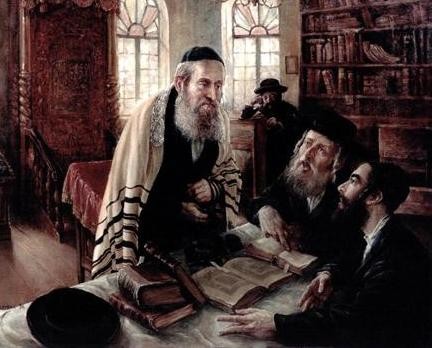
rabbis-talmud-debateThe reason for any lack of “overarching standards” for halakhah is that the rabbinical system was designed to be more flexible than that, and dependent on each generation of rabbis to apply a set of common standards from common principles. That having been said, the standards are a bit less ambiguous in the orthodox realm, which is still the standard by which other modern streams of Judaism must measure themselves even insofar as they wish to diverge from them to accommodate some perceived modern situation. I will refrain from offering any comment about how well or poorly they may achieve their goals, and I will offer the observation that Judaism has preserved in its literature numerous behaviors that may be deemed more or less applicable or enforceable in any given generation but that may be revived when appropriate. I have the greatest sympathy for the Jewish Christians in your church, though I would try to persuade them that the Hebrew-Christian model developed a century ago was a temporary accommodation whose purpose has passed, and that their well-being as Jews and contributors to the Jewish enterprise would be better served otherwise. History has shown that they will not survive as Jews in a Christian environment, certainly their children or grandchildren will not, and that they are contributing to the alienation of their Jewish families from the Messiah. If they have been mis-taught that these considerations are unimportant, I can only lament their loss.

The modern Reform and Conservative streams (not to neglect Reconstructionism and others) were formulated in response to historical circumstances, and modern MJ is still grappling with a selection of halakhot that meets its needs. One of these needs or desires is to somehow reclaim a first- or second-century CE outlook, while recognizing all the subsequent influences that have affected halakhic development so as to integrate as much of Jewish tradition as may be possible and applicable into our current circumstances. I suppose that characterizes them somewhere within the Conservative spectrum. At issue is not a “doing of religion” so much as the development of a lifestyle that incorporates and illustrates millennia of Jewish civilization. It is a practical corporate educational exercise that promotes the preservation of the Jewish people and our characteristic knowledge base that is still indispensible to understanding Rav Yeshua’s and Rav Shaul’s teachings. It remains to be seen whether the modern streams of Judaism will also become increasingly anachronistic, or if some of their insights may continue to be preserved. What is currently called Reform Judaism has become quite different from its origins, especially since the Holocaust and the resurgence of Israel, though it has not yet embraced halakhah. Conservative Judaism has always applied halakhah, though it tries to adjust it to modern circumstances. On the other hand, so does modern Orthodoxy, though with a stronger emphasis on maintaining historical connectivity.

Acts 15 is quite clear that the full body of Torah mitzvot is not incumbent upon non-Jews, though it was still recommended that they learn Torah in synagogues each Shabbat. This does carry some implications about what may be permitted for the more mature non-Jew to do voluntarily and without obligation, for all the extra merit that the rabbis assigned to non-Jews who pursue Torah even though it is not their obligation (based on Is.56, among other passages). Of course, Rav Shaul re-inforced en-passant in Gal.5:3 his view that Torah is fully binding upon Jews and circumcised proselytes (i.e., converts). In his time it was also especially important to emphasize to non-Jews not to allow coercive social forces to deprive them of that potential for extra merit by becoming circumcised, which is how the Acts 15 halakhah came to be formulated.

-ProclaimLiberty, 1/27/2013
as quoted from a comment in Love and Commentary

I know it’s a long quote but I just loved the “in-a-nutshell” summation ProclaimLiberty (PL) offered in reply to my blog post and my subsequent comments on the topic (and as a counterpoint to the topics I discuss in Part 1 of this article). Not only does PL succinctly describe the history and development of Jewish halachah over the centuries, but also brings in the issue of Gentile disciples as they entered “the Way” in the late Second Temple era and the Apostolic response to their presence. In reading the original comment, I felt as if a clear vision of a valid Jewish viewpoint in relation to how tradition and Torah obedience interrelate were presented to me. It’s difficult to work through a large set of tomes addressing my questions,  and a few paragraphs that can reduce the arguments down to their basic essence is incredibly welcome.

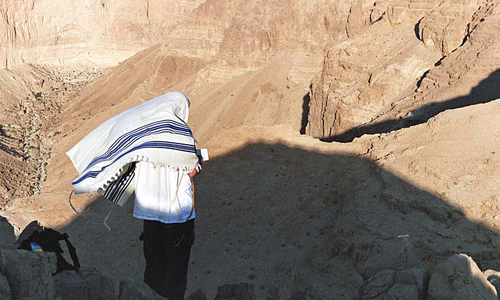
praying_at_masadaI’m not saying there isn’t any possible rebuttal from Christianity or the other “Judaisms,” but at least we have a firm starting point as to how (and why) Messianic Jews must continue to live as observant Jews, and how halachah can be appropriately part of the modern expression of “the Way” within Jewish communities. It seems like there’s a certain amount of latitude regarding how each Jewish tradition (including the modern Messianic tradition) may select halakhot (although as PL says below, a great deal of selection may not be required) that meets its needs without running roughshod over the authority of the written Bible.

But PL has more to say:

Halakhah is the human response in the conversation with HaShem that begins with His Torah instructions. It is a re-iterated conversation that continues throughout our generations, so of course it is varied and flexible. Judaism is not constrained by a concept of “the Bible as the final sovereign word of G-d”. We view a hierarchy that begins with the Torah above all, followed by the authoritative interpretations of Torah from Israel’s appointed leaders and teachers, in the Torah-defined role of the “shoftim v’shotrim” (judges and magistrates). The Prophets decry failures to live up to the standards of Torah, but they do not contribute to any new interpretation of it. The Writings provide additional illustrations of how this plays out in history or even in hypothetical scenarios (as some might view some of the literature). The inter-testamental apocryphal writings take that farther, including some material that could be viewed virtually as “fantasy” (since it was a bit too early in history to consider science fiction), though even that period included historical records such as the Maccabbean revolt and the miracle of Hanukah. Subsequent to that we have a variety of Rabbinic literature and Responsa, of which the Rav Yeshua messianic writings are a fitting example, though a bit earlier than other Rabbinic codifications. So MJ is not required to choose a particular stream of tradition, though most of its current contributors to halakhic formulation have been influenced by the Conservative movement and its particular flexibility. The only “complication” for messianists is the desire to integrate the views of Rav Yeshua and Rav Shaul into their compilation of halakhah for a Jewish community that honors them at least as well as other rabbinic views are honored. Since there is not really any incompatibility here for the discerning halakhist, that need not present difficulty or disconnection from other halakhic compilations in other Jewish streams.

As to the difficulty of recapturing the 1rst-2nd-century worldview, more data seems to become available continually, but it is fair to say that MJ has devoted more attention to this than any other form of Judaism has done, because of its need to understand the teaching context of its primary rabbis. But from a modern halakhic standpoint, the issue is somewhat moot because of all that has happened in the past two millennia. So “… when [he] comes, will he find faith in the earth? (Luke 18:8). The linguistics of this also allow a more narrow colloquial reading asking whether he will find those who trust him in the land of Israel. Will he have any difficulty recognizing his sheep, either because of their halakhah or in spite of it? As long as MJ halakhists keep this question in mind, I’m reasonably confident of a positive response.

There is a midrash that depicts Moshe Rabbeinu as being carried by an angel across time and space to visit the Jewish Talmudic Academy of Babylon. He is terribly perplexed by the argumentation, of which he cannot make any sense. He is then consoled by its reference to the Mishnah and its quotation of the words of Torah from the mouth of Moshe. Now, while we know nothing of the conversation that occurred on the “Mount of Transfiguration” between Rav Yeshua, Moshe, and Eliahu, in some future midrashic conversation Moshe might council Rav Yeshua to be patient with his modern disciples for exactly similar reasons. And we would be similarly well advised.

-PL, 1/28/2013

jewish-handsI apologize for inserting large blocks of copied and pasted text, but the alternative would be for me to rework what PL has written and present those ideas in my words, and really, what’s the point? Better that you read what was presented in the original comments rather than risk my messing up the meaning or intent. All I really want to present are these ideas and my impressions of them.

Part 1 of this article was my continued understanding of how Torah does and doesn’t apply to Gentile Christians, including Jewish halachah. In this second part of my missive, I’m trying to show the opposite side of the coin, not so much about why Torah applies to Jews, because by definition, the entire body of Torah must apply, but how we can see the rulings and traditions of the sages as a natural extension of Torah, which includes the authority of the accepted teachers in Judaism to make such rulings.

I view Judaism as we know it today as valid and authoritative for the Jewish people. I also agree with Yeshua own words (in Matthew 23:3) that whatever (“everything”) those sitting in the seat of Moses (Jewish leaders) bid Jews to observe is bound on all Jews. He didn’t make an exception for Jewish disciples of Yeshua, but in fact was speaking to them when he said those words. He believed in the leadership of Israel, even if he condemned those who were hypocrites.

-Gene Shlomovich, 1/28/2013
as quoted from his comment in The Jewish Girl Who Saved Her Children

I’ve spent a great deal of time attempting to establish and confirm the validity and the authority of the ancient and more modern Jewish sages to establish halachah in Judaism including Messianic Judaism, such as in my recent blog post The Moshiach and the Rabbis, so I won’t go into a long tirade and repeat myself again at length, but I do want to try and tie together as many loose threads as possible.

If God is God over all and Jesus is the Jewish Messiah King and the Divine in the flesh who dwelt among us and who will do so again, then what are we to do with the post-Second Temple sages and the ancient and modern Jewish traditions and interpretations? Apparently, if you’re a Gentile Christian, you don’t have to do anything with them. As I have said on numerous occasions over the past few years, a Christian, in my opinion, is free to observe a wide variety of the mitzvot on a voluntary basis as a personal conviction and in solidarity with his or her Jewish fellows, as long as issues of Jewish identity don’t get stepped on, let alone walked all over. Saying all that, we don’t have to perform those mitzvot in obligatory obedience.

Since it’s impossible to observe the kosher laws, wear tzitzit, lay tefillin, or even daven from a siddur without encountering the sages and their judgments, any Gentile Christian who chooses to go down that path will have to make decisions about tradition as well (should I bind my tefillin by the Ashkenazi or Sefard tradition, or use the Chabad or another method?) Halachah, in this case, is unavoidable, even for the Gentile.

But for the observant Jew, it’s not a matter of whether or not to walk the steps of halachah, but to “grapple with a selection of halakhot that meets his or her needs.” God’s Word, in the final analysis, is absolute, but not necessarily halachah (of course, if you ask an Orthodox Jew about it, you might get a different answer).

Pastor Randy asked me recently if I thought it was possible for anyone to observe Torah perfectly? No, I sincerely doubt it, only because we human beings are bound to make mistakes sooner or later. So if Jews can’t keep the Torah perfectly, what’s the point of keeping it at all (James 2:10)? That’s like asking a Christian if he were to find himself looking at a woman in lust even on a single occasion, should he give up on remaining faithful to his wife, throw the Bible to the winds, and let himself be consumed by his desires for other women. It’s not about having perfect behavior, since no person is perfect, it’s about “perfecting” ourselves, continually turning away from sin, and turning more completely to God.

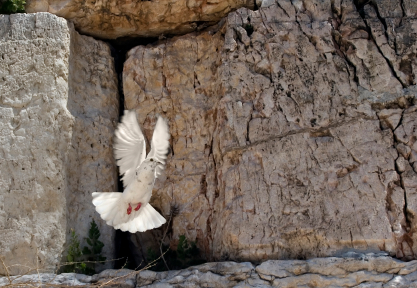
white-pigeon-kotelFor a Jew, that includes striving to become more spiritually elevated by correcting transgressions and continuing to master the mitzvot one at a time in order to honor God as a Jew and to sustain a Jewish presence and identity today and for future generations.

I hope this makes some sort of sense to both my Jewish and my Christian readers. I don’t have a Jewish lived experience, so I suppose I’ve made a thousand mistakes and if so, I trust I’ll be gently corrected. As far as my Christian readers go, I don’t doubt you will have many points of disagreement, if only because especially in Protestantism, tradition and Bible generally don’t mix. But we aren’t looking at how Christians walk as disciples of the Jewish Messiah, we’re looking at how Jews walk as disciples, and if we are to honor the uniqueness of their relationship with HaShem, then we must also honor how Jews are to be Jews, both in their communities, and in the presence of God.

The Lord is my shepherd; I shall not want.
He makes me lie down in green pastures.
He leads me beside waters of rest.
He restores my soul.
He leads me in right paths for his name’s sake.
Even though I walk through the valley of deep darkness,
I will fear no evil, for you are with me;
your rod and your staff, they comfort me.
You prepare a table before me in the presence of my enemies;
you anoint my head with oil; my cup overflows.
Only goodness and steadfast love shall follow me all the days of my life,
and I return to dwell in the house of the Lord for length of days.

Psalm 23 (ESV)

This conversation will continue in an “extra mediation” later today, based on some correspondence with PL whose insights I’m learning to appreciate. I hope I’ve laid a sufficient foundation upon which to base a dialog on these matters. The sheep are out of the pens and gathering together as a flock in the green meadow with our Good Shepherd. It is his voice we must listen to, and if we are his, we will follow where he leads.

One last thing I’d like to add is a short video made of Boaz Michael presenting the Gospels as the oldest written record of some of the Jewish oral traditions. I hope you’ll find this information as compelling as I do.

Shepherd, Pens, and Flock, Part 1

ancient_beit_dinThe apostles, after some deliberation, dispensed four rulings. Their letter to these Gentiles who are coming to faith indicated that they must abstain:

  • from what has been sacrificed to idols
  • from blood
  • from what has been strangled
  • from sexual immorality

The text of the letter is found in Acts 15:23-29. (Re-statements of these rulings appear in Acts 15:20, 21:25. Also note that manuscript variants exist with different versions of this list.)

Numerous and varied interpretations exist as to the exact intent and purpose of these rulings. Regardless, it is unreasonable to think that these four laws constitute the complete list of obligations of a Gentile before God. They say nothing about stealing, oppression, justice, or honor for parents, for example. Furthermore, the laws are not specific enough to be practical. What, for example, constitutes “sexual immorality”? Where does one go to find that definition, if not the Torah?

Regardless of their exact meaning and purpose, we can see from these rulings that they are not an end, but a beginning of a Gentile’s journey into a life conformed to God’s will. Consider the rationale for these four prohibitions:

Therefore my judgment is that we should not trouble those of the Gentiles who turn to God, but should write to them to abstain from the things polluted by idols, and from sexual immorality, and from what has been strangled, and from blood. For from ancient generations Moses has had in every city those who proclaim him, for he is read every Sabbath in the synagogues. (Acts 15:19-21)

What purpose does it serve to mention the fact that [the Torah of] Moses is read every Sabbath in the synagogues in conjunction with the list of obligations for Gentiles?

-Aaron Eby
“Divine Invitation”
Adapted from Messiah Journal #100
First Fruits of Zion (FFOZ)

As my regular readers must realize by now, I’ve been writing “fast and furious” about the topics of halachah in the Messianic Jewish world and the application of the Torah commandments to Christianity. I feel as if I’m trying to think in two opposite directions simultaneously, and it’s giving me a headache. But it’s also fascinating me and as you can tell, I can’t put these topics down. It is or should be part of the continual dialog between the believing Jewish and Gentile communities, and provide a point where we can meet to compare our similarities and our differences; a place in the meadow where the sheep from the two sheep pens participate in the flock of the Good Shepherd (see John 10:1-18).

I’m not a real fan of the term “divine invitation,” mainly because I don’t think it can be derived from the Bible or even necessarily implied. I’d rather have the Christian’s role in relation to Judaism defined by a more substantial mission.

That doesn’t mean to say that I disagree with Aaron, but his article poses more questions than answers. He suggests that more of the Torah and the Prophets apply to the Gentile church than what is intimated in the “Jerusalem letter,” but he doesn’t define just how far we are to take it. I suppose the answers are contained elsewhere, but I’m not going to wait until I can discover their location in order to comment.

Aaron says correctly that Israel has always been intended to be a light to the nations (Deuteronomy 4:5-8, Isaiah 49:1-6). This “light” is to extend well beyond the first coming of the Messiah and project itself far into the Messianic Age (Micah 4:1-2, Isaiah 42:1-4). He even goes so far as to suggest that Messiah always meant the Torah to be the light for the Gentiles:

You are the light of the world. A city set on a hill cannot be hidden. Nor do people light a lamp and put it under a basket, but on a stand, and it gives light to all in the house. In the same way, let your light shine before others [anthropon, literally “men, humans, mankind”], so that they may see your good works and give glory to your Father who is in heaven.

Matthew 5:14-16

praying-jewish-womanBut as I’ve previously said, just how was and is the Torah meant to be applied to the Jewish and Gentile populations of believers? As I’ve met Aaron and I know Boaz Michael as well as the philosophy of FFOZ. I know they don’t believe in a theology that does away with Jewish identity and fuses Jew and Gentile believers into a homogeneous mass of generic humanity, but how we Gentiles are to “do” Torah has never been clear, except as an effect of love of God and of humanity, which I have commented on and related to the new commandment of Messiah.

I did suggest to my Pastor not too long ago that if a Christian wanted to voluntarily choose to take on additional mitzvot as a personal conviction, it would not be such a bad thing. The fact that he lived in Israel for fifteen years meant, in his case, that he did observe such things as Shabbat and a form of kosher, because his environment supported it. Granted, the environment outside of Israel is less friendly to Jewish observance, particularly among Christians, but that doesn’t mean a Christian who is so led can’t perform some of the same “Torah” out of love and solidarity, especially in interfaith families such as mine.

But why can’t Gentile Christians simply mimic Jewish religious behavior down to the last detail? I mean, what’s the problem if, as Aaron says, the Torah is for the Gentiles, too?

Each human being possesses a unique combination of personality, talents, timing and circumstances – a specific role to play in this world. Our role is dependent on many factors – not only our innate talents, but also on the needs of the times.

The important thing is to discover your unique contribution – and fulfill it.

The Torah tells us that one day Moses saw an Egyptian taskmaster killing a Jew.

“And Moses looked all around, and when he saw that there was no man, he took action.” (Exodus 2:11-12)

Why does the Torah tell us “there was no man”? Because Moses was checking to see if someone else was available, someone better qualified to do the job. Because if you reach for leadership when it’s not necessary, then you’re doing it more out of your own desire than for the needs of the people. Only when Moses saw there was nobody else qualified, did he take action.

-Rabbi Noah Weinberg
“Way #26: Know Your Place”
from 48 Ways to Wisdom
Aish.com

If Gentile Christians were to observe the mitzvot in a manner completely like the Jewish people, then the most straightforward way to accomplish this would be for Jews to convert Gentiles to Judaism. While such a process didn’t exist in the days of Moses because Israel was organized around tribal identity, and after the Babylonian exile, around clan identity (see Cohen, From the Maccabees to the Mishnah, Westminster John Knox Press; 2006) it was completely available in the days of Jesus. But that didn’t happen in the New Testament as the application of Christ’s Matthew 28:19-20 command. We see this acted out by Peter in response to Cornelius and his household:

While Peter was still saying these things, the Holy Spirit fell on all who heard the word. And the believers from among the circumcised who had come with Peter were amazed, because the gift of the Holy Spirit was poured out even on the Gentiles. For they were hearing them speaking in tongues and extolling God. Then Peter declared, “Can anyone withhold water for baptizing these people, who have received the Holy Spirit just as we have?” And he commanded them to be baptized in the name of Jesus Christ.

Acts 10:44-48 (ESV)

Notice what didn’t happen here. If it had been Peter’s intention to convert the Gentiles to Judaism, between Cornelius and his household receiving the Holy Spirit and being baptized in water, Peter should have arranged for Cornelius and the other men to be circumcised. He didn’t and in fact, we don’t see any of the new disciples of Christ from among the nations ever converting to Judaism (I believe Timothy was considered Jewish because of his Jewish mother and that’s why Paul circumcised him). Paul spent a great deal of effort in his letter to the Galatians specifically discouraging them from converting, and as I’ve said before, also citing Paul from Galatians, if you’re not a Jew or a righteous convert, you are not obligated to the full “yoke of Torah,” both as defined by the actual Books of Moses and the Prophets, and by accepted halachah.

the_shepherd1Rabbi Weinberg suggests that we are each created for a purpose as individuals and should pursue that purpose in order to fulfill God’s design for our lives. What if it’s true that God’s intent was and is to have a specific purpose for the Jews and another (and perhaps overlapping) specific purpose for the Gentile Christians?

Jesus opens all the doors and holds all the keys. He is the portal by which we Gentiles enter into any sort of covenant relationship with God at all, and he also fully reconciles and restores the Jewish nation to the Father as the fulfillment of all His covenants with and His promises to the Jewish people. Make no mistake, the Sinai covenant made between God and Israel didn’t vanish simply because Messiah came. It would be insane to suggest otherwise. Not only did Jesus live a lifestyle in obedience to Torah and not only did his teachings support Torah and the Temple, but his Jewish disciples were never seen to do otherwise, either. The history of the Messianic movement forward isn’t abundantly clear, but I don’t believe that next generation of Jews after Paul and Peter were any less Jewish even as they continued to worship Jesus as Messiah (we never see Paul, for example, telling Timothy that he doesn’t have to observe the mitzvot as a Jew).

But that’s a direction I’m saving for part 2 of this article. For now, although we don’t have an image we could define as crystal clear regarding just how far to apply Torah to Christians, we do know that it is well-applied in the weighty matters of the Law: doing justice, loving kindness, and walking humbly with our God.