All posts by James Pyles

James Pyles is a published Science Fiction, Fantasy, and Horror author as well as the Technical Writer for a large, diversified business in the Northwest. He currently has over 30 short stories published in various anthologies and periodicals and has just sold his first novella. He won the 2021 Helicon Short Story Award for his science fiction tale "The Three Billion Year Love" which appears in the Tuscany Bay Press Planetary Anthology "Mars."

5 Days: Practicing Christianity

pakistani-christians-singing-hymnsBoth the Jews and gentiles recognized that the Jews denied the gods of the nations and claimed that their God alone was the true God, the Lord of the universe, but for both Jews and gentiles the boundary line between Judaism and polytheism was determined more by Jewish observances than by Jewish theology. Josephus defines an apostate as a Jew who “hates the customs of the Jews” or “does not abide by the ancestral customs.” He defines a convert to Judaism as a gentile who, through circumcision, “adopts the ancestral customs of the Jews.”

-Shaye J. D. Cohen
Chapter 3: The Jewish “Religion”, Practices and Beliefs
From the Maccabees to the Mishnah, 2nd ed.

Many years later, as recorded in Acts 21, the apostles reaffirmed that the Jewish believers in Jerusalem were all “zealous for the Law.” To clarify the key difference between Jewish and Gentile believers, they continued: “But as for the Gentiles who have believed, we have sent a letter with our judgment that they should abstain from what has been sacrificed to idols, and from blood, and from what has been strangled, and from sexual immorality” (Acts 21:25).

Based on this ruling and on the revelation Christ gave to him personally, the apostle Paul staunchly fought for the right of Gentile believers to remain Gentiles. This is actually what Paul was arguing for in Galatians 3:28: “There is neither Jew nor Greek, there is neither slave nor free, there is no male and female, for you are all one in Christ Jesus.” In other words, the body of Messiah accepts everyone as they are – it doesn’t matter whether you’re slave or free, male or female, Jew or Gentile. You don’t have to become something you’re not in order to follow Yeshua.

-Boaz Michael
Introduction, pg 20
from his book
Tent of David: Healing the Vision of the Messianic Gentile

That’s comforting to know. God is the ultimate supporter of diversity. No matter who you are, where you come from, what your race, ethnicity, nationality, language, heritage, or anything else is, you can be reconciled to the Father through His Son, Jesus Christ, Yeshua HaMashiach, the Savior of the world and the Jewish Messiah King.

Only let each person lead the life that the Lord has assigned to him, and to which God has called him. This is my rule in all the churches. Was anyone at the time of his call already circumcised? Let him not seek to remove the marks of circumcision. Was anyone at the time of his call uncircumcised? Let him not seek circumcision. For neither circumcision counts for anything nor uncircumcision, but keeping the commandments of God. Each one should remain in the condition in which he was called.

1 Corinthians 7:17-20 (ESV)

This is Paul, saying the same thing we read in Galatians 3:28 and it fits very well with how Cohen states Josephus defines a convert to Judaism. Since we know that Paul opposed Gentile believers becoming circumcised when they came to faith in God through the Messiah, then we understand that the Gentiles did not convert to Judaism. They retained their Gentile identities. If we compare the message of Acts 21 with the rest of the definition of a convert as presented by Josephus, we can reasonably believe that the Gentile disciples of Messiah were not required to adopt the full yoke of the Torah and not commanded to perform the entire body of mitzvot.

I know I’ve talked about this before in The Uncircumcised Convert, Part 1 and Part 2, but when I started reading my actual, official, published copy of Boaz Michael’s book Tent of David (yes, it finally arrived) and in parallel, took up Cohen’s book again (I couldn’t access it for a while because I needed to get my Kindle Fire replaced – battery problems), I immediately saw how what both Michael and Cohen wrote dovetailed into this message.

christian-coffee-cultureI know it seems as if I’m off on another religious harangue designed to bring the so-called “One Law” or “One Torah” movements within Hebrew Roots (as opposed to Jewish roots and as more opposed to Messianic Judaism) to task, but this is more personal, or more to the point, this has more to do with my personal identity.

After a recent encounter, I’ve received a very strong message that I need to redouble my efforts to return to church, stay there, and become part of the body of believers within their walls and their context. Part of that effort is picking up, to whatever degree I’m able, the identity of a Gentile believer, a Christian. Boaz Michael in his book plainly defines a “Messianic Gentile” as:

While these believers are still Christians, for the sake of clarity and definition I will call them by the term “Messianic Gentile” (the term “Gentile” meaning nothing more than “non-Jew”). A Messianic Gentile is a non-Jewish Christian who appreciates the Torah, his relationship with Israel, and the Jewish roots of his faith.

-Michael, pg 17

There are probably a fair number of Christians in churches who are also “Messianic Gentiles” based on that definition, but who just haven’t thought of themselves in such a light.

Based on my recent coffee encounter as well as other factors, not the least of which is Boaz’s book, I know I have to go to church and stay in church. It still doesn’t particularly thrill me at this stage, but I must proceed hopefully. And I know I’m not going in to change anyone or to present myself as some sort of “expert.” I’m certainly not going to bill myself as a “Messianic Gentile,” though I suppose the definition fits me after a fashion.

But who I am needs to fit better with other Christians. I can study the Jewish texts forever, and forever I will be isolated and alone because I’m not Jewish. It’s not my “Messianic Gentileness” I’m taking into the church and it’s not even my Christianity…it’s my desire to encounter God within the context of his non-Jewish disciples. Perhaps at some point, my voice will be added to theirs but for now, I need to be a learner and not a teacher.

I know I’m not a Jew and I know based on the Bible, that I’m not required or directed to act like one. Yes, the very early Gentile believers took on a number of the mitzvot such as giving to the poor among Israel, donating to build synagogues, studying the Law of Moses, and the fixed times of prayer.

All these texts imply that the recitation of prayers was a prominent feature of Jewish piety, not just for sectarians like the Jews of Qumran but also for plain folk. Jews who lived in or near Jerusalem prayed regularly at the temple. This is the plausible claim of Luke 1:10, “Now at the time of the incense offering, the whole assembly of the people was praying outside [the temple],” and Acts 3:1, “One day Peter and John were going up to the temple at the hour of prayer, at three o’clock in the afternoon.”

-Cohen, Chapter 3

PrayingWe know the early Jewish disciples met at Solomon’s colonnade (John 10:23, Acts 3:11, 5:12) at the Temple for daily prayers. The later Gentile converts to “the Way” most likely adopted the times and “the prayers” in their own worship (Acts 10:3) as well as other Jewish customs and practices, but of course, as we’ve seen above, they were not considered converts to Judaism nor obligated to the mitzvot, although it seems like they were certainly allowed to perform the mitzvot in a number of instances. That had limits, particularly in terms of access to the Temple.

When the seven days were almost completed, the Jews from Asia, seeing him in the temple, stirred up the whole crowd and laid hands on him, crying out, “Men of Israel, help! This is the man who is teaching everyone everywhere against the people and the law and this place. Moreover, he even brought Greeks into the temple and has defiled this holy place.” For they had previously seen Trophimus the Ephesian with him in the city, and they supposed that Paul had brought him into the temple.

Acts 21:27-29 (ESV)

We may never recapture the full history of what the relationship was like between the early Jewish and Gentile disciples of the Master, but we can take what information we have and use it to reasonably recognize who and what we are today as Christians. For me, that means pursuing a course of action that requires following both the timeless footsteps of the first Christians such as Cornelius (Acts 10) and the modern Gentile believers, with the firm conviction of who I am and who the Jewish people are in relation to God. If God permits, maybe my role will one day be of some use to Him among His people in the church, but for now, I just need to practice being who I am…a Christian.

5 Days: Encounter

meeting-a-strangerOne who responds “Amen” after a blessing surpasses the one who recites the blessing.

-Berachos 53b

“Amen” is an expression of confirmation, whereby we attest that what the other person has said is indeed true. Thus, when someone recites a blessing expressing gratitude to God or asserting that God has commanded the performance of a particular mitzvah, one is making a declaration of one’s faith. When we respond by saying “Amen,” we are essentially stating, “What you have said is indeed true,” and thereby we are not only concurring with what was said and expressing our own faith, but also reinforcing the other person’s statement and strengthening the other person’s faith.

There are things that one can do that will strengthen other people’s faith in God, and things that will weaken it. In Torah there is a concept of arvus – mutual responsibility – by virtue of which one is obligated to try to strengthen other people’s belief and trust in God. Although every person has free will, and God does not intervene to deter someone from committing a wrong, people who have suffered because of someone’s misdeeds often feel that God has abandoned them. Thus, if we deal unfairly with others, we may not only cause them to be angry at us, but also bring them to doubt God for allowing an injustice to happen. While such reasoning is faulty, the one who caused it is nevertheless responsible for causing the victim to feel that way. On the other hand, when we behave in the manner which God wishes, the result is kvod shamayim – bringing glory and honor to God, and strengthening people’s faith. Our actions can and do affect how other people will think and act.

Today I shall…

try to behave in a way that will result in people having greater respect for and trust in God.

-Rabbi Abraham J Twerski
“Growing Each Day, Tevet 11”
Aish.com

On Sunday afternoon, I had my periodic “coffee meeting” with a friend of mine. It was cold, windy, and threatening to snow, which is the perfect time to sit in a coffee shop, sip some hot java, and chat.

Oh, the conversation started out with small talk but that’s not where it ended up.

Have you ever been in a situation where someone said something to you and your internal response was “I wish he hadn’t said that,” not because it wasn’t true, but because it was true and you didn’t want to hear it?

I think most of us have at one point or another in our lives and last Sunday afternoon was the most recent occurrence in mine.

Can you encounter God in church?

I know that sounds like a silly question if you’re a Christian, but church was the last place I thought I’d ever encounter God in a meaningful way.

Let me explain.

My most recent “church experience” has been like a process of steps. I walk into the church, Bible in hand. I get the program, the pamphlet or whatever it’s called from the older lady standing near the door. We greet each other and I move on. I weave my way through the crowd of people chatting with each other and head for the door of the sanctuary. At the doorway, I’m greeted by several other gentlemen, one or two of which may engage me in brief, light conversation. Once that’s done, I try to find a seat near the rear of the chapel where I’ll be out of the way.

I busy myself before services by reading the contents of the pamphlet, paying extra attention to the outline for the day’s sermon. I’m usually greeted a couple more times by people I’ve made a casual acquaintance with.

People enter, settle down, and services begin.

The service has a pattern which is almost always the same. There’s singing, praying, the reading of the daily Bible passage, sometimes an appeal for donations for missionaries or other worthy causes and needs, the passing around of the plate for offerings, more singing, and the Pastor delivers his message while I rapidly take notes.

I usually slip out to use the men’s room during the last hymn because afterwards, the service ends and everyone floods out and lines start to form. I might even manage to get a cup of coffee before Sunday school.

Then I go to Sunday school. For the first few minutes, there’s the usual casual conversation between everyone else since they are all friends. I politely listen. Class begins and I struggle not to say too much, aiming for not saying anything at all.

Class ends, church ends, and I go home.

waiting-for-mannaAt what point in all that would I encounter God?

Oh, I’ve encountered God in a meaningful, supernatural manner that I can’t even begin to articulate, but those “meetings” are quite rare.

And I believe I encountered God over coffee last Sunday afternoon, but it wasn’t what you would call supernatural. I forgot that God can insert people into the stream of your life who will tell you what you need to hear (though not necessarily what you want to hear).

He said several things.

  • People go to church to encounter God.
  • Anyone who wants to encounter God should spend time in prayer and reading the Bible, asking and expecting to encounter God.
  • Don’t seek Judaism and don’t seek Christianity, seek God.

Oh.

He said a lot more too, particularly on the dynamics of how to make connections and relationships. The following metaphor is my own but it applies.

If you are single and you want to make an impression on a girl, you don’t do so by showing up for dates only sometimes. If you have a standing date with your girlfriend every Sunday morning, if you like her and want to develop a relationship with her, you’ll show up for your date every Sunday morning unless something serious comes up to prevent it. You don’t just go hit and miss and still expect her to want to develop a relationship with you. She won’t think you’re very trustworthy and reliable. She won’t spend the time and energy to try to connect with you if she doesn’t see you making the same effort.

Oh.

I’ve been viewing going to church as only an obligation. Who in their right mind dates a girl if it’s only an obligation and not a desire?

And let us consider how to stir up one another to love and good works, not neglecting to meet together, as is the habit of some, but encouraging one another, and all the more as you see the Day drawing near.

Hebrews 10:24-25 (ESV)

That sounds like an obligation but an obligation of love.

To be honest, I don’t always want to encounter God in a meaningful way, because some of those encounters aren’t easy to take.

Then Job arose and tore his robe and shaved his head and fell on the ground and worshiped. And he said, “Naked I came from my mother’s womb, and naked shall I return. The Lord gave, and the Lord has taken away; blessed be the name of the Lord.”

Job 1:20-21 (ESV)

If he should set his heart to it and gather to himself his spirit and his breath, all flesh would perish together, and man would return to dust.

Job 34:14-15 (ESV)

Fear of the Lord may be the beginning of wisdom but it’s also fear.

But God cannot be avoided and without God, life is nothing.

Man’s life is dependent on the air around him. Without air he cannot live and the quality of life is dependent on the quality of air. In an atmosphere of Torah and mitzvot there is healthy life. In a G-dless environment life is diseased, and one is constantly threatened with the possibility of being stricken with contagious maladies.

“Today’s Day”
Shabbat, Tevet 11, 5703
Compiled by the Lubavitcher Rebbe
Translated by Yitschak Meir Kagan
Chabad.org

torah-tree-of-lifeThe Rebbe goes on to describe how we can purify our environment by studying words of Torah, but taking the message down to basics, what is being said is that God must inhabit our environment for us to be who He designed us to be. We must encounter Him in order to live the life He has planned for us.

No matter how uncomfortable or even frightening those encounters may be.

Obey your leaders and submit to them, for they are keeping watch over your souls, as those who will have to give an account. Let them do this with joy and not with groaning, for that would be of no advantage to you.

Hebrews 13:17 (ESV)

That reminds me of what Pastor Randy said to me the second Sunday after Thanksgiving. I skipped going to church the Sunday after Thanksgiving because I was wiped out and wanted some rest. Pastor made some remark, supposedly joking, asking where I was the week before. I figured I wasn’t very important to anyone at the church and my missing a Sunday or two wouldn’t be a big deal. Maybe it’s a bigger deal than I thought. I still don’t feel important at church, which isn’t necessary, but I don’t feel even slightly significant, either. But that’s my fault.

If church is an opportunity to encounter God rather than just a Biblical and social obligation, then it becomes something entirely different from what I first thought. Next Sunday is the last day of my countdown to zero and the end of the year.

Or, it’s a new beginning and a fresh encounter.

So This Is Christmas

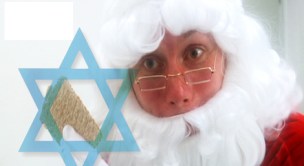
jewish-christmasAnd that “calendar conflict” seems to bother some Jews. Of course our problem with Christmas is nothing like the one that afflicted my parents in Poland. The only way we are assaulted today is by way of our eardrums, forced to endure the seemingly endless carols and Christmas songs that have become standard fare for this season. There are no attempts at forced conversions. No one makes us put up a miniature replica of the Rockefeller Center tree in our living rooms. No one beats us up because we choose not to greet others with a cheerful “Merry Christmas.” But still…

I hear it all the time. Jews verbalizing their displeasure with public displays of Christian observance. Jews worried that somehow a department store Santa Claus will defile their own children. Jews in the forefront of those protesting any and every expression of religiosity coming from those with a different belief system than ours. Christmas, they claim, is by definition a threat to Judaism and to the Jewish people.

And I believe they are mistaken.

-Rabbi Benjamin Blech
“Is Christmas Good For the Jews?”
Aish.com

Jesus has become a stranger to Jews just as he has become the property of Christians. What needs to happen is for many Christians to examine whether the Jesus of their faith has replaced Judaism or whether he is Judaism-friendly. It won’t be enough to say that Jesus was raised a Jew and that He kept Torah. The problem is that much Christian theologizing . . . and hymnody . . . enshrines a Jesus who outgrew or replaced Judaism. And as long as Christians think that way, don’t be surprised if Jews think of Jesus as at best a former Jew. And that is a concept as cold as a Brooklyn December.

-Rabbi Dr. Stuart Dauermann
“Toward Making Christmas Once Again A Jewish Holiday”
The Messianic Agenda

“So, this is Christmas,” to quote John Lennon. You’d expect Christians to be blogging about Christmas left and right, but what about so many Jews blogging about Christmas? In America, you can’t avoid Christmas no matter who you are, but what could possibly make Christmas a good thing for a Jew?

I’ve been critical of Christmas lately, not so much on theological or historic grounds as on the expectation that is presented by Christmas; the directive that one must be happy and of good cheer because of the holiday. If you read all of Rabbi Blech’s commentary, you know that at one point in the lives of his parents, Christmas in Poland was not such a good thing.

My parents told me many times how much they dreaded the Christmas season.

Living in a little shtetl in Poland, they knew what to expect. The local parish priest would deliver his sermon filled with invectives against the Jews who were pronounced guilty of the crime of deicide, responsible for the brutal crucifixion of their god and therefore richly deserving whatever punishment might be meted out against them.

No surprise then that the Christian time of joy meant just the opposite to the neighboring Jews. The days supposedly meant to be dedicated to “goodwill to all” were far too often filled with pogroms, beatings, and violent anti-Semitic demonstrations.

Rabbi Dr. Dauermann writes on a somewhat overlapping theme, seeing as how the birth of the Jewish Jesus has not been good news for Jews for a very long time.

Besides conceiving of Jesus as Judaism-friendly, there is a second challenge for those Christians who would have their Jewish friends see him as not only good news for the Jews, but also Jewish good news. And that challenge is for fine and aware Christians to reconnect with how the Christ who was born in Bethlehem, died at Calvary, and rose from the dead, remains the Lion of the Tribe of Judah, the Son of David, the King of the Jews who one day will return to bring to fruition all the promises God made to that chosen nation. The many Christians who deny that this is how the story ends should not be surprised when there is no room for their Jesus in the Jewish inn.

But while Rabbi Dauermann’s apparent goal is to reintroduce Jesus as the Jewish Messiah King to multitudes of Christians, Rabbi Blech sees Christmas presenting a different opportunity for Jews.

To be perfectly honest, Christmas season in America has been responsible for some very positive Jewish results. This is the time when many Jews, by dint of their neighbors’ concern with their religion, are motivated to ask themselves what they know of their own. To begin to wonder why we don’t celebrate Christmas is to take the first step on the road to Jewish self-awareness.

My parents were “reminded” of being Jewish through the force of violence. Our reminders are much more subtle, yet present nonetheless. And when Jews take the trouble to look for the Jewish alternative to Christmas and perhaps for the first time discover the beautiful messages of Chanukah and of Judaism, their forced encounter with the holiday of another faith may end up granting them the holiness of a Jewish holiday of their own.

family-chanukah-mea-shearimChristmas lights and music and decorations may have a wide variety of meaning to you, depending on who you are and what you believe. Very often, the religious aspects of the holiday conflict with the politically correct priorities of the culture around us, and a battle ensues over something as simple as saying “Merry Christmas” vs. “Happy Holidays.” But what Rabbi Blech points out as good news for Jewish people is actually good news for all of us. Christmas, even if we don’t celebrate it and even if don’t like it, offers us an opportunity, in observing those who do use Christmas as an overt expression of their faith, to take a look at who we are and what we believe. Even an atheist can take this opportunity to re-examine themselves and to either re-affirm their beliefs or reconsider their choices.

For those of us who are people of faith, we can do the same. If you’re a Christian, you can take Rabbi Dauermann’s advice and start viewing the Savior of the world as a Jew with good news for Jewish people. If the Christmas songs say “Born is the King of Israel,” then take the opportunity to look at Jesus as Israel’s King who will restore Israel as a nation above all other nations, and who will rebuild the Temple in Holy Jerusalem for the Jewish people.

If you’re a Jew who is not acquainted with the idea that there are Jews who seriously believe Jesus is the Jewish Messiah and are disciples of the “Maggid of Nazaret,” you might want to become familiar with some of these Jews, such as the Rabbi who loved Jesus (his identity and family line may surprise you).

If you are among the “Bah! Humbug!” brigade as I sometimes am, no matter how dismal you find the Christmas season, try to put that aside this year and see if watching those who truly do worship the “King of Israel” may, by example, have something to say to you. Take some time to ask yourself who you are, what you believe, and out of that, what you’re doing with your life.

If you don’t like the answer, then it’s time for a change.

Regardless of what you do or do not believe and celebrate about this day, may God grant you His mercy and kindness now and all the days of your life.

No Guarantees

NoGuaranteesDue to the widespread famine in Canaan, Jacob and his family descended to Egypt to live under Joseph’s care. Before the journey, G-d appeared to Jacob and said “Don’t fear going down to Egypt, for I will make you a great nation there. I will go down with you and I will also take you out (Gen. 46:3).” Wouldn’t this move to Egypt prove to be the beginning of hundreds of years of painful enslavement under ruthless taskmasters? Jacob knew of Abraham ‘s prophecy that his offspring would endure slavery and oppression in a foreign land for hundreds of years (Gen. 15:13). Why shouldn’t he have feared this impending horror?

The truth is that yes, Jacob had reason to fear. But G-d’s promise — that He would be with Jacob’s children all along and that ultimately they would emerge a great nation — gave Jacob the strength to overcome it. G-d, in His Wisdom, sent the Jewish people to Egypt to build them into a great nation. Life in Egypt would be difficult, torturous and deadly at times, but our Father swore to never let go of our hands throughout the surgery. He promised that the Jewish People would leave with new strength and a promising future. A nation committed to G-d, one that would introduce and instill spiritual purpose into the world, would come out at the other end.

Pain is commonplace, and it’s our Egypt. “That’s life!” as they say, but it’s far too glib. Take a moment to consider some of the difficulties you’ve gone through, where the pain has now subsided. Did that experience change the way you look at and value life, your family, or your community? Did you grow or learn from the trying times? Jacob learned the importance of remembering that G-d is with us throughout our suffering, and to focus on the rewards on the other side. We often merit seeing the blessing hidden in the sorrow, if we take a moment to appreciate it.

-Rabbi Mordechai Dixler
“Living in Fear”
Commentary on Torah Portion Vayigash
and the Sandy Hook School Shootings
ProjectGenesis.org

Experiencing continual anxiety and fear is a terrible thing. According to Rabbi Dixler, we should look back on some crisis we’ve experienced in life and see how we made it through it all, and then determine how we changed and grew as a result. Difficult times are often a “hidden blessing.” Yes, I suppose that’s true. But if we take the example of Jacob and God as we see in Genesis 46:3, even though Jacob knew that his family; his descendents would suffer slavery and oppression in Egypt for centuries, he had God’s direct assurance that they would rise up out of Egypt and become a great nation.

But what happens when you are the one facing a challenge in your life or in your family? God rarely gives us, as individual believers, His personal assurance as to how things will turn out. The vast majority of the time, we don’t have a clue what’s going to happen from day-to-day or even hour-to-hour. Did the parents of those 26 children murdered at their school in Newtown, Connecticut have any idea at all that when they sent their precious ones off on that fateful Friday morning, they’d never see them alive again?

Of course not. If they did, the parents would never have let them go.

We don’t know what’s going to happen an hour from now, a day from now, a year from now. When tragedy strikes or even threatens to strike, such as an ambiguous and disturbing medical test result requiring a visit to a specialist in the near future, you have absolutely no idea what’s going to happen and how it’s going to turn out. So you live with the concern and anxiety of not knowing, sitting on proverbial “pins and needles.” Rabbi Dixler has a suggestion for how we are to endure tragedy and I suppose, the threat of future tragedy as well.

It’s now just a week since the Sandy Hook Elementary tragedy, and we’re all afflicted with new fears and feelings of helplessness. We don’t know why this had to happen, but perhaps there’s one thought that can give us strength: Someone Who loves us is holding our hand, and the hands of our precious children. Turn to Him for reassurance. May we soon see the other end of this pain, and may we all find new strength and a more promising future.

In other words, there are no guarantees from God that we won’t suffer from tragedy and pain. The only promise is that God loves us and will stand with us, holding our hand, so to speak, while going through the anguish with us.

Supposedly, that’s exactly what God did with His people Israel every moment of their captivity in Egypt. Supposedly, that’s exactly what God did with His people Israel every moment during the Holocaust. And yet millions suffered and died, including many, many innocent children.

job_sufferingI’ve been reading the book of Job for the past couple of weeks and in the midst of all of his quite undeserved suffering, he had no idea what was happening to him or why. He was completely bewildered about why God should allow such terrible things to happen to him, since he could figure out no reason for it. His friends, on the other hand, were quite content to blame Job, most likely sincerely believing that the reason for Job’s pain and anguish was because of some sin. I haven’t gotten to the end of the book yet and I read Job very infrequently, but as I recall, it was only at the very end that God “explained Himself” and He also explained that “He who makes the universe also makes the rules.” In other words, you don’t get to question God. Sometimes God just “happens.”

Some cynics say that religion is a crutch for people who fear death. That may sometimes be the case, but it certainly does not apply to those who study Torah. The Torah does not say much about life after death. It’s really not a book about how to go to heaven or what happens after we die. The Torah is more concerned with how we live in this lifetime, not the next. It is possible to read the entire Torah and conclude that there is no afterlife or resurrection from the dead. In the days of the apostles, a sect of Judaism called the Sadducees did exactly that. They read the Torah, did not see anything about an afterlife, and concluded that there is no afterlife, no heaven or hell, no resurrection from the dead.

“Resurrection in the Torah”
Commentary on Torah Portion Vayechi
First Fruits of Zion (FFOZ)

There isn’t even the promise of life after death, at least as far as a plain reading of the Torah (the Five Books of Moses) is concerned, which is what led the Sadducees to their conclusion. However, as the FFOZ commentator points out, a study of the Torah tells us more about how to live than how to die, or more accurately, it is a study of how to live in this life not the next one.

But now we have a puzzle. If the foundation of the Bible is a lesson on how to live our lives as we exist in this world and there are no guarantees as to how this life will turn out for us, shouldn’t we continually be in fear, trembling all of the time about what apparently random circumstance is going to happen next? It’s either that or live in denial of everything I just said and either pretend that we have control of our lives or that God, being in control, will never, ever let anything bad happen to us.

Death would almost be preferable, because then, there’s no uncertainty, no fear, no pain (assuming there is no life after death). Just an end and nothingness.

But the FFOZ commentator continues.

Once, a Pharisee named Rabbi Simai was arguing with the Sadducees. They asked him to prove from the Torah that the dead would be raised.

Rabbi Simai said, “From where in Torah do we learn the resurrection of the dead? From the verse, ‘I also established my covenant with them to give them the land of Canaan.’ It doesn’t say ‘[to give] you’; it says ‘to give them.’ Therefore [since Abraham, Isaac and Jacob haven’t yet received the land] the resurrection of the dead is proved from the Torah.” (b.Sanhedrin 90b, quoting Exodus 6:4)

Rabbi Simai’s point is that God promised to give the land to Abraham, Isaac and Jacob—not just to their descendents. Yet, as the writer of the book of Hebrews points out, the patriarchs “died in faith, without receiving the promises” (Hebrews 11:13). God must keep His promise, but in order to do so, He will have to raise the patriarchs from the dead. This explains why Jacob was so adamant about being buried in the tomb of his fathers in the land of Canaan.

Rabbi Simai’s argument with the Sadducees sounds similar to Yeshua’s. When the Sadducees asked Yeshua to prove from the Torah that the dead are raised, He pointed to Abraham, Isaac and Jacob:

But regarding the fact that the dead rise again, have you not read in the book of Moses, in the passage about the burning bush, how God spoke to him, saying, “I am the God of Abraham, and the God of Isaac, and the God of Jacob”? He is not the God of the dead, but of the living. (Mark 12:26–27, quoting Exodus 3:6)

There is a hope of a life after this one, both in Jewish and Christian tradition. Sure, there are a lot of gaps in our knowledge and we don’t really know exactly how it all works, but I guess that’s where faith and trust comes in.

always-hopeFaith and trust also “fills in the gaps” of our lives in this world and this life as well. We don’t know what’s going to happen. Life is a mystery and not always in an exciting and fun way. The mystery can be horrifying and terrible. Disaster has struck. We tell ourselves we can only go up from the bottom, but what if the bottom drops out? We can still fall further. We can still suffer more. After Hurricane Sandy devastated New York and New Jersey, it’s not like everything got immediately better for the victims. Many are still struggling to recover. It may take years for some people to restore everything they lost. Maybe some of them never will.

Where is God?

I ask that question a lot. If Rabbi Dixler’s interpretation is correct, then God is with us all the time, even in the midst of hideous pain and suffering. According to Rabbi Dixler, God is not just an impassive observer, watching us as we writhe in agony or shiver in fear. He’s an active if unseen (and unfelt) participant in our pain, experiencing it with us, expressing compassion, demonstrating love, though we may not be consciously aware of it.

We just have to believe He is there and that He somehow helps. We just have to somehow trust in His presence and His concern, that He will not leave us alone, even though we can feel very much alone.

Not a great message to start out your week with, especially since this is Christmas Eve (for those of you who celebrate Christmas). A message of uncertainly with only faith to hang on to in a season most Christians believe is one of ultimate hope, joy, and glory.

That’s the “official story” of Christianity at this time of year. I didn’t go to church again this Sunday. I have my reasons, but basically, I just didn’t feel like it. I didn’t feel like listening to and singing Christmas Caroles, hearing the “oh boy, isn’t it great that Christmas is almost here” messages, and “joy, joy, joy to the world” and all that jazz.

God, I would love some “joy, joy, joy” in my life and in the world, but I’ll settle for the knowledge and assuredness that no matter what I and my family must face now and in the future, that you will truly be with us all, strengthening us and comforting us in the bad times, and rejoicing with us in the good times.

Amen.

8 Days: Critical Mass

Critical_Mass_by_sam2993How much better than fine gold is the acquisition of wisdom, and the acquisition of understanding is choicer than silver! The paved road of the upright is turning from evil; one who keeps his way guards his soul. Pride precedes destruction and arrogance comes before failure. Better [to be] lowly of spirit with the humble than [to be] sharing the spoils with the proud. One who undertakes a matter intelligently will find good [success]; and praiseworthy is he who trusts in Hashem. The wise of heart will be called an understanding person, and one whose speech is sweet will gain learning.

Proverbs 16:16-21 (Stone Edition Tanakh)

Anyone who does not love does not know God, because God is love.

1 John 4:8

James/haSatan: First of all I made sure to use the words of Messiah particularly because you don’t know them or understand them. The teaching I put in the comments here were all backed up by scripture and were HIS WORDS and there is NO GREATER LOVE THAN TO LAY DOWN ONES LIFE FOR HIS FRIENDS. What are you accusing Yeshua of…..hatred?

IF I don’t sit in a pity party with you guys reviewing all the past evils done to the Jewish people while at the same time “Bashing Christians” and attempting to lay all the responsibility at THEIR feet……you call my words hateful?

A critic

I know. Taking verses out of context can sometimes create a false impression of what is really being said, but in my current reading from Proverbs, there seems to be an emphasis on controlling your speech, humility, understanding, and wisdom. No, I’m not trying to blow my own horn, but I am trying to understand why someone who feels they have a valid theological point to make must do so while spewing vitriol and hate. Certainly comparing me to the adversary is a little over the top, no matter how angry my fellow Christian brother may be with me.

But what started this mess, anyway?

What follows is a confession of faith for Jewish converts to Christianity, from the Church of Constantinople. While it seems extreme to us today and many Christians have regained their appreciation for Israel and Jewishness of Jesus, how many Christians truly disagree with a basic premise expressed in this swearing of allegiance to faith in Christ when it comes to their own attitudes toward Jews and especially their view of Judaism?

My friend Gene Shlomovich wrote a blog post called Confession of faith for Jewish converts to Christianity, from the Church of Constantinople. He wanted to draw attention to how Jews, during the early Christian period, were put in the position of having to renounce their entire Jewish identity, the Torah of Moses, all of the mitzvot, in order to be allowed to enter the community of faith in the Jewish Messiah…uh, that is Jesus Christ, our Lord. Here is the “confession of faith” a Jew was expected to make as quoted from Gene’s blog.

As a preliminary to his acceptance as a catechumen, a Jew ‘ must confess and denounce verbally the whole Hebrew people, and forthwith declare that with a whole heart and sincere faith he desires to be received among the Christians. Then he must renounce openly in the church all Jewish superstition, the priest saying, and he, or his sponsor if he is a child, replying in these words:

‘I renounce all customs, rites, legalisms, unleavened breads and sacrifices of lambs of the Hebrews, and all the other feasts of the Hebrews, sacrifices, prayers, aspersions, purifications, sanctifications and propitiations and fasts, and new moons, and Sabbaths, and superstitions, and hymns and chants and observances and synagogues, and the food and drink of the Hebrews; in one word, I renounce absolutely everything Jewish, every law, rite and custom, and above all I renounce Antichrist, whom all the Jews await in the figure and form of Christ; and I join myself to the true Christ and God. And I believe in the Father, the Son and the Holy Spirit, the Holy, Consubstantial and Indivisible Trinity, and the dispensation in the flesh and the descent to men of the Word of God, of the one person of the Holy Trinity, and I confess that he was truly made man, and I believe and proclaim that after the flesh in very truth the Blessed Virgin Mary bore him the son of God. and I believe in, receive, venerate and embrace the adorable Cross of Grist, and the holy images; and thus, with my whole heart, and soul, and with a true faith I come to the Christian Faith. But if it be with deceit and with hypocrisy, and not with a sincere and perfect faith and a genuine love of Christ, but with a pretence to a be Christian that I come, and if afterwards I shall wish to deny and return to Jewish superstition, or shall be found eating with Jews, or feasting with them, or secretly conversing and condemning the Christian religion instead of openly confuting them and condemning their vain faith, then let the trembling of Cain and the leprosy of Gehazi cleave to me, as well as the legal punishments to which I acknowledge myself liable. And may I be anathema in the world to come, and may my soul be set down with Satan and the devils.’ (From Assemani, Cod. Lit., 1, p. 105.)

That sounds very hateful and even kind of crazy, but it did reflect the reality of how Christians were thinking of Jews at that point in time. Unfortunately, something of an “echo” can still be heard among at least a few Christians these days.

With the merciful thou wilt show thyself merciful; With the perfect man thou wilt show thyself perfect; With the pure thou wilt show thyself pure; And with the perverse thou wilt show thyself froward. And the afflicted people thou wilt save; But thine eyes are upon the haughty, that thou mayest bring them down.”

Both the abusers of the Jewish people and those of the Jewish people who hate G-d, his son, and their neighbor will stand in judgment together. “I tell you, Nay: but, except ye repent, ye shall all in like manner perish.”

No repentance……no mercy!

No-MercyNo mercy. No mercy from God?

Doesn’t God have mercy upon us even before we repent? If He didn’t, He would never allow us the opportunity to do so…no matter how long it may take some of us.

Or how about this?

This post is not about anti-semitism. It is Christian bashing by way of blaming men who were never really followers of Yeshua for Israel’s lack of belief, faith, and transgressing the law and departing through disobedience. Israel needs to take some responsibility and stop blaming others. If you have unforgiveness in your heart and need to go through history to find someone to blame other than yourselves you missed the entire point of the Torah. Repentance begins by taking responsibility.

But how could the Jews historically accept a Messiah who was re-cast as the “Goyishe King” and was unrecognizable to his Jewish brothers?

Unfortunately, that point isn’t always understood in the church or at least by some of those in the church. But what really bothers me isn’t that some Christians have an idea that the Jews are to blame for their own hardships because “they rejected Jesus.” What really bothers me is the level of rage and hate that such individuals express in trying to “explain” their point of view. Even if they believe they can back up their position with scripture, doesn’t scripture also encourage us to love, to use measured and wise words, to feel compassion?

The really sad part of the conversation I’m referencing is just that day, I had written a memorial to the victims of the Sandy Hook school shootings. Among the victims was a 6 year old Jewish boy named Noah Pozner. It’s one thing to take “pot shots” at Jewish people in general as a Christian if you believe Judaism is thumbing its nose at Jesus Christ, so to speak. It’s another thing entirely to completely forget a national tragedy that occurred hardly a week ago and to disdain (though indirectly) a specific Jewish victim. No, my adversary never mentioned his name or referenced Noah in any way, but when you condemn all Jews who don’t renounce being Jewish for the cause of the Gentile Christ, you condemn each individual Jew, including a young Jewish boy who did no harm to anyone at all.

You can go to Gene’s blog and read everything there including all of the comments and judge for yourself whether or not I’m being unfair. I typically don’t like calling people out personally on their behavior, but it really bothers me that a Christian can not only condemn all Jewish people everywhere unless they renounce being Jewish, but I find it offensive that it is done in so callous and harsh a manner. Does God hate the Jewish people He calls His own? Did the Messiah hate us before we came to him?

Are we supposed to hate those who disagree with us, who don’t accept our faith, who believe bad things about us? This goes way beyond what one “loose cannon” Christian thinks about the Jewish people and considers how the church views the “unsaved,” i.e. the rest of the world. Are we only supposed to love people once they’re “saved?” Until then, is everyone who isn’t a Christian just “secular scum?”

I hope I’m only referencing a few random, infrequently occurring believers among a more compassionate and caring church, but it’s hard for me to tell. I guess the only way to find out is to keep going to church and to see how people treat not only me, but those who aren’t like “us.”

I wonder what I’ll discover?

Nobody Ought to be Alone on Christmas

aloneThings are different since you’ve been here last, Childhood dreaming is a thing of the past

Maybe you can bring us some hope this year, Visions of sugar plums have disappeared

I’m all grown up but I’m the same you’ll see, I’m writing you this letter ’cause I still believe

Dear Santa, I’ve been good this year, Can’t you stay alittle while, with me right here?

Nobody ought to be alone on Christmas

-from the song All Alone on Christmas (1992)
Written and arranged by Steve Van Zandt
Recorded by Darlene Love with members of
the E Street Band and the Miami Horns

This song is one of my guilty pleasures. I love it. I didn’t particularly like the film Home Alone 2 (1992) in which the song is featured, but it has a killer sax solo. No, I don’t celebrate Christmas, but I still like the song.

But I can’t listen to the song this year without tears welling up in my eyes (particularly embarrassing, since I’m at work as I write this). I can’t remember which news story I read it in, but I keep remembering something a reporter wrote about how some children’s Christmas presents will never be opened this year in Newtown, Connecticut because the light of those children’s lives was removed from the world last week. Because someone found it necessary to kill 26 children in Newtown, there will be parents, grandparents, brothers, sisters, and friends who will feel all alone this Christmas.

Imagine anticipating the “thumping” sound of little feet coming down the stairs before dawn on December 25th to see if Santa had brought the presents and then never hearing that sound. Imagine having wrapped each gift for your little boy or girl with care, decorating the package, and writing something loving and special on the Christmas card…but now there’s no one to rip open the wrapping paper and scatter it all over the living room in glee. As a parent, could you bear to unwrap the new toys and donate them to Toys for Tots? What would you do with them?

What would you do with “Christmas?” As a parent and a grandparent, the deaths of these 26 children tears me apart. In my imagination, I’d pull down the Christmas tree and burn it, rip all of the lights from my home and shatter them, eliminate any trace of this “festive season” from my environment, and perform the modern, moral equivalent of putting on sackcloth and ashes (whatever that might be).

But what if your small missing child has brothers and sisters? What do you say to them? How can you “celebrate” with them, or can you? Do you destroy their Christmas because of your grief? What about their grief? How can you comfort your other little ones and your spouse when pain and anguish crowd out everything else in your heart?

I’m normally pretty neutral about Christmas these days but this year, I hate it. I hate all of the expectations people have for “the season to be jolly.” In retrospect, I probably should always have hated it. Who is happy and cheerful now? Doesn’t every home know death? Don’t thousands of children die all over the world every day? Aren’t their tens of thousands, hundreds of thousands of hearts in the world right now who feel alone and empty for so many reasons? This “season” tells you that you must be happy and joyful and festive.

Eat heaping plates of turkey or ham on Christmas this year if you so choose. I’ll be dining on ashes.

No, that’s too cruel.

I don’t celebrate Christmas but maybe you do. Maybe you have many reasons to be happy and grateful (I’m grateful that my family is alive and safe this year). I have no right to take that away from you. I have no right to believe that the victims and mourners in Newtown haven’t come together to comfort and console each other. I have no right to believe that anyone will be alone this Christmas in Newtown, though I know without a single doubt that there will be an emptiness in each of those homes.

Today, we observed a moment of silence for the victims. Also, bells tolled 26 times, once for each child who died. On Christmas, if you celebrate Christmas, I don’t want to take away from your joy, but in the midst of your joy, take a moment, or two, or twenty-six, or twenty-eight.

And remember them.

Charlotte Bacon, age 6, Daniel Barden, age 7, Rachel D’Avino, age 29, Olivia Engel, age 6, Josephine Gay, age 7, Dylan Hockley, age 6, Dawn Lafferty Hochsprung, age 47, Madeleine Hsu, age 6, Catherine Hubbard, age 6, Chase Kowalski, age 7, Jesse Lewis, age 6, Ana Marquez-Greene, age 6, James Mattioli, age 6, Grace McDonnell, age 7, Anne Marie Murphy, age 52, Emilie Parker, age 6, Jack Pinto, age 6, Noah Pozner, age 6, Caroline Previdi, age 6, Jessica Rekos, age 6, Lauren Rousseau, age 30, Mary Sherlach, age 56, Victoria Soto, age 27, Benjamin Wheeler, age 6, Allison Wyatt, age 6.

You can find out more about each of them at wptv.com.

Not everyone on that list celebrated Christmas but that’s not really the point. The point is that each of them had the right to live. The point is that each of them was someone’s son or daughter and that each one of them was loved. The point is that there are people left behind to grieve and to mourn and to cry. And the point is that, in spite of all the multi-colored lights that sparkle on homes and businesses and trees right now, the little more darkness has entered our world and a little more light has been taken away from each of us.

sandy-hook-victims

And nobody ought to be alone.