Do you believe in miracles
Am I hearing you? Am I seeing you?
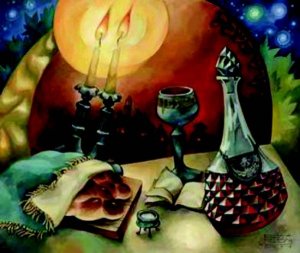
Eight nights eight lights and these rites keep me right
Bless me to the highest heights with your miracle
Do you believe in miracles?
Happy Chanukah.

Do you believe in miracles
Am I hearing you? Am I seeing you?
Eight nights eight lights and these rites keep me right
Bless me to the highest heights with your miracle
Do you believe in miracles?
Happy Chanukah.
 Question: My granddaughter is becoming bat mitzvah, and my 92-year-old mom is saying she will not be able to go because she cannot drive on Shabbat. But is it allowable—for this special occasion—for her to violate Shabbat just this once? The way I see it, this is a once-in-a-lifetime situation, making it quite okay to drive. This is her first great-granddaughter to reach bat mitzvah, and unfortunately she probably will not be around to celebrate this milestone with any of her other great-grandchildren.
Answer: This is an important question, for it leads us to a central theme in Judaism.
It’s easy to relate to a mitzvah as tradition or symbolism. Perhaps, taking it one step further, a mitzvah is divine advice on how to live the best life possible—the most meaningful, the most blessed.
If we would accept either of those definitions, we would have to agree that fulfilling mitzvot depends on the situation. We would say that yes, tradition is important, living a meaningful life is important, but in this situation there is something else more traditional and more meaningful—so we would use our judgment as to what takes precedence.
But that isn’t so. A mitzvah is precious not just because it is a tradition and has meaning to us. A mitzvah is G‑d’s own will and infinite wisdom. If so, a mitzvah’s incredible power and the blessing it brings is infinite in nature. It’s a connection to an infinite G‑d, way beyond our own understanding. It goes beyond the benefits and meaning we sense—though that’s important as well—for it is part of the divine. And a G‑dly formula for living is not subject to man deciding whether it is or isn’t relevant in a particular situation. (It is only when the Torah itself instructs us to put aside Shabbat, as in to save a life, that Shabbat laws should be disregarded.)
We might feel that a hike to the top of a mountain will be a more spiritual experience than a trip to the synagogue. Or that the pastrami from the new “kosher style” delicatessen will make the bat mitzvah a more joyous experience. Or, in a far more subtle manner, the situation here: that a great-grandmother being at the family celebration outweighs the prohibition of driving. And that’s when we remember that a G‑dly mitzvah is eternal, and extends far, far past the benefits we happen to sense . . .
Your grandmother should most certainly be at this bat mitzvah. It is only that you will need to find a way for this to happen in a permissible manner. Have you looked into her staying within walking distance from the synagogue? If this is not a possibility, you can speak to the rabbi about having a non-Jew wheel her to the synagogue (a subject beyond the scope of this e‑mail).
Mazel tov, and may you have much nachas from the entire family!
-Rabbi Yisroel Cotlar
“Can We Drive Grandma on Shabbat?”
Chabad.org
I suppose, even if I were currently tempted to convert to Judaism, this is one of the reasons I could never be a Jew. I understand, at least to a degree, the principle that Rabbi Cotlar is trying to communicate, but from my point of view, human compassion has to take a back seat to obedience to the mitzvot regarding not driving on Shabbos (maybe saying that makes me a bad person, I don’t know). Worse than that, I don’t understand the Rabbi’s advice about having a non-Jew wheel her to the synagogue (if it would help and if this were happening now in my community, I’d be more than willing…but there seems to be a problem).
It is forbidden for us to tell a gentile to perform work on the Sabbath on our behalf, although they are not commanded [to observe] the Sabbath. [This applies] even when the instructions were conveyed to them before the Sabbath and we do not require [the products of] their work until after the Sabbath.
The above is forbidden as a Rabbinical prohibition to prevent the people from regarding the Sabbath lightly, lest they perform [forbidden] labor themselves.
On the other hand…
[The following rules apply] when a gentile performs a [forbidden] labor on the Sabbath on his own accord: If he performed it on behalf of a Jew, it is forbidden to benefit from that labor until one waits the amount of time necessary to perform the labor on Saturday night.
[The latter leniency is granted] provided the matter is not public notice – i.e., everyone knows that a particular task is being performed for a person on the Sabbath.
If [the gentile] performed [the labor] for his own sake alone, it is permitted to benefit from it on the Sabbath.
Halacha 1 and Halacha 2 from
Chapter six of Mishnah Torah, Sefer Zemanim, Shabbos
Translated by Rabbi Eliyahu Touger
Chabad.org
 Lacking the educational background (as well as an ethnic, cultural, and lived Jewish experience), I admit that I can’t really interpret what is being said here and whether or not a non-Jew would really be permitted to “wheel grandma” to the synagogue on Shabbos if asked by her Jewish relatives. It seems a little dodgy to me, but then again, admittedly the nuances of interpreting Mishnah Torah escape me.
On the other hand, what should we say…that man was made for the Shabbat rather than the Shabbat being made for man?
One Sabbath he was going through the grainfields, and as they made their way, his disciples began to pluck heads of grain. And the Pharisees were saying to him, “Look, why are they doing what is not lawful on the Sabbath?” And he said to them, “Have you never read what David did, when he was in need and was hungry, he and those who were with him: how he entered the house of God, in the time of Abiathar the high priest, and ate the bread of the Presence, which it is not lawful for any but the priests to eat, and also gave it to those who were with him?” And he said to them, “The Sabbath was made for man, not man for the Sabbath. So the Son of Man is lord even of the Sabbath.”
–Mark 2:23-27 (ESV)
I included the entire section of scripture relevant to this situation rather than just quoting verse 27 because I’m aware that the circumstances Jesus was describing may not be directly associated with “driving grandma to synagogue.”
If grandma could stay Friday night within walking distance of the synagogue (assuming she can walk adequately at age 92), then I understand that would be acceptable. If grandma could stay the night within walking distance of the synagogue but could not walk, while I am “unclear” of the legitimacy of asking a “Shabbos Goy” to wheel her to shul, I’d accept that as an alternative from my Christian perspective. But if no halachically acceptable alternative were available, and grandma really, really wanted to attend her great-granddaughter’s bat mitzvah (and/or great-granddaughter really, really wanted great-grandma to be there for this once-in-a-lifetime event), then I’d drive grandma to shul (I know…she would be violating Shabbos by even accepting the ride).
I know this isn’t a life or death situation but I can’t set aside the feelings of the great-grandmother in question or her great-granddaughter either. Besides, according to one person’s comment on the matter, there is precedent for an alternative:
I think of the Rev that chopped wood and made soup for a helpless woman in her bed on Yom Kippur -she had just given birth) Sometimes it is necessary to hurt ourselves spiritually in order that another rmay grow or even live. However, I am loving ths suggestion of staying with her family for the entirety of Shabbat or the motor home. How important will the young ladies’ Bat Mitzvah be to her without Grandma there? How will that affect her walk with Hashem? We will never know. Some souls are mighty sensitive. Will this suck out all of the girl’s joy, what a sin that would be. Have her expectations been considered?
-Emily
I remember reading of this “Chasidic tale” so I think there is a value in Judaism that would allow an individual to violate Shabbos for the sake of another, even when their life is not at risk.
Here are a few more comments:
I proposed some questions to Rabbi Manis Friedman years ago relating to the halachot of shabbos. His answer? Shabbos is shabbos. End of story.
-Anonymous
I wasn’t raised Orthodox and don’t have a full understanding of this. But my argument would be that just because rabbis declared that driving, or even riding in a car, violates the Sabbath, doesn’t make it so. I don’t know, but my guess is that at the time, there were probably arguments going both ways.
-R. Baron
i’m a committed but not orthodox Jew and am fascinated by the question and your response.
The alternatives you gave were good; you may want to consider a nearby hotel for Friday night also. But to the heart of the matter, you mentioned consideration of what is ‘most meaningful, etc.’
I believe keeping the great-grandmother away from attending and participating would be cruel. since the question comes up –and Chabad is consulted –it implies she has done a great job in raising a Jewish family.
I do not believe the divine would want her to miss it and this is not a question of climbing a mountain on shabbat or going to a ‘kosher style deli.’
-Oppie
Apparently, this isn’t a clear-cut issue for at least some Jewish people, either. I know. I’m probably going to “catch heck” from my Jewish friends who read this blog and maybe a few “Judaically-aware” Christians as well. I know that if someone who is shomer Shabbos is lenient on a rare occasion, it may lead to greater lenience and finally to habitually “cheating” on the Shabbat, but on the other hand, isn’t it possible to be too rigid? If a “hedge” is placed around the mitzvot to prevent a Jew from even coming near to violating Shabbos, isn’t it possible the hedge can become too extreme?
My perspective can be easily dismissed with a “you aren’t Jewish and so you don’t understand,” but as I mentioned (and demonstrated) above, even other Jewish people have a hard time with this one. My response (and this is quite a counterpoint to my Shabbat commentary from the other day), all other reasonable alternatives failing, is that I’d find a way to get grandma to shul for the bat mitzvah. I don’t think God would really mind, but then again, how am I to tell?
 Recognize, please, to whom these belong…
–Genesis 38:25
The arrival of a letter, adorned with official-looking stamps and seals, was quite an event at the small wayside tavern somewhere in the backwoods of White Russia. The simple tavern-keeper, who had never quite mastered the written word, ran to find the melamed he kept to teach his children.
As the teacher read the letter, the tavern-keeper turned white, uttered a small cry, and collapsed in a dead faint. For the letter contained most shocking and tragic news for this simple, good-hearted Jew: his beloved father had passed away.
Said the mashpiah Reb Michael of Aptask:
An outside observer witnessing the events described above may wonder: why does the tavern-keeper react so dramatically to the letter while the teacher is relatively unmoved? Who among the two better grasps and comprehends its contents if not the learned teacher? The other cannot even read and write!
Obviously, this is a ridiculous question. What if the teacher has a better appreciation of the vocabulary, sentence structure, and artful calligraphy with which the letter is composed? What if he better understands the background, the circumstances, the nuances of the event described? It is not his father who died!
True, Reb Michael would concluded, it is important to learn, to study, to comprehend. And the more one understands, the deeper one delves into the nature of his own existence, the world about him, and his relationship with his Creator, the better equipped he is to fulfill his mission in life. But objective knowledge alone is worthless. Unless one sees himself in the picture, the most profound of theories will yield no meaningful results. Unless one sees the subject matter as ‘his father’, a lifetime of study and discovery will have little bearing on life itself.
-Rabbi Yanki Tauber
“The Theory and the Father”
Commentary on Torah Portion Vayeishev
Chabad.org
Apparently, I’m a hypocrite. I don’t believe that I’m a hypocrite, but two individuals have called me one in the past few days. Here are a couple of examples from recent comments on my blog. The first one I present is pretty benign:
…since you are a gentile, dabbling in Messianic Judaism, “which is for Jews”, is a bit of a contradiction, technically you are muddying the waters, so to speak. Would you not agree?
The second example, on the other hand…
I will tell you that you are a hypocrite in your face. I don’t play nicely nicely with the truth. I have to chastise one who does not play with a full deck…You fell for false teaching and with your blog you are causing people to stumble…Go home……
Supposedly, because I advocate for the Jews having a unique covenant relationship with God and that they have a special role beyond any other people or religious group, including Gentile Christians, I have a problem. Actually, the problem is supposed to stem from the fact that I advocate for the above and yet I also involve myself, as a Christian, in the affairs of Messianic Judaism by writing commentaries on the movement. I suppose the fact that I very often quote from Jewish religious and educational sources just adds to my “problem.”
But does that make me a hypocrite?
Just a few days ago I said:
We serve One God and we have one Messiah King who will return to rule over all of Creation. As servants and sons, we each have our roles and duties. We can’t afford to let our limitations, biases, and human ambitions restrict who we are and who God created us to be…both the Jew and the Gentile. Christian support of Israel does not mean taking control of the process of defining Israel. It’s allowing the Jewish people and nation the space to define themselves, and supporting them in this effort through whatever means are at our disposal. That is a Christian’s unique role and purpose in life. It’s time we start living it.
 I tried to the best of my ability in the paragraph above to synthesize Christian and Jewish interactions and roles relative to mutual discipleship under the Messiah. Apparently, I failed, at least with the two people who objected to my blog post. I know most of you must be wondering why I’m even writing this. After all, only a few people (publicly) object to me while a much larger number seem to be more encouraging. Why express angst over just a couple of people who question my motives?
I’ve said time and again on this blog that I want to be fair. I want to consider other people’s viewpoints. If someone has a grudge or a beef with me, I have to ask myself if there is anything I’ve done to contribute to it. If there is, then there’s something within me that I need to change. If not, then at least I’ve looked in the mirror and asked myself a few hard questions before moving on.
It’s not that I expect everyone to agree with me all of the time, but it’s difficult for me to comprehend how even my critics can miss what I’m trying to say. It’s one thing to understand my message and to say, “I disagree,” and another thing entirely to misunderstand me to the point what I’m considered to be advocating one position while living out the opposite. Saying that I support Jewish covenant and identity uniqueness is not the same as saying that Jews must be walled up inside their compounds and have nothing to do with the Christians, particularly those of us who are involved with Jews and Jewish community. In my case, I’m married to a Jew. Are we supposed to divorce and live separately? Does my involvement with my Jewish spouse make me a hypocrite? The criticism doesn’t make sense.
I quoted Rabbi Tauber’s story above because it illustrates the relationship and the differences between knowing and understanding; between information and lived experience. The teacher understood the letters, words, and sentences contained in the message but the tavern-keeper experienced the true meaning and impact of what the letter actually said, including the importance of relationship and context. The teacher “knew” the letter while the tavern-keeper “lived” out the meaning and consequences.
I can “know” the “letters, words, and sentences” of the Torah, the mitzvot, and something of the Jewish writings to the limits of my education, but I can never “live” out the experiences, the meaning, the fabric of what it is to be Jewish, whether it is within the context of Messianic discipleship or otherwise. In saying, Recognize, please, to whom these belong, Tamar was calling Judah to acknowledge his unique identity as the father of her children (she was pregnant with twins) and (without realizing it) as the forefather of the Messiah.
I don’t believe that we Christians who stand alongside our Jewish brothers and sisters in the Messiah are hypocrites, either for actually standing by them or by discussing our relationship with each other. If such were the case, a great many writers and teachers, far more knowledgable and talented than I, would have to suffer the same accusation of “hypocrite” and, to serve the honor of Messiah, adjust our behavior accordingly.
 But that would be psychotic.
Jewish and Gentile disciples of the Master are still united by one Messiah and one God. While Rabbi Dr. Michael Schiffman may say that Messianic Judaism and Christianity are two different and separate religions, he also said this:
I also believe Yeshua will bless those gentiles who truly love him. We acknowledge that the gentiles in Yeshua have a place in God’s heart. It makes them our brethren, just as our fellow Jews are our brethren. We are related to other Yeshua followers, just as we are related to other Jews. Nevertheless, Messianic Judaism and Christianity remain two separate religions, yet we have the same Messiah, Yeshua. That being the case, rather than beating each other up with statements of faith we require each other to affirm, it would be good if we just began by treating each other as brethren, loving and supporting one another. I have always been more happy affirming people than doctrinal statements.
That certainly doesn’t sound like he’s requiring isolation between Christians and Messianic Jews. How could he advocate for a complete separatist philosophy and still say that Christians and Jews should “began by treating each other as brethren, loving and supporting one another?” That seems to go along with a “Daily Lift” of Rabbi Zelig Pliskin:
When you build up your own courage, you will be able to serve as a coach to others. Some of the best courage coaches are those who had to struggle to attain the courage they now have. Since it didn’t come easy to them, they know what it’s like to lack the courage to do what others consider easy.
If you don’t yet have the courage you would like, let the knowledge that you will inevitably be able to help others serve as a further motivation to increase your own courage.
Recently, I’ve been encouraged and reminded that in writing this series of “morning meditations,” I’m encouraging others. These are words and actions we are supposed to live by.
Therefore encourage one another and build one another up, just as you are doing.
–1 Thessalonians 5:11 (ESV)
Good Shabbos.
 Picture the scene: Dead, feathered birds are lying on the kitchen counter; a bag of flour has spilled onto the floor, along with a orange juice—and so, the two-year-old is having a lovely time creating edible mud pies from the mix. From upstairs, a scream shakes the house—it’s the little one furious at the big one for making her bathtub too hot. Meanwhile, the big one is kvetching at the top of her voice because “there’s nothing for me to wear.” The father of the house is hiding somewhere, in full knowledge that if he shows his head, he’ll be sent out again on another urgent, last-minute errand.
At this point, the doorbell rings. It’s the nudnik guest, delivering his gift bottle of wine in advance, certain that the lady of the house has nothing better to do this afternoon than stand at the door and chat. She is careful to open the door only a slight 20 degrees, wedging herself into the space—first, so that the guest won’t see the state of affairs within; but also to prevent the little one who has just escaped from his hot tub from running out naked into the street.
The guest sniffs the air, and sighs, “Ahhh . . . Shabbos!”
Shabbos? Shabbos is a day of rest! Of peace! Of harmony! This is a total disaster zone!
But the guest smells what is coming. And the inhabitants of this house know as well. They know the dead birds will become a sumptuous chicken soup, the remainder of the flour will become fresh-baked challah, the children will be neatly dressed in their finest clothes, the father will turn up again, and they will all sit together at the table, singing in harmony and telling the stories and words of Torah they learned in school that week.
When you know the story, the scene becomes a different scene. The gadget in your pocket, the news on the tab before this one, the financial chaos and the promises of technological breakthrough, the void of leadership and the medical miracles that keep failing to come—think of those as the dead, feathered birds on the kitchen counter, soon to become a sumptuous chicken soup.
Science has opened our eyes to the awesome harmony of our world. The Kabbalah of the Ari, explained in the language of Chabad, can open anyone’s eyes to the G‑dliness behind that harmony. Shortly, we will sit at the Shabbos table with Moshiach, who will show how the earthly wisdom and the heavenly wisdom complement one another. While we are yearning for that knowledge, what is stopping us from tasting a spoonful of the soup right now?
-Rabbi Tzvi Freeman
“The Last Day of History”
Chabad.org
This is the climax to a rather lengthy and challenging article my wife shared with me the other day. I must admit to having skimmed over much of the content, but this portion is not only straightforward but rather the point of it all. I don’t mean that it’s the point of the article, although I suppose it is, I mean that it’s the point of everything.
For we who have believed enter that rest…
–Hebrews 4:3 (ESV)
The writer of Hebrews and Rabbi Freeman seem to be drawing their respective audiences to the same point: that we will one day enter into that final rest with the Messiah. What is especially attractive about Rabbi Freeman’s perspective is that a foretaste of that rest exists right now. Jews experience a small sampling from the “menu” of the Messiah’s table every Shabbat. Some Christians who are attached to the traditional Jewish community, Messianic Judaism, or Hebrew Roots, also have the opportunity to experience that “rest” and sample from the “menu” to varying degrees.
As far as I can tell, most Christians don’t.
 I think that “Christ’s rest” is something that is more conceptual within Christianity. Most Christians anticipate being “raptured” and going up to Heaven of course, but there’s no idea that you can get a preview of the event before the event, at least not very frequently. There’s no manner of experiencing such an event in the material world because the “Messiah’s rest” is thought to be wholly spiritual.
More’s the pity.
I miss even the tiniest sliver of Shabbos observance in which my family used to participate. Hopefully, by God’s mercy, my wife will desire to observe the Shabbat again as her life calms down, and our home will be illuminated and warmed by the Shabbos candles once more.
I’m sure what I’m saying seems totally alien to most Christians. How can we experience the return of Jesus Christ before he returns? It must seem ridiculous.
But think about it.
In the U.S., we’ve recently celebrated Thanksgiving and most Christians are anticipating Christmas in just a few weeks. One of my favorite parts of Thanksgiving is the aroma of delicious foods in the kitchen. I traditionally barbecue the turkey in a Weber on the back patio, so in tending to it, I get to enjoy the smells of the slowly roasting bird as the smoke curls into the air. These smells all by themselves are highly pleasurable and also herald the grand feast that is to come.
And that is Shabbat. We know the feast will come but we also have a role in preparing for the feast. How many “feast” metaphors did Jesus use to describe the preparations for his own return and King and Bridegroom? Here’s just one of them.
“Then the kingdom of heaven will be like ten virgins who took their lamps and went to meet the bridegroom. Five of them were foolish, and five were wise. For when the foolish took their lamps, they took no oil with them, but the wise took flasks of oil with their lamps. As the bridegroom was delayed, they all became drowsy and slept. But at midnight there was a cry, ‘Here is the bridegroom! Come out to meet him.’ Then all those virgins rose and trimmed their lamps. And the foolish said to the wise, ‘Give us some of your oil, for our lamps are going out.’ But the wise answered, saying, ‘Since there will not be enough for us and for you, go rather to the dealers and buy for yourselves.’ And while they were going to buy, the bridegroom came, and those who were ready went in with him to the marriage feast, and the door was shut. Afterward the other virgins came also, saying, ‘Lord, lord, open to us.’ But he answered, ‘Truly, I say to you, I do not know you.’ Watch therefore, for you know neither the day nor the hour.
–Matthew 25:1-14 (ESV)
There’s preparation. There’s work to be done. There’s waiting. And then finally, sometimes unexpectedly, the Prince arrives and the feast begins.
But in cooking a meal, how many chefs manage to taste a bit here and a bit there, making sure the seasoning is just right, adding a spice or an herb to enhance the flavor?
I suppose that’s what Christmas is to most Christians…celebrating the birth of Jesus and his first entry into the world in anticipation of the second. That’s probably why Easter is also observed with such zeal (and a meal), to rejoice over the risen Jesus and to pray that he returns soon.
But while Judaism also has its great festivals, they also have Shabbos, the weekly reminder. Going to church on Sunday just doesn’t compare.
 For a Jew, six days of the week are spent in pursuit of the mundane, taking care of business, and sometimes letting life take over or overwhelm. Shabbos is bringing order to chaos and peace to turmoil. Even the preparations for Shabbos can seem maddening, much like life itself, but the result is wonderful, much like Messiah’s coming.
In God’s wisdom, He gave the Shabbat to the Jewish people as a sign of His covenant with them. Alas, it did not transfer to we Christians when we were brought into the fold. But sometimes you need rest and refreshment in order to summon courage for what is to come and to lay down the burden of what’s already happened. I don’t observe Shabbat these days, but I hope I will again. You may not observe Shabbat either, but it’s something you can access if you choose.
Messiah may come today, tomorrow, next year, or a thousand years hence. But Shabbos comes every week. Why wait? The Challah is rising in the oven and pots are steaming and bubbling on the stove. Have a taste of chicken soup now. It’s delicious.
 How many days you have left, and how many more article can you milk from the dry turnip?
-A comment to me on one of my recent blog posts
A person who is serious about self-improvement will be grateful to anyone who points out his faults! (Whereas a person who does not have a strong desire for self-improvement will deny that he has any faults – even those which are blatant.)
Utilize the criticism of others as an opportunity for introspection.
-Rabbi Zelig Pliskin
“Daily Lift #1123, Accepting Criticism”
Aish.com
It’s just amazing how people will address you when the Internet stands between the two of you. I’ve written before about how rude people tend to be when communicating on the web, and how (in all likelihood) they’d be a tad bit more civil if they had to talk with you face-to-face.
I started the “Days” series in part because of my internal response to Internet “crankiness.” After all, who wants to put up with a collection of people who continually complain at you (me) because you won’t fully endorse their opinions on a topic you have in common? Not me. Of course, there are some folks who say that it’s not “crankiness” or complaining that motivates them, but rather the use of “challenging discourse” as a method of learning. I set aside that particular excuse for rudeness awhile ago.
But my critic hit the nail on the head. I have 26 days left in my self-imposed countdown. Do I disappear then to avoid the “challenges” of “crankiness” on the Internet?
On the one hand, life would be a little more calm without the continual “noise” of social networking, but amid the noise, there’s occasional “signal” that is beneficial. Should I put up with those who have a particularly low signal to noise ratio because I benefit from others who possess a much higher ratio? Is it worth it?
On the other hand, I don’t like being pushed around and I don’t like bullies. If someone doesn’t like the content I generate, they don’t have to visit my blog. I’ve stopped visiting the blogs and websites of nudniks because it was foolish of me to engage people who would only talk at me and never listen. Disagreement is fine and I can certainly live with it. Hostility for its own sake I can live without.
There are people who do gracefully criticize me when I get things wrong, and as stinging as it can be, I actually appreciate it. On the other hand, these are people who can bring such matters to my attention without behaving as if my error or ignorance has personally insulted them. I’m finding that’s a rare and special gift among human beings.
If someone is critical of you in a harsh tone of voice, try telling them the following:
“I appreciate your strong feelings about the matter, but I would appreciate the comments more if they were expressed more pleasantly.”
-Rabbi Zelig Pliskin
“Daily Lift #304, Soften Criticism”
Aish.com
I don’t like to “call out” individuals on my blog. It’s happened to me on numerous occasions on more than one blog and I find it ungracious and offensive. On the other hand, I couldn’t illustrate my point without quoting what one of my critics said to me earlier, so to my critic, I apologize if I caused you embarrassment. I really do just want to point out that if your criticism of me is out of a sincere desire to help me become a better person, there are more constructive ways to go about it.
I have to consider that there are some people out there who can’t just leave my blog alone and who really do want me to give up and pull the plug at the end of the month. Frankly, if I bother some folks that much then I suspect they may need to get another hobby or maybe even a life, since I’m not that significant in either the blogosphere or the human race.
But if there are people who want me to leave, that’s probably a good reason for me to stay. Remember, I don’t like bullies. If you don’t like me, don’t read my blog. I don’t read your blogs and I certainly don’t comment on them. I don’t need to hang around people who suck the joy out of life and living just because they can.
If you have a suggestion on how I can be better that is motivated by a sincere desire to help and you can express it without hostility, please let me know, either in a blog comment or via email. If you are complaining about me just because you can, I invite you to go elsewhere.
Thank you.
 Though there are an estimated 175,000 to 250,000 Messianic Jews in the U.S. and 350,000 worldwide, according to various counts, they are a tiny minority in Israel — just 10,000-20,000 people by some estimates — but growing, according to both its proponents and critics. Messianic Jews believe that Jesus is the Jewish messiah, and that the Bible prophesizes that God’s plan is for him to return to Jerusalem, prevail in an apocalyptic battle with the Antichrist, and rule the world from the Temple Mount. Unlike Jews for Jesus, which focuses on bringing Jews into churches, Messianic Jews seek to make Jews believers in Jesus while still maintaining congregations that identify as Jewish and observe Jewish customs and holidays.
While these Messianic Jews are derisive of Orthodox Jewish fundamentalism (particularly what they call its “legalism”), they pick and choose some of the practices of traditional Judaism, such as weekly Torah readings — although they add New Testament verses to it.
They import to Israel many of the worship practices and the political agenda of the American Christian right. They are tightly knit with an American-born global revival movement that holds that modern-day prophets and apostles receive direct revelations from God, forming an elite army of prayer warriors on a mission to carry out God’s plans to purify Christianity, “restore” Israel, and bring the Messiah back.
-Sarah Posner
“Kosher Jesus: Messianic Jews in the Holy Land”
An article written for
the Atlantic
In a previous blog post, I mentioned that it’s helpful to take a look at that entity we call “Messianic Judaism” from outside the Messianic Jewish and Hebrew Roots contexts. We have a tendency to see our arguments through a very narrow tube that significantly limits our vision, not only of who and what Messianic Judaism is (along with Hebrew Roots and its variants such One Law, One Torah, Sacred Name, and Two-House), but how the rest of the world perceives it and them.
The above-quote from a recent online magazine article was apparently written by a Jewish reporter who, in all likelihood (but I can’t know for sure), is not religious (I say this based on the overall content of the full article). Her description of Messianic Jews in Israel was either so biased as to make the Jews she interviewed seem overly Christian (and certainly not Jewish in a cultural or halakhic sense) or indeed, the Jews she spoke with were very “Christianized.” But if the latter is true, then did this reporter choose a representative sample of the Messianic Jews in the Land or did she bias her research to only select the most “Christian-like” Jews in the Israeli Messianic environment?
In other words, are there any authentically, halachically, and culturally Jewish Messianic Jews in Israel, and can Messianic Judaism be fairly assessed by a Jewish reporter who may have “issues” with whether or not the Jewish participants in Messianic Judaism are actually Jewish?
When I write about Messianic Judaism as a Judaism (as opposed to “a Christianity”), I’m usually criticized, typically from Hebrew Roots proponents, saying that the majority of people involved in what I term as Messianic Judaism are not Jewish. True enough. As I’ve said before, Messianic Judaism as it exists today is a goal or an ideal. It is not a fully realized movement among the other Judaisms of our era.
And that’s probably Christianity’s fault.
Granted, “ownership” of the Jewish Messiah passed from Jewish to Gentile hands nearly 2,000 years ago and it’s only within the past century or less that any Jews at all have even considered the possibility that Jesus is the Messiah and that it’s “Jewish” to honor him. Tsvi Sadan in his article “You Have Not Obeyed Me in Proclaiming Liberty”, written for the Fall 2012 issue of Messiah Journal, says of past and present Messianic Judaism in Israel:
In the past, leadership was largely in the hands of Christian missionaries. Today leadership is predominately held by American Jews, American “wannabe” Jews, and American Christians. Where Jewish Israelis are in leadership, they have received their education – if they have any – from Christian institutions either in North America or Great Britain. In addition, with the influx of immigrants from the former Soviet Union in the 1990s, Russian speakers began to establish new churches and assume leadership positions in existing churches (congregations). Yet though some of the people and organizations have changed, the present-day leadership is essentially operating in the same way as their missionary predecessors did. While Hebrew is now the spoken language in most Israeli churches, modes of operation and models of leadership which grew mostly out of evangelical worldviews still dominate the scene.
 So perhaps Ms Posner’s report on Messianic Jews in Israel wasn’t particularly inaccurate or biased after all. However, Posner ends her article with a chilling pronouncement:
In the meantime, Messianic Jews are assiduously attempting to, essentially, redeem Israel from its Jewishness. That seems to be the task at hand at the Jerusalem Prayer Tower, another 24-7 prayer meeting place located on the top floor of an office building on the bustling downtown thoroughfare Jaffa Street. At the “Restoring Jerusalem” prayer meeting, an American Christian woman read about Jezebel from the Book of Revelation, and exhorted the half dozen people in the room to pray to “purify” and “cleanse” Jerusalem.
Another woman prayed for the Jews “to change their mind, to feel you, Lord, to convert to you, Lord.” The first woman resumed her prayers, hoping that Jesus will give Israeli Prime Minister Benjamin Netanyahu “a great understanding of who you are.” She seems to earnestly believe this is a plausible scenario. “Help him, Lord,” she implores. “Bring him to Messiah.”
I was especially taken by the statement, “Messianic Jews are assiduously attempting to, essentially, redeem Israel from its Jewishness.” This comment clashes incredibly against what most of the Jewish Messianics I interact with tell me. In the article “Messianic Judaism: Reconsidering the One-Law, Two-House Trajectories” written by Boaz Michael, also for Messiah Journal, in addressing Gentile and Jewish roles, Boaz states:
In rejecting the right and responsibility of the Jewish people to define what it means to be Jewish and to practice Judaism, One-Law theology strikes directly at the core of authentic Judaism. One-Law replaces the Jewish rabbis and sages with self-appointed Gentiles who believe that they are divinely sanctioned to interpret the Torah outside of a Jewish context: whatever conclusions they come to are given greater weight than those of Jewish halachic authorities.
There is a struggle to define Messianic Jewish practice as Jewish and some of the Jews in the Messianic Jewish movement are caught between two forces: Evangelical Christianity and Hebrew Roots. Both groups of non-Jews are vying for the opportunity to define the Jewish worshipers of Christ in some manner that removes significant parts of what it is to be a Jew. In the vast majority of cases, this isn’t done from the malicious desire to harm Jews or Judaism, but intentions aside, the results are obvious. Even many Jews in Messianic Judaism believe that to accept Jesus as the Jewish Messiah, they must reduce or eliminate their Jewish identities. Those Jews who accept the One Law proposal are required to surrender their unique Jewish identity to any Christian demanding an equal share in the Torah.
 The latest discussion (as I write this) in the “Messianic blogosphere” on this struggle is Derek Leman’s article, CRITIQUE: Tim Hegg’s Article on Acts 15. By the time you read this “morning meditation,” the comments section of Derek’s blog will most likely have heated up to the temperature where lead melts (621.5 degrees F or 327.5 degrees C). There is a great deal of tension in this communications dynamic largely because each group, Evangelical Christianity, Hebrew Roots (One Law, Two House), and Messianic Judaism, have “turf” to defend. But while both Evangelical Christianity and Hebrew Roots see themselves as pro-Judaism and pro-Israel, it has been strenuously asserted by Messianic Jews that their impact is otherwise.
Boaz Michael says:
These movements damage and diminish Jewish identity in several ways. In one way, a very practical and real diminishing of Jewish identity occurs when people who are not Jewish begin to dress and act like they are Jewish (particularly like Orthodox Jews). When Jewish customs and Jewish apparel are taken on outside the context of a Jewish community and authentic Jewish identity, it diminishes real Judaism and real Jewish life. It sends a message to the Jewish people: “All of the things that make you unique and identifiably Jewish are mine too.”
Tzitzit are a prime example. In a traditional Jewish context, tzitzit have real meaning. They send a specific message: “The person wearing these is shomer Shabbos. They keep a high standard of kashrut. They are serious about traditional Judaism.” To see a person with tzitzit, for example, eating a cheeseburger or driving on the Sabbath actually diminishes the Torah and casts Messiah (and Messianics) in a negative light. It is application without understanding. It strips tzitzit of their meaning and significance.
That final statement could be extended to say that such a person “strips Judaism of its meaning and significance.”
Again, the large portion of the blame for this mess is Christianity, not in its intent but in its approach. Sadan stated that many Jews in Israel have come to know the Messiah, not through Jewish people or contexts, but through Evangelical Christians or Jews who have an Evangelical mindset. In the United States, many Jews come to know the Messiah, either through the traditional Church or through Hebrew Roots churches, and particularly One Law groups. My wife and I were introduced to “Messianic Judaism” through a local One Law congregation and for quite some time, we thought this was the only expression of Messianic Judaism. It was our introduction to “Judaism” without having to actually enter into a Jewish community (the vast, vast majority of people present were Gentiles). Jewish customs and practices were very poorly mimicked and an understanding of even the prayers was only elementary.
It wasn’t until my wife joined first our local Reform-Conservative shul and later the Chabad, that we both began to understand actual Judaism. From my wife’s point of view, it was in the form of a real, lived experience, and for me, it was largely by observation.
But I got to observe a lot.
Tsvi Sadan’s article presents an alternate method of introducing the Jewish Messiah to Jewish people in Israel:
Instead of this traditional Mission approach with its “proclamation of alienation,” Messianic Jews should consider the “proclamation of Keruv,” not as a tactical maneuver but as a state of being. Keruv is a Hebrew word that comes from “near” (karov). Essentially therefore, Keruv is a mission to call Jews to draw nearer to God and one another, first and foremost through familiarity with their own religion and tradition. The Jewish people, as taught by Jesus, cannot comprehend his message apart from Moses (John 5:46). Talking about the significance of Jesus apart from the everlasting significance of Israel is that which renders evangelism ineffective. Keruv on the other hand is all about reassuring the Jewish people that Jesus came to reinforce the hope for the Jews as a people under a unique covenant.
 It’s impossible to change the past but we have the power to summon the future. We have the ability to change directions and to correct our mistakes. In order to introduce the Jewish Messiah to Jewish people without damaging Jewish identity, either by removing it or co-opting it from Jews, it must be communicated that Judaism and the Jewish Messiah are mutually confirming and supporting. Instead of Messianic Judaism being seen as trying to “redeem Israel from its Jewishness,” it must behave in a manner that is totally consistent with restoring Jewishness to Israel and the Jewish people. This is not to say that Israel and Jewish people aren’t currently Jewish, but that the Messiah affirms, supports, and restores the rightful place of Israel and the Jewish nation as the head of nations and as a people called out by God to be completely unique from among the nations and peoples of the earth, including Gentile Christians.
This doesn’t diminish the Christian in the slightest. Even non-Messianic Jews assert that Jews are not better than Christians or any other group of Gentiles, just different and unique. I’ve said many times before that we Christians have a responsibility to support Jews, both materially and in their return to the Torah of their Fathers, all for the sake of the Kingdom and the return of the Messiah. As Boaz Michael said in a recent blog post, “The completion or resolution of Israel’s story does not and will not occur until she is redeemed from her exile, planted firmly in the land God has promised to her, and returned to a state of loving obedience to the Torah under the leadership of the Son of David, Yeshua the Messiah.”
We serve One God and we have one Messiah King who will return to rule over all of Creation. As servants and sons, we each have our roles and duties. We can’t afford to let our limitations, biases, and human ambitions restrict who we are and who God created us to be…both the Jew and the Gentile. Christian support of Israel does not mean taking control of the process of defining Israel. It’s allowing the Jewish people and nation the space to define themselves, and supporting them in this effort through whatever means are at our disposal. That is a Christian’s unique role and purpose in life. It’s time we start living it.
 Morning Meditations