Antignos of Socho received the tradition from Shimon the Righteous. He would say: Do not be as slaves, who serve their master for the sake of reward. Rather, be as slaves who serve their master not for the sake of reward. And the fear of Heaven should be upon you.
-Pirkei Avot (Ethics of the Fathers) 1:3
quoted from Chabad.org
Back to Stern’s statement: replacing “tradition” with “interpretation” we could rewrite it to say: “There could never have been a time when interpretation of some sort was not a necessary adjunct to the written Torah.” Tradition claims legitimacy by appealing to the past for its authority, and is independent of scriptural anchoring; interpretation does not look to the past for legitimacy, but rather seeks an anchoring in the text itself. One dispute among the rabbis is whether certain halakhot were actually derived exegetically or whether they were an independent revelation.
-Rob Vanhoff
from his December 31, 2014 at 4:03 pm comment on his blog post Is there a core “Oral Torah” written in response to Peter Vest’s blog post Question for Rob Vanhoff
I’m dabbling into somewhat dangerous waters by invoking commentary written by Rob Vanhoff of TorahResource.com since typically, my theological orientation and Mr. Vanhoff’s (and his employer Tim Hegg) are not entirely compatible (I say that as an understatement).
But in reading Mr. Vest’s and Mr. Vanhoff’s dialog and then commentary from the book Pirke Avot: A Modern Commentary on Jewish Ethics, I started to ponder the relationship between interpretation and tradition in both Christianity (which includes the Hebrew Roots movement in my opinion) and Judaism (which I believe includes Messianic Judaism).
I should note at this point that I’m not writing this to challenge either Mr. Vest or Mr. Vanhoff (or Mr. Hegg). I’m not attempting to enter into yet another “I’m right and you’re wrong” debate. I just want to point out that, from my point of view, how we interpret the Bible is based on our traditions, both within Christianity and Judaism as I’ve defined them above.
The existence of the oral tradition is alluded to in the Written Law in numerous places.
For example:
The Torah says: (Deut. 12:20) “When G-d expands your borders as He promised you, and your natural desire to eat meat asserts itself, so that you say; ‘I wish to eat meat’, you may eat as much meat as you wish… you need only slaughter your cattle and small animals… in the manner I have commanded you.” Nowhere in the Written Torah is such a manner described. So what is the manner in which we are supposed to slaughter cattle?
Though the laws of slaughtering cattle are not explained in the Written Torah, they are described in detail in the Oral Law.
The Talmud tells the story of a Gentile who went to Hillel the Elder and said to him, “I want to convert, but I want to accept only the Written Torah, and not the Oral Torah. I don’t wish to accept the words of the Rabbis. So teach me only the Written Torah, and not the Oral Torah.”
But Hillel knew that the man wanted to do the right thing. He simply didn’t understand the purpose of the Oral Torah. So he began to teach him the Aleph Bais (Hebrew alphabet). The first day, Hillel the Elder taught him the first two letters, aleph, and bais (aleph and bet, for those who speak the Sefardic dialect).
The next day, Hillel the Elder taught him the same two letters in reverse. He showed him the letter aleph, and called it “bais.” The man objected, “but yesterday you taught it the other way!”
“Well, then, you need me, a Rabbi, to teach you the Aleph Bais? So you have to trust my knowledge of the tradition of the letters. What I tell you is the Oral Tradition. You can’t read the alphabet if no one tells you what it means. And you think you don’t need the Rabbis’ knowledge of Jewish Tradition in order to understand the words of the Torah? Those are much more difficult! Without an Oral Tradition you will never be able to learn the Torah.”
So it is clear that an Oral Tradition is needed, and that one exists.
-from “The Indispensable Oral Law”
BeingJewish.com
Moses received the Torah from Sinai and gave it over to Joshua. Joshua gave it over to the Elders, the Elders to the Prophets, and the Prophets gave it over to the Men of the Great Assembly. They [the Men of the Great Assembly] would always say these three things: Be cautious in judgement. Establish many pupils. And make a safety fence around the Torah.
-Pirkei Avot 1:1
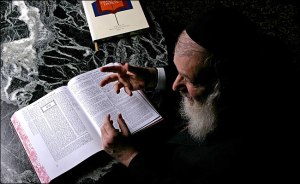 Was there an Oral Law given to Moses by Hashem in parallel to the Written Law (Torah), and was that Oral Law passed down, generation by generation, in an absolutely unchanged manner, from Moses to Joshua, from Joshua to the Elders, from the Elders to the Prophets, and then from the Prophets to the Men of the Great Assembly, eventually being codified and making its way to modern Judaism?
It seems like a long shot, given that even the written Torah had “gone missing” for quite some time.
When they were bringing out the money which had been brought into the house of the Lord, Hilkiah the priest found the book of the law of the Lord given by Moses. Hilkiah responded and said to Shaphan the scribe, “I have found the book of the law in the house of the Lord.” And Hilkiah gave the book to Shaphan. Then Shaphan brought the book to the king and reported further word to the king, saying, “Everything that was entrusted to your servants they are doing. They have also emptied out the money which was found in the house of the Lord, and have delivered it into the hands of the supervisors and the workmen.” Moreover, Shaphan the scribe told the king saying, “Hilkiah the priest gave me a book.” And Shaphan read from it in the presence of the king.
When the king heard the words of the law, he tore his clothes. Then the king commanded Hilkiah, Ahikam the son of Shaphan, Abdon the son of Micah, Shaphan the scribe, and Asaiah the king’s servant, saying, “Go, inquire of the Lord for me and for those who are left in Israel and in Judah, concerning the words of the book which has been found; for great is the wrath of the Lord which is poured out on us because our fathers have not observed the word of the Lord, to do according to all that is written in this book.”
–2 Chronicles 34:14-21 (NASB)
The preservation of an unchanging Oral Torah across hundreds if not thousands of years would require that God sustain the Oral Law as He has the Written Law. I suppose it would make more sense to say that Oral Law as it’s conceived of in modern Judaism is the grand compilation of traditions that have accumulated over the centuries, but were not all given originally to Moses (if any of them were).
Question:
Can you explain why laws never seem to revert back to their original form? For example, some holidays are two days outside of Israel because of the difficulty with keeping time hundreds of years ago, which has since been resolved.
Answer:
Simply put, customs have the import of law since the Torah itself recognizes them as law. That makes sense, because the basis of Torah is not the book, but the people. How do we know the Torah is true? Because the people witnessed it, accepted it and passed down the tradition. So without tradition, we have no Torah.
-Rabbi Tzvi Freeman
“Why Aren’t Customs Reversible?”
Chabad.org
Of course the belief that the Oral Law as it exists in Judaism today originated as a complete body of knowledge with Moses at Sinai is also a tradition and as such is considered factual, at least in Orthodox Judaism.
Now I admire the refined skill-set of a good kosher shochet, but what Dr. Stern sees as “evidence” for “oral Torah” from Deuteronomy 12:21 (כאשר צויתיך) is for me simply a pointer to what Moshe states elsewhere concerning slaughter: pour out all the blood, cover it with earth, don’t consume it, etc… I’m definitely a minimalist in this regard. Let’s keep in mind that the art of midrash (be it halakhaic or aggadic) consists first of positing a textual ‘gap’ and second of filling it!
-Vanhoff
On the other hand…
Hashem said to Moses, saying: “Speak to the Children of Israel and say to them that they shall make themselves tzitzis on the corners of their garments, throughout their generations. And they shall place upon the tzitzis of each corner a thread of turquoise wool. It shall constitute tzitzis for you, that you may see it and remember all the commandments of Hashem and perform them; and not explore after your heart and after your eyes after which you stray.
–Numbers 15:37-39 (Stone Edition Chumash)
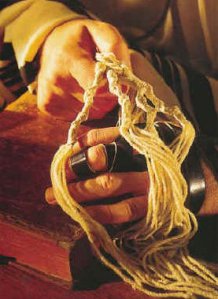 So how do Jewish men know how to tie tzitzit (keeping in mind there’s more than one tradition on how to do so)? Who taught the Jewish people the specific method of obtaining the blue dye to color the “thread of turquoise”? There is nothing in the (written) Torah describing how this is done, so how did Moses teach the Children of Israel how to observe this mitzvah? Is it possible that Moses had conversations with Hashem that were not recorded in writing? Was literally every second of every transaction between Moses and God put down in writing?
Probably not, otherwise the Bible in written form would be too large to carry.
But that’s supposition on my part. Still, I must admit that there are more than a few commandments in Torah where there is no written instruction for how to observe them.
Does that mean the Oral Law as it’s understood today is exactly as it was or may have been given to Moses at Sinai or later during the forty years in the desert?
From a human point of view, this seems doubtful, but if an Oral Law also comes from God, then nothing is impossible.
The Bible is the most authoritative element of Judaism. But it is not the only one. Just as it had been preceded by tradition, so was it soon followed by tradition, the “Oral Law,” which strives to penetrate into the essence of the Bible’s written word. The Oral Law strives to apply the teachings of the Bible to all the events of existence; to provide religious and moral standards for all of life’s activities; and to realize the Bible’s teachings in the whole Jewish community. This tradition, which was ultimately established in the Talmud, had at first to fight for recognition; subsequently, it too became a conservative factor in Jewish religious life.
-Leo Baeck, “The Essence of Judaism,”
New York: Schocken Books, 1948
quoted in “The Bible and the Talmud,” p.17
Pirke Avot: A Modern Commentary on Jewish Ethics
In Judaism, tradition is what tells a Jew what the Bible means. In Christianity, as Mr. Vanhoff states, a systematic method of interpretation does the same job.
So am I saying that Jews have tradition and Christians have interpretation? Well, not exactly. I’m saying that Jews are open in stating that tradition guides their Biblical interpretation and Christians believe that they have no tradition of interpretation…
..except that’s not true.
Almost a year ago, I wrote a blog post called Does the Church Interpret the Bible Based on Traditions. I’ll save you the trouble of reading the whole thing and give you the answer here: Yes!
In fact, I believe that every branch of Christianity, including all versions of Hebrew Roots, interpret the Bible based on some overt or covert set of traditions that transcend any “scientific” method of Biblical hermeneutics. I know I’m going to receive a significant amount of push back for making that statement. I know that many scholarly arguments can be leveled against me, showing me that Protestant Christianity and Hebrew Roots (they have more in common than you might imagine) use totally objective means by which to determine the true and factual meaning of the Biblical text.
Except if that were true, then I don’t think we’d see such dissonance between the pro-Jewish people and pro-Israel words of the Bible including the Apostolic Scriptures and the nature and function of the New Covenant, and how modern Protestant Christianity refactors the Bible to minimize or delete the role of Jews and national Israel in God’s redemptive plan for the world.
Much has been made of Martin Luther and the men of the Reformation and how they undid the abuses of the Bible by the Catholic Church, but the Reformation didn’t “reform” as much as you might think. Many traditions of the Church (Sunday worship rather than a Saturday Shabbat, the continued “gentilization” of Jesus Christ, the supersession of “the Church” in place of Israel) were maintained and survived to this very day in virtually all expressions of Christianity.
So it’s quite possible if we view Hebrew Roots as a minor “reformation” of Evangelical Christianity to believe they didn’t reform as much as you might think, including holding onto some (but not all) of the traditions of the Church, such as how to interpret certain sections of the Bible.
Interpretation of the Bible begins at translation, or so it’s said. I tend to believe that the first step in interpreting the Bible is how we already understand it based on who taught us our traditions. This is true whether you are a Baptist, an Orthodox Jew or operate in any other branch of Christianity or Judaism.
I’m always amazed at how people who have read a dictionary entry or two on “Mishnah” or “Talmud” become so quickly convinced that when they pick up the Soncino Bavli in English, they are reading the culture, worldview, and halachah of the 1st Century! Truth be told, most Messianics who are enamored with “rabbinic Judaism” have spent precious little time actually reading the rabbinic sources, even in translation. They’re willing to watch a YouTube video or two from a Cabad rabbi and think that they’ve just been educated in the finer details of rabbinic halachah and aggadah, and what is more, that their new knowledge informs “what Yeshua really thought and did.”
– from Tim Hegg’s comment on Rob Vanhoff’s aforementioned blog post
I just want to be clear that I don’t consider myself some sort of “expert” in Talmud or anything else. What I do want to emphasize is that we cannot separate our understanding of the Bible from our “religious orientation.” Sure, we can change religious orientations and thus our understanding of the Bible, but with some difficulty. I changed from a more “standard” Christian hermeneutic, to a Hebrew Roots perspective, and then finally to a viewpoint formed from various teachers within a Messianic Jewish context.
Does that make me right and everyone who disagrees with me wrong? Not at all. I have far more questions about the Bible and God than I have answers. I just want to point out that no one has raw, naked, unfiltered access to the Word of God such that they and only they know “the truth” about exactly what it says in every single detail. No Bible scholar worth his or her salt would make such a claim. That’s why Biblical research is ongoing and that’s why we study the Bible (hopefully) every day.
 This is like the African-American woman Tim Hegg describes in his comment on Vanhoff’s blog post, the one who believed that the Apostle Paul’s Bible was the King James translation. Her understanding (I have to assume based on limited information that this woman really did believe such a thing) is based on some sort of tradition she was taught and like many, most, or all religious people, tradition first became truth in her mind, and then absolute fact.
Even when we’re aware that we are guided by our traditions, that awareness isn’t going to be enough to keep us from continuing to be driven by said-traditions for the most part. Yoda may have said “You must unlearn what you have learned” (as shown in this brief YouTube video), but that’s easier said than done. Maybe Luke Skywalker could do that under the Jedi Master’s guidance, but in real life, once we learn something, we are very likely to stick with it, even in the face of evidence to the contrary.
Again, this isn’t a matter of one side being right and the other side being wrong. It’s a matter of all sides being guided and molded by tradition, even when we think we’re not. What we think is who we are.


 Part how I measure my physical health is how quickly my heart rate recovers after a cardio workout. However, that principle can be applied to a completely different context. How quickly a person recovers after a major failure in making teshuvah and restoring relationships with God and people is also a measure of health.
 This is heralding a very extraordinary time that will lead to the ultimate redemption of Israel and the nations, but in the meantime, there are still many mundane matters we all struggle with. I find it hard to always pray for the return of the Master when all I really want is to be successful in teshuvah, for God to grant me mercy and forgiveness, and for His Spirit to soften the hearts of those who have been hurt so they will be moved to mercy and forgiveness.









 Morning Meditations