All posts by James Pyles

James Pyles is a published Science Fiction, Fantasy, and Horror author as well as the Technical Writer for a large, diversified business in the Northwest. He currently has over 30 short stories published in various anthologies and periodicals and has just sold his first novella. He won the 2021 Helicon Short Story Award for his science fiction tale "The Three Billion Year Love" which appears in the Tuscany Bay Press Planetary Anthology "Mars."

Sermon Review of the Holy Epistle to the Hebrews: Full Assurance of Faith

“I’m not perfect, just forgiven.” “I’m not holier than thou, I’m just a sinner saved by grace.” Something has gone terribly wrong with our thinking if we believe that the only difference between a believer and a non-believer is that the believer is forgiven and assured of eternal life. That’s a useless, selfish, hypocritical religious idea which deserves a slap in the face. It’s not worthy of the name “Christian,” the name of Messiah, and it sullies the reputation of our holy Master. Hebrews 10:18-31 contains a stern warning and exhortation to the upward call of discipleship and the demands of new-covenant living.

-D. Thomas Lancaster
Sermon Thirty-Nine: Full Assurance of Faith
Originally presented on January 18, 2014
from the Holy Epistle to the Hebrews sermon series

This doesn’t have anything to do with the topic, but I listened to Lancaster’s sermon with my laptop in my sukkah a few afternoons ago. Yes, WiFi is great.

Lancaster started out by discussing a song by Paul Wilbur called I Enter the Holy of Holies. I liked a number of Wilbur’s songs but don’t have an opportunity to listen to them anymore. But this specific reference has less to do with worship music, and more to do with the topic of our study:

Therefore, brethren, since we have confidence to enter the holy place by the blood of Jesus…

Hebrews 10:19 (NASB)

But how can we, or anyone but the High Priest, enter the Holy of Holies? Even the High Priest enters the Most Holy Place only once a year on Yom Kippur. The song is nice. It’s inspiring. But it’s not meant to be a theological roadmap as such. Let’s see a little more context:

Therefore, brethren, since we have confidence to enter the holy place by the blood of Jesus, by a new and living way which He inaugurated for us through the veil, that is, His flesh, and since we have a great priest over the house of God, let us draw near with a sincere heart in full assurance of faith, having our hearts sprinkled clean from an evil conscience and our bodies washed with pure water.

Hebrews 10:19-22

And Jesus cried out again with a loud voice, and yielded up His spirit. And behold, the veil of the temple was torn in two from top to bottom; and the earth shook and the rocks were split.

Matthew 27:50-51

Lancaster says it’s important to realize that the writer of the Epistle to the Hebrews is speaking figuratively, not literally. These verses aren’t permission for just plain ol’ folks, Jews or otherwise, to go “tramping” through the Holy of Holies. Even Jesus couldn’t enter the Holy of Holies of the earthly Temple in Jerusalem (before or after his death and resurrection) because he is not an Aaronic priest.

TempleThese verses are to indicate that we have access to God through the Heavenly Temple and our Heavenly High Priest, who is indeed Yeshua. We can draw near by appealing to our High Priest, our mediator of the New Covenant.

The veil is symbolic of his flesh, as the verses above tell us. Also, to “draw near” is technical language for bringing a sacrifice. When a person, usually Jewish but Gentiles could do so as well, desired an encounter with God in the days of the Temple, they could bring a sacrifice, a korban, to the Temple and indeed, physically, literally, draw near to the Divine Presence.

The readers of this letter are, according to Lancaster, Greek-speaking Jews living in or near Jerusalem, disciples of Yeshua who have been denied access to the Temple. The Hebrews letter writer is trying to reassure them that if they cannot draw near to God in the earthly Temple, they can still do so through their faith in the Heavenly High Priest who presides over the Heavenly Temple.

But this has applications for us as well. After all, there is no Temple in Jerusalem today, so even if we desired with all our heart to draw near to the Divine Presence, it is impossible to do so.

But Lancaster says that we are designed to desire closeness with God. How can we do this? We have the blessings of the New Covenant, but the New Covenant promises have yet to arrive. How do we summon the future into the present?

Through the verses I quoted above. Through having “confidence to enter the holy place by the blood of Jesus…He inaugurated (the way) for us through the veil (which is) his flesh.” We have “hearts sprinkled clean from an evil conscience and our bodies (are) washed with pure water.”

The writer of Hebrews is speaking about all this in the present tense. We, and the letter’s original readers, are supposed to be transforming into “Kingdom people” right now. That’s how we “draw near”.

For I will take you from the nations, gather you from all the lands and bring you into your own land. Then I will sprinkle clean water on you, and you will be clean; I will cleanse you from all your filthiness and from all your idols. Moreover, I will give you a new heart and put a new spirit within you; and I will remove the heart of stone from your flesh and give you a heart of flesh. I will put My Spirit within you and cause you to walk in My statutes, and you will be careful to observe My ordinances.

Ezekiel 36:24-27

The writer of Hebrews could well have been thinking about Ezekiel 36 when he wrote about “hearts sprinkled clean” and “bodies watched with pure water” which is also part of the Yom Kippur service. But the exile hasn’t ended, the Jews have not be regathered, and no, we do not yet have a new heart and a new spirit. That’s for the future.

But as people of faith, we are responsible to live as if the New Covenant age is already here, even though our current world is still full of sin. We must live a transformed or at least a transforming life, rather than a life just like everybody else.

Lancaster calls us tokens of the future in the present world. We are ambassadors of the Messianic future, and that should show in our lives; we should live supernatural lives.

At the very top of this blog post, I inserted a quote that introduces today’s sermon. Lancaster considers it insulting that Christians cheapen themselves by saying they’re (we’re) just like everyone else, only forgiven, as if we live lives identical to our secular counterparts and the only distinction between them and us is that we are forgiven because we believe in Jesus.

synagogueSure, we’re not perfect, but we should be living lives Holy and specifically distinct from our secular neighbors. Just as the readers of this letter were tempted to waver and even to renounce their faith for the sake of possibly regaining access to the Jerusalem Temple (verse 23), believers today waver from their faith and live watered down lives rather than pursuing a closer encounter with God.

Next, Lancaster touched on a subject that has been on my mind lately.

… and let us consider how to stimulate one another to love and good deeds, not forsaking our own assembling together, as is the habit of some, but encouraging one another; and all the more as you see the day drawing near.

Hebrews 10:24-25

Why is the letter writer saying this? In Jerusalem, the faithful among the Jews met daily at the Temple for the prayers. As far as we know, they had no other meeting place, no “Messianic synagogue” as it were.

Why do we worship together? Is the letter writer even issuing a directive that we can generalize to us, to me today? People meet to sing, worship, pray, study, listen to sermons, but most or all of that could be done at home. Lancaster says the Hebrews letter specifies the more important reasons. To encourage one another in our faith and confession. To build each other up. To apply positive peer pressure to live more Godly lives. It’s sociology, not theology.

In my current situation, my most likely options for further fellowship are in the virtual, that is, the online realm, but I don’t know how well that works if verses 24 and 25 are the key reasons for congregational connectedness.

Then Lancaster gets very passionate:

For if we go on sinning willfully after receiving the knowledge of the truth, there no longer remains a sacrifice for sins, but a terrifying expectation of judgment and the fury of a fire which will consume the adversaries.

Hebrews 10:26-27

Lancaster calls these verses the “smack down” of this chapter. Once we become believers, there’s no turning back. Either we commit wholeheartedly to living a transformed life and continually becoming perfected in our faith, or we join the enemies of God in harsh judgment and its consequences.
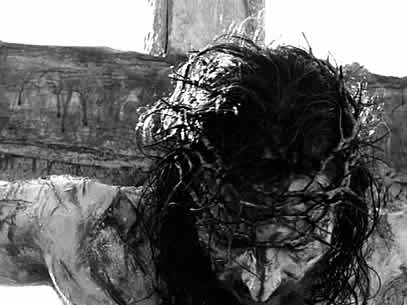
The Death of the MasterLancaster said that, “Messiah died to take away sin, not to excuse it.”

This reminded me of how even among different churches and synagogues, people are dancing on both sides of some serious social topics in an attempt to be people of faith and yet fit in with the rest of the world and what the world (though not necessarily God) thinks is important and right. If you are living a Holy life, your life should not be in synch with the popular and progressive imperatives of our secular society (and political affiliation is beside the point).

Sorry.

Now this is interesting:

Anyone who has set aside the Law of Moses dies without mercy on the testimony of two or three witnesses. How much severer punishment do you think he will deserve who has trampled under foot the Son of God, and has regarded as unclean the blood of the covenant by which he was sanctified, and has insulted the Spirit of grace? For we know Him who said, “Vengeance is Mine, I will repay.” And again, “The Lord will judge His people.” It is a terrifying thing to fall into the hands of the living God.

Hebrews 10:28-31

This is still in the present tense and remember the writer and readers of this letter are all Jewish. The letter writer is impressing upon his audience, using a lighter to heavier argument (we’ve seen this before), that if setting aside the Torah can result in a death sentence, how much more serious is it to trample underfoot the Son of God. Yes, it’s serious for a Jew to violate the Shabbat but it’s even more serious to consider the righteous and Holy sacrifice of Messiah as unclean and common.

This is a stern warning that even under extreme provocation, the consequences of abandoning faith in Messiah are terrifying.

You know that He appeared in order to take away sins; and in Him there is no sin. No one who abides in Him sins; no one who sins has seen Him or knows Him.

1 John 3:5-6

This makes it sound like we should never, ever sin, not even once after we become believers, but what the apostle is saying is that we should continually strive to become more spiritually perfected, not that we’ll ever be perfect this side of the resurrection, but that we shouldn’t just put up with a certain level of sinning in our lives as if it is inevitable.

Not that I have already obtained it or have already become perfect, but I press on so that I may lay hold of that for which also I was laid hold of by Christ Jesus. Brethren, I do not regard myself as having laid hold of it yet; but one thing I do: forgetting what lies behind and reaching forward to what lies ahead, I press on toward the goal for the prize of the upward call of God in Christ Jesus.

Philippians 3:12-14

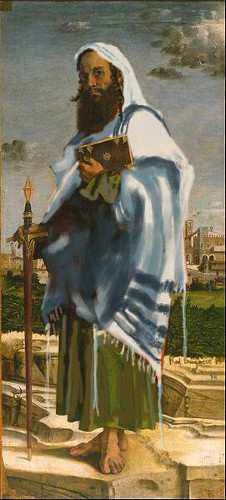
The Jewish PaulEven Paul said he hadn’t obtained perfection but it was a goal he always moved toward, he pressed on, even though he hadn’t yet put his hands on it. That’s what we’re supposed to do.

Let us therefore, as many as are perfect, have this attitude; and if in anything you have a different attitude, God will reveal that also to you; however, let us keep living by that same standard to which we have attained.

Philippians 3:15-16

For Lancaster, this is a key statement. We need to keep striving to live by the standard that we are pursuing, the standard of a Holy and righteous life, to live, not natural lives as the rest of the world does, but supernatural lives. This is how we draw nearer to God and draw the Messianic Age nearer to our present reality.

What Did I Learn?

When I was reading in Matthew 27 about the tearing of the veil, I noted the verses that immediately followed:

The tombs were opened, and many bodies of the holy ones who had fallen asleep were raised; and coming out of the tombs after His resurrection they entered the holy city and appeared to many.

Matthew 27:52-53

No other Gospel writer mentions this event, but for Matthew, who was writing to a Jewish audience just as the Hebrews writer was, one of the strongest promises of the New Covenant is the resurrection of the dead. The death of Jesus was immediately followed by the tearing of the veil and the resurrection of people who were recognizably Jewish tzaddikim must have been terrifically obvious signs of who and what Jesus was and is. Even a Roman centurion present picked up on it:

Now the centurion, and those who were with him keeping guard over Jesus, when they saw the earthquake and the things that were happening, became very frightened and said, “Truly this was the Son of God!”

Matthew 27:54

I had noted each of these events separately, but putting them together relative to the New Covenant gives them a lot more meaning than just a series of supernatural events related to the death of Jesus. This moment in time formally set into motion the beginning of the entry of the New Covenant into our world and these events were part of the evidence.

But that was almost two-thousand years ago and most people in the world today don’t even think of the Bible as evidence of anything real and applicable to their lives.

That’s why they have us.

Lancaster said that we have to make a difference and we do that by adhering to a standard set before us by God, a standard to live lives of Holiness and excellence, as if the New Covenant were already here, as if we had already been resurrected, as if our hearts of stone had already been replaced by hearts of flesh and we were filled with the Holy Spirit to such abundance that we all “know God” in a manner greater than all the prophets of old.

Imagining myself living a “supernatural life” isn’t always an easy thing for me. I can’t picture myself “checking my brain at the door,” so to speak, and just relying upon my feelings as the means by which I draw nearer to God. I know that isn’t what Lancaster (or those few others in my life who encourage me to also be more “supernatural”) is saying, but it feels like what he’s (they’re) saying.

with godI think what he’s actually saying is that we can live better lives behaviorally, and we can be better people than we think we are. If we tried to be better just by force of will, we might make some temporary achievements, but most of us would fall back into our usual flight patterns after a while. Our natural methods wouldn’t work out in the long run. Only the supernatural methods, by faith, by continually striving for an authentic encounter with God, will grant us access to transforming and perfecting our lives, little by little, bit by bit, until the evidence of God is undeniably visible in everything we do.

Then we will be the evidence that God is real and that His promises are true. They will happen because they’re happening now, through us.
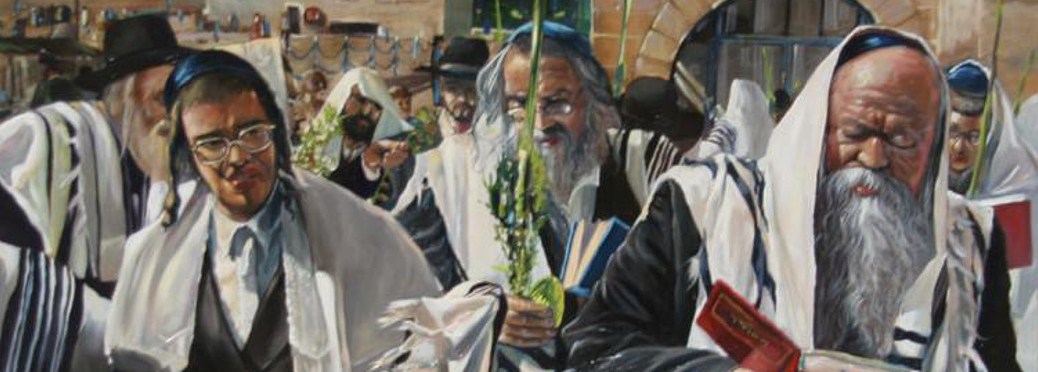
Who is Honored on Sukkot?

Epicurus used to say, “Were the gods to answer the people’s prayers, people would deteriorate and die, for so multitudinous are the tribulations which each one wishes upon his fellow.”

Epicurus may be right as regards the prayers of the nations, but not as regards our prayers. We well know “This is the book of the generations of man,” and every year we begin our supplications with “And now, Lord our God, place Your awe upon all whom You have made, Your dread upon all whom You have created…”

-Rabbi Moshe Avigdor Amiel
Chapter 13: The First Man and the Jewish Nation, p.75
Translated by Kadish Goldberg
Jews, Judaism, & Genesis: Living in His Image According to the Torah

Last week, I spent some time writing about those things that make Jewish people unique and distinct from the people of all the other nations, including Gentile Christians, in three blog posts: Upon Reading a Rant About “Messianic Jewishism”, Diminishing the Moon and Israel, and Are Messianic Jews Not Expected to Practice Judaism?. I suppose I could be accused of fomenting discord between Jewish and Gentile members of the ekklesia of Messiah, or to put it in more Christian-friendly terms, the members of the “body of Christ”.

In the spirit of unity which is aptly expressed during this time of Sukkot, I thought I’d take a different tack.

As we discussed last year, the fruit symbolizes the Torah inside a person, while the fragrance represents the Mitzvos, the deeds a person does which affect those around him or her. The four species represent those who have both Torah and good deeds, those who have one but not the other, and even those who have neither.

And what are we told to do? We bind them together! Every Jew is a unique and essential part of our nation.

from “Note from the Director”
News from Project Genesis and Torah.org for Sukkot
Torah.org

Unfortunately, I can’t find this note from Rabbi Yaakov Menken on the Project Genesis website which would allow you to read all of the Rabbi’s comment, but as you might imagine, he is specifically addressing unity among Jewish people and not including non-Jewish believers in Jesus (Yeshua). However, giving Rabbi Menken’s words a “Messianic spin,” I think we can include the entire population within the ekklesia of Messiah, the Jews and the Gentiles, at least for the sake of my example. While unity doesn’t require uniformity, we still are united with each other by love of the Moshiach, may he come swiftly and in our day.

Earlier in his email newsletter, the Rabbi wrote:

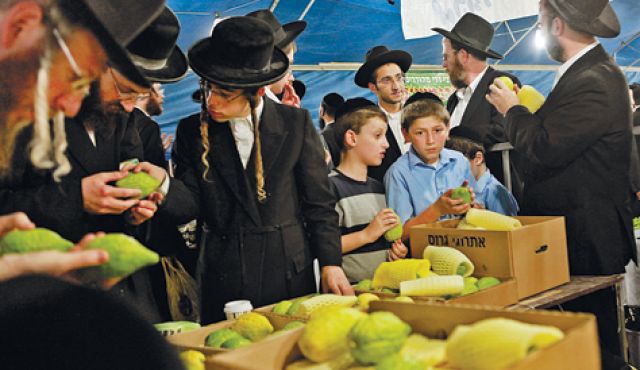
The Torah tells us to take four species: the Esrog, a citrus fruit with a pleasant taste and smell; the Lulav from a Date Palm which produces fruit but is not fragrant; Hadasim, myrtle branches which are aromatic but does not provide edible fruit; and aravos, from the willow, which has neither taste nor smell.

Consider the differences and the distinctions involved in each of the four species. What does a citrus fruit, a lulav, myrtle branches, and aravos from a willow have in common?

Not much apparently.

And yet all four of these highly different items are absolutely required for the observance of Sukkot as it is written:

Now on the first day you shall take for yourselves the foliage of beautiful trees, palm branches and boughs of leafy trees and willows of the brook, and you shall rejoice before the Lord your God for seven days.

Leviticus 23:40 (NASB)

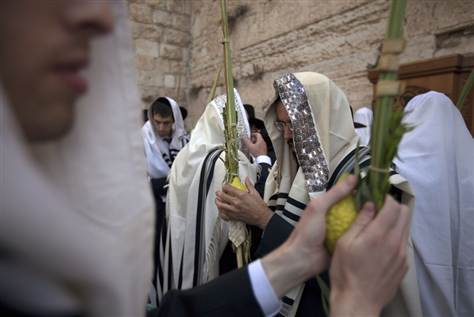
four species
Photo by Gili Cohen Magen

Those distinctively different objects are required to be bound together and, in essence, to “work together,” in order for Sukkot to be observed properly. While it’s impossible to offer the appropriate sacrifices related to Sukkot today due to a lack of the Temple and the Priesthood, the celebration is nevertheless observed by religious Jews and not a few believing Gentiles as well.

In a recent comment on one of my blog posts and then again in commenting on a different blog post, I said:

According to Jewish tradition, on the first seven of the eight days of the festival, we are to extend a special invitation to a specific guest in this order:

  1. Abraham, who represents love and kindness
  2. Isaac, who represents restraint and personal strength
  3. Jacob, who represents beauty and truth
  4. Moses, who represents eternality and dominance through Torah
  5. Aaron, who represents empathy and receptivity to divine splendor
  6. Joseph, who represents holiness and the spiritual foundation
  7. David, who represents the establishment of the kingdom of Heaven on Earth

Now before you think I’ve flipped for considering something so far-fetched, look at this:

“I say to you that many (Gentiles) will come from east and west, and recline at the table with Abraham, Isaac and Jacob in the kingdom of heaven (meaning the Messianic Kingdom here on Earth established by Jesus upon his return)…”

Matthew 8:11

This at least suggests a sort of feast occurring during Sukkot in which we non-Jewish disciples of Christ will join the Jewish disciples in participating in the Sukkot festival with the greatest prophets, priests, and kings in the Bible, all in honor of King Messiah.

While I crafted the above quoted-statement to be easier for a traditional Christian to comprehend, I want all of us to understand that Jews and Gentiles will be together at the feast with Abraham, Isaac, and Jacob (and perhaps Moses, Aaron, Joseph, and David) to give glory and honor to King Messiah upon the establishment of his Kingdom. Maybe this will even happen on Sukkot, although of course, I can say that for sure.

Certainly the Prophets, Priests, and Kings represented by the Seven Ushpizin guests are not exactly alike, and although they exist within the unity of the Jewish people, they are not identical in type or function. So too it can be said that even though Jew and Gentile in the ekklesia of Messiah and as citizens in the Kingdom of Heaven have unity within that assembly, they also are not identical in type and function.

sukkotBut you won’t see Abraham, Moses, and David arguing about it, so why should we?

About twelve years ago, Rabbi Eliyahu Hoffman wrote a Sukkot commentary called “Shaking Up Our Priorities” which you can find at Torah.org. It’s worth the read and won’t take much of your time, but I’d like to quote just a part of it here:

One year, as he always did before Sukkos, R’ Yitzchak gathered his belongings, including all the rubles that he had put aside, and left home to travel to a nearby town where the Four Species could be bought. Travelling along the roadside, he stopped suddenly when he heard the sound of someone crying. Indeed, a Jewish man sat in a nearby field, head in his knees, crying and moaning bitterly. R’ Yitzchak approached him. “Reb Yid, what’s the matter?”

“Don’t even ask,” the Jew said, “a bittere pekel tzures – what a bitter portion the Almighty has dealt me! Woe is to me. I had one horse. That might not seem like much, but it was enough to support my family. It was a good horse. I rode it from town to town, delivering people’s mail, parcels – whatever they needed. I didn’t make a fortune, but we had what to eat, and we were happy. But today I awoke, and – woe is me – I found her dead. She must have passed away overnight. As it is, we live from hand to mouth. If I have to deliver by foot, I don’t stand a chance of making a living. Woe is me!”

“Tell me,” asked R’ Yitzchak, “what would a new horse cost you. I’m sure she was a good horse, but there are other horses out there.”

“Of course there are other horses, for someone who has 300 rubles to spend! It would take me almost a year to earn that kind of money! So you see, all is lost!”

Without further ado, R’ Yitzchak took out his wallet and counted out 300 rubles, leaving for himself only the smallest sum from all the money he had so carefully put aside. He placed it in the pocket of the forlorn Jew, who had all the while never taken his head out from between his knees. Sticking his hand into his pocket, he was flabbergasted to find the entire sum he needed to buy himself a new horse. “What… What have you done. I… I never expected.” Completely choked up with emotion, he barely managed to thank R’ Yitzchak for his magnanimity. Little did he know, R’ Yitzchak himself was not a rich man, and that he had just parted with the lion’s share of his own savings.

That year R’ Yitzchak had to settle for the plainest of Esrogim, much to the surprise and wonder of his friends and family. Despite their best attempts to find out, he told no one of what had come of his plans to purchase the most beautiful Esrog, nor of his savings, except to say, cryptically, that “the money was not lost – in fact it had just galloped off and was being put to very good use.”

If you are a (non-Jewish) Christian or otherwise are a person who does not observe Sukkot (or who does so in a rather casual manner), you won’t understand the tremendous significance involved in R’ Yitzchak’s generosity. In a sense, he had before him two apparently conflicting mitzvot. He could do as he had done every year and dedicate the more than 300 rubles it had taken him all year to save for the purchase of the most beautiful Esrog he could find in honor of the festival and God, or he could alleviate the sorrow of a Jew even poorer than he was by freely handing over his money for the purchase of a horse, and settle for the plainest Esrog he could still afford.

Again, from a Christian point of view (and probably the viewpoint of most people), the decision to help his fellow Jew seems clear, but remember, what is at stake is the honor of both God and of human beings at this Holy time of year.

Perhaps, even after performing tzedakah (charity) by giving up his Esrog money, R’ Yitzchak was still unsure that he did the right thing, for we find:

During Chol Ha-Moed (the Intermediate Days of Sukkos), R’ Yitzchak travelled to Lublin to visit his Rebbe, the famed Choize (Seer) of Lublin. At the festive Yom Tov meal, the Choize remarked to his disciples, “The mitzvah of Arba Minim must be performed with great joy. We must thank Hashem that we all managed to perform the mitzvah of waving the Lulav and Esrog. When we wave the mitzvos, all the Heavenly spheres and realms are awakened, and much joy and goodness permeate the upper realms, ultimately reflecting that joy and goodness back down to this world where we can reap its benefits. We all shook the Lulav and Esrog, but, R’ Yitzchak,” he said, turing as he did so to face him, “to wave a horse – now that is a truly original and exceptional way to perform a mitzvah!”

davening_morningChristians, most other non-Jews, and even some Jewish people often think of the Rabbinic Sages as inflexible, rule-bound, and even “anti-Bible” in considering halachah and Talmud as having any sort of authority when compared to the commandments clearly written in the Bible, but here we see that kindness, mercy, and “waving a horse” for Sukkot are not only original and exceptional ways to perform a mitzvah,” but deserving of special honor as expressing the heart of God.

In one of the commentaries for Tractate Yevamos 5 as collected and distributed in the Daf Yomi Digest by the Chicago Center for Torah & Chesed, we find the following based on “Each person shall fear his mother and father, and guard my Shabboses…”:

On today’s daf, we find that the Beraisa proposes that were it not for the verse, one might think that honoring parents overrides the Shabbos!

The famous Yehudi HaKadosh, zt”l, would deliver a regular Gemara shiur to his students that explored the commentary of Tosfos. One of his students was an extremely talented local boy who was unfortunately orphaned of his father. Once, the Rebbe interrupted their learning so that he could concentrate deeply on a certain subject. His young student knew well that such a break could last an hour or more, so he took advantage of the pause to go home and eat.

The boy ate a quick meal and hurried out back to his Rebbe’s home, but his mother called out after him that she wanted him to go up to the attic and bring something down for her. In his rush to return to study, he ignored her call, but half-way back the boy had second thoughts. “Isn’t the whole purpose of study to fulfill the mitzvos? Shouldn’t I honor my mother instead?” he asked himself. So he ran home and did as he was bid.

Afterward he returned to his studies, and as he opened the door to the Rebbe’s house, the Yehudi HaKadosh snapped out of his reverie and rose to his full height as a sign of respect. Beaming, the Yehudi HaKadosh asked, “What mitzvah have you just performed, because it has brought the spirit of the great Amorah Abaye with you into my house.”

The student told his story, and the Rebbe explained to the rest of the students: “It is well known that Abaye was an orphan—his name is an acronym of the verse, ‘For in You does the orphan find mercy.’ This is why his spirit accompanies a person who fulfills the mitzvah of honoring his parents—so that he should have a part in a mitzvah that was denied to him. You want to know why am I smiling? Because Abaye came and answered my question on the Tosafos!”

Again, this may not resonate with most people, including many Jews, but we see a comparison between the authority of a Rebbe over his young students and the mitzvah of honoring parents. It is said that a Rebbe is to be considered greater than one’s own father, so you can see that the young student put himself in a bind by going home to eat and then having to decide between his mother’s request and his obligation to promptly return to the Rebbe’s home.

MidrashIn choosing to honor his mother, he not only did the right thing from a human point of view, but he achieved a certain amount of respect from his Rebbe. Did “the spirit of the great Amorah Abaye” really accompany the boy to the Rebbe’s house and answer the Rebbe’s question on the Tosafos he had been pondering?

There’s no way to know for sure and probably no way to know if any of these events ever actually occurred. But whether or not they did, there’s a principle being taught here, the same principle as was taught in the previous Rabbinic story.

Even if we know nothing of the Torah, the mitzvot, or anything else, we know, or we should know as disciples of Rav Yeshua, our Rebbe, that extending mercy, kindness, compassion, and respect are the greater and loftier mitzvot, the acts of obedience and response to God that, even in moments of doubt, cannot fail.

I said in a comment last week that “if I’m going to err, I’d rather err on the side of humility”. I also quoted one of the Master’s parables:

And He began speaking a parable to the invited guests when He noticed how they had been picking out the places of honor at the table, saying to them, “When you are invited by someone to a wedding feast, do not take the place of honor, for someone more distinguished than you may have been invited by him, and he who invited you both will come and say to you, ‘Give your place to this man,’ and then in disgrace you proceed to occupy the last place. But when you are invited, go and recline at the last place, so that when the one who has invited you comes, he may say to you, ‘Friend, move up higher’; then you will have honor in the sight of all who are at the table with you. For everyone who exalts himself will be humbled, and he who humbles himself will be exalted.”

Luke 14:7-11

When we finally attend the “feast of Abraham, Isaac, and Jacob,” and it will be a massive affair no doubt, I suppose seating arrangements will be a big problem. What are you going to do with all of the people who show up from all over the world to honor King Messiah and to actually recline at the table with men like Jacob and Joseph? Where should we sit?

In retrospect, and considering the example the Master laid out for us, the answer should be obvious. We should consider ourselves as having no honor of our own, but only seek to honor the King and those Seven Ushpizin guests who represent the Prophets, Priests, and Kings of Israel, and indeed, all the Jewish people. If we mistakenly think we are greater than they, won’t our host, Yeshua, be forced to embarrass us by asking us to take the last place at the table?

Ben Zoma says: Who is honored? The one who gives honor to others…

(Talmud – Avot 4:1)

As non-Jewish disciples of the Jewish Messiah King, if we seek to honor him and believe we are worthy of honor, respect, equality, and inclusion within the ekklesia, then both the teachings of the Master and of the great Sages are clear that to be honored, we must honor others, and not deliberately strive to honor ourselves.

UnityThe Master also teaches:

Jesus answered, “If I glorify Myself, My glory is nothing; it is My Father who glorifies Me, of whom you say, ‘He is our God'”

John 8:54

If our Rebbe and Master did not glorify himself, should we not follow his example? Will he not take the different “species” within the body and unite us, regardless of our extreme differences…or perhaps because of them, and in our honoring him, won’t he honor us?

Chag Sameach Sukkot.

Are Messianic Jews Not Expected to Practice Judaism?

Question: Is formal conversion really necessary to be considered part of the Jewish people? After all, so many synagogues welcome non-Jewish members and so many rabbis sanction interfaith weddings.

Answer: It’s true that Jewish communities have become more inclusive of non-Jews, particularly non-Orthodox synagogues. Many Reform and some Conservative synagogues grant membership to non-Jews, Reform and Reconstructionist rabbis will officiate at interfaith weddings, and some Jewish cemeteries will grant burial rights to non-Jewish spouses.

“There are plenty of people who want to sojourn in the synagogue and not convert and still know they’re part of the Jewish family,” said the president of the Union for Reform Judaism, Rabbi Rick Jacobs. They’re “living in the Jewish community.”

-from “10 Questions About Jewish Conversion You Want to Know but are Afraid to Ask”
VirtualJerusalem.com

No, I’m not considering converting, but this particular question and answer has bearing on a theme I’ve been addressing this week. You could consider today’s “meditation” to be a “Part 3” to my Upon Reading a Rant and Diminishing blog posts.

The theme I’ve been discussing has to do with the relative roles of Jews and non-Jews within the modern Messianic Jewish (or just “Messianic”) community. As the comments section of my blog posts indicate, opinions vary widely. However, in the above-quoted question and answer, I see a sort of “marriage” between the two major viewpoints, an illustration of how a non-Jew can be part of the Jewish “family” as such.

We have to remember that this discussion or something like it, was taking place nearly two-thousand years ago. It was occurring in the synagogues and other communities established by the Apostle Paul as he endeavored to find a way for the Jewish and non-Jewish disciples of Messiah Yeshua (Christ Jesus) to co-exist in a mutually shared Jewish environment as co-equals (and please recall what I’ve said before about equality not requiring uniformity).

Jewish prayerBut there’s a distinction between the Jewish communities mentioned in the article I cited above and Messianic Judaism today. In all of the other Judaisms, it is well-known that they are first and foremost, Jewish communities, and that being a Gentile who is a participant in those communities does not automatically make the Gentile identical in form and function to the Jewish people in membership.

I only quoted part of the answer to the question above. Here’s the rest:

Indeed, surveys show that actual converts to Judaism are far outnumbered by Americans born outside the faith who consider themselves Jewish despite having never formally converted to Judaism. However, even in the most liberal Jewish communities, there is a dividing line that excludes non-Jews. Practically no synagogues allow non-Jews to be called to the Torah (unless they are accompanying a Jewish spouse at their kid’s bar mitzvah). Jews married to non-Jews are barred from admission to rabbinical school. And, of course, non-Jews can’t marry Jews under Conservative or Orthodox auspices.

Most importantly, you can call yourself whatever you want – friend of, member of, parent of. But unless you formally join, you’re no Jew.

The big issue that seemingly separates the Judaisms described above from Messianic Judaism, is the assumption by Gentile believers who are among Jews who have sworn fealty to the Moshiach, that by virtue of such a faith, all differences and distinctions between Jewish and Gentile disciples are rendered moot, and the ekklesia ceases to be a Jewish community in favor of a Messianic community, as if the two concepts are mutually exclusive.

And yet, we forget that the ekklesia of Messiah began most forcefully as a Jewish community, one in which few if any Gentiles were to be found.

So then, those [Jews] who had received his word were baptized; and that day there were added about three thousand [Jewish] souls. They were continually devoting themselves to the apostles’ teaching and to fellowship, to the breaking of bread and to the prayers.

And the Lord was adding to their number day by day those [Jews] who were being saved.

Acts 2:41-42, 47 (NASB)

“You see, brother, how many (tens of) thousands there are among the Jews of those who have believed, and they are all zealous for the Law…

Acts 21:20

All Jews, all living, working, and glorifying God together in Jewish community. No one batted an eye and in fact, the only upset occurred when Gentiles started to enter the mix in great numbers.

As Paul and Barnabas were going out, the people kept begging that these things might be spoken to them the next Sabbath. Now when the meeting of the synagogue had broken up, many of the Jews and of the God-fearing proselytes followed Paul and Barnabas, who, speaking to them, were urging them to continue in the grace of God.

The next Sabbath nearly the whole city assembled to hear the word of the Lord. But when the Jews saw the crowds, they were filled with jealousy and began contradicting the things spoken by Paul, and were slandering him. Paul and Barnabas spoke out boldly and said, “It was necessary that the word of God be spoken to you first; since you repudiate it and judge yourselves unworthy of eternal life, behold, we are turning to the Gentiles.

Acts 13:44-46

Apostle Paul preachingThe tale of Paul’s encounter at the synagogue in Pisidian Antioch is well-known, although most Christians are taught that these verses indicate Paul’s permanently turning away from the Jews to the Gentiles, which is patently untrue. Nevertheless, this is a portrait of the extreme difficulty that many Jewish communities had in understanding the New Covenant imperative of including the Gentiles in the community of Messiah without having them undergo the proselyte rite as formal initiates into Judaism.

Paul attempted to communicate that imperative to his Jewish listeners (see verse 48) by quoting Isaiah 49:6:

‘I have placed You as a light for the Gentiles,
That You may bring salvation to the end of the earth.’

(As a side note, when Paul says “I have placed You and “That You may…”, the “You” in both cases is singular in the Greek.)

In all this, I am not saying that Gentiles and Jews in Messiah cannot co-mingle and cannot share community. I am saying that it is not strange, bizarre, or even unBiblical to understand that community, the Messianic community, as distinctly Jewish.

On a previous and related blog post, Pete Rambo said:

The question Messianic Judaism has to answer is, ‘Who are they desiring to please? Abba, or Judaism?’

To quote Tony Stark by way of an answer, my response is, “Is it too much to ask for both?”

To find out more about how Jews and Gentiles in Jewish community finally didn’t work out in the late First Century CE, please read Zetterholm, Ancient Antioch, and “Honey, I Want a Divorce”.

It’s fairly easy to understand why “Messianic Gentiles” of one sort or another might object to the idea that Messianic Jews have a right to Jewish community and even a right to Jewish rituals, practices, and religious objects based on the long history between Christians and Jews, but what about Messianic Jews who object to this way of thinking?

No, I’m not talking about Messianic Jews who are willing to share their communal space with Gentiles with the understanding that Jewish and non-Jewish roles within the ekklesia are, by definition, differentiated. I’m talking about those few Jewish individuals who truly believe there is one and only one single application of the mitzvot for all populations everywhere and that Jews are not distinct in any behavioral or covenantal sense.

Question: I recently saw a “Jewish” professor speaking at an anti-Israel rally. When I voiced my disgust to a friend who knew him as a child, I learned that his parents converted to Catholicism back in Europe, he never had a circumcision or a bar mitzvah, and he is married to a non-Jewish woman. He claims in his speeches that he is a Jewish son of a Holocaust survivor. He may be the son of a survivor, but can we say once and for all that he is not Jewish?

-from “Is a Self-Hating Jew Still a Jew”
Chabad.org

self hatingThis may not seem applicable but hear me out. There are Jewish people who have come to faith in Messiah (or in Christ, as it were) who truly struggle with the apparent dissonance that results from being Jewish and being a Christian. After all, the Church generally teaches that you can’t practice Judaism and Christianity simultaneously. Actually, that part is probably true, but the underlying message is that you can’t be Jewish and be a Christian. You have to choose one. Messianic Judaism, to many Christians, seems like a messy “mash-up” of the two faiths (many Jews see it that way, too), a way to “pretend” to be one while actually being the other. But interestingly enough, Christianity was “invented” by Gentiles starting in the Second Century CE and beyond (see my aforementioned review of Zetterholm) and the original faith in Messiah has always been Jewish.

Hebrew Christians and Hebrew Roots Jewish people have the same struggle from two different directions. They both do not believe that “Judaism” has much if anything at all to do with faith in the Jewish Messiah. While they can acknowledge (and I could be stepping into deep doo doo expressing this opinion since I’m not Jewish) their Jewish ancestral and “DNA” heritage, there’s a difference (for them) between being Jewish and practicing Judaism. For them, faith in Messiah transcends Judaism and becomes something else entirely. So in this, Hebrew Roots is in agreement with traditional Christianity, though their expressions are quite different.

Chabad Rabbi Aron Moss answers the above-quoted question in part by saying:

And so, in a twisted way, he expresses his Jewishness by being the anti-Jewish Jew.

Yes, he is using his Jewishness as a weapon against Jews.

No, he should not be invited to speak at any Jewish event.

But yes, he is a Jew.

People like that can do a huge amount of damage. But the biggest damage is to themselves. Here is a Jewish soul yearning to connect to Jewishness, who has blocked his own path. Here is someone whose primary preoccupation, whose main claim to fame, is his Jewishness, but a tormented Jewishness. Rather than embrace it, he fights it. He is an accomplice in his own persecution.

While the “anti-Jewish Jew” in question doesn’t exactly fit the circumstance to which I am writing, there is an approximate match. I do not believe that you can separate being Jewish from practicing Judaism if you are at all a religious Jew in Messiah. Yeshua observed the mitzvot faithfully. So did his brother Jacob (James). So did Peter and the other apostles who walked with Yeshua. So did the later apostle Paul, emissary to the Gentiles. So did tens of thousands of other Jews in Messiah who were all zealous for the Torah of Moses (see the previously quoted Acts 21:20).

JudaismPracticing Judaism today is not like practicing Judaism in the days of the apostles. Practicing Judaism in the days of the apostles was not like how it was with the Prophet Daniel in the Babylonian exile. Practicing Judaism was also different in the days of Solomon, in the days of David, and it was different in the days of Moses.

Torah is Torah and the Word of God is permanent and inviolate, but how it is interpreted and applied across the wide tapestry of Jewish history is changeable and adaptable. The method of allowing non-Jews to join the assembly of Israel for example, has undergone much change since the days of Moses and Aaron, and it has changed again since the days of Paul, Peter, and James.

Of course, accepting the idea of the modification of the application of Torah is contingent upon the belief that God authorized or at least permitted the Jewish people to make such adaptations due to changes in circumstance and environment, particularly as related to the passage of time. Assuming this is true, then the current varieties of practicing Judaism are no less valid than they were Apostolic times. Are they all “right”? Probably, at least in the same sense that different Christian denominations are also all “right” (though it might be more accurate to say that none of them are completely right or completely wrong relative to their interpretation and application of the Bible).

I can’t throw out the baby with the bath water, though, whether it be in the case of Christianity or Judaism. Jesus taught and worked within the Judaism that existed in his day. He may have criticized specific teachings and practices, but he didn’t dismiss those Judaisms as entire ways of life with a wave of his hand. He accepted that these people were Jews and that by and large, especially when it came to the Pharisees, their overall teachings and halachah were acceptable and authoritative.

Jesus didn’t preach the destruction of Judaism with the idea of replacing it with “the Church” as Christianity teaches, nor did he believe Judaism (for Jews) should be replaced with anything else, as far as I can tell. Otherwise, he wouldn’t have operated within the normative Judaisms of the late Second Temple period nor would he have permitted the Jewish apostles to do so after his ascension to the right hand of the Father.

With all that in mind, why do both Jews and Gentiles in the Hebrew Roots system of belief insist that Jesus wants the destruction of the practice of observant Judaism among Messianic (or any other kind of) Jews now?

Diminishing the Moon and Israel

God made the two great lights, the greater light to dominate the day and the lesser light to dominate the night, and the stars.

Genesis 1:16 (JPS Tanakh)

R. Simeon b. Pazzi pointed out a contradiction [between verses]. One verse says: And God made the two great lights, and immediately the verse continues: The greater light . . . and the lesser light. The moon said unto the Holy One, blessed be He, ‘Sovereign of the Universe! Is it possible for two kings to wear one crown’? He answered: ‘Go then and make thyself smaller’. ‘Sovereign of the Universe’! cried the moon, ‘Because I have suggested that which is proper must I then make myself smaller’? He replied: ‘Go and thou wilt rule by day and by night’. ‘But what is the value of this’? cried the moon; ‘Of what use is a lamp in broad daylight’? He replied: ‘Go. Israel shall reckon by thee the days and the years’. ‘But it is impossible’, said the moon, ‘to do without the sun for the reckoning of the seasons, as it is written: And let them be for signs, and for seasons, and for days and years’. ‘Go. The righteous shall be named after thee as we find, Jacob the Small, Samuel the Small, David the Small’, On seeing that it would not be consoled the Holy One, blessed be He, said: ‘Bring an atonement for Me for making the moon smaller’. This is what was meant by R. Simeon b. Lakish when he declared: Why is it that the he-goat offered on the new moon is distinguished in that there is written concerning it unto the Lord? Because the Holy One, blessed be He, said: Let this he-goat be an atonement for Me for making the moon smaller.

-Tractate Chullin 60b

True, no human being ever heard the above conversation between the Holy One and the moon. We know of it only through our tradition. But we can actually see with our own eyes that very legend applying to that body which has been symbolized by the moon — Knesset Yisrael.

-Rabbi Moshe Avigdor Amiel
Chapter 5: The Moon and Knesset Yisrael, p.25
Translated by Kadish Goldberg
Jews, Judaism, & Genesis: Living in His Image According to the Torah

I read this chapter last Tuesday after I reviewed the latest set of comments on my recent blog post Upon Reading a Rant About “Messianic Jewishism” and I couldn’t help but be reminded of the general themes involved in said-blog post. While I don’t ascribe great credence to the idea that the Moon and God actually had a conversation, I think there’s a principle we can derive from the midrash on the “relationship” between the Moon and “Knesset Yisrael” or the Assembly of Israel. It’s the same principle the sages have derived.

How can Israel be compared to the Moon, the lesser of two “great lights?” Think about the relationship between the Moon and the Sun as compared to the relationship between Israel and God.

An adult sitting at his father’s table is considered a minor; a minor independent of his father’s table is considered an adult.

-from Tractate Kiddushin

yom kippur katanJust as the Moon is always dependent upon the Sun for light, and the Moon’s light would be immediately extinguished should the Sun “hide his face” so to speak, so too would Israel be extinguished should God hide His face from her.

And yet, the diminishing of the Moon is not one that is performed on it from outside but an act which the Moon, upon the command of God, performs upon herself, reducing herself in relation to the Sun and the stars.

The life of the moon is marked by a terrible tragedy. The Holy One, at first glance, seems to unequivocally accept her argument. He fully admits that her claim is reasonable, but as an expression of commendation for her just position, He demands more of her no more and no less than, “Go and diminish yourself.”

-R. Amiel, p.27

Rav Amiel compares this to Rosh Chodesh (festival of the New Moon), for on Erev Rosh Chodesh, “Jews offer prayer and supplication as they do on Yom Ha-kippurim, the Day of Atonement. This is Yom Kippur Kattan service” (ibid p.26). Just as the new or reborn Moon is in a greatly diminished state, so too is the rebirth of Israel (and keep in mind, Rav Amiel wrote this in the 19th century, long before the rebirth of the modern state of Israel).

R. Amiel speaks of the pogroms and other offenses the nations have committed against the Jewish people, and the utter dependence upon the leaders and rulers of the various nations in which “Knesset Yisrael” finds herself in, even for existence. Israel has been exiled, Jerusalem is in ruins, the Temple has been destroyed, the people have been scattered. Hostile churches (historically) have burned her volumes of Talmud, her Torah scrolls, and her synagogues.

However, even as the least among the nations as she currently may be, there is a consolation:

On the one hand, we are the smallest of all the nations, mocked and despised among the nations. On the other hand, we occupy “The Eastern Seat,” the seat of honor.

-ibid, p.28

The Jewish Paul…my kinsmen according to the flesh, who are Israelites, to whom belongs the adoption as sons, and the glory and the covenants and the giving of the Law and the temple service and the promises, whose are the fathers, and from whom is the Christ according to the flesh, who is over all, God blessed forever. Amen.

Romans 9:3-5 (NASB)

Rav. Amiel says something similar:

Israel orders the times for all nations and tongues. All our seasons, such as our “Festival of Freedom,” our “Festival of the Giving of the Torah,” are celebrated by all enlightened nations. In matters of time, we are emulated by all, even though sometimes the imitation is blemished by modifications — for example, the Sunday imitation of the Sabbath day — but it universally acknowledged that the original is ours.

Timewise, we are the most powerful of nations, the deciding factor. “Go and let Israel determine the days and years by you.” The nations’ calendar is based upon the birth date of a certain Jew.

-Amiel, p.28

The Rav, even in the admission of the lowered and diminished state of “Knesset Yisrael,” declares that in her weakness, Israel is great, for the rest of the nations follow her through (imperfect) imitation.

But he goes on:

This is our only consolation. It is, of course, only a partial consolation.

The moon “was not appeased.” Nor is Knesset Yisrael appeased. She thirsts for salvation and redemption, weeping bitterly, “When I remember this, O God, I moan…

-ibid, p.29

And does God not hear the cries of the oppressed and act in their defense?

“Because of the devastation of the afflicted, because of the groaning of the needy, Now I will arise,” says the LORD; “I will set him in the safety for which he longs.”

Psalm 12:5 (NASB)

Now, behold, the cry of the sons of Israel has come to Me; furthermore, I have seen the oppression with which the Egyptians are oppressing them.

Exodus 3:9

…but, ‘As the Lord lives, who brought up the sons of Israel from the land of the north and from all the countries where He had banished them.’ For I will restore them to their own land which I gave to their fathers.

Jeremiah 26:15

JewishI know people who criticized me and the topic of my other blog post don’t see themselves as in any way oppressing Israel or the Jewish people. They certainly have no deliberate intent to do so. In many ways, they see themselves as doing the opposite, lifting the Jewish people up and joining them by performing the identical mitzvot as an obligation in the merit of Messiah.

You might say to yourself that if God commanded Israel to diminish herself as He did (in midrash) to the Moon, should not Israel and the Jewish people be humble and elevate the Gentile to a higher level than the Jews, offering the Gentiles all of the mitzvot; the mitzvah of Shabbat, of Kashrut, of tzitzit, of tefillin, of the Moadim? Shouldn’t Israel be “fair” and at least share all of her mitzvot? Don’t they all belong to us (Gentiles) now anyway?

Maybe not, and we cannot consider Israel diminished forever, just as the sages have said, “for every descent, there is an ascent.”

Therefore, Heaven forbid that we discontinue the custom of Yom Kippur Kattan. Even in Eretz Yisrael of today, Knesset Yisrael is still compared to the moon. And so it will be until that hoped for time when “The light of the moon will be as bright as the sun, and the light of the sun as the light of the seven days.”

-Amiel, p.30

Then Jesus again spoke to them, saying, “I am the Light of the world; he who follows Me will not walk in the darkness, but will have the Light of life.”

John 8:12

And the city has no need of the sun or of the moon to shine on it, for the glory of God has illumined it, and its lamp is the Lamb.

Revelation 21:23

Moshiach is the light of Israel and the light of the world. Will he come to diminish Israel or to raise her up as the head of all the nations? As the people of the rest of the nations of the world who are called by Hashem’s Name, are we to continue to diminish Israel in disobedience to the Master? Why wait for his return? We can raise Israel up now by acknowledging her role and her place in the redemptive plan of God. We must do this now, lest we be counted among Israel’s enemies and even as disciples, be diminished ourselves in Messianic days.

Then it will come about that any who are left of all the nations that went against Jerusalem will go up from year to year to worship the King, the Lord of hosts, and to celebrate the Feast of Booths. And it will be that whichever of the families of the earth does not go up to Jerusalem to worship the King, the Lord of hosts, there will be no rain on them.Small plant

Zechariah 14:16-17

Admittedly, I’m playing a little fast and loose with my interpretation of that last passage of scripture, but do you really want to take the chance that I am wrong and God will not deliver consequences upon those of us to call ourselves disciples and yet fail to elevate Knesset Yisrael above all the peoples of the Earth?

There will be another “follow up” blog post on this subject tomorrow morning.

Sermon Review of the Holy Epistle to the Hebrews: Single Sacrifice for Sin

Hebrews 10:10-18 presents the death of Yeshua of Nazareth as the “single sacrifice for sin,” but does that make Yeshua a sin offering like those once offered in the Temple? In what sense is Yeshua a sacrifice? How can he be a sacrifice when his death does not accord with the Levitical laws for the sacrificial services whatsoever? This teaching, based upon the final chapter of D. Thomas Lancaster’s booklet What about the Sacrifices? answers the difficult question of how the death of the Messiah provides atonement for sin.

-D. Thomas Lancaster
Sermon Thirty-Eight: Single Sacrifice for Sin
Originally presented on January 11, 2014
from the Holy Epistle to the Hebrews sermon series

By this will we have been sanctified through the offering of the body of Jesus Christ once for all.

Every priest stands daily ministering and offering time after time the same sacrifices, which can never take away sins; but He, having offered one sacrifice for sins for all time, sat down at the right hand of God, waiting from that time onward until His enemies be made a footstool for His feet. For by one offering He has perfected for all time those who are sanctified. And the Holy Spirit also testifies to us; for after saying,

“This is the covenant that I will make with them
After those days, says the Lord:
I will put My laws upon their heart,
And on their mind I will write them,”

He then says,

“And their sins and their lawless deeds
I will remember no more.”

Now where there is forgiveness of these things, there is no longer any offering for sin.

Hebrews 10:10-18 (NASB)

In today’s sermon, Lancaster continues to build on the points he made in previous weeks, including last week’s sermon in which he strongly differentiated between the nature, character, and purpose of the Temple sacrifices and the Levitical priesthood, and the purpose of Jesus as the single and final sacrifice for sin in the Heavenly Temple.

Now he specifically takes on a really big issue that even many Christians struggle with: just how does the sacrifice of Jesus on the cross take away sins and why doesn’t that mean God approves of human sacrifice?

LambThe “official” answer of the Church is that the sin and guilt sacrifices as well as the annual Yom Kippur sacrifices of the Temple took away the sins of the people of Israel, sacrifice by bloody sacrifice, year by year until Jesus was crucified, taking our sins away forever. Then the Temple system was rendered meaningless, having been replaced once and for all (Hebrews 9:27-28, 10:12) by the blood of Jesus, for as John the Baptist said (John 1:29), “Behold, the Lamb of God who takes away the sin of the world!”

But we have some problems with this theological theory. The Torah is very specific about what qualifies as a sacrifice according to God. Lancaster laid out a very convincing list:

Condition 1: An acceptable sacrifice must be an unblemished, undamaged, uninjured kosher animal, and usually a specific animal or set of animals relative to the particular sacrifice. Jesus wasn’t an animal of any kind, he was a man, and he certainly wasn’t unblemished or uninjured, having been whipped and bloodied before ever being nailed to the cross.

Condition 2: Any sacrifice must be made in the Temple, according to the Torah. Jesus was executed outside the walls of Jerusalem, not in the Temple.

Condition 3: The blood of the sacrifice must be splashed on the altar. This did not happen with the blood of Jesus.

Condition 4: The sacrifice must be performed by Levitical priests. Jesus was killed by people who weren’t even Jewish, the Romans.

Condition 5: The sacrifice must be slaughtered in a highly specific manner, with the throat cut by a very sharp knife. The animal must be bled out and suffer no pain whatsoever. If it suffers, it is disqualified as a sacrifice. Jesus certainly did suffer and suffer greatly, and no knife came anywhere near his throat.

Condition 6: God forbids human sacrifice and finds it repugnant.

All this means that Jesus absolutely, positively could not be a literal sacrifice for the atonement for sin and guilt.

Lancaster brought up the obvious objection of the Akedah or the Binding of Isaac (Genesis 22:1-19) but the flaw here is that God did not allow Abraham to actually kill Isaac. It was a test, not a human sacrifice.

This is the problem with Christianity reading from the Gospels and Epistles backward into the Torah, the Prophets, and the Writings. If you start with a New Testament mental and interpretive template, it forces standard Christian doctrine into the Old Testament text. Unfortunately, this results in erroneous conclusions based on Christian tradition.

So if the blood of goats and sheep never, ever took away sins in the first place, and Jesus can’t in any sense be considered an acceptable sacrifice, how does his death take away sin? Are the anti-missionaries and apostates right? Is Christianity a crock?

First of all, the writer of the Book of Hebrews says that the death of Jesus takes away sins once and for all in his single sacrifice:

By this will we have been sanctified through the offering of the body of Jesus Christ once for all.

Hebrews 10:10

After that single act, Jesus waited and still waits.

Every priest stands daily ministering and offering time after time the same sacrifices, which can never take away sins; but He, having offered one sacrifice for sins for all time, sat down at the right hand of God, waiting from that time onward until His enemies be made a footstool for His feet.

Hebrews 10:11-13

LevitesOn Earth, the Levites had to daily minister in the Temple, but the Temple sacrifices in Jerusalem were never designed to take away sins, but instead, to cleanse the bodies of those desiring to draw near to the Divine Presence physically (Hebrews 9:13). The sacrifice of Jesus was qualitatively different in that it enables people to draw near to God spiritually (Hebrews 9:14). But now that the single sacrifice of Jesus has been made, he need offer no other sacrifices in the Heavenly realm, but waits seated at the right hand of the Father for the final battle to begin, when his and Israel’s enemies will be laid at his feet.

Verses 14-18 cite the New Covenant, specifically how God will write His Torah on the hearts and minds of the people of Israel and he will cleanse them of sin forevermore. In fact, verse 12 says for all time,” which Lancaster interprets as from the beginning of human history and the sin of Adam and Havah (Eve) to the end. So the blood and death of Jesus cleanses you and me of our sins two-thousand years after he was slain, and cleanses Abraham of his sins two-thousand years before the crucifixion, even though Jesus was executed at a single point in time, the early First Century CE. I’ll get back to this in a bit.

But first, we have to solve the mystery of how Jesus can be an effective sacrifice to atone for sin for all time and yet not be a literal Temple sacrifice. I mean, when John the Baptist called Jesus “the Lamb of God” do you really think John believed Jesus was a four-footed animal who grew wool and went “baa”? Of course not. John wasn’t being literal, the was being “literary”

The hearers and readers of the teachings of the Bible, that is, the ancient Jewish people, received these teachings within a certain conceptual context. They understood the Hebraic metaphors, symbolism, and wordplay being employed by the Prophets and the Sages of each time period in which the Biblical text was authored. As Christians almost twenty centuries later, we can make the mistake of either allegorizing the Bible, rendering God’s promises to Israel as “really meaning” promises to “the Church,” or we can be overly literal and attempt to directly compare the sacrifice of a sheep on the altar in the Temple in Jerusalem on Passover with the execution of a late Second Temple itinerant Rabbi, and one who ultimately was proven to be Moshiach, by a bunch of Roman soldiers at the command of the local Roman governor.

So if Jesus wasn’t a literal sacrifice, and comparing him to a lamb and the spilling of his blood to the splashing of the blood of lambs on the altar is metaphor, how does his sacrifice work?

self sacrificeThe answer isn’t very obvious in the Bible, which tends to throw a lot of people, but it has to do with God’s quality of absolute justice and something called “measure for measure.” That is, the righteous are rewarded and the wicked are punished.

Period.

Problem is, we see very little of that kind of simple justice in the real world:

Righteous are You, O LORD, that I would plead my case with You; Indeed I would discuss matters of justice with You: Why has the way of the wicked prospered? Why are all those who deal in treachery at ease?

Jeremiah 12:1

Good question.

According to Lancaster, the Pharisees answered Jeremiah’s (and our) question this way:

  1. Death is not the end. If it were, then our world, and God, is unjust.
  2. Justice is delivered in the resurrection when the righteous and the wicked are judged before God, with the righteous being rewarded and the wicked being condemned.

The righteous may suffer in this world, and even suffer horribly, but they will be rewarded in the Messianic Kingdom and the life in the world to come.

…strengthening the souls of the disciples, encouraging them to continue in the faith, and saying, “Through many tribulations we must enter the kingdom of God.”

Acts 14:22

Of course, even the best among us isn’t completely sinless. Even Lancaster admitted to having committed acts of which he is still ashamed and probably will be for the rest of his life. It can be said that we suffer in this world, at least in part, as a consequence of our own imperfections and our own sins, and thus, when we die, it can be said that our death is just because we have sinned. Even Paul said “the wages of sin is death” (Romans 6:23).

But what if a totally and completely sinless person should die unjustly? If he’s not suffering and dying in his own sins, when why is he suffering and dying at all?

Another explanation of AND THOU SHALT MAKE THE BOARDS FOR THE TABERNACLE. Why does it say FOR THE TABERNACLE? Should it not rather have said ‘ into a tabernacle ?  R. Hoshaya said: Because the sanctuary stands as a pledge, so that if the enemies of Israel became deserving of destruction, it would be forfeit as a pledge. Moses said to God: Will not the time come when Israel shall have neither Tabernacle nor Temple? What will happen with them then? ‘ The divine reply was: ‘ I will then take one of their righteous men and retain him as a pledge on their behalf, in order that I may pardon all their sins. Thus too it says, And He hath slain all that were pleasant to the eye (Lam. II, 4).

-Exodus Rabbah 35:4

This Talmudic text points back to Isaiah 53 and the suffering servant, and specifically verse 11 which states:

As a result of the anguish of His soul,
He will see it and be satisfied;
By His knowledge the Righteous One,
My Servant, will justify the many,
As He will bear their iniquities. (emph. mine)

The Death of the MasterAlthough the traditional Jewish interpretation of these verses render the suffering servant as Israel, I have to agree with the Christian view in this case, and say that the Prophet is writing about Messiah, who as an individual person and who was completely without sin, suffered and died to justify the many.

The concept of the Suffering Tzaddik is known in Rabbinic literature and Lancaster even delivered a sermon on the topic. Although I haven’t listened to that sermon, I wrote a commentary of my own on the same subject several years back. Here’s part of one of the texts I quoted:

“… suffering and pain may be imposed on a tzaddik as an atonement for his entire generation. This tzaddik must then accept this suffering with love for the benefit of his generation, just as he accepts the suffering imposed upon him for his own sake. In doing so, he benefits his generation by atoning for it, and at the same time is himself elevated to a very great degree … In addition, there is a special, higher type of suffering that comes to a tzaddik who is even greater and more highly perfected than the ones discussed above. This suffering comes to provide the help necessary to bring about the chain of events leading to the ultimate perfection of mankind as a whole.”

Derech Hashem (The Way of God)
Rabbi Moshe Chaim Luzzatto
As translated and annotated by Aryeh Kaplan
Feldheim Publishers
Jerusalem, 1997, p. 122.
Quoted from Yashanet.com

To extend the thought, if a tzaddik or righteous one among the sages may die and atone for the sins of his generation, how much more so can death of the great tzaddik, the most righteous one, who was completely without sin, take away the sins of all peoples in all generations across the vast span of time.

Thus, the death of Jesus is effective to take away the sins of the world, but not because it was based on the sacrificial system that took place in the Temple as commanded by the Torah of Moses. It was effective based on God’s justice and the principle of “measure for measure.” If the completely sinless Jesus died an unjust death, to balance justice, since he did not die for his own sins, in the merit of his death, his blood atones for the sins, not just of many in a single generation, but of all people across all generations.

This also means that any comparison or “competition” between the sacrifice of Jesus and the sacrificial system of the Temple is like comparing apples and airplanes. The one has nothing to do with the other. The writer of the Epistle to the Hebrews was employing metaphor so he could get his point across, not saying Jesus was a literal lamb, or a literal sin offering. This is like saying Jesus is a Priest of the Order of Melchizedek. Jesus didn’t really establish and belong to this “order” of priests (and he certainly wasn’t literally Melchizedek). The Hebrews writer was using metaphorical language to say how Jesus could be High Priest in the Heavenly Court, even though he can’t and won’t qualify to be a Priest of any kind in the Earthly Temple (including the future Temple) in Jerusalem.

What Did I Learn?

The biggest thing for me was nailing down the “time span” within which the sacrifice of Jesus atoned for sins. Lancaster says that metaphysically, it covered all sins across human history, from Adam and Eve in the Garden, to the very end of the age including our age and beyond.

…“for I will forgive their iniquity, and their sin I will remember no more.”

Jeremiah 31:34

For I do not want you, brethren, to be uninformed of this mystery—so that you will not be wise in your own estimation—that a partial hardening has happened to Israel until the fullness of the Gentiles has come in; and so all Israel will be saved; just as it is written,

“The Deliverer will come from Zion,
He will remove ungodliness from Jacob.”

“This is My covenant with them,
When I take away their sins.”

Romans 11:25-27

King DavidThis seems to answer the question, “are the Old Testament Jews saved?” The answer is “yes” if they sincerely repented of their sins. Like David’s lament in Psalm 51, it wasn’t the sacrifices of bulls, goats, and sheep that atoned for his willful sin with Bathsheva, it was repentance and a broken heart.

Lancaster didn’t address this, but it brings up the question of a Jewish person and if he/she must believe in Jesus in order to be saved. A Christian would say “yes,” and further, a Christian (at least some of them) would say that only Jews who believed in Jesus after the crucifixion were saved, since no one comes to the Father except through the Son (John 14:6). However, if that is literally true, than all of the Jewish people who were born, lived, and died before Jesus (and the rest of humanity as well) were automatically condemned to eternal damnation.

But that violates the language of the New Covenant promises as well as Romans 11 and Hebrews 10. While I don’t understand it completely, the Jewish people, not just in the age when Jesus returns, but across time, will “mourn for him as one mourns for an only son” (Zechariah 12:10).

These conclusions won’t sit well with most Christians (and most Jews, since Lancaster will be accused of playing “fast and loose” with the Talmudic texts), especially the Bible literalists, but they have the benefit of making the older scriptures harmonize rather than drastically conflict with the Apostolic Scriptures. If we are to consider the Bible as a single, unified document describing God’s overarching redemptive plan for Israel, and through her, for the rest of the world, then we can’t have that plan jarringly switch tracks somewhere between the end of the Gospels and the beginning of Luke’s Acts of the Apostles.

If the Bible doesn’t appear to have a seemless flow that preserves God’s promises and integrity, and avoids making Him a liar by pulling the biggest “bait and switch” with Israel the world has ever seen, then the problem isn’t with the Bible, it’s with how the Bible is interpreted.

“And their sins and their lawless deeds
I will remember no more.”

Now where there is forgiveness of these things, there is no longer any offering for sin.

Hebrews 10:17-18

Restoration
Photo: First Fruits of Zion

The consequence of the New Covenant promises to Israel is just that. On the merit of the death of the great tzaddik Yeshua who is the mediator of that covenant, God remembers the sins of Israel no more and writes His Torah within them so they will never sin again (but see last week’s review for why sin offerings will continue, even in the absence of people sinning). From that time on, with all sins forgiven, there will no longer be any offering for sin, for there will be no need for Israel to make sin offerings. They have drawn near to their God in Spirit and in truth.

May it be so for all of us who believe and make teshuvah before Hashem by the merit of Moshiach.

Tonight begins the festival of Sukkot. Chag Sameach Sukkot.

A Review of the Sinai Ethic: On the Way to Sinai

All her ways are ways of pleasantness. And her paths are peace. She is a tree to those who lay hold of her: Those who hold her fast are called blessed.

Proverbs 3:16-18

The Sinai Ethic was originally presented by Rabbi Russ Resnik, executive director of the Union of Messianic Jewish Congregations (UMJC), during the annual First Fruits of Zion (FFOZ) Shavu’ot Conference at Beth Immanuel Sabbath Fellowship in Hudson, Wisconsin. Shavu’ot, the anniversary of the giving of the Torah and the pouring out of the Spirit, is a holy and deeply spiritual time that provides a reverent connection with the people of God who heard the words of the LORD spoken from the fire at Mount Sinai. These teachings, given in three sessions during the festival, focus on the moral and ethical mandates that the giving of the Torah established for the Jewish people and all nations.

-from the back cover of the CD for the audio teaching, “The Sinai Ethic”

Session One: On the Way to Sinai

I received this packet of two audio CDs containing the three sessions that make up Rabbi Resnik’s “The Sinai Ethic” presentation some time ago, but until now, I haven’t had the opportunity to listen to any of them, let alone write a review. So on a warm and pleasant Sunday afternoon, having completed the construction of my humble sukkah on my back patio, I set about to listen to the first of the three lectures.

I don’t know what I expected, but whatever it was, this wasn’t it.

Actually, it took me awhile to figure out what R. Resnik was getting to, that is, the actual topic and point of his presentation. I suppose it would have helped if I paid attention to the overall theme of this year’s FFOZ Shavuot conference, but since I didn’t attend, it really wasn’t on the forefront of my thoughts.

Rabbi Resnik started out with a familiar topic, the Shabbat. In Exodus 20, he states the commandment is to “remember the Shabbat”, but in Deuteronomy’s repeat of the Ten Commandments, it shifts to “observe the Shabbat”. Of course one must remember in order to keep and observe, or perhaps it’s the other way around. The point is that “remembering” isn’t a matter of holding an idea in your thoughts, but in re-enacting an event. It’s what Shavuot does when Jews are called up to the bema to read the Torah portions, just as the ancient Israelites went up to Mount Sinai to hear the Torah and receive it.

I want to make sure I insert this next part because it’s the cornerstone of Resnik’s talk. He quotes a Rabbi who lived sometime around 400 CE and who said (I’m paraphrasing):

All that is written in the Torah is for the sake of peace.

That’s a nice sentiment, but there is plenty recorded in the Torah that doesn’t sound very peaceful. The taking of the Land of Canaan, for example, was anything but peaceful. In fact, it was war.

Speaking of re-enacting…

Say, therefore, to the sons of Israel, ‘I am the Lord, and I will bring you out from under the burdens of the Egyptians, and I will deliver you from their bondage. I will also redeem you with an outstretched arm and with great judgments. Then I will take you for My people, and I will be your God; and you shall know that I am the Lord your God, who brought you out from under the burdens of the Egyptians.’

Exodus 6:6-7 (NASB)

Rabbi Russ Resnik
Rabbi Russ Resnik

There are four promises in these verses that are re-enacted during the Passover seder with the four cups. God’s promises to take the children of Israel out of Egypt, free them from bondage, redeem Israel, and take them for His people as their God.

But there’s a fifth promise spoken of in verse eight:

I will bring you to the land which I swore to give to Abraham, Isaac, and Jacob, and I will give it to you for a possession; I am the Lord.’”

God will fulfill the promise He made to Abraham, Isaac, and Jacob, the promise of the Land of Canaan, and give the Israelites possession of it.

There are two important things to remember here about the Israelites and the Land:

  1. The Promise of the Land
  2. Possession of the Land

In Genesis 12:1-3 and again in Genesis 15:1-16, we see God making this promise to Abraham and acting out its confirmation. This promise is totally without condition. Abraham and his descendants through Isaac and Jacob don’t have to do anything at all for this promise to be given to them, the promise that their descendants will one day possess the Land. Nothing can take this promise away.

But here’s where the “Sinai Ethic” comes in:

Then in the fourth generation they will return here, for the iniquity of the Amorite is not yet complete.

Genesis 15:16

The promise is unconditional, but taking possession isn’t. The Israelites couldn’t take possession on a whim. Certainly Abraham couldn’t possess any part of the Land, even though technically, he held the deed. In fact, after Sarah dies, he must buy the cave of Machpelah and the surrounding field for a hefty price in order to bury his wife.

Abraham and his descendants received the promise of the Land, but they couldn’t take possession until the iniquity of the inhabitants in current possession reached a certain threshold that triggered God’s judgment upon them.

But that’s not the only condition. In fact, the entire giving of the Torah at Sinai was not only the list of conditions the Children of Israel had to obey to hold up their end of the covenant, it was the conditions for taking possession of the Land. And while the promise isn’t conditional, taking and keeping possession is.

What I am saying is this: the Law, which came four hundred and thirty years later, does not invalidate a covenant previously ratified by God, so as to nullify the promise.

Galatians 3:17

sinai
Sinai

Resnik says the context of this verse has to do with the giving of the Holy Spirit to the Gentiles, but the underlying principle has to do with promises and possession. The fact that God made the Sinai Covenant with Israel in no way made void or invalidated the promise He made with Abraham. A subsequent covenant or event never nullifies a previous covenant or a promise of God.

Period.

(As an aside, going back to the context of the above-quoted verse, I could interpret this, based on the principle, to mean that the giving of the gift of the Holy Spirit to the Gentiles in no way undermines or reverses God’s covenant promises to Israel, either the Sinai or the New Covenant, but that’s not what Resnik was driving at, so I digress)

Resnik applied this principle to our day-to-day lives as individual believers. The world doesn’t like committed religious believers and Resnik says some of that is our fault. We have become arrogant. We say we have the promises, and forgiveness of sins, and the resurrection, and at least some of us talk and walk around like we’re “too cool for school” (my words, not Resnik’s). The technical term in religious circles is “Triumphalism.”

Yes, the promises we have received as believers are true and they are real, but we haven’t taken possession of them yet. The resurrection has yet to come, just as Abraham had the promises but did not have possession. Like him, we need to learn to walk humbly before God and man, living out our faith day by day in obedience.

“Then it shall come about when the Lord your God brings you into the land which He swore to your fathers, Abraham, Isaac and Jacob, to give you, great and splendid cities which you did not build, and houses full of all good things which you did not fill, and hewn cisterns which you did not dig, vineyards and olive trees which you did not plant, and you eat and are satisfied, then watch yourself, that you do not forget the Lord who brought you from the land of Egypt, out of the house of slavery. You shall fear only the Lord your God; and you shall worship Him and swear by His name.”

Deuteronomy 6:10-13

Taking and then keeping possession of the Land required obedience to God’s commandments. When the Israelites obeyed God, they lived well in the Land. When they didn’t, the promise of the Land was still intact, but typically the Israelites went into exile and (temporarily) lost possession of the Land. In some ways, the exile isn’t really over today because Messiah hasn’t returned, many Jews still live outside Israel, and national Israel has enmity with her neighbors (and probably the rest of the world).

sukkot jerusalem
Sukkot in Jerusalem

Which brings us back to that Rabbinic quote about peace, the Torah, and the Sinai Ethic.

Resnik quoted a modern Orthodox Jewish scholar (I tried looking up what I thought his name was on Google but got nothing). As near as I was able to write it down, in part, this Orthodox scholar said he preaches “love of the Land with a high degree of non-violence.”

The gist of this scholar’s statement and Resnik’s agreement to it is that we shouldn’t be too caught up with political and military power for holding onto the modern state of Israel, particularly when it violates peace in the region and around the world. The Jewish people should be prepared to once again lose possession of the Land for the sake of upholding peace, because we know, as the Orthodox Jewish scholar knows, that when Messiah comes (returns), the Jewish people will get back possession of the Land based on the promises anyway.

That was a lot for me to swallow, but let me continue.

It’s not through politics or armies that the promises are fulfilled, but through returning to God in deep teshuvah and being obedient in all His ways. Resnik was careful to point out that we do indeed have a part to play in all this. He’s not advocating total pacifism and immediate surrender to Israel’s enemies, he apparently just wants to put everything in its proper context in that God is the one who will ultimately cause His promises to come to pass.

Remember, Messiah is called Sar Shalom, the Prince of Peace.

Blessed are the peacemakers, for they shall be called sons of God.

Matthew 5:9

“You have heard that it was said, ‘You shall love your neighbor and hate your enemy.’ But I say to you, love your enemies and pray for those who persecute you, so that you may be sons of your Father who is in heaven…

Matthew 5:43-45

To be “sons of God” in this case is to reflect the nature of God. Resnik explained to his listeners that Yeshua wasn’t preaching some pie-in-the-sky ideal, but how to live out practical life in that place and time. Israel was occupied by the brutal Roman empire, and yet the Master preached not only loving your neighbors, your fellow Jews, but even the harsh persecutors, those who pursue you, all for the sake of peace. Jesus wasn’t leading a revolution, even if his disciples and the common people who believed he was the Messiah wanted him to.

At the end of his first of three lectures, this is where Rabbi Resnik left us with the Sinai Ethic.

What Do I Think?

Like I said above, this was totally unexpected. I thought there would be some other focus (though I didn’t imagine what it would be) than the juxtaposition of possession of the Land of Israel by the Jewish people, and the potential for losing possession, all for the sake of the higher value of peace.

One thing I do know is that Messiah will return as a conquering King in the spirit of David, not a “meek and mild lamb”. During his first appearance as the “Word made flesh,” he didn’t put up a fight, even for his own life, but indeed, was led to the slaughter, so to speak, all for the sake of bringing atonement, not only to the Jewish people, but to the world.

That’s not how he’s going to come back.

Of course, since he’s not here yet, Resnik may have a point, but Israel has been through too many wars and won most of them against all odds (and I believe through the providence of God) for me to believe that current Jewish possession of the Land is entirely by human effort. I believe God is already playing a part, a big one, in Jewish people living in Israel today.

I’m not Jewish and I’ve never even been to Israel, but something just sticks in my throat when I even think about the Jews, under any circumstances, rolling over and giving the Land to Abbas and his cronies. “Peace” in the Arab world is something of an illusion. When the Arabs don’t have Jews to fight, they fight each other. I know that probably sounds racist, but that’s the history of the Arab peoples across the long centuries. In fact, Dennis Prager late last month, published an article which highlights my point called What the Arab World Produces.

abandoned_israelBut since “The Sinai Ethic” is made up of all three sessions, with this being just the first one, I could be jumping to a hasty conclusion. Ecclesiastes 3:8 says there’s a time for war and a time for peace. God has commanded war for the sake of His people Israel on numerous occasions. The ancient Israelites took the Land originally by force of arms at the command of Hashem, Master of Heaven’s Armies, so it’s not like the Torah only teaches peace and self-sacrifice. Yes, it does teach those things, but as a former instructor of mine once said, “Once in action, watch the timing.”

I’ll listen to and review the second of the three sessions by the by which should add some dimension to what “the Sinai Ethic” means.