Category Archives: Torah Portion

Va’eira: Is This Egypt?

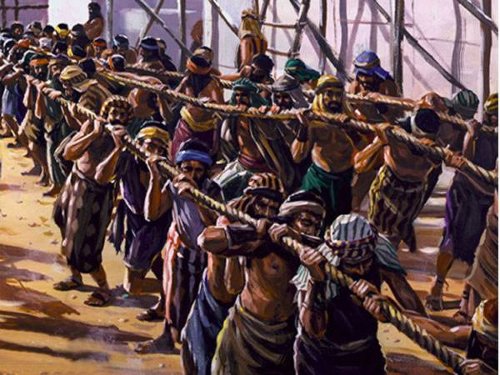
hebrew_slaves_egyptSay, therefore, to the Israelite people: I am the Lord. I will free you from the labors of the Egyptians and deliver you from their bondage. I will redeem you with an outstretched arm and through extraordinary chastisements. And I will take you to be My people, and I will be your God. And you shall know that I, the Lord, am your God who freed you from the labors of the Egyptians.

Exodus 6:6-7 (JPS Tanakh)

G‑d reveals Himself to Moses. Employing the “four expressions of redemption,” He promises to take out the Children of Israel from Egypt, deliver them from their enslavement, redeem them, and acquire them as His own chosen people at Mount Sinai; He will then bring them to the land He promised to the Patriarchs as their eternal heritage.

from “Va’eira in a Nutshell”
Commentary on Torah Portion “Va’eira
Chabad.org

I had coffee with a friend after work on Wednesday. We see each other irregularly these days, but our conversations are always good. The main reason we met was because he wanted to borrow my copy of Boaz Michael’s book Tent of David: Healing the Vision of the Messianic Gentile. This, of course, was also one of the primary topics of our talk as I sipped my coffee and he sampled his tea.

One of the things I value about our relationship is that we don’t always see eye-to-eye. We never argue and conversations never become heated, but we do see things from different points of view. I think he’s interested if not intrigued about my return to church (although this could be projection on my part) and he struggles with the implications of going back into the church after having been “redeemed” from it. It’s an interesting metaphor.

In our discussion, he likened leaving the church to the Children of Israel leaving Egypt. It’s not a complementary picture of the church that he’s painting, but it’s one that I’ve encountered on numerous occasions during my sojourn in the Hebrew Roots movement. Egypt represents nothing good spiritually and morally and leaving Egypt is always seen as a positive action on the part of God toward the Israelites. But can non-Jewish believers leaving the church be seen in the same way? If the church equals Egypt, torment, and slavery, and being released from all that means coming closer to God, then when a Christian leaves church, where do they (we) go that is better and what do they (we) do when they get there?

Let’s back up a minute. In Judaism the process of God rescuing the ancient Hebrews from their slave status in Egypt and bringing them to Himself at Sinai involves what is called the “four expressions of redemption” based on the above-quoted Exodus 6:6-7. But what are these four expressions and what do they mean?

According to the Ask the Rabbi column at Ohr Somayach, they are:

  1. “I will take you out from under Egypt’s burdens – Vehotzeiti
  2. “And I will save you from their servitude – Vehitzalti
  3. “And I will redeem you – Vega’alti
  4. “And I will take you as My nation – Velakachti

This is actually a commentary on the four cups we see during a traditional Passover seder. The Ohr Somayach Rabbi further states:

We didn’t go from a slave nation to being the Chosen People at Mount Sinai overnight. There were different stages of redemption. The above phrases described these different stages. Each cup of wine represents one of these levels.

leaving_egyptThat’s fine as far as it goes, but to me, it’s not very revealing, especially if we are trying to compare these four expressions to how we might view a non-Jewish Christian leaving the church (which is being equated to Egypt).

OU.org expands on the meaning of the four expressions thus:

According to R. Bachya (Spain, 1263-1340), the explanations of the Four Expressions are as follows:

  1. “I will take you out” – Hashem would remove the slavery even before the Jews left Egypt, from all the Tribes of Israel, because of the growing perception by Egypt of Hashem, the G-d of Israel, as the One Almighty G-d.
  2. “I shall save you” – Hashem would take the Jews out of Egypt with plagues visited upon the Egyptians, their Pharaoh and their gods, “with a strong hand and an outstretched arm.”
  3. “I shall redeem you” – Hashem would perform the miracle of “Kriat Yam Suf,” the Splitting of the waters of the “Yam Suf,” and the creation of a dry path for the Children of Israel to walk upon as they crossed the Sea of Reeds. Then Hashem caused the piled-high waters to descend in a tidal wave upon the Egyptian Army, to permanently crush the World-dominating power of Egypt.
  4. “I shall take you” – Hashem took the Jewish People to Himself as a Kingdom of Priests and a Holy Nation. This was the spiritual component of the Redemption from Egypt. In fact, the spiritual Redemption was the Reason for the Physical Redemption.

The fifth expression, “I shall bring you to the land,” refers, of course, to the Land of Israel…

I must admit, I’m having a tough time mapping what I’ve been quoting from above to any image of why Christians should leave the church and where they are supposed to go. On the other hand, I’m kind of biased and truth be told, it wasn’t that many years ago that I might have accepted my friend’s metaphor relative to the Hebrew Roots movement.

But consider this. If Hebrew Roots is supposed to be the “Sinai” for Christians leaving the church, is it an attainable goal and is it right and accurate to say the church is Egypt in a spiritual (or any other) sense?

The Christians who, throughout the ages, have propagated this message and tried to soothe the hurting, feed the hungry, and speak to social injustice have been keeping the weightier matters of the Torah. Both Yeshua (Mark 12:31) and the Sages (Rabbi Hillel in b.Shabbat 31a and Rabbi Akiva in Sifra, Kedoshim 4:12) taught that love of neighbor is the essence of Torah. These are non-trivial accomplishments which speak to the robust, biblical ethical system which many devout Christians have embraced.

-Boaz Michael
“Chapter One: The Church is Good,” pg 49
Tent of David: Healing the Vision of the Messianic Gentile

You’ll have to read all of Boaz’s book to get the full flavor of why the church is good, but I believe he paints a very convincing picture of the modern “body of Christ” as it lives and breathes within the multitude of churches in our communities and around the world. Even today in the lives of people I know, Christians are doing wonderful acts of kindness in the name and spirit of Messiah.

We are seriously getting love aimed at us by a little church nearby. Out of the blue, the pastor had contacted me wanting to know if some of their members could do anything for us and he wouldn’t take no for an answer unless it really was no.

Today some amazingly nice folks showed up and hauled off to the dump our junk too big for our own vehicle, in one of the guy’s large truck.

Meanwhile, the ladies scoot in to do some cleaning while visiting with Heidi.

And meanwhile another great guy is walking me around our deck, explaining to me how he is going to prep the bannister and then paint it for us.

And they’re coming back tomorrow!

-Joe Hendricks

I originally quoted Joe in a blog I published last June. Sadly, since that time, Joe’s wife Heidi passed on, but the church he mentions continues to be a support in his life as he grieves and as he yet looks to the future by the grace of Christ.
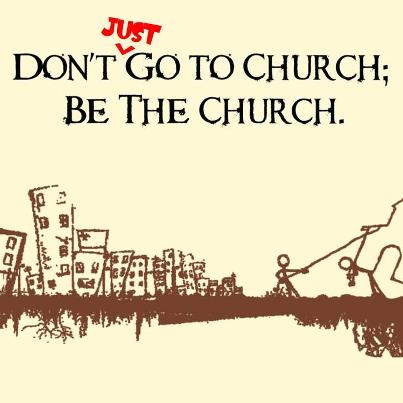
afraid-of-churchThe church isn’t perfect. In fact, It’s taken quite awhile for me to overcome my own misgivings about going back to church (which can be reviewed in all their glorious details in my recent “Days” series, which culminated at Day Zero). In fact, I still periodically have to review Pastor Jacob Fronczak’s blog post Why I Go to Church to remind myself that a community can be imperfect and still be the will of God for the good.

So if the church isn’t Egypt, then do we have to be delivered from it? Is there someplace better to go to and what do we call it?

I can’t answer for every person out there who has once been in the church and, for whatever reasons, left it, either for some other religious organization or to pursue God as a solidary individual or family. I can only speak for myself and how I express my evolving understanding of God’s will for my life.

I don’t think we can get back to the “root” of our faith. I know that’s disappointing and maybe some of you disagree with me, but hear me out. At some point about 2,000 years ago, a sect  called “the Way” rose among the other movements in Judaism in the late Second Temple period. The Jewish disciples were devoted to a “dead Rebbe” rather than a living teacher, one who they said not only died, but rose again. He is the Mashiach, the Son of the Living God (Matthew 16:16), who sits at the right hand of the Father (Psalm 16:8, Psalm 110:1, Acts 2:33), and who is the High Priest in the Court of Heaven (Hebrews 4:14).

The “Christianity” of that moment in history was a wholly Jewish religious movement and it co-existed with numerous other Jewish movements in Roman occupied “Palestine” in those days. Acts 10 shows the first non-Jew who came into discipleship under Messiah within this sect without converting to Judaism, and the “ministry” of Paul, who as an emissary to the Gentiles, preached a Gospel not given by men but by Jesus Christ (Galatians 1:11-12). As more and more Gentiles in the diaspora began to hear the “good news” of the Jewish Messiah and apply it to their lives, slowly the Gentiles and Jews within the “Jesus movement” began to trace somewhat divergent trajectories. Those slight deviations in trajectory would later lead them on completely different paths through the progression of history, and for centuries now, they have both identified themselves as two completely different religions that once shared a common point.

Should Christians seek to leave the church and travel backward across the timeline, trying to recapture whatever idealized or “perfected” Christianity that may (or may not) have existed somewhere around the mid 40s CE? Is it even possible?

Or does the path that God has set before us lead forward into the future…a future that will summon the risen Messiah to come out of the sky in the clouds (Revelation 1:7), who will redeem his people Israel, and who will also gather his disciples from the nations? If this future-oriented path is the true one, then perhaps there is no “perfect Christianity” to go back into upon “leaving the church.” Regardless of whatever Christian or Jewish worship venue to which you are attached (including any form of Hebrew Roots or Messianic Judaism), chances are, you don’t belong to a perfect community. Chances are people in your congregation make mistakes. Chances are, when scrutinized by the King of All Glory, your theology may not be absolutely and totally 100% “kosher.”

Chances are, there is no perfect church, synagogue, community, or congregation for you or for any of us to join upon leaving “church.” Face it. All congregations that involve human beings and human relationships are “messy.” We have to start with where we are, not where we’d like to be.

Yes, the church could be improved. That’s the other very valuable (to me) chapter in Boaz’s book, “Chapter 2: The Church Needs to Change.” Frankly, we could also probably say, relative to God’s perfect understanding, that the synagogue needs to change as well. A better way to say it is that we all need to change, to be better, to draw nearer to God, to refine our understanding of who He is and who we are in Him, Jew and Christian alike. We travel upon our divergent trajectories but we have one Shepherd and one King, and God is One. Not that our ultimate unity under Him as His “peoples” means uniformity, but it does mean unity of devotion and fealty.

The Messiah will come. He will return Israel to its place as the head of all the nations, rebuild the Temple, defeat evil, and establish a reign of peace and tranquility for all peoples of the earth. All the Jewish people will be gathered unto him in their nation Israel, and we believers who reside across the four corners of the Earth will bow our knees to him and call him Lord over all (Romans 14:11, Philippians 2:10). That is our future.

But we’re not there yet.

two-roads-joinWe have to start where we are. If we are non-Jewish Christians in church, we should stay in church. We should bring our understanding of the Jewish Messiah King to where we are, not remove it from our fellow believers and hoard it for ourselves. If we are Gentiles in a Messianic community, then we should stay there (though there may be exceptions who will also attend a church) and use other platforms for communicating our understanding to the Christians we know or will come to know (compare to 1 Corinthians 7:18). For myself, I go to church not to change anything but to encounter God and His purpose for me, whatever it may be.

We may not always see the good in the church but it’s there. We may not see it because when we were introduced to the Hebrew Roots movement (for those of you reading this who are or were involved in Hebrew Roots), we were told the “church is Egypt.” However, if it’s been awhile since you’ve taken a look at the church, at the Christians in your community, at the believers you work with, live near, and consider friends, maybe it’s time you took another look. There are indeed two paths involved, but they’re not the two you have been imagining.

There are two paths:

One: Everything is for the good. Perhaps not immediately, but eventually good will come out from it.

The other: Everything is truly good—because there is nothing else but He who is Good. It’s just a matter of holding firm a little longer, unperturbed by the phantoms of our limited vision, unimpressed by the paper tiger that calls itself a world, and eventually we will be granted a heart to understand and eyes to see.

Eventually, it will become obvious good in our world as well.

-Rabbi Tzvi Freeman
“Believing in G-d”
Based on letters and talks of the Rebbe
Rabbi M. M. Schneerson
Chabad.org

To modify Rabbi Freeman’s commentary slightly, everything we encounter is for the good, and eventually good will be demonstrated by the church. We must be patient and help as we can. Also, everything in church is truly good because nothing else exists in our world but God who is Good (Mark 10:18). It’s just a matter of us holding on a little longer where we are, not allowing our limited vision of how we see Christianity to limit God’s work in the church.

Eventually, the good of God and of the body of Christ in our world will become obvious to us as the time for the return of our Master draws near.

Good Shabbos.

Shemot: Trusting God

trust2In this week’s Torah portion the Torah tells us “There arose a new king over Egypt who did not know Joseph.” There is a disagreement whether it was truly a new king or whether the king (Pharaoh) chose to ignore any debt of gratitude to Joseph and his people for saving Egypt and the world from the 7 year famine. Obviously, trusting in people — especially heads of governments — is problematic. Who do you trust? Who can you trust?

In my youth there was a television show entitled, “Who Do You Trust?” The show was not entitled “Is There Anyone You Trust?,” because, in the end all of us trust in someone or something. People trust in their intelligence, their power, their charm, their knowledge, their connections, their political candidate, and in their wealth. For those who trust (or trusted…) in their wealth, it is ironic that on the American dollar bill it advises “In God We Trust.”

Ultimately, what will help all of us to weather these difficult times is strengthening our trust in God. Trust in God gives a person peace of mind, the ability to relax and to be free of stress and worry. It helps one to deal with frustrations and difficulties.

Like all intelligent discussions, we first have to start with a definition. Trust in God is believing, knowing, internalizing that all that the Almighty does for us if for our good. It is knowing that the Almighty loves us greater than any love one human being can have for another person. He totally knows and understands us and our personal situations. Only the Almighty has the power to impact your situation. He has a track record. You can rely on Him. Everything the Almighty does for you is a gift; there are no strings attached.

-Rabbi Kalman Packouz
“Who Do You Trust?”
Commentary on Torah Portion Shemot
Aish.com

That sounds fine as far as it goes, but it’s not as simple as all that. Trusting in God does not mean that you are guaranteed a problem-free life. In fact, as we’ve recently seen, Many people suffer horrible tragedy and tremendous loss regardless of their trust, or lack thereof, in God. The hurricane devastates the righteous and unrighteous alike and loss of a child will break anyone’s heart.

However, Rabbi Packouz provides a handy list of 7 Principles for Trusting in God for our review. Here they are:

  1. The Creator of the universe loves me more than anybody else in the world possibly can.
  2. The Almighty is aware of all my struggles, desires and dreams. All I need is to ask Him for help.
  3. The Almighty has the power to give me anything I want.
  4. There is no other power in the universe other than the Almighty. Only He can grant me success and give me what I want.
  5. The Almighty has a track record for giving me more than I am asking for.
  6. The Almighty gives with no strings attached. I don’t need to earn it or deserve it. He will give it to me anyway.
  7. The Almighty knows what is best for me and everything He does is only for my good.

Although Christianity and Judaism are two different religions (with a common root), I think the list above can be applied just as well to the non-Jewish believer as to the Jewish person.

Does God love you more than anybody else in the world can? The New Testament is full of comments about God’s love, the most obvious being John 3:16. Yes, God does love you and He loves me, and He loves all Christians, and all Jews, and all Muslims, and all Buddhists, and all human beings who have ever lived and who will ever lived.

And yet disaster can strike at any moment and human history is replete with tragedies and disasters. The road of our lives and the lives of all who came before us is littered with broken bodies and broken hearts and broken spirits.

Certainly God is aware of all our needs and struggles since nothing is hidden from Him, but point two suggests that all we have to do to be relieved of our pain is to ask Him for help. Does everyone who has a sincere faith and prays to God receive immediate relief from suffering? Ask the parents of those children who were murdered at Sandy Hook Elementary school.

God really does have the power to give you, me, and everyone else anything we want, but that doesn’t mean He will grant us anything we want. In fact, it is very likely that God will not grant us anything we really want most of the time.

From a Christian’s, Jew’s, or Muslim’s point of view, there is only one power in the universe: God. Only God can grant success and comfort. But as I already said, there’s a difference between what He can do and what He will do.

Does God have a track record of giving us more than what we ask for? I’m not even sure how to measure such a thing. I think that’s probably true in some cases, but not in others. Ask six million Jews who died during the Holocaust while praying for God to grant them mercy. Was death the only mercy He decided to give?

no-strings-attachedGod gives with no strings attached. Hmmm. Is that true? Probably in more cases than not, but there’s a presupposition that even in giving, God is trying to get our attention, especially if those receiving His gifts do not have faith. On the other hand, referring back to John 3:16, God is the grand master of unconditional love, so who am I to talk?

God knows what is best for me. I can’t argue against that and this seventh point could be used to explain the other six. We may ask for something and not get it and then conclude that we didn’t get what we wanted because it wasn’t good for us. On the other hand, the parents of 26 murdered children only want this all to be a bad dream and for their precious little ones to be restored to them. Is that not “good for them?”

No, I’m not trying to be a downer and “diss” trusting in God, but such an abiding trust is difficult to come by.

Blessed are You, O God … Who has provided me my every needs.

-Siddur

One of the great tzaddikim lived in abject poverty, yet always had a happy disposition. He was asked how he managed to maintain so pleasant an attitude in the face of such adverse conditions.

“Each day I pray to God to provide all my needs,” he said. “If I am poor, that means that one of my needs is poverty. Why should I be unhappy if I have whatever I need?”

Tzaddikim are great people and we are little people who may not always be able to achieve the intensity of trust in God that would allow us to accept adversity with joy. But even if we cannot attain it to the highest degree, we should be able to develop some sincere trust.

When our children are little, we as parents know what they need. They might prefer a diet of sweets, but we give them nourishing foods. They certainly despise receiving painful injections that immunize them against dreadful diseases, but we forcibly subject them to these procedures because we know what is good for them.

Some people do not believe in God. But to those that do, why not realize that He knows our needs better than we do, and that even some very unpleasant experiences are actually for our own betterment?”

Today I shall…

try to bear adversity with less anger and resentment, remembering that God is a compassionate Father, and that He gives me that which He knows, far better than I, that I truly need.

-Rabbi Abraham J. Twerski
“Growing Each Day, Tevet 20”
Aish.com

The Hebrew word bitachon is typically translated as “trust” in English, but that hardly does it justice. Trusting God isn’t about God always giving us what we want or us experiencing God as always doing what we think of as good. It’s the realization that God is always good regardless of our experiences.

Consider any of the “holy men” you may admire and revere from the Bible. From Abraham to Paul, they all led less than perfect lives. Yes, God granted them many gifts, but He also allowed much hardship. Abraham and Sarah were childless and without an heir for most of their lives and into extreme old age until God granted them Isaac. Jacob was hated by his brother Esau, kept in virtual slavery by his relative Laban for twenty years, his daughter was raped and held captive, his favorite son Joseph was lost and presumed dead. Another son Judah married outside of the Hebrews and two of his three sons died. Joseph was a slave and a prisoner for years in a strange land before being elevated to great power, but only on the condition that he conceal his identity, even from his own brothers. When Joseph died, every one of his descendants for generations was kept as slaves in Egypt. Even their rescuer Moses was unable to lead his people into Canaan and instead wandered with them in the desolate wilderness for forty years until finally dying with almost everyone else in his generation without walking in Israel for himself.

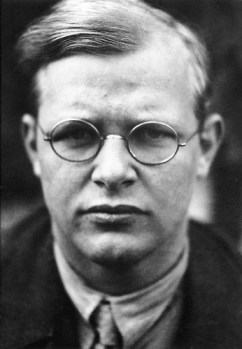
Dietrich BonhoefferThe “saints” of the New Testament fared no better. Consider the stoning of Stephen, the harsh life of Paul leading only to death in Rome, and the martyrdom of Peter and every other Apostle. No, trust and faith did not result in comfort of life.

No, trust in God cannot be based on experience with God because if it were, none of these people would have been able to trust Him. In fact it seems that one must trust God in spite of our life experience. Rabbi Packouz’s list does little good, since God does not perform good on command. Knowing that God can spare us pain and suffering doesn’t help and is a bitter irony when God doesn’t spare us pain and suffering. Job’s most famous line (for me) illustrates what it is to trust in God.

Though he slay me, I will hope in him; yet I will argue my ways to his face.

Job 13:15 (ESV)

This gives us a picture of the Jewish method of trusting God, since it doesn’t preclude telling God how we feel about what’s happening to us.

Rabbi Twerski tells us that only a great tzaddik, a very holy and spiritual person, can truly trust God at the level I’m talking about here. But he also says that it’s not impossible for we “ordinary folk” to trust God, either. In his own declaration on the matter, Rabbi Twerski states, Today I shall try to bear adversity with less anger and resentment, remembering that God is a compassionate Father, and that He gives me that which He knows, far better than I, that I truly need.

In our own times of hardship and anguish, maybe this is the best we can do as well.

For what we proclaim is not ourselves, but Jesus Christ as Lord, with ourselves as your servants for Jesus’ sake. For God, who said, “Let light shine out of darkness,” has shone in our hearts to give the light of the knowledge of the glory of God in the face of Jesus Christ. But we have this treasure in jars of clay, to show that the surpassing power belongs to God and not to us. We are afflicted in every way, but not crushed; perplexed, but not driven to despair; persecuted, but not forsaken; struck down, but not destroyed; always carrying in the body the death of Jesus, so that the life of Jesus may also be manifested in our bodies. For we who live are always being given over to death for Jesus’ sake, so that the life of Jesus also may be manifested in our mortal flesh. So death is at work in us, but life in you.

2 Corinthians 4:5-12 (ESV)

Good Shabbos.

Vayechi: Being Strong Until the End

Lion of JudahThe scepter shall not depart from Judah, nor the lawgiver from his descendants, until the Moshiach comes . . .

Genesis 49:10

Every soul possesses a spark of the soul of Moshiach

—Rabbi Israel Baal Shem Tov

After the passing of Rabbi DovBer of Mezeritch in 1772, Rabbi Menachem Mendel of Horodok led a group of chassidim to settle in the Holy Land.

One day, a somewhat deluded individual climbed the Mount of Olives in Jerusalem and sounded a shofar. Soon the rumor spread that Moshiach had arrived, setting off a great commotion in the street. Rabbi Mendel went to his window and sniffed the air. “No,” he said, “unfortunately, the redeemer has not yet arrived. On that day, ‘the world shall be filled with the knowledge of G‑d as the waters cover the sea,’ and ‘all flesh will perceive’ (Isaiah 11:9 and 40:5) the reality of the Creator. I do not sense the divine truth that will permeate the world in the era of Moshiach.”

Said the renowned mashpia, Rabbi Grunem Estherman: “Why did Rabbi Mendel need to go to the window to sniff for the presence of Moshiach? Because the all-pervading truth of G‑d was already a tangible reality within the walls of Rabbi Mendel’s room.”

-Rabbi Yanki Tauber
“Moshiach in the Air”
Chabad.org

I know this commentary seems rather fanciful and not particularly realistic (can you smell Moshiach in the air?), but as I read it, I was reminded of how in certain corners of Christianity, the topic of the end times and the second coming are very prominent, almost to the point of obsession. It’s as if we haven’t read the Gospels in our own Bibles.

Then if anyone says to you, ‘Look, here is the Christ!’ or ‘There he is!’ do not believe it. For false christs and false prophets will arise and perform great signs and wonders, so as to lead astray, if possible, even the elect. See, I have told you beforehand. So, if they say to you, ‘Look, he is in the wilderness,’ do not go out. If they say, ‘Look, he is in the inner rooms,’ do not believe it. For as the lightning comes from the east and shines as far as the west, so will be the coming of the Son of Man. Wherever the corpse is, there the vultures will gather.

Matthew 24:23-28 (ESV)

Why are we so worried about the coming Messiah? He gave us great advice about what worry is all about.

But if God so clothes the grass of the field, which today is alive and tomorrow is thrown into the oven, will he not much more clothe you, O you of little faith? Therefore do not be anxious, saying, ‘What shall we eat?’ or ‘What shall we drink?’ or ‘What shall we wear?’ For the Gentiles seek after all these things, and your heavenly Father knows that you need them all. But seek first the kingdom of God and his righteousness, and all these things will be added to you.

“Therefore do not be anxious about tomorrow, for tomorrow will be anxious for itself. Sufficient for the day is its own trouble.

Matthew 6:30-34 (ESV)

But as I said before, it’s very difficult for us to change our thinking and to rise up out of the darkness as a light. It is very difficult to let the world be the world, to just do our best, and to have faith and trust that everything will work out according to God.

And will not God give justice to his elect, who cry to him day and night? Will he delay long over them? I tell you, he will give justice to them speedily. Nevertheless, when the Son of Man comes, will he find faith on earth?”

Luke 18:7-8 (ESV)

Who is Moshiach?Is waiting and rumor a test of faith? It’s been nearly 2,000 years since the ascension and we’ve been waiting ever since. Jews cry out “Moshiach now” but Moshiach has yet to come. Rabbi Mendel said that the world will be filled with the knowledge of God before the Messiah’s coming (return) but that’s just one of many different thoughts about what must happen beforehand. We can’t be that sure of our facts. In many ways, the Bible is a mystery containing clues we struggle all our lives to interpret.

This Shabbos is called Shabbos Chazak, “the Shabbos of reinforcement,” because of the custom of declaring, Chazak, Chazak, Vinischazaik (“Be strong, be strong, and may you be strengthened”) at the conclusion of the Torah reading, in acknowledgment of the completion of the Book of Genesis.

The awareness nurtured by the reading of Vayechi generates strength. When a Jew knows he has been granted a heritage of life expressed through a connection with the Torah, and that there will come a time when this connection will blossom, he will acquire the inner strength to confront the challenges presented by his environment.

By heightening the expression of this potential in our people as a whole, we hasten the coming of its fruition in the Era of the Redemption. May this take place in the immediate future.

-Rabbi Eliyahu Touger
“True Life”
Adapted from
Likkutei Sichos, Vol. X, p. 160ff; Vol. XV, p. 422ff;
Sichos Shabbos Parshas Vayechi, 5751
Commentary on Torah Portion Vayechi
Chabad.org

So Joseph and his father’s household remained in Egypt. Joseph lived one hundred and ten years. Joseph lived to see children of the third generation of Ephraim; the children of Machir son of Manasseh were likewise born upon Joseph’s knees. At length, Joseph said to his brothers, “I am about to die. God will surely take notice of you and bring you up from this land to the land that He promised on oath to Abraham, to Isaac, and to Jacob.” So Joseph made the sons of Israel swear, saying, “When God has taken notice of you, you shall carry up my bones from here.”

Joseph died at the age of one hundred and ten years; and he was embalmed and placed in a coffin in Egypt.

Genesis 50:22-26 (JPS Tanakh)

chanukah-josephs-tombThe final verses of this Torah Portion and the book of Genesis find Jacob and Joseph dead and Jacob’s descendants continuing to live in Egypt. This sets the stage for the birth of Moses and the centuries of slavery of the Jewish people under a “new king who arose over Egypt and who did not know Joseph.” If Jacob understood prophesy, he must have known what was going to come after his death, just as Joseph did. True, he was reassured by God that He would go down into Egypt with Jacob and his family, and that God would bring Jacob’s descendants back out of Egypt (Genesis 46:4), and yet what a bitter thing to go to your grave knowing your children and your children’s children will suffer.

As Rabbi Touger states, at the end of this Torah portion, it is customary to declare “Chazak, Chazak, Vinischazaik (“Be strong, be strong, and may you be strengthened”).”

Where ever you are in your life and whatever your experiences are, however you anticipate your future, whether it be long or brief, you…we…all of us must be strong.

But that can be so very hard. Seek first the kingdom of God and His righteousness.

God be merciful, and may Moshiach come soon and in our days. Amen.

Good Shabbos.

Vayigash: Settling Into Prosperity and Captivity

jewish-handsIn 468 CE, Rabbi Amemar, Rabbi Mesharsheya and Rabbi Huna, the heads of Babylonian Jewry, were arrested and executed 11 days later. The Jewish community of Babylon had existed for 900 years, ever since Nebuchadnezzar had conquered Israel, destroyed the Holy Temple, and exiled the Jews to Babylon. Seventy years later, when the Jews were permitted to return to Israel, a large percentage remained in Babylon — and this eventually became the center of Jewish rabbinic authority. Things began to worsen in the 5th century, when the Persian priests, fighting against encroaching Christian missionaries, unleashed anti-Christian persecutions which caught the Jews of Babylonia in its wake. Eventually the situation improved, and Babylon remained as the center of Jewish life for another 500 years.

-Rabbi Shraga Simmons
“Today in Jewish History, 7 Tevet”
Aish.com

Thus Israel settled in the country of Egypt, in the region of Goshen; they acquired holdings in it, and were fertile and increased greatly.

Genesis 47:27 (JPS Tanakh)

It’s hard not to compare these two events. Both of them describe different points in the process of the Jewish people going down into a land not their own and then making themselves comfortable there and thriving. As we see in the Babylonian example, the “good times” don’t last forever, but from Jacob’s point of view, this isn’t readily apparent. In fact, he had assurances that dwelling in Egypt was the right thing to do.

So Israel set out with all that was his, and he came to Beer-sheba, where he offered sacrifices to the God of his father Isaac. God called to Israel in a vision by night: “Jacob! Jacob!” He answered, “Here.” And He said, “I am God, the God of your father. Fear not to go down to Egypt, for I will make you there into a great nation. I Myself will go down with you to Egypt, and I Myself will also bring you back; and Joseph’s hand shall close your eyes.”

So Jacob set out from Beer-sheba. The sons of Israel put their father Jacob and their children and their wives in the wagons that Pharaoh had sent to transport him; and they took along their livestock and the wealth that they had amassed in the land of Canaan. Thus Jacob and all his offspring with him came to Egypt: he brought with him to Egypt his sons and grandsons, his daughters and granddaughters — all his offspring.

Genesis 46:1-7 (JPS Tanakh)

God’s blessing upon Jacob as we see above, is the beginning of the process of Israel dwelling in Egypt, multiplying greatly, and thriving there. However, the other end of the story is hardly so pleasant.

A new king arose over Egypt who did not know Joseph. And he said to his people, “Look, the Israelite people are much too numerous for us. Let us deal shrewdly with them, so that they may not increase; otherwise in the event of war they may join our enemies in fighting against us and rise from the ground.” So they set taskmasters over them to oppress them with forced labor; and they built garrison cities for Pharaoh: Pithom and Raamses. But the more they were oppressed, the more they increased and spread out, so that the [Egyptians] came to dread the Israelites.

The Egyptians ruthlessly imposed upon the Israelites the various labors that they made them perform. Ruthlessly they made life bitter for them with harsh labor at mortar and bricks and with all sorts of tasks in the field.

The king of Egypt spoke to the Hebrew midwives, one of whom was named Shiphrah and the other Puah, saying, “When you deliver the Hebrew women, look at the birthstool: if it is a boy, kill him; if it is a girl, let her live.”

Exodus 1:8-16 (JPS Tanakh)

rabbi-prayingThe irony in making the above comparisons, is that the Fast of the Tenth of Tevet is just a few days away.

The Fast of the Tenth of Teves marks the day that Nevuzadran, the Babylonian general, laid siege to Jerusalem prior to the destruction of the first Holy Temple. The siege lasted almost three years until the city walls were breached and the Temple was destroyed. This was the beginning of a long line of disasters on the Jewish people, including the first exile, and the destruction of the second Temple.

This day is commemorated by refraining from eating or drinking from sunrise to nightfall.

While the last sentence of this week’s Torah portion is one of hope and prosperity for the Children of Israel, it is ominously foreshadowed by what we know will occur after the death of Joseph and his brothers. This is the fate of the Jewish people that we’ve seen enacted again and again across history since the destruction of Herod’s Temple in 70 CE and to this very day, when the Jews settle in an area, develop a robust and prolific community, and then are persecuted, robbed, maligned, murdered, and exiled.

On his blog, my friend Gene Shlomovich posted an extremely telling example of how Christianity in the “bad old days” expected and enforced Jewish conversion to Christianity. I invite you to click the link I just provided and read the whole story. It’s not a pretty picture, and many Jews chose to be tortured and die rather than to abandon the God of their Fathers and the Torah of Truth, and replace them with the “lure” of the “Goyishe Jesus.”

What am I saying here? That Christians are perpetually bad and that Jews should do anything in their power to blame the church for the hideous way it has historically treated Jewish people? Is that what the upcoming fast is all about? Not according to Rabbi Raymond Beyda

The purpose of fasting almost 2500 years after the events of the destruction took place is to awaken our hearts today to repentance. Our sages teach that anyone who lives at a time when there is no Bet Hamikdash must realize that had he or she lived when the Temple stood that his or her behavior would contribute to its destruction. Should we mend our ways and remove from our lives the behavior that brings destruction we will bring about the construction of the third Temple — the one that will never be destroyed — and the coming of Mashiah speedily in our days. May we all spend the day productively contributing to that end — Amen.

This is not to excuse the church for its crimes or to pardon any of the peoples and nations who have harassed and abused the Jewish people over the long centuries, but we must separate history from current events. Yes, hatred of Jews and hatred of Israel is still rampant in our world and there are many accounts in the media that indicate it is on the upswing. However, there are also many churches that have significantly revised and improved their (our) understanding of Jews and Judaism, and they (we) have repented and seek to understand our “Jewish roots,” while also honoring that God created a unique covenant people and nation in Israel who remain unique and special to the current day.

But the Jewish people have only one nation, Israel. While, in most parts of the world, Jews are welcome, and flourish, and are fully integrated within the countries and societies where they dwell, we see from history that there is such a thing as being too integrated, and certainly assimilation takes Jews to the point of no longer being recognizably Jewish. What the ancient church attempted and failed to do by force is now being accomplished voluntarily.

Judaism is being destroyed by assimilation and integration, which in effect, means Jews are, without realizing it, renouncing all that it is to be a Jew for the sake of national, social, and cultural belonging. But for those Jews who fully retain their unique ethnic, covenant, and halakhic identity as Jews, the danger they face living in the nations is the same danger the Jews faced in 468 CE in Babylon, and the same danger they faced in the 1930s in Germany.

joseph_egyptAnd it’s the same danger we find them facing this week as Jacob and his family settle comfortably in Goshen, which is in Egypt, and ruled by Pharaoh. Today, as we read Vayigash, Pharoah, King of Egypt knows Joseph and seeks to continue the profitable relationship between Egypt and Jacob’s family. Tomorrow, a new Pharoah will arise who does not know Joseph. That’s the way it’s always happened. Jews believe it will happen again.

According to the Talmud, as the Messianic era approaches, the world will experience greater and greater turmoil: Vast economic fluctuations, social rebellion, and widespread despair. The culmination will be a world war of immense proportion led by King Gog from the land of Magog. This will be a war the likes of which have not been seen before. This will be the ultimate war of good against evil, in which evil will be entirely obliterated. (Ezekiel ch. 38, 39; Zechariah 21:2, 14:23; Talmud – Sukkah 52, Sanhedrin 97, Sotah 49)

What is the nature of this cataclysmic war? Traditional Jewish sources state that the nations of the world will descend against the Jews and Jerusalem. The Crusades, Pogroms and Arab Terrorism will pale in comparison. Eventually, when all the dust settles, the Jews will be defeated and led out in chains. The Torah will be proclaimed a falsehood.

“End of Days”
from the “Ask the Rabbi” series
Aish.com

Israel and her people, the Jewish people, will be rescued when Moshiach comes. But until then, we in the church have a responsibility to make sure the Holocaust or anything like it does not happen again in our towns, in our cities, and in our nations. In solidarity, we can also fast on the Tenth of Tevet, which this year is on Sunday, December 23rd.

Peace be upon Jerusalem and may the Messiah come soon and in our day.

Good Shabbos.

Mikeitz: Dreams and Nightmares

dreams-and-prisonThese concepts are reflected in this week’s Torah reading, Parshas Mikeitz, which focuses on the release of Yosef from prison. Yosef serves as an analogy for the entire Jewish people. For the name Yosef, meaning “increase,” refers to an infinite and unbounded potential for growth, (See Toras Chayim, Bereishis, 87b.) i.e., the soul we all possess, which is “an actual part of G-d from above.” (Tanya, ch. 2.)

Moreover, the prayer Rachel recited when naming Yosef, (Genesis 30:24.) “May G-d add on (yosef) to me another son (ben acher),” reflects the spiritual mission of the Jewish people. Entities which have hitherto been acher (“other” estranged from their G-dly core) are brought close and manifest the intimacy of ben (“a son”).(See Or HaTorah, Vayeitzei, p. 202a.)

The prison in which Yosef is held refers to the body, and to material existence as a whole. These tend to confine the infinite power of the soul and deny it expression. Although G-d gave man His Torah, His will and wisdom, (Tanya, ch. 4.) the Torah is also affected by the limits of material existence, and its G-dly source is not always evident.

-Rabbi Eliyahu Touger
“An End And A Beginning”
Commentary on Torah Portion Mikeitz
Chabad.org

Again, I can only relate to Chassidic mysticism in terms of its power to paint metaphorical pictures. We all exist in some sort of prison which seemingly prevents us from flying free. It could be an emotional restraint, a physical ailment, a spiritual lacking, anything, really. Sometimes God sends us on a quest in search of who we are and in the midst of it, we feel discouraged and uncertain. Have we taken the correct turn? Are we on the right trail? Should we turn back and start again? What if it doesn’t matter?

Yet Joseph the slave and Joseph the prisoner shows us that regardless of our environment and circumstances, and sometimes because of it, we can always be who God has created us to be. Then again, it sometimes takes someone like Joseph to teach us that lesson.

Once, when Rabbi DovBer of Lubavitch, the son of Rabbi Schneur Zalman of Liadi, was a young man, he was visiting with his father-in-law in Yanovitch. There he met with one of his father’s chassidim. The chassid noticed that the young ‘rebbe’s son’ was all too aware of his achievements in scholarship and meditative prayer and felt that some cutting down to size was in order.

Said the chassid to Rabbi DovBer: “Considering who you are and how you’ve lived, what’s the big deal? Your father – well, we all know who your father is. You were certainly conceived under the holiest of circumstances, and I’m sure that your father secured a most lofty soul to bring down into the world. Then you were raised in a rebbe’s home and great care was taken to mold your character and safeguard you from any negative influences. All your life you’ve been exposed to scholarship and sanctity and to this very day you’re preoccupied only with the study of Torah and the teachings of chassidism. So you’ve amassed a certain amount of knowledge and you pray with fervor and devotion. Big deal.

“Now, take me for example. My father was a simple man, and we can well imagine what was on his mind when he scraped out some dreg of a soul out the bottom of the barrel. My upbringing? I was raised as a goat and basically left to my own devices. And do you know what I do with my life? Let me tell you how I earn my living. I loan money to the peasants during the planting season and then, during the winter months, I make my rounds of their villages and farms to collect the debts before they have a chance to squander their entire harvest on vodka. This means setting out several hours before sunrise, well before the permissible time for prayer, equipped with a flask – for without a drink one cannot begin to talk business with a peasant. After drinking to his health, one must share a ‘l’chayim’ with the woman in the house as well – otherwise she can ruin the whole deal for you. Only then can you sit down to settle part of the account.

the_chassid“After three or four such stops I make my way home, immerse myself in the mikveh and prepare for prayer. But after such preliminaries, what sort of prayer would you expect…?”

The words of this chassid, who was, in truth, renowned for his refined nature and soulful prayers, made a deep impression on Rabbi DovBer. The young man immediately travelled home to his father and poured out his heart. He bewailed his spiritual state, saying that his service of G-d is worthless, falling so short of what is expected from him.

The next time the chassid from Yanovitch came to Rabbi Schneur Zalman, the Rebbe said to him: “I am most grateful to you – you have made a chassid out of my Berel.”

-Rabbi Yanki Tauber
“The Rebbe’s Son and the Chassid”
Commentary on Torah Portion Mikeitz
Chabad.org

In this tale, we see a reversal of what you might expect. The Rebbe’s son, who had every material and spiritual advantage, was basically a talented but spoiled brat. Something like who Joseph was as a teen prior to being assaulted by his brothers, thrown into a pit, and then sold into slavery (see Genesis 37). The Chassid, on the other hand, had virtually no advantages and lived a difficult life among rough and uncultured people, and yet he was “renowned for his refined nature and soulful prayers,” perhaps because of the lessons he was taught by such a life.

We see a dramatic change in Joseph’s attitude and behavior once he becomes a slave and continuing on during his imprisonment. He could have dissolved into despair, surrendered to the advances of Potiphar’s wife, and disappeared from the realm of spirituality altogether, but instead, he chose a different path. One that ultimately lead from the lowliest of positions to the exalted heights of both material and spiritual wealth.

The Rebbe thanks the Chassid from Yanovitch for making “a chassid out of my Berel.” How much more did slavery and imprisonment make a “chassid” out of Joseph…and what can it do for us?

In truth, there is no need to change the world, but only to illuminate it. For each thing has a place, and in that place it is good.

There is only one problem: It is dark. In the dark, there is no way to find the place for each thing. No way to know what belongs in your closet, ready for use, and what belongs in the laundry, waiting to be cleaned. And so, that which could be washed and used for good is despised as hateful, and that which is wholly good is used for evil.

Torah is light: it tells us the place of each thing. Shine it bright, and heal the world.

-Rabbi Tzvi Freeman
“Illumination”
Based on letters and talks of the Rebbe
Rabbi M. M. Schneerson
Chabad.org

in-the-darkThis, of course, is not easy because as the esteemed Rabbi says, it is “dark.” We can’t see a thing. While we may know that we are to illuminate our world, imagine coming to that realization if you are Joseph in slavery or Joseph in prison. How is this to be done? You have no hope. You will never see your family again. You will never see your home again. You will forever be trapped in a foreign land among strangers. Even if you adapt, seem to fit in, learn to walk among them, you will never truly be one of them. Should you even try?

Make an effort to do the actions you fear to do and by this means lessen those fears. Think of a specific fear that stops you from doing something that would be beneficial for you to do, and take action.

-Rabbi Zelig Pliskin
“Daily Lift #667, Act On Your Fears”
Aish.com

You can cower and hide, imprisoned by your nightmares…or you can rise up from the darkness and live your dreams in the light.

Happy Chanukah and Good Shabbos.

Vayeishev: Understanding, Living, and Courage

walking-side-by-side Recognize, please, to whom these belong…

Genesis 38:25

The arrival of a letter, adorned with official-looking stamps and seals, was quite an event at the small wayside tavern somewhere in the backwoods of White Russia. The simple tavern-keeper, who had never quite mastered the written word, ran to find the melamed he kept to teach his children.

As the teacher read the letter, the tavern-keeper turned white, uttered a small cry, and collapsed in a dead faint. For the letter contained most shocking and tragic news for this simple, good-hearted Jew: his beloved father had passed away.

Said the mashpiah Reb Michael of Aptask:

An outside observer witnessing the events described above may wonder: why does the tavern-keeper react so dramatically to the letter while the teacher is relatively unmoved? Who among the two better grasps and comprehends its contents if not the learned teacher? The other cannot even read and write!

Obviously, this is a ridiculous question. What if the teacher has a better appreciation of the vocabulary, sentence structure, and artful calligraphy with which the letter is composed? What if he better understands the background, the circumstances, the nuances of the event described? It is not his father who died!

True, Reb Michael would concluded, it is important to learn, to study, to comprehend. And the more one understands, the deeper one delves into the nature of his own existence, the world about him, and his relationship with his Creator, the better equipped he is to fulfill his mission in life. But objective knowledge alone is worthless. Unless one sees himself in the picture, the most profound of theories will yield no meaningful results. Unless one sees the subject matter as ‘his father’, a lifetime of study and discovery will have little bearing on life itself.

-Rabbi Yanki Tauber
“The Theory and the Father”
Commentary on Torah Portion Vayeishev
Chabad.org

Apparently, I’m a hypocrite. I don’t believe that I’m a hypocrite, but two individuals have called me one in the past few days. Here are a couple of examples from recent comments on my blog. The first one I present is pretty benign:

…since you are a gentile, dabbling in Messianic Judaism, “which is for Jews”, is a bit of a contradiction, technically you are muddying the waters, so to speak. Would you not agree?

The second example, on the other hand…

I will tell you that you are a hypocrite in your face. I don’t play nicely nicely with the truth. I have to chastise one who does not play with a full deck…You fell for false teaching and with your blog you are causing people to stumble…Go home……

Supposedly, because I advocate for the Jews having a unique covenant relationship with God and that they have a special role beyond any other people or religious group, including Gentile Christians, I have a problem. Actually, the problem is supposed to stem from the fact that I advocate for the above and yet I also involve myself, as a Christian, in the affairs of Messianic Judaism by writing commentaries on the movement. I suppose the fact that I very often quote from Jewish religious and educational sources just adds to my “problem.”

But does that make me a hypocrite?

Just a few days ago I said:

We serve One God and we have one Messiah King who will return to rule over all of Creation. As servants and sons, we each have our roles and duties. We can’t afford to let our limitations, biases, and human ambitions restrict who we are and who God created us to be…both the Jew and the Gentile. Christian support of Israel does not mean taking control of the process of defining Israel. It’s allowing the Jewish people and nation the space to define themselves, and supporting them in this effort through whatever means are at our disposal. That is a Christian’s unique role and purpose in life. It’s time we start living it.

jewish-christianI tried to the best of my ability in the paragraph above to synthesize Christian and Jewish interactions and roles relative to mutual discipleship under the Messiah. Apparently, I failed, at least with the two people who objected to my blog post. I know most of you must be wondering why I’m even writing this. After all, only a few people (publicly) object to me while a much larger number seem to be more encouraging. Why express angst over just a couple of people who question my motives?

I’ve said time and again on this blog that I want to be fair. I want to consider other people’s viewpoints. If someone has a grudge or a beef with me, I have to ask myself if there is anything I’ve done to contribute to it. If there is, then there’s something within me that I need to change. If not, then at least I’ve looked in the mirror and asked myself a few hard questions before moving on.

It’s not that I expect everyone to agree with me all of the time, but it’s difficult for me to comprehend how even my critics can miss what I’m trying to say. It’s one thing to understand my message and to say, “I disagree,” and another thing entirely to misunderstand me to the point what I’m considered to be advocating one position while living out the opposite. Saying that I support Jewish covenant and identity uniqueness is not the same as saying that Jews must be walled up inside their compounds and have nothing to do with the Christians, particularly those of us who are involved with Jews and Jewish community. In my case, I’m married to a Jew. Are we supposed to divorce and live separately? Does my involvement with my Jewish spouse make me a hypocrite? The criticism doesn’t make sense.

I quoted Rabbi Tauber’s story above because it illustrates the relationship and the differences between knowing and understanding; between information and lived experience. The teacher understood the letters, words, and sentences contained in the message but the tavern-keeper experienced the true meaning and impact of what the letter actually said, including the importance of relationship and context. The teacher “knew” the letter while the tavern-keeper “lived” out the meaning and consequences.

I can “know” the “letters, words, and sentences” of the Torah, the mitzvot, and something of the Jewish writings to the limits of my education, but I can never “live” out the experiences, the meaning, the fabric of what it is to be Jewish, whether it is within the context of Messianic discipleship or otherwise. In saying, Recognize, please, to whom these belong, Tamar was calling Judah to acknowledge his unique identity as the father of her children (she was pregnant with twins) and (without realizing it) as the forefather of the Messiah.

I don’t believe that we Christians who stand alongside our Jewish brothers and sisters in the Messiah are hypocrites, either for actually standing by them or by discussing our relationship with each other. If such were the case, a great many writers and teachers, far more knowledgable and talented than I, would have to suffer the same accusation of “hypocrite” and, to serve the honor of Messiah, adjust our behavior accordingly.

contemplating-jumpingBut that would be psychotic.

Jewish and Gentile disciples of the Master are still united by one Messiah and one God. While Rabbi Dr. Michael Schiffman may say that Messianic Judaism and Christianity are two different and separate religions, he also said this:

I also believe Yeshua will bless those gentiles who truly love him. We acknowledge that the gentiles in Yeshua have a place in God’s heart. It makes them our brethren, just as our fellow Jews are our brethren. We are related to other Yeshua followers, just as we are related to other Jews. Nevertheless, Messianic Judaism and Christianity remain two separate religions, yet we have the same Messiah, Yeshua. That being the case, rather than beating each other up with statements of faith we require each other to affirm, it would be good if we just began by treating each other as brethren, loving and supporting one another. I have always been more happy affirming people than doctrinal statements.

That certainly doesn’t sound like he’s requiring isolation between Christians and Messianic Jews. How could he advocate for a complete separatist philosophy and still say that Christians and Jews should “began by treating each other as brethren, loving and supporting one another?” That seems to go along with a “Daily Lift” of Rabbi Zelig Pliskin:

When you build up your own courage, you will be able to serve as a coach to others. Some of the best courage coaches are those who had to struggle to attain the courage they now have. Since it didn’t come easy to them, they know what it’s like to lack the courage to do what others consider easy.

If you don’t yet have the courage you would like, let the knowledge that you will inevitably be able to help others serve as a further motivation to increase your own courage.

Recently, I’ve been encouraged and reminded that in writing this series of “morning meditations,” I’m encouraging others. These are words and actions we are supposed to live by.

Therefore encourage one another and build one another up, just as you are doing.

1 Thessalonians 5:11 (ESV)

Good Shabbos.