Category Archives: Torah Portion

Vayeitzei: Entering the Sacred Space

Jacob left Beer-sheba, and set out for Haran. He came upon a certain place and stopped there for the night, for the sun had set. Taking one of the stones of that place, he put it under his head and lay down in that place. He had a dream; a stairway was set on the ground and its top reached to the sky, and angels of God were going up and down on it. And the Lord was standing beside him and He said, “I am the Lord, the God of your father Abraham and the God of Isaac: the ground on which you are lying I will assign to you and to your offspring. Your descendants shall be as the dust of the earth; you shall spread out to the west and to the east, to the north and to the south. All the families of the earth shall bless themselves by you and your descendants. Remember, I am with you: I will protect you wherever you go and will bring you back to this land. I will not leave you until I have done what I have promised you.” Jacob awoke from his sleep and said, “Surely the Lord is present in this place, and I did not know it!” Shaken, he said, “How awesome is this place! This is none other than the abode of God, and that is the gateway to heaven.” Early in the morning, Jacob took the stone that he had put under his head and set it up as a pillar and poured oil on the top of it. He named that site Bethel; but previously the name of the city had been Luz.

Genesis 28:10-19 (JPS Tanakh)

Jacob leaves his hometown of Beersheba and journeys to Charan. On the way, he encounters “the place” and sleeps there, dreaming of a ladder connecting heaven and earth, with angels climbing and descending on it; G‑d appears and promises that the land upon which he lies will be given to his descendants. In the morning, Jacob raises the stone on which he laid his head as an altar and monument, pledging that it will be made the house of G‑d.

“Vayeitzei in a Nutshell”
Commentary on Torah Portion Vayeitzei
Genesis 28:10-32:3
Chabad.org

According to Rashi’s commentary on Genesis 28:11:

“The place” is Mount Moriah (the “Temple Mount” in Jerusalem, where Abraham had bound Isaac upon the altar and where King Solomon would erect the Holy Temple).

Whether that is literally true that Jacob chose to spend that night on the Temple Mount or not, there’s no way to know, but it is correct according to Jewish tradition. It’s also fitting that my commentary for this week’s Torah portion should be on the site of the Temple, given the sermon I heard at church last week. I’m not so certain that Christians can grasp what the Temple (and its current lack of existence) means to the Jewish people, since the center of our religious lives is the Messiah and not Jerusalem.

Why do we call G-d Hamakom, “The Place”? Said Rabbi Jose ben Chalafta: We do not know whether G-d is the place of His world or whether His world is His place. But when the verse (Exodus 33:21) states, “Behold, there is a place with Me,” it follows that G-d is the place of His world, but His world is not His place.

-Midrash Rabbah
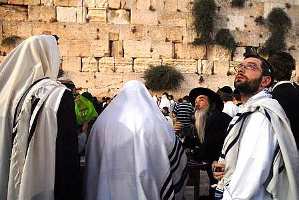
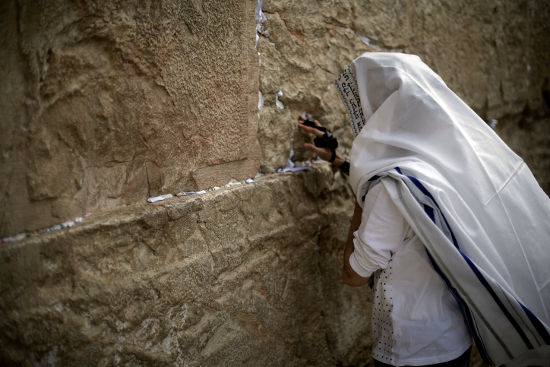
Tisha b'Av at the Kotel 2007While Christianity too has its own rich mystic tradition, Protestantism tends to shy away from any such thing, so how Jews, and particularly the Chassidic tradition tends to view God, Moses, the Torah, and the Temple, seem not just mysterious, but almost completely silly. It’s probably why one fellow in the last Sunday’s Bible study class referred to Orthodox Jews adopting a certain manner of dress and Jewish dedication to praying at the Kotel as “putting God in a box.” Tradition, ritual, and looking outside the literal (English) language of the Bible (ironically) seem to Christians as if Jews are restricting God rather than letting “God be God.”

Rabbi Tzvi Freeman wrote a commentary on Vayeitzei and the Temple called The Temple Mount as Sacred Space. Sacred space? Not a “sacred place?”

Torah generally talks in terms of dual systems: Heaven and Earth; G-d and Man; Creator and created; Nothingness and something. So if we want to get into fascinating territory, we can ask: Where do they meet and what happens there?

The first description of such a place was given by Jacob, the third of the three fathers of the Jewish people. On his way leaving the land of Canaan he slept at a place and dreamt of a ladder with messengers of G-d ascending and descending. When he awoke, he exclaimed, “Y-H-V-H (–we pronounce that ‘Havayeh,’ as the Torah instructs us not to pronounce the four letter name of G-d the way it is written; more about this name later–) is in this place, and I didn’t realize!” Once this realization had hit him, he trembled and said, “This place is awesome!” (The classic Aramaic translation reads, “This is not a normal place.”) And then, “This could only be the house of Elokim, and this is the gateway of heaven!”

According to the sermon I heard last Sunday, “Israel’s history has been characterized by limiting worship to a sacred place, rather than a sacred person.” This is worded as if Israel had made a mistake and venerated the Temple as an act of faithlessness somehow, but that ignores how some religious Jews view the Temple Mount as “sacred space.” Even a plain-text reading of  Genesis 28:10-19 seems to suggest that God wasn’t there with Jacob just because God is everywhere, but because the place where Jacob slept was somehow special, as if the geographic location held some sort of supernatural and mystic significance. Small wonder that Jerusalem has been the object of strife and envy for thousands of years.

There’s a portion of Nehemiah that directs the Israelites to march around the boundaries of Jerusalem, and during his sermon, Pastor Randy said that when he takes his tour group to Israel next spring and they visit Jerusalem, the group will obey this “commandment” and literally walk around the Holy City. But in Nehemiah 12:27-47, it records that Nehemiah divided his choirs of Levites to march around the city to dedicate the wall of Jerusalem.

Maybe I’m thinking of a different part of the Tanakh.

It’s traditional during Sukkot for Jews and Christians to march around Jerusalem’s walls. Jews also march around Jerusalem to commemorate many Jewish tragedies on the 9th day of Av (Tisha B’Av).

While there are some Christians who have the drive and passion to position themselves to better understand Jews and Judaism, for most of us, it’s a bit of a stretch. That’s not because we can’t understand, but because we choose not to, or worse, because we choose to employ a totally maladaptive way of “understanding” Judaism that completely misses the point.

“Messianic Judaism”, or, “Evangelical Jewish Cosplay” is simply another attempt at awkward, text-based reconstructionism, except this awkward, text-based reconstructionism also poorly co-opts living Rabbinic Jewish traditions, creating a Frankenstein LARP that mocks both Jews and Christians.

If we, as Christians, cannot or will not enter “the sacred space” (and perhaps this is a space that only a Jew may enter) or even try to comprehend that it may well exist in our world, we shouldn’t deny the right of the Jews to enter there, nor should we denigrate them for wanting to enter with all of their hearts.

Although the world is generally a binary place, there is a third factor, that which binds and unites all opposites together–even space and non-space. And that, too, is the revelation exemplified by the Third Temple, may it be built very soon, sooner than we can imagine.

Good Shabbos.
Toldot: Blessings Upon Israel

Isaac and Rebecca endure twenty childless years, until their prayers are answered and Rebecca conceives. She experiences a difficult pregnancy as the “children struggle inside her”; G-d tells her that “there are two nations in your womb,” and that the younger will prevail over the elder.

Esau emerges first; Jacob is born clutching Esau’s heel. Esau grows up to be “a cunning hunter, a man of the field”; Jacob is “a wholesome man,” a dweller in the tents of learning. Isaac favors Esau; Rebecca loves Jacob. Returning exhausted and hungry from the hunt one day, Esau sells his birthright (his rights as the firstborn) to Jacob for a pot of red lentil stew.

In Gerar, in the land of the Philistines, Isaac presents Rebecca as his sister, out of fear that he will be killed by someone coveting her beauty. He farms the land, reopens the wells dug by his father Abraham, and digs a series of his own wells: over the first two there is strife with the Philistines, but the waters of the third well are enjoyed in tranquility.

Esau marries two Hittite women. Isaac grows old and blind, and expresses his desire to bless Esau before he dies. While Esau goes off to hunt for his father’s favorite food, Rebecca dresses Jacob in Esau’s clothes, covers his arms and neck with goatskins to simulate the feel of his hairier brother, prepares a similar dish, and sends Jacob to his father. Jacob receives his father’s blessings for “the dew of the heaven and the fat of the land” and mastery over his brother. When Esau returns and the deception is revealed, all Isaac can do for his weeping son is to predict that he will live by his sword, and that when Jacob falters, the younger brother will forfeit his supremacy over the elder.

from “Toldot in a Nutshell”
Commentary on Torah Portion Toldot
Chabad.org

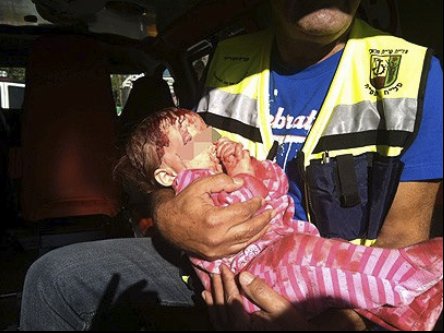
As I write this, it’s early in the Thursday morning, just past 3:30 a.m. If most of you have been keeping up on the events in Israel, you’re aware of the terrorist attacks from Gaza and the response of the IDF.

My wife and children are Jewish. I believe the Jewish people have a right to Israel and a deep connection to the Land. These events may signal not just another round of terrorism and response but a prelude to another war. I can’t know that, of course, but it’s not as if it hasn’t happened before. That’s enough to keep me up at night or to wake me up too early in the morning, but then a friend of mine’s daughter is currently serving with the IDF, so it’s feels personal as well.

But that’s not all I have on my mind.

you realize that israel is the aggressor, right? they’ve been shelling women & children forever… after stealing their land

the US may be the second most evil country on earth, but Israel has 1st place locked up by a few miles.

where do you come up with that? can you show me any evidence? You’re either brainwashed or willfully ignorant.

is that really what you believe? seriously? where do you get your intel? ZionistPress? get real! Israel is the aggressor.

-from my twitter feed

As you can see, I try to follow a variety of opinions on twitter, but as someone on Facebook (ironically) said just recently about twitter, “the noise to signal ratio dropped to nothing but noise.” I want to be fair and give other opinions consideration, but it’s not worth my health or peace of mind, is it?

What does this have to do with Toldot and the story of Esau and Jacob?

I couldn’t help but draw parallels between two warring brothers (and only one becomes the patriarch of the Children of Israel and the Jewish people) and the events in Israel right now. Two related people struggling over what they believe are their rights but with only one, in my opinion and my understanding of the Bible, having the superior claim on the inheritance of the Land promised to Abraham.

The story we read in Toldot ends with Jacob leaving his home for an uncertain future:

So Isaac sent for Jacob and blessed him. He instructed him, saying, “You shall not take a wife from among the Canaanite women. Up, go to Paddan-aram, to the house of Bethuel, your mother’s father, and take a wife there from among the daughters of Laban, your mother’s brother, May El Shaddai bless you, make you fertile and numerous, so that you become an assembly of peoples. May He grant the blessing of Abraham to you and your offspring, that you may possess the land where you are sojourning, which God assigned to Abraham.”

Then Isaac sent Jacob off, and he went to Paddan-aram, to Laban the son of Bethuel the Aramean, the brother of Rebekah, mother of Jacob and Esau.

Genesis 28:1-5 (JPS Tanakh)

The conclusion of Toldot is a little easier to take knowing what happens next and the ultimate outcome of the journeys of Jacob, but in a very real way, those journeys have not yet ended. The Jews have returned to the land of their inheritance but it is an uneasy return. They face strife from terrorism within their borders, the threat of war from outside, and the aggression of a world that does not believe that Israel has a right to exist, let alone defend itself from hostile people who use the weapons of rockets and public opinion to chip away at the Jewish land, taking the Land and the lives of the children of Jacob bit by bit.

It was decades before Jacob could return to Canaan and in the meantime, Esau was there, doing as he willed, and remaining a threat and a barrier to Jacob’s blessings in Israel. Jews believe that in the age of redemption, all Jews will live in Eretz Yisrael and motivate all mankind to seek God (see Inwardness: The Path to Posterity). But as the path for Jacob was not easy and required a great deal of suffering and searching, both in the material and the spiritual sense, so too is the future of Israel between now and the time of Messiah.

And the servants of Isaac dug in the valley, and they found a well of living water.

Genesis 26:19

If a person tells you “I have toiled but I have not found”—do not believe him.

-Talmud, Megillah 6b

Rabbi Sholom DovBer of Lubavitch was deep in thought, struggling with some elusive idea deep in the recesses of his mighty mind. A bowl of soup had been set before him some time earlier, but the Rebbe was in another world; sharp lines of concentration plowed his forehead, as he sat gazing into the bowl and slowly stirring the soup with his spoon.

The Rebbe’s servant, who figured that the Rebbe must be searching for the egg noodles, exclaimed: “Rebbe, dig in further! The lokshen lies deeper down.”

A wave of contentment passed over the Rebbe’s tensed features. “Thank you,” he said to his servant, “You have revived my soul…”

-Rabbi Yanki Tauber
“Digging for Noodles”
from Once Upon a Chassid
Chabad.org

Nothing is final. That Israel exists today is no assurance that it will continue as it is between now and the Messiah’s return. The people who govern Israel today are human. Israel is not yet perfected as a nation. As they are today, Israel is not immune from making mistakes out of their humanity. But that doesn’t mean that Israel and the Jewish people deserve annihilation as the Palestinian terrorists (and the Arab nations) and their supporters in the western nations declare.

I have faith that God will not let the Jewish people perish, but what is to happen in the Land of Israel now, I cannot know. Modern Israel has faced crisis after crisis in its young history. There were many times it looked as if it would be destroyed, only to be sustained by the miracles of God. Just as Jacob and his family ultimately returned and established themselves in Canaan, so too have the Jews returned to Israel. Just as Moses lead his people through the desert, there have been desperate struggles for the Jews. Just as Joshua lead Israel over the Jordan and into their Land, the Land promised to Abraham, and to Isaac, and to Jacob, so too will Messiah, son of David, lead his people to take final possession of their Land and into their promised rest.

But there is still much to do between now and then. The first task is to reassure and to fortify ourselves, to lift up and strengthen our faith. Israel is from God. It shall not be destroyed. God urges Joshua, as he takes command of Israel, to be “strong and courageous” four times in the first chapter of the book of Joshua. So too must the inhabitants of Israel today be strong and courageous. So too must we, the supporters of Israel and we who have faith in God’s promises…we must be strong and courageous, though Israel and everyone who loves her will be dragged through the mud and maligned for faith and trust and for obeying God.

Only God knows when the time of “living water” will come. We must be ready.

If you see what needs to be repaired and how to repair it,
then you have found a piece of the world that G-d has left for you to complete.

But if you only see what is wrong and how ugly it is,
then it is you yourself that needs repair.

-Rabbi Tzvi Freeman
“Perceptive Repair”
Based on letters and talks of the Rebbe
Rabbi M. M. Schneerson
Chabad.org

Blessings upon Israel and her people, the children of Abraham, and of Issac, and of Jacob.

If I forget you, O Jerusalem, let my right hand forget its skill. Let my tongue adhere to my palate, if I fail to elevate Jerusalem above my foremost joy.

Psalm 137:5-6 (Stone Edition Tanakh)

Continue to keep informed on the events in Israel at IsraelNationalNews.com.

Good Shabbos.

Chayei Sarah: Oil for the Lamp

“Now Avraham was zaken / old, well on in days, and Hashem had blessed Avraham bakol / with everything.”

Genesis 24:1

Why does our verse say that Avraham was “well on in days” rather than “well on in years”? R’ Yaakov Yosef Hakohen z”l (1710-1784; foremost disciple of the Ba’al Shem Tov z”l; known by chassidim as “the Toldos” after one of his works) explains:

The Gemara (Shabbat 153a) teaches: Rabbi Eliezer said, “Repent one day before you die. But, since no one knows when he will die, repent every day.” King Shlomo likewise said (Kohelet 9:8), “At all times, let your clothes be white.” Rabbi Yochanan ben Zakkai said: “This may be likened to a king who announced that he would hold a feast, but did not announce the time. The intelligent ones among his entourage dressed-up so as to be ready on a moment’s notice, while the fools did not prepare.” [Until here from the Gemara]

-Rabbi Shlomo Katz
“Beginnings and Endings”
Hamaayan, Volume 26, No. 5
Commentary for Torah Portion Chayei Sarah
Torah.org

“Then the kingdom of heaven will be like ten virgins who took their lamps and went to meet the bridegroom. Five of them were foolish, and five were wise. For when the foolish took their lamps, they took no oil with them, but the wise took flasks of oil with their lamps. As the bridegroom was delayed, they all became drowsy and slept. But at midnight there was a cry, ‘Here is the bridegroom! Come out to meet him.’ Then all those virgins rose and trimmed their lamps. And the foolish said to the wise, ‘Give us some of your oil, for our lamps are going out.’ But the wise answered, saying, ‘Since there will not be enough for us and for you, go rather to the dealers and buy for yourselves.’ And while they were going to buy, the bridegroom came, and those who were ready went in with him to the marriage feast, and the door was shut. Afterward the other virgins came also, saying, ‘Lord, lord, open to us.’ But he answered, ‘Truly, I say to you, I do not know you.’ Watch therefore, for you know neither the day nor the hour.

Matthew 25:1-13 (ESV)

Ben Zoma says: Who is wise? The one who learns from every person…

-Pirkei Avot 4:1

Who is wise? The motto for the Boy Scouts is “Be prepared,” so, given the lessons we see above, it would seem that we would be wise if we learned from the sages who provided those teachings. We can learn from every person, but it is better to learn from those who have something useful and edifying to say.

And yet, how often do we ignore wise teachings until it is too late? How often do you put off changing the batteries in the smoke detectors in your home? How often do you let the needle on your car’s gas gauge get down to “E” before looking for a gas station? And while it’s impossible to predict an earthquake, if you knew a hurricane was coming, how long would you wait before trying to leave for a safer location or stocking up on food and water for yourself, and batteries for your radio, and then shuttering your windows against the coming storm?

No, I’m not taking a cheap shot at the victims of hurricane Sandy, but rather, I’m saying something about we Christians. How often do we take “being saved” for granted, even when we know that a “storm” is coming? How often do we take our relationship with God for granted and think we know everything we need to know about Him?

I saw this yesterday on Facebook:

Going to be a very interesting year ahead. I started going to a Bible study with a friend of mine, yesterday was our first class and let me just say complete shock. They are studying B’RESHEET (Genesis) and in the new members class the leader was telling us how she has been a Christian for over 40 years, joined this Bible study 5 years ago and it was the first time she ever read the ‘Old Testament’. Many of the other women commented that they too had not read anything other than the Psalms and had no idea where this thought of ‘twelve’ tribes came from. How very ,very sad.

Isn’t that a little like waiting until the last minute before getting oil for your lamps, and then getting locked out of the “marriage feast?”

OK, a lot of Christians don’t really consider the Old Testament to be that important. A lot of churches bill themselves as “New Testament” churches and that’s pretty much all they feel they need. However, since all of Christ’s “source material” from Scripture was before the Gospel of Matthew, it might be wise to study what he must have studied (We sort of assume that Jesus just “knew” the Bible forward and backward, but as a child and young adult, no doubt like other Jews, he attended synagogue on Shabbos, heard the sacred texts being read, and studied as would be expected of a young Jewish lad from a humble family in the Galilee).

We do know that he knew a few things and learned a few things growing up.

After three days they found him in the temple, sitting among the teachers, listening to them and asking them questions. And all who heard him were amazed at his understanding and his answers. And when his parents saw him, they were astonished.

Luke 2:46-48 (ESV)

It is true that studying does not automatically assure that a person will grow wise, but lack of study will almost certainly result in a person being ignorant. Christianity and Judaism have one core document that provides us with a connection to those who established our faith and who can tell us the story of man and God: the Bible (“Bible” has different definitions depending on whether you’re Christian or Jewish).

But it’s not that simple.

To define sola scriptura without academic terminology might sound something like this: The Bible is the only authority in the believer’s life; it is never wrong about anything; it touches on every aspect of life; it needs no outside help to be correctly interpreted; it never disagrees with itself; it can be understood by anyone of average intelligence; and it applies to everyone in every situation.

-Jacob Fronczak
“The Five Solas: Sola Scriptura”
Messiah Journal, Issue 111 (pg 47)

That sounds good as far as it goes, but let’s see what else Pastor Fronczak has to say.

I only use the example of translations to illustrate the fact that in a very practical sense, the Scriptures in their original languages are, for most Christians, not enough – tools such as translations, concordances, the Masoretic vowel points, and commentaries are required in order to understand the text. Of course, the goal is to understand the original text, which in itself is not an objection to the doctrine of sola scriptura – until one realizes that every translation, every commentary, and even the textual tradition itself are all based on traditions along with the divine written revelation. It is simply impossible to get away from these traditions and study the Bible in isolation. (Fronczak, pg 52)

It seems that studying the scriptures to acquire wisdom is getting harder or at least more complicated all the time.

I’ll probably write another “meditation” sometime soon expanding on other points in Fronczak’s article, but essentially, he is saying that we cannot study the Bible in any useful manner without employing (hold on to your hats) the “traditions of the (Christian) elders.”

“The traditions of the elders” has received a lot of “bad press” in Christianity because of the perception that both ancient and modern Jews allow “the traditions of men” to have authority equal to or even greater than the Bible. The Christian response, particularly among Protestants, is to say, “let scripture interpret scripture,” which is the short definition of sola scriptura. That means, “no traditions are allowed,” just the Bible itself. However, Fronczak’s article makes it abundantly clear that the early church fathers employed a great deal of tradition in even canonizing the books of the New Testament, and Catholicism, even to this day, states that the Bible can only be understood through its traditions.

Imagine the shock of realizing that the same is true among all modern-day Protestant churches as well. We just don’t choose to say it in those words.

Remember that quote from Pirkei Avot about a person being wise if they learn from everyone?

And what about the commentary on Abraham and its apparent companion lesson about the ten virgins? How can we learn from everyone and how can we be prepared to learn what we need to learn in order to comprehend what the Master is teaching us, and thus draw closer to God?

You must unlearn what you have learned.

-Yoda (Frank Oz – voice)
The Empire Strikes Back (1980)

In some sense, learning what’s important and what takes us on the path toward wisdom means “unlearning” concepts and doctrines that we discover aren’t useful in our lives. That isn’t always easy when such information is directly attached to words like “sacred” and “holy” and “divine revelation.” It would be like a person who learned as a child that God was a giant, old man with a long white beard who sits on a huge golden throne on a cloud in the sky. Now imagine that child is Jewish and then he grows up and learns that according to Rambam’s thirteen principles of faith, God doesn’t even have a body and is not to be considered a corporeal being? If the fellow was still young enough, that might come as quite a jolt.

Now imagine being a woman of middle age who has been a Christian for forty years reading from the book of Genesis for the first time. Taking it a step further, imagine the same woman in a group of women studying the Old Testament, accessing the classic interpretations for Genesis to try to understand anything at all about who Abraham was, where he came from, why God made a covenant with him, and what that covenant means to both Jews and Christians today.

If we are to take the lesson from Avot at face value, then our class of women might want to “unlearn” a few things about the Old Testament and learn, not only from extra-Biblical Christian commentaries about Genesis, but from a few Jewish ones as well.

Certainly Jesus understood Abraham from a completely Jewish context and framework. If we want to understand Jesus, we must understand what he understood.

Do not seek to follow in the footsteps of the wise. Seek what they sought.

-Matsuo Basho

So we unlearn what is not useful to us and then start learning from a wide variety of sources, seeking to understand God (as best we can) and who we are in Him. How do we know when we’re “prepared enough?” Five of the ten virgins kept “flasks of oil” with them for their lamps so that when the bridegroom came, they were ready to light them, even if it was at midnight. How do we know when we’ve studied enough so that we have “flasks of oil” at hand?

Let’s look at it another way. Studying, learning, understanding, are all active processes. You can’t bottle the stuff and put it on a shelf for a rainy day. It’s like continually replenishing the oil in lamps that continually must be burning. This makes sense when compared to another parable of the Master about we Christians being the light of the world (see Matthew 5:14-16) and how our light must be placed where everyone can see it burning all the time.

Our “lamps” will never be filled to 100% capacity where we can then stop tending to them. We are prepared when we’re always preparing; when we’re always studying, and learning, and discussing, and pondering, and repenting, and praying, and…you get the idea.

In each journey of your life you must be where you are. You may only be passing through on your way to somewhere else seemingly more important—nevertheless, there is purpose in where you are right now.

-Rabbi Tzvi Freeman
“Be There”
Based on letters and talks of the Rebbe
Rabbi M. M. Schneerson
Chabad.org

Or in the words of my generation, “Wherever you go there you are.” We should all consider ourselves “a work on progress.” We’ll never be complete. We’ll never be “finished” or “done” or “perfect.” As long as we live, we must move forward. As long as we’re breathing, there’s someplace else to go, something else to learn, another person we need to meet.

And God will always be with us, as long as we continually seek him, and walk by the light of our lamp.

Good Shabbos.

Vayera: Miraculous

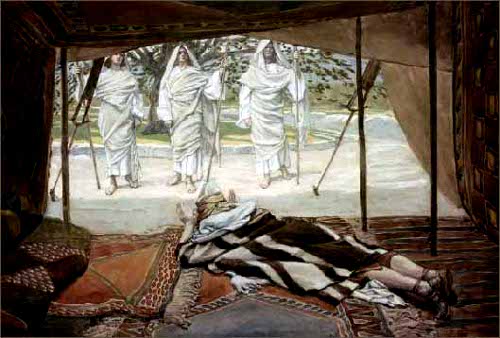
abrahams visitorsThe Lord appeared to him by the terebinths of Mamre; he was sitting at the entrance of the tent as the day grew hot.

Genesis 18:1 (JPS Tanakh)

When Rabbi Sholom DovBer of Lubavitch was a child of four or five, he entered into the room of his grandfather, Rabbi Menachem Mendel, and burst into tears. His teacher in cheder had taught the verse “And G-d revealed himself to Abraham…” “Why,” wept the child, “doesn’t G-d reveal Himself to me?!”

Rabbi Menachem Mendel replied: “When a Jew, a tzaddik, realizes at the age of 99 that he must circumcise himself, that he must continue to perfect himself, he is worthy that G-d should reveal Himself to him.”

-Rabbi Yanki Tauber
“The Tears of a Child”
Chabad.org

This is a well-known commentary on this week’s Torah Portion, Vayera and I’m hardly in a position to add to what a great many sages and spiritual luminaries have already stated regarding this portion of the Torah. But in studying the Torah Club commentary (volume 6) for this week on Acts 4:32-5:42, I discovered what could be a tangentially related issue.

Now many signs and wonders were regularly done among the people by the hands of the apostles. And they were all together in Solomon’s Portico. None of the rest dared join them, but the people held them in high esteem. And more than ever believers were added to the Lord, multitudes of both men and women, so that they even carried out the sick into the streets and laid them on cots and mats, that as Peter came by at least his shadow might fall on some of them. The people also gathered from the towns around Jerusalem, bringing the sick and those afflicted with unclean spirits, and they were all healed.

Acts 5:12-16 (ESV)

D. Thomas Lancaster’s lesson on these verses, both in the written text of his commentary and in the Torah Club audio teaching, speaks about “the age of miracles” and whether or not we have miracles today. As we read passages such as the one I quoted above, we Christians may be hard pressed to explain why 2,000 years ago, severely ill and disabled people could be cured simply by having Peter’s shadow fall across them, while today our most fervent prayers and petitions to God fail to prevent a loved one from dying of cancer. Why don’t we see miraculous signs, wonders, and healings in today’s church?

Some say that we do, but because we live in the 21st century, many events that a person 2,000 years ago would have called a miracle, today might be explained as some other phenomena. Even in the church, we are sometimes hesitant to say something is a miracle for fear of appearing foolish. On other occasions, the claims of miraculous events from some seem to be so common that the credibility of witnesses is brought into question.

While I do believe that sometimes miracles do happen today, they don’t seem to be “predictable,” which I guess stands to reason, but they also don’t seem to be predictably produced by an identifiable individual or group of individuals, such as the apostles. When we read about Peter, John, and the other apostles in the early chapters of Acts, it’s as if they’re doing miracles all the time.

One explanation, as Lancaster points out, is that the book of Acts compresses 35 years of history into about two hours worth of reading. It’s easy to get the impression that Peter was healing the sick through miracles every day and several times a day. This is probably untrue and only the “highlights” of the “Acts of the Apostles” were recorded by Luke. All of the other more mundane occurrences in their lives over three and a half decades went unchronicled and passed away into the shadows of history.

But there’s another reason we may not see miracles today the way we see them in Acts.

When the day of Pentecost arrived, they were all together in one place. And suddenly there came from heaven a sound like a mighty rushing wind, and it filled the entire house where they were sitting. And divided tongues as of fire appeared to them and rested on each one of them. And they were all filled with the Holy Spirit and began to speak in other tongues as the Spirit gave them utterance.

Acts 2:1-4 (ESV)

This is the day when the apostles of Christ (and only the apostles of Christ) received the Holy Spirit. Most Christians think this event is identical to what happens to all people everywhere when they receive Jesus Christ as Savior and Lord (although I’ve yet to hear a modern Christian tell me that they received the Spirit on tongues of fire). But what if this isn’t exactly true?

We know that in Acts 10:44-45 the Roman Centurion Cornelius and his entire household also received the Holy Spirit, but to the best of our knowledge, none of them went on, after the initial event, to perform miraculous healings, signs, and wonders. What’s the difference between Cornelius and Peter? Were the Jews the only ones with the Spirit able to perform miracles, or was something else going on?

It was declared at first by the Lord, and it was attested to us by those who heard, while God also bore witness by signs and wonders and various miracles and by gifts of the Holy Spirit distributed according to his will.

Hebrews 2:3-4 (ESV)

Take a closer look at this verse. According to Lancaster, “those who heard”, that is, those who were direct witnesses of the Messiah, were the apostles. Only the apostles were able to be witnesses of the validity of Jesus “by signs and wonders and various miracles and by gifts of the Holy Spirit distributed according to his (God’s) will.”

The idea, in this particular explanation, is that during the so-called “age of miracles,” God did not use everyone to perform miracles, and miracles did not occur for just any old reason at all. The miracles were a witness that occurred through those who actually walked and talked with the Master, that he is the Messiah, the Son of God.

The apostles could be compared to Abraham as we re-examine the brief Chasidic tale recorded by Rabbi Tauber above. They were “tzaddikim” (Righteous Ones) who were assigned by God to fulfill a specific mission and purpose; to witness to the Messiahship of Jesus of Nazareth. Their tools for doing so, in addition to what they taught, were signs and wonders.

I know this viewpoint could be questioned and disbelieved, but I think we should at least consider the possibility. It doesn’t mean that God doesn’t do miracles today, and it doesn’t mean that God doesn’t use “ordinary Christians” to perform said-miracles today. It does mean however, that God does miracles “according to His will” and not our will. It also may mean, as we see in Rabbi Tauber’s tale, that when someone, a tzaddik, realizes he must perform the equivalent of “circumcising himself at the age of 99 years, he is worthy that G-d should reveal Himself to him.”

It’s an imperfect theory and it certainly could be wrong, but we’re an imperfect people and God, and His reasons for doing anything, are perfect. Whether we understand the nature of miracles happening in the past as opposed to happening the present or not, we can certainly acknowledge that miracles seem to occur in the world from time to time, at the will of God and for His own purposes, but we must not depend on them. Should God choose to intervene in our lives with a miracle, it is good, but if He chooses not to, it is good as well.

We depend, not on miracles to sustain us or to be a witness to the Messiah, but on our faith and trust in God. These are the stones with which God builds the path we walk upon as we journey each day, as we follow Him, reaching out to touch the hem of his garment, flourishing in the glow of His holiness, and then reflecting that light into the world. Perhaps that is miracle enough, for the light of God is His healing of the world.

It is a Divine kindness that His mercies are endless.

Lamentations 3:22

Another way to translate this verse is, “It is a Divine kindness that we are never finished.”

The Maggid of Koznitz was extremely frail and sickly as a child. It was not thought that he would survive to adulthood. Much of his life was spent sick in bed, and he was so weak that he was often unable to sit up to meet visitors. Still, he lived to an advanced age.

The Maggid once revealed the secret of his longevity. “I never allowed myself to be without an assignment or a task to perform,” he said. “People are taken from this world only when their missions here are completed. Whenever I was just about to finish one task, I would start another; hence, I could not be removed from this world if my assignment was not completed.”

Even from a purely physiological aspect, the Maggid’s concept is valid. Some think that the healthiest thing for us is rest and relaxation. Not so. In reality, unused muscles tend to atrophy, while muscles that are exercised and stimulated are strengthened.

The same principle applies to the entire person. If we constantly stimulate ourselves to achieve new goals, we avoid the apathy that leads to atrophy.

Today I shall…

try to take on a new spiritual goal, and stimulate myself to greater achievement in serving God and being of help to other people.

-Rabbi Abraham J. Twerski
“Growing Each Day, Cheshvan 16”
Aish.com

I’ll be away from the computer for the day and won’t be available to respond to or approve comments. If I am unable to attend to them before Shabbat begins, then I will do so on Saturday after sundown.

Good Shabbos.

Lech Lecha: The Course of My Spiritual Travels

abrahams-servantIn the course of one’s spiritual travels, a person encounters situations which can only be overcome with a struggle, and which may even cause one to fall. Nevertheless, since all phases of life’s journey are guided by Divine Providence, we must realize that the purpose of every experience is positive. Even when we fall, we are being given an opportunity to borrow an expression from our Sages (Cf. Makkos 8a.) to descend in order to ascend.

Why must a person face such challenges? Two reasons are given:

a) To bring out the power of one’s soul. As long as a person remains untested, he can “get by” without having to tap his core. When, by contrast, one faces a fundamental challenge, it becomes necessary to call upon one’s spiritual resources in order to succeed.

b) In the process of overcoming a challenge, a person recognizes and thus elevates the sparks of G-dliness contained therein. For all existence is maintained by G-d’s creative energy; that energy is hidden within the world’s material substance. As a result of this “hiddeness,” challenges arise. By overcoming these challenges, a human reveals the true G-dly nature of existence.

Avraham’s spiritual journey contained such challenges. Shortly after he entered Eretz Yisrael, he was forced to descend to Egypt, described as “the nakedness of the land.” (Cf. Genesis 42:9, 12.) The very name of the land, mitzrayim, is related to the word meitzarim, meaning “boundaries” or “limitations.” (Torah Or, Va’eira, p. 57b ff.)

And yet even Avraham’s descent brought him blessing. He left Egypt “very rich in cattle, in silver, and gold.” (Genesis 13:2.) Moreover, this wealth came from spiritual effort; Avraham had elevated some of the sparks of G-dliness invested in that country.

-Rabbi Eli Touger
“A Journey To One’s True Self: Avraham’s Odyssey As A Lesson For His Descendants”
Commentary on Torah Portion Lech Lecha; Genesis 12:1-17:27
Chabad.org

Four mornings during the work week, I get up at 4 a.m. and by five, I’m picking up my son David at his place so we can go to the gym together and work out for 60 or 70 minutes before getting ready to commute to our jobs. Although that sounds like a really early hour to go through such exertion, we encourage each other and one of us always helps the other one to do the best we can. Some days are better than others, but we both know that only through hard work can we move toward our goals. David is suffering from a number of physical disabilities he incurred during his service in the Marines, and I’m just plain getting older. We both have our challenges to overcome, but thankfully we don’t have to go the course alone.

As Rabbi Touger’s commentary on this week’s Torah reading teaches, we also encounter a number of spiritual challenges in our lives, all of us. While working out physically is a choice (I could choose to be lazy, eat what I want, become ever larger, and damage the quality of my life as I continue to age), it really isn’t if I want to remain healthy and even to improve my physical condition as I get older. The same goes for spiritual growth.

But if you think getting up at four in the morning just so you can start sweating by five is no fun, imagine making yourself face, not just traditional Bible readings and devotionals, but challenges and conflicts both within yourself and your understanding of God, and outside of yourself in the world of religious dialog (to put it politely). Sometimes, I’d rather face any machine and any exercise I could possibly work with at my gym than spend five minutes wrangling with some “attitude” in the religious blogosphere.

As I mentioned though, those challenges don’t have to be externally driven. I’ve got enough internal challenges to last me for a good, long while. How exactly do the blessings in the Abrahamic covenant bind the Christian to God in covenant relationship? What effect does the New Covenant have on the Abrahamic for a Christian? Why does or doesn’t the Mosaic covenant factor into the line of other covenant blessings for the non-Jews in the church? Other people seem to think the Bible and what is says is a “slam-dunk” as far as what it all means. For me, it’s an endless adventure story wrapped in darkest mystery that has inspired me to the heights of ecstasy and driven me to miserable despair.

A person’s spiritual quest should not be a lonely journey. On the contrary, one of the hallmarks of personal development is an increasing capacity to inspire others. Avraham surely gained such an ability, as our Sages comment (Sotah 10a.) with regard to the verse, (Genesis 21:33.) “And he called in the name of the G-d of the universe”: “Do not read ויקרא (‘And he called’), read ויקריא (‘And he had others call’).”

This concept is also reflected in the changing of his name from Avram to Avraham. (Ibid. 17:5.) Rashi (In his commentary to that verse.) explains that Avram implies merely “father of Aram,” while Avraham alludes to the Hebrew words meaning “father of many nations.” The change implies that Avraham had been given the potential to inspire and influence all the nations of the world to begin striving toward spiritual goals.

“It is not good that..man should be alone.” (Genesis 2:18 ESV) Although Rabbi Touger suggests that the “not alone” part in Abraham’s case, was his ability to teach and to inspire others to call out to God, it implies (for most of us, I think) that we should seek out companionship, not just to inspire them, but so that they can inspire us, much like my son David and I inspire each other. Avraham Avinu was the father of many nations, not just the Hebrews, and according to Paul, this was through his seed.

Now the promises were made to Abraham and to his offspring. It does not say, “And to offsprings,” referring to many, but referring to one, “And to your offspring,” who is Christ.

Galatians 3:16 (ESV)

Paul explains that we Christians too can call Abraham our father because of our relationship with his seed, the Jewish Messiah, Jesus Christ. Jesus was never alone. He was always teaching. He was surrounded by his disciples. He was surrounded by multitudes of those who were desperate. He was the shepherd to the lost sheep of Israel. I can’t recall the source (and a quick Google search doesn’t reveal it), but I seem to remember a principle in some corners of Judaism saying that a teacher will learn as much from his students as they will from him. I don’t know if this could be applied to Jesus, but perhaps it can be to those who came after him.

As one who has taught (albeit in a rather small setting) before, I can certainly say it is true of me.

As you may know from my comments in my Days series, I have been inspired, or maybe challenged is the better word, to seek out a more traditional Christian fellowship venue. This is with the idea that I not only can learn and be supported by my fellow believers, but that I also have something of value to give back. What that is may be apparent to my blog audience, but it remains to be seen if a face-to-face group of Christians will agree.

There’s only so much encouragement I can give and receive via the web. At some point, like Abraham, I must leave, at God’s command, what is familiar and comfortable to proceed into the unknown. Abraham trusted God with everything he had, and it was accounted to him as righteousness. (Genesis 15:6, Romans 4:3) Abraham’s example teaches me that it is not good that I be alone and that risk is part of the “business” of faith and trust in God. Abraham took everything he had, his family, his entire household, and all his possessions, and followed God to a land he never knew.

What a person believes about himself and his abilities is a self-fulfilling prophecy. A person who does not consider himself “important” will not free himself from negative habits.

Believing you are inferior, untalented, unimportant or incapable, influences your abilities. If you view yourself as unable to do things, you will be unable to do them. On the other hand, if you see yourself as talented, capable, and important, your self-concept will open up powers and talents that would have otherwise remained dormant.

Hardly anyone utilizes his entire capabilities. We can accomplish much more than we realize. By raising the perception of your capabilities, you will accomplish more.

-Rabbi Zelig Pliskin
“Daily Lift #618”
Aish.com

A week from today, I begin the first step on a journey into a land that, while not entirely unknown, seems rather alien to me after so many years. One difference is that I don’t take with me everything I have. Certainly my family will not be accompanying me on the journey. Unlike Abraham, I walk alone, with only the promise that it will not always be this way.

Good Shabbos.

70 Days: The Lost Shabbat

Shabbat candlesWhen Lemech named his new son (at the end of last week’s reading, Gen. 5:29), he called the boy “Noach”, saying “this shall comfort us (yeNaCHameinu) from our work and the difficult labor of our hands.” But the name Noach was prophetic in a different vein, as the name also means to be at rest (“NaCH”). The Zohar, the fundamental work of the Kabbalah, of Jewish mysticism, says that “Noach” is thus a hint to the Sabbath, the day of rest. “Shabbos” is derived from the word “SHeVeS,” which also means to be at rest: “for in [the seventh day] He rested (“SHaVaS”) from all His work.” [Gen. 2:3]

In this week’s reading, Noach is commanded to make sure there is a light in the Ark, using the unusual word “Tzohar” (found nowhere else in the Bible) to indicate brightness like midday (“Tzaharayim”). The Avnei Azel writes that when we combine the numerical value of “Tzohar” with that of the Ark, “Tayvah,” the sum is the value of “Shabbos.” The Sabbath encapsulates both the Ark, the shelter from the flood, and the brightness within it.

We live throughout the week with work and other responsibilities, building up (and sometimes crashing down) around us. Shabbos is quite literally a shelter from the storm, and opportunity to withdraw from all the distractions and focus upon what is truly important. It is the busiest executives who, when they decide to fully observe the Sabbath, and stop using all electronic devices and not do business on that day, frequently remark that they don’t know how they survived without it.

Viewed correctly, the Sabbath isn’t about restrictions, but is the opportunity to focus upon the light within.

-Rabbi Yaakov Menken
“The Light Within”
Commentary on Torah Portion Noah
ProjectGenesis.org

I usually “get in trouble” when I post anything mentioning mysticism or Kabbalah, and I want to assure you that I tend to see mystic writings metaphorically, since I am nowhere near being any sort of “mystic” myself. But in reading Rabbi Menken’s commentary on last week’s Torah portion, I can’t help but once again be captured by the “magic” of the Shabbat. I don’t think it’s so much the mechanics of the seventh day, but the idea that God has provided the Jews with a way to wrap themselves inside a comforting blanket of sorts, that provides peace and a special closeness with God for one day a week. It’s as if the week is a cold, winter’s day with an icy wind blowing, freezing you to the marrow as you make your way about your tasks, and Shabbat is staying in bed late in the morning, toasty warm and pleasantly relaxed inside and under your comforter, while that self-same icy wind blows impotently outside.

I have been told more than once that the Shabbat is the sign of the Mosaic covenant with the Children of Israel and as such, is not “transferable” to the rest of the world, but of all the blessings that God provided the Jewish people, I must admit, I continue to “covet” only this one. I find it a particular disappointment that when Jesus made it possible, through certain blessings of the Abrahamic and New covenants, and through his broken body and blood, for we non-Jews to also enter into covenant relationship with God as his disciples, he didn’t make it possible for us to also enter into a weekly Shabbat as well.

More’s the pity.

But then again, early Christianity, when it threw off its Jewish mentors and guides like old rags and “reinvented” itself in the centuries after the destruction of the Temple by the Romans in Holy Jerusalem, set aside many of the “Jewish” aspects of its own Messianic worship, including meeting with other like-minded Gentiles and Jews in the synagogue to daven on Shabbos. We abandoned the potential for such a “rest” in both God the Father and in Christ. We did it to ourselves.

I say all of this because I’ve contacted a Pastor and set up an appointment to meet with him in a little less than two weeks to discuss my “situation.” As I’ve said in other Days blogs, I pretty much have to “fish or cut bait.” I can try to sit on the edge of a razor blade forever, or pick a side and jump off into whatever awaits me below. So I picked a side and jumped. Now, I’ll be in free fall for the next week and a half or so, and then I’ll arrive at ground level and make the first “bounce” in my landing. Believe me, I’ll make sure you hear it when I go “thump.”

But the closer I move toward Christianity and the church, the further I feel I am distancing myself from Judaism and, in some aspects, particularly from my Jewish wife. And as I said, of all the Jewish practices and values I have been exposed to, the Shabbat is the one closest to my heart. Even though the Shabbos candles are no longer lit in my home on Friday evening, I do not abandon it in my heart. But with my body and everything else, having chosen a “course correction” for myself which is designed to increase my trust in God, what am I leaving behind?

In describing the Shabbos, the verse in Bereshis (2:3) writes: “For on it [the seventh day] Hashem rested from all His work which He created לעשות —to do.” This final word in the verse…does not complete the thought of the verse the thought of the verse smoothly, and it seems to even be an extra word altogether.

A cursory observation of the world indicates that Hashem continues to sustain the world on Shabbos just as on every other day. Plants grow and creatures thrive on Shabbos, with the ongoing providence of Hashem overlooking every detail just as on the weekdays. In what manner, then, is the seventh day a day of rest for Hashem?

The Bnei Yisasschar explains that when the world was created, it was set into place with the potential it needed to continue, and for nature to take its course. Creatures were given the instincts necessary to procreate, and plants were placed into their environment for survival and in order to prosper. As the world continues to exist on Shabbos, it is within the realm of work that was put into place before Shabbos, and the work takes place on Shabbos automatically without further input.

The verse tells that Hashem created the world “to be done.” Hashem continually renews the world every moment. Yet, from the day of creation and onward, this supervision of Hashem is manifest in a manner as if the world is set and conducts itself naturally.

Daf Yomi Digest
Gemara Gem
“A World Set in Motion”
Commentary on Shabbos 17

I’ve sometimes wondered about Creation, the Seventh Day, and entropy, that property of all systems including the universe, to go from a more to a less organized state, very slowly running down like an old clock worked by a mainspring (if you’re old enough to remember such clocks and watches). When God “rested” and He built-in to His Creation the ability to continually move forward under its own “momentum,” so to speak, is what we see of the universe’s expansion, and the general long-term decay of systems (including human being “systems”) part of His “rest?”

Jewish philosophy sometimes states that God is continually renewing the universe and if He was to cease, even for the briefest of moments, existence itself would fly apart. But I seem to notice (and I believe the scientific world will agree with me here) that the universe is rather very slowly, ponderously, “flying apart” anyway. Sort of a disturbing counterpart to the “warm, comforting blanket Shabbat’s rest” I described above.

FallingApartBut if God’s rest isn’t a literal, one-to-one model of Shabbat between Creator and creation, then perhaps it is a twist on the metaphor that we should regularly rest in Him, or otherwise “fly apart” for lack of any rest in God at all. However, I understand that we can also consider the Shabbat as a hint or foretaste of the Messianic era to come, when all of our current concerns and labors will come to an end and we will all perpetually rest with Him.

The Jewish people are compared to the stars twinkling in the high heavens. By their light, even he who walks in the darkness of night shall not blunder.

Every Jew, man or woman, possesses enough moral and spiritual strength to influence friends and acquaintances, and bring them into the light.

“Today’s Day”
Wednesday, Cheshvan 5, 5704
Compiled by the Lubavitcher Rebbe
Translated by Yitschak Meir Kagan
Chabad.org

God gave a good many gifts to the Jewish people, not the least of which is the Shabbat. Although both Judaism and Christianity tend to agree that we non-Jews don’t enter into a weekly Shabbat’s rest (no Christian ever treats Sunday like an observant Jew treats the Shabbat, so no, Sunday is not the “Christian Shabbat”), it is much to our own regret that we fail to do so. For we have robbed ourselves of not only a weekly renewal in God, but of a preview of what life will be like when the Jewish King and Lord will take possession of his kingdom, and rule the world in true justice and in peace.

And yet today and in the weeks ahead, I find myself deliberately walking on a path that leads away from that peace. I hope this is me trusting in God rather than me just being foolish.