Category Archives: Torah Portion

Emor: Favorable Light

The Rambam writes: (Mishneh Torah, Hilchos De’os 5:1.) “Just as a wise man can be recognized through his wisdom and his character traits, for in these he stands apart from the rest of the people, so too, he should be recognized in his conduct.”

The Rambam’s intent is that the Jewish approach to knowledge must be more than theoretical. Instead, a person’s knowledge must shape his character, and more importantly, influence his behavior. This is what distinguishes him as wise.

Among the types of conduct mentioned by the Rambam as appropriate for a wise man is refined speech, as he continues: (Ibid.: 7) “A Torah scholar should not shout or shriek while speaking…. Instead, he should speak gently to all people…. He should judge all men in a favorable light, speaking his colleague’s praise, and never mentioning anything that is shameful to him.”

The wording employed by the Rambam “judging… in a favorable light” and “never mentioning anything that is shameful” imply that a Torah scholar may recognize faults within a colleague’s character. Even so, he will “speak his colleague’s praise.” When speaking to his colleague privately, he may patiently and gently rebuke him for his conduct. (See ibid., 6:7.) But when speaking to others and when viewing his colleague in his own mind he will think and speak favorably of him.

-Rabbi Eli Touger
“Inspiring Light”
from In the Garden of Torah
Commentary on Emor
Chabad.org

I doubt I could be classified as a “wise man” and certainly not a “Torah scholar,” but it seems as if the Rambam (Rabbi Mosheh Ben Maimon) is offering advice that should be attended to by any reasonable and prudent person. Unfortunately, the Rambam didn’t anticipate the Internet and blogging and I’m sure if he could have access to the web today and review some of the religious commentaries present (including mine), he’d be appalled.

Recently, my friend Gene Shlomovich posted a blog article called Crisis? A Jewish husband believes that Jesus is the Messiah but not G-d (oh, and if you decide to visit his blog and join the debate, please be polite and considerate). The basic issue is that a woman sent an email (I’m not sure if it was originally to Gene or not) saying that her Jewish husband has come to faith in Jesus as the Jewish Messiah, but he does not accept the traditional Christian teaching that Jesus is one part of the Godhead and is God himself in living flesh.

Naturally for a Christian woman, this is of some concern (and probably most Christians reading this will be equally upset). Here;s the question: is the Jewish man who believes Jesus is Messiah but not God “saved?”

Gene asks this question (which is by definition, emotionally charged within the community of believers) as dispassionately as possible, and his interactions with people responding to his question have been measured, calm, and thoughtful. Most people responding have been pretty reasonable too, given the nature of the conversation. It hasn’t been absolutely smooth sailing, though:

Commentor 1: Did you know that the ancient Jewish followers of Yeshua Did not believe that Yeshua was G-d in the flesh?

Commentor 2 in response to 1: The original followers of Yeshua, his disciples, bowed down and worshiped him. Matthew 14. Either that’s idolatry, or Yeshua is God.

There were later groups like the Ebionites who rejected Messiah’s divinity. They also rejected Paul’s writings, and some of the gospels. Your case is weak, and not a few who have taken that path have ended up as apostates.

Gene in response to Commentor 2: You don’t have to constantly, over and over, threaten people with a boogie man of apostasy just to make your point. Over its history, Christendom has excommunicated (or worse) countless followers of Yeshua and branded them as apostates over slightest doctrinal differences. That’s why we have over 43K Christian denominations today, many condemning each other to hell. Some, perhaps many of them, would no doubt consider your Gentiles-must-observe-Mosaic-Torah beliefs as some sort of neo-Galatian heresy and would consider you as a hell-bound grace-forfeited apostate.

OK, no one is being terribly rude, but as I was reading the above-quoted commentary on this week’s Torah portion, I was wondering what Rambam would think of the transaction (the tone, not necessarily the content). Can we judge each other in “a favorable light” and still disagree, particularly on important points of theology and doctrine? Gene says the failure to treat each other favorably within the body of the Messiah has resulted in that body being fractured into over 43,000 different denominations. That’s a lot of different pieces. Imagine taking a rock and throwing it as hard as you can at a large, beautiful, pristine pane of glass. Imagine what will be left over after the rock has done its job and you’ve gone scurrying off to elude the police.

Christianity is fractured and I stand with the myriad pieces scattered around my feet declaring a “Humpty Dumpty-esque” message about the impossibility of the church’s reconstruction.

Humpty Dumpty sat on a wall;
Humpty Dumpty had a great fall.
All the King’s horses
And all the King’s men
Couldn’t put Humpty together again!

And speaking of Kings:

I tell you, he will give justice to them speedily. Nevertheless, when the Son of Man comes, will he find faith on earth?” –Luke 18:8 (ESV)

Will the King be able to put our “humpty dumpty” church back together again? It’s assumed that he can and he will and after all, that’s his main job: to perform tikkun olam in a broken world and for a broken church.

To continue Rabbi Touger’s commentary:

The above concepts relate to our Torah reading, which is called Emor. Emor is a command, telling one to speak. In the context of the Torah reading, this command has an immediate application: to communicate laws pertaining to the priesthood. Nevertheless, the fact that this term is used as the name of the reading indicates a wider significance: A person must speak.

And yet, we find our Sages counseling: “Say little,” (Pirkei Avos 1:16.) and “I… did not find anything better for one’s person than silence,” (Ibid.: 17.) implying that excessive speech is not desirable. Nor can we say that the charge emor refers to the commandment to speak words of Torah, for there is an explicit command, (Deuteronomy 6:7.) “And you shall speak of them,” encouraging us to proliferate the Torah’s words. Instead, emor refers to speaking about a colleague’s virtues, as explained above.

If speaking little is the mark of a wise man and scholar, then the blogosphere is contains an immense lack of wisdom and knowledge. Yet, in the view of Rambam, when we speak, we are to speak words of Torah (Christians can mentally translate that into “the Bible”) and to illuminate the Word of God by telling it. We have two ways to use our tongues:

And the tongue is a fire, a world of unrighteousness. The tongue is set among our members, staining the whole body, setting on fire the entire course of life, and set on fire by hell. For every kind of beast and bird, of reptile and sea creature, can be tamed and has been tamed by mankind, but no human being can tame the tongue. It is a restless evil, full of deadly poison. With it we bless our Lord and Father, and with it we curse people who are made in the likeness of God. –James 3:6-9 (ESV)

Therefore encourage one another and build one another up, just as you are doing. We ask you, brothers, to respect those who labor among you and are over you in the Lord and admonish you, and to esteem them very highly in love because of their work. Be at peace among yourselves. And we urge you, brothers, admonish the idle, encourage the fainthearted, help the weak, be patient with them all. See that no one repays anyone evil for evil, but always seek to do good to one another and to everyone. –1 Thessalonians 5:11-15 (ESV)

The latter sounds a lot like the advice of Rambam for wise men and Torah scholars. It also sounds a lot like good advice for us. Yet we tend toward the former, more’s the pity.

Woman in fireI’m not saying we shouldn’t speak out when we disagree on important matters, but that when doing so, we should also “judge all men in a favorable light, speaking his colleague’s praise, and never mentioning anything that is shameful to him.” That’s a tall order for many religious people who feel they have a right to be confrontational, harsh, rude, and even condemning based on the outspokenness of Jesus and Paul in the Bible, as if any of us can approach the merit of Paul, let alone that of Jesus (perhaps another example of paying attention to one small piece of scripture to the exclusion of the rest of the Bible).

The tongue is fire and it is poison. We use it to bless God and to curse our neighbor and fellow believers. We are called to truth and to shun lies, but can we do so without “personalizing conflict?” I believe it’s possible, though not particularly common. But if we intend to obey the new commandment of the Master to love one another (John 13:34), then we have to start somewhere. This is particularly difficult for anyone who blogs because of the temptation to respond when someone is wrong on the Internet. Nevertheless, the purpose of studying the Word of God is not to “lord it over” those who we disagree with, but to encourage others and to share the blessings of God.

In the holy Zohar it is written that through the study of the secret wisdom, the final liberation will come with compassion. Not with judgment alone.

Now the wisdom is no longer secret. Sages and masters have found ways to make it accessible to all. Those who learn it and spread it, they are bringing divine compassion and redemption to the world.

-Rabbi Tzvi Freeman
“Unsecret Wisdom”
Based on letters and talks of the Rebbe
Rabbi M. M. Schneerson
Chabad.org

Good Shabbos.

Tazria-Metzora: Suffering at the Touch of God

Our Sages ask: “What is Mashiach’s name?” and reply “The leper of the House of Rebbi.” This is very difficult to understand. Mashiach will initiate the Redemption, and is associated with the pinnacle of life and vitality. How can his name be linked with leprosy (tzaraas), which is identified with death and exile?

This difficulty can be resolved based on the statements of Likkutei Torah, which explain that a person affected by tzaraas will be:

A man of great stature, of consummate perfection…. Although such a person’s conduct is desirable, and he has corrected everything,… it is still possible that on the flesh of his skin there will be lower levels on which evil has not been refined. This will result in physical signs on his flesh, in a way which transcends the natural order….

Since the filth on the periphery of his garments has not been refined, therefore [blemishes] appear on his skin…. Moreover, these blemishes reflect very high levels, as indicated by the fact that they are not considered impure until they have been designated as such by a priest.

The passage implies that there are sublime spiritual influences which, because of the lack of appropriate vessels (as evidenced by the “filth on the periphery”), can produce negative effects. For when powerful energy is released without being harnessed, it can cause injury. This is the reason for the tzaraas with which Mashiach is afflicted.

-Rabbi Eli Touger
“Mashiach’s Name”
Commentary on Torah Portion Metzora
Adapted from
Likkutei Sichos, Vol. VII, p. 100ff;
Vol. XXII, p. 77ff; Parshas Tazria, 5751;
Sefer HaSichos 5751, p. 491ff
Chabad.org

In Hebrew, leprosy is given the unlikely name nega – literally “a touch” – which means a leper is someone touched by God.

In light of this, when the names of Messiah are discussed in the tractate Sanhedrin of the Talmud, each school names Messiah after its own Rabbi. So for example, to the students of Yanai, Messiah will be called Yinnon (Psalm 72:17; the English says “shall continue”) and to the students of Shila, Messiah’s name is Shiloh (Genesis 49:10). In the same way, Messiah is called Leper after Rabbi Yehudah Hanasi, who either suffered greatly or was in fact a leper. To support their claim that the Messiah is called Chivra, the students of Rabbi Yehudah say, “His name is Chivera after the house of Rabbi, since it says, ‘We esteemed Him stricken, smitten by God, and afflicted'” (b.Sanhedrin 98b).

-Tsvi Sadan
from the chapter “Leper,” pp86-87
The Concealed Light

You find the Messiah in some pretty odd places and doing some pretty unusual things…such as suffering and even dying. But who is suffering and dying? Rabbi Touger’s commentary continues:

The Jewish people as a whole are compared to a human body. This applies within every generation, and also to the entire nation throughout history. All Jews those of the past, present, and future are part of a single organic whole.

This is to be compared to something I just read:

Jews have never found it easy to accept each other. Whether Ashkenaz or Sephard, religious or secular, liberal or conservative, Jews of all stripes have had a difficult time tolerating those with whom they differ. Of course, this isn’t unique to Jews. Human nature compels members of any group to focus on all the differences that exist between one another. Nevertheless, a Jew is a Jew – regardless of the additional descriptive words. Although it sounds oxymoronic, the Jewish people are not a monolithic group and yet we are one. Go figure.

-Asher
“We Are One”
Lev Echad

My friend Yahnatan on his blog Gathering Sparks pointed me (well, anyone who has read his blog post, actually) to a review of Daniel Boyarin’s book The Jewish Gospels written by New Testament scholar Joel Willitts. It says in part:

Now Boyarin’s chapter is quite dense, although accessible. His position is based on a view that Daniel 7 is “a house divided against itself” because it leaves a reader with contrary information: the Son of Man is both a second divine figure and a collective earthly figure, the faithful of Israel.

Setting aside any interpretation of the Deity of the Messiah in the Willitts blog post, we see that in this interpretation and in traditional Judaism, the Messiah and Israel are virtually interchangeable or perhaps inexorably intertwined. Messiah is Israel.

And Israel is touched by God and Israel suffers.

No, I’m not necessarily talking about the modern, geographical and national entity called the nation of Israel (though I suppose I could say a few words on that subject) but rather the historical, spiritual, mystical, people/group/nation of Israel who were forged at the foot of that fiery anvil we call Sinai, and who throughout the panorama of time, have continued to burn at the touch of God while awaiting the comfort and rescue of the Messiah (not unlike Shadrach, Meshach, and Abednego…see Daniel 3), may he come soon and in our day.

But what does that have to do with Christians?

Seen from the perspective of everything I’ve said so far, that’s a hard question to answer and one that is very uncomfortable for the church. I can see why supersessionism exists in the church and, within the Hebrew Roots movement, I can see why the non-Jews are desperate to lay claim to Torah “obligation” and “spiritual Judaism,” if only to be able to have a share in the Jewish King; the Son of Man, who is also Chivra; “touched by God.”

We want to be “touched by God” too, which is strange, since it means that we among the nations, the Gentile disciples of Jesus, must also suffer.

…and if children, then heirs – heirs of God and fellow heirs with Christ, provided we suffer with him in order that we may also be glorified with him. For I consider that the sufferings of this present time are not worth comparing with the glory that is to be revealed to us. –Romans 8:17-18 (ESV)

We Christians say we want to “be like Jesus” but do we really know what that means? In Hebrew Roots, the Gentiles say they want to be “one with Israel” and to share the obligations of Torah and God, but do we really know what that means?

We see from the tale in Matthew 20 that the mother of the sons of Zebedee asked that her two sons sit on the left hand and on the right of Jesus in his kingdom, but this was not an easy request to grant:

Then the mother of the sons of Zebedee came up to him with her sons, and kneeling before him she asked him for something. And he said to her, “What do you want?” She said to him, “Say that these two sons of mine are to sit, one at your right hand and one at your left, in your kingdom.” Jesus answered, “You do not know what you are asking. Are you able to drink the cup that I am to drink?” They said to him, “We are able.” He said to them, “You will drink my cup, but to sit at my right hand and at my left is not mine to grant, but it is for those for whom it has been prepared by my Father.” And when the ten heard it, they were indignant at the two brothers. But Jesus called them to him and said, “You know that the rulers of the Gentiles lord it over them, and their great ones exercise authority over them. It shall not be so among you. But whoever would be great among you must be your servant, and whoever would be first among you must be your slave, even as the Son of Man came not to be served but to serve, and to give his life as a ransom for many.” –Matthew 20:20-28 (ESV)

If you say you are ready to share in the Messiah, are you ready to share his burden, his suffering, his slavery? Are you ready to be “touched by God” as the leper?

As the old saying goes, “be careful what you ask for…you just may get it.”

Tsvi Sadan’s description of the Messiah as a leper in his book (pg 87) tells us what to expect when we, his disciples, share the cup of the Messiah:

“Leper Messiah” is found in Jewish legends such as the one in the above Talmudic passage. This legend describes an encounter of Rabbi Joshua ben Levi, a student of Shimon bar Yochai, with Messiah. On a quest to find out when Messiah would come, Rabbi Joshua ends up in Rome, where he sees one leper amongst the poor and the sick who is tying and untying his bandages (b.Sanhedrin 98a). Rabbi Joshua identifies this leper as Messiah and asks him when he will come. Messiah answers him with a single word “Today!” Waiting in vain till the day was over, Rabbi Joshua complains to his teacher that Messiah lied to him. Rabbi Shimon replies to his disappointed student: “[He will only come] today, if you will hear His voice” (Psalm 95:7).

In some sense, because he is Israel, the Messiah suffers because his people suffer. If we among the nations choose to be grafted in, while it doesn’t make us inheritors of Sinai, we must agree to drink from the cup of the Messiah and to suffer with him and to bear the burden of Israel’s suffering as well. This is why part of our duty as disciples is to support and uplift the Jewish people and to affirm the Jewish right to their national and Biblical homeland: Israel.

I find it ironic and all too human that when some among the Gentiles demand the “right” to be “obligated” to the Torah and to share in a Jewish lifestyle (but without making the actual commitment to be a Jew), they focus on the honor and glory and joy of Judaism; the lighting of candles on Shabbos, an aliyah to the bimah to read Torah, the wearing of tzitzit, and so forth. The stark reality is that anyone who chooses to be called by the name of Christ, whether you call yourself “Christian” or “Hebraic” or “Messianic,” is called to be a leper, to live among lepers, to tie and untie the bandages of the sick and dying…and to be sick and dying. The world didn’t esteem our Master, nor if we are really his disciples, will it esteem us.

Are you sure you are ready to drink from that cup?

Rabbi Shimon interprets the words of the Messiah to mean that he will come today only if the Jewish people are worthy and will “hear His voice.” In my arrogance, I’m going to suggest an alternate explanation (this is only my opinion so if you disagree, I’m the responsible party to complain to). I think the Messiah didn’t lie to Rabbi Joshua. I think the Messiah did come “today.” I think the Messiah has come yesterday and he will come today again and, God be willing, he will also come tomorrow. I think the Messiah comes every day that someone who is suffering and dying ties and unties the bandages of someone else who is suffering and dying.

Whenever we suffer for His sake and yet in our suffering, live among others who are hurt and sick and dying, and we minister to them, not thinking of ourselves, but serve them for their sake and God’s, then the Messiah has come, and he is coming right now, and he will come tomorrow…because he lives in us.

Yes, someday he will come with the clouds of heaven, in might and power, as one like the Son of Man (Daniel 7:13) and he will heal a broken world and his suffering people, but if we are who we say we are, we will not idly wait for him. We will drink his cup, take up our cross (Luke 9:23), and follow him. We will allow God to touch us and we will be like lepers. If we aren’t willing to suffer with him and with Israel, as Paul said in his letter to the Romans, then we also will not be glorified with him, and all of our words are in vain.

Good Shabbos.

Shemini: Ordinary Miracles

These concepts are reflected in this week’s Torah reading, Parshas Shemini. Shemini means “the eighth.” It refers to the first of Nissan, the day on which the Sanctuary was established. It is called “the eighth day” because it was preceded by seven days of dedication, during which Moshe erected and took down the Sanctuary each day, and taught Aharon and his sons the order of sacrificial worship…The Torah relates (Leviticus 10:1-2) that they brought an unauthorized incense offering and as a result, “Fire came forth from G-d and consumed them.”

Many explanations are offered as to why the brothers were punished by death. From a mystical perspective, it is said (Or HaChayim, commenting on Leviticus 16:1) that they died because their souls soared to such heights that they could no longer remain in their bodies. Nevertheless, their conduct is judged unfavorably because their spiritual quest ran contrary to G-d’s intent in creation: the establishment of a dwelling for Himself amidst the day-to-day realities of our existence. (See Midrash Tanchuma, Parshas Bechukosai) Their deaths show that our spiritual quest should not be directed towards the attainment of lofty rapture, but instead should remain firmly grounded in our actual lives.

This theme is also reflected in the conclusion of the Torah reading, which focuses on kosher food. For the establishment of a dietary code indicates that Judaism’s conception of Divine service involves living within the world.

-Rabbi Eli Touger
“Transcendence and Immanence”
In the Garden of Torah”
Adapted from
Likkutei Sichos, Vol. III, p. 973ff;
Vol. XVII, p. 92ff;
Sefer HaSichos 5749, p. 475ff
Commentary on Torah Portion Shemini
Chabad.org

All that walk on four… (11:21)

When Rabbi Shmuel of Lubavitch was a child of seven, he asked his father: Why does man walk upright, while animals walk on all fours? Rabbi Menachem Mendel replied: “This is a kindness from G-d to man: although man treads upon the material earth, he sees the sublime heaven. Not so those that crawl on four, who see only the mundane.”

-Rabbi Yanki Tauber
“The Rebbe’s New Clothes”
Once Upon a Chasid
Commentary on Torah Portion Shemini
Chabad.org

I suppose I’m being unfair when I accuse Christianity of focusing on the Heavenly at the expense of the here-and-now. After all, Christians perform many wonderful services of charity and kindness to those around them and to those in far-flung corners of the world. But as I recall my past when I used to sit in a pew in a church sanctuary on Sunday morning, it seems as if a great deal of time was spent touting the advantages of a “personal relationship with Jesus Christ” and that it’s all about “me and Jesus.” How many prayers have I heard offered up to the ceiling of the Sunday school classroom, asking for “a closer walk with thee” and thanking Jesus for the personal gift of grace and salvation?

There’s nothing wrong with any of that, of course, but now that our “ticket to Heaven” has been “punched,” so to speak, what are we supposed to do with the rest of our lives?

The commentaries I quoted from above may seem alien to most of you, but they do aptly illustrate the necessity of balancing the secular with the Divine. So many of the commandments given to the Israelites at Sinai were related to the world in which we live. There are commandments about food, commandments about clothing, commandments about marriage, commandments about farming, commandments about helping your neighbor, even if you don’t like him very much, commandments about…well, you get the idea.

Sure, there are also a lot of commandments about God, services of holiness, and acts of the Spirit, but there is an inseperable link between loving God and loving human beings (See Matthew 22:36-40). As far as I can tell, most or all of the commandments we see in the Torah that have to do with visiting the sick and feeding the hungry apply just as much to the Christian as they do to the Jew. That’s what I see in the Master’s teachings, anyway.

But many Christians still have this funny idea that we are only really serving God if we have some sort of formal “ministry” within the church, even as a lay teacher. Yet we see countless examples in the Bible of ordinary people who were devoted to God and who lived day-to-day lives that included acts of kindness and compassion to whomever they encountered who needed it.

Giving a jump start to the car of a guy who’s late for a job interview is just as holy as helping to build a new church on a mission trip to a foreign country. Where did we get the idea that we had to do something unusual and extraordinary; something way outside the normal boundries of our lives, in order to serve God and to obey the teachings of Jesus? As an “ordinary” person, you may be capable of committing more acts of holiness than even the greatest televangelist or Pastor of a “megachurch” you see on TV ( I suppose I’m employing more than a little tongue-in-cheek here).

And perhaps you are capable of even much greater miracles than these.

“Truly, truly, I say to you, whoever believes in me will also do the works that I do; and greater works than these will he do… –John 14:12 (ESV)

Miracles, by the way, don’t always have to be violations of the laws of physics. Sometimes, offering a momentary smile to a person who looks sad, or helping a lost person find the right address can be a miracle as great as moving a mountain.

Reading the Bible, praying, meditating on the acts of God, and worshiping with your fellows are all absolutely necessary acts of holiness and they bring much joy to God and to your own heart. But they are no more or less vital than helping change a flat tire for someone, donating a can of soup to your local food bank, or spending time with a neighbor who is in the hospital after surgery.

Today (as I write this), I’m going to take my son to work, deliver a Bible and some other books to a Chaplin who is going to deliver them to a sick and elderly Jewish gentleman who has just discovered the Messiah in Yeshua, and spend some time over coffee studying the Word of God with a friend. I don’t say these things because I think it makes me a better or special person. I say them because I’m an ordinary person doing ordinary things. But the ordinary and the holy are all intermixed in everything we do. We have our feet on the ground, but our eyes turned to Heaven.

And of all the ordinary things you and I are going to do today, who knows which one of them is a miracle?

Whatever we “offer” to God and to human beings, let it be who we are and not some “strange fire” we think we need to burn with in our hearts. God made us perfect as the people we are meant to be.

Good Shabbos.

Tzav: Burning in the Dark

The fire upon the altar shall be kept burning upon it, it shall never go out. Each morning, the kohen shall burn wood upon it.

Leviticus 6:5

Although a supernal fire from heaven always burned upon the altar, nevertheless, it was imperative that an additional fire be provided by man.

Talmud, Eruvin 63a

The Ramban states (Commentary on Vayikra 1:9.) that the offering of an animal upon the altar was able to achieve atonement for a sinner because the person realizes that everything transpiring with the animal should have been happening with him, were it not that G-d in His kindness permitted the substitution.

It is thus understandable that all aspects of an offering, including the burning of fat and limbs, find corollaries in terms of man’s spiritual service.

How does “burning the fat” apply to our spiritual lives?

Fat is indicative of pleasure. (See Gittin 56b.) The lesson here is: “All fat is to be offered to G-d” (Vayikra 3:16.) – all of a Jew’s pleasure and satisfaction should be offered to G-d.

Commentary on Torah Portion Tzav
from the The Chasidic Dimension series
Chabad.org

There’s a sort of “communication” that happens in substitutionary sacrifice. In saying that the body, the sinews, the flesh, and the fat of this animal is burning in your place because of your sins, God was showing the Jewish people the dire consequences of their sins. Extending that to we who are Christians, by showing us a picture of a Christ crucified and “abandoned” (Matthew 27:46) by God, He lets us see the ultimate consequences of our own sins. By continuing to show us that horrible image after we have come to faith and trust in God through the Messiah, we can see that any wrongdoing we commit as a “saved” person is throwing pain, suffering, blood, and death right back in the face of the Master.

If God so loved the world and the world continues to sin, what does His love mean to us anyway?

To be fair (if fairness comes into the equation), human beings are very frail and easily distracted. As I mentioned in yesterday’s morning meditation, we are all in search of a language and a method by which we can reconcile the spiritual and the “animal” within each of us. We strive to reach heaven while wallowing in the mud. “The spirit indeed is willing, but the flesh is weak.” (Matthew 26:41) We will never be “perfect people” this side of paradise and so our “fruits” will never be perfect either. I think it’s the struggle toward holiness that defines us just as much as the result.

…it is possible to explain the analogies of day and night on a deeper plane, enabling us to understand why offering the fats during the day is a positive mitzvah, while offering them at night serves merely to preclude sin.

In addition to the interpretation mentioned above, day and night can be seen as analogies for a person’s spiritual state. Day refers to a time when one feels the G-dly light in his soul. This applies not only when he is involved in the observance of Torah and mitzvos, G-d’s will and His wisdom, (Tanya , ch. 4.) but also when involved in material activities. Even in the worldly sphere, he serves G-d, following the dictum: (Mishlei 3:6.) “Know Him in all your ways.” To cite an example, when tzaddikim partake of food, their eating serves a higher purpose than humanity’s ordinary efforts at refinement; “A tzaddik eats for the satisfaction of his soul.” (Mishlei 13:25.)

Night, by contrast, refers to a condition in which a person does not feel G-dliness. Therefore his need to engage in material things generates a constant struggle to serve G-d rather than indulge his desires. Moreover, even when he is involved in studying Torah and observing its mitzvos, he must labor to remain properly motivated. For the law is enclothed in mortal intellect, and the mitzvos involve material entities and the potentials of our animal soul. And so it is necessary to strive that one study lishmah, only for the sake of the Torah. Similarly, our observance of the mitzvos must be for G-d’s sake, and not for our own.

-Rabbi Eli Touger
Lekutei Sichot: Tzav
“Day and Night in Our Divine Service”
Adapted from Sichos Yud-Tes Kislev, 5711
Chabad.org

I think a lot of folks qualify as “night people” by the above interpretation and, sad to say, that includes me. I admire people who can “Know Him in all your ways,” but that behavior eludes me. I think it requires that I somehow repair the disconnect between the spiritual and the secular within me. I say that with the awareness that to “repair” something means it must have worked properly at some point in the past. However, in my case, maybe I never made the connection in the first place. Maybe I have never “known Him in all my ways.”

In that case, are all of my efforts in attempting to “know Him,” while constantly walking into walls in the material world, in vain? Maybe I am the one who is burning on the fire and I just haven’t let myself smell the aroma of my own incineration yet. Maybe like Peter and the two sons of Zebedee at Gethsemane, I’m also asleep at the switch, present in the garden because of my spirit but completely unconscious because of my “flesh.” In “practicing stillness,” I have “stilled” myself into a spiritual nap, and in my nightmares, I can’t escape the maze of my so-called day-to-day existence.

On today’s daf we find that, for certain sacrifices, one who is poor can use a bird instead of an animal. The birds permitted for use are either a pigeon or a dove.

In Bava Kama, Rabbi Avahu learns a lesson from this. “One should be among those whom others pursue rather than among those who pursue others. We learn this from the birds used when bringing a sacrifice: pigeons or doves. There are no birds which are more pursued than these.”

Ramban, zt”l, explains why specifically these birds are used. “There are no birds more readily available than pigeons or doves. As our sages say regarding the animals used for sacrifices, he brings a sheep or a goat since no other animals are more readily available. This is so that a person should not have to hunt to bring a sacrifice. God wanted us to use big pigeons since they never take another mate. Similarly, Yisrael is God’s nation and will never leave Him for anything. Doves will take new mates however. That is why we find that only small yonim are qualified to be used as a sacrifice.

“Our sages tell us that if a person takes eggs or chicks out of the nest, most birds will never take them back. The yonah is an exception to this rule—it will never abandon its eggs or offspring. This symbolizes, that we will never leave God no matter what duress we may have to endure. As the Midrash writes, Jews would say, ‘Either let me live as a Jew, or crucify me!'”

Daf Yomi Digest
Stories Off the Daf
“The Doves”
Kereisos 10-1

According to the Daf, a Jew must be allowed to live as a Jew in every detail of day-to-day existence because it is that lifestyle that expresses his worship of and devotion to God. When the church has historically demanded (and forced) Jews to abandon their Judaism in order to “be saved” and to worship the Jewish Messiah (though the church did not depict him as such in that bygone era), they were asking the impossible. They were asking a Jew to abandon God for the sake of worshiping the Christian Jesus. As the Daf concludes, “As the Midrash writes, Jews would say, ‘Either let me live as a Jew, or crucify me!'”

It’s that level of devotion in the face of human tribulation that escapes me. The ability to rise above adversity, the arguments about religion, politics, and what it means to be good or bad, given the various biases in the world is (as I see it) impossible for me to achieve. Where is the “one small still voice” and the “peace beyond all understanding” in a world of controversy surrounding whether the Jewish murder victims in Toulouse are more or less worthy of compassion than shooting victim Trayvon Martin in Florida? Why does the world insist that I choose and why should I care what the world insists upon? Why can’t I see beyond the arguments of the moment and extend my perspective to the world as God sees it? Does God not care equally for all of the hurt, and the fearful, and the dying?

No man is an island entire of itself; every man
is a piece of the continent, a part of the main;
if a clod be washed away by the sea, Europe
is the less, as well as if a promontory were, as
well as a manor of thy friends or of thine
own were; any man’s death diminishes me,
because I am involved in mankind.
And therefore never send to know for whom
the bell tolls; it tolls for thee.

-John Donne
No Man Is An Island

This is a very old poem, and yet it presents the modern day humanity with a perfect image of how we should feel about one another. The Master said that the two greatest commandments (Matthew 22:36-40) were to love God and to love our neighbor, and he forever, inexorably linked the two mitzvot. If we love God, we must love each other, but that requires that we step outside of ourselves, our petty squabbles, our biases, our wants, our needs, and our humanity. To love God requires a mystical connection to the supernatural, ephemeral essence of God, the Ayn Sof, the Infinite, the Unique One. The Jewish Messiah provides the conduit we non-Jews require to make that happen, but it’s hardly automatic.

I sometimes wonder if these “day people” are truly real or even possible, and it’s only a matter of some people being better able to hide their “night” persona better than others? Yesterday, while sitting at the bottom of the abyss, I optimistically reached out for the first rung in my metaphorical “Jacob’s ladder” of prayer and dared to imagine I could climb up and achieve a “light at the end of the tunnel” experience with God.

Today, it seems like my reach has greatly exceeded my grasp and nothing but wishful thinking and presumptuous arrogance allowed me to imagine I could go that far. But restructuring probably isn’t an event that can be achieved in a moment of brilliance. It’s rather a process that occurs as slowly as the movement of the constellations against the velvet dark sky.

So here I am, a night person in the dark, sitting with my Bible and my humanity, wrestling with that other part of me created in God’s image. They don’t like talking to each other, and although perfectly aware of each other’s presence, they can barely see or even stand each other. So I try to light a candle to give off even a tiny modicum of light in the hopes that humanity and divinity can come to some sort of accord, but is that light the illumination of my inner holiness, or is it just my flesh burning on the pyre?

By our nature, we are aflame. We burn with anxiety, the angst of survival in a hostile world.

To channel this fire, there is meditation and prayer. With these, we fan a fire of love for that which transcends this world. One fire swallows another and we are set free.

Liberated from fear, we face the world no longer as slaves, but as masters.

-Rabbi Tzvi Freeman
“Fire Burning Fire”
Based on letters and talks of the Rebbe
Rabbi M. M. Schneerson
Chabad.org

Good Shabbos.


Vayikra: Voluntary Offering

The Torah portion Vayikra discusses various types of korbanos, sacrificial offerings, first relating the laws of voluntary offerings and then of obligatory offerings. Why does the Torah begin with free-will offerings; one would think that we should first be made aware of the laws regarding the korbanos that must be brought, and only then learn about the details of the voluntary offerings. The answer is that, by doing so, it indicates that the most crucial aspect of all offerings is that they be offered from a genuine desire to come closer to G-d – “his heart’s intent is for the sake of Heaven.”

It can thus be said that all korbanos are to be considered free-will offerings, for at the crux of all offerings are the feelings of the individual bringing them.

In fact, the intention required is found within each and every Jew, but when an individual brings a free-will offering, these latent desires are revealed for all to see.

Thus, it is not necessary for the Torah to command this intent, for it is found in any case; bringing the offering will automatically reveal the Jew’s innate intention of drawing close to G-d.

-from “Korbanos and the Heart’s Intent”
Commentary on Torah Portion Vayikra
Based on Likkutei Sichos, Vol. XVII, pp. 9-13
and the teachings of the Lubavitcher Rebbe
Rabbi Menachem M. Schneerson
Chabad.org

In Christianity, we have a tendency to view Jewish religious behavior as obligatory, works-driven acts; almost a kind of “slavery” to God. By comparison, the Christian believes that grace makes us as free as a bird in flight to enjoy the peace and understanding of a loving and forgiving God. What we do in response to the grace of God and the crucifixion of Jesus Christ is based (ideally) on sheer gratitude for all God has done for us. There are few, if any, obligations incumbent on the Christian, or at least that’s how it sounds when most Pastors deliver their message from the pulpit on Sunday.

But here we see a different side of Judaism, one that we’re not always aware of. We see that a Jew is encouraged to embrace the motivation of voluntarily drawing closer to God. It’s not a slave approaching a Master with bloody sacrifices on a hot, burning, and ash-filled altar, but a person who actually wants to approach, as a lover with a gift, desiring to enter into the presence of her paramour.

Today’s daf continues to discuss the halachos of various issurei kareis.

The evil inclination will drive a person insane if given half a chance. First it entices a person to sin. Then it riddles him with thoughts of guilt and gloomy thoughts of what will be the result of his sinful activities.

Rav Yitzchak Sher, zt”l, explained why the yetzer hara won’t even allow a person to enjoy having sinned. “The yetzer wants to kill us, as our sages teach. He therefore pushes one to sin and urges God to punish the hapless fellow. Even if he cannot kill us, he wants us to suffer. He is in essence saying, ‘You sinned, now give up all the pleasure too.’”

One of the strongest arguments the yetzer has is when a person transgresses issurei kareis, chas v’shalom. The evil inclination immediately begins harping on this stain, insisting that teshuvah doesn’t help—in direct contradiction of the Gemara itself. Yet even one who learned that kareis can be rectified cannot help being daunted by the need for Yom Kippur and yesurin to clean away such guilt. Although the Meiri there adds that a complete teshuvah also atones alone, who can say he has done a complete teshuvah?

The Chofetz Chaim, zt”l, brings that the Yesod V’Shoresh Ha’avodah, zt”l, teaches how to wipe away even the kareissins. “It is brought from the Arizal that one who did a sin punishable by kareis should stay awake the entire night and learn Torah, especially those segments where the sin he transgressed is discussed.”

The Yesod V’Shoresh Ha’avodah adds, “This practice is most frequently followed during the nights of Aseres Yemei Teshuvah. The custom is for people to stay on their feet and learn Meseches Kareisos the entire night.”

The Chofetz Chaim adds that one who learns Meseches Kareisos well attains added holiness and purity. Learning this tractate is a segulah to rectify transgressions.

Daf Yomi Digest
Stories Off the Daf
“Repairing the Damage”
Kereisos 3

That doesn’t sound very voluntary, but when we have distanced ourselves from God, it’s pretty tough to actually want to face Him again, particularly after we’ve sinned and let Him down. Guilt makes things a mess and we’ll put ourselves through all kinds of pain and sorrow as a result.

But God does not want sin to make His people distant and desires that His chosen ones draw close, even after periods of separation.

The unique love which G-d shows the Jewish people is reflected in the beginning of our Torah reading, which states: “And He called to Moshe, and G-d spoke to him.” Before G-d spoke to Moshe, He called to him, showing him a unique measure of endearment. G-d did not call Moshe to impart information; on the contrary, He called him to express the fundamental love He shares with our people. (For although it was Moshe alone who was called, this call was addressed to him as the leader of our people as a whole.)

The inner G-dly nature which we possess constantly “calls” to us, seeking to express itself. This is reflected by the subject of the Torah reading, the sacrificial offerings. The Hebrew word for sacrifice, korban, shares a root with the word kerov, meaning “close.” Sacrifices bring the Jews’ spiritual potential to the surface, carrying our people and each individual closer to G-d.

-Rabbi Eli Touger
from “The Dearness of Every Jew”
Commentary on Torah Portion Vayikra
Adapted from
Likkutei Sichos, Vol. VII, pgs. 24-26;
Vol. XVII, pgs. 12-15;
Sefer HaSichos 5750, Vol. I, p. 327ff
Chabad.org

But how does this speak to the Christian? Actually, it speaks to us especially so that me might understand how passionately God does not want His chosen ones, the Jewish people, to be distant from Him…ever. How can the joining of the nations to the God of Israel ever diminish, or God forbid, destroy the loving union between the Jews and God? How can we ever dare believe such as thing?

But if God is so close to the Jew, where does that leave the Gentile?

“For God so loved the world, that he gave his only Son, that whoever believes in him should not perish but have eternal life. –John 3:16 (ESV)

And Jesus came and said to them, “All authority in heaven and on earth has been given to me. Go therefore and make disciples of all nations, baptizing them in the name of the Father and of the Son and of the Holy Spirit, teaching them to observe all that I have commanded you. And behold, I am with you always, to the end of the age.” –Matthew 28:18-20 (ESV)

Therefore remember that at one time you Gentiles in the flesh, called “the uncircumcision” by what is called the circumcision, which is made in the flesh by hands – remember that you were at that time separated from Christ, alienated from the commonwealth of Israel and strangers to the covenants of promise, having no hope and without God in the world. But now in Christ Jesus you who once were far off have been brought near by the blood of Christ. –Ephesians 2:11-13 (ESV)

God’s grace and mercy are not limited to the Jewish people, although the Jews have been and always shall be a special people unto the Creator. God grants His grace to the nations of the world as well, but here’s the catch. We must volunteer to draw near to Him. We are not compelled to do so, nor are we born into His grace.

To one degree or another, if you are born Jewish, even though God desires the Jewish person to draw near of his or her own free will, there is an attachment of the Jew to all other Jews and to the Torah that can never be disconnected. You belong, quite frankly, whether you want to or not. This is not true for the rest of us. Although each of us was created in God’s own image, we either choose to draw near to Him or we choose to be distant. Even the atheist, who believes it is more rational to disbelieve in the existence of God, is still making a choice, since knowledge of God is abundant in the world around us.

But God desires us. He desires that we all draw near to Him and that none should be lost or perish (2 Peter 3:9). But we must desire Him. How can this be done, since all human beings desire only their own wants and needs without hardly a thought of God? It would take a miracle. Rabbi Touger’s commentary continues.

The G-dly potential within every Jew and within our people as a whole will not remain dormant. Its blossoming will lead to an age when the G-dliness latent in the world at large will become manifest, the Era of the Redemption. At that time, the Jewish people will “relate [G-d’s] praise” in a complete manner, showing our gratitude for the miracles performed on our behalf.

Herein we see a connection to the month of Nissan, during which Parshas Vayikra usually falls. Our Sages associate Nissan with miracles. Further, Nissan is the month in which the Jews were redeemed, and the month in which we will be redeemed in the future. At that time, our entire nation will proceed to our Holy Land and “relate [G-d’s] praise” in the Beis HaMikdash. May this take place in the immediate future.

The Rabbi’s words echo those of the Apostle Paul who also said that “all Israel will be saved” (Romans 11:26). We also see how the rest of us are included in God’s grace, as Rabbi Touger says that the “blossoming” of Jewish holiness, “will lead to an age when the G-dliness latent in the world at large will become manifest, the Era of the Redemption.”

This is the era of the Messiah’s return.

The Christian world is looking forward to a reminder of the return of Jesus in its celebration of his resurrection on Easter Sunday, which is on April 8th this year. For the Jew, the special time of redemption is when the Jewish people were redeemed from slavery by God, during the Passover season, which begins at sundown on Thursday, April 5th. I personally relate more to the Passover season for reasons too numerous to mention here, but regardless of which time you hold dear in your heart, realize that we are called, not to be chained to God, but to fervently desire to be near to Him, to draw close, to love His Word and His Presence in our lives.

To want to be near God, we must believe we are safe when we are with Him. We must do more than hope in Him, we must trust in God, something that is not always easy for me. I suppose this is a major reason why our relationship isn’t what it should be. I suppose it’s why God drops little reminders into my calendar; little invitations to draw near to Him. He does so every week on Shabbat. He does so every day for morning and evening prayers. He does so many times a year and, after all, as I just mentioned, Passover is drawing near. These are times when God asks me to set aside my doubts and fears, to trust Him, to believe in miracles, and to approach.

Trust transcends hope, as the sky above transcends the earth below.

The heart that clings to a thread of hope is anchored to its earthly bounds. It desires to receive, but its capacity is tightly defined. The thread snaps and your eyes look up to see nothing more than the open sky. Hope is gone. All you can do now is trust the One who has no bounds.

That is Trust: When you stop suggesting to your Maker what He should do. When you are prepared to be surprised and open to wonders and miracles.

-Rabbi Tzvi Freeman
“Trust over Hope”
Based on letters and talks of the Rebbe
Rabbi M. M. Schneerson
Chabad.org

Good Shabbos.
Building and Rebuilding the Tabernacle

Ever watch a child learning to walk? While strolling along confidently, albeit a bit wobbly, he’ll suddenly drop to the floor. With admirable persistence, he’ll usually pick himself right back up on his feet and continue on as if nothing had happened.

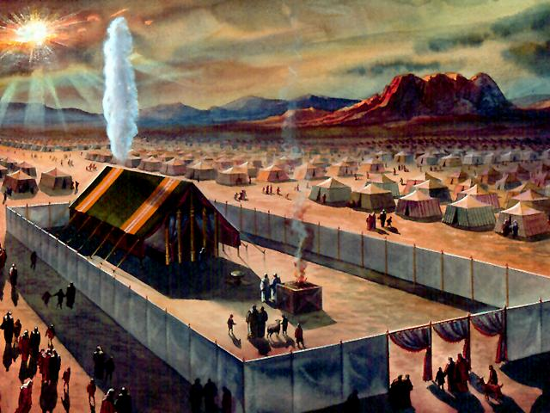
The Midrash (Tanchuma 11) says that throughout the seven inaugural days of the Holy Tabernacle, the portable dwelling place built for G-d’s Holy Presence, Moses would construct and disassemble it two or three times each day. The Tabernacle, of course, was a large and extremely heavy structure. Many of its parts were solid wood and gold, and it was tens of feet high. To build and dismantle the entire structure 14 times, or more, in one week must have been incredibly taxing to Moses! Why didn’t he just assemble it the first day, and then leave it standing until the next time G-d instructed the nation to travel?

There was a deeper meaning, however, to the construction of the Tabernacle, corresponding to the efforts of a person committed to spiritual growth. That person drafts a model of holiness, an ideal setting for rising above material and selfish pursuits, insuring the appropriate goals and safeguards are set. As he takes his first few steps of growth, he feels a sense of pride and serenity, assuring himself that he’s on the proper course. But soon, it all crumbles. The habits of the past return, and his best-laid plans for the future appear unattainable.

The continuous building and dismantling of the Tabernacle throughout the inauguration tells us that holy structures are designed to be built and rebuilt before they are completed. The nature of spiritual growth is to move forward and fall back, repeatedly, akin to the toddler’s efforts to walk. Although a toddler first falls immediately, after just a few steps, his strength, balance, and ability improve exponentially. Don’t be afraid when experiencing setbacks on the road to spiritual growth, because we are promised that the results will come — if we get right back up and keep trying!

-Rabbi Mordechai Dixler
Program Director, Project Genesis – Torah.org
“Pick Yourself Up, Brush Yourself Off”
Commentary on Torah Portion VayakhelPekudei
Based on Nesivos Shalom, Pikudei, 279
ProjectGenesis.org

In keeping with my previous blog posts based on Rabbi Tzvi Freeman’s A Multimedia Guide to Jewish Prayer series, I read the next installment in sequence, Climbing Jacob’s Ladder prior to writing this “morning meditation”. Unfortunately, the “Jacob’s Ladder” piece just didn’t inspire me as I had hoped. However, Rabbi Dixler’s commentary did.

Here I am, still sitting at the bottom of the dark, dusty abyss, looking at the ladder that has been placed before me by God, as an invitation to a dance, so to speak. As Rabbi Freeman commented in his Jacob’s Ladder article, What was that ladder? According to the Zohar, it’s the ladder of prayer. That’s what I thought when I wrote another of my morning mediations as well. But then how do I climb?

That reminds me of an old joke:

A tourist from an Iowa farm decides to visit New York City. He’s having fun seeing the sights, visiting the Statue of Liberty, stopping off at Times Square and such, but he’s bought a ticket for a Broadway play and it starts in an hour. Trouble is, he doesn’t know how to find where the play is going to be performed.

He stops a person who appears to be a local and asks, “How do I get to Broadway.”

The gruff New Yorker replies, “Practice.”

How do you climb the ladder of prayer? The answer is the same. Practice.

I know I’ve said something like this before but it can use repeating, which is also part of practicing.

Look at Rabbi Dixler’s story again. In a way, Moses needed the “practice” in putting up and taking down “holiness.” Chances are, the story isn’t literally true, but it is a metaphor that communicates something important to me. In fact, here’s the part that especially speaks to me.

There was a deeper meaning, however, to the construction of the Tabernacle, corresponding to the efforts of a person committed to spiritual growth. That person drafts a model of holiness, an ideal setting for rising above material and selfish pursuits, insuring the appropriate goals and safeguards are set. As he takes his first few steps of growth, he feels a sense of pride and serenity, assuring himself that he’s on the proper course. But soon, it all crumbles. The habits of the past return, and his best-laid plans for the future appear unattainable.

I have better days and worse days, probably just like everyone else. I have better days and worse days in relation to God, too. Sometimes reading the Bible is very uplifting and other times, the messages I read carry nothing but discouragement. The trick for me, in having fallen down again, is figuring out a way to keep discouragement from having the last word.

The nature of spiritual growth is to move forward and fall back, repeatedly, akin to the toddler’s efforts to walk. Although a toddler first falls immediately, after just a few steps, his strength, balance, and ability improve exponentially. Don’t be afraid when experiencing setbacks on the road to spiritual growth, because we are promised that the results will come — if we get right back up and keep trying!

Why does a toddler, who falls down more times than we can count, continue getting back up? Why does the child, who falls, and falls, and falls, keep trying to walk again? Why doesn’t he get to the point of saying, “I’ll never be able to walk,” and then just keep on crawling as a means of locomotion?

I don’t know.

I suppose there’s something built into every child, a sort of developmental “map,” that drives the boy or girl to keep on trying to walk, keep on building blocks, keep on learning their ABCs, keep on trying to read, to write, to count, to dress themselves, to reach a little higher, then a little higher, then a little higher…

You get the idea. If little kids gave up anytime something was difficult, they’d never develop, become bigger, more sophisticated kids, then teens, and finally adults. They’d always be stuck at being toddlers.

Somewhere along the line, we learn that it’s possible to give up. For most of us, that doesn’t prevent us from hitting all of the usual developmental milestones. Most of us keep on trying and today, we’re able to walk, talk, write, read, count, get dressed, feed ourselves, even drive, get a job, have friends, get married, and raise children of our own. But we also learn we can give up on things and sometimes we do. Some of us learn that we can have a relationship with God and other people give up without even trying, “reasoning” that God doesn’t exist.

I think we have a “developmental need” to seek out God, even as we have developmental needs to learn to walk, feed ourselves, and read. All of those developmental milestones I listed require enormous amounts of practice and the more we practice, the better we get at mastering those skills. The more you read (usually), the better reader you become. The same goes for driving a car, fixing a leaky faucet, or playing a musical instrument (it should be noted though, that some people can practice certain skills forever and still not get very good at them).

But while most of us won’t become world-famous classical guitarists, unless we have a significant disability, we will all learn how to walk, talk, read, count, eat, and get dressed, because (unlike playing a musical instrument or performing heart surgery) they are all basic human skills. But they still all take lots of practice. Is having a relationship with God a basic (rather than an advanced) human skill?

I think so. But it’s one that we are able to abandon even before we ever learn it. Even after learning the basic steps of that relationship, we can still lose skills through lack of practice or lack of confidence. We may at one point have climbed the ladder well and then later, for whatever reason, find we are even afraid of trying. Maybe we fell off the ladder and got hurt. Maybe we failed at some other related skill and we don’t have the nerve to face the ladder again.

So here I sit at the bottom of the well, looking at the first rung of the ladder. Perhaps I fell off the ladder or maybe I never started to climb in the first place. Regardless, here I am, like a toddler who tried to walk and landed on his butt. According to Rabbi Dixler, I need to stand and fall and stand and fall, like Moses building and unbuilding the Mishkan, hour after hour, day after day, until I can stand a little longer, walk a little further, and climb the first rung of the ladder.

Don’t be afraid when experiencing setbacks on the road to spiritual growth, because we are promised that the results will come.

PrayingThe mystical aspects of Jewish prayer are enormously complex and well beyond my limited comprehension and abilities. I’m still trying to climb onto the first rung of the ladder and not become discouraged when I fall back off. But just like a toddler learning how to walk, it’s not something someone else can teach me or even help me with. You can’t walk for someone else, they have to learn it on their own.

But after everything I just said about being able to pray and to forge a relationship with God being a “basic human skill” that anyone can learn, why do I still doubt that I’m ever going to be any good at it? Maybe I’ve just been “plain old me” for too long, sitting here staring at the ladder. It goes up awfully high…and you know what happened to Icarus.

Getting to where you need to be is an important step. But nothing is as important as getting out of where you’re at right now.

-Rabbi Tzvi Freeman
“Hit the Road”
Based on letters and talks of the Rebbe
Rabbi M. M. Schneerson
Chabad.org

He erected the Courtyard all around the Tabernacle and the Altar, and he emplaced the curtain of the gate of the Courtyard. So Moses completed the work.

The cloud covered the Tent of Meeting, and the glory of Hashem filled the Tabernacle. –Exodus 40:33-34 (Stone Edition Chumash)

May it ever be so for you…and for me.