Category Archives: Uncategorized

Blessings, Curses, and Works of the Law

torah-nailed-to-the-cross…those who support the New Perspective on Paul, such as J.D.G. Dunn…and N.T. Wright…maintain that “works of the law” focuses on the boundary markers that separate Jews and Gentiles. The boundary markers, or identity badges, of Judaism were circumcision, food laws, and Sabbath. The problem with the Judaism in Paul’s day, then, was not legalism but exclusivism. “Works of law” highlights the nationalistic spirit of the Jews by which they excluded Gentiles from the promises of God. According to his interpretation, Paul does not indict the Jews for their failure to obey the law. Their fault was not inability but separatism.

-Thomas Schreiner from his book
40 Questions About Christians and Biblical Law
Question 5: What Does the Expression “Works of Law” Mean in Paul? pg 42

My previous review on earlier chapters of Schreiner’s book can be found in this morning’s “meditation,” Captured in the Glass. Please read that article before proceeding here.

It took me until this fifth chapter, uh…question to realize that Schreiner was writing this book primarily, or at least significantly, in order to refute the “New Perspective on Paul.” The New Perspective on Paul is actually a formal, academic interpretation of the writings of Paul, supported by a number of New Testament scholars. It also seems to dovetail nicely into the viewpoints of some commentators on Messianic Judaism, particularly those to support the distinction between Jewish and non-Jewish believers in Yeshua (Jesus) as Messiah relative to covenant signs (circumcision, food laws, and Sabbath).

But according to Schreiner, these scholars are dead wrong. I suspect that’s why my Pastor gave me this book. It really is a compelling book, but not in the way Pastor may have intended it.

Here’s Schreiner’s point of view on “works of the law.”

…”works of law” refers to the entire law and the actions that are required by the law. This is the most likely reading of Romans 3:20 (“For by works of the law no human being will be justified in his sight, since through the law comes knowledge of sin”) and Gal. 3:10 (“For all who rely on works of the law are under a curse; for it is written, ‘Cursed be everyone who does not abide by all things written in the Book of the Law, and do them'”).

-ibid

As noted above, I wrote about earlier “questions” in Schreiner’s book in my previous blog post and apparently the subsequent questions form the foundation for later parts of the text. Unfortunately so do the errors that were previously established as well. As I mentioned before, Schreiner himself states that observing the Torah mitzvot was a perfectly acceptable response to obeying God after He redeemed the Israelites from Egypt and apparently it was OK until the coming of Jesus.

Look up Deuteronomy 30, Psalm 19, and Psalm 119 as just a few of the many examples of how the Torah was upheld, esteemed, thought beautiful, a source of wisdom, on, and on, and on, how wonderful the Law of Moses was.

How did it get morphed in the late Second Temple period to be such a pain in the neck for the Jewish people?

Even Schreiner acknowledges that Paul sincerely believed that the Torah was the authoritative word of God for the Jewish people. So what’s Schreiner’s beef with “works of the law?”

A number of arguments support the idea that “works of law” refers to the entire law and the deeds commanded by it…”Works of law” most naturally refers to all deeds commanded by the law. There is no reason to think that it is limited to or focuses on only part of the law, or that it refers to “evil works,” or that it refers to legalism.

-ibid, pg 43

So what? So what if “works of the law” refers to the Torah as a whole? I still maintain that Paul was talking about Jewish and Gentile people who believed that one needed to keep the whole of Torah without error in order to be saved. If you believe keeping the mitzvot will save you instead of faith in God, then you’ve got a problem. I agree. No matter how many of the mitzvot you perform and no matter how well you perform them, those acts are not what saves you from sin and death. Abraham had faith and it was counted to him as righteousness (Genesis 15:6, Romans 4:3).

If the mitzvot was a perfectly good response of obedience to God after Israel’s redemption in the days of Moses, why is it a problem in the days of Paul?

I know what you’re thinking. Schreiner thinks the same way.

For whoever keeps the whole law and yet stumbles in one point, he has become guilty of all.

James 2:10 (NASB)

jewish-repentanceSchreiner’s argument from Question 7: Is Perfect Obedience to the Law Mandatory for Salvation? states that the law is impossible to keep perfectly and therefore no one can be saved by keeping the law. He’s rocketing toward the supersessionistic conclusion that in order to be saved, Jews must abandon the Torah (which he erroneously believes Paul did) and cling to Jesus and grace in order to be saved. He is correct in that God expected Israel to observe the mitzvot, but he forgets that God established provisions for the Israelites when they sinned. He uses examples such as Proverbs 20:9 and Ecclesiastes 7:20 to demonstrate how the “Old Testament” Jews couldn’t keep the law and of course, he uses Romans 3:10 to indicate how the “New Testament” Jews couldn’t keep the law either.

But he is building his argument on sand or rather, on a false premise.

Those who do not do everything the law commands are cursed.

Galatians 3:10b

Schreiner’s problem is that he assumes it was God’s intention that Israel keep the law perfectly in order to be saved…salvation by works. Would God really expect that? He didn’t seem to in Genesis 15. He redeemed Israel before He gave the Torah at Sinai (see my review of the FFOZ TV episode Exile and Redemption for the actual, Biblical definition of “redemption,” which is much more than how Schreiner understands the term), so obviously that redemption or salvation was not based on the Israelites keeping the Torah, being obedient, or any other form of “works-based salvation.”

So what was Paul complaining about, then? What was his problem with the law? His problem was with people, both Jews and Gentiles, who erroneously thought just keeping the law would save them. That’s why he was against Gentiles converting to Judaism (see the Book of Galatians), since they were laboring under the false teaching that they had to keep the law in order to be saved.

That wasn’t Paul’s understanding of the law and it certainly wasn’t God’s.

But if Paul is saying that those who convert to Judaism and thus who are bound to the Sinai covenant and its conditions, the mitzvot of Torah, don’t keep the law perfectly, and not keeping the law perfectly doesn’t cause them to lose their salvation, what is this curse Paul’s talking about?

You’ll find the blessings the Israelite were to receive for observing the mitzvot and the curses they were to suffer from for disobedience in next week’s Torah Portion Ki Tavo: Deuteronomy 26:1-29:8. The actual actions that must be committed in order to be cursed are listed in verses Deuteronomy 27:15-26 and 28:15-19. So what are the consequences of being cursed?

The Lord will let loose against you calamity, panic, and frustration in all the enterprises you undertake, so that you shall soon be utterly wiped out because of your evildoing in forsaking Me. The Lord will make pestilence cling to you, until He has put an end to you in the land that you are entering to possess. The Lord will strike you with consumption, fever, and inflammation, with scorching heat and drought, with blight and mildew; they shall hound you until you perish. The skies above your head shall be copper and the earth under you iron. The Lord will make the rain of your land dust, and sand shall drop on you from the sky, until you are wiped out.

The Lord will put you to rout before your enemies; you shall march out against them by a single road, but flee from them by many roads; and you shall become a horror to all the kingdoms of the earth. Your carcasses shall become food for all the birds of the sky and all the beasts of the earth, with none to frighten them off.

The Lord will strike you with the Egyptian inflammation, with hemorrhoids, boil-scars, and itch, from which you shall never recover.

The Lord will strike you with madness, blindness, and dismay. You shall grope at noon as a blind man gropes in the dark; you shall not prosper in your ventures, but shall be constantly abused and robbed, with none to give help.

Deuteronomy 28:20-29 (JPS Tanakh)

gerizim_ebalThat’s not the entire list, of course. You’ll have to read the rest of that chapter to find all of the curses. None of them says that the Children of Israel will lose their salvation and go to Hell when they die if they don’t keep the law perfectly.

Whenever Israel has been unfaithful to God and to their sincere, faithful obedience to the mitzvot, what consequence has God delivered to Israel? What consequence do we always see in the Tanakh (Old Testament)? What effects of these consequences do we see to this very day?

The Lord will scatter you among all the peoples from one end of the earth to the other, and there you shall serve other gods, wood and stone, whom neither you nor your ancestors have experienced. Yet even among those nations you shall find no peace, nor shall your foot find a place to rest. The Lord will give you there an anguished heart and eyes that pine and a despondent spirit. The life you face shall be precarious; you shall be in terror, night and day, with no assurance of survival. In the morning you shall say, “If only it were evening!” and in the evening you shall say, “If only it were morning!” — because of what your heart shall dread and your eyes shall see. The Lord will send you back to Egypt in galleys, by a route which I told you you should not see again. There you shall offer yourselves for sale to your enemies as male and female slaves, but none will buy.

Deuteronomy 28:64-68 (JPS Tanakh)

War, famine, destruction of the cities of Israel, and exile to the diaspora.

What was Paul’s problem? Did he know what was coming? Israel was occupied by the Roman Empire. At a thought, the Romans could swoop down on Israel, destroy the Temple, raze Jerusalem, and remove the Jewish people from their Land. If you were born Jewish in the late Second Temple period, there must have been an exceptional sense of being responsible for performing the mitzvot, since they knew the consequences of failure. But how could Gentile believers and God-fearers who were only somewhat familiar with the Torah, truly understand he horrendous consequences of converting to Judaism, being bound by the Torah, and what would happen if they weren’t obedient? The lived memory of all of the previous disasters that had befallen Israel, including the destruction of Solomon’s Temple and the Babylonian exile, were imprinted on every single Jew. But how could the Goyim who had recently come to faith in Messiah even begin to understand?

Was this Paul’s motivation? Probably not entirely, but it must have factored in. The other motivation is that it simply wasn’t necessary for Gentiles to convert, since, as I’ve been trying to hammer home, keeping the law does not save you!!! Any Christian who states this as the reason Paul “rejected” the law is barking up the wrong tree. Not only does a Gentile converting to Judaism and taking up the mitzvot not save that Gentile (and it doesn’t save Jewish people, either), but it makes that Gentile and lots of others like him/her a loaded gun pointed at the head of Israel. A bunch of Gentiles who don’t know squat about a experiential Torah lifestyle abruptly converting to Judaism on the mistaken notion that it will save them (and that Jesus isn’t enough) means a whole pool of “newbies” have just been primed to lead Israel into the next disaster because they don’t realize the tremendous responsibility they possess.

As it turns out, that disaster happened anyway, but I can see Paul’s point in saying that anyone who doesn’t keep the law perfectly brings a curse upon themselves and Israel. No, one little screw up wouldn’t do it, but lots and lots of Jews (including converts) over a sustained period of time who were being disobedient always resulted in exactly those curses being delivered by God upon Israel (and please understand that after each exile, God always redeemed and restored the Jews to their Land).
the-divine-torahWhen Paul said that anyone who does not keep the law is under a curse, it has nothing to do with salvation and going to Hell. It does not mean the Torah is bad. It does not mean Jews in Messiah should give up the mitzvot. It does not mean Jewish faith in God and performance of the commandments are mutually exclusive. Quite the opposite. Jesus gives the mitzvot their full meaning. He was the only Jewish person to ever keep the mitzvot perfectly. He’s the poster child for Torah obedience. He also takes away the curses of failing to be perfect and remember, even Jesus said, Be perfect for your Father in Heaven is perfect (Matthew 5:48).

Did Jesus expect his Jewish disciples to keep the law perfectly? How could he? We have a Biblical record that no one ever kept the law perfectly. What is being perfect? Works? Heaven forbid! What justifies us before God? Works? Not a chance. It’s faith. It’s always been faith. If a Jew keeps the law, no matter how imperfectly, are they instantly sent to Hell, are they sent to Hell when they die, or are they even instantly exiled from their Land? No. The consequences are for a faithlessness, corporate Israel, and faithlessness leads to lack of obedience. Lack of obedience is the symptom, the indicator of lack of faith. That’s the trigger for the consequences, the curses.

In Messiah, the curses are redeemed, removed, done with.

Christ redeemed us from the curse of the Law, having become a curse for us—for it is written, “Cursed is everyone who hangs on a tree”— in order that in Christ Jesus the blessing of Abraham might come to the Gentiles, so that we would receive the promise of the Spirit through faith.

Galatians 3:13-14

Yes, if Jesus removed the curse of the Law, then why would believing Gentiles converting to Judaism be a threat? Because, as we see from Paul’s argument in Galatians, the Gentiles were under the mistaken impression that keeping the Law justified them. In the end, if Israel believed observance of the mitzvot also justified them apart from faith, then that’s the recipe for exile.

Jesus died to redeem us from sin. He paid the price. He died for us. As Paul told the churches in Galatia, Jesus opened the door so both Jews and Gentiles could come to faith and thus be justified before God. In his death and resurrection, he fulfilled that part of the Abrahamic covenant that says he is the “seed” that blesses all the nations.

But also, in Messiah, Jewish believers are free from the curses and the obligation to be perfect, for only in Messiah is anyone considered justified before God. In Acts 15:10 Peter called the law a “burden.” Why would he say that? On some level, maybe it was. Maybe part of what Messiah brings to the table for the Jewish people is the freedom from the curses of the Law so that they are free to observe the mitzvot without a “burden.” This sets the stage so the Jewish people can ultimately be returned to their Land, to Israel, by Messiah.

For the Jewish people, faith and observance go hand in hand, Jewish observance of the mitzvot is the outward response and indicator of faith.

I have to thank Schreiner and my Pastor for this book. My brain is still percolating, I’m shooting from the hip, and half-rambling in this blog post, but I think I’m coming to a better understanding of Paul, the law, and maybe even Galatians. I think I’m getting closer to the Christian puzzle of “the law is bad.” I hope as I continue reading Schreiner’s book that my brain will be opened up and God will provide more illumination. I feel like He’s flipped the switch. Maybe it’s just a night-light so far. But the dawn is coming.

For more on this, see the commentary “Blessings Over Curses” at JewishJournal.com.

The next review in this series is Schreiner’s Law of Torah and Sin.

Captured in the Glass

dust-and-ashesThen the Lord God formed man of dust from the ground…

Genesis 2:7 (NASB)

…we commit his body to the ground; earth to earth; ashes to ashes, dust to dust. The Lord bless him and keep him, the Lord make his face to shine upon him and be gracious unto him and give him peace. Amen.

-from the funeral service in the Book of Common Prayer

That’s how I feel sometimes. Like ashes. Like dust.

I’m no theologian. I just finished reading Jobes’s and Silva’s book Invitation to the Septuagint. The title is rather deceptive, since after the first few chapters, the book is anything but introductory. I came away from the text realizing that it’s amazing how Bible scholars act like they are sure of so much. I’m stunned at how we can be certain of anything at all about the Bible. I knew this already, but the book reminded me that translating ancient texts is an almost impossible task, especially if you’re going to do something crazy with the translations like establish binding theology and doctrine for large groups of human beings, telling them the intent of God for their lives.

How can we be so sure of every, single, tiny, detail that we say we’re certain about? Can we say what God and Moses talked about on Sinai for every minute of those forty days and forty nights? Do we know what it actually felt like to stand in the presence of Jesus, to have watched him right before he began to teach on any given morning? Do we fully, completely understand the lived experience of what it was like to be a human being listening to the prophesies of Elijah, Jeremiah, and Isaiah, at the places and times where and when they lived and breathed?

We have words on a page, but that must pale in comparison to the original intent and action of the spoken words of Moses as he addressed all of Israel on the banks of the Jordan only hours and minutes before his death.

Who am I to tell anyone what I think as if I have any better thoughts than anyone else?

Sometimes I feel like I’m ready to give up spewing my thoughts and feelings into the blogosphere on a daily basis. Then I read something like this:

Another scholar who concurred with Sanders’s reading of Judaism was Heikki Räisänen, who retired from the University of Helsinki in 2006. Räisänen adopted a more radical solution than Sanders. If Sanders’s portrait of Second Temple Judaism is correct, then how do we explain Paul? Räisänen argued that the idea that Paul is a coherent and logical thinker is flawed. In other words, Paul’s theology of law is shot through with contradictions and is fundamentally incoherent. Scholars have labored to articulate Paul’s theology of the law as if it represented a consistent system of thought. They have generally failed to realize, according to Räisänen, that Paul operated with two fundamentally contradictory presuppositions. On the one hand, he posited that the Old Testament law was God’s authoritative word. On the other hand, he insisted that Gentiles were not required to observe the Old Testament law. Naturally, says Räisänen, Paul could not reconcile these two ideas since they are mutually exclusive.

-Thomas Schreiner from his book
40 Questions About Christians and Biblical Law
Question 4: What Is the New Perspective on Paul, and How Should It Be Assessed? pp 36-7

So close and yet so far. I believe Räisänen and ultimately Schreiner are missing the point. Räisänen lays it all out like a dream but still doesn’t grasp what Paul was doing. There was (and is) no contradiction between Paul’s view of the Torah and not requiring Gentile believers to keep it. Paul simply understood that Jewish believers continued to be bound to the Sinai covenant and the Gentiles were not.

Pastor Randy gifted me with this book a few weeks ago and I just started reading it yesterday (as I write this). There are significant parts I agree with and then there are parts that I believe miss the point. Yeah. Here’s me putting my thoughts and feelings out on the Internet again, non-theologian than I am. Go figure.

On the other hand, I thought Schreiner was more or less spot on in Question 2: Was the Mosaic Covenant Legalistic? when he said:

The giving of the law followed the salvation of Israel, and hence such obedience signified Israel’s grateful response to the redemption accomplished by the Lord. There is no basis in the text for the idea that Israel’s obedience established a relationship with the Lord. The Lord took the initiative in rescuing his people, and they were called upon to respond with faithful obedience.

-Schreiner, pg 26

Mount SinaiSchreiner almost has it right (IMHO) but he seems to believe that the Israelites observed the mitzvot out of emotional gratitude for being saved. This is a very Christian way of thinking. I agree that observing the Torah in a mechanical fashion does not make anyone right with God. It never did. However, once the Israelites were redeemed by God and agreed that He would be their God and they would be His people, He gave the Torah to the Israelites and they were expected to observe it.

When they didn’t, as the Tanakh (Old Testament) tells us, they didn’t lose their “salvation” (keeping in mind that Jewish people don’t think of salvation the same way we Christians do), but rather, they tended to lose their right to live in the Land of Israel and to enjoy personal and national freedom. They faced war, captivity, exile, and the destruction of Jerusalem.

Honor your father and your mother, that your days may be prolonged in the land which the Lord your God gives you.

Exodus 20:12 (NASB)

This is just one of the Torah mitzvot, contained in what we refer to as “the Ten Commandments,” that directly ties obedience to the mitzvot with continued residency in the Land of Israel.

I say all this because, in spite of the fact that Schreiner clearly states that Torah obedience is not and never has been tied to personal salvation and redemption by God, he subsequently becomes “confused.”

Consequently, Sanders’s claim that Second Temple Judaism did not emphasize the role of works in obtaining salvation is overstated. The Jewish sources do not so neatly support his contention that Second Temple Judaism was a religion of grace. At the very least some segments of Judaism focused on human obedience and had fallen prey to a kind of legalism.

We have significant evidence that Paul rejects the law because of human inability and that some of his opponents had fallen prey to legalism…

-Schreiner, pp 38-9

OK, Schreiner is talking about the practices of Judaism (Judaisms, really) during the Second Temple period and saying that some of the streams of Judaism believed that it was the scrupulous observance of the mitzvot that “saved” someone rather than faith in Hashem.

…and do not suppose that you can say to yourselves, ‘We have Abraham for our father’; for I say to you that from these stones God is able to raise up children to Abraham.

Matthew 3:9

Some men came down from Judea and began teaching the brethren, “Unless you are circumcised according to the custom of Moses, you cannot be saved.”

Acts 15:1

phariseesI tend to agree that the connection between faith and obedience became lost by many Jewish people in those days. Given that Israel was an occupied nation and that the Jewish people had no reason at all to love or regard the Gentiles, a form of ethnic and national “pride,” and in some cases, “egotism” was to be expected. You see that in any oppressed population. But if, as we have seen Schreiner state in earlier portions of his book, the Torah was considered a valid and indeed commanded form of response to God by the Israelites in ancient times, why was it suddenly so hard to obey in the late Second Temple era? Furthermore, why, given that we already know from Schreiner’s book, not to mention the Biblical record, would Paul, who esteemed the Torah as God’s Holy Word, ever reject it?

I know what you’re thinking. You’re thinking that a lot of what Paul wrote really does seem contradictory. We have an extraordinarily difficult time in the 21st century trying to figure Paul out. In fact, Christians have been trying to understand Paul for who knows how long? My opinion is that he is woefully misunderstood and miscast in the role of the villain who took the teachings of Jesus and made them anti-Law and anti-Jewish. I’m not alone in this opinion.

…and regard the patience of our Lord as salvation; just as also our beloved brother Paul, according to the wisdom given him, wrote to you, as also in all his letters, speaking in them of these things, in which are some things hard to understand, which the untaught and unstable distort, as they do also the rest of the Scriptures, to their own destruction.

2 Peter 3:15-16

Peter admitted that Paul’s writings were hard to understand and that even during the time in which Peter was writing, “untaught and unstable” people were distorting Paul’s words. How much more do we experience this distortion as we work from copies of copies of copies of his original writings, translated again and again, and on top of all that, rigidly filtered through the smoky lens of thousands of years of Christian theology and doctrine?

The reason that Schreiner can’t figure out the contradiction between Paul’s reverence for the Torah of Moses and Paul’s specifically not requiring the Gentile believers to keep the Torah in the manner of the Jews, as well as forbidding them to circumcise and thus convert to Judaism, is that the Christian lens of theology and doctrine is not designed to “see” the obvious resolution.

I know I’ve said this before, but when we understand how the Abrahamic covenant ties all nations to the Messianic promise by faith but links only the descendants of Abraham, and Isaac, and Jacob to the Sinai covenant, then we realize on what basis Paul, and the Council of the Apostles in their binding ruling of halachah for the Gentiles, established that the Gentile believers had a different legal status; one that didn’t require conversion to Judaism and being yoked to the entire mitzvot of Torah.

I’ll say it again for any Christians reading this. Keeping Torah or not keeping Torah is not an issue of personal salvation. The fact that Jewish people, including those who have faith in Yeshua (Jesus) as the Messiah, observe the Torah mitzvot doesn’t save them, but that doesn’t mean the Sinai covenant no longer applies to them. Paul, James, and the Council absolved the Gentile believers from having to take on board the same yoke. Once saved, we were given a status somewhat like non-Jewish people living among Israel (but not identical to the ancient Gerim) and obligated to a modified set of the mitzvot that, on the surface, seem deceptively simple.

shattered-glassBut there’s nothing I can see in the writings of Paul, especially the record of his life we read about in Luke’s Book of Acts, that tells us Paul dispensed with Torah observance in his own life, taught other Jews to do such a thing, or ever, ever disconnected Torah observance from the proper Jewish response to God.

I know this book is going to cause me more than a few headaches. It already has, and I’ve only read four of the questions. I’ve got thirty-six more to go. I suspect that my conversations with Pastor will be very dynamic. Hopefully, my conversations on this blog will be dynamic as well.

Our view of Paul is like he described our understanding of the Bible and God, as seen “through a glass darkly” (1 Corinthians 13:12). Our beliefs, theology, doctrines, and dogma are captured in that glass, trapped in crystal, frozen in amber. It’s time to take a big brick and start pounding on that glass, which was heated, blown, and cast by men who have long since died, and take a fresh look at Paul, Moses, Jesus, Torah, the Bible, and God.

Religious Judaism is accused of taking the Bible and weaving tons and tons of interpretations and traditions around it so that the original intent of the text is barely recognizable. What Protestant Christianity doesn’t realize is that we’ve done exactly the same thing with our post-Reformation, post-modern theologies and doctrines. That we are told we must see Paul’s love of Torah as God’s authoritative word, and his command to the Gentiles that they (we) are not required to observe Torah as mutually exclusive, is a perfect example of our own tradition-induced blindness in the church.

The next part of my review of Schreiner’s book can be found in Blessings, Curses, and Works of the Law.

The Worlds Within Ourselves

??????????????????????????????????That’s when I noticed the rosary beads.

The woman next to me had them on her lap, running them through her fingers. Was she a nun? I didn’t want to violate the Code, so I couldn’t just turn and look. I also didn’t want to distract myself from my davening for too long. (How long is too long? I think it’s similar to the five-second rule for eating food you dropped on the floor – a moment is okay, after that you’re asking for trouble.)

Then I noticed the plastic divider in front of me, which separated us from the driver (affording him protection from spitballs, if nothing else). It was reflective, and I could see my seatmate perfectly well in it without having to turn.

She was middle-aged, dressed conservatively, her nondescript features notable only for the intensity of her expression, her lips moving in fervent prayer. Was she a nun on holiday, and thus out of her habit and habitat, or just a holy roller on her way to work? Was she even now praying for the return of Jerusalem to the Church’s hands? Had she noticed me with my siddur and added in a few prayers for the salvation of my soul? Or maybe its damnation! After all, she’d no doubt been taught that someone in my family had killed her Lord. Even though her Lord was actually someone in my family

-Eric Brand
“Peace on Earth in 30 Min., 45 with Traffic: Rosary beads, a yarmulke, and a lot of overthinking”
Aish.com

Eric Brand will never know how glad I am that he wrote this missive. Lately, I’ve been going through one or two challenges as far as how Jewish people see Christians. I haven’t experienced it as very complementary, to say the least.

On top of that, I’ve been musing about how my wife and children see my Christian faith. I’ve been taking a few conversations and a few cues and clues, and winding myself up quite a bit about what they mean. Maybe I’m right, but then again, like Mr. Brand, maybe I’m overthinking things.

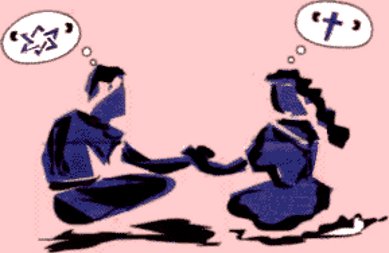
A chance encounter on a public bus in New Jersey results in a Jewish man and a Catholic woman sitting next to each other. Both of them are praying, him with a siddur and her with rosary beads. Their religious orientations are unmistakable. While the “code” of riding public transportation from Jersey to New York forbids each of them from talking with or even looking at each other, what could they have been praying about?

That ticked me off. Was it right to stereotype and scapegoat me? Hadn’t my people suffered enough? Did I have to be subjected to this? I was just a guy on a bus!

I tried to go back to my siddur, but I could see those hands working the rosary beads out of the corner of my eye, and I could sense those lips going a mile a minute, spewing who knows what. Well, okay, lady, I thought, maybe this is a test from God to see if I have the right reaction! How about I throw in some prayers for your soul? How about we have a nice debate and pick apart your faulty theology?

I was mulling this over, thinking about a good opening crack, when I was struck by another thought. If I can see her, she can see me. And she can see me looking at her – and not davening. Better get those lips moving, buddy, you don’t want to give this religious nut a leg up on feeling superior.

I admire Brand’s transparency in describing his thoughts and feelings. I try to show that side of myself as well. What “teachable moment” might we inspire or intersect if we just write down what we think and feel about each other and let those words be accessible via the Internet? More than that, what can the writer learn in the writing?

I was still mouthing some words from the siddur when my brain re-engaged momentarily and focused on what I was reading. “God is close to all who call upon Him, to all who call upon Him sincerely.”

Oh, while there were two people in that seat, there were actually three “personalities” present. God had something to say to Brand and maybe to his Catholic traveling companion as well (we’ll never know what she was thinking during all this, alas).

“God is close to all who call upon Him, to all who call upon Him sincerely.”

jewish-christian-intermarriageI know the assumption in the text from the siddur is that “all who call upon Him” means “all Jewish people who call upon Him,” but if God’s House is really to be a house of prayer for all people, then all people aren’t just Jewish people. It’s everyone who “calls upon Him with sincerity.” What if the Catholic woman was calling upon God sincerely? Was God as close to her as He was to Brand? Is God close to all of us when we sincerely call upon Him? Is He as close to me, a Christian, when I pray as He is to a davening Jew?

We religious people make a lot of assumptions about God and we make a lot of assumptions about each other. It would have been a complete breach of public transportation etiquette for Brand to have introduced himself to his seat-mate and struck up a conversation with her about their faiths. But if that could have been accomplished, maybe his fears would have been allayed somewhat (or maybe not). One Catholic person commented on Brand’s column and this might help figure out what the woman on the bus could have been thinking:

As a Catholic, who reads aish.com, I can almost guarantee that very few of us are condemning anyone to hell. We are all G_d’s children.

While Brand never talked with the Catholic person next to him on the bus, God managed to get his attention in the pages of his siddur.

I know I’ve wondered if my Jewish wife feels at all threatened about me going to church and what that means about my attitude towards Jews, but I wish she’d believe that we’re all God’s children.

But more than my concerns about my wife’s fears about me, Brand taught me that my own imagination could well be creating a situation that isn’t real.

But I left the bus undaunted – even after Comb-Over stepped on my foot as he rushed to get to the escalator – with a smile on my face. Jewish tradition tells us we should consider the world as though it was created for each of us. Because each of us has a unique touch of godliness that gives the universe purpose.

But there’s another way to look at it. We each create the world for ourselves. Our perceptions, our attitudes, our thoughts produce the world around us every moment of our waking days. We see, hear, experience what we want, what we will. And in doing so, we affect all the other people busily creating their worlds.

That’s a big responsibility. I’m glad I was able to figure this out before the journey ended. Fortunately, there was traffic.

The world is still a big, bad, ugly place in many ways. There’s all kinds of trouble and troublesome people around. But we also create the world we live in. We can choose to be upset, anxious, or angry because we are choosing to imagine what people think and feel about us. We can choose to communicate or choose to be silent. And even if silent, we can choose how we consider the people in our lives, for good or for ill.

I’ve heard it said that an anxiety attack is a person’s response to an emergency that does not exist. It still feels real, but the only danger is the choice we’ve somehow (it’s not volitional) made inside. Perhaps my being a Christian isn’t the danger I’ve imagined it is to my wife and children. And if some Jewish people, including my friends, believe my faith is a problem, please talk to Eric Brand. Maybe my faith isn’t automatically against you. Maybe I love you.

FFOZ TV Review: Exile and Redemption

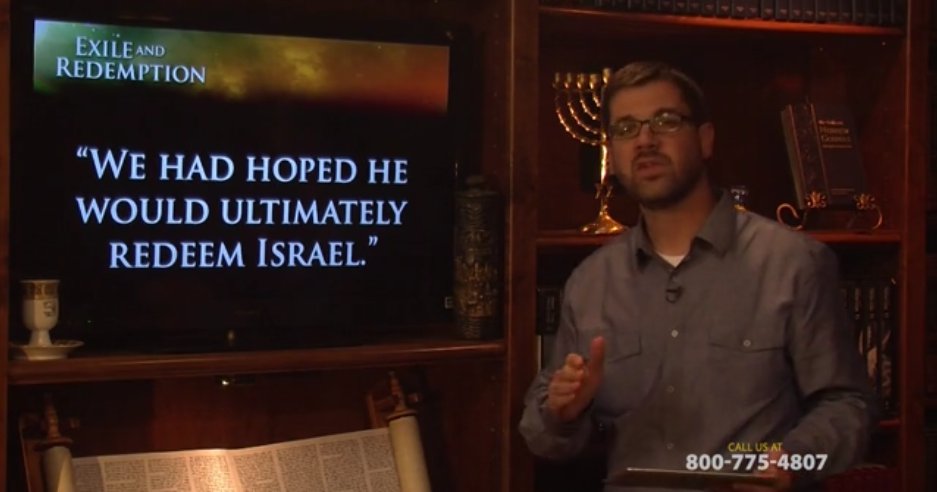
tv_ffoz6_oneEpisode 06: Exile and redemption are two of the most significant Biblical concepts and in episode six viewers will learn that these two concepts play a major role in the job description of Messiah. It was the job of Messiah to bring redemption to Israel by ending their exile and gather them back to the land of Israel. While Messiah did bring a spiritual redemption at his first coming, he has some unfinished business to take care of upon his second return in the way of bringing a physical redemption to not only Israel but the entire world.

-from the Introduction to FFOZ TV: The Promise of What is to Come
episode 6: Exile and Redemption

The Lesson: What Does It Mean To Be Redeemed?

This lesson summoned a lot of material I recently read about and described in this blog. Toby Janicki explores what he called “The Mystery of Redemption”, which is far more than just what Scot McKnight in his book The King Jesus Gospel called “a plan for salvation.”

Toby, who was raised as a Christian, describes his own early understanding of terms such as “being saved” and “being redeemed.” Traditionally in the church, we are taught that Jesus died for our sins and that we have been redeemed by the blood of the lamb. But redeemed from what exactly? Typically, the answer is that we are saved or redeemed from the power of sin and any punishment in the afterlife.

But as McKnight says in his book, which I reviewed last month, and as Founder and President of First Fruits of Zion (FFOZ) Boaz Michael stated in his presentation “Moses in Matthew,” there’s a lot more going on in the gospel message of redemption than we get in the common Christian viewpoint. The gospel message is a message directed at the Jewish people, and only through the redemption of national Israel and the return of the Jews from exile to their Land, will be people of the nations who are called by His Name, that is, we Christians, also be fully redeemed.

One of them whos name was Kleyofas answered. He said to him, “Are you the only one residing in Yerusalayim that does not know what has happened within it in these days?” He said to them, “What is it?” They told him, the incident of Yeshua the Notzri, who was a prophet mighty in works and in speech before God and before all the people. “But our high priests and elders arrested him for a death sentence and crucified him. We had hoped that he would ultimately redeem Yisrael, but today it has been three days since these things happened.”

Luke 24:18-21 (DHE Gospels)

Here we see two Jewish men who were disciples of Yeshua (Jesus) and whose hopes of redemption for Israel had been dashed to the ground. They believed Yeshua was the Messiah, but the fact that he died and was buried meant for them that he couldn’t be, because he had not lived to redeem the nation of Israel. I should note here that most Jewish people today deny that Jesus could be the Messiah for exactly the same reasons. These are people who deny the resurrection, the ascension, and that one day, Jesus will return to finish the Messianic mission.

But I’m getting ahead of myself or rather the program. Toby teaches that this scripture gives us our first clue in solving today’s mystery:

Clue 1: Messiah will redeem Israel from exile.

This is not only what Jewish people believed in the late Second Temple period but what religious Jews believe today. Messiah must come to redeem the Jewish people and to restore Israel. But exactly what does that mean? Most Christians don’t know, which is the importance of this TV episode. Where did the Jewish people get the idea that Messiah as redeemer was more than just about redemption from personal sin and what will that teach Christians in the church?

Say to them, ‘Thus says the Lord God, “Behold, I will take the sons of Israel from among the nations where they have gone, and I will gather them from every side and bring them into their own land; and I will make them one nation in the land, on the mountains of Israel; and one king will be king for all of them; and they will no longer be two nations and no longer be divided into two kingdoms.

“I will make a covenant of peace with them; it will be an everlasting covenant with them. And I will place them and multiply them, and will set My sanctuary in their midst forever.”‘

Ezekiel 37:21-22, 26 (NASB)

The prophet Ezekiel is speaking of King Messiah who will return all of the Jewish people in exile to their Land, the Land of Israel. In addition, God will make a covenant of peace with Israel, which will last forever, and God will establish His sanctuary, the Temple, among the Jewish people in their nation forever.

This last part threw me a bit. Revelation 21:22 describes New Jerusalem as having no Temple in the sense of a structure, since God and the Lamb are the Temple. I suppose there’s another mystery we could explore here, but it’s not contained in this television episode, so it’ll have to wait for another time.

tv_ffoz6_threeWe know that God exiled the Jewish people and Israel at the end of the Second Temple period. Jewish sages believe this was because of the sin of baseless hatred among the Jewish people. But religious Jews also believe that God will one day redeem them by sending Messiah.

But there is a modern state of Israel. Jews can make aliyah at any time. Isn’t the exile over? Not according to Toby’s teaching. Israel may exist nationally but the restoration is not complete. There is no Davidic King on the Throne, there is no Sanhedrin court system, and there certainly is no Temple in Holy Jerusalem. The state of Israel has not been set right again and established as the head of the nations. The Temple is to be a house of prayer for all nations (Isaiah 56:7), but not one stone of the Temple stands upon another, so there is no “house of prayer” for anyone right now.

Shocking as this may seem to many Christians, Messiah’s work was not finished at the cross, not by a long shot.

Toby uses 1 Peter 1:17-19 to illustrate that not only are the Jewish people in exile, but as long as our King, Jesus the Messiah, is not sitting on his throne is Jerusalem, all of his disciples, Jewish and Gentile, are also in exile. In effect, Messiah himself went into exile when Jerusalem was destroyed nearly two-thousand years ago, much as God went down into Egypt and ultimately into slavery with Jacob and the seventy members of his family (Genesis 46:3-4).

Although Toby didn’t mention this at all, I should say that as long as the current Israeli government negotiates with the Arab “Palestinian” people to carve up Israel including Jerusalem, and give it away in exchange for the Arabs ceasing all acts of terrorism, then Israel can hardly be said to be “redeemed” and even Jews in the Land may as well consider themselves in exile. In fact, Israel itself is still in a sort of exile. I imagine the Jewish people trying desperately to hold onto their homes in the so-called “territories” feel that way, too.

Toby also didn’t say this explicitly, but we must consider it to be the drive and desire of all Christians everywhere to see King Messiah restored to his throne in Jerusalem because until this happens, redemption is not complete. Yes, we are still “saved” from sin and condemnation, but being personally “saved” is only the beginning. The greatest works of Messiah are yet to come.

The scene shifts to Israel and to teacher and translator Aaron Eby who discusses what the word “redeemer” means in Hebrew and what it means to “redeem” a person or property.

Thus for every piece of your property, you are to provide for the redemption of the land.

‘If a fellow countryman of yours becomes so poor he has to sell part of his property, then his nearest kinsman is to come and buy back what his relative has sold.’

Leviticus 25:24-25

This portion of the Torah explains that the concept of redemption is a buying back or re-acquiring of property or even a person who has been a slave. The principle and meaning of ancestral property is well-defined in the Torah and if it is lost, there is a strong expectation that the original owner or his heirs will buy it back; will redeem it.

tv_ffoz6_aaron2Aaron brought up a question (sort of) I have recently explored. What if the owner dies and has no heirs? The answer lies in the concept of the leverite marriage. Aaron draws examples from scripture including Ruth and Boaz. Ruth the Moabitess was married to a Jewish man who died. Boaz was a relative, a kinsman redeemer, and by marrying Boaz and having a son with him, she restored her former husband’s lost family line.

Aaron also says that, when God liberated the Israelites from slavery in Egypt, He was acting as a redeemer and indeed, as God’s agent in this matter, Moses was also a redeemer. But another redeemer is to come after Moses.

Returning to Toby, we reach our second clue:

Clue 2: Redemption means buying back, re-acquiring, and setting things right.

That’s the function of Messiah in terms of the Jewish people, the nation of Israel, and through redeeming them, he also redeems the rest of us who continue to have faith. Toby cites Paul in Romans 6:17-18 where Paul metaphorically uses the laws related to redeeming slaves in describing how believers in Jesus are redeemed from slavery to sin, which is also part of the Messianic mission.

Toby referred to another scripture as a way to get to the third clue, a passage that I also commented on less than a week ago.

The Lord your God will raise up for you a prophet like me from among you, from your countrymen, you shall listen to him.

Deuteronomy 18:15

Toby identifies Jesus as “the prophet” and directs his viewers to Peter in Acts 3 and Stephen in Acts 7 as evidence that the Jewish believers also saw Jesus as “the prophet” spoken of by Moses. Thus we have the third clue.

Clue 3: Prophesy says that Messiah will be the prophet like Moses. Moses was the first redeemer and Messiah will be the ultimate redeemer.

Part of this third clue is dependent on another portion of scripture and I’ll get to that momentarily.

What Did I Learn?

Actually, some interesting stuff.

“Therefore behold, days are coming,” declares the Lord, “when it will no longer be said, ‘As the Lord lives, who brought up the sons of Israel out of the land of Egypt,’ but, ‘As the Lord lives, who brought up the sons of Israel from the land of the north and from all the countries where He had banished them.’ For I will restore them to their own land which I gave to their fathers.

Jeremiah 16:14-15 (NASB)

passover-artIt never occurred to me to consider the return of the Jewish people to their Land from the current exile as a sort of second Exodus, one that makes the first Exodus from Egypt pale by comparison. I started to think, especially in light of how most Christians have to see Jesus in all of the moedim as their only application, if a new meaning will be assigned to Passover in the Messianic Age, one that reminds the Jewish people not only of their redemption from Egypt, but their ultimate redemption from exile and the restoration of Israel as a united people and a sovereign nation. If the absence of our King on his throne means that even the Gentile disciples are in exile, along with the Jewish people, and along with Israel itself, then we should be crying out to Heaven, “How long, God? How long?”

The other thing I learned, and I’m not sure what to make of it, is that when Jerusalem is redeemed by Messiah taking up his throne, that Jews and Christians will see Jerusalem as their (our) city. Of course, Jerusalem is the Jewish city, the City of David, but how can we Christians lay claim to it in any sense?

I suppose because our King will be sitting on the Throne and the Temple in Jerusalem will finally be a house of prayer for all peoples. I don’t think that means we Gentiles get to live there, but if God is willing, may I see Messiah on his throne in Holy Jerusalem in those days, and may my sacrifices and burnt offerings be a sweet aroma to him.

I’ll review the next episode very soon.

What God Wants

the-divine-torahIf one wishes to add on more restrictions than the law requires, one may do so for oneself, but not [make such demands] of others.

-Shulchan Aruch

Some people employ a double standard. One set of rules applies to themselves, and another to everyone else. The Shulchan Aruch, the standard authoritative compilation of Jewish law, accepts this policy – but on one condition: the more restrictive set of rules must apply to oneself, and the more lenient apply to other people.

Guidelines exist for many things, such as the percentage of income that one should give for tzedakah. Many tzaddikim, righteous people, retained only the barest minimum of their income for themselves, just enough to provide for their families, and gave everything else to the poor. However, they would never expect anyone else to follow their example, and some even forbade it.

Our minds are ingenious in concocting self-serving rationalizations. Sometimes we may have excellent reasons not to give more liberally to tzedakah, even if it is within the required amount. We may project into the future, worry about our economic security, and conclude that we should put more money away for a rainy day. Yet we often criticize people who we feel do not give enough to tzedakah.

We should be aware of such rationalizations and remember that the more demanding rules should apply to ourselves. If we are going to rationalize, let us rationalize in a way that gives the benefit of doubt to others.

Today I shall…

…remember to be more demanding of myself than I am of others.

-Rabbi Abraham J. Twerski
“Growing Each Day, Elul 5”
Aish.com

I know that between Christianity, Judaism, Messianic Judaism, and Hebrew Roots (and their various streams and branches), there is quite a bit of difference in understanding what God wants from us. How do we serve Him in holiness and righteousness? There is some common ground. Generally performing acts of kindness and charity are involved. We can all agree that giving food to the hungry is the right thing to do. But we also have lots and lots of traditions, doctrines, dogmas, and theologies that only sort of match up with the other groups or that don’t even come close.

Most Christians believe that Jesus replaced the Law with Grace, while observant Jews believe the Torah continues to be in force upon the Jewish people, as interpreted and operationalized by the sages. Within Messianic Judaism, there are different opinions about Torah and how it applies to Jewish and Gentile believers, and Hebrew Roots is so diverse a population, that opinions about Torah span a very wide spectrum.

I can’t tell you what to believe and how to live your life. If you’ve been reading my blog for any length of time, you know that I’m continuously working on how to live my own life in accordance with my beliefs. I thought I’d reached a state of equilibrium, but recent questions have made me take another look at a few things. Also, as my relationship with different people change, I’m forced to evaluate the meaning of those relationships and how they impact my understanding of faith and God.

And there are no end of opinions on the Internet, and no end of people who are more than happy to tell you what to do, where to go, and especially what you’re doing wrong. If my hair were long enough, I’d want to tear it out, at least sometimes.

Some people accomplish a great deal, yet they are unhappy because they keep thinking that “somewhere else” they might be able to accomplish more. They live their lives with the general feeling that whatever they are engaged in at the moment is nothing compared to what they might possibly do.

This feeling is a poison that destroys joy and happiness in life. While you should try to accomplish as much as you can, it is often an illusion that you are missing out by not being “somewhere else.”

-Rabbi Zelig Pliskin
“Daily Lift #908, Make the Most of the Here and Now”
Aish.com

approaching-GodI sometimes feel this way about those believers who seem obsessed with “the end times” and spend unceasing hours and effort exploring every possible conspiracy theory as if they were investigating a spiritual X-Files. But Rabbi Pliskin’s statement is also well applied to understanding the purpose of our lives in general. What does God want from us? How are we to live? How stringent are “the rules” and are “the rules” the same for everyone, or do they differ for differing populations? What does God want of us?

He has told you, O man, what is good; And what does the LORD require of you But to do justice, to love kindness, And to walk humbly with your God?

Micah 6:8 (NASB)

That seems like a good start but is it a good finish as well? I don’t know. I do know that any life of faith has to stand on something solid. If it doesn’t, it becomes too easy for someone else to come along and knock your faith down, like a shoddy sand castle on some forlorn beach.

In Christianity, it’s all about what you believe. In Judaism, it’s all about what you do because of what you believe (that last part isn’t exactly correct, but I’m choosing to express it as such).

Never underestimate the power of a simple, pure deed done from the heart.

The world is not changed by men who move mountains, nor by those who lead the revolutions, nor by those whose purse strings tie up the world.

Dictators are deposed, oppression is dissolved, entire nations are transformed by a few precious acts of beauty performed by a handful of unknown soldiers.

As Maimonides wrote in his code of law, “Each person must see himself as though the entire world were held in balance and any deed he may do could tip the scales.”

-Rabbi Tzvi Freeman
“Powerful Beauty”
Based on letters and talks of the Rebbe, Rabbi M. M. Schneerson
Chabad.org

God is here. He is listening. I sometimes forget until He reminds me, that He fulfills my every need, even when I don’t ask Him to. When I “see” Him doing that, it’s His reminder to me that He’s there and He’s real and He cares.

I can’t let anyone try to take that away from me. I pray to God that He continually shares His Presence with me. What does God want? For me to wait for Him, watch for Him, and when He reveals Himself to me, to respond to Him with acts of righteousness, kindness, compassion, and justice. What do those things mean? I’ll spend the rest of my life finding out, but I know I’m not alone on the journey. I’m walking humbly with my God.

Intermarriage: Not Peace, But A Sword

onfire.jpgTo die while committed to a belief system that is idolatrous, false and contrary to what G-d has revealed to us AND has resulted in the persecution of the Jewish people for the last two thousand years, even if it doesn’t affect our eternity through the ever burning hell fires that Christianity reserves for those who didn’t believe in Jesus, is still not something I would desire for myself or anyone.

-from a private conversation

The simple believes everything, but the prudent gives thought to his steps.

Proverbs 14:15

Faith and belief are both defined as accepting as true something which transcends logic and which may not be subject to proof by rational argument. Yet, belief in God is not the “blind faith” of a simpleton.

A simpleton does not think, either because he lacks the capacity or does not wish to make the effort. Therefore, he is gullible and can be easily swayed in any direction. Being credulous is not the same as having faith.

When we reflect on the concept of a Supreme Being, Who is in every way infinite, we are likely to feel bewilderment, because our finite minds cannot grasp the infinite. Since all of our experiences involve finite objects, we lack a point of reference for dealing with the infinite.

When this reflection brings us to realize that the question of the existence of an infinite Supreme Being cannot be logically resolved, we then turn to the unbroken mesorah, the teachings which have been transmitted from generation to generation, from the time when more than two million people witnessed the Revelation at Sinai. When we accept our faith on this basis, we do so as the culmination of a process of profound thought which is no way similar to the credulousness of a simpleton.

This process also helps us with other questions that we have about God. For instance, the fact that we cannot possibly logically understand God does not preclude our coming to a knowledge of His Presence.

Today I shall…

…strengthen my faith by reflecting on the unbroken chain of tradition since Sinai.

-Rabbi Abraham J. Twersky
“Growing Each Day, Elul 3”
Aish.com

I’d like to think I’m not a simpleton. I hope I’m thoughtfully considering my steps. I have faith. I believe. The faith and belief of the Jewish people ultimately rests at Sinai, at the giving of the Torah. It is said that each Jewish person is to consider himself or herself as having personally stood at Sinai and having received the Torah directly. This communicates a sense of direct “ownership” of the commandments of God, rather than just the tradition of having them passed down from one generation to the next.

For a Christian, faith and belief ultimately rests at the foot of the cross, in a pool of blood shed for our sins. Christians aren’t “commanded” to consider ourselves as having personally stood at the foot of the cross of Christ, watching him die for our sake and for the sake of the world. Maybe we should.

But even so, people like me have a difficult thing to face. In my case, I have a Jewish wife, two Jewish sons, and a Jewish daughter. My children don’t speak to me one way or the other about my attending church and professing my Christian faith, but occasionally my wife does. Occasionally a few (non-believing) Jewish friends do (although in strictest confidence) as well.

If I love my Jewish family and friends, how can I be a part of a faith that historically has been guilty of “the persecution of the Jewish people for the last two thousand years”? I thought I knew, but when someone you deeply care about asks that question, it’s not so easy to answer. The answer is long and involved, and when someone is responding to your Christianity on a really emotional level, they don’t always want to hear long, involved explanations that they’ll probably do their level best to shoot out of the water in any case.

I don’t really want to argue. If someone wants to hear about my faith, I’ll do my best to explain it to them. If they don’t, I’m not invested in beating people over the head with a copy of the New Testament.

intermarriageIt doesn’t help (ironically enough) that my wife used to be a believer. My limited experience with Jewish people who were once believers and then returned or adopted a more traditional Jewish practice and worship, is that they are more highly resistant to any idea that there could be validity in Christianity or Messianic Judaism. I can only imagine it’s like being a person who is an ex-smoker (I used to smoke a number of decades ago) and a smoker is trying to convince the non-smoker to light up again.

“Yuck,” is the predictable reaction, followed by a series of reasons from the non-smoker why lighting up is an incredibly bad idea, and harmful not only to the smoker, but to everyone around the smoker, particularly the smoker’s loved ones.

As a Christian among Jews, I feel like a smoker among long-term non-smokers. If I want to “light up,” I sure better take it outside, down the alley, and around back behind a shed where no one can see me or smell me. As a Christian among Jews, I feel as if they see me like this:

In 1391, the Jews of Barcelona, Spain were victims of a massacre. This was part of three months of deadly riots throughout Spain, which left the Jewish community crushed and impoverished. Incredibly, on this same date 70 years later, a bishop named Alfonso de Espina urged the establishment of the Spanish Inquisition. The Inquisition was designed to uncover those Jews who continued to practice Judaism in secret (called Conversos or Marranos). During the years of brutal Inquisition, an estimated 32,000 Jews were burned at the stake and another 200,000 were expelled from Spain.

-from “Day in Jewish History” for Elul 4
Aish.com

You may consider that example a little extreme, but I’m not sure it’s that far out. I think it’s one thing to be Jewish and to be aware of Christians in your general environment, at the grocery store, at work, at the park, driving the streets of your city, and another thing entirely to be close to and even to live with a Christian. While my wife will occasionally give voice to her concerns, my children haven’t. My daughter, who is the only child left at home, has become more distant from me in recent months. She says everything’s OK, but everything else she says and does communicates otherwise. I can’t absolutely say it’s because of my continued church attendance and my reading from the Christian Bible, but it wouldn’t be much of a stretch, either.

Authentic Jewish life is characterized by the study of Torah, the observance of Shabbat and Kashrut, and the thrice-daily worship of God. Not Shabbes leichter as museum pieces, but a generation of Jewish women who light their candles to usher in the holy Shabbat. Not klezmer concerts to evoke nostalgia for the shtetl, but Jewish bands playing Jewish music at Jewish weddings where Jewish communities are celebrating the beginning of a new generation of a Jewish family.

I wish my niece Jodi had had such a wedding.

-Sara Yoheved Rigler
“The Dead End of Jewish Culture”
Aish.com

magen-davidRigler wrote this article as a description of how Jewish people identifying themselves as Jewish entirely on the basis of Jewish culture (as opposed to Jewish faith, observance of the mitzvot, and study of Torah) are reaching a dead-end to their Jewish identity. The painful result, from Rigler’s perspective, is her Jewish niece Jodi’s (not her real name) wedding to a Catholic husband in a Catholic church.

Rigler writes:

One December afternoon, my precious four-year-old niece Jodi walked into my mother’s suburban New Jersey kitchen and asked, “Bubbie, are you Jewish?”

“Yes, I am,” my mother answered proudly.

“So am I,” Jodi confided, “but don’t tell Santa Claus.”

I laughed when my mother told me this story, and I chuckled every time I thought of it – for 22 years. Last week, Jodi got married, in a Catholic church, kneeling in front of a huge gilded cross. I stopped laughing.

Apparently, Jodi’s perception of Judaism as a liability grew with the years. At the age of four, being Jewish made her a persona non grata to Santa Claus. At the age of 16, growing up in a town whose century-old bylaws stipulated, “No Jews or Negroes,” Jewish identity must have been a social non-starter. At the age of twenty, as a sophomore at Boston University, being Jewish must have threatened her budding romance with a handsome Catholic senior.

I’m sure Jodi’s Catholic husband doesn’t imagine that he might be considered guilty of any wrongdoing to Jodi or Jodi’s Jewish family, but, based on my experience, eventually he’ll have to confront those feelings. At least I don’t have Jewish in-laws who are upset with me, just the nuclear family and a few other Jewish people.

He who loves father or mother more than Me is not worthy of Me; and he who loves son or daughter more than Me is not worthy of Me.

Matthew 10:37 (NASB)

That’s a tough one to take. How am I supposed to respond to that, God? And what about this?

For whoever is ashamed of Me and My words, the Son of Man will be ashamed of him when He comes in His glory, and the glory of the Father and of the holy angels.

Luke 9:26 (NASB)

This next one is even worse.

For in the case of those who have once been enlightened and have tasted of the heavenly gift and have been made partakers of the Holy Spirit, and have tasted the good word of God and the powers of the age to come, and then have fallen away, it is impossible to renew them again to repentance, since they again crucify to themselves the Son of God and put Him to open shame. For ground that drinks the rain which often falls on it and brings forth vegetation useful to those for whose sake it is also tilled, receives a blessing from God; but if it yields thorns and thistles, it is worthless and close to being cursed, and it ends up being burned.

Hebrews 6:4-8 (NASB)

It would be worse to come to faith in Messiah and to fall away than never to have come to faith in the first place. Ouch.

So how am I supposed to choose, or if a choice is impossible, what am I supposed to do? At least in terms of marriage, Paul (and not God) had this to say:

But to the rest I say, not the Lord, that if any brother has a wife who is an unbeliever, and she consents to live with him, he must not divorce her. And a woman who has an unbelieving husband, and he consents to live with her, she must not send her husband away. For the unbelieving husband is sanctified through his wife, and the unbelieving wife is sanctified through her believing husband; for otherwise your children are unclean, but now they are holy. Yet if the unbelieving one leaves, let him leave; the brother or the sister is not under bondage in such cases, but God has called us to peace. For how do you know, O wife, whether you will save your husband? Or how do you know, O husband, whether you will save your wife?

1 Corinthians 7:12-16 (NASB)

separation“But God has called us to peace.” Really? Not until Messiah comes/returns (depending on who you are).

I don’t want to give the impression that I’m fighting with the missus (or anyone else) tooth and nail, and that I’m constantly engaged in some sort of “battle” of faith with the Jewish people in my life, but I can hardly ignore the steady undercurrent in these relationships as well as the occasional flare ups, either.

“Do not think that I came to bring peace on the earth; I did not come to bring peace, but a sword. For I came to set a man against his father, and a daughter against her mother, and a daughter-in-law against her mother-in-law; and a man’s enemies will be the members of his household.

Matthew 10:34-36 (NASB)

“Not peace, but a sword.”

Whoever has faith in individual Divine Providence knows that “Man’s steps are established by G-d,” (Tehillim 37:23) that this particular soul must purify and improve something specific in a particular place. For centuries, or even since the world’s creation, that which needs purification or improvement waits for this soul to come and purify or improve it. The soul too, has been waiting – ever since it came into being – for its time to descend, so that it can discharge the tasks of purification and improvement assigned to it.

“Today’s Day”
Friday, Elul 3, 5703
Compiled by the Lubavitcher Rebbe; Translated by Yitschak Meir Kagan
Chabad.org

Assuming God is establishing my steps too, I have to believe that I have come to this place, this time, this circumstance, for a reason. What that reason is, I cannot say. May it be right that I am here for a good purpose, and that God intends my existence and my presence in order to correct and purify some part of the world around me. I have no desire to hurt anyone, least of all those people I love who are Jewish.