Category Archives: Uncategorized

The Purpose of Torah in New Testament Judaism, Part 2

mentorAnd whoever occupies (“osek”) himself with the study of Torah is elevated, as is stated (Number 21:19), “And from the gift to Nahaliel, and from Nahaliel to The Heights.”

-Pirkei Avot (Ethics of Our Fathers) 6:2

What is Torah?

I hear people speak about “Torah study” and “the power of Torah,” etc. But I’m not clear what exactly they are referring to with the term “Torah.” Is that more than the Five Books of Moses?

The Aish Rabbi Replies:

The word “Torah” literally translates as law or teaching.

Torah is the Five Books of Moses: Genesis, Exodus, Leviticus, Numbers and Deuteronomy. Each book is one-fifth of the Torah. In Hebrew, this is collectively called the Chumash (literally: fifth).

It is called the Five Books of Moses because G-d dictated the text to Moses, who then wrote it down. Moses also plays a central role in the Torah.

Sometimes you will see the Five Books referred to by the Greek word, Pentateuch, which means “Five Books.” (“Pent” means five, and “teuch” means book.)

The second, more colloquial use of the term “Torah” includes the entire body of rabbinic literature – the Five Books of Moses, the Prophets and Writings, the Midrash, the Talmud (the compilation of rabbinic teachings explaining the biblical commandments), and even any teaching today based on these sources.

In this regard, Torah is the “constitution” of the Jewish people, covering the totality of law and lore, including lifecycle, business and medical ethics, holidays, family life, etc.

So when someone says, “I’m going to a Torah class,” or shares a “Devar Torah” (word of Torah), it is usually meant in the broader sense, not the Five Books in particular.

“What is Torah?”
-from the “Ask the Rabbi” column at Aish.com

Since I’m in pursuit of the answer to the question What is the purpose of Torah in New Testament Judaism,” which I first asked in Part 1 of this series, the question asked of the Aish Rabbi couldn’t have come at a better time. It’s the question behind the question, the very center of my ongoing discussions with my Pastor about why I believe that Jews who have come to know Jesus as the Messiah are still obligated to the Torah mitzvot.

To say one is obligated to Torah begs the question, “What is Torah?”

But that’s not an easy question to answer, though the Aish Rabbi did a pretty good job. However, that one answer isn’t the only answer. I know my Pastor wouldn’t consider any extra-Biblical sources as “Torah” because he considers only the Bible as containing the inspired Word of God. Midrash and Talmud, not so much.

But if we must necessarily turn to Judaism to answer the question, the answer won’t be palatable to most Christians, especially Biblical literalists.

Another Aish Rabbi answers the same question differently:

The accurate meaning of “Torah” is twofold. Firstly it comes from the word “hora’ah,” which means teaching. More precisely it means “teaching with direction,” i.e. the type of teaching which enables and empowers one with a direction to proceed. The same word could be used in Hebrew with such teachings both in spiritual and secular realms.

The second meaning is from the word “orah,” which means light. One example of this reflected in the verse which states, “A mitzvah is a candle, and Torah is the light” (Proverbs 6:23). This can be understood on multiple levels:

One thought is that the Torah is the source of spiritual illumination in the world. Besides it being the source of Judaism, through it and its teachings we serve as a light unto the nations. As such the Torah serves as the foundation of much of Christianity and Islam.

The Torah also, more importantly, serves as the source of illumination for our own lives. Like the Clouds of Glory which guided the Jews for 40 years in the Desert, providing illumination and direction at night, the Torah lights our paths and provides the Jewish people with direction throughout our long period of exile, even through the darkest of times.

The Torah also provides direction in each Jew’s personal life. In business, family life or interaction with others, the Torah offers the ethical and moral compass by which to navigate the most complicated and tempestuous, thorny issues.

tallit_templeThis takes a giant step back from the document of the Torah and presents it as a two-fold principle or a “service” that is offered. Torah provides education and Torah provides spiritual illumination.

But then what do you do with commandments like this?

You shall not wear a material mixed of wool and linen together.

Deuteronomy 22:11

Is that Torah? It’s certainly located within the Five Books of Moses. Do observant Jews perform that mitzvah today? Some do. Why don’t all Jews observe it, even those who may observe other mitzvot, such as wearing tzitzit or keeping some form of kosher? Is there more than one way to “do” Torah?

The answer to a simple question such as “What is Torah” seems multi-leveled and elusive. It’s further complicated by the fact that different streams of religious Judaism observe the mitzvot in different ways or observe some but not all of the codified mitzvot. I know Reform Jews who will go out to lunch at a restaurant on Shabbos but who maintain a tab so they can pay their bill (handle money) on a different day. Orthodox Jews couldn’t imagine themselves doing such a thing, even in their worst nightmares.

Another example: as far as I can tell, there are multiple forms of kosher, one being glatt kosher. If kosher is kosher, why different or varying standards?

This all goes back to my statement to my Pastor asserting the believing Jews are obligated, for instance, to “keep Kosher.” Yes, but “What is kosher?”

I mentioned in another blog post that my concern with looking to Christian sources for the answer to these questions is that the response will be biased by the assumption that Jesus “fulfilled” the Law so that all or much of it is no longer required for the believing Jews. However, looking to Judaism for the answer introduces a bias in the opposite direction, especially if part of that answer states that all of the midrashim and Talmud must be considered as Torah and thus infallibly inspired (or at least authorized) by God.

I also mentioned in my previous blog post that my Pastor believes there is a perfect and permanent Torah in Heaven that is never-changing, but that idea takes us immediately into mystic realms best left for another time (the upcoming Part 3 of this series). However, my Pastor also said that he would never tell a Jewish person who came to faith in Messiah that they had to give up their Torah observance because that’s who they are in terms of covenant, ethnicity, culture, and as a lived-Jewish experience. Part of being a Jew is Torah, even for Jews who have never studied Torah.

For instance, another Aish Rabbi answered the question of a sixty-six year old Jewish man who had never studied Torah before and was feeling as if he had “come to the party too late,” so to speak; that he was too old to begin to learn Torah.

When it comes to Torah study, there is no time like the present.

Maimonides writes (Laws of Torah Study 3:7):

“Perhaps one will say: ‘[I will interrupt my studies] until after I make money, and then I will return and study; [I will interrupt my studies] until after I buy what I need and can focus less on my business, then I will return and study.’

“If you think like this, you will never merit the Crown of Torah. Rather, make your work provisional and your Torah study permanent. Do not say: ‘When I have free time, I will study,’ for perhaps you will never have free time.”

Some people use the excuse, “I’m too old to begin learning.” But we know that Rebbe Akiva didn’t even learn the Aleph-Bet until he was 40 years old. This is the same Rebbe Akiva who became the greatest sage of his generation with 24,000 students!

Some people are hesitant to learn Torah because they can’t imagine ever becoming a scholar – so therefore why even get started? But that is faulty thinking. Every drop of Torah study is precious and eternal.

The story is told of Rabbi Yosef Kahaneman, who lived in the Lithuanian town of Ponevich. In the 1930s, when the Nazi threat grew grim, he escaped and made his way to Palestine. Arriving on the shores of Tel Aviv, he proudly proclaimed: “I have come here to establish a Yeshiva.”

Those who had come to greet the rabbi were perplexed: “Apparently you are not aware,” they told him, “that Rommel’s troops are now stationed in Egypt, and planning a total invasion of Israel. The Jewish Agency is destroying its records; the rabbis are distributing thousands of burial shrouds throughout the country. Our annihilation is imminent!”

“That will not deter me,” replied Rabbi Kahaneman. “Even if I am able to spread Torah learning for only a few days, that in itself would be of eternal significance.”

Rabbi Kahaneman built the Yeshiva in Bnei Brak, and named it after his Lithuanian town of “Ponevich.” Today it is the largest Yeshiva in Israel with thousands of students.
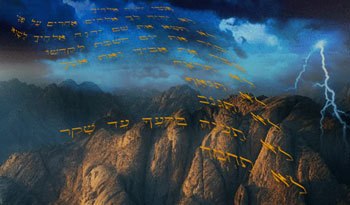
the-divine-torahI don’t know if you consider this “Biblical,” but for me, this is one of the most powerful arguments as to why all Jews, believing and otherwise, should zealously pursue studying and observing the mitzvot. Because Torah (however you define it) is at the heart of what it is to be a Jew. Not that secular, non-observant Jews aren’t Jewish…they certainly are, but something incredibly wonderful happened at Sinai when Hashem gave the Torah through Moshe. A people were brought together and united “as one man” before God in a way that had never happened previously in human history. It’s arguable that such a thing has ever happened since.

Although Christians have blessings without end through Israel and through Messiah, we never stood at the foot of Mount Hor and watched it burn in Divine fire and smoke. According to midrash, God spoke all the words of Torah simultaneously, in all of the seventy languages of the nations. It was truly wondrous and terrifying. Whether that happened literally or not, the point is that an event occurred at Sinai that forged and fused the Jewish people into a nation in a way that has never happened before or since.

I believe that Jesus is the prophet greater than Moses but salvation comes from the Jews, as the Master said himself (John 4:22). If we say that all or at least a whole lot of Torah (whatever that is) has gone the way of the Dodo bird, then all or at least a whole lot of what happened to the Children of Israel at Sinai went with it.

What is Torah? If Pastor is right and Torah, the whole Word of God, actually, exists in a perfect and immutable form in the Heavenly court, then it cannot be annulled, deleted, edited, altered, folded, spindled, or mutilated in any way. If that is true and if the “earthly” Torah was given as a sort of copy or model, just as the Mishkan (Tabernacle) in the desert was a “scale model” of the Heavenly Court of Hashem, then both the original and the model are Holy.

One does not desecrate the altar of the Tabernacle (and later, the Temple) without desecrating God. If we say that parts of the Torah can be removed, minimized, and deleted for the inheritors of the Torah at Sinai, the Jewish people, what are we saying about the Holy original? What are we doing to God?

What is Torah and what are the Jewish disciples of the Jewish Messiah supposed to do about it?

This is an exploratory series, so I’m not going to try to answer all of the above right now. I’m just setting the scene and inviting the players to take up their roles. Answer for me, if you will, the questions about Torah in a way that our brothers and sisters in the Christian church can comprehend and see how Torah is an ideal and a goal for the Jewish people, even as is the Messiah who is in Heaven and who will return.

The world is a place of constant change and unrest. Each point in time is distinct from the point before and the point after. Every point in space is its own world, with its own conditions and state of being. It is a world of fragments constantly rushing like traffic in anarchy.

Look at your own life: You do so many different things, one after the other without any apparent connection between them.

Inner peace is when every part of you and every facet of your day is moving in the same direction.

When you have purpose, you have peace.

-Rabbi Tzvi Freeman
“Inner Peace”
Based on letters and talks of the Rebbe, Rabbi M. M. Schneerson
Chabad.org

More questions and another perspective on the purpose of Torah coming up in Part 3 of this series on Monday.

The Purpose of Torah in New Testament Judaism, Part 1

creative-torahJewish tradition holds that “Moses received the Torah from Sinai,” yet there is also an ancient tradition that the Torah existed in heaven not only before God revealed it to Moses, but even before the world was created.

“The Written Law: Torah”
Jewish Virtual Library

Last night was my regular Wednesday evening meeting with Pastor Randy in his office at church. Often our conversations take various twists and turns (last night was no exception) but we tried to stick to our task of discussing D. Thomas Lancaster’s book The Holy Epistle to the Galatians

Between last week and last night, we managed to cover chapters 6 and 7, but we keep running into a wall based on our different perspectives.

Paul had an ulterior motive for this trip to Jerusalem. He intended to use the opportunity for a private meeting with the apostles, those reputed pillars of the assembly under James the Righteous, the brother of the Master. James presided over the assembly of Messiah as the steward of the throne of David, so to speak. Paul wanted to present his unique interpretation of the gospel to James and the apostles – namely the version of the gospel that God-fearing Gentile believers need not become Jewish in order to inherit salvation, enter the kingdom of heaven, and obtain citizenship in the people of God; rather that faith in the Master was sufficient for even Gentiles.

-Lancaster, Sermon 6: The Big Meeting (Galatians 2:3-5), pg 60

One of the problems Paul had encountered was hearing of “false brothers” (Galatians 2:4) coming into the Messianic communities in Galatia, and convincing some of the Gentile believers that they could only be saved if they were circumcised and converted to Judaism. This was contrary to what Paul believed, but he needed his understanding of the Gentile role in Messianic Judaism confirmed by the Council of Apostles in Jerusalem (which it finally was in Acts 15).

Pastor Randy agrees with me that non-Jews don’t have to convert to Judaism and take on the full weight of Torah as the Jews in order to become disciples of Jesus. However, he believes the “false brothers” were not just convincing the Gentiles to be circumcised, but the Jesus believing Jews as well!

The underlying belief is that both Jews and Gentiles were being taught by Paul that no one must “keep the Torah” once they have come to faith in Jesus because Jesus fulfilled the Law (This contradicts Paul’s own testimony that he never broke any of the laws of Torah, which he repeated many times starting with Acts 21, including what he says in Acts 25:8).

(Note that I’m using the New American Standard Bible – NASB – for quoting Bible verses unless otherwise indicated.)

Do not think that I came to abolish the Law or the Prophets; I did not come to abolish but to fulfill.

Matthew 5:17

For Christ is the end of the law for righteousness to everyone who believes.

Romans 10:4

According to the Greek (according to Pastor Randy), the word “fulfill” in Matthew 5 gives the sense of to fill up, to complete, rather than “fulfilling prophesy” as in simply meeting the qualifications.

Therefore the Law has become our tutor to lead us to Christ, so that we may be justified by faith.

Galatians 3:24

Pastor interprets this verse the way you might expect, that the Torah had one primary purpose and that when Jesus came, that purpose was completed and the Torah, for the most part, is no longer valid or at least not currently valid.

temple-prayersThis actually is a little complex because there are whole sections of Torah that have to do with the Temple and Priesthood that cannot currently be performed for obvious reasons. However, both Pastor Randy and I believe that there will be a third Temple and when it exists, some or all of the laws related to Temple worship will be re-established. We also agree that what Christianity calls “the moral laws” of the Torah remain, such as feeding the hungry and visiting the sick, and these are laws that apply to Christians and (believing and non-believing) Jews. You can’t eliminate all of the Torah without eliminating Christianity.

My assumption is from the opposite end of the telescope, so to speak. I believe that the Jewish believers including James, Peter, and Paul, would not have automatically assumed that the coming of Moshiach would have meant their Torah-observant lifestyles would have been changed or diminished in any way. In fact, I believe that their faith in Messiah would have given them a renewed sense of purpose and meaning in Torah.

You see, brother, how many thousands there are among the Jews of those who have believed, and they are all zealous for the Law…

Acts 21:20

What shall we say then? Is the Law sin? May it never be! On the contrary, I would not have come to know sin except through the Law; for I would not have known about coveting if the Law had not said, “You shall not covet.” But sin, taking opportunity through the commandment, produced in me coveting of every kind; for apart from the Law sin is dead. I was once alive apart from the Law; but when the commandment came, sin became alive and I died; and this commandment, which was to result in life, proved to result in death for me; for sin, taking an opportunity through the commandment, deceived me and through it killed me. So then, the Law is holy, and the commandment is holy and righteous and good.

Romans 7:7-12

There seems to be a duality in how the Torah is addressed in the New Testament, so we can each make a case for the Law being considered “good” or “bad” but what we are trying to determine is if the Torah retained a purpose for the Jewish believers after the resurrection and ascension of Jesus. In order to do that, Pastor Randy and I need some sort of definition for “Torah” or more likely, a mutually agreed upon answer to the question, “What is the purpose of the Torah?”

Pastor believes that there is a purpose to certain portions of the Torah after the ascension but that those portions apply equally to both Jewish and Gentile believers, since believers are defined by faith in Jesus as the bottom line. I disagree and believe there is an additional differentiation between Jewish and Gentile believers based on Sinai and that the Jewish believers remain distinct, even among the larger body of Gentile disciples of Messiah.

My project is to try to investigate the purpose of Torah for Jewish people who are in Messiah. Pastor is going to approach it from his perspective starting with Calvin’s Purposes of the Law in the New Testament. While I think it’s necessary to look at such a viewpoint, my concern is that by definition, it will not take the possibility of continued Jewish Torah observance into account.

I think it is completely reasonable to say that believing Jews and Gentiles can still have differences in obligation and duty under the Torah, just as Levites and Kohens have different duties under Torah than other Jewish people. They are all Jewish and yet specific Jews have certain additional obligations based on who they are. In a community of Jewish and Gentile believers, they (we) are all believers, but the Jews have certain additional obligations based on who they are.

Even a casual Google search on the string, “What is the purpose of the Torah” turned up a vast number of what seems to be very compelling sources, too many to review and summarize in a single blog post. I know this conversation with Pastor Randy will go beyond next week’s meeting, but we both agree that we need to, if not settle the matter, at least have a better handle on it than we do now (we’re also covering Chapter 8 in Lancaster for next week).

torah-tree-of-lifeI may not be the sharpest knife in the drawer, so to speak, but I’m not the dullest either. I know how to do my homework. On the other hand, I’m still only one person and as such, have the limitations of a single perspective. If anyone has something useful or can point me to a resource that can assist me in looking at the purposes of the Torah for believing Jews, both in the time of Paul and in the present age, I’d certainly appreciate you giving me a “heads up.”

Oh, Pastor Randy reads my blog every day, so it’s not like I’m trying to pull a fast one or something.

One more thing. At the beginning of this blog post, I quoted from Jewish Virtual Library on part of the “identity” of the Torah. It’s interesting that Pastor Randy pretty much agrees with that definition. That is to say, he believes there is a “Word of God” that is independent of the physical object we call a “Bible.” There is a pure, refined, holy, transcendent Torah in Heaven that no man has access to. The Bible contains the Word of God, but the Bible isn’t actually that Word.

That belief lends itself to some very interesting possibilities about what happens when we study the Bible, but I’ll stop at this point rather than try to explore such a vast territory.

The Torah is a tree of life for those who grasp it, and its supporters are praiseworthy. Its ways are ways of pleasantness and all its paths are peace. Lengthy days are at its right; at its left are wealth and honor. Hashem desired for the sake of its [Israel’s] righteousness, that the Torah be made great and glorious.

-from the Siddur

I hope to continue contributing to this project on my blog with some regularity, not only because of my conversations with my Pastor, but for its own sake. I suppose I’m “reinventing the wheel,” and perhaps some knowledgeable scholars have already done some or most of the work for me. If that’s true and who know where I can access that work, don’t be shy. Let me know.

More questions and another perspective on Torah coming up in Part 2 of this series.

Learning God

davening_morningIn the early period of his leadership the Alter Rebbe taught: “The footsteps of man are directed by G-d.”(Tehillim 37:23) When a Jew comes to a particular place it is for an (inner Divine) intent and purpose – to perform a mitzva, whether a mitzva between man and G-d or a mitzva between man and his fellow-man. A Jew is G-d’s messenger.

Wherever a messenger (shaliach) may be, he represents the power of the meshalei’ach, the one who sent him. The superior quality that souls possess, higher than the angels (who are also “messengers”), is that souls are messengers by virtue of Torah.

“Today’s Day”
Tuesday, Tamuz 10, 5703
Compiled by the Lubavitcher Rebbe; Translated by Yitschak Meir Kagan
Chabad.org

If you know something worthwhile, share it. By reaching others, you will reach yourself.

Whatever you learn – from books, lectures, or life experience – do so with the goal of sharing with others. If it was fascinating, how did it change you? What did it teach you about living? And how can you transfer that insight to others?

-Rabbi Noah Weinberg
“Way #46: Learn In Order To Teach”s
Aish.com

Sharing life experiences? Rabbi Weinberg is talking my language.

The past two “morning meditations” were my commentary on a teaching given by First Fruits of Zion (FFOZ) President and Founder Boaz Michael called Moses in Matthew. One of the essential points I tried to get across is that not all of the information “encoded” in the gospels (or the rest of the Bible for that matter) can be accessed and understood apart from a Jewish context. That context includes not only understanding the original languages and the cultural and historical framework of the time in which the Bible writers were operating, but the philosophical, religious, and midrashic material that would have been in the minds of those writers and their immediate audiences.

While the Bible is truly the inspired word of God, the Bible writers most likely had no idea that what they penned would be translated into hundreds of languages and consumed by nations and cultures all over the planet, two-thousand or more years into the future. In their intent, they were writing to people like them, people they knew or knew about, a specific and contemporary  readership.

Localization, when applied to language, is the process of writing a document in one language with the specific purpose that it be (more or less) easily translated into other languages. That requires the original document be written as “generically” as possible, employing no slang, idiom, or other language forms that are difficult to translate literally into other languages.

But one of the things we know or should know, is that the Bible writers used a lot of word play, symbolism, imagery, idiom, slang, and nicknames that were extremely specific to not only the original languages but to the time and culture in which these writers were living. To make matters worse, the Greek of the New Testament can seem extremely awkward at communicating thoughts and ideas that the Hebrew thinking/speaking writers were attempting to communicate.

My Pastor, who is fluent in Hebrew, agrees that some of the New Testament phrases written in Greek are worded in a very difficult manner, but they become much clearer when “retro-translated” into Hebrew (which is one of the reasons why the Delitzsch Hebrew Gospels are extremely helpful).

man_risingThe quote from “Today’s Day” at the top of this blog post says in part that “A Jew is G-d’s messenger. Wherever a messenger (shaliach) may be, he represents the power of the meshalei’ach, the one who sent him.” That’s quite true but as disciples of the Jewish Messiah, even we Gentiles are messengers of God and we also represent the one who sent us.

Rabbi Weinberg says that the purpose of learning is to teach, not that we must all take on the role of a formal teacher, but any time we communicate something we have learned to another, we are teaching them what we learned. That’s what I’m doing with this blog.

The interesting thing is that, based on everything I’ve written over the past several days (and long before that), as Christians, we can’t really learn the Bible beyond a certain point until we learn to read it “Jewishly.” Therefore, we can’t really teach what we’ve learned about the Bible beyond a particular limit until we’ve learned to teach it “Jewishly.”

This isn’t to say that we Gentile Christians will ever learn to conceptualize the world in the same way as someone who was born into a Jewish home, raised and educated within a fully cultural and religious Jewish context, and as someone who lives a life that is halachically Jewish. I live with a Jewish wife and have three Jewish children and I don’t come anywhere near understanding my world from the Jewish perspective, let alone writing from that perspective.

But hopefully I’ve learned enough to add a bit of an “accent” to my language…to communicate from a different perspective, presenting my understanding of the Bible (limited though it may be) in a way that appears new or at least different from what most Christians teach and comprehend.

According to Rabbi Weinberg, you don’t have to be perfect to teach. That’s a lesson I know all too well:

The best teachers make mistakes; more at the beginning, less later on. It’s like riding a bike or driving a car – the more you do it, the easier it becomes. Nobody ever became a great teacher without flopping a few times.

The first time, you’ll probably be laughed at. But don’t be discouraged. (Be glad they didn’t curse you!) Try again. The second time they’ll argue with you. That’s a good sign already; you’ve got them engaged. The third time they’ll thank you. That makes all the previous efforts worth it.

The same way a budding artist needs to study under the masters, a teacher needs to study the methods of great educators. If you have a favorite teacher (or journalist, actor, etc.) be conscious of their techniques for communicating the message.

But don’t wait until you’re perfect – because that’s a long way off! Just get started and teach as best you can. It will do wonders to help clarify your own viewpoint.

Of course, no one will ever become a perfect teacher and some people are more naturally gifted in that role than others. One of the reasons I write is to clarify what I’m learning within myself. Sometimes presenting that to others helps me learn as well. If the Jewish people were called to be a light to the nations, then Messiah has taught us that we need to be a light, too. We are learning things from our Master that are well worth sharing, but as he said, a light cannot shine if it is hidden under a basket.

GardeningLearning and teaching is a living, organic process. We know we’re alive when we are interacting, not only with other human beings, but with God. We are fulfilling the purpose of our existence. We are exercising the reason for our design.

We don’t have to be perfect and we don’t even always have to be all that good. We do have to do, though. If we are sincere, and motivated, and acting in His Name, we will move forward, we will learn, we will teach, and with the help of God, a few people will actually understand, then learn, and then teach too.

People think that to attain truth you have to pulverize boulders, move mountains and turn the world upside-down. It’s not so. Truth is found in the little things.

On the other hand, to move a mountain takes some dynamite and a few bulldozers. To do one of those little things can take a lifetime of working on yourself.

You do what you can: Learn and meditate and pray and improve yourself in the ways you know how—and He will help that what you do will be with Truth.

-Rabbi Tzvi Freeman
“Small Truths”
Based on letters and talks of the Rebbe, Rabbi M. M. Schneerson
Chabad.org

“I long to accomplish a great and noble task, but it is my chief duty to accomplish small tasks as if they were great and noble.”

-Helen Keller, American writer and political activist

The Master said (Luke 21:15), “…for I will give you words and a wisdom that none of your opponents will be able to withstand or contradict.” While that may not always seem true given the amount of ridicule believers receive from various members of our society, we are not abandoned and alone, either. Learn and keep on learning, but information kept to yourself only helps you. You are only serving God when you share it and Him.

A Few Notes on Inner-Biblical Exegesis and Jewish Hermeneutics

Jewish_men_praying2In this almost painfully beautiful book…Fishbane…explores the question of the kind of canon, privileged status, or Logos, the Torah actually has for the post-modern Western Jew. It…is a moving, personal apologia…

-James A. Sanders,
“Theology Today”

Pastor Randy recommended Michael Fishbane’s book The Garments of Torah to me more than once and I finally decided to buy it. He said he hasn’t read it in many years but recalls Fishbane’s book having a profound effect on him. I’m going to try to give you a taste of the effect it’s having on me.

This isn’t a full book report. I’ve only read one chapter so far. Fishbane’s book is only 168 pages long but it’s hardly what you’d call “light reading.” The first chapter, Inner-Biblical Exegesis: Types and Strategies of Interpretation in Ancient Israel is dense with information and erudite in its writing, so I find I need to read slowly and carefully in order to grasp what is being said by the author.

Hence my writing this blog post as a series of “notes” just to offer some of my impressions. It’s interesting though that I find a sort of association between what Fishbane is presenting so far and what I wrote about in The Jewish Gospel, Part 1 and Part 2.

I want to say before proceeding that there is a likelihood that I’ll misinterpret some of what I’m trying to explain about what Fishbane’s is saying. In that case, I don’t doubt some of my more scholarly readers will step in and point out where and how I could do better. Thank you in advance for your efforts.

One of the great and most characteristic features of the history of religions is the ongoing reinterpretation of sacred utterances which are believed to be foundational for each culture. So deeply has this phenomenon become part of our modern literary inheritance that we may overlook the peculiar type of imagination which it has sponsored and continues to nurture: an imagination which responds to and is deeply dependent upon received traditions: an imagination whose creativity is never entirely a new creation, but one founded upon older and authoritative words and images.

-Fishbane, Chapter 1, pg 3

It’s interesting that Fishbane uses this block of text to begin a chapter on inner biblical exegesis, since it summons images of learned Rabbis crafting new Talmudic interpretations of the Torah in response to the demands of a changing world. But Fishbane is discussing how later portions of the Bible were crafted based on traditional understandings of earlier portions, at least as I read this chapter. The rationale for doing so is also very “Jewish” (I say this last part for the sake of my Christian readers).

…if not tradition’s realization that there is no authoritative teaching which is not also a source of its own renewal, that revealed teachings are a dead letter unless revitalized in the mouth of those who study them.

-ibid

If we don’t reinterpret (some might say “reinvent”) the Bible through the study and perceptions of the scholars and students of the present age, does it become a “dead letter?” Many people, both Christians and Jews, believe so, but clergy and scholars who are literalists tend to believe that reinterpretation throws out the baby with the bath water, and that making scripture more “relevant,” also robs the Bible of its power and holiness.

But even this mythification of a chain of legitimate interpreters did not so much obscure the distinction between Revelation and Interpretation as underscore it. From this perspective, the interpretative traditions of ancient Judaism constitute a separate, non-biblical genre: a post-biblical corpus of texts which stand alongside the Sinaitic revelation as revelation of new meanings through exegesis.

-ibid, pg 4

I know that’s going to disturb and even scare some folks. Fishbane is describing his views on how Pharisaic Judaism (which doesn’t have many fans in the church) attempted to minimize the gap between divine Torah and human interpretation by performing what I have called the rabbinization of Abraham. From an outsider’s point of view, it seems this must require more than a little sleight of hand and violates any sort of sola scriptura approach.

ancient_rabbisFrom this perspective though, the early Rabbis could be considered the “guardians of Torah” and according to Fishbane, the discovery of the Qumran documents may lend credence to the idea that the foundation texts upon which the later portions of the Tanakh (Old Testament) were written have already been interpreted and such “scribal intrusions” actually open a window and allow us to look into both the world of the early Torah authors as well as those who came after them. Examination of newly recovered ancient texts and how they comment on even older texts illustrates a process where the scribes, interpreters, and traditions became integrated components of Divine revelation.

The process of the intercultural transmission of traditions may be considered one of the primary areas in which authoritative teachings or memories were received and revalued for new generations.

-ibid, pg 5

Recall in my commentary on Boaz Michael’s presentation Moses in Matthew how this process was illustrated by the apostle Matthew. Knowledge of traditions about the Creation and Moses being drawn from the water and parting the Reed Sea were a necessary component of correctly interpreting the deeper meaning of Jesus walking on water (see The Jewish Gospel, Part 1). Earlier Biblical text and the traditions surrounding how those scriptures are interpreted seems to be woven into the fabric of the apostle’s Matthew 14:22-33 account.

For if scribalism points to the fact that ordinary textual ambiguity or openness may serve to catalyze commentary and that these supplements, when incorporated into the received text, reflect the cultural dynamics of transmission, then law and theology, where the frequent incomprehensibility or non-comprehensiveness of divinely authorized rules requires human exegesis and expansion, offer an even richer sphere of study.

-ibid, pg 7

I can see two ideas coming from that one sentence. The first is that the uncertainty about particular laws in Torah and how to actualize them may have actually enhanced discussion among sages and scholars resulting in developing a tradition on how to perform the mitzvot based on those commentaries. Tradition first becomes the lens by which Torah ambiguities are examined and finally becomes an element of the revelation itself (though a separate “genre” existing alongside scripture, according to Fishbane). But Fishbane can also be saying that one older section of the Bible such as a prophesy can be refactored and applied anew to a later occurrence, such as Matthew referencing Hosea 11:1 and applying it to Jesus in Matthew 2:15 as possibly based on the ambiguous interpretation of the older scripture.

Not only does tradition resolve Biblical ambiguities but it allows for older prophesies to be reinterpreted in such a way that later portions of the text can connect back to entire ideas and images associated with earlier writings.

The terse formulation prohibiting Sabbath labor found in the Decalogue, Exod. 20:18-21, is taken over virtually verbatim in the Mosaic citation of it in Deut. 5:12-14…But even Moses’ recitation of the ancient rule…does little to explicate the details of prohibited work.

-ibid, pg 10

(I should mention as an aside, that D. Thomas Lancaster’s book The Sabbath Breaker: Jesus of Nazareth and The Gospels’ Sabbath Conflicts which I previously reviewed, also addresses the struggle in comprehending that is considered “forbidden work” within the context of the acts of Jesus in the gospels.)

Fishbane suggests that the ambiguity regarding forbidden work on the Sabbath was later addressed in passages of Jeremiah in an attempt to achieve a resolution (see Jeremiah 17:19-27). Attempting to go into more detail would just result in me either including longer quotes from Fishbane’s chapter or essentially rewriting Fishbane in this blog post. The point is to get you to turn your attention to his book so you can see what you think of his viewpoint for yourself (Well, that’s not the whole point of me writing this. I’m also just trying to get my brain around this topic).

However, among his many examples of Inner-Biblical exegesis is this:

As an example, we may consider 2 Chron. 15:2-7, a speech which one Azzariah ben Oded delivers an oracle to King Asa of Judah.

This prophetic discourse (as also the prophet in whose name it is spoken) is unknown to earlier biblical sources, and appears to reflect the pseudepigraphic handiwork of the Chronicler who has woven together several strands of tradition in order to confront his contemporary readership (in the Persian period) with a matter of “prophetic” concern to him.

-ibid, pp 14-15

studying-talmudThis seems to harken back to books such as Who Wrote the Bible by Richard Elliott Friedman which considerably blur the lines between God-inspired text and the human, social, and political requirements of the authors involved. The tradition for interpretation of the text ultimately becomes part of the revelation itself and we can’t always see where the inspiration of God leaves off and the authorship of the actual human writers (and their various priorities) begins. We only know that how the Jewish people came to understand their Bible scriptures (which is certainly true by the time of Jesus) was inseparable with the interpretative traditions of the text itself.

In fact, those traditions were well used by later Jewish Bible writers such as Matthew (and I mentioned this earlier) in order to communicate important ideas to the audience. To do away with those traditions involving inner-biblical exegesis and return to a strictly literal reading of the text in isolation both from tradition and other sections of the Bible, strips away the vast majority of the meaning from what the Bible is communicating. It becomes virtually impossible to understand what Matthew is really writing about Jesus unless we A) refer to previous sections of the Bible, and B) engage the interpretative traditions associated with those older portions of scripture as applied to the later texts.

Seemingly agreeing with the Moses in Matthew presentation and Boaz Michael’s viewpoint, Fishbane tells us that referencing these older sections of the Bible in later writings re-contextualizes them to apply to (apparently) people and events to which these older scriptures didn’t originally reference (the aforementioned Hosea 11:1 and Matthew 2:15).

And those are my notes on only one chapter made up of fifteen pages in Fishbane’s book. Not the most amazingly cohesive blog post I’ve ever written, but then there’s quite a lot to digest. However, when compared to other opinions and ideas about the Jewish view of the Bible, and particularly the Jewish view of the midrashic linkage between the Tanakh and the apostolic scriptures, we should experience several “Ah-ha” moments in our understanding as the ideas from The Garments of Torah begin to sink in.

I’m looking forward to the rest of Fishbane’s book.

Addendum: I know I’m probably playing fast and loose with Fishbane’s chapter, but these are more my impressions about what I’m reading and the associations sparked by his writing, than a detailed, “nuts and bolts” analysis.


The Jewish Gospel, Part 2

studying-talmudBut the way Boaz teaches this lesson teaches us something about Biblical sufficiency. The idea of sufficiency is that the Bible is all that we need to understand the Bible. That’s not exactly true. While the plain meaning of the text does teach us something about Jesus and who we are as Christians, an understanding of early Jewish thought, writings, and midrash, shows us that the text contains a deeper meaning, one that would elude us if we ignored the extra-Biblical understanding of how an early Jewish audience would have comprehended these verses and associated them with other parts of the Bible. Sola scriptura isn’t quite the beginning and end of how we can understand the Word of God.

We may call the Bible “sufficient” and it is, but it can be more “complete” only when we reinsert the Jewishness of its overall context and include both Jewish perspective and Jewish midrashic thought into our understanding.

That is some of my commentary from yesterday’s morning meditation (If you haven’t done so already, please click the link and read part 1 before continuing here) based on First Fruits of Zion (FFOZ) founder and director Boaz Michael’s “Moses in Matthew” presentation. The original lecture series is a couple of years old, but it was recently released on audio CD and I’ve had the opportunity to listen to this teaching. I learned a few things from this lecture and by sharing some of it, I hope you can learn a few things, too.

One of the scribes came near and heard them disputing with one another, and seeing that he answered them well, he asked him, “Which commandment is the first of all?” Jesus answered, “The first is, ‘Hear, O Israel: the Lord our God, the Lord is one; you shall love the Lord your God with all your heart, and with all your soul, and with all your mind, and with all your strength.’ The second is this, ‘You shall love your neighbor as yourself.’ There is no other commandment greater than these.”

Mark 12:28-31 (NRSV)

It’s interesting that Matthew’s rendition of this event (Matthew 22:36-40) doesn’t include a more direct reference to the Shema. Many Christians imagine that Jesus replaced the 613 commandments of the Torah (though the Torah wouldn’t be formally codified in this manner for many centuries after the resurrection) with just two, thus substituting grace for the law. But that’s not how it would have sounded to Messiah’s original Jewish audience.

In yesterday’s blog post, I related the part of Boaz’s teaching illustrating how the Master (or any Jewish teacher in those days) could quote from just a single verse in a Psalm or other portions of the Tanakh (Old Testament), and his audience would immediately recall the full text of the part of scripture to which he was referring, connecting the teaching to the much wider body of words and imagery. When Jesus taught about the two greatest commandments and in Hebrew said, “Shema Yisrael” (Hear O Israel), the people listening wouldn’t have just thought of Deuteronomy 6:4-7, but to the rest of the content of that chapter as well as Deuteronomy 11 and Numbers 28 which also are part of the Shema. The reason the Pharisee who was an expert in the law agreed with Jesus so strongly is because he not only agreed with the interpretation of the immediate text under discussion, but the wider implications of how Jesus was presenting and teaching the Shema and Torah as good news and hope to Israel.

And again, Christians tend to miss this point, especially since we are (most likely) reading the text in English and not viewing it with a Jewish mindset. But the further importance of the Delitzsch Hebrew Gospels being presented at the same time as Boaz’s teaching is that “retro-translating” the Greek back into a “Hebrew voice,” allows for a more “Jewish” reading of this lesson, giving us a closer look at how the ancient Jewish listeners were hearing and understanding Jesus. Even reading the Gospels in Greek would still “miss” what the ancient Jews were hearing when Jesus taught.

We can see a further connection here:

Everyone then who hears these words of mine and acts on them will be like a wise man who built his house on rock.

Matthew 7:24 (NRSV)

The two greatest commandments do not replace the Torah nor do they really condense the Torah. This teaching actually unpackages the meaning of the Shema and defines any Jewish person who has faith in God and who is zealous for the Torah to be both hearers and doers of the Word and will of God.

That’s a lot to pull out of a short discussion between Jesus and a legal expert.

the-teacherBut Boaz’s teaching is called “Moses in Matthew” and in referencing Matthew chapters 1 and 2, he says that it was the Apostle’s intent to mirror the birth and childhood narratives of Jesus with Moses. That may not be immediately obvious to the Christian reader, which is why lectures such as this one are so important.

I won’t go into all of the details (since my notes are limited) but making the connection requires some knowledge of Jewish midrash (Maybe books such as those written by Daube and Lachs would help) about the early life of Moses and his parents, information that isn’t available in the Bible (and Bible sufficiency proponents will likely struggle at this point). But Jesus’s audience would have been aware of some form of the midrashim connected to the early life of Moses, and when reading how Matthew wrote about the early life of Jesus, Boaz believes Matthew’s audience would be saying to themselves, “I’ve heard this story before.”

As an aside, I just read Dr. Michael L. Brown’s review of David Klinghoffer’s book Why the Jews Rejected Jesus in which Dr. Brown writes the following:

Klinghoffer fails to grasp the depth of Matthew’s hermeneutic (along with the hermeneutic of other NT authors), noting, “Pointing out the imprecision of proof texts like these, one feels almost unsporting. It’s too easy” (66). To the contrary, as top Matthew scholars have observed, “Matthew was not above scattering items in his Greek text whose deeper meaning could only be appreciated by those with a knowledge of Hebrew. Indeed, it might even be that Matthew found authorial delight in hiding ‘bonus points’ for those willing and able to look a little beneath the gospel’s surface.”3 At times it is clear that Klinghoffer simply failed to get the NT author’s point (see again 66, citing Matt 2:23 and Isa 11:1).

Boaz Michael’s perspective on Matthew’s Gospel is not in isolation. Now to continue with the main portion of my missive.

Please keep in mind that the point isn’t whether or not midrash is literally true. It probably isn’t. But the cultural context of the midrashim and what it means to a Jewish audience is what connects and binds the interpretive stories about Moses to the stories Matthew was telling about the young Jesus and his family.

Boaz went on in his teaching to compare the temptation accounts in Luke 4 and Matthew 4. They’re not the same. Matthew includes specific details that Luke leaves out, such as the Master fasting for forty days and forty nights. That specific time period (as opposed to just forty days) is mentioned only four times in the Bible, and three of those events are related to fasts (Elijah’s fast is one of them). How could Matthew’s readers not associate Jesus’s fast in the wilderness with that of Moses on the Mountain with God. It is further said in midrash that Moses dined on the bread of angels on the Mountain (somewhat contradicting that he was fasting) and in Matthew’s account of the temptation, the Adversary said that Jesus could command stones to become bread.

The order of the temptations is reversed from Luke to Matthew, with Matthew’s account presenting Jesus being taken to a high mountain and shown all the nations as the last temptation. Just before Moses’s death, God took him to a high mountain and showed him all of the nation of Israel.

(You might be thinking that these comparisons aren’t very strong, but it’s the way Matthew is writing his entire Gospel that provides the complete illustration of Messiah and Moses. The Gospels differ from each other, not because the Gospel writers were inconsistent, but because they each had a different emphasis on Messiah to present, like four different artists each painting a different portrait of Messiah. Same guy but different styles and interpretations.)

When Jesus saw the crowds, he went up the mountain…

Matthew 5:1

When Jesus had come down from the mountain, great crowds followed him…

Matthew 8:1

In between these two events, Yeshua (Jesus) delivered what has come to be called “the Sermon on the Mount.” It might surprise you to hear that Boaz believes Jesus going up the mountain and then coming back down can be compared to Moses going up to receive the Torah and coming back down. That probably sounds a little thin to you, but consider the function of the sermon itself. It’s been called the greatest distillation of the Torah. Moses ascended the mountain to receive the Torah and descended to deliver it to Israel. Jesus ascended the mountain to teach the Torah and descended when he had finished.

Also, when Moses descended, he encountered the faithless Children of Israel worshiping the Golden Calf. When Jesus descended, he encountered a leper (actually, a Jewish man with a form of “spiritual skin disease”) who through faith was made clean of his disease. There’s a “mirror effect” being created between Moses and Jesus by Matthew for his readers.

Now here’s something really interesting.

“Do not think that I have come to abolish the law or the prophets; I have come not to abolish but to fulfill. For truly I tell you, until heaven and earth pass away, not one letter, not one stroke of a letter, will pass from the law until all is accomplished.

Matthew 5:17-18

Torah at SinaiAnyone involved in either the Messianic Jewish or Hebrew Roots groups for more than five minutes will recognize this passage as the core message of those two movements. Yes the Torah will pass away, but not until Heaven and Earth pass away. Now here’s the really cool part.

Truly I tell you, this generation will not pass away until all these things have taken place. Heaven and earth will pass away, but my words will not pass away.

Matthew 24:34-35

The words of the Torah will pass away at some point in the future, but Messiah says that his words will never pass away.

The Torah is greatly praised both in the Tanakh (Old Testament) and in the New Testament but if you study the Torah, a great deal of its content has to do with daily living in Israel, daily human living on earth. All of that will eventually fade away after a long, long period of time.

I saw no temple in the city, for its temple is the Lord God the Almighty and the Lamb. And the city has no need of sun or moon to shine on it, for the glory of God is its light, and its lamp is the Lamb. The nations will walk by its light, and the kings of the earth will bring their glory into it. Its gates will never be shut by day—and there will be no night there. People will bring into it the glory and the honor of the nations. But nothing unclean will enter it, nor anyone who practices abomination or falsehood, but only those who are written in the Lamb’s book of life.

Revelation 21:22-27

With no temple currently existing in Jerusalem, most Christians think the Torah has already been done away with and been replaced by Christ’s grace, but I believe another temple will be built. It would be impossible to observe the laws related to the temple without the Torah being in effect for the Jewish people. We know that the Gentile nations will be required to send representatives to Jerusalem to observe Sukkot every year in the Messianic Era. Again, observing the festival requires a temple in Jerusalem and the laws of the Torah for temple worship. Jesus said the Torah will be with us as long as there are a heaven and earth. Eventually there will be no Torah and no Temple, but we aren’t there yet. But even when we get there, the words of the Lamb will remain, for they are eternal.

All the nations you have made shall come and bow down before you, O Lord, and shall glorify your name.

Teach me your way, O Lord, that I may walk in your truth; give me an undivided heart to revere your name.

Psalm 86:9, 11

I’ve said in today’s “meditation” as I’ve said many times before, that the Torah remains and functions. It remained and functioned after Christ’s ascension and in the days of James, Peter, and Paul. In order for prophesy to be fulfilled, the Torah needs to remain in force for the Jewish people until all has been completed and as long as there is a heaven and an earth.

But if you’re a Christian reading this, you’re probably wondering what that means to you. Even if you’re willing to accept the continued authority of the Torah for the Jewish people (a big “if” for many Christians), what does it have to do with a believer who isn’t Jewish?

There’s a great deal in even a surface reading of the Torah that has to do with a Christian living a holy life. All of the principles upon which we live a life of faith are from Torah; caring for the disadvantaged, feeding the hungry, comforting the widow, helping a neighbor, visiting the sick…these are all from Torah and they all apply to Christians today.

Boaz said that the heart of discipleship is to study the teachings of our Master and to apply those parts of the teachings that directly connect to us to our daily living. Remember, Jesus primarily taught to Jewish audiences who were perceiving his teachings from a Jewish worldview. Paul was the primary agent responsible for taking those Jewish teachings and crafting them in a manner “digestible” to a God-fearing Gentile audience.

The first discourse Paul gave at the synagogue in Pisidian Antioch (Acts 13:13-43) was a teaching of Jesus the Messiah as the culmination of Jewish history condensed (and most likely summarized by Luke) by the Apostle and presented to Jewish and God-fearing Gentile listeners. Their response was overwhelmingly enthusiastic.

messiah-prayerBut as time passed, the message of the good news of Messiah became increasingly “Gentilized” and eventually divorced from its Jewish context. Even those Christian scholars who can read the New Testament in the Greek can easily miss the “Hebrew voice” of the Apostles and thus lose a great deal of their intent and meaning.

Which is why teachings such as this one given by Boaz Michael are important. It’s why studying midrash and Jewish thought are exceptionally helpful in augmenting our understanding of the Bible.

The value of the Messianic Jewish and Hebrew Roots movements for non-Jewish believers is to teach us the Torah and how to read it in relation to the New Testament scriptures. It’s to help us filter the Bible through the eyes of Jewish thinkers, writers, and sages. It’s to encourage us to think outside the traditional Christian “box,” not to turn us into quasi-Jewish people, but to define and illuminate the Christian relationship to the Jewish people, the chosen ones of God, and thus to Messiah himself, the first-born son of Israel.

If you are intrigued but unfamiliar with the perspectives I’ve been discussing in yesterday’s and today’s blog posts, I encourage you to go to First Fruits of Zion and see what else they have to offer. As a fellow Christian and student of the Bible, I’ve found many of their materials invaluable in my own exploration of my faith.

Who is the Jewish Jesus and how does a “Jewish” understanding of the scriptures make us better Christians? It’s a journey I hope you’ll join me on as we investigate this “undiscovered country,” including the Jewish Gospel of Matthew.

The Jewish Gospel, Part 1

620_moses-in-matthewLast night, the new MJTI Interfaith Center in Beverly Hills hosted a seminar on the Gospels with special guest, Boaz Michael, the founder and director of First Fruits of Zion.

The two-hour seminar introduced many of the typologies throughout Matthew to Yeshua’s “Moses-like” fulfillment. The Gospels are composed in a thoroughly Jewish manner and need to be understood within that context to fully see what and why things take place and are said. The Moses in Matthew seminars are currently being offered at various locations and if you have the opportunity to attend one of these seminars, definitely do it! I found myself not only intellectually engaged and enlightened, but spiritually encouraged by this discussion.

-Rabbi Joshua Brumbach
“Moses in Matthew”
Yinon Blog

I acquired an audio CD of this presentation from First Fruits of Zion (FFOZ) through the FFOZ Friends program and have been meaning to review it for awhile now. It’s hard for me to sit still and listen to a recorded audio lecture, but I took my wife’s portable CD player outside and, as I weeded in the back yard, allowed my mind to be illuminated by Boaz Michael’s teaching while my body took care of the home that God has graciously provided. I learned a few things. I’d like to pass them along to you (and I apologize if I got anything in Boaz’s presentation not quite right…it’s tough to take notes while weeding).

The Lord your God will raise up for you a prophet like me from among your own people; you shall heed such a prophet.

Deuteronomy 18:15 (NRSV)

According to Boaz’s teaching, the Gospel of Matthew was written specifically for a Jewish audience and was probably the only one of the Gospels originally written in Hebrew (although the Hebrew original is lost to us). The words of Moses quoted above foretell of a prophet greater than Moses who would one day rise up from among Israel. This prophet would be Messiah and he would also be a King and do many great signs and wonders. Messiah would be known by the prophesies he would tell and he would lead Israel back to faithfulness in the Torah.

In Matthew and the other synoptic gospels, it was asked if Yeshua (Jesus) was the prophet, but in John’s gospel, it was declared that he was (and is) the prophet.

Boaz tied his teaching to the release of the Delitzsch Hebrew Gospels (this was a few years back) and he described at length the history of Franz Delitzsch and his mission to “retro-translate” the Greek language of the Gospels back into Hebrew. This doesn’t restore the “Hebrew text” but it does provide the “original voice,” the Hebrew voice of the gospels and the gospel writers.

That’s an important point to get because the focus of Boaz’s “Moses in Matthew” teaching is to be able to read Matthew the way a Jewish person would have read it during the early days of the Jewish religious movement “the Way.”

Boaz said something I consider very important (paraphrasing): “Every translation is really a commentary.” I know my own Pastor has said that we need to be able to understand the Bible in its original languages and within its own context in order to gain an objective understanding of what God is trying to say. My counter argument is that any translation imposes a certain set of assumptions being made by the translator so that interpretation doesn’t begin after translation but during translation. It’s at this point when we also start making connections from one text in the Bible to another and deciding what those connections mean.

And there shall come forth a shoot out of the stock of Jesse, and a twig shall grow forth out of his roots. And the spirit of the Lord shall rest upon him, the spirit of wisdom and understanding, the spirit of counsel and might, the spirit of knowledge and of the fear of the Lord. And his delight shall be in the fear of the Lord; and he shall not judge after the sight of his eyes, neither decide after the hearing of his ears.

Isaiah 11:1-3 (JPS Tanakh)

The people of Nineveh will stand in judgment of this generation and condemn it, for they repented at the call of Yonah. But look! One greater than Yonah is here. The queen of Teiman will stand in judgment of this generation and condemn it, because she came from the ends of the earth to hear the wisdom of Shlomoh. But look! One greater than Shlomoh is here.

Matthew 12:41-42 (DHE Gospels)

shlomo-hamelechThese verses tell a Jewish audience (and hopefully the rest of us) something about the Messiah. The prophet Isaiah tells us that the Spirit of the Lord shall rest upon the Messiah, Son of David, and he shall be wise and understanding and knowledgeable, more so than Solomon. The idea is that Messiah isn’t just like Moses the Prophet, David the King, and Solomon the Wise, but he is greater than all of those. The Hebrew word translated as “delight” from the passage in Isaiah actually is better translated as “sense,” giving the idea of sense of smell, so it is like Messiah can sense, almost “smell out” the truth.

While a general audience can “get” the meaning of all this, it would, according to Boaz, have been quite a bit more obvious to a Jewish audience in the days of Matthew and in fact, it was Matthew’s intent to write in a manner that would demonstrate Messiah to them in a uniquely Jewish way. The gospels, and especially Matthew’s, are considered the greatest Jewish story ever told, if we just know how to properly read it.

Here’s another Jewish story:

During the fourth watch, Yeshua came to them, walking on the surface of the water. His disciples saw him walking on the surface of the sea and were terrified. They said, “It is the appearance of a spirit!” and they cried out in fright. Yeshua called to them, “Be strong, for it is I. Do not fear!”

Matthew 14:25-27 (DHE Gospels)

The full text of this event is in Matthew 14:22-33. You probably think you know everything there is to know about this story, including Peter’s brief ability to also walk as long as he kept his eyes on the Master.

But to an ancient Jewish audience, it says so much more.

When God began to create heaven and earth — the earth being unformed and void, with darkness over the surface of the deep and a wind from God sweeping over the water…

Genesis 1:1-2 (JPS Tanakh)

The Hebrew word translated as “wind” can also be translated as “spirit,” thus we understand that it was the spirit from God that was hovering over the water.

This is the part where you have to “think Jewishly” and moreover, to have access to popular Jewish writings and teachings that are now collected in a large number of written works but at the time Matthew was writing his gospel, were more likely conveyed through oral tradition in less refined forms.

Boaz states in his presentation that according to Midrash Rabbah, it was the spirit of Moshiach (Messiah) that hovered over the waters. We know (and Matthew’s Jewish audience would have known) that from Isaiah 11:1-3 the spirit from God rested upon Moshiach. We know from Matthew 3:16-17 that the spirit came from God “like a dove” and rested on Jesus.

According to midrash, whose spirit hovered over the water? The Spirit of Moshiach. Putting all this together, the Messiah “hovering” or “walking” over the water would have summoned an immediate connection between that event and Moshiach’s Spirit hovering over the waters at creation.

This is also an indication that Messiah is greater than Moses. Moses’s name indicates one who was saved or drawn from water. We also know of Moses, through the power of God, splitting the Reed Sea (yes, that’s “Reed Sea.” “Red Sea” is a poor translation) and walking at the bottom of the sea with the water over him. Yeshua is greater because he is over the water as was his spirit at creation.

Your way was through the sea, your path, through the mighty waters; yet your footprints were unseen.

Psalm 77:19 (NRSV)

walking_on_waterThis verse seems to reference Moses but it is also Messianic because footprints are “unseen” when someone is walking on top of water. Also water, in ancient Jewish thought, represents chaos. In the story of creation, God “binds” and limits the great waters with shores. Yeshua is above the chaos and Matthew telling this story as he does, is declaring to his Jewish audience that Jesus is the Messiah from creation. For the rest of us, his message is that the good news of Moshiach is “first to the Jews.” It is the story of Jewish good news.

But the way Boaz teaches this lesson teaches us something about Biblical sufficiency. The idea of sufficiency is that the Bible is all that we need to understand the Bible. That’s not exactly true. While the plain meaning of the text does teach us something about Jesus and who we are as Christians, an understanding of early Jewish thought, writings, and midrash, shows us that the text contains a deeper meaning, one that would elude us if we ignored the extra-Biblical understanding of how an early Jewish audience would have comprehended these verses and associated them with other parts of the Bible. Sola scriptura isn’t quite the beginning and end of how we can understand the Word of God.

There’s another message here according to Boaz. In his presentation, he was addressing a traditionally Christian audience, one who was just becoming involved in FFOZ’s HaYesod program. Historically in the Messianic Jewish and Hebrew Roots movements (and I can attest to this personally), there’s been a tendency for Gentile believers to become enamored with the Torah to the exclusion of the rest of the Bible. It has tended to “defocus” Gentile believers involved in either of these movements from the Gospels and from the Messiah. Just as the Gospels don’t replace Moses and the Torah, Moses and the Torah don’t replace Jesus and the Gospels. The Gospels require the Torah to illustrate and validate the message of Messiah but always remember, the Messiah is the Prophet, the one who is greater than Moses.

But there’s more in Matthew that teaches us about Messiah:

They remained there until the death of Hordos, fulfilling the word of HaShem through the prophet, sayings, “Out of Mitzrayim I called my son.”

Matthew 2:15 (DHE Gospels)

This is a direct reference to the following:

When Israel was a child, then I loved him, and out of Egypt I called My son.

Hosea 11:1 (JPS Tanakh)

Modern Jewish commentators cry “foul” at Matthew’s application because Hosea is clearly referring to Israel the nation as God’s son, not the Messiah. But the heart of Jewish interpretation and application is taking scripture and applying it differently to other circumstances. This also does something special that I completely agree with. Matthew is creating a one-to-one equivalency between Israel and Messiah. Messiah is not only the Son of God, but the living embodiment of the nation of Israel; the Jewish people. Moshiach is Israel’s first-born son.

Yeshua spoke all these things in parables to the crowd of people, and other than parables, he did not speak to them at all, fulfilling what the prophet spoke, saying, “I will open my mouth with a parable; I will utter riddles from ancient times.”

Matthew 13:34-35 (DHE Gospels)

This compares to the following:

I will open my mouth in a parable; I will utter dark sayings from of old.

Psalm 78:2 (NRSV)

But here we learn something else. Typically, a Christian will understand that Matthew 13:34-35 is relating back to Psalm 78:2. In a Bible study on the verses from Matthew, a Christian teacher would probably include a reference specifically to Psalm 78:2 rather than the entire content of that Psalm. But from a Jewish writer’s point of view, he intends for his audience to read or hear that portion cited from Matthew and to recall all of the Psalm.

bet_midrash_temaniPsalm 78 as a whole, describes the repeating cycle of Jewish faithfulness and unfaithfulness, faithfulness and unfaithfulness to God. Matthew wants his audience to “get” this point and associate it with Yeshua as Messiah and that Messiah has come to restore Israel’s faithfulness to God.

Again, if we just isolate and link Matthew 13:34-35 and Psalm 78:2, we miss the larger message Matthew is transmitting to his Jewish readership. We may call the Bible “sufficient” and it is, but it can be more “complete” only when we reinsert the Jewishness of its overall context and include both Jewish perspective and Jewish midrashic thought into our understanding.

I’m going to split this teaching into two posts for the sake of length. There are other important parts to what Boaz Michael spoke that I don’t want to miss or gloss over. Part 2 will be in tomorrow’s “morning meditation.”