Category Archives: Uncategorized

First Seek Peace

There are three ways to bring unity between two opposites:

The first is by introducing a power that transcends both of them and to which they both utterly surrender their entire being. They are then at peace with each other because they are both under the influence of the same force.

But their being is not at peace—their being is simply ignored.

The second way is by finding a middle ground where the two beings meet. The two are at peace where they meet on that middle ground—but the rest of their territory remains apart and distant.

The third way is to reveal that the essence of every aspect of the two beings is one and the same.

-Rabbi Tzvi Freeman
“Essential Peace”
Based on letters and talks of the Rebbe
Rabbi M. M. Schneerson
Chabad.org

All the possessions and pleasures of the world are only valuable to the extent they are accompanied by peace of mind. A person who has tremendous riches and can gratify all of his desires, will nevertheless suffer if he lacks peace of mind.

As a rule, the power-hungry and the status-seekers lack this obvious realization. Why work on obtaining power and status when you have the ability to work on something that is much more precious? A peaceful mental attitude and serenity of the soul are the most important factors for happiness.

It is related that when an ancient emperor was about to sail for Italy, an advisor asked him what his ultimate plans were. “To conquer Rome,” he replied. “What will be after that?” “To conquer Carthage, Macedonia, and Greece.” “And after you have conquered all that, what are your plans?” Then I will be able to spend my life in peace and comfort.” “But,” queried the wise advisor, “why not be in peace and comfort right now?”

-Rabbi Zelig Pliskin
“Daily Lift #620”
Aish.com

What is it to be at peace? What is it to be at peace with others, especially those who seem to be the opposite as you? In Rabbi Freeman’s commentary, who or what is he talking about? Could it be reconciling between a man and a woman. Plenty of married people feel they are joined with an “opposite” who doesn’t understand the first thing about them? Then again, he could have been talking about man and God, but then, how could he suggest that a third and larger force be able to bring peace between them, when there is nothing larger than God? How about Christian and Jew, but certainly they are not the only “opposites,” for there are many different religious traditions that seemingly contradict each other.

God only knows
God makes his plan
The information’s unavailable
To the mortal man
We work our jobs
Collect our pay
Believe we’re gliding down the highway
When in fact we’re slip slidin’ away

-Paul Simon
from the song “Slip Slidin’ Away” (1977)

Like the ancient emperor in Rabbi Pliskin’s story, we too make all kinds of plans that, in the end, are designed to bring us pleasure and peace. Who knows if they’ll ever work, but we’ve got to try. Of course, that often means putting off pleasure and peace for a long time, maybe many years, until our “retirement,” if it ever comes. In the meantime, what do we do? Do we ever have peace? What is peace?

It seems like we are in a life that is constantly in conflict. The world is in conflict, people in different nations and within our own nation contend with each other. We ruin each other’s peace. Sometimes I think it would be better to be alone. Then at least, there would be peace and quiet. But is that what God intended when he said “be fruitful and multiply,” first to Adam and then to Noah? Probably not. We seem to be expected to make peace with our “opposite,” who in one sense is the mate God chose to correspond to us. But how is this done? Must we just plan and scheme and wait for peace to come like Rabbi Pliskin’s mythical emperor?

“The land of a rich man produced plentifully, and he thought to himself, ‘What shall I do, for I have nowhere to store my crops?’ And he said, ‘I will do this: I will tear down my barns and build larger ones, and there I will store all my grain and my goods. And I will say to my soul, “Soul, you have ample goods laid up for many years; relax, eat, drink, be merry.”’ But God said to him, ‘Fool! This night your soul is required of you, and the things you have prepared, whose will they be?’ So is the one who lays up treasure for himself and is not rich toward God.”

–Luke 12:16-21 (ESV)
That didn’t work, either.

What’s the secret? What must we do? Some believe that we must understand what God wants us to do; how God wants us to obey Him, right down to the slightest detail, in order to find peace. Peace is not a state of mind then, nor is it a relationship with an opposite, neither with a spouse, nor with another person such as Christian or Jew, nor with God. Peace is the perfect “doing” of things, like the mitzvot, not due to a desire to please, or as a means to express compassion, grace, or love, but for the sake of simply doing and simply knowing how to do. Is that what God intended, actions and things to be placed above people and particularly loved ones? Does that being peace within and peace with others?

Rabbi Yaakov Ruderman, zt”l, the former Rosh Yeshiva of Ner Yisroel, reported a story which the Chofetz Chaim had told him.

The Chofetz Chaim used to visit the saintly Rabbi Nachum from Grodna. The Chofetz Chaim considered him to be his teacher and Rebbe, as he studied and learned from his holy actions and customs in all areas of Torah. Once, on one of the nights of Chanukah, the Chofetz Chaim was at his Rebbe’s home, and nightfall came and went. The hours passed, the street traffic thinned out, and still the candles of the menorah remained unlit. Much later, the wife of Rabbi Nachum returned home, and only then did his Rebbe kindle the Chanukah lights.

The Chofetz Chaim asked his Rebbe for an explanation of what had happened, for the halachah seems to say that the lighting should be done in an expedient fashion, and his Rebbe’s wife’s obligation could have been fulfilled with her husband’s lighting, even without her being home at the time.

Rabbi Nachum explained. The halachah tells us that if a person has only enough money for either Shabbos candles or Chanukah candles, the candles of Shabbos have priority, for the glow of the Shabbos candles ensures and guarantees tranquility in the house – Sh’lom Bayis. “My wife,” continued Rabbi Nachum, “is selfless and dedicated. It is to her credit that I am able to learn Torah and to be involved in the many Mitzvah activities which I handle. She enjoys being present when I light the Chanukah candles. It is for this reason that I decided that the consideration of “Sh’lom Bayis” takes priority, and I waited for her, rather than light earlier during the prime hour.”

Daf Yomi Digest
Stories Off the Daf
“Sh’lom Bayis comes first”
Shabbos 23b

Obviously, study, learning, and understanding the mitzvot of God is not irrelevant, nor would I ever suggest such a thing, but as we see in this example, it’s not the doing of things that is the most important of the mitzvot, it’s the caring for others, including one’s beloved spouse.

“Do not lay up for yourselves treasures on earth, where moth and rust destroy and where thieves break in and steal, but lay up for yourselves treasures in heaven, where neither moth nor rust destroys and where thieves do not break in and steal. For where your treasure is, there your heart will be also.”

–Matthew 6:19-21 (ESV)

Peace is not the absence of conflict, noise, strife, or struggle, but the presence of the heart. Our “treasure;” our peace, both within ourselves and with others including with God, is where ever we place our heart and our love.

If I speak in the tongues of men and of angels, but have not love, I am a noisy gong or a clanging cymbal. And if I have prophetic powers, and understand all mysteries and all knowledge, and if I have all faith, so as to remove mountains, but have not love, I am nothing. If I give away all I have, and if I deliver up my body to be burned, but have not love, I gain nothing.

–1 Corinthians 13:1-3 (ESV)

How often is this simple lesson completely ignored or worse, reviled and ridiculed, in favor of “debate” and “argument” and “discussion” in order for people to jockey for position in the hopes of gaining some sort of superiority over their fellow disciples in Christ. Better that we just smile at and return our peace to those who continually seek to give us the gifts of strife and discord.

A caring person is an elevated person. It is a great act of kindness to express your caring for people who might not realize that you care about them.

Today, think of three people who would greatly appreciate your sincere caring. Be resolved to let them know that you care about them as soon as possible.

-Rabbi Zelig Pliskin
“Daily Lift #619”
Aish.com

We see in examples from the Master, the Jewish Messiah King, from his emissary to the Gentiles, the Jewish “sage” Paul, and down to the Rabbis of the modern era, that love, peace, and caring are not something that we consider only after knowledge, study, and scholarship. They are the very goal for which we study. The Bible exists so that we may know God, not as a Professor knows history or as a Scientist knows chemistry or physics, but as a man knows a woman in total intimacy and love. It is from that love and intimacy with God that we can represent His Name and His grace to our fellow human beings, to our spouse, our children, our neighbors, and to even strangers. We are commanded to love. We are made to love, first God and then the world, just as God so loved the world (John 3:16).

And one of the scribes came up and heard them disputing with one another, and seeing that he answered them well, asked him, “Which commandment is the most important of all?” Jesus answered, “The most important is, ‘Hear, O Israel: The Lord our God, the Lord is one. And you shall love the Lord your God with all your heart and with all your soul and with all your mind and with all your strength.’ The second is this: ‘You shall love your neighbor as yourself.’ There is no other commandment greater than these.” And the scribe said to him, “You are right, Teacher. You have truly said that he is one, and there is no other besides him. And to love him with all the heart and with all the understanding and with all the strength, and to love one’s neighbor as oneself, is much more than all whole burnt offerings and sacrifices.” And when Jesus saw that he answered wisely, he said to him, “You are not far from the kingdom of God.” And after that no one dared to ask him any more questions.

–Mark 12:28-34 (ESV)

To those of you who have responded to me (for whatever reason) with anger and upset, I’ll have to take my lesson from Gandhi and refuse your “gift.” In seeking my peace, I desire to seek your peace as well. However, that is only available when we love God, for in loving Him and in loving our neighbor, can we be at peace with each other and within ourselves.

Shalom to you all.
64 Days and 41,000 Paths to Follow

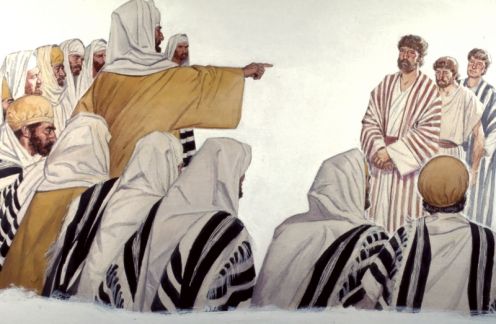
Now when they saw the boldness of Peter and John, and perceived that they were uneducated, common men, they were astonished. And they recognized that they had been with Jesus. But seeing the man who was healed standing beside them, they had nothing to say in opposition. But when they had commanded them to leave the council, they conferred with one another, saying, “What shall we do with these men? For that a notable sign has been performed through them is evident to all the inhabitants of Jerusalem, and we cannot deny it. But in order that it may spread no further among the people, let us warn them to speak no more to anyone in this name.” So they called them and charged them not to speak or teach at all in the name of Jesus. But Peter and John answered them, “Whether it is right in the sight of God to listen to you rather than to God, you must judge, for we cannot but speak of what we have seen and heard.”

–Acts 4:13-20 (ESV)

Solemnly charged not to speak in Yeshua’s (Jesus’s) name, the apostles replied, “Whether it is right in the sight of God to give heed to you rather than to God, you be the judge; for we cannot stop speaking about what we have seen and heard.”

The Sanhedrin could argue that they were God’s ordained authority on earth, therefore disobedience to them was disobedience to God. It was a difficult contradiction, and one faced by others in Jewish history. Decisions the legislators adopted by majority consensus were also adopted as the ruling in heaven. (see b.Bava Meitza 59a-b)

What does one do when God-ordained institutional authority rules in contradiction with the will of God? The Master had already prepared his disciples for just such a circumstance. He had foreseen the way things would go and had assured His disciples that they would possess “the keys to the kingdom of heaven” and the right to make legal determinations of binding and loosing. (Matthew 16:19) As apostles of Yeshua, the twelve disciples represented the authority of the throne of David. That important legal power gave Simon Peter and the Twelve the right to overrule the Sanhedrin if necessary.

-from Torah Club, , Volume 6: Chronicles of the Apostles
Torah Portion Lech Lecha (“Go Forth”) (pg 78)
Commentary on Acts 2:42-4:31
Produced by First Fruits of Zion (FFOZ)

It’s all fine and well for Jesus to assure “His disciples that they would possess ‘the keys to the kingdom of heaven’ and the right to make legal determinations of binding and loosing,” but what about us? The apostles represented a direct link to the Messiah, since they had been taught by him and the giving of the Holy Spirit to them, in a very public visible and physical demonstration, was only days or weeks old. While the Sanhedrin could attempt to refute and even defy their “Messianic authority,” a good many witnesses in Jerusalem were more than convinced, and correctly so. Not only that, but there could have been no doubt in the minds of Peter, John, and the rest of the apostles, that they were in the right. Thus they had not only the authority, but the confidence and certainty of mind to be able to stand up in defiance of an order of Israel’s authentic and authoritative legal court system.

But how does D. Thomas Lancaster’s commentary on the legal authority of the apostles to defy the legal authority of the Sanhedrin affect us? That is, who holds “the keys to the kingdom of heaven” today?

You might say, “the church,” but which one? How many denominations of the Christian church currently exist?

According to the Center for the Study of Global Christianity (CSGC) at Gordon-Conwell Theological Seminary, there are approximately 41,000 Christian denominations and organizations in the world. This statistic takes into consideration cultural distinctions of denominations in different countries, so there is overlapping of many denominations.

-quoted from “Christianity Today – General Statistics and Facts of Christianity”
christianity.about.com

Oh my!

That’s a lot of denominations, and they don’t take into account a lot of the more fringy or cult-like groups who also claim some sort of authority to interpret scripture over their flocks in a legal manner.

And then there’s the Internet. As we’ve seen in a seemingly endless stream of religious blogs and their associated comments, there is a plethora of groups and individuals who claim to collectively or personally possess “the keys to the kingdom of heaven” and the right to defy the more established Christian authorities.

I suppose we could split the difference 41,000 (legitimate) ways within the body of Christianity and say that each church possesses a set of keys as applied to their own communities, and that their authority, as it were, is limited to the confines of said-communities, but that’s not really satisfactory. There are not 41,000 Gods and there are not 41,000 Christs, and there are not 41,000 Holy Spirits. God is One. While I believe, to a certain degree, that how the Bible principles are applied may vary and even evolve over the centuries in order to serve the needs of each generation, there is still an objective God; a God unto Himself, the One God with One Mind, and One Spirit, who cannot be subdivided in any manner, even though we may want and even need Him to do so for the sake of our own priorities.

So who inherited the “keys of the kingdom of heaven” or were they simply lost over the course of time?

That’s the problem we are having today. Look at the struggles the “early church” had in Jerusalem. They never became a major power in the Jewish hierarchy. They remained a small Jewish sect operating within the larger collection of valid Judaisms of the late Second Temple period and to some small degree, beyond the destruction of the Temple (but not very much farther). If there was one authentic Messianic (Christian) Jewish authority with the living apostles of Christ among the many Judaisms, when the Jews either surrendered Christianity to the nations or were “kicked out” of the assembly of the Messiah by the Gentiles, what happened to that authentic authority? Was it divided and subdivided, and subdivided again, endlessly across history, like a single-celled organism replicating, evolving, developing to form some vast living mass that is associated but not particularly unified? Is that authority shared among 41,000 living “cells” in what is (loosely) collective Christianity today?

Who currently has the right to make legal decisions that are binding both on earth and in Heaven and to defy all of the others who claim authority over the “Christian church?”

Oh, it gets worse.

It has been taught: On that day R. Eliezer brought forward every imaginable argument, (Lit., ‘all the arguments in the world’) but they did not accept them. Said he to them: ‘If the halachah agrees with me, let this carob-tree prove it!’ Thereupon the carob-tree was torn a hundred cubits out of its place — others affirm, four hundred cubits. ‘No proof can be brought from a carob-tree,’ they retorted. Again he said to them: ‘If the halachah agrees with me, let the stream of water prove it!’ Whereupon the stream of water flowed backwards — ‘No proof can be brought from a stream of water,’ they rejoined. Again he urged: ‘If the halachah agrees with me, let the walls of the schoolhouse prove it,’ whereupon the walls inclined to fall. But R. Joshua rebuked them, saying: ‘When scholars are engaged in a halachic dispute, what have ye to interfere?’ Hence they did not fall, in honour of R. Joshua, nor did they resume the upright, in honour of R. Eliezer; and they are still standing thus inclined. Again he said to them: ‘If the halachah agrees with me, let it be proved from Heaven!’ Whereupon a Heavenly Voice cried out: ‘Why do ye dispute with R. Eliezer, seeing that in all matters the halachah agrees with him!’ But R. Joshua arose and exclaimed: ‘It is not in heaven.’ (Deut. 30:12) What did he mean by this? — Said R. Jeremiah: That the Torah had already been given at Mount Sinai; we pay no attention to a Heavenly Voice, because Thou hast long since written in the Torah at Mount Sinai, After the majority must one incline. (Ex. 23:2 though the story is told in a legendary form, this is a remarkable assertion of the independence of human reasoning)

R. Nathan met Elijah (It was believed that Elijah, who had never died, often appeared to the Rabbis) and asked him: What did the Holy One, Blessed be He, do in that hour? — He laughed [with joy], he replied, saying, ‘My sons have defeated Me, My sons have defeated Me.’

–Baba Mezi’a 59b

The Torah Club commentary, from which I quoted above, refers to this Talmudic story, and it is believed in observant Judaism, that the right of the Rabbis to interpret and apply halakhah in an authoritative manner derives from this passage as attached to Deuteronomy 30:12 (Stone Edition Chumash):

It is not in heaven, [for you] to say, “Who can ascend to the heaven for us and take it for us, so that we can listen to it and perform it?”

My Christian reading audience is probably asking why any of this matters, since the Jews do not have authority to interpret scriptures for Christians, and especially not to establish halakhah for us. That’s a good question and you’re right. We don’t expect any of the Talmudic rulings to have any sort of impact, let alone authority, over any of the 41,000 Christian denominations (and their variants, spin-offs, or edge case adaptations) today.

But what about Jews who profess Jesus Christ as the Jewish Messiah King, not as members of a Christian church, but as disciples of Yeshuah HaMashiach (Jesus the Christ) within a wholly Jewish ethnic, cultural, and halakhic religious and lifestyle context? What about Messianic Judaism?

When G-d intrusted Israel with the Torah, He commanded them to appoint leaders to interpret the Torah and to judge whether or not the people had broken the Torah. Inherent in this process is the development of case law, history, tradition of the Jewish people which establishes the precedence that fleshes out the full meaning and implications of each of the commandments. This body of tradition was created by the Jewish people at the commandment of G-d…The Torah invests the divine authority in the spiritual leaders of the Jewish people (this is in the Deuteronomy ch. 17), where their rulings are called…”a word of Torah”. Any Israelite presumptuous enough to reject the rulings of the judges of Israel was cut off from his people, the same punishment as for someone who rejected the written Torah. How much more presumptuous is it for a gentile to cast off entire body of Jewish tradition and claim the right to act as the judge and definer of the Torah?

-Boaz Michael
President and Founder of First Fruits of Zion (FFOZ)
Speaking at the Union of Messianic Jewish Congregations (UMJC) July 2012 conference in Baltimore, Maryland
as quoted by Gene Shlomovich on his blog
Daily Minyan

We see that in some corners of Messianic Judaism (as I define it), there is a serious devotion to the authority of the Jewish people to define themselves as Jews and to determine halakhah for themselves based on the authority of the sages. This rather flies in the face of we non-Jewish Christians but is a particular “thorn in the side” of some of those non-Jews who have either directly (by attending authentic Messianic Jewish congregations) or tangentially (through an affiliation with some form of the Hebrew Roots movement) attached themselves to a (more or less) “Jewish” viewpoint on the New Testament scriptures, Jesus as the Jewish Messiah, and God as the God of Israel.

I’ll tell you right now that I don’t know what all this means and that I don’t have the answers to the questions I’m asking. Because of this, some people accuse me of not knowing if I’m coming or going, and I suppose that is a valid concern from an outside observer’s point of view. On the other hand, there are others who feel exactly the same way about the impact and the consequences of a real, authentic, and transparent life of faith and trust in God as we attempt to grasp the meaning of the Bible across the history of the Jewish people and the world.

The Messianic Jewish Rabbinical Council (UJRC) has established a written Standards of Observance (PDF) document that is intended to guide its member synagogues in the appropriate halakhic rulings as adapted for Messianic Jews, but it is only one body and cannot possibly represent all Jews who profess Yeshua as Messiah everywhere. It also, by necessity, defines a varying level of halakhic response for the non-Jewish disciples who come under the MJRC’s authority, but again, the scope if such authority is limited. These standards do not solve the problem or answer the questions I’ve been posing in today’s meditation however, but only because, like the multitude of Christian churches that exist today, it can’t, at least not outside its own community. We don’t have a universal legal and theological interpretation of scripture where “one size fits all.”

We long for the coming of Messiah. Christians desperately await the return of the King in all his glory. We have many reasons for doing so but one of the reasons I seek him and his presence is to help me understand who indeed on earth holds the “keys to the kingdom,” if anyone. Many claim to hold them or at least know the path on which to travel to find them. Many would-be “Messiahs,” religious leaders, pundits, and self-taught scholars of one stripe or another, profess to know “the truth.” But who are we to believe except God Himself, but how we understand God through the Bible and even through the Spirit, is split at least 41,000 ways, from a Christian perspective.

How am I to choose among 41,000 paths, and probably more if I factor in my own fascination with Judaism, as applied to my Christian faith? I can’t. I can only choose one of the myriad ways as they stand before me and start walking, trusting that God will not allow me to travel the wrong path, nor select a guide made out of my ego, my biases (at least not too severely), or my weaknesses, but only His Son, and the lamp of the throne of David.

May he and I walk together discovering the truth of his existence and my own. May God grant you this gift as well, for this may be all we can do until Messiah returns to rule in Jerusalem, and reveals clearly the One God and the One Way from His Temple.

Blessed is Hashem from Zion, He Who dwells in Jerusalem. Halleluyah!

–Psalm 135:21 (Stone Edition Tanakh)

For from Zion shall go forth the Torah, and the word of Hashem from Jerusalem.

–Micah 4:2 (Stone Edition Tanakh)

64 days from now, on my path, chosen from among 41,000 paths, (and probably more) where will I find myself?


Stealing a Conversation About Ephesians, Jesus, and Being a Christian

The big problem in christianity and also messianic judaism is that there seems to be little knowledge on why Yeshua came an what His proclaimed Kingdom of Heaven / Kingdom of G-d meant and what the goal of entity for the Jews really was.

If everyone would see that, than there was not so much competition on to be or to be not Yisrael (though important still) and urge to take the law upon him or herself because of thinking that is the goal.

Did Yeshua come to bring the law? He certainly didn’t come to take it away! But why did he come and what was His message?

-Shmuel haLevi
October 15, 2012 11:52 am
Daily Minyan

This probably won’t be as organized or concise as I’d like it to be, but there was a terrific conversation on Gene Shlomovich’s blog post One-Law Gentile has a change of heart and I wanted to try and preserve some of the more helpful contributions. Most information about the New Testament and the purpose of Jesus in coming “first the Jew and then the Gentile” is interpreted by traditional Christian doctrine, with some “fringy” commentary by “edge case scholars,” so it’s difficult to get a more balanced perspective. I’ve recently been accessing Volume 6 of the Torah Club, which is a study on the book of Acts produced by First Fruits of Zion (FFOZ), to round out my education somewhat, but additional sources are most helpful.

I am attempting to put together the information I’ve gathered from the discussion at Gene’s blog in a way that not only presents it to readers visiting my blog in a meaningful way, but also to help clarify my understanding of some of the New Testament writings from a more Jewish perspective.

Above, Shmuel haLevi brings up an important issue. If the Torah was supposed to be generalized to the entire world as a “universal law” for everyone, and not exclusively to the Jewish nation in all its aspects, why couldn’t Israel have “evangelized” the nations at any time it wanted? Why was Jesus necessary to “spread the Torah” to his non-Jewish disciples, and yet not require that they convert to Judaism?

Unless, of course, the Jewish Messiah commanded his Jewish disciples to bring the nations into discipleship not specifically to turn them into “Jews without a circumcision,” so to speak.

The following is a collection of selected quotes from Gene’s blog post comments section. I’ve provided the links to the original source above so you can see all of the material in context.

That’s an excellent point, Shmuel. If people think that the goal of Yeshua’s coming was to give the Torah to the Gentles, so to speak, then the entire goal of their (our/my) faith will be in “keeping the (mechanics of the) Law” … Alternately, if he came to bring the nations into reconciliation to God and to allow us to become members of the Kingdom as the goal, then our entire focus changes. Love, grace, compassion, mercy all become our focus and the mitzvot of feeding the hungry, visiting the sick, and granting mercy and grace as it has been granted to us becomes the fabric woven into our lives as believers.

-me
October 15, 12:08 pm

…like many others you discovered there were geirim in TaNaCH. And there was the same law for them and for the inborn Yisraelites. But that was not the reason why Yeshua came. The Hebrews had already received the Torath Mosheh and Gentiles were welcome to join, becoming Jews in nationality. So, that could not have been the reason for the coming of the Mashiach. Gentiles already could be righteous, adhering to the Torath for Adam weNoach. That was enough. But if one insisted, felt drawn to join Yisrael and wanting to serve HASHEM in the same way, that was possible but certainly not obliged. Nor is it in the New Covenant.

-Shmuel haLevi
October 15, 5:05 pm

So if a Gentile could convert to Judaism to take on the Torah mitzvot, and if a Gentile could be considered righteous under the covenant God made with Noah, why indeed did Jesus come? Could the secret be somehow concealed with Cornelius the Roman (see Acts 10) as well as Nebuchadnezzer, King of Babylon and the King of the city of Ninevah?

“Every convert in history became part of Israel.” ???

But not every true servant of the Most High became part of Israel.

“Now I, Nebuchadnezzar, praise, exalt and honor the King of heaven, for all His works are true and His ways just, and He is able to humble those who walk in pride.”

Nebuchadnezzar remained King of Babylon.

The city of Nineveh sincerely repented in sackcloth, and remained Assyrian.

The Roman Centurian, who loved Israel, remained Roman.

The uncircumcised listed above were true servants of G-d and did not become part of Israel.

-benkeshet
October 15, 6:31 pm

This may seem kind of disjointed and please remember, I’m “cherry picking” the content to try and “copy and paste” the most relevant pieces of the conversation together, so there are obvious sections of the conversation that have not been included.

Except for Cornelius and his acceptance of discipleship under Jesus that we find at the end of Acts 10, we don’t see an apparent role for Jesus in the above examples. The Kings of Babylon and Ninevah (and in fact, the entire population of Ninevah) were considered “righteous Gentiles” and did not have to join the nation of Israel in any sense in order to be considered righteous. In fact, as we recall from Paul’s letter to the Romans, Abraham was considered righteous by faith before taking on the covenant sign of circumcision. (see Genesis 15:6, Romans 4:3)

But while this is a good argument that a non-Jew doesn’t have to become a Jew or a member of the nation of Israel to attain righteousness, where does Jesus come in?

Paulos said the be the Jews as a Jew, Greeks as a Greek. You cannot come in the same way with the Good Message to the Jews as to the Gentiles. So the way he spoke and the focus in the words of Yeshua before His last instructions where Yisraelite centered.

-Shmuel haLevi
October 16, 3:02 pm

So is there some sort of dual path to righteousness, one for the Jew and one for the Gentile?

…if Paulos meant here that they now became citizens of Yisrael. Also the Yisraelite had not jet reached their destination. Yeshua said, in the house of my Father are many mansions (John 14:2). The resemblance on earth of the Fathers House was the Temple, which had on each side the mansions of the Cohanim – the Priests. This was the promess that Yeshua disclosed since it was done and proclaimed in Shemoth 19:6. According to Yeshayahu 61:6 it would occur in the Messianic age. Making it possible to come to this status, the heavenly Heichal was disclosed for those, the Heichal (Temple) is were the King resides on His throne, so there is were the Kingdom is. That day that the heavenly Heichal will be joined with Yerushalayim, the Kingdom of HASHEM wil be established to rule over all the aerth. But we can chose to be part of it right know and spread the good message that was spread through our Mashiach to Tzion: That their G-d is King (Yeshayahu 52:7).

So it is my question if the focus was to only being brought near to Yisrael, or even something which was not jet reached by Yisrael itself: The Mamlecheth Cohanim – the Kingdom of Priests. This citizenship might be where Paulos pointed at. The higher plan that was promised! We Jews all know that the land of Yisrael is Holy, but Yerushalayim even more, and The Templecourt even more, and Holy place even more and and the Holy of Holies even more. It is because what they represent and are as, connected with it, as in Heaven also on Earth.

-Shmuel haLevi
October 26, 3:36 pm

Now here’s where the role of Jesus comes in for the Gentile.

The focus of Moshiach has always been the entire world.

“3 And many people shall go and say, Come ye, and let us go up to the mountain of the Lord, to the house of the God of Jacob; and he will teach us of his ways, and we will walk in his paths: for out of Zion shall go forth the law, and the word of the Lord from Jerusalem.”

Yeshayahu was speaking of Yeshua Rabbeinu. Yeshua didn’t change plans. His plans are consistent. His plans ALWAYS included the gentiles–even if it appeared as though He didn’t care about the gentiles.”

He came first to the Jews and than the maessage came to the Greeks as prophecied: Yeshayahu 49:3-6.

-Shmuel haLevi
October 16, 3:39 pm

So what we have so far is that Jesus has the focus of the entire world, Jew and Gentile alike, but while (and I’ve alluded to this previously) the Jews were already a covenant people under all of the prior covenants God made with Israel, the rest of the world could not access the same covenant closeness with God except through “Abraham’s seed,” the Messiah. The Messiah, Jesus, is required for the non-Jewish people of the world to come into covenant relationship with God in any way whatsoever!

benkeshet (at October 18, 4:32 pm) delivers an excellent analysis of Ephesians 2 which is too long for me to replicate here in its entirety. However, I’ll quote some of the relevant portions. Here’s a description of the non-Jewish races without Jesus:

And you were dead in the trespasses and sins 2 in which you once walked, following the course of this world, following the prince of the power of the air, the spirit that is now at work in the sons of disobedience—3 among whom we all once lived in othe passions of our flesh, carrying out the desires of the body and the mind, and were by nature children of wrath, like the rest of mankind.

Now here are verses 13-20 with additional emphasis by benkeshet:

13 But now in Messiah Yeshua you who once were far off [as children of wrath] have been brought near by the blood of Messiah. 14 For he himself is our peace, who has made us both [Israel and the Nations] one and has broken down in his flesh the dividing wall of hostility 15 by abolishing the law of commandments expressed in ordinances, that he might create in himself one new man [or one new Humanity] in place of the two [i.e. Israel at enmity with the Nations], so making peace, 16 and might reconcile us both [Israel and the Nations] to God in one body through the cross, thereby killing the hostility. 17 And he came and preached peace to you who were far off [Nations who had been children of wrath] and peace to those who were near [Israel]. 18 For through him we both [Israel and the Nations] have access in one Spirit to the Father. 19 So then you [Nations] are no longer strangers and aliens [or children of wrath], 4 but you are fellow citizens with the saints [Israel] and members of the household of God, [Genesis 22:18 and in your Offspring shall all the Nations of the earth be blessed – i.e. redeeming them from being children of wrath] 20 built on the foundation of the apostles and prophets, Messiah Yeshua himself being the cornerstone…

What we gather here is that Jews and Gentiles are both reconciled to God through Messiah but both groups retain their identity (i.e. Israel and the Nations). The “belonging” that we Gentiles become inserted in is not Israel; that is, we do not become Israel, rather, we become citizens of the Kingdom of God, but Israel is still Israel and the Christians from the nations are still citizens of their respective nations. The only shared citizenship between a Jew and a Christian under Messiah, is citizenship in God’s Kingdom. What Jews and Christians equally share in is that we have “access in one Spirit to the Father” (verse 18).

benkeshet describes it this way:

Israel and the Nations do not lose their distinctiveness. Rather, what was lost was the enmity between them, which has been destroyed by Messiah’s sacrifice. Both Israel and the Nations have access to the Father via ONE SPIRIT because of faith in Messiah.

This is just the best description of the whole “one man out of two” discussion of Ephesians 2 that I’ve read and I especially wanted to share it here. I’m thankful to Gene, Shmuel haLevi, and benkeshet for their contributions to not only the source discussion, but to my personal education.

There is quite a bit more discussion at Gene’s blog so again, please visit it for the entire content. I know I can be accused of “stacking the deck,” so to speak, by presenting only certain fragments of the conversation, but my goal was to illustrate how we can look at portions of the New Testament, and especially Ephesians 2, in a different and more “Jewish” way, to see a clearer picture of how we non-Jews are brought closer to God by Jesus and what that does to the relationship between Christian and Jew. As you can tell, this perspective is a bit different that what you may have been taught, and it’s different than what some people want to believe, but it’s important to at least consider the possibility that the traditional Christian viewpoint on Ephesians 2 isn’t sustainable, given not only modern Biblical scholarship, but a more authentic Jewish interpretation of (the Jewish) Paul’s understanding of the topic at hand.

Shmuel haLevi (October 18, 1:33 pm) re-enforced the citizenship issue.

Yeshu talks frequently of the Kingdom of G-d. That citizenship is Paulos talking about. Both Jews and gentiles have to go into there for the true government.

I have only covered a portion of the full length of the discussion and I could add more, but then this “meditation” would be ridiculously excessive.

I hope I’ve provided enough information to make some of you curious and perhaps even to inspire a few (friendly, please) comments. I’m not trying to steal Gene’s thunder, so to speak, or to rob from his blog (and I received his permission to copy the above-quoted content prior to publishing it), but a lot of very good information is lost in the comments sections of the endless number of blogs on the web, and I wanted some of the key parts of this conversation to survive Internet oblivion.

A Walk to Redemption

WalkingThe chassidic community in Poland was in a state of shock. The great chassidic master Rabbi Moshe of Lelov had decided to ascend to the Holy Land and settle there. How could they possibly go on without his leadership?

To his closest disciples the rebbe revealed that when he was a small boy, his father, Rabbi David of Lelov, had said to him: “I did not merit to see the Holy Land, but you must go there. Through your divine service which you will perform there, you will succeed in bringing Moshiach sooner, and hastening the Redemption.”

-Rabbi Yerachmiel Tilles
“The Shattered Goblet”
Chabad.org

Last spring, after Shavuot, I wrote a two-part meditation called “Redeeming the Heart of Israel,” Part 1 and Part 2. I received a certain amount of criticism because I was perceived as somehow elevating Israel and the Jewish people above the non-Jewish believer in the Messiah. While the church is slowly moving away from its stance of supersessionism (I know, I used that word, again) and anti-Israel/anti-Jewish beliefs, it is still difficult for many Christians to take Paul at his word and believe that “all Israel will be saved.” (Romans 11:26)

Part of the problem is understanding what redemption means. From a traditional Christian point of view, individuals are redeemed; we are saved by our faith in Jesus Christ, which generally means, when we die, we go to Heaven. All seems so nice and simple and reassuring. But that’s generally not how Jews see the concept of redemption and the coming of Messiah. As we see from Rabbi Tilles’ story, it is clear that the coming of the Messiah is closely coupled with the redemption of national Israel, not necessarily focused on each individual’s redemption (although this too is important). However, the Jewish point of view is often criticized by Christians as extra-Biblical and thus invalid.

But is this actually true or did Christ’s own disciples believe he was supposed to accomplish Israel’s national redemption?

So when they had come together, they asked him, “Lord, will you at this time restore the kingdom to Israel?” He said to them, “It is not for you to know times or seasons that the Father has fixed by his own authority. But you will receive power when the Holy Spirit has come upon you, and you will be my witnesses in Jerusalem and in all Judea and Samaria, and to the end of the earth.”

–Acts 1:6-8 (ESV)

I’ve mentioned all this before, but I don’t know if anyone is taking the message seriously. I’m not trying to “undo” or contradict the doctrine of personal salvation through Jesus Christ, but to illustrate that one of the things he will do upon his return, that was expected the first time he was here but not accomplished, is to restore Israel as a nation to a state of rule over the earth, and return the Jewish people to their Land and heritage in glory and honor.

That’s the part some Christians, including some of those in the Hebrew Roots movement, have a problem with. The “inequality” among the body of believers in the form of salvation coming from the Jews. (John 4:22) Traditional Christianity has historically taught (and thankfully, this is changing) that the church has replaced the Jews in all of the covenant promises, and that Jesus killed the Torah in the process. Hebrew Roots maintains that the Torah still lives, but that the distinctions between Jew and (Christian) Gentile have been totally eliminated and there is only one new identity before God, the “Messianic” identity, despite the fact that God has promised to be a God to the Jewish people forever, to return them to their Land, and to establish Israel as the head of all the nations (i.e. the rest of us).

If you read all of Rabbi Tilles’ tale, you’ll see that sadly, Rabbi Moshe of Lelov never accomplished his mission to reach the Kotel and summon the Moshiach. It is believed that this occurred because the time for the Moshiach’s arrival had not yet come. While Christianity doesn’t believe we can do anything to hasten the return of Jesus, Jews believe by performing acts of tikkun olam or “repairing the world,” that we all, Jews and Gentiles alike, can take part in bringing the time of his coming (or return) just a little bit closer.

In the face of everything I’ve just said, we Christians have a couple of choices. We can accept that the Bible is telling us that we are dependent on the Jews for our salvation through the Jewish Messiah and our covenant relationship with the God of Israel, or we can ignore those parts of the Bible that present this information and focus on either the traditional church doctrine of supersession, or one of the variants being created in minority movements within larger Christianity (which includes Hebrew Roots in general and it’s subgroups such as One Law, which indeed is a Christianity and not a “Judaism”).

Probably the most lively debate on this topic currently happening (though it seems to be winding down) in the blogosphere is on Gene Shlomovich’s blog. I’m actually learning a great deal from a few of the individuals posting (and I may mine some of those comments and pull them together for a future “meditation”), mixed in with the more expected objections to Jewish “choseness” within the Messianic body. But I struggle to remember a lesson that I very recently wrote discouraging the acceptance of someone else’s “gift” of their own anger and hostility, which is not an easy task on the web, but one that is absolutely necessary if we are to truly call ourselves disciples of our Master.

We see in the early chapters of Acts that the community of disciples of Jesus Christ were all Jewish and that, upon accepting the Spirit and declaring their discipleship, the Jews did not deviate in any way from being Jewish. In fact, in the Torah Club commentary I’m reading this week, the early Jewish disciples are referred to as “The Temple Sect.”

Contrary to popular assumptions, the disciples did not teach against the Temple or the Levitical worship system. If the gospel did cancel the Torah and the Levitical worship system, the apostolic community in Jerusalem seems to have been ignorant about the change. They continued to revere the Temple and participate in its services throughout their lives.

The disciples of Yeshua revered the Temple because their Master revered it. He regarded the Temple as his “Father’s house.” As a boy, Yeshua was reluctant to leave the Temple courts. As an adult, He was found in the Temple teaching and attending the festival services. He spent the last days of His life, prior to his crucifixion, in the Temple. He prophesied its coming destruction only with sorrow and weeping…

After the ascension, his disciples “were continually in the temple praising God” (Luke 24:53). They were likely in the Temple when the Holy Spirit was poured out upon them on the day of Pentecost. Aftr that, they remained day by day in the Temple together.

As I continue my study of the book of Acts in the First Fruits of Zion (FFOZ) Torah Club, I hope to find that my perceptions are becoming clearer on these points, including what redemption truly means for Israel and the nations, and where we all stand, Jews and non-Jews, as brothers and sisters in the Messiah.

In my Days series, I’ve been recording my plans to return to more traditional Christian fellowship, in part to reconcile on some level with the larger body of Gentile believers. I don’t know how successful I will be, but I’ve been challenged to trust God more than I have in the past. Hopefully, the ground will remain firm rather than falling out from under me.

Walter Donovan (Julian Glover): As you can now see, Dr. Jones, we are on the verge of completing a quest that began almost two thousand years ago. We’re just one step away.

Indiana Jones (Harrison Ford): That’s usually when the ground falls out from underneath your feet.

from the film
Indiana Jones and the Last Crusade (1989)

Hopefully and with God’s grace, my journey toward reconciliation and redemption will also have a “happy ending.”

68 Days: Encouragement

I really, really needed this post today. Sent it to my husband and daughters. The story about Rabbi Schneur Zalman was wonderful. Thank you for writing. You are indeed a benefit to the body.

Blessings!

-Linda in a comment on
one of my blog posts

For God has not destined us for wrath, but to obtain salvation through our Lord Jesus Christ, who died for us so that whether we are awake or asleep we might live with him. Therefore encourage one another and build one another up, just as you are doing.

–1 Thessalonians 5:9-11 (ESV)

Sometimes when I’m physically tired and haven’t had enough sleep, I irrationally become discouraged and “bluesy.” I was feeling that way last night, especially after reading some of the more recent and “cranky” responses on Gene Shlomovich’s blog. (Gene’s blog is fine and most of the respondents are too, but not all of them, alas.) This goes along very well with my “Days” series and my countdown to renewal or (virtual) oblivion.

But I’ve been receiving some encouragement. A lot of it is “behind the scenes” but some of it comes in the form of blog comments, such as the one I quoted above. I suppose it’s sort of ironic that I should be encouraged by someone telling me that I’m encouraging them. But isn’t that the point? One of the things I find greatly discouraging is all this bickering on the web between (supposed) brothers in Christ Jesus over who is right and who is wrong, as if this is some sort of twisted form of the recent Presidential debates, and God is the moderator who will decide who wins and who loses.

Really, if God is going to judge us on our actions, I seriously don’t think it will have much to do with our “debates” on all our blogs:

“When the Son of Man comes in his glory, and all the angels with him, then he will sit on his glorious throne. Before him will be gathered all the nations, and he will separate people one from another as a shepherd separates the sheep from the goats. And he will place the sheep on his right, but the goats on the left. Then the King will say to those on his right, ‘Come, you who are blessed by my Father, inherit the kingdom prepared for you from the foundation of the world. For I was hungry and you gave me food, I was thirsty and you gave me drink, I was a stranger and you welcomed me, I was naked and you clothed me, I was sick and you visited me, I was in prison and you came to me.’ Then the righteous will answer him, saying, ‘Lord, when did we see you hungry and feed you, or thirsty and give you drink? And when did we see you a stranger and welcome you, or naked and clothe you? And when did we see you sick or in prison and visit you?’ And the King will answer them, ‘Truly, I say to you, as you did it to one of the least of these my brothers, you did it to me.’

“Then he will say to those on his left, ‘Depart from me, you cursed, into the eternal fire prepared for the devil and his angels. For I was hungry and you gave me no food, I was thirsty and you gave me no drink, I was a stranger and you did not welcome me, naked and you did not clothe me, sick and in prison and you did not visit me.’ Then they also will answer, saying, ‘Lord, when did we see you hungry or thirsty or a stranger or naked or sick or in prison, and did not minister to you?’ Then he will answer them, saying, ‘Truly, I say to you, as you did not do it to one of the least of these, you did not do it to me.’ And these will go away into eternal punishment, but the righteous into eternal life.”

–Matthew 25:31-46 (ESV)

I know in the church, we believe that we are saved, not through what we do, but by our faith in Jesus Christ. However, we see that self-same Jesus Christ judging by what we do or fail to do for our fellow human being (and ultimately, for him). I suppose there’s no contradiction here, since if our faith and trust is true and we are actual and authentic disciples of our Master, then our actions following that faith and trust should be almost automatic. We should naturally be found feeding the hungry, visiting the sick, comforting the grieving, extending hospitality to the homeless and lost, and much, much more.

I don’t think we’ll win the race (2 Timothy 4:7) by “winning” a blogosphere argument (and let’s face it, nobody ever changed their minds on the web because of someone else’s devastating argument or piercing witticisms).

So, in writing about what I always write about, that is, whatever’s on my mind and heart at the time, I managed, through God’s grace, to encourage another believer traveling her own path of faith. Fingers pressing keys on a keyboard, and electrons zipping across the Internet managed to communicate the will and kindness of God from one human being to another. How could I not feel honored that my small “service” has been accepted as it was intended?

But I truly believe that those who really have “fought the good fight, finished the race, and kept the faith” probably don’t even know how to create a blog, let alone have the time to write on one. They’re too busy feeding the poor, clothing the naked, making sure the homeless have shelter, opening their homes to the needy, and doing a thousand other things that serve God and provide His generosity to the very least of His servants.

I’m glad, in the middle of my own meager efforts, that I was able to encourage one human being. Thank you Linda, and everyone else who has commented kindly to me, for continuing to encourage me as well. For that’s what our Master, and Paul, his Apostle to the nations, have commanded us to do.

A new commandment I give to you, that you love one another: just as I have loved you, you also are to love one another. By this all people will know that you are my disciples, if you have love for one another.”

–John 13:34-35 (ESV)

Community Snapshot: Lessons from Acts 2:42-4:31

Now Peter and John were going up to the temple at the hour of prayer, the ninth hour.

–Acts 3:1 (ESV)

At Caesarea there was a man named Cornelius, a centurion of what was known as the Italian Cohort, a devout man who feared God with all his household, gave alms generously to the people, and prayed continually to God. About the ninth hour of the day he saw clearly in a vision an angel of God come in and say to him, “Cornelius.”

–Acts 10:1-3 (ESV)

The disciples devoted themselves to “the prayers.” “Luke’s reference to ‘prayers’ rather than to prayer per se here may indicate observance of regular prayer times in the Temple – as well as the community’s own prayers.” (see Le Cornu and Shulam, “A Commentary on the Jewish Roots of Acts: Acts 1-15, 147.”) Most English versions obscure the meaning by not transmitting the definite article. The Greek says that they devoted themselves to “the prayers (tais proseuchais).”

“The prayers” should be understood in keeping with the common liturgical, daily prayers of Judaism, the synagogue, and the Temple. Six verses later, Luke depicts Simon Peter and John “going up to the temple at the ninth hour, the hour of prayer” (Acts 3:1).

This does not mean that early believers prayed out of a Siddur. Prayer books did not yet exist. It only implies that they prayed in concert with other Jewish people, following the same forms, conventions, modes, and times of prayer as the rest of the Jewish world. Their faith in Yeshua (Jesus) did not change their mode of worship. Their faith made their worship more intense and ardent.

Torah Club, Volume 6: Chronicles of the Apostles
from First Fruits of Zion (FFOZ)
Torah Portion Lech Lecha (“Go forth”) (pg 63)
Commentary on Acts 2:42-4:31

In my previous meditation about the Torah Club commentary on Acts, I tried to explain a couple of things. Based on Acts 2, I illustrated that those who were at the Shavuot (Pentecost) festival, and the 3,000 who received the Holy Spirit in Christ’s name, were all Jewish. Coupling what we read in Acts 2 with this week’s study of Acts 2:42-4:31, we can see that the very early days of “Christianity” with Peter and John in Jerusalem involved a completely Jewish religious community. In fact, this portion of Acts is devoted to the description of the early Jewish disciples of the Jewish Messiah in the weeks and months after his ascension.

I’m choosing to focus on that aspect of Jewish community involving “the prayers” for a couple of reasons. One is the obvious point that nothing about the practice of the Jewish disciples changed in the slightest because they were disciples of the Jewish Jesus. They still observed “the prayers” at the set times for prayer. They prayed together with other Jews, both disciples of the Master and any others who had gathered together, seemingly in the part of the Jerusalem Temple known as Solomon’s Portico.

However, you will notice that I again insert something from Acts 10 about the Roman Centurion Cornelius, the God-fearer, who at the beginning of that chapter, had not yet received the Christ; the Messiah, as Lord and Savior. And yet, he was praying at the ninth hour which was “the hour of prayer,” just as the Jews did, including Peter and John.

I also said in my previous missive that the non-Jewish God-fearers and later, the non-Jewish disciples of Jesus indeed took on some (or many) of the Jewish religious practices in order to imitate their mentors and in fact, at that point in history, the “Jewish model” for worshiping God was the only model available. This didn’t make Cornelius or any of the Gentile disciples suddenly Jewish or automatically obligated to a full Jewish lifestyle (otherwise, Paul wouldn’t have thrown such a “temper tantrum” in Galatians 5:1-5). However, it does mean that “Christian” worship looked a lot more Jewish, even after the first non-Jews began to be admitted as disciples, than we could ever imagine it being today.

I suppose that I’ll have a lot more material on Cornelius and the first non-Jewish “Christians” when I actually arrive at the Torah Club’s commentary on Acts 10 (which won’t happen for another six weeks or so) but I want to point out, for those of you reading this who may not already know, the discipleship under Jesus Christ for the early Jewish and Gentile believers did not entail some abrupt demarcation from what otherwise was considered “normal” Jewish religious practice. As D. Thomas Lancaster points out in this week’s study (pp. 61-62):

Notice that each of the four devotions (The Apostles’ Teaching, Fellowship, Breaking of Bread, and the Prayers) are hallmarks of Jewish practice. The new community that formed around the disciples of Yeshua did not adopt new customs or innovations that could be considered particularly Christian and distinct from Judaism. Instead, they devoted themselves to the same pursuits that might characterize any Jewish faith community. Today’s churches and communities of faith would look more like messianic synagogues if we committed ourselves to the four devotions of study, community, hospitality, and liturgy.

That recalls a question I asked not too long ago. Do Christians Practice Judaism? As we understand the concepts today, the answer must be “no.” However, as the “Messianic faith” began as a wholly Jewish expression of discipleship under the Master, what were the very first Gentiles doing when they were brought into discipleship with the Jews? For that matter, what did Cornelius think he was doing when he, as a God-fearer, prayed at the ninth hour and (presumably, though we can’t know for sure) gathered with the Jews in synagogue on Shabbat? Practicing Judaism?

Well, probably not, anymore than a modern-day Noahide could be said to be practicing Judaism by davening with Jews in a synagogue on Shabbat. But is the relationship between a Noahide and a Jew in the 21st century the same as that of a “Messianic” Jew and non-Jew in the mid-1st century? Noahides generally see themselves as bound by the covenant of Noah (see Genesis 9), while Jews claim the Abrahamic, Mosaic, and New Covenants, so strictly speaking, they are unlike members of God’s community, attached to God by different covenants.

I’ve said before that I believe we Christians have a relationship with God due to certain blessings included in the Abrahamic and New Covenants but that we are not attached to all of the same conditions within those covenants. Further, it is my belief (because there’s no evidence directly involving non-Jews) that we are not recipients of any blessings from the Mosaic covenant, which more than any of the other covenants, specifically identifies the Jewish people as a unique covenant people, even within the Messianic community of the 1st century and of the budding Messianic Jewish community of the 21st century.

But let’s wind back to the very early chapters of Acts again and take a look at the community as it existed after that first fateful Shavuot when the Spirit was given.

And they devoted themselves to the apostles’ teaching and the fellowship, to the breaking of bread and the prayers. And awe came upon every soul, and many wonders and signs were being done through the apostles. And all who believed were together and had all things in common. And they were selling their possessions and belongings and distributing the proceeds to all, as any had need. And day by day, attending the temple together and breaking bread in their homes, they received their food with glad and generous hearts, praising God and having favor with all the people. And the Lord added to their number day by day those who were being saved.

–Acts 2:42-47 (ESV)

Here we see some of what Lancaster called “the devotions,” namely teaching/studying and fellowship through breaking of bread (which is just as it sounds, eating together, rather than some special sacrament). This passage is also sometimes referred to as “Christian Communism,” since everyone “re-distributed wealth” so that everyone shared everything. This brings up a point I want to make, not only about this passage but about the larger issue of community.

There are some who would isolate this part of the second chapter of Acts and say it’s the only way a Christian community should be run, and if any other Christians are “hoarding” material wealth for themselves through private ownership of a car, house, and so on, they are in violation of their Christian faith.

But we’re only talking about five verses in a single chapter of the Bible. Who develops an entire theology and Christian lifestyle based on a tiny handful of verses taken out of context?

Actually, quite a lot of people. I tend to think of Christians and Christian groups who insist on cherry picking verses to fit some arcane theology as “on the fringe” and I hope they are indeed in the minority, because it’s a dangerous practice. Focusing on just little bits and pieces of the Bible in an attempt to justify a “pet theology” and then to “sell” it to a wider audience as some form of “scholarship” is not only dishonest but potentially misleading to people who may actually believe it for lack of any better insights on their part.

Let’s take another example from Lancaster’s commentary. He defines the early Jewish Messianic community in terms of the larger context of 1st century Judaism in Jerusalem and Roman occupied Palestine. Let’s keep in mind that there was no one, monolithic Judaism then, anymore than there is one now (that goes for Christianity too, by the way). There were differing sects of Judaism and the sect that became known as “the Way” was what we see as the early Jewish disciples of Jesus in the beginning chapters of Acts. They were Jewish. They behaved in a way that was considered acceptable relative to Jewish religious and lifestyle practices. Except for their insistence that the man from Nazareth named Yeshua was indeed the Messiah, and that he was unjustly executed and three days later, rose from the dead, their Jewish lives and teachings wouldn’t have raised an eyebrow from any other Jew in the Holy Land.

Can we take a “snapshot” of their lives as we see them lived out in Acts 2 and 3 and say that’s how we Christians should live today? Is it any more valid to say that than to say that we must live a Christian lifestyle that exactly mirrors Acts 2:42-47? Probably not. It fails to take a great deal into consideration.

If the 1st century Jewish disciples of Jesus lived a lifestyle that was completely consistent with their Jewish peers and their surrounding Jewish culture, does that translate into a bunch of non-Jewish Christians in the 21st century doing the same thing? Remember, for the most part, Peter, John, and the rest of the disciples didn’t appear particularly unusual as they prayed at the ninth our in Solomon’s Portico. They didn’t appear particularly unusual as they met together to study the teachings of their Master. They didn’t appear particularly unusual when they met together for communal meals. Lots and lots of different groups of Jewish disciples of one Rabbi or another behaved in very similar ways.

But that wouldn’t necessarily translate to Christians twenty centuries later any more than it would translate to modern Jews. Our situations have changed drastically and on top of that, we don’t have a complete picture of what the early Messianic Jewish communities looked like. We can extrapolate based on whatever knowledge we possess of wider Jewish practices in the late Second Temple era, but we have even less knowledge of “normal” Christian practices among the newly minted Gentile disciples post-Acts 10. How could we ever figure out, assuming our goal was to imitate some portion of 1st century worship behaviors, how to replicate what that community (or those communities if we assume that once early non-Jewish churches were founded, their practices began to vary from those of the Jewish disciples in the synagogues) did way back in the first weeks, months, and years after the ascension of Jesus?

We can’t, at least not to a high degree of reliability and detail. What we can do is take what we understand of some of the general principles we see lived out and match them up with some of Christ’s teachings within a larger Biblical context and figure out some foundational points with which to connect.

Meeting together? Don’t we do that now? Don’t we have churches? Don’t we have home Bible studies? Don’t we serve food and eat together? Don’t we study together? Don’t we pray together?

Didn’t I just cover Lancaster’s four devotions in the previous paragraph?

Nothing in what we’ve seen in the first chapters of Acts necessarily tells us that the Gentile disciples (who didn’t exist during that time frame) where to behave exactly like their Jewish counterparts. It does tell us that the early Jewish disciples behaved very consistently with the Jewish religious and cultural practices in which they lived. Those Jews believed Jesus Christ was the Messiah and yet there was nothing at all to say that they ever stopped being Jews, stopped making sacrifices at the Temple, stopped celebrating the traditional festivals, stopped keeping kosher, stopped observing the Shabbat, stopped…you know what I’m getting at.

In the days when the Second Temple still stood and after the ascension of Christ, there was nothing to show us that the so-called “Jewish Christians” stopped being Jewish and started being “Christian” as we understand the term today.

But while I’m content to table what the later (from an Acts 3 point of view) Gentile disciples were supposed to do within what appears to be a wholly Jewish religious arena (I know I just left this question hanging, but I’ll pick it up again in subsequent studies of Acts via Torah Club), can we say that if the ancient Jewish disciples of the Master lived completely Jewish lifestyles and those lifestyles were totally consistent with their discipleship under Jesus Christ, could the same be true for the modern Jewish disciples of the Jewish Messiah?

Most of my regular readers (the ones who typically comment, anyway), already know that answer. But some of you, especially if you’re just surfing in here, may be a bit surprised. Food for thought.