Category Archives: Uncategorized

A Creative Life

The Chazon Ish, zt”l, teaches how we should relate to a new baby. “The astounding miracles of matrimony, birth and raising a child open a person’s heart and eyes and his ears to see that nothing ‘just happens.’ This experience should awaken any thinking person’s ability to be emotionally moved.

“This is the meaning of the Midrash Tanchuma on the verse וילדה זכר And she birthed a male.’ The Midrash applies the verse, ‘ ואין צור כאלוקינו ’ to this. It explains there that the word צורcan be understood to refer to צייר which means one who fashions. In this context the verse is saying that there is none who can fashion like God does. A human makes a picture on the wall. Can it move? Can it breathe? Can it speak? God creates man who moves, breathes and speaks. An expert painter has many types of paint to create a picture. God can create a human from one drop.

“We see from here that one who sees a child should be filled with wonder. Studying a child should bring one to contemplate the works of God. Giving this any thought should lead one to the same conclusion as the Midrash: ‘There is צייר , no artist like God.”

Rav Yechiel Michel Stern pointed out the obvious question on this midrash: “It seems strange that our sages took the verse ‘ ואין צור כאלוקינו ’ out of the simple meaning. Usually the word צור literally rock, means forceful or powerful, and does not refer to an artist or fashioner.

“The Maharsha in Berachos answers this question. Since the verse tells us that there is no צור like God it implies that there are others which should be referred to as צור , but they cannot be compared to God. Clearly, here we are speaking not of the one and only Rock, but of a different meaning related to the root צור!”

Daf Yomi Digest
Stories Off the Daf
“The Ultimate Artist”
Niddah 41

In Rabbi Yaakov Menken’s commentary on last week’s Torah Portion Chukat, he addresses the mystery behind the sin that resulted in the death of Aaron and Moses being denied entry into the Land of Promise. For many, trying to comprehend what sin Aaron and Moses committed that was worth so terrible a price is extremely difficult. But we must remember that not only were Aaron and Moses born to accomplish a very high purpose, but we see that the more exalted a person’s holiness, the more is required of them. In other words, the higher you fly, the further you have to fall.

Precisely because the Bible is dealing with individuals on an exalted spiritual level, if it were to tell us merely what they did, we would be unable to perceive anything wrong. For those people, their behavior was no less a transgression than if a more common individual had committed a major sin such as murder, adultery or idolatry — and thus the Prophets use severe language, similar to HaShem’s own words that Moshe and Aharon “did not believe” in Him. Just like the anthropomorphic references to HaShem Himself, these passages use language which we can understand, so that we can learn from them, but are not intended to be taken literally at all.

Every human being is just that — human — and no one is perfect. Even as we are humbled by recognition of the heights reached by prophets and great scholars, we should never lose hope, or imagine that those who came close to G-d were truly angels, without inner struggles or difficulties. This is the lesson the Torah brings home to us when attributing unimaginable ‘sins’ to our forebears. And yet it is also incumbent upon us to realize that we could be, ourselves, so close to HaShem that our ‘sins’ would be something we could not even recognize today.

Perhaps one of the reasons why this event in the Bible is nearly impossible for most of us to understand is that the majority of us are not tzaddikim; exceptionally righteous ones. Our worldview does not operate at such an exalted level. In the same manner, this is most likely what made it difficult for Christ’s own disciples to understand him at times and, what continues to contribute to what we often refer to as “the difficult sayings of Jesus” as seen from the perspective of the 21st century believer.

I know most Christians like to think of Jesus as ultimately approachable, friendly, kind, and understandable, but in spite of 1 Corinthians 2:16, we may be forced to admit that the mind of the Messiah is beyond most of us. Even the sins of those lesser than the Messiah but still exalted Holy ones are difficult to comprehend. Hence the following from Rabbi Menken:

On Rosh HaShanah, there is a tradition to go to a body of water and “cast off” one’s sins, as it were, and ask that they be covered over like water covers and hides the fish who swim within it. Many Chassidim have a custom to take bread crumbs along and throw them in, to give physical expression to this idea.

It is said that after a particular Chassidic Rebbe threw crumbs into the water in accordance with this custom, one of his Chassidim bounded into the lake and began to retrieve them. When questioned, the Chassid explained: “what the Rebbe considers his ‘sins’ are Mitzvos where I’m concerned!”

For years, I couldn’t understand this story or its intended lesson. A transgression is a transgression! But then, I heard that the Chofetz Chaim, Rabbi Yisrael Mayer HaKohein Kagan (perhaps the greatest known Torah scholar of the last century) once repented on Yom Kippur for having wasted eight minutes from Torah study during the previous year.

Can we imagine wasting merely eight minutes in an entire year? I would be extremely happy to say that I had managed to waste no more than eight minutes on a given afternoon! Maybe, maybe I’ve spent a few hours without wasting eight minutes once in my life. Maybe.

It’s impossible to imagine being able to account for every moment of every day, save eight minutes (I would almost be relieved to be told that I had heard this story incorrectly). And this is what the Chassid was saying: for us, it would be a great Mitzvah! The sins of great people occur at such a level of precision, that _reaching_ that level, to be worthy of being judged at that level, would be a phenomenal achievement.
Previously, I momentarily seemed to disregard a passage from 1 Corinthians 2, but I’d like to revisit those words in the context of Paul’s epistle:

Now we have received not the spirit of the world, but the Spirit who is from God, that we might understand the things freely given us by God. And we impart this in words not taught by human wisdom but taught by the Spirit, interpreting spiritual truths to those who are spiritual.

The natural person does not accept the things of the Spirit of God, for they are folly to him, and he is not able to understand them because they are spiritually discerned. The spiritual person judges all things, but is himself to be judged by no one. “For who has understood the mind of the Lord so as to instruct him?” But we have the mind of Christ. –1 Corinthians 2:12-16 (ESV)

This part of Paul’s letter makes it seem like, with the guidance of the Holy Spirit, all believers and disciples of the Jewish Messiah should have an equal ability to comprehend the Word of God, as if we were Jesus Christ himself. But do we? If we did, you’d think that the endless myriad of questions I post on this blog wouldn’t exist or would just be rather moot. You’d think instead of the 35,000+ Christian denominations (and counting) that exist in the world, we’d have only one. You’d think that we would all have the identical understanding of God and the very same template for organizing the community of faith.

You’d think God would have finished writing the Word upon our hearts by now. But apparently, He hasn’t.

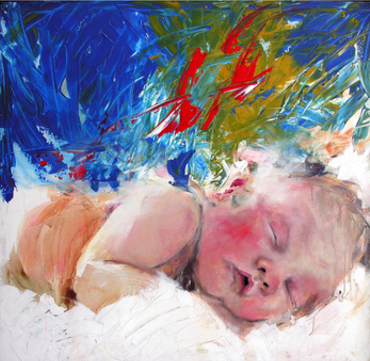
As we saw in the “Story Off the Daf” from which I quoted earlier, God can be considered a magnificent artist. He fashions each and every one of us miraculously and He has repeated His artistry in an endless progression from the beginning of Genesis until now. He is creating His “paintings” still, and will continue to do so until a point in time we cannot yet even begin to grasp.

And He has created us for many purposes, all of which serve His will. But all that being true, He gave us the gift of self-determination to the point where only a human being may actively and purposefully defy the will of God. In other words, we can take the incredibly wonderful work of art that was created by the hand of God and turn it into the moral equivalent of a velvet painting of Elvis (and I apologize to all of the fans of Elvis Presley and those of you who enjoy velvet paintings).

I can hardly accuse Aaron and Moses of such a sin against God. It is God who held them both responsible for how they chose to treat His “artwork”. And while you and I (or at least I) are not tzaddikim and we do not operate at the level of Aaron or Moses (and certainly not at the level of Christ), we have been created as God’s handiwork to serve a purpose and a goal. We are responsible for what we do with our lives. There are consequences for choosing not to live as we were designed to live.

The end of the lives of Aaron and Moses give us an idea of those consequences. We also have examples such as Nadab and Abihu.

Who are we and where do we come from? Do we have a purpose in life, or is everything we do random and meaningless? Is this all there is or is there something more?

We spend all our lives trying to answer questions like these. Even those of us who adhere to a specific religious tradition encounter great difficulties in answering what should be the simplest questions about our faith. Now we see that these questions and their answers aren’t just meaningless exercises in philosophy. They are what define us, not just as individuals, but as a species. If we are simply the most evolved animals on the planet, then it pretty much doesn’t matter what we do. Go ahead and destroy the physical environment and contribute to our extinction. It doesn’t matter. The planet will eventually recover and even if it doesn’t, so what? We will have exterminated ourselves, but the Universe goes on.

But what if we have been created by the “Master Artist” for a higher purpose? If there are consequences, for good or for bad, for the manner in which we live out our lives, then our every action does matter, our every decision does have an impact beyond that of the moment. Our words, behavior, and feelings are all part of a greater design that contributes to the infinite tapestry of Creation. Each individual life is personally important as an artistic act of God and it matters to Him how things are going for us each and every day.
Just recently, I compared a life of faith to a bird in endless flight. Given the example of Aaron and Moses, we can see how “dangerous” it is to fly as high as they did, because with one subtle failure, they lost their wings and fell back to earth in disgrace. And yet the wonder and majesty that they beheld, especially Moses who spoke to our infinite “Artist” as one might speak to a dear and close friend…isn’t that worth even so great a risk? Isn’t soaring through space, nearing the court of the Mighty One, tasting the excitement, the freedom, the glory of approaching even the tiniest thread of the hem of the living God worth our time, our effort, even our very lives?

The Artist with His brush, puts the finishing touches on His latest painting and looks upon it with satisfaction. The painting, moments away from birth, stares back at the Creator and smiles with gratitude and love.

Then, as a child might send a paper airplane aloft with a single flick of the wrist, we are sent up into the Heavens and born into our lives. May we fly with the wings of an angel and live with the soul of His Image.

Why can’t He provide simple, clear directions and let us just follow His Divine plan? Why does He place these challenges before us, forcing us to make our own decisions, to chisel out our own paths?

Because He desires a home in our world
—not a home manufactured in heaven and transported downward to earth,
but a home made in our world
out of worldly materials,
chosen, designed and constructed
by citizens of our world.

-Rabbi Tzvi Freeman
“Made On Earth”
Based on letters and talks of the Rebbe
Rabbi M. M. Schneerson
Chabad.org

Balancing Flight

These days, my son David and I go to the gym together at about five every weekday morning to work out. This morning, I was on one of the aerobic machines. The last five minutes of a workout, I go into a cooldown mode trying to get my heart rate back down to something more or less reasonable. Often, I’ll close my eyes and imagine that I’m running alone on a path that’s climbing to the crest of a hill. It’s dark, but I can see the light of a new sunrise beckoning ahead of me. The light gets brighter as I near the top. It’s almost as if I can see the breath of God intermingling with my own as we approach each other. I jog toward the crest of the hill but never quite reach it before the timer on my machine gets to zero.

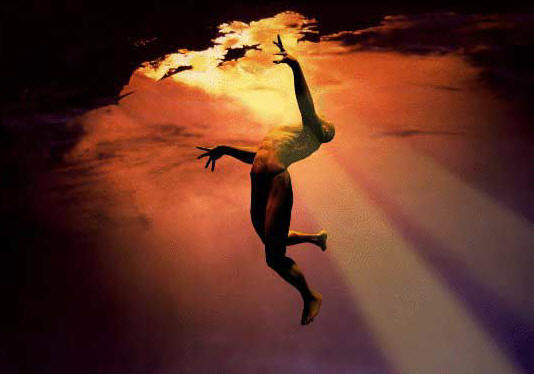
But in the last seconds of my fatal descent from the heavens, I manage to pull back up, avoiding a fiery disaster, and with my wings fully extended and my engines roaring with new life, I begin to climb.

-James Pyles
Climb!

I suppose it’s narcissistic for me to quote myself in order to start another blog post, but I couldn’t think of anything else that fit. OK, how about this one?

I’ve heard that there’s a kind of bird without legs that can only fly and fly, and sleep in the wind when it is tired. The bird only lands once in its life… that’s when it dies.

-Yuddy (played by Leslie Cheung)
from the film Days of Being Wild (1990)
original title, “A Fei jingjyhun”

I’ve never seen this film and probably never will, but when I Googled what I was thinking about, the above-quoted piece of dialog came up. Interestingly enough, I first heard this idea in High School. A fellow in my Creative Writing class (yeah, I was interested in writing even back then) wrote a poem (I think…it’s been forty years) about a bird without legs that was perpetually in flight. Sadly, that’s all I can remember.

But it’s enough.

I had a conversation like this with Boaz Michael at the FFOZ Shavuot Conference last month in Hudson, Wisconsin. During one of his presentations, he was talking about FFOZ being able to “land the plane,” which meant being able to get past the chaos of how various people and groups reacted to their shift away from the One Law theology. The idea was to be able to move on and focus on the primary mission and goals of FFOZ. This includes being able to reach out to the church in an effort to promote a more pro-Jewish message, and reaching out to normative Judaism to promote the Jewish Messiah.

At some point during the conference, I had several opportunities to sit down with Boaz and discuss various topics. One of the things I said is that the plane would never land because there will always be challenges.

I think that’s true of us personally in the realm of faith, too. Once we are introduced to God and realize that we must strive to approach Him, we take flight. But its only when we are in the air that we realize we can never land again. There is no turning back. There is no true sense of rest or peace.

I know that sounds strange, especially to anyone who has a bumper sticker on their vehicle that says, “No Jesus, No Peace; Know Jesus, Know Peace.” But really. You live in a world that is completely hostile to the discipline of religion in general and a Christian faith specifically (I think only Jews and, in some circles, Muslims are more reviled). Once we leave the ground, there are only two options: flight and death.

Sounds pretty grim.

When I say “death,” I don’t mean (necessarily) actually dying but if we choose to leave the faith, we die in terms of being spiritually dead. We no longer have a sense of God. Our relationship with Him is severed. We’ve gotten a divorce.

But considering flight, what a glorious thing it is. Imagine being able to fly without the aid of some sort of machine. Imagine simply extending your arms, raising your head, and realizing that your feet have left the ground. Up, up, up you go. The air is cold and crisp but you don’t feel chilled. Instead, you are invigorated, excited, thrilled. You are sharing the skies with God, seeking Him, soaring up to Him, as a bird might climb high above the clouds to seek out the Sun.

Now imagine that flying is something like running. Eventually all of that flapping will make you tired, just like running a marathon will exhaust you (not that I’ve ever run a marathon). Sooner or later you will want to land, to rest.

And you can’t.

You’re committed. It doesn’t matter how tired you get. It doesn’t matter if you’re exhausted. It doesn’t matter that your wings feel like they’re made of lead and sometimes, you feel as if you don’t care anymore. You just want to rest. Even if you fall. Even if you crash. It’s like Yuddy said:

I’ve heard that there’s a kind of bird without legs that can only fly and fly, and sleep in the wind when it is tired. The bird only lands once in its life… that’s when it dies.

So you can glide. Find a sustaining wind, a jet stream, a thermal and let them do the work. Just hold your wings out and let them catch the air and feel yourself suspended between Heaven and Earth; between life and death.

Isn’t that were we all are right now?

Bette Midler sings the Jeff Silbar and Larry Henley song Wind Beneath My Wings (no, I won’t inflict the YouTube videos on you) and the song ends with:

Fly, fly, fly high against the sky,
So high I can almost touch the sky.
Thank you, thank you,
Thank God for you, the wind beneath my wings.

That last line should probably say, “Thank God, You are the wind beneath my wings.” Without God, how could we sustain such an existence.

We all want to enter into His rest. We all long for the Messiah’s return for just that reason. The character Yuddy said cynically, “I used to think there was a kind of bird that, once born, would keep flying until death. The fact is that the bird hasn’t gone anywhere. It was dead from the beginning,” but if that were true, then faith is in vain. The atheists say that, and they say they are more alive than we are. There are more than a few believers who have been unable to find that updraft to support them, and exhausted and flightless, have collapsed back to earth like a latter-day Icarus, not because they flew too close to the Sun, but because they flew too long with leaden wings. They never found their source or they lost the will to keep seeking out that great imagination.

Now let me tell you a little secret. My wings get tired, too. It isn’t always easy to find a convenient wind to keep me aloft. Sometimes I doze and drift and wake up to find myself in a spiraling descent. I rouse my wings and push and lift and climb.

But sometimes it’s a close call.

Somewhere between Heaven and Earth are the forces that balance flight and falling. I know that God would not have called me into the sky if He only intended me to lose my ability to fly, but like that first generation of Israelites who were called out of Egypt, I sometimes doubt and complain. Like them, I sometimes feel as if God really did call me into the Heavens just to break my wings and send me plummeting back into the mud and tears. Like them, sometimes my faith is shaken. Like them, I fear defeat.

Today, if you hear his voice,
do not harden your hearts, as at Meribah,
as on the day at Massah in the wilderness,
when your fathers put me to the test
and put me to the proof, though they had seen my work.
For forty years I loathed that generation
and said, “They are a people who go astray in their heart,
and they have not known my ways.”
Therefore I swore in my wrath,
“They shall not enter my rest.” –Psalm 95:7-11 (ESV)

What a horrible thought that, after all of this effort, after tiring days and sleepless nights, no rest, no sanctuary, no oasis, constantly encountering resistance and opposition, that when it’s all over, I will not enter into His rest anyway.

So desperately terrified of a flight that never ends even after I have collapsed into shredded bone and flesh, I look around for some sign of another thermal. I try to find a way to let the wind lift me so I can rest my wings. I strive to look for the courage and strength to make it one more day in the air. I hope that God will show me, not just the ponderous effort of flying, but the glory of infinitely ascending across the skies.

Because sometimes, that’s all I have left.

Each journey the soul travels takes her higher.

There are journeys that are painful, because there is struggle. Struggle to wrestle out of one place to reach another, struggle to discern the good from the bad and put each in place, struggle to face ugliness and replace it with beauty. But in each of these, a sense of purpose overwhelms the pain and brings its own joy.

Then there are journeys that seem to have no purpose. Where nothing appears to be accomplished, all seems futile. There is no medicine to wash away the pain.

But every journey the soul travels takes her higher. It is only that in some, the destination is a place so distant, so lofty, she could never have imagined. Until she arrives.

-Rabbi Tzvi Freeman
“Unimaginable Journeys”
Based on letters and talks of the Rebbe
Rabbi M. M. Schneerson
Chabad.org

I hope, I pray, I plead that every day is a journey that takes me higher. But the destination is so far away and the effort to reach it is so great. Yet I dare not consider the possibility of falling. I must climb. I must soar. I must fly.

May God, by His grace and mercy, give me the strength. May He grant it to us all.

The Sacrifice at Golgotha

The Death of the MasterI am hoping you will be able to resolve a very important issue confronting the very foundation of Christianity.

God’s way of testing Abraham by calling for the sacrifice of Isaac…and then the abrupt staying of the knife…was intended to demonstrate that God abhorred human sacrifice and would not accept it (Gen 22.12). When the great central Law of Judaism (the TORAH) was revealed at Sinai, it called for animal sacrifices. The slaying of an animal and the offering of its blood according to certain prescribed rites, symbolized God’s mercy to the sinner, for this would have been his fate. Later in the Law, Moses gives warning to Israel not to worship God in the manner of the pagans (through human sacrifice) for it is an abomination unto the LORD in any way or form it is practiced (Deut 12.30-32).

Turning to the New Testament, Jesus states that he completely upholds the precepts of the Judaic Law until its complete spiritual enactment through-out the world. This great authorization of the central Law of Judaism renders it supreme (Matt 5.18). Nevertheless, here is where a trouble-some contradiction arises. According to Romans 5.6-11, Jesus’ death was a vicarious atonement. But this is a human sacrifice which is expressly forbidden by the very same Law sanctioned by Jesus.

True, Jesus is unique in being both human and Divine. But by sanctioning the Law He did not allow His uniqueness to detract from His subjection to the Law which is understandable since the Law is the perfect Word of God.

In sum, if Jesus was upholding the Law then His death cannot be sacrificial. Or, if His death is sacrificial, He has rejected the Law which He claimed to uphold. In either case, Christianity’s central doctrine of the sacrificial death of Jesus is proven to be scripturally untenable. Christianity is therefore in peril of crumbling away. The stakes are very high. If Christianity succumbs to an inner breakdown, the moral order in the world will soon follow….

This contradiction can only be satisfactorily resolved by reference to Scripture. Scripture is a single, self-consistent truth, but beginning to end. Each verse urges its own truth. When two verses appear to exhibit incompatible claims, a contradiction develops. We must then attempt to resolve this contradiction by reference to another verse(s) which will reconcile the two opposing viewpoints…

When reconciliation is not forthcoming, the contradiction remains and the verse(s) in question are not Divinely revealed facts, but have been spoken by the prophet out of his own authority…

The defensibility of Jesus’ sacrificial death has been troubling me for a long while. I am unable to resolve it according to Scripture. I would be very grateful to you if you could clear it up for me…

Quoted from christianthinktank.com

Have you ever been asked a question you were so sure you knew the answer to that you never even worried about it, and then, when you tried to answer the question, realized you didn’t really know how to respond?

That happened to me yesterday afternoon. Let me explain.

On most Thursdays after work, I meet with a couple of other guys for coffee and discussion. There’s no set agenda, but we usually talk about matters of faith and questions that come up in the Bible that sometimes drive us crazy. We are all reasonably comfortable questioning the traditional Christian assumptions and our coffee meetings give us an opportunity to ask questions we could never ask in church.

I commute to and from work with my son David. On Thursdays I usually drop him off at his place, then go to the coffee shop for my meeting. Yesterday, my daughter-in-law had an activity planned with some female friends at their place and asked if David and I could hang out together. I asked him if he wanted to join my meeting and he said, “OK.”

David was the first of my children to develop a sense of spirituality. When he was little, he went to church with my wife’s brother Steve whenever Steve was visiting from the Bay Area. After David went to church with Steve, he’d ask my wife and me why the rest of us didn’t go to church and believe in Jesus (this was years before my wife and I became religious). That was kind of awkward.

Somewhere between childhood and adulthood, David set his faith aside but it’s always been on the back burner, so to speak. Thursday allowed him to revisit old territory and to ask some of those questions that would drive most Christians nuts.

The four of us were having a fairly stimulating conversation when the question of human sacrifice came up. David sees the death of Jesus on the cross to atone for the sins of the world as a direct violation of the commandment not to sacrifice a human being.

So here we are, three guys from different backgrounds but who all have the same fundamental belief in Christ as Messiah and Savior trying to address this question.

I shot off my big mouth first.

Understand, that this is a very troubling question with no simple answer. Also understand that one of the reasons that I am attracted to Jewish mysticism and particularly the Chassidim, is because I don’t think that there is any other way to explain certain things about the Messiah, including his bloody, sacrificial death, outside of a deeply mystic framework.

Just how can a human sacrifice, even that of the Messiah, atone for the sins of the world? What’s the mechanism that makes it possible and that doesn’t violate God’s prohibition against human sacrifice?

My answer was based on the understanding of the death of a tzaddik being able to atone for the sins of a community or even of an entire generation. Of course, my answer was founded entirely on the Chassidic mystic understanding of this process; something which most Jews, particularly in modern times, do not agree with.

So where is this explained in the Bible?

My friend Russ offered David what I would consider the traditional Christian explanation for the sacrifice of Jesus Christ on the cross. As I listened to him answering David, I realized that I didn’t find the Christian viewpoint particularly satisfying. I know that I’ve had this explained to me before at some point, but my memory is a leaky container and a lot of stuff has dribbled away over time, so I don’t remember exactly what was said or when that conversation occurred.

This really bothered me.

The conversation ended with more questions than answers, which is fairly typical for our little group, but where was David now? He continues to focus on the Torah and the Prophets as the foundation of his understanding about God and the Jewish people, though I’m sure he would benefit from a review of his knowledge base, but the New Testament seems to him like so many exceptions and contradictions to his understanding of Torah. On the drive back to my place, David and I continued our conversation, and I decided to encourage David to start where he is. If the Torah and Judaism are the rock on which he now stands, then I will support him returning to and exploring the cornerstone of his faith.

But it still bothered me that not only could I not give a satisfactory answer to his questions about Jesus, but I couldn’t really answer my own questions. I can’t solely rely on the “mystic” explanation for how a tzaddik’s death provides atonement, and assuming the traditional Christian response to this query is also lacking, then what is the answer?

I don’t know.

I know that faith is sometimes the mortar that fills in the spaces in religious understanding, but I’m uncomfortable with it being the putty that replaces solid Biblical knowledge let alone logic.

OK, I know that logic is the beginning of wisdom and not its conclusion and that once we accept the existence of God, we also must accept the supernatural, but David did bring up what seems to be a huge disconnect between the Tanakh (Old Testament) and the New Testament in terms of death, atonement, and sacrifice. You’ve probably already clicked the link I provided above and read the christianthinktank.com reply to this question. I did too, but I’m not sure I’m buying it.

Do we see any example of the death of a righteous man providing atonement for the sins of other people in the Tanakh? Was any man in the Old Testament deliberately killed in order to turn away God’s wrath toward other human beings? We talk about men like Joseph, Moses, and David being “types and shadows” of the Messiah. But we don’t see that their deaths really did anything to illuminate the problem of Jesus being a human sacrifice to turn away God’s fatal judgment from all people everywhere across time who accept Christ as Lord and Savior.

I’m not that smart. Some people think I’m smart. My wife thinks I’m smart (except when she disagrees with me, then I’m not too bright at all *wink*). But it’s not really true. I suppose it’s more accurate to say that in this particular area, I’m not very well-educated. I feel ill-equipped to manage these sorts of questions. On some level, I think that it’s not very easy or maybe even not very possible to use human language and human logic to explain the mysterious, mystical way the death of the Messiah somehow atones for the sins of people.

And yet, that’s all we have to work with. Assuming extra-Biblical and particularly mystical (when my wife learned about this conversation, her response to me was to ask in an incredulous tone, “You talked to him about mysticism?”) sources are not considered valid in this discussion, then we must rely on scripture. But if the Old Testament and New Testament don’t agree that the Messiah must die to atone for sins, then what do we have?

A big, fat, furry mess, that’s what.

So I’m opening up yet another can of worms and throwing this topic out to the public via the Internet. I’m seeking out a greater imagination or at least a more scholarly believer. What’s the answer to how the death of Jesus isn’t human sacrifice? Is there an answer that doesn’t contradict the commandment to not sacrifice people?

The comments section is now open. What do you think?

Seeking Out a Greater Imagination

“Do not seek to follow in the footsteps of the wise. Seek what they sought.”

-Matsuo Basho

Rabbi Sholom Ber of Lubavitch used to say that if the hedonists would know the ecstasy of mystic union, they would instantly drop all their worldly pleasures and chase after it.

It is not just pleasure. It is the source of all pleasures.

-Rabbi Tzvi Freeman
“Paradise”
Based on letters and talks of the Rebbe
Rabbi M. M. Schneerson
Chabad.org
I recently had a discussion with an (apparent) atheist in the comments section of one of my blog posts. As with many other Christian/Atheist discussions on the web, he found Christianity wanting due to its lack of morality. That generally means “lack of morality” as progressive secular humanism defines the term (and the definition tends to shift over time). But is the sole reason for someone to become a person of faith or a person of faithlessness to gain a sense of morality and ethics?

Probably not. At its core, I think a person selects one system of philosophy or theology over another in an attempt to seek a reason for existence. Rabbi David Hartman in his book A Living Covenant: The Innovative Spirit in Traditional Judaism (chapter 9) says it this way:

As history has shown, the human being is not only a fact-seeking animal, but equally and possibly more so, a value-hungry individual seeking direction and significance in life. We hunger for a frame of reference that orders and orients everyday existence into some meaningful pattern. In spite of the extreme importance of facts, their range does not exhaust the sources from which one constructs a vision of life that gives meaning and direction to existence.

Beyond the quest to determine the moral relativity of right and wrong, and even beyond the desire to understand the nature of the universe, its origins and its development, is the overwhelming desire of human beings to seek out and discover themselves. This is perhaps the greatest mystery within our awareness, greater than the origin of life and greater than the scope of the cosmos.

Who are we? Why are we here? Is this all there is? Is there something more?

I was recently watching the first part of a two-part episode of Star Trek: Voyager called “Scorpion”. The starship Voyager was about to enter an area of space dominated by the Borg, which is a highly malevolent cybernetic race and mortal enemies of the Federation. It is the only path Voyager can take to make it back to the Alpha Quadrant and home.

The Borg are under attack by an equally malevolent race of beings from a realm outside our universe who are referred to only as “species 8472.” The destruction caused by the war between the Borg and species 8472 is vast and multiple star systems have been destroyed in its wake. If Captain Kathryn Janeway (played by Kate Mulgrew) orders Voyager to go forward, the ship and everyone on board will be annihilated. If she turns the ship around to ensure everyone’s safety, she must admit that she will never get her crew home. She’s trapped in an endless loop of guilt and remorse, because it was her decision to save an alien race that stranded the Voyager crew over 70,000 light years away from home nearly four years ago.

As a diversion, Janeway had previously programmed a holodeck simulation of Leonardo da Vinci (played by the acclaimed British actor John Rhys-Davies) and his workshop environment. Janeway takes on the role of Master da Vinci’s student in order to relax, work on various art projects, and be inspired by a holographic replica of one of history’s most innovative creators. In the throes of despair, as Voyager is poised to either move forward to destruction or turn back in defeat, Janeway makes a midnight visit to the Master’s studio seeking a solution she cannot find within the limits of her own resources.

She finds da Vinci sitting in his darkened studio, softly illuminated by dozens of candles, staring at light and shadow as they play upon a blank wall. Janeway sits with him and asks him what he sees. da Vinci (Rhys-Davies) responds:

A flock of starlings; the leaves of an oak; a horse’s tail; a thief, with a noose around his neck… Uh… And a wall, with the candlelight reflecting on it. There are times, Katarina, when I find myself transfixed by a shadow on the wall, or the splashing of water against a stone. I stare at it, the hours pass, the world around me drops away, replaced by worlds being created and destroyed by my imagination. A way to focus the mind.

Out of desperation, with all other options exhausted, Janeway turns to this computer generated simulation of one of the world’s finest minds and imaginations and opens her soul to him.

There’s a path before me – the only way home. And on either side, mortal enemies bent on destroying each other. If I attempt to pass through them, I’ll be destroyed as well. But if I turn around – that would end all hope of ever getting home. And no matter how much I try to focus my mind, I can’t see an alternative.

Then da Vinci replies in a way I found absolutely fascinating, especially since Janeway has always been played as a pragmatic atheist (and after all, she programmed da Vinci).

When one’s imagination cannot provide an answer, one must seek out a greater imagination. There are times when even I find myself kneeling in prayer.

I’m sorry to take you through a mini-tour of one of my favorite Voyager stories (especially if you’re not a Star Trek fan) but this is the point I was building up to. This is what we as human beings are seeking; a greater imagination. I don’t mean one that we can possess, but something beyond ourselves and our reality. Janeway and Voyager are exploring the galaxy, or a non-trivial part of it, as they attempt to travel 70,000 light years from the Delta Quadrant back to the Alpha Quadrant and Earth, but the real journey; the human journey is far more wondrous and vast.

The human journey is the attempt to travel beyond the limits of observation, science, and the very conceptualization of a physical and temporal reality and to find what lies beyond, which must surely be a greater creative imagination than ours and the One who is responsible for everything we now experience.

On a website called The God Debates, a discussion on a cause for the universe’s existence is going on (as I write this). I seriously doubt that the matter will be resolved to everyone’s satisfaction, but the need to have this discussion is completely human and shows us how much we need to seek out “a greater imagination.” An even more unusual example of this is a story at Jewish Ideas Daily called Disturbing the Universe. This is Kabbalah scholar Daniel Matt’s review of cosmologist Lawrence M. Krauss’s new book, A Universe from Nothing: why There Is Something Rather Than Nothing. In the same article, Matt reviews Alan Lightman’s new novel Mr g: A Novel About the Creation. An article where a Kabbalah scholar reviews both a very serious book on cosmology and a seemingly light-hearted but compelling work of fiction on God and Creation? Definitely worth a read.

However, why does one person seek the limits of the universe in a microscope, a telescope, in a chemistry class, in an archaeological dig, or using the cutting-edge tools of physicists? Why does another person seek to escape the limits of the universe entirely and encounter the infinite wonder that lies beyond the scope of the mechanisms mankind feebly constructs with flesh and blood hands?

Maybe sub-atomic particles and a vast, expanding universe are the only wonders that exist, but I certainly hope not. If it is true that this is all there is and there is nothing more, then everything mysterious, wonderful, and astounding about our existence is potentially within man’s grasp and one day, there will be no more mysteries. The universe will be “solved” and man will reach the end of his own adventure and become his own “god” (if he hasn’t already).

But in seeking God, man longs to go beyond the possible and to engage a mystery that can never be solved. But that’s the greatness of spiritual man: the need, the desire, and drive to seek out the impossible and to experience even the briefest glimpse of the unseeable, the untouchable, the unknowable.

In seeking God, man approaches the real purpose of his being. This is what pushes us past the barriers of despair, loneliness, hardship, and torture. This is why man endures. This is why man achieves. Without the search for God, man’s labors are no more significant than an ant pushing a bread crumb across a dirt lot, regardless of the illusion of “greatness” we bestow upon ourselves.

Some abandon the covenant after the death of a single loved one, but others retain belief in God’s love for and commitment to themselves despite having lost their whole family in the Holocaust. One human being leaves Auschwitz an atheist and another as a person whose belief has grown stronger.

-Hartman

I suppose there are many cynical explanations for why a person who has suffered incredible horrors would retain a faith in God and even increase that faith in the shadow of Auschwitz, or a dying child, or a body shattered in war. Some more “enlightened” individuals accuse us of needing a “crutch” as if atheism is far more courageous and noble. But I don’t think it’s a matter of courage and nobility, and I can’t really say what it is that causes one person to deny God and another to seek him out, even sometimes at the cost of his own life.

The best I can see is that, like John Rhys-Davies’s version of Leonardo da Vinci, even when it seems to defy the person we think we are, we absolutely need to seek out a greater imagination than our own. We find ourselves seeking it and Him by kneeling in prayer.

It is only God who makes it possible for a human being to search for that which exists in a place no man can reach or touch or see. But that’s where we will find Him…and us.


Being Married to the Girl with the Jewish Soul

“To get to the point, our daughter has informed us that she has fallen in love with a non-Jew, and that they intend to marry. We have tried everything to dissuade her, but our arguments, appeals, threats and tears have all been to no avail. She now refuses to discuss the matter with us at all, and has moved out of our home. Rabbi! You are our only hope! Perhaps you can reach her; perhaps you can impress upon her the gravity of the betrayal against her people, her parents and her own identity in what she intends to do!”

“Would she agree to meet with me?” I asked.

“If she knew that we had spoken to you, she’d refuse.”

“Then I’ll go speak to her on my own.”

I took her address from her parents, and rang her bell that very evening. She was visibly annoyed to learn of my mission, but too well-mannered not to invite me in. We ended up speaking for several hours. She listened politely, and promised to consider everything I said, but I came away with the feeling that I had had little effect on her decision.

For several days I pondered the matter, trying to think of what might possibly be done to prevent the loss of a Jewish soul.

-Aaron Dov Halprin
“A Jew in Brooklyn”
from “The Life and Teachings of Rabbi Menachem M. Schneerson”
Translated from the Hebrew by Yanki Tauber
Chabad.org

The loss of a Jewish soul.

Derek Leman recently posted a link to a discussion “between Messianic Jew David Brickner and John Piper” concerning “supersessionism.” From a supersessionist Christian point of view, the only way for a Jewish person to become reconciled to God and the Jewish Messiah is to forfeit his or her Jewish soul.

The loss of a Jewish soul.

Is that really what the God of Abraham, Isaac, and Jacob would want?

I know Christians who would answer “yes” so fast that it would make my head spin. But then you see, I have a Jewish wife. She is a Jewish soul.

I’m not going to go into the whole “is she saved or not” argument, which is probably way over my head (though I frequently wade into waters that are way over my head). Of course, it would gladden my heart if she would come to know, or at least be re-acquainted with (as she was in years past) the Jewish Messiah, but in her view of Judaism, which is not unlike that of the Chabad, a Jew does not believe the “Messiah of the goyim” is the Jewish Moshiach.

The local Rabbi consults the Rebbe and he presents a solution. The solution to the problem of the Jewish girl who intended to marry a non-Jew was to tell her that there was a Jew in Brooklyn who was deeply troubled and could not sleep at night because of her intentions. The Jew (whether this story is true or not, I have no idea) was named “Rabbi Menachem Mendel Schneerson, known as the Lubavitcher Rebbe.” Although the girl lived in Brazil and had never met the Rebbe or even seen a picture of him, when the local Rabbi showed her a photo of the Rebbe, she exclaimed, “this man has been appearing in my dreams and imploring me not to abandon my people.”

The story ends without telling us what the girl does, but presumably, she breaks off her engagement to the non-Jewish fellow and returns to her family. Not very much like the story between me and my wife, but then we were married for many years before she became determined to enter into the Jewish community and decided that a Jew would never believe that Jesus was the Messiah.

I’ve been pondering this story for several days but only read the following tale just a few minutes ago (as I write this):

Rabbi Zalman Serebryanski, a senior chassid from Russia and dean of the Lubavitch Rabbinical College in Melbourne, Australia, once brought a girl to Rabbi Chaim Gutnick. “Please, help this girl convert,” he asked.

Rabbi Gutnick listened to the girl’s story. She lived in Balaclava, and from her youth had felt a strong attraction to Judaism. Whenever she heard stories of the Holocaust, she was deeply touched. She had been reading and studying about Judaism for a long time, and now wanted to convert.

Rabbi Gutnick was moved by her sincerity. Nevertheless, he did not want to perform the conversion. The girl was still living at home with her non-Jewish parents. Would she be able to practice Judaism in her parents’ home? Would her interest continue as she matured into adulthood? Since he could not answer these questions, he decided to let time take its course. If the girl was still interested when she was older, she could convert then.

Rabbi Gutnick’s refusal plunged the girl into deep depression, to the extent that she had to be confined to a hospital. The elder Reb Zalman, stirred by the depth of her feelings, continued to visit her from time to time.

After several weeks, he called Rabbi Gutnick, telling him of the girl’s condition and asking him whether perhaps he would change his mind because of the strength of her feelings.

-Eli and Malka Touger
“The Girl Who Had To Be Jewish”
from “The Life and Teachings of Rabbi Menachem M. Schneerson”
Chabad.org

This appears to be the opposite of the previous story. Here, a non-Jewish girl is pursuing Judaism to the point that she becomes severely depressed when the option is denied her. On the surface, it seemed conversion was impossible because her family was Anglican, but appearances can be deceiving. In this case, the Rebbe is once again consulted and the results are surprising.

Rabbi Gutnick did not receive an immediate reply to his letter. But at a later date, at the end of a reply to another issue, the Rebbe added: “What’s happening with the Jewish girl from Balaclava?”

Rabbi Gutnick was surprised. The girl and Reb Zalman had both made it clear that her family was Anglican!

He and Reb Zalman went to confront the girl’s mother. At first, she continued to insist that she was Anglican, but as the sincerity of the two rabbis impressed her, she broke down and told her story. She had been raised in an Orthodox Jewish home in England. As a young girl, she had rebelled against her parents and abandoned Jewish life entirely, marrying a gentile and moving to Australia. She had not given Judaism a thought since. She loved her daughter, however, and would not oppose her if she wished to live a Jewish life.

Once the girl’s Jewishness was established, Rabbis Serebryanski and Gutnick helped her feel at home in Melbourne’s Lubavitch community. She continued to make progress in her Jewish commitment, and today is a teacher in a Lubavitch school.

But Rabbi Gutnick still had a question: How did the Rebbe know she was Jewish? At his next yechidut (audience with the Rebbe) he mustered the chutzpah to ask.

The Rebbe replied that, at Reb Zalman’s urging, the girl had also written him a letter. “Such a letter,” the Rebbe declared, “could only have been written by a Jewish girl.”

Again, I have no idea if this story is true, but it is compelling, especially to me.

My wife’s mother was Jewish and her father was a non-Jew (both of my in-laws passed away many years ago). My wife’s mother, as a young woman, rejected her family in Boston and her Judaism and walked away from both, about seventy years ago. My mother-in-law met my father-in-law on a blind date and they subsequently married and had five children. At no time did the fact that my mother-in-law was Jewish ever come up in the family.

True, my wife as a child, knew that her maternal aunt and cousin, who lived in Southern California where she grew up, were Jewish, but she never made the connection that her mother was Jewish (and thus, her children) until my wife was a young woman herself.

Of her two sisters and two brothers, only my wife was driven to self-identify as a Jew and decades later, to pursue a life as a Jewish woman.

The girl who had to be Jewish.

These two stories collide because the girl who had to be Jewish married the guy who ended up being Christian.

The thirty years of our marriage haven’t always been easy for one reason or another. I think any couple who has been married for decades will say that there have been trials in their relationship from time to time. It’s not all romance and flowers. But typically, at a foundational level, the couple is united in terms of their basic worldview. If the husband is a Christian, usually so is the wife. If the wife is an atheist, usually so is the husband. You get the idea.

Jewish/non-Jewish interfaith marriages are at an all-time high as far as I understand the statistics, and this is a crisis in the world of Judaism. Particularly Orthodox Jews see the marriage of a Jew to a non-Jew (and especially a Christian) as the loss of a Jewish soul.

There are plenty of books, guides, and advice blogs that address interfaith marriages, but usually the couples being targeted arrive at their wedding day as fully realized Jews and Christians. As far as I know, all interfaith couples at my local Reform/Conservative and Chabad synagogues are Jew/Goy (non-Christian). Some of the non-Jews who have married Jews convert to Judaism. The issues are complex and troublesome but not insurmountable.

A few weeks ago, I was talking to my wife about some of the things that had happened at the First Fruits of Zion (FFOZ) Shavuot conference in Hudson, Wisconsin. One of the issues was having Christians who are already in a church or who would be willing to return to a church, be sort of “messengers” and advocates for a positive relationship with Jewish people within the Christian community.

My wife’s response was something like, “Are you thinking of going back to church?” I wish I could remember her exact words. They could have been, You aren’t thinking of going back to a church, are you?” But I’m not sure. I’m also not sure if the tone of her voice registered any distress or not. It’s hard to tell with her sometimes. She plays her cards “close to the vest,” so to speak.

If we had entered our marriage with her as a fully realized Jew and me as a fully realized Christians (we were agnostics/atheists on our wedding day and for many years afterwards) and if we agreed to still get married, we probably wouldn’t be experiencing what we are today with each other. I’ve asked her about this aspect of our relationship point-blank, but she remains elusive.

As nearly as I can understand my options, the best thing for me to do is to let her be “the girl who has to be Jewish” and for me to be a low profile Christian at home. I don’t think we have a “typical” interfaith marriage, if there is such a thing. I don’t know if she sees my faith as somehow threatening to her, but it isn’t something that she’s comfortable discussing.

PrayingBut I don’t want the world to lose another Jewish soul. Supersessionist Christianity wouldn’t care, and would walk all over her Jewish soul without feeling the slightest pang of guilt or remorse. However, that Jewish soul is my wife. She gave birth to three other Jewish souls who are my children. Like any husband and father, when confronted with a threat to the family, I become defensive and protective. I cannot let their Judaism be extinguished for the sake of someone else’s theology…not even my own.

For I could wish that I myself were accursed and cut off from Christ for the sake of my brothers, my kinsmen according to the flesh. They are Israelites, and to them belong the adoption, the glory, the covenants, the giving of the law, the worship, and the promises. –Romans 9:3-4 (ESV)

Paul was in anguish over his Jewish brothers and sisters who did not understand the blessings of Jesus the Messiah and who would be temporarily “cut off.” He was sincerely willing to become accursed and cut off from his own salvation for the sake of other Jews. It meant that much to him; his Jewish brothers and sisters meant that much to him.

Although I am not a Jew, how much more should my Jewish wife and children mean to me?

The Elusive, Invisible, Tzaddik

The tzadik is one with G-d.

We recognize him because within each of us is also a tzadik who is one with G-d.

-Rabbi Tzvi Freeman
“The Tzaddik”
Based on letters and talks of the Rebbe
Rabbi M. M. Schneerson
Chabad.org

This is amazingly difficult for me to get my brain around, mostly because I can’t imagine it applying to me, not even a little. But there are only a few sentences here to try and understand Rabbi Freeman’s point. What about how others reacted to this blog post?

*Posted June 24, 2012 by Yaakov Branfman, Jerusalem, Israel
So, in other words, when he goes against the Tzaddik, he’s really going against that part in himself who is a Tzaddik. And, not even talking about going against, but when he simply doesn’t value the Tzaddik, he’s not valuing that part of himself.
When he values a “regular” person, he’s valuing that part in himself, and when not valuing that person, he’s not seeing the good parts in himself.

*Posted Aug 22, 2009 by Anonymous, New York, NY
Yosef is the only one in the Torah was called HaTzaddik. Yet we find that Yosef made mistakes, and struggled, yet overcame his inclination, but is not that he had _NO_ such impulses.

By the way this is a phenomenal pearl of wisdom by written by Tzvi Freeman… If we look at people, and look for the Tzaddik within them… we can _PULL_ the Tzaddik to the surface.

*Posted Aug 9, 2009 by mark alcock, Durban, SA
“Tzaddik, The: A wholly righteous person. In the context of Chabad literature, one who has conquered his animal impulses and is filled entirely with love and reverence for G-d.” One is either righteous or not, not sometimes without sin.

*Posted Aug 9, 2009 by Michal
When I look at it this way,
then even I am a Tzaddik.
Most of the time.
Unfortunately not always !!!

I think what Rabbi Freeman (or the Rebbe) is trying to say is that we should look for the best in other people and the best in ourselves. There is supposed to be some spark of wonder, divinity, and even perfection within each human being and, if we can try to relate to that part of another person rather than the other parts that are imperfect, then maybe they will aspire to be what we see in them, rather than what the rest of the world sees.

That has profound implications. If you know someone who is perpetually sad or angry or cynical or sarcastic, you tend to relate to them by their primary presentation. We all tend to believe that a person is the way we see them and the way they act. But what if we choose to look at and to treat each person as if they were a tzaddik, even if that is the farthest thing from who they actually appear to be?

No, it wouldn’t suddenly change them. Chances are, they’d think you were faking it when you treated them with respect, honor, and deference (how else should you treat someone who is one with God?). Chances are they’d think you were lying. But what if you always treated the other person with respect, honor, and deference, even though their behavior didn’t warrant such treatment and even though everything inside of you tells you that they don’t deserve it?

At the very least, you’d confuse the other person. At the very most, they might, just might be able to see something of a tzaddik in themselves and start behaving differently.

OK, it’s a long shot and most of the time, it wouldn’t work, but how could it hurt? And what if their life is somehow a message to us?

So even if one is your enemy, and justifiably so; even if his moral and spiritual downfall is one of his own making – it could have happened without your having been made aware of it. That you have witnessed it has nothing to do with him: it is a message to you, enjoining you to deal with a similar negative element – be it in subtlest of forms – within yourself.

-Rabbi Israel Baal Shem Tov, founder of the Chassidic movement

What if someone where to treat you like a tzaddik? How would you react?

Depends.

If you go around thinking you’re pretty cool stuff, you might think that it’s only what you deserve and you’d let it go to your head. That would be too bad, because if you go around all the time thinking you’re pretty cool stuff, chances are, you really aren’t. Chances are, things like humility, honoring God, and loving your neighbor as yourself might have escaped you. Yet none of these things would escape a tzaddik. If even one other person started treating you like a tzaddik and kept treating you that way, do you think those things that had escaped you before would begin to become noticeable?

And what if you look and look but you don’t see the tzaddik in yourself? What if you see a total screw up who, no matter how hard he tries, just can’t stop making mistakes, losing track of important details, and whose past is a ghost attached around his neck with heavy, iron chains, haunting not only his every waking moment but every minute of his dreams? And what if no one ever treated you like a tzaddik, not that you’d ever expect such a thing?

Can you look for and find the tzaddik in yourself or is there only your past, your mistakes, and how everyone else sees you in exactly the same way you see yourself?

Don’t be “this”. Don’t let them define you. If you catch yourself fitting into a definition, contradict it. Never travel a single road.

Be forever walking through the splitting of the sea.

-Rabbi Tzvi Freeman
“Being Paradox”
Based on letters and talks of the Rebbe
Rabbi M. M. Schneerson
Chabad.org
If there is even a tiny spark of the tzaddik in you, then not only can God see it but He placed it there. When a person can see only his mistakes, he also believes that’s only what God sees. It’s not that God can’t see past our flaws, but when we are drowning in our own despair, it’s impossible for us to believe God can see in us what we can’t see. It’s impossible for us to believe that there is something more in us than our own self-definition or the way others see our behavior and choose to define us. It’s impossible for us to think that we can escape the definition and become the paradox. Rabbi Freeman’s commentary on the above statement tells us that only God is truly the paradox:

If we wish to touch G-d Himself, we cannot find Him in any defined, bounded form. He is entirely unbounded, free of any definition. and that can only be discovered in utter paradox.

That is why everything a Jew does according to Torah, is bound up with paradox–because it is divine.

A Jew enters that identity when He is bound up in the Torah. A Christian would have to be bound up in Christ, the living Torah, to transcend the definition as Rabbi Freeman suggests, and to find the tzaddik within.

It would be wonderful to suspend the definition and to find the tzaddik who is completely concealed inside of me. But most days, there’s just who I see when I look in the mirror, and who the world sees when it looks at me, and who knows what God sees? Some days are better, and some days are worse, and some days all there is to see in me is a rasha. Have you even seen the tzaddik in you, let alone met him or her? If so, what is it like?

One of the Alter Rebbe’s great and very close chassidim had yechidus, in the course of which the Rebbe inquired after his situation. The chassid complained bitterly that his financial situation had utterly deteriorated. The Rebbe responded: You are needed to illuminate your environment with Torah and avoda of the heart – (davening). Livelihood and what you need – that, G-d must provide for you. You do what you must, and G-d will do what He must.

“Today’s Day”
Thursday, Tamuz 5, 5703
Compiled and arranged by the Lubavitcher Rebbe
Rabbi Menachem Mendel Schneerson, of righteous memory, in 5703 (1943)
from the talks and letters of the sixth Chabad Rebbe
Rabbi Yosef Yitzchak Schneersohn, of righteous memory
Translated by Yitschak Meir Kagan
Chabad.org