Category Archives: Uncategorized

Struggling with the World, Part 2

From the anthropological perspective on the problem of evil, therefore, the prime concern is not so much to defend the notions of divine justice and power. It is rather, as in other personal relationships, to determine what measure of continuity, stability, and predictability can enable the relationship with God to survive all shocks. It is to identify the cluster of beliefs that supports a person’s will to persist in the face of tragedy and suffering. If the world I live in requires that I become overly vigilant because of the threat of danger striking at any moment, then how can I sustain commitment to a way fo life predicated on God’s covenantal love and justice?

How do we respond to events that can call into question our whole identity as God’s relational partners?

-Rabbi David Hartman
Chapter 8: “Rabbinic Responses to Suffering”
A Living Covenant: The Innovative Spirit in Traditional Judaism

Note: If you haven’t read Part 1 of this “meditation” already, please do so before proceeding here.

An atheist can dismiss such questions by dismissing God. The presence of tragedy, suffering, and evil can be accepted as conditions of a natural world filled with imperfect human beings. It can also be a world that, while imperfect, is struggling to develop toward a higher moral and ethical reality as indeed, progressivism strongly believes. Human beings then, establish and revise the foundations of our own morality, sometimes radically, as time advances and the concepts of rightness, mercy, and justice continue to evolve in societal consciousness.

The covenantal Jew on the other hand, perpetually wrestles with God as did Jacob (Genesis 32:22-32) before his confrontation with the (supposedly) murderous Esau. But it’s in that battle that a Jew struggles not only with God but with himself.

A covenantal religious consciousness is always vulnerable to self-doubt and to feelings of rejection and guilt. When suffering and tragedy have struck without any explanation once, twice, and repeatedly, individuals in the community no longer know what kind of world they are living in. Like Job, they may ask: “Why do You hide Your face and treat me like an enemy?” (Job 13:24)

-Hartman

But in Rabbi Hartman’s viewpoint, a Jew is not simply a conduit for the cosmic forces of an Almighty Being to use to manipulate the course of history or even personal events.

The acceptance of that responsibility therefore need not entail that paralyzing sense of guilt alleged in Paul’s criticism of the law. Nor does mitzvah demand unconditional obedience without rational discernment, since the halakhah expects from Jews not just a dedicated will to serve God but also a reflective, sensitive, and critical moral disposition.

This takes away the motivation for a covenantal Jew to say that “God told me to do it” when facing a moral decision or in responding to personal disaster. The Torah is not a static set of rules carved in stone but rather a moral imperative written on the living and beating heart of every Jew. Each situation must be examined and evaluated not only against the yardstick of tradition and the mitzvah, but as potentially a wholly new phenomenon that may require a completely unique and unanticipated response, framed within the organic, evolving Jewish moral and historical tapestry.

Returning to Rabbi Freeman’s commentary on Judaism and its response encountering the demands of a progressive culture, the Rebbe felt that modernity didn’t present a set of obstacles but only “challenges. Challenges chiding you to show your stuff. Show that stuff and do what a Jew has to do, and those challenges themselves lift you on their shoulders, carrying you high.”

To continue:

Every talk, every letter, every teaching of the Rebbe must be understood in that context: We are not prisoners within an ominous world; we are the agents of its Master. We are not here to placate the world, but to repair it; not to reform ourselves to its tastes, but to reform it to the tastes of its Creator; not to conserve Judaism, but to be an organic part of its flourishing growth; not to reconstruct it, but to use it to reconstruct our world. Because ours is not a Torah of the past, but one that beckons to us from a magnificent future.

The Rebbe’s response to the challenges of a world and its developing, progressive morality is to move one giant step backward and to take a “metaview” of that world. Human advancement and even human history is transitory. Modern liberal progressive thought acknowledges that morality is not a fixed entity and adapts across time and the needs of the human spirit. While the Rebbe no doubt had a more established sense of moral and ethical standards, he also understood that the world is not ownerless or that, human beings are not the only “landlords” of reality. The world has a Master and we are His agents.

The world of human events wasn’t something to be avoided, but to be encountered and wrestled with. Rabbi Freeman characterises the Rebbe’s response by saying that “he grabbed it by its horns and harnessed it to plow his field.” For the Rebbe, each Jew stands in this place:

When you stand in a place of enlightenment, the Rebbe so often taught, you may have boundless, infinite light—but you do not have G‑d Himself. In the void of light where this world was made; in the darkness of Jewish exile, where we must choose life from the depths and create our own light to find it; in a society that forces us to wake up, take the reins of our own lives and challenge everything—there we touch G‑d at the very core.

A Jew may be surrounded by darkness but he stands in a place of light and it is from that light, regardless of how hopeless the circumstance, he must proceed, carrying with him not only the strength of the traditions of the past, but the infinite hope of a future from which the Moshiach will emerge and where God will rescue His people. Atheism, progressivism, secular humanism are conditions to be wrestled with, to be “grabbed by its horns and harnessed,” but they are not defining, either of a Jew nor the world that is ultimately owned by God.

My understanding of all of this is that Judaism may wrestle with itself, with the demands of society, and ultimately with God, but it is the Jewish identity that remains the one constant that enables them as a people, to move forward, to survive not only challenges, but horrors, and that will see them finally standing at the foot of the throne of God, receiving His promises of life and peace.

As I’ve been writing this, I’ve been seeing a few elements that can be adapted to Christianity and those promises we expect to be fulfilled by our Master at the end of this age. But we must also learn to establish an identity that can engage our environment without fear or despair. Our “liability” as such, is that we Christians are commanded to not only encounter our neighbor and love him, but to attempt to convince him to adopt our faith and our worldview (which is something no Jew must face). In that, we present ourselves as agents of the world’s greatest benefactor while being perceived by many in the secular world as humanity’s greatest enemy.

We are ridiculed and reviled by atheists and humanists and in response, we struggle with our own doubts, retreat into concrete bunkers of inflexible dogma, or attack the inhabitants of an unbelieving world, thereby abandoning our evangelical imperative. But we can neither ignore the world nor hate it. We are commanded to live in it and to live with faith in God. Like the covenantal Jew, we must be anchored to our legacy who, for us, are the Apostles and disciples of ancient times, and also look to the hope of the future when Jesus returns.

In the meantime, like the Rebbe, we need to seize the world around us and live in it, though we are not of it. We must treat each person we encounter with love, respect, and dignity. Our values do not require that they respond in kind, only that we are consistent in imitating the example of our teacher and Master by being involved and by being a light.

We are not trapped between a hostile and violent army and a vast and unconquerable sea. We can move forward. The sea will part. But first, we have to get our feet wet.

Don’t be afraid.

Addendum: Just found an article at Commentary Magazine on liberal intolerance of religious folks (in this case, Jews) called Liberal Prejudice Against the Orthodox Crosses a Line. I can see we have a long way to go.


Korach: Who is Speaking to Your Heart?

In the Torah portion Korach we read how Korach led a band of 250 men in a rebellion against Moshe and Aharon. Underlying their revolt against Aharon’s High Priesthood was the charge: “All the people in the community are holy and G-d is in their midst; why are you setting yourselves above G-d’s congregation?” (Bamidbar 16:3.)

From Moshe’s response, (Ibid. verse 10.) “…and you seek priesthood as well,” we readily perceive that Korach and his band desired to become priests. This being so, their argument that “All the people…are holy,” and nobody can set himself above anybody else seems to contradict their desire to be above others by obtaining priesthood.

“A Lesson in Priesthood”
Based on Likkutei Sichos Vol. VIII, pp. 116-118
Commentary on Torah Portion Korach
The Chassidic Dimension series
Chabad.org

Rav Yisrael of Ruzhin, zt”l, gives a fascinating explanation of a famous statement on today’s daf. “Our sages say that today the yetzer hara says to do one sin, tomorrow another, until one finally falls to idolatry. This statement does not mean that the yetzer hara increases the sins that one indulges in from day to day. It means that the yetzer hara pushes a person who falls to keep falling in the same manner day after day, time after time. Even this is enough to cause one to worship idolatry eventually, God forbid!

“This can be compared to a sick person whose weakened constitution does not improve. If his system does not overcome what ails it, he gets sicker and sicker and eventually he reaches the point where he is dangerously ill.” Rav Shalom Schwadron, zt”l, offers his own insight here. “It is interesting that the yetzer doesn’t demand that one stop fulfilling mitzvos; it merely pushes one to follow his instructions. He wants to bring a person to a place where he will fulfill only that which interests him. A student in yeshiva will learn Torah until very late at night, missing out on a meaningful shachris. Another person will express his zealousness at the expense of fulfilling his obligations to his fellow human beings.

“The yetzer wants to be in the driver’s seat; that one should only do what interests him in the manner that he prefers. He knows that a person who only acts when he is inclined to do so will eventually stop fulfilling the mitzvos. We need to recall that the main thing is to fulfill the mitzvos of the Torah because this is the will of the Creator. We must not be swayed by the compelling-seeming logic of the yetzer hara which causes one to forget God.”

Daf Yomi Digest
Stories Off the Daf
“In the Driver’s Seat”
Niddah 13

Here’s the key portion of the above-quoted lesson:

He wants to bring a person to a place where he will fulfill only that which interests him.

By the time I finished reading this “story off the Daf,” I found that the conclusion didn’t match up with what I thought it would be at the beginning of the story. I thought fulfilling certain of the mitzvot would be contrasted against overt sin, such as a person who fulfills the mitzvah of feeding the hungry and then turns around and cheats his business partner. I didn’t think it would be focusing on fulfilling one mitzvah, the one that fits your personal desires, at the expense of other equally worthy mitzvot.

We’ve seen this sort of thing before:

Then Pharisees and scribes came to Jesus from Jerusalem and said, “Why do your disciples break the tradition of the elders? For they do not wash their hands when they eat.” He answered them, “And why do you break the commandment of God for the sake of your tradition? For God commanded, ‘Honor your father and your mother,’ and, ‘Whoever reviles father or mother must surely die.’ But you say, ‘If anyone tells his father or his mother, “What you would have gained from me is given to God,” he need not honor his father.’ So for the sake of your tradition you have made void the word of God. –Matthew 15:1-6 (ESV)

“Woe to you, scribes and Pharisees, hypocrites! For you tithe mint and dill and cumin, and have neglected the weightier matters of the law: justice and mercy and faithfulness. These you ought to have done, without neglecting the others.” –Matthew 23:23 (ESV)

We see a couple of important points taught by the Master relative to the story off the Daf, and both are related to hypocracy and setting human priorities on what we choose to do for good.

In the example from Matthew 15 (yes, I know this passage is typically used to say Jesus did away with man-made traditions and only endorses obeying pure Torah law, but he was perfectly fine with many other aspects of the normative halachah of the Judaism of his day, so I consider his main “rant” against hypocrisy, not tradition) , Jesus turns on his critics and accuses them of neglecting the commandment to honor parents by committing the money that could have been used to support their parents to the Temple. Outwardly, the Pharisees involved may have appeared holy, but in their neglect of their parents, they were reprehensible.

The short quote from Matthew 23:23 shows us something similar. Certain Pharisees were again, outwardly appearing as holy by their tithes but in the process, they completely ignored what Jesus called, “weightier matters of the law” such as the principles of “justice and mercy and faithfulness.” I should note that Jesus did not say one was really better than the other and told his audience that they should have performed their tithes without neglecting the other mitzvot.

But what does that have to do with us? On the one hand, these arguments could support the classic One Law position in the Hebrew Roots movement which states that non-Jewish people, when we become Christians and are “grafted in” (Romans 11) to the Jewish root, are obligated to the identical set of commandments as the Jews are, and we should not pick and choose which ones to obey. It would appear as if Jesus is telling us to not pick and choose as well, but to obey all of the 613 commandments, or at least as many as can be obeyed without the existence of a Temple, a Levitical priesthood, a Sanhedrin court system, and (for most of us), while living outside the Land of Israel.

On the other hand, we could use the same texts to consider just what our (I’m speaking to Gentile Christians now) true obligations are to God and whether, in our performance of the mitzvot, we are doing what God actually wants us to do, or only obeying what we want, what makes us feel righteous, and what makes us look “cool” in the eyes of our peer group. Are we falling into the same trap as Korach, Heaven forbid?

I know that sounds a little harsh, but I’ve encountered more than one non-Jewish person in the Hebrew Roots movement who seems really pleased with his tzitzit, his Hebrew prayers, and how he laid tefillin. OK, I want to be fair and say that there are many who subscribe to the One Law position who sincerely believe this is the one and only way a Gentile can please the God of Heaven, and these folks feel really picked on when people like me say that obeying many of the Torah commandments is a choice and not an obligation (your behavior doesn’t have to change in any way just because it’s voluntary rather than obligatory). But consider this.

When you say that non-Jewish believers in the Jewish Messiah are obligated to obey the full yoke of Torah, your saying that it is a sin for any Christian to fail to observe the full range of the mitzvot. You are condemning the vast, vast majority of Christians who have lived, loved the Master, observed the “weighter matters of the Torah,” and died, based on your personal interpretation of the Bible. By saying you are obligated to the Torah and that you are fulfilling the Torah, you aren’t equalizing conditions between Christians and Messianic Jews but (whether you mean to or not) elevating yourself above your brothers and sisters in the church.

Let’s continue the Chabad commentary on Korach. I think you’ll see that he and his followers were doing something very similar.

The Kohanim , the priestly class, differed from the rest of the Jewish people in that the Kohanim were wholly dedicated to spiritual matters. This was especially true with regard to the Kohen Gadol , the High Priest, who was commanded “not to leave the Sanctuary.” (Vayikra 21:12.)

Their apartness from the general populace notwithstanding, the Kohanim in general, and the Kohen Gadol in particular, imparted their level of sanctity to all the Jews. Thus we find that Aharon’s service of lighting the Menorah in the Sanctuary imparted sanctity to all Jews, and enabled them to reach Aharon’s level of service and love of G-d. (See Likkutei Torah , beginning of portion Beha’alosecha.)

You may consider this a bit of a stretch, but I think the unique standing and “choseness” of the Jewish people and their obligation Sinai covenant also imparts a “level of sanctity” to we who are grafted in from among the nations. I think there’s a relationship to Israel being a light and to those of us who have seen and been attracted to that light.

I’ve tried talking about this before, especially in blog posts such as Redeeming the Heart of Israel, Part 1 and Part 2, where we see a partnership between the Jewish and Gentile disciples of the Master that is complementary and interwoven, and I’ve tried to show that this partnership does not require a fused or homogenous identity between Christians and Jews in the Messianic realm.

Granted, I believe this manner of thinking is still in its formative stages and requires a great deal more research, especially in Scripture, but we see a classic example in the Korach rebellion of how a group desiring to separate themselves from their fellows and assume an identity not their own results in disaster. In the end, Korach and the rebels didn’t really believe that all of Israel had the right to become priests.

Korach and his band’s complaint that “All the people…are holy,” however, did not contradict their own desire for priesthood, for they desired a manner of priesthood totally removed from the rest of the congregation.

This manner of priesthood would not cause them to feel superior to the rest of the Jewish people, a superiority that resulted from their imparting holiness to them, for in their scheme of things they would not impart holiness to other Jews — they would remain totally separate and apart.

But Korach and his band were badly mistaken: It is true that there are different categories of service — Jews who are solely occupied with spiritual matters, and other Jews whose task it is to purify and elevate the physical world through the service of “All your actions should be for the sake of heaven,” (Avos 2:12.) and “In all your ways you shall know Him.” (Mishlei 3:6.)

Putting all this together, we can paint a picture of those Gentiles who want to assume a full “Jewish” identity without having to convert to Judaism as not demonstrating equality between Jews and Gentiles in the covenant, but perhaps setting themselves above their fellow Christians by taking on Jewish identity markers. I’m sure that many One Law proponents aren’t motivated in this direction, but ask yourself if this could be describing you.

If you, as a Christian (non-Jewish disciple of the Jewish Messiah) in the Hebrew Roots movement, choose to take on additional mitzvot that could be considered specific to Jews, please study up on them first, including the relevant halachah for performing the mitzvot. Shooting from the hip probably isn’t as effective way to perform any of the Torah commandments as using the accepted standards established in normative Judaism.

From my personal perspective, a Gentile publicly appearing as a Jew, even with completely pure motives, is like walking into a room full of trapdoors and tripwires. You might be successful in your efforts, but more than likely, once you step outside your local congregations and into the larger world, you could encounter unanticipated conflicts. Be sure whatever you do is actually what God wants and not just something that makes you feel special.

I’m sure no one wants to make Korach’s mistake. Ask yourself who or what is speaking to your heart?

Addendum: This all gets more complicated when you factor in people who claim a Jewish identity without Jewish parents and exist outside of Messianic Judaism, as we see in this Huffington Post article. One person has blogged about her experiences as a “Jewish” non-Jew, and Derek Leman has offered his own commentary. True, it doesn’t have a direct relationship with this week’s Torah portion or the matter of any Christian’s perceived obligation of Torah, but it is very much relevant to the “identity wars” between Jews and non-Jews, so I include these references here.

Good Shabbos.

Struggling with the World, Part 1

I’m not arguing for either the superiority or the necessity of a covenantal orientation to life for the realization of human responsibility and dignity. In thinking about Judaism, I cannot ignore the fact that atheists act with moral dignity and compassion in the world. I believe, in contrast to many contemporary religious thinkers, that secular humanism is a viable and morally coherent position. What I am claiming is only that neither the critique of halakhic Judaism found in the Christian tradition nor the moral critique found in Spinoza is convincing. There are many different approaches to human life that encourage initiative, intellectual freedom, responsibility, and the sense of personal adequacy and dignity. I am not arguing that faith is necessary in order to have these values, but only that faith in a covenantal God of Judaism does not have to contradict or undermine them.

The God of Sinai does not merely hand over responsibility for the mitzvot to Israel and then take His leave. He also commits Himself to permanent involvement in the history of the community…

-Rabbi David Hartman
Chapter 8: “Rabbinic Responses to Suffering”
A Living Covenant: The Innovative Spirit in Traditional Judaism

I hadn’t intended to turn this into a series, but I find myself continuing to compare the relative merits of the moral and ethical positions of Christianity and, if not atheism as such, progressive secular humanism, which is the predominant philosophy of modern western culture. My previous missives on this topic are Collision, which is my introduction into why atheism holds such animosity toward Christians and Repairing Life which suggests one possible response.

That should have been the end of my reflections on “Religion vs. Atheism,” and it was from a Christian point of view, but I neglected to discuss how Judaism considers this dynamic. As with many things, there’s no single Jewish viewpoint (and I’m probably not qualified to write about this but I will anyway) so I’ll try to offer two: one from Rabbi Hartman’s above-quoted book and the other from Rabbi Tzvi Freeman and Chabad.org.

Whenever someone asks me a question, I first have to think, “What kind of a box has this guy trapped me in?” Then I can deconstruct the box. If the box dissolves, there goes the question. If it doesn’t dissolve, I better listen up. The guy’s got a point.

Here comes one now:
“Rabbi, what was the Rebbe’s response to modernity?”

For at least two hundred years, Jews scrambled to find a response to modernity.

Today, there’s no longer much scrambling. Movements have stopped moving, firmly entrenched. But there was a time when Jewish creative genius generated a cacophony of responses to modernity: Reform, Orthodoxy, Zionism, Religious Zionism, Conservative, Ultra-Orthodoxy, Reconstructionism, Modern Orthodoxy, Renewal and more. Each movement had leaders who spent their years zealously articulating and re-articulating their particular response to the progressive, liberal, enlightened, modern world that came rushing down upon us, particularly after France beheaded its kings and smokestacks started belching into the sky.

Now, in Brooklyn sat a Jewish leader who built up a powerhouse movement that has transformed the face of Jewry worldwide. What was his response to modernity?

Gotcha. Neat little box. But it doesn’t work. What doesn’t work? The box: “Response.”

Again, as I mentioned in my other blog posts on this subject, I’m not trying to “prove” that religion is right and atheism is wrong or even to say that one group possesses an inherently greater moral response to life than the other (although from my point of view, religion should have the greater moral response).

I want to show that the issue can be as simple as how much or how little of themselves people choose to invest in their particular belief systems and and also demonstrate that these matters are far more complex than what we think of as mere “right and wrong.”

Rabbi Hartman’s position might be considered the more progressive of the two based on the quote I used to open this “extra meditation.” Rabbi Freeman represents the more conservative view. He suggests that historically, Judaism has responded to modernity by generating multiple variations of Judaism to adapt to the demands of progressiveness, but currently seems to be digging its heels in, so to speak, as representative of the Orthodox. But as we see from continuing to review Rabbi Freeman’s commentary, even this isn’t as two-dimensional as it appears.

Rabbi Freeman uses the dilemma of Children of Israel trapped between an advancing and vengeful Egyptian army and the uncrossable barrier of the Reed Sea (Exodus 14) as a metaphor for the struggle of Judaism to respond to liberal modernity.

The Children of Israel are stuck at the Sea of Reeds. The Egyptian army is closing in fast. The Jews divide into four parties—four opposing responses to one situation, perfectly summarizing the orthodox responses of the modern era: The Just-Go-Back-to-Egypt response, the I’d-Rather-Drown-Myself response, the Get-Up-And-Fight response and the Get-Down-And-Pray response.

Response Today
Self-Drowning Immerse in a ghetto of Torah, and pretend the world does not exist.
Back to Egypt Give up on the world, on the future, or on trying to change anything. Just do what you have to do because G‑d says so.
Fighting Prove that we are right and they are wrong.
Praying Rely on G‑d to bring Moshiach real soon.

G‑d’s response? You’re all wrong.

“Why are you crying out to me?” G‑d demands of Moses. “Speak to the Children of Israel and tell them to keep going forward!”

No response. No reaction. Proaction. Take charge. You have a purpose, you’re going somewhere. Keep going.

According to Rabbi Freeman, the response of Israel to the demands of progressionism is to progress. Of course, this doesn’t mean abandoning the covenant of Sinai and blending into the general cultural herd, which for a Jew would basically mean assimilation, but it doesn’t mean hiding or freezing in place, either. If the world moves, move with it, but don’t forget to take who you are with you and particularly, don’t forget to take God.

But the world of faith is always vulnerable, not just to tragedy and evil, but to how those elements of life are interpreted, and on some occasions, used against religious people by not only the atheists who blame all the world’s woes on religion (as if humanity weren’t capable of doing harm without a religious belief system to depend upon), but on our own doubts when “bad things happen to good people,” or when God is otherwise incomprehensible.

Rabbi Hartman continues on this point:

From the anthropological perspective on the problem of evil, therefore, the prime concern is not so much to defend the notions of divine justice and power. It is rather, as in other personal relationships, to determine what measure of continuity, stability, and predictability can enable the relationship with God to survive all shocks. It is to identify the cluster of beliefs that supports a person’s will to persist in the face of tragedy and suffering. If the world I live in requires that I become overly vigilant because of the threat of danger striking at any moment, then how can I sustain commitment to a way fo life predicated on God’s covenantal love and justice?

How do we respond to events that can call into question our whole identity as God’s relational partners?

An atheist can dismiss such questions by dismissing God. The presence of tragedy, suffering, and evil can be accepted as conditions of a natural world filled with imperfect human beings. It can also be a world that, while imperfect, is struggling to develop toward a higher moral and ethical reality as indeed, progressivism strongly believes. Human beings then, establish and revise the foundations of our own morality, sometimes radically, as time advances and the concepts of rightness, mercy, and justice continue to evolve in societal consciousness.

But what about the covenantal Jew? How does he resolve or at least address this problem? We’ll pursue the answer to that and other questions in Part 2.

Repairing Life

R’Simlai notes that the posuk (Yeshayahu 45:23) teaches that everyone in the world takes an oath before God. What is this oath, and when is it administered? The oath is the one referred to in Tehillim (24:3-4), “Who shall ascend into the mountain of God, and who shall be able to stand in His holy place? He who is of clean hands and pure of heart, who has not lifted up his soul to falsehood and has not sworn deceitfully.” The oath itself is that at the time of birth the soul is commanded, “Be righteous, and do not be evil!” It is given when the soul is sent to the world. We recite Tehillin 24 – the paragraph of “L’David Mizmor” – at Maariv immediately after the silent Amidah on Rosh HaShana and Yom Kippur.

Rabbi Chaim Hager, the Rebbe from Viznitz, was also known as the Imrei Chaim. When he would read this posuk on Rosh HaShana and Yom Kippur he would cry. A visitor to his community was taken aback to hear the Rebbe whimpering at the particular point where false oaths are mentioned. The visitor could not fathom how the Rebbe could be so moved about the possibility of having taken a false oath.

As the chassidim passed by the Rebbe after davening, this visitor followed along in the line. When he asked the Rebbe for an explanation, the Rebbe answered: The Gemara (Niddah 30b) tells us that before a soul is sent into this world it is administered an oath which states “You are to be a tzaddik! Do not be a rasha!”

The oath continues with the person being adjured that even if everyone in the world tells him that he is a tzaddik, he must never become complacent by believing their compliments. Rather, the person must always strive for perfection and consider himself to be a rasha.

“Now,” continued the Rebbe, “who can confirm that he has fulfilled this oath which his soul has taken and that he is a tzaddik? Who can insist that he has not taken a false
oath?”

Daf Yomi Digest
Gemera Gem
“Be a tzaddik! Do not be a rasha!”
Niddah 30

This is midrash and not (as far as I know) literal fact, so I don’t suppose that before we are physically born, our souls take an oath before God to be righteous and not to be evil. Still, what if you happen to feel obligated to do good but find yourself doing the opposite? Who are you accountable to and what are the consequences?

I commented in yesterday’s morning meditation about the ongoing debate between Atheists and Christians (and other religious people). I mentioned that atheism as a belief system, does not have a built-in moral or ethical structure. The only requirement to be an atheist is to not believe in God or that any supernatural being had anything to do with the creation of the universe, or is involved in the course of human events.

But if you choose to be a person of faith, you are agreeing to a certain set of moral and ethical standards. If you fail to meet those standards, even occasionally, you have not only reneged on your agreement with your religion and with God, but you have dragged the Name of God through the mud for all to see, especially those who disdain religion and religious people.

If you believe that you have taken an oath before God to be a “tzaddik” and not be a “rasha,” you’ve failed that, too.

The problem is, being human, sooner or later, you will fail. If a non-religious person fails, who is hurt? It depends on the failure. They may hurt themselves, people where they work, their friends, their family, and so forth. Of course none of that is good, but when we who claim faith in God fail, particularly in a moral or ethical area, we fail all those people and we fail God as well. We become a “rasha” and not a “tzaddik.”

I’m exaggerating here. Not all people in religion can be considered tzaddikim, since these are the most righteous, noble, and holy in the world of faith. Christianity would call them “saints.” How many Christians can truly be called “saints” (although some Christian denominations consider all Christians to be worthy of being saints because of the sacrifice of Jesus Christ)?

Most of us are “mere mortals” who are doing our best to try to make it through one day at a time. Some days are better than others. Some days we’re better at honoring God and His desires than others. Some days seem pretty crummy, but we try to keep going because of our faith and our belief that God is with us, regardless of our circumstances and, in most cases, regardless of how badly we fail.

That’s why anti-Christian and anti-religious rhetoric on the Internet or in real life is so disturbing. Not because secular people don’t agree with my choosing to have faith, but because it means that I or someone like me has failed. We have failed to show that we are doing our best to follow a moral standard that was set for us by the Creator of the Universe and the lover of our souls. We have given the world the opportunity to believe that our faith is not only a lie, but an excuse to actually indulge in selfish, moral attacks on those we deem weaker or more vulnerable in the world.

I wish I could find the image I saw the other day on the web (thought it was on the atheism sub-reddit but I can’t find it). It was a “rant” on how a young atheist found himself in church (not sure how this happened) and listened to the Pastor preach on how young people don’t have values today. The person listening to the sermon reasoned that the Pastor meant that young people don’t have the church’s values, which the commenter described as repression, inequality, exclusivism and so forth. He defined atheist values as inclusiveness (except if you’re a person of faith, but that’s beside the point), equality, compassion and so forth (I really wish I could find the image because it was just brilliant).

The conclusion is that the church wasn’t particularly moral at all and that atheism, by comparison, was a much better belief system. Of course, the commenter wasn’t really describing atheism but rather western political and social progressivism which includes atheism as a core element. Nevertheless, there are times when Christians do not take the moral high road and liberal progressives do (and I should mention that there are more than a few Jewish people who have doubts about God, too).

But the argument against religion has to discount the times when Christian programs really do feed the hungry, send visitors to the sick, comforts the mourning, defends the widow, the orphan, and the disadvantaged, but those people and programs don’t make it on the news or, for the most part, in the popular social networking sites. It also isn’t generally advertised that the civil rights movement was started and supported by Christian and Jewish activists rather than atheists and scientists.

Whether you as a Christian like it or not, the world is watching and waiting for us to fail (they never expect us to succeed). Some of those watching are really anxious for us to fall face down in the sewer. When we do fail, we fall far, and we hit hard, and we take the reputation of God with us when we go over the edge.

Debating atheists on their own terms will not sanctify the Name of God. You will never elevate God’s reputation by trying to “prove” He exists and created the universe. Living a life of faith and devotion to your ideals by helping others and repairing our damaged world will. You may never convince even one atheist to consider a life of faith, but at your finest, you will be fulfilling your oath, doing your best to live as a “tzaddik,” and helping vulnerable and needy people in the process. But you should always question your own motives before criticizing someone else’s.

If you have not yet succeeded in fulfilling the criteria to be a critic, yet still feel a necessity to provide criticism, there is an alternative:

Sit and criticize yourself, very hard, from the bottom of your heart, until the other person hears.

If it comes from your heart, it will enter his as well.

-Rabbi Tzvi Freeman
“The Last Word on Criticizing”
Based on letters and talks of the Rebbe
Rabbi M. M. Schneerson
Chabad.org

Repair the world one day at a time. And for Heaven’s sake, be a tzaddik! Do not be a rasha!

Collision

Criticizing another person is not out of the question. It’s just that there are a few conditions to attend to before you start.

The first condition is to make sure this person is your close friend. Those are the only people worth criticizing—not just because they may actually listen, but also since you run a lower risk of making them into your sworn enemies.

If this person you feel an urge to criticize is not yet your close friend, you’ll need to spend some time with him. Find out everything that’s good about him, and go out of your way to help him out. Eventually, a real friendship will develop.

Also, you’ll need to ensure that this person has the same knowledge, understanding and perspective of right and wrong as you do before you can attack his decisions. If he doesn’t, you’ll need to spend some time learning and discussing together until you see each other’s point of view.

Once the two of you are in the same space in Torah and observance of mitzvot, and he’s your good friend to boot, then it’s okay to criticize—if necessary. And if you can remember what there was to criticize.

-Rabbi Tzvi Freeman
from How to Criticize and More on How to Criticize
Based on letters and talks of the Rebbe
Rabbi M. M. Schneerson
Chabad.org

“Any fool can criticize, condemn and complain and most fools do.”

-Benjamin Franklin

I was recently involved in a Facebook conversation started by a fellow who took exception to the King James Version of the Bible and, by inference, all of Christianity. He was very nice about it, but just because someone says “please” and kisses you on the cheek before punching you in the face doesn’t mean it doesn’t hurt.

OK, that’s a little unfair and he did say something about his motivation for “sharing” the photo criticizing the KJV Bible:

…if something can’t stand inquiry at every level, do we have any business basing huge belief systems on it?

I suppose that’s true and there are many people, both atheists and Christians, who spend a great deal of time examining the Bible and offering critical analyses of the text. I don’t mind serious scholars investigating the writings of Judaism and Christianity and providing illuminating and challenging questions, but at one point does the motivation of those who criticize people of faith become less than scholarly?

And then there’s reddit or more specifically, the sub-reddit on atheism. For those of you who don’t know, reddit is a social news website where the registered users submit content, in the form of either a link or a text “self” post. Other users then vote the submission “up” or “down”, which is used to rank the post and determine its position on the site’s pages and front page. (source: Wikipedia) Sub-reddits are pages within the larger whole that address specific topics of interest, such as music, movies, science, and atheism. However, the atheism sub-reddit isn’t defined so much by what atheists believe as by what they’re against which is, for the most part, Christianity (although the atheist sub-reddit page is probably doing it wrong).

I only bring up reddit because I read it daily and because they go out of their way to bash Christians daily. The fact that popular online social venues regularly criticize not only religious beliefs but religious believers shouldn’t exactly come as a shock. After all, atheism is probably the predominant “religion” in the west today (I say that last part somewhat ironically).

Besides, weren’t Christians told to expect this sort of behavior?

Blessed are you when others revile you and persecute you and utter all kinds of evil against you falsely on my account. –Matthew 5:11 (ESV)

Count it all joy, my brothers, when you meet trials of various kinds, for you know that the testing of your faith produces steadfastness. And let steadfastness have its full effect, that you may be perfect and complete, lacking in nothing. –James 1:2-4 (ESV)

However, I’d be remiss if I didn’t consider the other side of the coin. Just why is there so much criticism being directed at Christianity? There are a few reasons.

You can’t really be an atheist unless you are defining yourself against a theist, someone who believes in a god or gods of some sort. Since belief in a god or gods requires a belief in the supernatural, something you can’t examine objectively using the scientific method, atheists who are scientifically oriented define themselves in opposition to religious people who are considered irrational, superstitious, or just plain stupid.

Atheists who may or may not be scientifically oriented have another, wider motivation for not only refuting religion, but particularly being really angry at Christianity. Christians tend to be viewed (and not unjustly in many cases) as being pushy, self-righteous, opinionated, bigoted, hostile, narrow-minded, and generally “in-your-face” about what they believe.

The basis for some of this is “the great commission,” which we find in Matthew 28:19-20:

Go therefore and make disciples of all nations, baptizing them in the name of the Father and of the Son and of the Holy Spirit, teaching them to observe all that I have commanded you.

In other words, Christians are commanded to carry the “Good News of Jesus Christ” to everybody who will listen. That’s fine as far as it goes. If someone is curious about me and my faith, I’ll be glad to explain to them why I believe what I believe and to suggest (if they’re still willing to listen) that a life lived in relation with our Creator has many benefits.

But it doesn’t stop there for many believers.

I mentioned before that atheists tend to define themselves in relation to who they’re against. So does Christianity. Christianity defines itself against sin, or so it says. Christians pursue this definition to the degree that they can be very outspoken (depending on the denomination and how conservative they are) against the values and people currently held in high esteem by popular western culture.

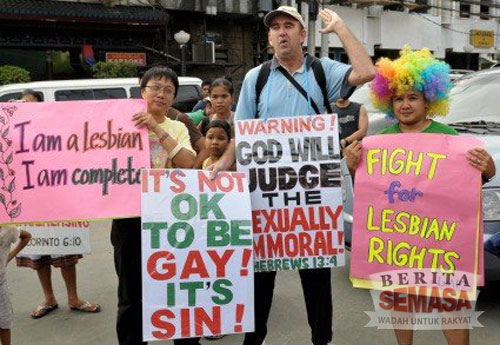
The current popular debates between Christianity often are not based on whether God exists or not, but on the so-called “culture wars” between what some consider Christian values and the more popular, progressive viewpoint. These topics tend to center around social issues such as the rights of women, people of color, and particularly (since it’s been in the news a lot lately) gay rights and what is referred to as “marriage equality.”  Each side accuses the other of heavy-handed tactics in promoting their agenda and attempting to manipulate the minds and beliefs of the next generation.

As an example, I’m presenting an interesting photo (no, not the one below, you’ll have to click the link) I found on the atheist sub-reddit page. Although there’s no explanation regarding the photo of this person’s facial bruise and his bumper sticker, since it is posted on the atheist sub-reddit page, I can only assume it’s meant to indicate that a person of faith, possibly a Christian, assaulted this man because the person of faith believed the man in the photo was gay.

This plays into the reputation Christians have in the secular world relative to gays (even though the Bible doesn’t specifically command a Christian to give a gay man a black eye). To say that this particular (assumed) example of “Christian hostility” is unfair and possibly inaccurate is obvious, but to be fair, we have been rather oppressive at times in our treatment not only of gay people, but of any person who doesn’t measure up to the particular standards of the church, however those standards are understood.

In other words, religious people and non-religious people are capable of being unfair and critical. Religious people and non-religious people are easily offended and need to strike back against the person or organization that offered the offense. Religious people and non-religious people believe their particular system of beliefs are right, correct, represent basic reality, and are not only fact but truth.

What do religious people and non-religious people have in common.

They’re all people.

It’s important to remember (curb your dogma for a second) that we all operate inside of systems. Having a particular religious orientation means you are operating within that system and are subject to all of the conditions imposed by that system. Having an orientation toward atheism means you are operating within that system and are subject to all of the conditions imposed by that system. Sure, religion tends to believe that it is a container for truth while atheism tends to believe that it is a container for fact, but both are systems and the people within them will go to great lengths to defend their beliefs including attacking people who hold differing beliefs.

If you’re a Christian and an atheist says or does something that offends you, hurts your feelings, or makes you angry, that happens because you are human. Your faith is important to you and when it’s attacked, it’s like someone has just jabbed you in the eye with a sharp stick. If you’re an atheist and a Christian says or does something that offends you, hurts your feelings, or makes you angry, that happens because you are human. Your beliefs are important to you and when they’re attacked, it’s like someone has just jabbed you in the eye with a sharp stick.

I’m not here to “prove” that Christianity is right or wrong or that atheism is right or wrong. I’m here to say that we are spending a tremendous amount of time defining ourselves by who and what we are against and going out of our way…all of us, to hurt as many people as we can in the process, whether we think that’s our motivation or not.

Since atheism has no formal moral or ethical code attached to it, I can’t hold atheists to any standard of right or wrong. If an atheist wants to go out of his or her way to hurt a Christian, Jew, Muslim, I can’t blame them too much. After all, they are only acting according to human nature.

However, Christianity does come with a formal moral and ethical code (which varies a bit depending on denomination) and I can (and will) hold Christians to a moral and ethical standard. If you’re a Christian and you’re going out of your way to hurt someone just because you can, I’m going call you on it. That’s not “church bashing,” that’s calling believers to return to behaving as we were taught by Jesus and his example.

As I recall, when Jesus became angry, he was usually criticizing the religious authorities around him, not unbelievers and sinners. He used to hang out with sinners, eat with them, talk with them, and provide charity for them. If he defined himself at all, it was in comparison to the standards of the One who sent him, not against the people around him.

So Jesus said to them, “Truly, truly, I say to you, the Son can do nothing of his own accord, but only what he sees the Father doing. For whatever the Father does, that the Son does likewise. –John 5:19 (ESV)

No one is born a Christian. Unlike Judaism, we don’t have a biological, genetic, inheritance from our “fathers.” We each come to know God through the example of our Master and teacher at some point in our existence. Then we spend the rest of our lives trying to figure out what that means by acting out of our understanding and Christ’s example. We don’t always do such a great job of it, unfortunately.

But since no one is born a Christian, that means anyone who isn’t a Christian might come to faith one day. If we are obligated to share our “good news” with everyone else, we need to make sure we are really sharing good news and not criticism, judgmentalism, hostility, and bigotry. We must remember that we have been taught to share the good news by feeding the hungry, clothing the naked, and visiting the sick and imprisoned, and there are penalties against us when we fail to do so. (Matthew 25:31-46)

Rabbi Freeman said, The first condition is to make sure this person is your close friend. Those are the only people worth criticizing—not just because they may actually listen, but also since you run a lower risk of making them into your sworn enemies. In other words, all of the time we (believer, atheist, whatever) spend on the web criticizing other people and their beliefs isn’t going to change anything. No one will listen let alone change their minds just because someone they’ve never met thinks they’re either godless or superstitious.

I have no hope of changing anyone as a result of today’s “morning meditation,” either. But who knows? Maybe by advocating that all parties put down their guns, knives, and boxing gloves, maybe we can temporarily arrive at an uneasy truce. In the end, we all want to know the same things.

Who am I and what am I doing here? Is this all there is, or is there something more?

I’m pretty sure bashing people who don’t share our belief system won’t answer those questions.

This is the first part of a series that continues in Repairing Life.


Spilled Out

The rabbinic approach to prayer, rather than pointing to the collectivization of Jewish religious consciousness, encourages individuals within the community to discover the personal dimension of Judaic spirituality within the communal life of the halakhah. In prayer and the Shema, the rabbis sought to allow the personal to be present in the framework of halakhic practice by joining individual initiative to structure, discipline, and order. They insisted that habit not triumph in the life of prayer, and they constantly admonished the community that prayer must not be a gesture that one repeats unthinkingly. They insist that one must not pray today just because one prayed yesterday. Personal supplication must be brought within the fixed framework of the petitional benedictions of the Amidah. One must even strive to bring novel elements into daily petitional prayer.

-Rabbi David Hartman
A Living Covenant: The Innovative Spirit in Traditional Judaism
Chapter 7: “Individual and Community Prayer”

Actually, there are days when I’d do almost anything if I could just flip my brain, heart, and soul into automatic pilot and be able to belong to the “collectivization of…religious consciousness” and turn what some religious Jews refer to as tefillat nedavah (voluntary prayer) into “structure, discipline, and order.” Sometimes my relationship with God, or at least the thoughts and feelings associated with that relationship, is too chaotic and scrambled to be of much use to either me or Him.

But as Rabbi Hartman describes it, there is a greater responsibility and intention (kavvanah) in Jewish prayer than most Christians tend to understand. There are exceptions, such as Pastor Jacob Fronczak’s love of liturgy, but I think you have to be wired a certain way as a non-Jew in order to love liturgical prayer. For me though, on those days (or weeks) when it is just too much for me to summon up the necessary energy and passion to take aim at God through my “prayer antenna” so what I want to say to God will reach Him, a structured set of benedictions would do quite nicely.

I don’t know where we learn to pray. I guess it’s different for everyone. For Rabbi Hartman, it came from listening to his mother pray during the synagogue service when he was a child.

I could hear her asking God to ensure that her adult sons would find good brides and that her husband would be able to support his family with dignity. Her prayers gave expression to her personal yearnings as a wife and mother. Her language was in no way inhibited or stunted. As I listened to her prayers, I did not sense that she felt unworthy to approach God with “petty” personal needs. She would have been astonished if someone had told her that the significance of prayer is to manifest an Akedah consciousness and asked how she dared feel so relaxed and easy before God. My mother, a deeply traditional Jew, prayed in the manner of generations of Jewish mothers. She continued a tradition that she received from her own family.

I’m compelled to think of the prayer of Hannah when reading about how Rabbi Hartman heard his mother’s prayers:

As she continued praying before the Lord, Eli observed her mouth. Hannah was speaking in her heart; only her lips moved, and her voice was not heard. Therefore Eli took her to be a drunken woman. And Eli said to her, “How long will you go on being drunk? Put your wine away from you.” But Hannah answered, “No, my lord, I am a woman troubled in spirit. I have drunk neither wine nor strong drink, but I have been pouring out my soul before the Lord. Do not regard your servant as a worthless woman, for all along I have been speaking out of my great anxiety and vexation.” Then Eli answered, “Go in peace, and the God of Israel grant your petition that you have made to him.” And she said, “Let your servant find favor in your eyes.” Then the woman went her way and ate, and her face was no longer sad. –1 Samuel 1:12-18 (ESV)

It’s funny. In the moments when I was typing the previous quote from Rabbi Hartman’s book, I also couldn’t help but think of my wife. As a child, she would never have heard her mother pray as a Jew because her mother had long since abandoned any vestige of cultural, let alone religious Judaism. I can only feel compassion for my wife as I picture her first entering into the Jewish community in middle age, determined to reclaim what God intended for her from the first breath she took after birth, but could never live out until decades later.

The only prayer I can remember from my childhood is the one that begins, Now I lay me down to sleep, I pray the Lord my soul to keep…” While I don’t doubt that it’s comfortable for most Christians to keep formalized and liturgical prayer down to a bare minimum, I think they rob themselves and their children of something special when they dismiss it altogether. There’s a fabric of tradition, history, community, and belonging in those prayers. I’ve never been part of a purely Christian congregation that has employed a traditional prayer structure (although it could be argued that the small, “One Law” group with whom I once “fellowshipped” and continue to remember with affection, were more Christian than anything else), but in relation to Jewish prayer, the attraction for me to be part of that dynamic is substantial.

But more often than not, I find that serious time in prayer eludes me. I don’t know if it’s because I previously declared I would forego worship practices that even appear to be Jewish (with some rare and recent exceptions) or it it’s something more endemic to my soul, but lately, God seems to be rather “standoffish,” or perhaps it’s me. I used to think that a “crisis of faith” would be singular and rather brief since, by definition, a crisis is a dramatic event or set of events that occur very quickly and result in non-trivial change, but now I’m not so sure. I’m beginning to believe, maybe just in my case, that this “crisis of faith” is an evolutionary process that is leading me to some newer (and hopefully higher) realization of who I am in God.

In commenting on Maimonides, Hartman states:

I believe, however, that Maimonides’ understanding of prayer as avodah she-be-lev is an invitation to individuals to discover their own personal and individual mode of worship within a system in which common practice and community are so heavily emphasized.

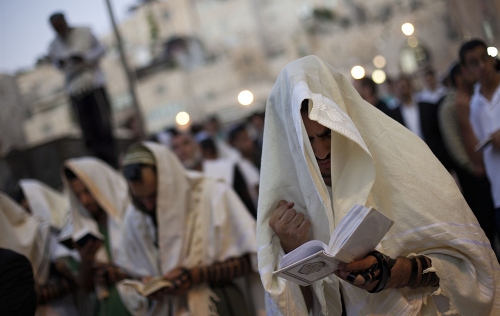
She-be-lev or service of the heart is the individual operating of personal worship and devotion to God within the larger community of Judaism. It’s the unique part of space and time where a man davening during morning prayers with a minyan can still be an individual Jew with an individual heart and soul given up like an incense offering to God.

Traditional Jewish prayer is like a container holding a liquid. The container defines the shape of the liquid but not its characteristics, substance, and behavior. The liquid can freeze, boil, or steam within the container and still be held and kept “safe.” Without the container though, all it can do is spill into a puddle on the counter top and dribble onto the floor, becoming fodder for the mop and destined for the drain and sewer.

When I try to pray or even think about how to get back to, let alone closer to God, I’m poured all over the ground. It would be nice if I could consider myself Paul’s proverbial “drink offering” (Philippians 2:17; 2 Timothy 4:6), but I know in fact, that I’m just making a mess.

But we have this treasure in jars of clay, to show that the surpassing power belongs to God and not to us. We are afflicted in every way, but not crushed; perplexed, but not driven to despair; persecuted, but not forsaken; struck down, but not destroyed; always carrying in the body the death of Jesus, so that the life of Jesus may also be manifested in our bodies. –2 Corinthians 4:7-10 (ESV)

Does anyone out there have a sponge to soak me up with and a handy jar to squeeze me into?