Category Archives: Uncategorized

What Can You Do For The Land Of Israel?

I wanted to take a few minutes this morning to emphasize how important our presence is in the land to the Israelis. (By ‘our’ I mean people living outside the land – whether Jew or Gentile.) So many people I spoke with feel alone, that the world doesn’t care. And what they see the world saying is that all the trouble in Israel is their fault.

Now, I am saying we take the place of God. But aren’t we, as followers of the Messiah, called to be the hands and feet of Hashem in this world? Isn’t it part of our job to love his people and support them? Isn’t that what Paul emphasized?

-Ro Pinto
“We Must Let Them Know”
Journey to Messiah

I suppose you know by now that Israel is suffering from the latest plague of terrorist attacks against its Jewish citizens. I also suppose you aren’t surprised that the news and social media are saying (again) it’s all Israel’s fault.

Given the nature of my blog, I can only believe that most of my regular readers are pro-Israel and support the defense of the Jewish people against their aggressors. Ro, in the blog post I quoted from above, suggested that one of the things we can do in support of Israel is to visit the Land, just as she did a short time ago (and about which she blogged prolifically).

So what can we do? Most of us aren’t in a position financially or in terms of our schedules, to hop a transatlantic flight and vacation in Israel for a couple of weeks. How else can we show our support?

seven things israelI read Ro’s blog when she originally published it to the web, but didn’t consider passing along her message until today when I read an article from the Chabad with the title 7 Things You Can Do for Israel.

This list is definitely written for religious Jews, so not everything applies to the rest of us, but here it is (click the link I provided above to get the full details):

  1. Take Up a “Call to Arms”
  2. Share the Power of Light
  3. Check Your (Spiritual) Security System
  4. Pray
  5. Be Financially Supportive
  6. Nurture Your Faith
  7. Get a Letter

Some items on that list may seem pretty obscure so I’ll expand on them a bit.

The “call to arms” is to help any Jewish man or boy over age 13 put on tefillin. That’s not something we non-Jews get much of an opportunity to do, nor is it something non-Jewish males typically perform (with a few exceptions, or so I’m told).

Sharing the power of light is lighting the Shabbos and holiday candles and encouraging Jewish girls and women to do so. Again, not something most non-Jewish believers tend to perform and we typically aren’t in a position to suggest to Jews that they do so.

The “Jewish security system” is the mezuzah. Because my wife is Jewish, we have a mezuzah attached to pretty much every doorway in our home (bathrooms are the exception). I’ve been told that when a Jew sells his or her home, they leave the mezuzot (plural of mezuzah) in place if another Jew is buying the home, and remove them if a non-Jew is the buyer (because it won’t be a Jewish home anymore).

prayerPraying for Israel is the first item on the list that’s freely accessible to any religious person, and we can certainly encourage others to pray for Israel and the Jewish people as well.

The Chabad article has various links to charitable organizations anyone can donate to for the benefit of Jewish victims of terrorism. You can also do your own research and determine for yourself where you want to give your tzedakah (the word translates commonly as “charity” but also means “justice”).

Nurturing your faith has to do with a Jewish person encouraging more religious observance and acts of faith with their own family and friends, specifically as it relates to a Jew’s connection to Israel.

While we non-Jews don’t have the same connection to the Holy Land, it would be inaccurate to say we don’t have a connection at all. Hashem established Israel for the Jewish people but He also commanded the Jewish people to be a light to the world. That light comes most strongly from Israel and from our Rav, Yeshua (Jesus).

Further, in His grace and mercy, Hashem has extended the promise of the resurrection, eternal life, and the Holy Spirit even to the Goyim, so how could we not be attached to Rav Yeshua, whose symbolic, sacrificial death and miraculous resurrection have opened the door to redemption for any who would repent and come to faith.

We can encourage our own family and friends to embrace their faith in our Rav by expressing clear support of Israel in any manner we have available to us. No congregation that pays homage to Yeshua, which includes any Christian church, should fail to support the nation of the Jews in any way.

torah up closeGetting a letter is unique. Special Torah scrolls are being written in Israel, and the Chabad article says that any Jewish person may purchase a letter being written in a scroll. The way the form is set up, asking for the Jewish name of the person for whom the letter is being purchased, as well as the Jewish mother’s name and so on, I don’t think a non-Jew would be permitted to do this.

On the other hand, we can certainly pass along this information to any Jewish people we know who we believe would be interested.

The article finishes up with the suggestion that we pass this along in social media or anyplace else that Jewish people might see it and act.

I’m writing all this not to make any non-Jew reading it feel discouraged by what they can’t do for Israel. After all, Chabad is in the business of drawing Jewish people to Jewish faith and observance, not Gentiles (though I suppose they’d have an opinion on what a Noahide could do).

I’m writing today to show that we do have options in supporting the Land and the Jewish people. As Ro suggested, we could visit Israel and show our financial (by purchasing goods and services during our visit), emotional, and spiritual support. If we are in a position to do so, we can find some way to support any Jewish people in our local communities who we may know, to greater levels of Jewish observance. We can certainly pray, donate to Israeli charities helping terror victims, and encourage other believers to support Israel as an act of our faith (the last being a great way to educate others at your church or congregation).

Non-Jewish disciples of Rav Yeshua call ourselves Christians, or sometimes believers, followers, or even “Messianic Gentiles.” We are who we are. We are not Jews and we are not Israel. But we can stand by Israel, even if we don’t know a single Jewish person, and do something to support a Land under attack, not just by human terrorism and world-wide public condemnation, but by ancient forces of spiritual evil.

I don’t often write about “supernatural forces” but let’s face it. Our physical world is an extension of a spiritual reality and of powers and events long foretold by the Biblical prophets. We know that bad things are coming for the Jewish people, for Israel, and ultimately for the whole world.

IsraelThis is as good a time as any to stand up and be counted on the side of good…the side of God.

Tag. You’re it. Pass this along.

This is just the short list. For more, read 54 Ways You Can Help Israel and find out which ones you can do…and then do them.

Addendum: Just saw this link on Facebook about helping victims of terrorism and thought I’d share.

The Torah viewpoint is that the Almighty constantly creates the entire world and everything in it for each individual. This concept has the potential to give a person immense pleasure. Think about it for a moment. The Almighty — Creator and Sustainer of the universe — is constantly creating for you the sun, the moon, and all the other worldly phenomena. He is constantly bestowing upon you life, and every single second He supplies you with your needs.

(see Rabbi Noson Tzvi Finkel; Tnuas Hamussar, vol.3, p.202; Gateway to Happiness, p.36)

-Rabbi Zelig Pliskin
Aish.com

Working Together

And we are human, after all. Our humanly unique sense of self is partially framed and reinforced by our awareness of that self in relation to others. It’s only human nature to hope you might be in some way “better” than others — smarter, possessing of higher status, more resources, and greater physical attractiveness — even if that’s not always the case. From there, it’s only a short step toward actively seeking out the more negative aspects of others to feel better by comparison. And once we’ve begun to indulge in those self-gratifying judgments, it’s hard to stop. How else can you explain American’s fascination with reality TV? Next to Honey Boo-Boo and the Duggars, we all look pretty good, right?

Wrong.

Research has also shown that people who seek out and comment upon negative traits and behaviors in others are often highly anxious about those very same traits in themselves.

-Leslie Turnbull
from the article “Don’t Judge Me”
The Week

bullyingAccording to this magazine story based, supposedly, on research, it’s natural for human beings to be judgmental, it just makes us unhappy. I suppose that might mean that it’s not natural for a person to give the other guy or gal the benefit of the doubt and to judge them favorably.

However, in Judaism, it is considered desirable to judge others favorably:

Joshua the son of Perachia and Nitai the Arbelite received from them. Joshua the son of Perachia would say: Assume for yourself a master, acquire for yourself a friend, and judge every man to the side of merit (emph. mine).

Pirkei Avot 1:6

Now let’s expand our information base to include the Apostolic Scriptures, which also, I believe, qualifies as Jewish wisdom.

Do nothing from selfishness or empty conceit, but with humility of mind regard one another as more important than yourselves; do not merely look out for your own personal interests, but also for the interests of others.

Philippians 2:3-4 (NASB)

Also…

But if you have bitter jealousy and selfish ambition in your heart, do not be arrogant and so lie against the truth. This wisdom is not that which comes down from above, but is earthly, natural, demonic. For where jealousy and selfish ambition exist, there is disorder and every evil thing. But the wisdom from above is first pure, then peaceable, gentle, reasonable, full of mercy and good fruits, unwavering, without hypocrisy. And the seed whose fruit is righteousness is sown in peace by those who make peace.

James 3:14-18

James (Jacob or Ya’akov), the brother of Rav Yeshua (Jesus), writes that jealousy, selfish ambition, and arrogance are also natural for human beings, and he calls these qualities “earthly, natural, demonic.”

Not a pretty picture.

He advocates for behaving gently, reasonably, and treating others with mercy.

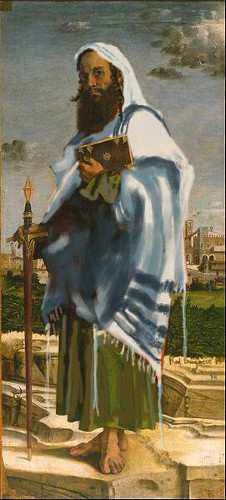
The Jewish PaulAs students of the teachings of Yeshua as they are interpreted for the Gentiles by the Apostle Paul (Rav Shaul), we really need to be different from the world, behaving “unnaturally”, and as a “light to the nations” (Matthew 5:14-16).

Maybe it’s “natural” for us to be snarky and unkind to others, but as Ms. Turnbull’s article points out, we may complain the most about people who are the most like us.

So the next time you feel the urge to snark about the way your brother-in-law tries to dominate every conversation, spend a few minutes listening to yourself. You might just realize it’s time for you to pipe down, too.

Further…

Need more reason to curtail that instinct to be a hater? Consider this: Unjust criticism may be hurtful to others , but it hurts those who over-indulge in it even more. Just as those who spend a lot of time in the water fixate on the extremely rare shark attack while ignoring the much more prevalent (but still almost non-existent) threat of lightning on land, folks who over-focus on negativity will eventually only see what they spend time thinking about: the bad stuff.

So being judgmental and negative not only hurts us, it hurts other people, and our teachers, as we read them in the Bible, instruct us to not hurt others, but rather, to be kind and, as much as it depends on us, to be at peace with everyone (Romans 12:18).

Not particularly common in the blogosphere, even in the religious blogosphere.

I’m not writing to lean on anyone or masking my own criticism toward anyone else, but with all of the verbal and physical violence in the news and social media lately, it seems like there’s no place to go for a bit of peace.

cooperatingBut ideally, we should be able to seek out other disciples in Messiah for that peace, Jew and Gentile alike.

Not only that, but we should be able to work together, for although we represent a diverse population, and there are sometimes significant differences between Jewish and Gentile disciples, we do have something in common:

From the above closing words of the Acts of the Apostles [Acts 28:30-31] we can see that the Kingdom of God was the message that Paul and the other Apostles preached, a message of God’s Kingship in the person and work of Yeshua Messiah. The Bilateral Messianic Community was the body of believers who had accepted the message of the Kingdom of God and were to be the proclaimers of the coming of the Kingdom of God.

-Sean Emslie
“The Kingdom of God and The Messianic Hope: Bilateral Messianic Community and Kingdom in the Epistles and Revelation”
Toward a Messianic Judaism

When did we forget this and how can be get back to what we’re supposed to be doing?

Identity and Diversity

I just read a blog post written by Dr. Larry Hurtado called Early Christian Diversity as well as a brief commentary by Rabbi Abraham J. Twerski on Pirkei Avot 1:14. Interestingly enough, I think they both speak to me personally as well as to the wider body of modern Yeshua (Jesus) believers.

Part of what Rabbi Twerski wrote was:

What Hillel really meant can be better understood with a statement by the Rabbi of Kotzk, who said, “If I am I because I am I, and you are you because you are you, then I am and you are. But if I am I because you are you, and you are you because I am I, then I am not and you are not.”

William Shakespeare said the same thing with the words “To thine own self be true,” and I think that’s what I’m attempting in creating my own definition of a life of holiness (not that it’s so easy to follow such a definition).

Larry Hurtado
Larry Hurtado

In reading Dr. Hurtado’s blog post, I am once again reminded that what I’m going through, what we are all going through, is not new at all:

But it isn’t as though we didn’t know that before Bauer wrote. From our earliest Christian texts (e.g., Paul’s letters and other writings) we have candid references to diversity in the young Jesus-movement, even sharp conflicts and mutual condemnation. Maybe Eusebius could convince himself that everything was sweet agreement initially and that diversity and division only came later, but that’s not what the earliest sources actually show.

This early Christian diversity, however, was not a number of totally separate communities or forms (hence, my dissatisfaction with “early Christianities”). As I contend in a recent article, the diverse expressions of early Christianity seem to have been in vibrant contact with one another, sometimes conflicting, at other times seeming to agree to overlook differences, at other times seeking to persuade others of their own views/emphases…

I’ve tended to think of the differences between “early Christian” communities as being divided largely across the lines of Gentile believers and Jewish disciples of Rav Yeshua, but I believe Dr. Hurtado is making finer distinctions. There may have been numerous branches of “Christianity” in the latter part of the first century and into the second that had other points of separation or distinction. In fact, there was likely no real effort to “form a broadly connected and cooperative trans-local religious movement” until Eusebius or Constantine, according to Dr. Hurtado.

That makes me wonder what the Apostle Paul was up to if not attempting to create unified and uniform communities of Yeshua followers among the Gentiles (certainly Jewish praxis and community was already well established for Jewish disciples of the Rav).

Now let’s look at the Christian and Jewish religious landscapes today. There’s a wide variety of denominations and branches in both faith movements. There are thousands of separate or overlapping Christian denominations, and a number of different branches to Judaism including various subsets.

We could spend a lot of time debating who is right and who is wrong, but that’s not why I’m writing this blog post. Each early “Christianity” (I keep writing that word in quotes because until the Gentiles forcefully separated themselves from their Jewish mentors and teachers and reinterpreted the Bible as a Gentile religious document which excluded Jews, there was no such thing as “Christianity” … it was just another Jewish sect, albeit with an unusually liberal policy about admitting Gentiles) was the result of a separate understanding of the teachings of Rav Yeshua, sometimes interpreted by Paul, sometimes interpreted by other Jewish or Gentile teachers.

church?In modern times too, we are separate by differences in theology and doctrine, but I believe some of these separations are also the result of efforts to define identity. This is a key issue for Messianic Judaism certainly, but I believe we “Judaicly aware” non-Jewish disciples of the Rav are also worshipers in search of an identity.

Some are comfortable identifying as “Messianic Gentiles” and operating within the confines of a Messianic Jewish community (or primarily Messianic Gentile community in some cases), while others, though appreciating the Jewish perspective on the Bible, feel a need to not necessarily emulate Jewish praxis, even to a minor degree.

In a number of ways, I think that Gentile involvement in Messianic Judaism, while it works for some, can lead other non-Jews to attempt to ingrain Jewish practice and Jewish identity into themselves, either via the “one law” theology promoted in areas of the Hebrew Roots movement, or in extreme cases, by these Gentiles abandoning Yeshua altogether and converting to (usually Orthodox) Judaism.

For some of these non-Jews, there is a justification for conversion, either to the aforementioned Orthodox Judaism (or some other traditional branch) or even within certain streams of Messianic Judaism.

However, there are a plethora of Biblical prophesies stating that both Israel and the people of the nations of the world will acknowledge God and bow to the King in Messianic Days. For that to happen, there have to be some Gentiles around. We can’t all convert to Judaism.

And we can’t all practice Judaism as such. There have to be people around who are devoted to God who nonetheless are recognizably Gentile.

And there are tons of us, but we are mostly in Christian churches of one sort or another. Lots of diversity even within “the Church”. And then there are outliers like me who don’t really fit anyone’s mold, system, or structure, who are seeking an identity that fits our personalities, educations, perceptions, and circumstances.

Rabbi Twerski summed up his small missive with:

Today I shall…

…try to achieve my own identity. Whereas I will listen to the advice of those who are wiser than me, I will nonetheless never hold others responsible for what I do.

Of course, he is describing his personal identity. His identity as a Jew in Jewish community is well-defined largely by the community. Anyone who belongs to any community is, in some fashion, defined by the norms of that community.

aloneAnd for those of us who don’t belong, we struggle to define ourselves or at least, search the Bible for a way to understand how God defines us.

One mistake we often make is to take offense at how an individual defines themselves relative to the Bible, Rav Yeshua, and God. In writing Isaiah 56 and the Gentile, I started a bit of a “conversation” that was the result of my self-definition spilling over onto how other non-Jews define themselves.

Really, I’m hardly in a position to tell other people who they are and how to live when I’m struggling with those very issues myself. I believe I have a self-identity that’s fairly well-formed but a life of faith remains vital only when it is constantly under scrutiny.

Dr. Hurtado wrote of an early Christianity that was highly diverse as well as interconnected, finding different local and ethnic expressions. Rabbi Twerski spoke of consulting other individuals and the community and ultimately allowing self-identity to emerge from the “self”.

Whoever we are as human beings and people of faith, in community or not, the final responsibility to grasp an understanding of who we are, who God made us to be, and how God defines our identity, remains with each of us.

No one can threaten that unless you let them.

Isaiah 56 and the Gentile

Thus says the Lord,
“Preserve justice and do righteousness,
For My salvation is about to come
And My righteousness to be revealed.
“How blessed is the man who does this,
And the son of man who takes hold of it;
Who keeps from profaning the sabbath,
And keeps his hand from doing any evil.”
Let not the foreigner who has joined himself to the Lord say,
“The Lord will surely separate me from His people.”
Nor let the eunuch say, “Behold, I am a dry tree.”

For thus says the Lord,

“To the eunuchs who keep My sabbaths,
And choose what pleases Me,
And hold fast My covenant,
To them I will give in My house and within My walls a memorial,
And a name better than that of sons and daughters;
I will give them an everlasting name which will not be cut off.
“Also the foreigner who join themselves to the Lord,
To minister to Him, and to love the name of the Lord,
To be His servants, every one who keeps from profaning the sabbath and holds fast My covenant;
Even those I will bring to My holy mountain
And make them joyful in My house of prayer.
Their burnt offerings and their sacrifices will be acceptable on My altar; for My house will be called a house of prayer for all the peoples.”
The Lord God, who gathers the dispersed of Israel, declares,
“Yet others I will gather to them, to those already gathered.”

Isaiah 56:1-8 (NASB)

I made a comment in one of my recent blog posts that having rendered a simple, basic definition for living a life of holiness, what else should I write about? After all, once the path is before me, my only job is to walk the path, not write endless commentaries about it.

But somewhere in my comments, I also mentioned the need to address, among other things, certain sections of Isaiah 56, from which I quoted above. I have largely defined a life of holiness for a non-Jewish disciple of Rav Yeshua (Jesus Christ) apart from the vast majority of Jewish lifestyle and religious observance practices. To live a life of holiness and devotion to God, it is my opinion that we non-Jews have no obligation observe the traditional mitzvot associated with religious Jewish people.

But we encounter a few “problems” in the above-quoted passage from Isaiah. Even leaving out the sections that relate to “eunuchs,” “the foreigner” is not to consider himself (or herself) as being separated from His people (presumably Israel). Further, foreigners who join themselves to the Lord do so, in part, by not “profaning the sabbath” (otherwise translated as “guarding” the sabbath) and by holding fast to “My [God’s] covenant.”

House of PrayerIn addition, the foreigner will be joyful in Hashem’s house of prayer (the Temple) and it will be called “a house of prayer for all peoples,” which seems to indicate the people of every nation.

In doing some research for today’s “meditation,” I discovered I’ve written about the Book of Isaiah before.

That was a sweeping panorama of the entire book (click the link to read it all), but of Isaiah 56, I wrote only this:

Isaiah 56 is the first time in the entire sixty-six chapter book that says anything specifically about how the nations will serve God. I was wondering if the word “foreigner” in verse 3 might indicate “resident alien” and somehow distinguish between Gentile disciples of the Messiah and the rest of the nations, which could bolster the claim of some that these “foreigners” merge with national Israel, but these foreigners, also mentioned as such in verse 6, are contrasted with “the dispersed of Israel” referenced in verse 8.

And…

And the foreigners who join themselves to Hashem to serve Him and to love the Name of Hashem to become servants unto Him, all who guard the Sabbath against desecration, and grasp my covenant tightly…

Isaiah 56:6

This is the main indication that foreigners among Israel will also observe or at least “guard” the Sabbath (some Jewish sages draw a distinction between how Israel “keeps” and the nations “guard”), and the question then becomes, grasp what covenant tightly? Is this a reference to some of the “one law” sections of the Torah that laid out a limited requirement of observance of some of the mitzvot for resident aliens which includes Shabbat?

I won’t attempt to answer that now since I want to continue with a panoramic view of Isaiah in terms of the relationship between Israel and the nations (and since it requires a great deal more study and attention).

I’m reminded that in very ancient times, the “resident alien,” a Gentile who intended for his/her descendants in the third generation and beyond, to assimilate into Israel, losing all association with their non-Israelite ancestors, had a limited duty to obey just certain portions of the Torah mitzvot in the same way as a native Israelite.

reading-torahThe “one law” didn’t cover all of the mitzvot, but only a small subsection, such as a limited guarding of the Shabbat, which I mentioned above.

Also, my understanding of the legal and scriptural mechanics behind the Acts 15 Jerusalem letter edict, is that the non-Jewish disciple of Rav Yeshua was to be considered, in some manner, a “resident alien” within the Jewish religious community of “the Way,” Jewish Yeshua-believers.

Putting all this together, we may infer some limited form of Torah observance for the non-Jew in Messiah, but beyond what we have before us so far, exactly what that entails may not be entirely clear.

Although the statement in Isaiah 56 saying that the foreigner was to “hold fast My covenant” seems general, there are only two specific areas mentioned: sabbath and prayer.

Regarding the Shabbat and Isaiah 56, I’ve written twice. The first mention is from My Personal Shabbos Project:

Of course, as I said before, I think there’s a certain amount of justification for non-Jews observing the Shabbat in some fashion based both on Genesis 2 in honoring God as Creator, and Isaiah 56 which predicts world-wide Shabbat observance in the Messianic Kingdom.

The second mention was from a companion blog post called Messianic Jewish Shabbat Observance and the Gentile where I mention using a particular Shabbat “siddur” that was specifically prepared for “Messianic Gentiles,” and this references Isaiah 56:7

This seems to bridge between the first specific item, Shabbat, and the second, which is prayer. I wrote of prayer and Isaiah 56 almost a year ago in this review of a sermon series:

Judaism makes a distinction between corporate and personal prayer, and man was meant to engage in both. Participation in the Jewish prayer services, at least in some small manner, is as if you have participated in the Temple services, which as Lancaster mentioned, is quite a privilege for a Messianic Gentile. It also summons the prophesy that God’s Temple will be a house of prayer for all nations (Isaiah 56:7, Matthew 21:13).

solomon
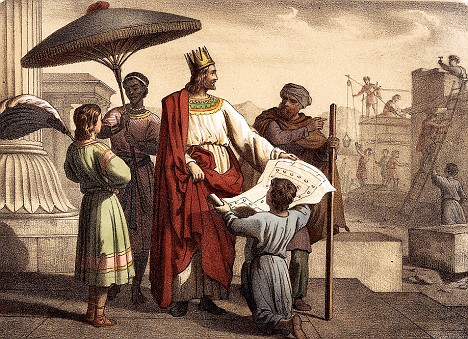
King Solomon supervises construction of his Temple

In addition to all of the above, we have this statement made by King Solomon as part of his dedication to the newly built Temple:

“Also concerning the foreigner who is not of Your people Israel, when he comes from a far country for Your name’s sake (for they will hear of Your great name and Your mighty hand, and of Your outstretched arm); when he comes and prays toward this house, hear in heaven Your dwelling place, and do according to all for which the foreigner calls to You, in order that all the peoples of the earth may know Your name, to fear You, as do Your people Israel, and that they may know that this house which I have built is called by Your name.”

I Kings 8:41-43

This doesn’t seem to be limited to the resident alien temporarily or even permanently dwelling among Israel, but includes any non-Jewish visitor who, for the sake of God’s great Name, comes to Jerusalem and prays toward (facing) the Temple.

Of all the commandments incumbent upon both the Jew and the Gentile believer, it seems that prayer is to be shared among all peoples.

But what about Shabbat or, for that matter, any of the other commandments?

I want to limit myself (mostly) to Isaiah 56 since it seems to be a sticking spot for many non-Jews who believe it acts as a “smoking gun” pointing toward the universal application of all of the Torah commandments to everyone, effectively obliterating everything God promised about Jewish distinctiveness.

Since non-Jews are so prominently mentioned in this chapter, I decided to see what (non-Messianic) Jews thought of this.

The easiest (though highly limited) way to do so was to look up this portion of scripture online at Chabad.org see read Rashi’s commentary on the matter.

Here’s verse 3:

Now let not the foreigner who joined the Lord, say, “The Lord will surely separate me from His people,” and let not the eunuch say, “Behold, I am a dry tree.”

rashi
Rashi

Here’s Rashi’s commentary on the verse:

“The Lord will surely separate me from His people,”: Why should I become converted? Will not the Holy One, blessed be He, separate me from His people when He pays their reward.

My best guess at the meaning of this statement is that the Gentile should not convert to Judaism since, when Hashem gives Israel its reward, won’t the convert be set apart from His people?

But I’m almost certainly reading that statement wrong. It makes no sense to me, since converts, according to the Torah, are to be considered as identical to the native-born. I don’t have an answer for this one.

The other relevant verses are 6 through 8, and here’s Rashi’s only commentary on them:

for all peoples: Not only for Israel, but also for the proselytes.

I will yet gather: of the heathens ([Mss. and K’li Paz:] of the nations) who will convert and join them.

together with his gathered ones: In addition to the gathered ones of Israel.

All the beasts of the field: All the proselytes of the heathens ([Mss. and K’li Paz:] All the nations) come and draw near to Me, and you shall devour all the beasts in the forest, the mighty of the heathens ([Mss. and K’li Paz:] the mighty of the nations) who hardened their heart and refrained from converting.

Referring to “foreigners” as proselytes or non-Jewish converts to Judaism is rather predictable and an easy way to avoid the thorny problem of Gentile observance of Shabbos or some other sort of association with Israel.

The last commentary seems to make some mention of “heathens,” possibly meaning that, in the end, Jews and non-Jews will turn to God, but ultimately, it seems, Rashi expects all non-Jews to convert to Judaism as their only means to become reconciled with Hashem.

My general knowledge of Jewish belief (and I suspect I’ll be corrected here) indicates that non-Jews will exist in Messianic days and those devoted to Hashem will be Noahides or God-fearers, just as we have those populations in synagogues today. They will have repented of their devotion to “foreign gods,” which from a more traditional Jewish perspective, will include (former) Christians.

interfaith prayerSo without further convincing proofs, I’m at an impasse. I can definitively state that part of a life of holiness for both a Jew and Gentile is prayer to the Most High God. Of course, that should be a no-brainer.

The Shabbat is a bit more up in the air. While I can’t see any real objection to a non-Jew observing a Shabbat in some manner, there doesn’t seem to be a clear-cut commandment. In Messianic Days, Shabbat may well be observed in a more universal manner, though the exact praxis between Jews and Gentiles likely won’t be identical.

As the discussion in How Will We Live in the Bilateral Messianic Kingdom indicated, while the vast majority of the Earth’s Jewish population may reside in the nation of Israel in Messianic Days, there may be some ambassadors assigned to each of the nations, and thus, there may be an application of the Shabbat in the nations for their sake and for the sake of Jews traveling abroad for business or leisure reasons.

I also can’t rule out a wider application of Shabbat observance for the Gentile in acknowledgement of God as the Creator of the Universe, which we see in Genesis 2:3:

Then God blessed the seventh day and sanctified it, because in it He rested from all His work which God had created and made.

That’s supposition on my part, but it’s not entirely out of the ballpark.

In any event, Isaiah 56 doesn’t give us as much detail about non-Jews in relation to the Torah as some folks might think. Pray? Yes. Pray toward the Temple in Jerusalem, even if you are outside Israel? Maybe. Couldn’t hurt.

ShabbatObserve the Shabbat? Maybe in some fashion. I think this part will become more clear once Messiah returns as King, establishes himself on his throne in Jerusalem, and then illuminates the world.

In terms of what I’ve written before, prayer should already be part of a simple life of holiness, so Isaiah 56 doesn’t add to this. Some form of Shabbat observance is allowable but may not be absolutely required for the Gentile in the present age. Isaiah 56 doesn’t make it clear that a Gentile “guarding”  or not “profaning” the Shabbat is also “observing” it, and even if we do observe, there’s still not an indication that such observance would be identical to current Jewish praxis.

Bottom line: when in doubt stick to the basics.

How Will We Live in the Bilateral Messianic Kingdom?

When I started writing this missive, I thought the answer had all to do with the Apostle Paul. By the time I finished, I realized I was dead wrong.

Let me explain.

This issue is compounded by two additional assumptions, based on the New Testament book of Romans – written by Paul whose authority is questionable because he never met Jesus.

-Rabbi Bentzion Kravitz
“Know How to Answer Christian Missionaries”
Aish.com

Articles like this make my heart ache because they are based on the assumption that everyone who has received and accepted the revelation that Rav Yeshua (Jesus) is the Messiah has an understanding of Jesus that’s exactly the same as Evangelical Christian theology and doctrine.

This is not consistent with many Messianic Jews I’ve met, either in person or over the web. In fact, most of those Jews have more in common with people like Rabbi Kravitz than they do with me.

But I’m not writing this to convince any Jewish person (or Gentile Noahide for that matter) of the validity of Yeshua’s identity and role, past, present, or future.

My current investigation has to do with a Gentile establishing and maintaining a relationship with Hashem outside traditional Christianity and Messianic Jewish community. For the former, this is the case because I’m definitely not a good fit for the Church, and for the latter, because I suspect any involvement on my part in either Christianity or the Messianic movement just drives my (non-Messianic) Jewish wife nuts.

Not that it’s her fault. That’s just the way it is. She’d probably get along famously with the above-quoted Rabbi Kravitz and eat up his responses to missionaries with a spoon.

So given my circumstances, and the circumstances of quite a number of “Judaicly aware” non-Jews who for many different reasons can’t or won’t join in a community, we turn back to the Bible and to God as our only resources.

I was trying to find a condensed list of the various directives that Paul issued to his non-Jewish disciples so I could “cut to the chase,” so to speak, but doing that search online is proving difficult. I keep encountering traditional interpretations of Paul as having done away with the Law and having replaced it with grace and so on.

I could turn to more “Messianic” or “Jewish” friendly commentaries, but many or most of them are quite scholarly and beyond my limited intellectual and educational abilities and experience.

I do point the reader to a source I’ve mentioned quite a bit of late, the Mark Nanos and Magnus Zetterholm volume Paul within Judaism: Restoring the First-Century Context to the Apostle. This is a collection of articles written by various researchers who are part of the “new perspective on Paul” movement, those who have chosen to reject the traditional interpretation of the apostle and who have taken a fresh look at his life and writings within the context of first century Judaism.

The Jewish PaulYou get a really different opinion of Paul when you take off your Christian blinders (sorry if that sounds a tad harsh).

I did look up Paul at beliefnet.com and they do seem to state that Paul was Jewish, but unfortunately, they take a more or less traditional point of view on what the apostle taught.

They did say that of all the epistles we have recorded in the Apostolic Scriptures, scholars are sure he was actually the author of:

  • 1 Thessalonians
  • Galatians
  • 1 & 2 Corinthians
  • Philippians
  • Philemon
  • Romans

Even limiting my investigation to those letters, I’m still faced with a lot of challenges. Romans alone is worth a book, actually many books, and is so complex I doubt I’d ever do more than scratch the surface of its meaning.

But maybe I don’t have to start from scratch. After all, in the several years I’m maintained this blogspot, I’ve written many times on Paul. Maybe I don’t have to reinvent the wheel. Perhaps all I have to do is read what I’ve already written.

Searching “Paul” on my own blog renders 33 pages of search results but I need to narrow it down more to what Rav Shaul specifically said about the Gentiles.

Actually, only the first two pages contain blog posts specifically with “Paul” in the title. It gets a little more generalized after that.

The added problem is typically, any time I wrote about Paul and the Gentile, it was usually in relation to or contrasting the role of Messianic Jew and Judaicly aware Gentile. I produced very little, if anything, about Gentiles as Gentiles. After all, I’ve been a champion (minor league, of course) of the cause of Messianic Jews to be considered Jewish and operating within a Judaism, just the same as other observant Jews in various other religious Jewish streams.

Only of late have I found it necessary to advocate for the Gentiles, and more specifically, me. Only recently have I realized that while it’s a good thing to emphasize Judaism for the Messianic Jew, it has some serious drawbacks for the so-called “Messianic Gentile,” not the least of which is resulting in some non-Jewish believers losing their identity because they’re surrounded by all things Jewish, including siddurim, kippot, Torah services, and tallit gadolim.

While I still believe that a significant role of the Judaicly aware Gentile as well as the more “standard” Christian is in support of Israel and the Jewish people, just as Paul required of his Gentile disciples in ancient times, I also believe there has to be something more for us to hang onto.

Or to borrow and adapt a hashtag from recent social media outbursts, #GentileLivesMatter (by the way, using Google image search to look up “goy” or “goyishe” returns some pretty anti-Semitic graphics).

multiculturalI did find a blog post I wrote in January 2014 called The Consequences of Gentile Identity in Messiah, but I’m not sure how useful it is in my current quest, in part because I wrote:

I wrote a number of detailed reviews of the Nanos book The Mystery of Romans including this one that described a sort of mutual dependency Paul characterized between the believing Gentiles and believing and non-believing Jews in Rome.

You can go to the original blog post to click on the links I embedded into that paragraph, but if part of who we non-Jews are is mutually dependent on Jews in Messiah, that leaves me pretty much up the creek without a paddle.

Of course, that’s citing Nanos and his classic commentary The Mystery of Romans, which describes a rather particular and even unique social context, so there may be more than one way to be a Judaicly aware Gentile and relate to God.

The problem then is how to take all this “Judaic awareness” and manage to pull a Gentile identity out of it that doesn’t depend on (Messianic) Jewish community. Actually, I would think this would be as much a priority for Messianic Jews as it is for me, especially when, as I’ve said in the past, in order for Messianic Jewish community to survive let alone thrive, Messianic Jewish community must be by and for Jews.

To put it another way quoting Rabbi Kravitz’s lengthy article:

The growth of Christian support for Israel has created an illusion that we have nothing to worry about because “they are our best friends.”

It would be a mistake to think the risk has been minimized, especially to Jewish students and young adults, just because missionaries are less visible on street corners and offer much appreciated Christian support for Israel.

Granted, R. Kravitz must paint the Church in the role of adversary if he believes that Christians are dedicated to missionizing young Jews so that they’ll abandon Jewish identity and convert to Goyishe Christianity, but we non-Jews in Messianic Jewish community are also sometimes cast as a danger in said-community because our very presence requires some “watering down” of Jewish praxis and Jewish interaction.

I suspect the same was true in Paul’s day and ultimately, it was this dissonance that resulted in a rather ugly divorce between ancient Jewish and Gentile disciples of Messiah.

Gentiles resolved the conflict by inventing a new religion: Christianity, and they kicked the Jews out of their own party, so to speak, by refactoring everything Jesus and Paul wrote as anti-Torah, anti-Temple, and anti-Judaism.

That does me no good because I don’t believe all that stuff, that is, I’m not an Evangelical Christian. I need an identity that allows for my current perspective, my pro-centrality of Israel and Torah for the Jews perspective, my King Messiah is the King of Israel and will reign over all the nations from Jerusalem in Messianic Days perspective, and still lets me be me, or the “me” I will be in those days, Hashem be willing.

Think about it.

All Jewish people will live in Israel. It will once again be a totally Jewish nation. As far as I can tell, people from the nations will be able to visit as tourists, but by and large, besides a rare exception or two, we will live in our own countries, which in my case is the United States of America…a United States devoid of Jews, synagogues, tallit gadolim, and all that, because they will only exist among the Jews in Israel.

MessiahI don’t know the answer to this one, but I think this is the central question I’m approaching. How will we Gentiles live in our own nations half a world away from Israel and King Yeshua? What will our relationship be to God?

The answer to how we’ll live in the future is the answer to my current puzzle.

As I ponder what I just wrote, I realize that even searching out Paul’s perspective on the Gentiles is a mistake. He was trying to find a way for Jews and Gentiles to co-exist in Jewish community. He never succeeded as far as I can tell. No one has succeeded since then, including in the modern Messianic Jewish movement.

But in the Messianic future, as such, Jews and Gentiles really won’t be co-existing in Jewish communal space. Jewish communal space will be the nation, the physical nation of Israel. We goys will be living every place else except in Israel. Maybe the Kingdom of Heaven will be more “bilateral” than I previously imagined.

Or have I answered my own question?

The Apostle Paul: Interpreter of the Gospel of Jesus Christ to the Gentiles

How does a Christian know what Jesus wants of us? From a traditional Church perspective, the answer is easy. Read the New Testament, that is the Apostolic Scriptures.

So primarily, Christians study the words of Jesus as recorded by four Jewish guys (I’m being way overly simplistic here regarding the source materials of the Gospels) Matthew, Mark, Luke, and John, the “Acts of the Apostles,” which is mainly about the life of the Jewish Apostle to the Gentiles, Paul, as recorded by the aforementioned, Luke, and a whole bunch of letters generally attributed to the aforementioned Paul.

But arguably, Jesus taught almost exclusively or exclusively to Jewish audiences. The Gospel of Matthew is definitely written to Jews, while Luke’s Gospel may well have been intended for a wider audience. According to some sources, Acts may have been composed as part of Paul’s legal defense when he appeared before Caesar in Rome (as possibly was Luke’s Gospel), and we have to assume that most or all of Paul’s letters were addressing his Gentile students, although he may have had messages for particular Jewish people or communities as well.

MessiahHere’s one startling thought that occurred to me. For the most part, we can’t really depend on the actual, quoted words of Jesus or Rav Yeshua as a guide to worship and devotion for the non-Jewish disciple.

Why not?

Remember, I said that Jesus primarily or exclusively taught Jews about the true interpretation of Torah and performance of the mitzvot. He was a Jewish teacher teaching Jewish students about the Jewish mitzvot. What does that have to do with non-Jews?

In yesterday’s blog post about the Roman Centurion Cornelius, I mentioned that Marc Turnage in his presentation defined circumcision as the dividing line as to whether or not a person is Jewish, and thus, whether or not a person is obligated to the Torah mitzvot.

Of course, it’s not just circumcision, but a bris (brit milah) performed on a male, either on the eighth day of life for a boy born to Jewish parents, or as part of the proselyte rite undergone by a male Gentile converting to Judaism.

So if Jesus is a Jew teaching Torah to Jews and is not presupposing Gentiles reading his recorded words (let alone trying to act them out), we can’t always rely upon a red-letter edition of the Bible to be the Gentile Christian’s sole guide to a life of holiness.

So what can we do?

What did the vast majority of non-Jews in the diaspora do when they heard the good news of Rav Yeshua? For that matter, who did they hear those words from?

As far as the Apostolic Scriptures are concerned, most of the time, they interacted with the man who Yeshua specifically appointed (in Acts 9) to be the special emissary to the Gentiles, the man known as Saul of Tarsus but who most Christians call the Apostle Paul.

The Jewish PaulPaul had the responsibility of interpreting Jewish teaching so it would apply to non-Jewish lives. That’s no easy task. Well, it might not have been too much of a chore if his audience were Gentile God-fearers who had already spent a lot of time in the synagogue hearing Jewish teachings (see Acts 13:13-43 for example). But he may have fought quite an uphill battle when addressing pagan Gentiles who only knew their own mythology (such as in Acts 14:8-18).

So get this. Paul didn’t teach the Gospel message to the Gentiles in exactly the same way as Jesus taught it to the Jews (which may be why Paul called it “my Gospel” in Romans 2:16, 16:25-27 and in other epistles). Why? Because the Jewish message had to be interpreted and adapted by Paul so it would not only make sense to non-Jewish audiences, but fit their particular legal status in Jewish community. This is really important, since Jews are named subjects of the New Covenant (Jeremiah 31; Ezekiel 36) and Gentiles are not!

From that, we have to understand that the “admission” process must be different for Jews than Gentile initiates. Jews are born into the covenants, all of them, whether they want to be or not. Gentiles are born into no covenant with God at all except perhaps the Noahide covenant (Genesis 9). Our entry, so to speak, must be via a different process with different criteria involved.

I often wonder if this is why more traditional Jewish people don’t mind what Jesus taught so much, but most of them absolutely loathe Paul. Paul, when interpreted through traditional Christian and Jewish lenses, seems not to be teaching Judaism at all, but rather, creating a new religion. For modern observant Jews, this makes Paul a traitor to the Jewish people, and an advocate to the elimination of Judaism (and Jews, even in Paul’s day, also believed this of him — see Acts 21 starting at verse 15).

Ironically, many Christians believe the same thing, that Paul threw Judaism under a bus and replaced it with Christianity, but in this case, that’s considered part of God’s plan and not the ultimate insult to God and the Jewish people (more’s the pity).

bibleNo, I’m not saying that we non-Jews shouldn’t read the Gospels. We really need to get to know our Rav and what he taught. However, we cannot always assume we can apply each and every lesson he taught to Jews about the Torah to ourselves as non-Jews without some interpretation, anymore than we can assume to apply what and how Moses taught the Torah to the Children of Israel to the Church today.

That’s why it is so important to understand Paul correctly, such as they way he is rendered in the Nanos and Zetterholm volume Paul within Judaism: Restoring the First-Century Context to the Apostle.

Although the Apostolic Scriptures record that it was sometimes difficult to teach the Jewish people about the good news of Rav Yeshua, it would have been extremely difficult to get that across to Gentile pagans who lacked a Jewish educational and lived context. That’s why the Apostle to the Gentiles had to be highly educated, multi-lingual and multi-cultural, both a Jew and a Roman citizen. He had to be thoroughly Jewish and yet be able to “talk the talk,” as such, of non-Jewish peoples who lived in a wide variety of religious, cultural, and social venues.

That’s why the job was so hard and required such a unique individual.

But this is (in my opinion) why we modern non-Jewish disciples of the Rav, cannot simply imitate modern Jewish worship practices and performance of the mitzvot and say we understand the teachings of Yeshua and how to respond to them. That’s as erroneous as modern Christians in their churches today saying that Jesus did away with the Law for the Jew and that everyone, including born Jews, must abandon Judaism, Torah, and Talmud and become goyishe Christians in order to be reconciled with God.

WaitingSo how did Paul interpret Jesus for the Gentile? We may never have a solid answer, but I’m convinced that we’ll never get anywhere near that answer unless we’re willing to ask the question.

Ultimately, it may not be as complex as most folks who are “Judaicly aware” imagine. In fact, it might not be that different from what most traditional Christians do now, apart from a specific attitude toward the centrality of Israel (rather than the Church) in God’s plan of redemption.

Please keep in mind that everything I’ve just written I pretty much composed off the cuff. It’s not the result of an exhaustive review of the Bible and associated scholarly literature. If anything, it’s the result of my imagination and a number of years of reading, writing, listening, and learning. I still think the message has merit.